
A complete issue · 20 pages · 1905
Judge — April 22, 1905
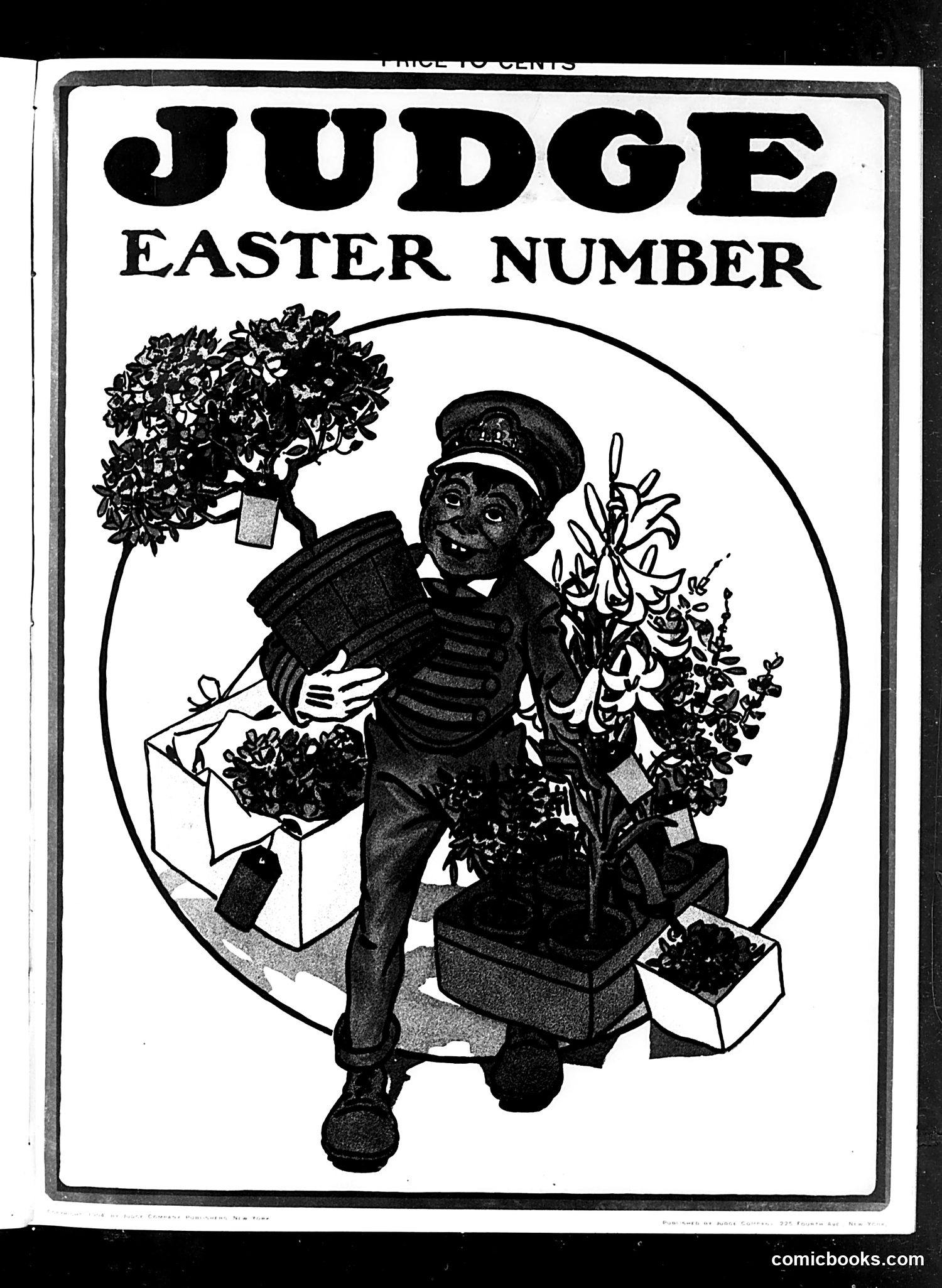
This is a Judge magazine Easter cover featuring a caricatured figure in a bellhop or porter's uniform carrying multiple potted flowering plants and packages. The figure's exaggerated facial features reflect the deeply racist visual conventions of early 20th-century American print media. The Easter theme connects to the traditional spring holiday association with flowers and gifts. The bellhop character likely satirizes service workers or delivery personnel of the era, though without additional context text, the specific political or social target remains unclear. The "Price 15 Cents" notation dates this publication, but the precise issue and intended satirical message would require supplementary historical documentation to accurately determine.
This page is primarily an **advertisement, not a cartoon or satire**. It promotes "Sylvan Violet Toilet Soap" by Armour & Company, a major American meat-packing firm that diversified into consumer goods. The ad emphasizes the soap's violet fragrance as a luxury item—"The Soap with a Sentiment"—marketed as a refined toilet requisite. The decorative art nouveau flourish with violets at the bottom is purely ornamental branding. There is no political or social satire present. The product was available in multiple scent varieties (Rose, Carnation, Lilac, etc.) at drugstores for three cakes at 25 cents. The company had offices in Chicago, New York, Paris, and London, indicating its international commercial reach during the early 20th century.
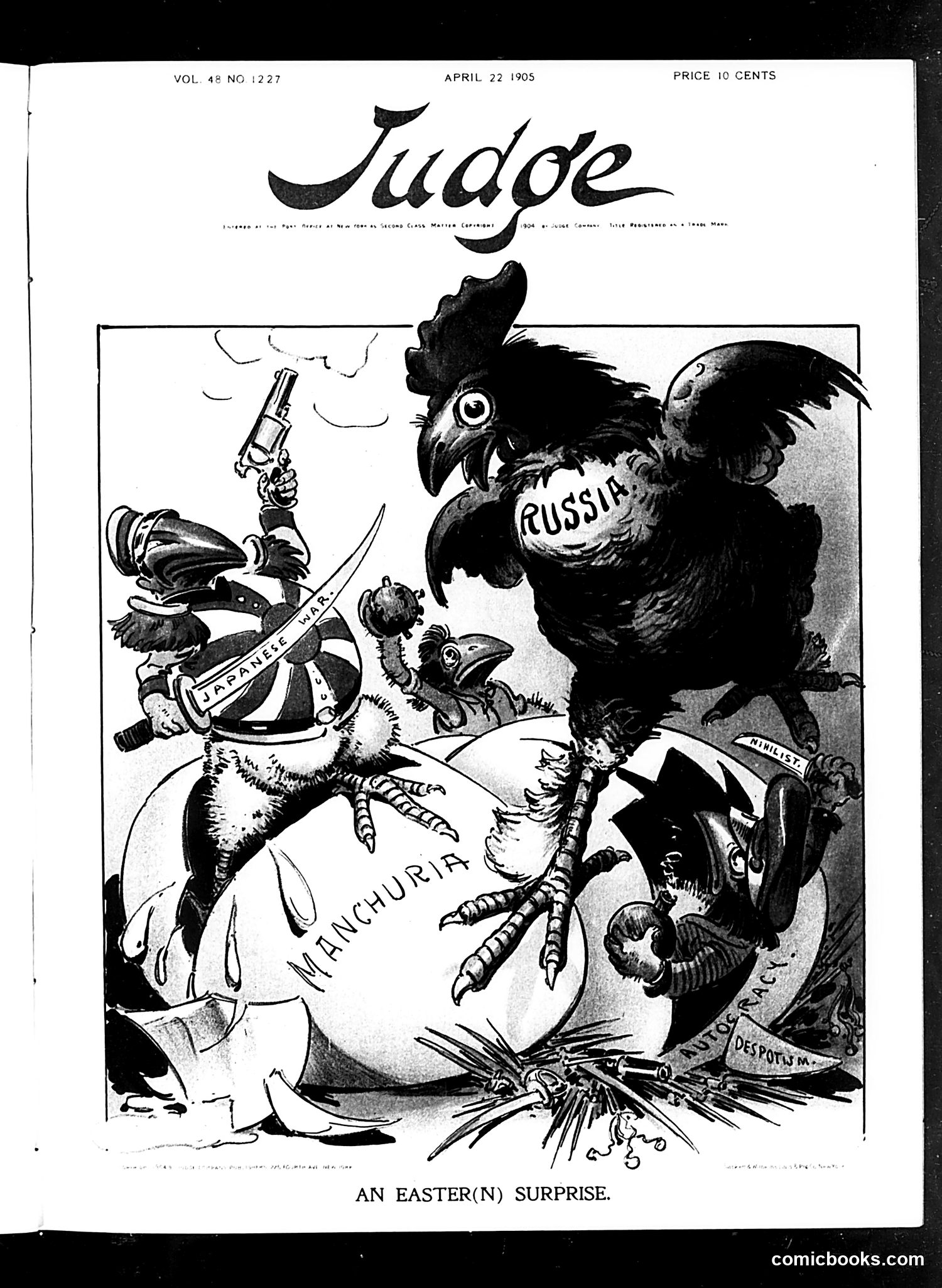
This political cartoon satirizes the Russo-Japanese War (1904-1905). The central egg labeled "Manchuria" is being hatched by aggressive birds representing Russia and Japan, with Russia depicted as a large, armed rooster. The smaller figures represent other powers—likely including Britain, France, and Germany—observing or participating in the territorial dispute. The "Eastern Surprise" pun references both Easter (the egg imagery) and Eastern geopolitical tensions. The cartoon warns that Russia and Japan's conflict over Manchuria threatens to destabilize international relations and draw other nations into confrontation. The weapons and aggressive postures emphasize the military danger, while onlooking nations suggest broader implications for global power dynamics during this crucial period of imperial competition in East Asia.
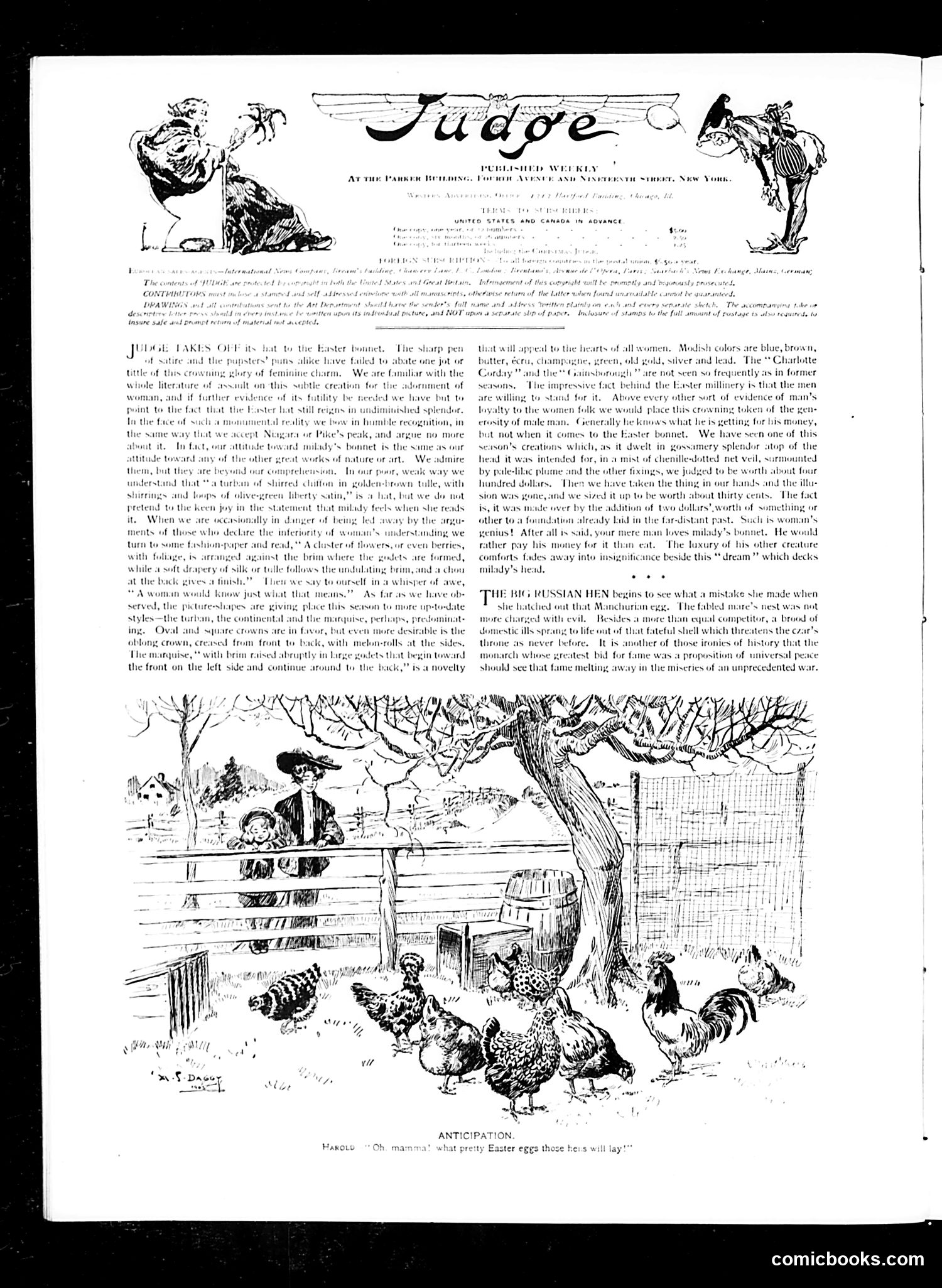
This illustration depicts a farmyard scene where hens gather around a large tree, with a farmer and boy observing from a fence. The caption reads: "Oh mamma! what pretty Easter eggs those hens will lay!" The satire targets naive optimism about Easter egg production. The joke plays on the child's innocent misconception that hens will spontaneously produce decorative Easter eggs, when in reality farmers must dye or prepare them artificially. The cartoon likely mocks broader American consumer culture and commercialization of Easter—the expectation that abundance and luxury goods will simply materialize without effort. The farm setting emphasizes rural simplicity contrasted with urban, commercialized holiday expectations. The humor relies on visual irony: the child's hopeful anticipation versus the actual mundane reality of farm life.
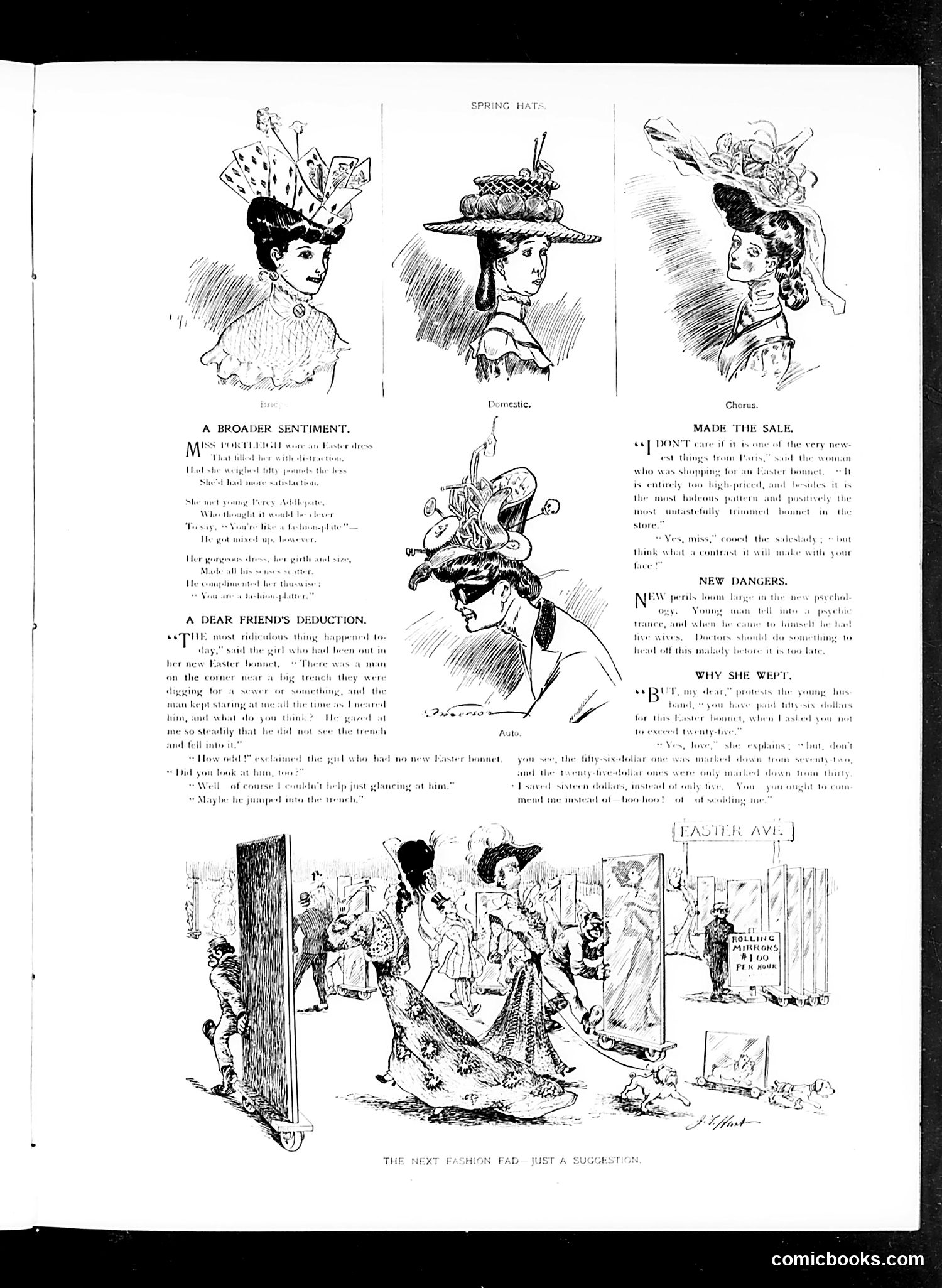
This page from *Judge* satirizes early 1900s women's Easter fashion, particularly elaborate hat trends. The top section shows three increasingly absurd spring hat designs labeled "Domestic" and "Chorus," mocking how extravagant women's millinery had become. The accompanying verses—"A Broader Sentiment," "A Dear Friend's Deduction," and "Made the Sale"—humorously critique women's shopping habits and hat prices. One poem jokes that a woman bought an outrageously expensive bonnet from Paris, prompting her husband's dismay at the cost. The bottom cartoon, "The Next Fashion Fad Just a Suggestion," appears to satirize how quickly women adopt ridiculous fashion trends, depicting a chaotic Easter scene where women's enormous hats have become so impractical they're causing literal collisions and disorder in public spaces. The overall message: satirizing both excessive female consumerism and the absurdity of contemporary women's fashion trends, particularly the iconic oversized hats that dominated the Edwardian era.
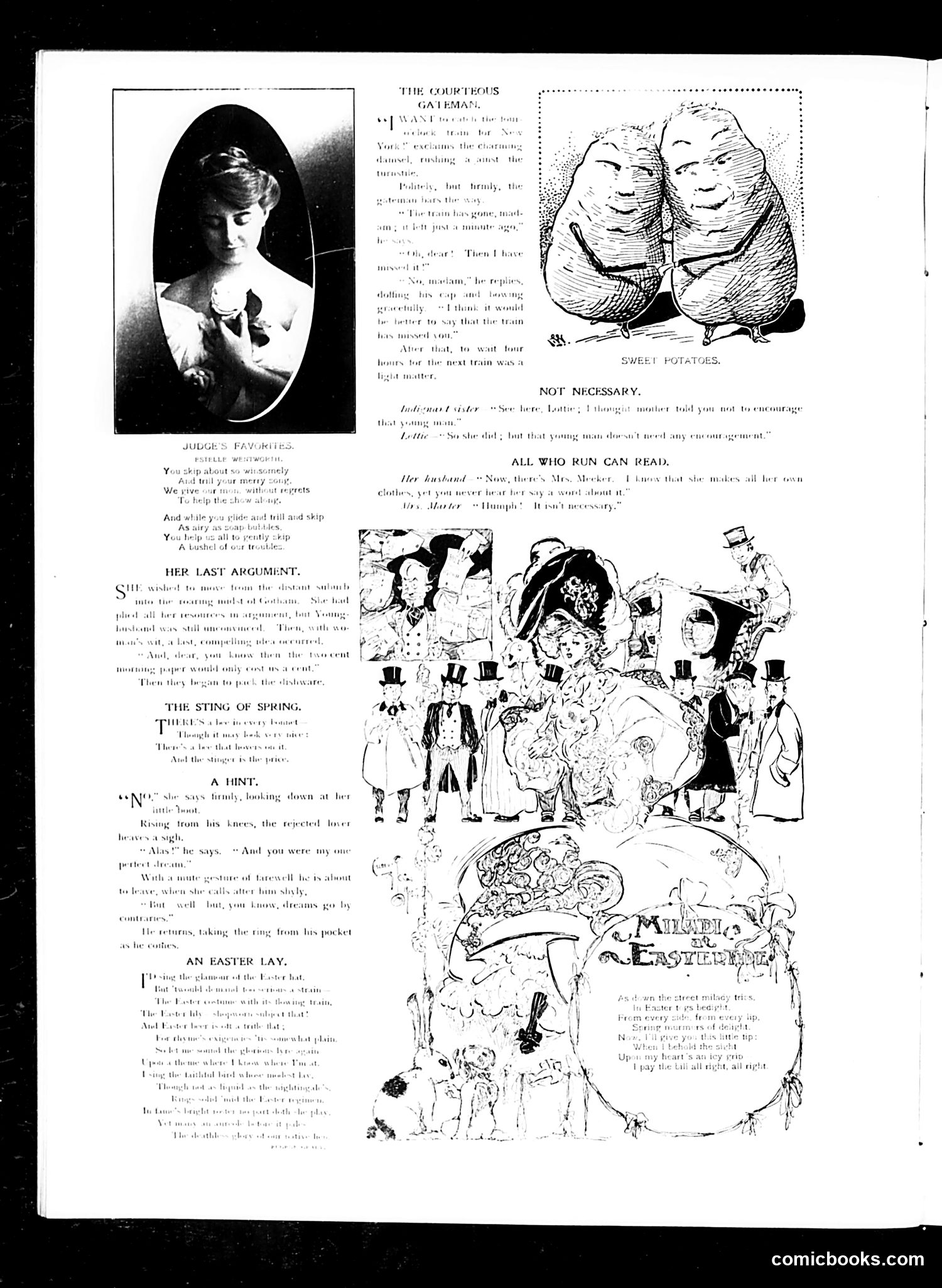
This page contains several satirical short comic pieces typical of early 20th-century American humor magazines: **"Sweet Potatoes"** mocks romantic couples through caricatured figures resembling tubers—likely satirizing sentimental love stories. **"All Who Run Can Read"** jokes about a wife's domestic economy: a husband brags his wife makes all her clothes but "never hear[s] her say a word about it," suggesting wives' unpaid labor went unappreciated or unacknowledged. **"The Sting of Spring"** and **"A Hint"** appear to be brief romantic comedies playing on spring courtship themes and relationship misunderstandings. **"An Easter Lay"** (bottom) is a poem with Easter imagery. The page reflects turn-of-the-century attitudes toward gender roles, courtship, and domestic life through humor that modern readers would recognize as reflecting limited female autonomy and domestic expectations. The large illustration shows period dress and social scenes, though specific political figures aren't clearly identifiable from this reproduction.
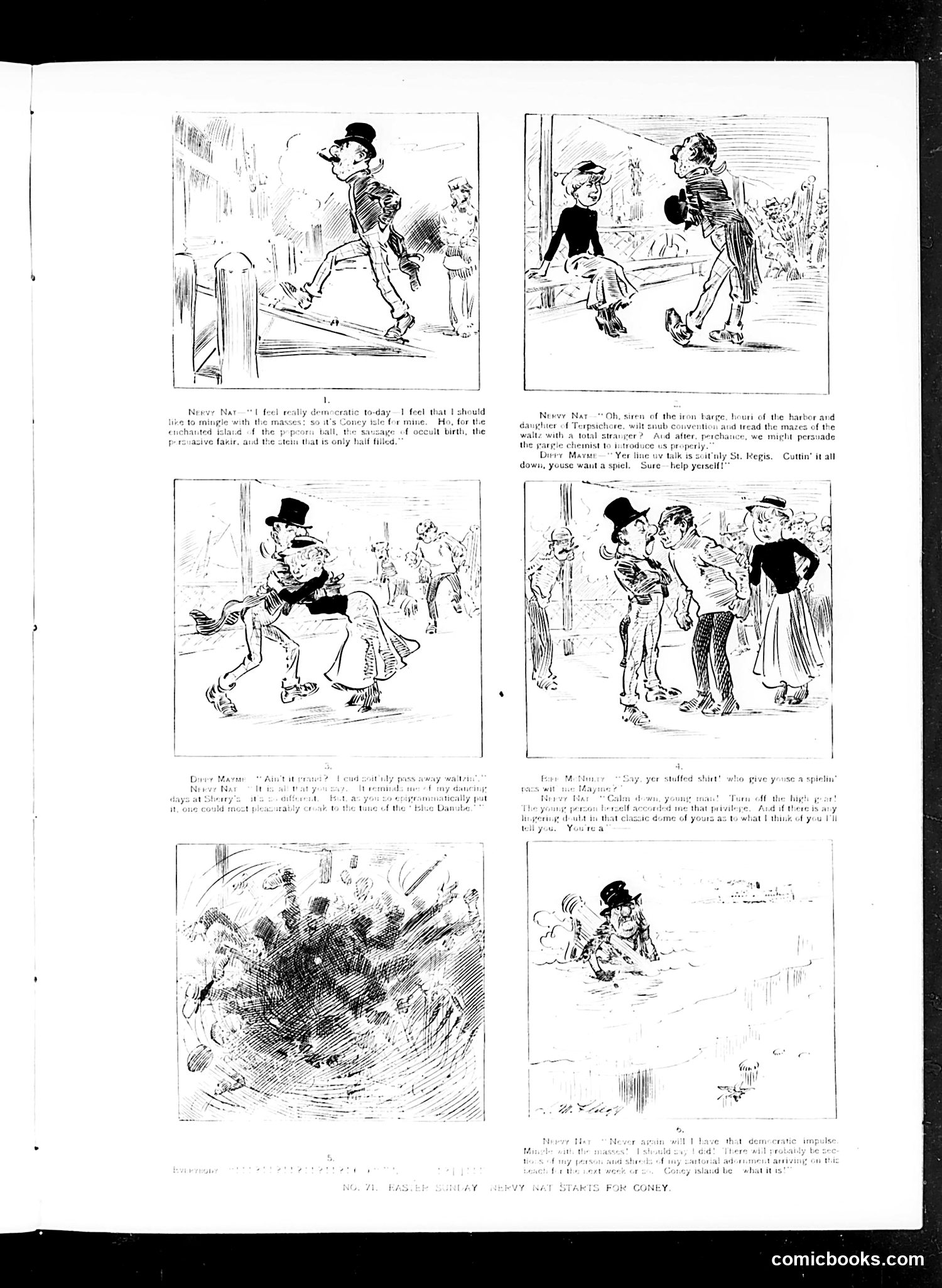
This appears to be a multi-panel comic strip satirizing upper-class social etiquette and romantic courtship among the wealthy. The narrative follows characters named "Never Nag," "Dotty Mama," and others navigating street encounters and social situations. The humor centers on class-conscious behavior: concerns about "the barber and daphne's Hypochondriac" social standing, references to "helping oneself" and proper deportment. The final panel shows what appears to be a chaotic street scene, suggesting the social pretensions collapse into disorder. The satire mocks Victorian-era anxieties about maintaining respectable appearances and the arbitrary rules governing acceptable public behavior among the privileged classes. Without clearer dates or specific references visible, the exact satirical targets remain somewhat unclear, though the general critique of snobbishness is evident.
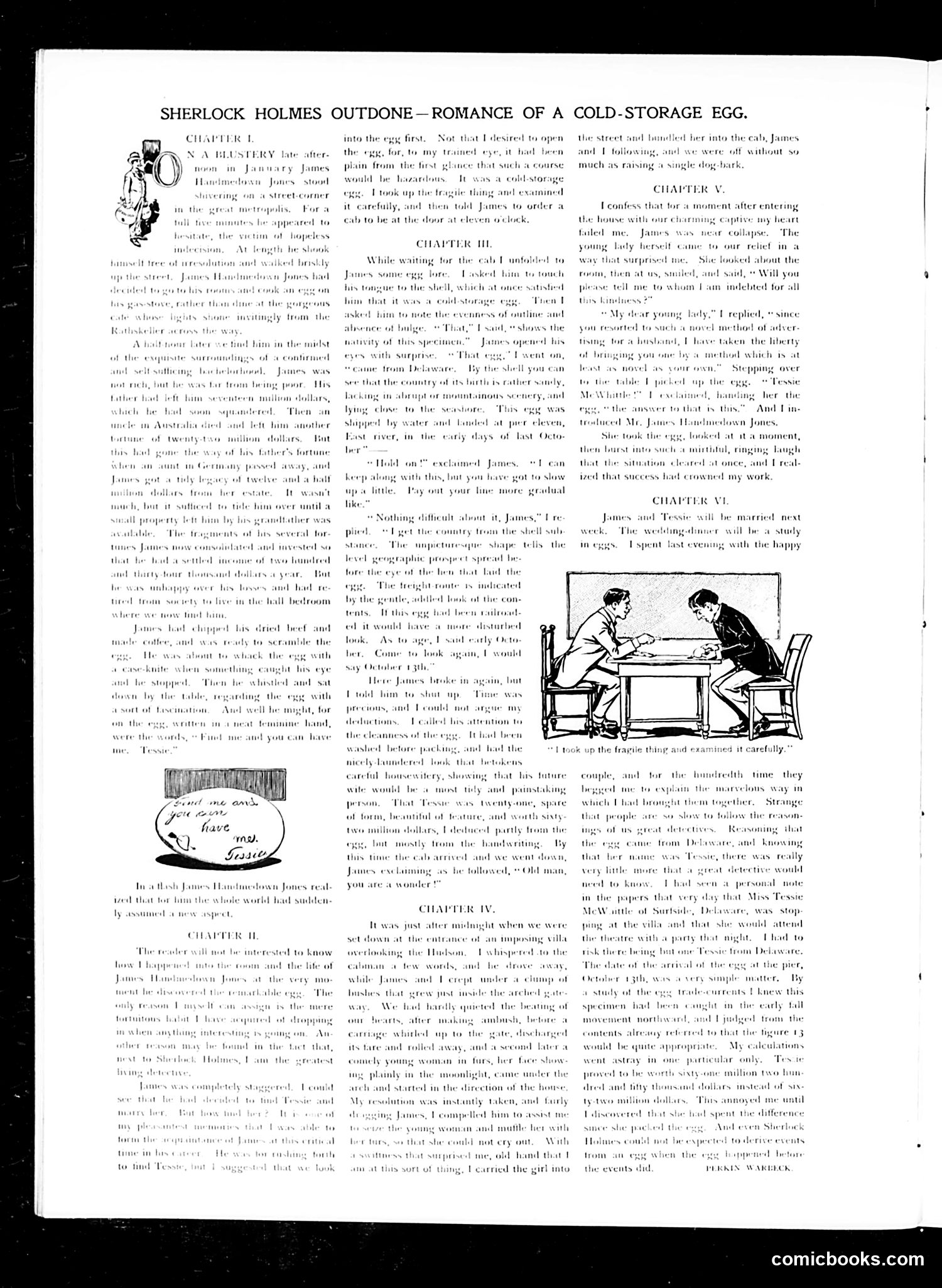
This is a humorous Sherlock Holmes parody where a detective solves mysteries using deductive reasoning applied to absurd situations. The story involves James, a wealthy man who inherits millions, finding a mysterious egg with a message asking him to "find me" for a reward. The satire mocks Holmes's famous deductive method. The detective examines the egg's shell and confidently deduces elaborate details—the hen's origin, the shipping route from Delaware, even the owner's (Tessie's) wealth and character from her handwriting on the egg. The humor lies in applying hyper-rational deduction to completely mundane domestic objects, treating an ordinary egg as a crime-scene clue. This pokes fun at the wildly popular Holmes stories circulating in magazines like *Judge* during this era, exaggerating his detective methods to absurdist extremes. The reader is meant to laugh at how ridiculous such logical leaps become when applied to everyday life rather than actual mysteries.
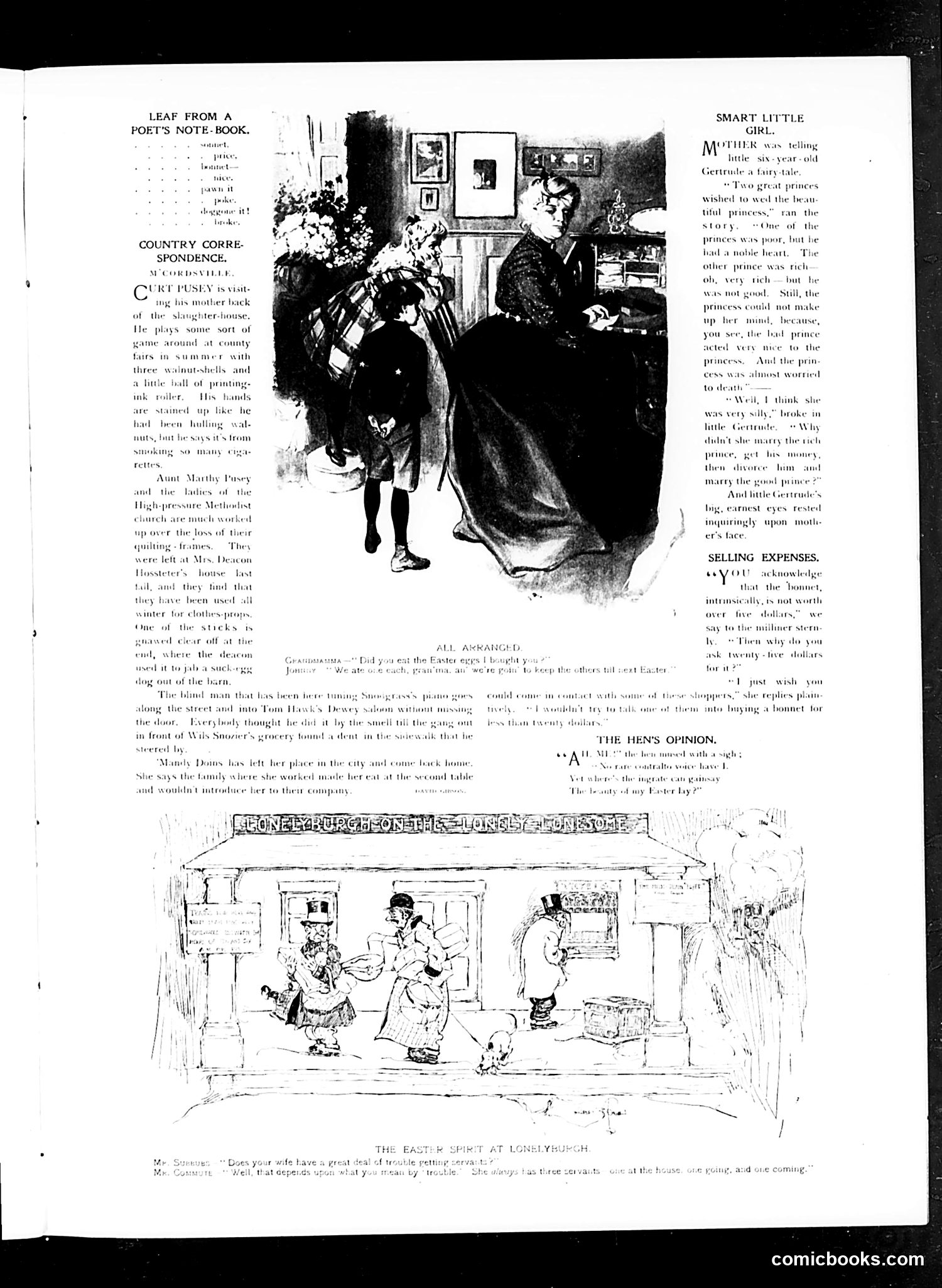
This page contains three distinct humorous pieces satirizing rural American life and consumer culture: **"Country Correspondence"** mocks small-town gossip and provincial life, depicting Curt Pusey's visit home with exaggerated details about shell-game hustling, damaged quilting frames, and domestic drama—poking fun at rural simplicity. **"Smart Little Girl"** is a gentle joke about children's logic. Six-year-old Gertrude hears a fairy tale about a princess choosing between a poor noble prince and a rich unkind one, then pragmatically asks why the princess didn't simply marry the good prince for his money—exposing the absurdity of romantic ideals versus material realities. **"Selling Expenses"** satirizes millinery shop deception: a milliner admits a bonnet costs only five dollars but charges twenty-five, justifying the markup as keeping "the others till next Easter"—a joke about artificial scarcity and retail manipulation. **"The Hen's Opinion"** appears to be a brief animal-perspective joke (text unclear). The satirical targets are rural pretension, consumer dishonesty, and the gap between romantic fantasy and practical thinking.
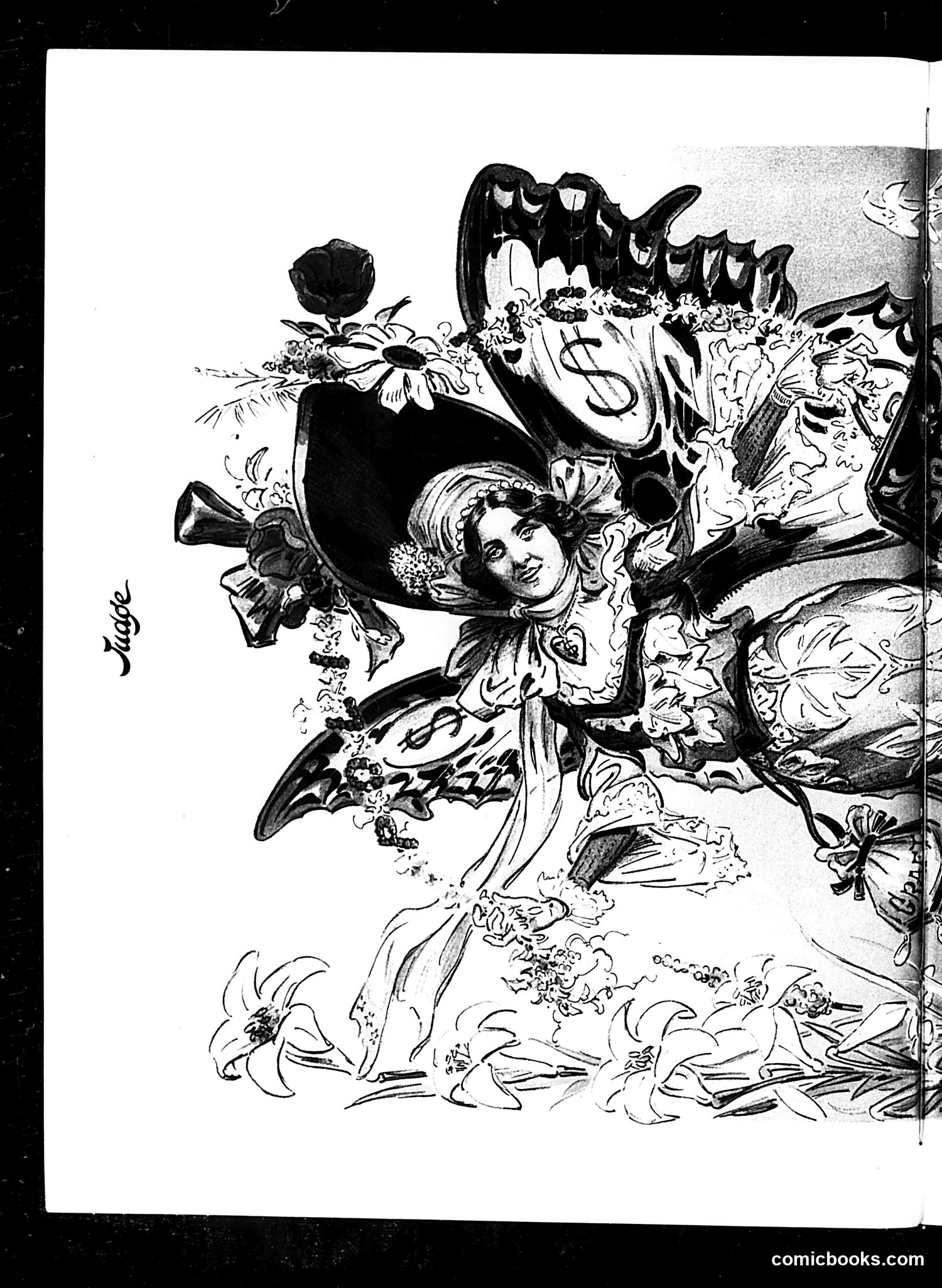
This appears to be a decorative illustration rather than a political cartoon. It depicts an elegantly dressed woman in elaborate Victorian-era clothing, surrounded by flowers, butterflies, and ornamental designs. The woman wears a large feathered hat and flowing garments decorated with dollar signs ($). The satire likely comments on **consumer excess and materialism** among wealthy women of the period—the prominent dollar signs suggest critiques of lavish spending, fashion consumption, or commercialism. The flowers and butterflies add ornamental beauty while emphasizing the frivolous, decorative nature of such extravagance. Without additional context or a visible artist signature legible in the image, specific attribution remains unclear. The style and subject matter are consistent with late 19th or early 20th-century satirical commentary on class and consumption.
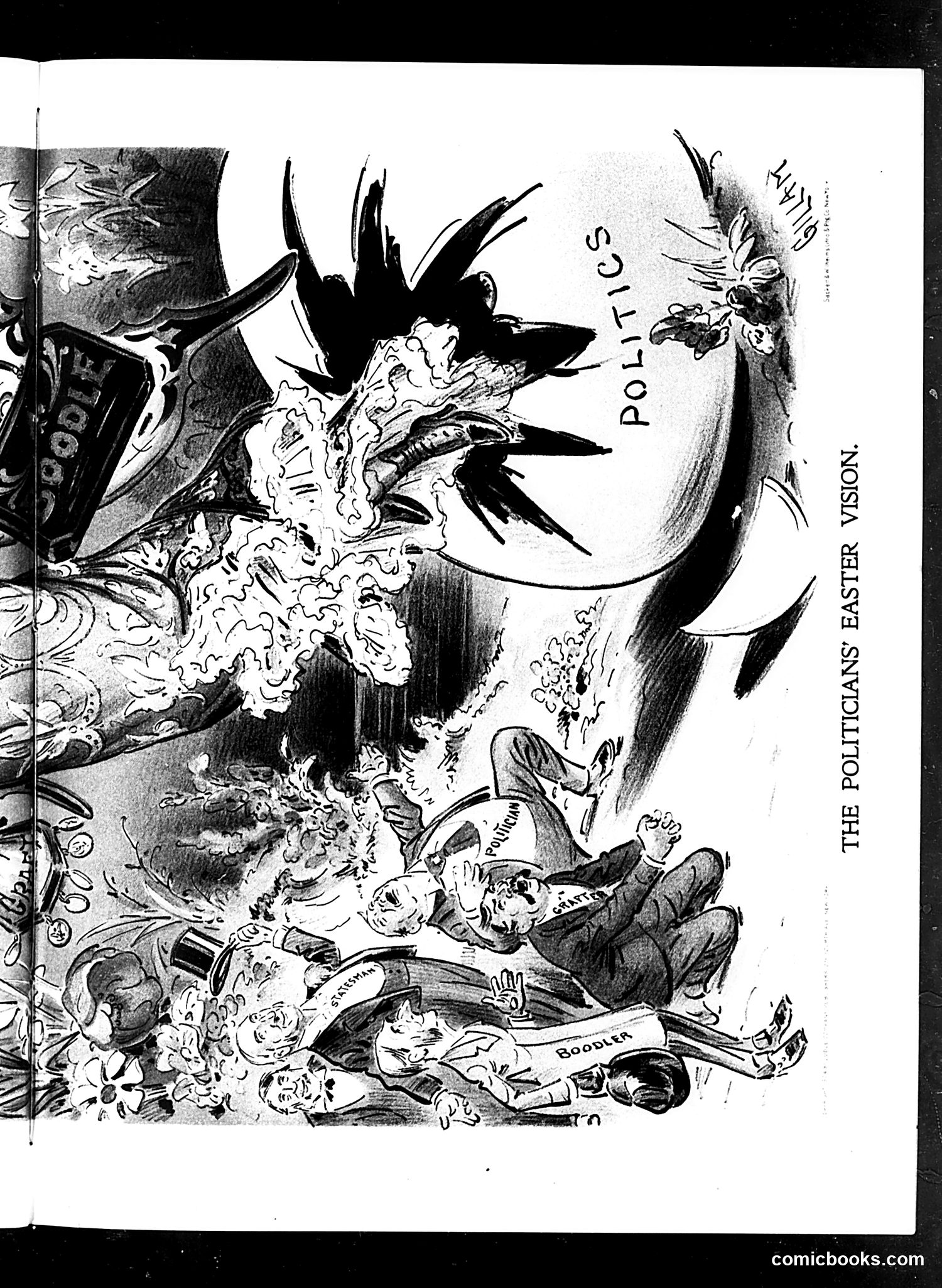
This is a political cartoon from *Judge* magazine satirizing politicians as parasitic creatures. The image shows grotesque, spike-headed figures emerging from or infesting what appears to be a Easter egg or oval shape labeled "POLITICS." At the bottom, small human figures (likely representing the public or voters) are shown overwhelmed or trampled beneath this chaos. One figure appears labeled "Booster," suggesting reference to political boosters or campaign supporters. The satire suggests that politicians are portrayed as monstrous parasites that corrupt and damage the political system, preying on ordinary citizens. The Easter imagery implies renewal or rebirth—possibly suggesting this cycle repeats annually. The overall message critiques the predatory nature of political figures and their exploitation of the public.
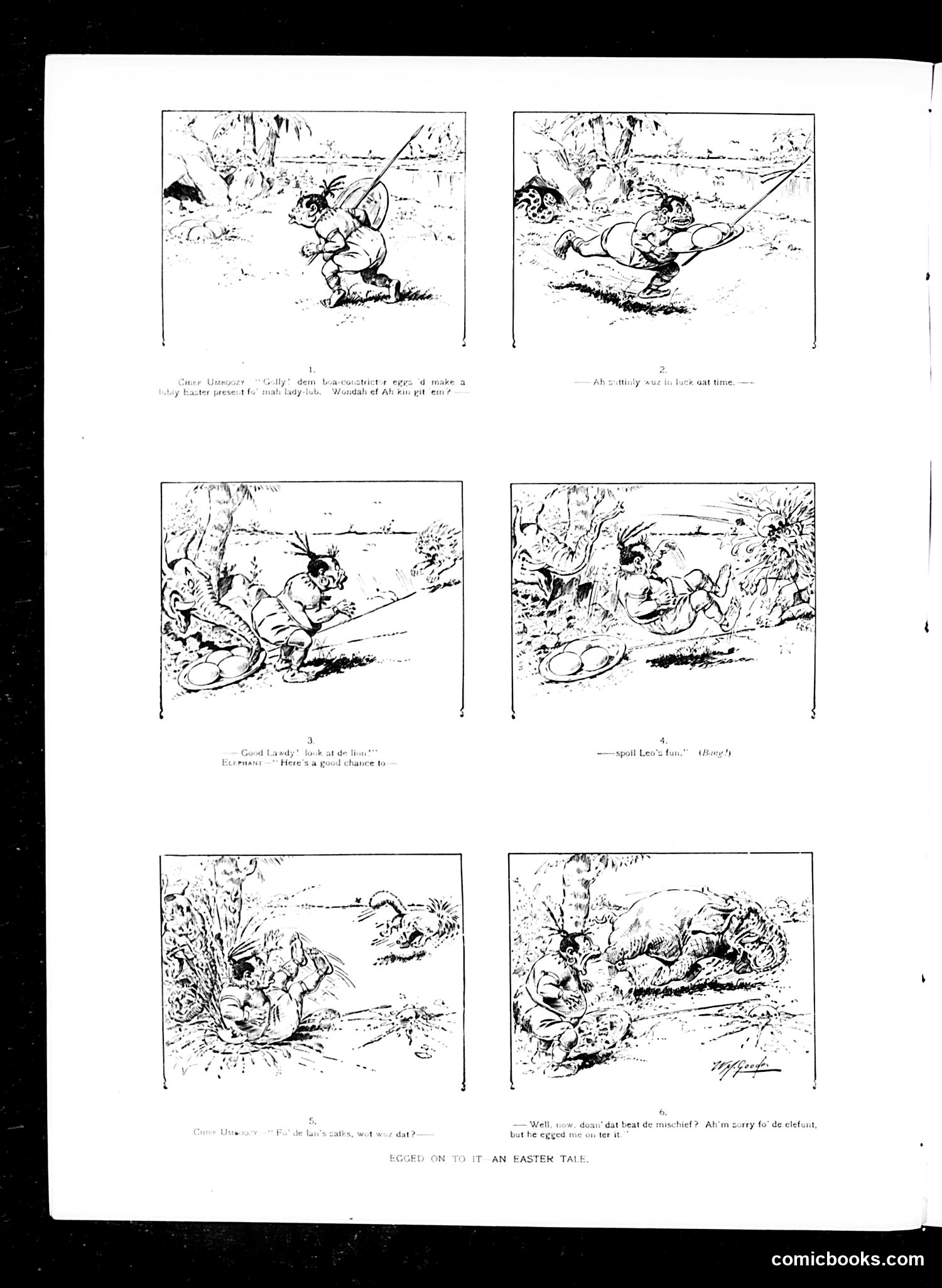
This is a six-panel comic strip titled "An Easter Tale" depicting slapstick humor involving what appears to be a child and an elephant. The panels show escalating chaos—the child attempts to fish or play near water, the elephant intervenes, and mayhem ensues with both characters getting increasingly muddy and disheveled. The final caption reads: "Well, now didn't dat beat de mischief? Ah'm sorry fo' de elefunt, but he egged me on to it"—using dialect speech typical of early 20th-century American humor. The satire appears to target the chaotic nature of Easter activities rather than political figures. It's simply a visual joke about innocent play gone wrong, relying on the slapstick comedy and exaggerated consequences popular in Judge magazine's humor sections.
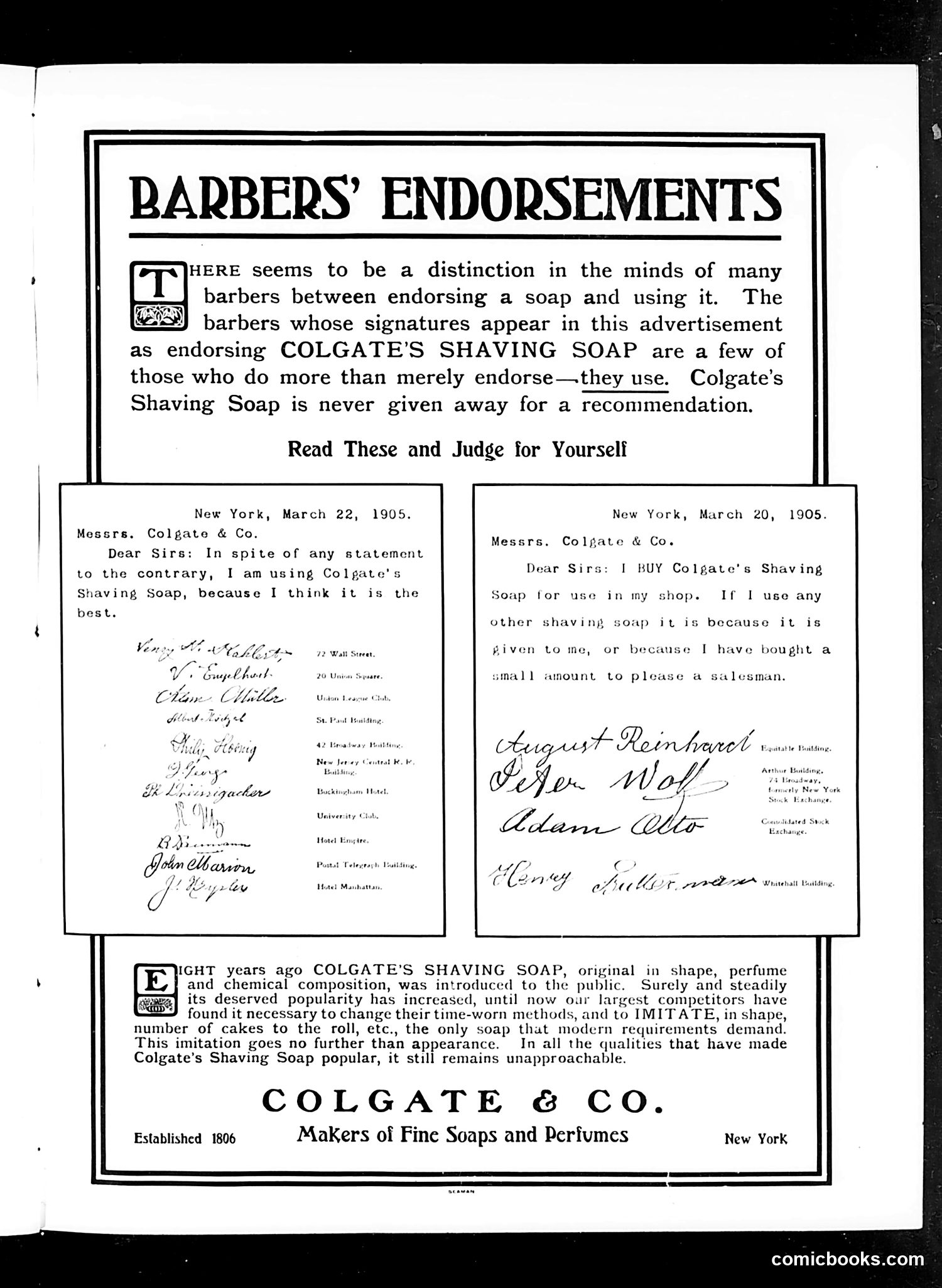
This is not satire but a straightforward **advertisement for Colgate's Shaving Soap**, appearing in *Judge* magazine. The page features testimonial letters from New York barbers (dated March 1905) endorsing the product. The advertisement's key argument: these barbers don't merely lend their names for payment—they actually *use* Colgate's soap in their shops, distinguishing genuine endorsement from hired testimonials (a common advertising practice even then). The text claims Colgate's original formulation (introduced eight years prior) has become so successful that competitors are now imitating its shape and packaging, though the ad asserts the imitations lack the original's superior quality. The page demonstrates early-20th-century marketing strategy: leveraging professional credibility through testimonials while implicitly acknowledging that paid endorsements were a recognized (and apparently suspect) practice in contemporary advertising.
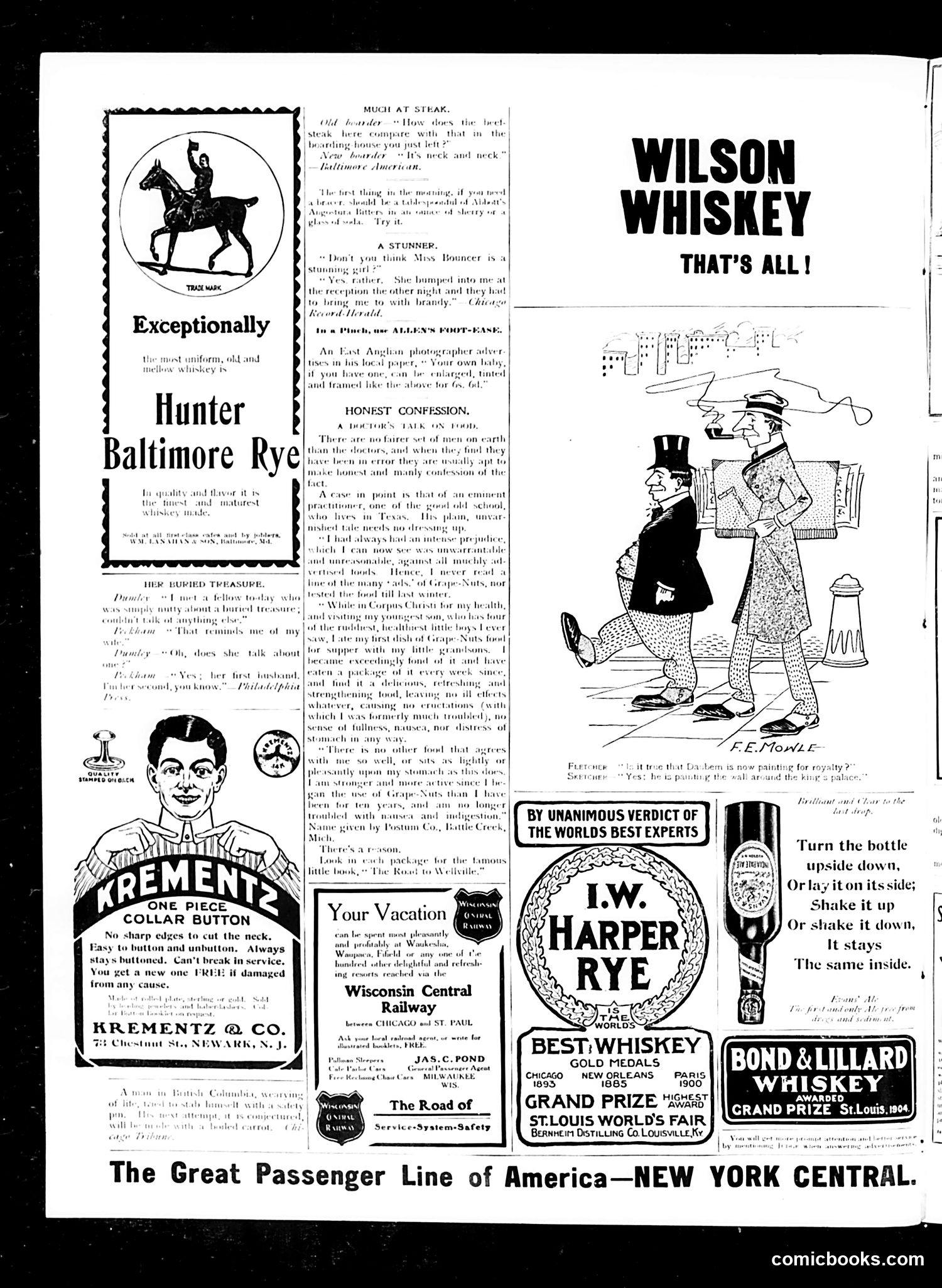
This page is primarily **advertising**, not satirical editorial content. It features multiple whiskey advertisements competing for consumer attention during the pre-Prohibition era. The main advertisements include: - **Hunter Baltimore Rye**: emphasized as "the most uniform, old and mellow whiskey" - **Wilson Whiskey**: with a cartoon showing two men and the slogan "That's All I" - **I.W. Harper Rye**: claiming "unanimous verdict of the world's best experts" - **Bond & Lillard Whiskey**: advertising a grand prize from the 1904 St. Louis World's Fair There's also a **Krementz collar buttons ad** featuring a smiling man's face, and various railroad/travel advertisements (Wisconsin Central Railway, New York Central). The repeated emphasis on award medals and "best" claims reflects typical early-1900s advertising strategies. The cartoon about Eastlake painting "for royalty" appears unrelated to whiskey and may be filler content. This reflects an era when whiskey companies advertised extensively in Judge magazine before alcohol advertising restrictions tightened.
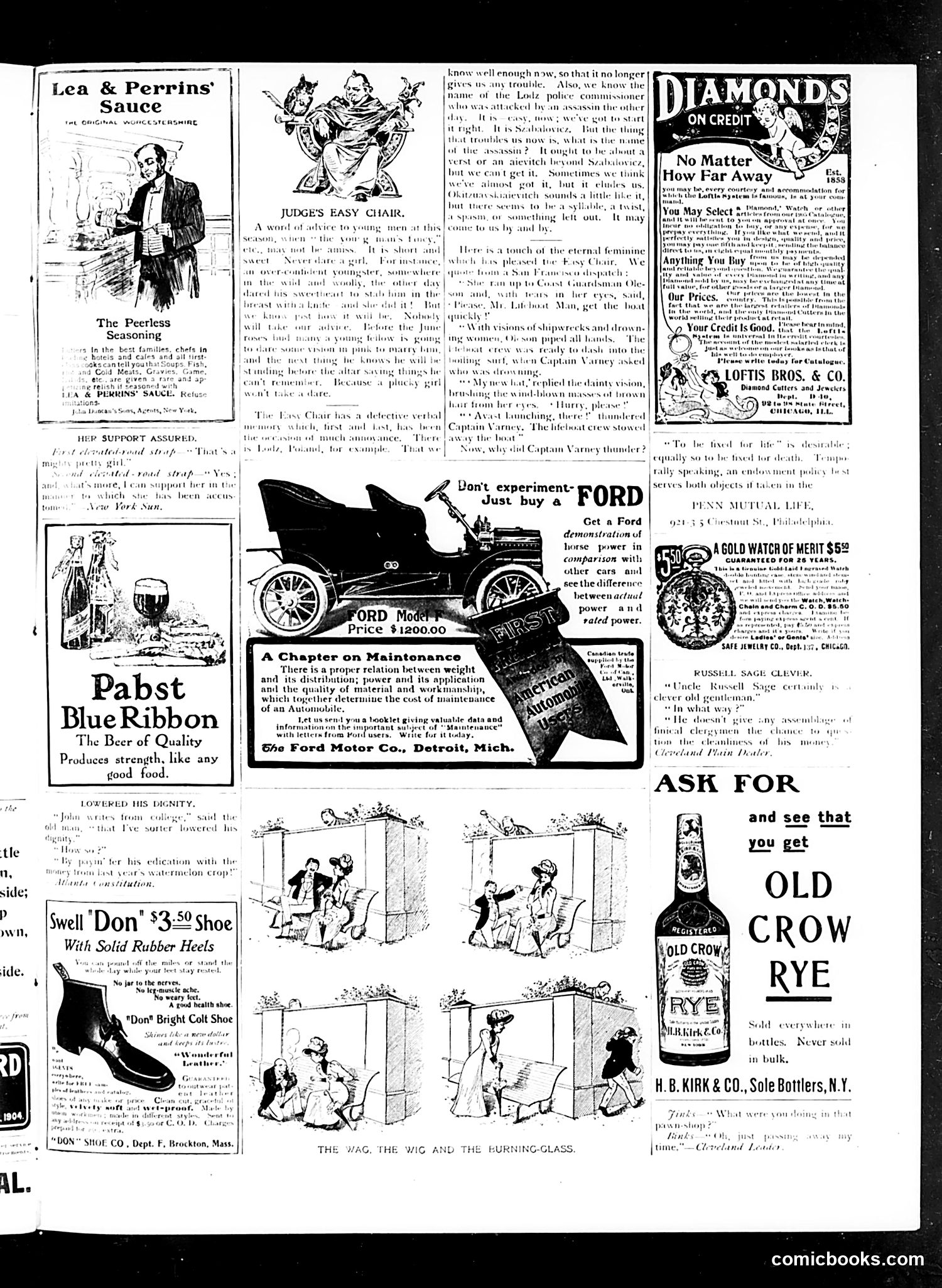
This page is primarily **advertising** with occasional satirical filler content typical of Judge magazine's format. **"Judge's Easy Chair"** column contains light social satire: a humorous account of a lifeboat rescue where Captain Varney stops the crew from launching because the woman calling for help was actually trying to retrieve her wig, not escape danger. The joke mocks melodramatic feminine vanity. **"Lowered His Dignity"** is a brief anecdote about a college student embarrassing his family by working during a watermelon crop harvest—social commentary on class pretension. The **political reference** appears in the opening text fragment discussing "the Lodz police commissioner" attacked by an assassin, referencing real Eastern European tensions, though the satire point is unclear from this excerpt. The bulk of the page consists of period **product advertisements**: Lea & Perrins Sauce, Pabst Blue Ribbon beer, Ford automobiles, shoe brands, Old Crow Rye whiskey, and insurance/jewelry products—typical early 20th-century magazine commerce with illustrative humor integrated into ads.
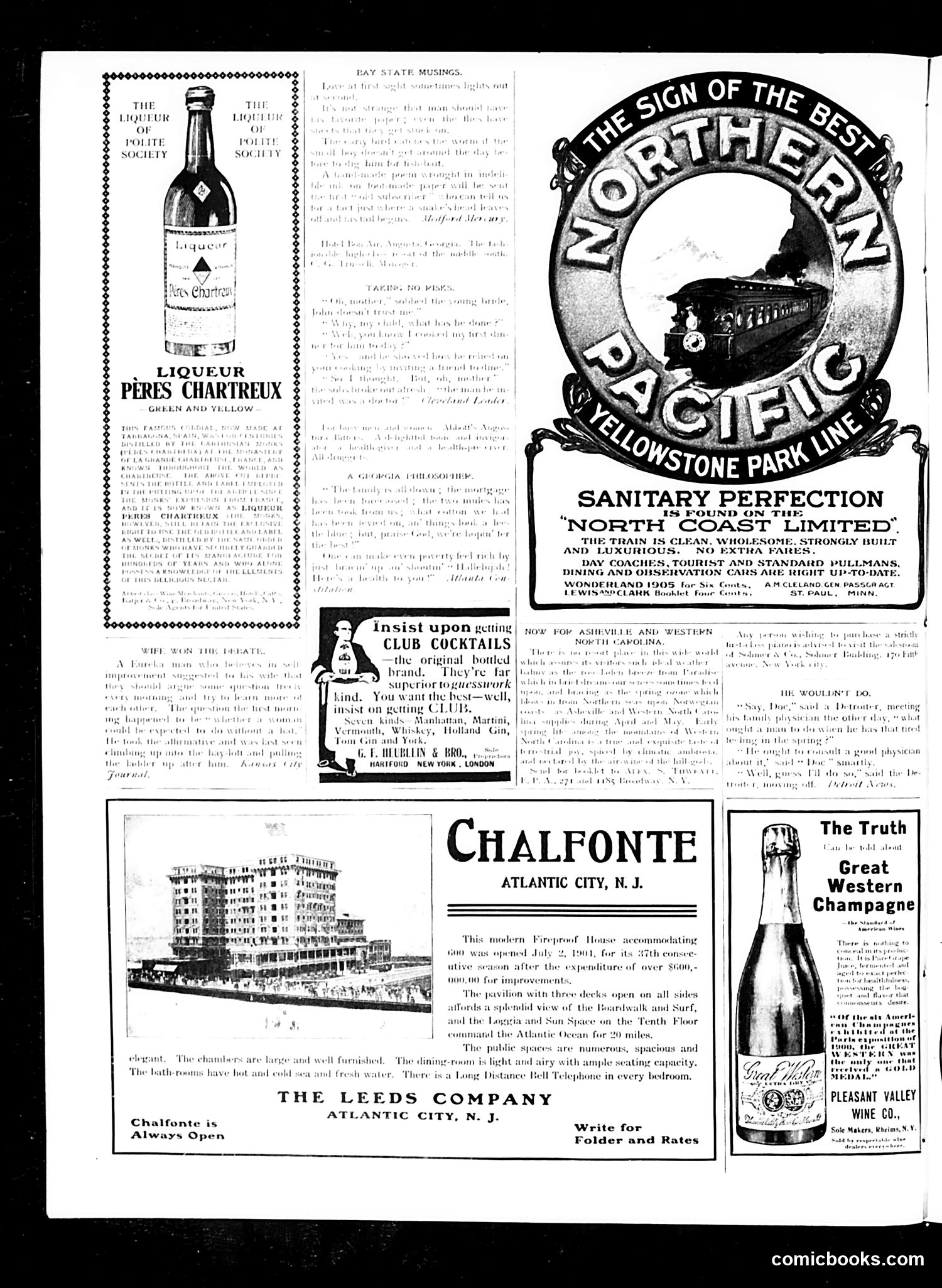
This page is primarily **advertising**, not political satire. It contains multiple product advertisements typical of an early 20th-century magazine: **Key Advertisements:** - Liqueur Pères Chartreux (French liqueur) - Club Cocktails (bottled cocktail brand) - North Coast Limited train (emphasizing cleanliness and luxury) - Chalfonte Hotel in Atlantic City, N.J. - Great Western Champagne - Pleasant Valley Wine The only text approaching editorial content is "BAY STATE MUSINGS" (top), which appears to be a brief commentary column, though it's largely illegible in this reproduction. **Historical Context for Modern Readers:** This predates Prohibition (1920-1933), so alcohol advertising was legal and common. The ads emphasize quality, cleanliness, and luxury—reflecting Gilded Age consumer values. The train and hotel advertisements highlight emerging leisure travel culture. The page demonstrates how satirical magazines like *Judge* subsidized content through advertising rather than subscriptions alone.
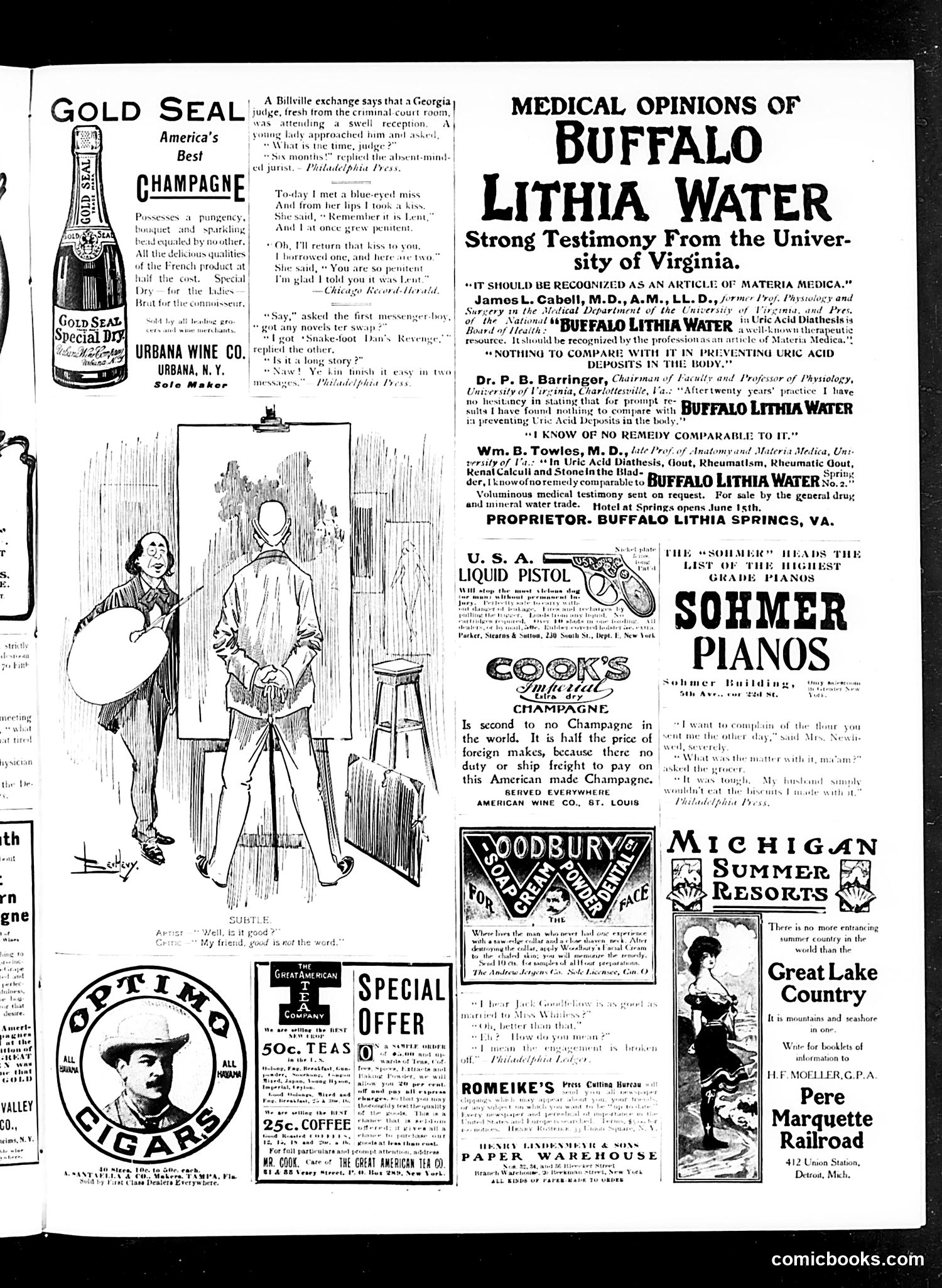
This page is primarily **advertising**, not political satire. The dominant content consists of product endorsements and commercials typical of early 20th-century magazines. The main feature is a lengthy medical testimonial section for "Buffalo Lithia Water," presenting quotations from University of Virginia professors claiming the mineral water treats uric acid deposits, gout, and rheumatism. This reflects the era's widespread marketing of patent medicines and mineral waters as cure-alls, often citing dubious medical authority. The page also advertises Gold Seal Champagne, Sohmer Pianos, Optime Cigars, and Michigan Summer Resorts. There is **one cartoon** visible (lower left): a simple comic dialogue between a critic and artist about whether a painting is "good"—a generic gag unrelated to current events or politics. The satirical content of *Judge* magazine appears elsewhere on this page; this particular section prioritizes **commercial messaging over social commentary**.
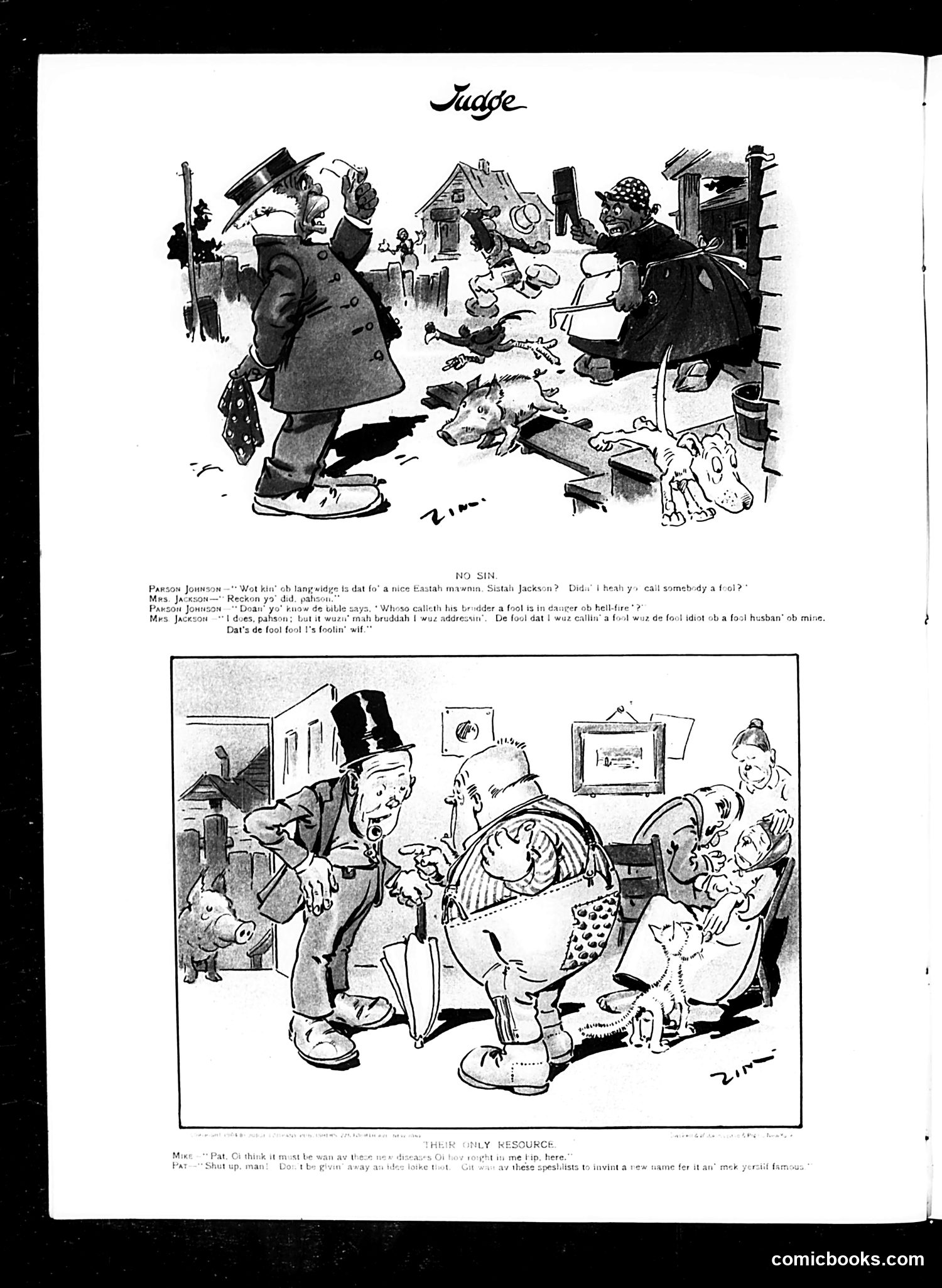
This page contains two satirical cartoons addressing social behavior and morality. **"NO SIN"** (top): Shows two working-class figures amid domestic chaos—broken furniture, fighting animals, debris. The dialogue suggests a couple rationalizing misbehavior, with one character claiming their actions aren't sinful. The satire mocks the rationalization of immoral conduct among lower classes. **"THEIR ONLY RESOURCE"** (bottom): Depicts what appears to be a working-class family in a cramped domestic setting. A man in a top hat (possibly a social worker, landlord, or official) confronts the residents. The caption suggests exploiting a family's desperation—using poverty as leverage for some inappropriate demand. Both cartoons critique either moral hypocrisy or the exploitation of economically vulnerable people, reflecting Judge magazine's tendency toward both class commentary and moral social criticism in the early 20th century.
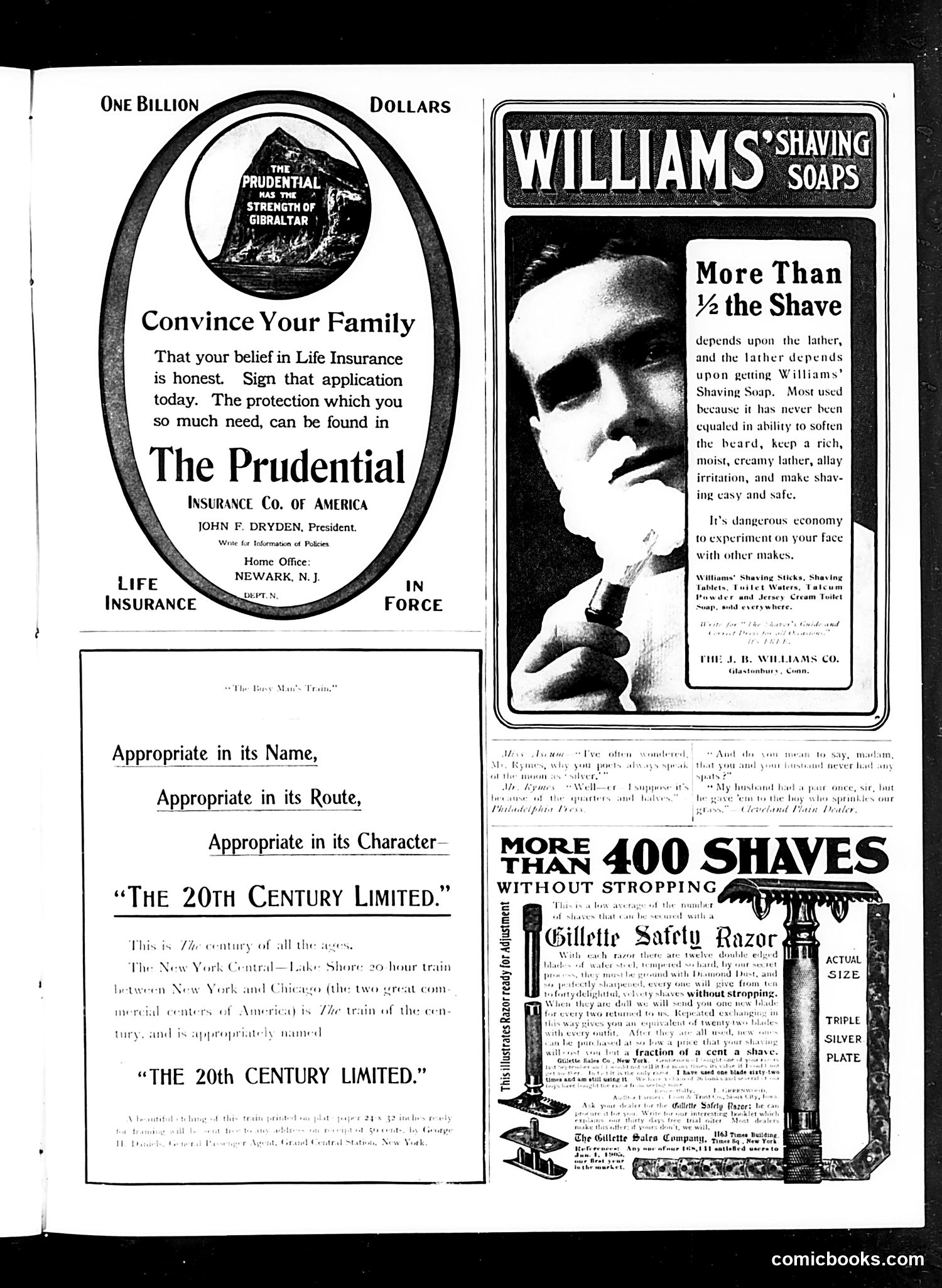
This page consists primarily of **advertisements**, not satirical cartoons. It contains three commercial ads typical of early 20th-century publications: 1. **Prudential Insurance** (left): Appeals to family security by invoking Gibraltar's strength as a metaphor for financial protection. The "One Billion Dollars" emphasizes the company's massive assets. 2. **20th Century Limited Train** (center-left): Promotes the New York Central Railroad's luxury 20-hour passenger service between America's two major commercial centers, emphasizing modernity through the name itself. 3. **Williams' Shaving Soap and Gillette Safety Razor** (right): Both ads emphasize product superiority—Williams claims unmatched lathering ability; Gillette boasts "400 shaves" per blade. These represent competing grooming products marketed to male consumers. The page reflects early 1900s consumer capitalism: large corporations advertising reliability, technological progress, and personal convenience to establish brand trust and market dominance.
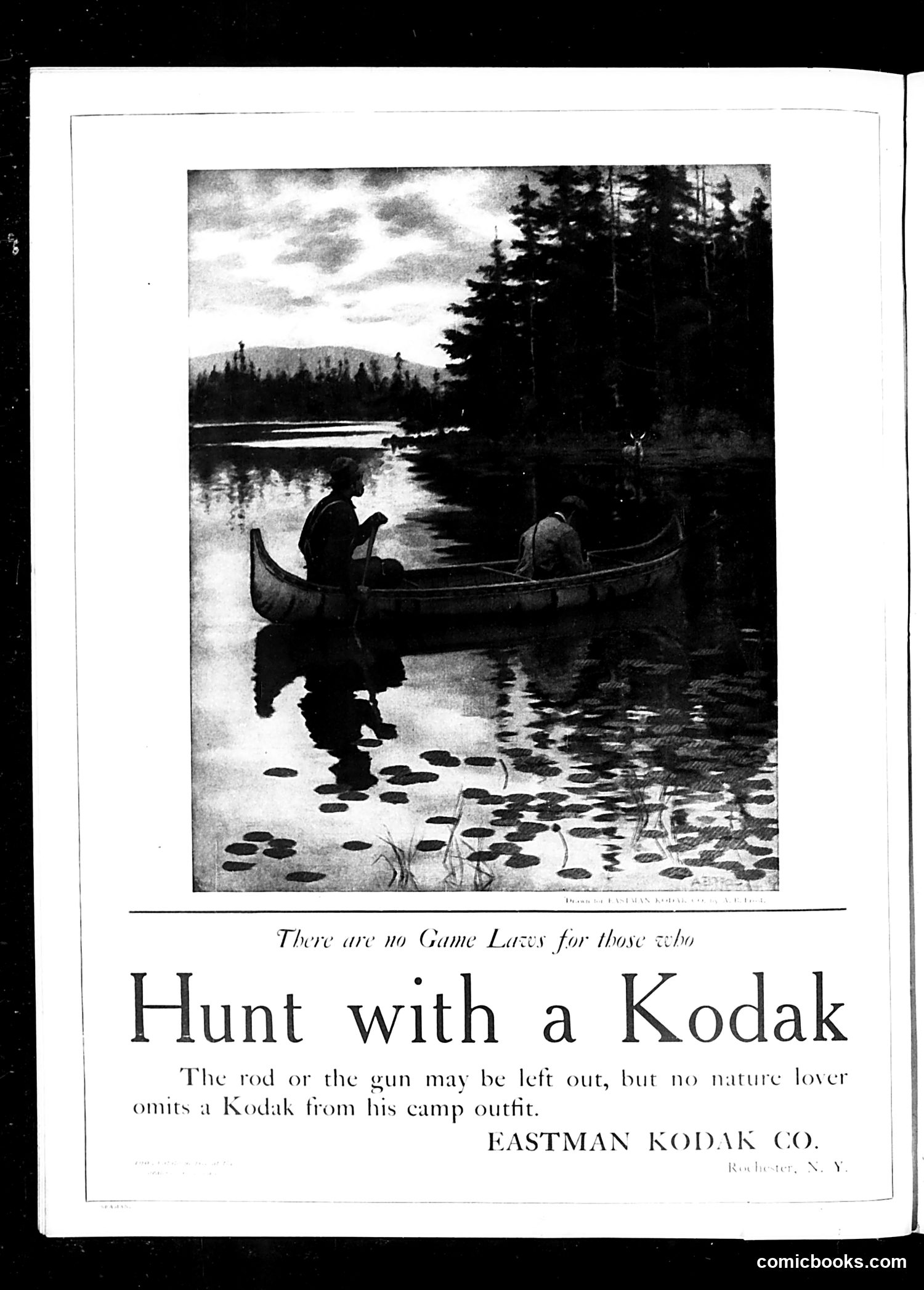
This is a **Kodak advertisement**, not political satire. The image shows a hunter in a canoe on a wilderness lake, surrounded by forest. The ad's message plays on the idea that photography offers an alternative form of "hunting"—capturing wildlife and nature through the camera lens rather than killing it. The tagline "There are no Game Laws for those who Hunt with a Kodak" is a clever pun: game laws regulate hunting for food, but photographers face no such restrictions. The ad targets outdoors enthusiasts and nature lovers, suggesting that a camera is an essential camping tool alongside—or instead of—traditional hunting equipment. This reflects early 20th-century marketing that positioned photography as a genteel, accessible way to engage with nature and wildlife.