
A complete issue · 16 pages · 1905
Judge — April 1, 1905
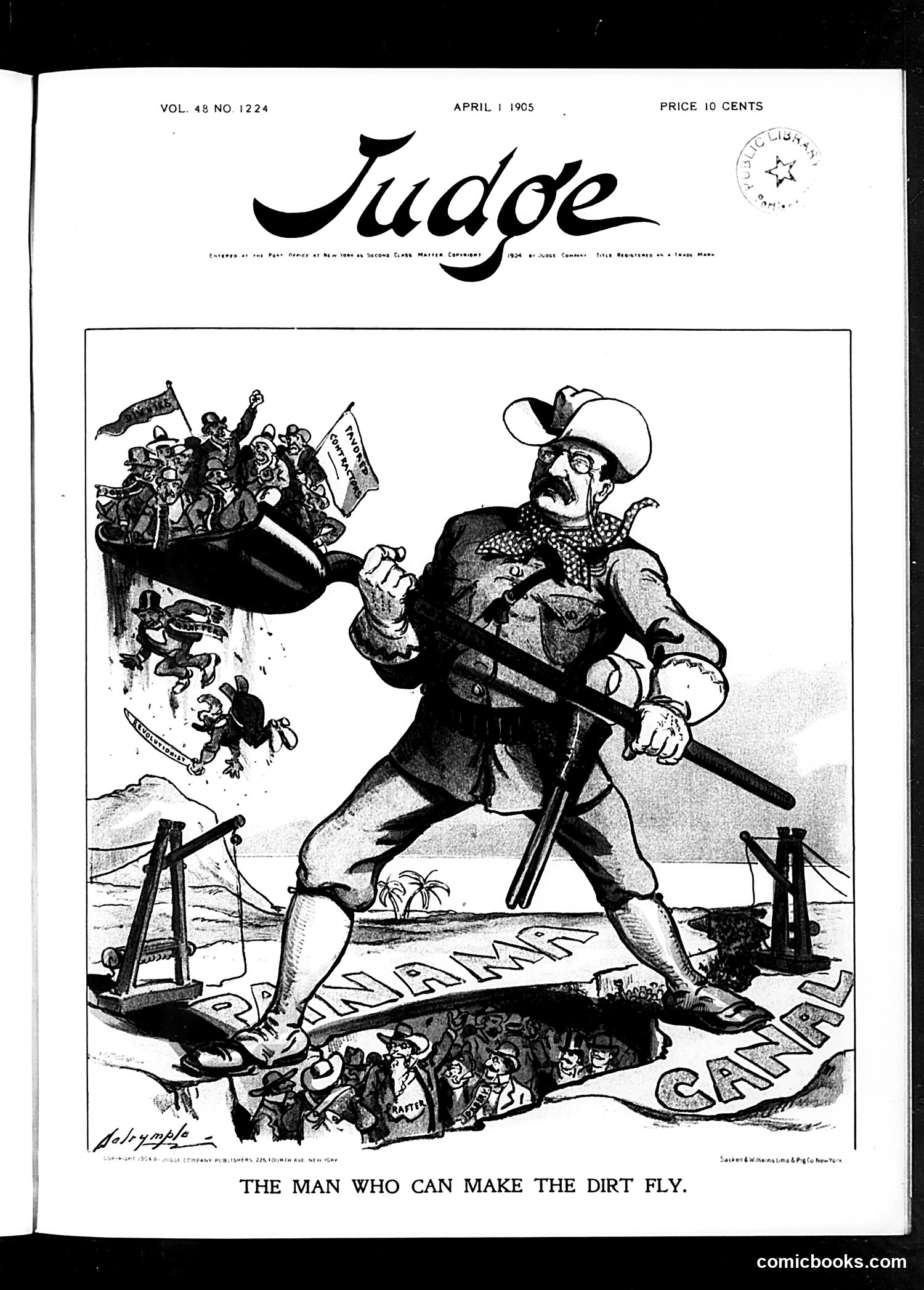
This April 1905 *Judge* cartoon satirizes Theodore Roosevelt's ambitious infrastructure projects, particularly the Panama Canal construction. The large military figure represents Roosevelt wielding a massive shovel, depicted as aggressively commanding dirt and resources. The figures emerging from the shovel appear to represent various political interests and groups affected by or involved in canal construction. The underground cavity shows crowds labeled "CANAL," suggesting the massive labor and upheaval required. The fortifications and military aesthetic emphasize Roosevelt's vigorous, forceful approach to the project. The title "The Man Who Can Make the Dirt Fly" ironically celebrates Roosevelt's energetic executive action while subtly mocking the chaos and disruption his ambitious policies created. The cartoon reflects contemporary debates about American imperialism and the canal's controversial construction.
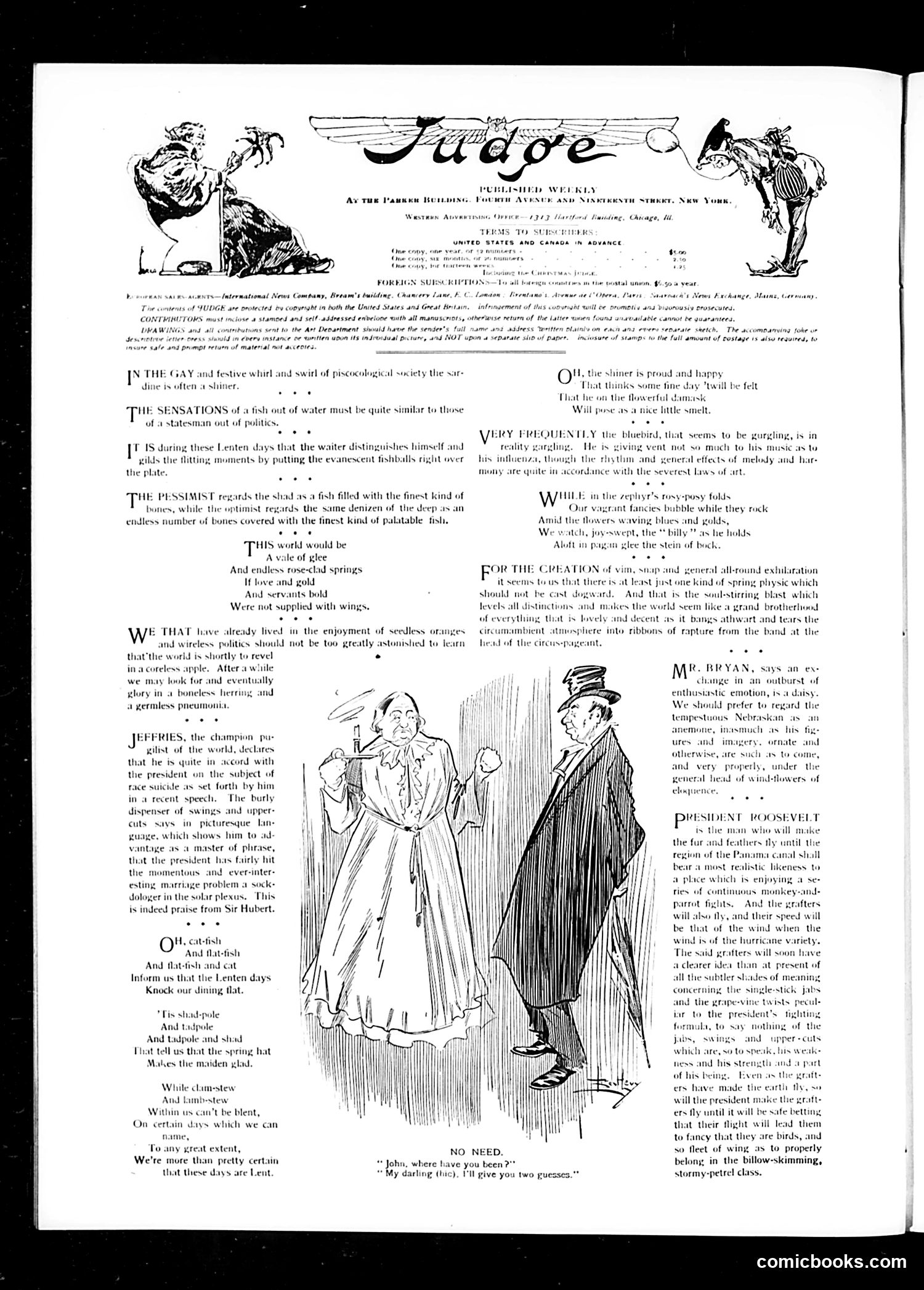
The main cartoon depicts two men in conversation, labeled "NO NEED" with the caption: "John, where have you been?" "My darling (tie), I'll give you two guesses." This appears to be a domestic satire about a husband's infidelity or suspicious absence. The woman's exasperated tone suggests she knows or suspects wrongdoing. The phrase "I'll give you two guesses" is sarcastic—implying his excuses are predictable. The surrounding text discusses various political and social topics typical of Judge's satirical commentary, including references to water sports, fish, and what appears to be commentary on political figures, though specific identities are unclear from this page alone. Without additional context or date information, the exact political figures referenced remain uncertain, but the cartoon itself satirizes conventional domestic deception and marital tension.
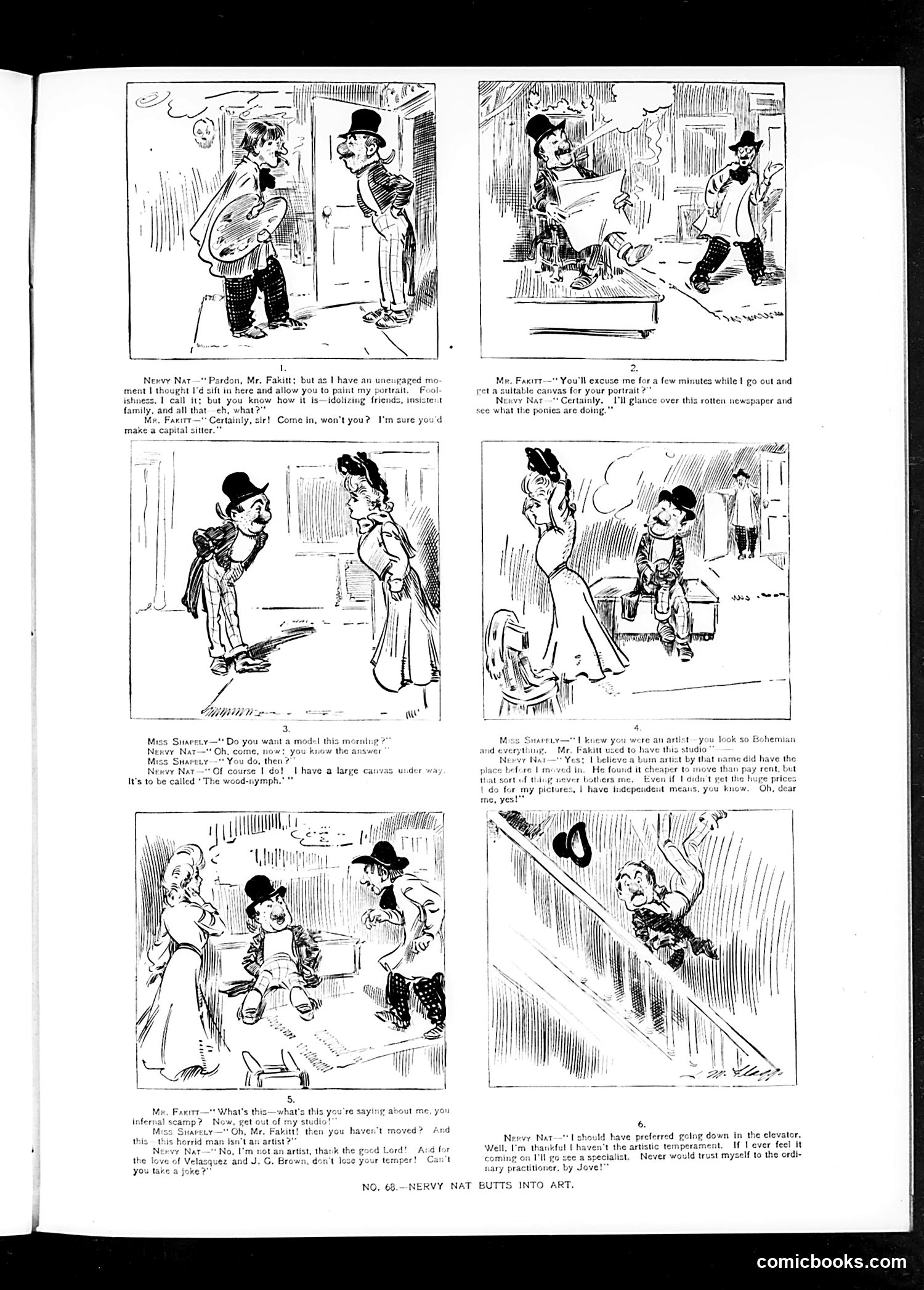
This is a humorous serial comic about **Nervy Nat**, a working-class character who crashes into the art world. The narrative involves Nat attempting to commission a portrait from an artist named **Mr. Fawrt** while being mistaken for someone of importance. The satire targets the pretentiousness of early 20th-century art circles and the class friction between wealthy patrons and struggling artists. Nat's blunt, irreverent manner—his "nervy" behavior—disrupts the affected social conventions of artists and their elite clients. Key joke: **Miss Shaffley** believes Nat is a "Bohemian" artist with talent, while Nat himself is simply trying to navigate the scene as an outsider. The misunderstanding and Nat's bumbling persistence drive the comedy, satirizing both artistic snobbery and social climbing.
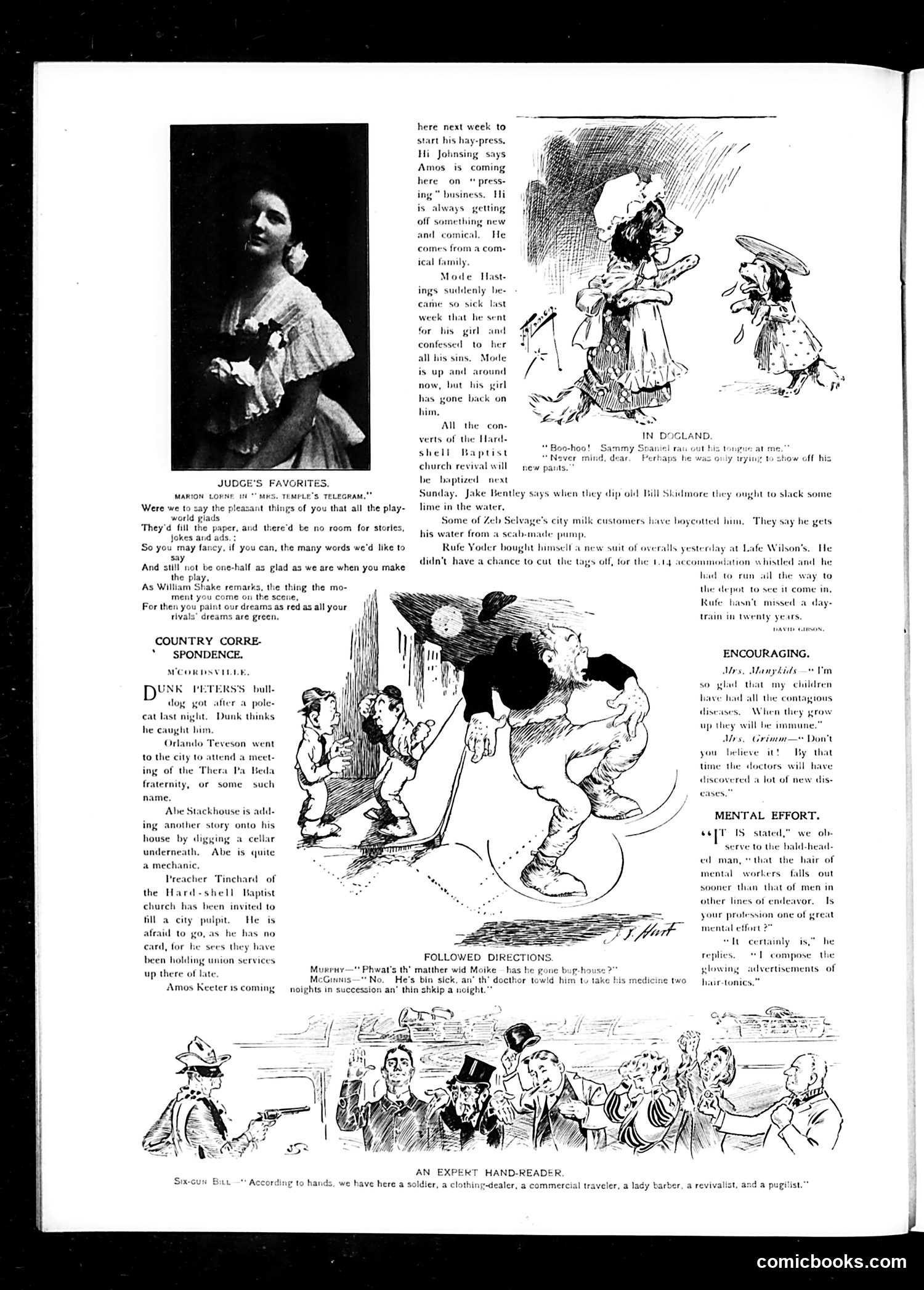
This page contains several satirical pieces typical of Judge magazine's humor: **"Judge's Favorites"** features Marion Lyon in theatrical costume, accompanied by verse praising her pleasant stage presence and comic timing. **"Country Correspondence"** humorously reports small-town happenings from Mooresville, including anecdotes about local figures like Dunk Peters (a drunk caught by police) and Orlando Pierson attending a fraternal meeting. **"In D'Gland"** cartoon mocks British class distinctions through a figure who appears to be snobbish about his "new pants." **"Followed Directions"** cartoon shows a doctor's misadventure—the patient apparently took literal rather than medical advice. **"An Expert Hand-Reader"** features "Six-Gun Bill" analyzing a group of characters' professions based on their hands, listing "a soldier, a clothing-dealer, a commercial traveler, a lady barber, a revivalist, and a pugilist." The overall tone reflects early 20th-century American satire focusing on everyday social absurdities.
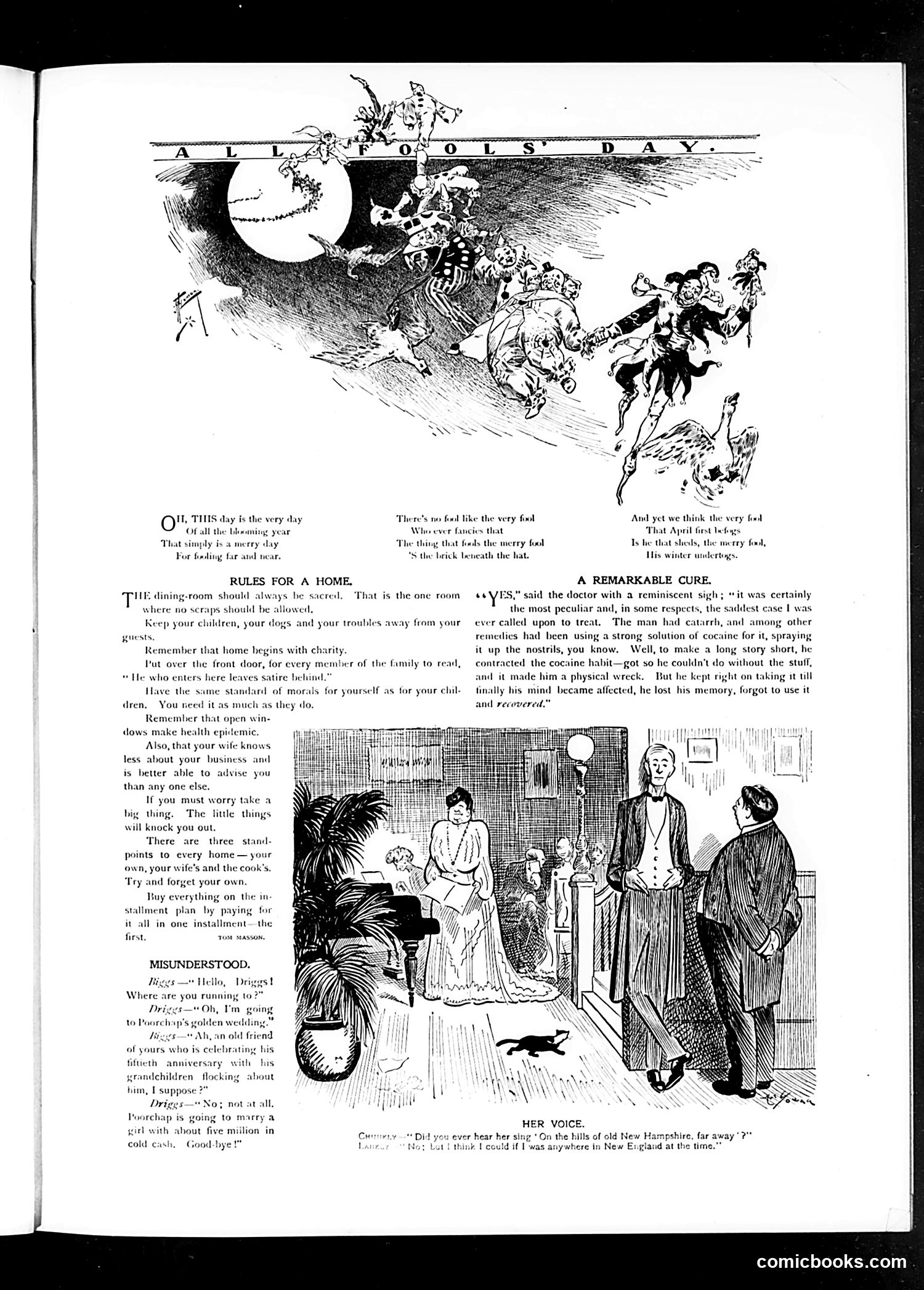
This page from *Judge* contains three satirical pieces: **"All Fools' Day"** (top): A chaotic cartoon showing foolish holiday revelry, with the accompanying verse mocking people who behave absurdly on April 1st. **"Rules for a Home"** (left): Practical domestic advice about maintaining proper household order and morality—likely satirizing Victorian ideals about family structure and the proper roles of wives, servants, and children. The joke seems to be that these "rules" are obvious common sense, yet apparently needed stating. **"A Remarkable Cure"** (center): A doctor's anecdote about treating cocaine addiction paradoxically by allowing the patient to continue until he "recovered" by simply forgetting to use it. This appears to satirize both medical incompetence and the era's casual attitude toward cocaine (then legal and common in medicines). **"Misunderstood"** (lower left): A brief comic dialogue where one man assumes another is attending an old friend's wedding anniversary, when he's actually attending that friend's *remarriage* to a wealthy young woman—satirizing mercenary second marriages.
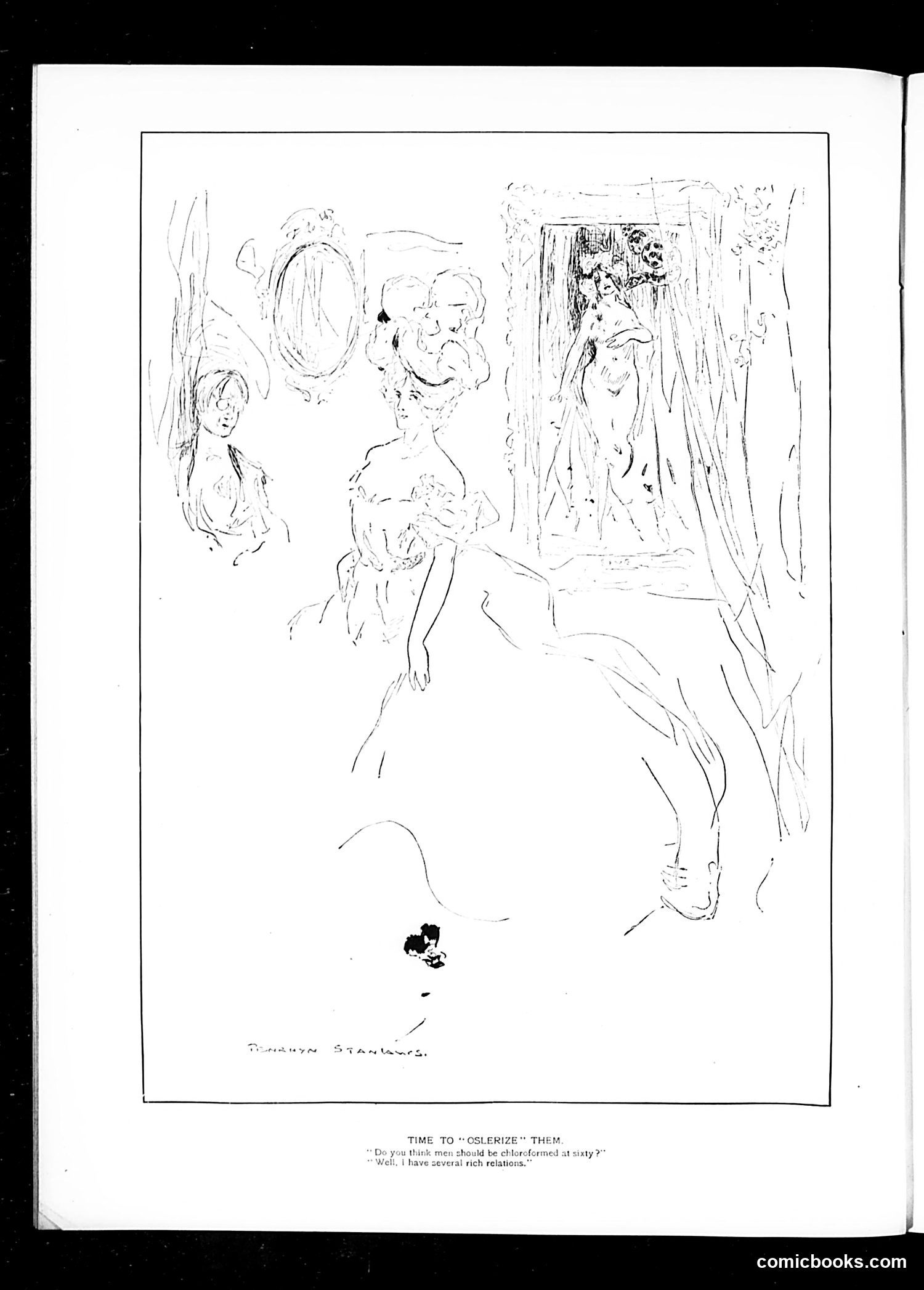
This cartoon satirizes wealthy men attempting to appear more respectable or socially elevated through strategic marriages or social connections. The caption reads: "Do you think men should be chloroformed at sixty?" with the response "Well, I have several rich relations." The humor targets the social practice of marrying or cultivating relationships with wealthy older men for financial gain. The woman's callous response—equating aging wealthy men with candidates for chloroform (an anesthetic, here used darkly as a euphemism)—while simultaneously noting her "rich relations" suggests fortune-hunting among the upper classes. The sketch style depicts an elegant woman in period dress amid fashionable company, likely mocking Gilded Age social climbing and the mercenary nature of high-society relationships. The satire critiques both the superficiality of wealth-obsessed socialites and the disposability wealthy older men faced in pursuit of younger companions.
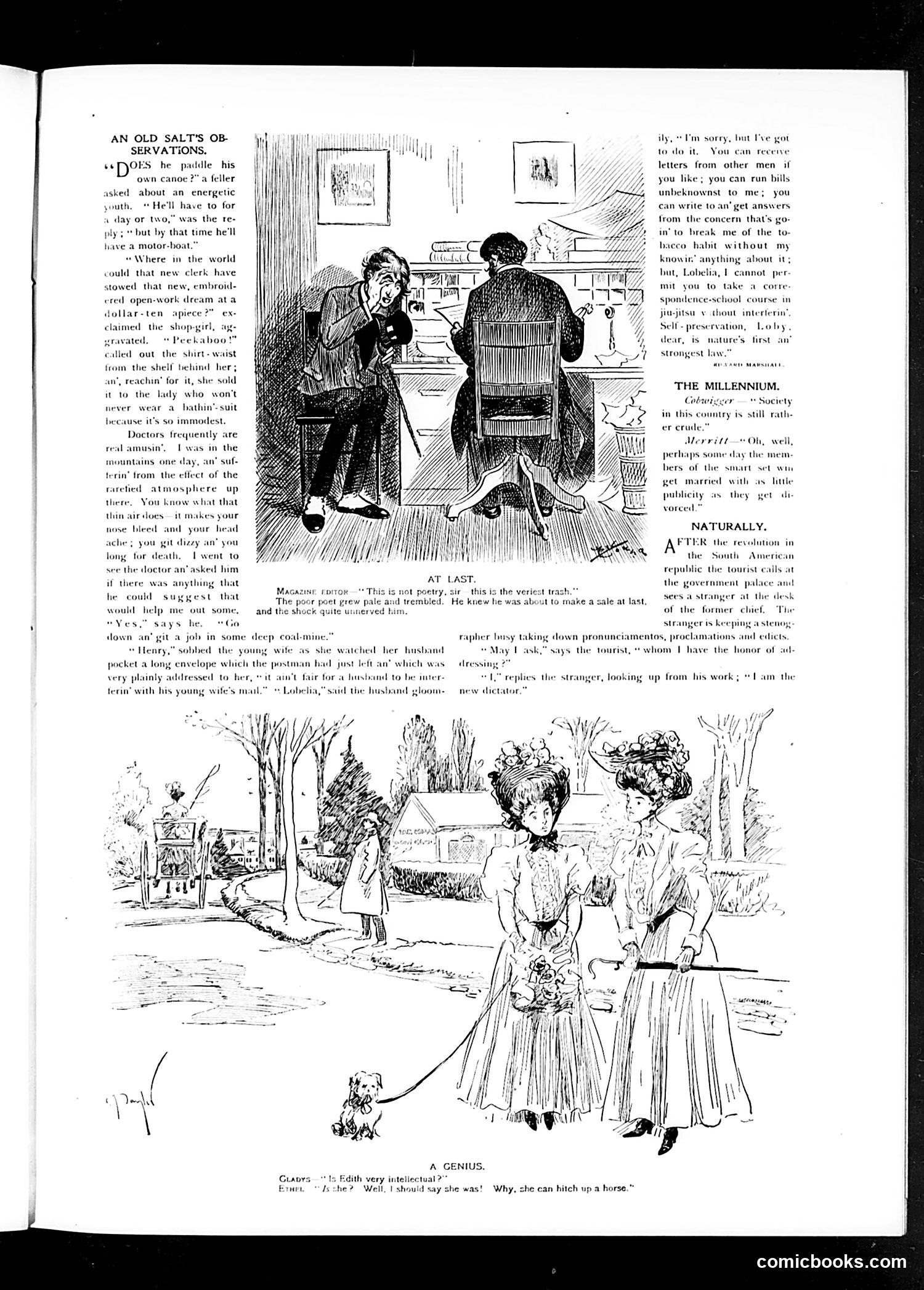
This page contains several satirical vignettes typical of early 20th-century American humor: **"An Old Salt's Observations"** mocks consumer culture and hypocrisy through a sailor's observations: a clerk will soon need a motorboat, a shop-girl sells immodest "peekaboo" blouses to a woman who refuses bathing suits for modesty reasons. **"At Last"** jokes about a husband receiving a letter from a magazine—he expects poetry but it's "veriest trash" (likely advertising). **"The Millennium"** sarcastically imagines a future where wealthy socialites marry with minimal publicity, unlike their divorce scandals. **"Naturally"** depicts a South American post-revolution scene where a former chief's successor now works as a hotel doorman—satirizing political upheaval and role reversals. **"A Genius"** (bottom) jokes that an intellectual woman's main skill is hitch-handling a horse—mocking pretensions about women's intelligence. The humor relies on period-specific references to consumer goods, class anxieties, and Latin American politics recognizable to Judge's educated, upper-middle-class readership.
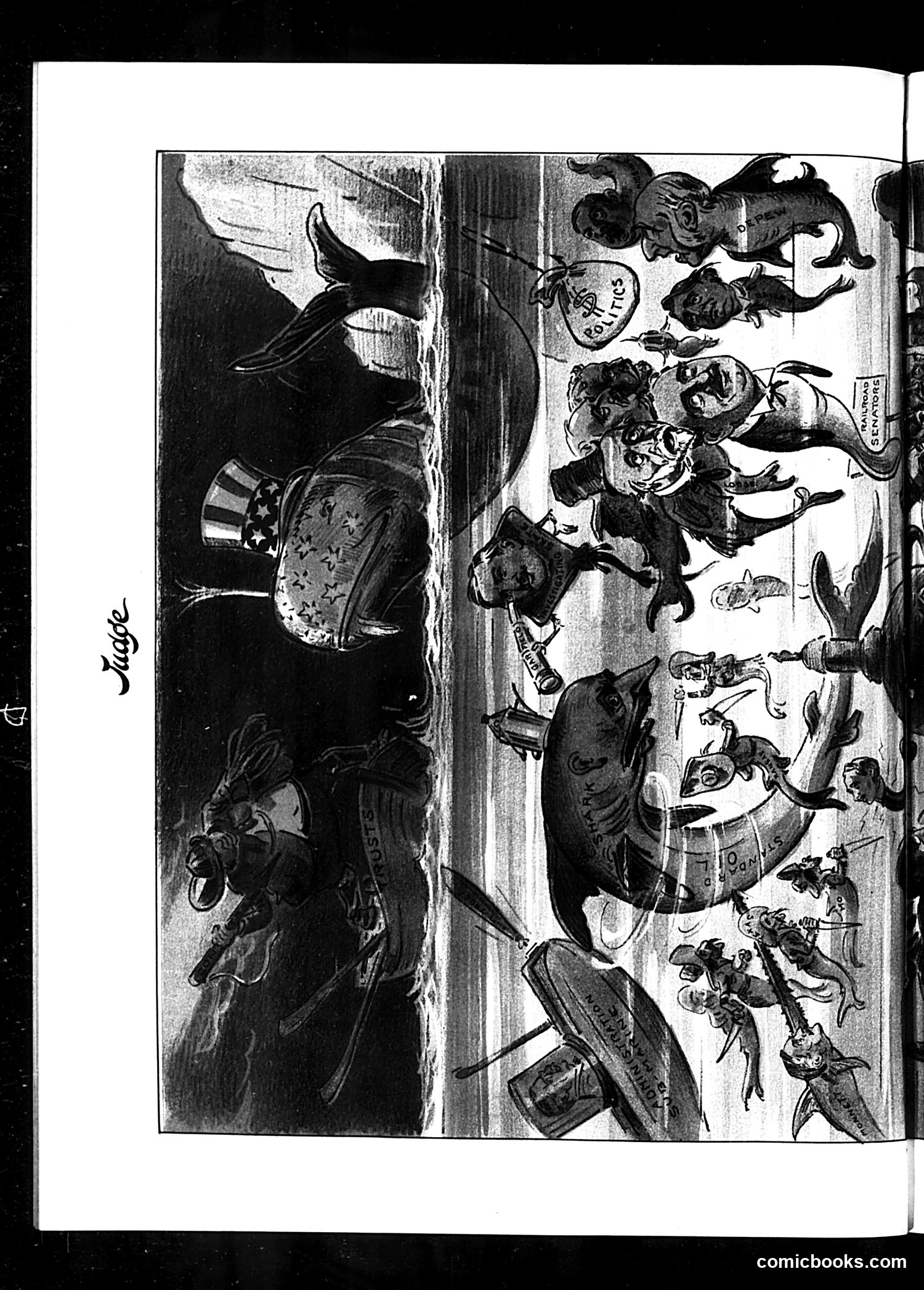
I can see this is a two-panel Judge magazine cartoon, but the OCR text provided is incomplete and illegible ("Fa" and some fragments). The left panel shows a large figure (appearing to be Uncle Sam, based on the striped pants and top hat) in a dark, dramatic setting. The right panel depicts multiple caricatured figures in what appears to be a chaotic interior scene. Without clearer text or additional context, I cannot reliably identify the specific political figures or events referenced, the dates of publication, or the precise satirical point being made. To accurately explain this cartoon to a modern reader, I would need either legible caption text or additional identifying information about the issue and date of publication.
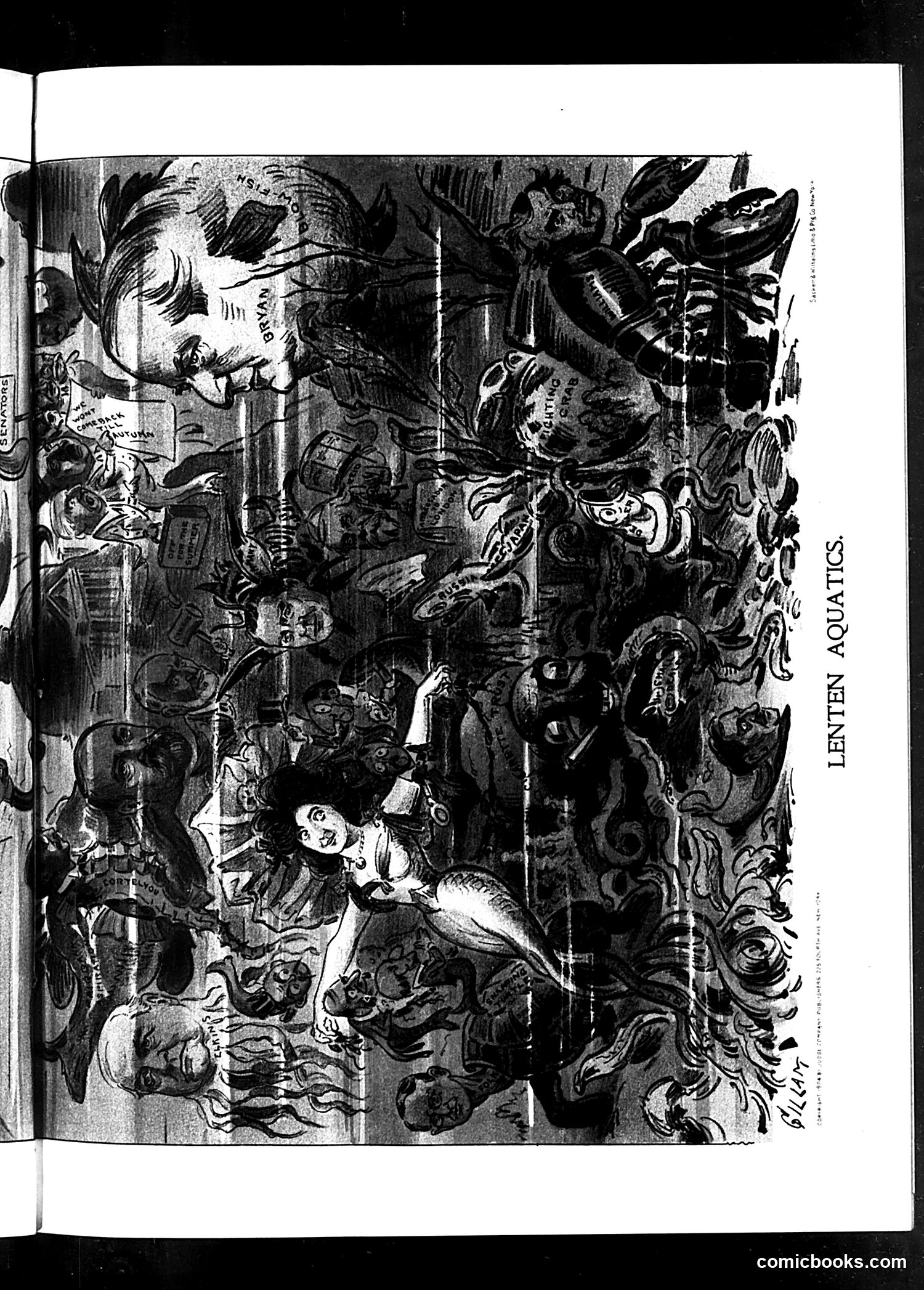
This appears to be a satirical cartoon from *Judge* magazine, though the OCR text is largely illegible. The image shows a chaotic underwater or aquatic scene with numerous grotesque figures, sea creatures, and human characters in exaggerated poses. The composition is densely packed with detailed cross-hatching and energetic linework typical of late 19th/early 20th-century satirical illustration. The title "Listen Aquatics" suggests aquatic-themed satire, possibly mocking water-related industries, policies, or public behavior around water. Without clearer text, the specific political or social targets remain unclear, though the crowded, chaotic nature suggests commentary on overcrowding, pollution, or confused public sentiment around some water-related issue of the era.
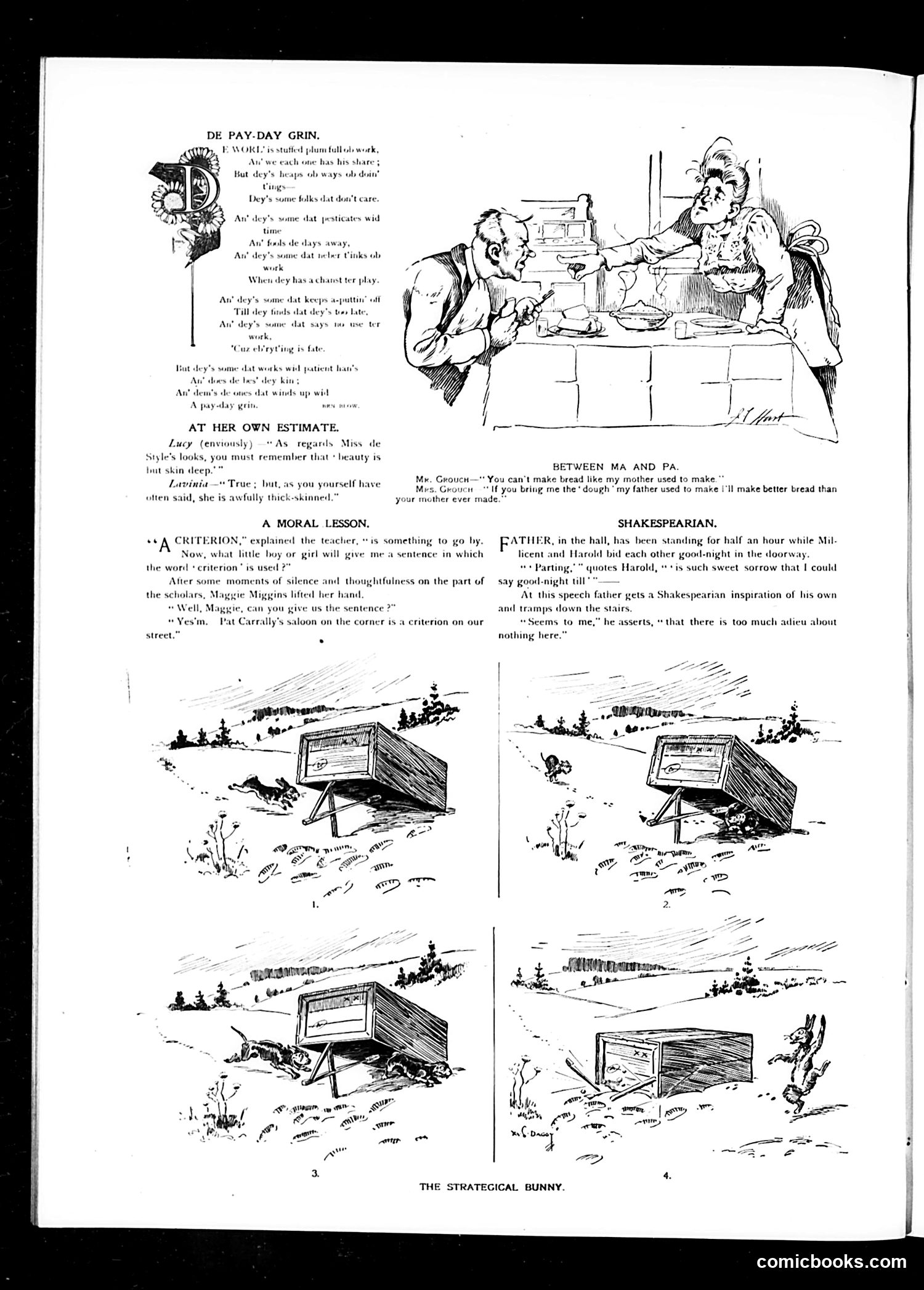
This page from *Judge* contains several short humor pieces typical of late 19th/early 20th-century American satire. **"De Pay-Day Grin"** uses dialect humor (common then, offensive now) to mock working-class fatalism—laborers who rationalize their poverty as inevitable fate rather than seeking improvement. **"Between Ma and Pa"** is a domestic joke: a wife challenges her husband to provide the financial means ("dough") her father once had, implying she'll then match her mother's cooking skills—blaming marital discord on economics rather than ability. **"A Moral Lesson"** satirizes schoolroom instruction: a teacher asks students to use "criterion" in a sentence; a girl innocently references a saloon, suggesting the working-class world outside formal education operates by different standards. **"Shakespearian"** mocks pretentious young lovers quoting Shakespeare during prolonged goodbyes, with the frustrated father eventually responding with mock-Shakespearian dramatics of his own. **"The Strategical Bunny"** appears to be a wordless comic strip showing a rabbit's escape tactics from a trap. The overall tone reflects *Judge*'s satirical approach to class, education, and American social pretensions.
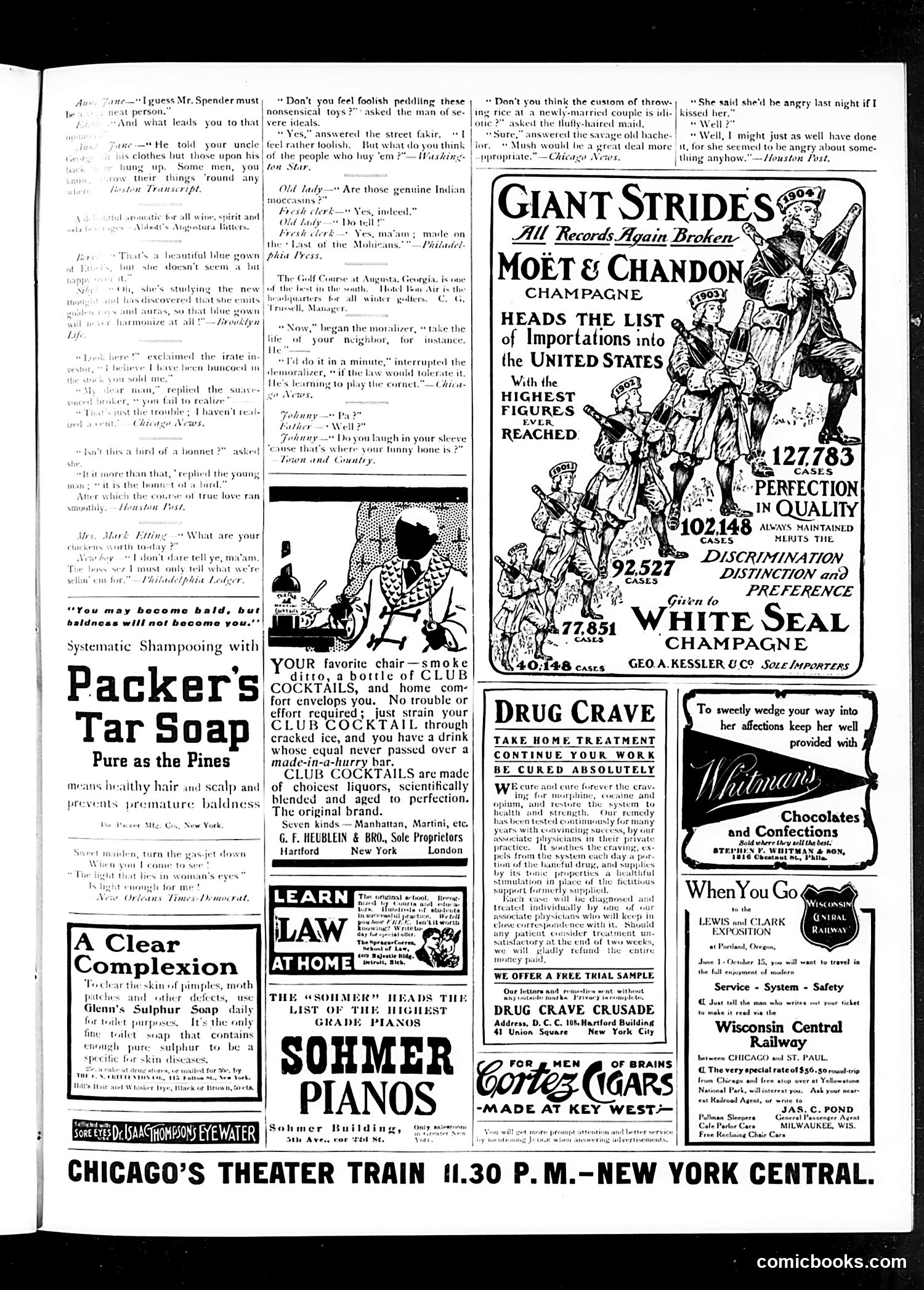
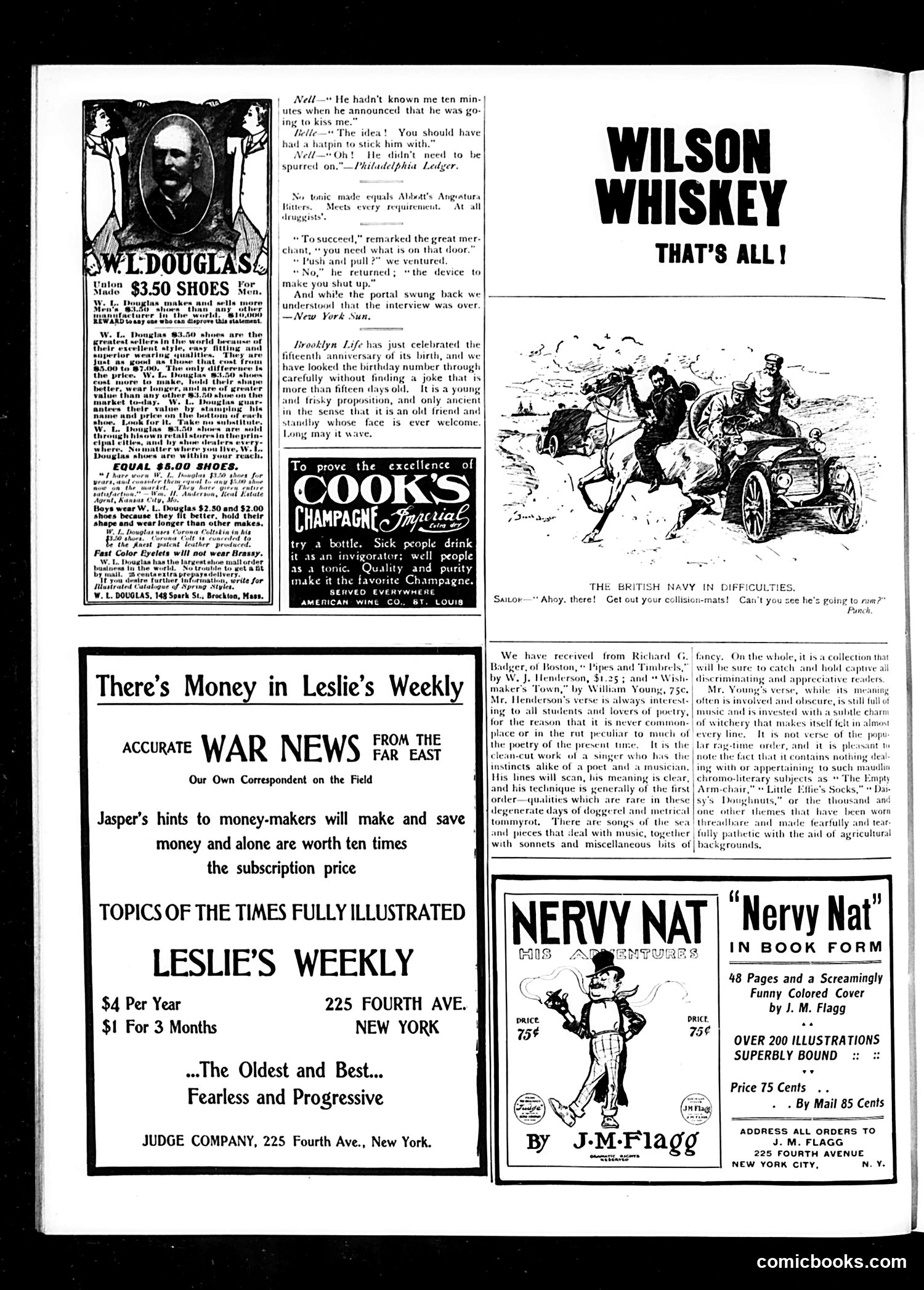
This page is primarily **advertising and editorial content** rather than political satire. The main elements are: **"The British Navy in Difficulties"** cartoon (top right): A humorous sketch showing sailors in a small boat, with a caption about "collision-mast" and someone asking if they can "see her going to ram!" This appears to be a light joke about naval mishaps rather than political commentary. **Advertisements dominate the page**, including: - W.L. Douglas shoes ($3.50) - Cook's Champagne (marketed as medicinal/"invigorator") - Wilson Whiskey - Leslie's Weekly (war news magazine) - Judge Company publications **Small humor pieces** at top left are genteel jokes about kissing, business dealings, and magazine anniversaries—typical lightweight satirical humor for this era. The page reflects early 1900s advertisement strategies and *Judge* magazine's blend of mild social humor with commercial promotion. There is **no significant political satire** visible here.
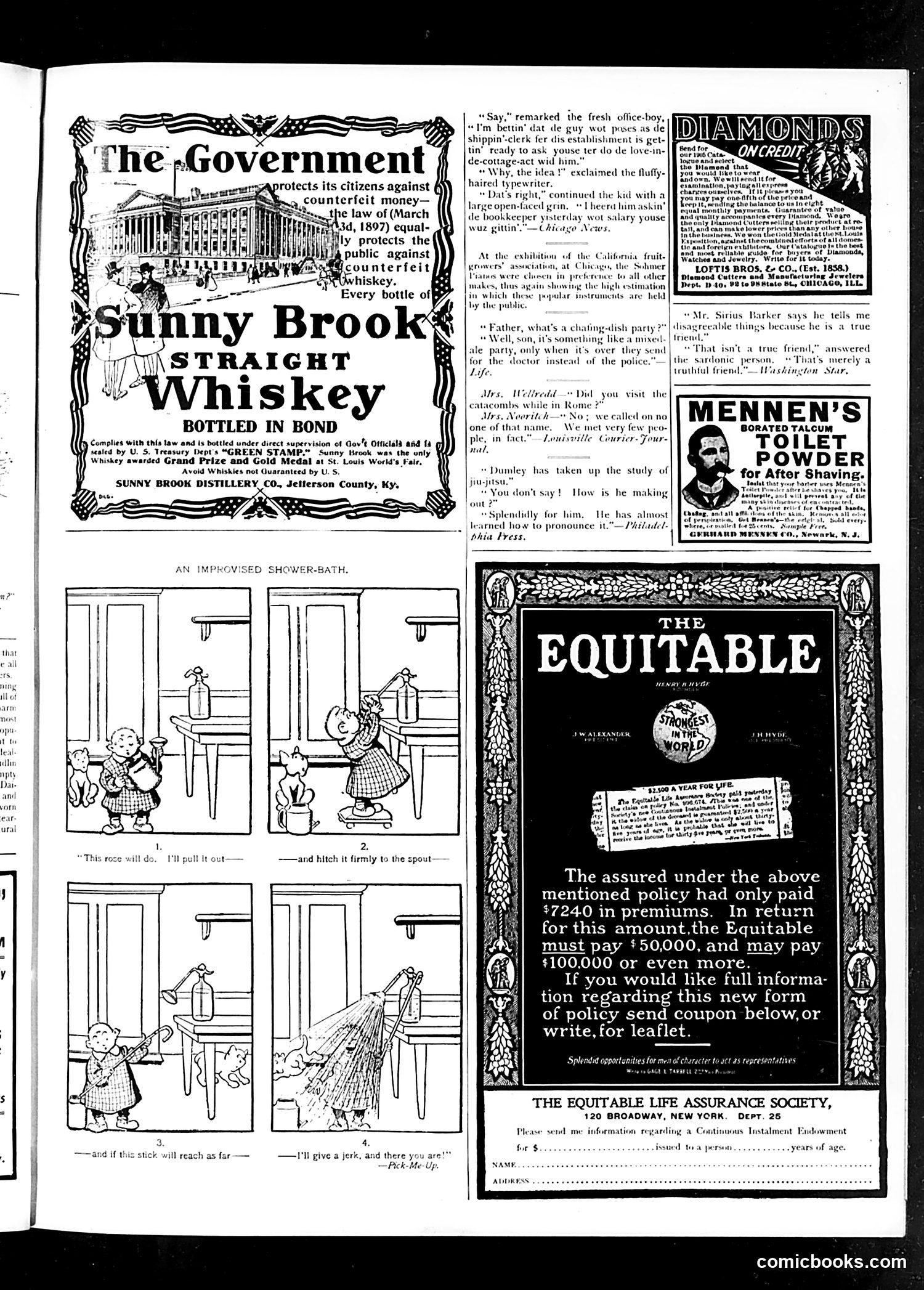
This page is primarily **advertising**, not political satire. The dominant content comprises four advertisements: 1. **Sunny Brook Whiskey** (top-left): Promotes "bottled in bond" whiskey, referencing the 1897 law protecting citizens against counterfeit money—drawing a parallel that government-sealed whiskey offers similar consumer protection. 2. **Mennen's Talcum Powder** (right): An aftershave product advertisement. 3. **The Equitable Life Assurance Society** (bottom-right): Life insurance promotion, highlighting that a policyholder who paid $7,240 in premiums could receive $50,000+ in benefits. 4. **Sohmer Piano** (upper-right): Brief advertisement for musical instruments. The only comic content is "An Improvised Shower-Bath" (center-left), a four-panel domestic humor strip showing a child using a stick and bottle to create a makeshift shower—a common slapstick joke format of the era. The page reflects Judge's mixed format: advertisement revenue funding satirical content.
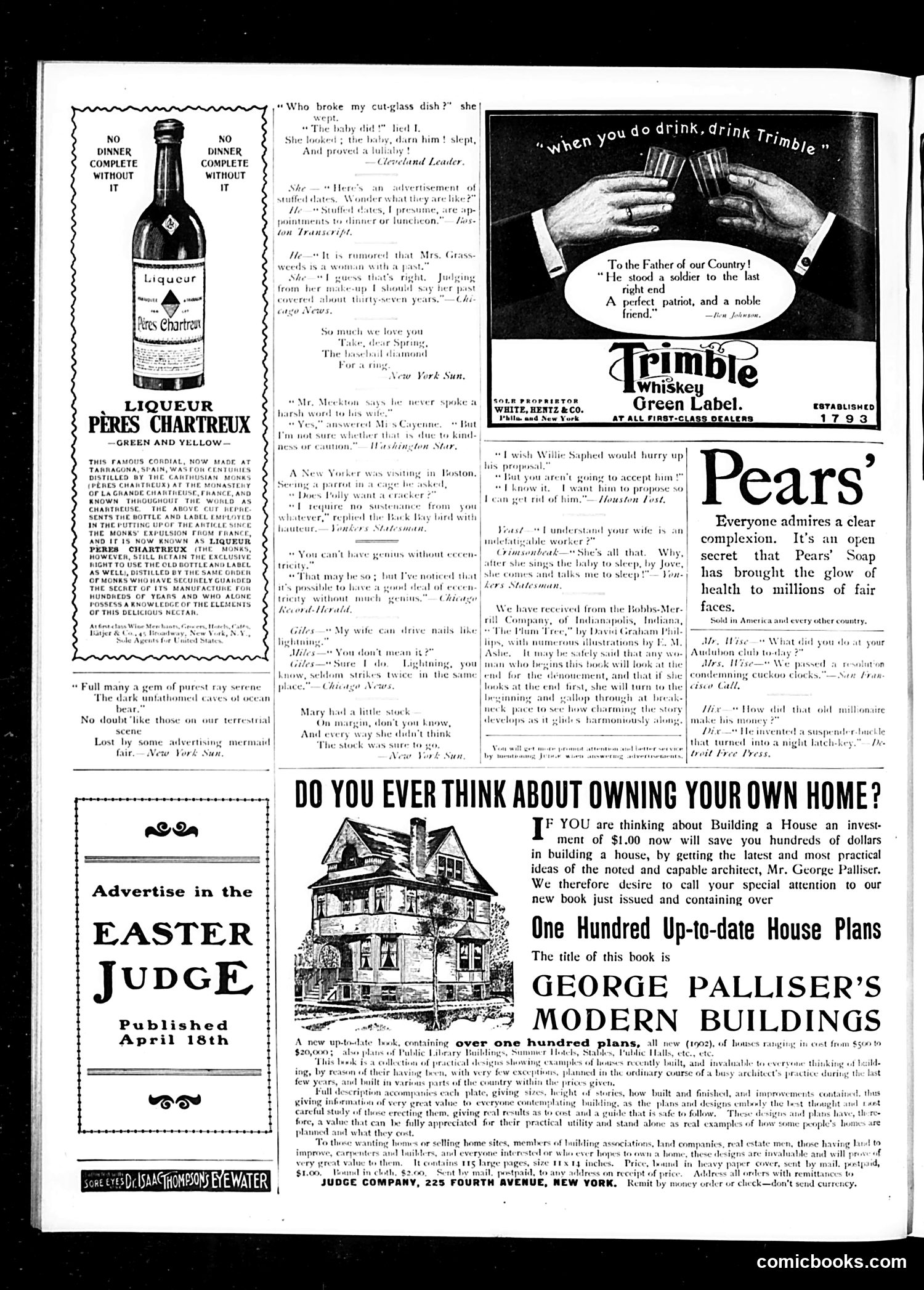
This page from Judge (a satirical weekly) contains **mostly advertisements** rather than political cartoons, reflecting the magazine's business model. The **notable content** includes: 1. **Liqueur and whiskey ads** (Pérès Chartreux, Trimble Whiskey, Pears' Soap)—luxury product marketing typical of Judge's affluent readership 2. **"Do You Ever Think About Owning Your Own Home?"**—a large advertisement for architect George Palliser's house-plan book, pitched to middle-class aspiring homeowners 3. **Comic snippets** scattered throughout—brief, lightweight domestic humor (arguing couples, malapropisms) rather than political satire 4. **An Easter Judge advertisement**—promoting the magazine's April 18th issue The page reflects Judge's dual nature: a satirical publication that also served as a premium advertising vehicle for consumer goods and services aimed at prosperous urban readers. The humor is genteel and domestic rather than biting social commentary.
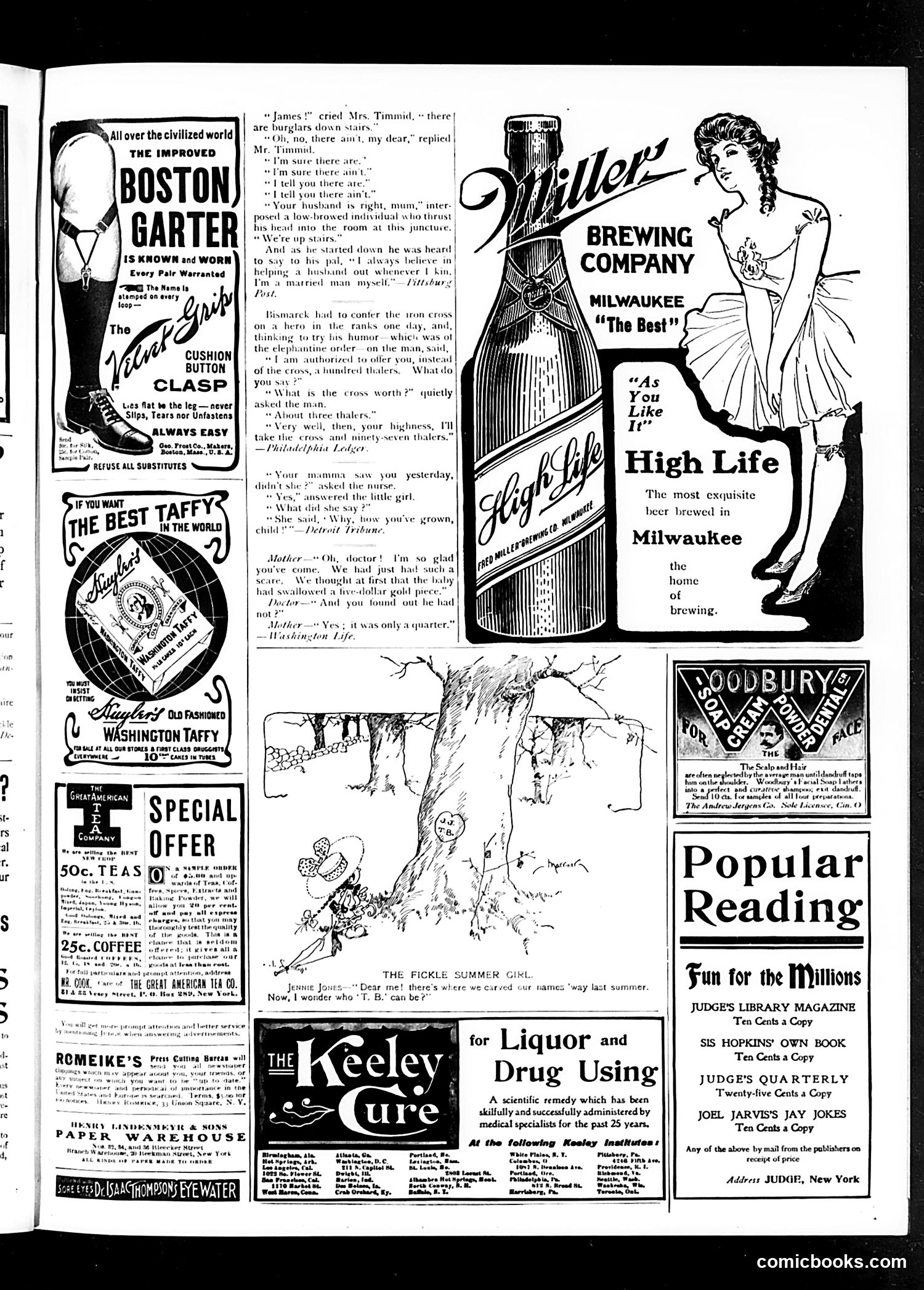
This page is primarily **advertising with interspersed short humorous anecdotes**—typical of Judge magazine's format. The advertisements include garter clasps, taffy candy, tea, and notably **Miller Brewing Company's "High Life" beer** and **"The Keeley Cure"** for alcohol and drug addiction. The latter is particularly striking to modern readers: it represents a legitimate medical treatment promoted during Prohibition-era America, advertising itself as a scientific remedy administered by specialists. The humor pieces are domestic comedies with no apparent political satire: - A burglar's politeness to a nervous husband - Bismarck's joke about a soldier's bravery - A child's misunderstanding of mother's compliment - A doctor's relief that a child swallowed a quarter, not gold The page reflects early 20th-century middle-class anxieties (burglars, child safety) and Judge's mix of genteel humor with commercial interests. No specific political figures or events appear identifiable.
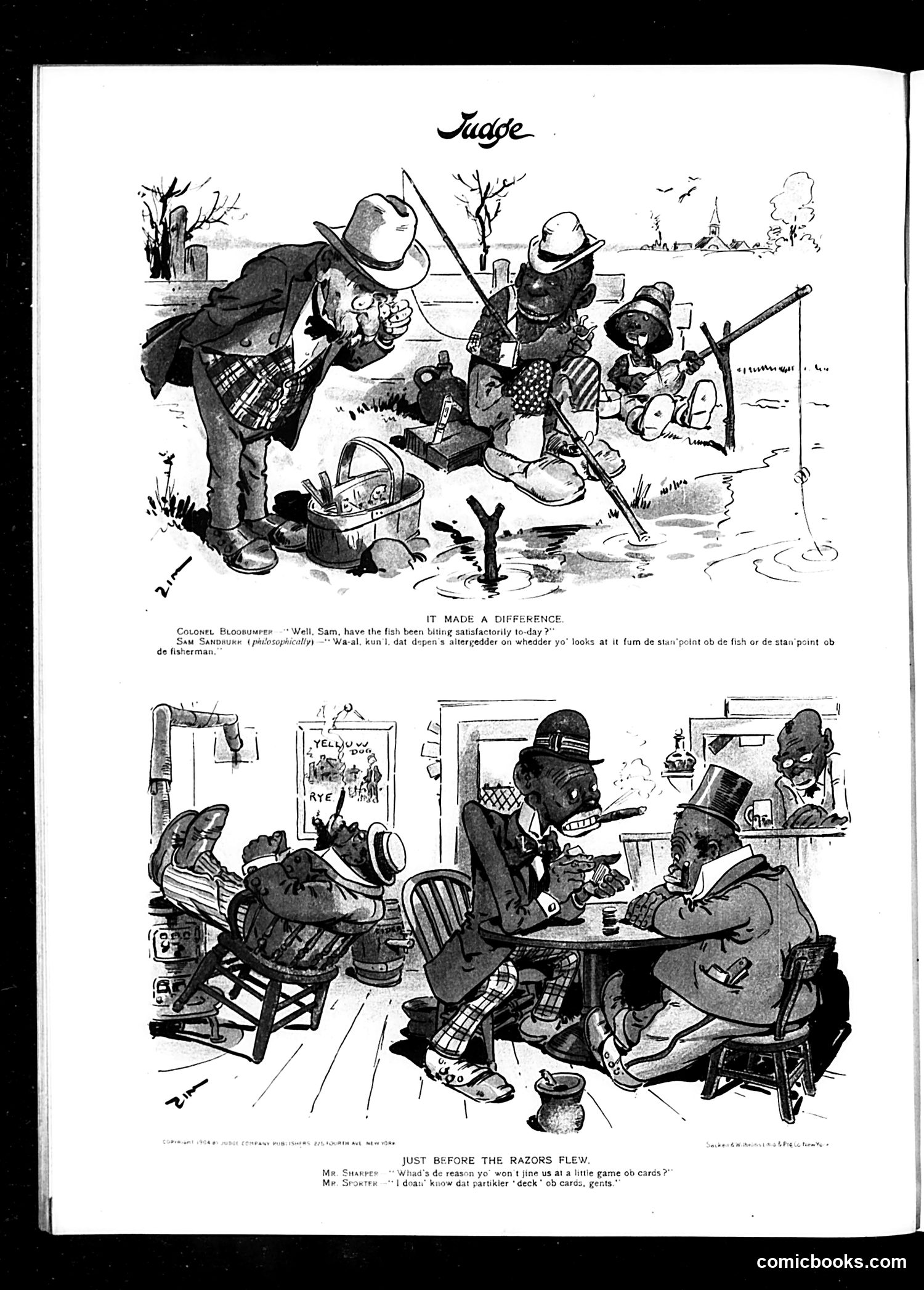
This page contains two separate cartoons depicting African American characters in dialect-heavy situations, typical of early 20th-century American satirical humor. **Top cartoon ("It Made a Difference"):** Colonel Bloodsucker asks Sam Sampson about fishing success. Sam philosophically responds that the answer depends on perspective—the fish's or the fisherman's. This appears to satirize how interpretation depends on one's vantage point, possibly commenting on labor or class relations. **Bottom cartoon ("Just Before the Razors Flew"):** Two men invite another to play cards, but he declines, claiming unfamiliarity with "that particular deck." The title suggests violence ("razors flew") may follow—likely a racial stereotype joke implying Black men fight over cards. Both cartoons use exaggerated dialect and caricature typical of minstrelsy-era humor now recognized as deeply offensive stereotyping. The satire targets Black characters rather than engaging substantive political commentary.