
A complete issue · 16 pages · 1905
Judge — March 4, 1905
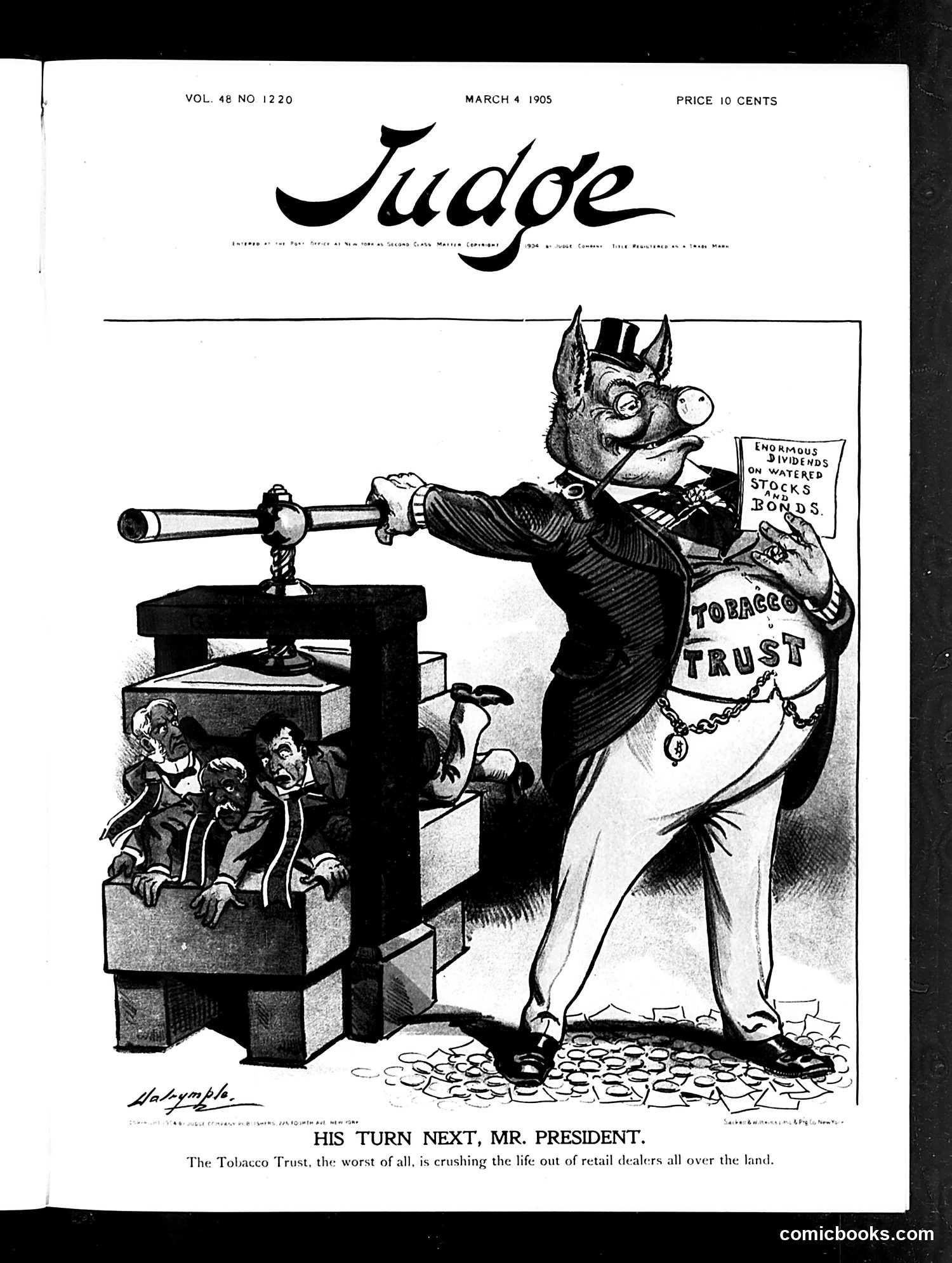
This is a 1905 *Judge* magazine cartoon attacking the **Tobacco Trust**—a monopoly controlling the cigarette and tobacco industry. The figure with the telescope appears to be President **Theodore Roosevelt**, known for trust-busting. The satirical point: a well-dressed capitalist (the "Tobacco Trust," labeled on his body) operates a cannon pointed at small figures in a box below—representing **retail tobacco dealers** being crushed by the monopoly's predatory practices. The cannon and telescope suggest the Trust's power to target and destroy competition. The title warns Roosevelt that after dealing with other trusts, the Tobacco Trust should be **his next target**. The scattered coins beneath emphasize the economic devastation inflicted on small retailers.
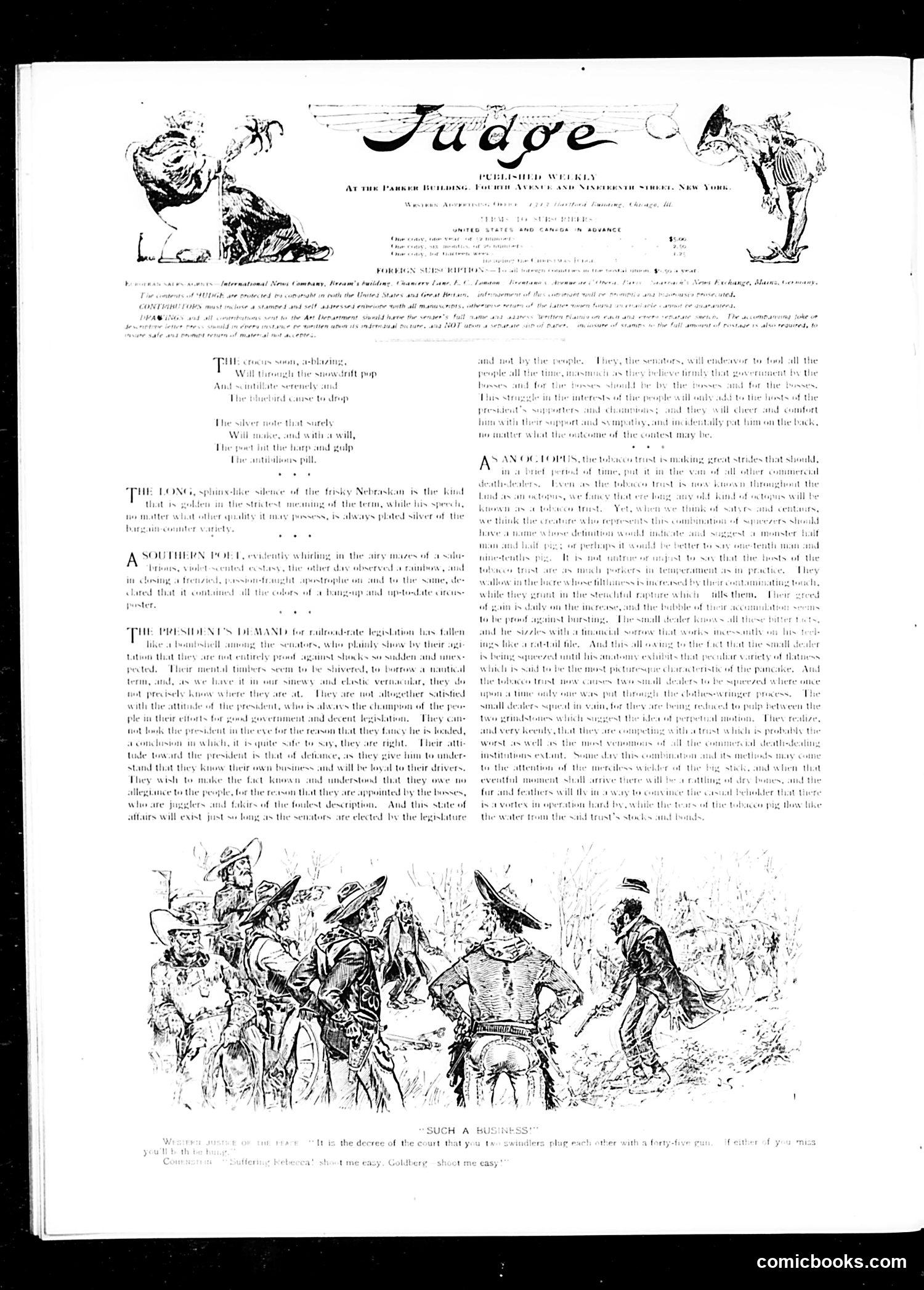
This page satirizes political corruption and the tobacco trust. The top editorial text discusses how the tobacco trust exploits commercial dealerships and manipulates smaller dealers through predatory practices—controlling prices, squeezing profits, and using intimidation. The large illustration at bottom depicts what appears to be corrupt politicians or tobacco industry figures conducting illicit negotiations ("Such a Business"). The cartoon mocks their schemes to monopolize the tobacco market while maintaining plausible deniability. The editorial argues that despite senators' public claims of oversight, they fail to meaningfully regulate corporate abuses. Judge criticizes the disconnect between politicians' rhetoric about protecting ordinary citizens and dealers versus their actual inaction against monopolistic practices. This reflects Progressive Era concerns about unchecked corporate power.
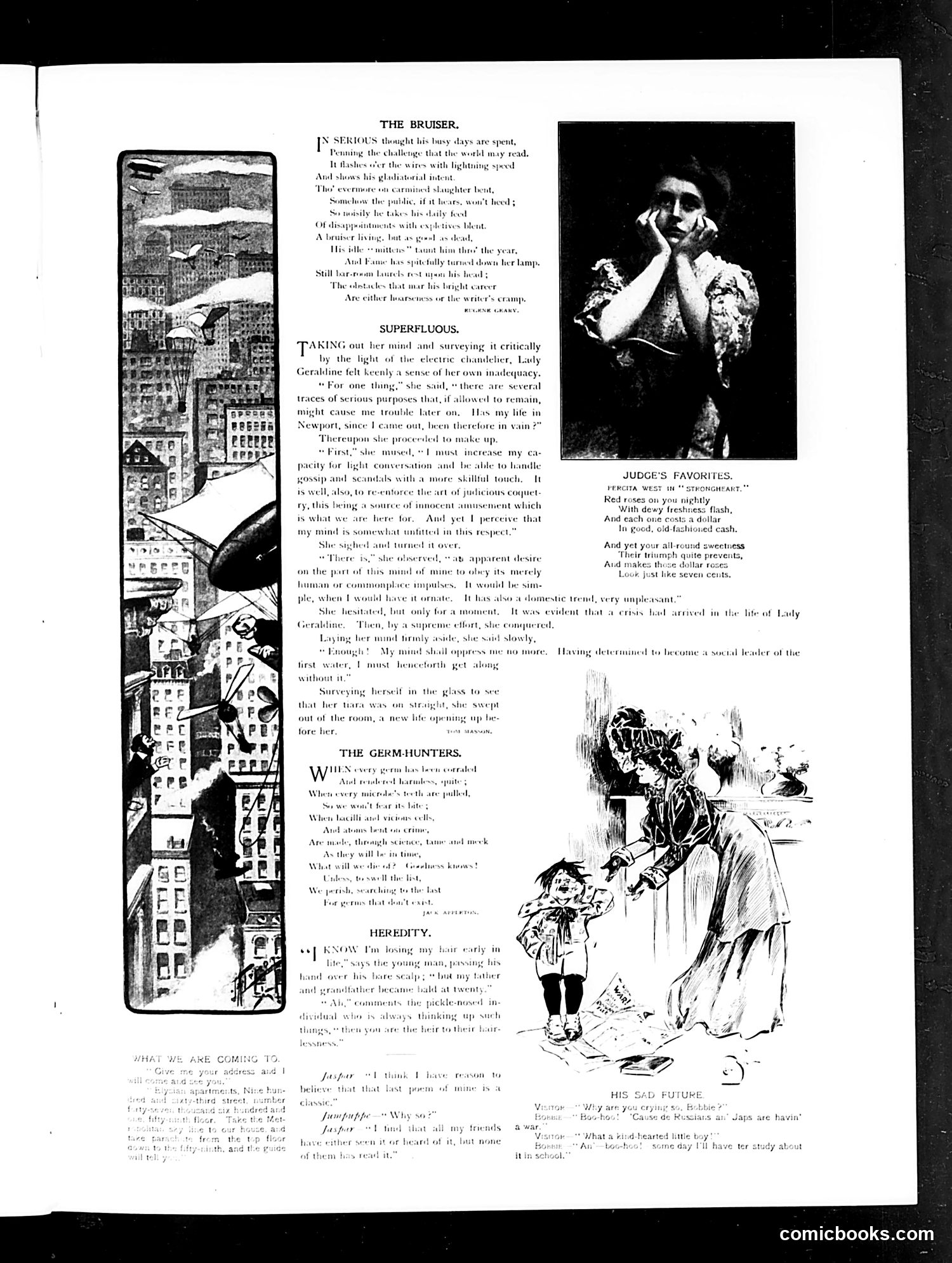
This page contains several satirical poems and illustrations typical of Judge magazine's social commentary: **"The Bruiser"** critiques a boxer or fighter whose violent nature contradicts polite society's expectations—he's brutish yet claims sophistication. **"Superfluous"** depicts a woman (Lady Geraldine) anxious about her social status in Newport, worried her past may undermine her aspirations to become a society leader. The satire targets nouveau-riche anxiety and social climbing. **"Heredity"** jokes about class pretensions—a young man boasts of aristocratic ancestors while his father was actually a laborer, mocking inherited-status claims. **"The Ghost-Hunters," "His Sad Future,"** and **"What We Are Coming To"** appear to be shorter satirical pieces on various social follies, though text quality makes precise interpretation difficult. The overall theme targets late-19th/early-20th-century American social pretension and class anxieties.
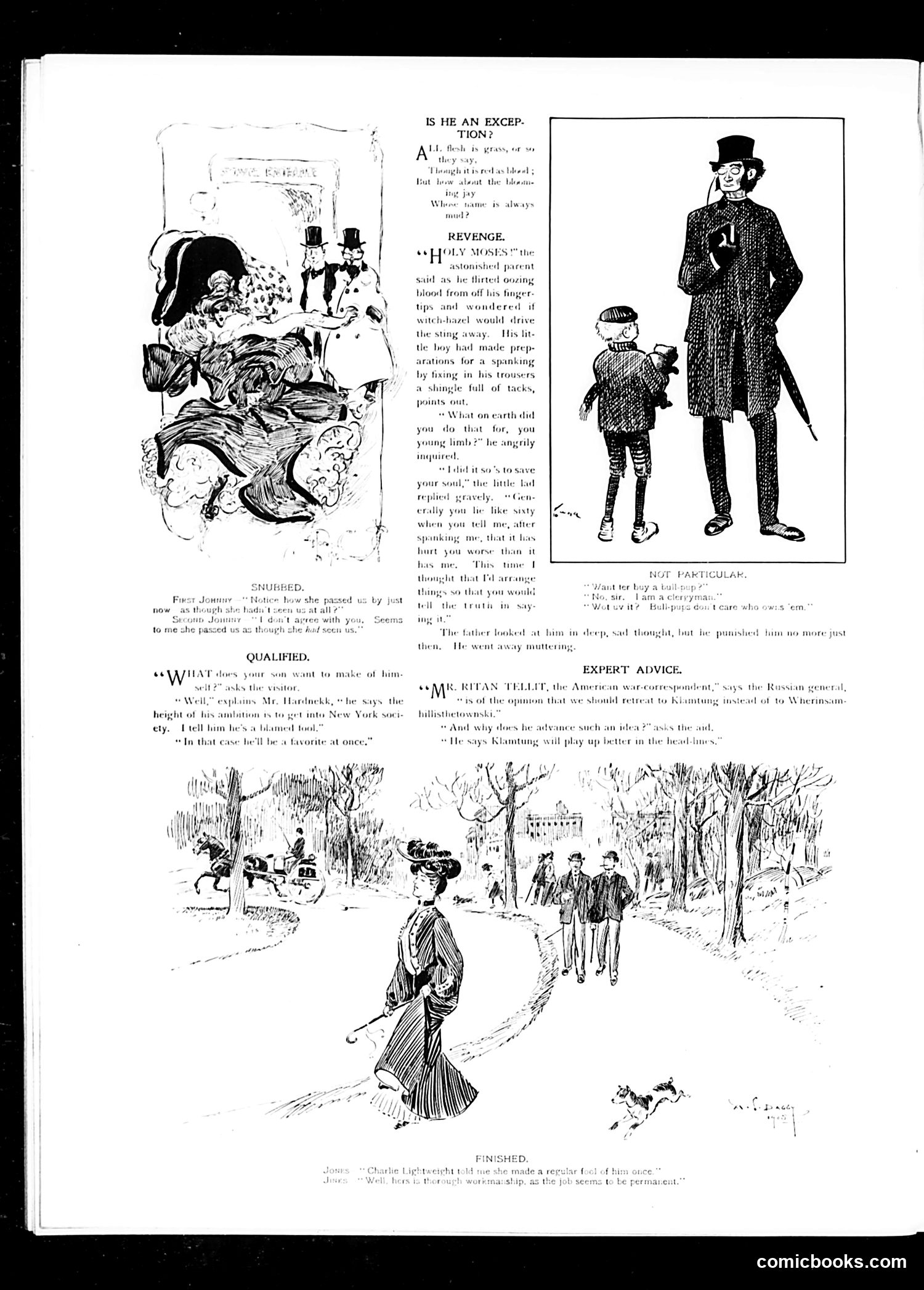
This Judge magazine page contains three sections satirizing social issues: **"Is He an Exception?"** and **"Revenge"** mock parental discipline. The first questions whether a well-behaved child exists; the second shows a parent using unusual punishments (like "living in his trousers"). The satire targets Victorian-era parenting debates. **"Qualified"** jokes about a visitor asking what a man wants to make of his son, with the response "Well, he says he wants to be a loafer." The humor targets parental anxiety about sons' ambitions. **"Expert Advice"** references a Russian general's opinion on military strategy, likely commentary on contemporary international affairs, though the specific conflict is unclear from available text. **"Finished"** shows a woman golfing, satirizing women's expanding participation in sports and leisure activities—a social change point in the era.
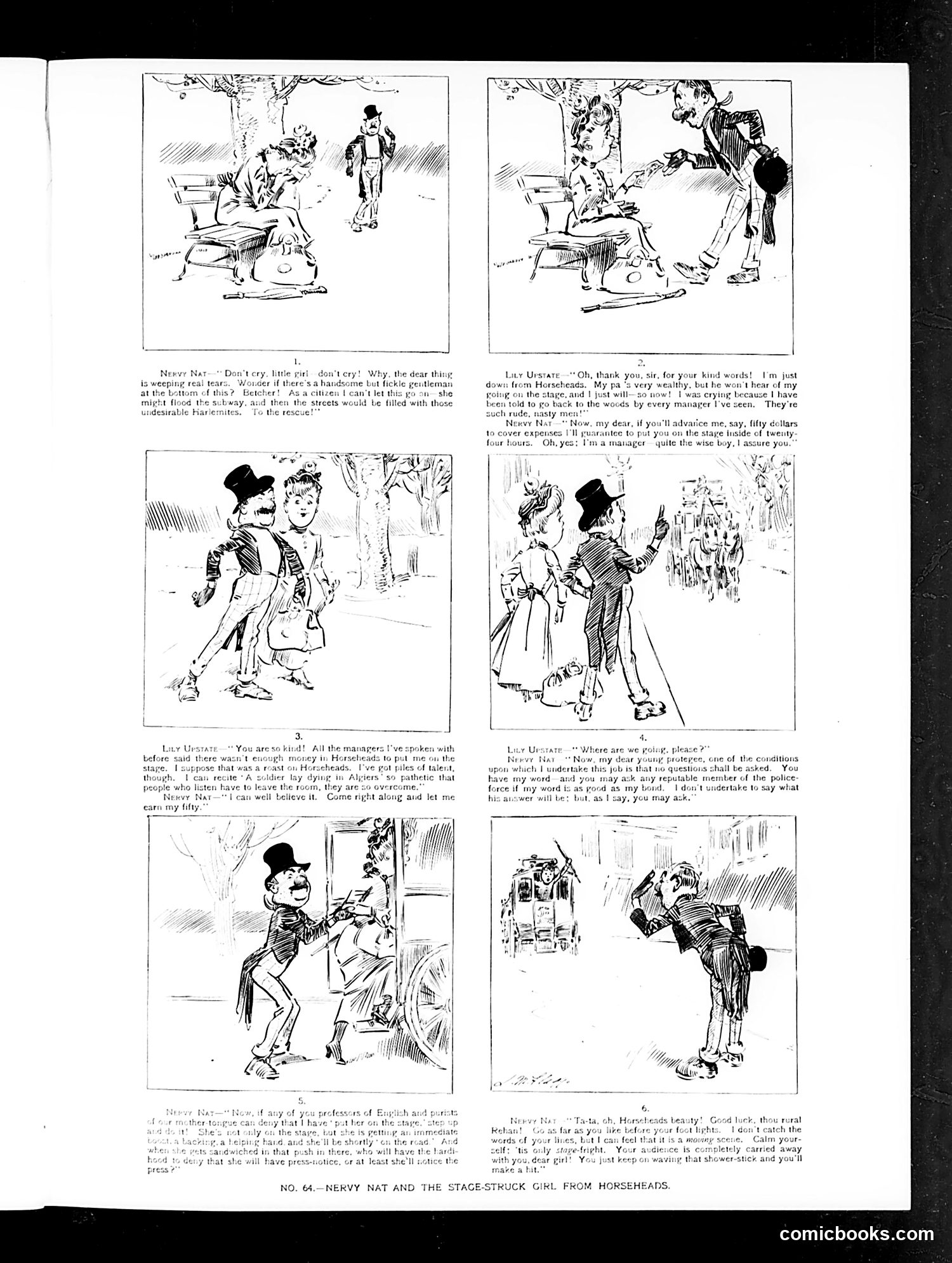
This is a comic strip titled "Nervy Nat and the Stage-Struck Girl from Horseheads" depicting a con artist's scheme. The narrative follows a young woman from a rural area (Horseheads) who dreams of becoming a stage performer. A slick male character ("Nervy Nat") exploits her ambitions by promising to advance her theatrical career in exchange for fifty dollars—money she doesn't have. The satire mocks two targets: gullible young women seduced by show-business fantasies, and predatory con men who prey on their dreams. The "stage-struck girl" represents a common early-20th-century social anxiety about rural girls vulnerable to urban deception. The humor operates through the gap between her naive hopes and the obvious con being perpetrated on her.
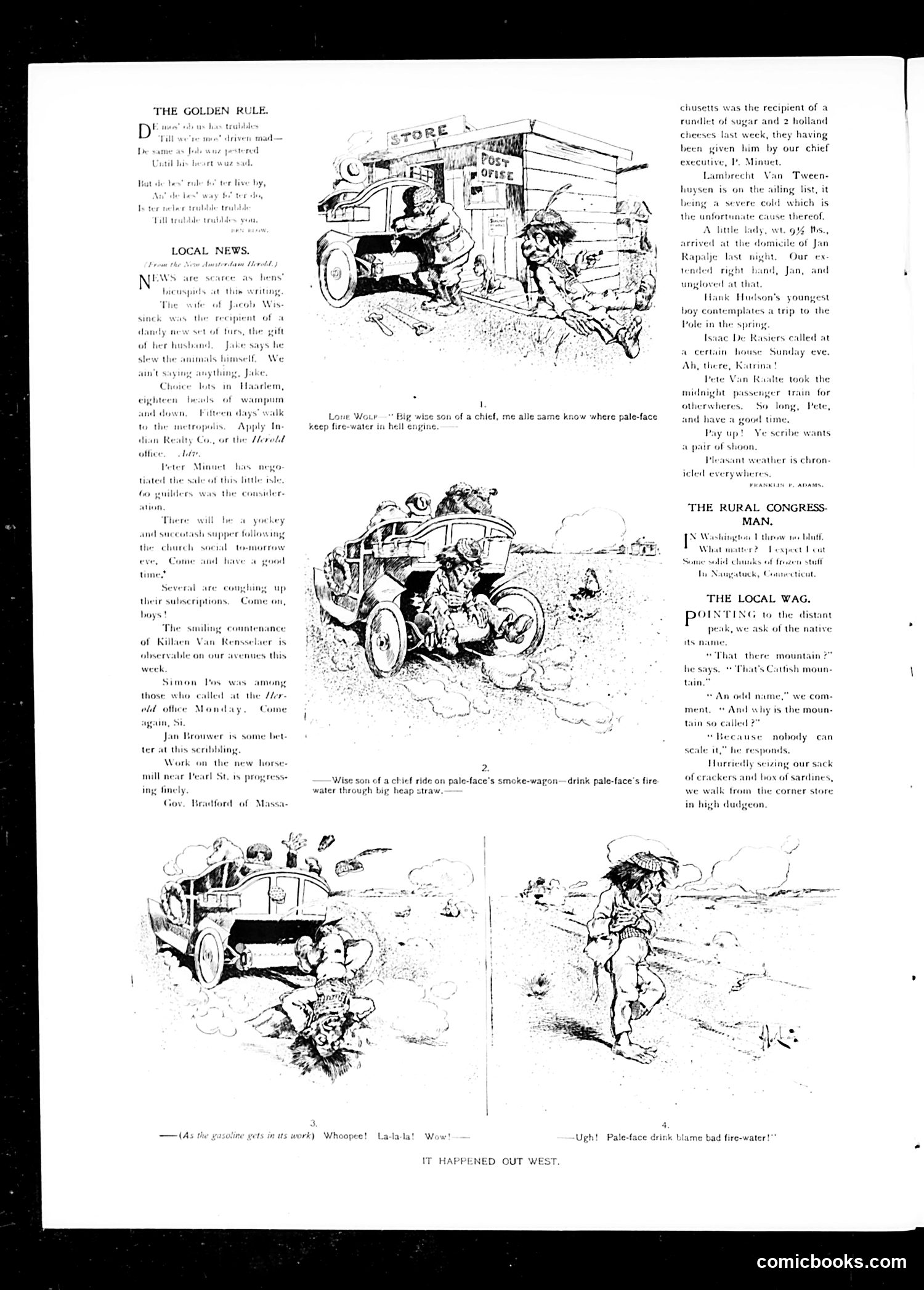
This page contains multiple humorous rural vignettes typical of early 20th-century American satire. The "Local News" section offers gentle mockery of small-town life through brief, gossipy announcements about neighbors—Jake Chote's lottery winnings, various residents' illnesses and travels, and a scribe's persistent requests for payment ("Pay up! Ye scribe wants 2 pair of shoon"). The illustrated panels satirize frontier encounters. Image 2 depicts a Native American chief sampling "pale-face's fire-water" (alcohol) from a wagon, playing on period stereotypes. Image 4 shows similar racial caricature humor. "The Rural Congressman" and "Local Wag" sections offer deadpan jokes about rural ignorance—a mountaineer's absurd explanation that "Catfish mountain" can't be scaled because "nobody can." Overall, the page reflects Judge's formula of city-magazine condescension toward rural and Native American subjects, presenting them as quaint, uncivilized, or foolish for contemporary urban readers' amusement.
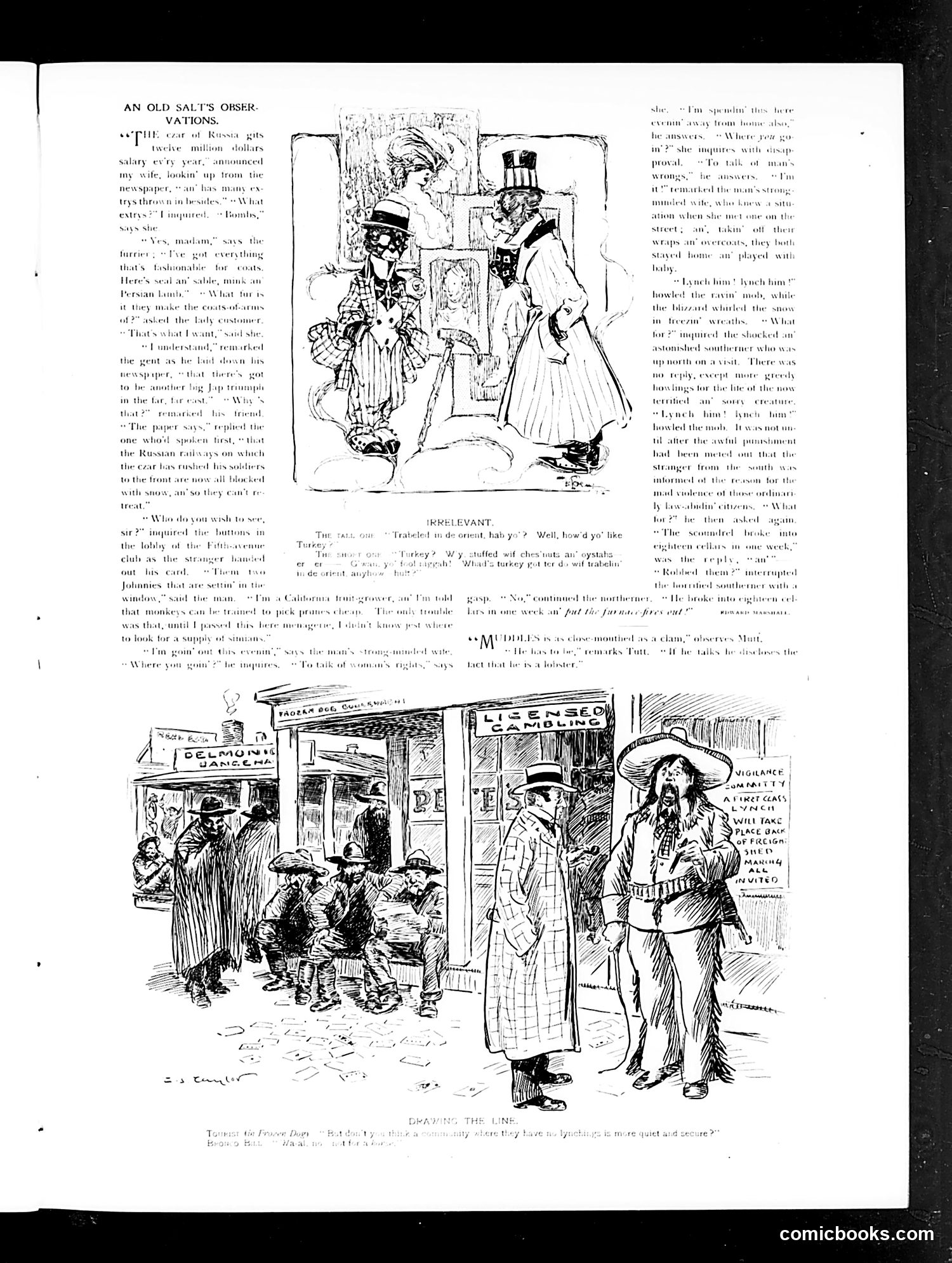
This page from Judge magazine presents satirical commentary on urban street life and social observation. The top section features dialogue between characters—apparently a husband and wife—discussing the peculiar behaviors and fashions they observe in the city, with the husband noting various oddities he's witnessed. The lower cartoon, titled "Drawing the Line," depicts a street scene with what appears to be a vagrant or beggar confronting a well-dressed man. The accompanying text suggests the joke concerns where people draw moral boundaries—the "line" between acceptable and unacceptable behavior or charity. The contrast between the disheveled figure and the buttoned-up gentleman likely satirizes class distinctions and the arbitrary nature of social respectability in the period. The overall theme appears to be commentary on urban character types and the humorous contradictions of city life.
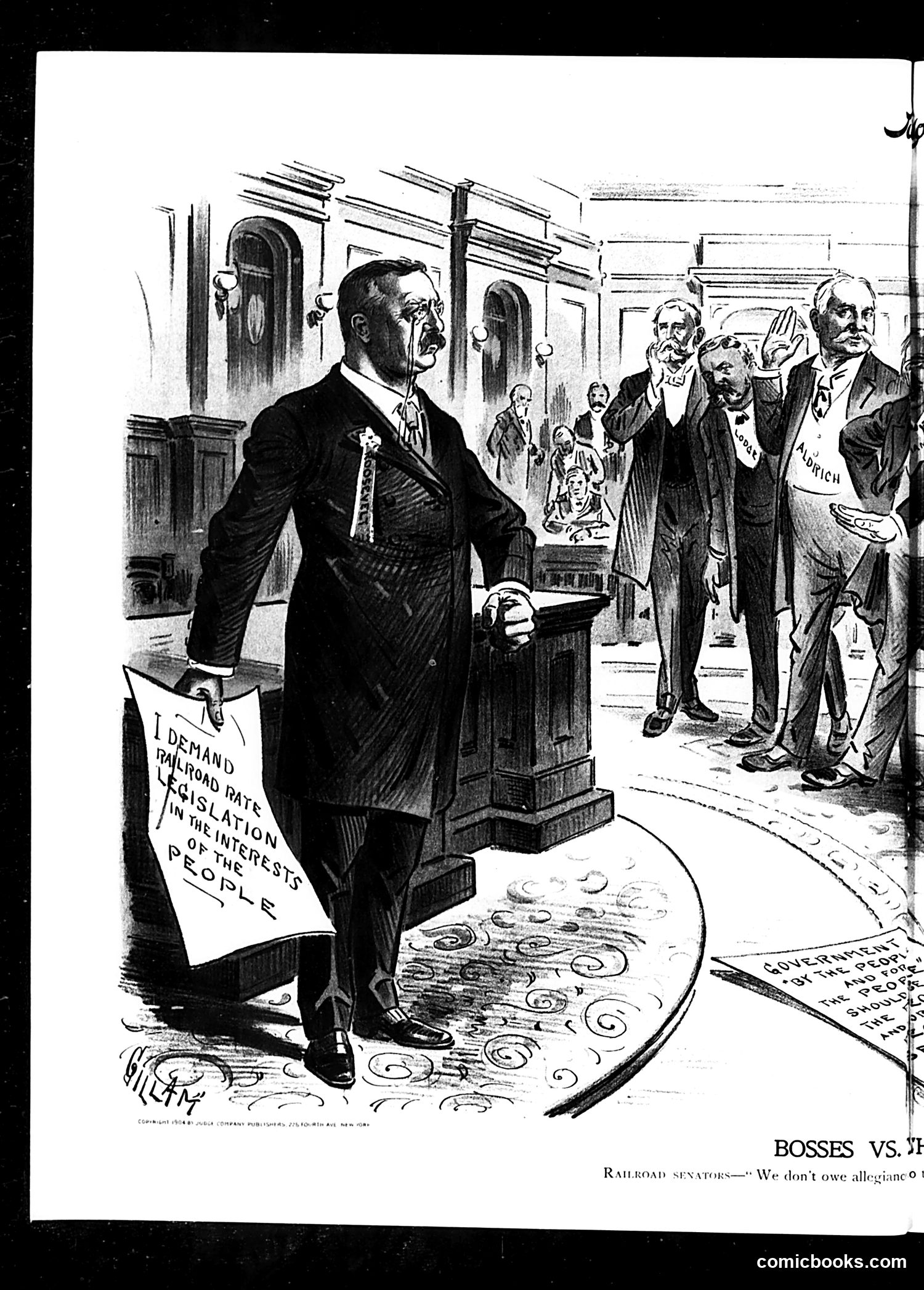
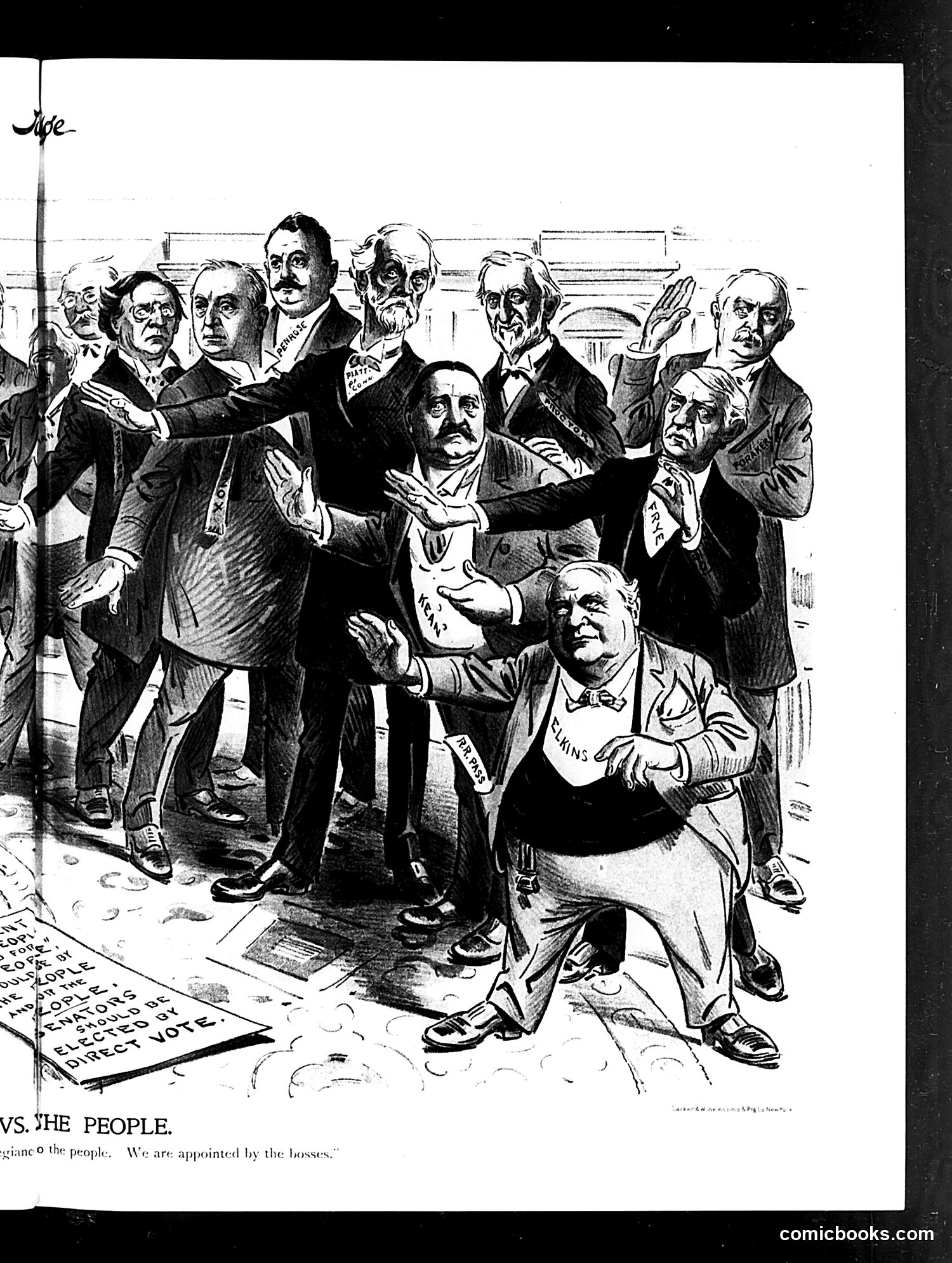
This Judge magazine cartoon satirizes political corruption and the disconnect between elected officials and the public they serve. A group of well-dressed politicians or bureaucrats stand together, their body language dismissive or arrogant toward the common people. The caption's key phrase—"We are appointed by the bosses"—is the satirical punch line. It mocks the idea that these officials answer to political "bosses" (party leaders, wealthy donors, or corrupt machines) rather than to voters or democratic principles. The title "VS. THE PEOPLE" emphasizes this adversarial relationship. The cartoon critiques how political machines and patronage systems operated in the Gilded Age and Progressive Era, where ordinary citizens had little real influence over their representatives. The exaggerated facial features and postures reinforce the caricature of arrogant, self-serving politicians.
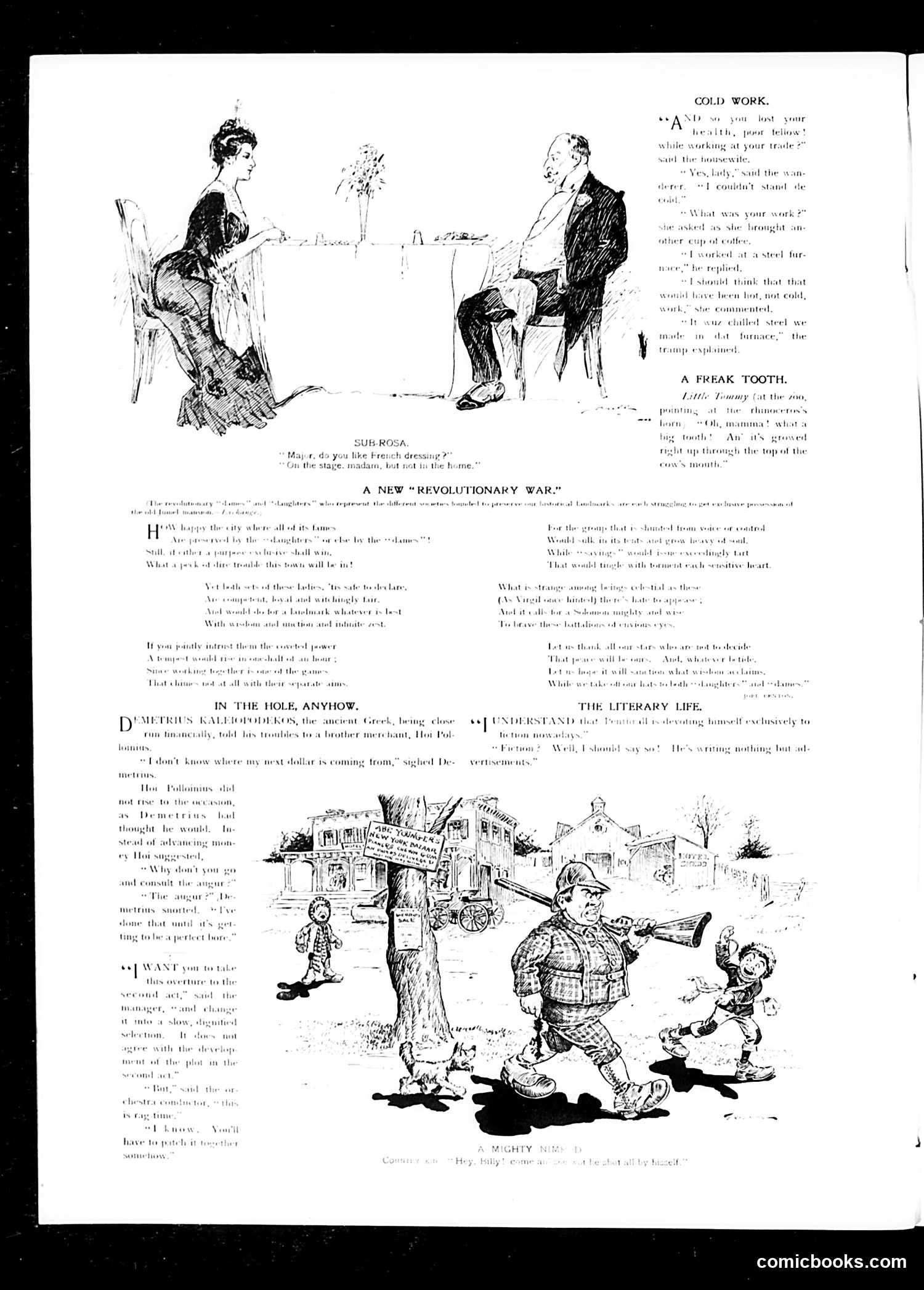
This page contains several unrelated short humor pieces typical of Judge magazine's format: **"Cold Work"** depicts a domestic conversation between a housewife and a man who worked at a steel foundry. The joke plays on the term "chilled steel"—she misunderstands his technical jargon, thinking the work itself was cold rather than understanding it's a metallurgical process. **"A Freak Tooth"** is a brief children's joke about a cow with an unusual tooth growing upward through its mouth. **"Sub-Rosa"** and **"A New Revolutionary War"** appear to be satirical pieces, though the OCR text is too corrupted to determine their specific targets. **"In the Hole, Anyhow"** recounts an ancient Greek anecdote about financial troubles, likely offering moral commentary on economic hardship. **"The Literary Life"** discusses a playwright's dismissive attitude toward writing advertisements, suggesting class distinctions in literary work. The page exemplifies Judge's mix of domestic humor, children's jokes, and social satire from the early 20th century.
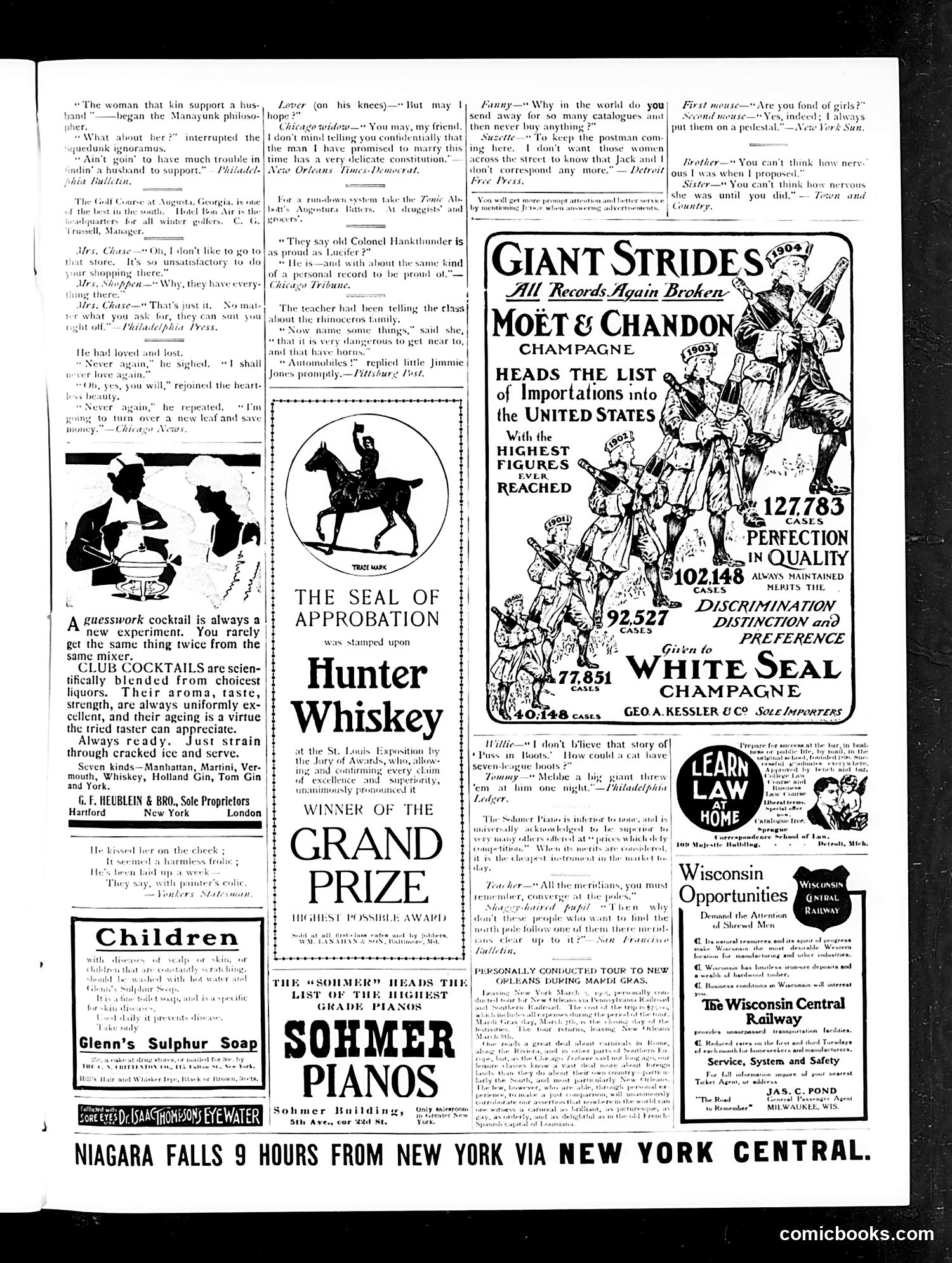
This page is primarily **advertising**, with small comic vignettes interspersed. The main content includes: **Advertisements:** - **Moët & Champagne/White Seal Champagne**: Features an ornate illustration of figures celebrating, emphasizing record import figures and "distinction and preference" - **Hunter Whiskey**: Claims a grand prize award - **Sohmer Pianos**: Advertises as winner of highest award - **Heublein Club Cocktails**: Emphasizes scientific blending - **Wisconsin Opportunities** and **Learn Law at Home**: Self-improvement ads typical of the era **Comic Vignettes:** Several brief joke dialogues mock courtship and romance: a woman supporting a lazy husband, a man proposing with weak health excuses, a teacher's lesson about rhinoceroses, and children's innocent misunderstandings. The humor is gentle, domestic satire—typical early-20th-century Judge fare—rather than sharp political commentary. The page reflects Prohibition-era messaging (advertising alcohol while temperance debates raged) and period attitudes toward gender roles and marriage.
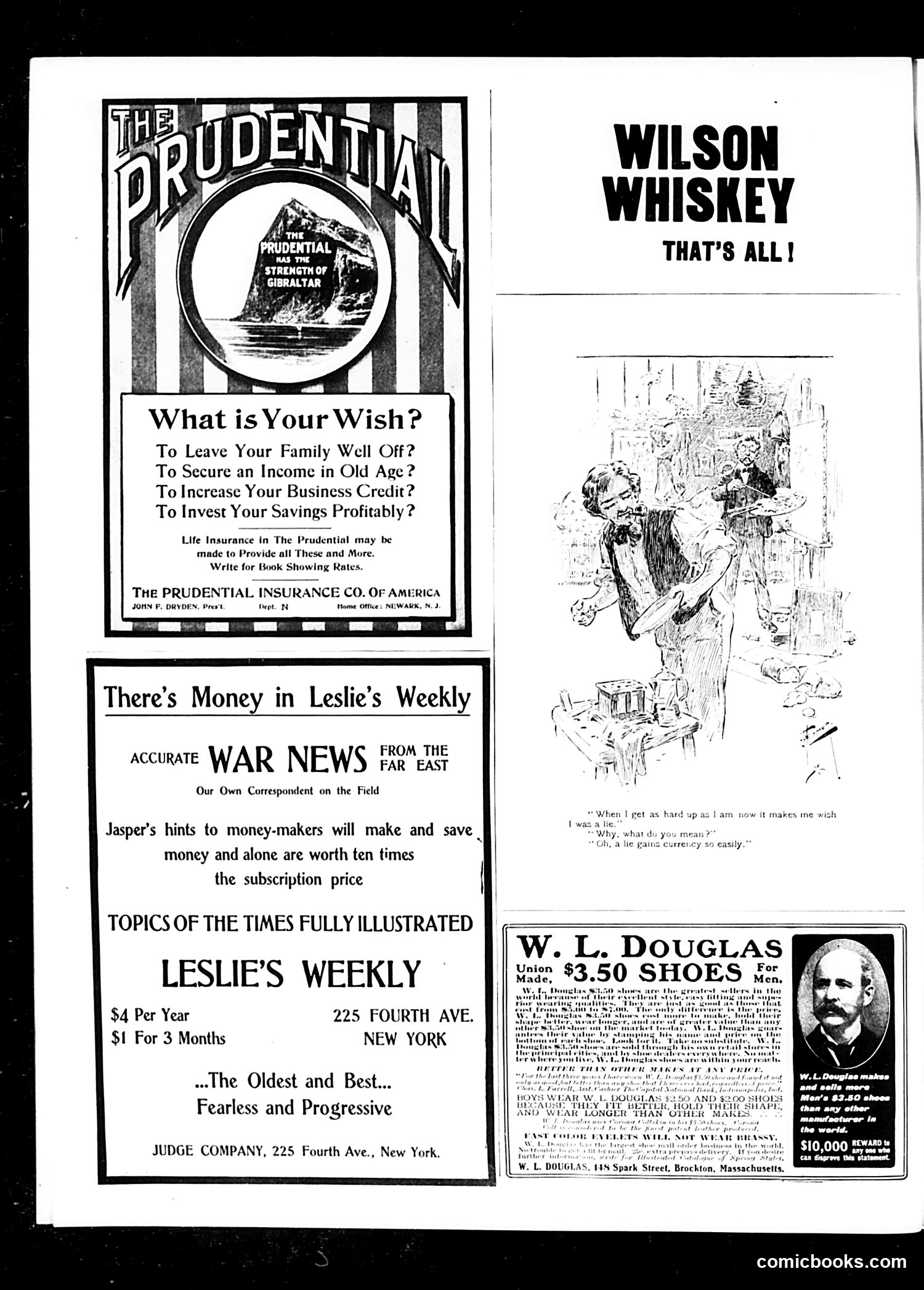
This is primarily an **advertising page** rather than editorial content. The page contains four distinct advertisements: 1. **Wilson Whiskey** (top right): A simple product advertisement with a illustration showing a man and woman, featuring a joke about currency ("a lie gains currency so easily"). 2. **The Prudential Insurance** (top left): Life insurance pitch listing financial security benefits, framed around the logo of Gibraltar (representing strength/stability). 3. **Leslie's Weekly** (center-left): Promotes a competing magazine, highlighting war news coverage from the Far East and financial advice columns, positioning itself as progressive. 4. **W.L. Douglas Shoes** (bottom right): Shoe manufacturer advertisement claiming superiority over competitors at $3.50 per pair. The page appears to be from an era when Judge relied heavily on paid advertising to fund publication. There is **no political satire or social commentary** evident—it's straightforward commercial promotion typical of early 20th-century magazine advertising.
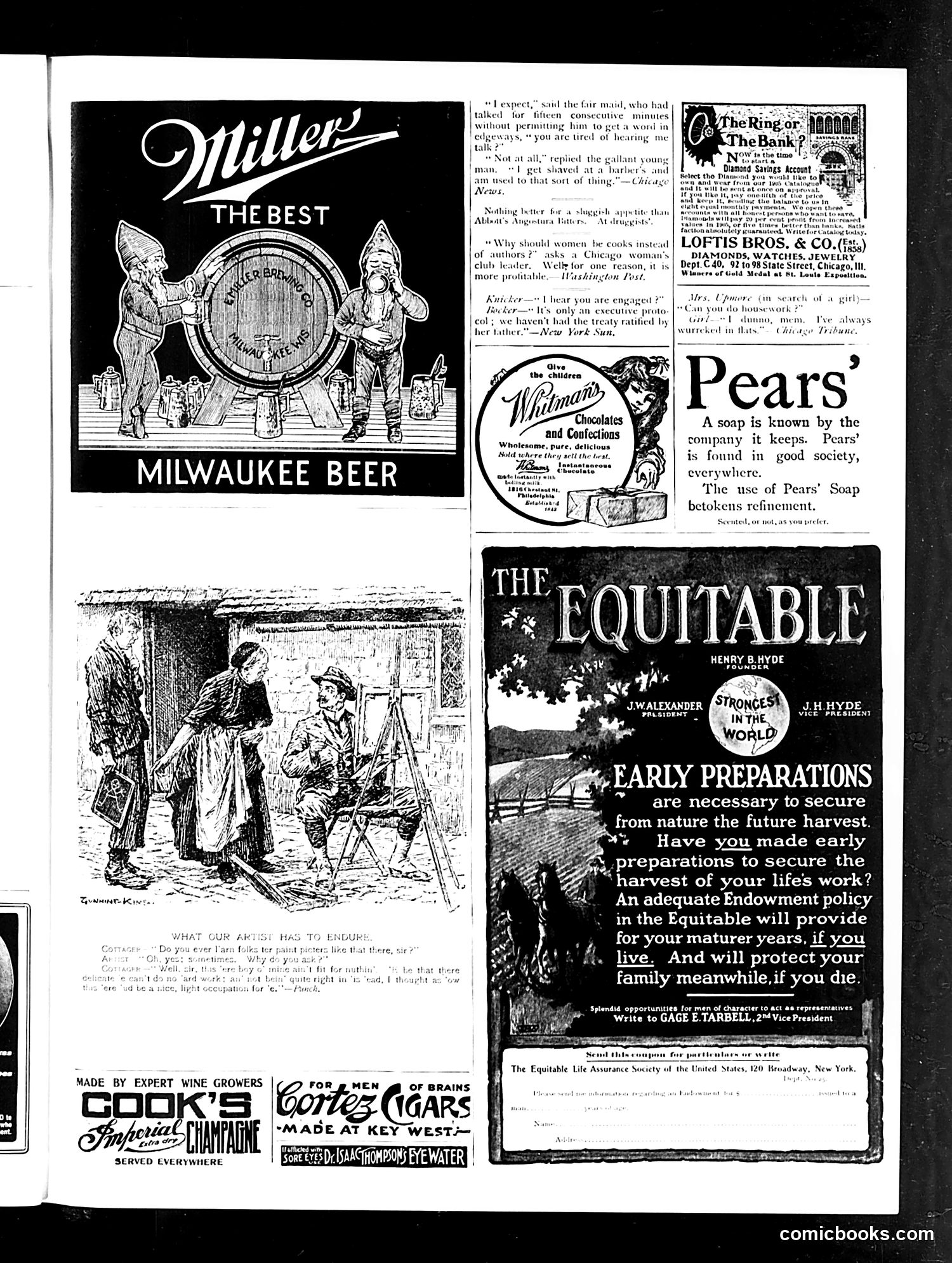
This page is primarily **advertisements** interspersed with brief satirical text snippets rather than coherent political cartoons. The visible content includes: **Advertisements**: Miller's Milwaukee Beer, Whitman's Chocolates, Pears' Soap, Cook's Imperial Champagne, Cortes Cigars, Loftis Bros. jewelry, and The Equitable Life Assurance Society dominate the layout. **Satirical snippets**: Brief dialogue exchanges mock contemporary social attitudes—particularly regarding women's roles (questioning why women should cook instead of write), and gender dynamics in courtship. One exchange appears to joke about a woman's long-winded speech. **Illustration**: A sketch labeled "What Gum Artist Has to Endure" depicts what appears to be an artist working while being observed, likely satirizing the artist's working conditions or public perception. Without identifying specific figures or clearer contextual framing, the page primarily reflects early 20th-century advertising alongside mild social commentary typical of Judge's satirical style, rather than focused political commentary.
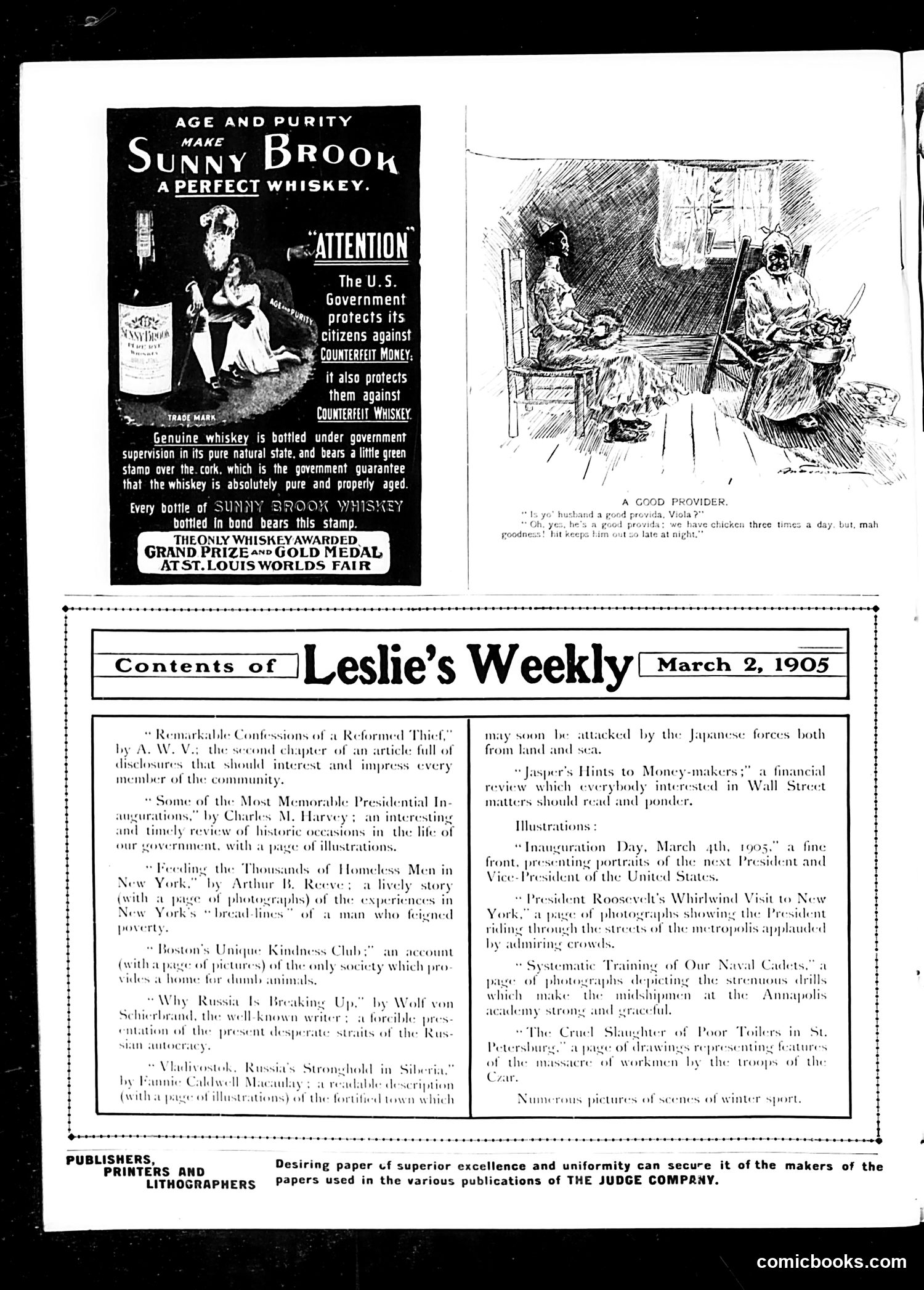
This is a table of contents page with a whiskey advertisement. The ad for "Sunny Brook" whiskey emphasizes government supervision and purity—a response to widespread counterfeiting of spirits in the early 1900s. The government "green stamp" seal advertised here was meant to assure consumers of authenticity and proper aging. The page lists upcoming articles reflecting contemporary concerns: Russian political instability and the Russo-Japanese War (then underway), poverty in New York, presidential inauguration coverage (Theodore Roosevelt's second term), and naval military preparedness. A cartoon appears showing a domestic scene—likely satirizing family life or social conditions—though specific details are unclear from the sketch. The overall content reflects Progressive Era anxieties about fraud, foreign threats, and American military strength circa 1905.
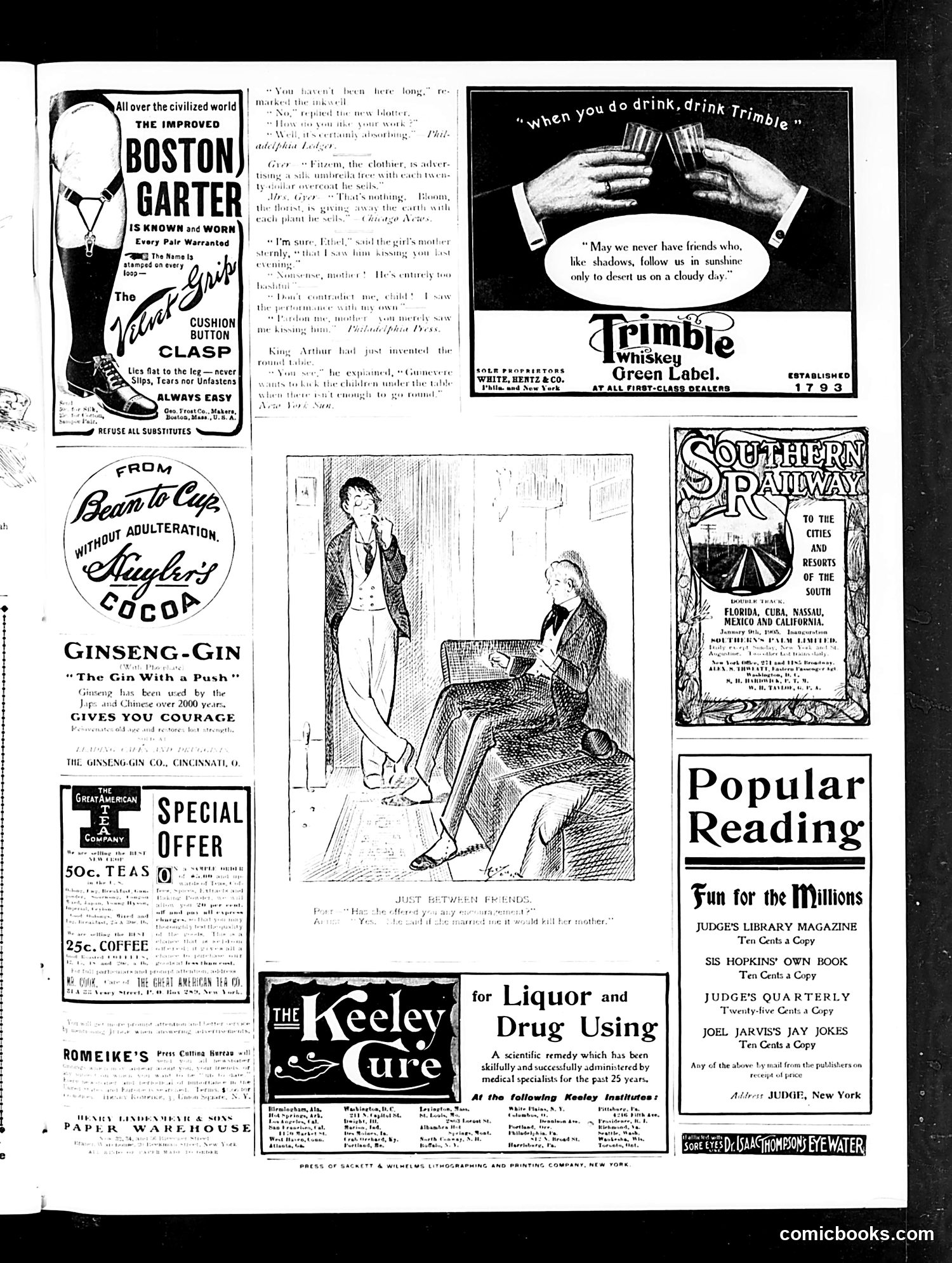
This page is primarily **advertising**, not political satire. It showcases period advertisements typical of early 20th-century American magazines. Notable ads include: - **Boston Garter** (men's hosiery) - **Trimble Whiskey** (with a friendship sentiment about loyalty) - **Ginseng-Gin** ("The Gin with a Push") - **Keeley Cure** for "Liquor and Drug Using" — a real medicinal treatment marketed as a scientific remedy for addiction, administered at multiple institutes nationwide - **Southern Railway** travel advertisement - Various tea, cocoa, and magazine subscription offers The central illustration shows two men in conversation, likely depicting a scene from a story or sketch (OCR text suggests dialogue about friendship). **Context for modern readers:** The Keeley Cure was a genuine (if questionable) late-19th/early-20th-century treatment. The casual advertising of alcohol alongside addiction "cures" reflects the era's conflicted attitudes toward substance use before Prohibition. These ads reveal what products and services were considered respectable to advertise in a major publication.
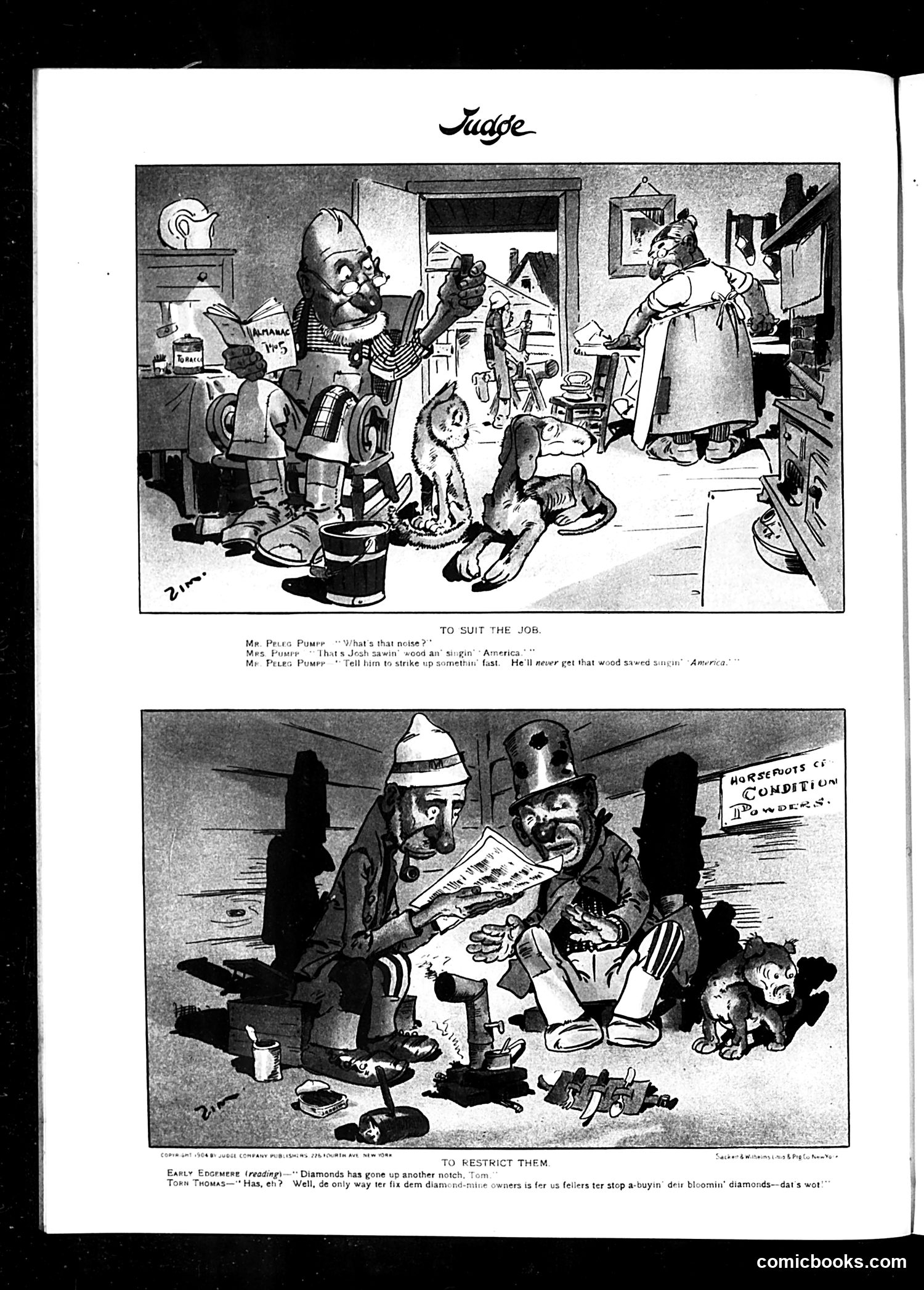
These two satirical cartoons appear to mock working-class labor activism, likely from the early 20th century. **Top cartoon ("To Suit the Job"):** A caricatured figure—possibly representing labor or union leadership—attempts to make a small worker "suit the job" by forcing him into an oversized role. The dialogue references singing "America," suggesting patriotic rhetoric used to motivate workers. **Bottom cartoon ("To Restrict Them"):** Two figures discuss diamond prices and a proposed boycott by workers ("fellers") to prevent diamond purchases. The satire mocks the idea that laborers could effectively restrict luxury goods through collective action, presenting their economic power as laughably ineffective. Both cartoons appear to ridicule labor organizing and workers' attempts at economic leverage, using exaggerated caricatures and dismissive dialogue to present their efforts as futile or misguided.