
A complete issue · 16 pages · 1905
Judge — February 18, 1905
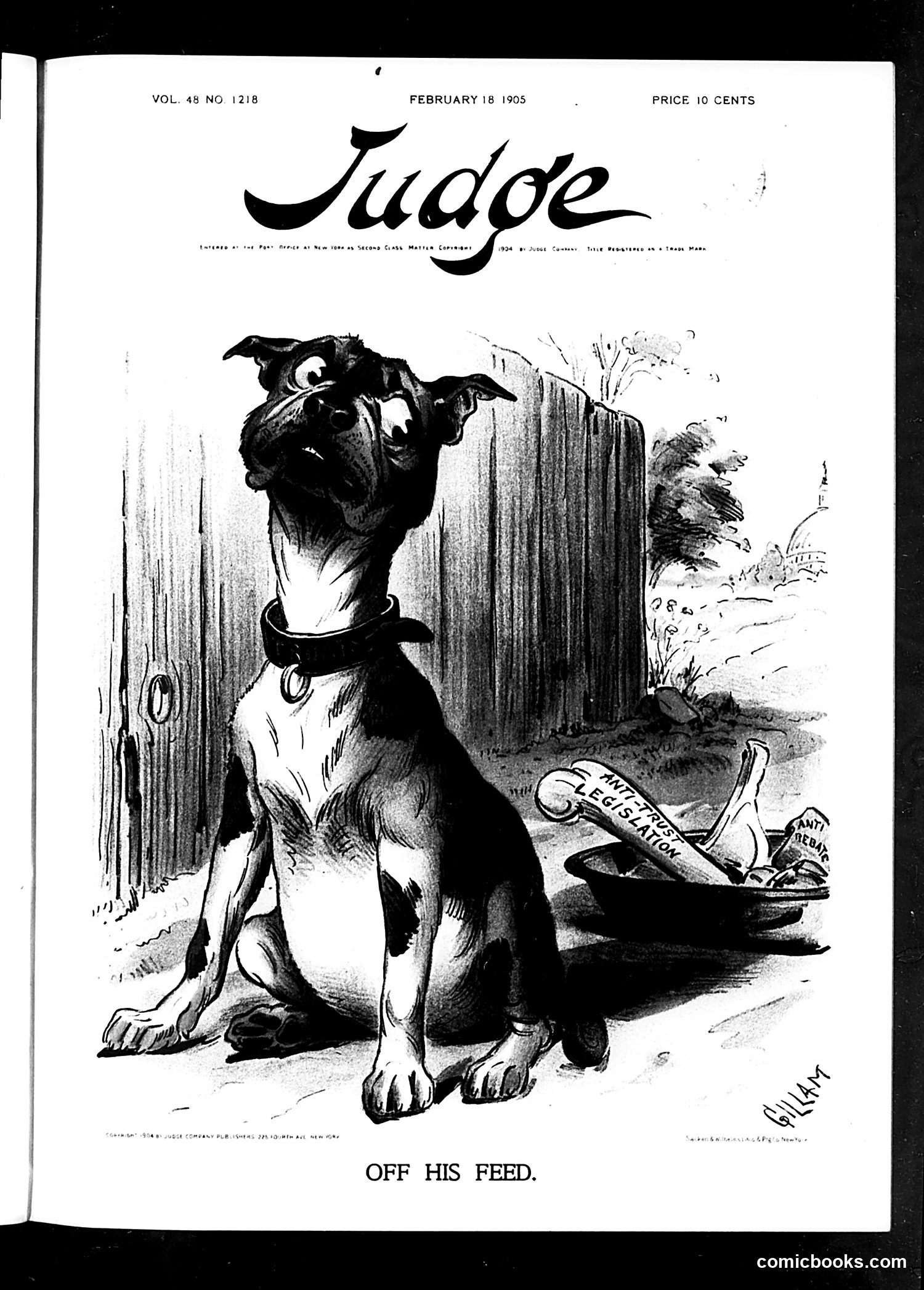
This political cartoon from Judge (February 18, 1905) depicts a bulldog wearing a collar and leash labeled "BEEF TRUST," sitting beside an overturned food bowl. The dog appears distressed or refusing to eat. The satire targets the American beef trust—massive meatpacking monopolies that controlled cattle and meat production. The bulldog, a common symbol of strength and aggression, represents these powerful corporations. By showing it "off his feed" (refusing to eat/unable to feed), the cartoonist suggests the trust faces problems or obstacles—likely referring to recent antitrust regulatory actions or public backlash against monopolistic practices that were intensifying during Theodore Roosevelt's presidency. The humor lies in depicting this "fierce" industrial power as weakened or compromised.
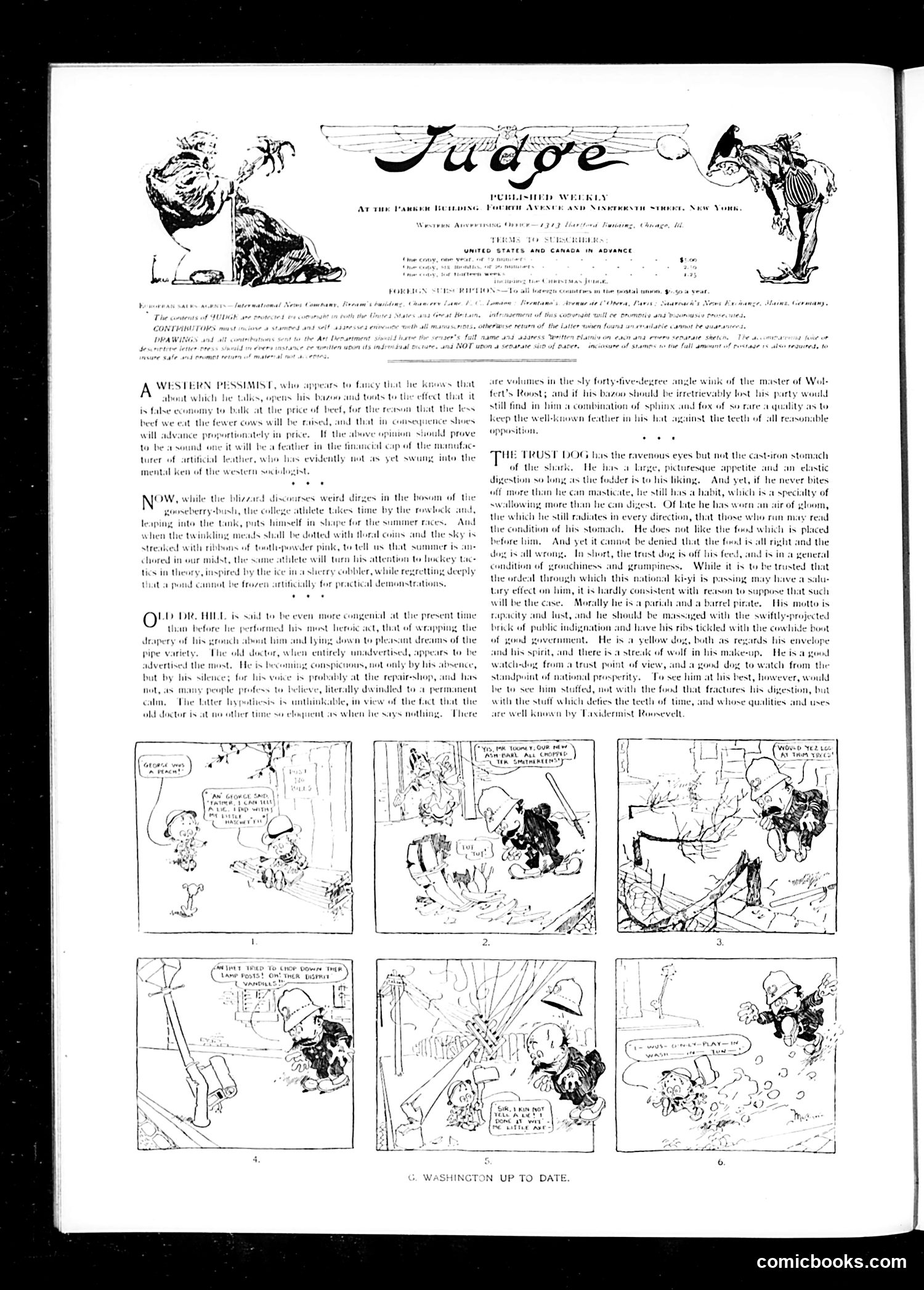
This satirical comic strip parodies contemporary dog behavior through the lens of a "trust dog" - a figure representing monopolistic business practices of the Gilded Age. The text explicitly uses dog metaphors to critique wealthy industrialists who accumulate excessive power and resources. The six-panel narrative appears to show a dog's destructive, selfish behavior - likely satirizing how monopolists like those controlling steel or railroad industries behaved ruthlessly toward competitors and consumers. References to "trusts" and "grandeur and grumpiness" suggest critique of large corporate consolidations that dominated American business in this era. The title "G. Washington Up to Date" ironically contrasts founding principles of fairness with contemporary rapacious capitalism, implying such behavior would horrify the nation's founders.
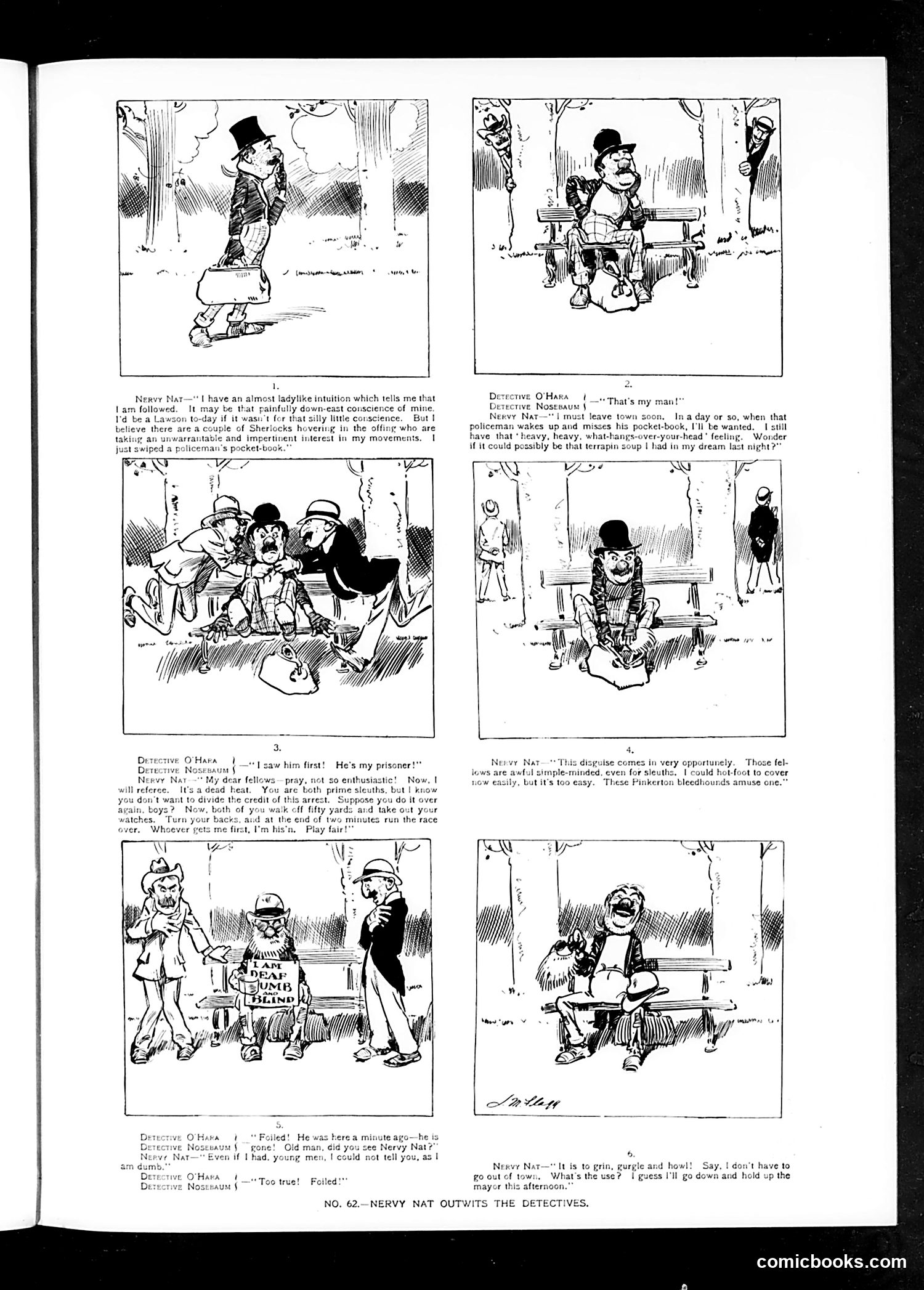
This comic strip features "Nervy Nat," a character who appears to be a small con artist or hustler. The narrative involves Nat convincing two detectives (O'Hara and Norseman) that he's located Sherlocks working undercover in their precinct, stealing from them. The satire targets police incompetence and gullibility. Nat exploits the detectives' pride and professional insecurity by suggesting rival "Sherlocks" are operating in their jurisdiction. Through an elaborate scheme, he extracts money and items from them under false pretenses—tricking them into believing they need to catch this fictitious competition. The humor derives from authority figures being outsmarted by a small-time grifter, reflecting broader skepticism about urban police effectiveness and intelligence.
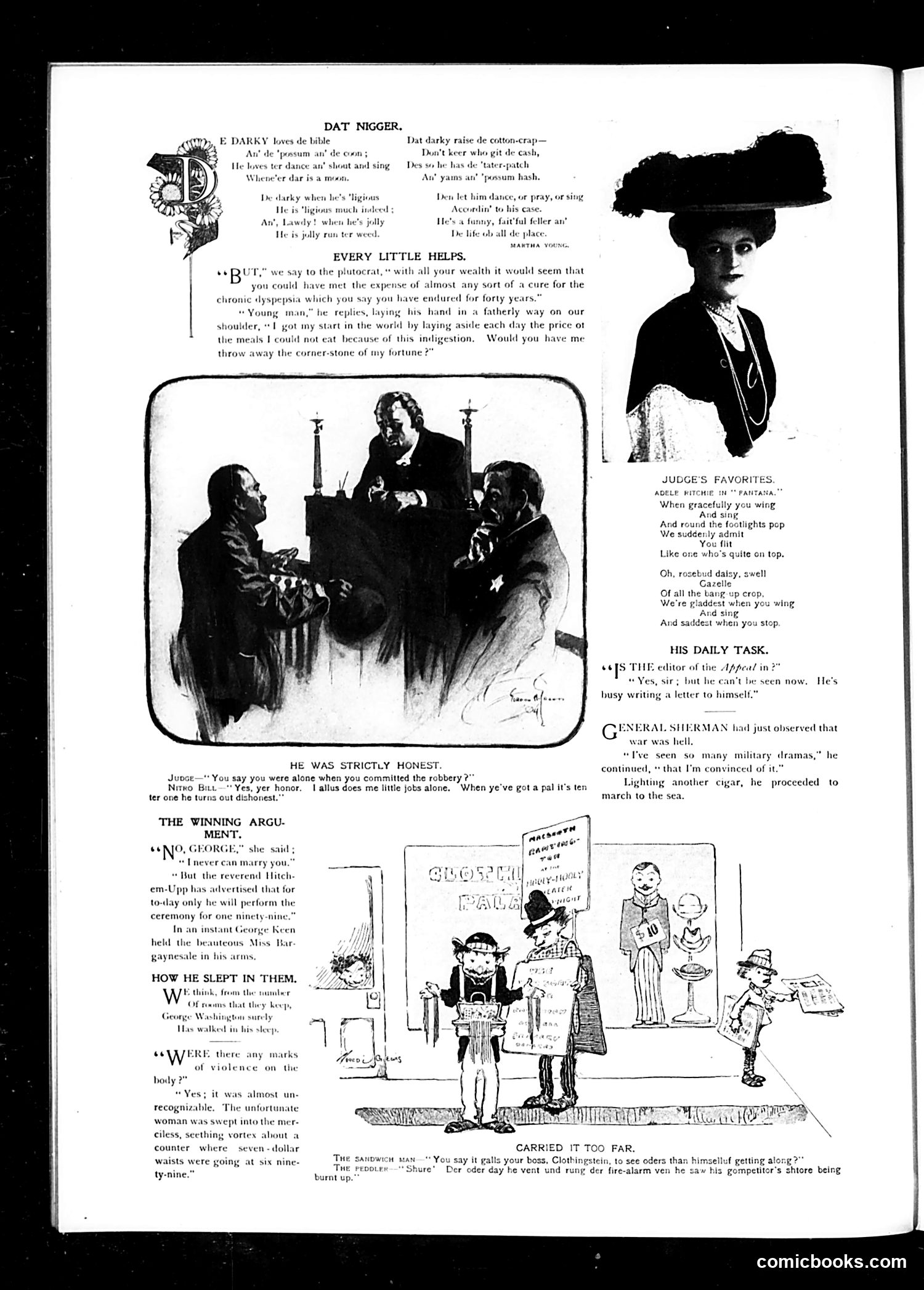
This page contains several unrelated short humor pieces and illustrations typical of Judge's satirical format. "Dat Nigger" presents dialect humor common to the era, depicting a character speaking in exaggerated African American vernacular—a now-offensive comedic style that was standard in early 20th-century American publications. Other sections include "Every Little Helps" (about financial hardship), "He Was Strictly Honest" (a judge and witness interaction), and "The Winning Argument" (about military ceremony). The cartoon titled "Carried It Too Far" shows a sandwich vendor and appears to mock someone's complaint about food quality or portion size. These pieces represent Judge's mix of social commentary, workplace humor, and domestic comedy aimed at educated readers, though the racial content reflects deeply problematic attitudes of the period.
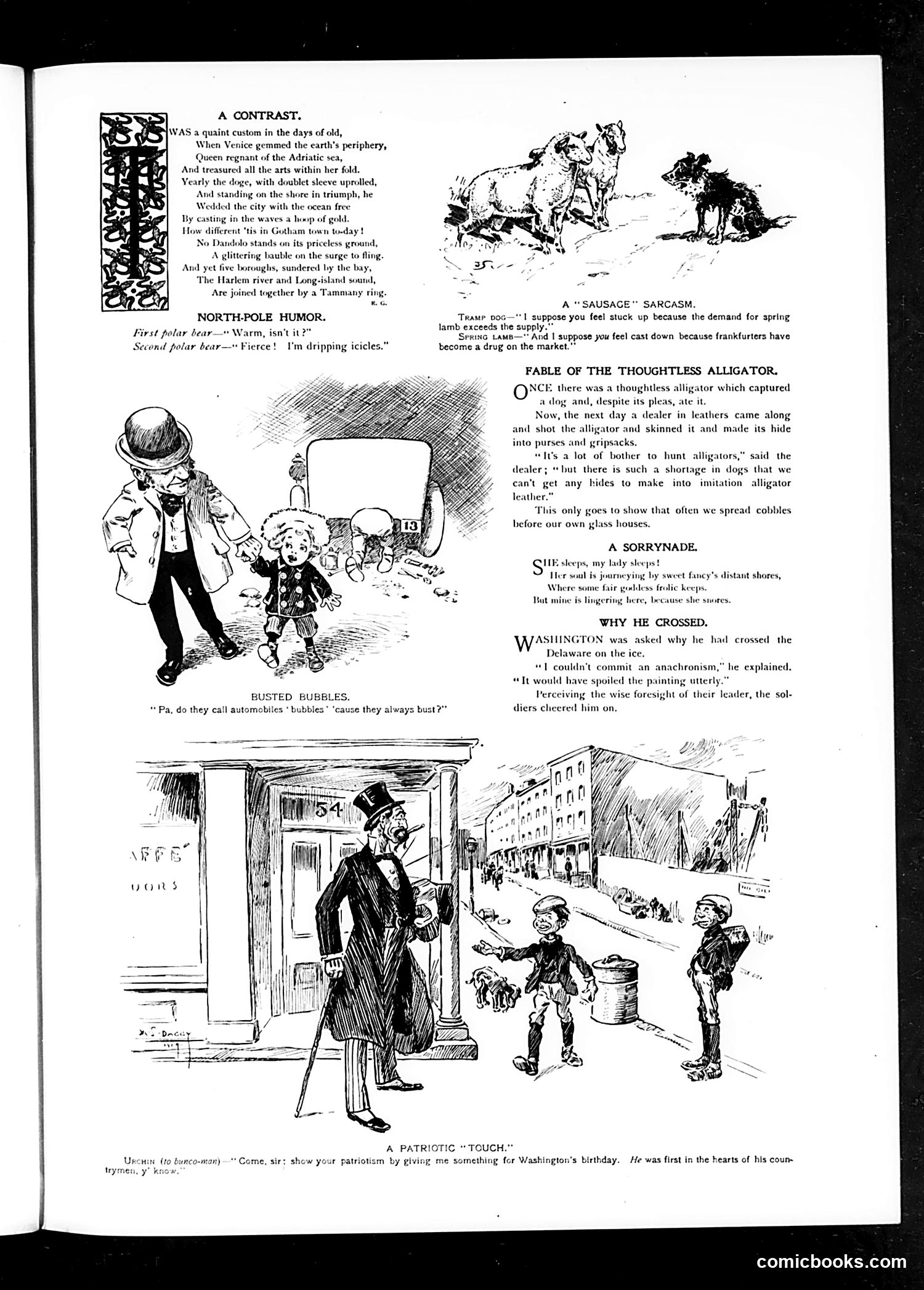
This page contains several humorous pieces typical of early-20th-century American satire: **"A Contrast"** compares Venice's historical grandeur—where the Doge ceremonially "married" the sea by casting gold into it—with modern New York City's mundane infrastructure (the Tammany Ring joining boroughs). **"North-Pole Humor"** is simple joke banter between polar bears about melting. **"Busted Bubbles"** satirizes automobiles as unreliable ("bubbles" that burst). **"Sausage Sarcasm"** depicts market reversals: spring lamb oversupplied while frankfurters are oversold. **"Fable of the Thoughtless Alligator"** is moral satire—a shortage of dog hides forces leather dealers to use alligator hide as substitute, illustrating how problems create unintended consequences. **"Why He Crossed"** humorously suggests Washington crossed the Delaware to avoid "anachronism"—implying historical accuracy matters more than military necessity. **"A Patriotic Touch"** shows a con artist soliciting money for Washington's birthday, exploiting patriotic sentiment.
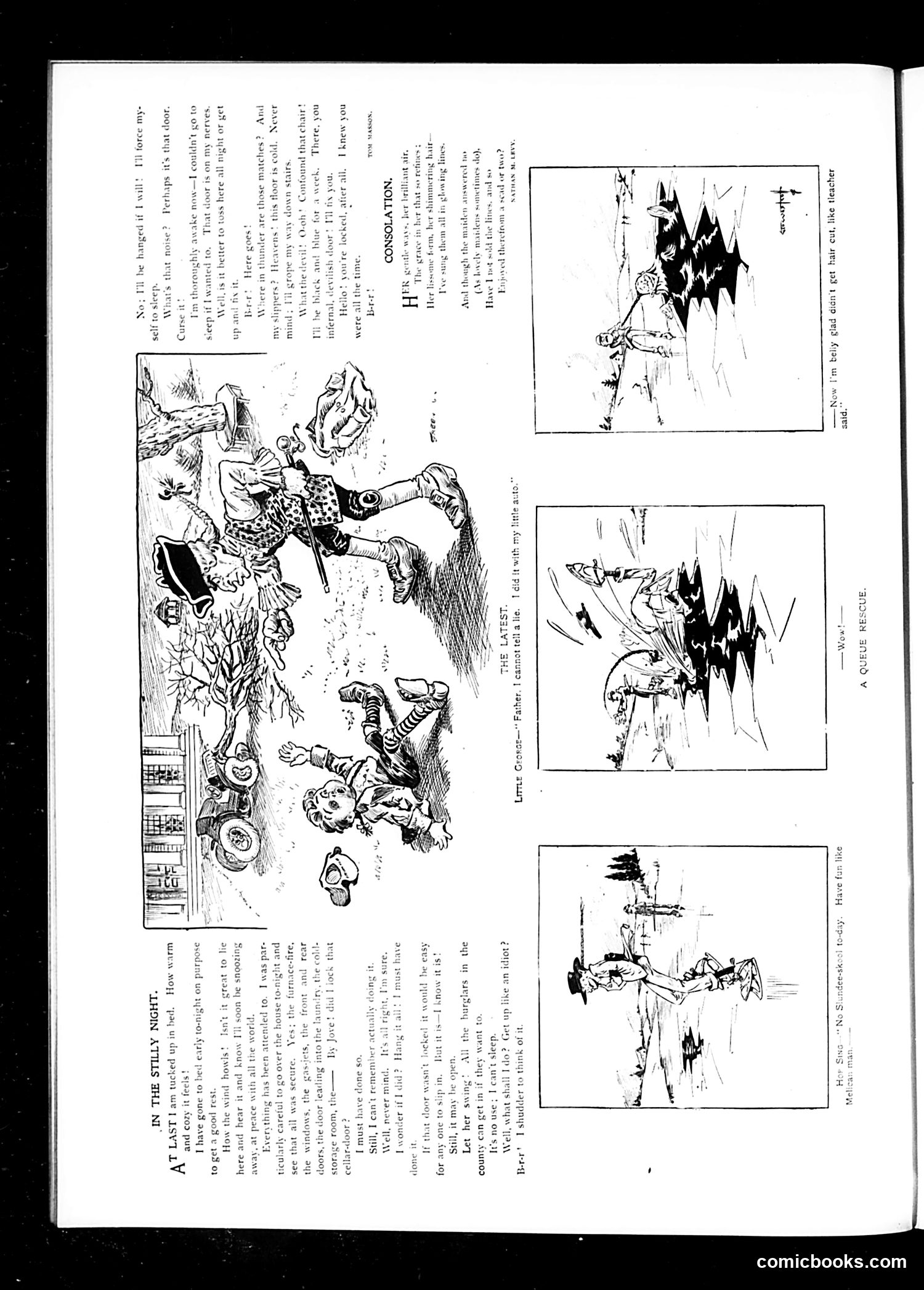
I can see this is a page from Judge magazine featuring several cartoon illustrations and accompanying text, but the OCR quality is too degraded for me to reliably read the specific article text or definitively identify the political figures and references depicted. The page contains what appears to be multiple sequential cartoon panels showing figures in various situations, rendered in the typical ink-sketch style of early 20th-century American political satire. Without being able to clearly read the article text or captions, I cannot accurately identify which political figures or events are being satirized. To provide you with accurate historical context about what specific political or social commentary this page contains, I would need either a clearer image or legible text.
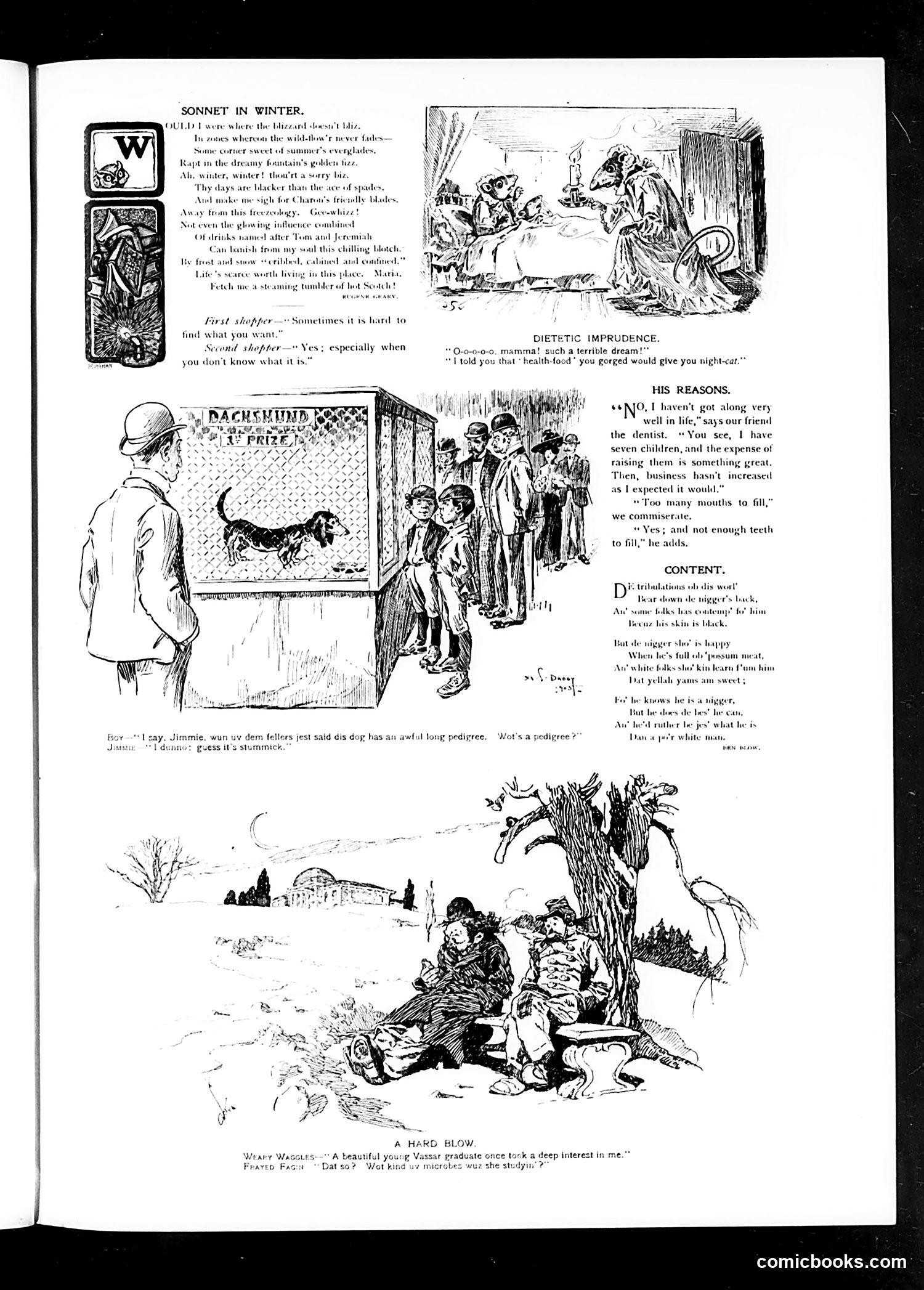
This page contains multiple satirical pieces typical of early 20th-century American humor: **"Sonnet in Winter"**: A romantic poem yearning for warm climates, accompanied by winter scene illustrations—straightforward seasonal nostalgia humor. **"Dietetic Imprudence"**: A woman's nightmare blamed on eating "health-food"—satirizing the contemporary fad of health-food trends, suggesting they cause digestive distress. **"His Reasons"**: A dentist explains his financial struggles: seven children to support, plus his business hasn't grown. The punchline—he has "not enough teeth to fill"—is dark humor playing on the profession's dependence on patients with dental problems. Fewer cavities means fewer patients. **Pedigree joke**: A working-class character misunderstands "pedigree" (ancestry) as "stomach," suggesting the dog's long lineage is really just a long digestive tract. This mocks both class differences in vocabulary and dog breeding pretensions. **"A Hard Blow"**: A woman admits a Vassar graduate interested her only while she was *studying* something—implying shallow romantic interest disconnected from her actual person.
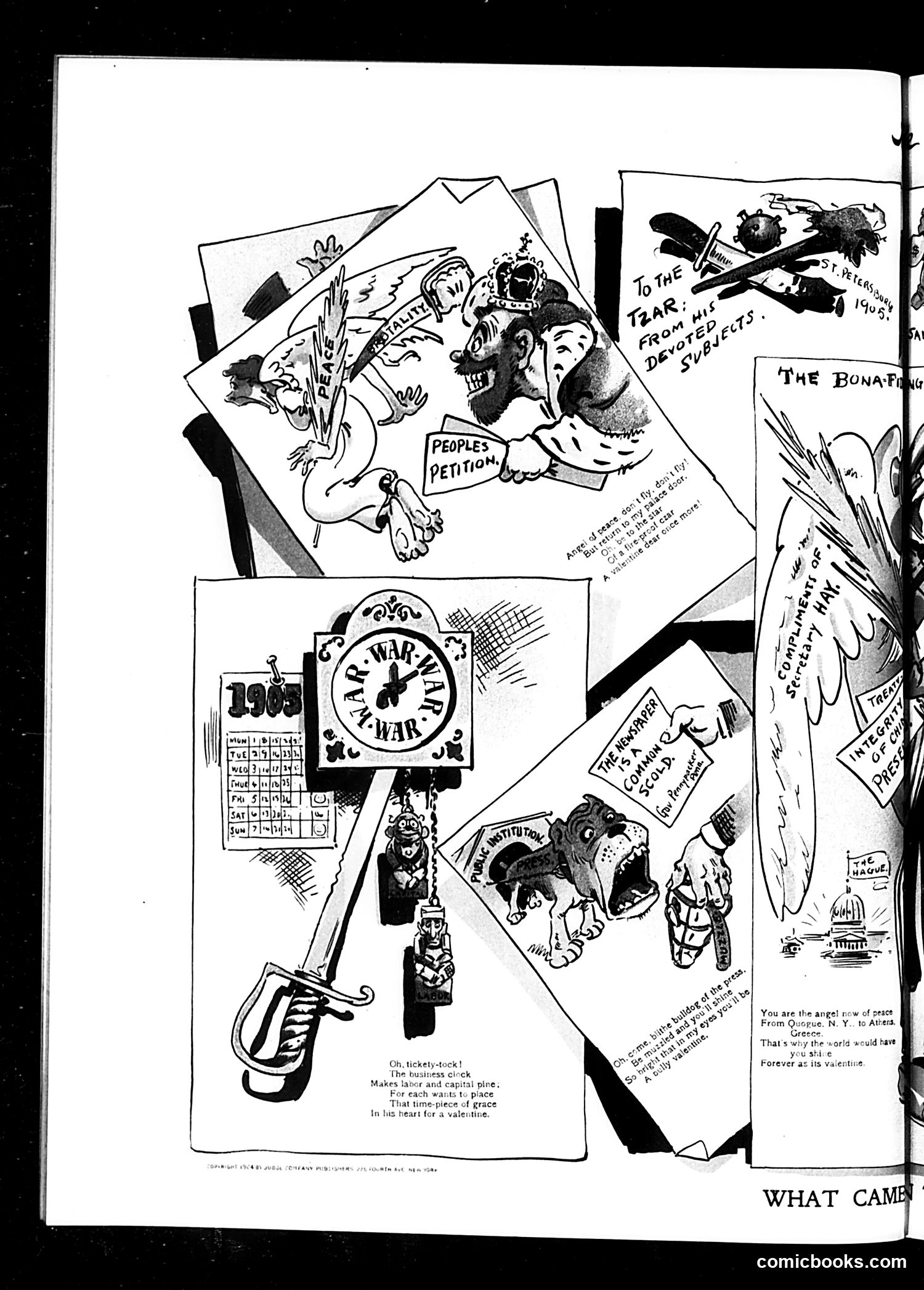
This page from *Judge* magazine contains WWI-era satirical content. The main cartoon depicts a "People's Petition" directed at figures representing warring nations, shown as grotesque caricatures engaged in conflict. A central clock marked "WAR-WAR" symbolizes the relentless continuation of warfare. The imagery emphasizes the public's exhaustion with the war's duration and destruction. References to a 1905 calendar and "war" messaging suggest commentary on prolonged international conflict and its toll. The right panel appears to reference peace advocacy, with text about an "angel" bringing peace from Queens, N.Y. This likely mocks American pacifist sentiment or specific peace activists of the WWI period. The overall message critiques both the endless nature of warfare and idealistic but ineffectual peace efforts, using grotesque caricature typical of *Judge's* satirical style.
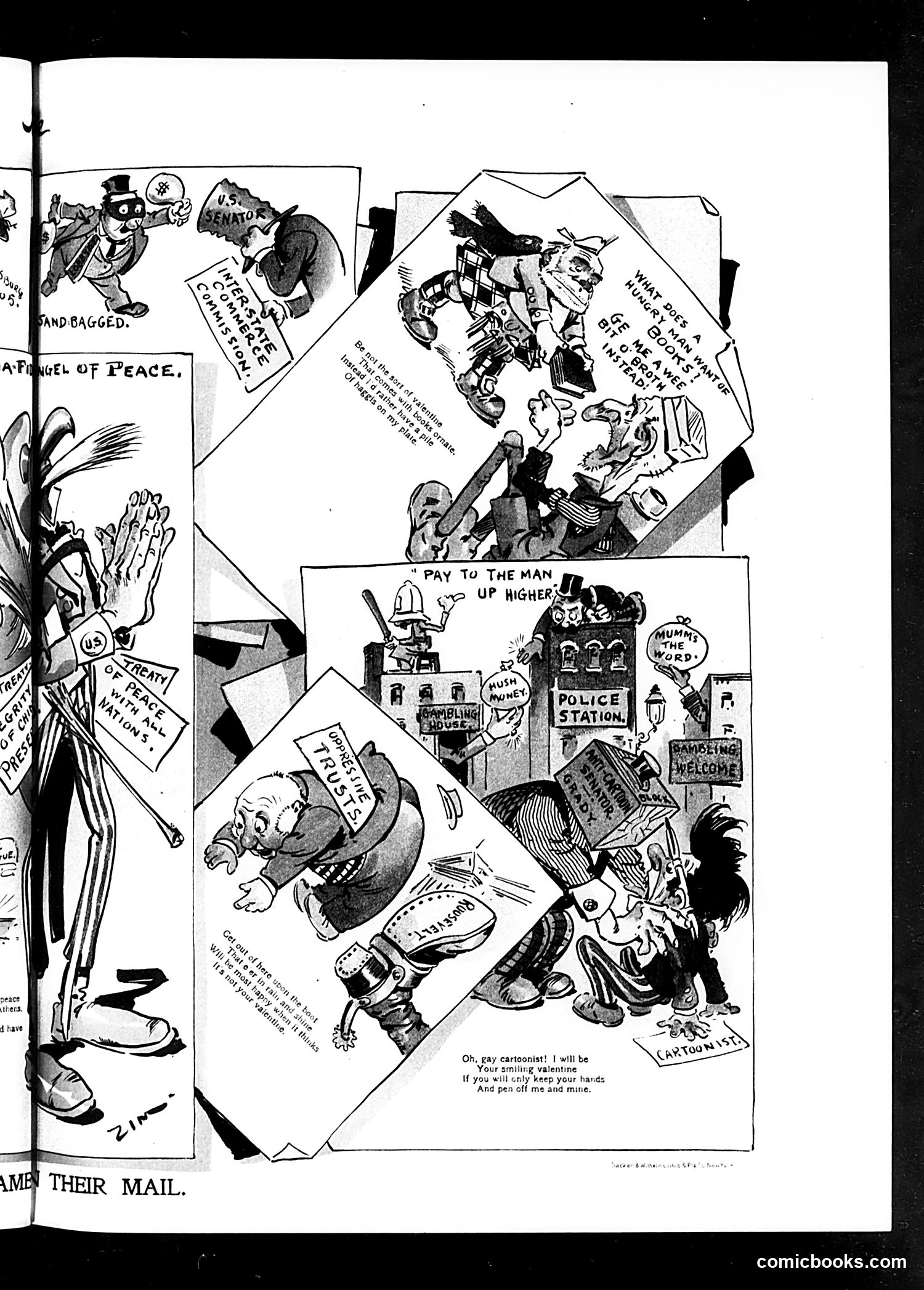
This Judge magazine page contains multiple satirical cartoons critiquing American social vices and corruption circa early 20th century. The left panel shows "A ANGEL OF PEACE" figure confronting what appears to be corruption or crime ("SANDBAGGED"). The central composition mocks various illegal activities—gambling operations, police stations, and criminal enterprises—suggesting widespread institutional corruption. The bottom panel's caption, "Pay to the Man Up Higher," indicates satire about bribery and payoffs to corrupt officials. The final verse warns a "gay cartoonist" to avoid criticizing certain powerful figures ("keep your hands / And pen off me and mine"), likely mocking threats against press freedom. Overall, the page satirizes systemic corruption, crime, and attempts to silence journalistic criticism through intimidation.
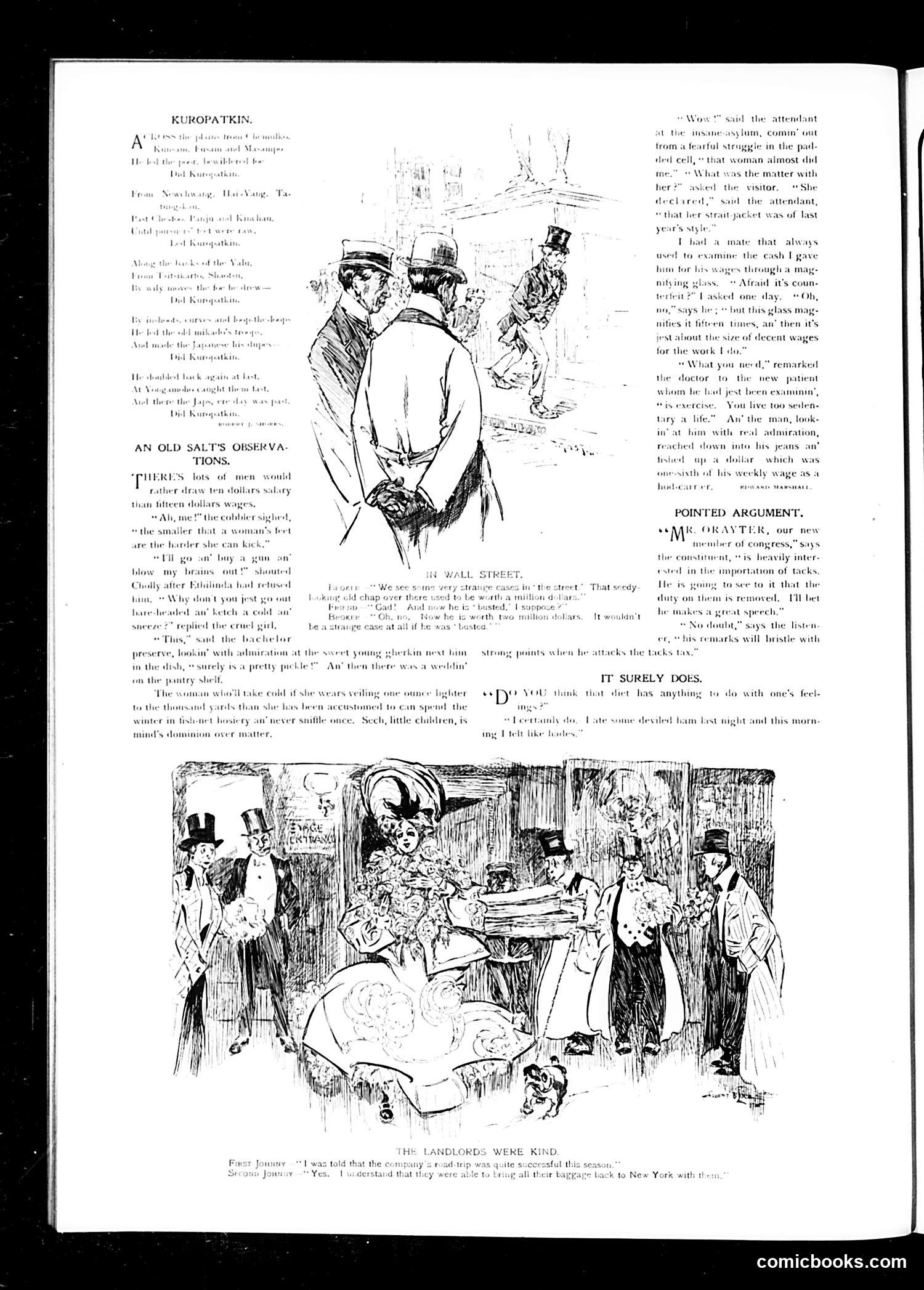
This page contains three distinct satirical pieces: **"Kuropatkin"** (top): References General Aleksei Kuropatkin, Russian military commander during the Russo-Japanese War (1904-05). The poem mocks his military failures and the war's disastrous outcome for Russia. **"An Old Salt's Observations"** and **"Wall Street"** (middle): A naval veteran comments on wage disparities—men earning fifteen dollars prefer that to ten dollars salary, illustrating working-class economic anxieties of the era. **"Pointed Argument"** (right): Satirizes a new congressman heavily invested in tack manufacturing, cynically suggesting his political "arguments" will "bristle with strong points" when defending tariff protection for his industry—lampooning corruption where legislators advance personal business interests. **"It Surely Does"** (bottom): A joke about digestion and physical discomfort. The cartoons collectively critique military incompetence, economic inequality, and congressional corruption through wit and visual exaggeration typical of Judge's satirical approach.
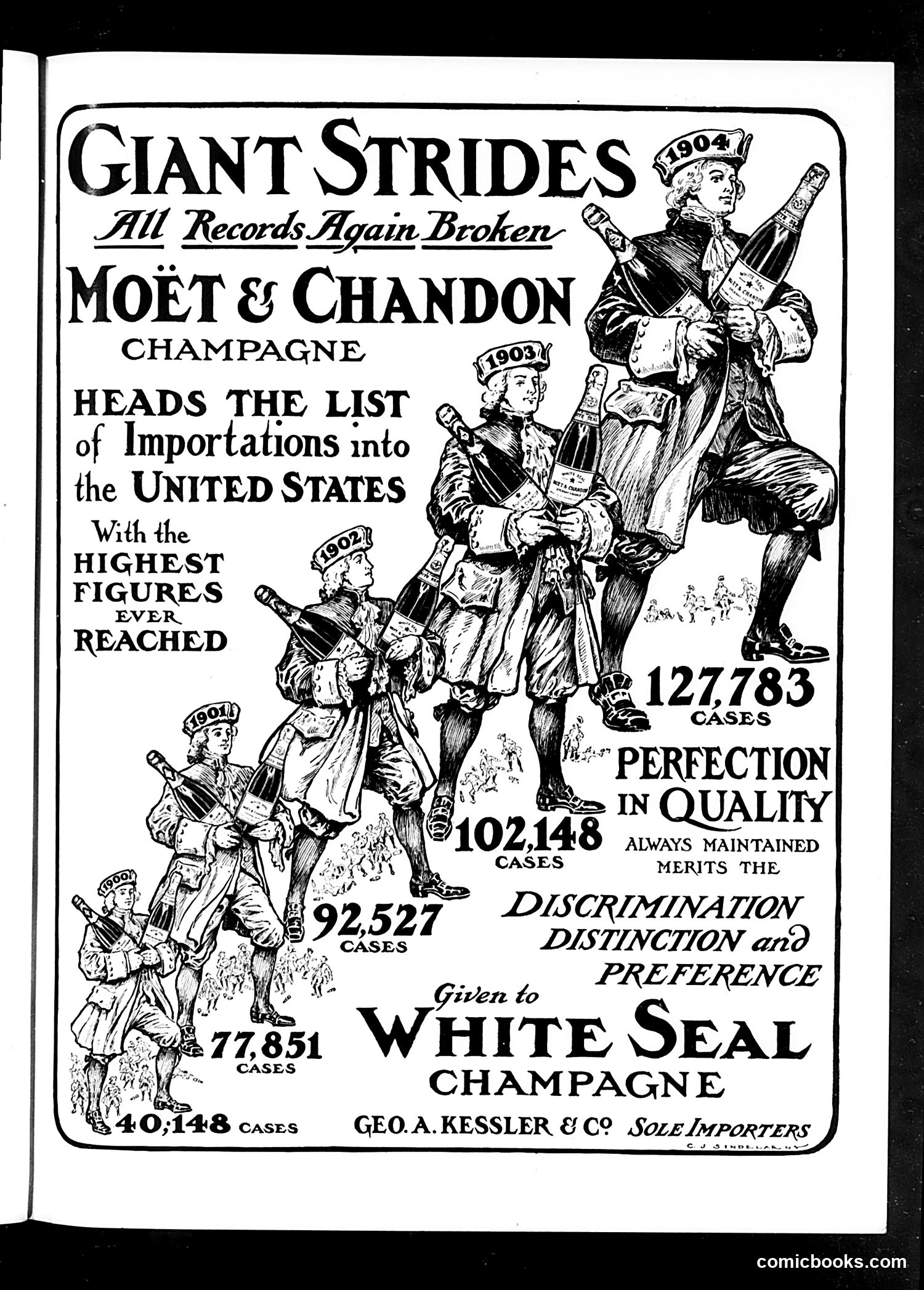
This is **advertising, not satire**—a full-page commercial for Moët & Chandon champagne disguised as editorial content in Judge magazine. The "Giant Strides" headline and illustrated figures climbing upward create a visual metaphor for sales growth. The ascending case numbers (40,148 → 77,851 → 92,527 → 102,148 → 127,783) document Moët & Chandon's dominance in U.S. champagne imports, with dates from 1900-1904 marking each milestone. The text claims the brand "heads the list of importations into the United States with the highest figures ever reached"—essentially bragging about market leadership and sales volume. The competing "White Seal Champagne" (by importer Geo. A. Kessler & Co.) receives a dismissive mention at the bottom, positioned as inferior despite claims to "perfection in quality." This reflects early 1900s advertising strategy: burying commercial messages within magazine editorial to reach readers seeking news rather than ads.
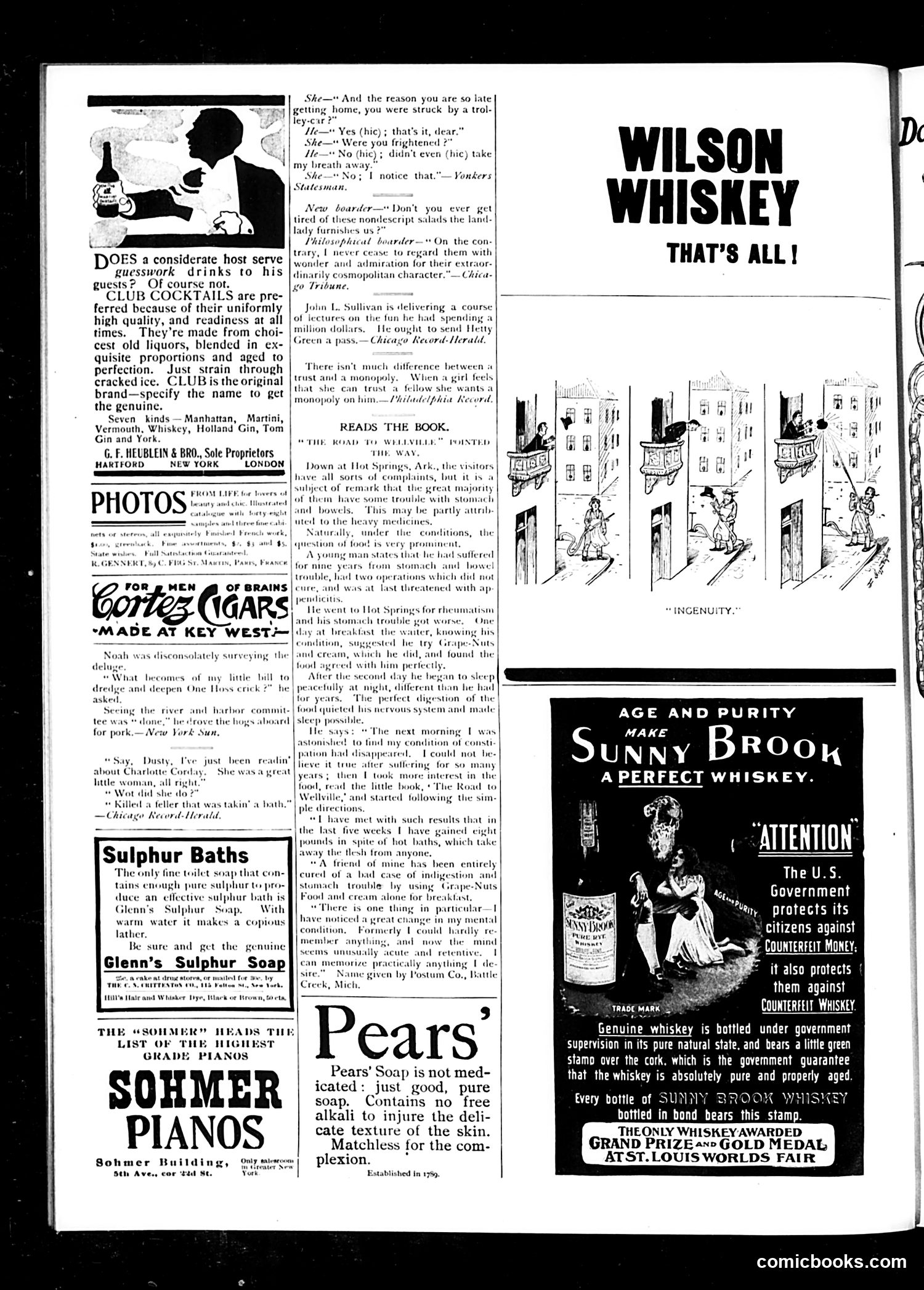
This page is primarily **advertising content** from an early 20th-century American satirical magazine, with minimal political cartoons. The main visual elements are humorous anecdotes and advertisements rather than political satire. Notable content includes: - A small silhouette cartoon at top-left showing a man at a desk (subject unclear from image alone) - Multiple comic vignettes using domestic situations for humor—a drunk man hitting a trolley, a wife questioning her late husband, discussions of Charlotte Corday and John L. Sullivan - A multi-panel cartoon titled "INGENUITY" showing repetitive door-opening scenes (the joke unclear without fuller context) **The advertisements dominate**: Club Cocktails, Cortez cigars, Glenn's Sulphur Soap, Sohmer Pianos, Pears' Soap, and notably **Sunny Brook Whiskey** with a government-purity guarantee addressing counterfeit alcohol concerns—a significant issue during Prohibition-era anxieties. The page reflects early 1900s concerns: stomach complaints, male leisure activities, and consumer product legitimacy rather than explicit political satire.
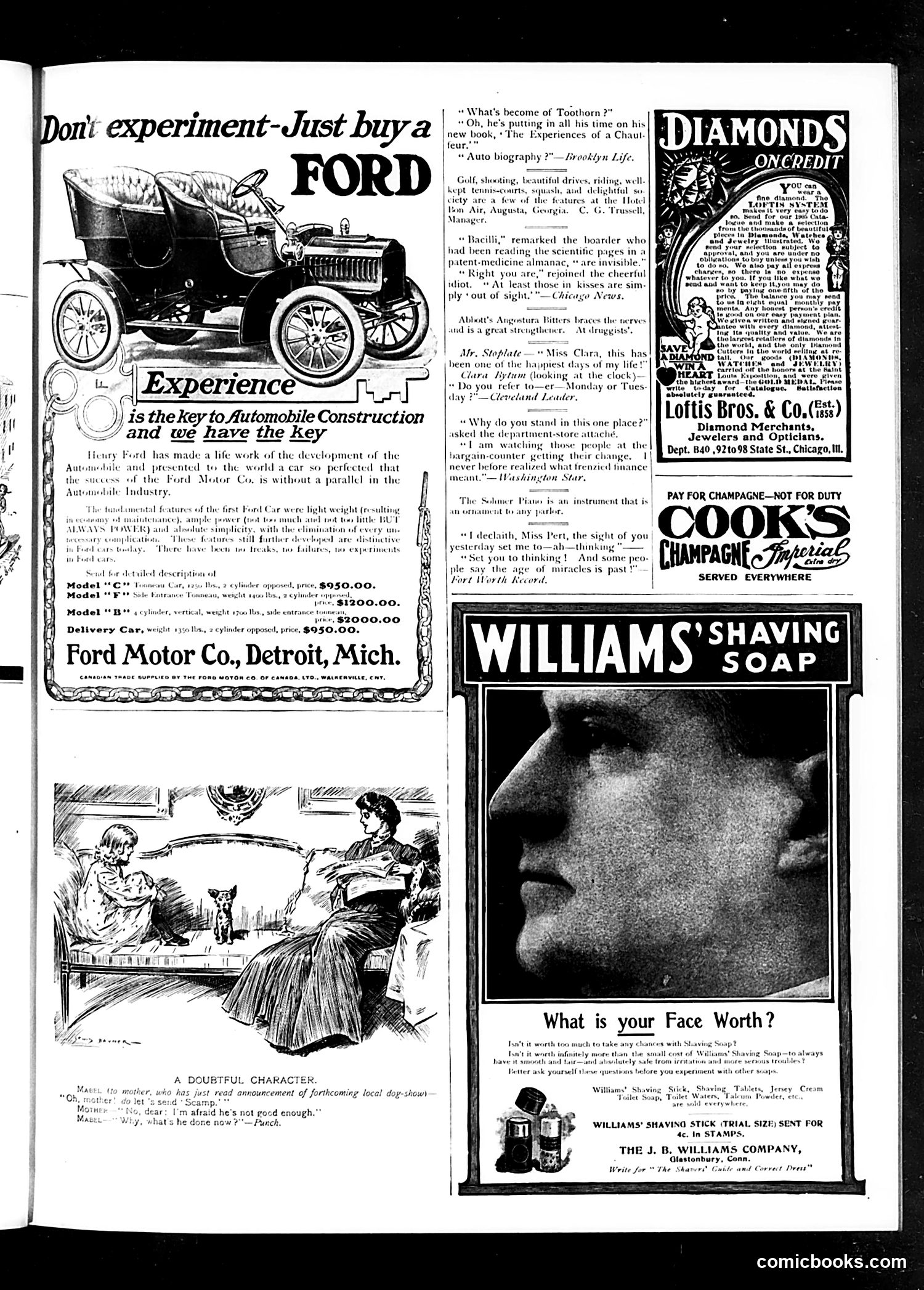
This page is primarily **advertising**, not political satire. The main content features a Ford Motor Company advertisement emphasizing Henry Ford's innovative automobile design—specifically the Model N's lightweight construction and affordability ($500-$2000). The ad's tagline "Experience is the Key" promotes Ford's engineering expertise. The page also includes various **humorous anecdotes** typical of Judge magazine's filler content: jokes about a "chaffeur" (chauffeur) writing an autobiography, romantic misunderstandings, and department-store observations. These are general comedic pieces without specific political targets. The remaining space contains advertisements for luxury goods (diamonds, champagne, shaving soap)—standard magazine filler. **No significant political satire or caricature** appears on this page. It represents typical early 1900s magazine content mixing automobile industry promotion with light social humor and commercial advertising.
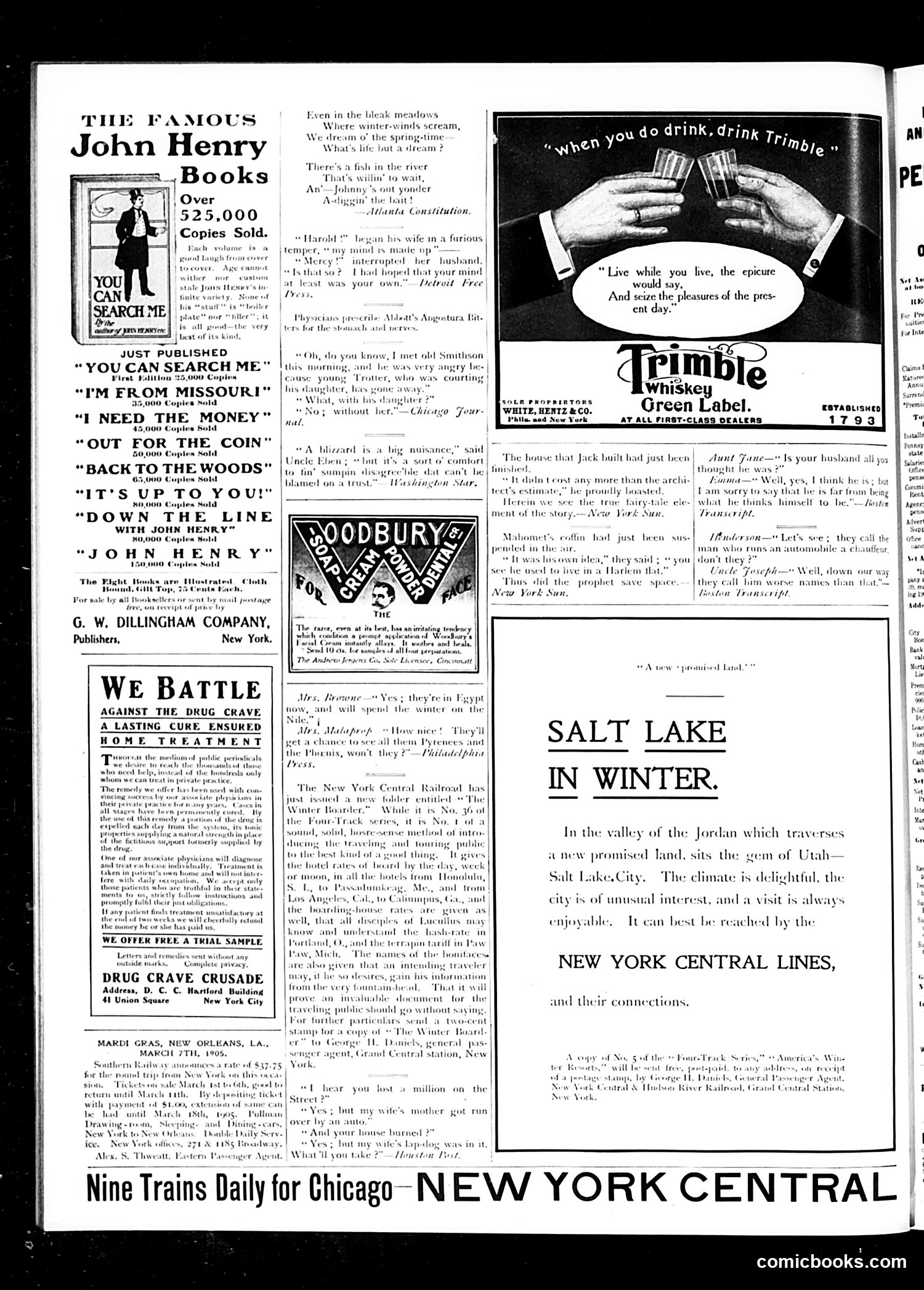
This page is primarily **advertising and miscellaneous content** rather than a focused political cartoon. However, it contains several satirical elements typical of Judge's era: **Key Content:** 1. **John Henry Books advertisement** - References the folk legend of John Henry (the steel-driving man), emphasizing themes of American labor and determination. 2. **"We Battle Against the Drug Crave"** - A public health crusade advertisement addressing addiction, reflecting Progressive Era concerns about substance abuse as a social problem requiring intervention. 3. **Trimble Whiskey advertisement** - Uses philosophy ("Live while you live, the epicure would say") to market alcohol—ironic alongside the anti-drug messaging on the same page, showing the contradictory values of early 1900s America. 4. **Various comic dialogues** - Short humor pieces mocking domestic life, railroad bureaucracy, and social pretension. 5. **Travel advertisements** - Promoting Salt Lake City and New York Central Lines, reflecting America's expanding leisure culture. The page reflects Judge's dual nature: serious social commentary mixed with commercial interests and light satire of everyday American life.
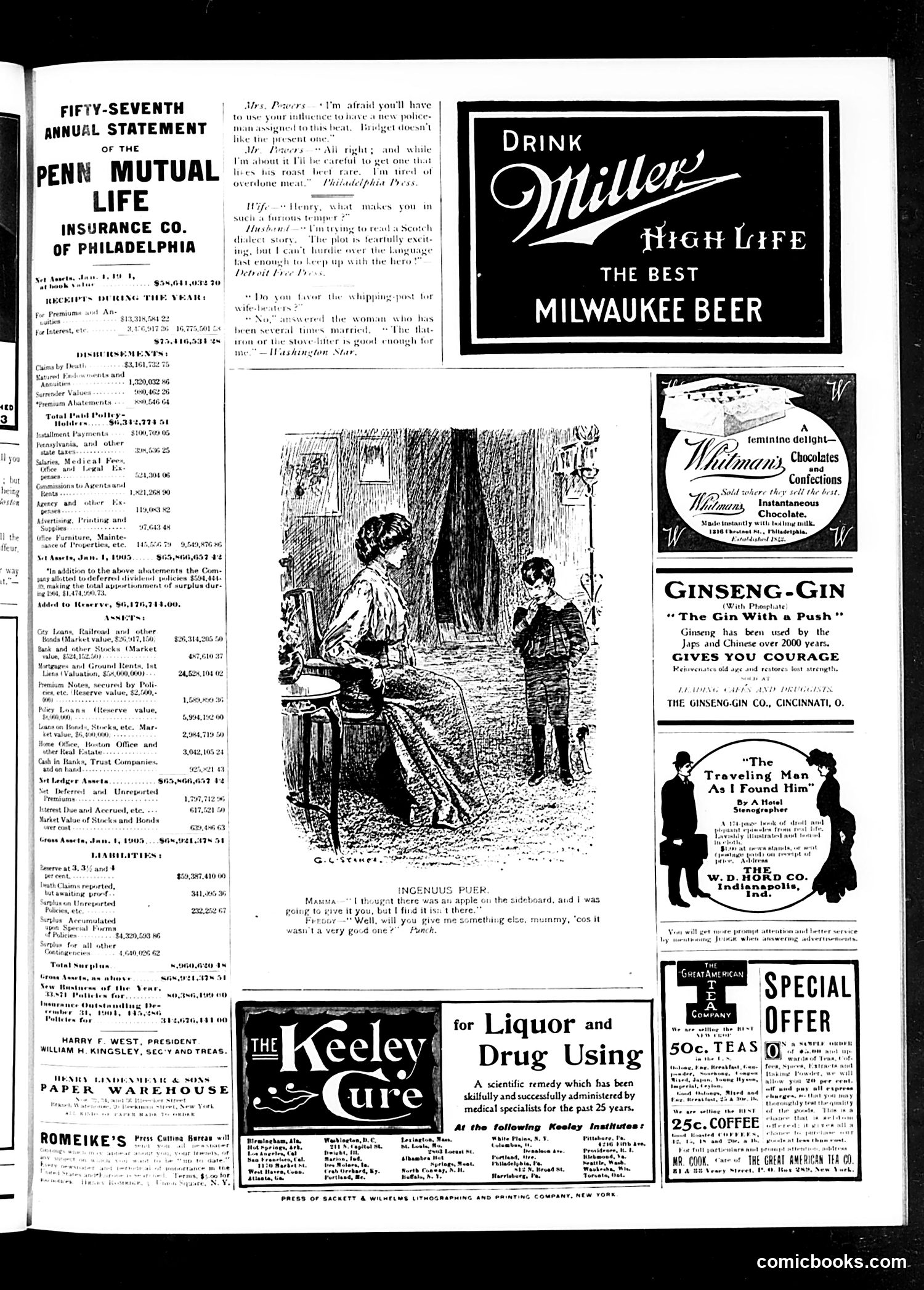
This page is primarily a **financial statement and advertising compilation** rather than satirical political cartoons. The left column contains Penn Mutual Life Insurance Company's 57th annual statement with financial figures and asset listings. The central image is titled "Ingenuous Puer" (Latin for "Ingenuous Boy"), showing a domestic scene of what appears to be a mother and child, accompanied by dialogue about an apple and the child's innocent misunderstanding—likely a gentle humor piece about childhood innocence rather than political satire. The surrounding advertisements are typical early-20th-century product promotions: Miller High Life beer, Whitman's chocolates, Ginseng-Gin (marketed with dubious health claims), and "The Keeley Cure" (a notorious patent medicine for alcohol and drug addiction). **The satire, if present, is minimal.** The page demonstrates the era's acceptance of unregulated medical claims and alcohol marketing, but this appears documentary rather than intentionally satirical. The content reflects 1900s commercial culture more than it critiques it.
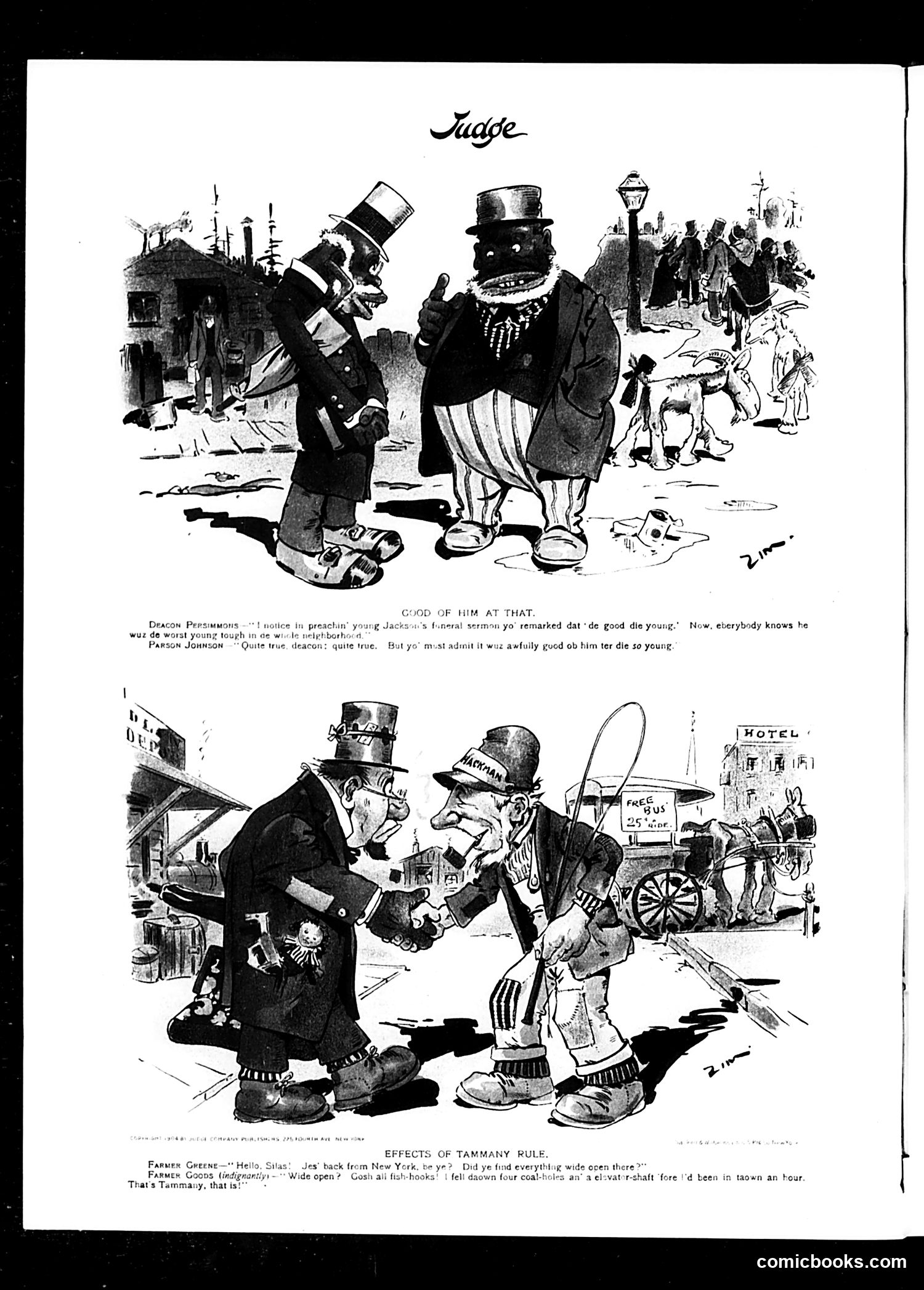
This page contains two satirical cartoons mocking political and urban conditions in early 20th-century America. **Top cartoon ("Good of Him at That"):** Shows caricatured figures in formal dress, likely depicting clergy or politicians. The dialogue references a funeral sermon about someone dying young, with cynical commentary suggesting the deceased wasn't virtuous. The satire critiques hypocrisy in eulogies. **Bottom cartoon ("Effects of Tammany Rule"):** References Tammany Hall, the infamous New York City Democratic political machine notorious for corruption. Two characters discuss New York's conditions—one returning from the city describes it as dangerously "wide open," having fallen into uncovered coal-holes and elevator shafts. The satire blames Tammany's corrupt governance for poor municipal infrastructure and unsafe conditions. This reflects contemporary urban complaints about negligent city management under machine politics. Both cartoons employ exaggerated caricature and dialect humor typical of Judge's style.