
A complete issue · 16 pages · 1905
Judge — February 11, 1905
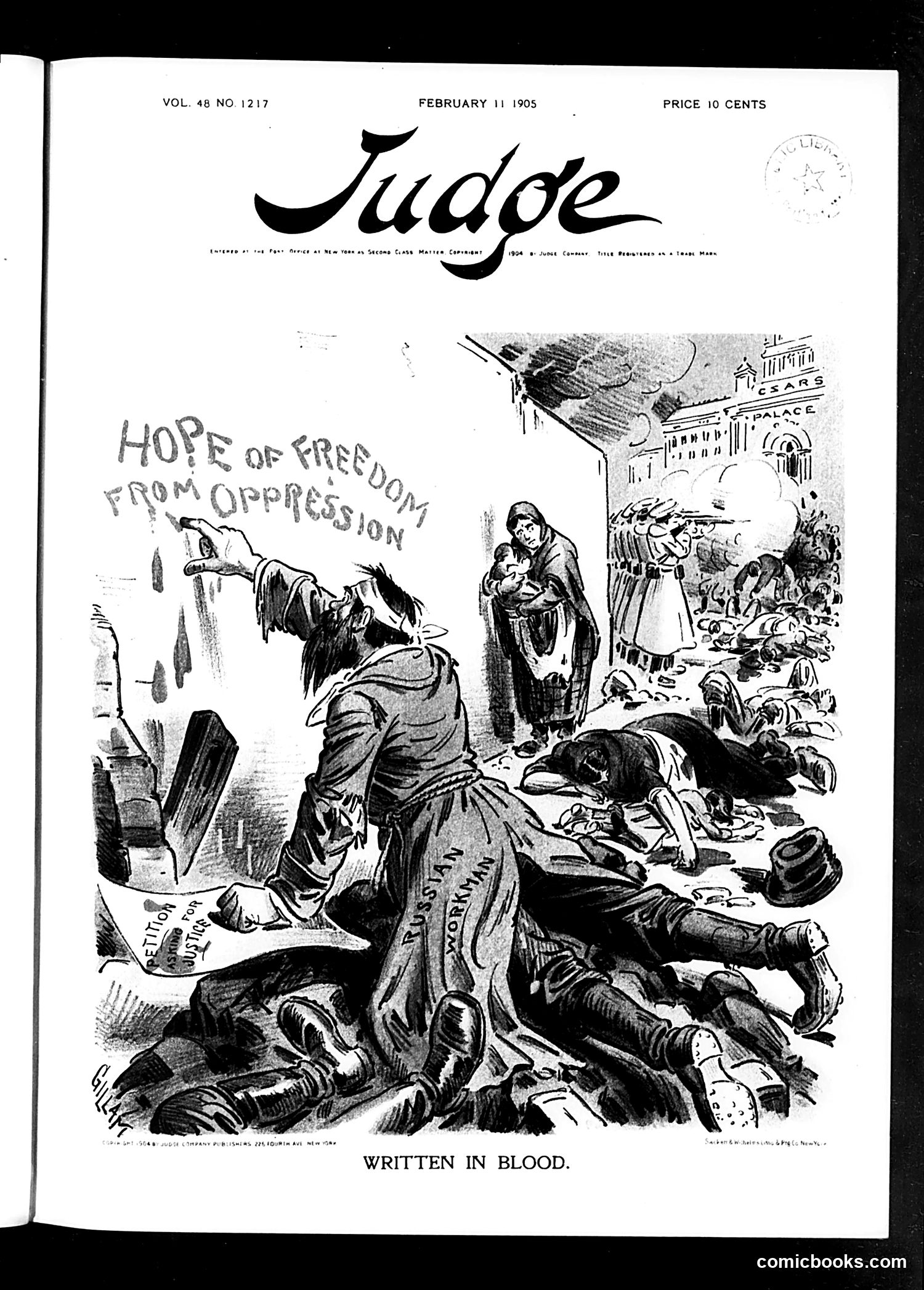
This political cartoon depicts violent oppression, likely related to Russian imperial brutality. The caption "Hope of Freedom from Oppression" appears ironically above a scene of suffering civilians, dead bodies, and military violence before a grand government building. The scattered bodies and bloodshed suggest a recent massacre or crackdown. The angel figure at top left gestures helplessly, emphasizing the tragedy. The title "Written in Blood" suggests that freedom's promise has been literally paid for in violence. This appears to reference early 1900s Russian imperial repressions, possibly the 1905 Revolution's violent suppression. The cartoon critiques the gap between rhetoric about freedom and the brutal reality of authoritarian governance—a common Judge magazine theme mocking governments' hypocritical claims.
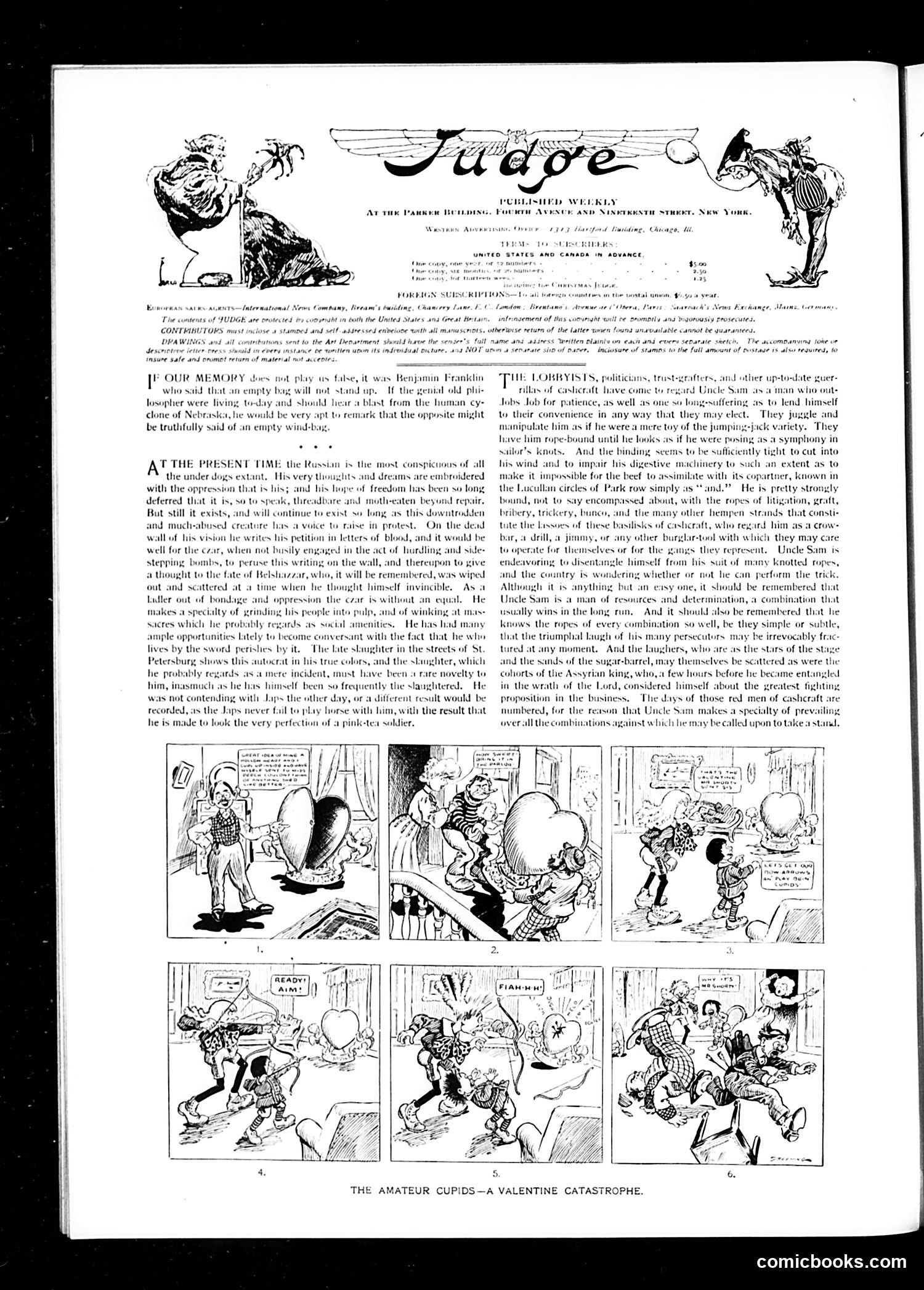
This page contains two distinct sections: political commentary and a comic strip titled "The Amateur Cupids—A Valentine Catastrophe." The top features two lengthy editorial pieces discussing **Russia's political situation** and **lobbying/corruption in American politics**. The Russian section criticizes the Tsar's oppressive regime and lack of freedom. The lobbying piece satirizes wealthy interests manipulating politicians, describing how special interests use various tactics—"bribery, trickery, buncombe"—to control government decisions. It specifically praises "Uncle Sam" as someone capable of resisting such manipulation. The six-panel comic strip below depicts a slapstick Valentine's Day scenario where amateur cupids cause chaos and physical comedy, typical of Judge's humorous content aimed at family audiences.
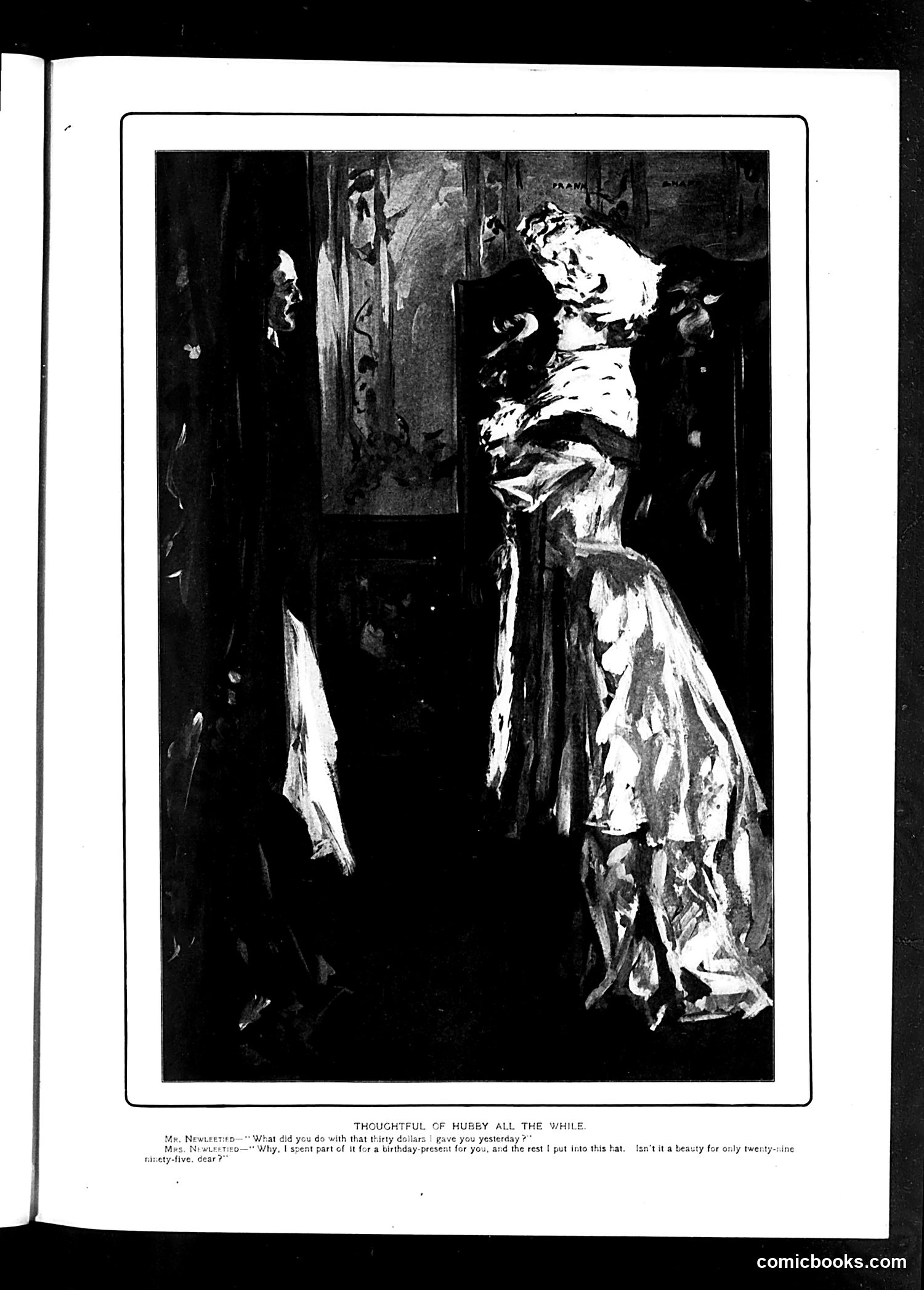
This cartoon depicts a domestic scene where a wife confronts her husband about spending thirty dollars. The husband claims ignorance about where the money went, while the wife reveals she spent part of it on a birthday present for him and used the rest to buy a hat—costing twenty-nine dollars total. The satire targets women's extravagant spending habits, particularly on fashion and hats, which were common subjects of ridicule in early 20th-century Judge magazine. The joke relies on the husband's shock that nearly all the money went toward a single hat, playing on period anxieties about wives' consumer spending and materialism. The cartoon reflects contemporary gender tensions around household finances and women's purchasing power.
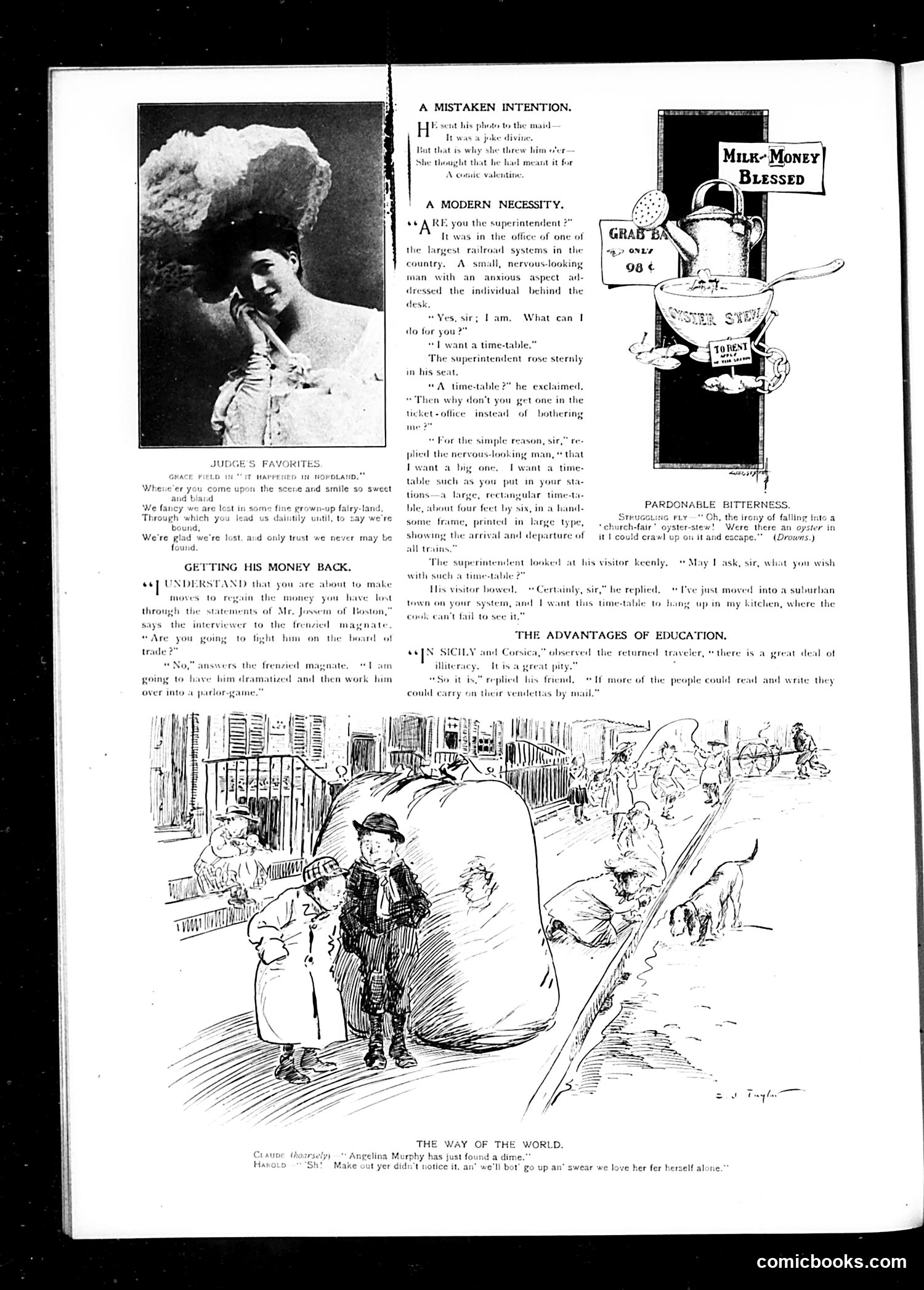
This page contains several satirical pieces typical of early 20th-century Judge magazine: **"A Mistaken Intention"** mocks a man who sent his photo to mail expecting romance, but received rejection—a commentary on naive courtship practices. **"A Modern Necessity"** depicts a railroad superintendent pestered by a nervous man demanding a timetable, satirizing bureaucratic frustration and modern efficiency demands. **"Getting His Money Back"** shows someone attempting to recover lost money through legal means, poking fun at litigation and financial disputes. The **large cartoon "The Way of the World"** illustrates children observing adult hypocrisy—one remarks that "Amelia Murphy found a dime," while the other notes they didn't notice it despite claiming to love honesty. This critiques adult moral inconsistency. The **"Milk-Money Blessed" advertisement** is commercial content, unrelated to satire.
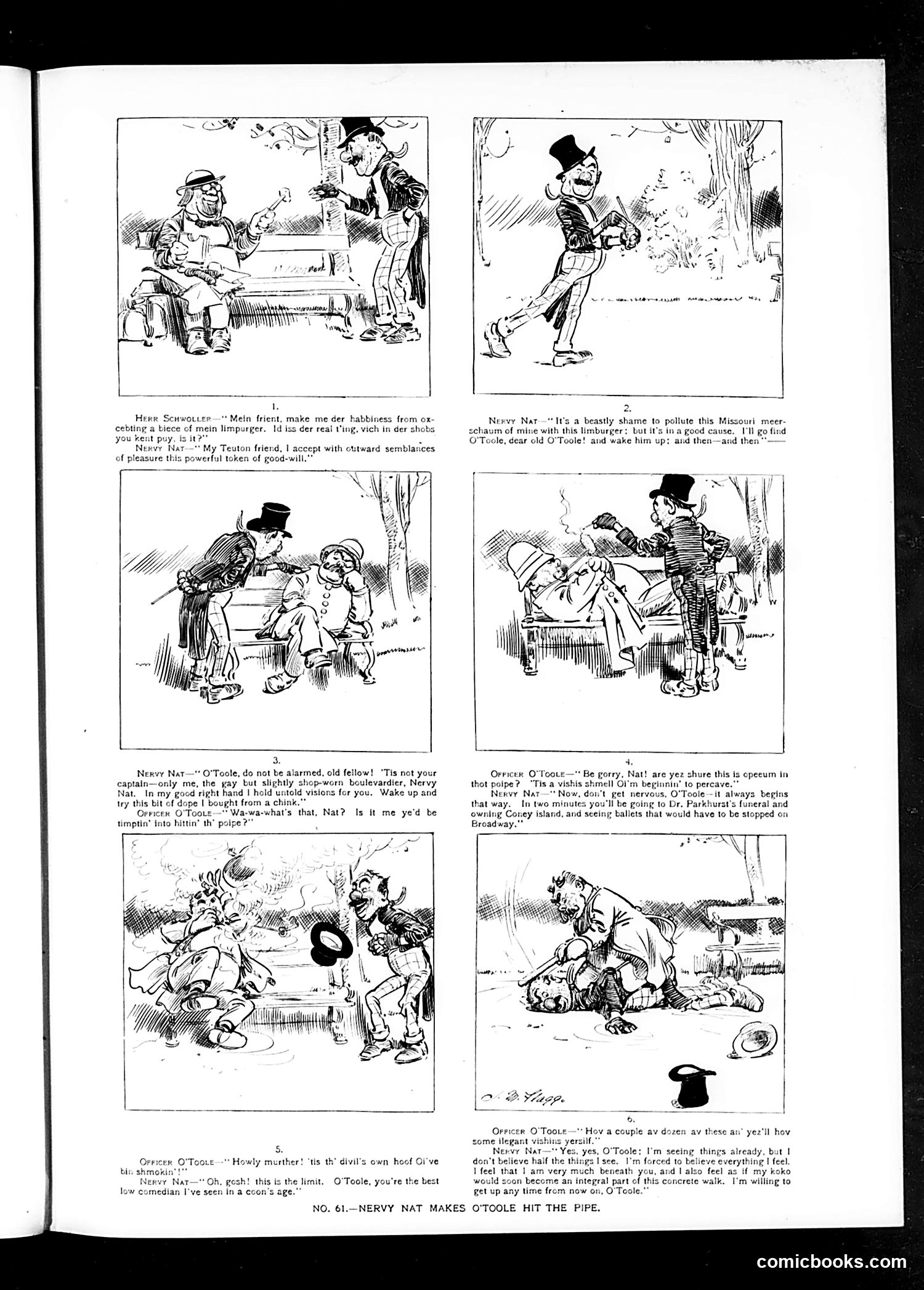
This is a vaudeville-style comic strip featuring two Irish-American characters: **Nervy Nat** and **Officer O'Toole**. The humor relies on ethnic stereotypes common to early 20th-century American comedy. The plot: Nervy Nat tricks Officer O'Toole into smoking opium ("hitting the pipe"), claiming it will give him wonderful visions. When O'Toole realizes what's happened, he becomes delirious and violent. **The satire targets**: - **Irish immigrants** through exaggerated dialect and portrayed as dimwitted - **Police corruption/incompetence** (the officer is easily duped) - **Drug use** as a contemporary social problem - **Vaudeville itself**, mimicking the slapstick "con man" routine popular on stage The references to Dr. Parkhurst and Coney Island suggest contemporary New York scandals, though details are unclear. The humor is crude by modern standards, relying entirely on caricature and slapstick rather than actual wit.
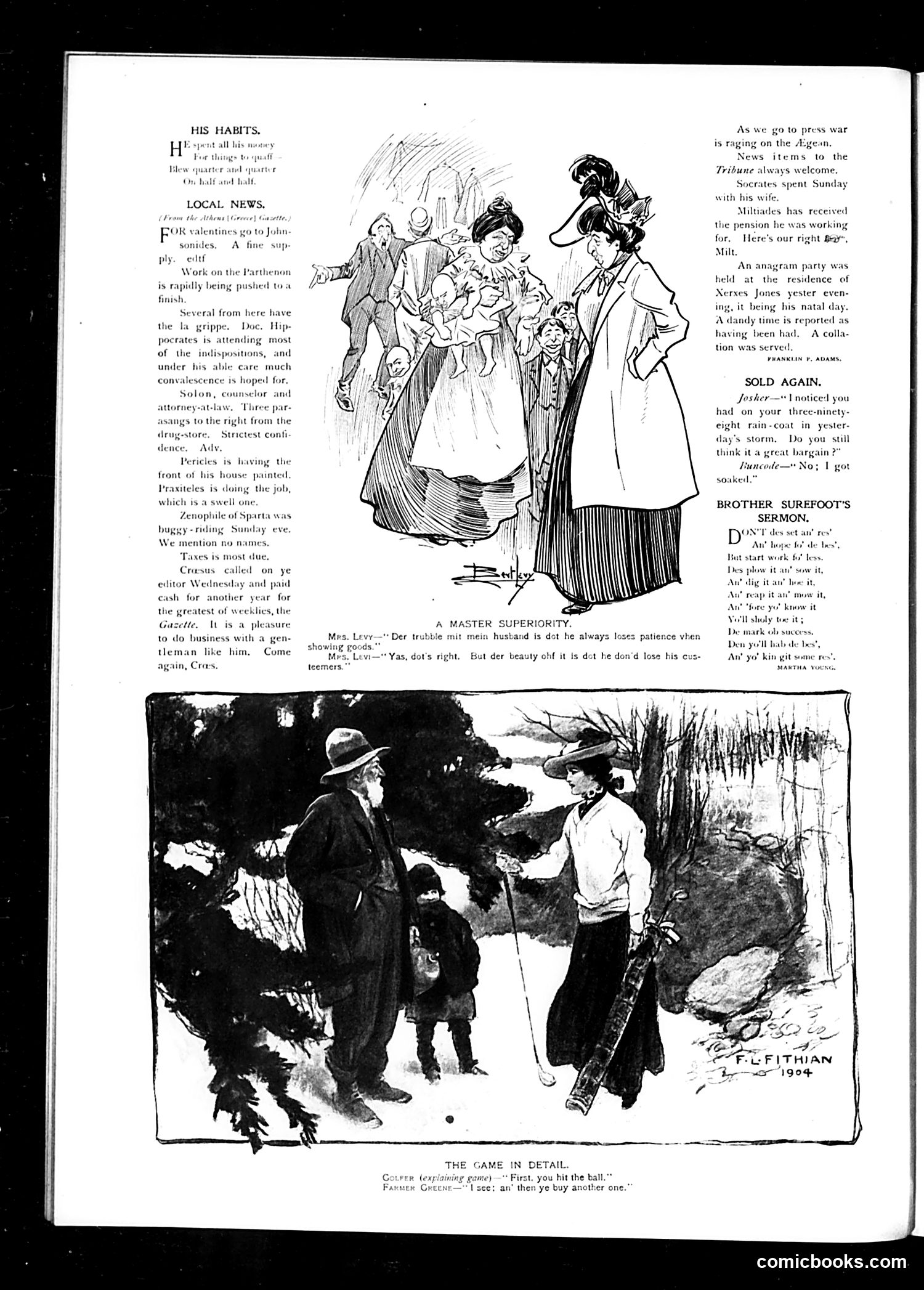
This page from *Judge* magazine (dated 1904, based on the illustration signature) contains satirical local news items with a classical Athenian setting—references to Socrates, Pericles, Miltiades, and the Parthenon create a humorous veneer of sophistication over mundane small-town gossip. The humor works through **bathos**: treating trivial matters (someone's house painting, tax collection, a birthday anagram party) with the grandiose language of ancient history. "His Habits" mocks a spendthrift; "A Master Superiority" satirizes marital dynamics through a German-accented character; "Sold Again" jokes about a soaked raincoat; "Brother Surefoot's Sermon" uses dialect humor typical of the era. The upper illustration depicts a woman showing goods to skeptical customers—likely commentary on consumer culture or salesmanship. The lower illustration shows men in winter clothing by water, captioned as explaining a game, probably referencing contemporary leisure activities. The satire targets **pretension, domestic friction, gullibility, and small-town life** through exaggeration and incongruity rather than specific political events.
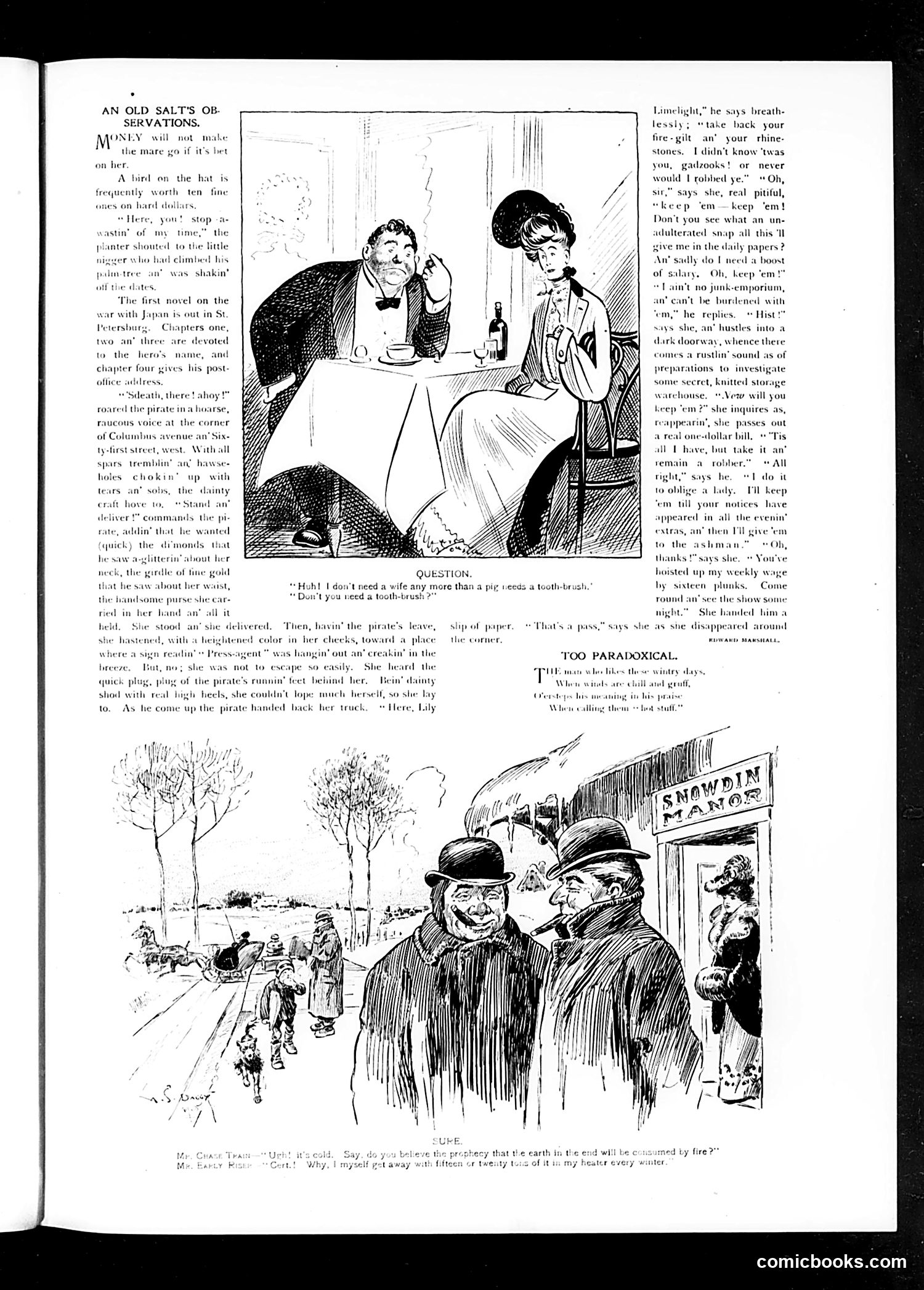
This page contains **three separate satirical pieces**: 1. **"An Old Salt's Observations"** (top): A rambling monologue by a sailor character commenting on various absurdities—including a reference to an early novel about war with Japan (suggesting pre-1905 publication, likely responding to Russo-Japanese War tensions). 2. **"Question"** (middle cartoon): A domestic dialogue joke about a husband claiming he doesn't need a wife "any more than a pig needs a toothbrush," only to be asked if pigs need toothbrushes. It's a simple wordplay joke exposing faulty logic. 3. **"Too Paradoxical"** (bottom cartoon): Shows two men outside a "Smowdin Manor" (appears to be a manor house). The caption references contradictory behavior: men who "deal in graft" yet "preach honesty," and those "calling them 'old stuff'"—likely satirizing hypocrisy in business or politics, though specifics are unclear. The page reflects typical Judge magazine humor: domestic comedy, social commentary, and light political satire aimed at turn-of-the-century American audiences.
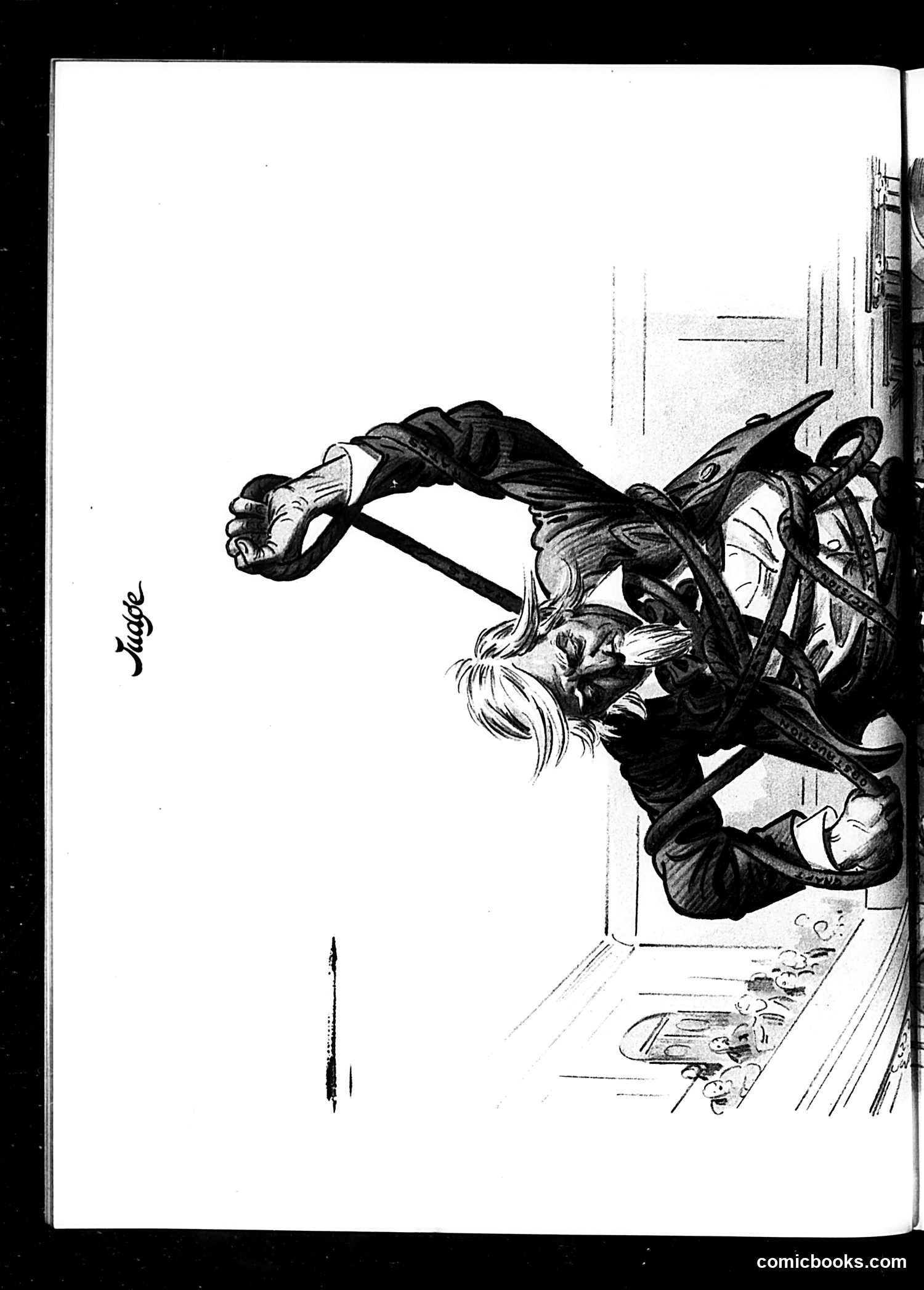
The image shows a detailed black and white satirical illustration, apparently rotated 90 degrees, depicting a figure in period dress wielding what appears to be a sword or similar implement. The signature reads "Judge" (the magazine's artist mark). However, the OCR text provided contains only "comicbooks.com"—a website URL with no article text, captions, or contextual information. Without the actual editorial text, caption, or title accompanying this cartoon, I cannot accurately identify the specific political or social references, the figures depicted, or the satire's intended meaning. To properly explain this cartoon to a modern reader, the original caption and surrounding text would be essential.
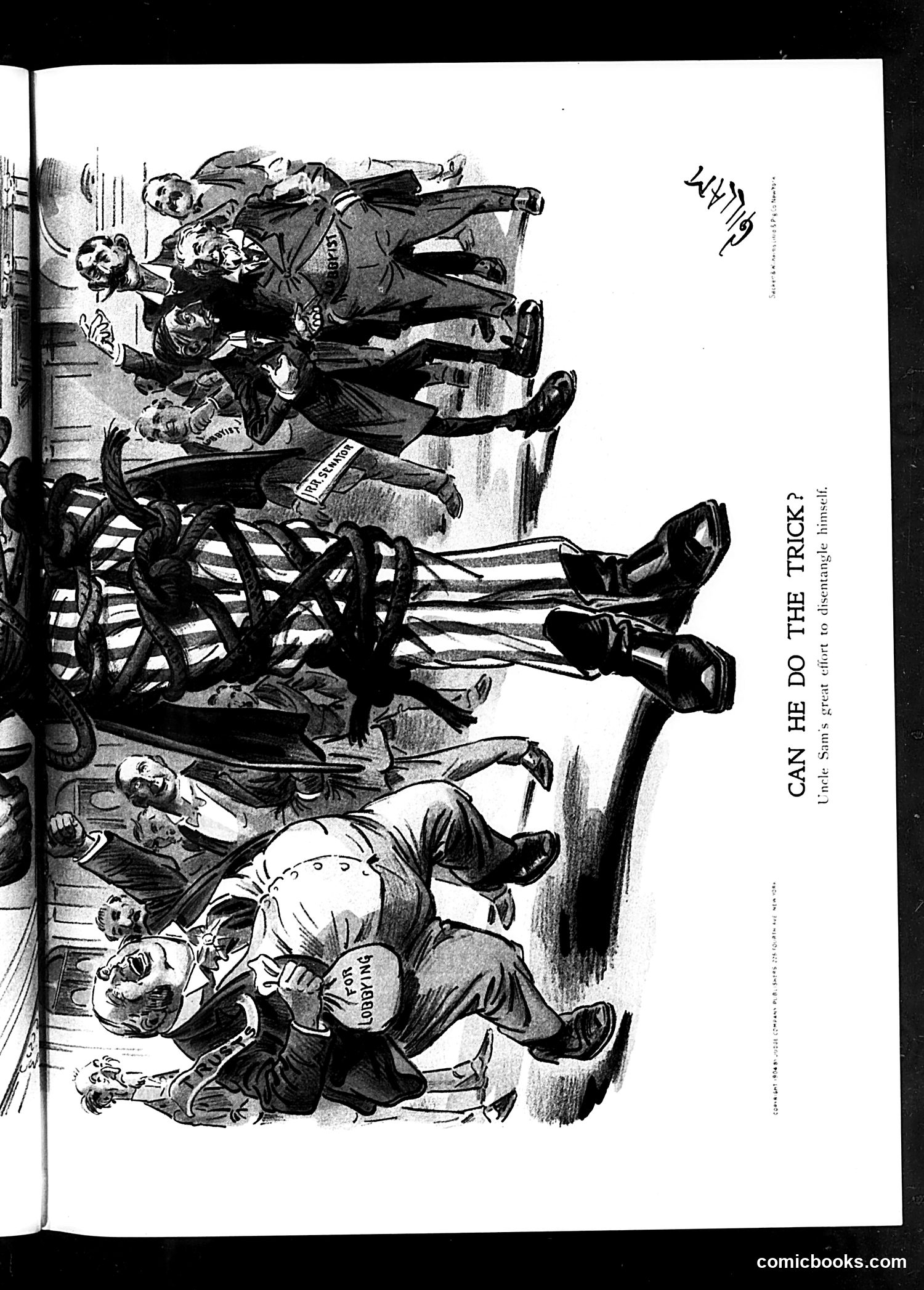
This satirical cartoon depicts a figure labeled "LABOR" (visible on the fallen man's clothing) literally being run over or crushed by a large truck. The image shows well-dressed men above observing the scene, while the laborer lies beneath the vehicle's wheels. The satire criticizes how industrial labor was being exploited or sacrificed during what appears to be rapid industrialization. The "truck" likely represents mechanization, industrial progress, or capitalist enterprise that literally tramples workers. The well-dressed figures observing passively suggest complicity of the wealthy or political establishment. The crude title "Can He Do The Truck?" appears to sarcastically question whether labor can survive or "perform" under such crushing industrial pressure—a commentary on worker exploitation and the human cost of industrial progress.
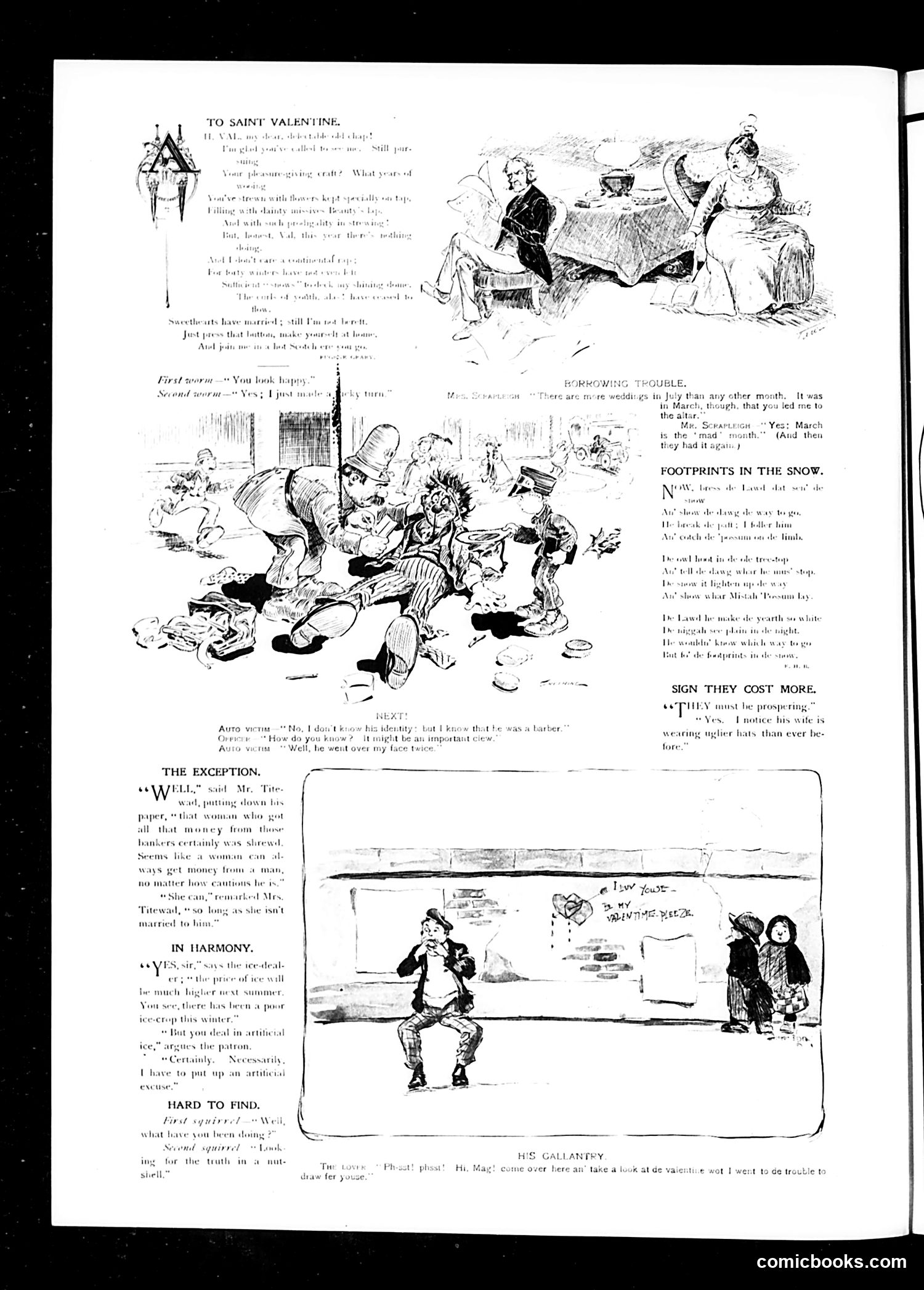
This page from *Judge* magazine contains several satirical sketches on romantic and domestic themes. The primary cartoons include: **"Footprints in the Snow"** — appears to mock African American dialect and servile stereotypes common in period humor, depicting someone tracking footprints. **"Sign They Cost More"** — satirizes prosperity through conspicuous consumption: a wife's "uglier hats than ever before" signals the family is doing well financially, as wasteful spending on fashionable goods indicates wealth. **"The Exception" and "In Harmony"** — sketch marital humor about financial disputes and artificial politeness in marriages. **"His Gallantry"** (bottom) — depicts a man showing a valentine to women, likely satirizing performative romance. The overall theme mocks turn-of-the-century courtship rituals, marriage dynamics, and assumptions about class markers. The racist dialect humor reflects attitudes pervasive in period American satire, though deeply offensive by modern standards.
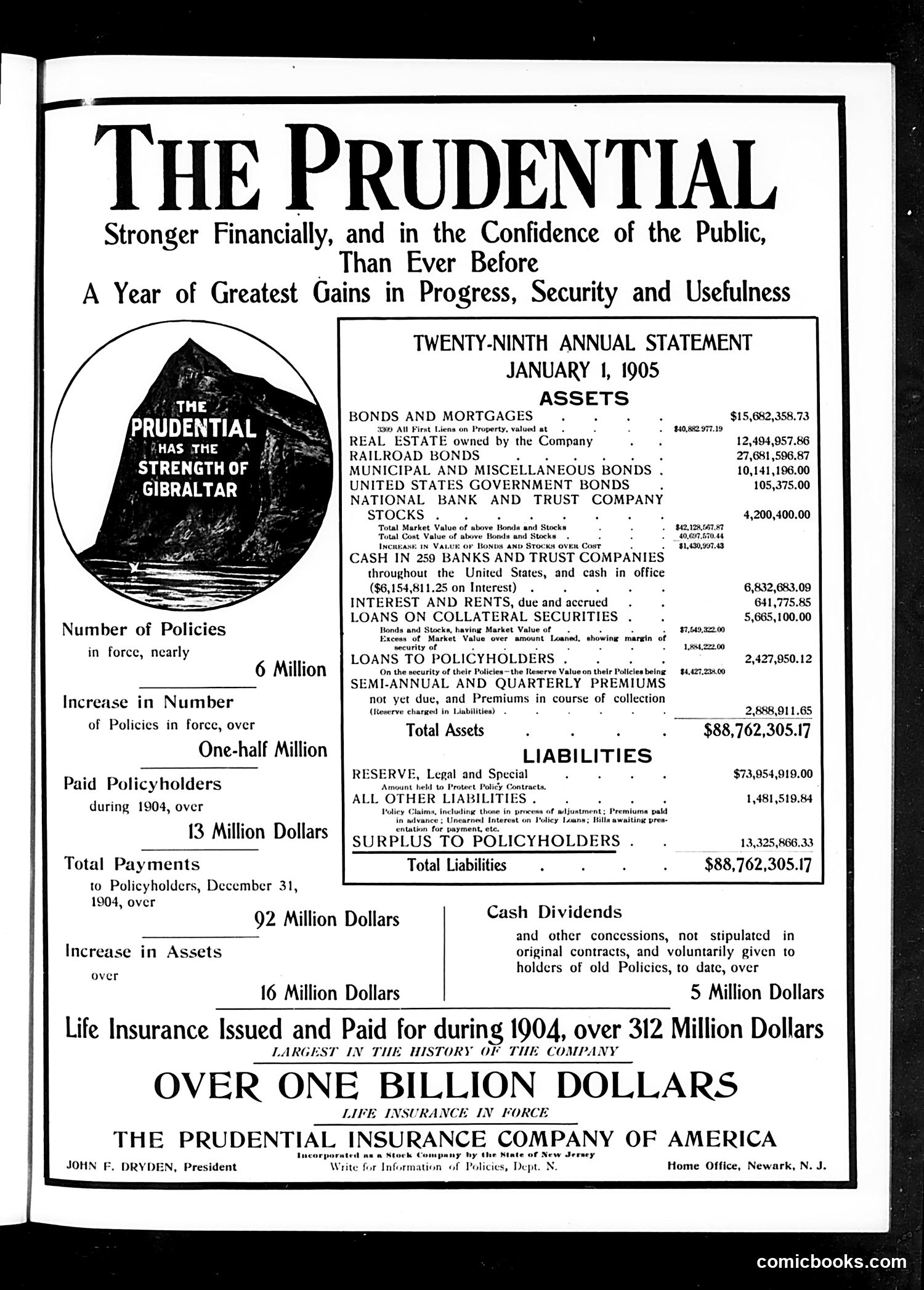
This is primarily a **corporate advertisement**, not satire. It's The Prudential Insurance Company's 1905 annual financial statement, designed to project strength and trustworthiness to potential customers. The key visual is the **Rock of Gibraltar** image—a famous symbol of stability and permanence. The accompanying text claims Prudential is "Stronger Financially, and in the Confidence of the Public, Than Ever Before." This directly invokes Gibraltar as a metaphor: just as that rock is immovable and enduring, so is this insurance company. The boastful statistics (6 million policies, $88 million in assets, over $1 billion in force) serve to convince readers of the company's financial solidity—crucial in an era when insurance company failures were a real public concern. **For modern readers**: This represents early corporate image-building, using metaphor and impressive numbers to reassure customers their money is safe. No satire is present; this is earnest brand promotion.
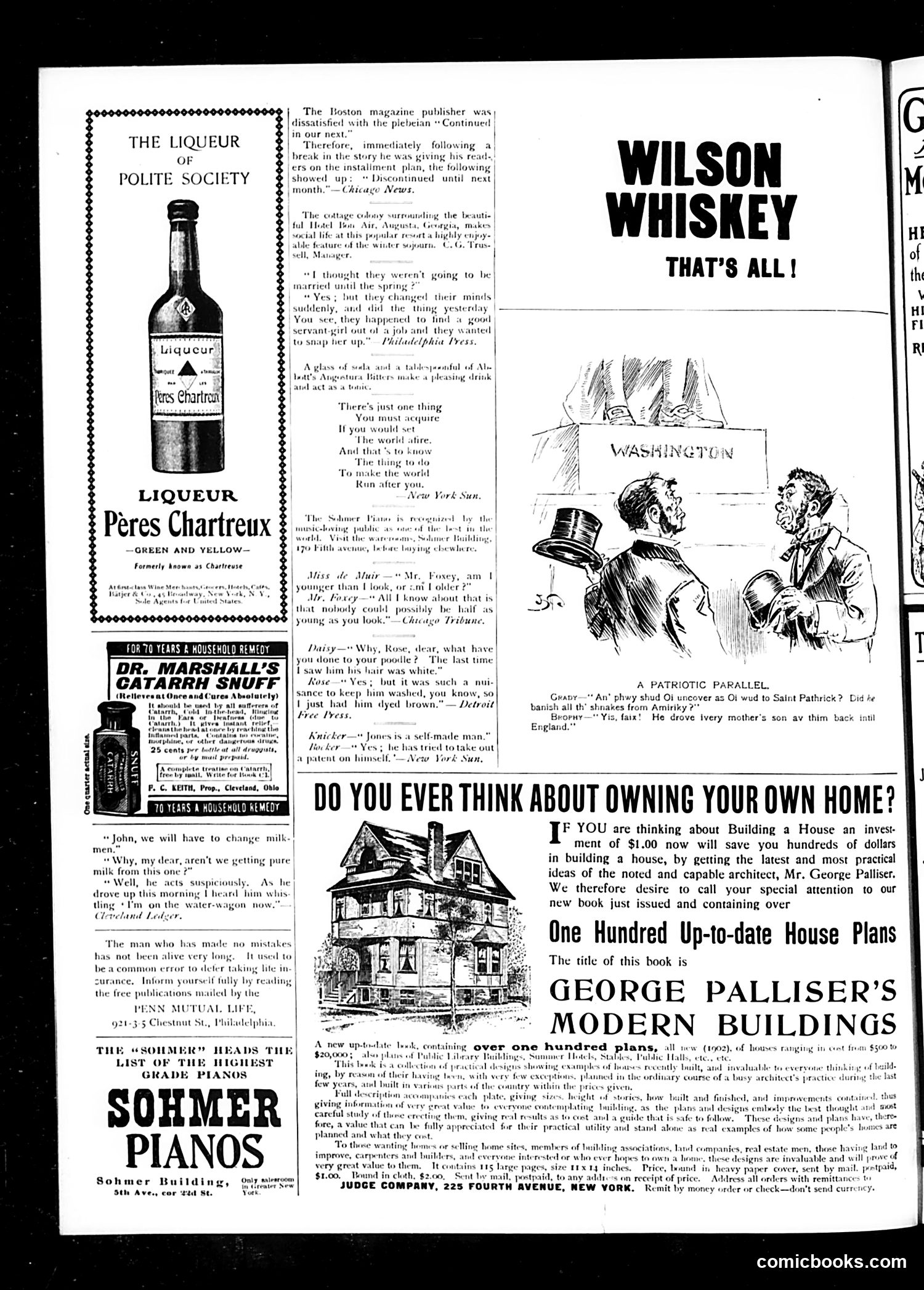
This page from *Judge* magazine contains mostly **advertisements and filler content** rather than political satire. The main items are ads for liqueur, catarrh snuff, pianos, and a book on house plans. The one actual cartoon—"A Patriotic Parallel"—depicts **two Irish immigrants** discussing Saint Patrick's Day. One asks why he should uncover (remove his hat) to honor Saint Patrick if Patrick drove snakes from Ireland, given that Irish people are now emigrating to America. The joke relies on **ethnic stereotyping** common to the era: Irish dialect ("faix," "Amiriky") and the implication that Irish immigrants are themselves "snakes" or undesirables—a cruel anti-Irish sentiment prevalent in early 20th-century America. The scattered text snippets are humorous anecdotes about milkmen, engagement rumors, and vanity, typical *Judge* filler content.
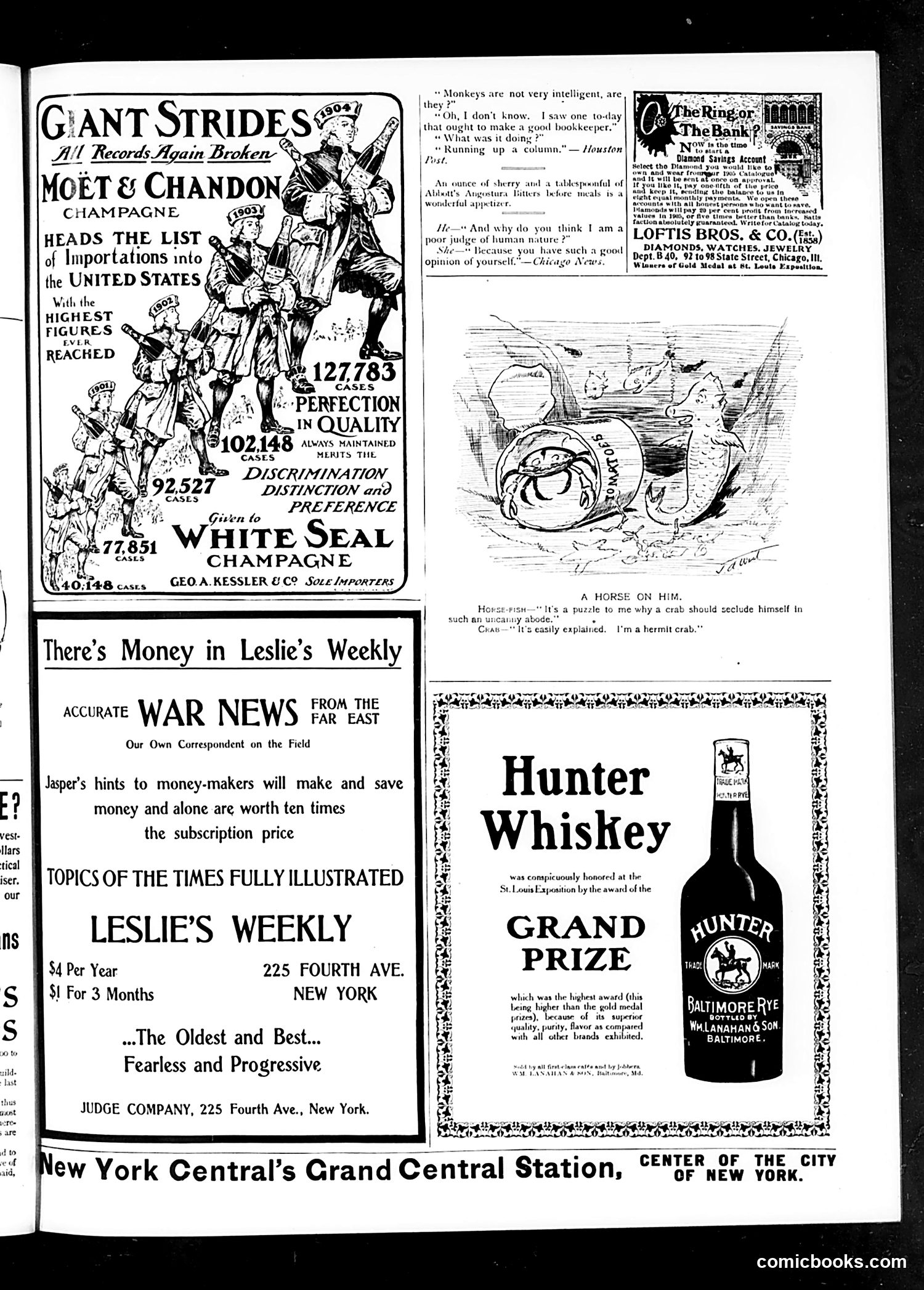
This page is primarily **advertising**, not political satire. The dominant content includes: **Main Advertisements:** - Moët & Chandon Champagne (left): Claims top import figures to the U.S., emphasizing quality and market dominance - Hunter Whiskey (right): Advertises a "Grand Prize" award from the St. Louis Exposition - Leslie's Weekly (center-left): Promotes subscription with "accurate war news from the far east," likely referencing the ongoing Russo-Japanese War **Cartoon Content:** A small sketch titled "A Horse on Him" depicts a conversation between a horse and crab about the crab's hermit lifestyle—a simple visual pun with no apparent political meaning. **Historical Context:** The "war news" references suggest this is from approximately 1904-1905, when the Russo-Japanese War attracted American media attention. The advertisements reflect the Gilded Age's emphasis on imported luxury goods and periodical journalism as sources of information. The page reflects early-20th-century publishing: advertising-heavy content mixed with light humor, targeting affluent readers interested in imported goods and current events.
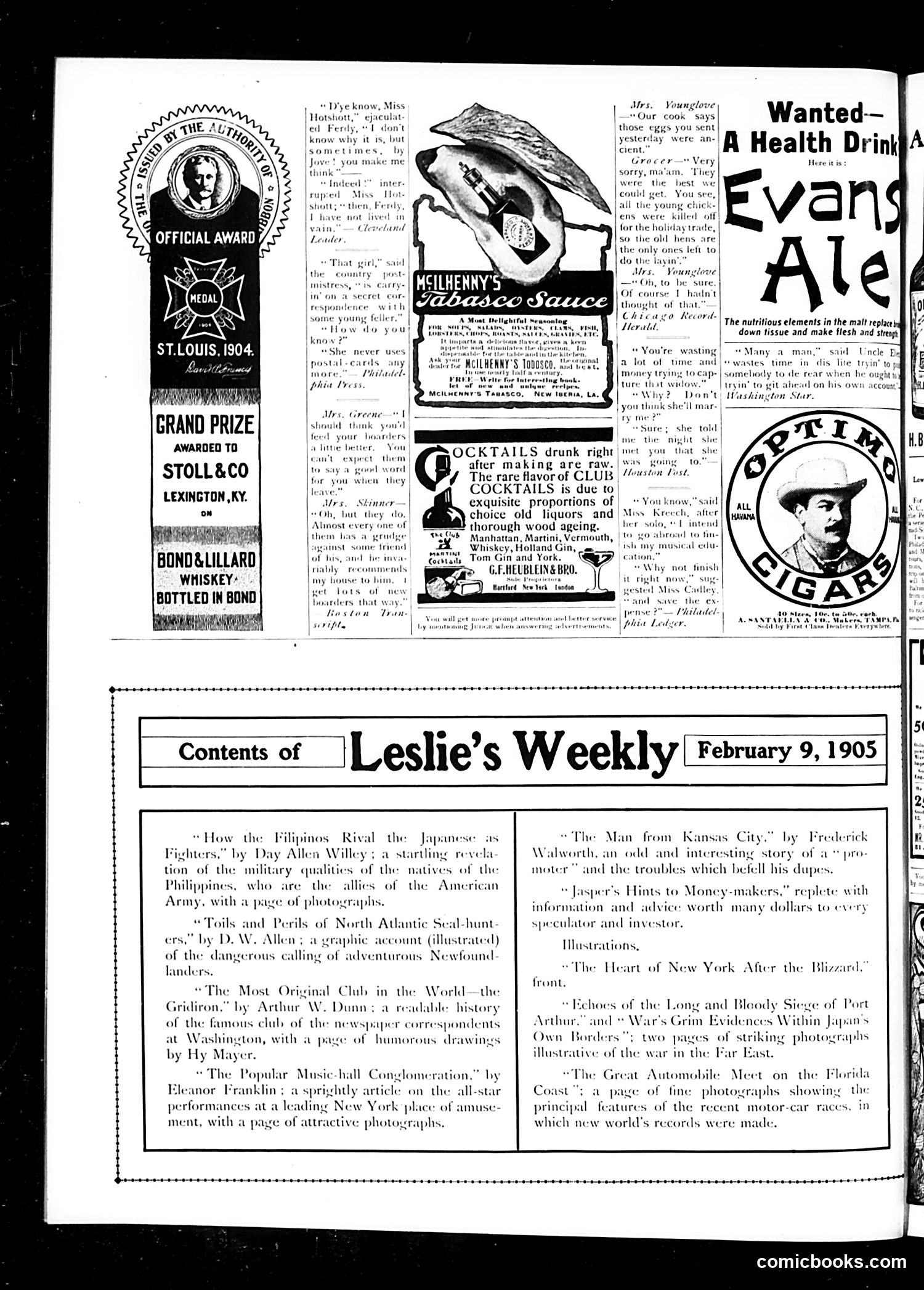
This is primarily a **contents/table of contents page** rather than a satirical cartoon page. It lists articles for that week's issue of Leslie's Weekly magazine. The page includes **advertisements** (Stoll & Co. whiskey, McIlhenny's Tabasco sauce, Club Cocktails, and what appears to be cigars), typical of magazine publishing of the era. The actual article summaries reference **contemporary events**: the Philippine-American War ("Filipinos Rival the Japanese"), the Russo-Japanese War (Port Arthur siege, "War in the Far East"), and early 1900s leisure topics (automobile racing, music halls, New York winter weather). Without visible satirical cartoons or political commentary on this particular page, the content reflects **turn-of-the-century American interests**—military conflicts abroad, emerging automotive technology, and urban entertainment—rather than providing specific political satire a modern reader would need explained.
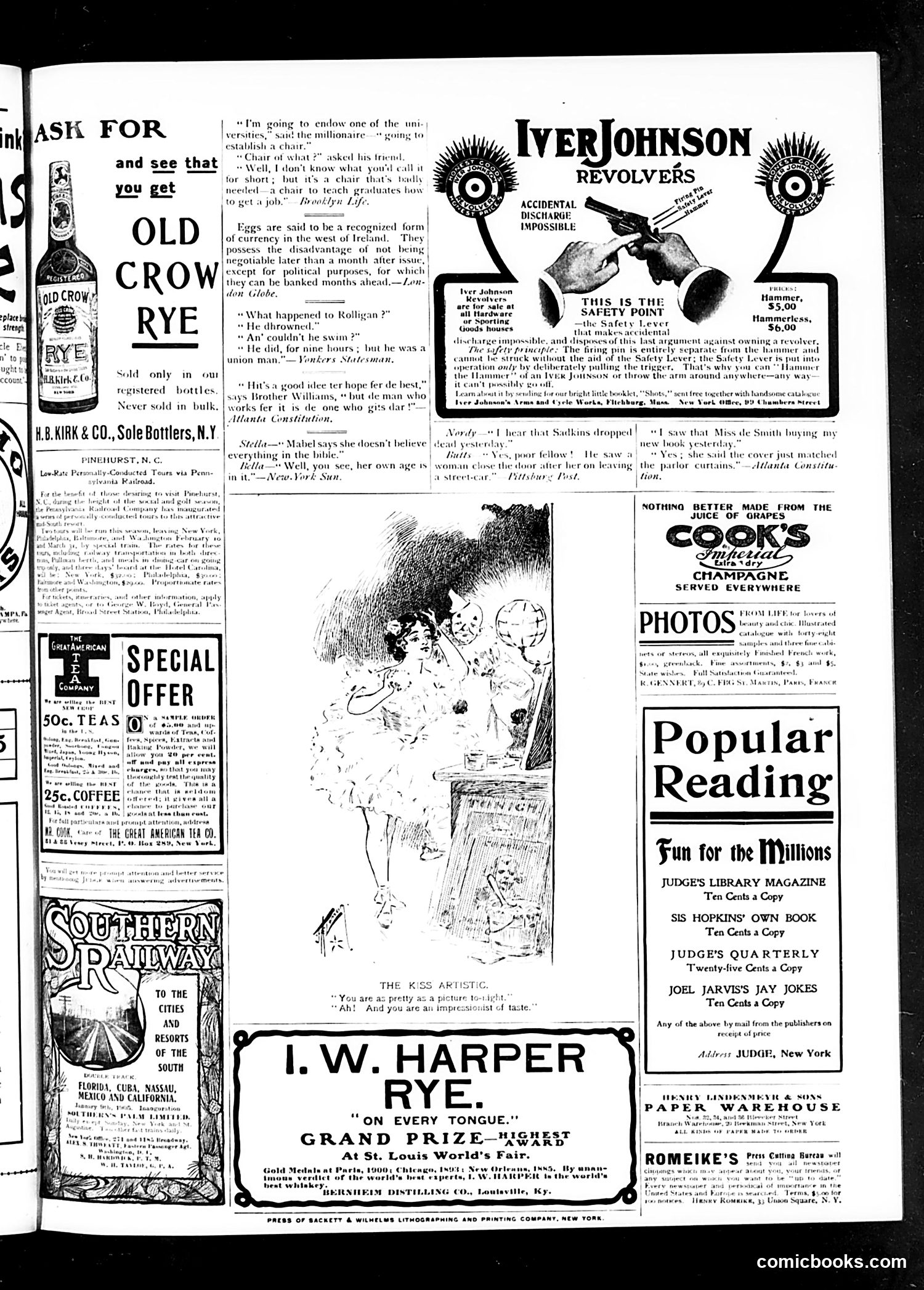
This page from Judge magazine combines advertisements with brief satirical jokes reflecting early 20th-century social attitudes. **The Main Cartoon:** The Iver Johnson revolvers ad features a "safety point" mechanism, humorously contrasted with text jokes about accidental discharge being "impossible"—satirizing product safety claims common in advertising. **Social Commentary in Jokes:** - A millionaire plans to endow a university chair teaching graduates "how to get a job"—mocking both wealthy philanthropists and unemployment - A drowned Irish union worker "couldn't swim" despite swimming nine hours—satirizing organized labor stereotypes - An egg-based currency system in Ireland appears absurd to American readers **The Bottom Cartoon** titled "The Kiss Artistic" shows a couple kissing, with the man calling the woman an "impressionist of taste"—likely mocking pretentious artistic language. **Context:** These jokes rely on era-typical stereotypes about immigrants (Irish), labor unions, and social climbing. The page is primarily advertising (whiskey, champagne, railway travel, magazines), with humor serving as filler content between commercial pitches.
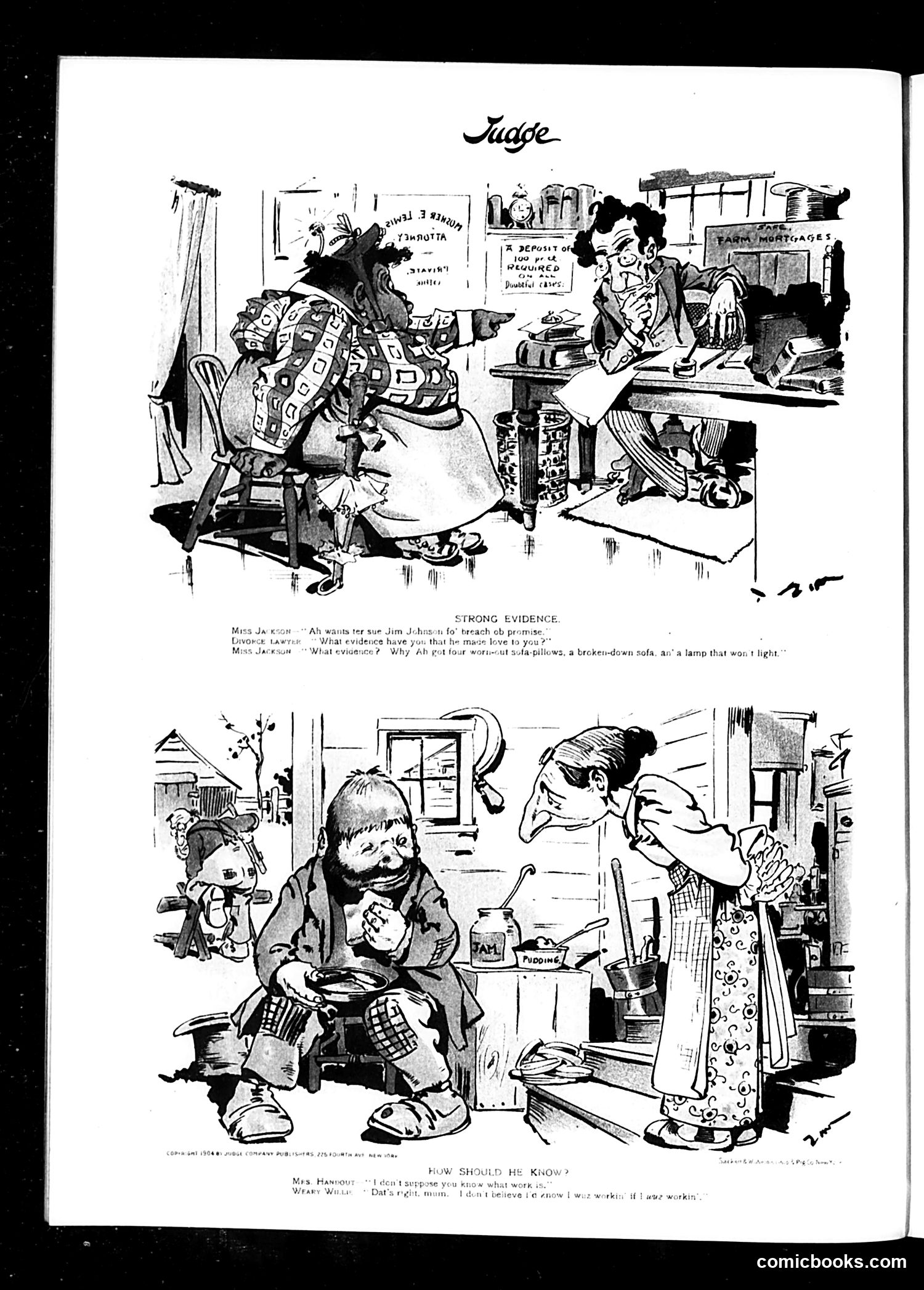
**Top cartoon ("Strong Evidence"):** A woman (Miss Jackson) confronts a judge about her husband's infidelity. She presents "evidence" of his affair—pillows, a broken sofa, and a lamp—suggesting a physical struggle occurred during domestic discord. The judge appears skeptical of her proof's relevance to establishing marital wrongdoing, satirizing the difficulty of proving infidelity cases in divorce court. **Bottom cartoon ("How Should He Know?"):** Mrs. Hanaford asks her husband where he works, claiming ignorance of his job. He sarcastically responds that she shouldn't expect to know what work is. The satire targets wives portrayed as disengaged from their husbands' professional lives—mocking both marital disconnection and possibly women's supposed lack of interest in "men's affairs." Both cartoons use exaggerated caricature to satirize marriage, gender relations, and domestic discord common to early-20th-century American humor.