
A complete issue · 16 pages · 1905
Judge — January 14, 1905
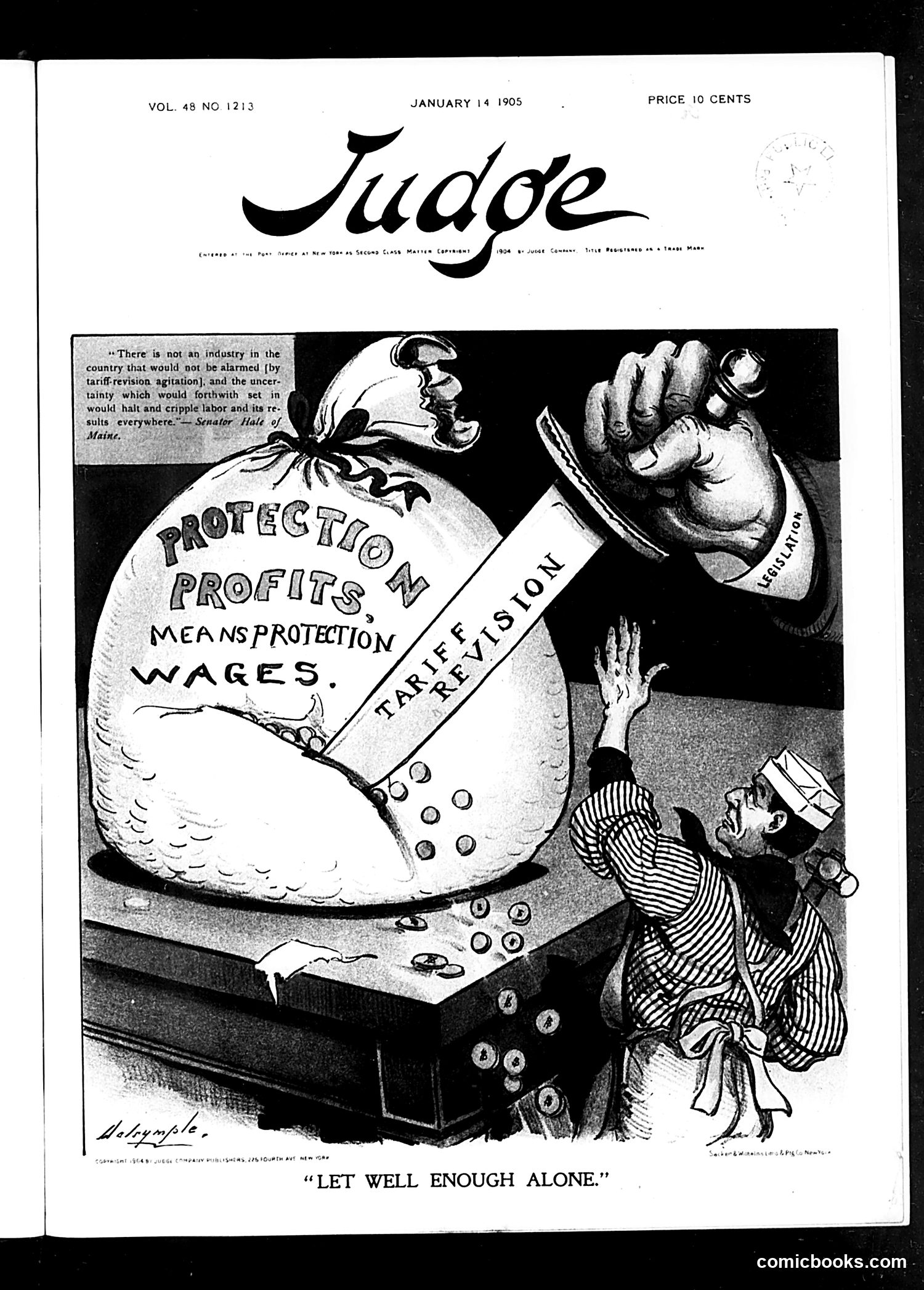
This cartoon satirizes the relationship between **protectionist tariffs and worker wages**. A large, bloated figure labeled "PROTECTION PROFITS" holds a "TARIFF REVISION" bottle, pouring coins onto a smaller worker below. The text inside reads "MEANS PROTECTION WAGES." The satirical message is clear: protective tariffs—defended as benefiting workers—actually enriched business profits while wages remained stagnant. The quoted epigraph from Senator Hale criticizes tariff revision as economically destabilizing. The cartoon argues that despite protectionist rhetoric claiming to shield American labor, the actual beneficiaries were wealthy industrialists, while workers received minimal wage increases. The title "Let Well Enough Alone" suggests ironic resignation to this exploitative system.
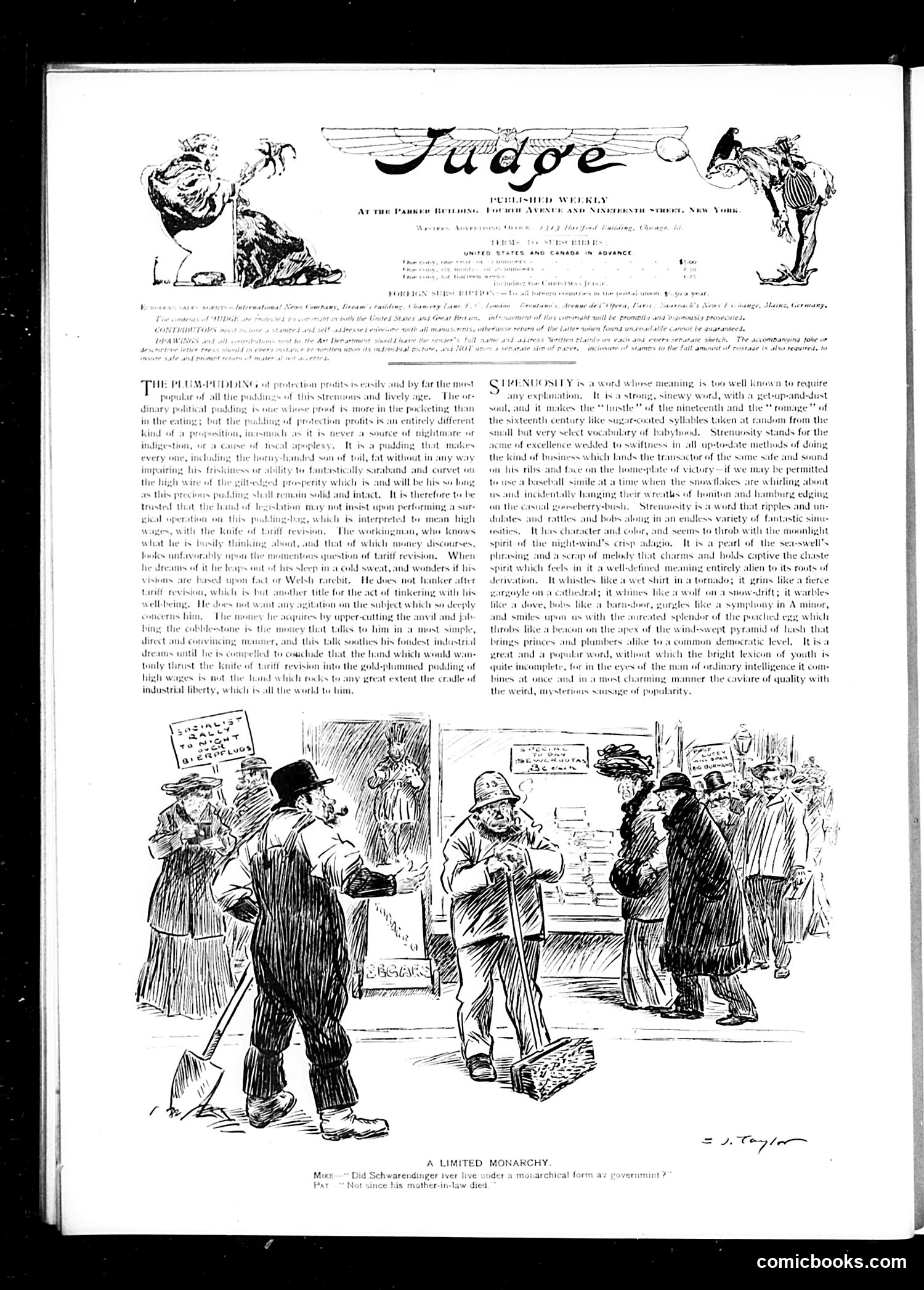
This cartoon titled "A Limited Monarchy" depicts a street scene with working-class figures and officials. The caption reads: "Mrs.—'Did Schaefer-anger over live under a monarchical form of government?' Pat—'Not since his mother-in-law died.'" The satire appears to play on the concept of "limited monarchy" (a government form with restricted royal power) by reframing it as domestic limitation—specifically, a man controlled by his domineering mother-in-law rather than any king. The humor relies on contemporary stereotypes about Irish immigrants (suggested by "Pat") and the common trope of overbearing in-laws. The joke suggests that ordinary working people experience more restrictive authority from family members than from actual government structures, undermining grandiose political concepts through everyday domestic reality.
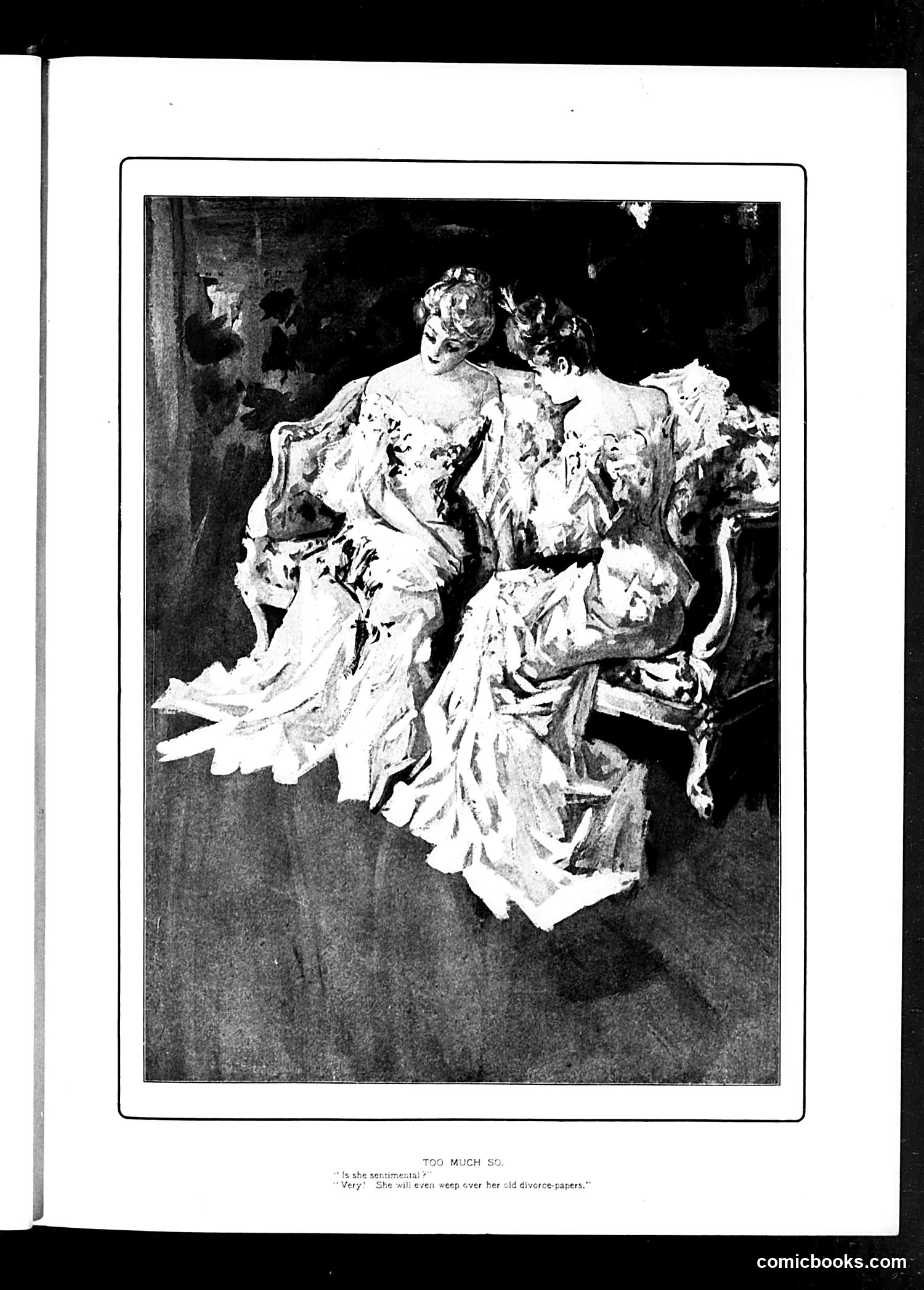
This satirical cartoon from *Judge* magazine depicts two elegantly dressed women in elaborate Edwardian gowns engaged in conversation. The caption reads: "Too sentimental?" "Very! She will even weep over her old divorce papers." The satire targets wealthy society women and the casualness of divorce among the upper classes. The joke centers on excessive sentimentality—the notion that a woman would cry over divorce papers as if they were romantic memorabilia, rather than legal documents ending a marriage. This mocks both the trivialization of divorce in high society and the artificial emotionality of elite women. The cartoon suggests that among the wealthy, divorce had become common enough to be treated as a sentimental keepsake, satirizing changing social attitudes toward marriage dissolution.
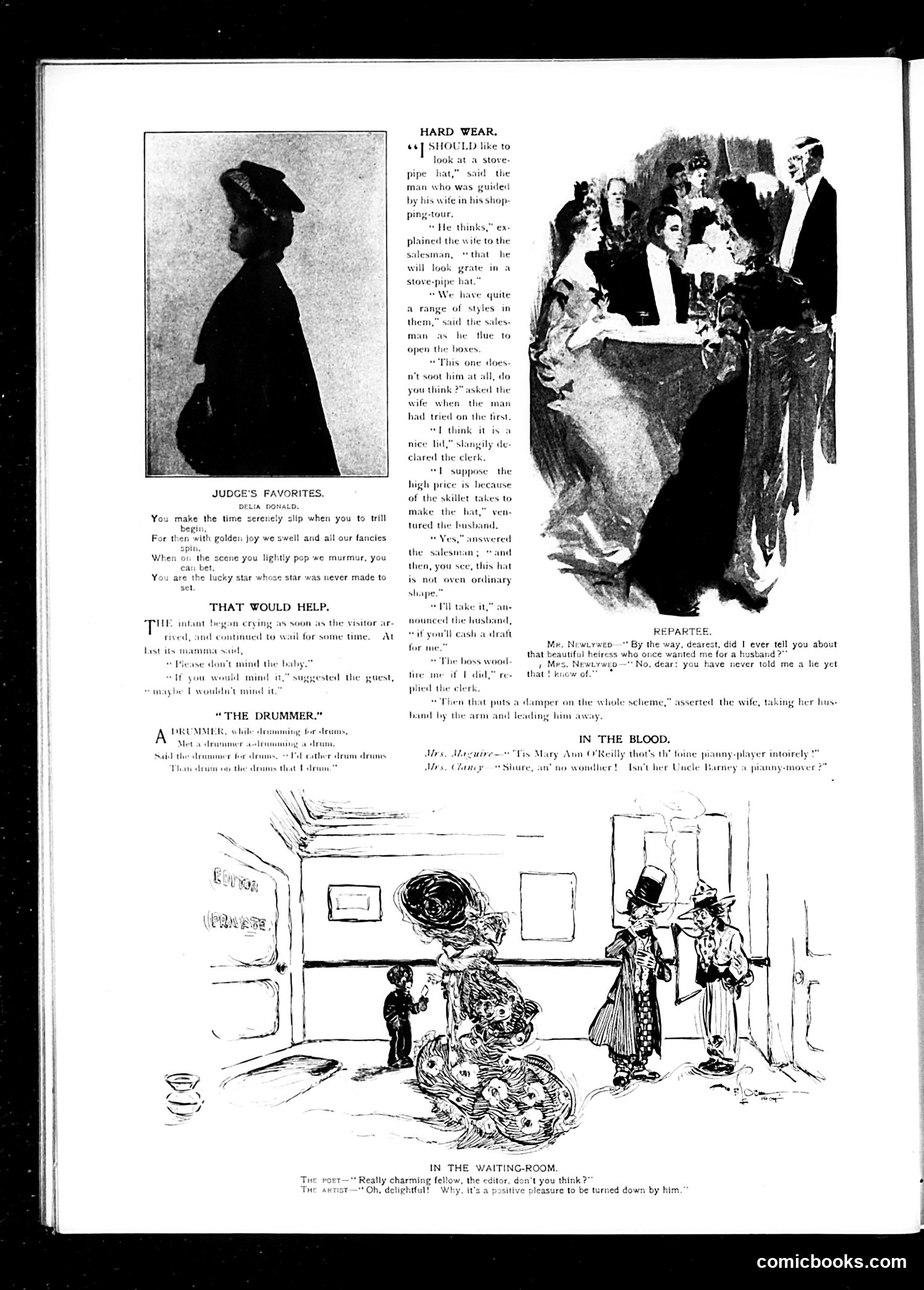
This page contains several short satirical pieces and cartoons typical of Judge magazine's humor: **"Hard Wear"** (top right): A domestic comedy sketch where a husband's wife guides him shopping for a stove-pipe hat. The satire mocks both fashion pretension and marital dynamics—the wife insists he'll "look great" in an expensive hat, while the husband worries about cost. **"Judge's Favorites"** and **"That Would Help"**: Brief humorous verses poking fun at everyday situations and social absurdities. **"The Drummer"**: A poem about percussion instruments. **"In the Blood"** and **"In the Waiting-Room"**: Short comedic dialogues about social interactions, using wordplay and situational humor. The cartoons feature silhouettes and sketches illustrating these domestic and social comedies. The overall tone is light satire aimed at middle-class American life and manners.
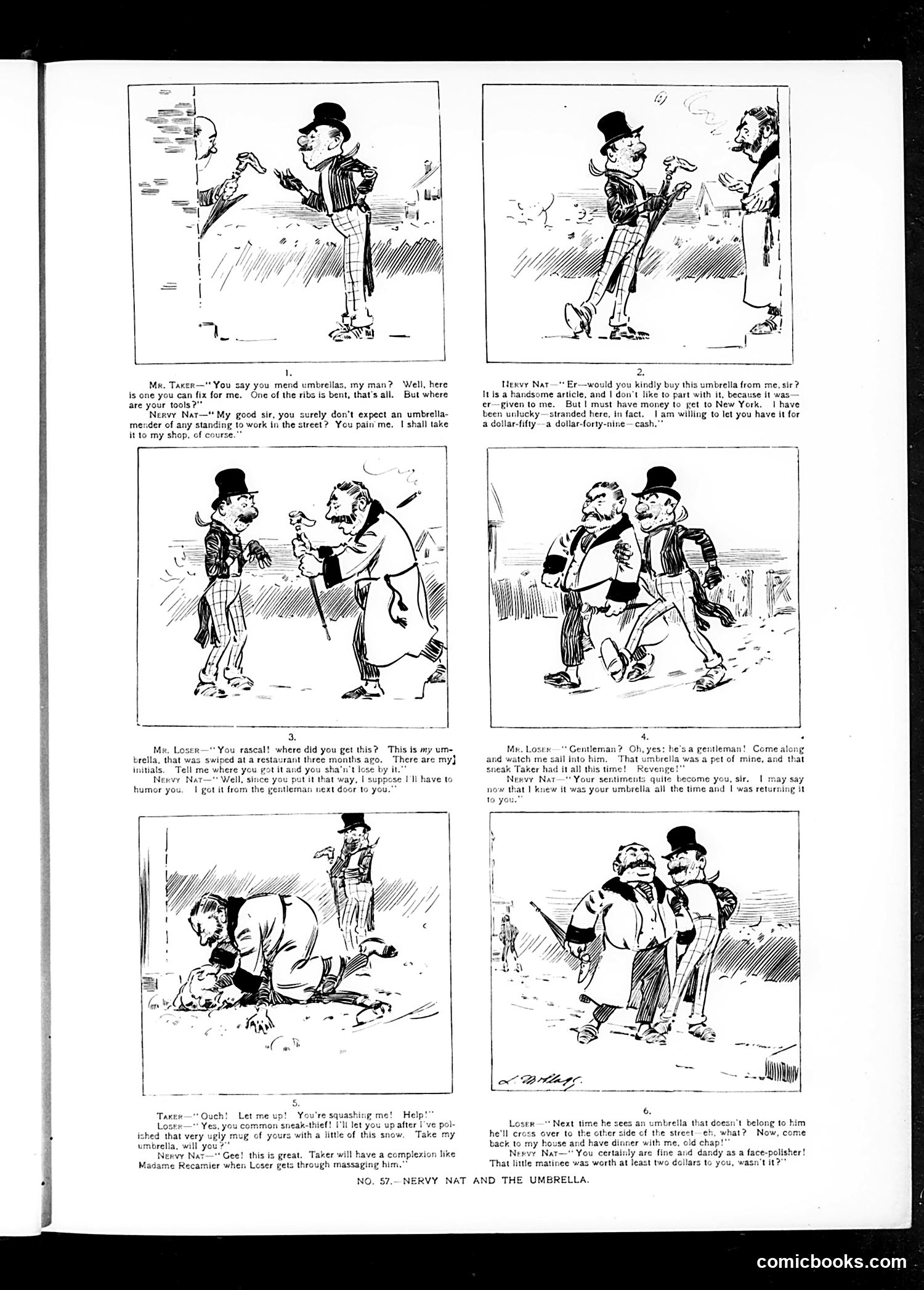
This is a six-panel comic strip satirizing a con artist character named "Nervy Nat." The plot follows a simple scam: Nat pretends to be an umbrella repairman, uses this cover to acquire stolen umbrellas from unsuspecting victims (Mr. Taxer and Mr. Loser), then attempts to sell them back to their original owners. The satire targets petty street hustlers and con men—common urban figures of the era. Nat's "nerve" (shamelessness) is the joke: he brazenly claims the umbrella is his when caught, invents elaborate excuses, and tries to profit from his own theft. The final panels show Mr. Loser's violent revenge, which provides comedic justice. The strip ridicules both the con artist's audacity and the ease with which such schemes apparently operated on city streets.
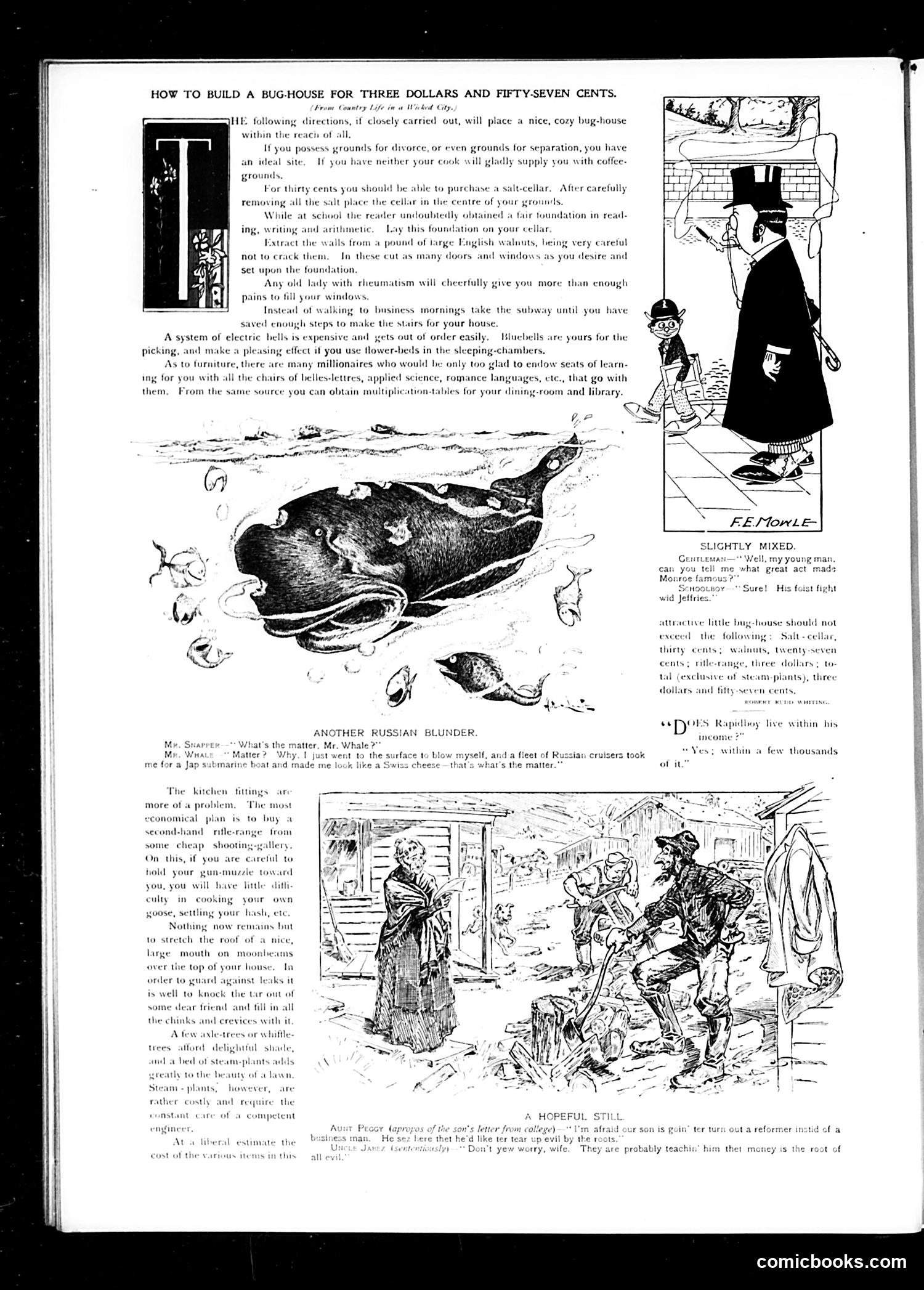
This is a humorous advice article satirizing both poverty and poor domestic planning. The title's specific price ($3.57) mocks budget-conscious readers attempting to build an inexpensive dwelling ("bug-house" slang for a cheap, shabby house). The satire works through absurd, impossible suggestions: using "divorce grounds" as a foundation, extracting walnut shells as walls, collecting "pains" from rheumatic elderly people as window fillings, and using subway steps as stairs. The final section on kitchen fittings darkly jokes about suicide ("hold your gun-muzzle toward you"). The accompanying illustrations and related brief jokes ("Another Russian Blunder," "Slightly Mixed," "A Hopeful Still") appear to be typical Judge magazine filler—unrelated satirical cartoons mocking Russian naval mishaps, class conflicts, and domestic incompetence. The overall message targets working-class aspirations to homeownership while mocking the absurdity of extreme penny-pinching and poor planning.
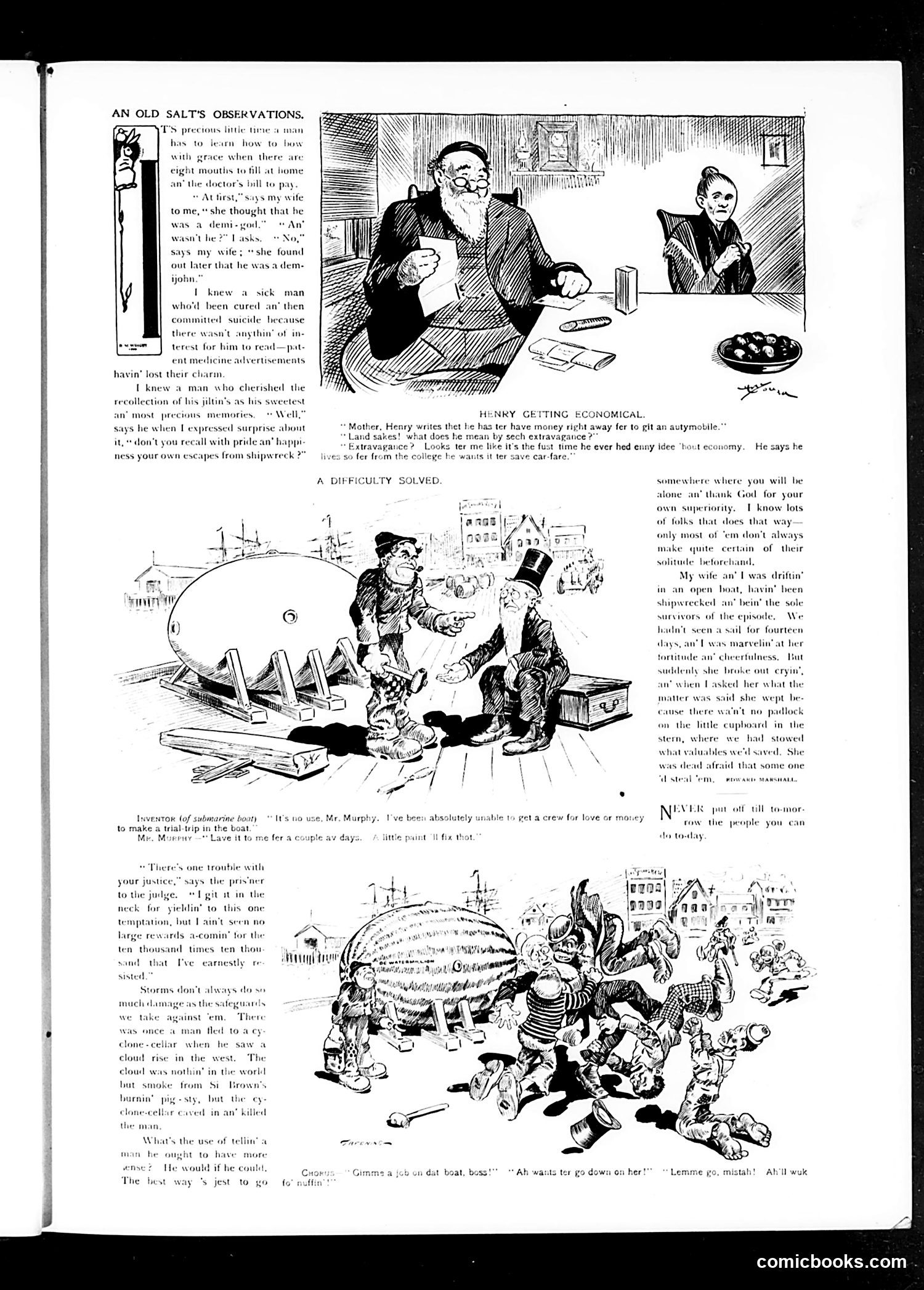
This page contains three separate anecdotes from "An Old Salt's Observations"—humorous stories told by a sailor character. The satirical points are: **"Henry Getting Economical"**: A mother complains her son Henry demands money for an automobile, calling it extravagant. Henry justifies it as *economy*—the car will save him trolley fare from college. The satire mocks absurd logic that masks wasteful spending as thrift; an automobile was a luxury expense in the early auto era, far exceeding transit costs. **"A Difficulty Solved"**: A shipwrecked couple drifts for two weeks. When the wife finally weeps, it's not from despair but because their storage cupboard lacks a padlock—she fears valuables might be stolen. The satire ridicules misplaced priorities and obsessive materialism even in life-threatening situations. **"A Difficulty Solved" (second anecdote)**: A prisoner complains receiving punishment for one temptation while seeing no reward for resisting thousands. Satire criticizes justice systems' apparent inconsistency in moral accountability. The page employs working-class dialect and vernacular speech typical of Judge's humor targeting middle-class pretension and illogical human behavior.
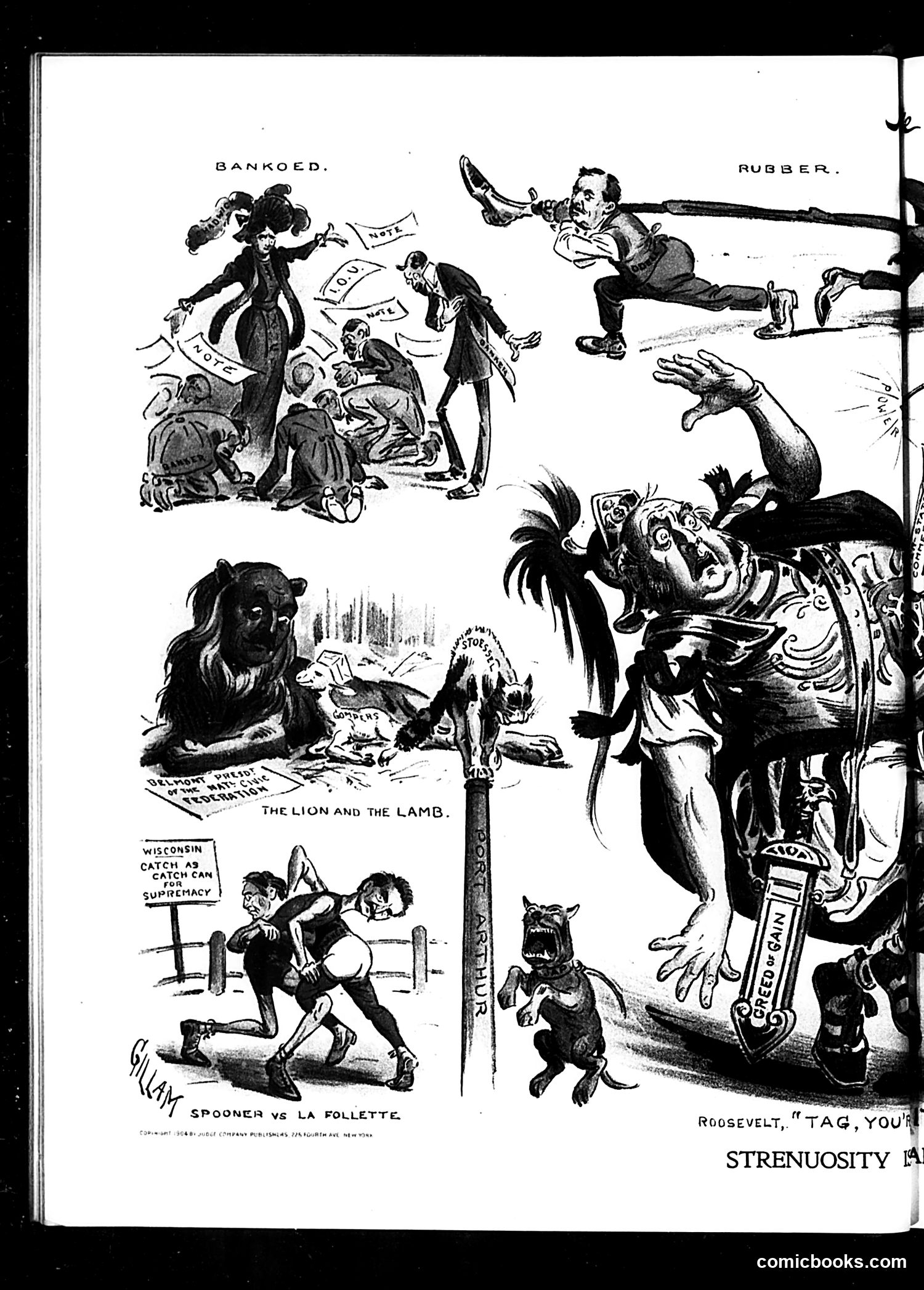
This page contains several satirical cartoons commenting on early 20th-century American politics. The top left "Bankoed" cartoon depicts a woman (likely representing a banking interest or financial institution) distributing notes to various figures, satirizing corruption or financial manipulation in politics. "The Lion and the Lamb" references a Wisconsin political struggle, with the lion and lamb as symbolic opponents competing for dominance—likely commenting on rival political factions or candidates. "Spooner vs La Follette" depicts a wrestling match, referencing an actual Wisconsin political rivalry. The right side shows Roosevelt (President Theodore Roosevelt) playing "tag" with a figure labeled "Robber," satirizing his famous trust-busting efforts and aggressive "strenuous" approach to combat corporate monopolies—a major theme of his presidency. The cartoons mock both the vigor of Roosevelt's policies and the political maneuvering surrounding them.
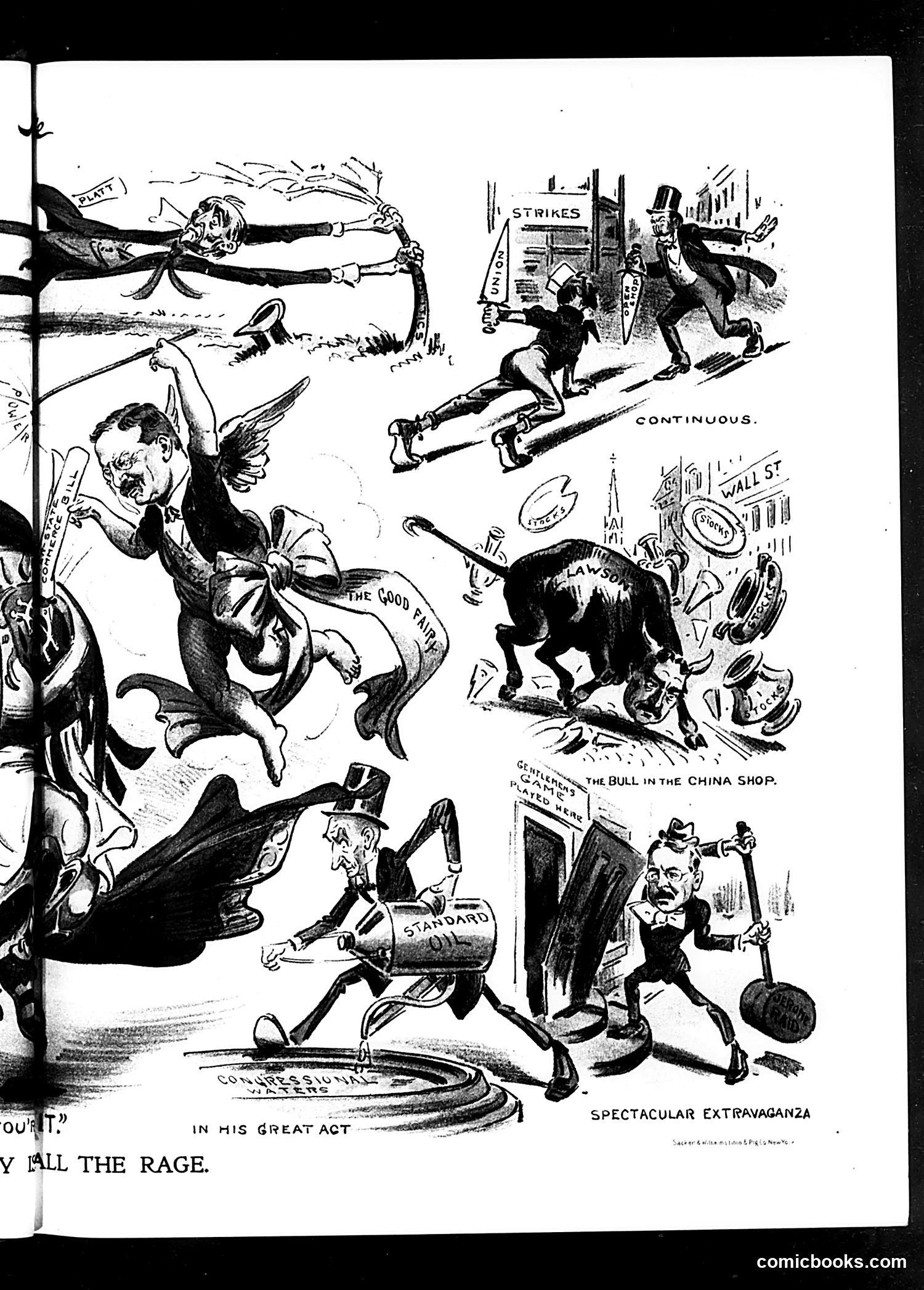
This page contains multiple satirical cartoons depicting financial and political chaos. The central image, "The Bull in the China Shop," shows a figure labeled "Lawson" (likely referring to a prominent financial figure) causing destruction among Wall Street establishments and stock markets. Other panels reference "Strikes" (labor unrest), "Continuous" action, and "Spectacular Extravaganza"—suggesting this depicts a period of economic turmoil and social upheaval. The cartoonist uses circus/performance metaphors to mock the chaos of financial markets and labor conflicts. The caricatured figures wielding tools like hammers and wrenches against established institutions suggest anxieties about reformers or agitators threatening traditional economic order. The overall theme portrays contemporary turmoil as dangerous disruption rather than legitimate reform—typical of Judge magazine's conservative satirical stance.
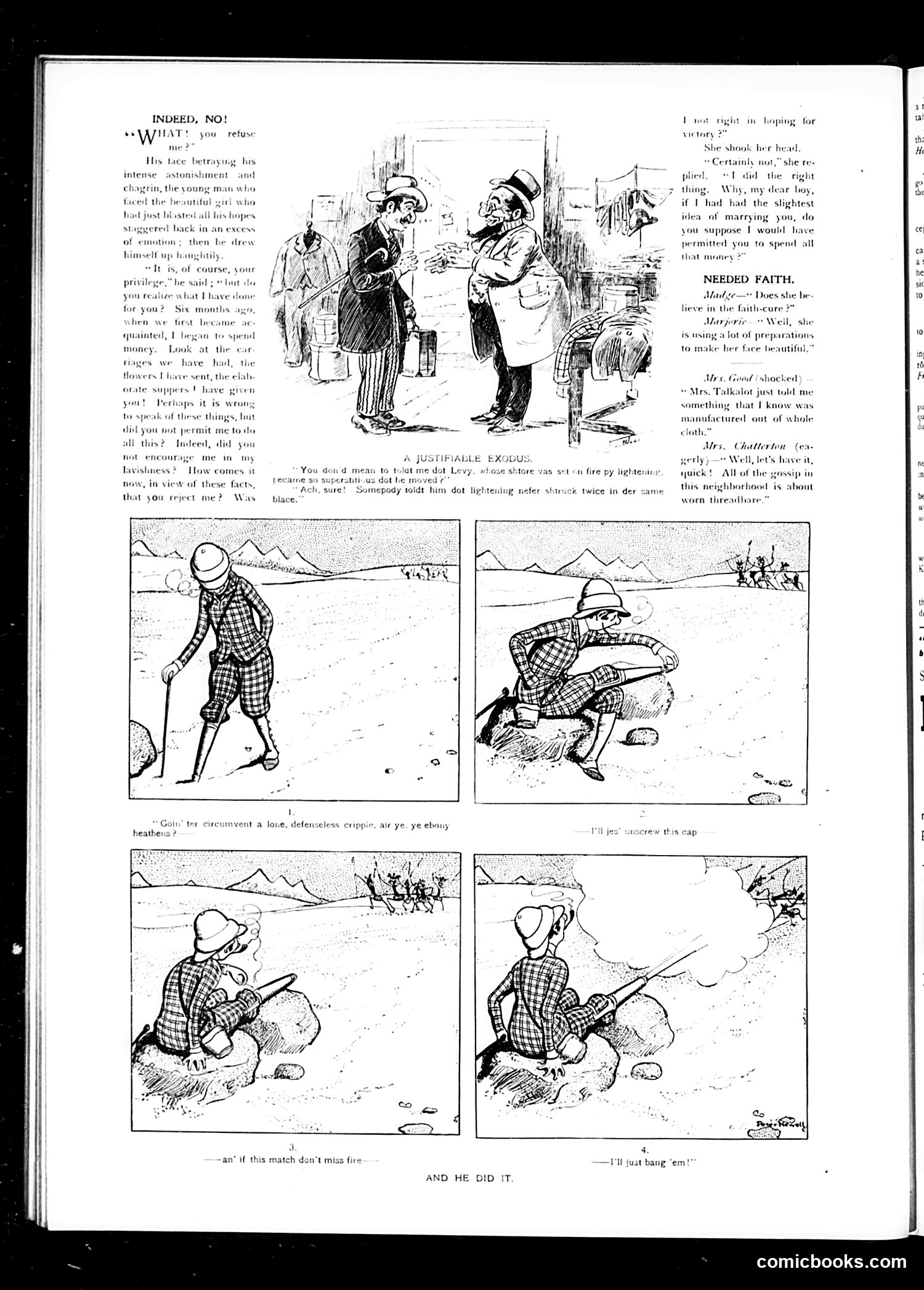
This page contains three distinct satirical pieces typical of Judge magazine's humor: **"Indeed, No!"** (top): A woman rejects a suitor's marriage proposal, revealing she deliberately manipulated him into spending money on her for six months—his lavish gifts and flowers were her goal all along, not genuine courtship. The satire targets both male gullibility and female mercenary behavior in romance. **"Needed Faith"** (middle right): A brief exchange mocking women's vanity, with one woman dismissing another's beauty preparations as artificial deception. **"And He Did It"** (bottom): A four-panel comic strip showing a man attempting to shoot at distant targets with increasingly comical desperation, finally succeeding. The satire likely targets either poor marksmanship or stubbornness in pursuing futile goals. All pieces employ the era's common stereotypes about gender relations, female vanity, and male foolishness for comic effect. The artwork style and printing quality suggest early 20th century.
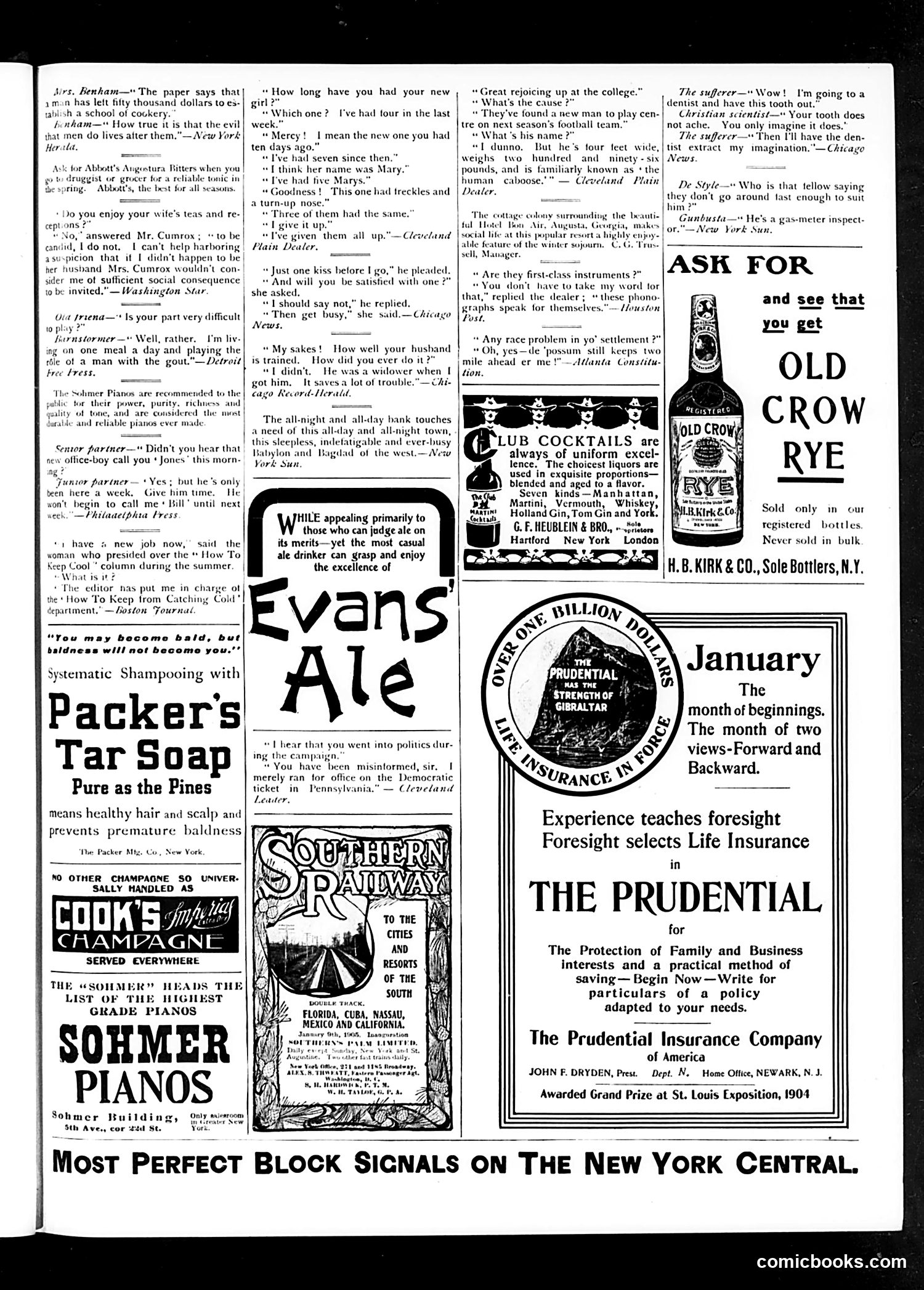
This page from *Judge* magazine (date unclear from image) is primarily **advertising with brief satirical jokes**, not political cartoons. The jokes target **domestic life and social pretension**. One mocks a husband's awareness that his wife only tolerates him because he's married to her. Another jokes about rapid staff turnover—the editor's "How To Keep Cool" column writer now handles a winter cold-prevention column. A third satirizes a woman's rapid succession of female servants, all named Mary. One joke references **Democratic Party politics**, suggesting Pennsylvania Democrats were so incompetent that simply running on their ticket constituted a political mistake rather than a genuine political act. The advertisements promote **Sohmer Pianos, Evans Ale, Packer's Tar Soap, Old Crow Rye whiskey, and Prudential Insurance**—period products targeting middle-class readers. The *Judge* audience was affluent enough to appreciate jokes about household help and country club life while being sold luxury goods.
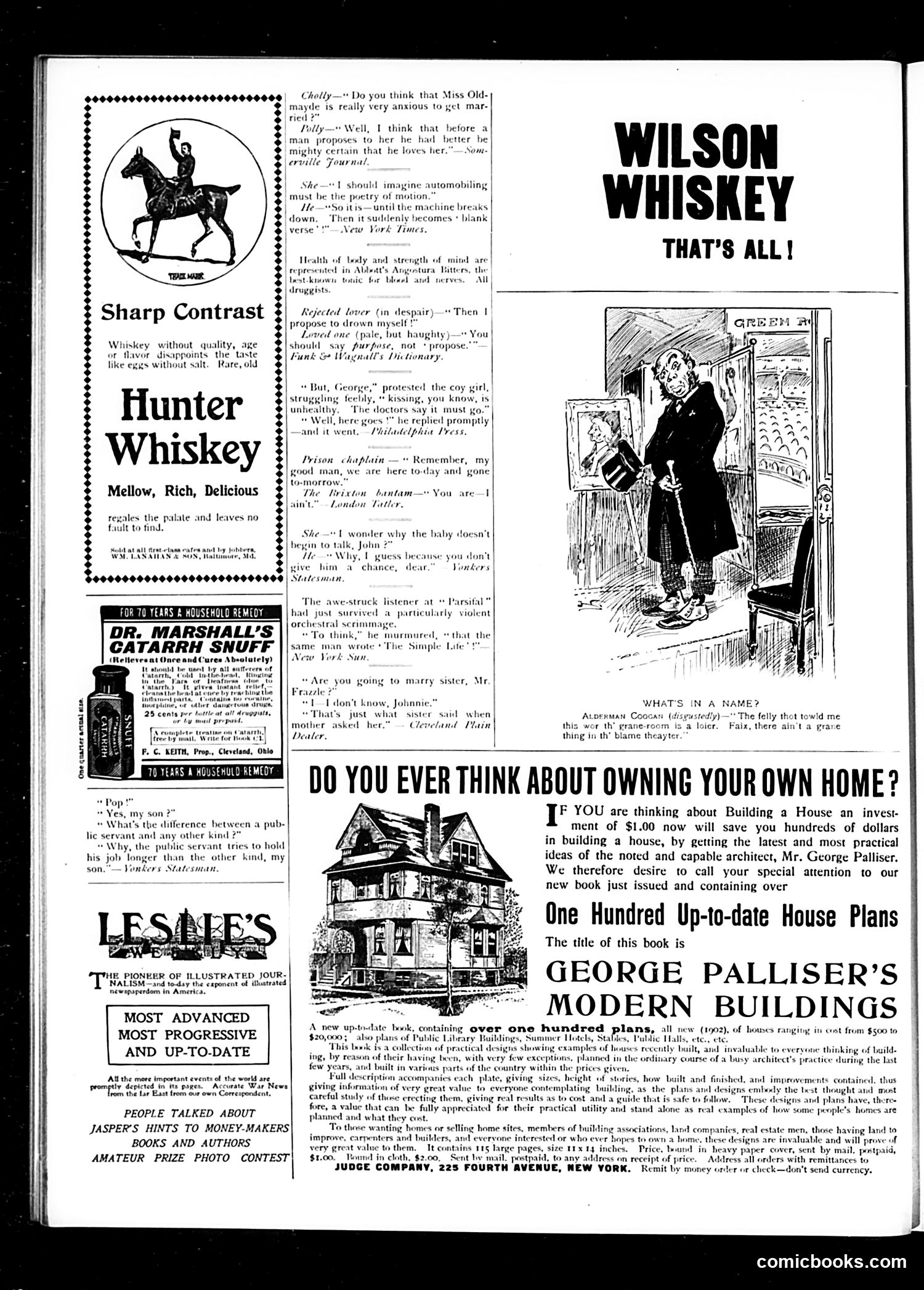
This page from *Judge* magazine contains several short humorous comic strips and jokes typical of early-20th-century American satire, interspersed with advertisements. The jokes mock contemporary social conventions: one exchanges dialogue between a young couple about marriage proposals; another satirizes how public servants prioritize job security over duty; a third jokes about the difference between romantic "poetry of motion" in automobiles versus mechanical breakdown. There's also humor about a rejected lover being corrected on his word choice, and a couple bickering about their baby not talking. The cartoons appear to target everyday relationship dynamics, gender roles, and the absurdities of modern life (automobiles, public service). The satire is gentle rather than cutting—poking fun at common romantic misunderstandings, marital dynamics, and social pretension rather than specific political figures or events. The bulk of the page consists of advertisements for whiskey, patent medicine (catarrh snuff), and architecture books—typical commercial content of period magazines.
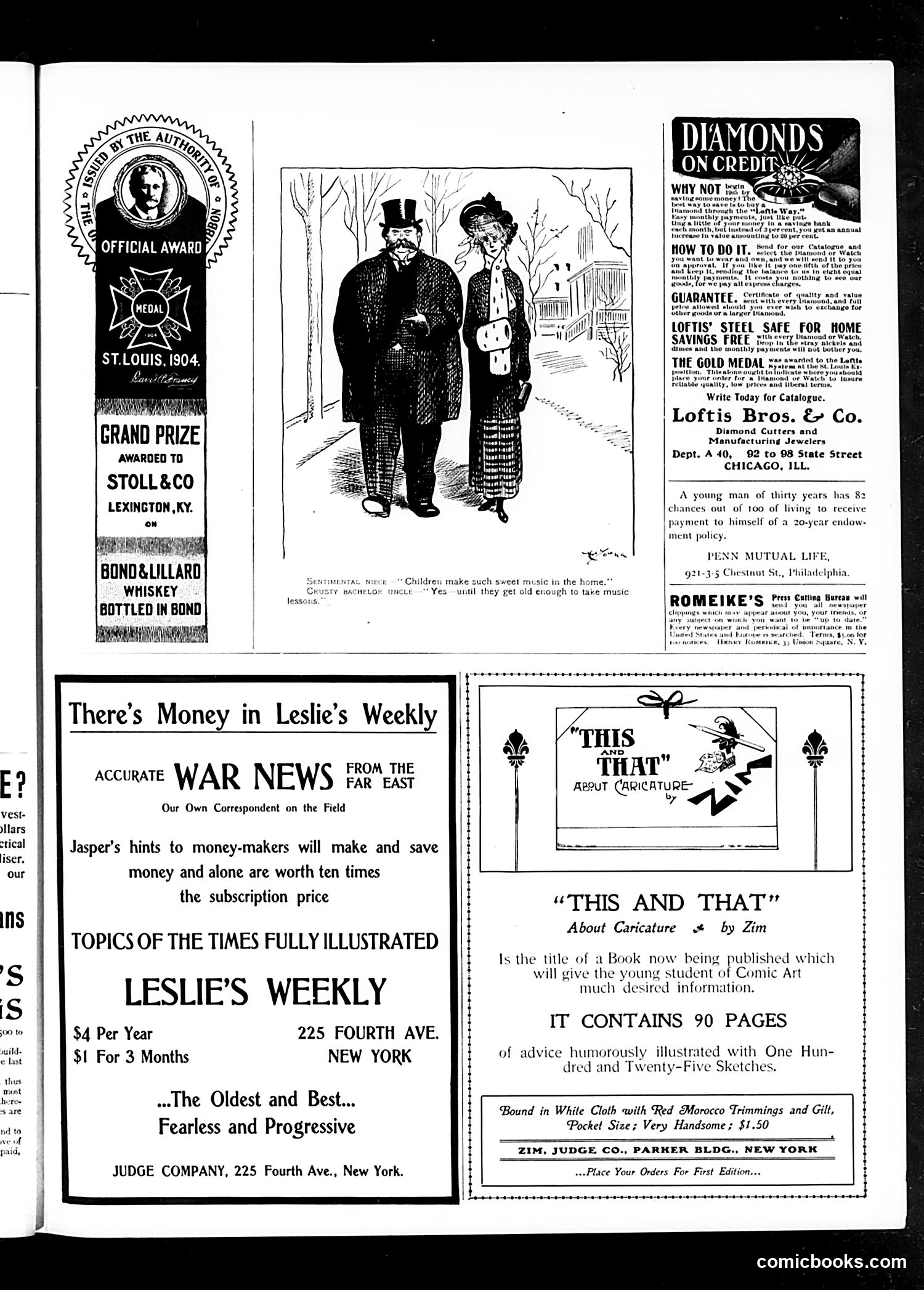
This page is primarily **advertising and promotional content** rather than editorial satire. The central cartoon shows two figures—an older man in a top hat and coat with a younger woman—with a caption about children making "sweet music" at home until old enough to take lessons, a gentle domestic joke about musical training. The page is dominated by ads for financial services (life insurance endowments, safes), whiskey (Bond & Lillard, awarded a St. Louis 1904 Grand Prize), diamonds, and publications. Leslie's Weekly advertises "War News from the Far East"—likely referencing the Russo-Japanese War (1904-05), a major contemporary news story that generated significant American media coverage and public interest. The "This and That" book advertisement promotes cartooning instruction by "Zim" through Judge Company, suggesting Judge's role in both satirical journalism and instructional content for aspiring cartoonists and illustrators. The page reflects early-1900s American consumer culture and publishing industry practices.
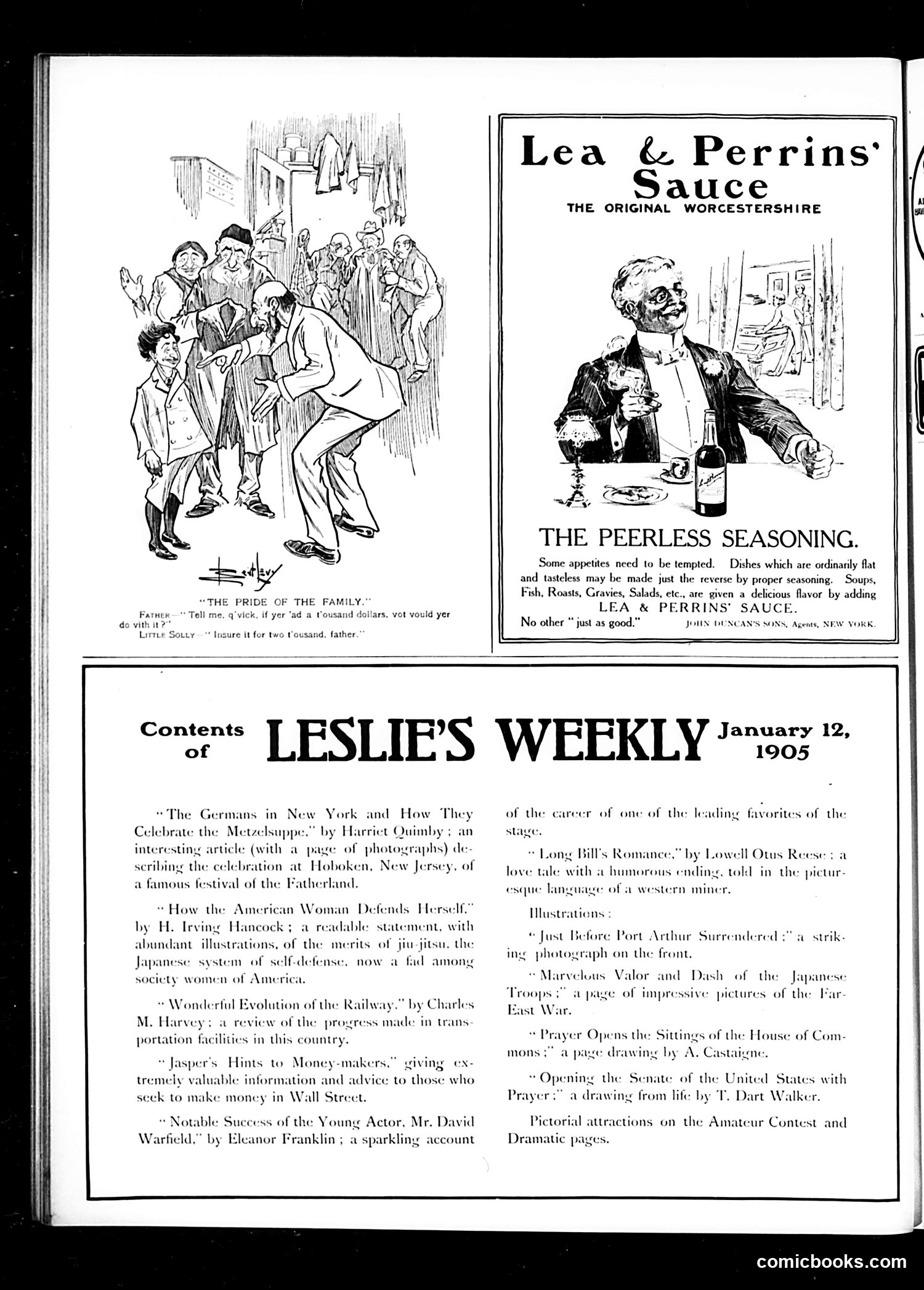
This is primarily a **table of contents and advertisement page**, not a satirical cartoon page. The main cartoon, titled **"The Pride of the Family,"** depicts a common immigrant stereotype joke. A farmer (drawn with exaggerated dialect spelling) asks his son what he'd do with a thousand dollars. The son replies he'd insure it for two thousand—a joke about immigrant naiveté regarding financial schemes and insurance fraud, reflecting early-1900s stereotypes about newly arrived immigrants' misunderstanding of American institutions. The page also advertises **Lea & Perrins' Worcestershire Sauce**, positioning it as essential for making "flat and tasteless" dishes palatable—a typical early advertising appeal about food quality. The contents preview articles on contemporary 1905 topics: German immigrants in New York, women's self-defense (jiu-jitsu as a society fad), railway progress, Wall Street financial tips, actor David Warfield, and coverage of the Russo-Japanese War (the Port Arthur reference).
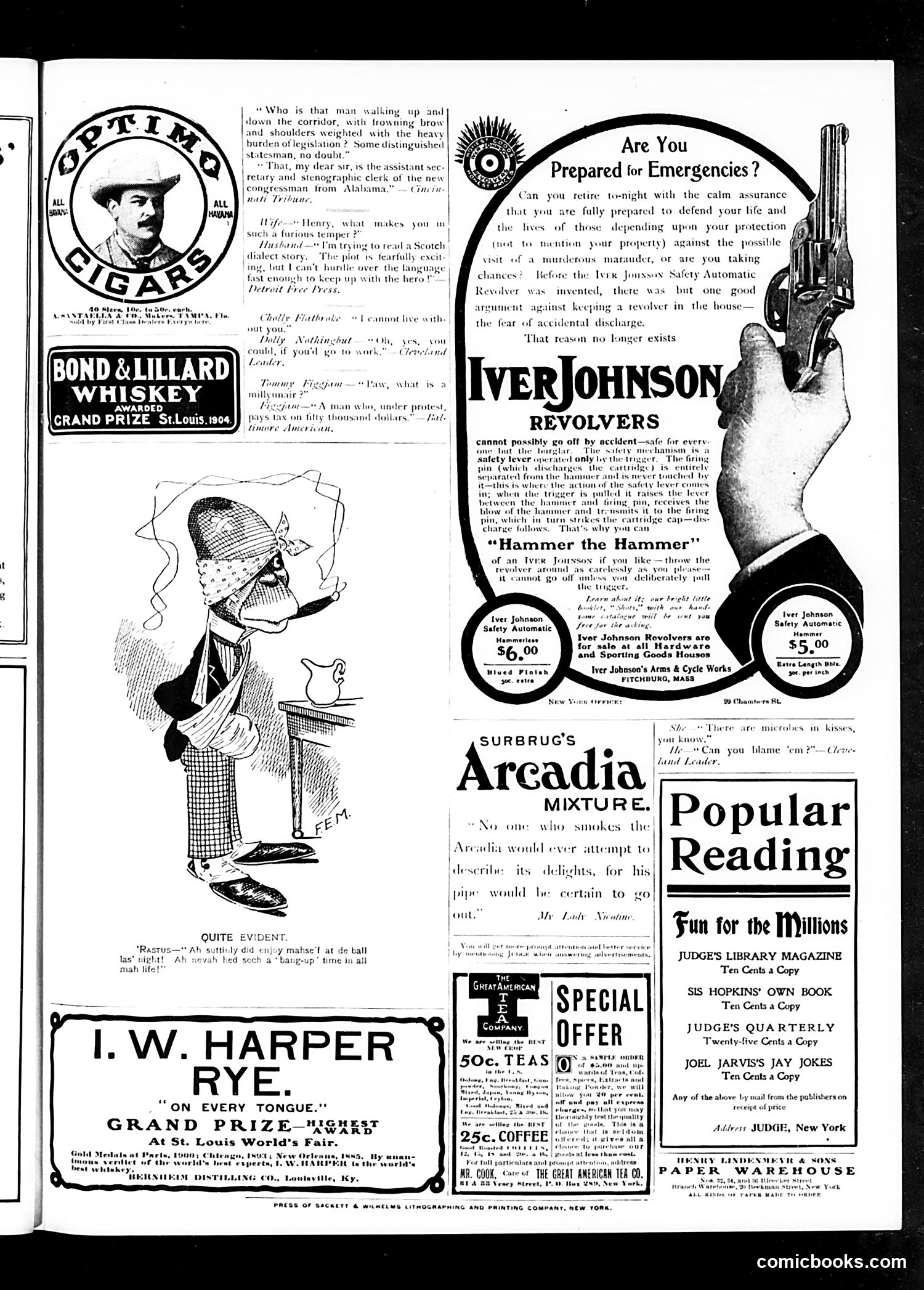
This page is primarily **advertising**, with one notable cartoon about workplace dynamics. The main cartoon, titled "QUITE EVIDENT," depicts a Black man ("Rastus") in dialect humor—a common though deeply offensive stereotype of the era. The joke plays on minstrel-show conventions: he claims to have had a great time at a ball "last night," despite the apparent contradiction with his current situation. This reflects Judge's reliance on racial caricature as comedic fodder, typical of early 20th-century American satirical magazines. The bulk of the page showcases period product advertisements: whiskey (Bond & Lillard, I.W. Harper), tobacco (Surburg's Arcadia Mixture), and notably, **Iver Johnson Safety Automatic Revolvers**—marketed as "safe for emergencies" with accident-prevention features. The revolver ad's emphasis on home defense reflects contemporary anxieties about urban crime and personal security. Additional ads promote Judge's own publications and reading material aimed at mass audiences. The page reflects the magazine's commercial priorities and the racial attitudes acceptable to its contemporary readership.
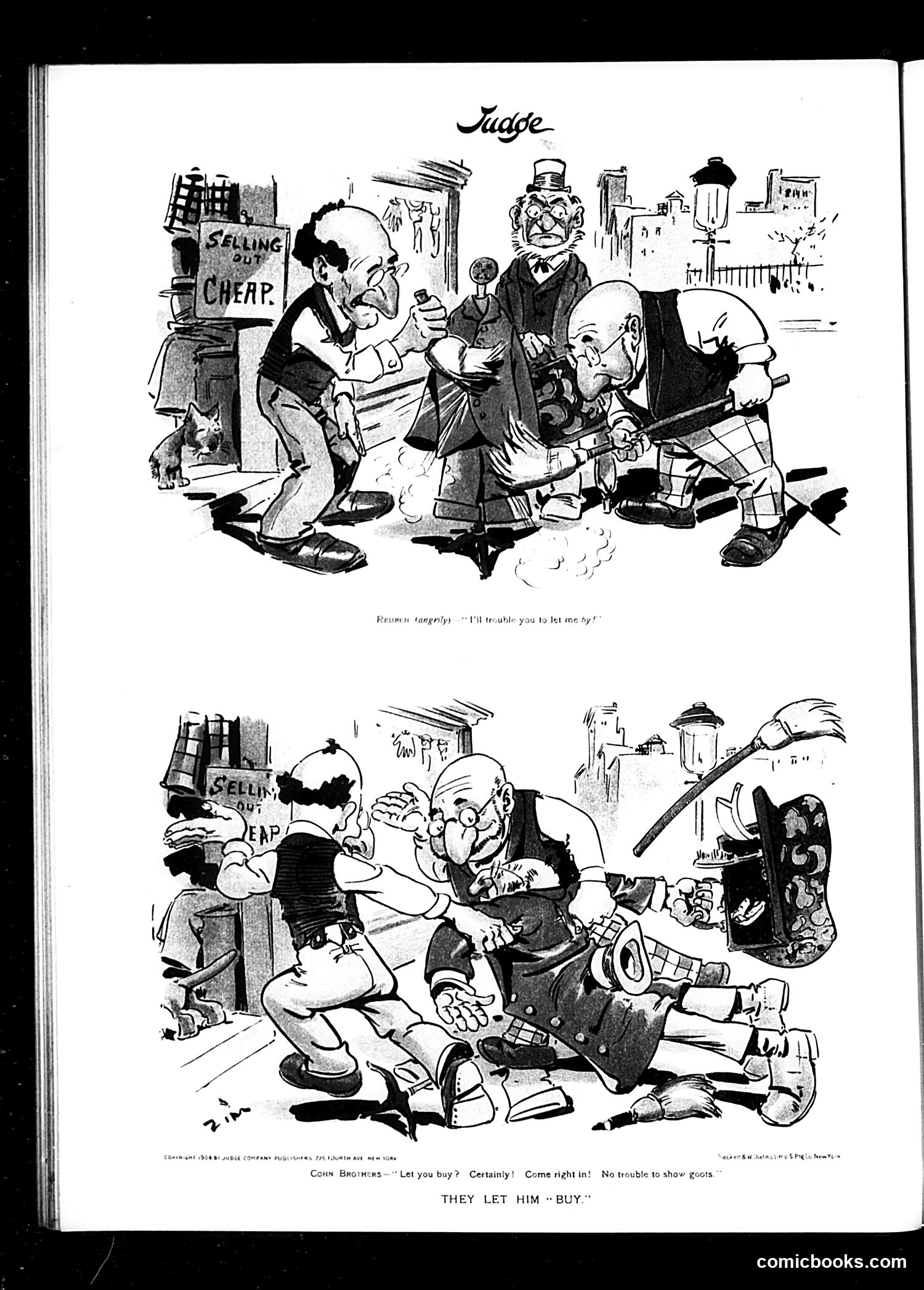
This two-panel Judge cartoon titled "They Let Him Buy" satirizes commercial dishonesty and judicial ineffectiveness. The top panel shows a judge observing street vendors operating a "Selling Out Cheap" stand while engaging in questionable dealings with customers. The caption reads: "Roman toga[?]—'I'll trouble you to let me go!'" The bottom panel depicts the same vendors now actively swindling customers with aggressive sales tactics. The caption states: "Corn Brokers—'Let you buy? Certainly! Come right in! No trouble to show goods.'" The satire critiques how merchants and brokers exploit consumers while courts and judges fail to intervene. The progression from observation to active fraud suggests judicial passivity allows commercial corruption to flourish unchecked. This reflects Progressive Era concerns about market regulation and legal accountability.