
A complete issue · 16 pages · 1902
Judge — October 25, 1902
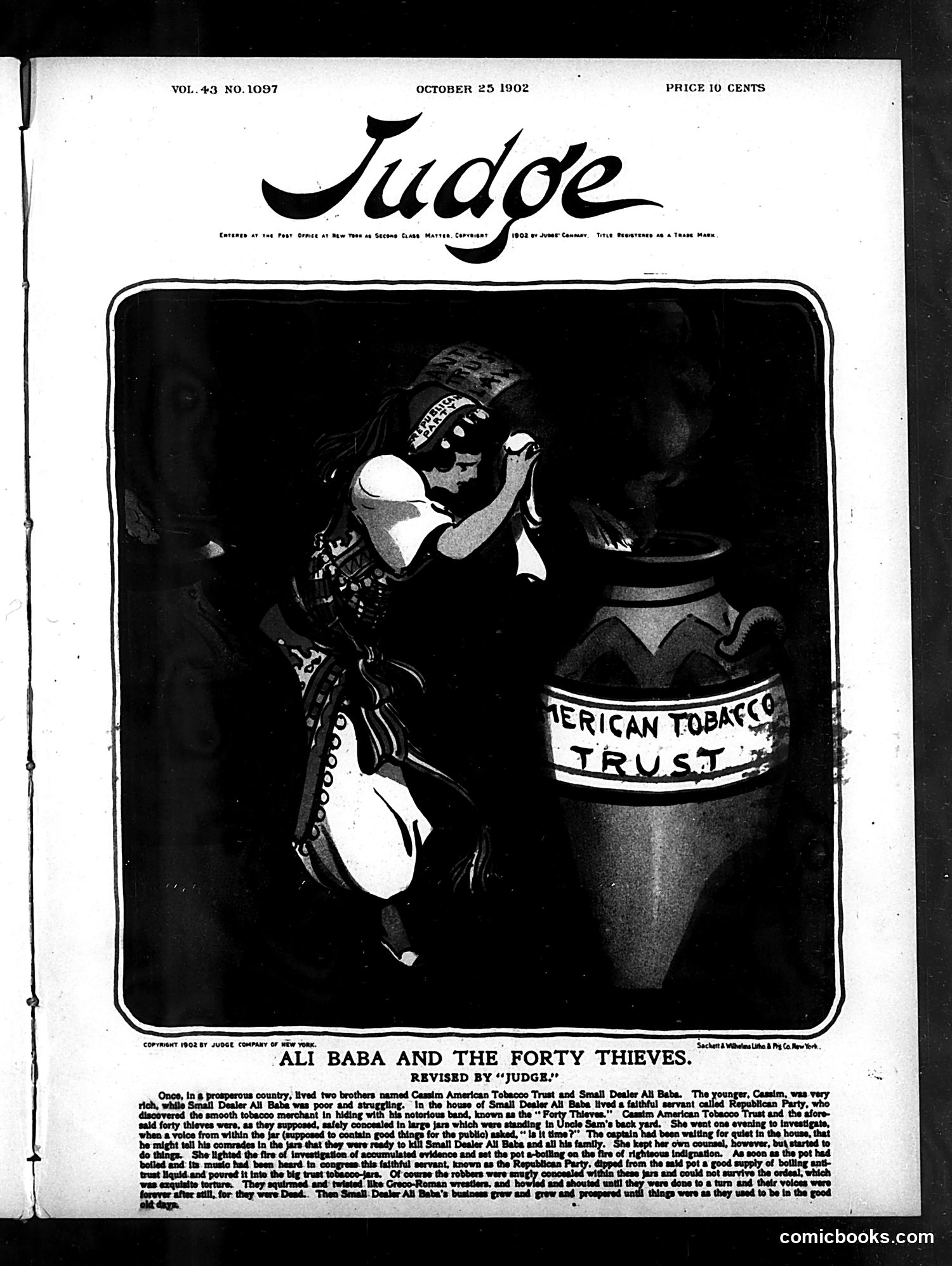
This 1902 cartoon satirizes the American Tobacco Trust. The image shows a caricatured figure (appearing to represent the Trust or its operators) confronting a large barrel labeled "American Tobacco Trust." According to the caption text, the satire revises the classic Ali Baba tale: two brothers named Cassin (American Tobacco Trust) and Small Dealer Ali Baba engaged in tobacco business. The narrative suggests the Trust is depicted as greedy monopolists—"thieves"—using underhanded tactics against smaller competitors, paralleling how Ali Baba's forty thieves operated through deception and intimidation. This reflects Progressive Era anxieties about corporate monopolies and their predatory business practices against independent merchants.
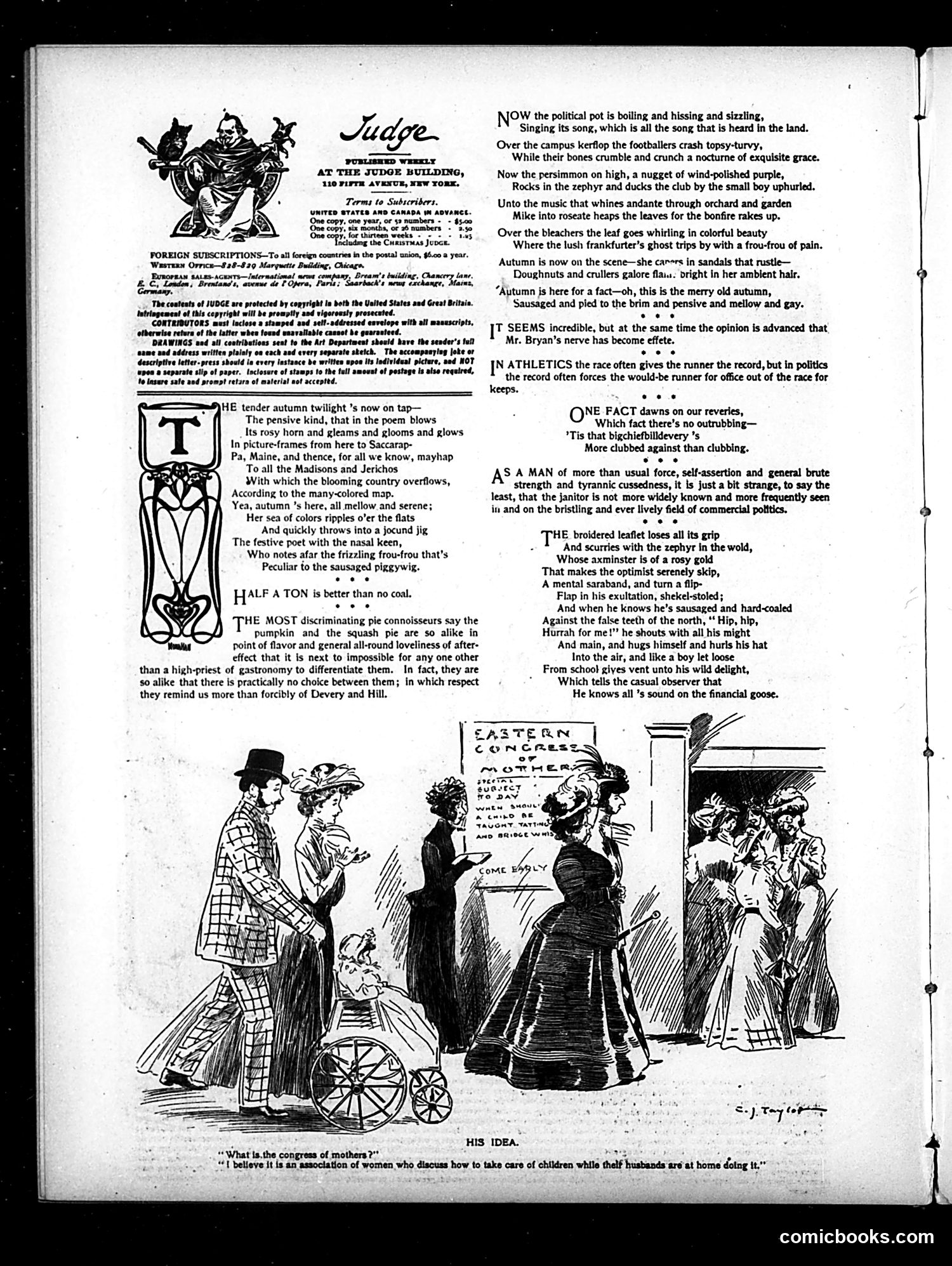
This Judge magazine page contains two main cartoons. The upper section features poetry and commentary on autumn and American politics, criticizing Bryan (likely William Jennings Bryan, a populist presidential candidate) for losing his political effectiveness. The lower cartoon titled "His Idea" depicts a congress of mothers discussing childcare. A man (likely representing a male politician or social commentator) proposes that mothers should organize to manage household duties while men work—essentially suggesting women should handle domestic labor exclusively. The satire mocks this reductive, paternalistic view of women's roles and the absurdity of men lecturing women about managing children and households. The cartoon critiques outdated gender assumptions common in early 20th-century American politics.
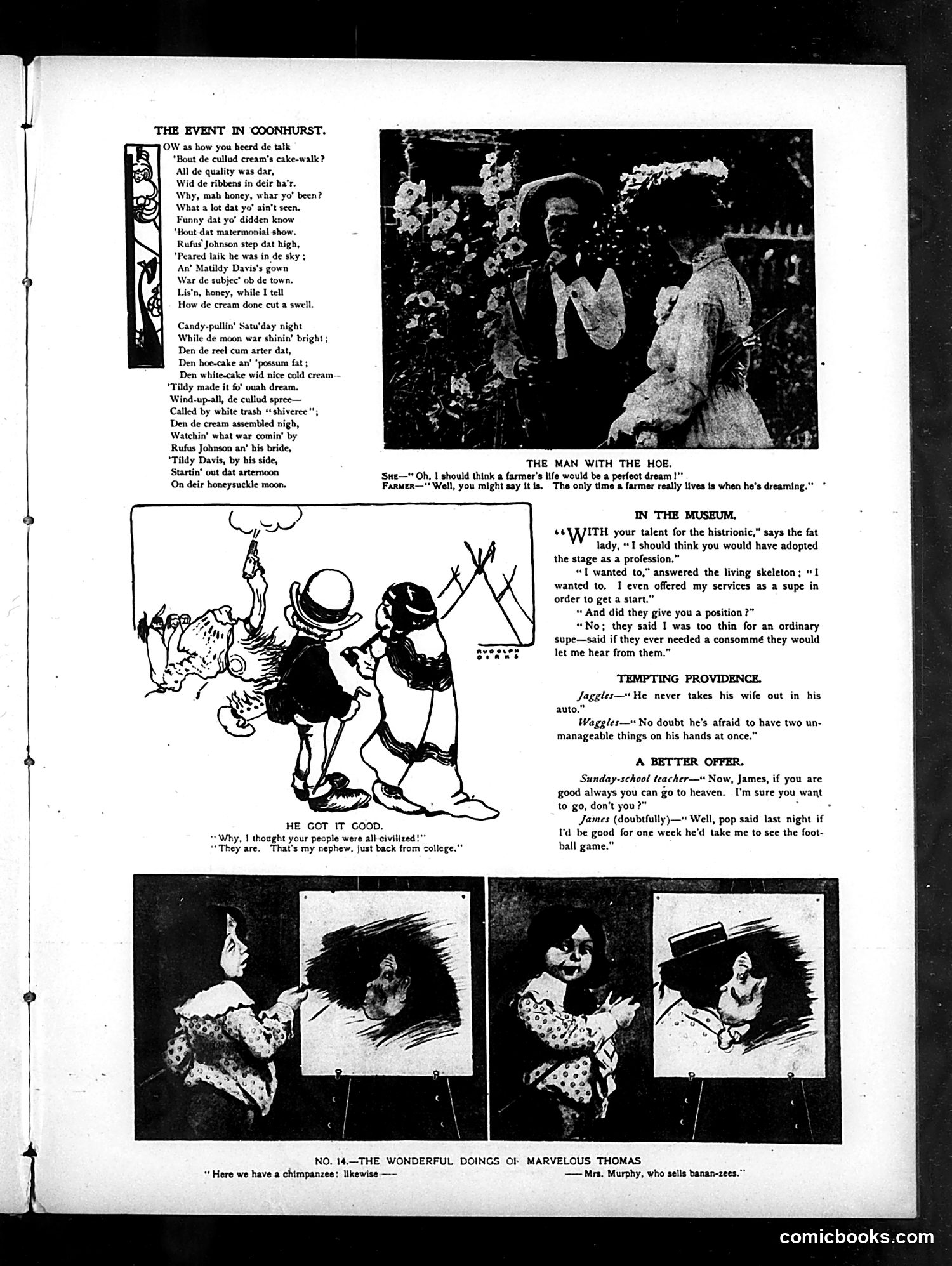
This page contains multiple satirical vignettes and a poem titled "The Event in Coonhurst." The content reflects early-20th-century humor conventions of Judge magazine. **"The Man with the Hoe"** (top right photo) appears to reference Millet's famous painting, with a dialogue about whether a farmer's life represents an ideal dream or reality. **"In the Museum"** jokes about a woman with theatrical ambitions being rejected as a stage performer or "living skeleton" attraction. **"He Got It Good"** (cartoon) depicts someone celebrating, with a caption suggesting relief or success. **The bottom section** appears to be stills from a film or stage production called "The Wonderful Doings of Marvelous Thomas," referencing vaudeville or slapstick entertainment popular in that era. The overall page reflects early-1900s popular entertainment, theatrical culture, and working-class humor typical of Judge's audience.
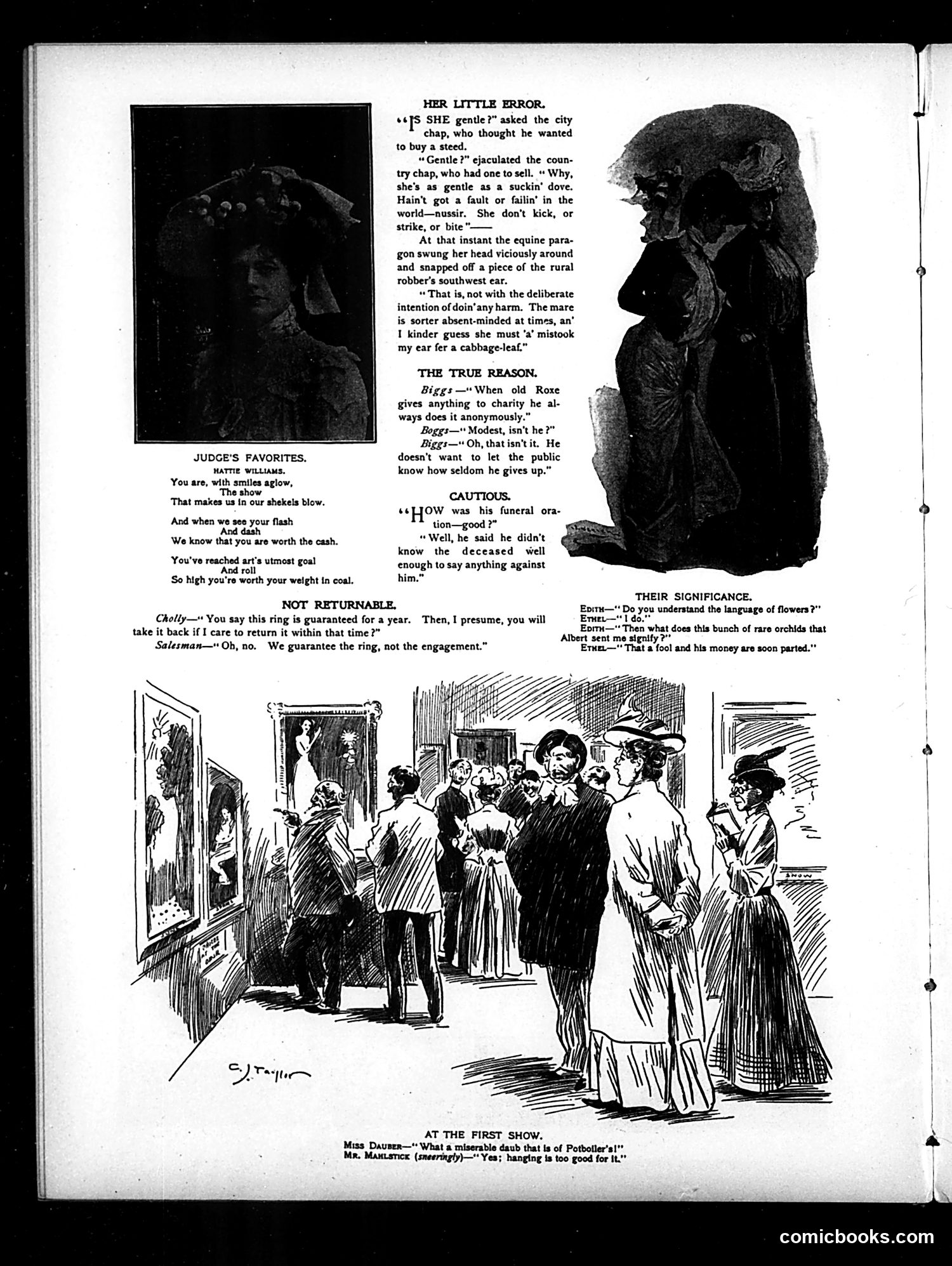
This page contains satirical commentary and humorous sketches from an early 20th-century American magazine. The "Judge's Favorites" section praises someone (likely a public figure) for their wealth and social status with tongue-in-cheek verse. "Not Returnable" depicts a jewelry sales dispute—a salesman refuses to guarantee an engagement ring, only the ring itself, mocking the disposability of modern relationships. "Her Little Error" satirizes rural/working-class dialect and behavior, presenting a country woman's violent reaction as characteristic ignorance rather than legitimate grievance. "At the First Show" (bottom illustration) depicts what appears to be an art exhibition opening, likely mocking pretentious art appreciation or social climbing among the wealthy. The overall tone reflects Judge's characteristic class-based humor targeting both the wealthy and working poor.
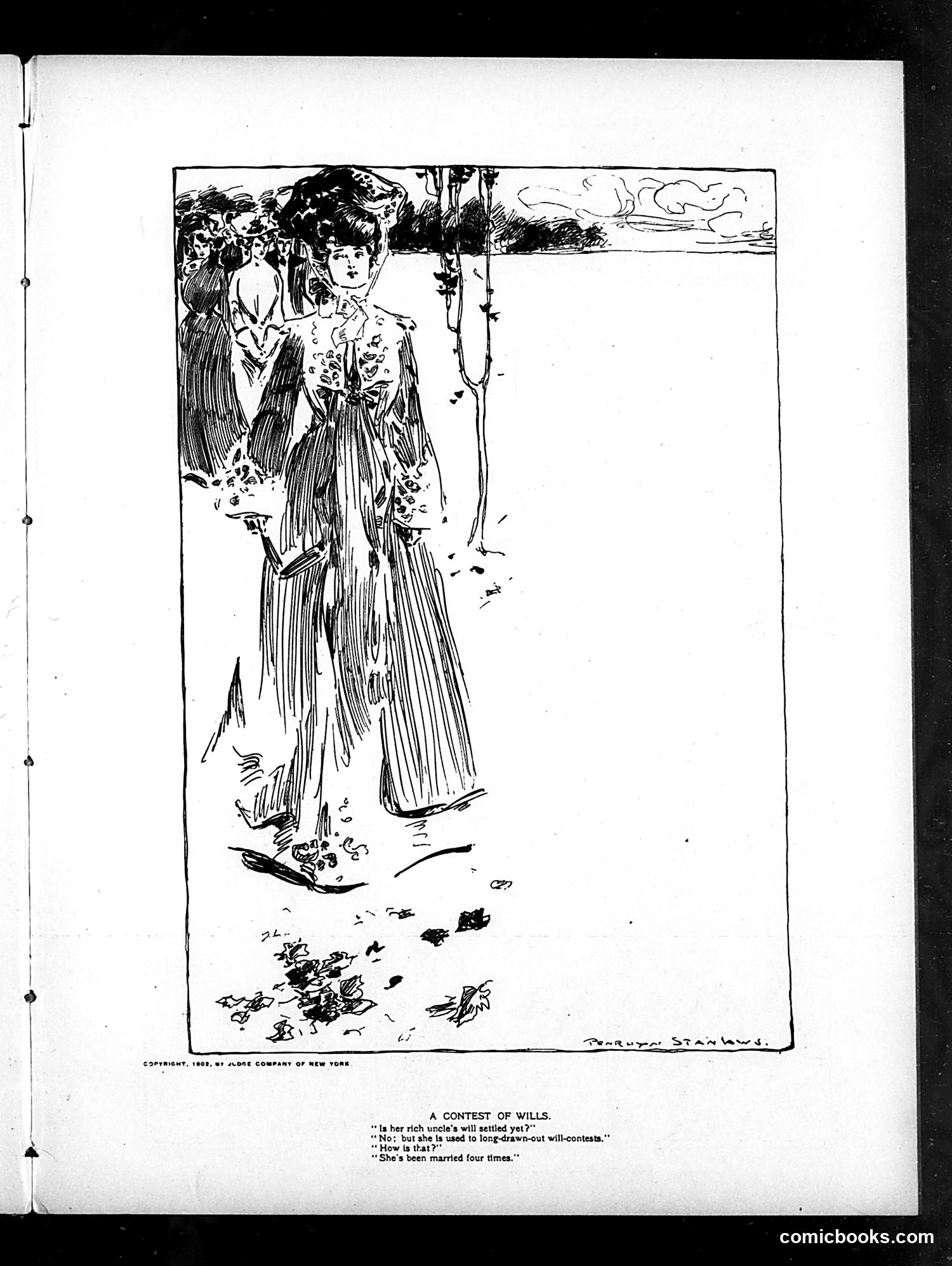
This cartoon satirizes women who marry repeatedly. The illustration shows a fashionably dressed woman with an elaborate updo hairstyle, standing amid scattered debris or fallen leaves. The joke plays on "will-contests"—legal disputes over an inheritance—by suggesting the woman's multiple marriages constitute their own kind of prolonged contest. The implication is that each marriage ends in divorce or death, requiring settlement negotiations similar to will disputes. The humor targets women perceived as serial marriers, suggesting their marital instability mirrors the drawn-out nature of inheritance litigation. The cartoon reflects early-20th-century Judge magazine's satirical stance on women's independence and changing social roles, mocking women with active romantic lives as frivolous or mercenary.
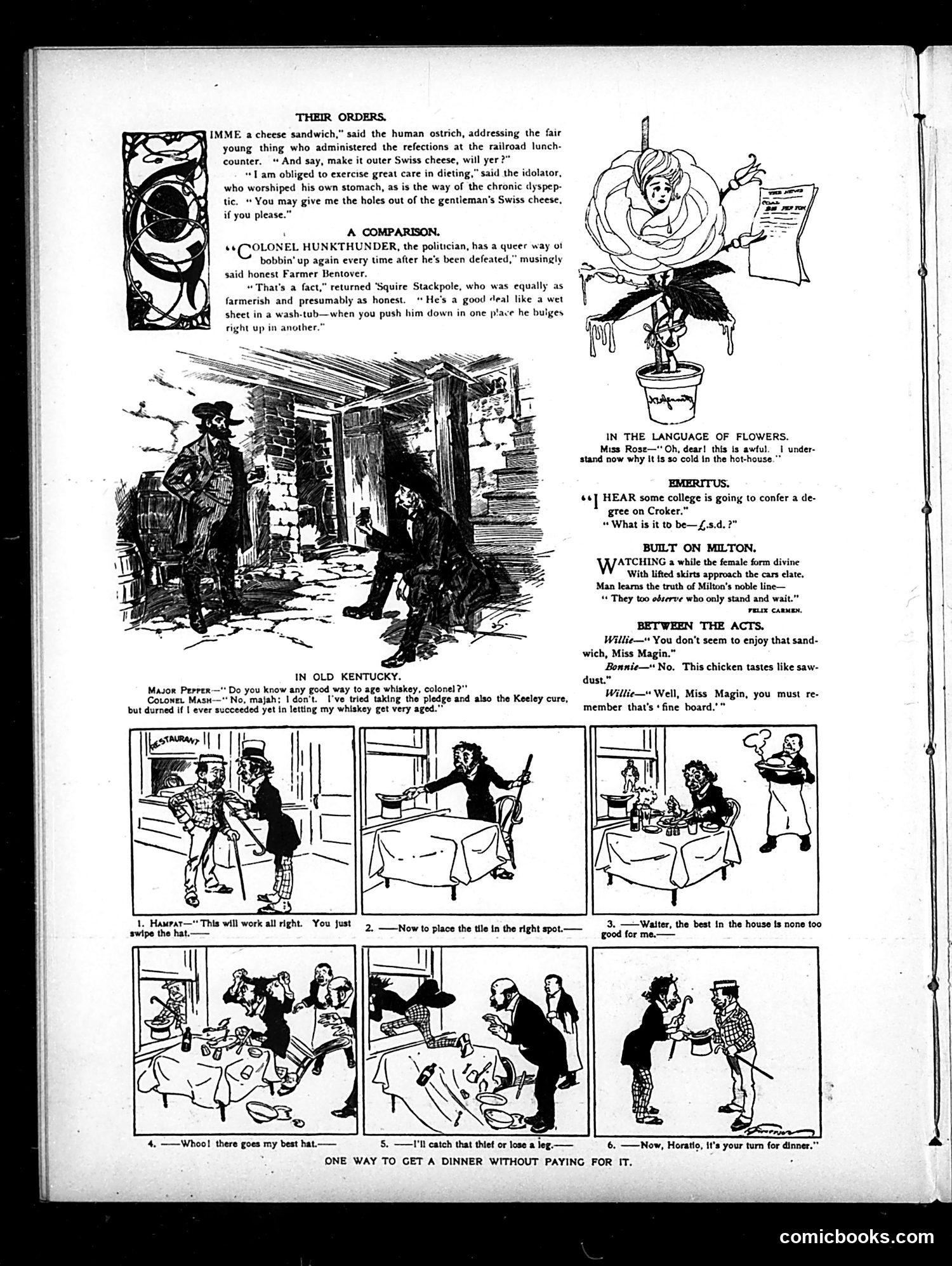
This page contains multiple brief satirical pieces typical of Judge magazine's humor: **"Their Orders"** mocks hypochondriacs—a chronic dyspeptic requests only the holes from Swiss cheese, treating his stomach as an obsession worthy of ridiculous dietary extremes. **"A Comparison"** uses rural characters (Farmer Bentover and Squire Stackpole) to joke about politician Colonel Hunkthunder's resilience after electoral defeats, comparing him to a wet sheet that pops back up when pushed down—implying politicians' persistent, annoying comebacks. **"In the Language of Flowers"** and **"Emeritus"** are brief one-liners about coldness and a degree for Croker (likely Richard Croker, the Tammany Hall boss). The bottom section is a six-panel comic strip titled **"One Way to Get a Dinner Without Paying for It,"** showing slapstick chaos at a restaurant—a waiter placing a tile incorrectly, someone losing their hat, a thief being chased, culminating in someone getting a free dinner through mayhem rather than payment. The overall tone is lighthearted social satire typical of Gilded Age American humor.
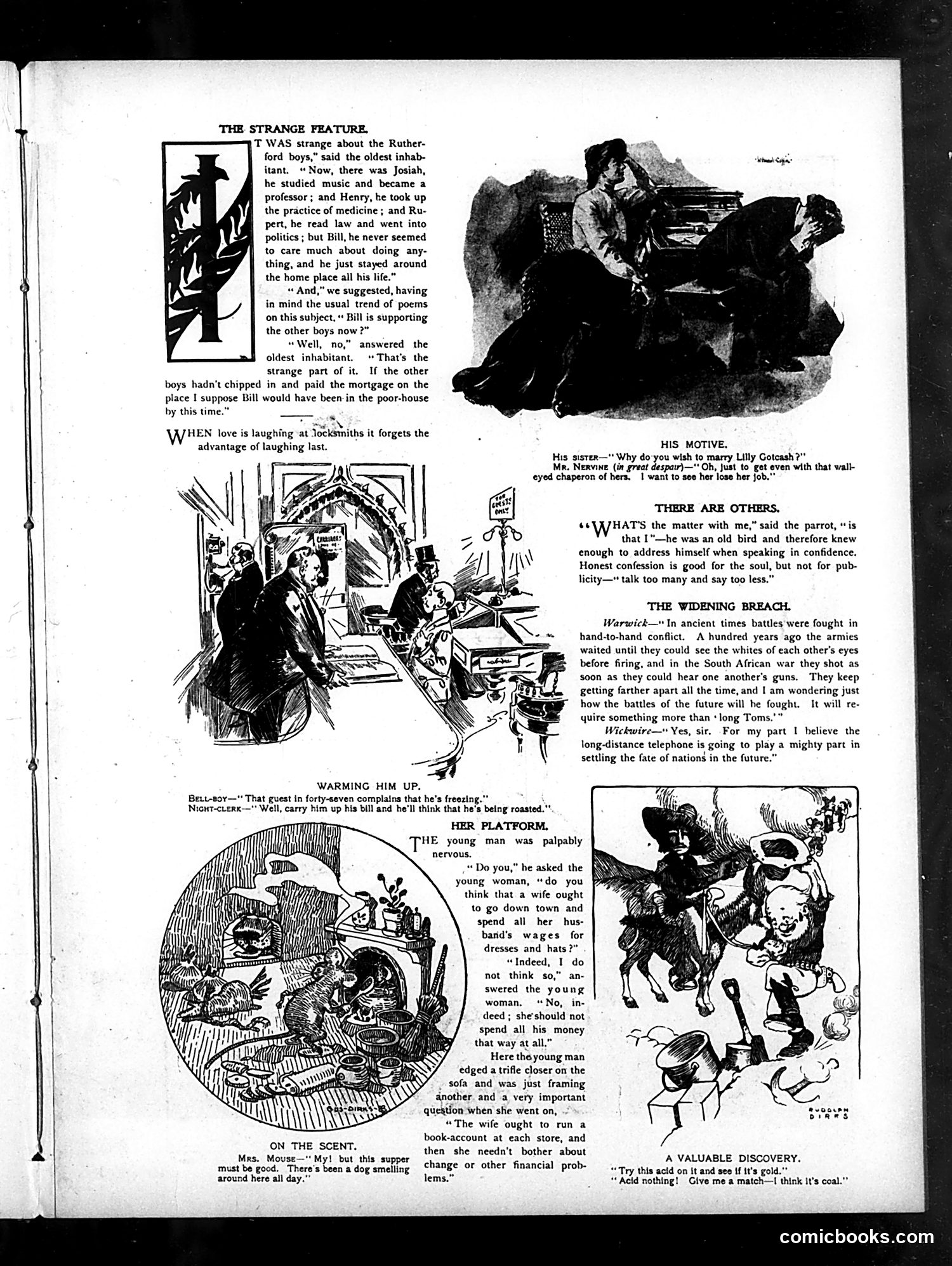
This page from the satirical magazine *Judge* contains multiple short humor pieces typical of early 20th-century American comic journalism: **"The Strange Feature"** inverts expectations: rather than the successful brothers supporting the stay-at-home Bill, Bill's prosperity actually sustains the others—a reversal of the conventional moral tale about industriousness. **"Warming Him Up"** jokes about a hotel guest's complaint; the night clerk suggests presenting an inflated bill will make the customer feel "roasted" (cheated/angry enough to forget the cold). **"Her Platform"** depicts a young man nervously courting a woman who advocates for wives maintaining separate store accounts—progressive domestic financial independence for the era. **"The Widening Breach"** satirizes military technology's evolution: warfare distances combatants progressively (hand-to-hand → visual range → auditory range → beyond hearing), with deadpan speculation that the telephone will eventually determine nations' fates. Other brief gags mock petty domestic complaints and economic anxieties. The humor targets social pretension, marital dynamics, and technological change characteristic of Judge's satirical voice.
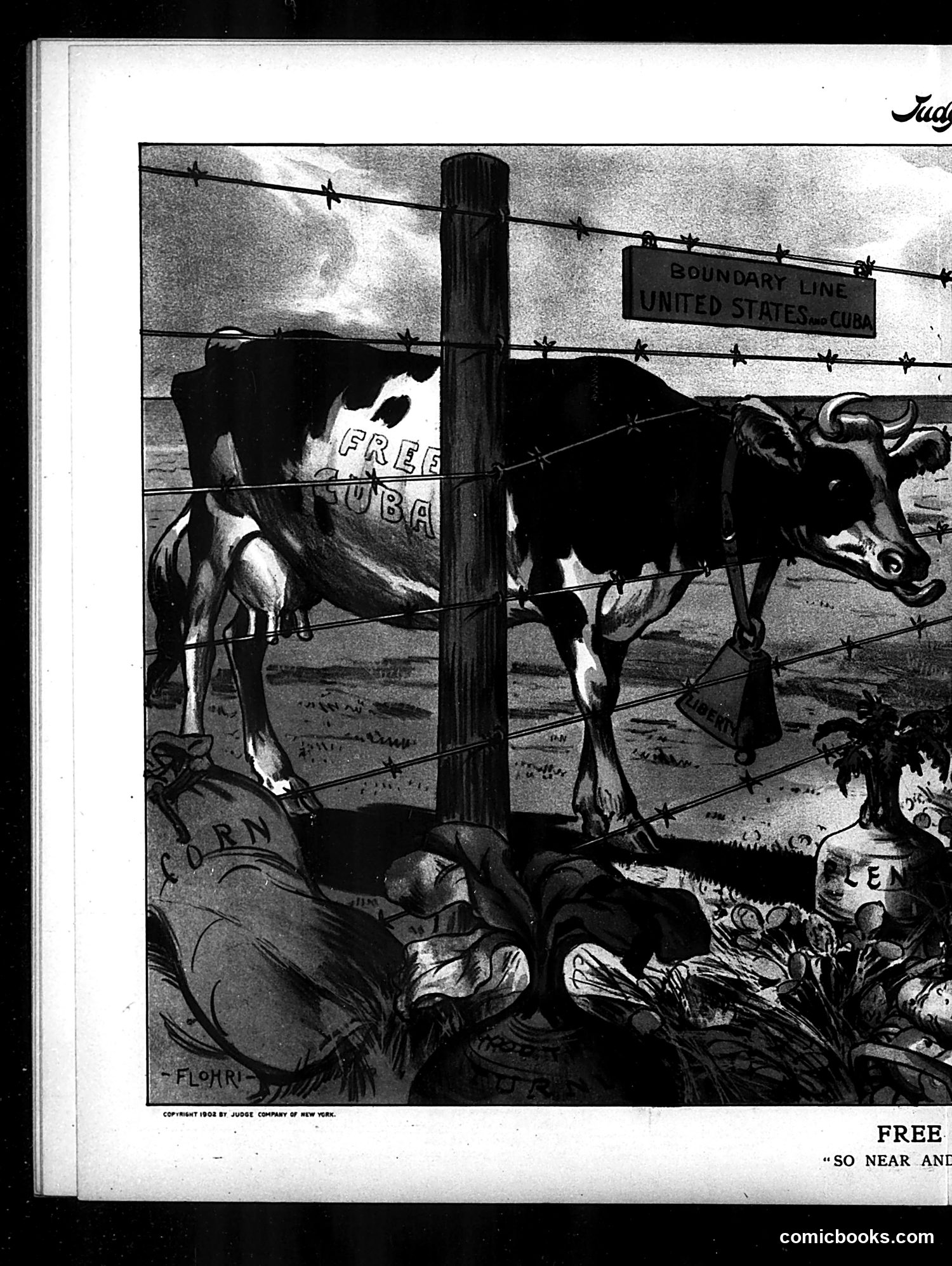
This is a satirical cartoon depicting the U.S.-Cuba boundary during what appears to be the early 20th century. The image shows cattle labeled "FREE CUBA" on the American side of a barbed-wire fence marked "BOUNDARY LINE—UNITED STATES and CUBA." The satire critiques American foreign policy regarding Cuban independence. The "free" Cuban cattle are penned in by American control, suggesting that despite rhetoric about Cuban freedom, the island remained practically constrained by U.S. interests and influence. The cartoon's title fragment "SO NEAR AND" (likely "So Near and Yet So Far") reinforces this ironic gap between stated independence and actual American dominance. The artist uses animal imagery to represent Cuba's dependent status.
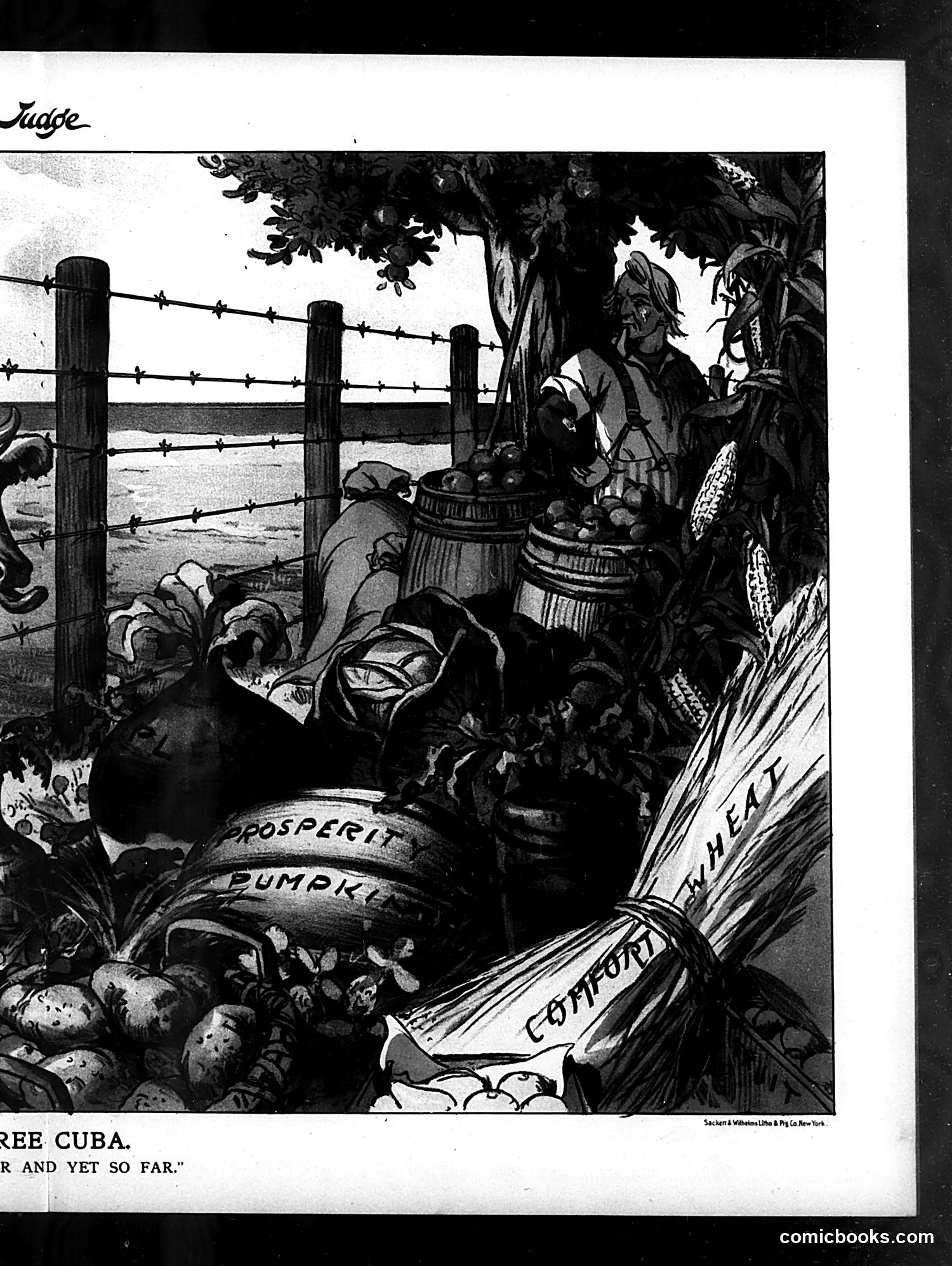
This appears to be a political cartoon from *Judge* magazine satirizing American agricultural abundance alongside Cuban independence struggles. The image shows farmers displaying crops (labeled "PROSPERITY," "BUMPER," "COTTON") near a fence, while figures on the right—likely representing American politicians or public figures—observe. The partial caption "...AND YET SO FAR" suggests ironic commentary: America enjoys agricultural prosperity while Cuba remains distant or unresolved (the text mentions "FREE CUBA"). The satire likely critiques the disconnect between American domestic wealth and failure to resolve Cuban independence, or perhaps American reluctance to intervene despite proclaimed sympathies. The contrast between overflowing American harvests and Cuba's struggle would have resonated with *Judge* readers during the period of Cuban independence movements (1890s-early 1900s).
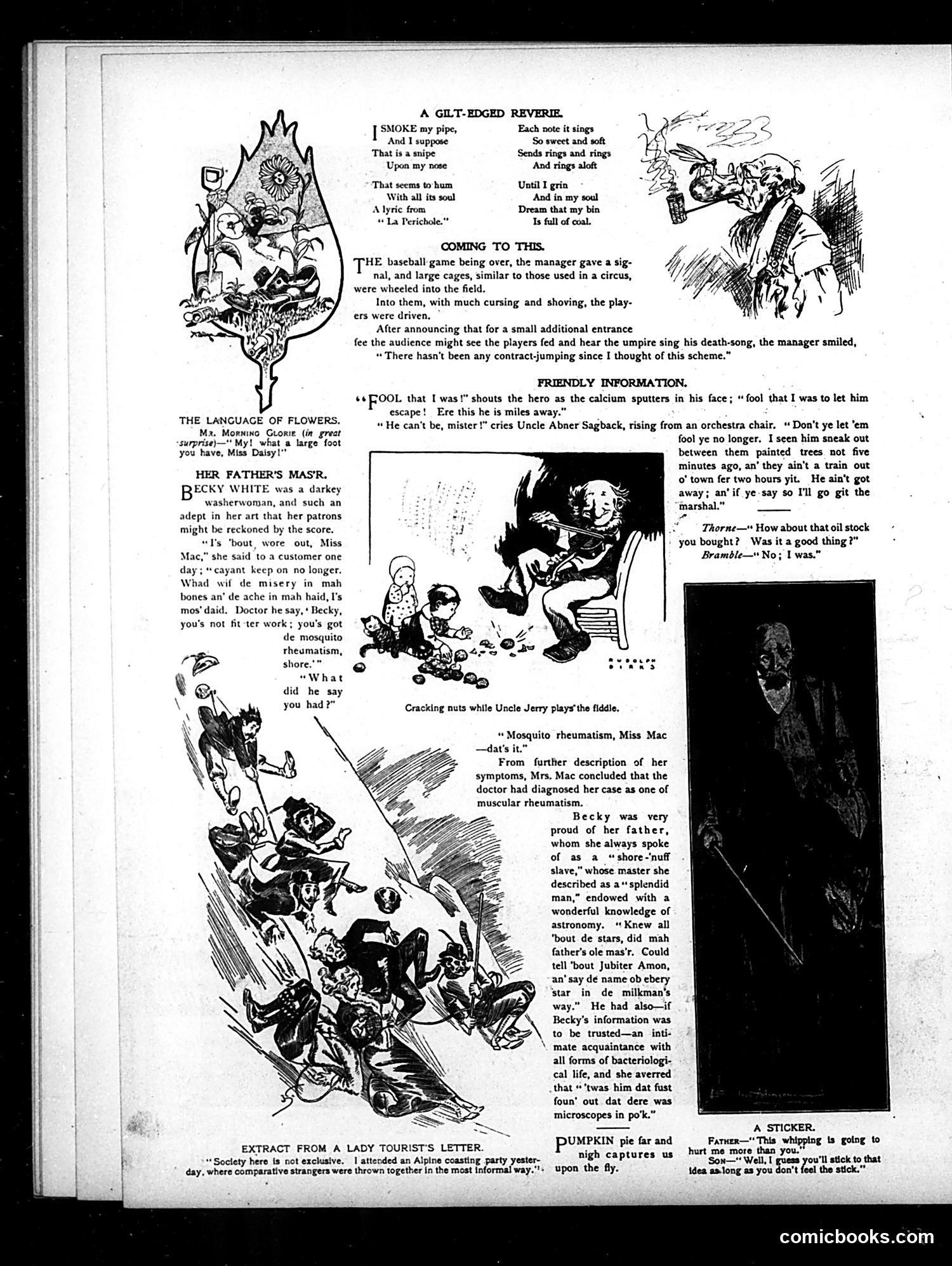
This page from *Judge* magazine contains several satirical pieces: **"Coming to This"** imagines baseball players caged like circus animals after games, with fans paying extra to watch them fed and hear the umpire "sing his death-song." This satirizes harsh labor practices and the dehumanization of workers—likely referencing contemporary labor disputes or exploitative contract conditions in professional sports. **"Her Father's Mas'r"** features "Becky," a Black washerwoman, speaking in heavy dialect about her enslaved father's former master. The joke relies on racist stereotypes and dialect humor common to the era. Becky absurdly credits her father's master with inventing the microscope and discovering bacteria—likely mocking both the exaggeration of slave owners' intelligence and the pretensions of scientific claims. **Other brief sections** include romantic/theatrical humor and a joke about bad oil stock investments. The content reflects *Judge*'s typical mix of labor satire, racial caricature, and financial humor aimed at middle-class readers.
This page is primarily **advertisements interspersed with short humorous anecdotes** rather than political cartoons. The jokes are light domestic humor typical of early 1900s *Judge* magazine: **Notable content:** - A woman admits she rejected a suitor for being poor, then accepted him after learning he had "two millions"—satirizing mercenary marriage - A young man marrying an unattractive woman because she "uses her voice so seldom"—mocking both nagging wives and poor romantic judgment - A child's logic joke about milk division **One political reference:** A brief mention of **F. Augustus Heinze of Montana** forming a fusion "party" combining Democrats, populists, silver Republicans, and labor unionists—appearing to mock the fragmented nature of anti-establishment politics of that era. **The advertisements** (Packer's Tar Soap, Evans Ale, Dr. Siegert's Angostura Bitters, Sohmer Pianos) dominate the page. This is typical of *Judge's* revenue model. The content reflects early 20th-century consumer culture and gender stereotypes rather than substantive satire.
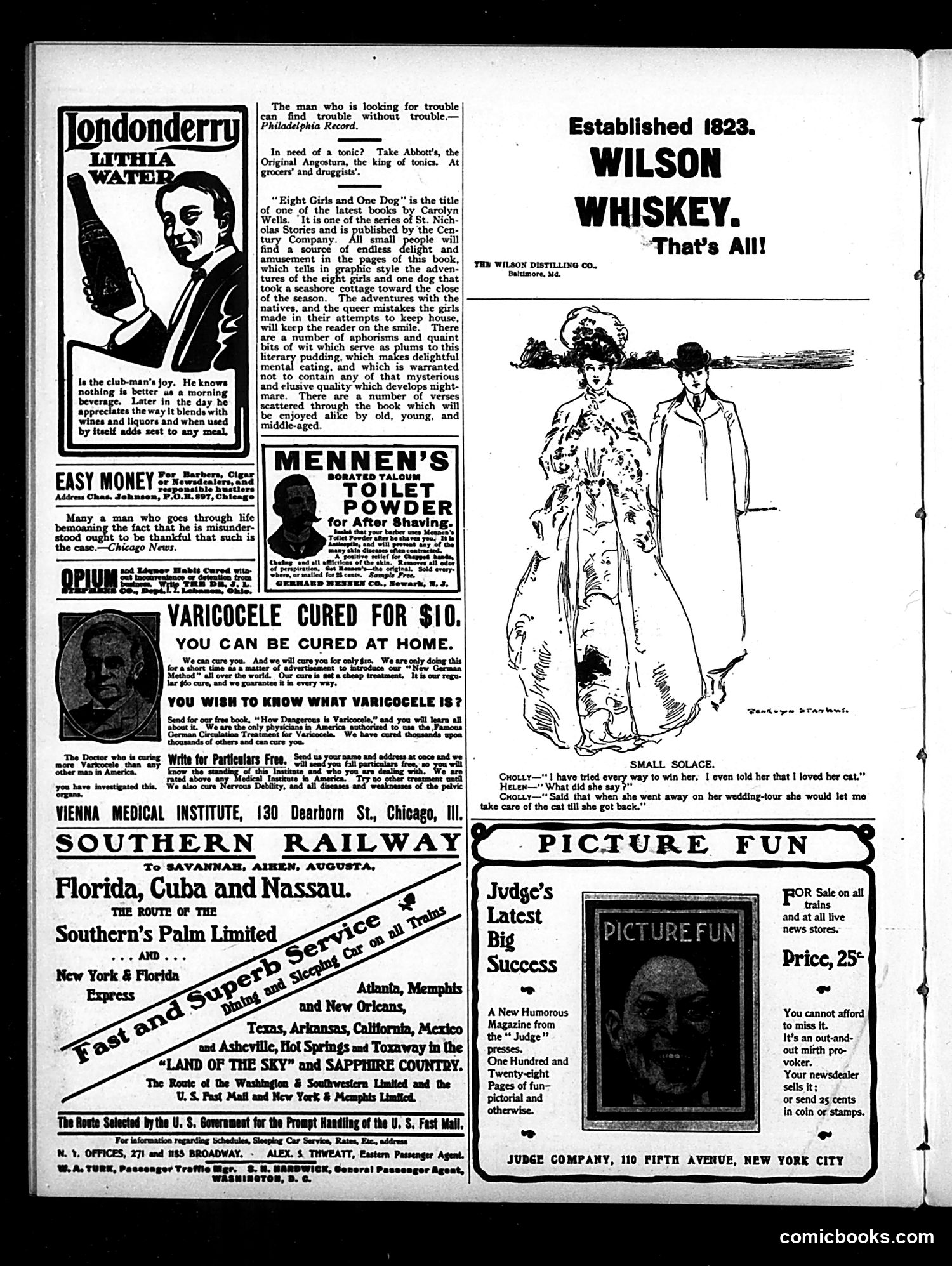
This page is primarily **advertising and product promotions** rather than political satire. The dominant content includes: **Main Advertisement**: Wilson Whiskey (established 1823) occupies the right half, featuring an illustrated couple in period dress with the tagline "That's All!" **Notable Advertisements**: - Londonderry Lithia Water (top left) - Mennen's Borated Talcum Toilet Powder - Opium liniment - Varicocele medical treatment (mail-order cure) - Southern Railway routes to Florida and Cuba - Judge's Picture Fun magazine **The Only Cartoon**: "Small Solace" (bottom right)—a brief domestic joke where a husband claims he told his wife he loved her cat to win her favor, but she responded by refusing to take the cat on their honeymoon. This is mild, non-political humor. The page reflects early 20th-century American publishing: heavy advertising subsidizing editorial content, patent medicine promotions (now illegal), and lightweight domestic comedy rather than hard-hitting satire.
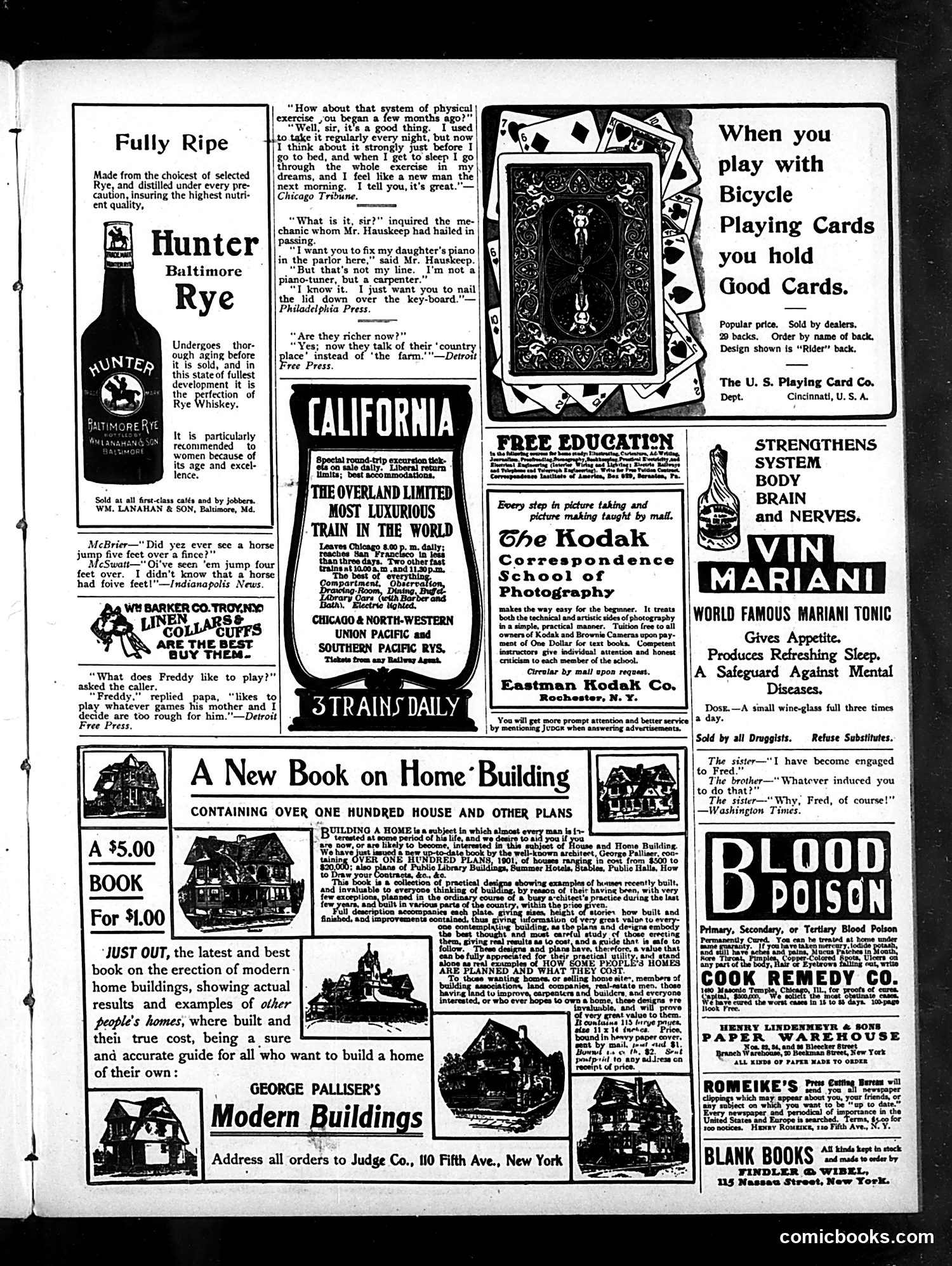
This is primarily an **advertising page** from Judge magazine, with minimal editorial cartooning content. The page features several brief **comic anecdotes** rather than political satire: - A dialogue about someone doing physical exercise only in dreams, feeling refreshed - A joke about a man asking a mechanic to lock down his daughter's piano (implying she plays badly) - Rural people adopting pretentious language after becoming wealthy, calling their "farm" a "country place" - A child's parents choosing his rougher play games The bulk of the page comprises **advertisements** for: - Hunter Rye whiskey - Bicycle playing cards - The Overland Limited train - A home-building instruction book by George Palliser - Kodak photography correspondence courses - Mariani Tonic (a patent medicine claiming to strengthen body, brain, and nerves) - Various other products The humor is gentle, domestic, and apolitical—reflecting Judge's turn-of-the-century focus on middle-class American life rather than sharp social commentary.
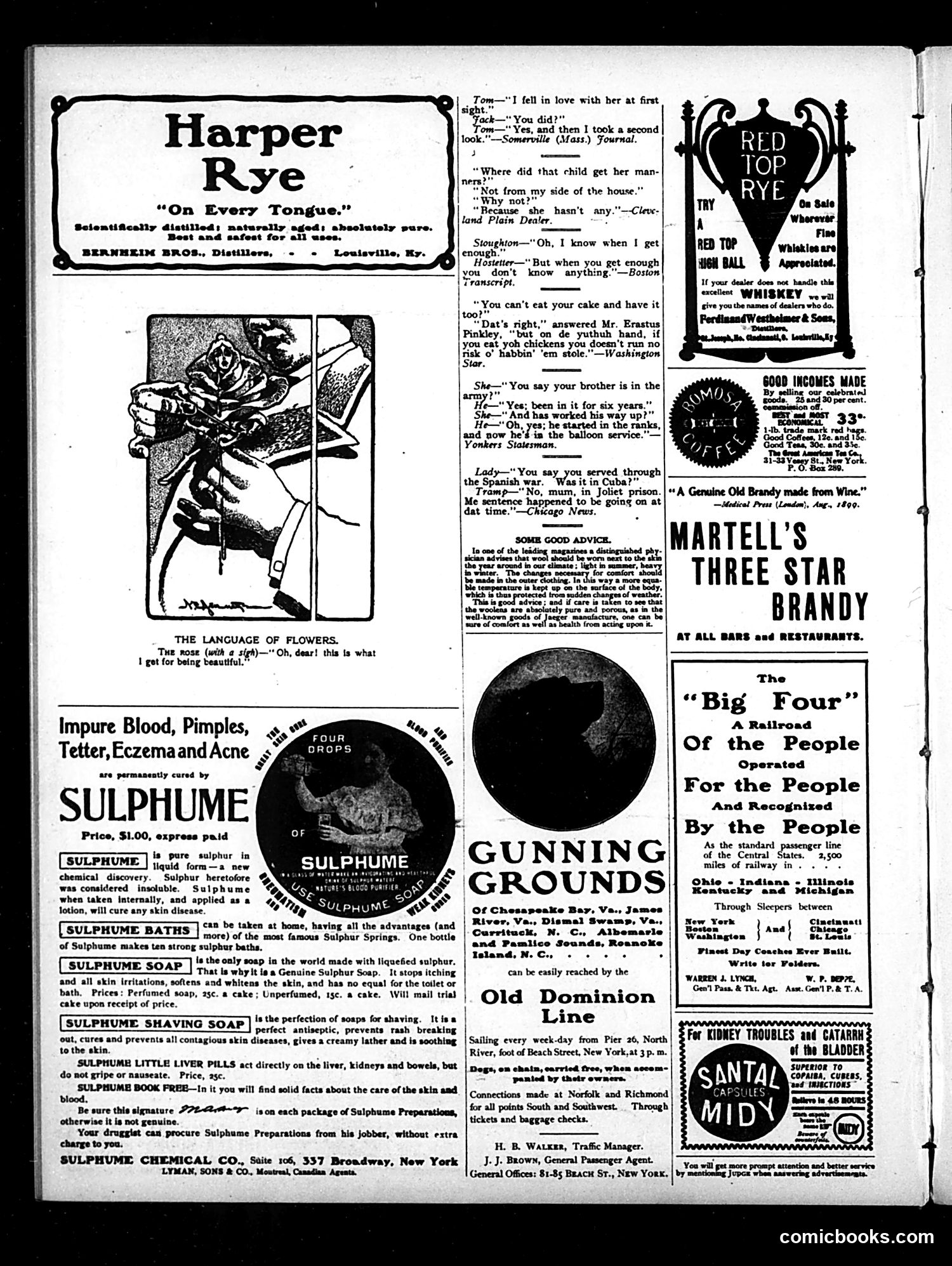
Looking at this page from *Judge*, the main cartoon is titled "The Language of Flowers." It depicts a nose with a sigh saying "Oh, dear! this is what I get for being beautiful." This is a visual pun: a nose with pimples or skin imperfections expressing vanity about its beauty while simultaneously being marred by acne. The joke targets the irony of maintaining attractive appearance while suffering common skin afflictions. The cartoon appears to function as a setup for the surrounding advertisements, particularly the multiple Sulphume skin-care product ads (shaving soap, baths, pills, and the main solution for "Impure Blood, Pimples, Tetter, Eczema and Acne"). Rather than pure satire, this is advertising-driven editorial content—a common *Judge* convention where humorous illustrations sold consumer products to readers, playing on vanity and self-consciousness about appearance. The cartoonist creates gentle mockery that the advertiser then "resolves" with their remedy.
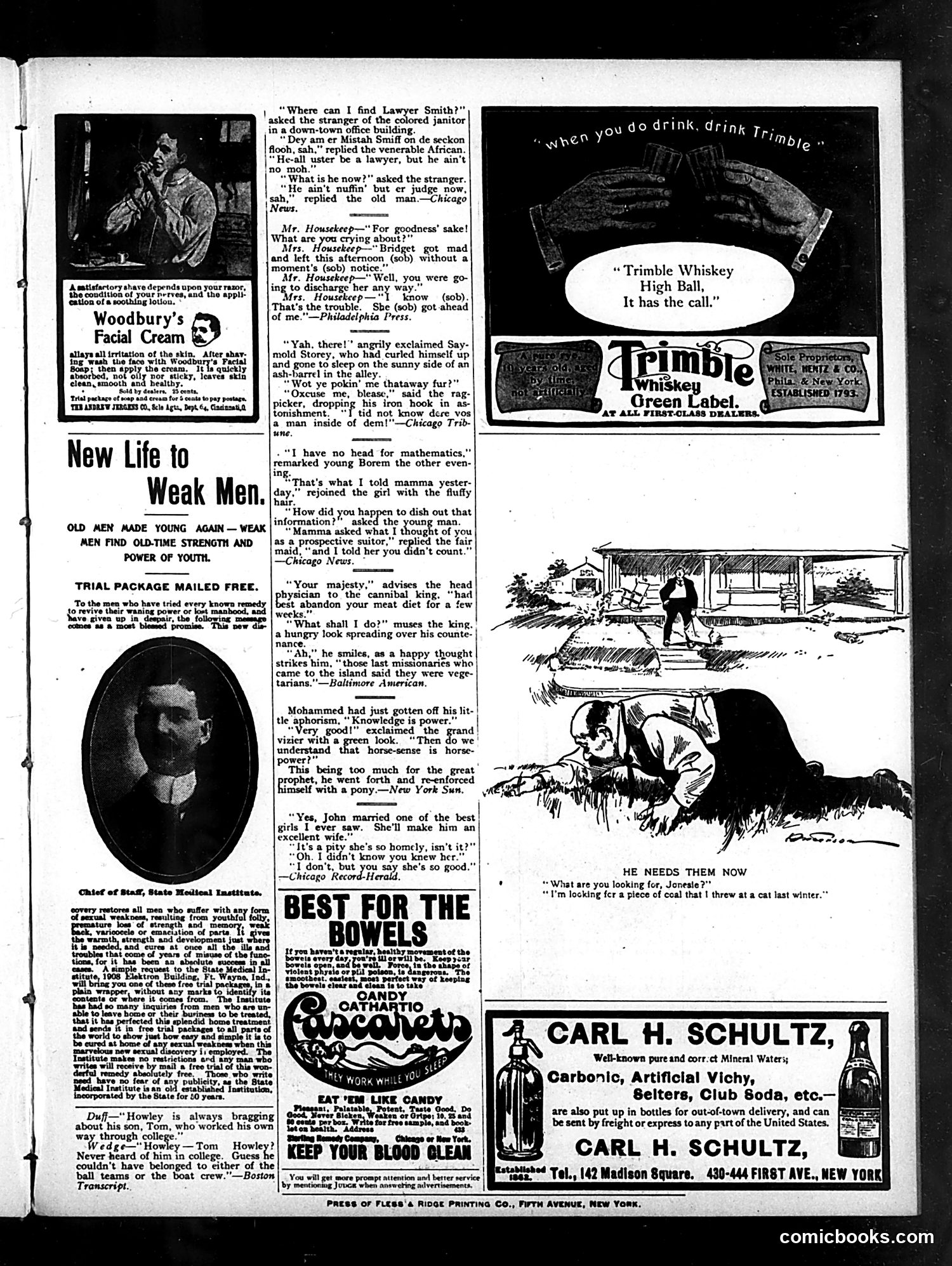
This page from Judge contains primarily **short humorous anecdotes** rather than political cartoons. The jokes rely on ethnic stereotypes and wordplay common to early 20th-century American humor: 1. **"Lawyer Smith" joke**: Features a racist caricature of a Black janitor using dialect ("Dey am er Mistah Smiff"), with the punchline that Smith became a judge instead of remaining a lawyer—likely satirizing judicial appointments or incompetence. 2. **Domestic humor**: Several jokes about housekeeping, relationships, and courtship follow conventional period comedy formulas with minimal satire. 3. **"Mohammed and the Prophet" jokes**: Mock non-Western figures using orientalist stereotypes and animal comparisons ("horse-sense is horse-power"). The page is **primarily advertising**—occupying significant space are promotions for Woodbury's Facial Cream, male vitality treatments, laxatives, whiskey, and mineral water. These ads reflect period anxieties about male weakness and digestive health. The content is dated by its casual racial caricatures and reflects era-specific commercial and social attitudes.
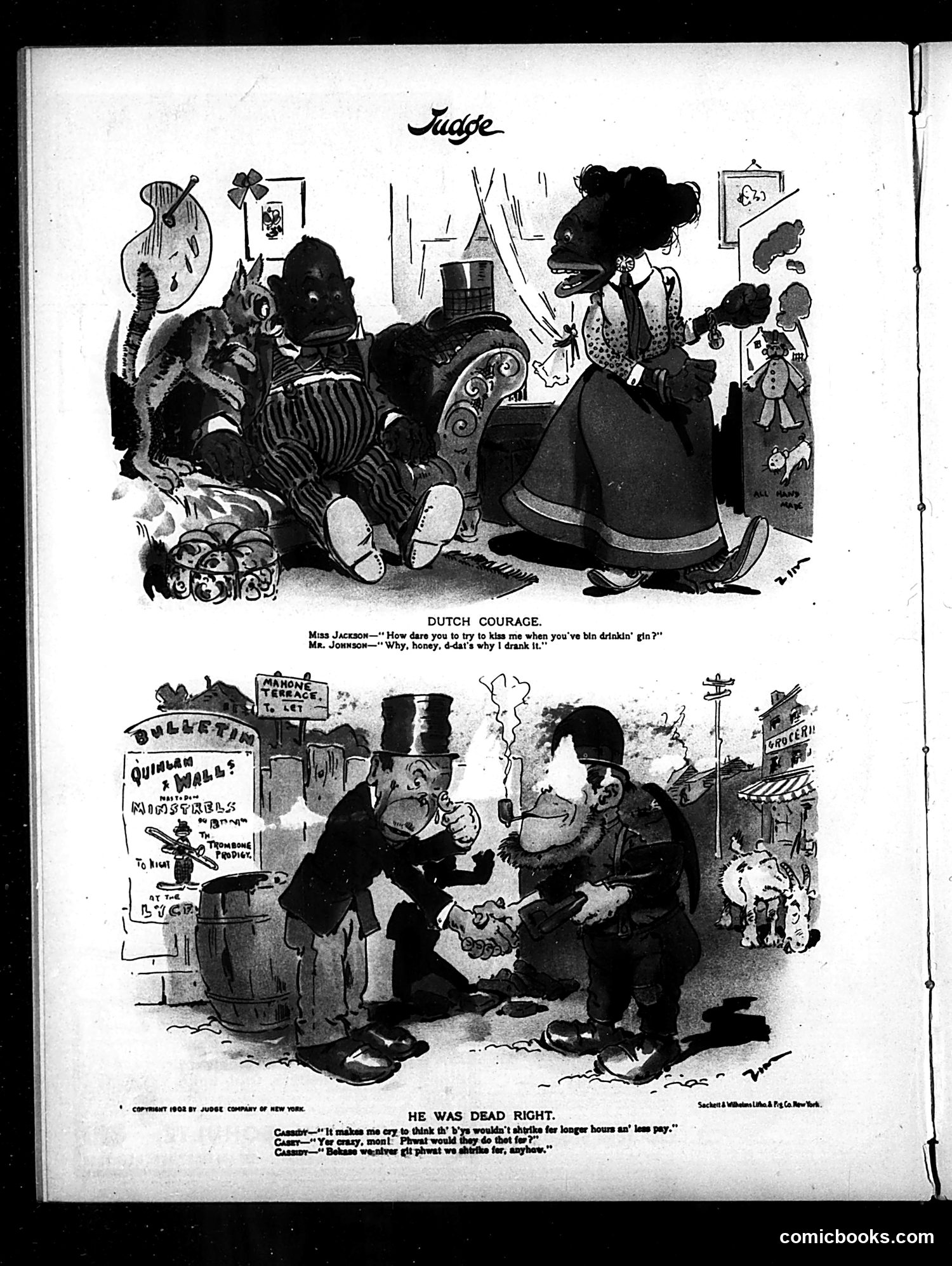
These two cartoons satirize drinking and its social consequences. **"Dutch Courage"** (top): A man attempts to kiss a woman while drunk, claiming he drank gin specifically for "courage" to do so. The joke plays on the phrase "Dutch courage"—alcohol-fueled bravery. The cartoon mocks how drinking was used as an excuse for inappropriate behavior. **"He Was Dead Right"** (bottom): Three men discuss a deceased acquaintance, debating whether he'd have shirked work longer if given alcohol. The dark humor suggests drinking made him unfit for employment—thus his death was "right" because he wouldn't have worked anyway. It's a grim commentary on how alcohol dependency was viewed as both self-destructive and economically wasteful. Both cartoons reflect early-20th-century attitudes toward drinking: as morally questionable, socially disruptive behavior that enabled poor judgment and laziness. The satire targets both the drinker's excuses and society's tolerance of such behavior.