
A complete issue · 16 pages · 1902
Judge — October 18, 1902
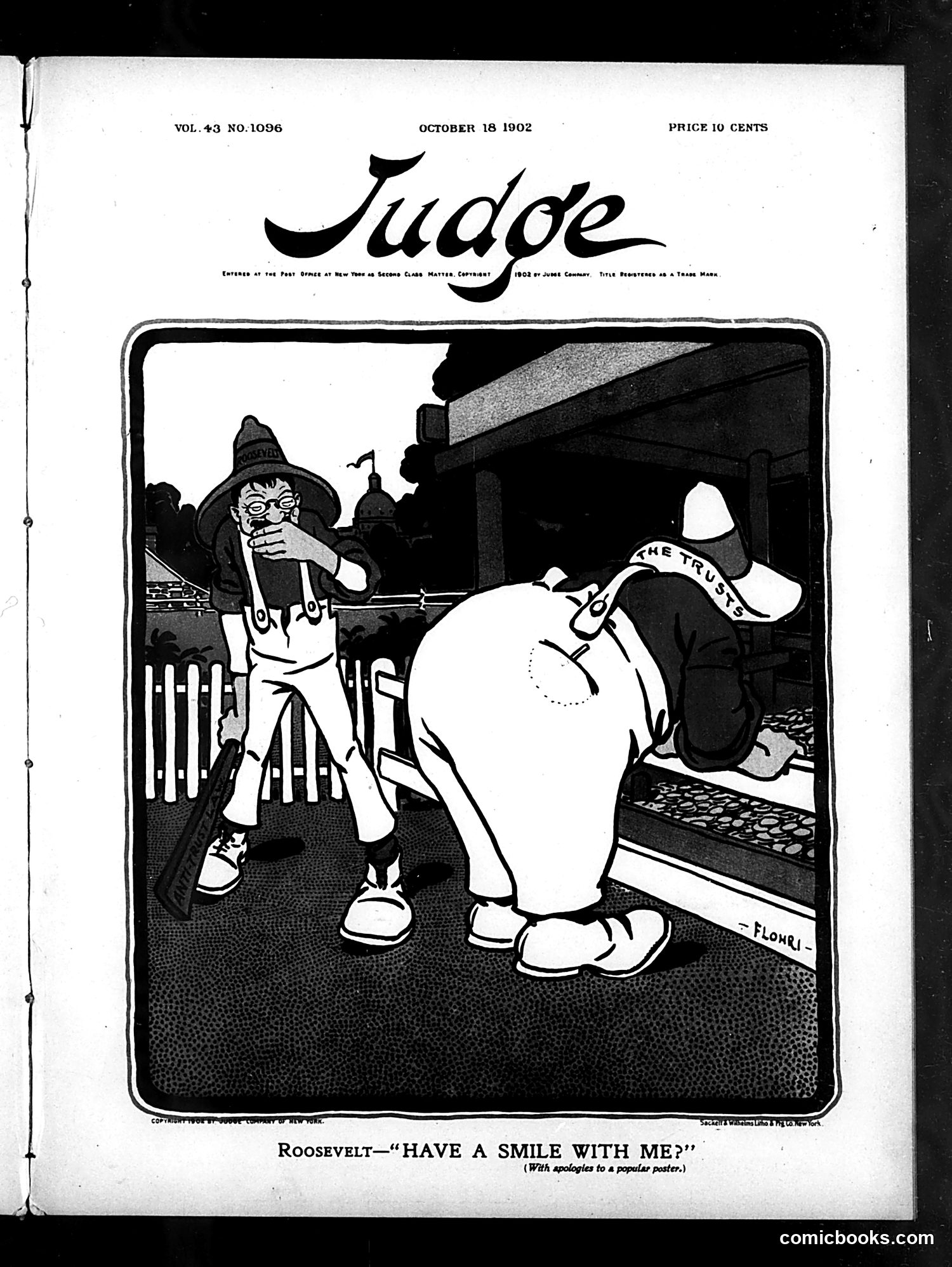
This political cartoon satirizes **President Theodore Roosevelt**, depicted as a rotund figure asking "Have a Smile with Me?" The caption notes it's "With apologies to a popular poster," suggesting the image parodies an existing advertisement. The cartoon appears to mock Roosevelt's famous public persona and charisma during his presidency. The exaggerated portrayal of his physique and the somewhat patronizing "smile with me" appeal suggests satirical criticism of his public relations approach or personality cult. The setting appears to be a baseball stadium, potentially referencing Roosevelt's well-documented love of sports and outdoor activities. The artistic style is typical of early 1900s American satirical cartooning, using caricature to critique political figures.
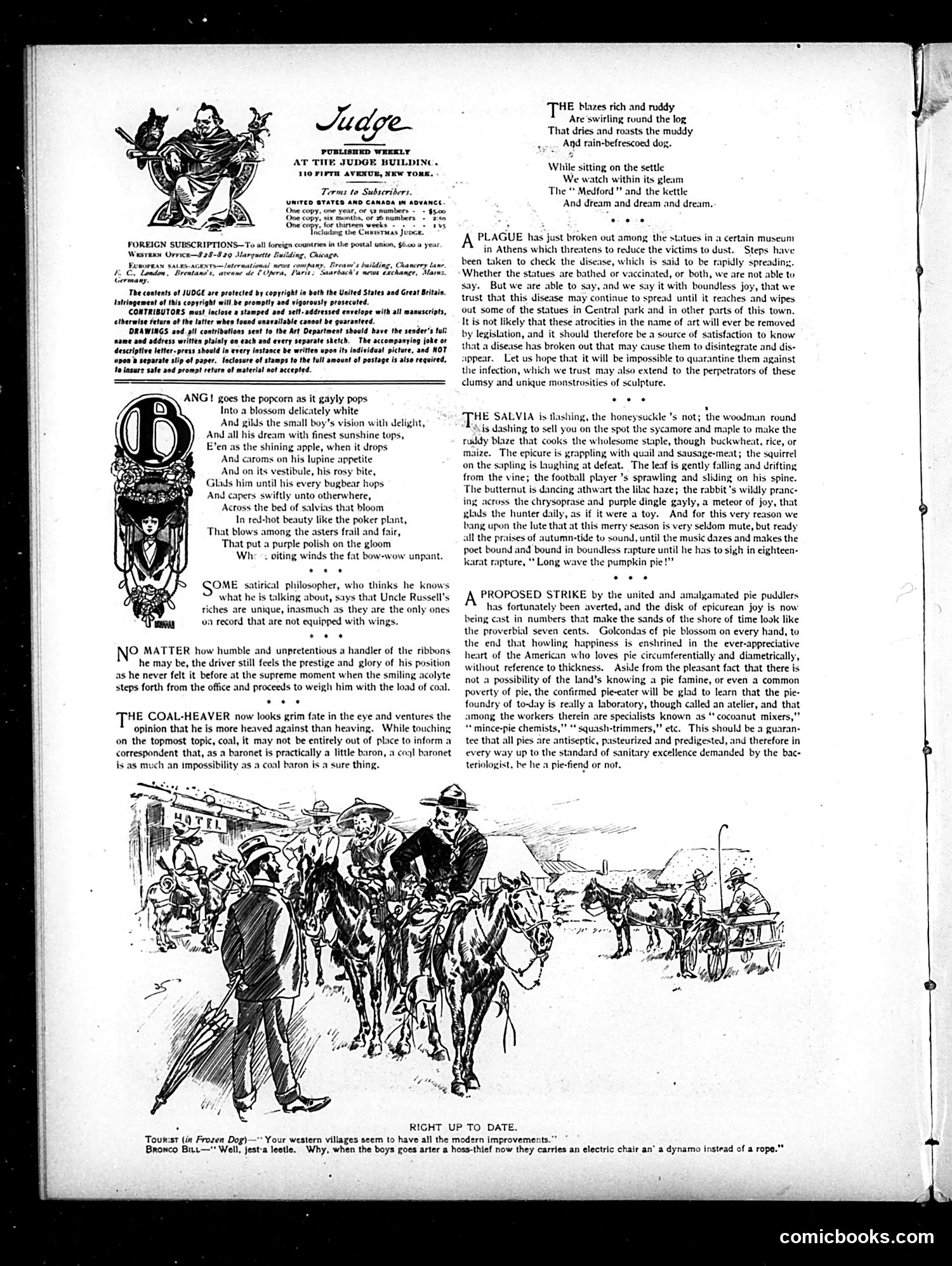
This page contains several short satirical pieces and a cartoon. The main cartoon, titled "Right Up to Date," depicts Western villages with modern improvements. The dialogue references horse-thieves now using "an electric chair" and "dynamo" instead of traditional ropes—satirizing the recent adoption of electric chairs for executions (a late 19th-century innovation). Other pieces mock contemporary concerns: a "plague" among museum statues (likely referencing public health anxieties), discussion of pie-peddlers' strikes, and commentary on coal-heavers' working conditions. The overall tone suggests working-class and social issues of the Gilded Age era, with Judge's typical irreverent humor targeting both labor disputes and modern technological developments.
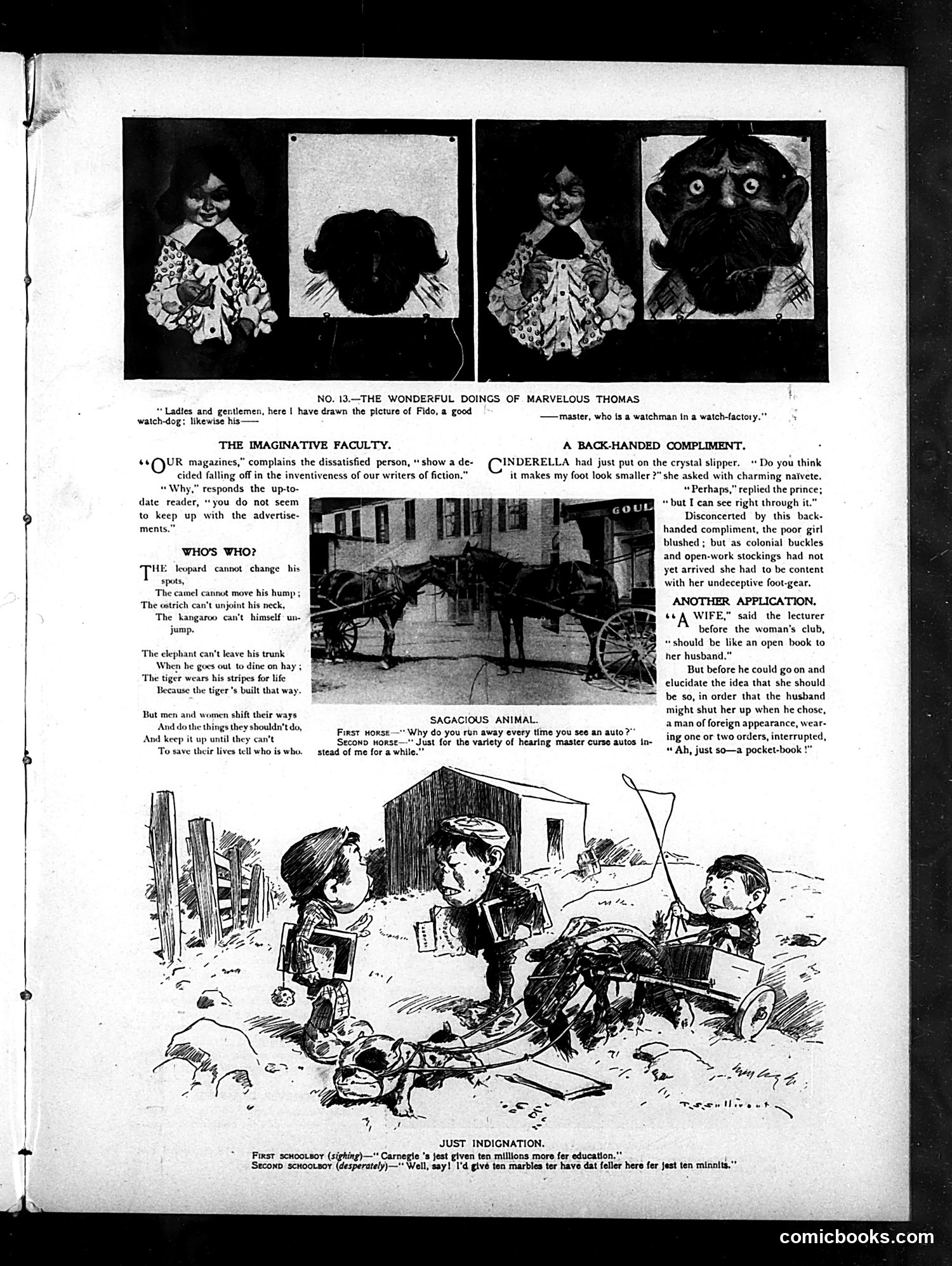
This page contains three distinct humor pieces: 1. **"The Wonderful Doings of Marvelous Thomas"** (top): A visual gag featuring a watch-dog named Fido, playing on the double meaning of "watch-dog." 2. **"The Imaginative Faculty"** (middle): A brief text joke mocking magazines' complaints about fiction writers' lack of invention. 3. **"Sagacious Animal"** (center image): A horse refuses to pass an automobile, satirizing early automotive anxieties and the conflict between traditional horse-drawn transport and new motor vehicles. 4. **"Just Indignation"** (bottom): Children quarrel over education funding, with schoolboys arguing about Carnegie's charitable donations versus government education budgets—a reference to Andrew Carnegie's philanthropic activities in early 20th-century America. The page reflects period concerns: technological change, education funding debates, and literary criticism.
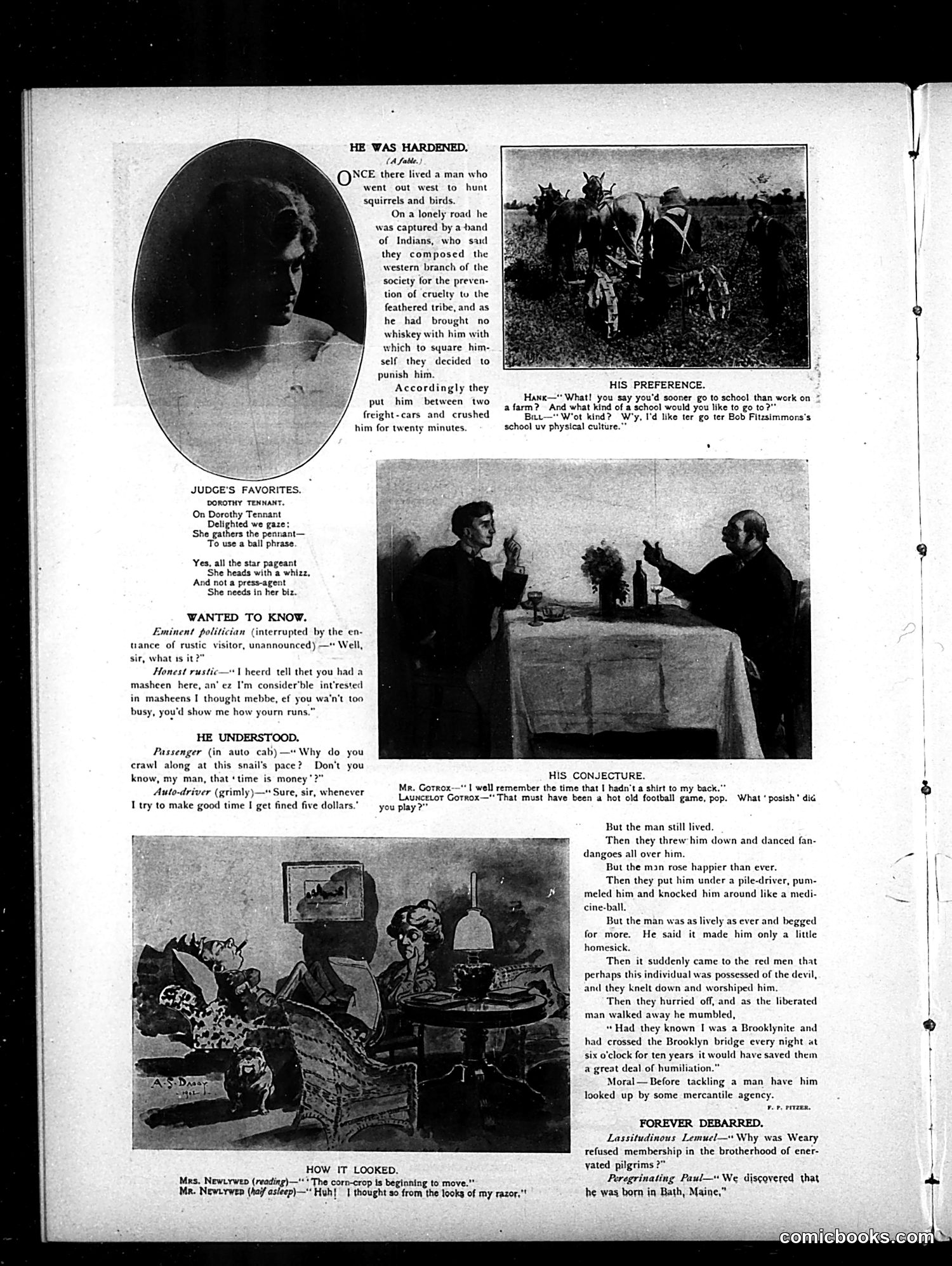
This page appears to be a satirical story titled "He Was Hardened" rather than a political cartoon. It depicts a man captured by Native Americans who torture him through increasingly brutal means—crushing him between freight cars, dancing on him with daggers, and driving a pile through him—yet he survives and becomes emotionally hardened. The accompanying comic sections ("Judge's Favorites," "His Preference," "His Conjecture," "How It Looked," "Forever Debarred") feature unrelated domestic and social humor typical of Judge magazine's era. The Native American imagery reflects period attitudes toward Indigenous peoples as instruments of brutality. The story's "moral" about hardship building character was common turn-of-the-century American sentiment, though presented here through gratuitous violence and racial stereotyping that would be considered deeply offensive today.
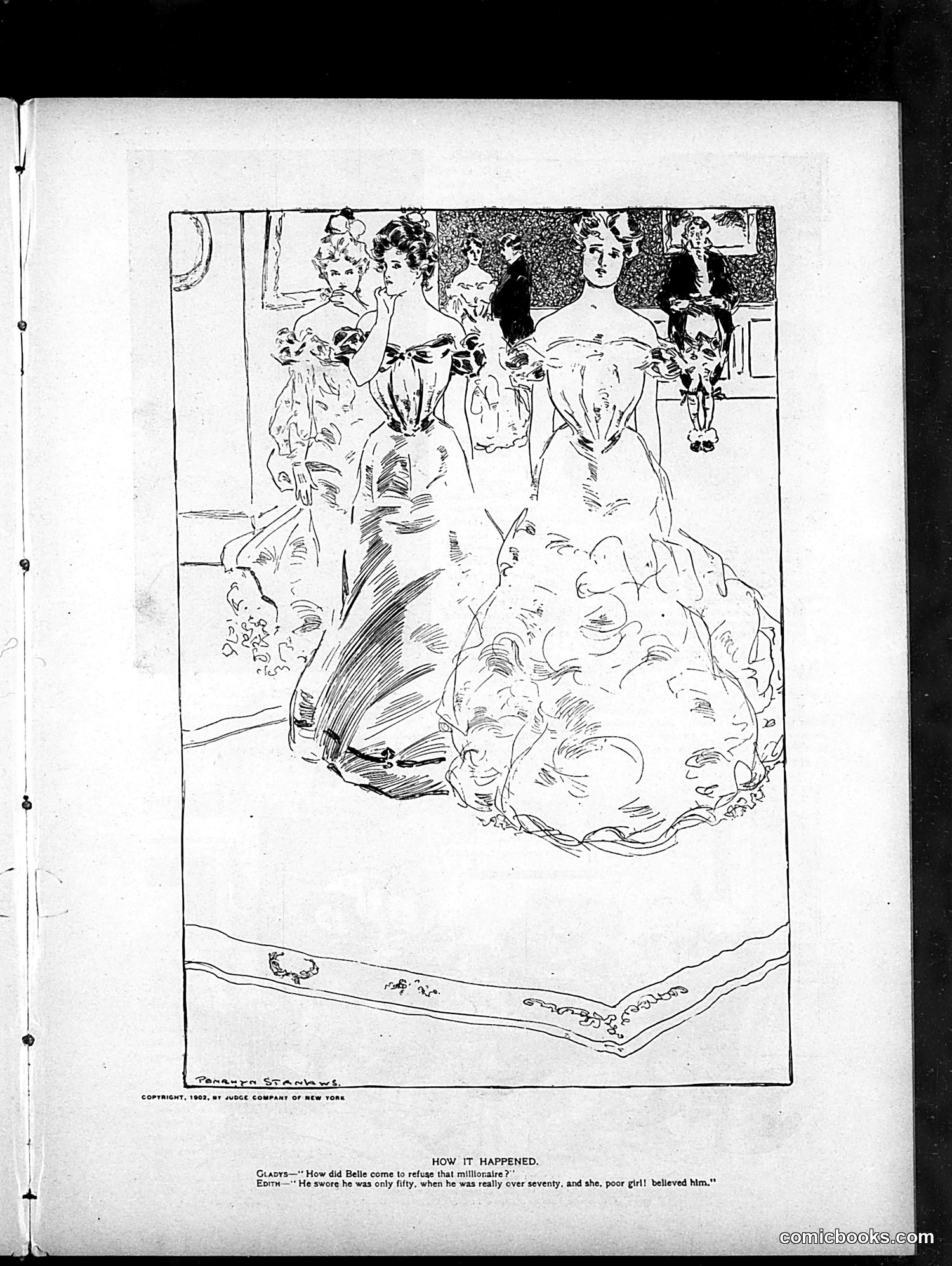
This 1902 Judge cartoon satirizes wealthy society women and marriage dynamics. The sketch shows elegantly dressed women in elaborate gowns at what appears to be a social gathering. The caption dialogue suggests a story about "Belle" marrying a "millionaire" despite initial doubts about his character—someone described as "only fifty" and "never...really...severly" (the OCR is corrupted here, but implies moral questions about the groom). The satire likely mocks the era's marriages of convenience among the wealthy, where women overlooked a suitor's questionable character or age in favor of financial security. The artist, Penrhyn Stanlaws, was known for depicting fashionable society scenes. The humor targets both the shallow materialism of high society and the desperation of women whose social status depended on advantageous marriages.
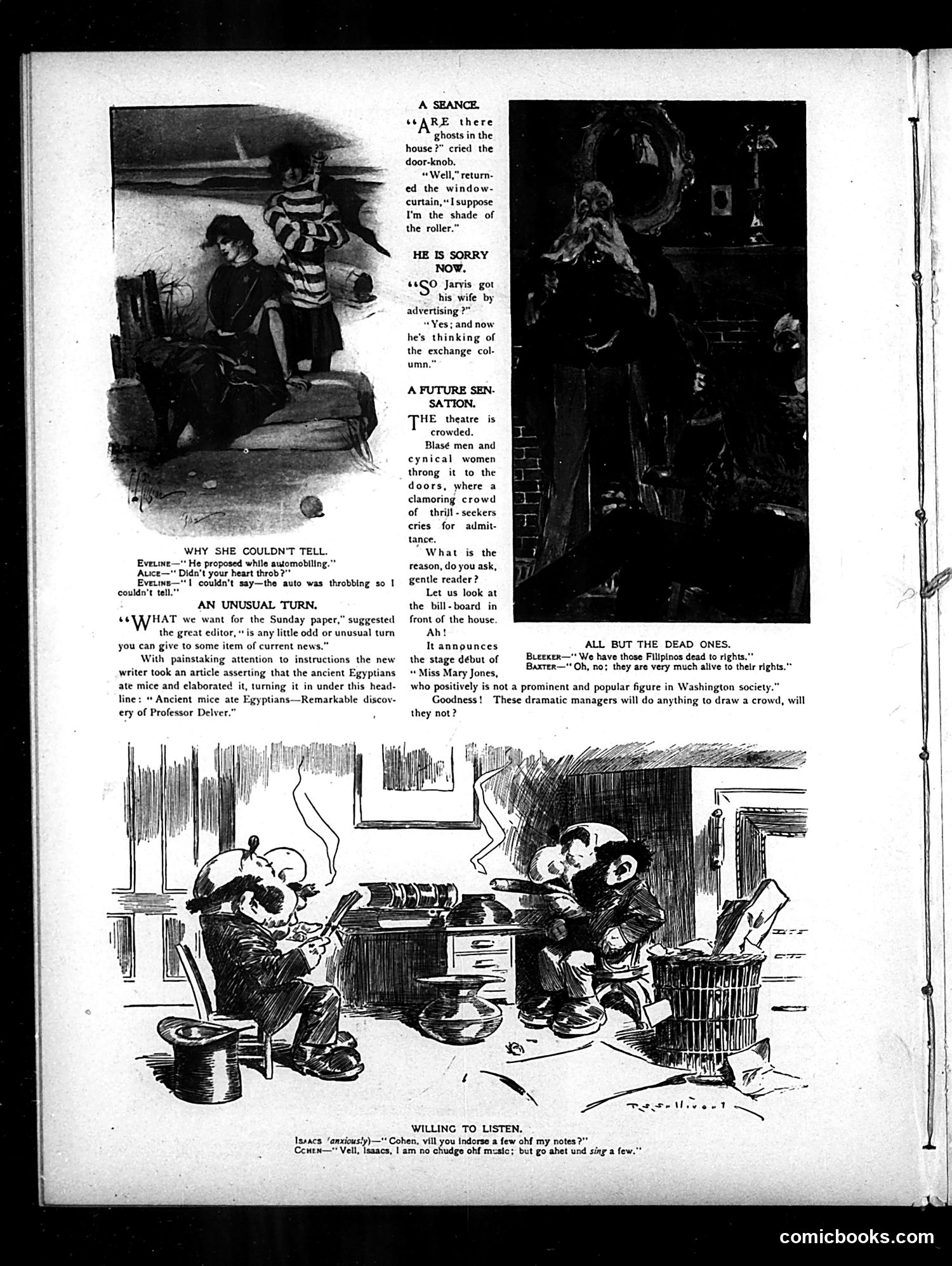
This page contains several satirical sketches typical of Judge's humor circa early 1900s: **"A Seance"** uses anthropomorphic puns (window-shade jokes about being a "shade") mocking spiritualism fads. **"He Is Sorry Now"** jokes about matrimonial advertising—a man who advertised for a wife now regrets it and considers the "exchange column" (divorce/classified ads). **"Why She Couldn't Tell"** satirizes women's supposed delicate sensibilities: a woman can't report her heart throbbing during a car proposal because the automobile's vibration masked any emotional response. **"A Future Sensation"** mocks theatrical excess and audience hunger for sensationalism, with a fake stage announcement about "Miss Mary Jones" (unnamed actress) drawing crowds. **"All But the Dead Ones"** appears to reference Philippine-American War politics, with characters debating whether Filipino insurgents are dead or "very much alive to their rights." **"Willing to Listen"** uses Jewish dialect humor (period-typical but offensive), depicting a financial negotiation with comedic mispronunciations. The sketches reveal contemporary concerns: spiritualism, matrimonial markets, automotive novelty, theatrical spectacle, colonial politics, and immigrant communities.
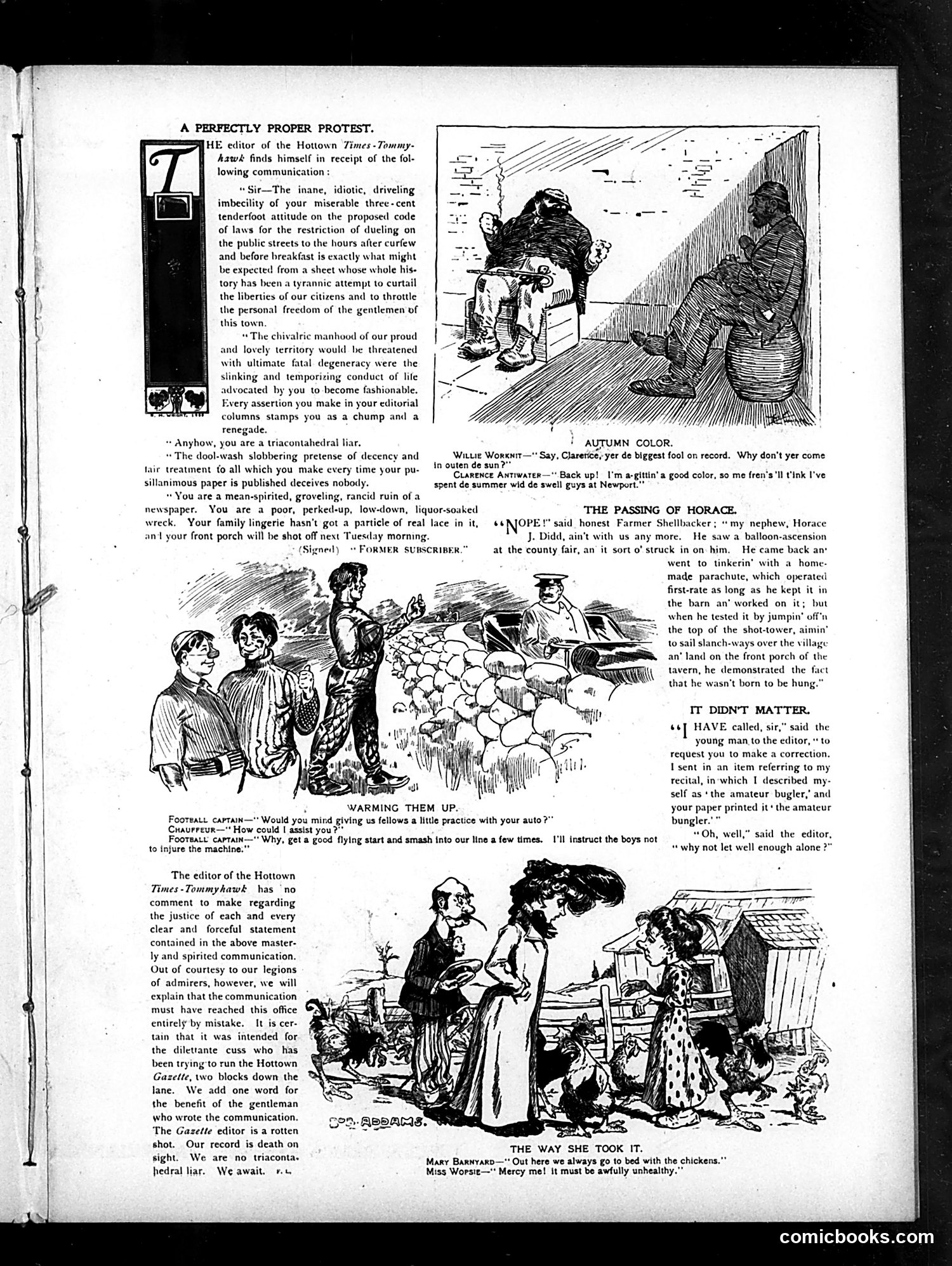
This page contains multiple satirical pieces typical of *Judge* magazine's social commentary: **"A Perfectly Proper Protest"** mocks a town editor who opposes dueling restrictions. A furious letter attacks the editor for advocating public safety, using absurd insults ("triacontahedral liar") and threats. The satire targets those who equate personal liberty with the right to engage in dangerous, antisocial behavior—a common 19th-century American debate. **"The Passing of Horace"** darkly jokes about a farmer's nephew who dies testing a homemade parachute after seeing a balloon ascension at a county fair. The humor derives from rural naïveté and fatal overconfidence. **Other cartoons** include workplace humor ("Warming Them Up"), class mockery about pretending to be wealthy ("Autumn Color"), and domestic situations. The overall tone satirizes American society's contradictions: prioritizing individual freedom over public safety, rural simplicity, and class pretension.
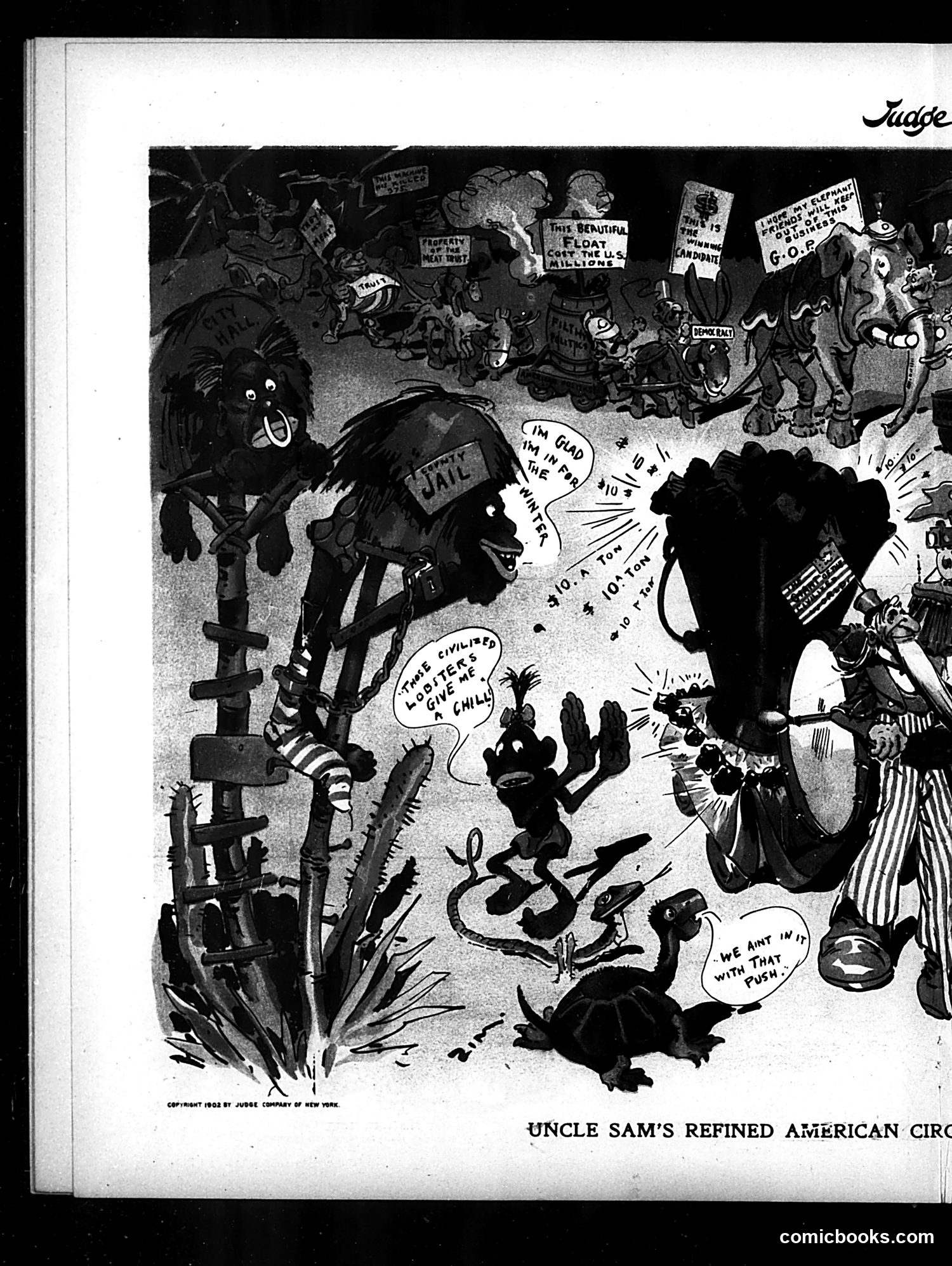
This 1902 Judge cartoon satirizes American politics as a chaotic circus. Uncle Sam (depicted as a ringmaster on the left) presides over various political figures and issues represented as circus performers and animals. The cartoon criticizes what appears to be political corruption, incompetence, or scandal—suggested by references to "jail," "G.O.P." (Republican Party), and various signs held by caricatured figures in the background. The central figure labeled "JAIL" suggests prosecutions or scandals. The densely packed crowd of performers symbolizes the messy, theatrical nature of American political life at the turn of the 20th century. The "refined" in the title is clearly ironic—the cartoon argues American politics is anything but refined, presenting it instead as a disorganized spectacle.
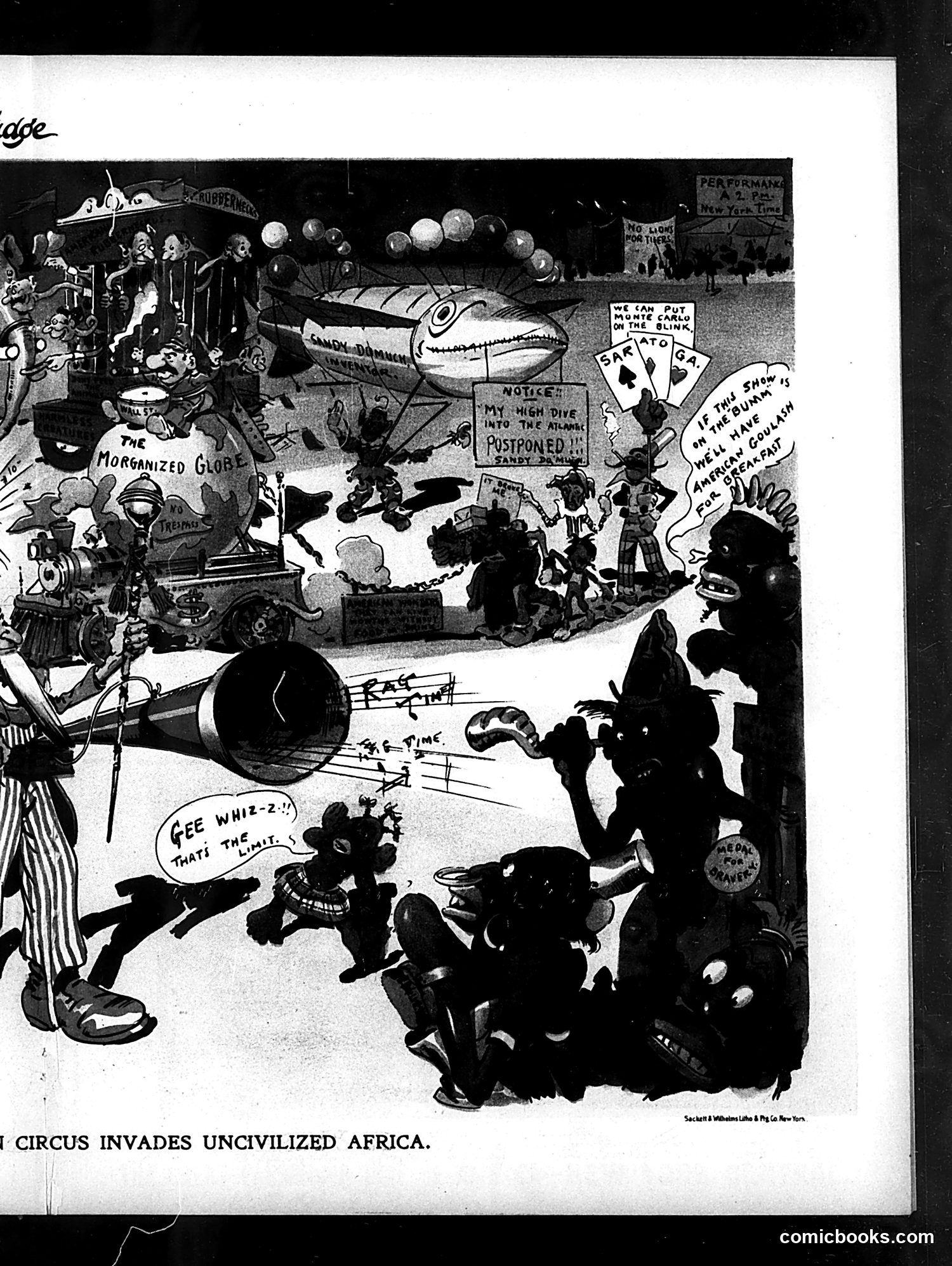
This satirical cartoon depicts a circus arrival in Africa, using exaggerated caricatures of African people as the joke's target. The cartoon reflects early 20th-century attitudes treating Africa as "uncivilized" and its inhabitants as exotic curiosities worthy of mockery. The scene shows circus performers and equipment alongside caricatured African figures, with signs referencing performances ("The Morganized Globe," notices about postponed events). The humor relies on contrasting "civilized" circus spectacle with dehumanizing depictions of African people. The satire appears directed at both American circus culture and imperialist attitudes toward Africa. However, the cartoon itself perpetuates the racist stereotypes it may critique—treating African people as backward subjects for Western amusement rather than as equals. This reflects Judge magazine's era, when such depictions were considered acceptable editorial content.
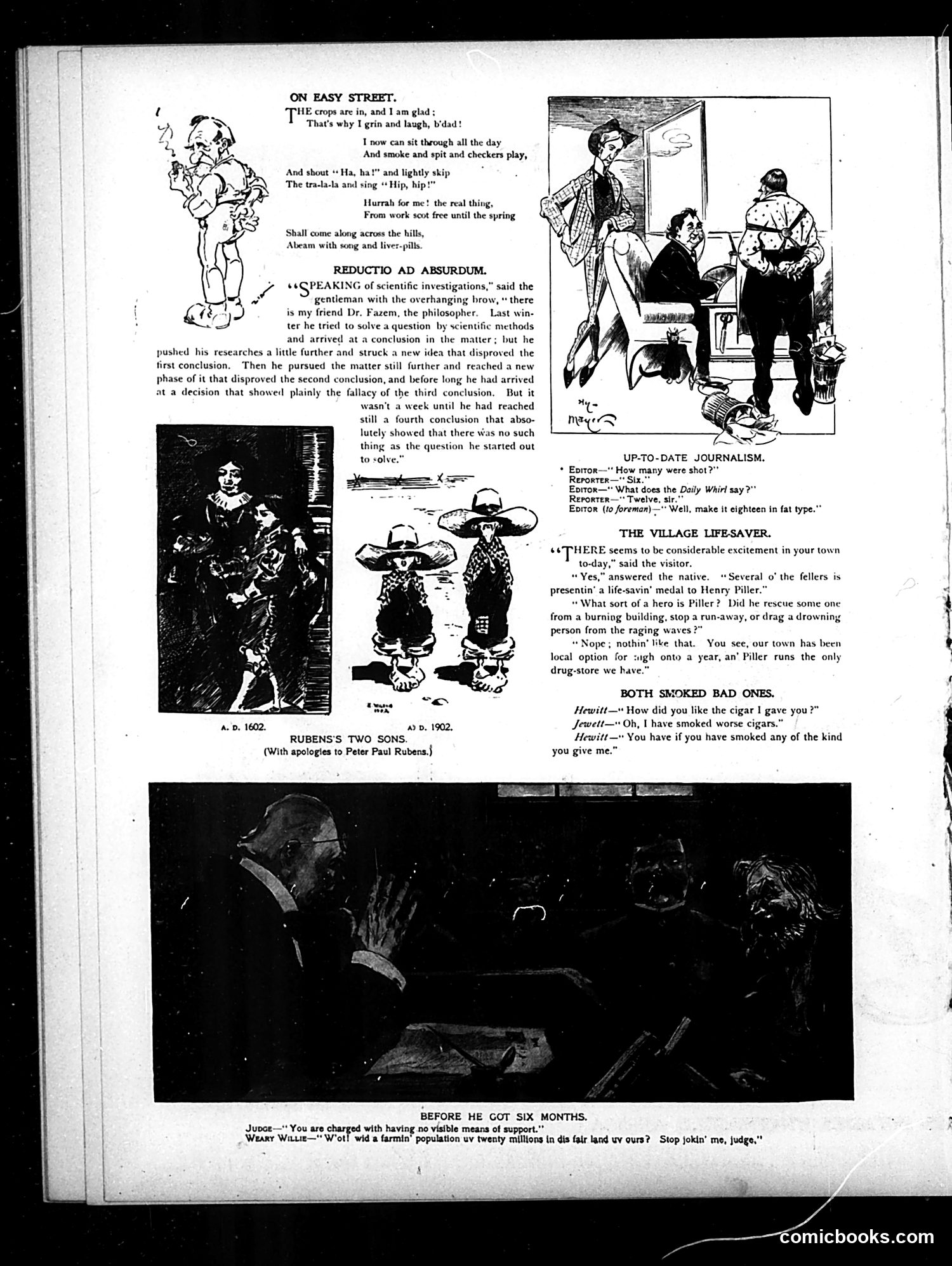
This page contains several satirical pieces typical of early 1900s American humor: **"On Easy Street"** depicts a farmer celebrating harvest season with carefree leisure—satirizing the rural ideal of seasonal work rhythms. **"Reductio ad Absurdum"** mocks philosophical overcomplication: a scientist (Dr. Fazem) investigates a question, reaches conclusions, then endlessly re-investigates until reaching the absurd conclusion that the original question doesn't exist. It critiques excessive academic analysis. **"Up-to-Date Journalism"** satirizes newspaper sensationalism: when six people are shot, a competing paper claims twelve; the editor instructs staff to report eighteen in large type—mocking how papers exaggerate for circulation. **"The Village Life-Saver"** uses dry humor about a pharmacist receiving a "life-saving" medal, not for heroism but for running the town's only drugstore during Prohibition ("local option"), suggesting pharmacies' inflated importance in dry communities. **"Both Smoked Bad Ones"** is a brief joke about terrible cigars. The page concludes with a courtroom scene involving a vagrant claiming millions of farmers support him.
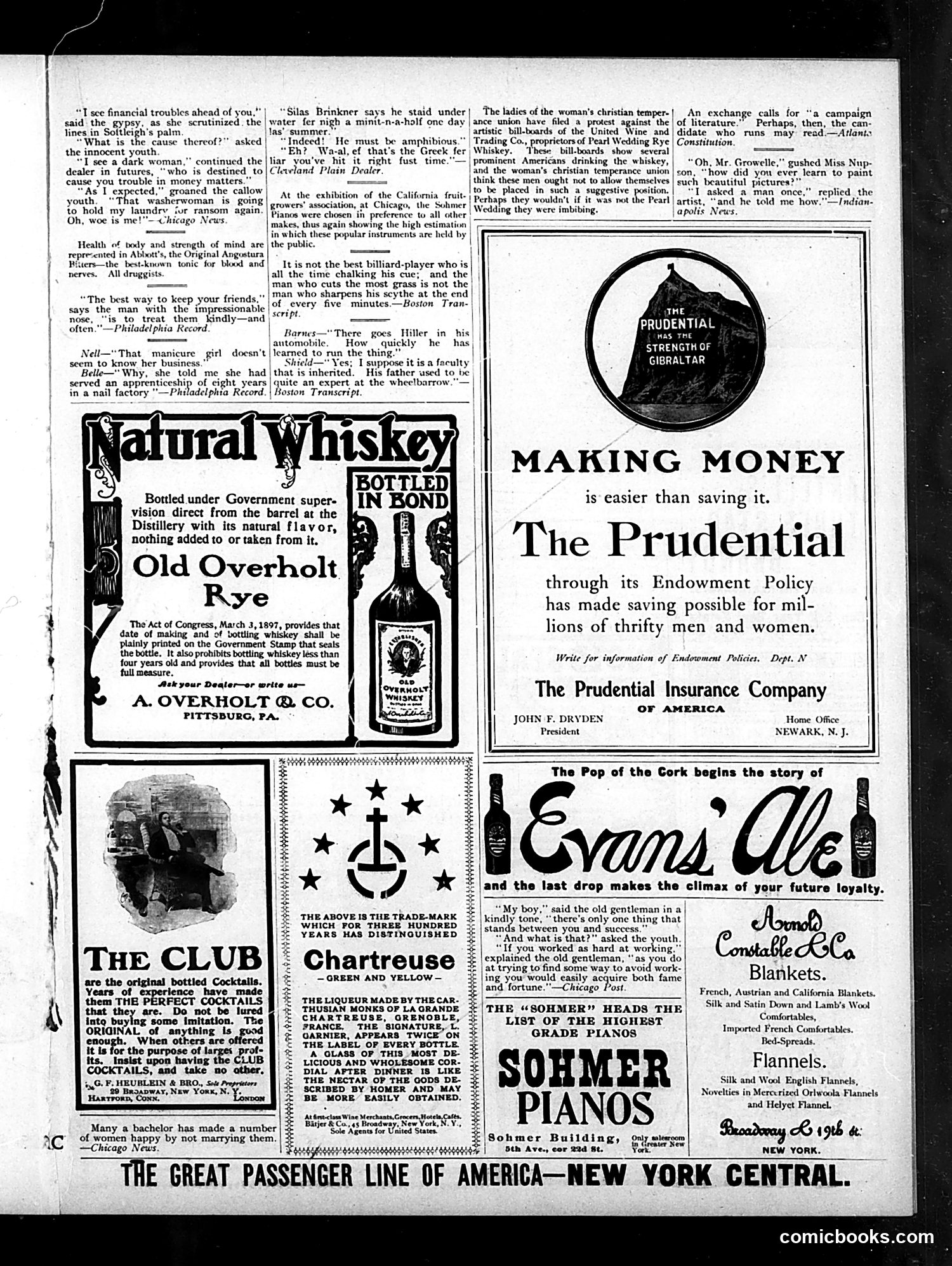
This page is primarily **advertisements and brief humorous anecdotes** rather than political cartoons. The satirical content consists of short jokes about contemporary social issues: **Main Satirical Points:** 1. **Women's Christian Temperance Union (WCTU) protest**: The page references the WCTU filing complaints against Pearl Wedding Rye whiskey for featuring "prominent Americans" in advertisements. This reflects early 1900s temperance movement activism against alcohol marketing. 2. **Short jokes on social behavior**: Scattered anecdotes mock various subjects—fortune tellers, billiards players, manicurists, and romantic pursuits—typical of Judge's lighthearted satirical style. 3. **Advertisements dominate**: Large ads for Natural Whiskey, Prudential Insurance, Sohmer Pianos, and other products fill most space, indicating this is a commercial publication mixing editorial content with paid promotions. The page reflects Progressive Era concerns about alcohol consumption and marketing while maintaining Judge's trademark irreverent humor toward everyday life and relationships.
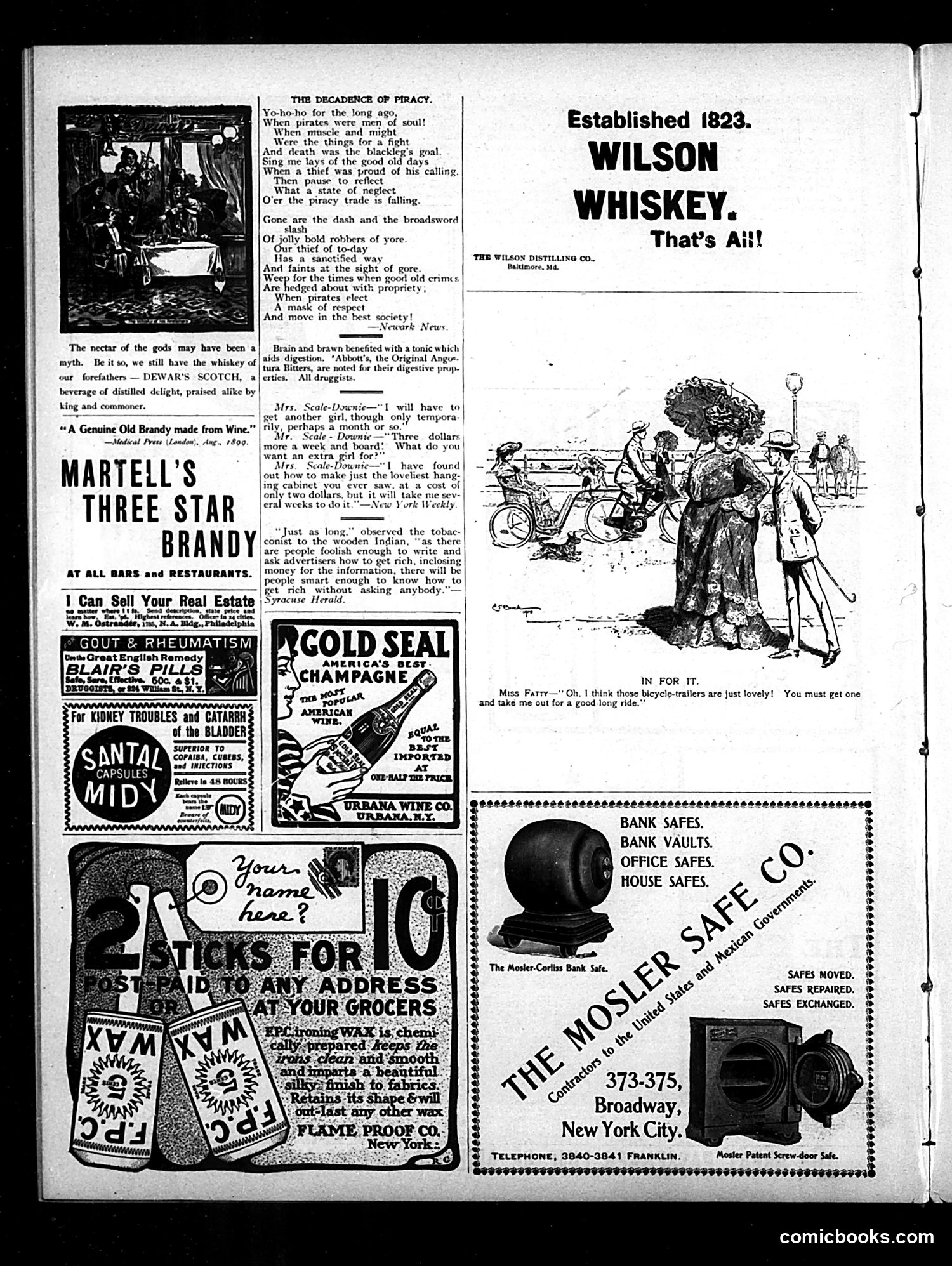
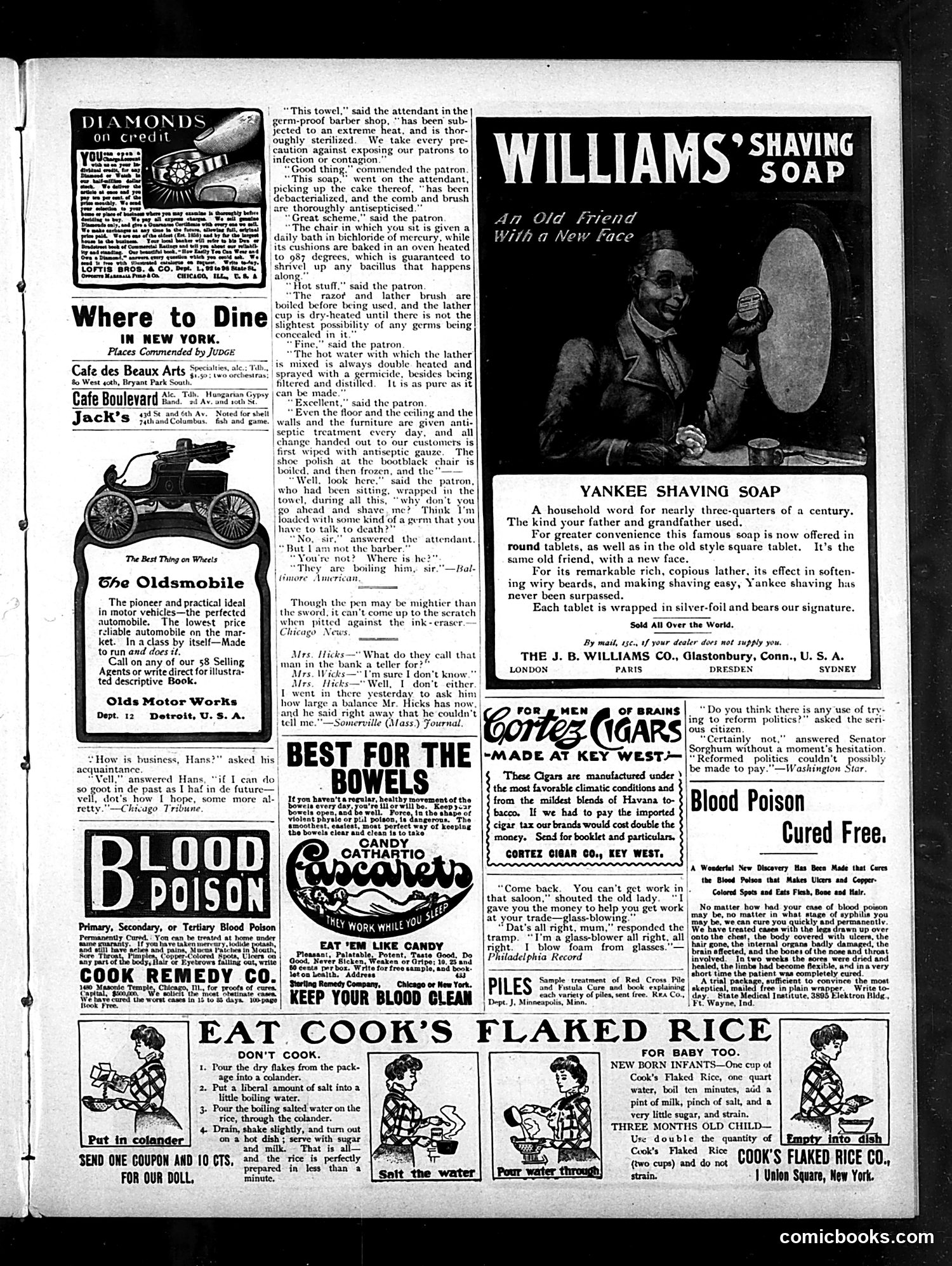
This page is primarily **advertisements and product promotions** rather than political satire. The main items are: 1. **The barber shop dialogue** (top): A humorous sketch about an obsessively germ-conscious barbershop that emphasizes sterilization of every tool and surface—reflecting early 20th-century anxiety about germs and hygiene following germ-theory discoveries. 2. **"Where to Dine in New York"**: Restaurant recommendations, a standard magazine feature. 3. **Multiple product ads**: Williams' Shaving Soap, Oldsmobile automobiles, Cook's Flaked Rice, Gomez Cigars, and "Blood Poison" remedies dominate the page. These ads reflect period concerns (bacterial infection fears, automobile novelty) and remedies we'd now consider dubious. 4. **Brief humor snippets**: Small jokes about bank tellers and political reform, unremarkable without fuller context. The page reflects **early 1900s consumer culture and health anxieties** rather than sharp political commentary.
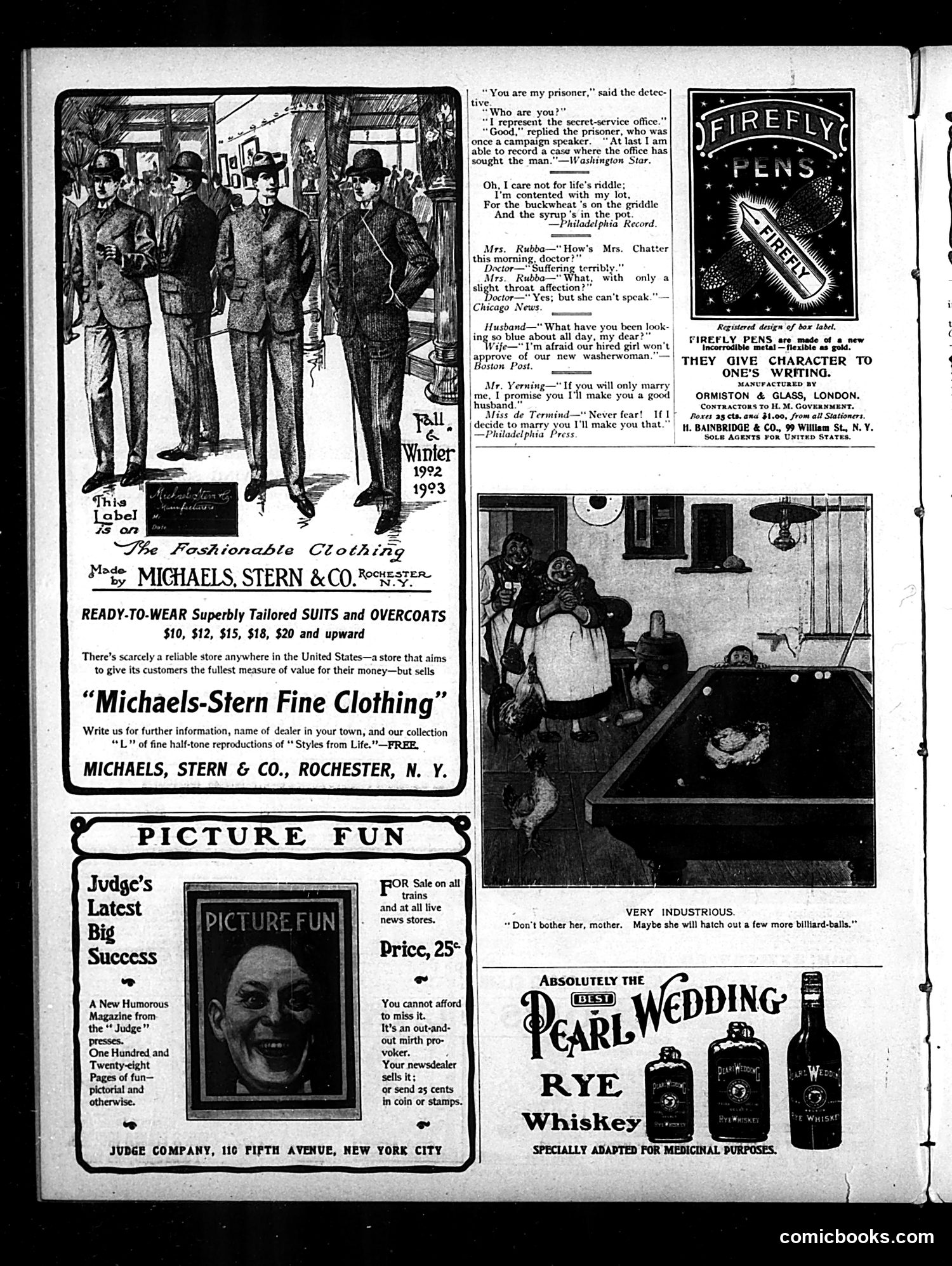
This page from Judge (circa 1892-1893) contains several brief satirical jokes reflecting Gilded Age concerns: **The Opening Joke** references a **campaign speaker arrested by Secret Service**—likely alluding to political corruption or fraud. The humor is that the politician finally "records a case where the office has sought the man," implying Secret Service typically ignores politicians' wrongdoing. **Domestic Humor**: Multiple jokes mock marital dynamics and servants—standard Judge fare. One gag about a "hired girl" reflects anxiety about household staff, common in this era of immigration and class tension. **The Cartoons**: The main illustration shows well-dressed men, likely representing the fashionable middle class—the magazine's target audience. **Advertising**: The page is dominated by ads for Michaels-Stern clothing, Firefly pens, and Pearl Wedding whiskey ("specially adapted for medicinal purposes"—a common Prohibition-era claim). The overall tone reflects 1890s urban American preoccupations: political corruption, servant problems, and consumer goods for the respectable classes.
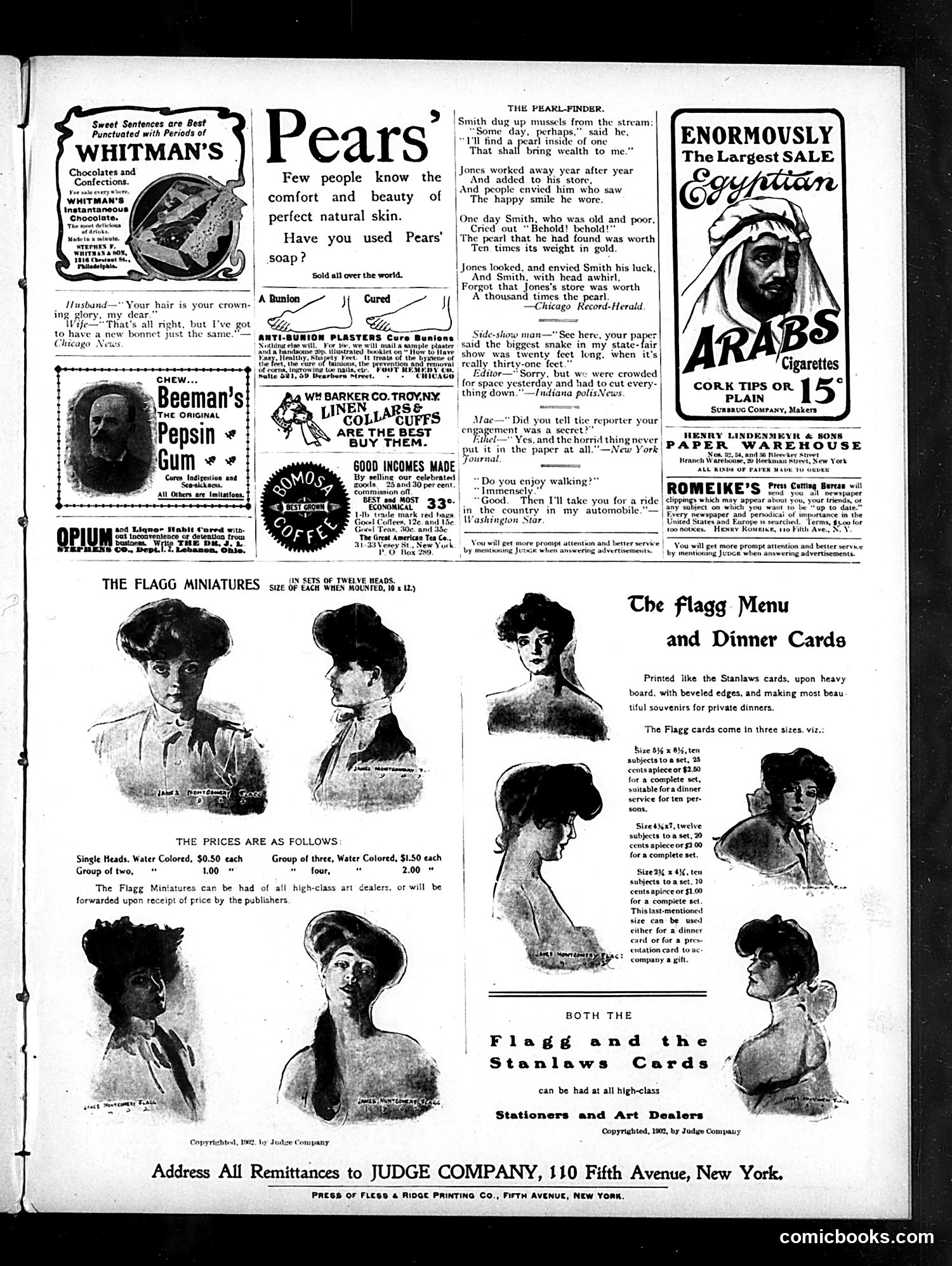
This page is primarily **advertising and product promotion** rather than political satire. It contains: **Main Content:** - A morality tale poem, "The Pearl-Finder," about Jones who accumulates wealth through years of labor, only to be envied by Smith who finds one lucky pearl—suggesting honest industry outweighs fortune - Multiple product advertisements typical of early 1900s magazines: Whitman's chocolates, Pears' soap, Beeman's gum, anti-bunion plasters, cigarettes, and office supplies - Large promotional sections for "Flagg Miniatures" and "Flagg Menu and Dinner Cards"—illustrated portrait cards sold as luxury souvenirs for entertaining **Social Context:** The ads reflect Edwardian consumer culture, emphasizing personal grooming (Pears' soap promotes "perfect natural skin") and luxury goods for the middle and upper classes. The Flagg cards' emphasis on "high-class" distribution suggests aspirational marketing. **Satire Present:** Minor humorous items include side-show exaggeration jokes and brief comedic anecdotes, but these are incidental to the page's primary commercial function.
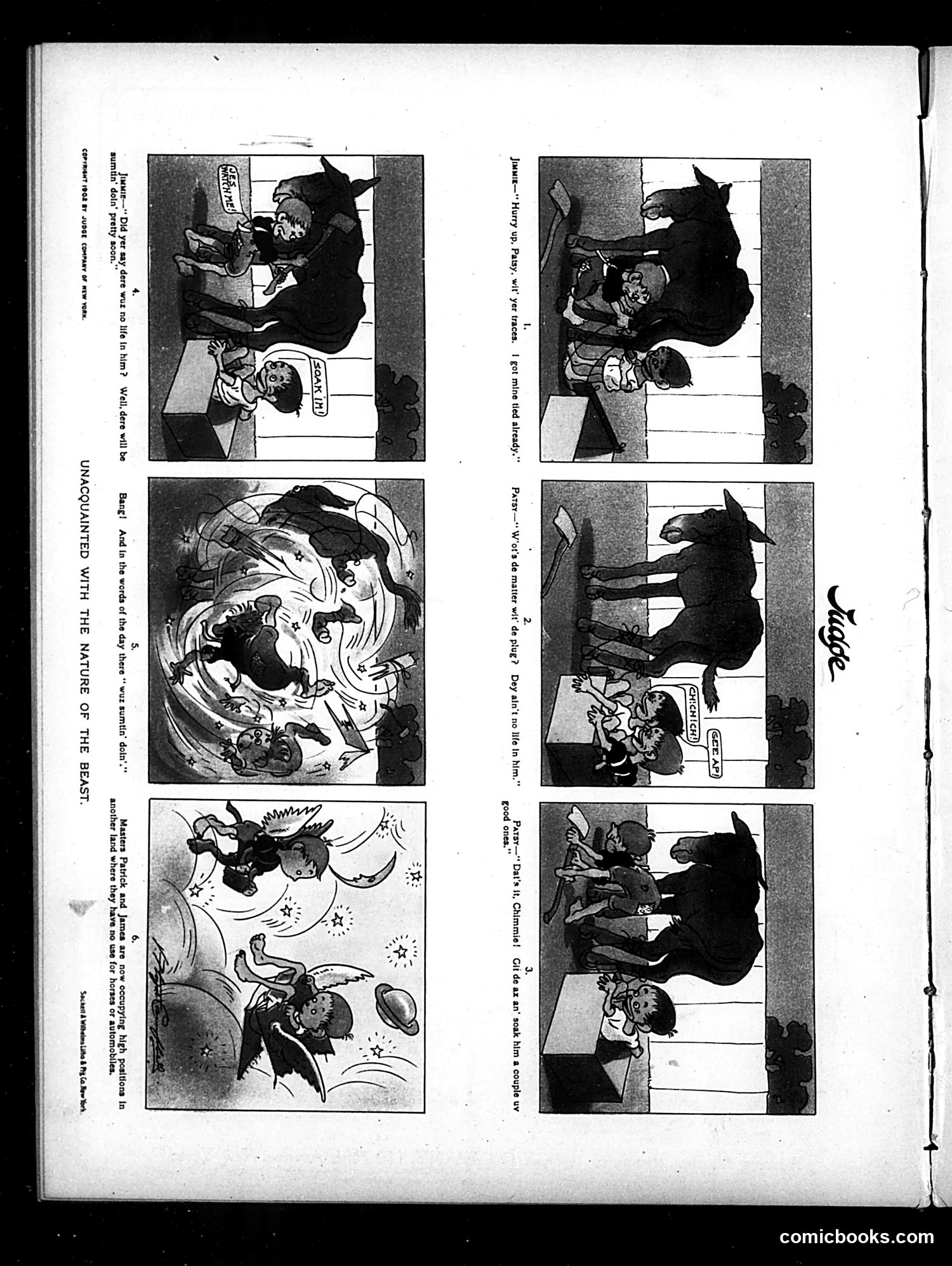
This 1902 Judge comic strip satirizes Irish immigrants ("Jimmie" and "Patsy," indicated by stereotypical dialect and names) through slapstick humor. The narrative shows two men struggling to hitch a horse to a wagon. When told the horse lacks energy, they beat it with an ax, which suddenly activates the animal—leading to violent chaos as the horse bucks them off. The dark punchline suggests both men die ("occupying high positions in another land"), playing on period anti-Irish prejudice by portraying them as ignorant, violent, and incompetent. The title's reference to being "unacquainted with the nature of the beast" applies both literally (they don't understand horses) and satirically (implying Irish immigrants themselves are bestial or uncivilized). This reflects common American nativist attitudes of the era toward Irish working-class immigrants.