
A complete issue · 20 pages · 1902
Judge — October 4, 1902
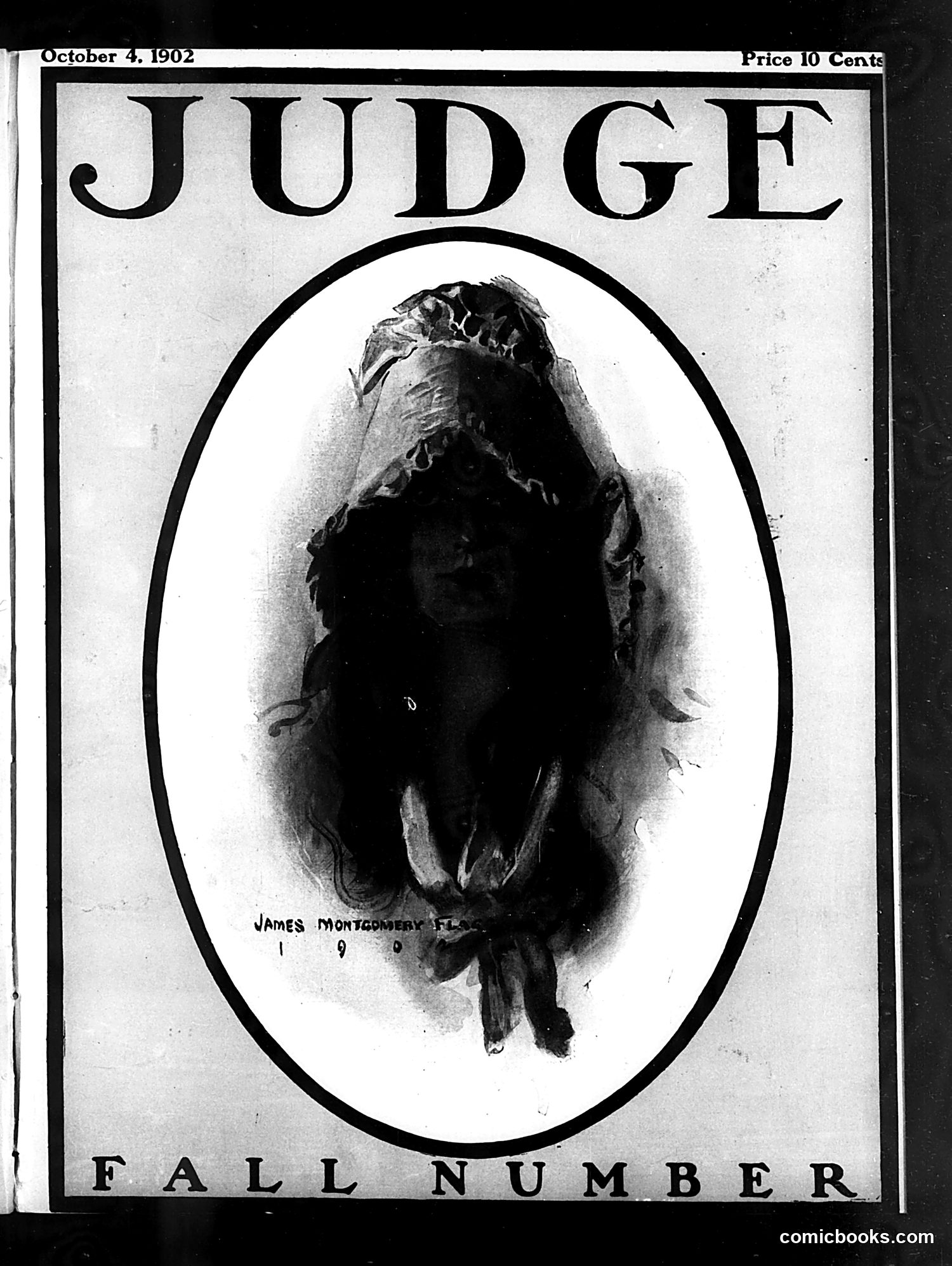
This is the Fall Number cover of Judge magazine, priced at 10 cents. The central image shows a portrait sketch signed "James Montgomery Fl[agg]" (a prominent illustrator of the era). The portrait depicts a person with long, somewhat disheveled hair and wrapped or bundled clothing, rendered in dark tones against a white oval background. Without additional text identifying the subject, the specific satirical target remains unclear from this image alone. The artistic style and presentation suggest it likely comments on a notable public figure or social type of 1902, but the exact political or social reference cannot be determined from the visual evidence provided. The Fall issue timing suggests seasonal topicality.
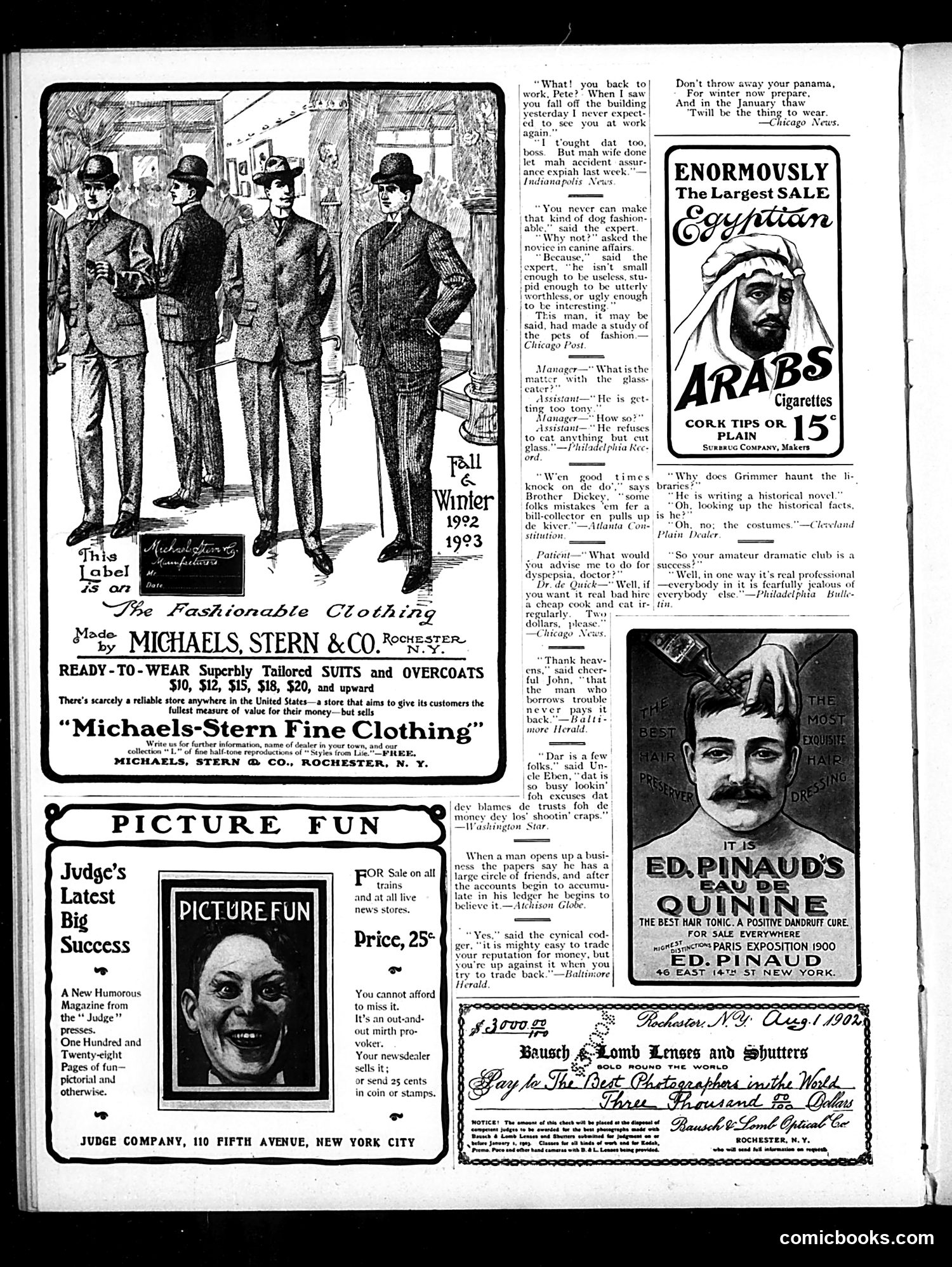
This page is primarily **advertising** rather than political satire. The main content includes: 1. **Michaels-Stern Clothing ad** (top-left): Features four men in formal suits and overcoats for Fall & Winter 1892-1893, promoting ready-to-wear tailored suits priced $10-20+. 2. **"Picture Fun" section** (lower-left): Advertises a Judge humor publication featuring 120+ pages of jokes and comics. 3. **Product advertisements** (right side): Egyptian Arabs cigarettes, Ed. Pinaud's Quinine hair product, and Bausch & Lomb lenses. The small text snippets between ads contain generic humor and advice columns rather than political commentary. This appears to be a standard late-19th-century magazine page mixing satirical entertainment with commercial advertisements—typical of Judge's business model during this period.
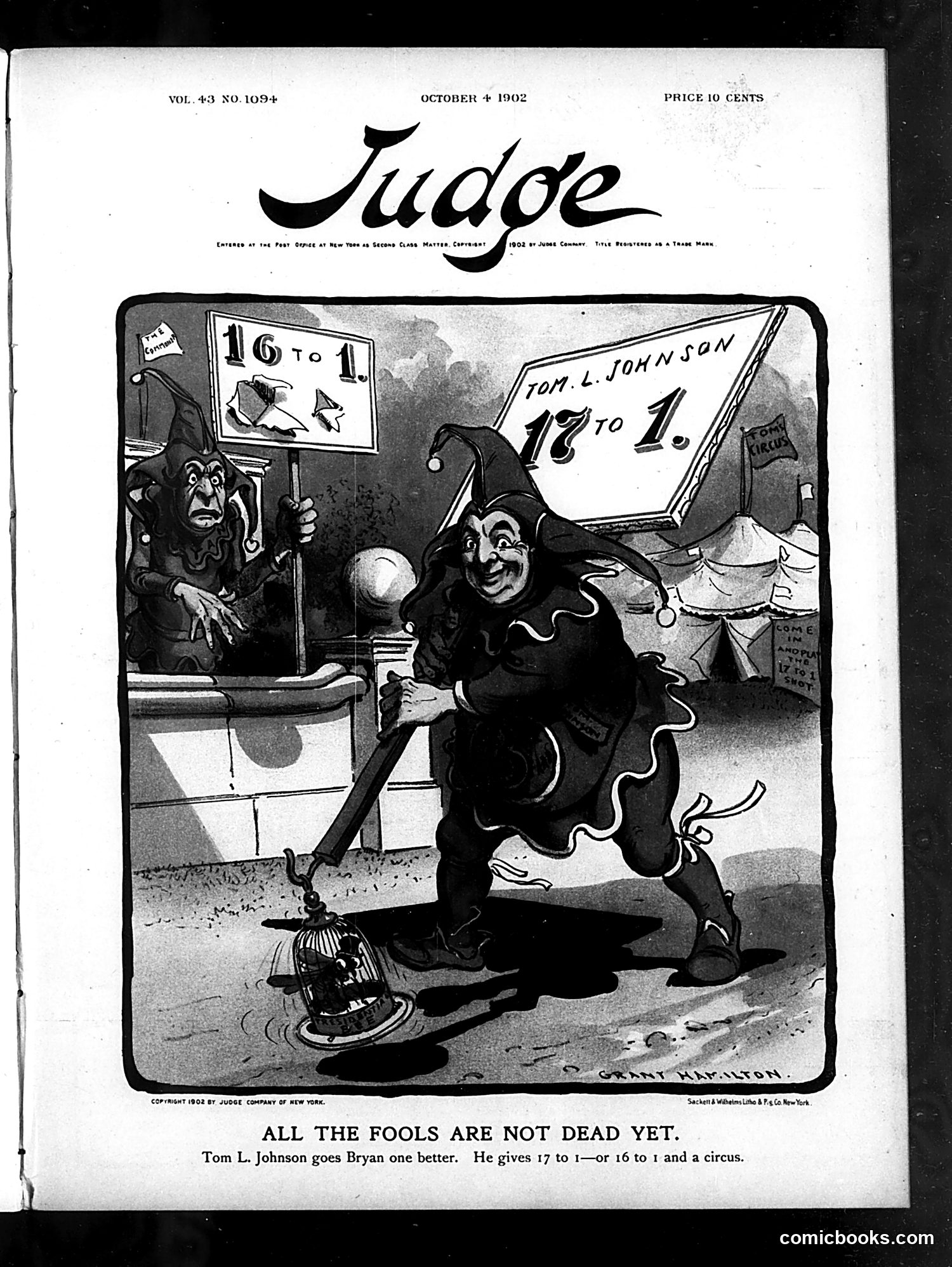
This October 1902 *Judge* cartoon satirizes the 1902 U.S. presidential election. The caption references **Tom L. Johnson**, who "goes Bryan one better" by offering odds of "17 to 1—or 16 to 1 and a circus." The caricatured figure on the right appears to represent Johnson or another Democratic candidate making increasingly extreme campaign promises. The opposing figure (left) holds a sign reading "16 to 1," referencing **William Jennings Bryan's** famous 1896 campaign for free silver coinage at a 16-to-1 ratio—a major economic controversy. The joke: Johnson is portrayed as so desperate to outdo Bryan's radical proposals that he's literally offering circus entertainment alongside political promises. The title "ALL THE FOOLS ARE NOT DEAD YET" mocks such extravagant campaign rhetoric as foolish.
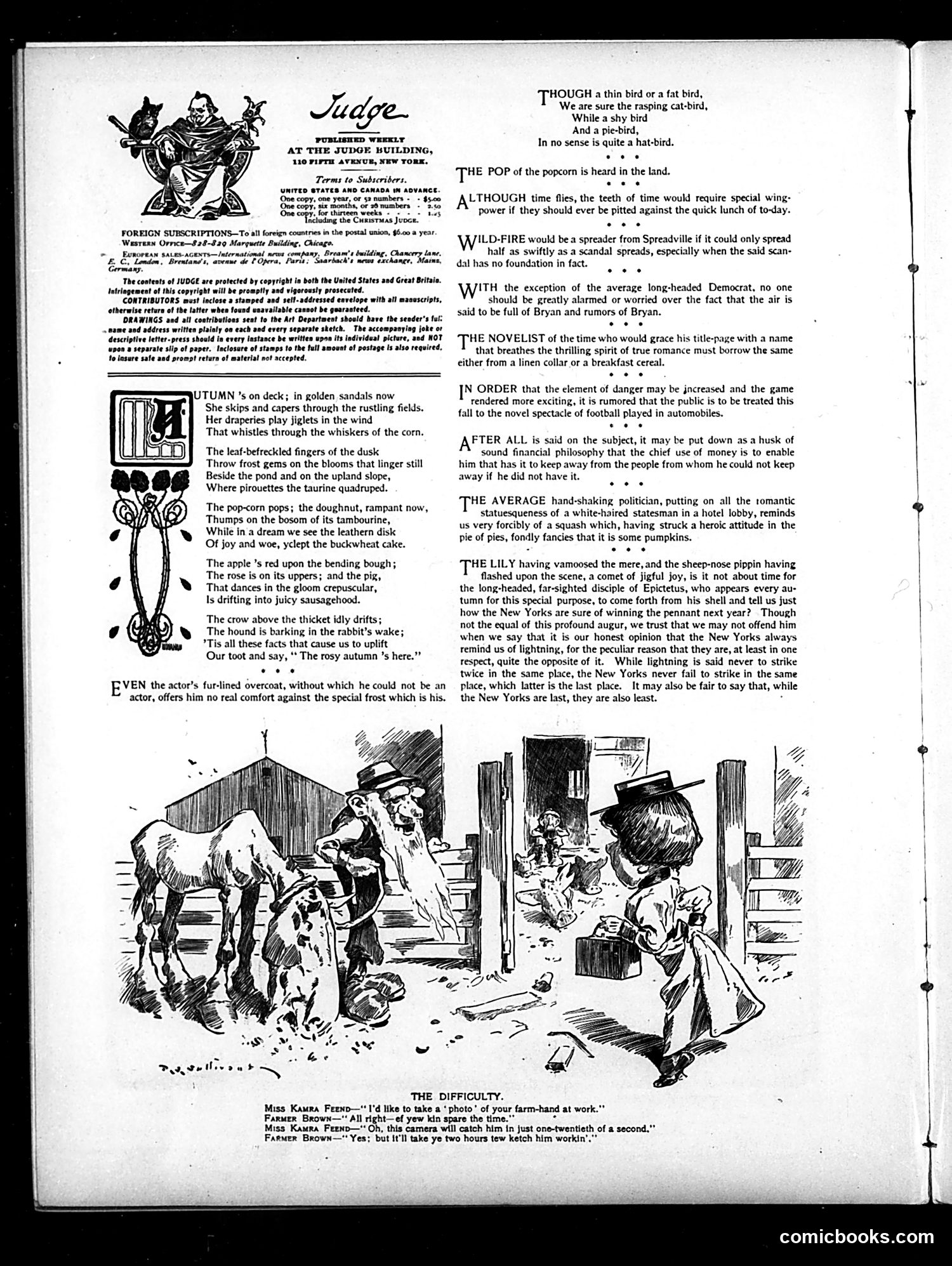
This page contains editorial commentary and a cartoon titled "The Difficulty." The cartoon depicts a farmer attempting to photograph his farm work while children interfere, making the task impossible—a visual pun on the challenge of "catching" or documenting rural labor. The editorial commentary addresses contemporary political and social topics, including references to Bryan (likely William Jennings Bryan), Democrats, popcorn prices, and financial philosophy. The pieces employ characteristic Judge satire: witty observations about politics, economics, and American life. Without specific dates or clearer visual identification of caricatured figures, the exact political targets remain somewhat unclear, though the tone suggests commentary on turn-of-the-century American politics and economics. The magazine's satirical approach targets both public figures and general social absurdities.
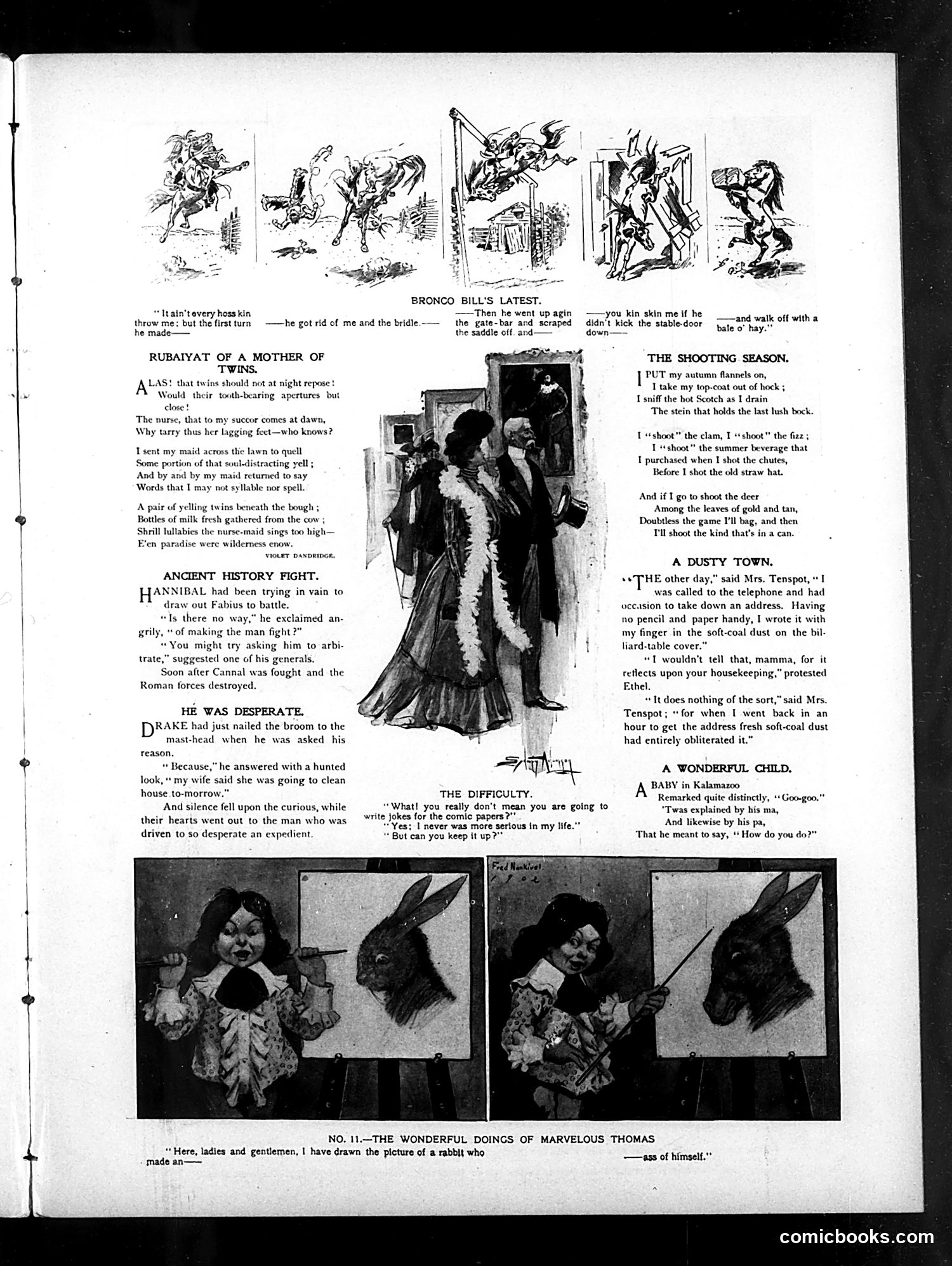
This page contains several satirical pieces typical of early 20th-century American humor: **"Bronco Bill's Latest"** mocks Wild West tales through sequential panels showing a cowboy repeatedly thrown from horses—deflating the genre's heroic mythology. **"Rubaiyat of a Mother of Twins"** parodies the poetic form of Omar Khayyam while depicting the genuine misery of sleep-deprived parenthood—a domestic complaint dressed in literary language for comic effect. **"Ancient History Fight"** jokes that arbitration could settle even Hannibal's military stalemate, satirizing contemporary labor disputes and peace-negotiation debates of the era. **"He Was Desperate"** presents a husband nailing a broom to avoid housecleaning—poking fun at married life and henpecked men, a recurring Judge theme. **"The Shooting Season"** puns relentlessly on "shooting" (hunting, drinking, photographs) to mock autumn leisure pursuits. The page concludes with domestic humor about dust and a child's gibberish, plus "Marvelous Thomas"—an apparent recurring character—making a crude pun about a rabbit. The humor assumes middle-class readers familiar with household management and literary references.
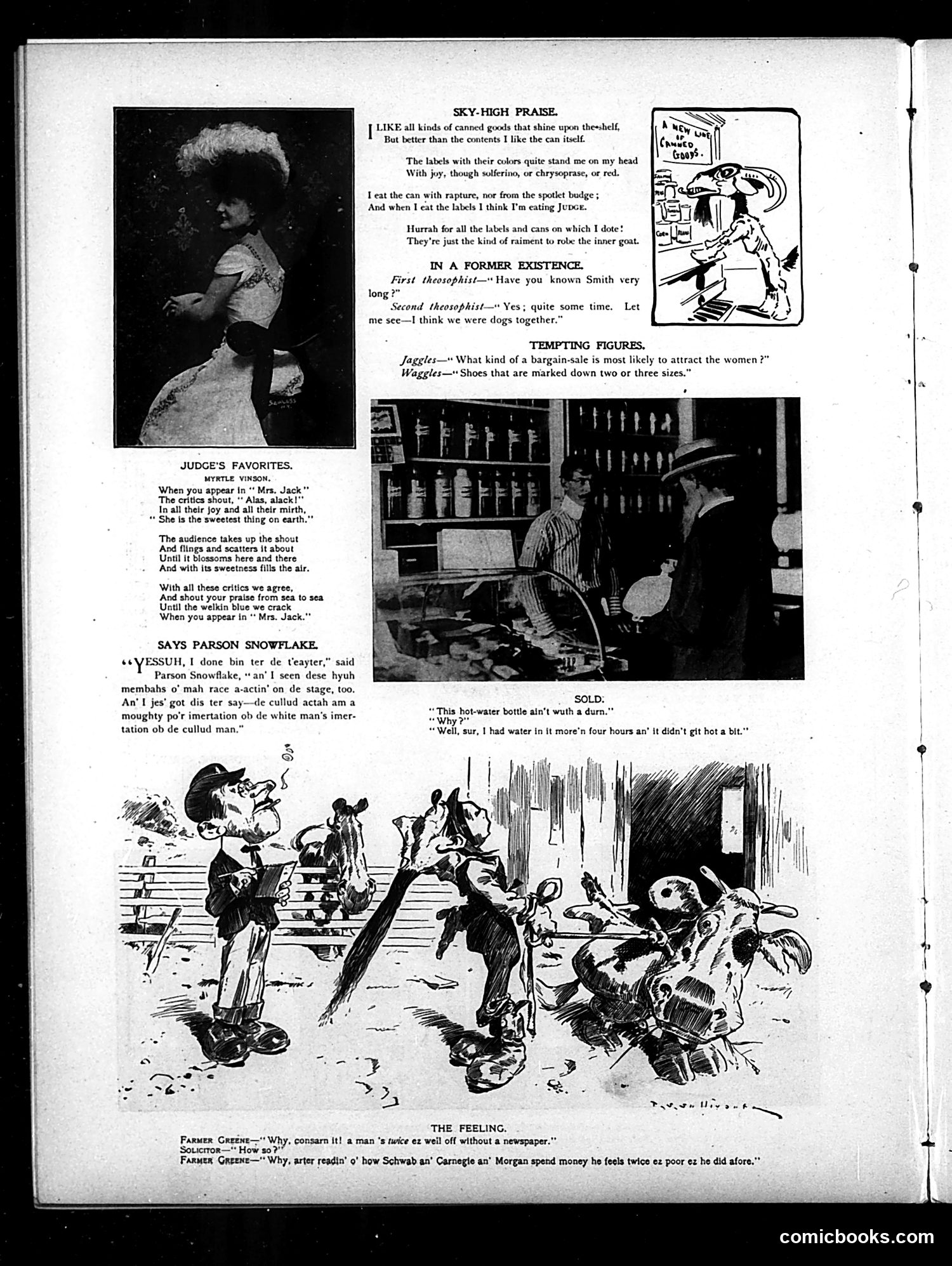
This page contains several satirical pieces typical of early 20th-century American humor: **"Sky-High Praise"** mocks consumers who value packaging over product quality—praising the can's appearance while dismissing its contents, a commentary on superficiality. **"In a Former Existence"** satirizes theosophist beliefs in reincarnation through a silly joke about two people claiming they were dogs together. **"Judge's Favorites"** praises actress Myrtle Vinson in "Mrs. Jack," appearing to be theatrical promotion dressed as editorial content. **"Says Parson Snowflake"** uses racist dialect humor (common in this era) to mock Black theatrical performers as poor imitators of white actors—reflecting the period's deeply prejudiced entertainment criticism. **"The Feeling"** jokes that reading about wealthy industrialists like Schwab, Carnegie, and Morgan spending lavishly makes ordinary farmers feel poorer by comparison—social commentary on wealth inequality's psychological effect. The page blends entertainment puffery, mild social observation, and period-typical racial caricature.
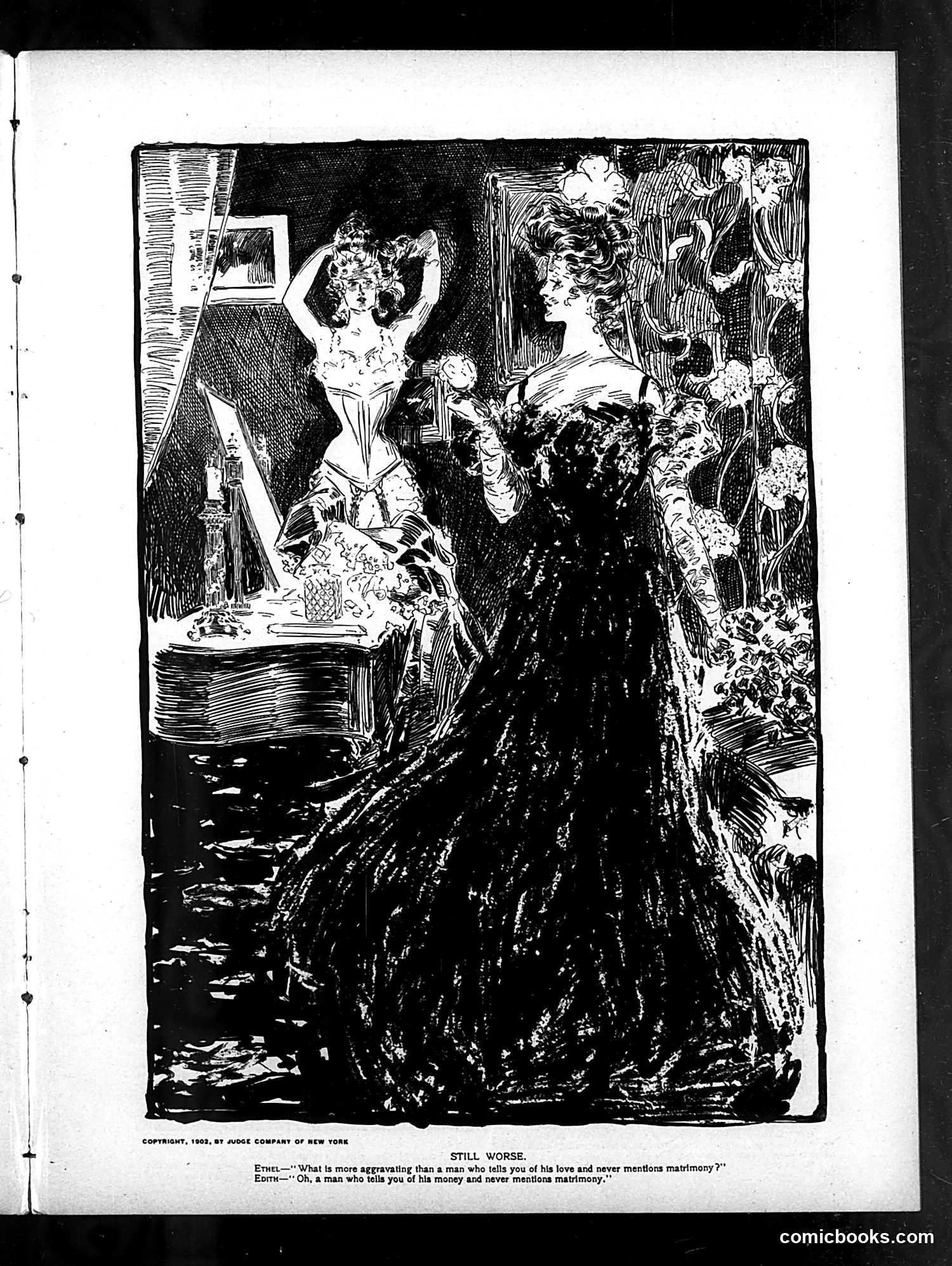
This cartoon satirizes courtship dynamics and women's economic concerns in early 1900s society. Two women (labeled Ethel and Edith) exchange complaints about aggravating suitors. Ethel protests men who profess love without mentioning marriage; Edith counters that worse are men who boast of wealth yet avoid matrimonial commitment. The joke reflects women's limited legal and economic autonomy at the time—marriage was often a financial necessity. The satire targets men's apparent hypocrisy: those displaying romantic or monetary assets to attract wives while deliberately avoiding the matrimonial outcome women needed. The illustration shows fashionably dressed women in an elegant interior, emphasizing their upper-class perspective on marriage as an economic transaction, not merely romantic union. The humor relies on recognizing this pragmatic, transactional view of matrimony as socially acceptable commentary.
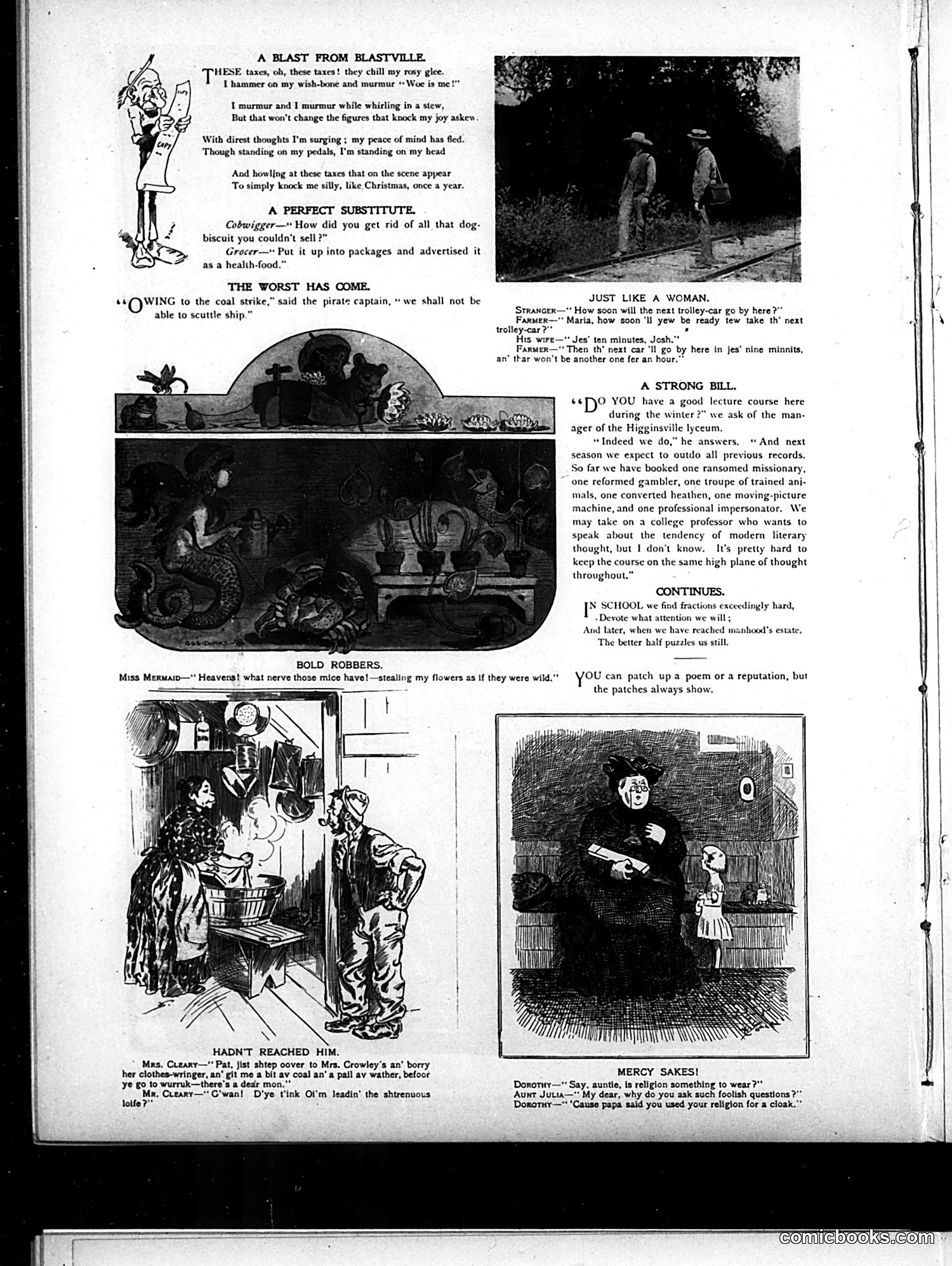
This page collects humorous short pieces typical of Judge magazine's satirical approach to American life: **"A Blast from Blastville"** mocks excessive complaining about taxes—a perennial complaint portrayed as futile griping that accomplishes nothing. **"A Perfect Substitute"** satirizes fraudulent advertising: a grocer repackages unsellable dog biscuits as "health food," critiquing both commercial dishonesty and gullible consumers. **"The Worst Has Come"** jokes that even a pirate cannot scuttle his ship due to coal strikes, suggesting labor disruptions affect everyone—likely referencing early 1900s coal labor conflicts. **"Just Like a Woman"** stereotypes women as indecisive; a farmer's wife cannot decide when to take the trolley, frustrating his logistics. **"A Strong Bill"** satirizes lowbrow lecture circuits: a lyceum manager boasts of booking sensational speakers (missionaries, reformed gamblers, trained animals, film machines) rather than serious intellectuals, mocking popular entertainment masquerading as culture. **Remaining items** include observations on school fractions and reputations, mice stealing flowers, and a child's misunderstanding of "religion" as clothing—standard domestic humor.
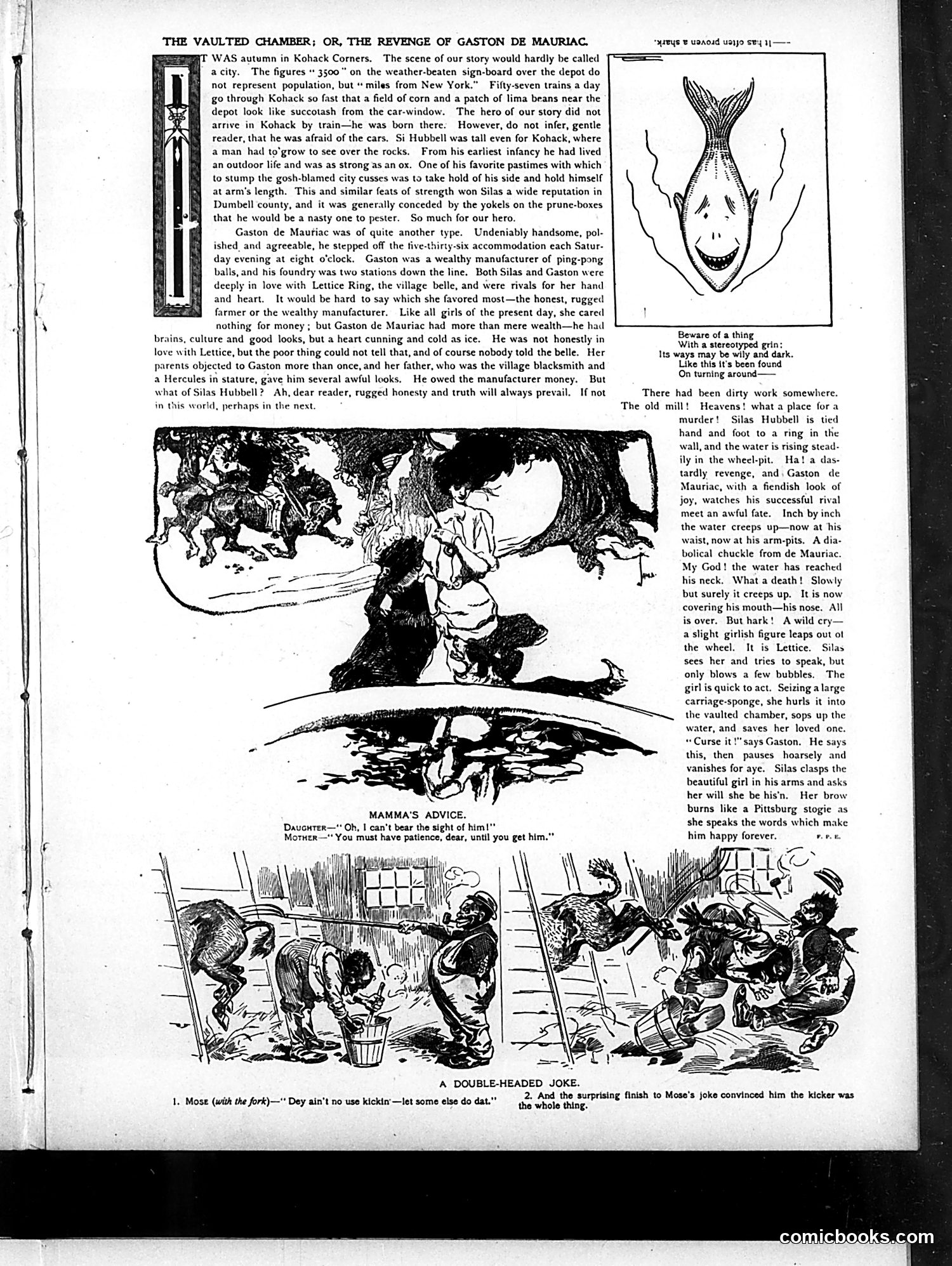
This is a serialized melodramatic story illustrated across the page—not a political cartoon. The narrative parodies overwrought Victorian romance fiction popular in the era. The plot involves a rural love triangle: honest farmer Si Hubbell, wealthy city manufacturer Gaston de Mauriac, and village belle Lettice Ring. Gaston, the villain with "a heart cunning and cold as ice," attempts murder by tying Silas in a flooding mill wheel—a melodramatic death trap. Lettice rescues him with a carriage-sponge, and Gaston "vanishes for aye." The satire targets contemporary sentimental fiction conventions: the virtuous poor hero, the morally corrupt rich rival, the resourceful heroine, and absurdly contrived peril. The deliberately exaggerated prose and implausible rescue mechanism mock popular serial stories Judge's audience consumed. The bottom section includes "A Double-Headed Joke" about a "kicker," unrelated to the main narrative.
I can see this is a black and white page from *Judge* magazine, but the image quality is too degraded for me to reliably read any text or identify specific cartoon content. The page appears to contain what might be a landscape or scenic illustration with horizontal bands of light and dark areas, possibly depicting water, sky, or terrain, but I cannot make out sufficient detail to identify specific figures, captions, or the satirical point being made. Without being able to read the OCR text clearly or discern the cartoon's subjects, I cannot responsibly explain what political or social references this content contains. To provide accurate historical context, I would need a clearer image or legible text.
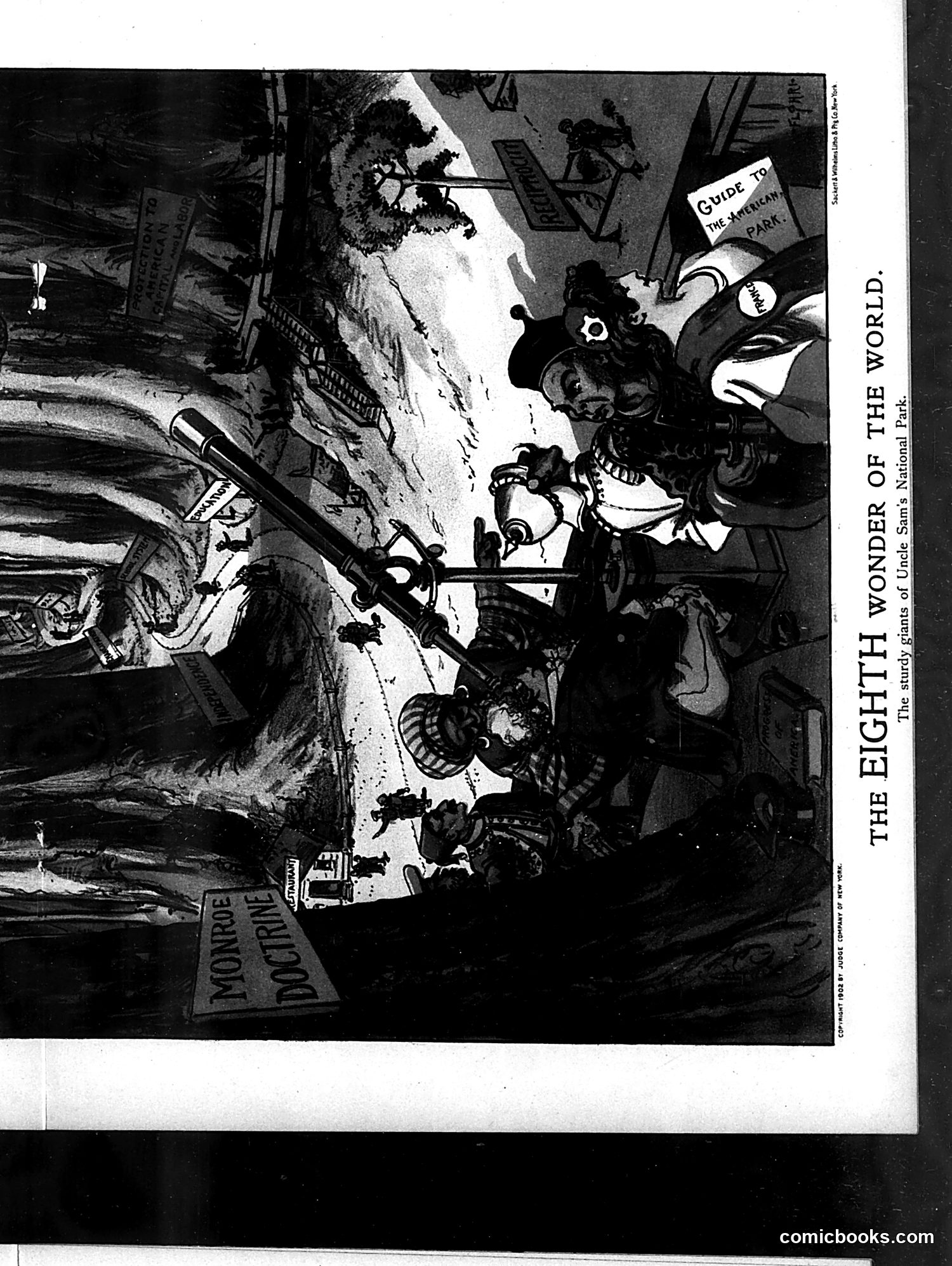
This appears to be a satirical illustration from *Judge* magazine showing a chaotic scene at what looks like a natural history museum or exhibition. The image depicts various figures examining or reacting to a large skeletal or anatomical display—possibly a dinosaur or prehistoric creature skeleton. The cartoon likely satirizes public fascination with "wonders" and curiosities, or critiques how museums present educational material to crowds. References visible include a "Guide to the American Parks" sign, suggesting commentary on tourism or popular attractions. The specific political or social target is unclear without the complete, legible OCR text. The style and composition suggest early 20th-century American satire about public entertainment, scientific exhibitions, or mass culture consumption—typical *Judge* magazine subjects during that era.
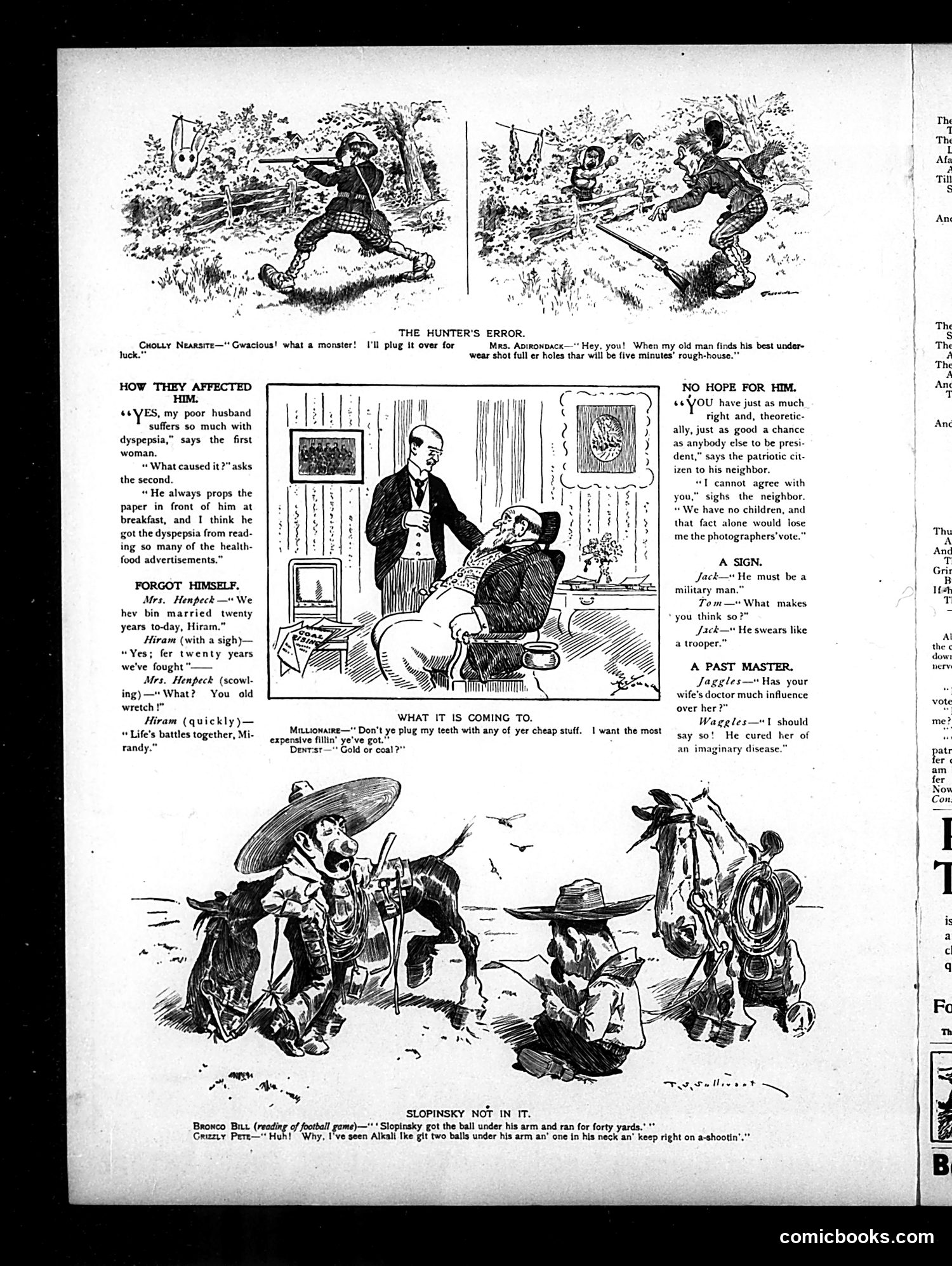
This page from *Judge* magazine contains multiple brief satirical vignettes typical of early 20th-century American humor. "The Hunter's Error" mocks urban hunters mistaking domestic animals for game—a woman shoots what she thinks is a monster but is actually someone's underwear. "How They Affected Him" jokes about health-food advertisements causing dyspepsia (indigestion), satirizing the era's proliferation of dubious medical advertising claims. Several short dialogues mock domestic life: a wife complaining about twenty years of marital "battles," discussions about presidential eligibility and photographers' voting preferences, and a doctor's influence over a wife's imaginary illness. "Slopinsky Not in It" compares a football player's performance unfavorably to fictional Western character "Alkali Ike," suggesting that even exaggerated dime-novel exploits exceed real athletic achievement—a humorous dig at sports culture. The overall tone reflects *Judge*'s satirical approach to American domestic life, advertising, and popular entertainment of the period.
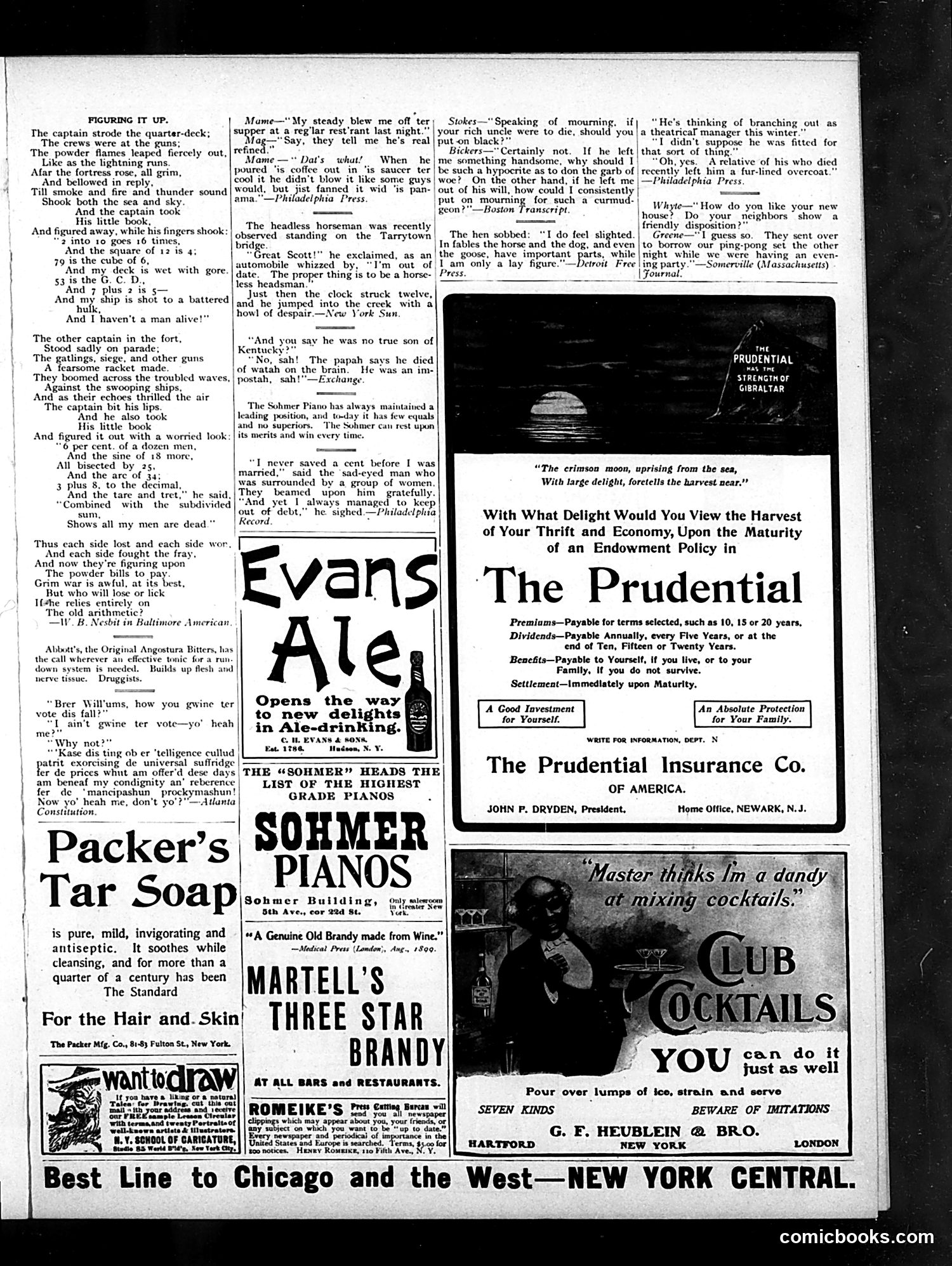
This is primarily an **advertising page** with one central cartoon titled "Figuring It Up." **The Cartoon's Satire:** The poem depicts two military officers—one commanding a ship, one in a fortress—engaged in battle. Rather than focusing on the violence, each captain frantically performs mathematical calculations in logbooks while their ships/fortresses are destroyed and men die. The joke satirizes **excessive bureaucratic mindset during wartime**: military officers so obsessed with paperwork, accounting, and procedure that they lose sight of actual human costs. After the battle, both sides don't mourn losses—they "figure upon / The powder bills to pay," reducing tragedy to mere expense calculation. The satire suggests military incompetence and the dehumanizing effect of turning warfare into bean-counting exercises. **Additional Content:** The page includes **period advertisements** (Packer's Tar Soap, Sohmer Pianos, Evans Ale, Martell's Brandy) and brief humor snippets about dating and voting—typical Judge magazine filler material.
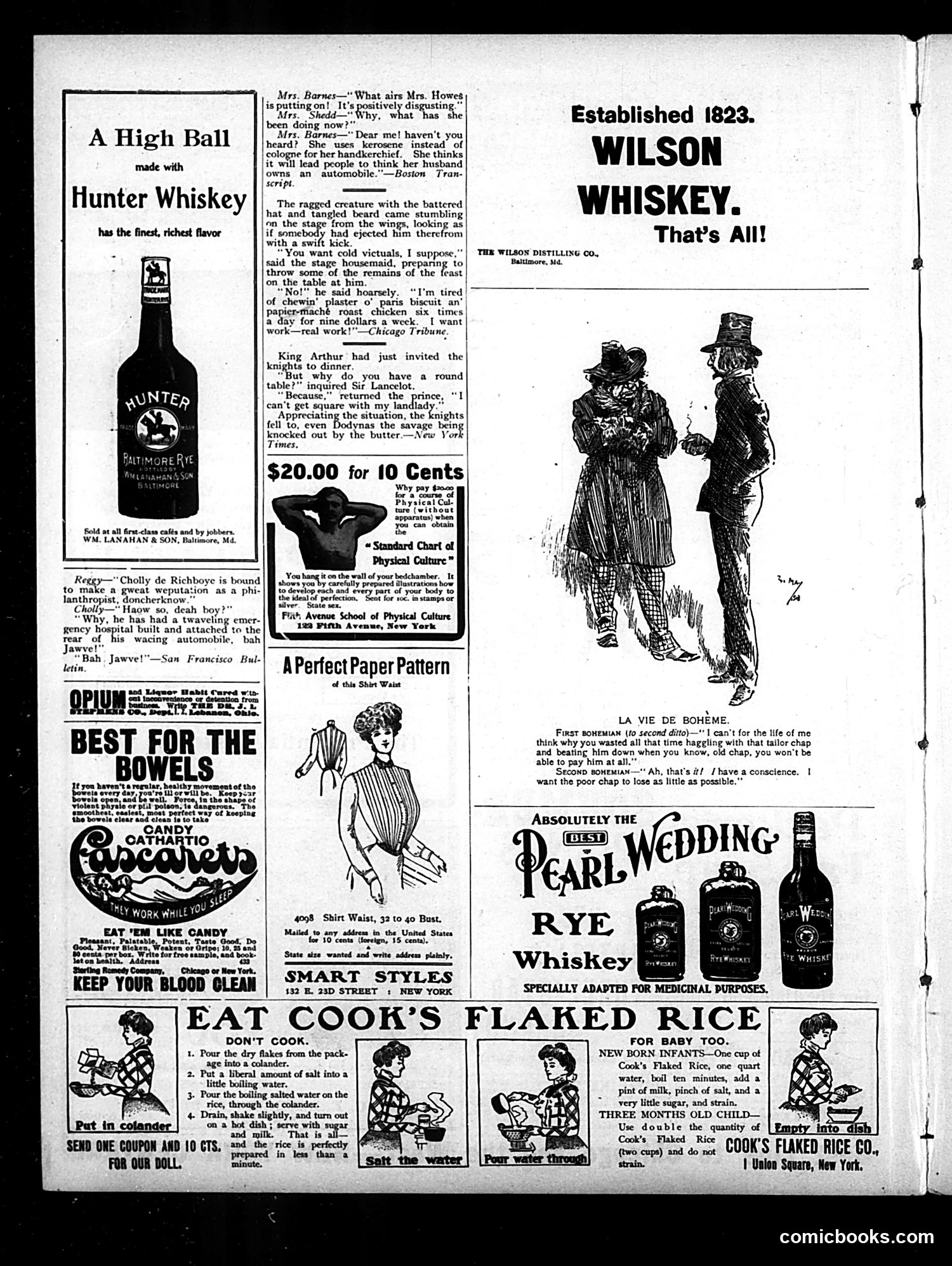
This page, primarily consisting of **advertisements and humorous vignettes** rather than political cartoons, contains several satirical jokes targeting early 20th-century social pretension: **"Cholly de Richboye" cartoon**: Mocks wealthy affectation—a rich man attaches an emergency hospital to his racing car, not from genuine philanthropy but as a status symbol. **Mrs. Howes/Barnes exchange**: Ridicules women's vanity; Mrs. Howes uses kerosene instead of cologne to suggest her husband owns an automobile—an expensive luxury item signifying wealth. **LA VIE DE BOHEME**: Satirizes bohemian poverty and self-deception—an impoverished artist deliberately hagggles with a tailor while knowing he cannot pay, justifying it as allowing the tailor to "lose as little as possible." **Stage beggar scene**: Commentary on theatrical realism versus artifice. The page's dominant content is patent medicines, whiskey advertisements (Wilson Whiskey, Pearl Wedding Rye), and household product promotions—typical of period magazines. The humor targets social climbing and false gentility among aspiring classes.
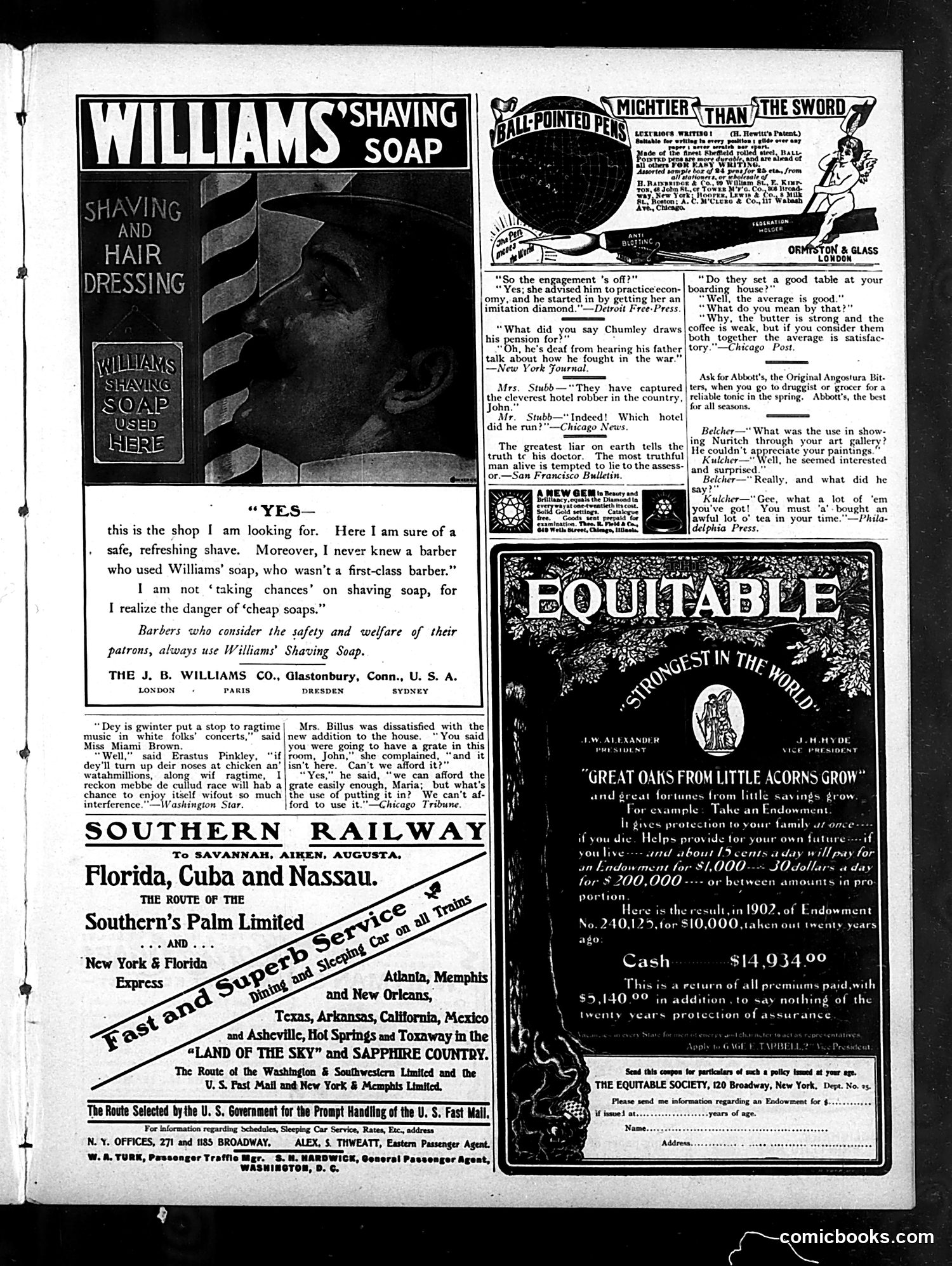
This page is primarily **advertising and filler content** rather than political satire. It contains: **Main Features:** - A large Williams Shaving Soap advertisement featuring a barber testimonial about product quality and safety - Southern Railway advertisements promoting routes to Florida, Cuba, and Nassau - The Equitable Life Assurance Society advertisement showcasing an endowment policy's returns **Comic Relief Elements:** The page includes various brief humorous anecdotes and jokes—typical of Judge's filler content—touching on everyday domestic and social situations (engagements, boarding houses, hotel robberies, ragtime music). These appear designed for light entertainment rather than political commentary. **Historical Context:** This appears to be an early 20th-century issue when Judge mixed serious satire with commercial advertising and general humor. The advertisements reflect the era's consumer culture and emerging insurance industry marketing. The page lacks identifiable political figures or sustained satirical campaigns, making it primarily a commercial/entertainment product rather than editorial commentary.
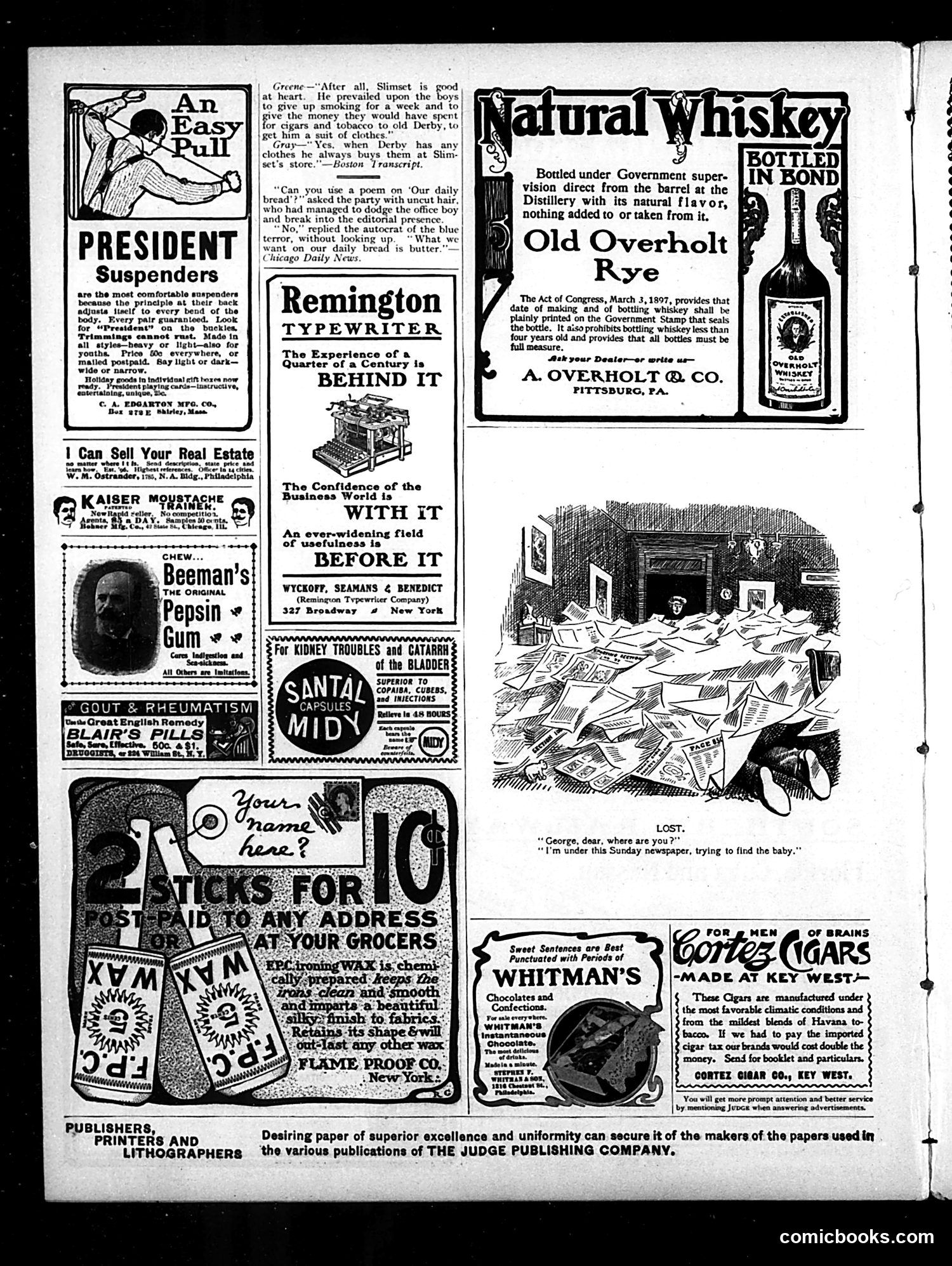
This page is primarily **advertising**, typical of Judge magazine's revenue model. Notable satirical content includes: **"Lost" Cartoon**: A husband searches frantically through scattered Sunday newspapers, telling his wife "I'm under this Sunday newspaper, trying to find the baby." The joke satirizes how newspapers were so voluminous and consumed so much household attention that a baby could literally be lost beneath them—commentary on the era's newspaper obsession and distracted domesticity. **Editorial Jokes**: Brief quips mock contemporary attitudes (e.g., a poet pitches a poem about "daily bread" to an editor who replies they want "butter" instead—satirizing editorial practicality over artistic merit). The remainder comprises period product advertisements (typewriters, whiskey, chocolates, cigars, patent medicines) representative of early 20th-century consumer culture. The whiskey ad notably emphasizes government regulation compliance, reflecting post-Prohibition-era credibility concerns.
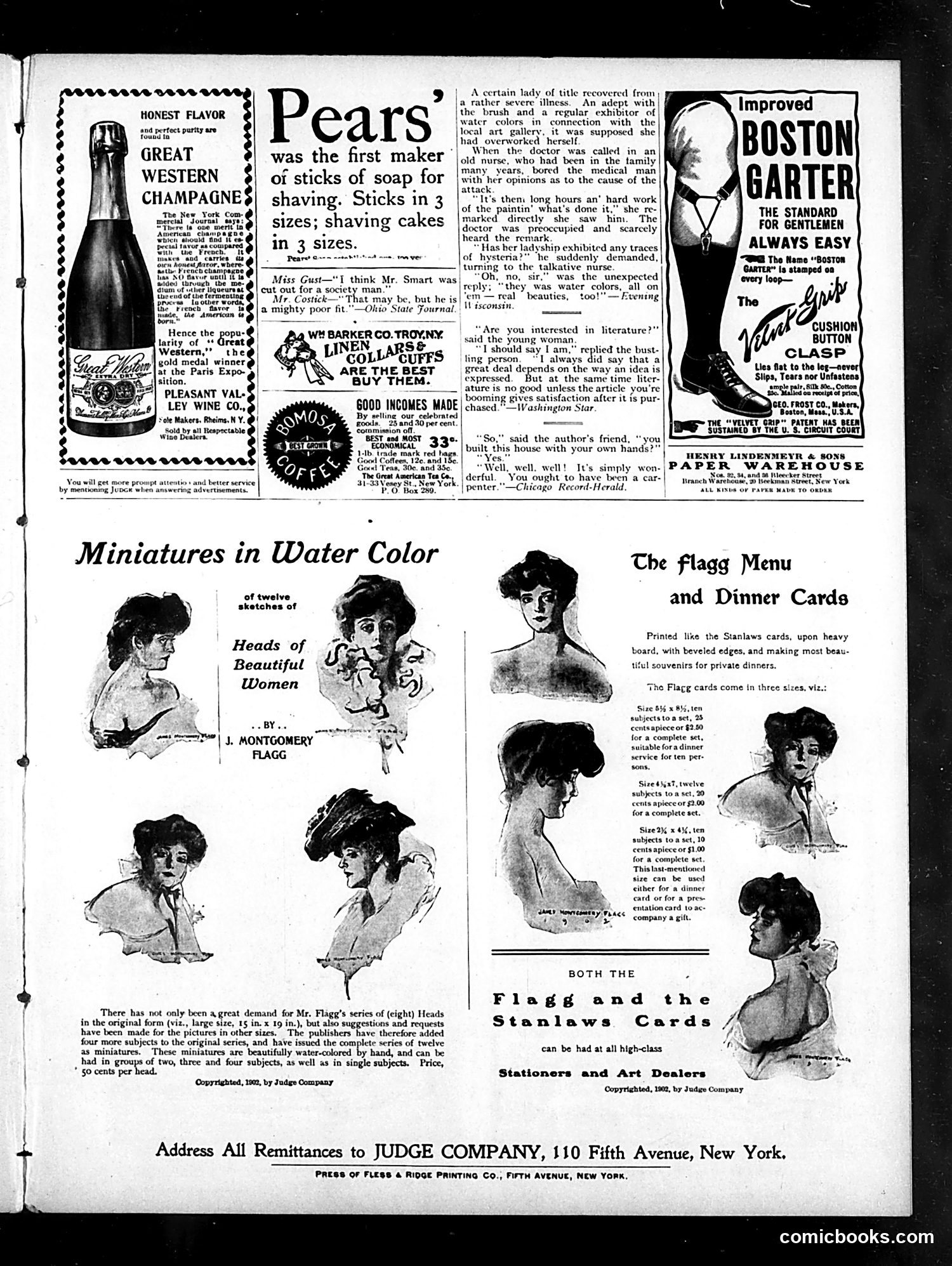
This page is primarily **advertising and product promotion** rather than political satire. It features: **Main advertisements:** - Great Western Champagne (shaving soap) - Pleasant Valley Wine Co. - W. Barker & Co. (linen cuffs) - Boston Garter (men's clothing) - Tea company products - Henry Lindenmeyr & Sons (paper warehouse) **Editorial content:** A brief humorous anecdote about a titled lady recovering from illness. Her doctor dismisses her unsolicited opinions about her condition, and when she later insists she should have become a carpenter, her friend replies that such practical work would suit her better than discussing literature. **Art feature:** J. Montgomery Flagg's "Heads of Beautiful Women"—miniature water-color portraits available for purchase in various sizes, marketed as dinner card decorative items. The page reflects early 1900s consumer culture and advertising practices, with minimal political content. The brief story is gentle domestic humor rather than satire.
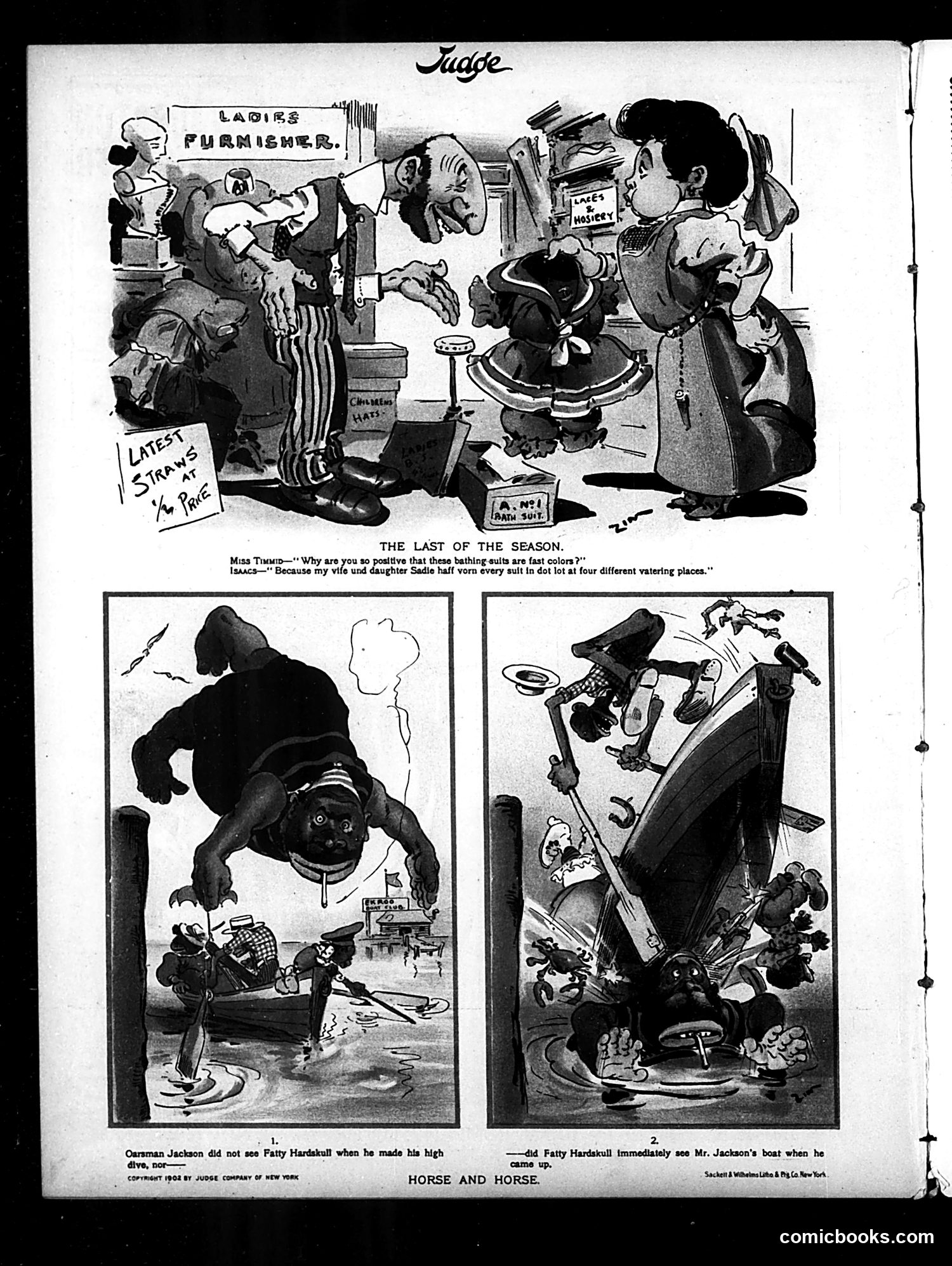
**Top Panel:** A vendor ("Ladies' Furnisher") sells bathing suits to a customer named Isaac. The joke relies on Yiddish-inflected English dialect humor (common in early 1900s American comedy). Isaac claims the suits are "fast colors" because his wife and daughter Sadie wore them at four different beaches—implying the dyes ran or faded, thus the suits changed appearance at each location. It's a play on "fast colors" (durable dyes) versus the family's rapid movement between venues. **Bottom Panels (1-2):** A diving accident between "Oarsman Jackson" and "Fatty Hardskull." Jackson didn't see Hardskull when diving; conversely, Hardskull immediately spotted Jackson's boat when surfacing—the implication being Jackson emerged directly beneath the boat, creating a collision. "Horse and Horse" likely refers to the cartoon's title or series name. The satire mocks working-class leisure culture and physical comedy of the era.
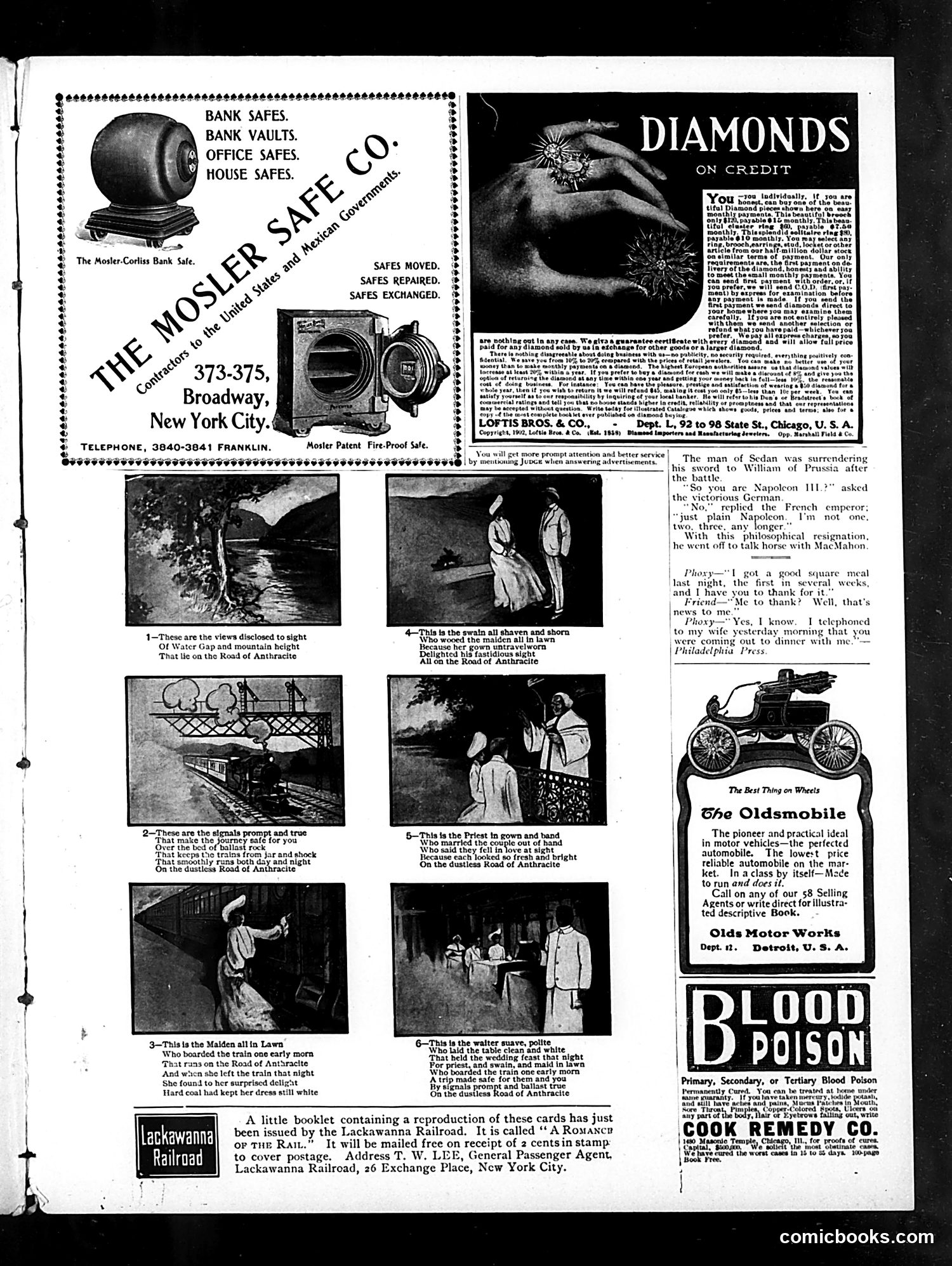
This page is **primarily advertisements** with minimal editorial cartoon content. The notable comic element is a brief dialogue joke titled "Phoxy" in the upper right, depicting a domestic humor scenario where a man thanks his friend for coming to dinner, only to learn the friend telephoned the wife to arrange it—a gentle mockery of social pretense. The page's main content consists of **product advertisements**: bank safes, diamonds on credit, and automobiles. There is also a **Lackawanna Railroad promotional feature** with six small illustrated vignettes depicting scenes of travelers on the "Road of Anthracite" (a coal-region railway line), emphasizing the comfort and safety of rail travel. These images romanticize the railroad journey. The advertisements include dubious medical claims (a "Blood Poison" cure), reflecting early 20th-century publishing standards that permitted unregulated medical advertising. No significant political satire or social commentary appears on this page beyond the mild domestic humor in "Phoxy."
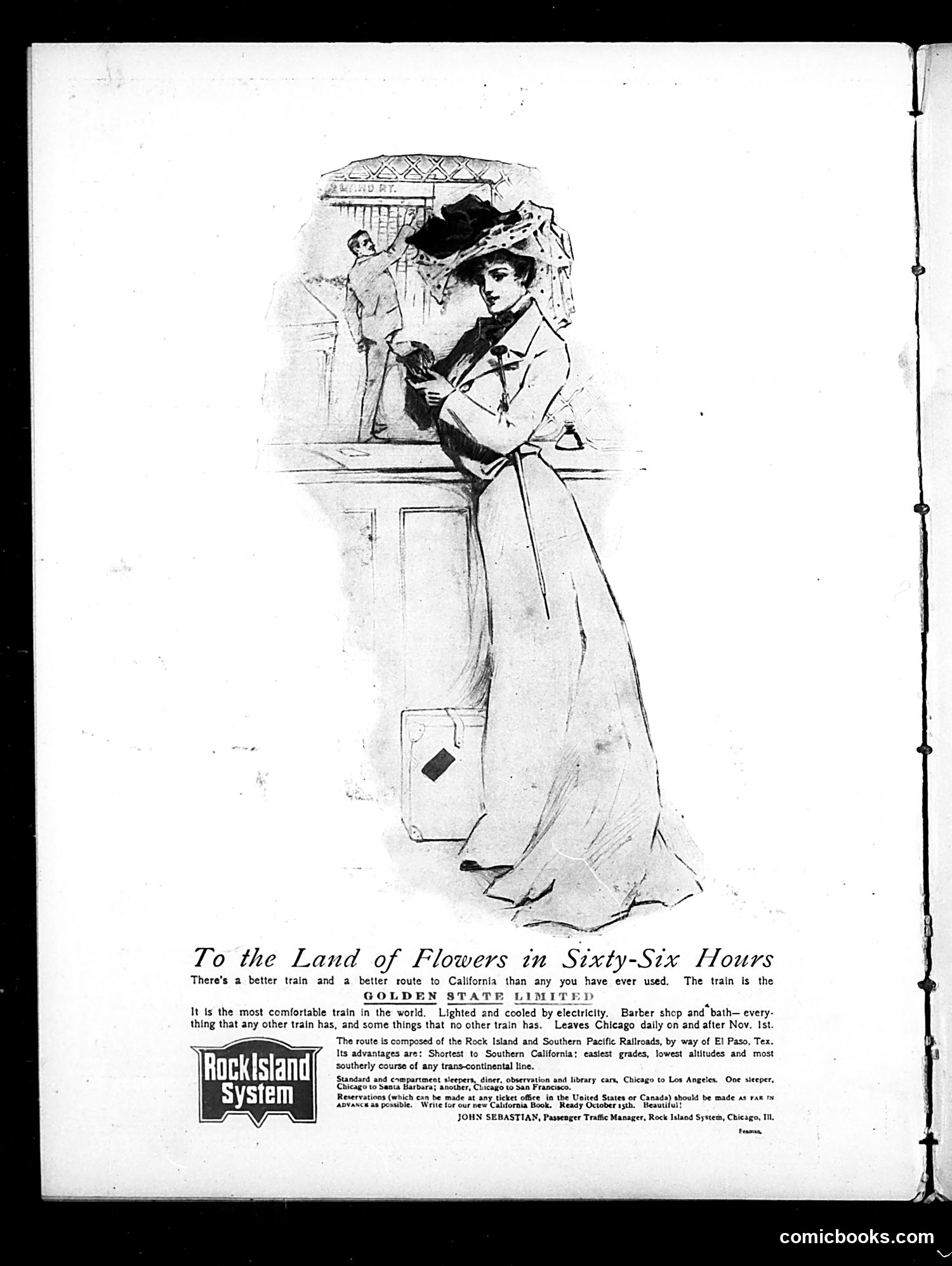
This is primarily a **railroad advertisement**, not political satire. It promotes the "Golden State Limited" train service to California, operated by Rock Island and Southern Pacific Railroads. The illustration depicts an elegantly dressed woman in Edwardian-era fashion boarding or traveling on the train, symbolizing luxury and modernity. The title "To the Land of Flowers in Sixty-Six Hours" references the journey time from Chicago to California. The ad emphasizes cutting-edge amenities for 1906: electric lighting and cooling, barber shops, baths, sleeping cars, dining cars, and observation decks. It positions this as the most comfortable transcontinental route available. The **satire or joke is minimal**—the main appeal is aspirational luxury travel, marketed primarily to affluent passengers through elegant imagery and detailed amenities. This represents turn-of-the-century American optimism about technological progress and westward expansion.