
A complete issue · 16 pages · 1902
Judge — August 23, 1902
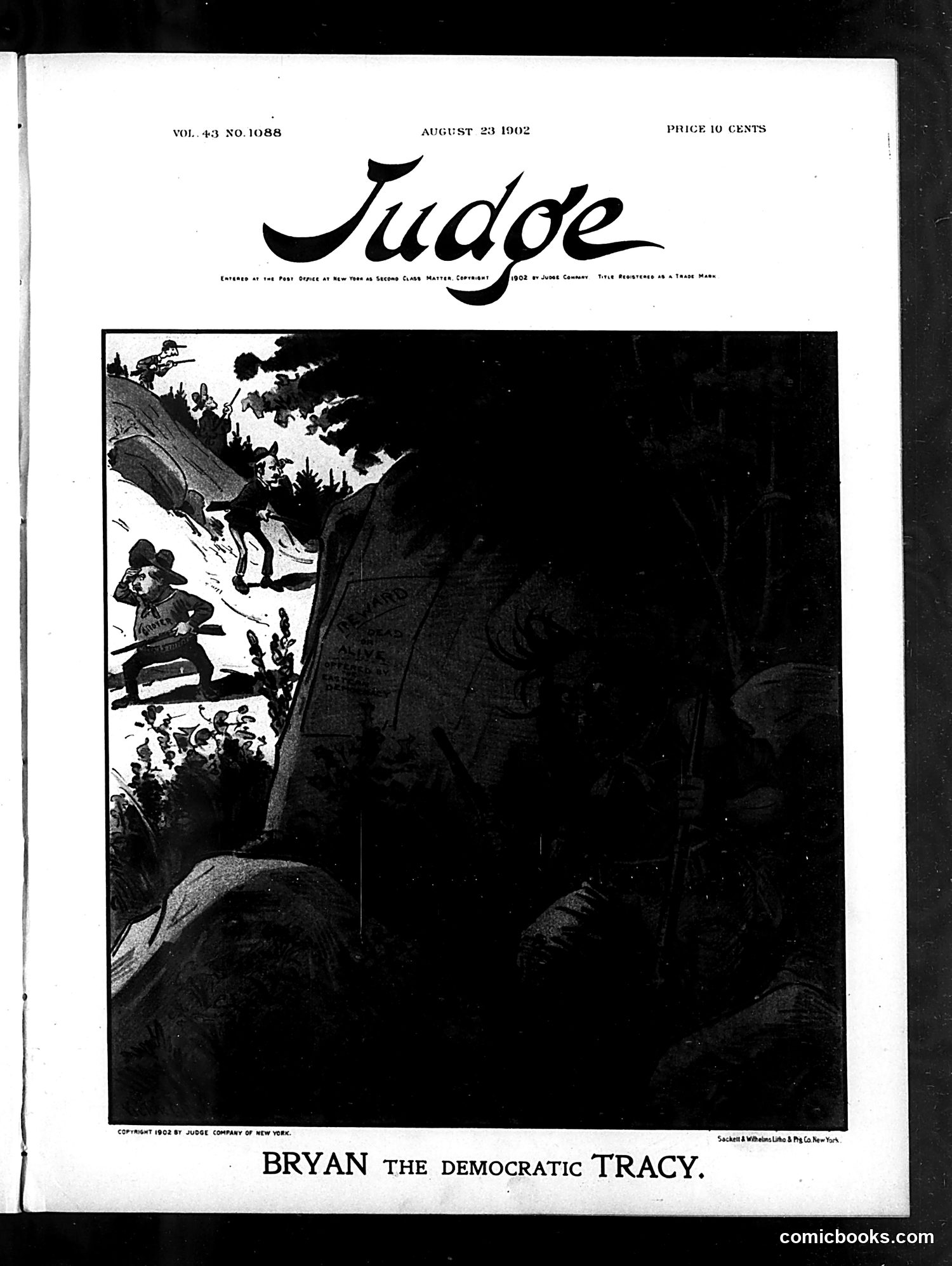
This Judge magazine cover from August 23, 1902 satirizes William Jennings Bryan, the three-time Democratic presidential candidate. The cartoon depicts Bryan as a donkey pulling a heavy cart labeled with Democratic Party baggage—likely referencing the party's internal divisions and failed electoral strategies following Bryan's losses in 1896 and 1900. The title's reference to "Tracy" appears to be wordplay, possibly alluding to Dick Tracy or another cultural figure, suggesting Bryan is being dragged along by forces beyond his control. The image shows the Democratic Party as an exhausted beast of burden, implying Bryan's leadership had become a liability rather than an asset to the party. This reflects post-election frustration with Bryan's continued prominence.
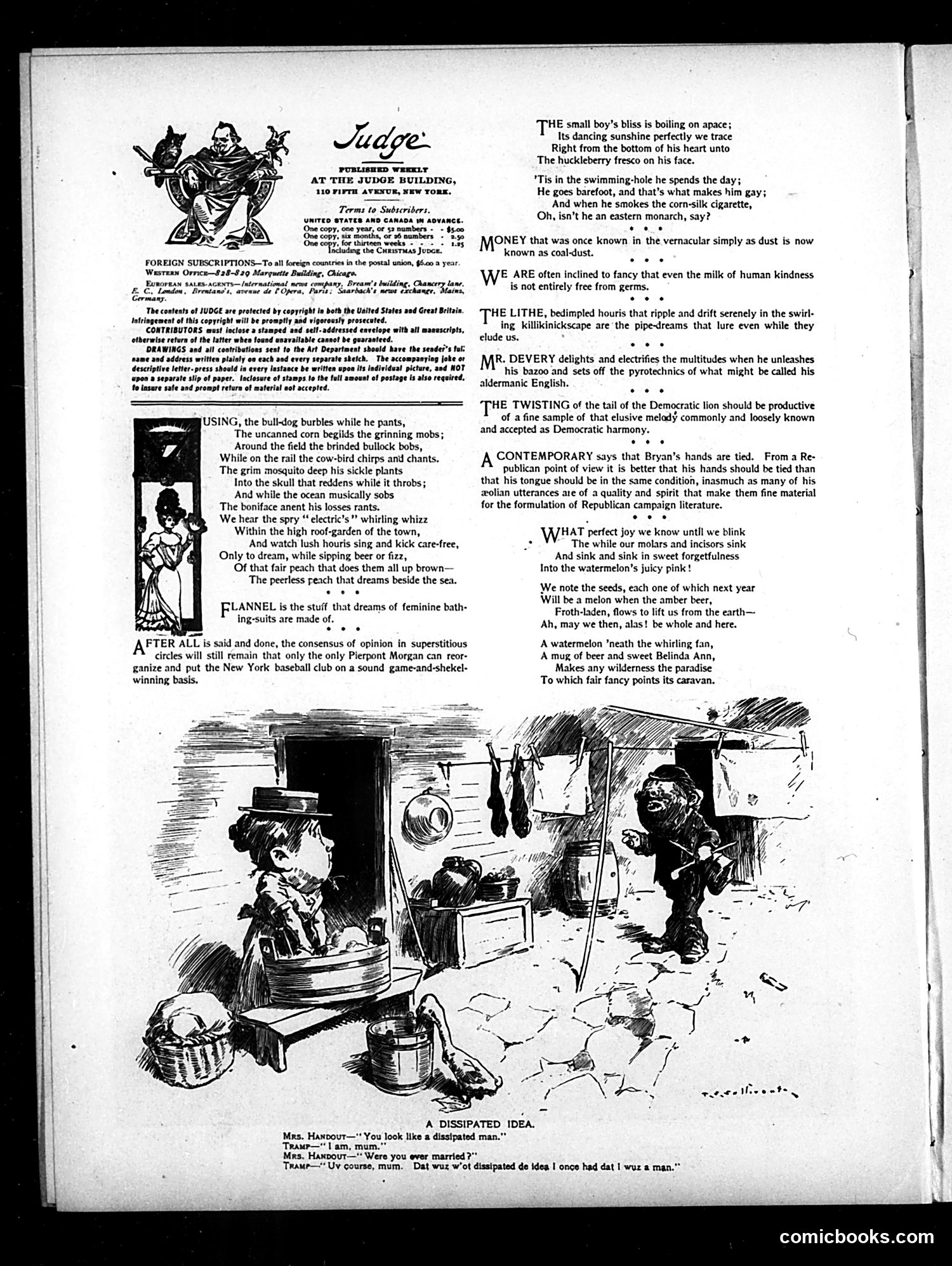
This page contains satirical commentary and a cartoon titled "A Dissipated Idea." The main illustration depicts a homeless or destitute man and woman in a makeshift shelter, illustrating urban poverty. The caption presents a dialogue: Mrs. Handout tells the man he "looks like a dissipated man." When asked if he was married, he responds that he "was a man" before marriage—implying his wife caused his degradation and loss of identity. The satire targets both poverty and marriage, using the tramp character to mock domestic life's effects on men. The accompanying editorial snippets address contemporary concerns: Bryan's politics, Republican campaign rhetoric, and social commentary on human nature and kindness. The overall theme critiques both social conditions and gender relations in turn-of-the-century America.
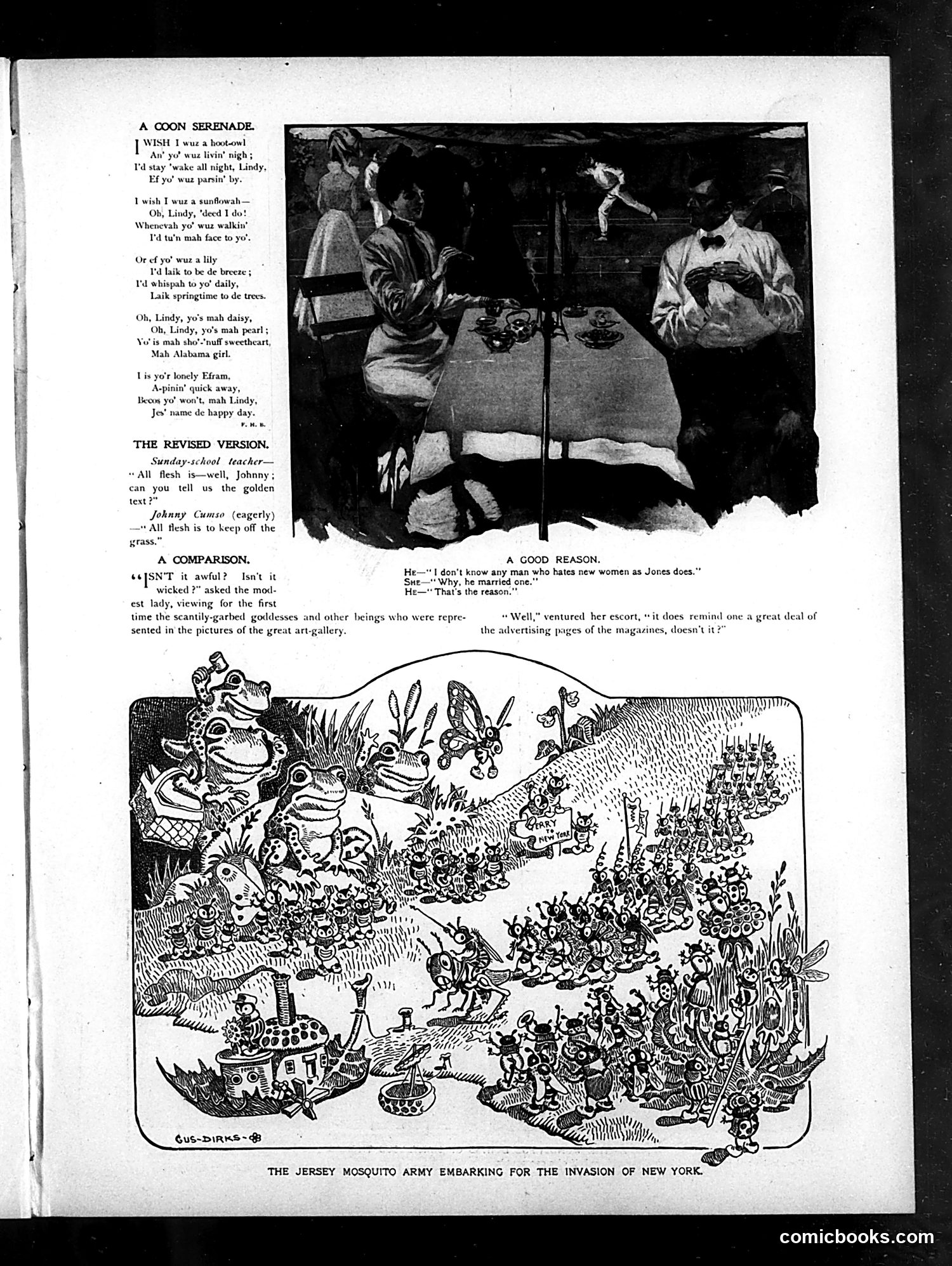
The page contains multiple sections: **"A Coon Serenade"** (top left) - A racist dialect poem, typical of early 20th-century minstrelsy content Judge regularly published. **Photograph** (top right) - Shows what appears to be a theatrical or social scene. **"The Revised Version"** - A brief comedic exchange about biblical flesh. **"A Comparison"** and **"A Good Reason"** - Short jokes about art galleries and marriage. **Main Cartoon** (bottom) - Titled "The Jersey Mosquito Army Embarking for the Invasion of New York," this is a humorous exaggeration depicting New Jersey mosquitoes as a military force invading New York. It's satirical commentary on the notorious mosquito problem in the Jersey region during summer months—a recurring joke topic in the era. The page reflects Judge's mix of racist content, crude humor, and local satire typical of early American humor magazines.
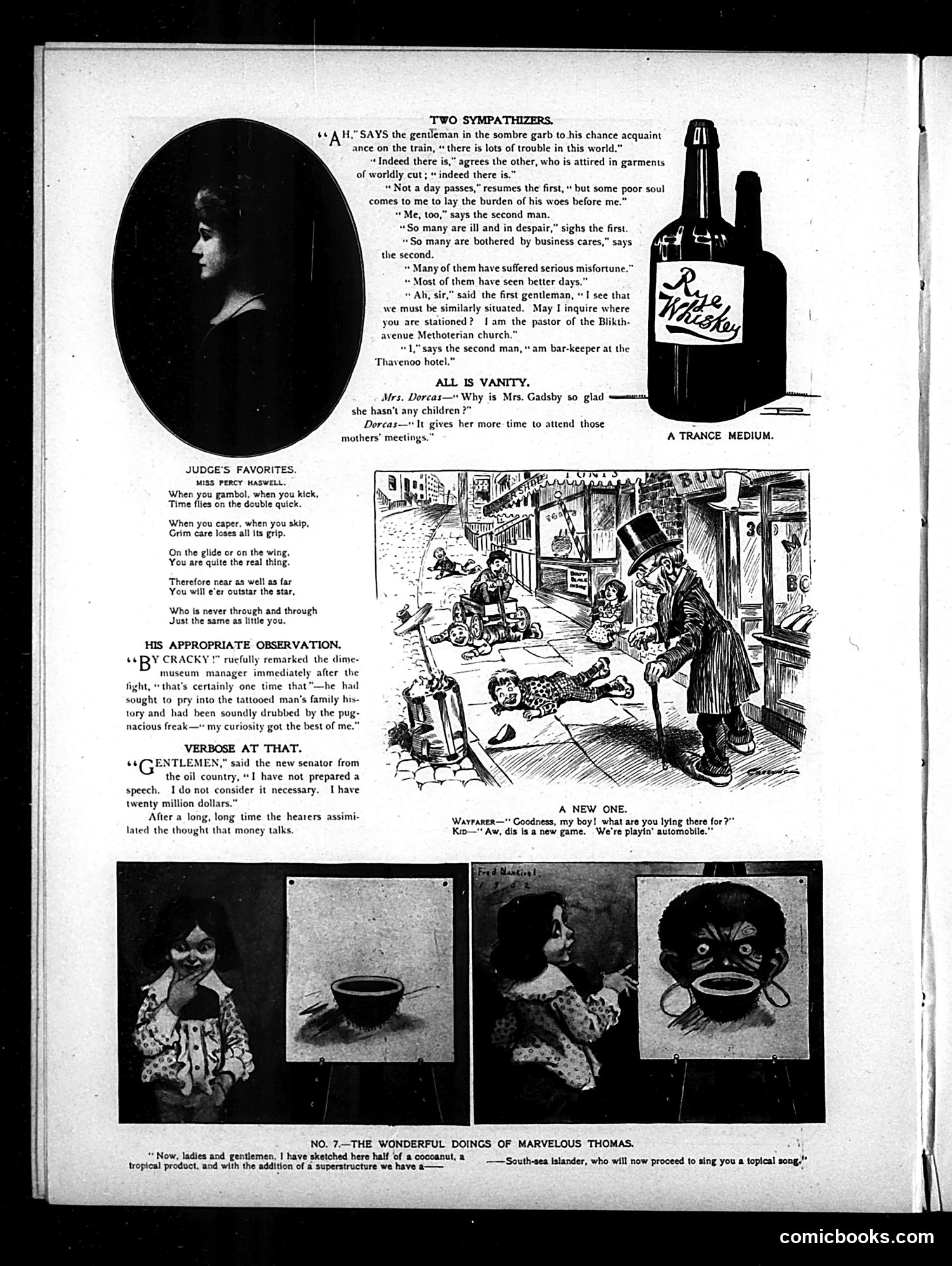
This page contains several distinct sections: **"Two Sympathizers"** presents a dialogue between two well-dressed gentlemen commiserating about life's troubles—wealth and social standing apparently don't insulate them from hardship. **"Judge's Favorites"** is a poem about Miss Percy Haswell, likely a contemporary actress or performer. **"All is Vanity"** features a brief exchange about Mrs. Gadsby avoiding motherhood to attend social meetings—satirizing upper-class women's priorities. **"A New One"** shows a street scene with children playing with toy automobiles, reflecting early-20th-century fascination with motorized vehicles replacing traditional games. **"The Wonderful Doings of Marvelous Thomas"** (bottom) appears to be a recurring comic strip featuring a performer demonstrating tricks with a coconut and "superstructure." The page mixes social satire with light humor typical of Judge's era.
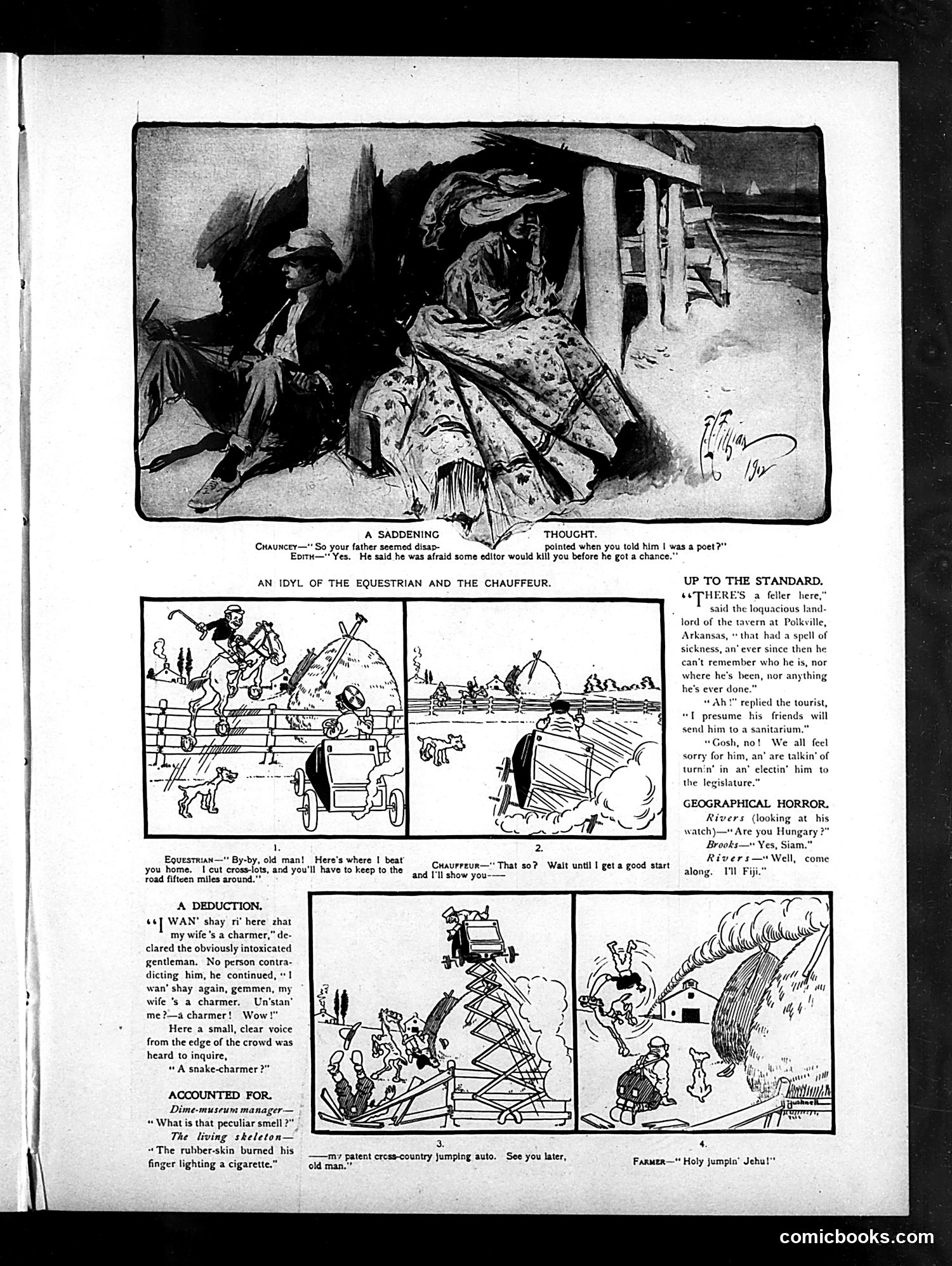
This page contains several unrelated satirical cartoons typical of early 20th-century American humor: **"A Saddening Thought"** jokes about a father's murderous response to learning his son is a poet—suggesting poets are worthless or dangerous. **"An Idyl of the Equestrian and the Chauffeur"** depicts the collision of old (horseback riding) and new (automobiles) transportation, with the chauffeur boasting he'll outpace the horseman. **"Up to the Standard"** satirizes rural politics: an amnesiac man is considered perfect candidate for elected office because he has no memory of wrongdoings—implying politicians are expected to be corrupt or incompetent. **"Geographical Horror"** is a pun: "Hungary" and "Siam" are country names, with "hungry" and "see 'em" as double meanings. **"A Deduction"** mocks a drunk man calling his wife a "charmer," only for someone to sarcastically suggest she's a "snake-charmer"—implying she's dangerous or controlling. The remaining panels involve carnival attractions and early automobiles. The humor relies on wordplay, social observation, and contemporary technology references.
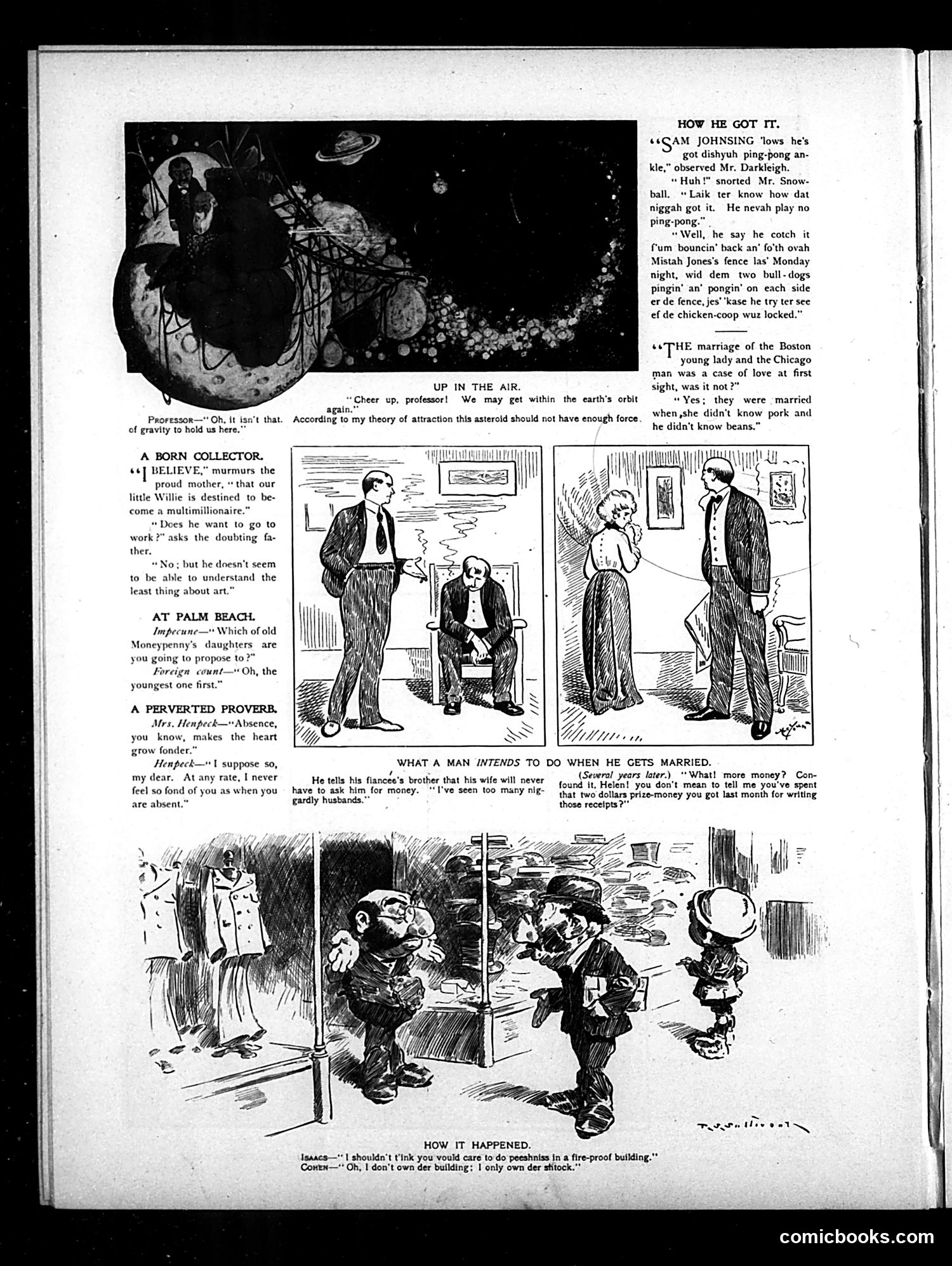
This page contains racist dialect humor typical of early 20th-century American satire. The top section mocks African American speech patterns in a story about acquiring a "ping-pong ankle" injury—the joke relies entirely on offensive stereotypes rather than wit. The middle sections offer conventional humor: a mother expects her art-ignorant son to become wealthy (satirizing nouveau-riche collecting); a foreign count pursues the youngest daughter for money; a husband admits he prefers his wife's absence. The bottom cartoon depicts Jewish characters (identifiable by names like "Isaacs" and "Cohen") in a business scheme—likely mocking Jewish merchants through the implication that owning stock in a building allows one to profit from it burning down (insurance fraud). This trades on antisemitic tropes about Jewish business dishonesty. The page reflects Judge's reliance on ethnic and racial caricature as its primary comedic vehicle, now historically significant mainly as documentation of period prejudices rather than humor.
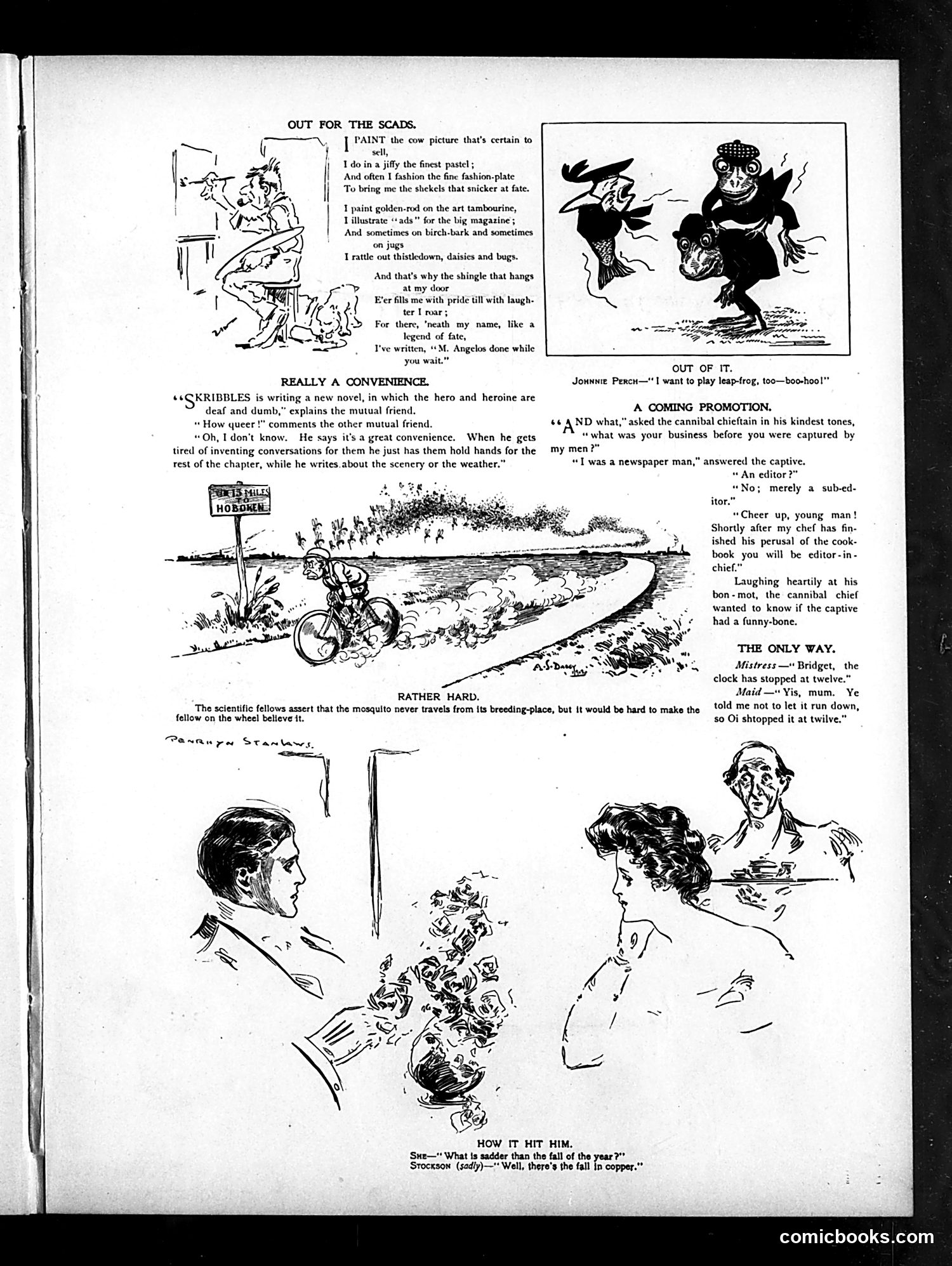
This page contains several satirical pieces typical of early 20th-century humor magazines: **"Out for the Scads"** mocks commercial artists who prioritize profit over artistic integrity, painting whatever sells—"cow pictures," fashion plates, advertisements—rather than serious art. The artist's sign reads "M. Angelos done while you wait," satirizing mass-production art. **"Really a Convenience"** jokes that a deaf-and-dumb couple in a novel is convenient for the lazy writer—he can avoid writing dialogue and just describe scenery instead. **"A Coming Promotion"** is a cannibals-and-captives joke: a captured newspaper sub-editor will become "editor-in-chief" after being eaten by the cannibal chef—dark humor about professional advancement. **"The Only Way"** plays on Irish-servant dialect: a maid stops the clock at noon to obey her mistress's order not to let it run down. **"How It Hit Him"** is a pun: copper stock prices falling is "sadder than fall" (autumn). The page emphasizes commercial success, laziness, and wordplay typical of Judge's satirical style.
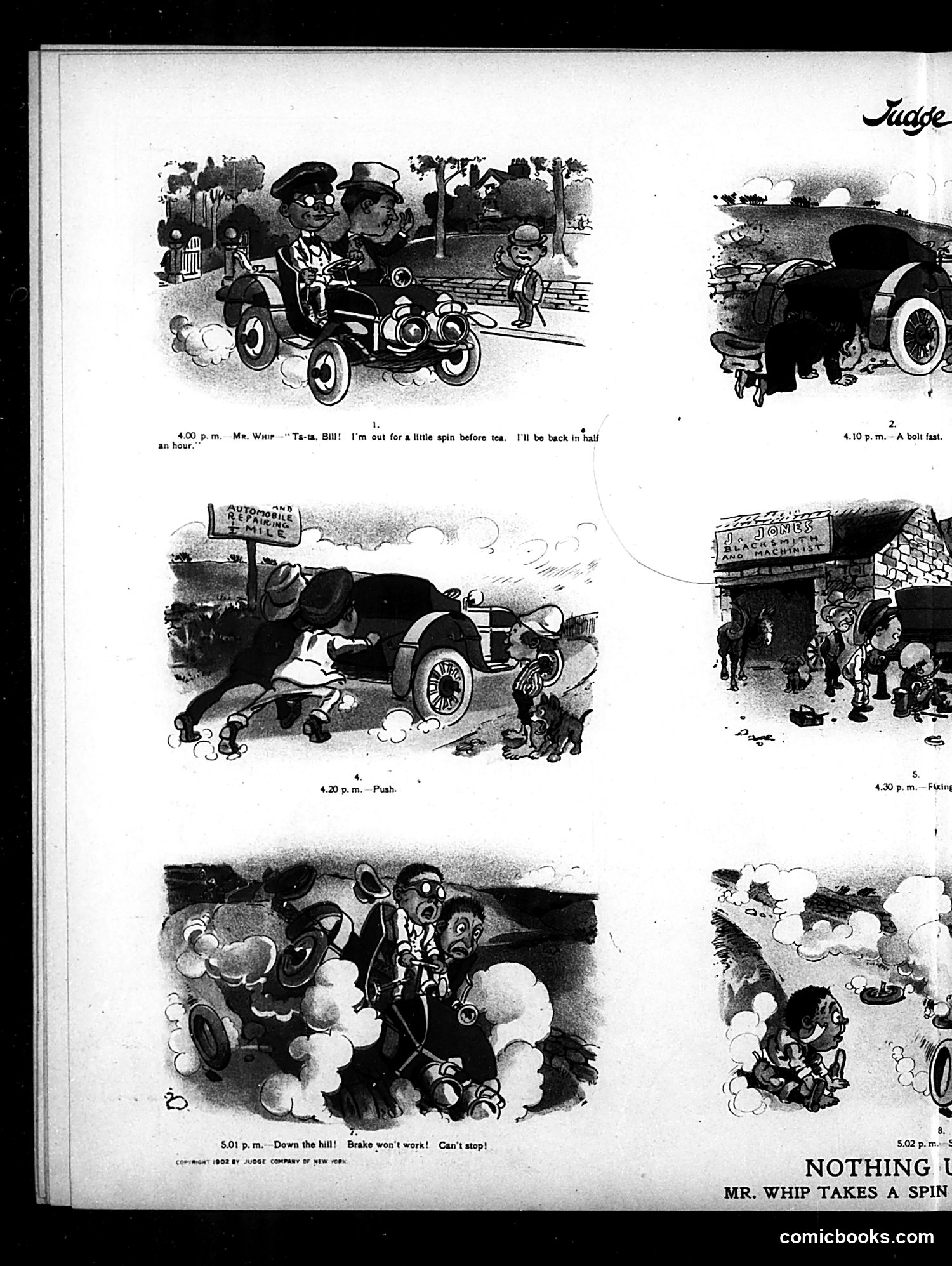
This is a sequential comic strip satirizing early automobile dangers. A gentleman named "Mr. Whip" confidently departs for a brief car ride before tea, assuring he'll return in half an hour. The subsequent panels show disaster: the brakes fail on a downhill stretch, leaving him unable to stop. The satire targets the false confidence of early motorists who treated automobiles as casual, controllable conveyances when the technology was actually dangerous and unpredictable. The contrast between his breezy departure ("I'll be back in half an hour") and the immediate mechanical failure mocks the era's optimism about automobile safety. The copyright date of 1902 places this during the early automobile boom in America, when such accidents were genuinely common and the public was still learning automobiles required serious respect.
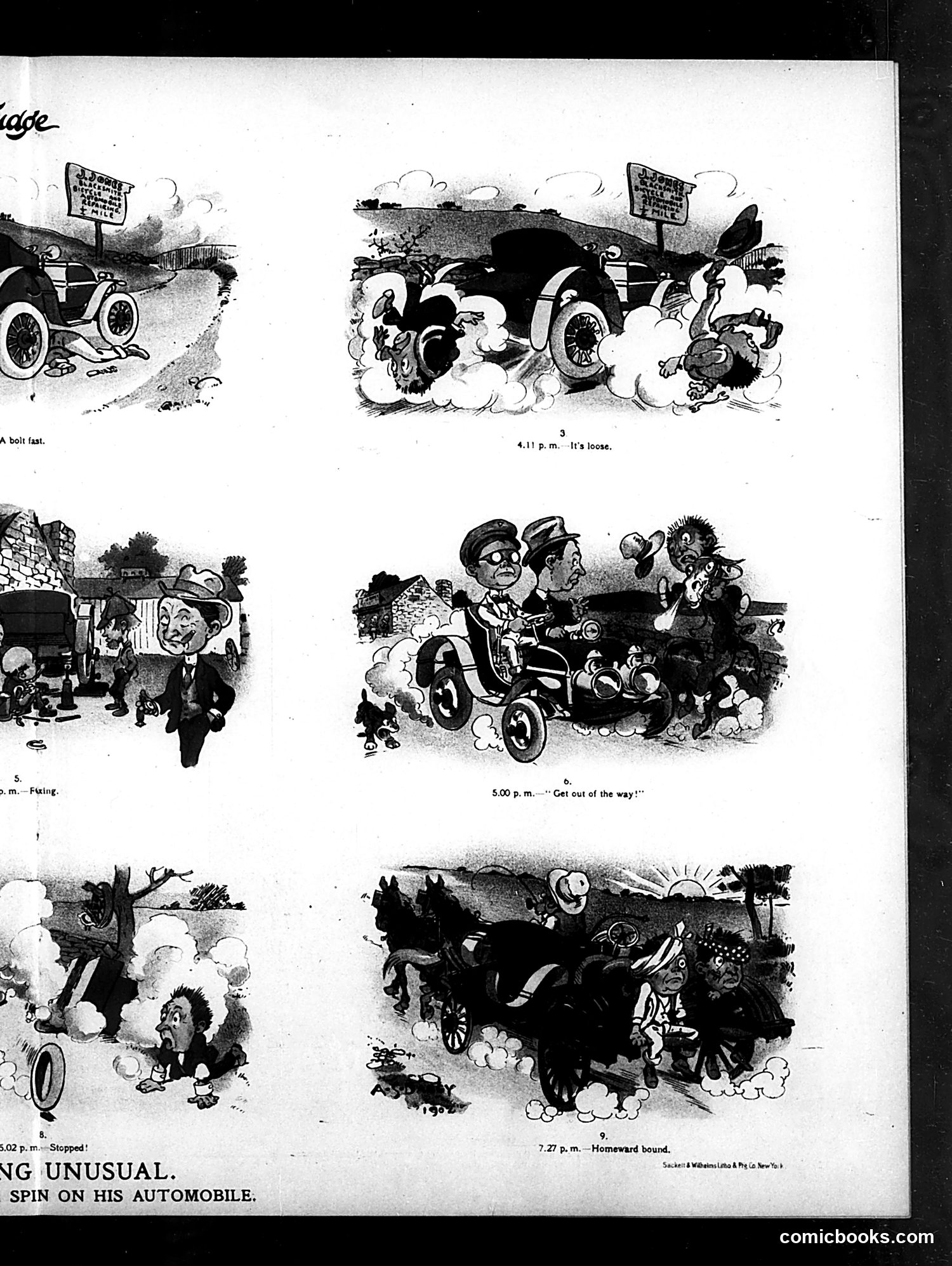
This is a sequential comic strip satirizing an automobile mishap. The narrative follows a man's car journey throughout an afternoon: **The sequence** shows: (1) a car breakdown at a roadside sign, (2) the vehicle spinning wildly out of control in clouds of dust, (3) the driver being ejected and landing among spectators, (4) a chaotic scene with multiple figures and vehicles, (5) the car's dramatic crash/flip, and (6) the driver finally returning home. **The satire targets** early-automobile culture—specifically the unreliability and danger of these newfangled vehicles. The exaggerated "spin" creates comedic chaos: the car loses control, pedestrians scatter in panic, and the journey devolves into slapstick disaster before the exhausted driver limps homeward. This reflects genuine public anxiety about automobiles' unpredictability and safety hazards during the early automotive era.
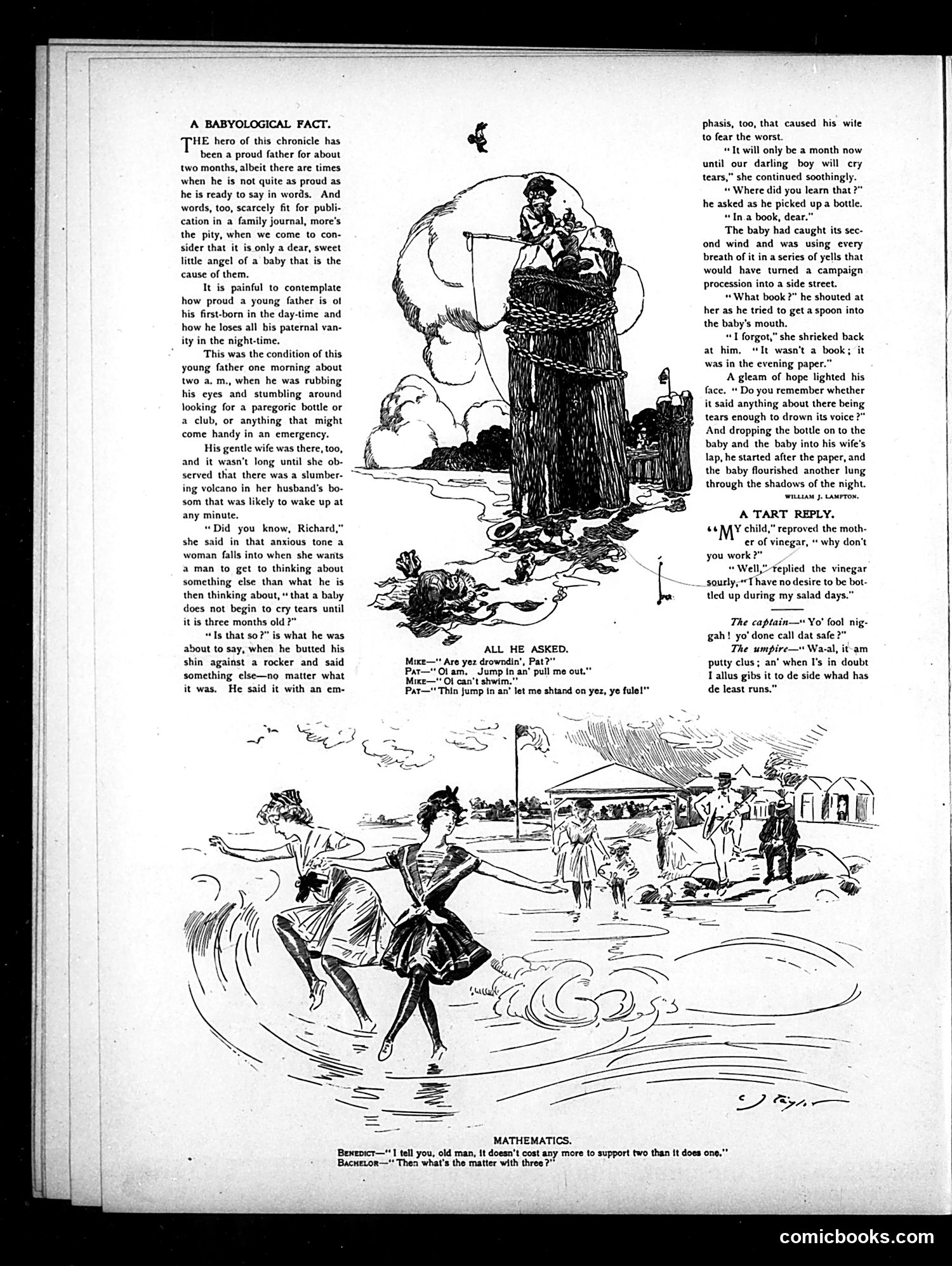
This humorous story satirizes the contrast between new fathers' public pride and private exhaustion. A proud new father, kept awake by his crying infant at 2 a.m., is desperately seeking anything—paregoric (a sedative), a club—to cope. His wife attempts to distract him with trivial baby facts from "the evening paper," hoping to prevent an angry outburst. The joke targets the gap between sentimental fatherhood ideals and the gritty reality of sleep deprivation and frustration. The page also includes three brief joke sections: an Irish dialect joke about drowning, a pun about vinegar avoiding being "bottled up," and a mathematics joke about supporting dependents. These reflect Judge's typical early-20th-century humor mixing domestic satire with ethnic stereotyping.
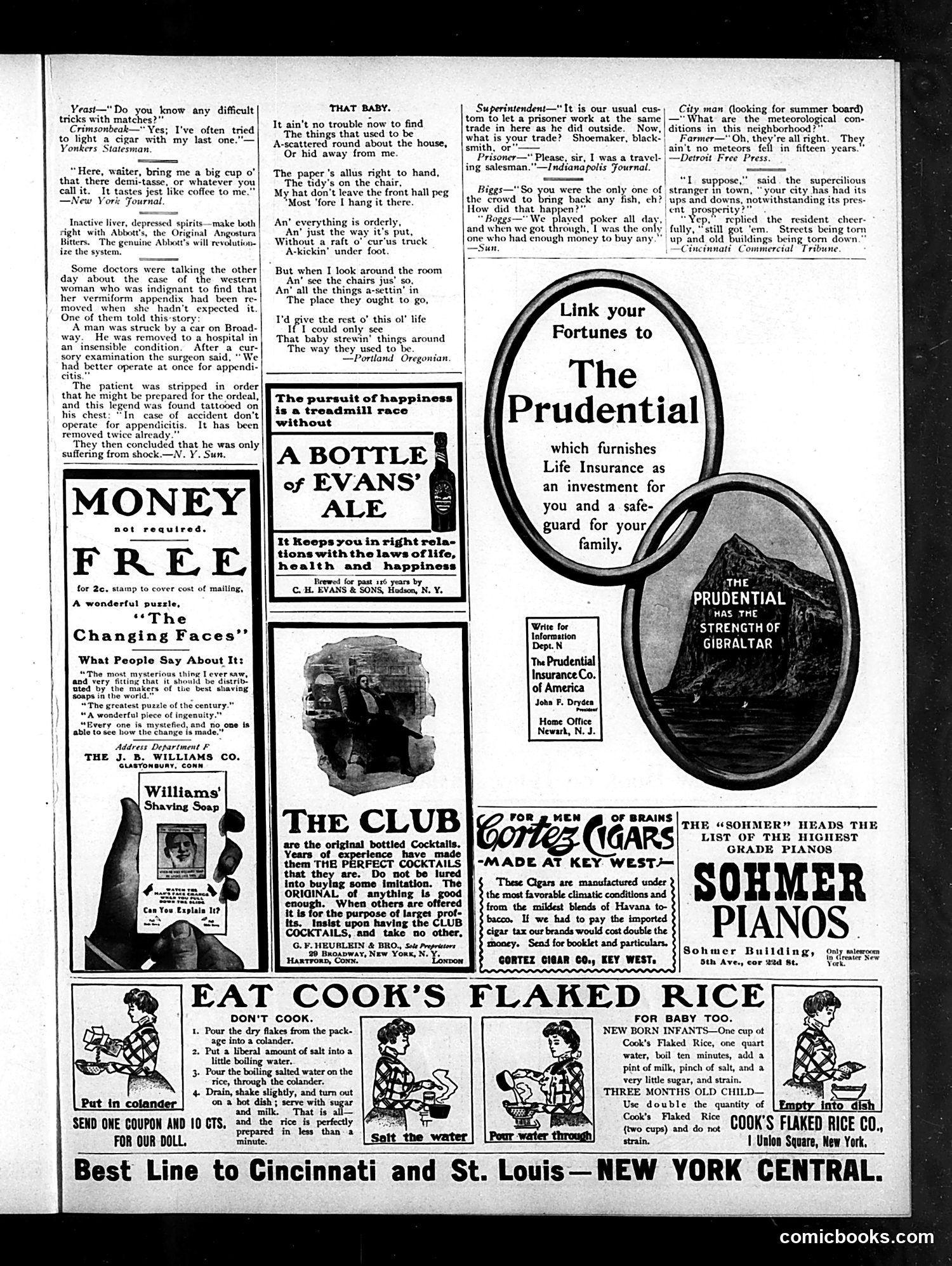
This page is primarily **advertisements and filler jokes** rather than political cartoons. The content includes: **Jokes & Humor:** - Brief one-liners about matches, demi-tasse coffee, and a surgeon who operates on a tattooed man who'd already had his appendix removed twice - A nostalgic poem about a baby creating household disorder (contrasting with the tidiness a wife has imposed) - Standard turn-of-century humor about poker, fishing, and city visitors misunderstanding rural weather **Advertisements:** - Evans Ale, Williams' Shaving Soap, Abbott's Bitters, Prudential Insurance, Cortez Cigars, Sohmer Pianos, Cook's Flaked Rice, and rail service The page lacks coherent satirical commentary on political figures or events. It's typical Judge magazine filler—light domestic humor and consumer advertising—rather than sharp social satire. No specific politicians or dated events are referenced.
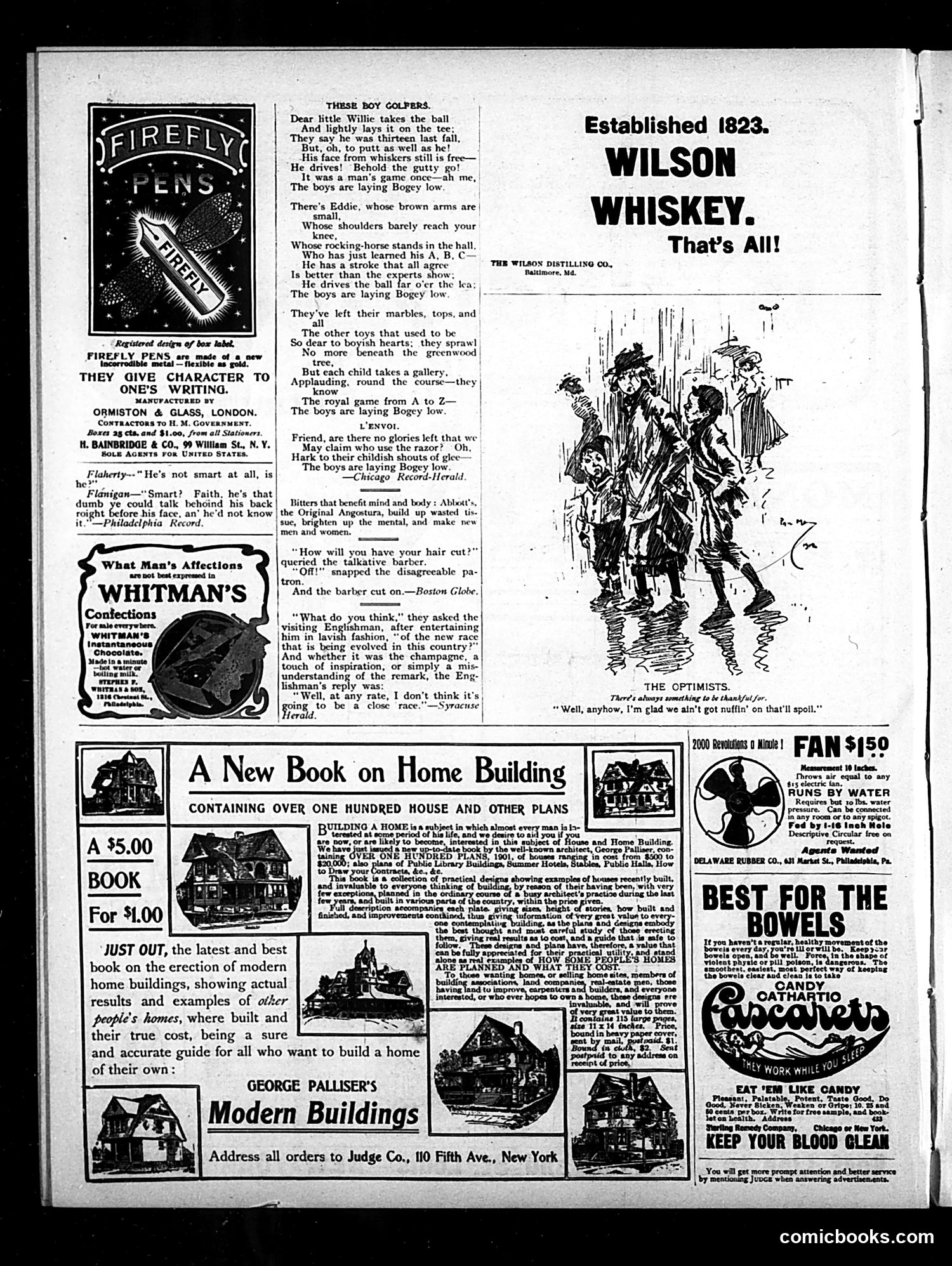
This page primarily features **advertisements and light verse** rather than political satire. The main content includes: **"These Boy Golfers"** — A poem lamenting that young boys have abandoned traditional childhood toys (marbles, tops) to play golf, a game formerly reserved for men. The repeated refrain "The boys are laying Bogey low" suggests both amusement and mild concern about this shift in youth recreation. **Supporting humor pieces** mock everyday situations: a barber's curt customer, an Englishman's confused compliment about American racial development, and optimistic children finding silver linings. The page is dominated by **period advertising**: Firefly Pens, Whitman's Chocolates, a home-building book, Wilson Whiskey, a water-powered fan, and bowel remedies—typical of Judge's revenue model. The "boy golfers" verse reflects turn-of-the-century anxiety about childhood changing as golf became increasingly popular among the middle class, though the tone is more nostalgic than genuinely critical.
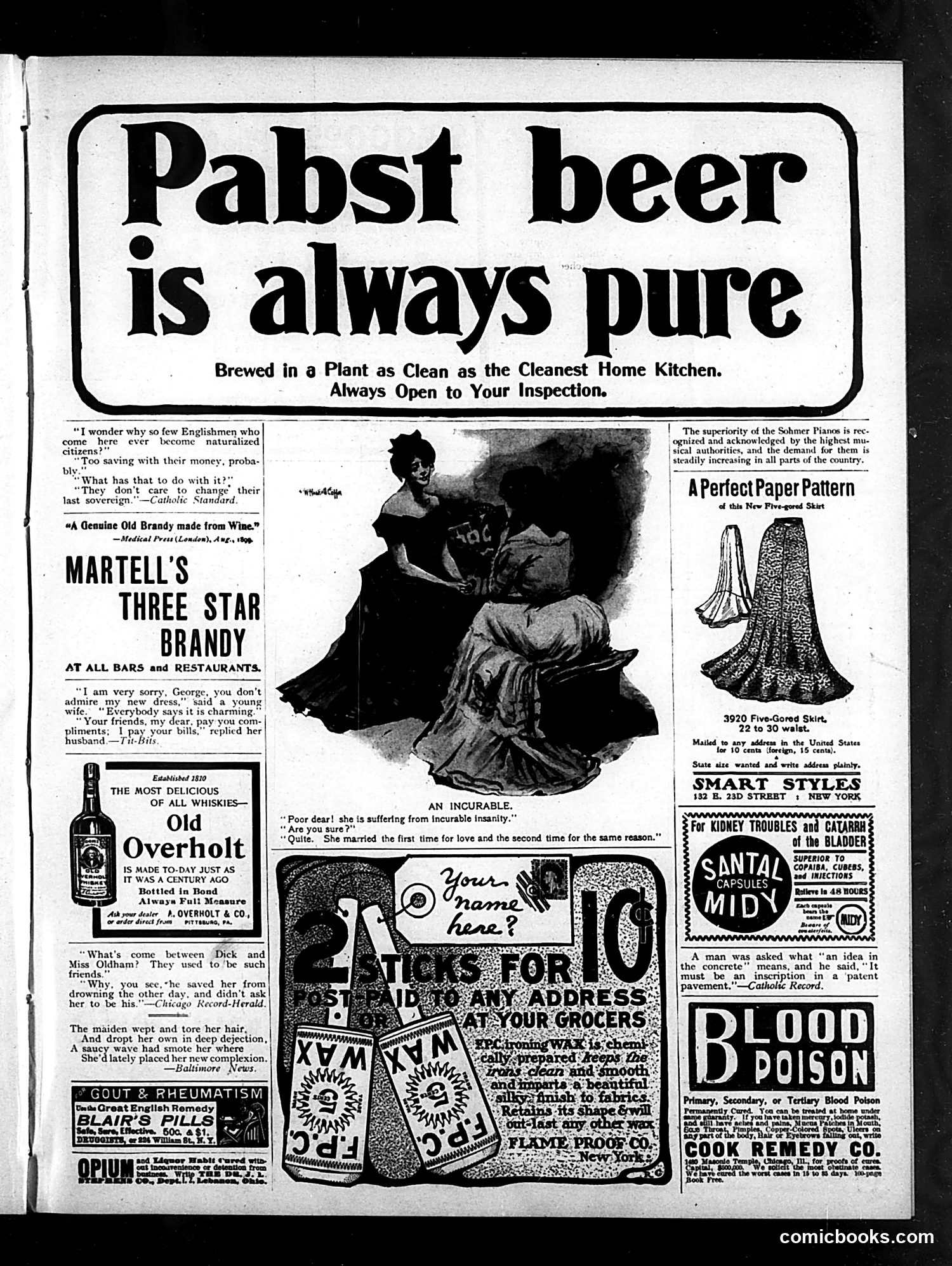
This page is primarily **advertising**, with small joke snippets interspersed. The main content includes: **Central Advertisement**: A large "Kymm" wax product ad featuring illustrated product boxes, appealing to housewives with claims about cleaning and polishing floors. **Satirical Jokes**: Several brief humor pieces mock marriage and gender relations—typical of Judge's social commentary. One jokes that an Englishman won't become a citizen because he won't part with money ("sovereign"). Another presents a woman's remarriage for love twice as "incurable insanity." **Period Products Advertised**: Pabst beer (emphasizing factory cleanliness), Martell's brandy, Old Overholt whiskey, and patent medicines (Santal capsules for urinary/bladder issues, "Blood Poison" remedy, gout pills, opium-based medicines)—reflecting early 1900s medical advertising standards now considered dangerous. **Fashion**: A paper pattern for a five-gored skirt demonstrates typical women's sewing content. The page reflects early-20th-century attitudes toward gender, marriage skepticism, and unregulated medical claims.
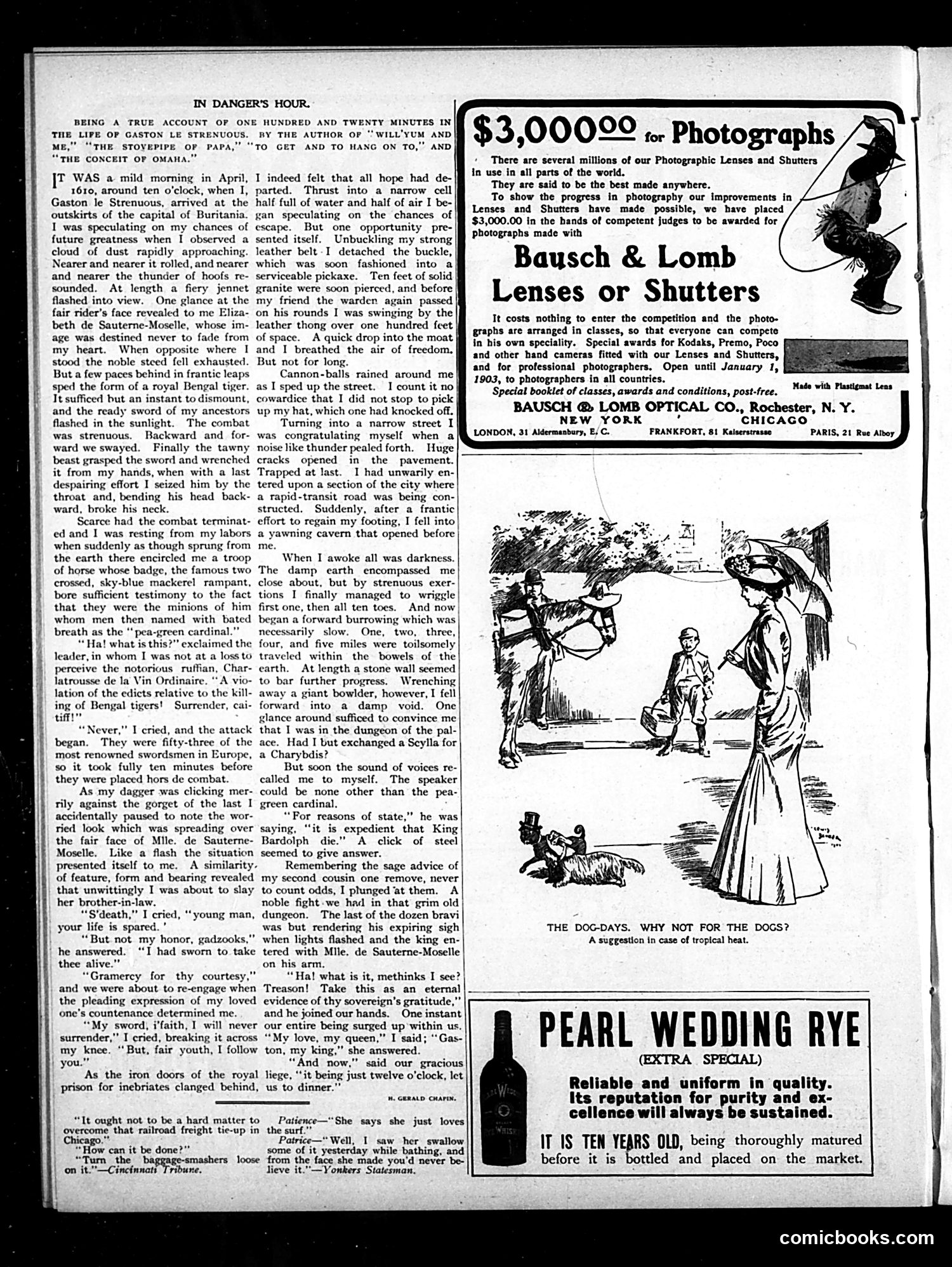
This page satirizes President Theodore Roosevelt's famous persona as an action hero and man of relentless vigor. "Gaston le Strenuous" is a transparent parody—"strenuous" directly references Roosevelt's "strenuous life" philosophy. The serialized adventure story mocks Roosevelt's tendency to insert himself into dramatic situations and his reputation for hyperbolic storytelling. The absurd plot—single-handedly defeating a Bengal tiger, then 53 swordsmen, then escaping from prison—exaggerates Roosevelt's actual big-game hunting and adventurous exploits into comic fantasy. The references to "pea-green cardinal" and French settings parody Roosevelt's romanticized view of heroism and adventure. The overall joke is that Roosevelt's public image had become so outsized and self-promotional that it could only be adequately satirized through increasingly ridiculous melodrama. The page also contains unrelated advertisements, typical for Judge magazine.
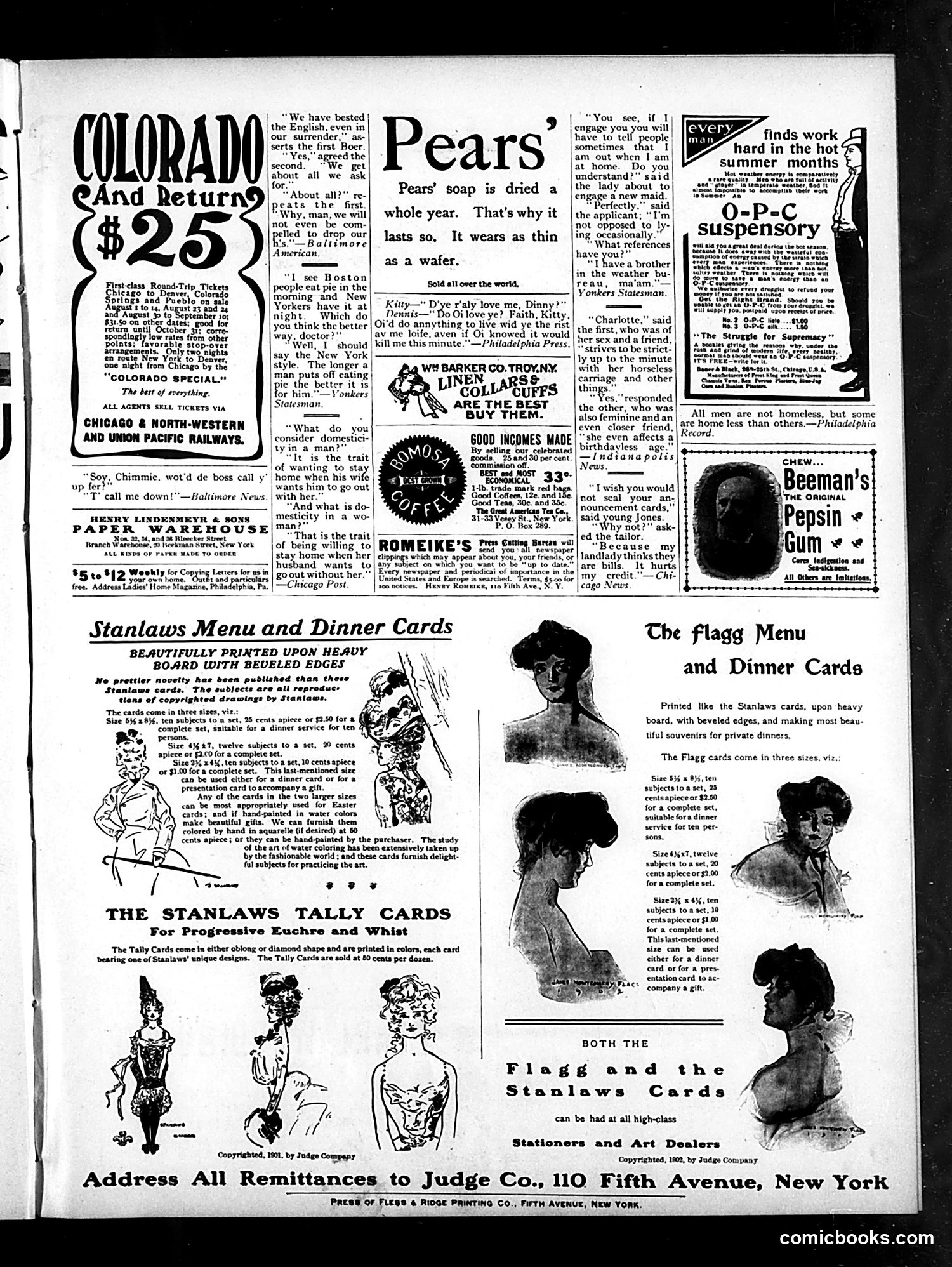
This is primarily an **advertising and content page** from Judge magazine, not a political cartoon. The page contains mostly product advertisements and notices with minimal satire. The notable content includes: 1. **Colorado Tourism Ad** ($25 round-trip tickets) - a straightforward travel promotion, not satirical 2. **Small dialogue vignettes** scattered throughout - brief, mild comedic exchanges about courtship and domestic life (e.g., an Irish couple's romantic banter, discussions of domesticity between spouses). These are sentimental rather than satirical. 3. **Pears' Soap Advertisement** - a standard product pitch emphasizing durability 4. **Multiple product ads** - including Beeman's Pepsin Gum, paper warehouse services, and printing services 5. **Stanlaws Menu and Dinner Cards** - decorative product advertisements with illustrated designs The page represents **typical Judge magazine filler content**: light humor, advertising revenue, and product promotions rather than pointed political or social satire. The dialogues are gentle domestic humor aimed at a general audience, with no clear satirical targets or controversial references visible.
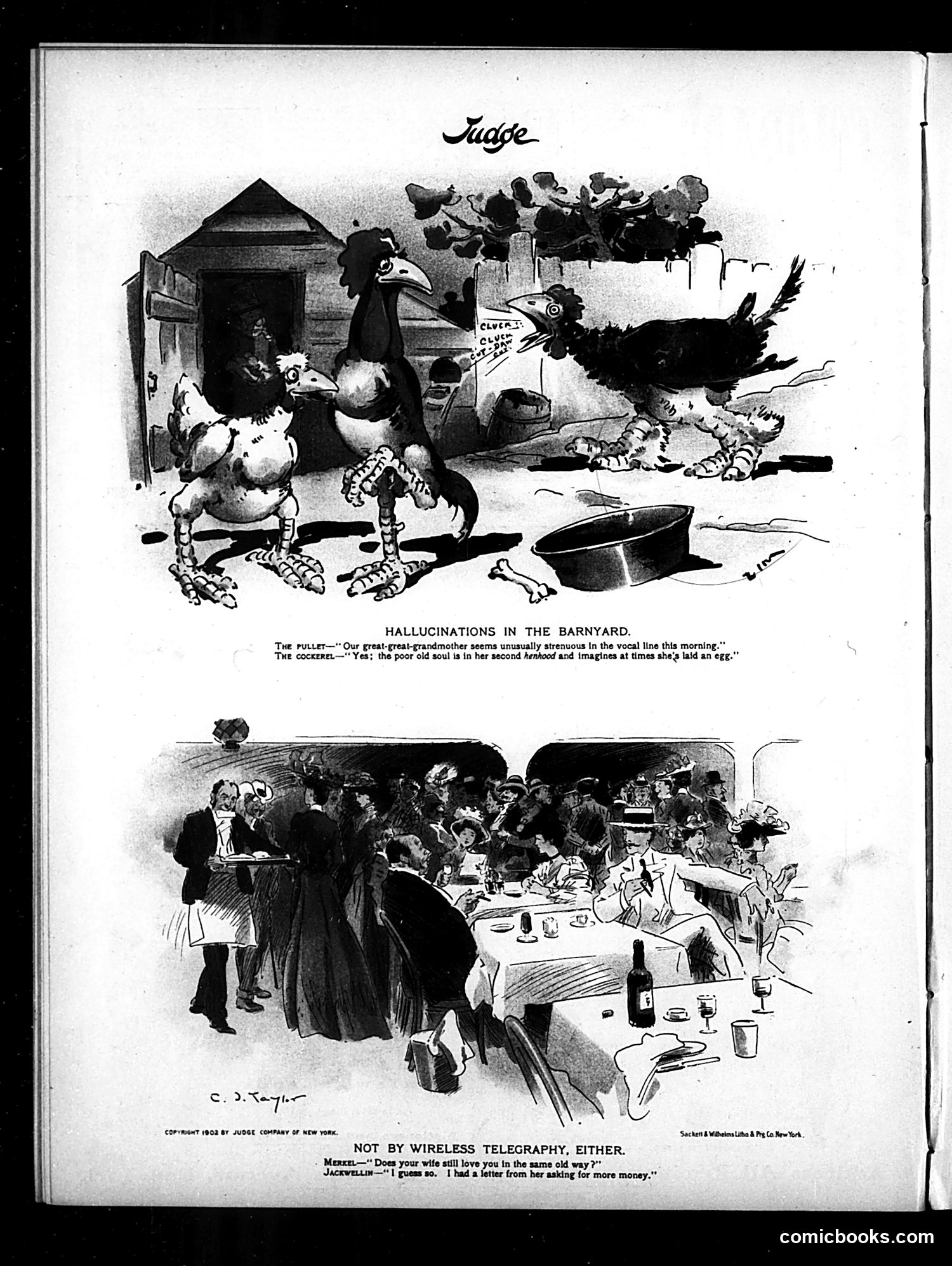
This page contains two unrelated satirical cartoons: **Top cartoon ("Hallucinations in the Barnyard"):** A hen appears delusional, imagining she has laid an egg despite her advanced age. The rooster and other barnyard fowl react to her delusions. The satire mocks elderly women or aging in general—suggesting an older female figure behaves irrationally, claiming accomplishments beyond her years. **Bottom cartoon ("Not by Wireless Telegraphy, Either"):** A husband and wife discuss their relationship. When asked if his wife still loves him "in the same old way," the husband replies she sent a letter demanding more money. The joke satirizes modern marriage, suggesting wives' love is transactional—measured by financial demands rather than genuine affection. The "wireless telegraphy" reference (newly invented technology in 1902) appears to mock the husband's naive belief in direct marital communication. Both cartoons use animal/domestic scenarios to mock contemporary social relationships—aging, matrimony, and women's motivations.