
A complete issue · 16 pages · 1902
Judge — July 12, 1902
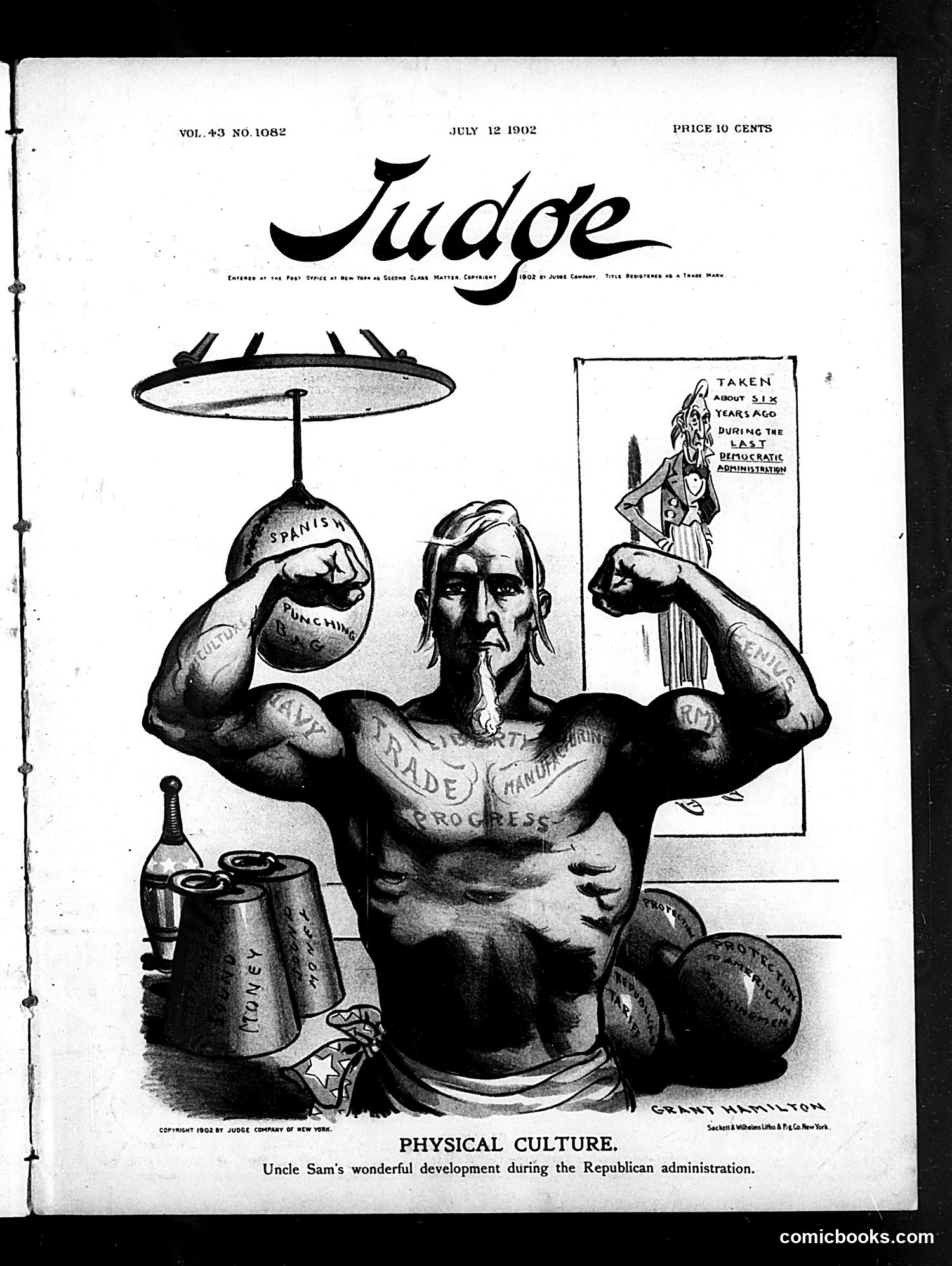
This July 12, 1902 Judge magazine cover satirizes Uncle Sam's physical development "during the Republican administration." The muscular figure represents America, flexing industrial and military strength through labeled achievements on his arms and torso. The inset box references events "taken about six years ago during the last Democratic administration," contrasting past weakness with present Republican vigor. Items at his feet—including what appears to be industrial/commercial goods and a wine bottle—suggest material prosperity. The satire praises Republican policies (likely President Theodore Roosevelt's) for strengthening American economic and military power. The "Spanish Punching Bag" label on one arm likely references the 1898 Spanish-American War, portrayed as evidence of American military prowess under Republican leadership.
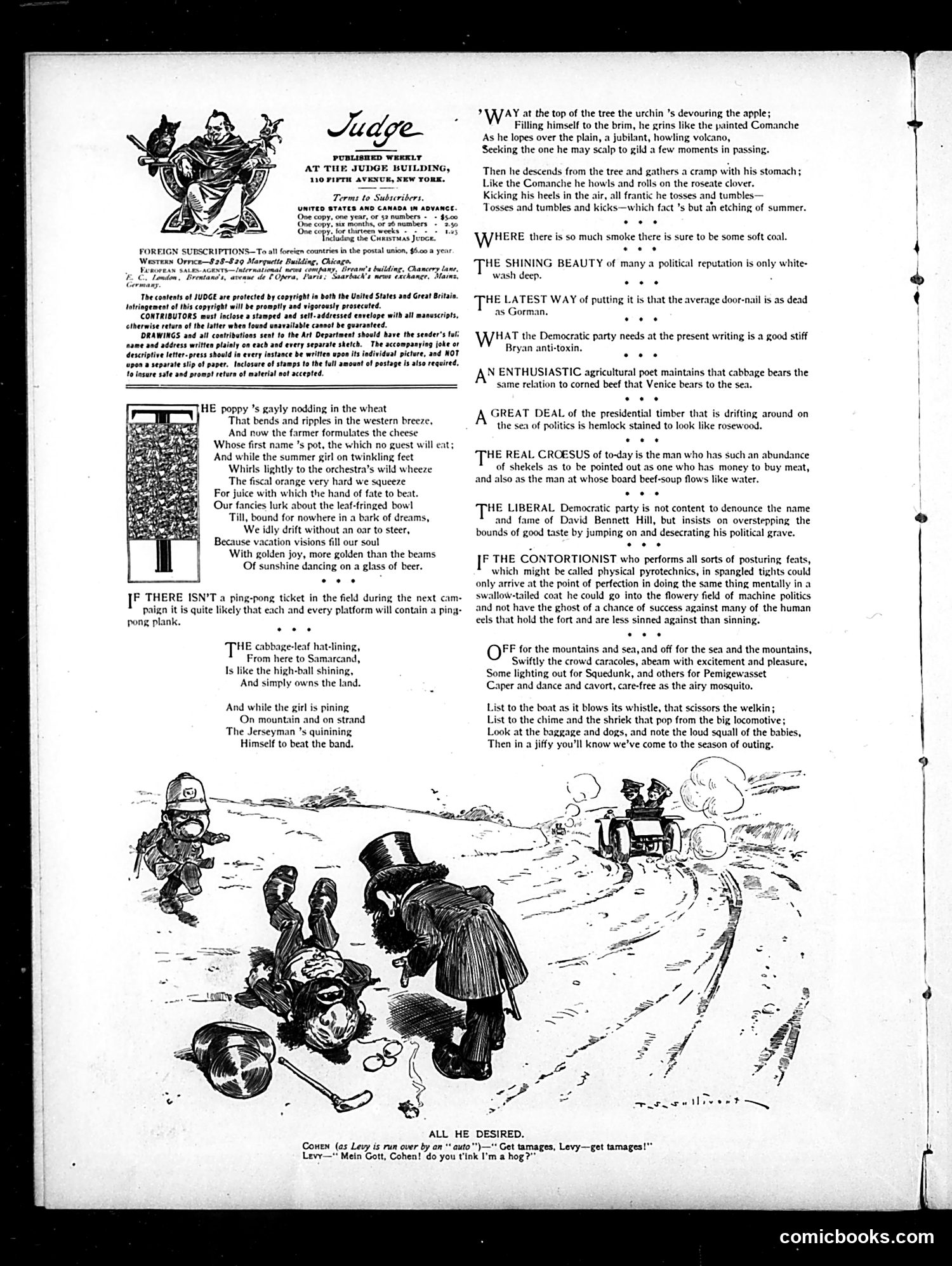
This page contains satirical commentary typical of Judge magazine's editorial content. The text includes pointed jabs at contemporary politics—criticizing the Democratic party's need for "a good stiff Bryan anti-toxin" (referencing William Jennings Bryan), mocking a "presidential timber" candidate "drifting around on the sea of politics," and attacking "the Liberal Democratic party" under David Bennett Hill for lacking taste. The bottom cartoon, titled "ALL HE DESIRED," appears to show political figures in a scramble or undignified situation, with dialogue about "damages" and someone being "a hog"—suggesting political corruption or self-interested behavior among office-seekers. The specific figures and events remain unclear without additional historical context, but the satire targets Democratic Party leadership and political opportunism of the period.
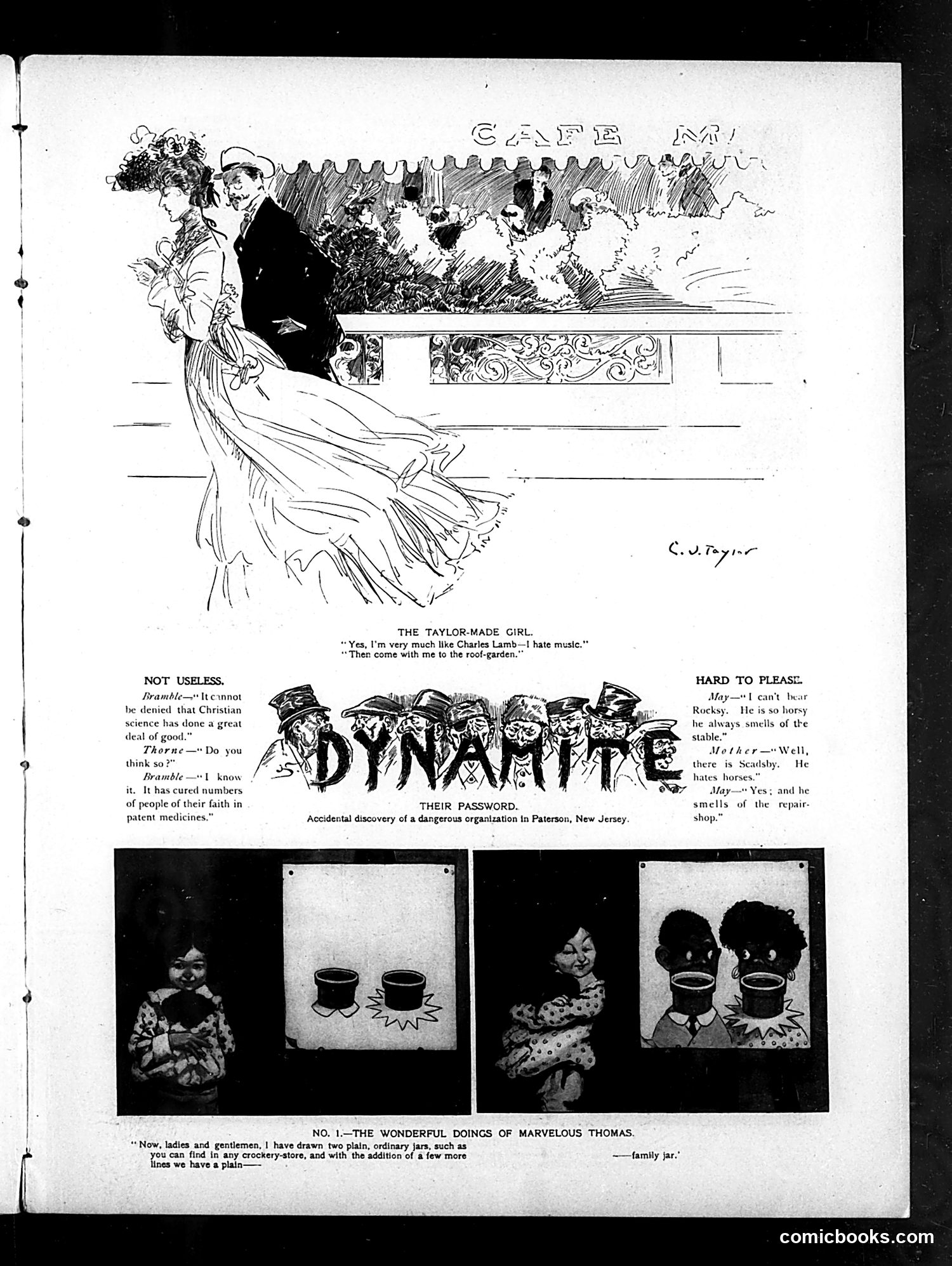
This page from *Judge* magazine contains three satirical pieces: 1. **"Café Arti"** (top): A sketch by C.J. Taylor depicting fashionable café society, likely mocking upper-class pretension. 2. **"Dynamite: Their Password"** (center): Political cartoon titled "Accidental discovery of a dangerous organization in Paterson, New Jersey." This references anarchist or radical labor movements—Paterson was a center of textile labor unrest. The crude caricatured faces and "dynamite" imagery reflect contemporary anti-radical hysteria and xenophobic stereotyping common in early 20th-century American satire. 3. **"The Wonderful Doings of Marvelous Thomas"** (bottom): A humorous instructional sequence about creating "family jars" from household items—apparently a parody of DIY or home improvement trends. The page reflects *Judge*'s characteristic blend of social commentary, xenophobia, and domestic humor typical of the era.
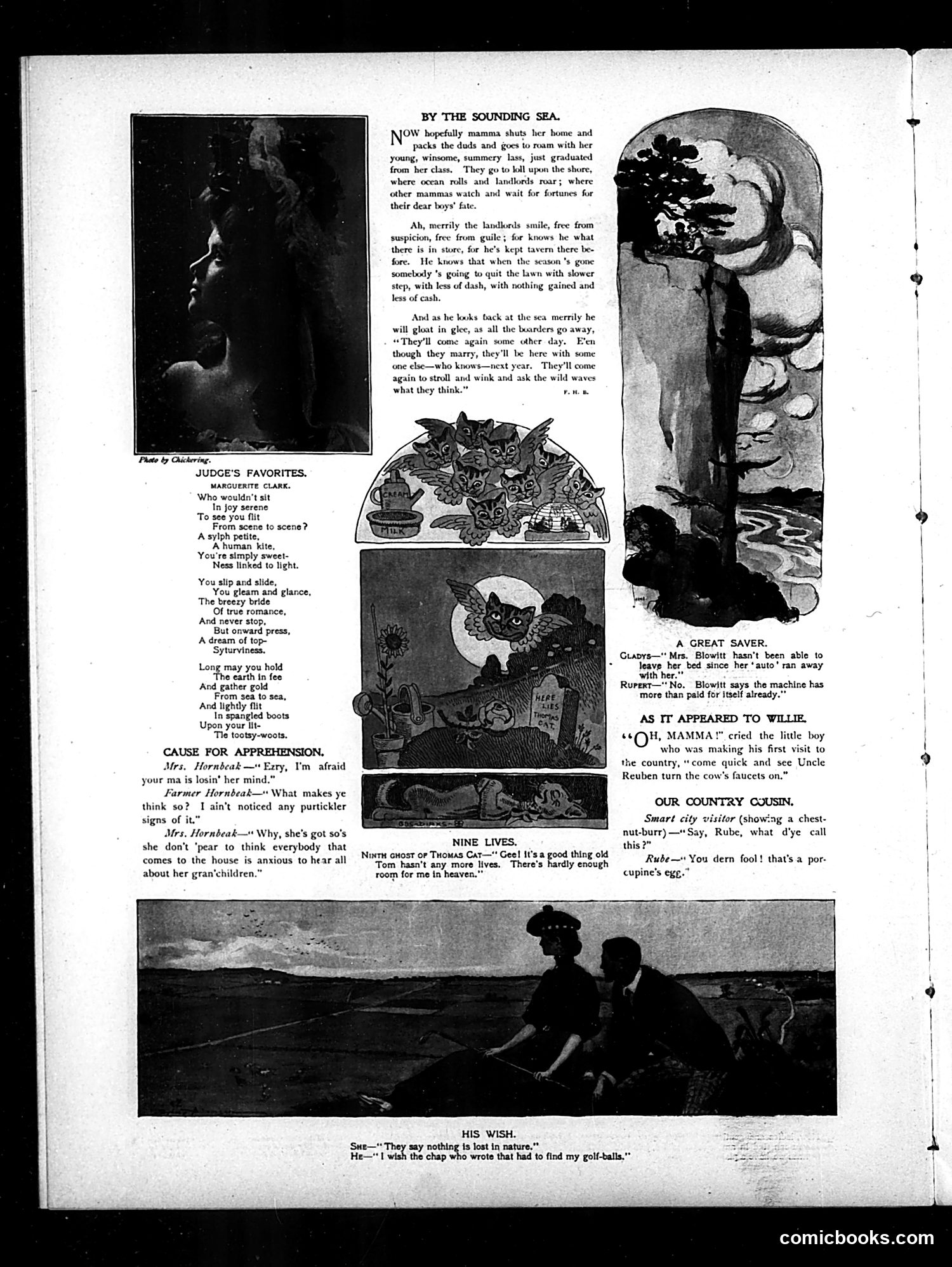
This page contains several distinct satirical pieces rather than a unified political cartoon. The main content includes: 1. **"By the Sounding Sea"** - A narrative poem about working-class mothers and their sons, touching on themes of manual labor and economic hardship. 2. **"Judge's Favorites"** - A poem by Marguerite Clark celebrating aesthetic pleasures. 3. **"Cause and Digression"** - A brief dialogue satirizing rural superstitions about omens and portents. 4. **"Nine Lives"** - A humorous cat illustration. 5. **"As It Appeared to Willie"** - A short anecdote about a child's country visit. 6. **"Our Country Cousin"** - Dialogue mocking rural dialect and sophistication. The page appears to mix sentimental working-class commentary with gentle mockery of rural/provincial life—typical Judge magazine fare combining social observation with light humor.
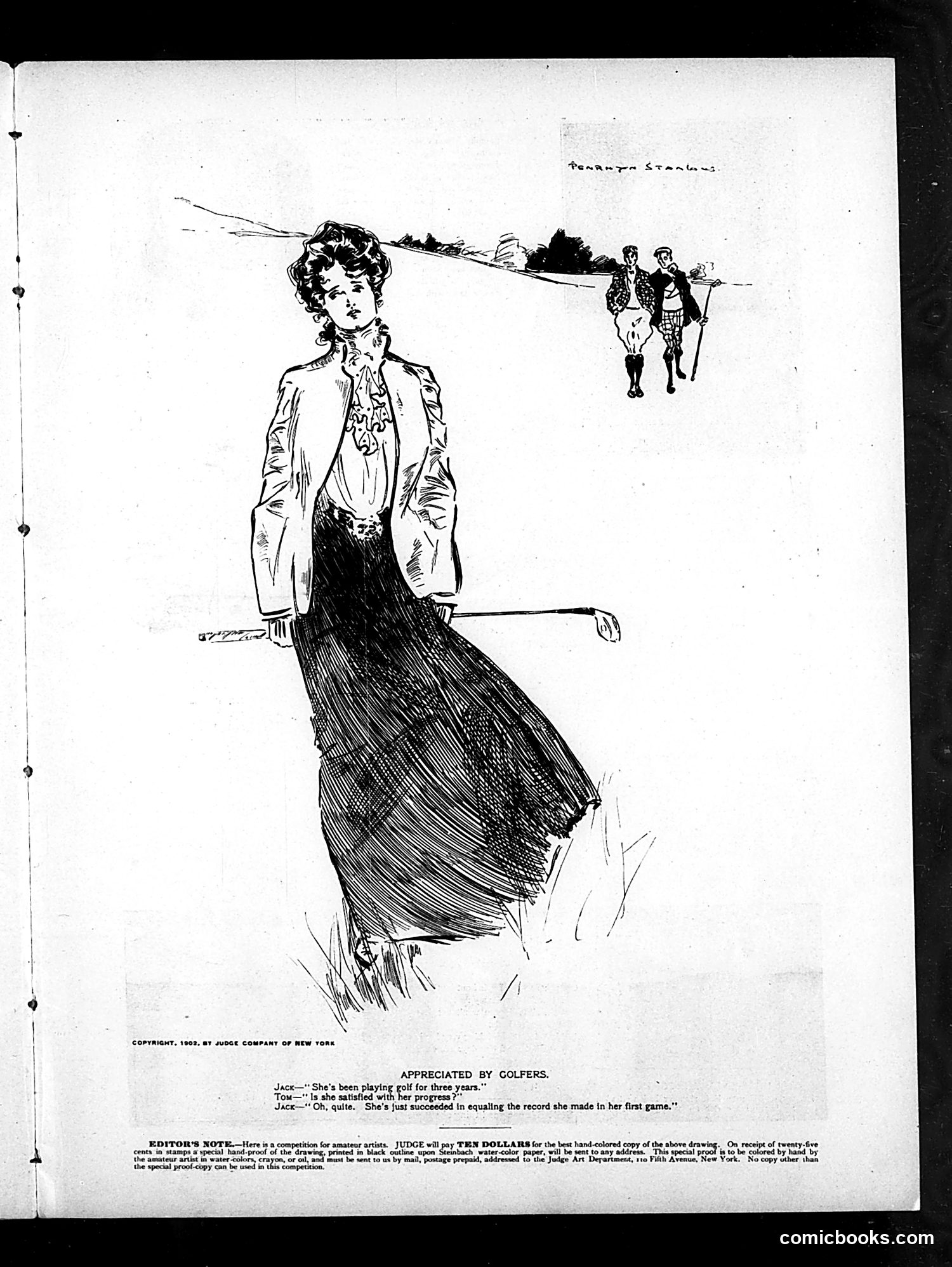
This is a satirical cartoon mocking women's golf performance. The joke suggests that a female golfer has made no improvement whatsoever over three years of play—she's merely matched her original terrible score, which the characters treat as a comedic "success." The cartoon reflects early 20th-century gender stereotypes portraying women as athletically incompetent. The elegantly-dressed woman holding a golf club is presented as the butt of the joke: her complete lack of progress is treated as amusing rather than frustrating. The dialogue implies that simply *maintaining* poor performance counts as an achievement worthy of satisfaction. This represents the condescending attitude toward women's participation in sports during this era, before women's golf became competitive and respected.
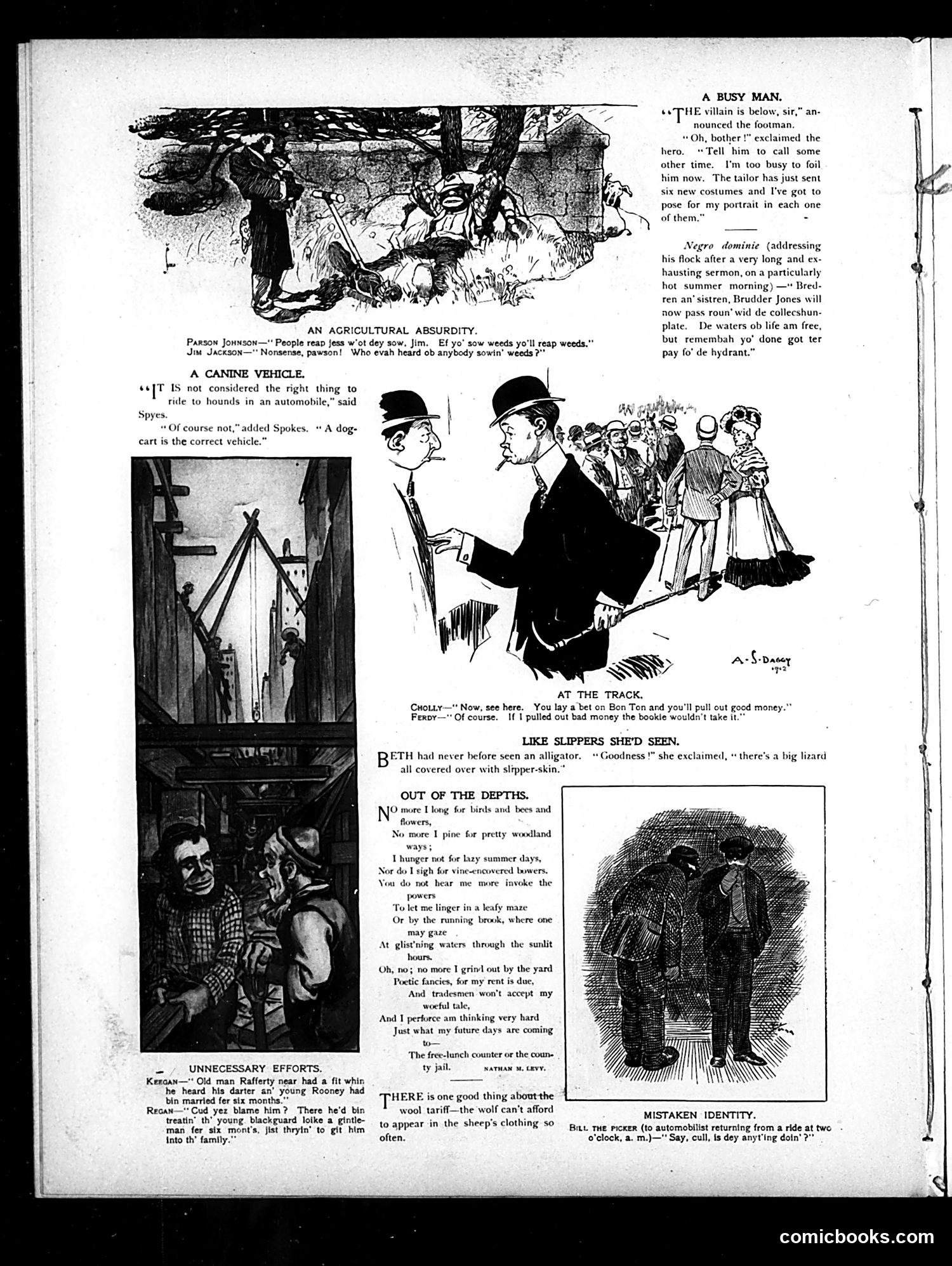
This page contains multiple satirical cartoons mocking various social types and situations circa early 1900s: **"A Busy Man"** ridicules vanity—a supposedly heroic gentleman is too preoccupied with portrait poses in new tailored costumes to confront a villain. **"An Agricultural Absurdity"** jokes about ignorance: a farmer claims nobody sows weeds, missing the obvious point about reaping what you sow. **"A Canine Vehicle"** mocks automobile culture invading traditional fox-hunting circles—suggesting motorcars are inappropriate for sporting gentlemen. **"At the Track"** satirizes betting corruption; a racetrack hustler explains pulling out "good money" versus "bad money" to a gullible mark. **"Out of the Depths"** presents a poem mocking romantic nostalgia—a writer abandons poetic yearning for nature because rent is due and creditors demand payment, reducing him to considering soup kitchens or jail. The page reflects period anxieties about modernization, class pretension, and economic struggle among the genteel poor.
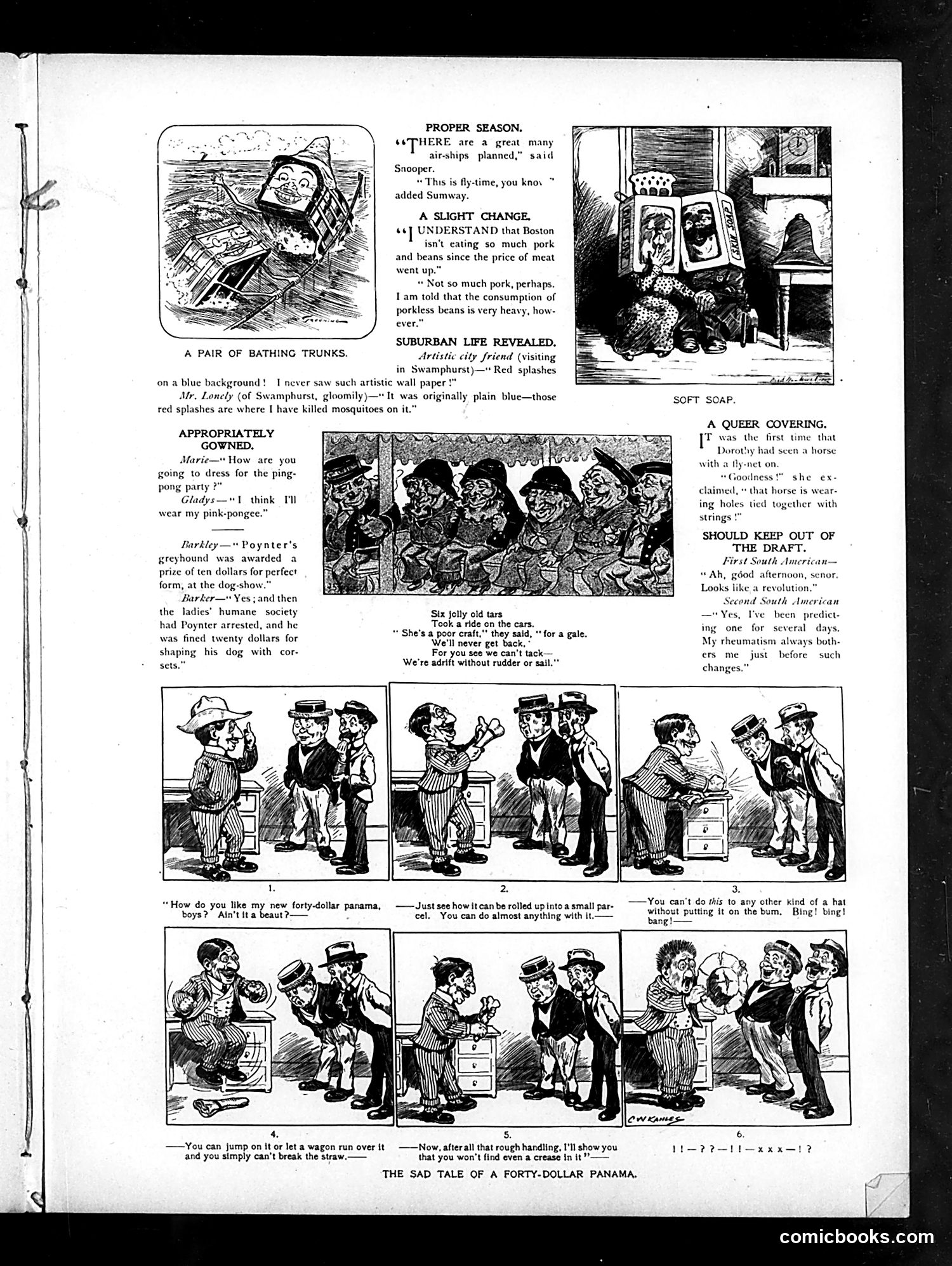
This page contains mostly brief humorous vignettes typical of Judge magazine's satirical style, plus one multi-panel comic strip. **Key content:** The "Forty-Dollar Panama" strip (bottom) satirizes consumer excess and poor value. A man buys an expensive panama hat, then his friends demonstrate its supposed durability through increasingly absurd abuse—jumping on it, running wagons over it—to "prove" its quality. The joke mocks both the inflated price and the ridiculous advertising claims used to justify it. **Supporting shorts** reference contemporary concerns: airship enthusiasm ("fly-time"), Boston's changing diet due to meat price inflation, mosquito-plagued suburban living, fashion puns ("pink-pongee"), and a horse wearing a fly-net. One brief joke references South American political instability ("Looks like a revolution"). Overall, this reflects early 1900s American preoccupations with new technology, inflation, advertising hype, and suburban life—delivered through visual puns and situational humor rather than political commentary.
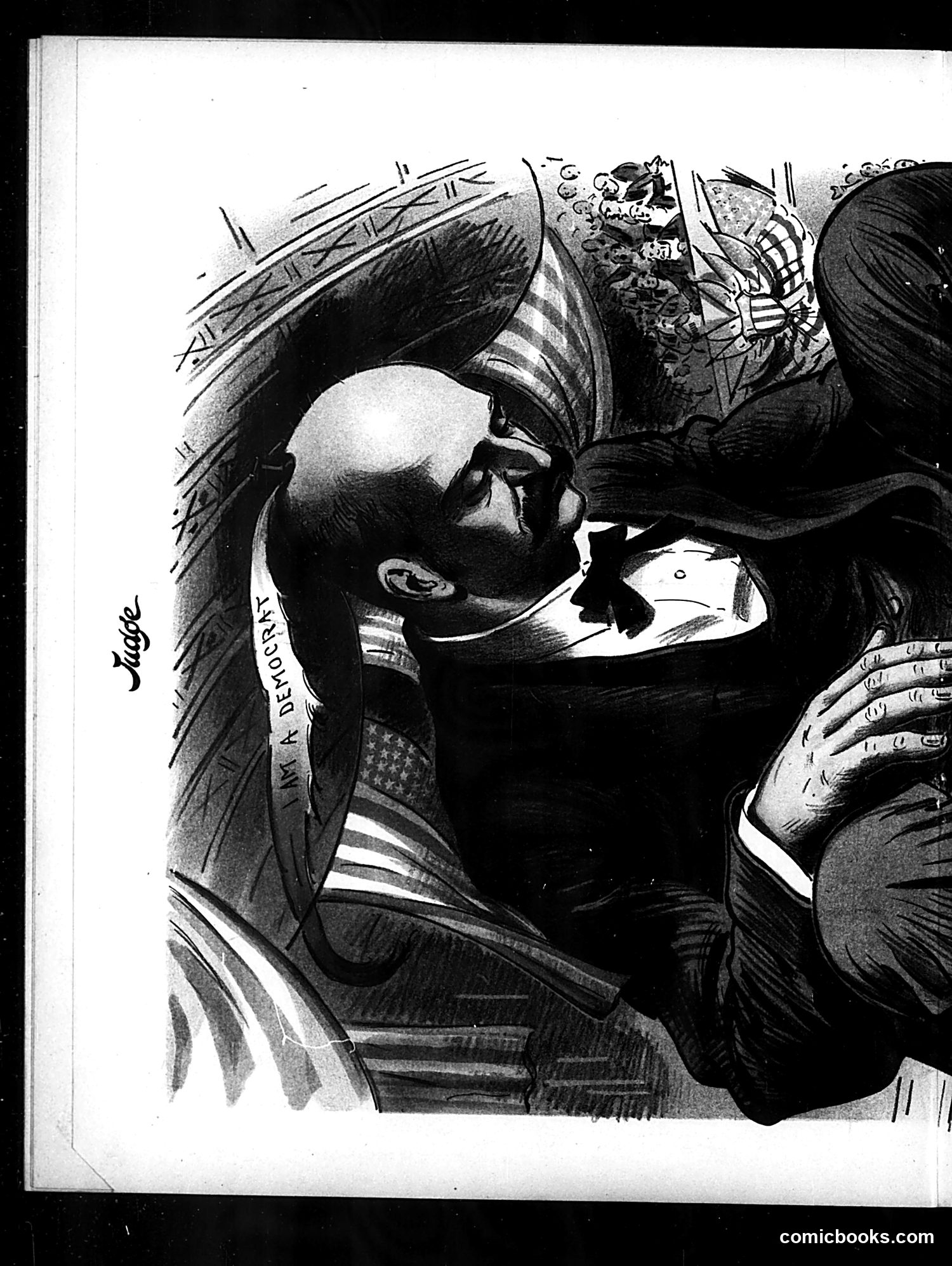
This political cartoon from *Judge* magazine appears to depict a bald man in formal attire examining or reading something intently, with an American flag visible in the background. The ribbon or band across his chest reads "BANK DEMOCRACY" (or similar text suggesting democratic/banking themes). The artistic style and composition suggest satirical commentary on American politics or finance, likely critiquing how democratic institutions or principles are being scrutinized, manipulated, or put under close examination by political figures. However, without a clear date, visible signatures beyond "Judge," or additional context from surrounding page content, I cannot definitively identify the specific figure, event, or political reference intended. The cartoon's precise meaning requires more contextual information to interpret accurately for modern readers.
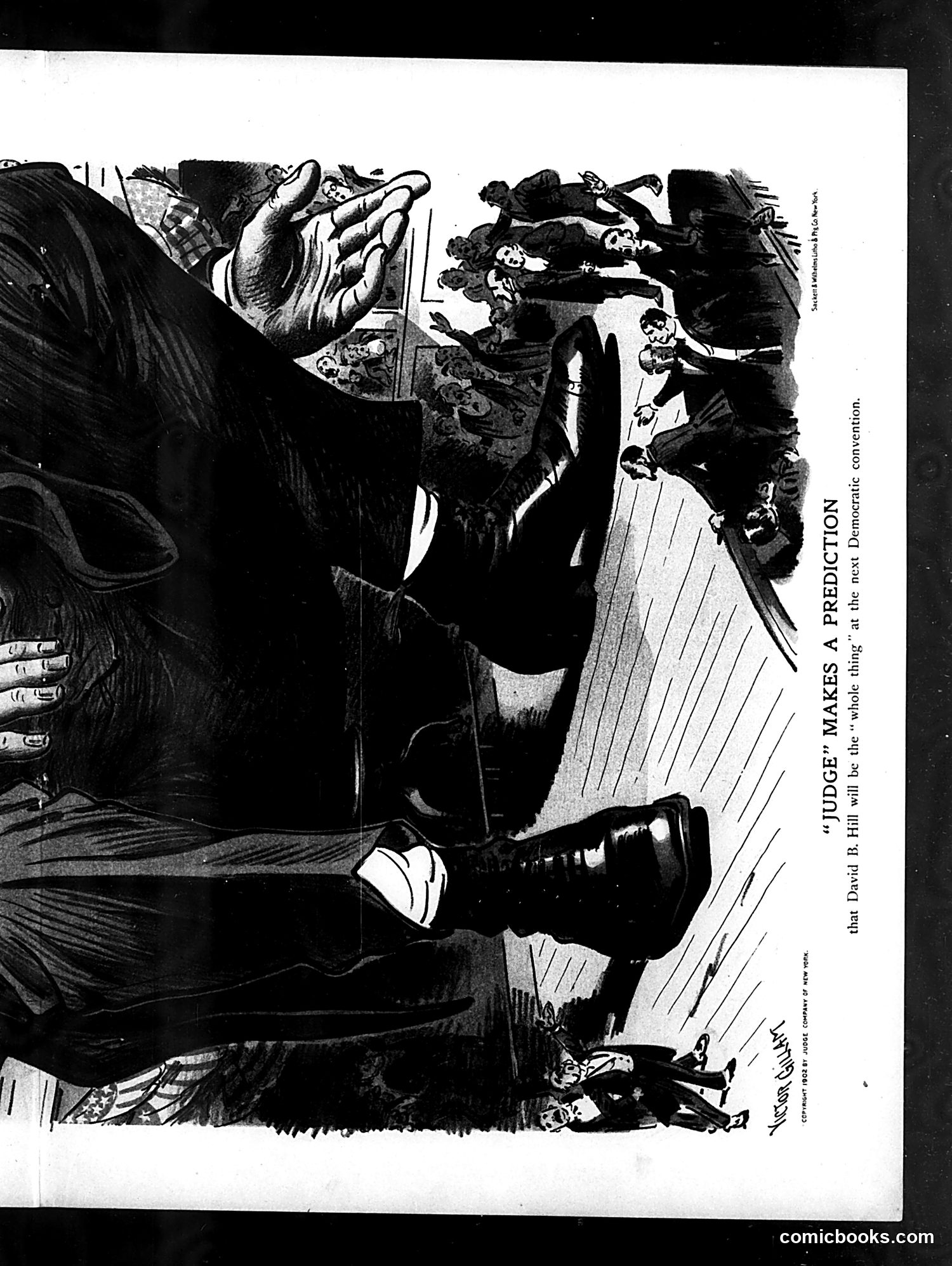
This political cartoon depicts a large figure (likely representing a political boss or establishment figure) gesturing toward a Democratic convention. The caption indicates the cartoon predicts that David B. Hill "will be the whole thing at the next Democratic convention." The image appears to satirize backroom political maneuvering and control within the Democratic Party, suggesting that Hill—a New York politician prominent in the Gilded Age—will dominate the party's nomination process. The caricatured style and heavy-handed gesture emphasize the satirist's mockery of insider political manipulation. The crowd of smaller figures in the background likely represents convention delegates or party members, portrayed as subordinate to this powerful operator. Without clearer dating, the specific historical moment remains unclear, but this reflects late-19th-century anxieties about machine politics.
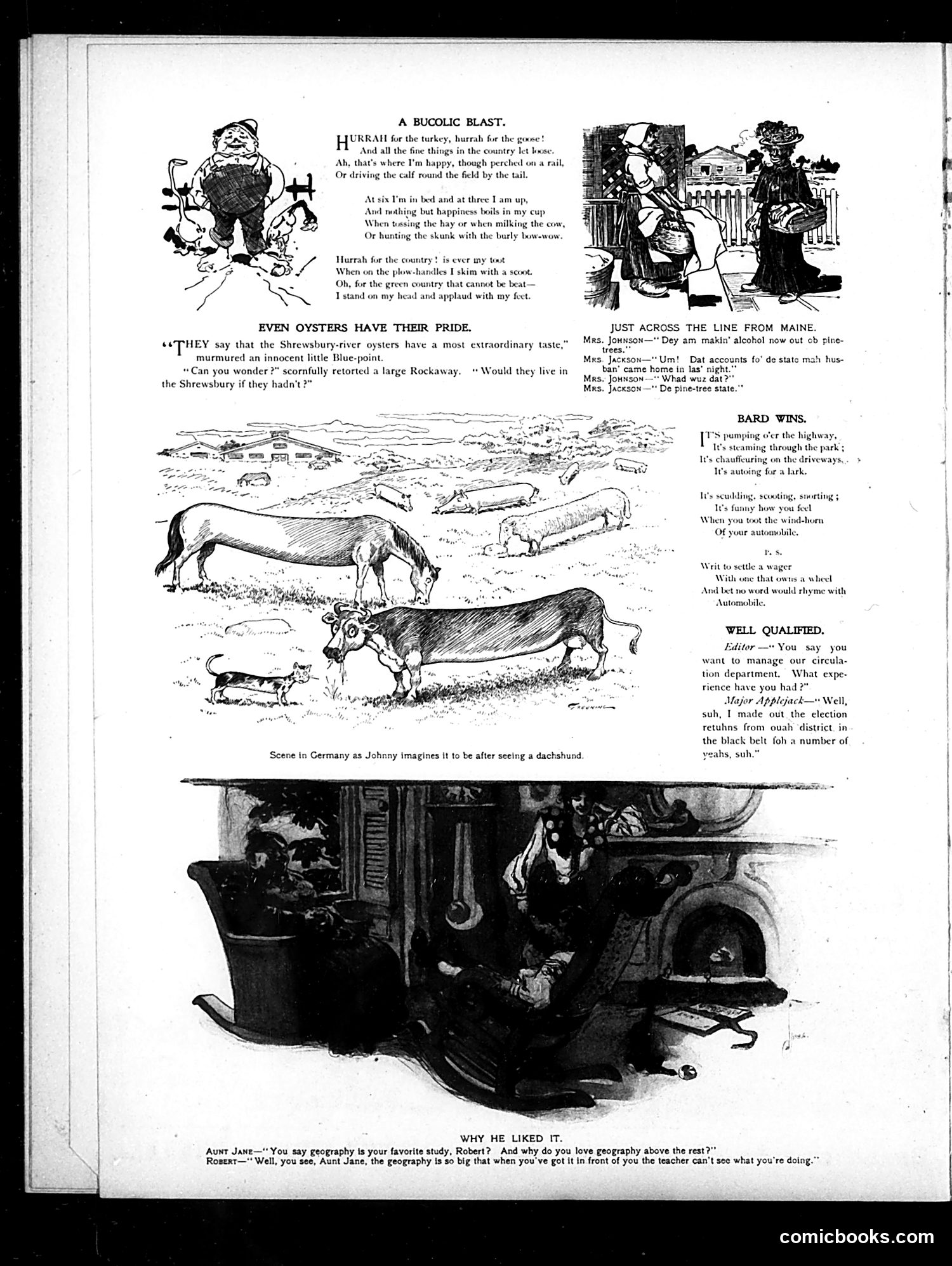
This page contains several satirical pieces typical of Judge magazine's humor: **"A Bucolic Blast"** mocks rural/farm life romanticism through exaggerated enthusiasm about country work (milking cows, hauling hay, driving calves by the tail at 3 AM). **"Even Oysters Have Their Pride"** features anthropomorphized oysters debating whether Shrewsbury-river oysters would live elsewhere. It's mild social commentary using shellfish as vehicles for snobbish class distinction. **"Just Across the Line from Maine"** presents dialect humor (likely mocking rural/working-class speech patterns) involving alcohol production and the "pine-tree state" (Maine's nickname). **"Well Qualified"** satirizes political corruption through a character claiming election administration experience—"Major Applejack" boasts of handling returns "in the black belt," a transparent reference to ballot manipulation in the segregated South. **"Why He Liked It"** is straightforward classroom humor: a student likes geography because the large textbook hides him from the teacher's view. The page reflects early-20th-century Judge sensibilities: rural stereotyping, class-based humor, and—in the political corruption joke—acknowledgment of actual voter fraud practices.
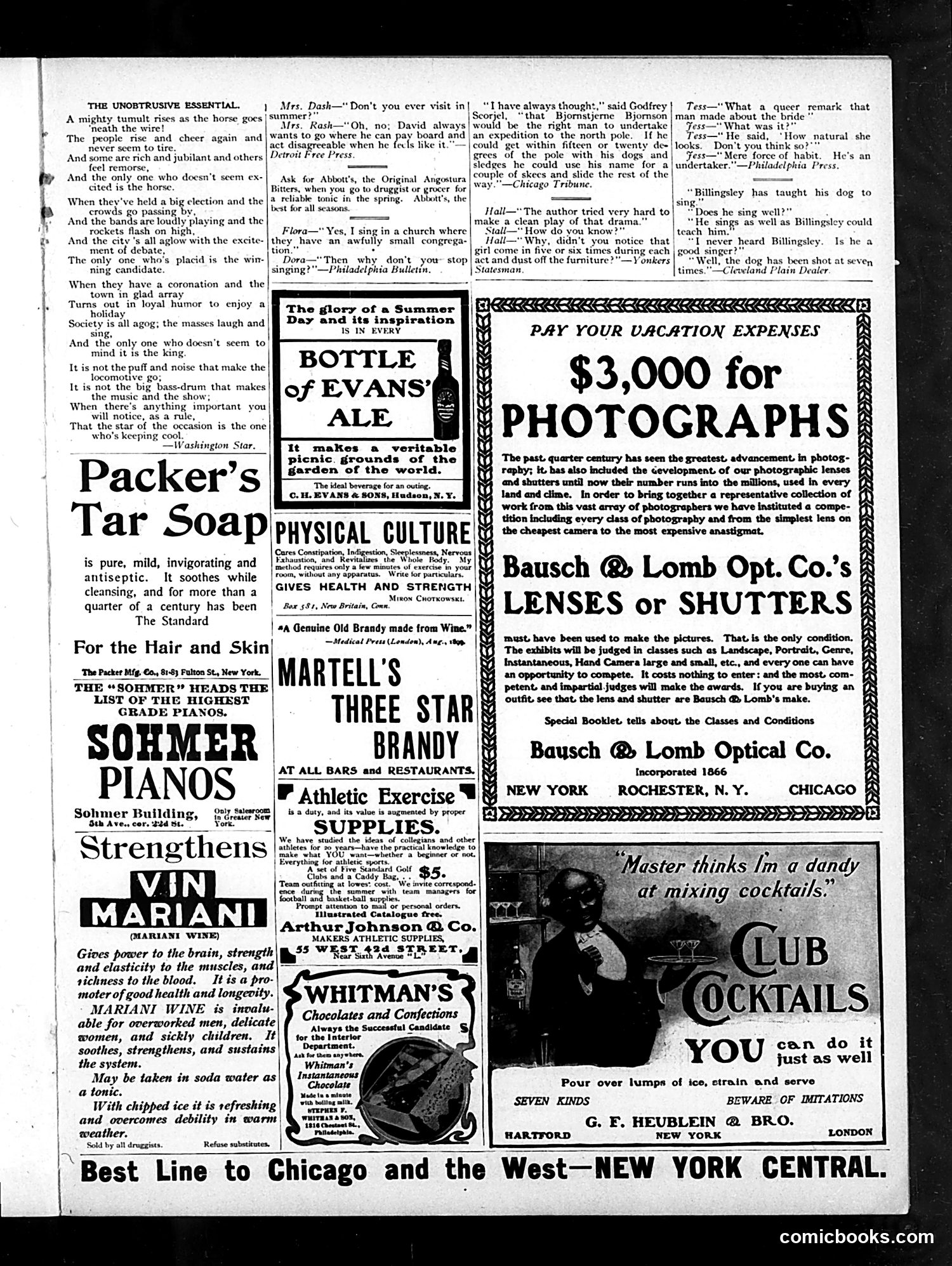
This page is primarily **advertising**, featuring product promotions for liquor, soap, pianos, and other goods typical of early 20th-century magazines. The editorial content consists of brief humorous observations rather than political cartoons. "The Unobtrusive Essential" presents a satirical point: at moments of great public excitement—horse races, elections, coronations—the one figure who remains calm and unbothered is the central participant (the horse, the winning candidate, the king). The joke satirizes how people get caught up in spectacle and ceremony while those most directly involved remain detached or indifferent. The page's other short pieces follow similar light social commentary rather than sharp political satire. One exchanges quips about visiting summer habits; another discusses church attendance. The advertisements dominate, hawking Packer's Tar Soap, Sohmer Pianos, Mariani Wine, and Evans' Ale—reflecting Judge's role as both satirical magazine and commercial medium.
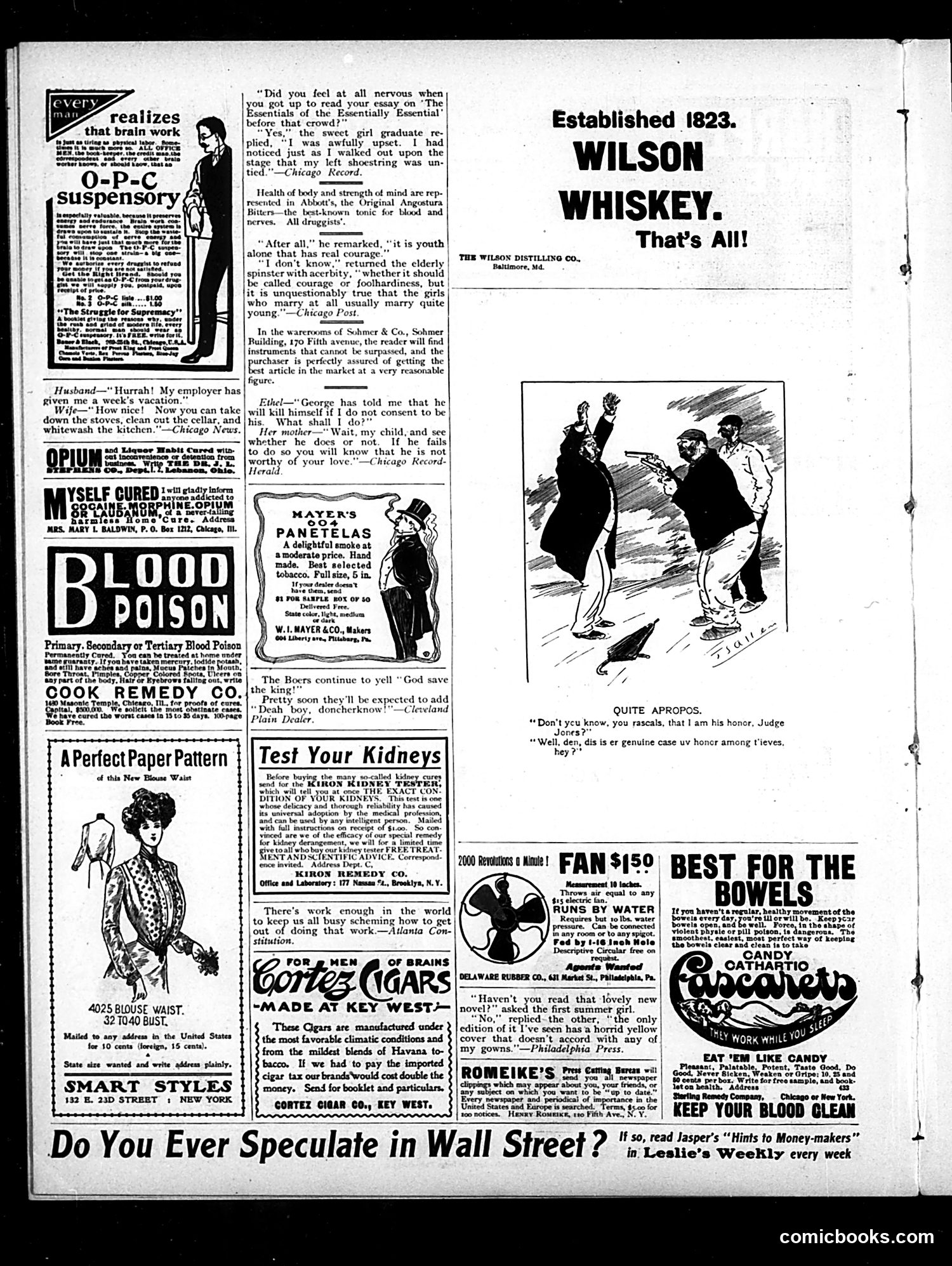
This page from *Judge* magazine is primarily **advertising** mixed with short satirical jokes typical of the publication's format. The main cartoon shows two men on a snowy street—one appears to be a judge or authority figure confronting another man. The caption "QUITE APROPOS" suggests ironic humor about "honor among thieves," likely commenting on corruption or hypocrisy in legal/political circles. The page's text humor includes: - A joke about a husband's "vacation" being spent on household chores (domestic satire) - A quip about a nervous girl graduate worried about her untied shoelace - Commentary on the Boer War (current events), mocking their continued patriotic cries Most of the page comprises period advertisements for whiskey, cigars, patent medicines (including dubious "blood poison" cures and opium treatments—legal then), corsets, and various products. The tone reflects early 1900s advertising's relaxed standards regarding medical claims. The cartoons use gentle domestic and social satire rather than sharp political commentary, typical of *Judge*'s approach to middle-class American life.
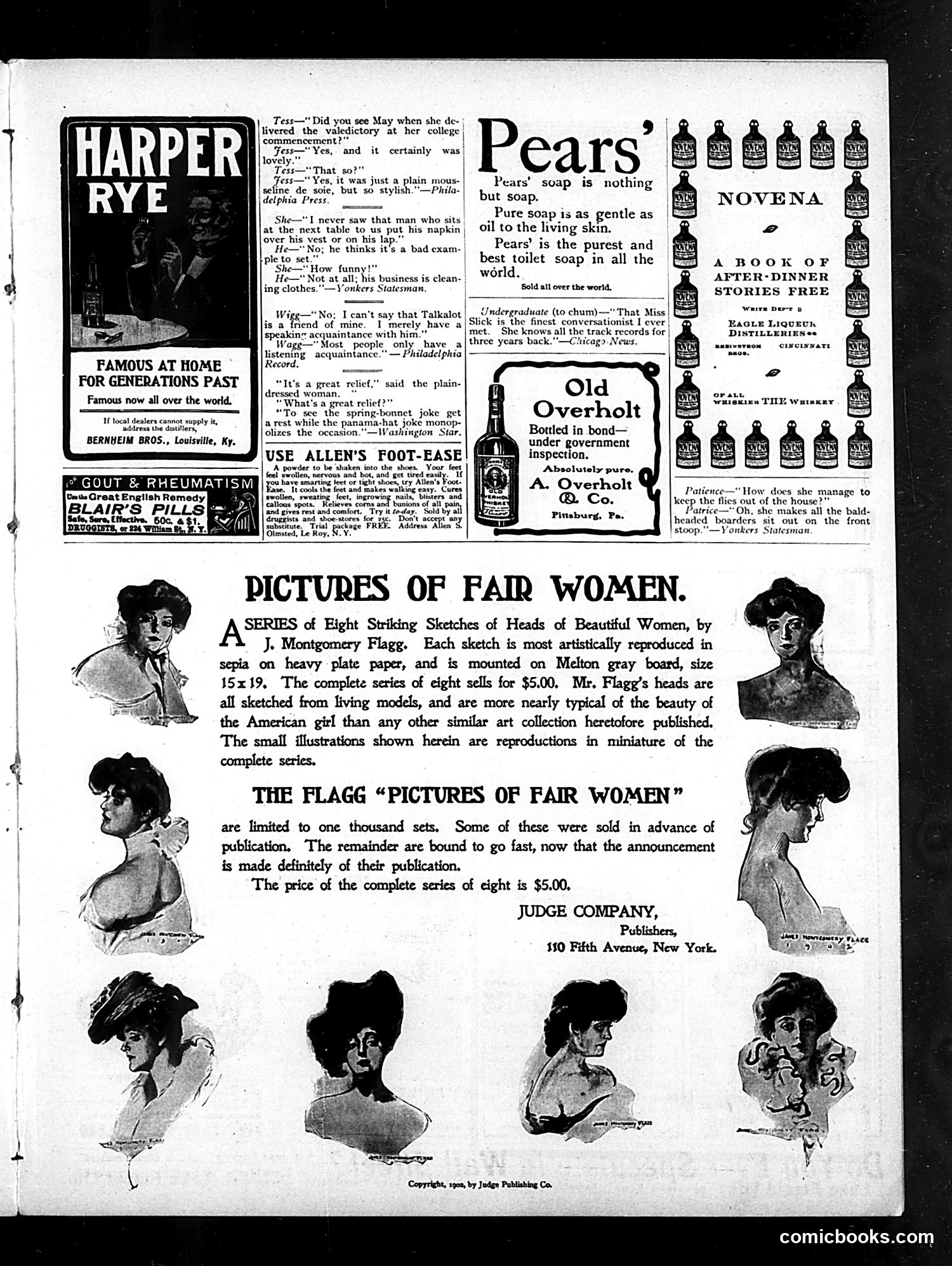
This page is primarily **advertising and promotional content** rather than political commentary or satirical cartoons. The top section contains brief humorous dialogue exchanges—typical Judge magazine filler jokes about social etiquette (napkin use, spring bonnets, acquaintances). These are mild observations about contemporary manners, not satire. The main content advertises **J. Montgomery Flagg's "Pictures of Fair Women,"** a series of eight portrait sketches of attractive women, available for $5.00. Flagg was a prominent illustrator of the era, and this appears to be a commercial announcement for a limited print run (1,000 sets). The surrounding ads promote consumer products: Pears' soap, Old Overholt whiskey, Harper Rye, Allen's Foot-Ease powder, and Blair's Pills—typical early 1900s patent medicine and luxury goods. The page reflects the magazine's dual nature: entertainment through light jokes and humor, supported by advertising revenue. No identifiable political figures or events are referenced.
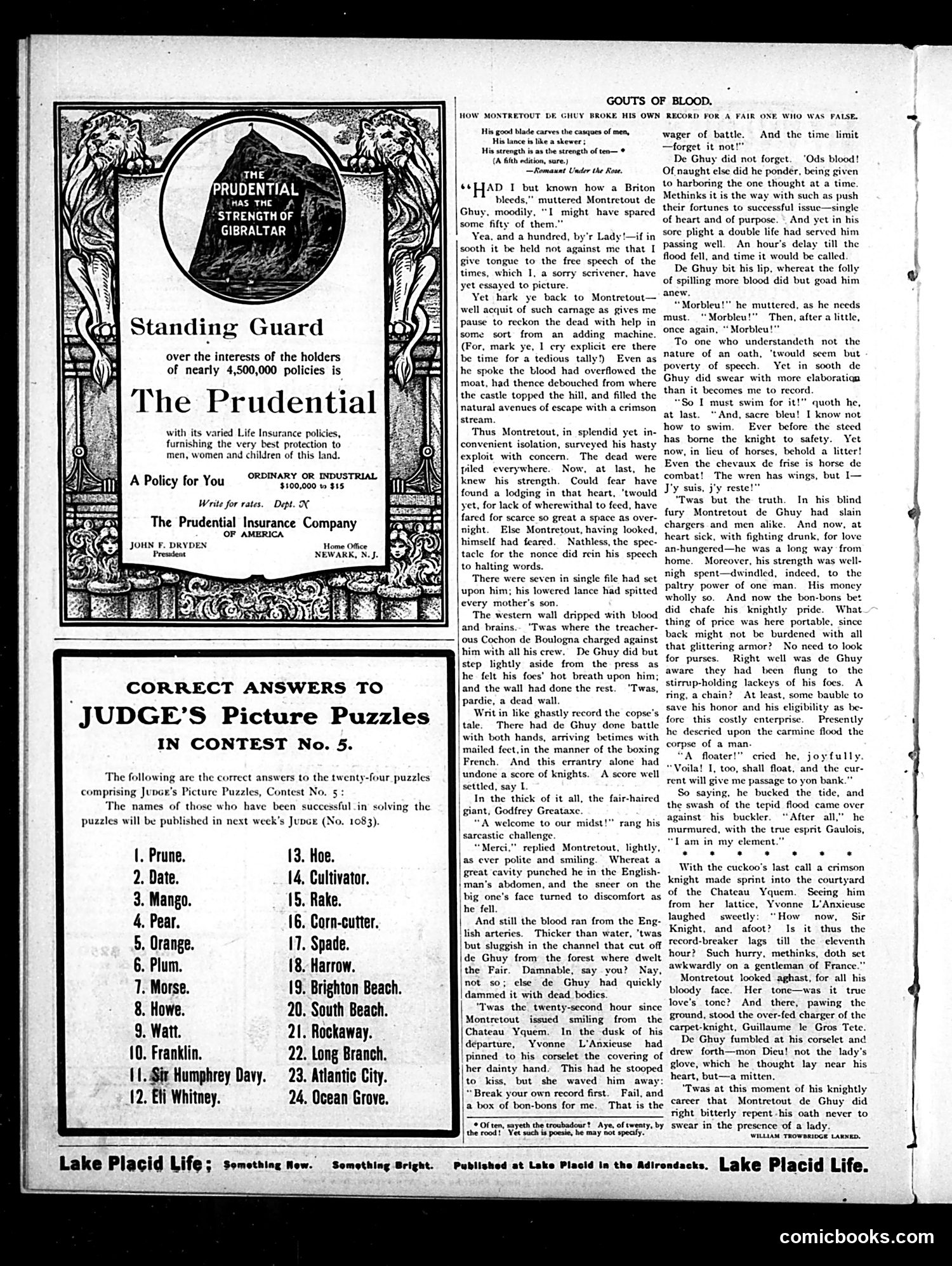
This page contains **two distinct elements**: a full-page **insurance advertisement** for The Prudential Insurance Company (left side) and a serialized **adventure story** titled "Gouts of Blood" (right side). The advertisement uses the metaphor of "Standing Guard" and "Gibraltar" (symbol of strength) to position Prudential as protector of policyholders—appealing to anxieties about financial security and family welfare. The story is a **swashbuckling historical fiction** featuring a French knight named Montretout de Ghuy engaged in combat and romantic intrigue. It's written in deliberately archaic, exaggerated language ("Morbleu!" "Ods blood!") typical of period adventure tales. The narrative emphasizes masculine virtues: martial prowess, honor, and passionate emotion. This appears to be entertainment filler common in early-20th-century magazines—the melodramatic tone and flowery prose are meant to entertain, not satirize. The page footer indicates this is from *Lake Placid Life*, a regional publication.
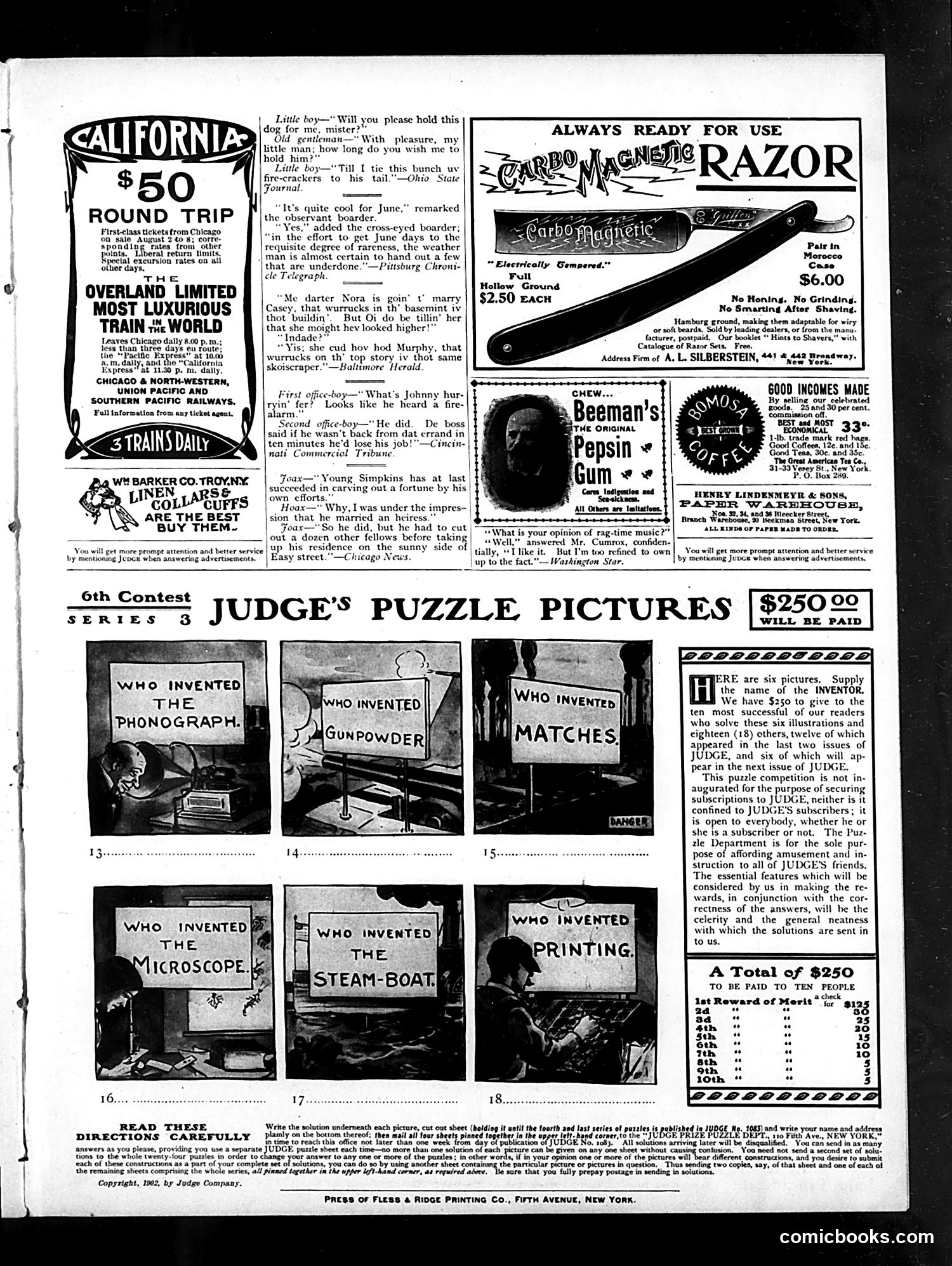
This page from Judge magazine (a major American satirical weekly) contains primarily **advertising and a puzzle contest**, with scattered humorous anecdotes. The main content is the "Judge's Puzzle Pictures" contest (6th series), offering $250 total to readers who identify the inventors depicted in six illustrated panels: the phonograph, gunpowder, matches, microscope, steam-boat, and printing. This was a popular puzzle format for Judge, designed to engage readers rather than secure subscriptions. The scattered jokes throughout employ typical early-1900s humor: a child's prank with firecrackers tied to a dog's tail; Irish immigrant dialect humor (references to "Murphy" and "Oi"); office-boy workplace comedy; and romantic/marriage jokes about fortune-hunting. These anecdotes reflect common Judge comedic tropes—slapstick, ethnic stereotypes, and working-class situations—rather than political satire. The advertisements (razors, coffee, trains, cufflinks) indicate the magazine's middle-class male readership.
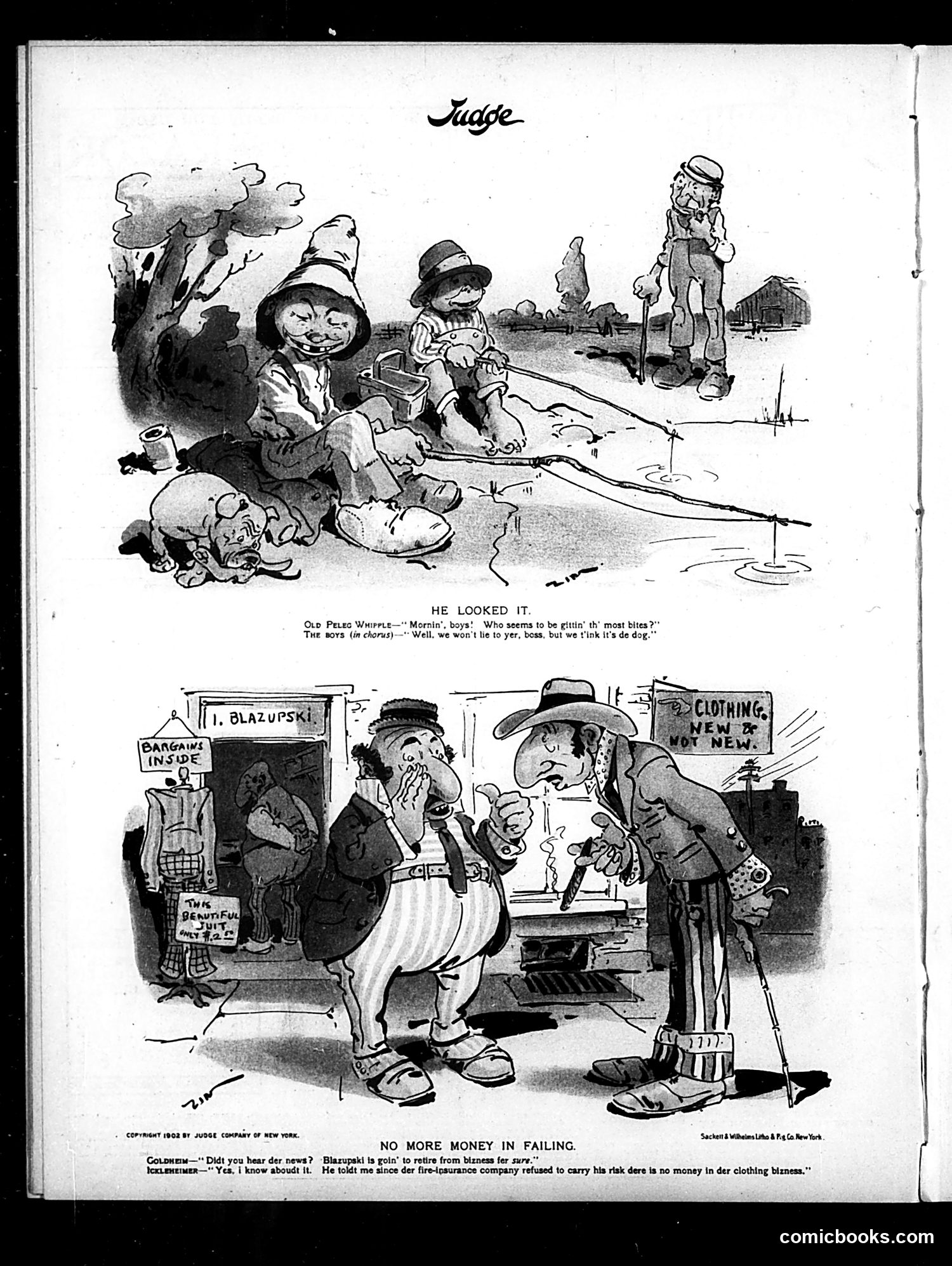
This page contains two separate cartoons satirizing early 1900s American life. **Top cartoon ("He Looked It"):** An old Polish immigrant ("Old Peles Waiffle") takes boys fishing. When asked who's catching the most fish, the boys joke that the dog is—a visual gag implying the old man looks like a dog or is equally unsuccessful. **Bottom cartoon ("No More Money in Failing"):** Two Jewish immigrant characters discuss a clothier named Blazupski retiring from business. The punchline: he's quitting not from legitimate failure, but because his fire-insurance company refused coverage—implying he planned arson for insurance fraud. This reflects period stereotypes associating Jewish immigrants and small business owners with insurance scams, a common antisemitic trope in early 20th-century American humor. Both cartoons employ ethnic caricature and dialect humor typical of Judge's satirical approach toward immigrant communities of the era.