
A complete issue · 16 pages · 1902
Judge — June 21, 1902
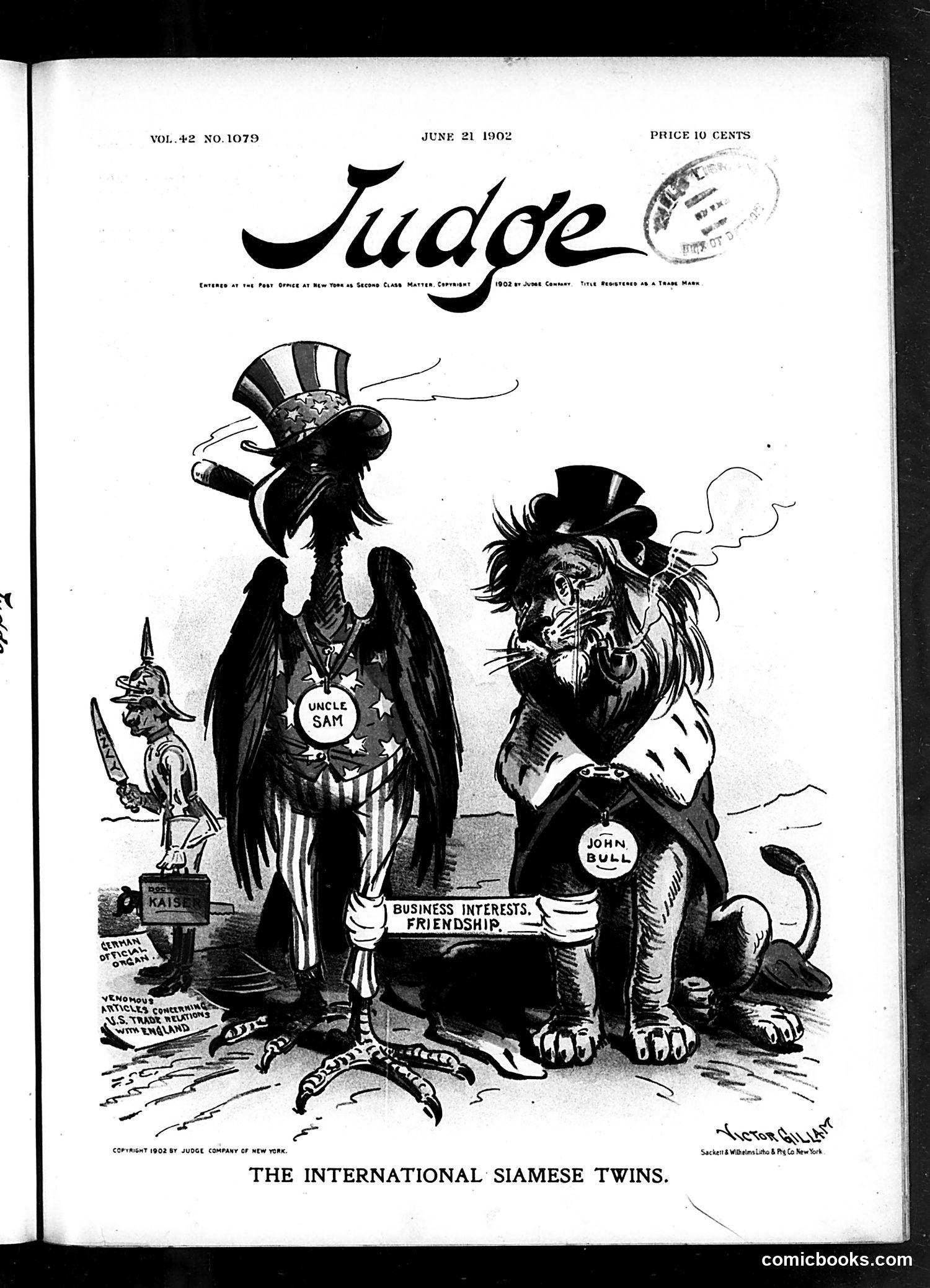
This 1902 *Judge* cartoon satirizes U.S.-German diplomatic relations through caricature. Uncle Sam (left, eagle-winged) and "John Bull" (right, lion-faced—representing Britain) are depicted as conjoined twins, connected by a banner reading "BUSINESS INTERESTS. FRIENDSHIP." The cartoon suggests their political alliance is purely transactional, bound by commercial rather than ideological ties. German militarism appears on the left (the spiked-helmet figure labeled "KAISER"), while various geopolitical tensions and "venomous articles" litter the ground beneath them, indicating underlying hostilities masked by their forced partnership. The "Siamese twins" metaphor implies this alliance is unnatural, uncomfortable, and dependent on economic self-interest to survive—a commentary on early 20th-century great-power diplomacy prioritizing profit over principle.
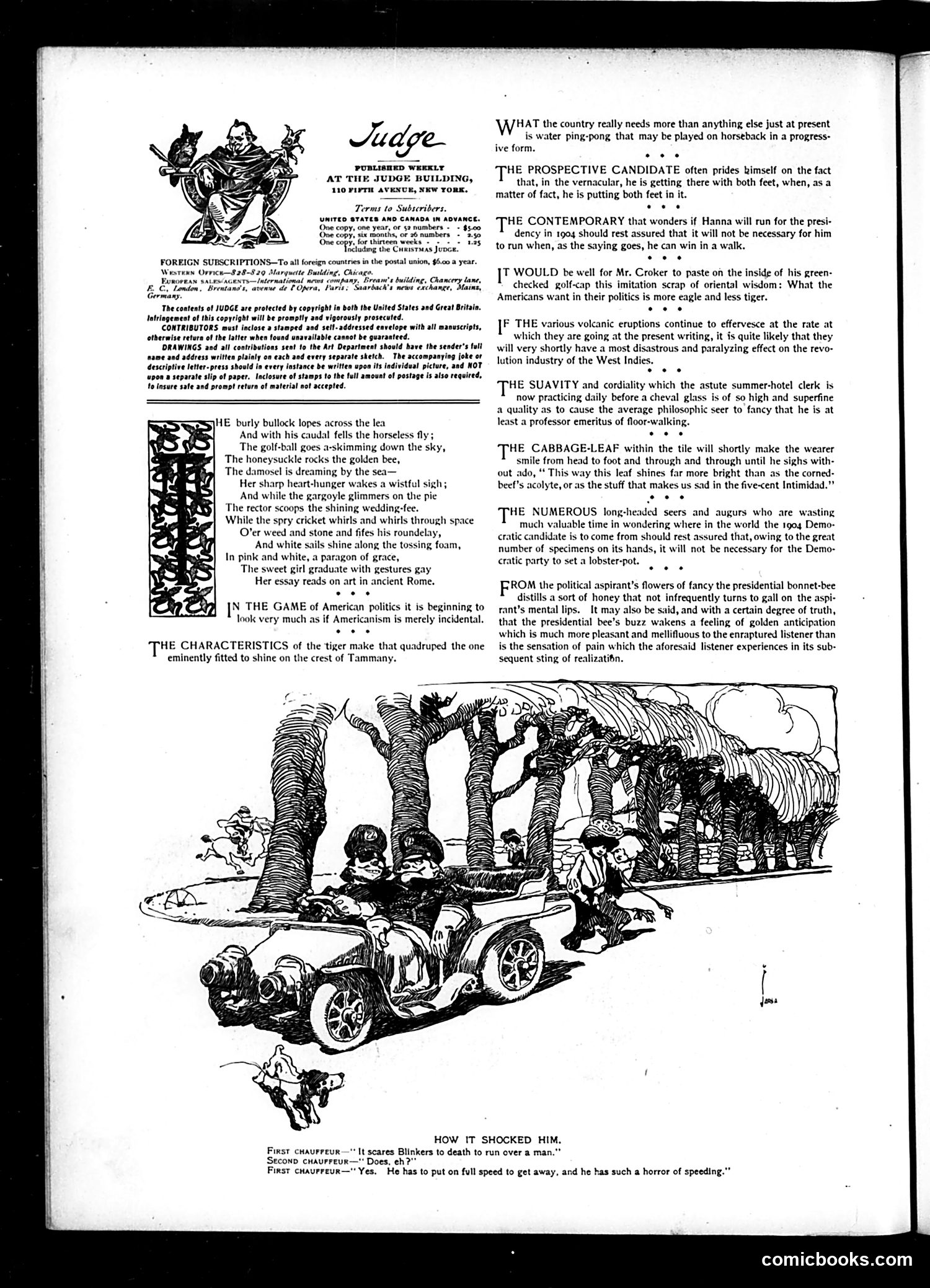
This page from *Judge* contains satirical commentary on early 20th-century American politics and society. The main editorial section, titled "Judge," critiques politicians and candidates, likely referencing the 1904 election period based on language about "prospective candidates" and contemporary political concerns. The lower illustration, captioned "How It Shocked Him," depicts an early automobile speeding dangerously past pedestrians beneath palm trees. The dialogue between chauffeurs discusses the driver's recklessness—"he has such a horror of speeding"—mocking the irony of someone terrified of speed yet driving recklessly. This satirizes wealthy automobile owners' contradictory attitudes toward traffic safety, a growing concern as automobiles proliferated in urban areas.
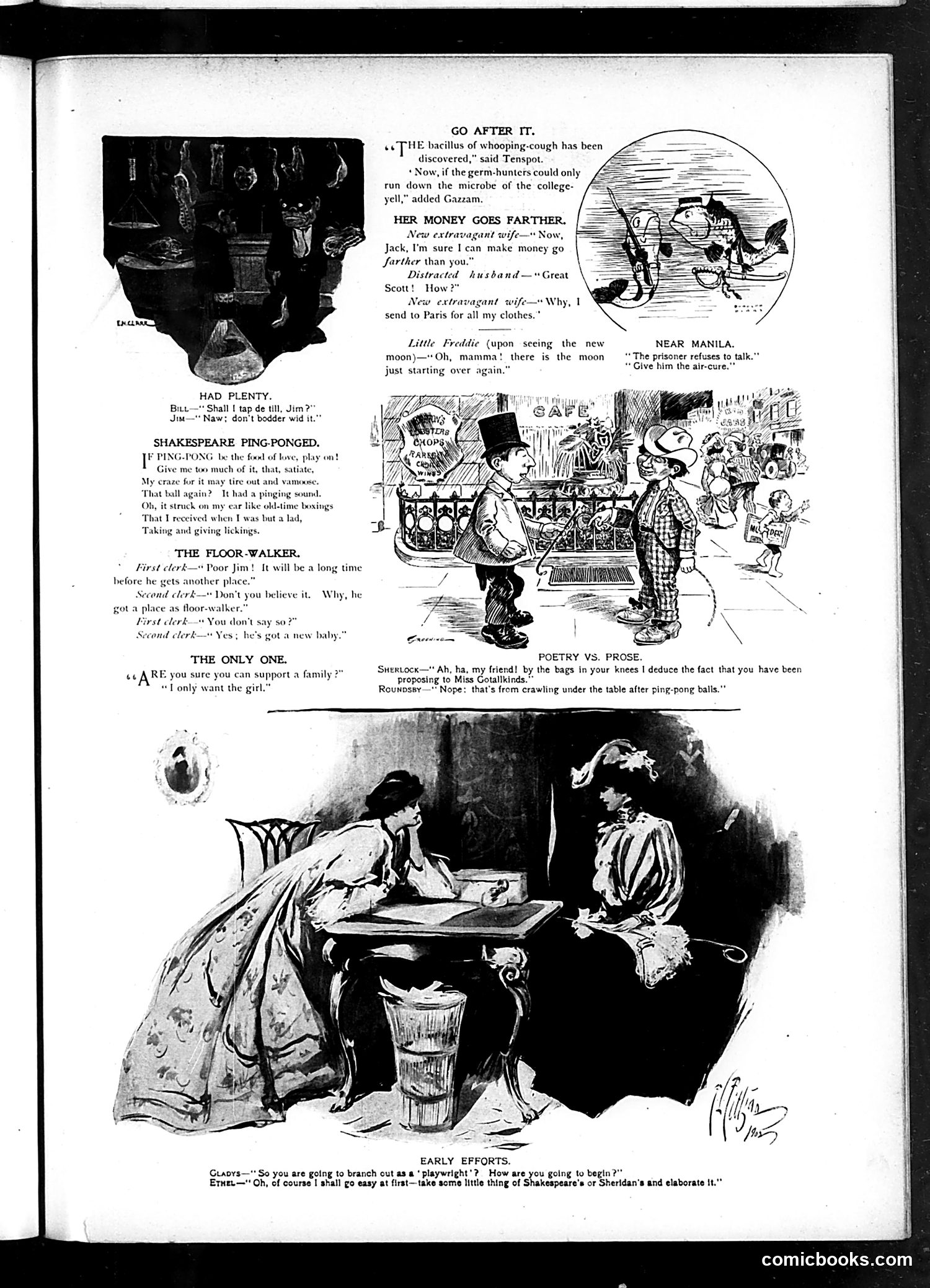
This page contains several brief humorous sketches and jokes typical of Judge magazine's satirical format: **"Go After It"** mocks medical discussions about whooping cough and college germs—likely referencing contemporary medical debates. **"Her Money Goes Farther"** satirizes a wife's extravagance, with the joke that she sends clothes to Paris, implying wealthy women's conspicuous consumption. **"Near Manila"** appears to reference the Philippine-American War era, with a prisoner needing "air-cure." **"Poetry vs. Prose"** is a Sherlock Holmes parody about deducing marriage proposals from crawling under tables. **"Early Efforts"** depicts a woman beginning playwriting, humorously suggesting she'll imitate Shakespeare or Sheridan. The cartoons target contemporary social themes: medicine, wealth disparity, imperialism, and women's intellectual ambitions—all presented through mock-serious dialogues and exaggerated situations typical of Judge's satirical approach.
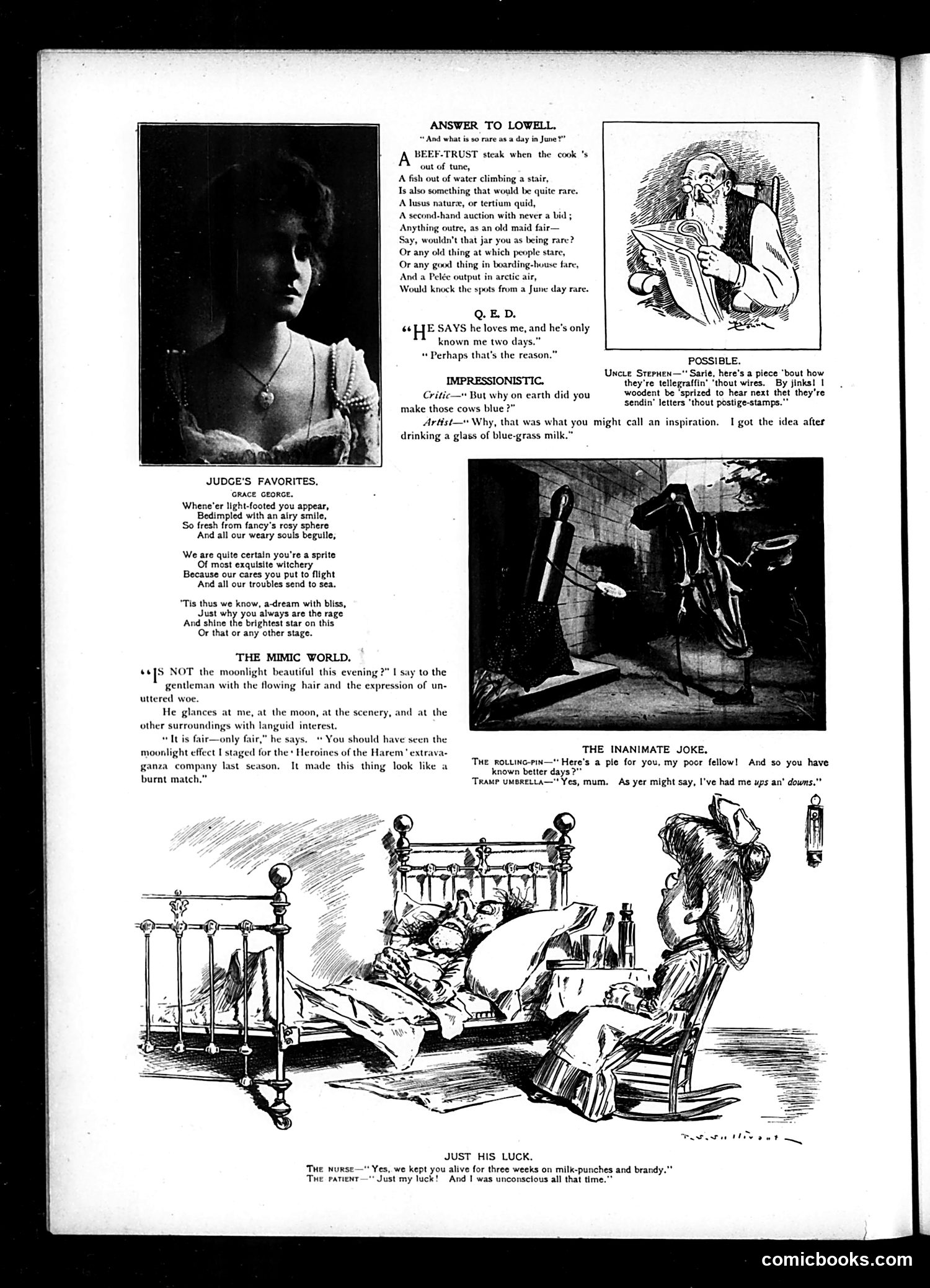
This page contains several satirical pieces and illustrations typical of Judge's humor: **"Answer to Lowell"** appears to be a response poem to James Russell Lowell, listing absurdities (blue cows, fish climbing stairs) as things rarer than finding good boarding-house fare—likely satirizing poor-quality American accommodations. **"Judge's Favorites"** is a short poem praising Grace George, likely referencing the actress. **"The Mimic World"** mocks theatrical productions, suggesting stage effects (moonlight, scenery) were unconvincing, specifically critiquing a Harem extravaganza production. **"The Inanimate Joke"** and **"Just His Luck"** are humorous dialogues: one involves a tramp and rolling pin; the other depicts a nurse and patient discussing recovery odds. The illustrations are satirical vignettes of everyday American life and theater, characteristic of Judge's social commentary format.
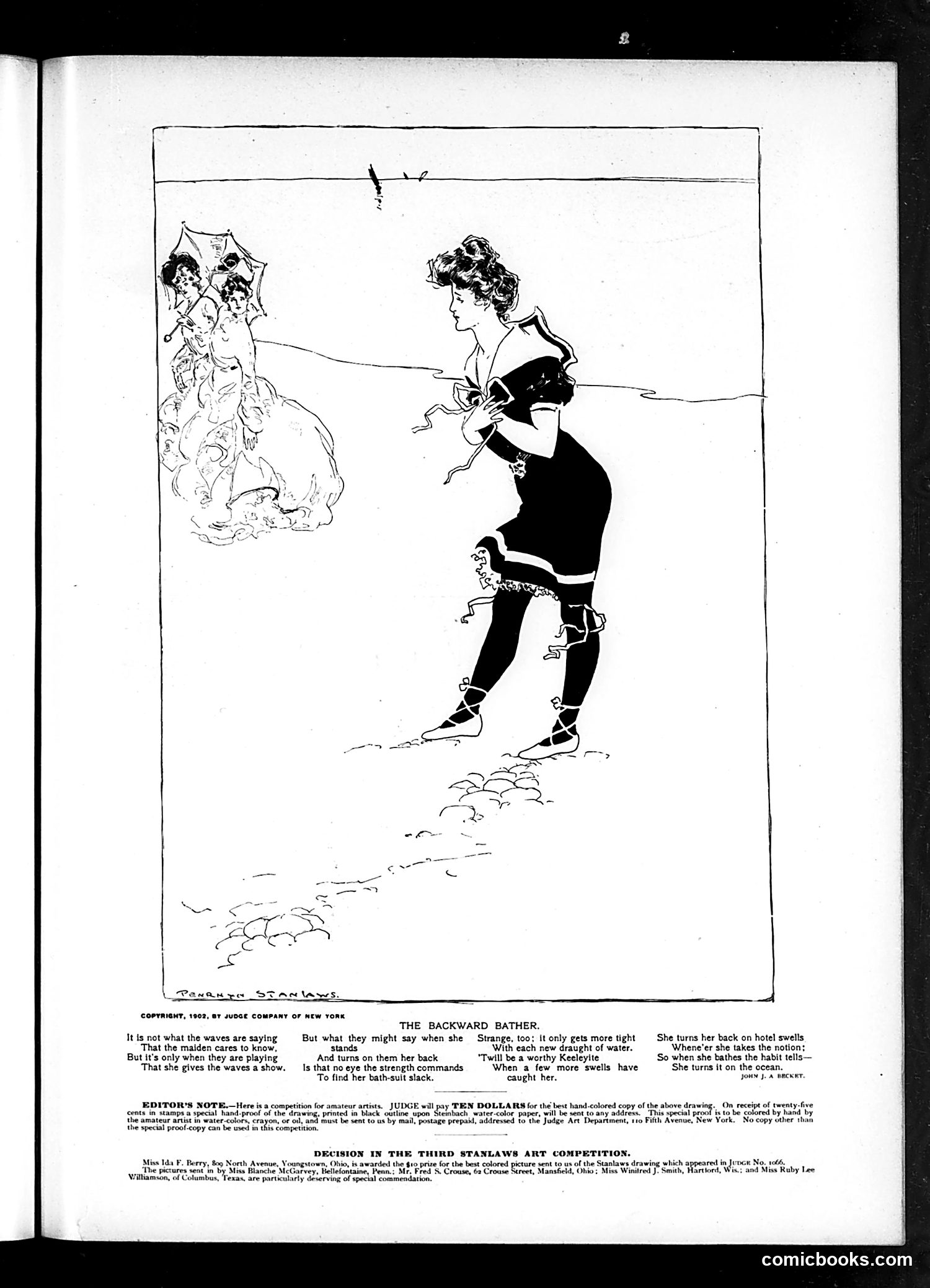
This cartoon satirizes female modesty conventions of the Edwardian era. A woman in a bathing suit stands with her back turned to the ocean, facing the shore—a humorous inversion of normal bathing. The joke plays on anxieties about swimwear: women's bathing costumes of this period were extremely modest by modern standards, yet still provoked social concern about propriety. The poem suggests the woman turns her back to the water (and away from male observers) to prevent her tight bathing suit from becoming even more revealing when wet. The "swells" referenced are both ocean waves and fashionable men watching from the beach. The satire mocks the absurd prudishness of the era—women couldn't bathe comfortably without worrying about their clothing's fit and what observers might see. The cartoonist (Penrhyn Stanlaws) ridicules these exaggerated social constraints on female swimmers.
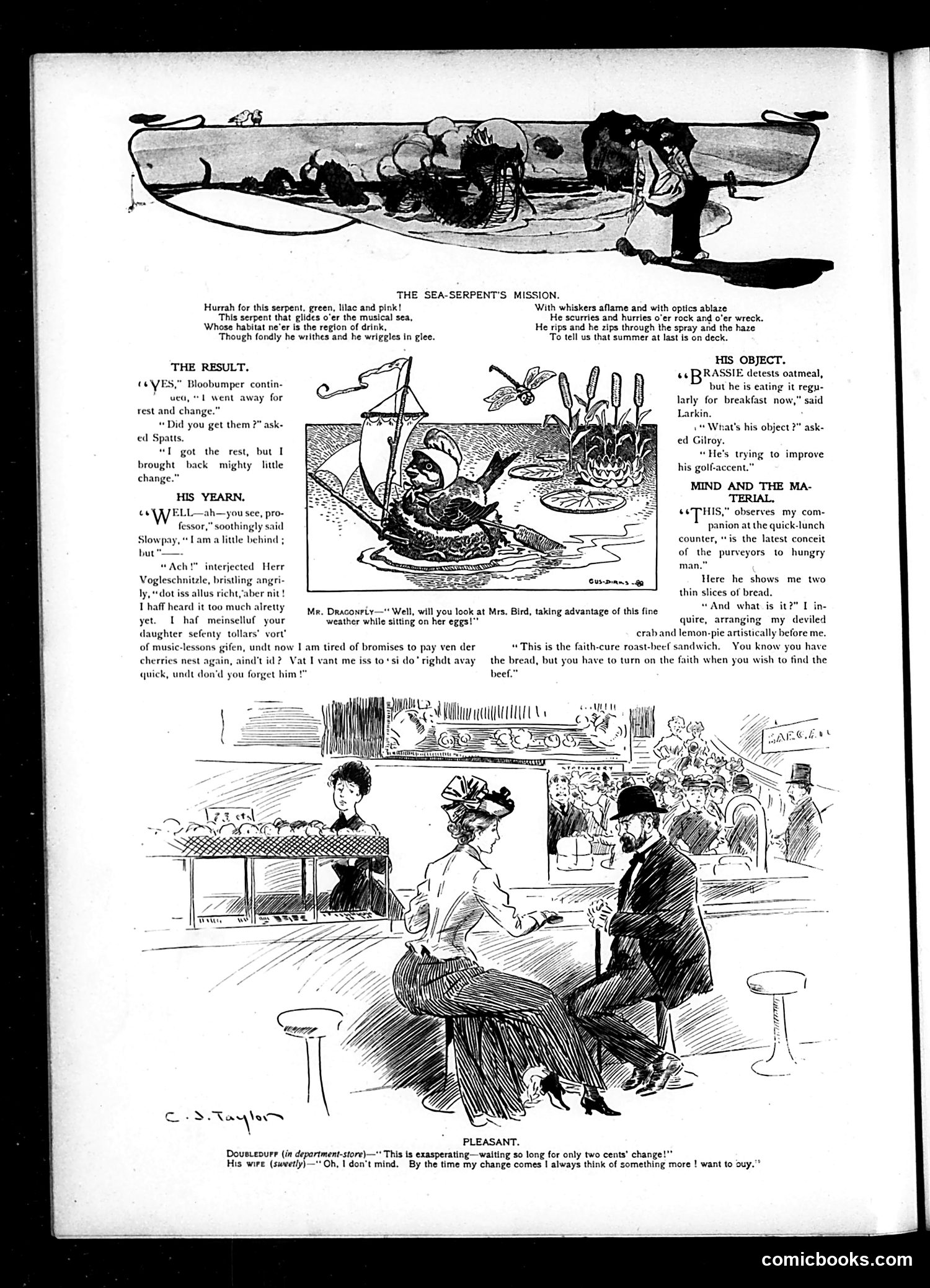
This page contains three distinct humorous pieces from Judge magazine. The top section, "The Sea-Serpent's Mission," is a whimsical poem about a sea serpent's activities. Below that are three prose humor sections: "The Result" (about someone getting rest after change), "His Yearn" (featuring a character named Herr Velocipedinski discussing music lessons), and sections on "His Object," "Mind and the Material" (discussing lunch counter philosophy and a "faith-cure roast-beef sandwich"). The bottom illustration, signed C.D. Taylor and captioned "Pleasant," depicts a couple at what appears to be a department store or similar venue, with the wife commenting about waiting for change while the husband expresses impatience—a relatable domestic joke about shopping frustrations and marital dynamics that would resonate with period audiences.
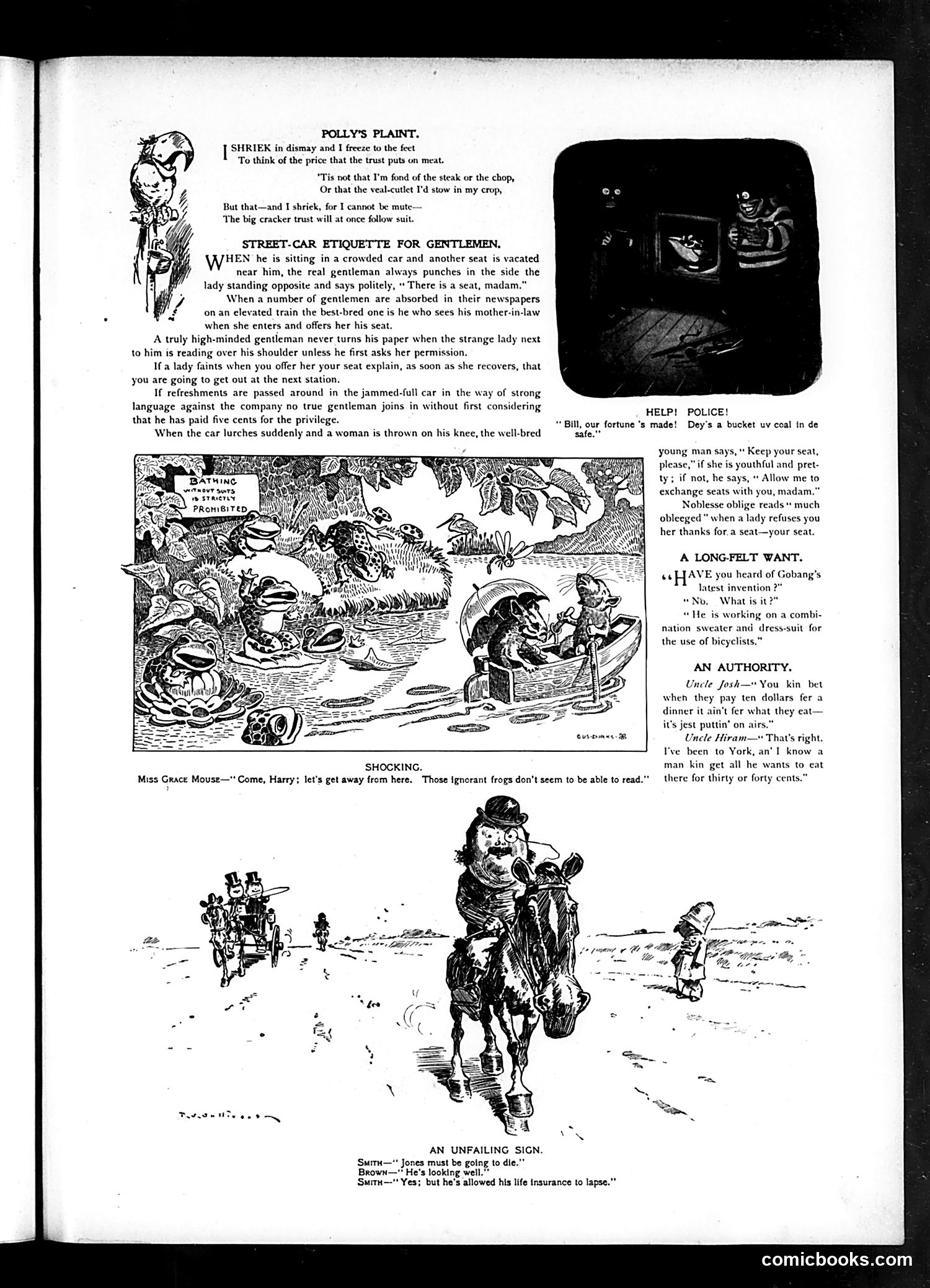
This page contains multiple satirical pieces targeting early 1900s social issues: **"Polly's Plaint"** criticizes meat-packing trusts, depicting a woman's fear that price-fixing will cascade across industries ("the big cracker trust will at once follow suit"). This reflects genuine Progressive-era anxieties about monopolistic corporations controlling food prices. **"Street-Car Etiquette"** mocks both pretentious gentlemen and the absurdity of crowded urban transit. The satirical "rules" exaggerate fake chivalry—punching ladies to offer seats, ignoring mothers-in-law—exposing shallow masculine posturing and the impossibility of real courtesy in cramped conditions. **Minor items** include humor about coal thieves, bicycle fashion, and a joke about life insurance lapses predicting death. The frogs cartoon ("Shocking") appears disconnected, likely part of separate humor content. Throughout, the magazine targets nouveau-riche affectation, corporate greed, and urban social friction—typical Judge concerns of the period.
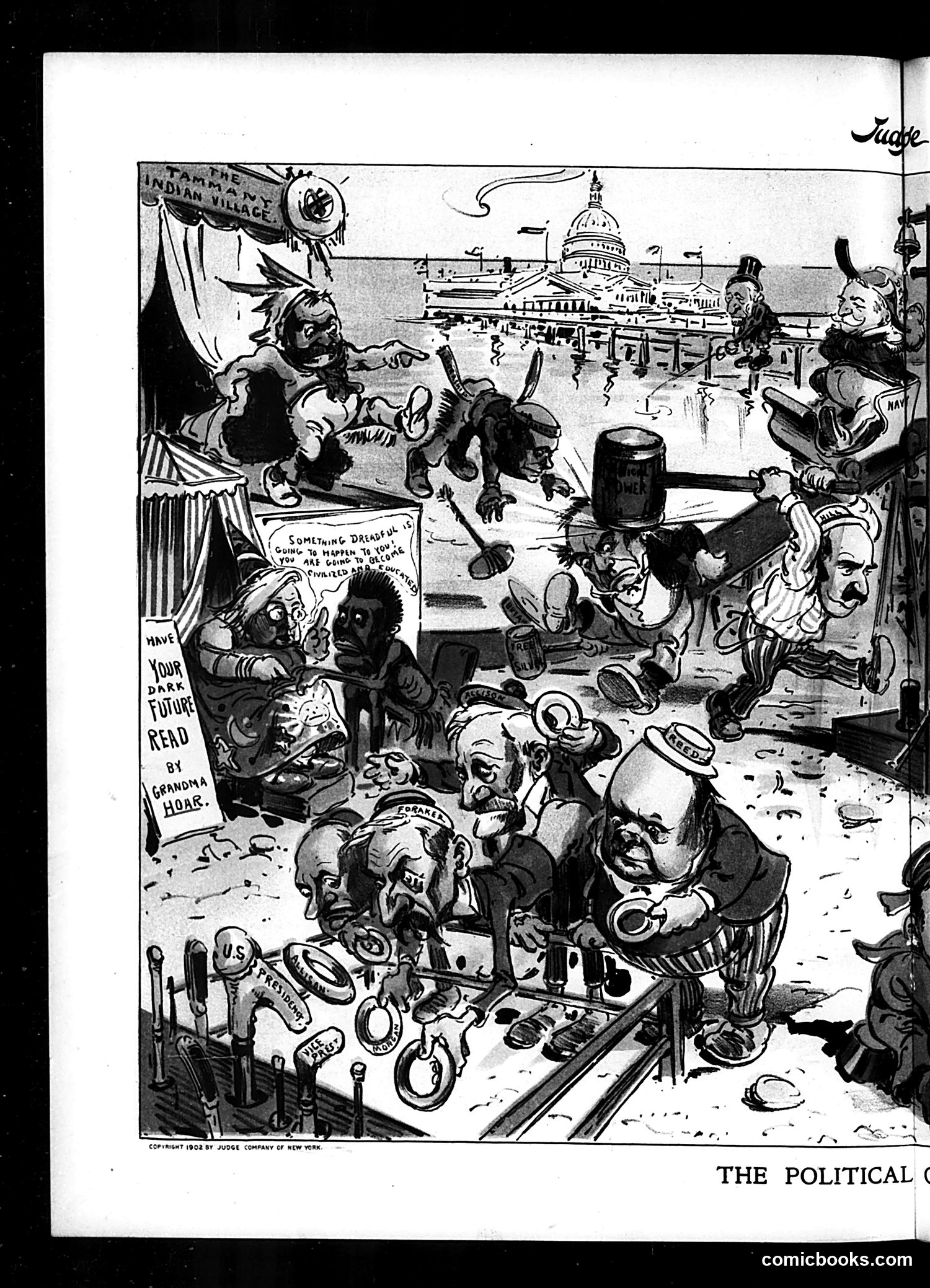
This political cartoon depicts "Indian Village" residents in chaos near the U.S. Capitol building. The exaggerated caricatures and chaotic scene appear to satirize corruption or mismanagement in Washington politics. A sign reading "Something Dreadful is Going to Happen to You if You Don't Read Grandma Hoag's" (visible left side) suggests commentary on political prophecy or warnings. The figures—wearing top hats, Native American imagery mixed with political stereotypes—appear to represent political figures or factions engaged in conflict or scandal. The disorderly scene with scattered objects suggests governmental dysfunction or political turmoil. Without the full title or date visible, the specific political event being mocked remains unclear, though the Capitol imagery indicates this concerns federal government matters. The satirical style is typical of Judge's political commentary from the early 20th century.
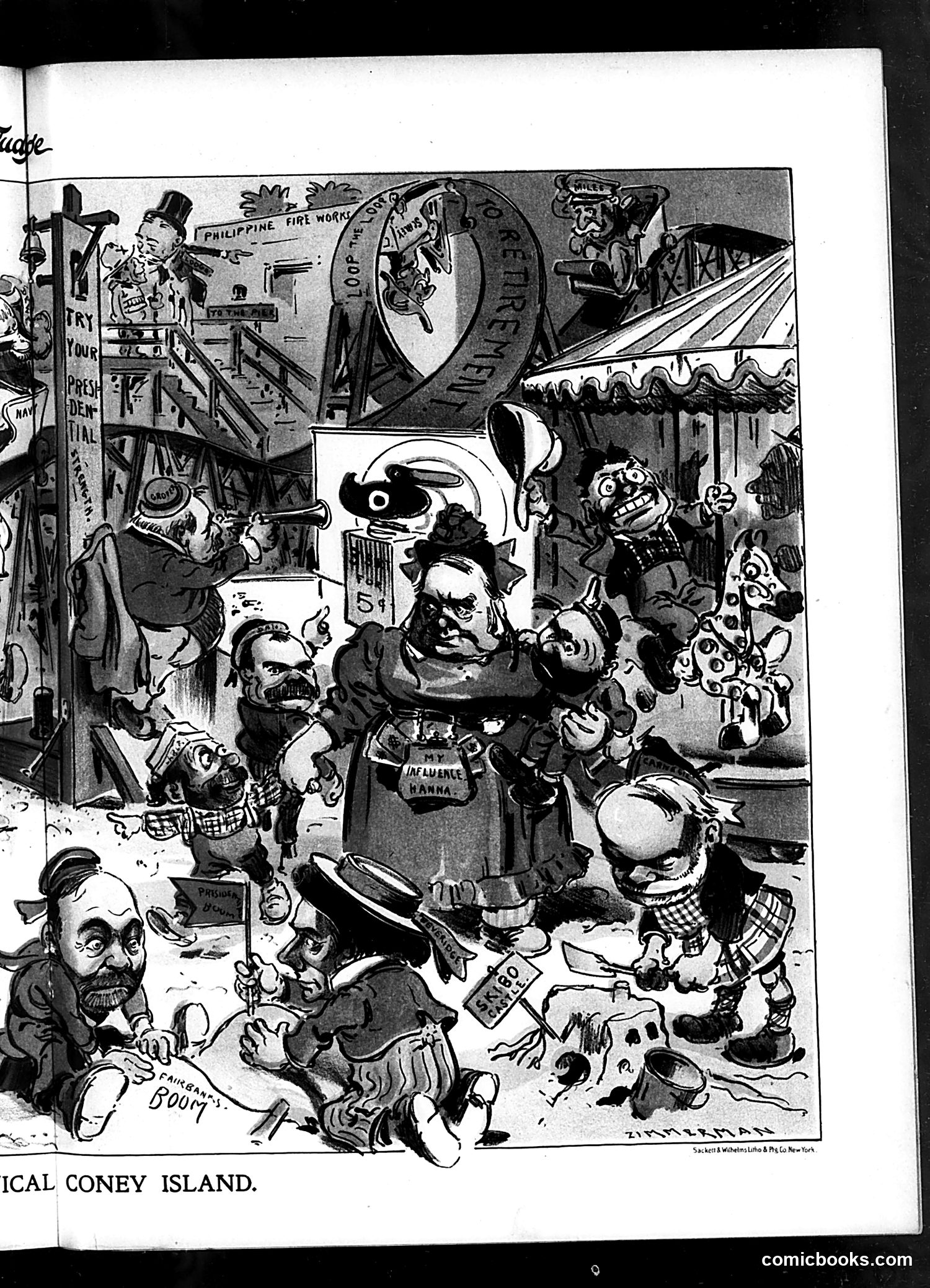
This appears to be a satirical cartoon depicting Coney Island as a chaotic, fantastical place. The central figure is a large character labeled "INFLUENCE" or similar, surrounded by smaller caricatured figures representing various groups or types. Visible text references "Philippine Fire Works" and what appears to be "Booty," suggesting commentary on imperialism or exploitation related to the Philippines. The crowded, carnival-like composition satirizes Coney Island as a place of vice, commercial excess, and questionable influences. The exaggerated caricatures and grotesque styling typical of Judge magazine's political satire suggest criticism of immigrants, criminal elements, or corrupt political figures profiting from the amusement park's unregulated environment. Without clearer identification of specific figures or dating, the precise political targets remain uncertain, but the overall tone criticizes moral degeneracy associated with the popular entertainment venue.
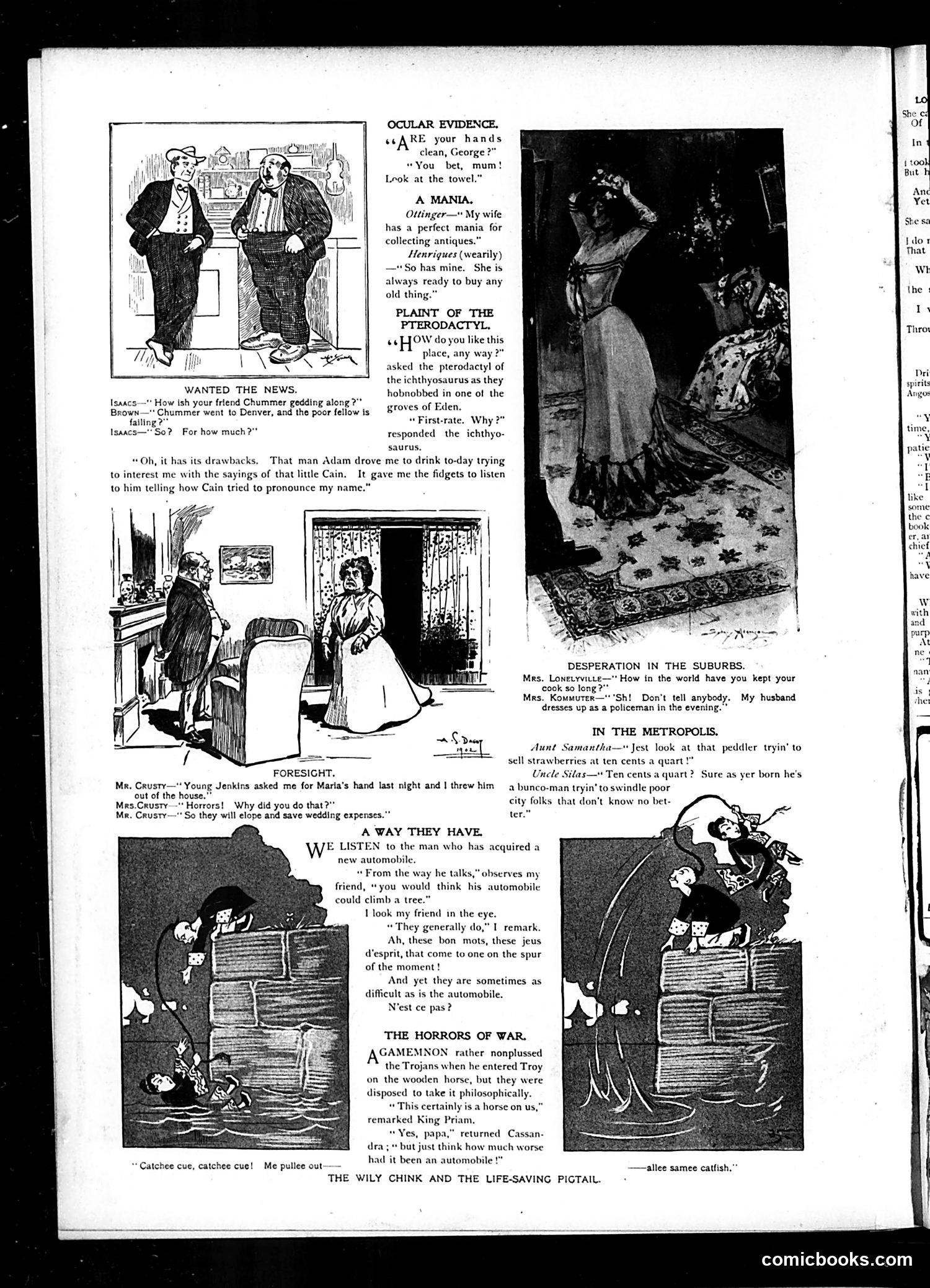
This page contains five unrelated satirical vignettes typical of early 20th-century Judge magazine humor: **"Ocular Evidence"** mocks a husband's cleanliness claims—his "clean hands" are evidenced only by a dirty towel, a visual joke on self-contradiction. **"A Mania"** satirizes the wealthy's obsession with collecting antiques, suggesting wives compulsively buy worthless "old things." **"Plaint of the Pterodactyl"** uses prehistoric creatures to mock modern materialism; even extinct species discuss objects' monetary value rather than merit. **"Desperation in the Suburbs"** jokes about servant-retention through deception: a husband dresses as a policeman to intimidate the cook into staying. **"The Wily Chink"** contains period racist caricature of a Chinese peddler attempting to cheat rural Americans, depicting Asian immigrants as inherent con artists. The automobile references throughout reflect early automotive skepticism—new cars were unreliable and treated as curiosities rather than practical transportation.
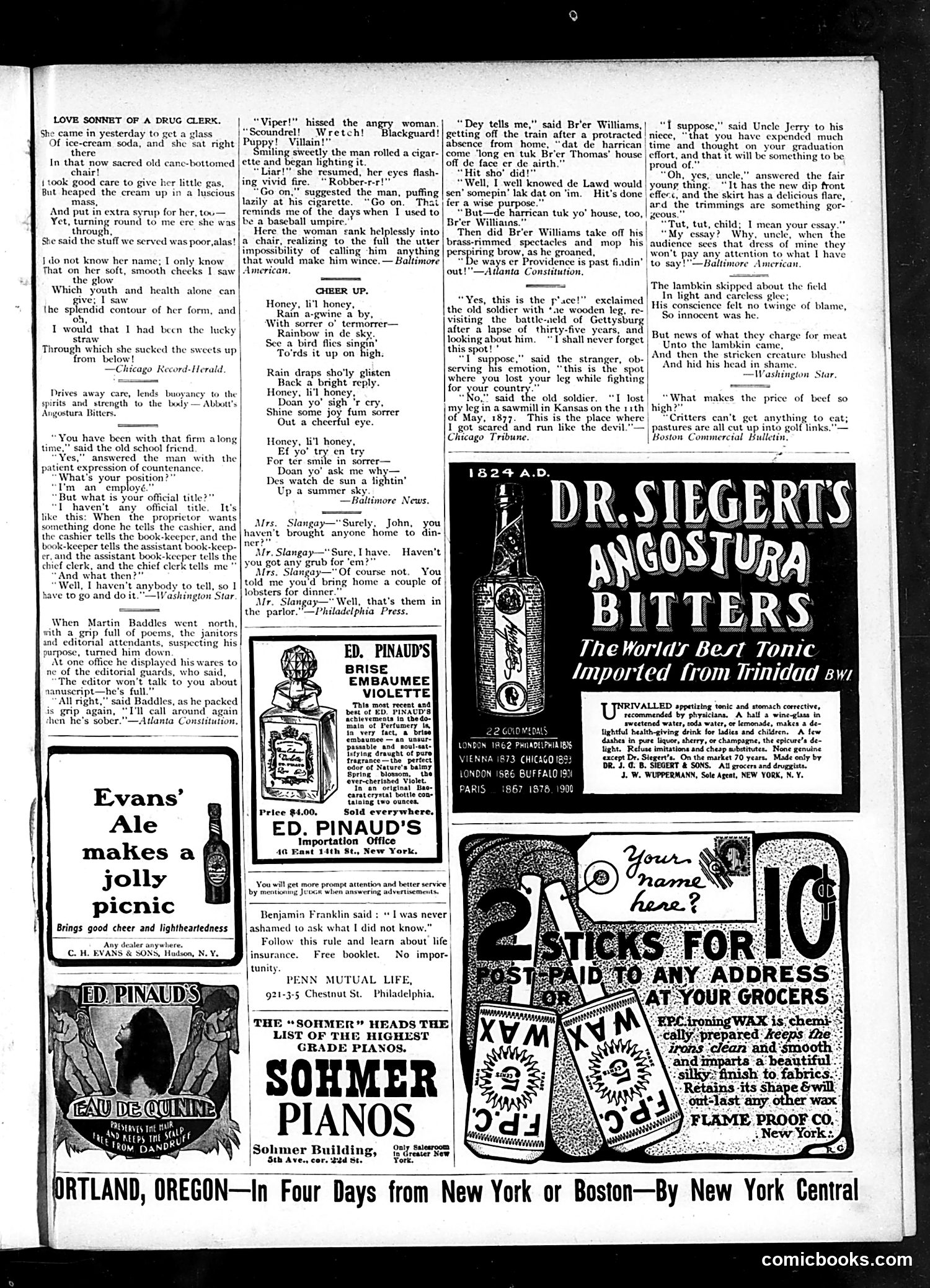
This page contains several short humorous stories typical of early 20th-century Judge magazine satirical content: **"Love Sonnet of a Drug Clerk"** depicts a smitten pharmacy employee who lavishly prepares an ice-cream soda for an attractive female customer, then laments his unrequited affection. The joke plays on the sentimental idealization of ordinary commercial transactions. **"Cheer Up"** stories feature rural African American dialect humor (Br'er Williams), common to the era's publications. One involves a man philosophically accepting hurricane damage; another recalls a Civil War amputee revisiting his injury site with nostalgic emotion. The page is primarily **advertising**, featuring promotions for Evans' Ale, Dr. Siegert's Angostura Bitters (imported from Trinidad), Ed. Pinaud's products, Sohmer Pianos, and Flame Proof Company wax polish. The content reflects period attitudes toward race, sentimentality, and consumer culture typical of early 1900s American humor magazines.
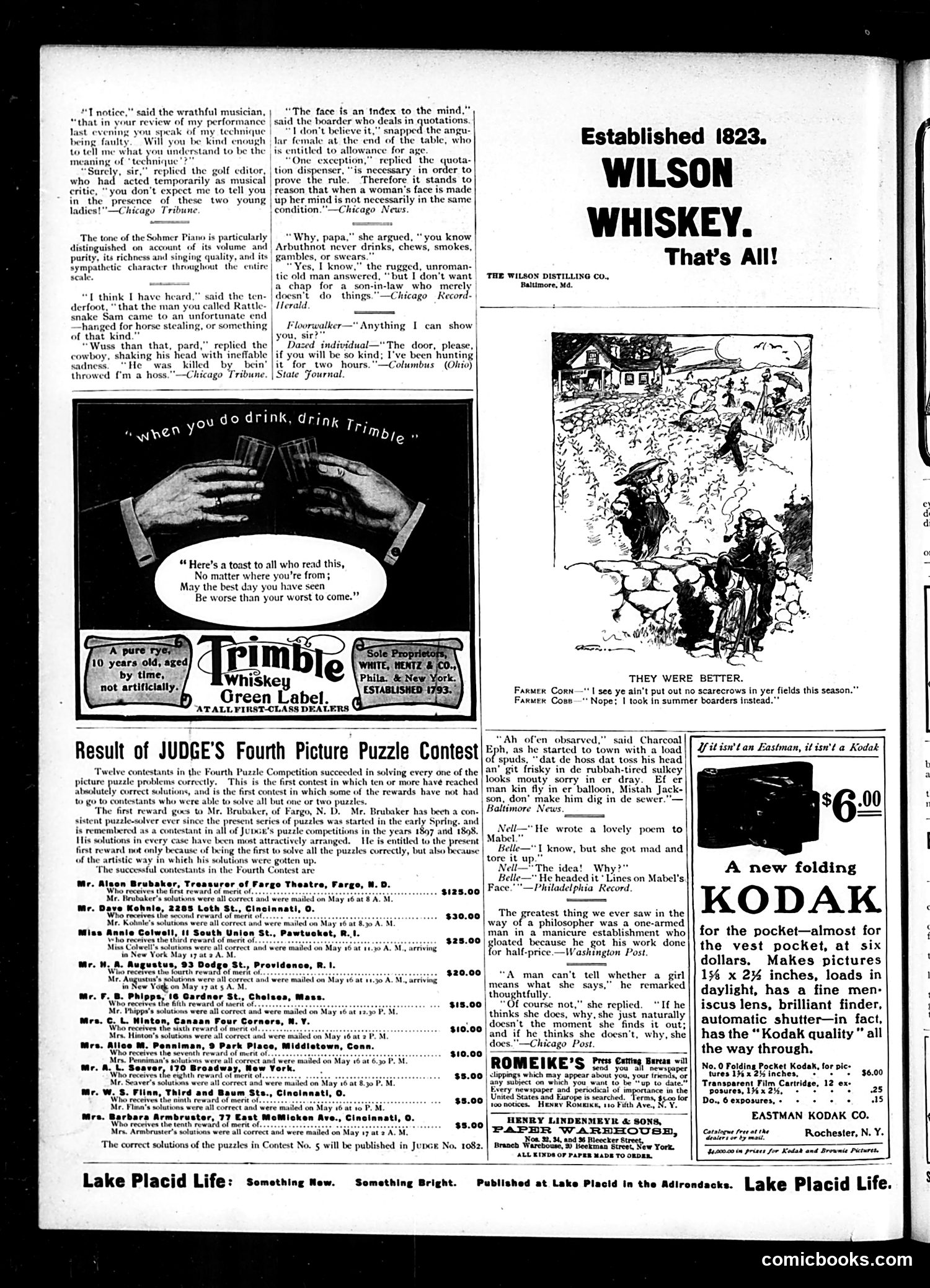
This page is primarily **advertisements and contest results**, not political satire. The main cartoons are lighthearted dialogues about social conduct: 1. **The "Technique" dialogue**: A musician insults a golf editor's knowledge, who deflects by claiming ignorance "in the presence of these two young ladies"—humor based on male deference to women in polite company. 2. **The "Index to the Mind" exchange**: A boarder argues that women who use makeup prove the saying "the face is an index to mind" is false—mild satire on women's cosmetics. 3. **The farmer dialogue**: Simple rural humor about an unsuitable suitor. The **Trimble Whiskey advertisement** and **Kodak camera ad** occupy significant space. The **Judge Puzzle Contest results** announce contest winners with prize money. **Context for modern readers**: This appears to be a typical Judge issue mixing genteel humor, advertising, and competitions—representative of early 1900s American magazine culture where satire was less biting and advertisements were interleaved throughout editorial content.
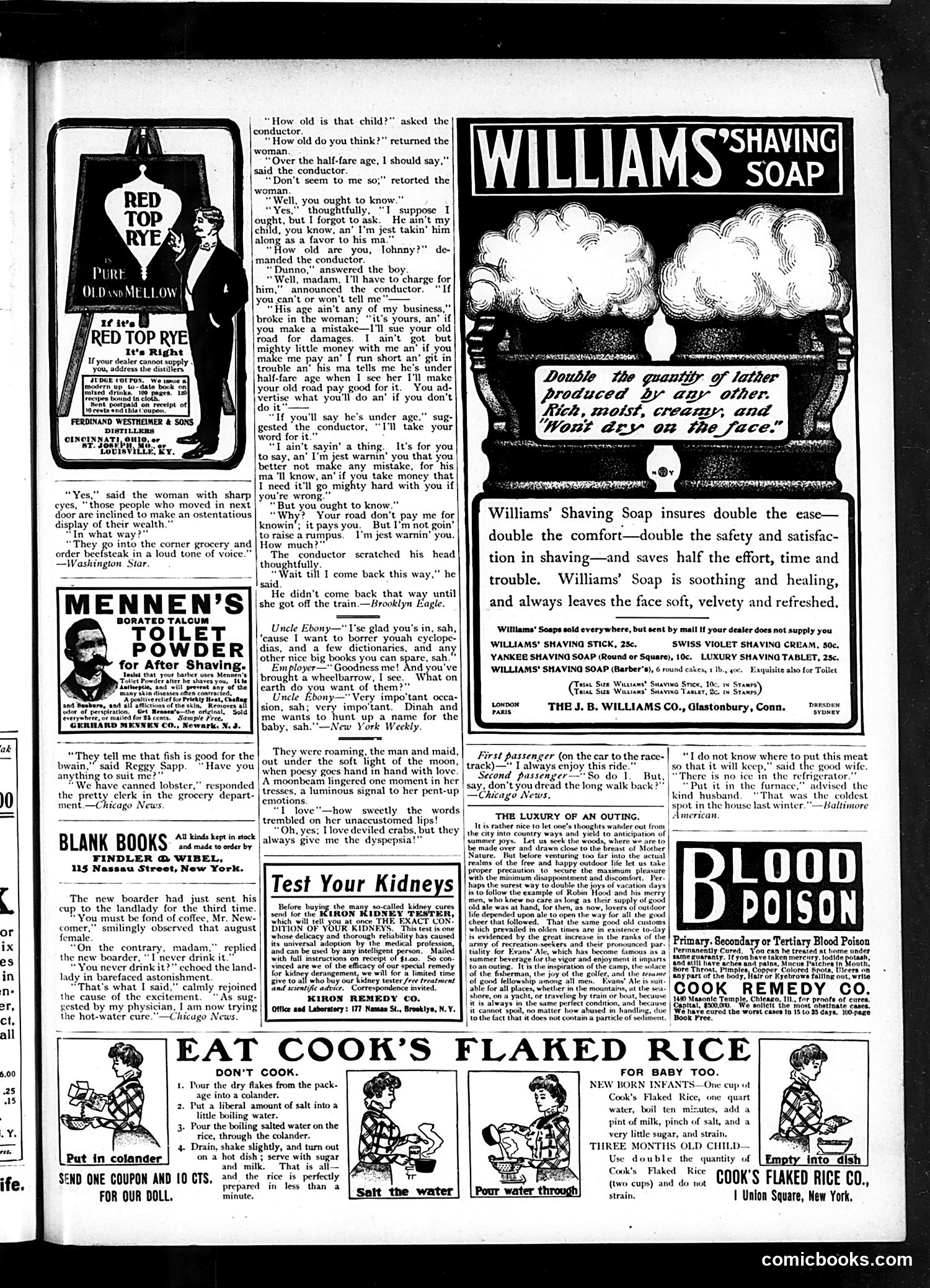
This page contains several unrelated satirical pieces typical of early 20th-century Judge magazine: **Main Cartoon (top):** A working-class woman outwits a railroad conductor over a child's fare. The satire targets both the conductor's assumption of authority and the woman's shrewd, confrontational response. She threatens to sue if he miscalculates the boy's age, turning his power against him through legal threat—a humorous commentary on ordinary people challenging institutional authority. **Side Cartoons:** Include "Uncle Ebony" (a stereotypical dialect-using Black character borrowing books—reflecting period racist caricature conventions) and brief dialogue jokes about fish being "good for the brain" and train passengers. **Advertisements:** The page is heavily populated with product ads (Williams' Shaving Soap, Cook's Flaked Rice, Blood Poison Remedy), reflecting how Judge subsidized content through advertising. The comedy relies on class dynamics, linguistic humor, and the "clever underdog" trope common to period American humor.
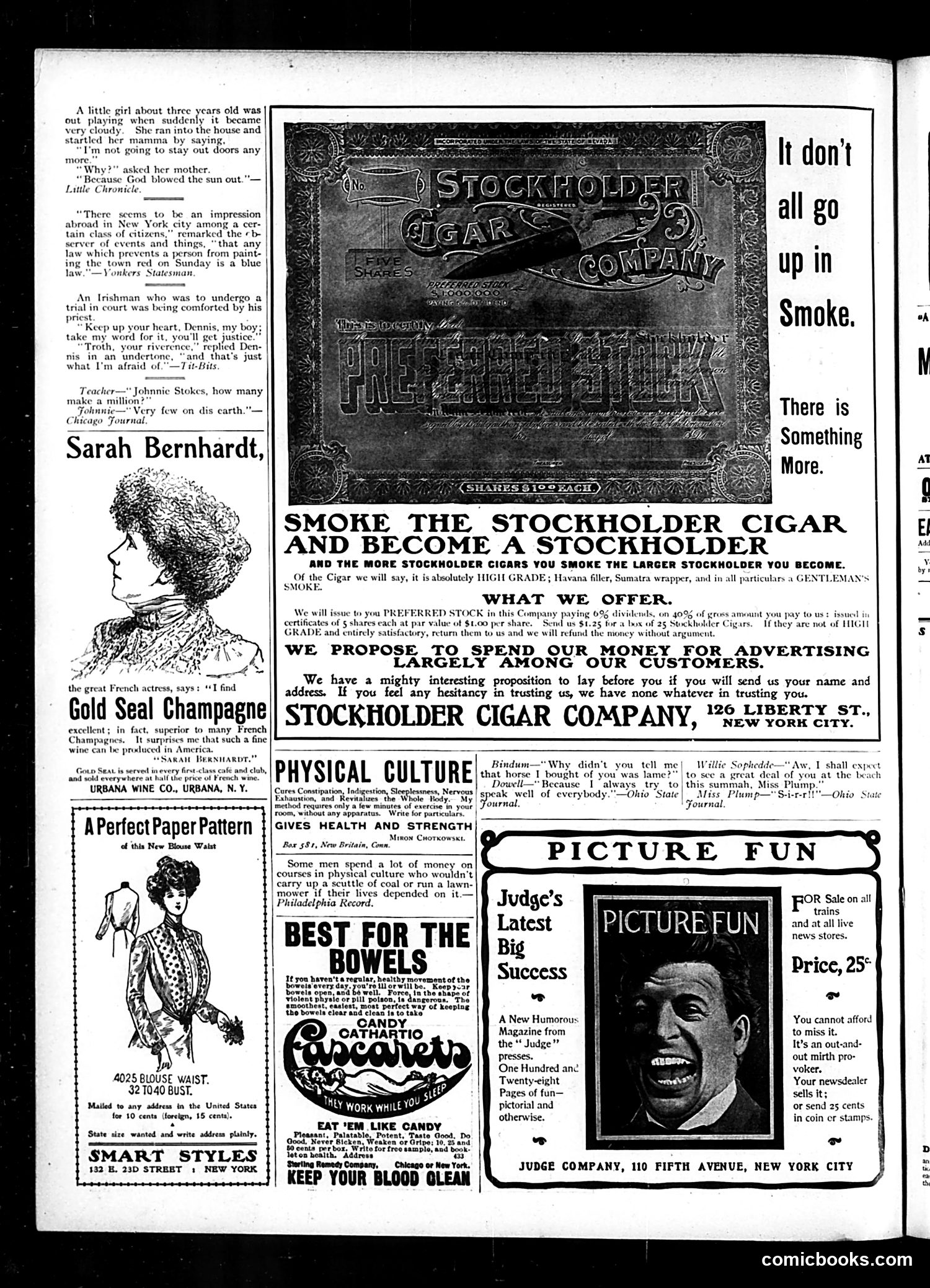
This page is primarily **advertisements and filler content** rather than political satire. The main elements include: **Major Advertisement:** The Stockholder Cigar Company dominates the center, promoting a scheme where purchasing cigars allegedly grants stock certificates—a transparently dubious financial proposition. The ad's overwrought claims ("the more cigars you smoke, the larger stockholder you become") suggest this is either satirizing get-rich-quick schemes or promoting an actual dubious product. **Supporting Content:** The page includes endorsements (Sarah Bernhardt praising Gold Seal Champagne), patent advertisements (a blouse waist pattern), and product promotions (Cascarets laxative, Physical Culture magazine). **Brief Humor Pieces:** Short, mild jokes appear—a child misinterpreting thunder, mild romantic banter—typical of Judge's filler material. **Notable:** The advertisements themselves may constitute the satire, mocking the extravagant claims and dubious products marketed to readers, though the page functions primarily as revenue-generating ad space rather than critical commentary.
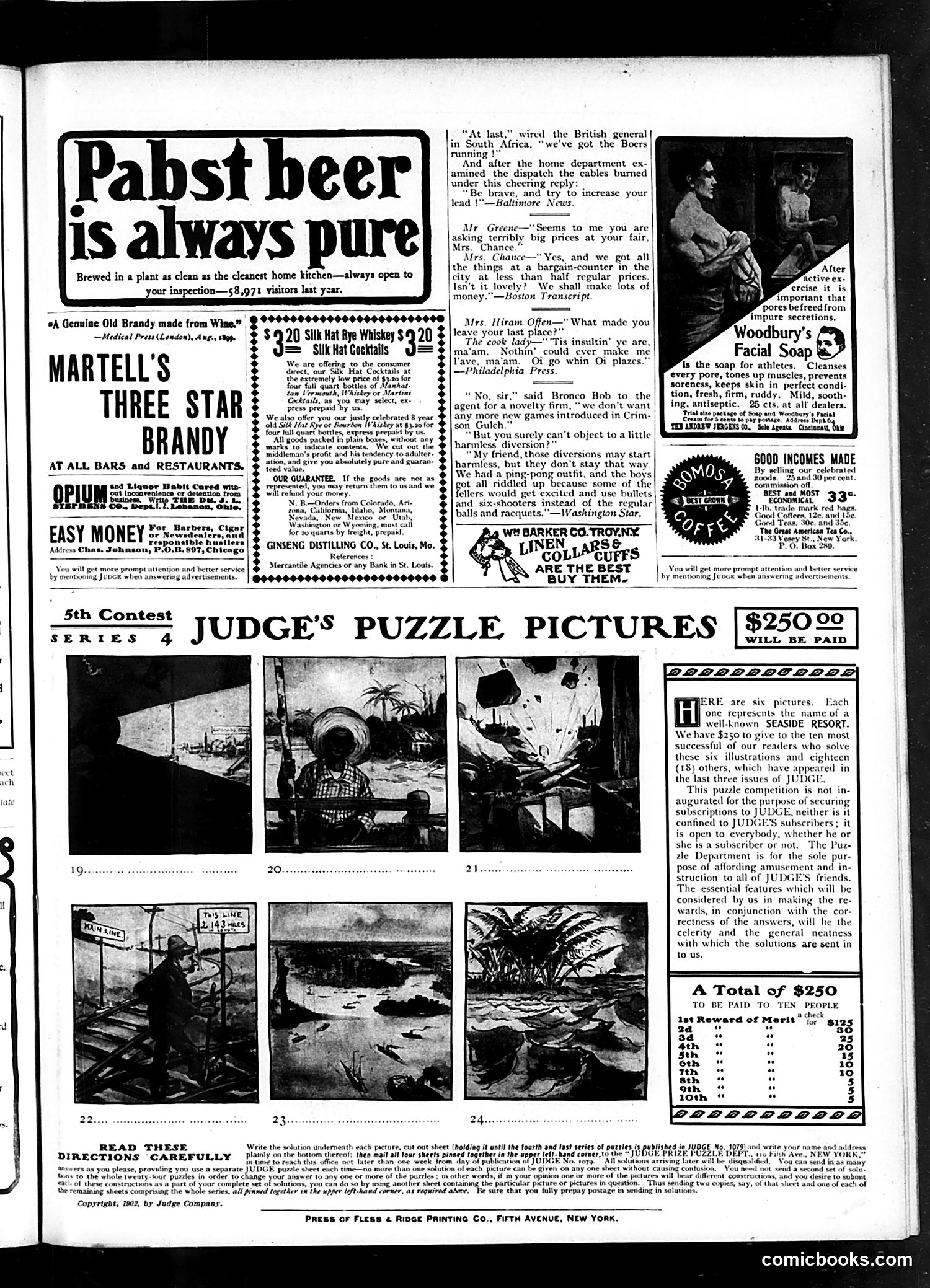
This page is primarily **advertisements and a puzzle contest**, not political satire. The only satirical content appears in brief anecdotes at the top: 1. **"At last" anecdote**: References the **Boer War** (British conflict in South Africa, 1899-1902). The joke mocks the British military's optimistic dispatches about pursuing the Boers, only to be undercut by a sarcastic home office reply urging them to "increase your lead"—suggesting the Boers are still winning despite claims of success. 2. **Other brief jokes**: Social humor about merchants overcharging at fairs, a cook leaving her employer, and a novelty firm trying to introduce games to a mining town. The bulk of the page features **product advertisements** (Pabst beer, Martell brandy, facial soap) and a **$250 puzzle contest** where readers identify six mystery seaside resort pictures. The puzzle section notes it's open to all readers, not just JUDGE subscribers.
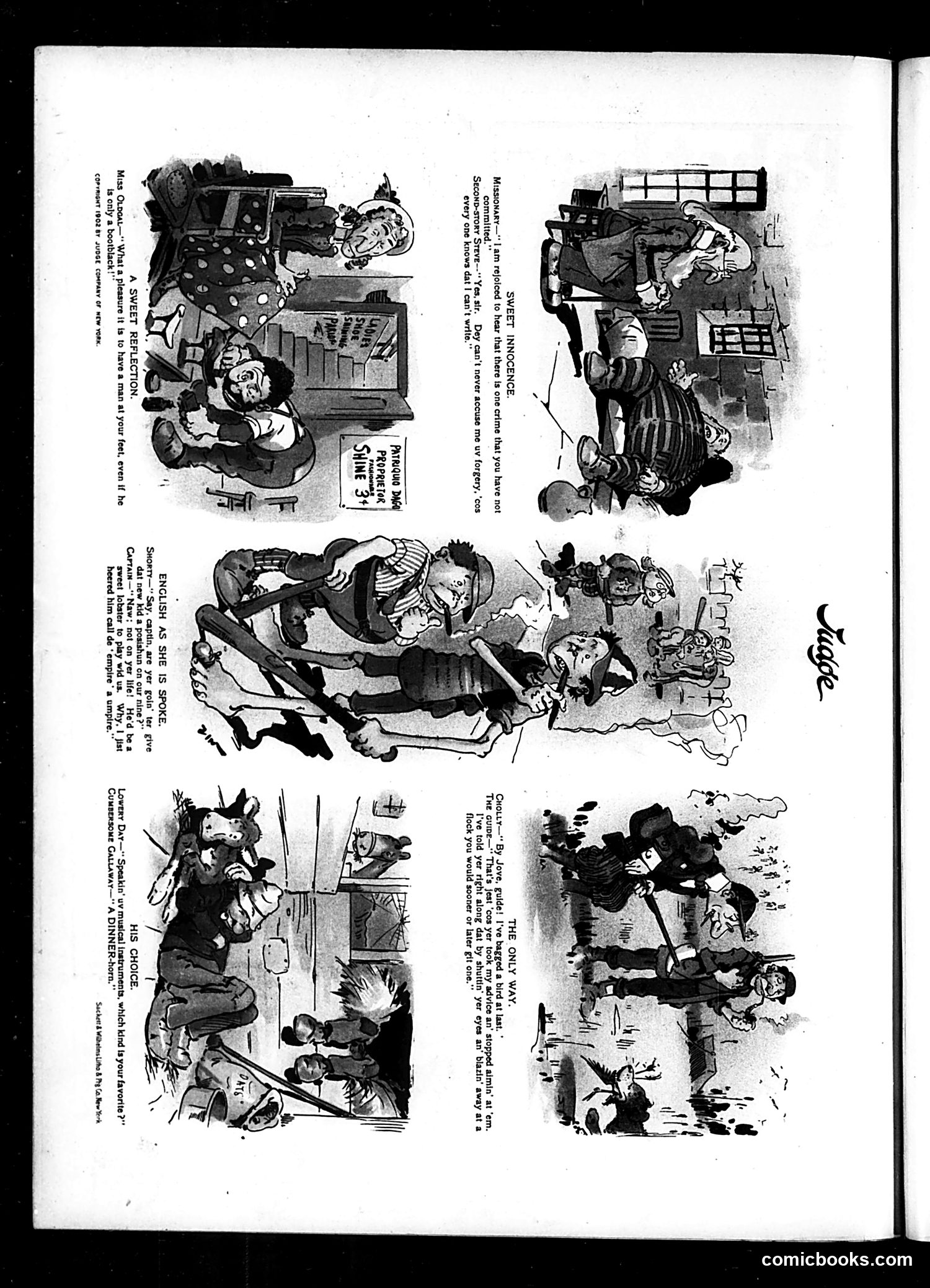
This page contains five separate satirical comic strips mocking social types and linguistic pretensions of the era: **"Sweet Innocence"** ridicules a missionary's naiveté about crime, with a criminal proudly noting he hasn't committed forgery—because he's illiterate. **"The Only Way"** shows a hunter advised to close his eyes and fire randomly at birds to eventually hit something, satirizing incompetence rewarded by blind luck. **"English As She Is Spoke"** mocks working-class dialect and malapropisms (calling an "umpire" an "empire"), reflecting period class anxieties about proper speech. **"His Choice"** features a woman romanticizing poverty, finding it charming to have a bootblack admire her. **"Patriquio Dag"** (partially visible) appears to reference similar class-based humor. The cartoons exemplify Judge's satirical approach: mocking immigrant/working-class speech patterns, criminal types, and sentimental middle-class attitudes—reflecting early-1900s American class consciousness and linguistic prejudices.