
A complete issue · 16 pages · 1902
Judge — June 14, 1902
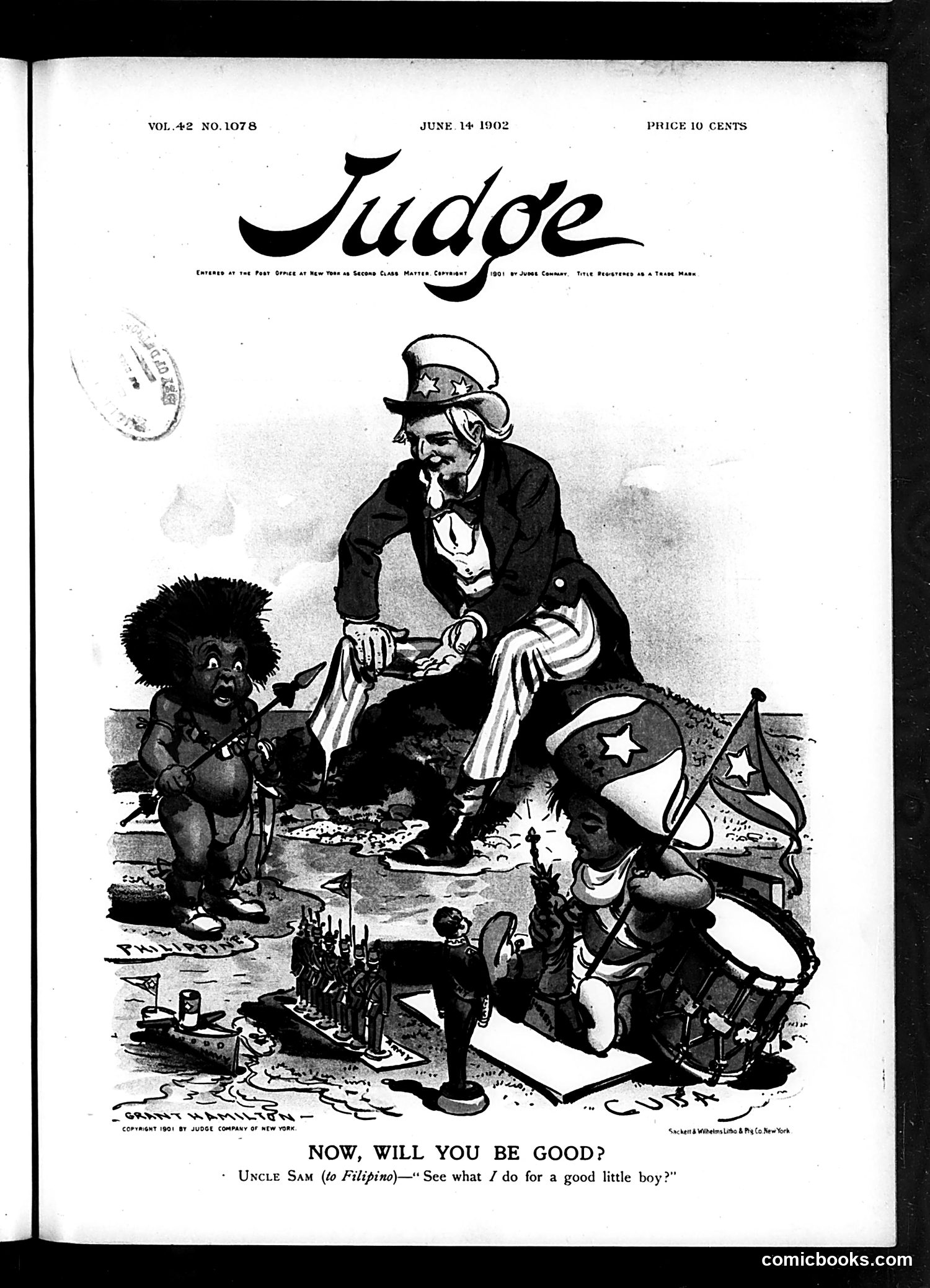
This June 1902 *Judge* cartoon uses Uncle Sam (the tall figure in stars-and-stripes clothing) as a disciplinarian figure confronting what appear to be caricatured Filipino figures. The caption's patronizing tone—"See what I do for a good little boy?"—suggests this satirizes American imperial policy in the Philippines. The cartoon likely comments on the ongoing Philippine-American War (1899-1902) and U.S. colonial administration. Uncle Sam presents military weapons and supplies, framing American intervention as benevolent "reward" for obedience, while depicting Filipinos in dehumanizing racial caricature. The satire appears critical of American paternalism disguised as benevolence—mocking the justification that U.S. military occupation served Filipino interests or development.
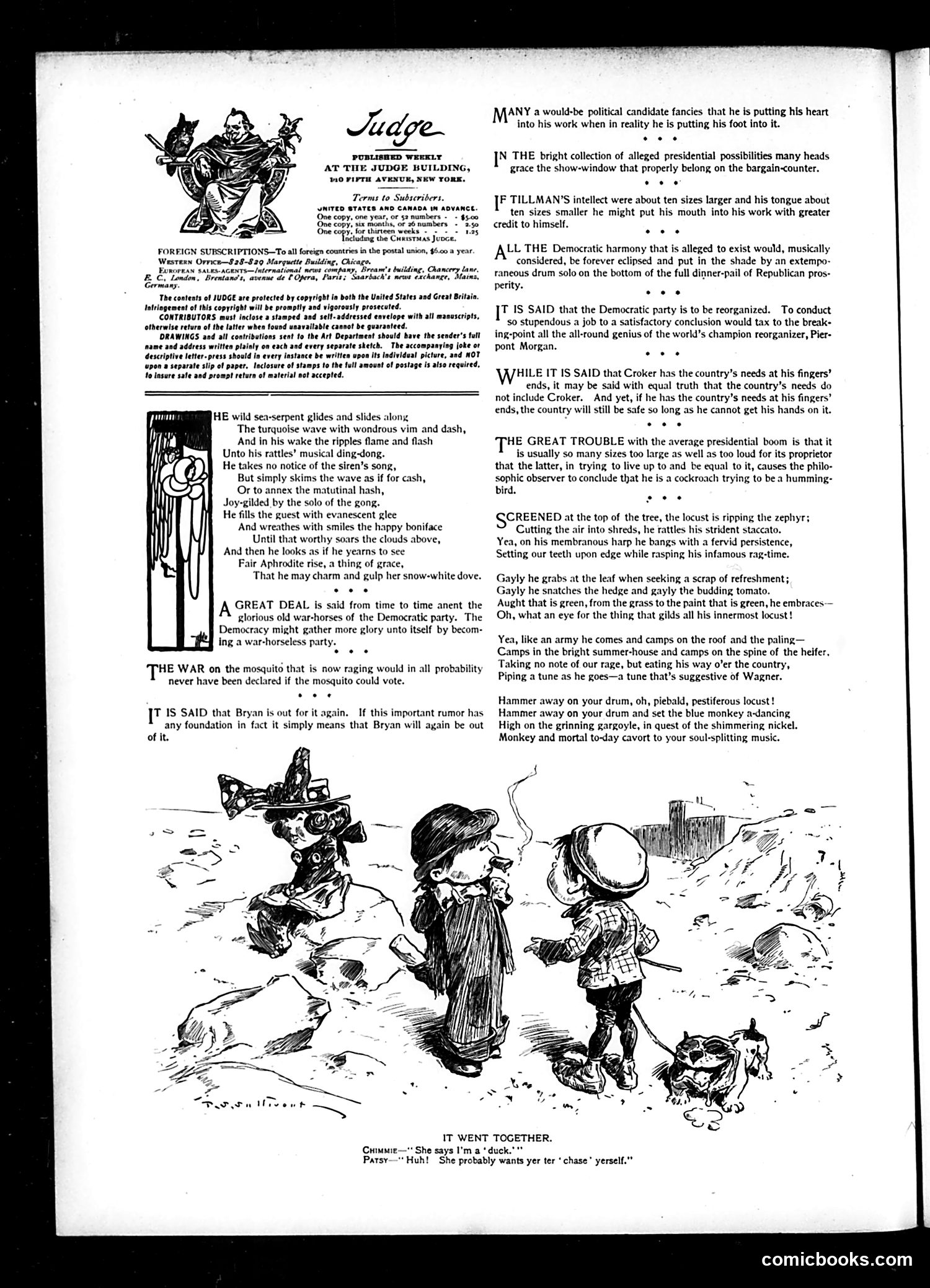
This page contains political commentary and satirical observations about early 20th-century American politics. The main text critiques various political figures and movements, including jabs at presidential candidates, the Democratic Party's organizational challenges, and figures like Croker and Tillman. The bottom cartoon depicts children playing, with the caption "IT WENT TOGETHER" and dialogue about a "duck" and "chasing yourself"—likely a metaphor for political futility or circular arguments. The left sidebar contains a poem about a musical guest, seemingly unrelated political satire. Overall, the page targets political incompetence and the absurdity of campaign promises, using humor to comment on contemporary political figures whose specific identities would require additional historical context to fully confirm.
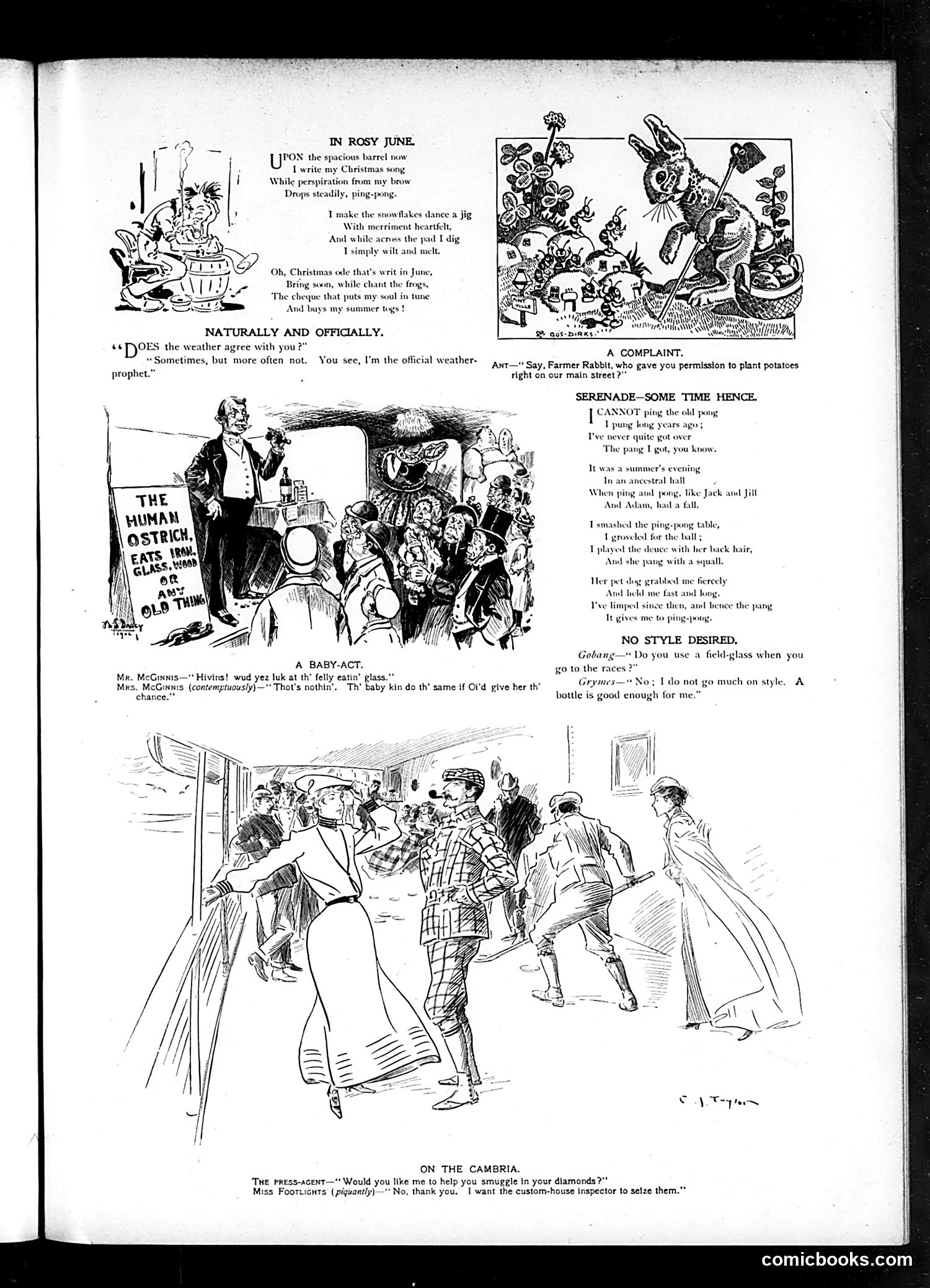
This page contains several humorous sketches and poems typical of Judge's satirical style: **"In Rosy June"** presents whimsical verse about Christmas in summer, illustrated with fanciful creatures. **"Naturally and Officially"** depicts a weather official as a fortune teller, making fun of meteorological predictions' unreliability—a long-standing joke about weather forecasters' poor accuracy. **"The Human Ostrich"** satirizes someone who ignores obvious truths, a common metaphor for willful blindness. **"A Baby-Act"** mocks mothers' speech around infants using exaggerated dialect. **"On the Cambria"** references ship customs, with a press agent attempting to help a passenger (Miss Footlights) smuggle diamonds past customs inspection—satirizing both journalistic corruption and wealthy passengers' attempted tax evasion. The page's humor relies on recognizable social types and everyday situations rather than specific political events.
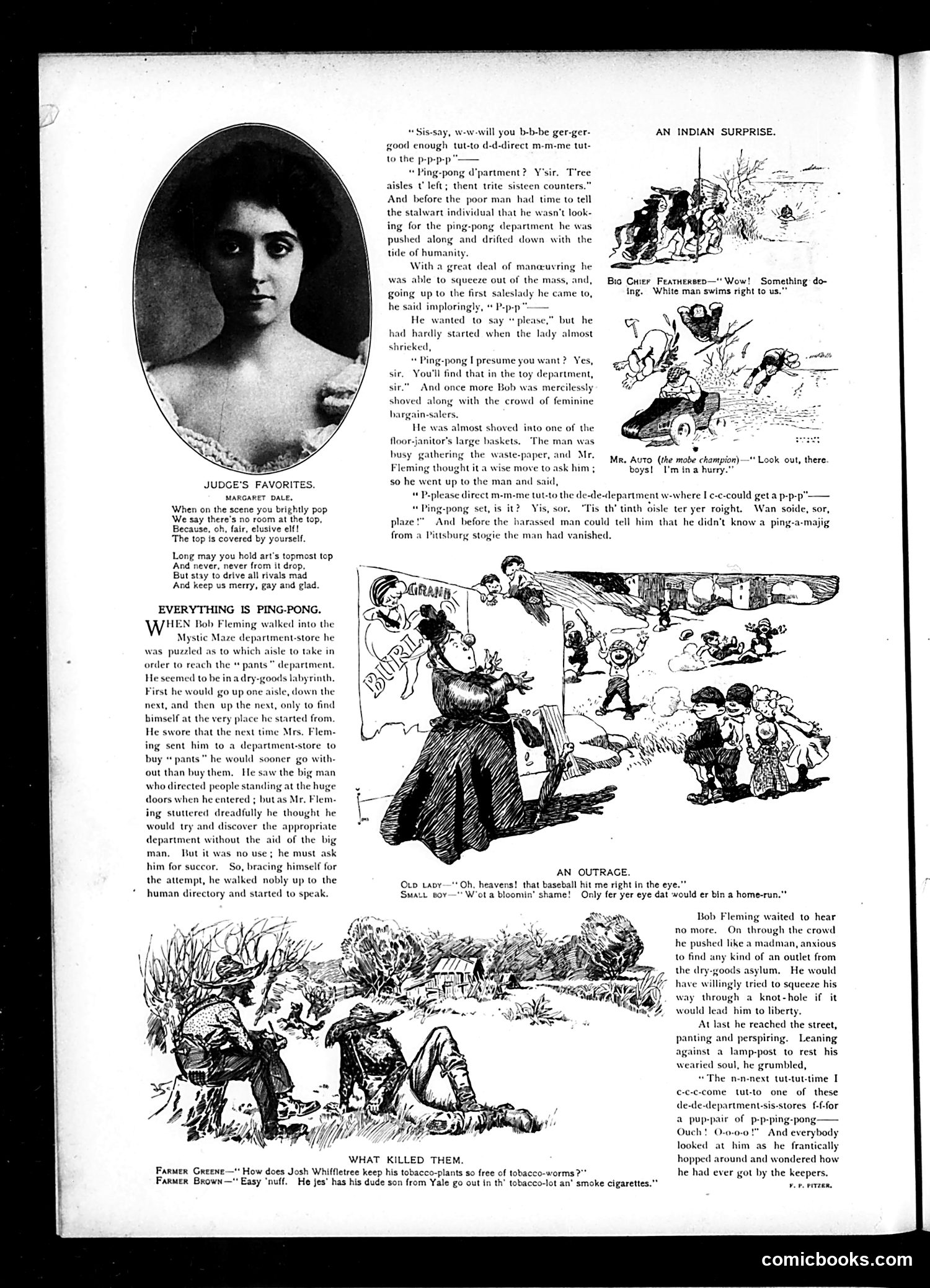
This page contains a humorous story about "ping-pong" department store shopping. The narrative follows Bob Fleming, a man navigating a chaotic dry-goods store to find ping-pong equipment. The satire mocks the confusing layout of late 19th/early 20th-century department stores and the specialized jargon used by sales clerks. The accompanying illustrations satirize urban retail chaos: customers crowding aisles, bewildered shoppers, and a dismissive sales culture indifferent to customer needs. Additional cartoons labeled "An Indian Surprise" and "An Outrage" appear to offer unrelated social commentary, though their specific targets remain unclear from context alone. The overall joke reflects period frustration with modern commercialism and impersonal retail environments.
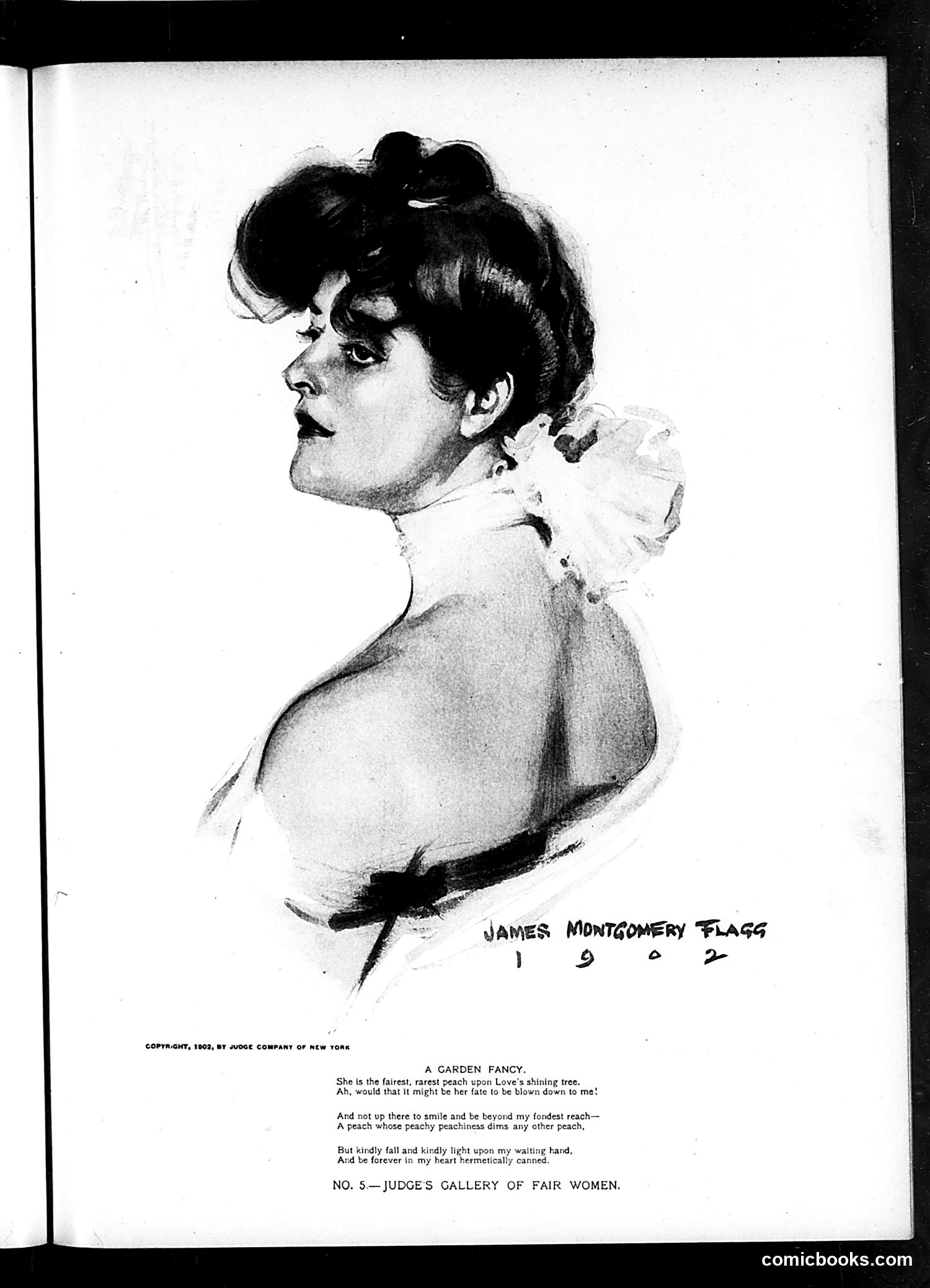
This is a portrait illustration by James Montgomery Flagg from Judge's "Gallery of Fair Women" series. Rather than political satire, it's a romantic/humorous verse accompanying an idealized portrait drawing of a woman in profile. The accompanying poem uses extended fruit metaphor—comparing a desired woman to a "peach" that the speaker wishes would "fall" into his hands. The humor is in the overwrought romantic language and the final pun: he wants to preserve her "hermetically canned" (sealed and preserved), suggesting he wants to possess and keep her permanently. This reflects early 1900s attitudes toward women as objects of romantic pursuit. Flagg was known for such society illustration work. The piece is sentimental rather than satirical—typical of Judge's lighter content featuring attractive women alongside coy, flowery verses.
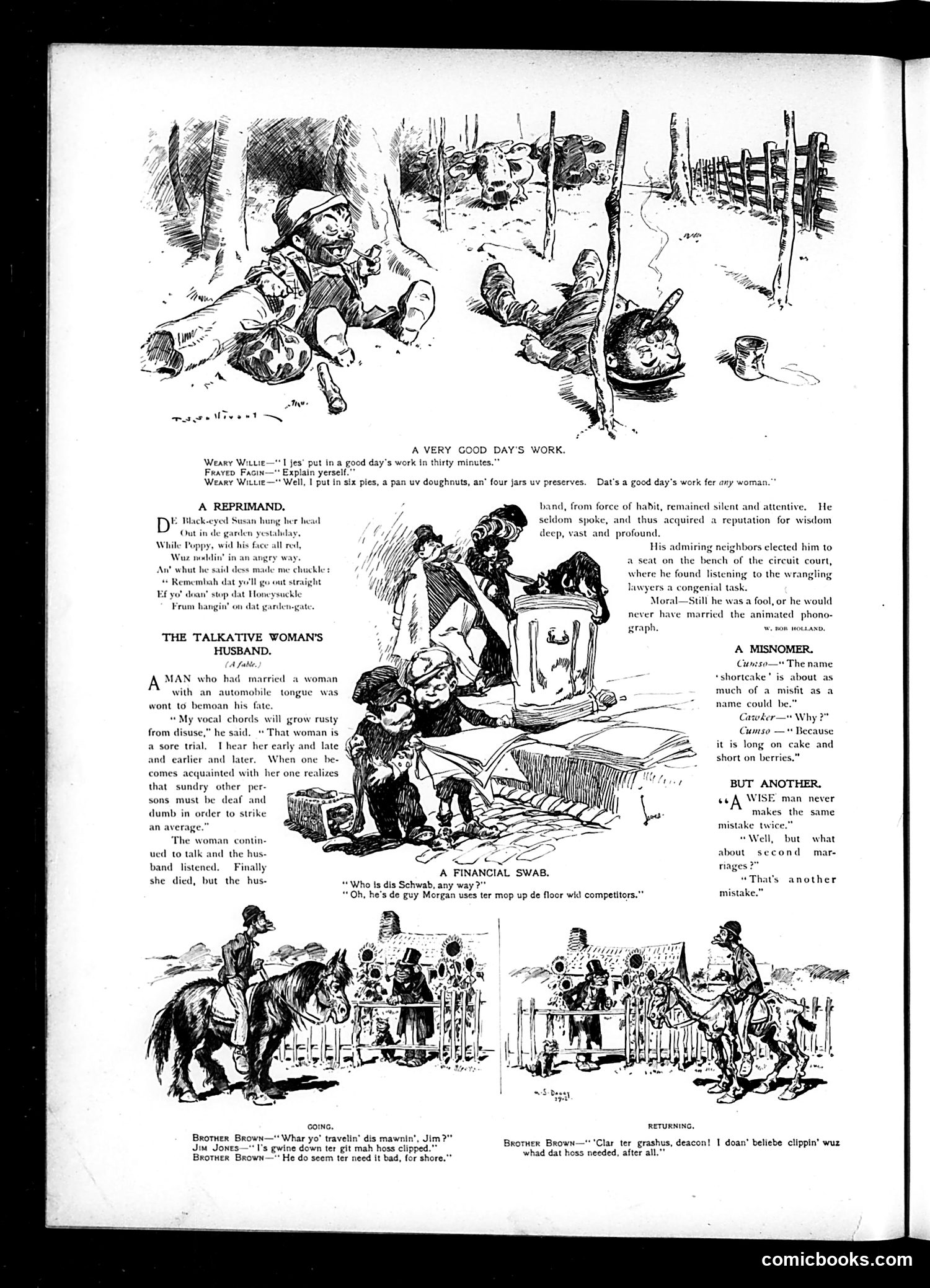
This page contains several short humorous pieces satirizing everyday American life, circa early 1900s: **"A Very Good Day's Work"** mocks working-class women's domestic labor through dialect humor—a vagrant claims baking six pies and canning preserves constitutes a full day's accomplishment. **"The Talkative Woman's Husband"** presents a fable about an incessant talker whose silence after death finally grants her husband peace—satirizing nagging wives. **"A Financial Swab"** references J.P. Morgan, the powerful banker, comparing a figure named Schwab (likely Charles Schwab, steel magnate) to a mop Morgan uses to eliminate competitors—mocking corporate consolidation and monopolistic practices. **"A Reprimand"** and other brief pieces use rural dialect and domestic scenarios for light social commentary. The page relies on period-typical stereotypes (ethnic dialects, gender roles) and targets recognizable wealthy industrialists. The humor reflects Judge's audience: educated readers amused by mockery of both working-class vernacular and robber-baron business tactics.
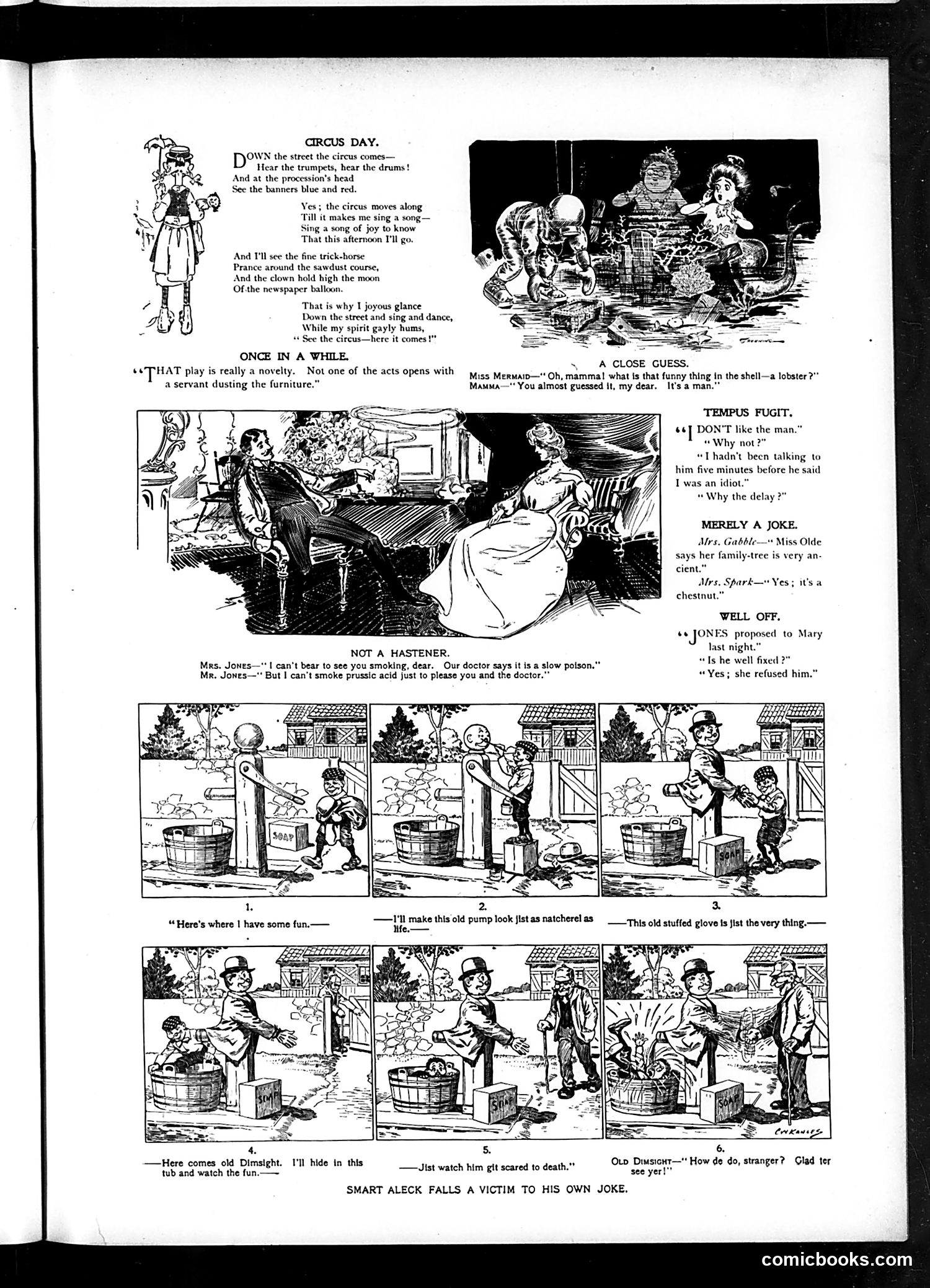
This page from *Judge* magazine contains several brief jokes and comic strips typical of early 20th-century American humor: **"Circus Day"** is a sentimental poem celebrating children's excitement about attending the circus—a major entertainment event of the era. **"Once in a While"** jokes that modern theatrical productions are novelties because they *don't* open with the tired old trope of a servant dusting furniture. **"A Close Guess"** plays on a child mistaking a man in a shell costume for a lobster—mild physical comedy. **"Smart Aleck Falls a Victim to His Own Joke"** (the main comic strip) depicts a prankster planning to frighten an old man named Dimsight by hiding in a washtub, but the old man accidentally falls into the water himself while searching for the prankster. The remaining items are brief wordplay jokes about courtship, family ancestry, and poison ("slow poison" as marital complaint). The humor is gentle domestic satire typical of *Judge's* middle-class audience.
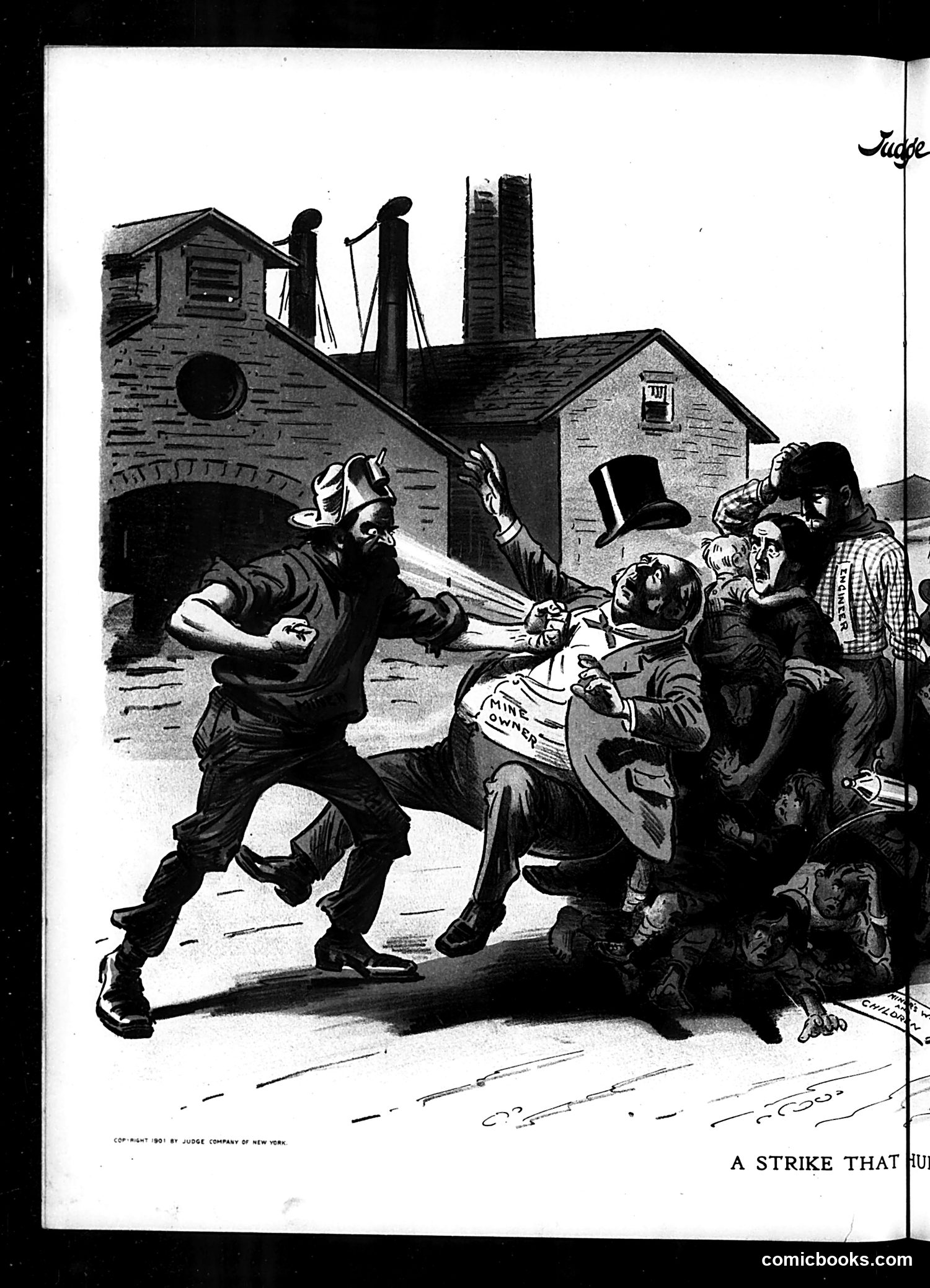
This cartoon depicts a violent confrontation between what appears to be a police officer or authority figure (left, wielding a club) and workers labeled "MINE OWNER" (center). The scene shows industrial buildings with smokestacks in the background, establishing a mining or factory setting. The satire critiques labor strike violence, likely from the late 19th or early 20th century when mining strikes were frequently brutal. The cartoon's title suggests commentary on strikes that backfire or cause harm. The composition suggests Judge magazine's likely anti-labor stance—portraying workers/strikers as victims of their own violence or depicting them unsympathetically. The formal dress of the "mine owner" contrasts with working-class figures, emphasizing class divisions central to labor disputes of this era. The specific historical strike referenced remains unclear without additional context.
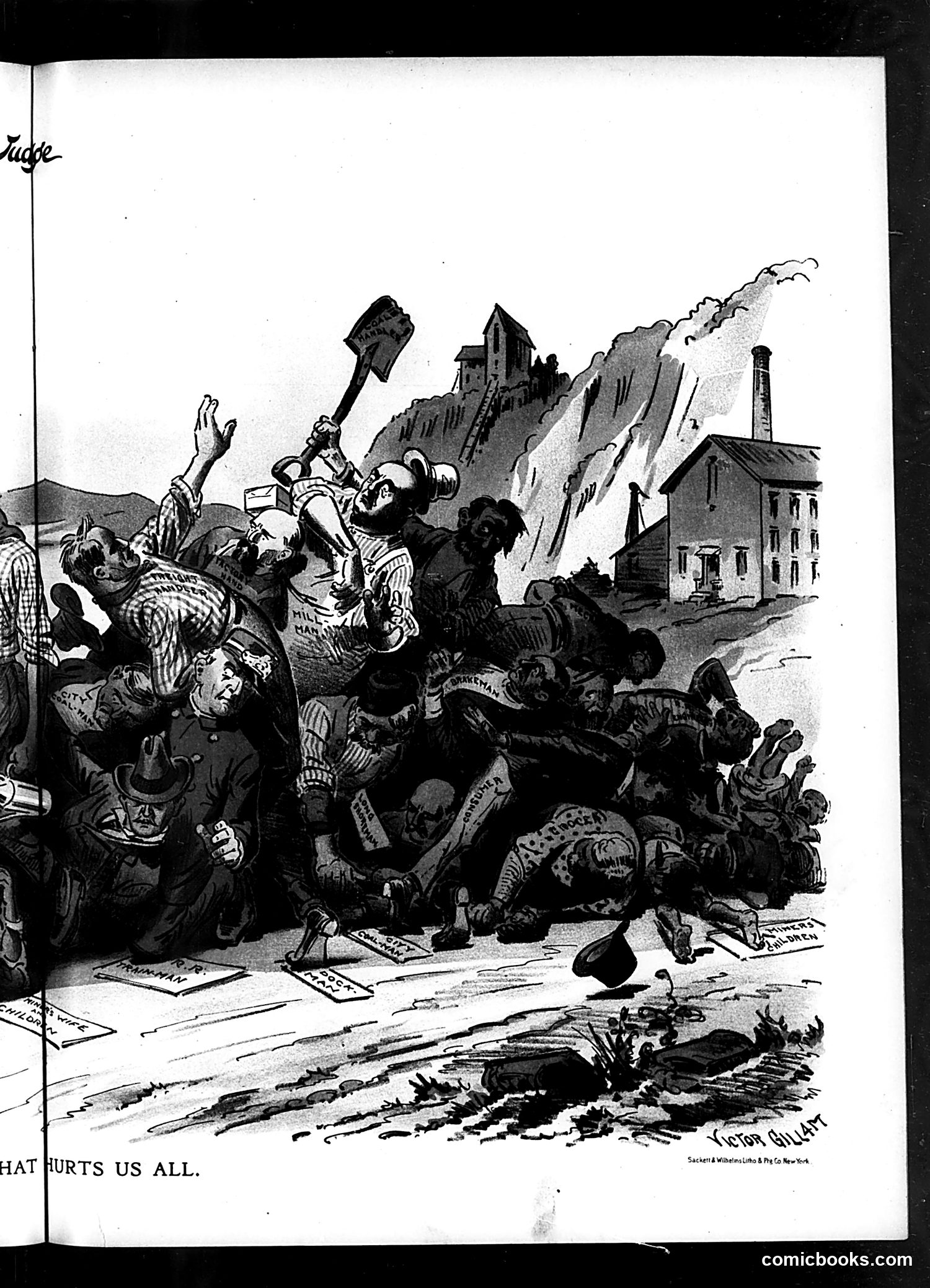
This political cartoon depicts a chaotic violent scene with multiple figures engaged in conflict near an industrial landscape (factory with smokestack visible). The composition suggests labor unrest or class conflict, a common Judge magazine subject in the late 19th/early 20th century. A central figure wields a large shovel or axe above the crowd in an aggressive pose. The scattered papers on the ground and the phrase "THAT HURTS US ALL" suggest the cartoon criticizes destructive labor violence or radical activism, arguing such actions harm society broadly—not just specific targets. The artist appears to be Victor Gillam (visible signature). Without the exact publication date, the specific event referenced remains unclear, though the imagery suggests commentary on industrial-era labor disputes.
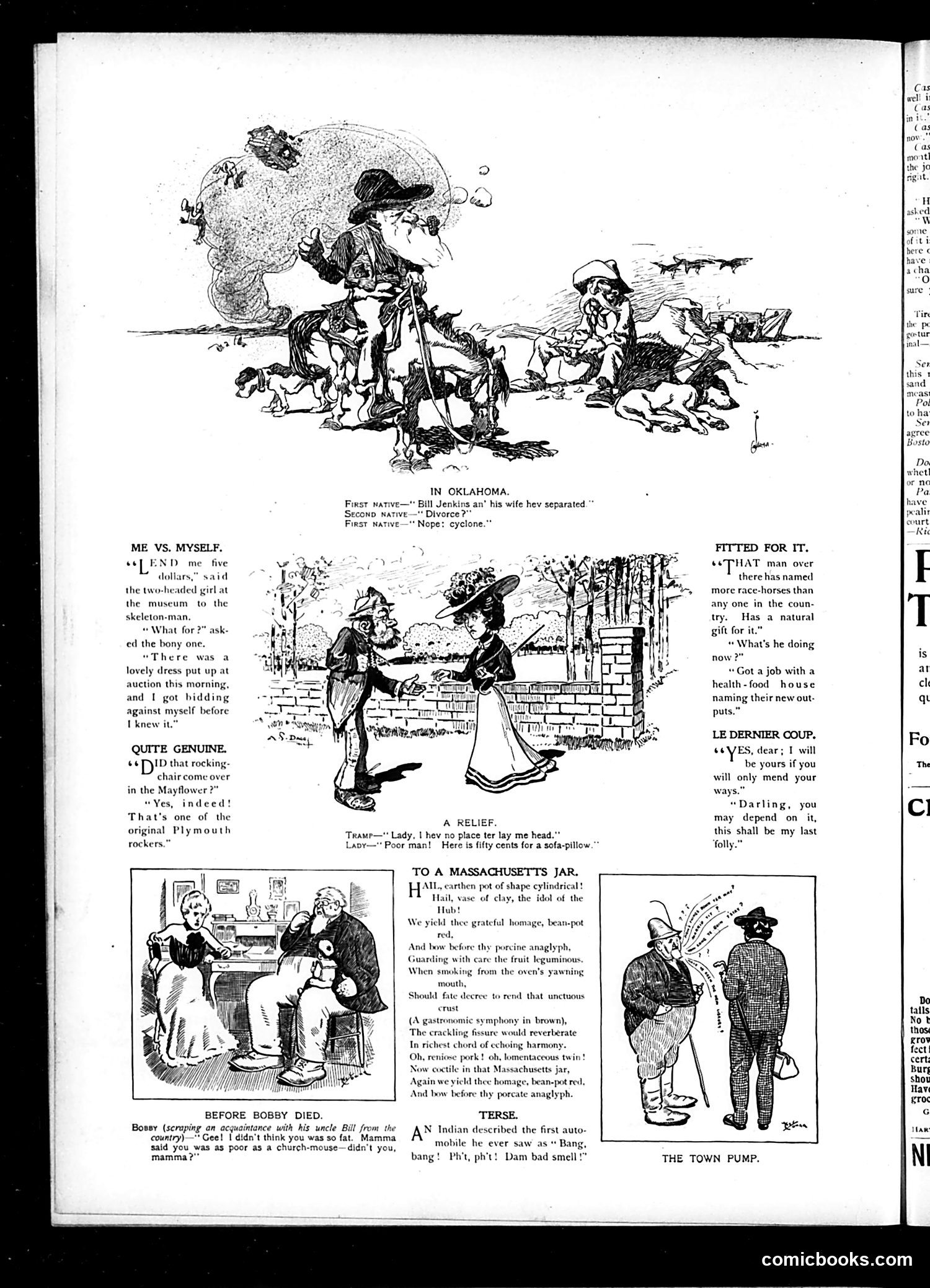
This page contains multiple satirical cartoons and humorous verses typical of late 19th/early 20th-century American humor: **"In Oklahoma"** mocks frontier life—a couple separated not by divorce but by a cyclone, suggesting the harsh, chaotic conditions of the Oklahoma Territory. **"Me vs. Myself"** jokes about absent-mindedness: a museum visitor bid against herself at an auction while distracted. **"Fitted for It"** satirizes specialized job placement—a man naturally gifted at naming racehorses is now employed naming health-food products, implying absurd corporate practices. **"Quite Genuine"** presents a Mayflower rocking chair as a humorous colonial relic. **"To a Massachusetts Jar"** parodies pretentious poetry by lavishing flowery verses on a baked-bean pot—mocking both regional New England pride and overwrought literary style. **"Before Bobby Died"** and **"The Town Pump"** appear to be brief anecdotal jokes about rural/working-class characters. Overall, the page satirizes American regionalism, pretension, and everyday absurdities through exaggerated dialect and situations.
This page consists primarily of **advertisements and brief humorous anecdotes** rather than political cartoons. The text snippets are short jokes about everyday situations: a man asking about climate (discovering construction noise, not weather, spoils the day); a senator rejecting a bribe; a doctor unable to diagnose constitutional illness; optimists grateful for colds; and a woman staring (turning the tables on a starer). **The advertisements** dominate: Packer's Tar Soap, Chartreuse liqueur, Club Cocktails, Whitman's Chocolates, Evans' Ale, The Prudential Insurance Company, Beeman's Pepsin Gum, and Sohmer Pianos. These reflect early 20th-century consumer products and services. There are **no identifiable political figures or satire** on this page. It appears to be a typical Judge magazine layout mixing light humor with paid advertisements—common practice for satirical magazines of this era, which relied on advertising revenue.
This page is primarily **advertising**, not political satire. The bulk consists of product promotions typical of early 1900s magazines: diamonds on credit, whiskey, brandy, bitters, collars, rubber goods, cigars, and breakfast cereal. The small humorous anecdotes scattered throughout are **gentle domestic humor** rather than satire: - A dialogue about dogs' lives versus human toothaches - A husband reluctant to walk the baby at night due to "golf shoulder" - A father's crude pun ("Dam it") about his daughter's flowery love metaphor These jokes target common middle-class complaints—dental pain, marital obligations, bad puns—not political figures or social movements. The only mildly satirical element appears in a brief quip: "People who never worry are entitled to a lot of credit they never get"—a play on financial credit that gently mocks carefree attitudes. Otherwise, this is a straightforward commercial magazine page using light humor to entertain readers between advertisements.
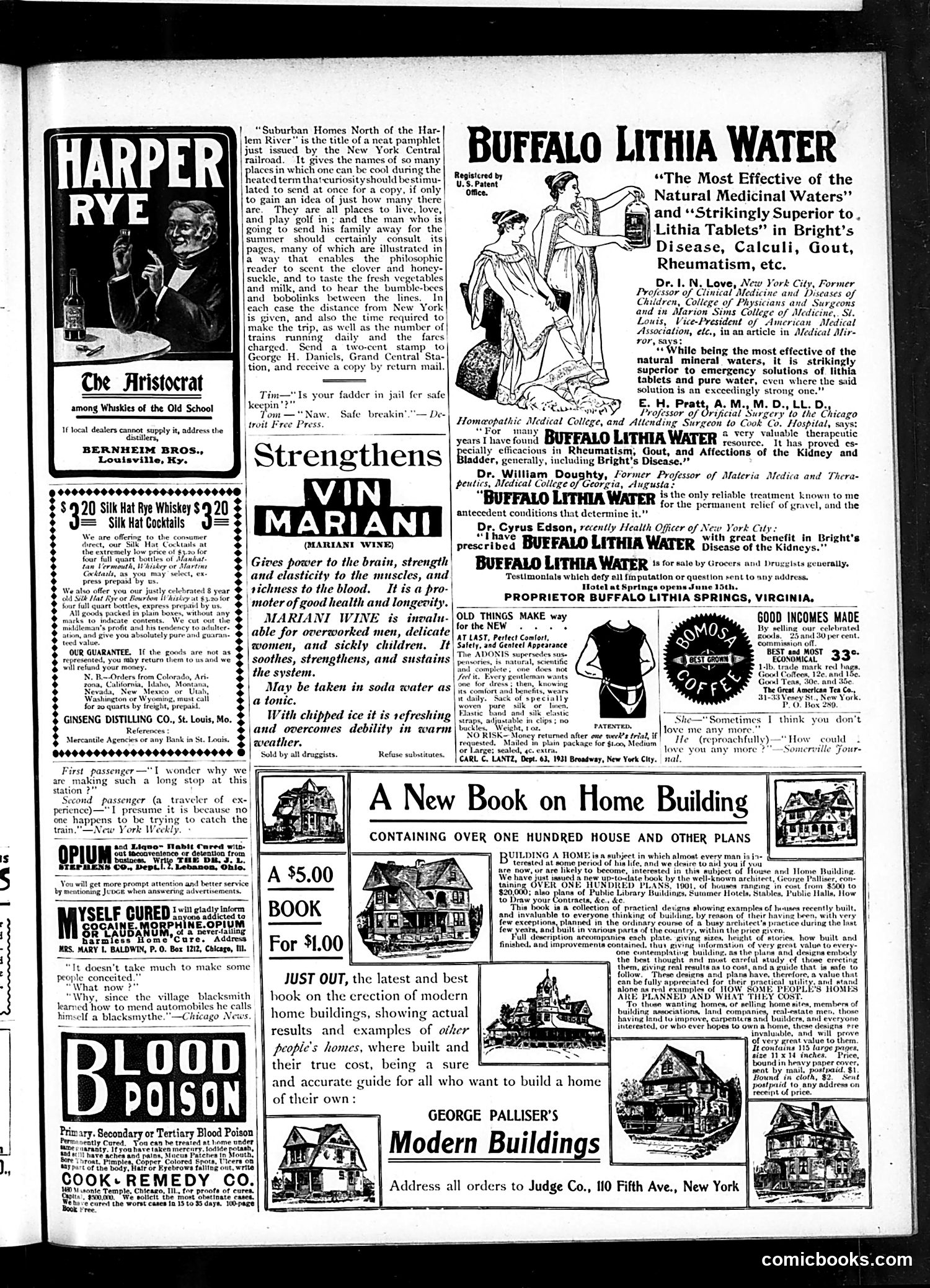
This page is primarily **advertising**, not political satire. The visible cartoons are brief, crude jokes: **"The Aristocrat"** shows a dialogue between two men—one asks if the other's father is in jail for "safe breaking," receiving the reply "Naw. Safe breakin'" (meaning the father is bad at breaking into safes). This is a simple ethnic-dialect joke, common in period humor. The page is dominated by **product advertisements**: Harper Rye Whiskey, Mariani Wine (marketed as a tonic), Buffalo Lithia Water (promoted as medicinal treatment for gout and kidney disease), and a home-building book. The ads employ pseudo-scientific testimonials from doctors—typical of early 20th-century patent medicine marketing, now recognized as fraudulent. The "medicinal waters" and tonics were common commercial products making exaggerated health claims. **Notable context**: This reveals how Judge magazine, while satirical, relied heavily on advertising revenue, mixing editorial content with endorsements for products we'd now recognize as dubious health remedies.
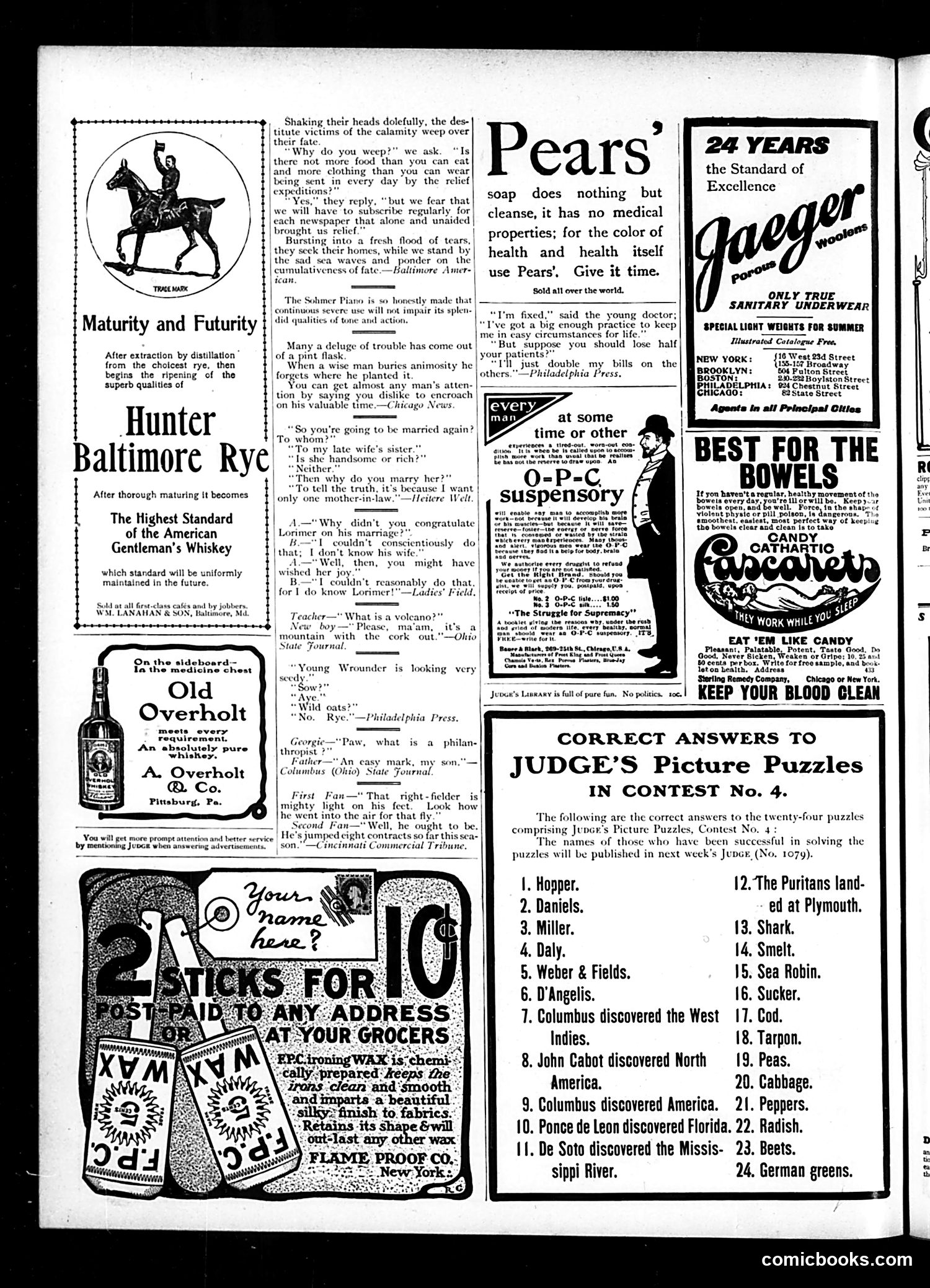
This page is primarily **advertising and contest answers**, not political satire. The main content includes: **Advertisements:** Whiskey (Hunter Baltimore Rye), soap (Pears'), underwear (Jaeger), laxatives (Candy Cathartic), and wax products dominate the page. These represent typical early 20th-century consumer goods marketing. **Humor section:** Brief comedic exchanges about marriage, volcanoes, and a baseball player—light domestic and wordplay jokes typical of Judge's humor columns. **Picture Puzzle answers:** The bulk of the lower half lists correct answers to a previous contest, featuring historical discoverers (Columbus, De Soto, Ponce de Leon) and vegetables/fish (peas, cod, radish, beets). The page reflects **no apparent political commentary**—it's a commercial product primarily serving as a vehicle for advertisements interspersed with genteel humor and competition results, characteristic of Judge as a magazine dependent on advertiser revenue.
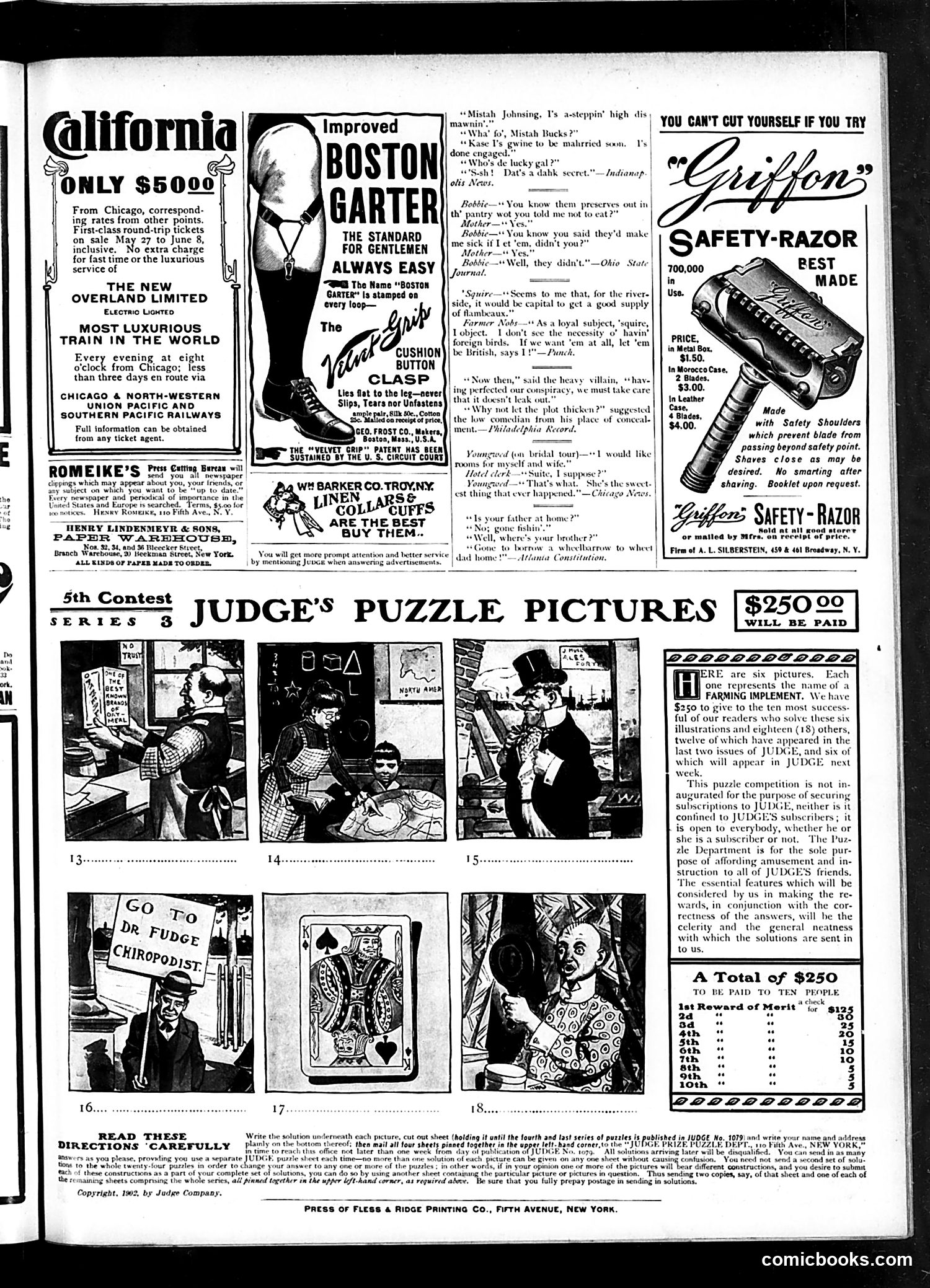
This page is primarily **advertising and a puzzle contest**, not political satire. The advertisements include: - California train travel (Overland Limited) - Boston Garters (men's hosiery) - Linen cuffs - Griffon Safety Razors - Various business services The main content is **Judge's 5th Puzzle Contest**, offering $250 total prize money. Readers must identify six illustrated scenes and solve eighteen additional puzzles appearing across multiple issues. The instructions explain that solutions should be cut out, numbered, and mailed to Judge's office. Interspersed throughout are brief **humorous dialogue snippets**—short jokes about domestic situations, proposals, and misunderstandings—typical of early-1900s magazine filler humor. These lack political significance. The page is dated 1902 based on the copyright notice and represents typical Judge magazine content: commercial advertising mixed with light entertainment and contests designed to boost readership and subscriptions.
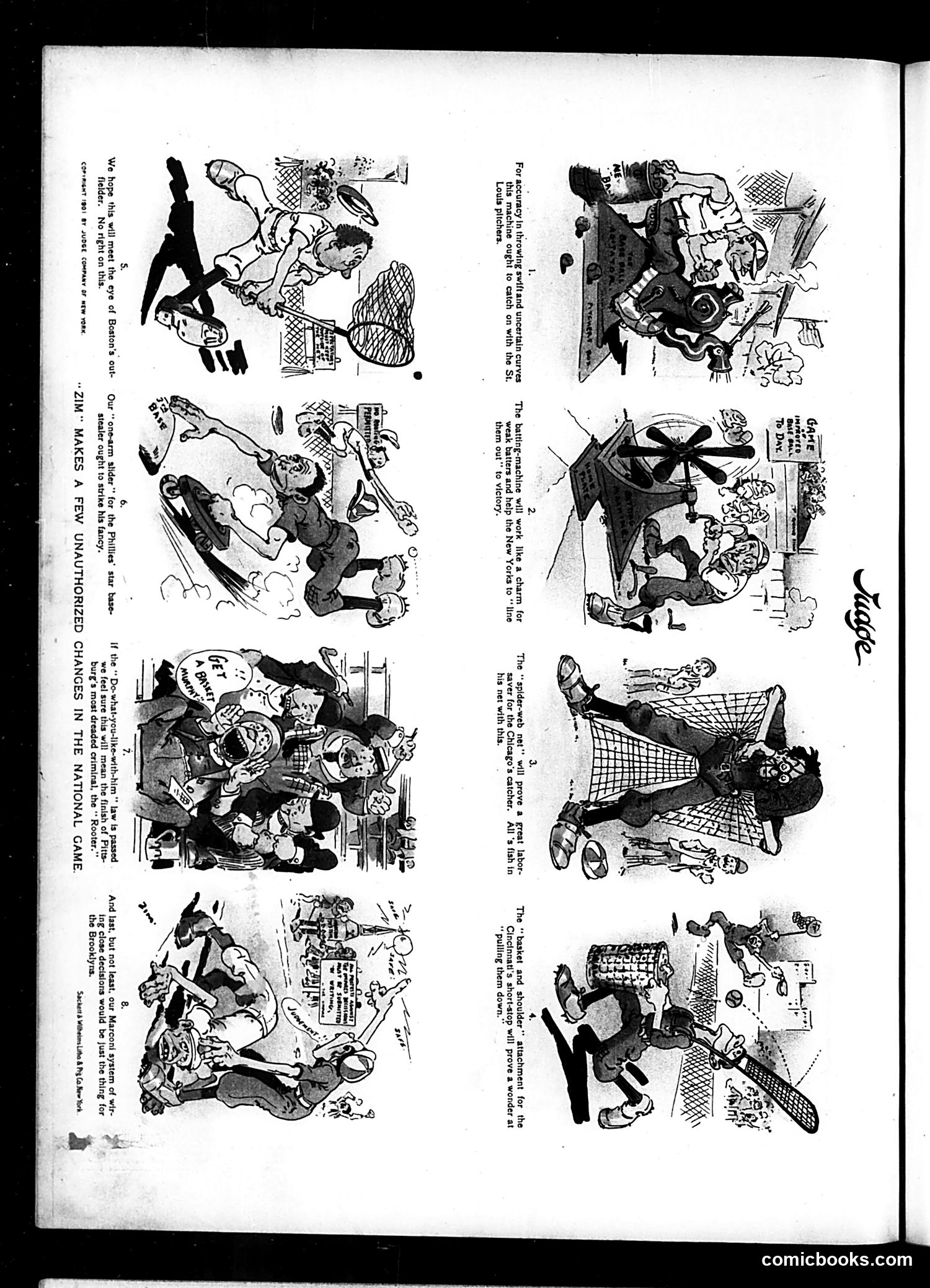
This 1901 Judge cartoon satirizes proposed baseball innovations through absurdist inventions. Each panel mocks a different MLB team by suggesting ridiculous "improvements" to address their weaknesses: - A "batting-machine" for St. Louis pitchers (implying they can't hit) - A "spider-web net" for Chicago's catcher (to catch everything) - A "basket and shoulder attachment" for Cincinnati's shortstop (to field better) - A "Marconi system" for Brooklyn (to help with close calls) The humor lies in presenting mechanical solutions to fundamental player incompetence. "Zim" (likely referring to a specific sportswriter or figure) proposes these tongue-in-cheek "unauthorized changes" as commentary on each team's notorious struggles. The satire targets both the teams' poor performance and contemporary faith in technological fixes for human limitations—a common Judge theme during this industrial era.