
A complete issue · 20 pages · 1902
Judge — May 10, 1902
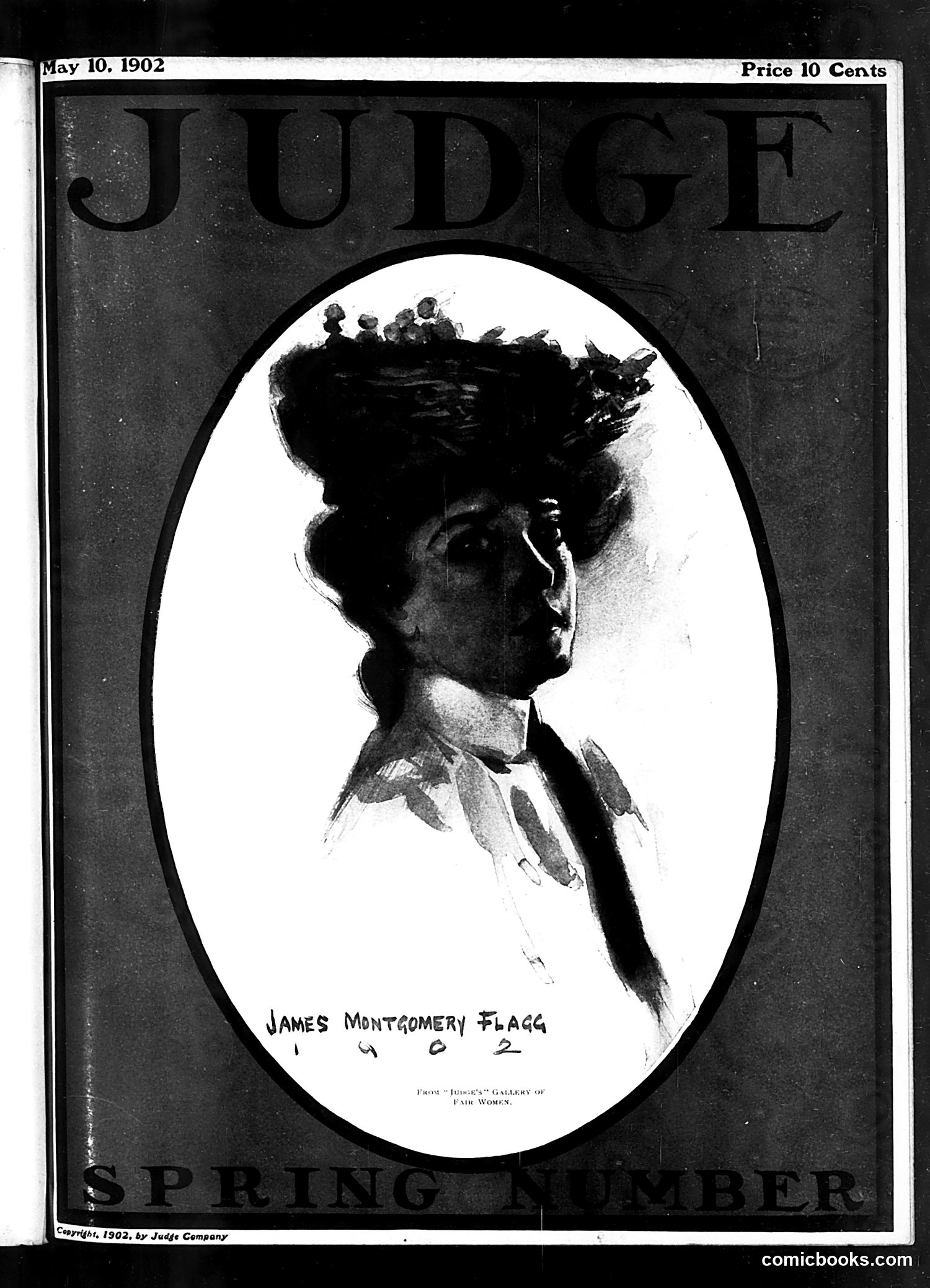
This is a portrait cover of **James Montgomery Flagg**, a prominent American illustrator and artist, credited in the image as "1902." The cover itself is not satirical commentary but rather a **feature or tribute to Flagg**, who was a celebrated and prolific artist of the era. Flagg was famous for creating iconic American imagery, including later the "I Want YOU" WWI recruitment poster. By 1902, he was already an established figure in commercial and editorial illustration. The oval framing and formal presentation suggest *Judge* magazine was highlighting notable cultural figures of the day—essentially offering their readership a portrait of an influential contemporary artist rather than political satire.
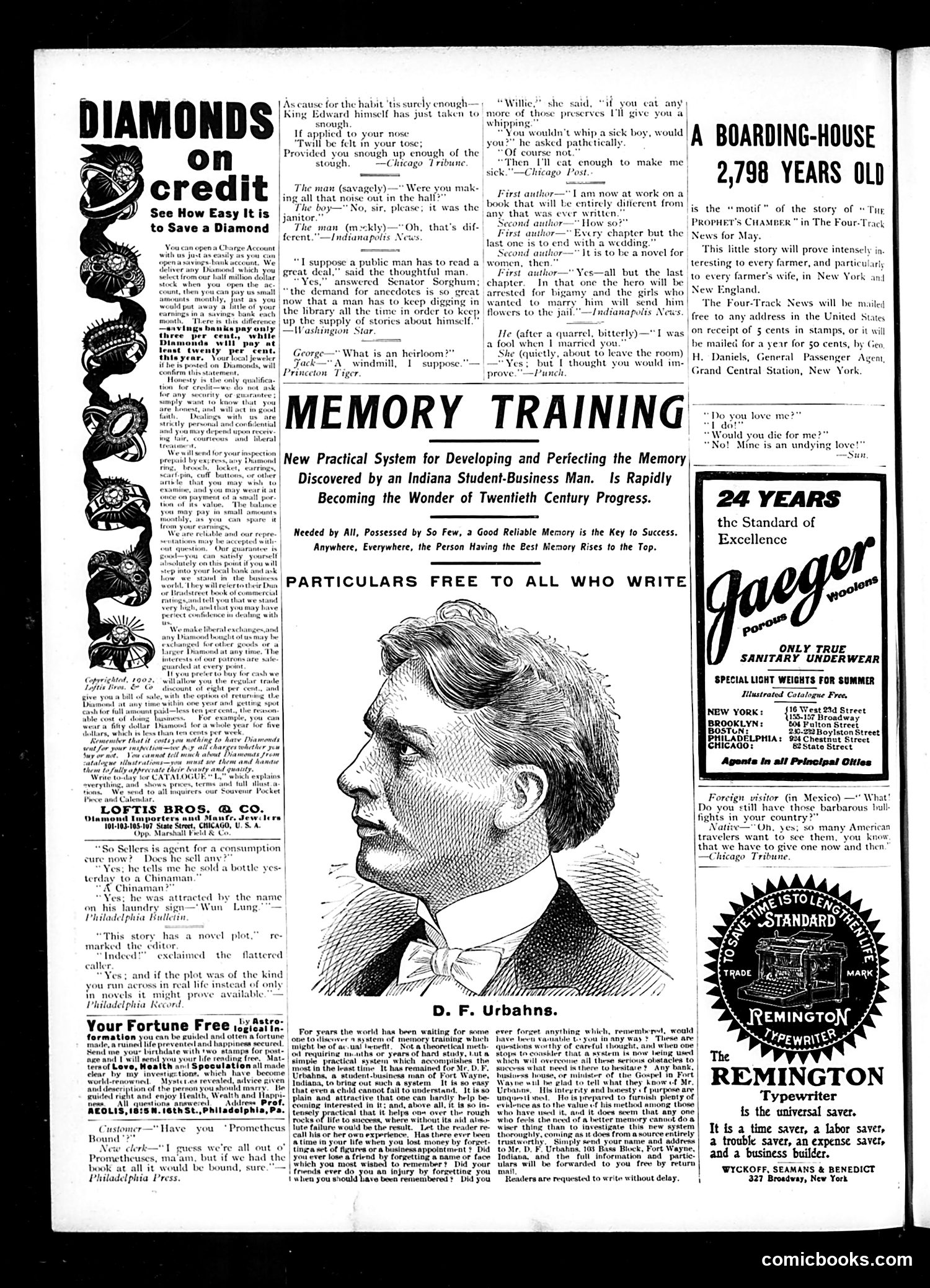
This page is primarily **advertising and cultural content** rather than political satire. The left column advertises diamond purchases on credit, using the sales pitch that diamonds are portable wealth. The center features a "Memory Training" advertisement promoting a memory-improvement system discovered by "an Indiana Student-Business Man," claiming rapid results. The portrait labeled "D. F. Urbahns" appears to be the memory-training system's developer or promoter. Below are testimonial-style quotes about the system's effectiveness. The right side contains ads for **Jaeger** undergarments and a **Remington typewriter**, emphasizing durability and practicality. No clear political satire is evident; this appears to be a typical early-20th-century magazine page mixing entertainment content with commercial advertising.
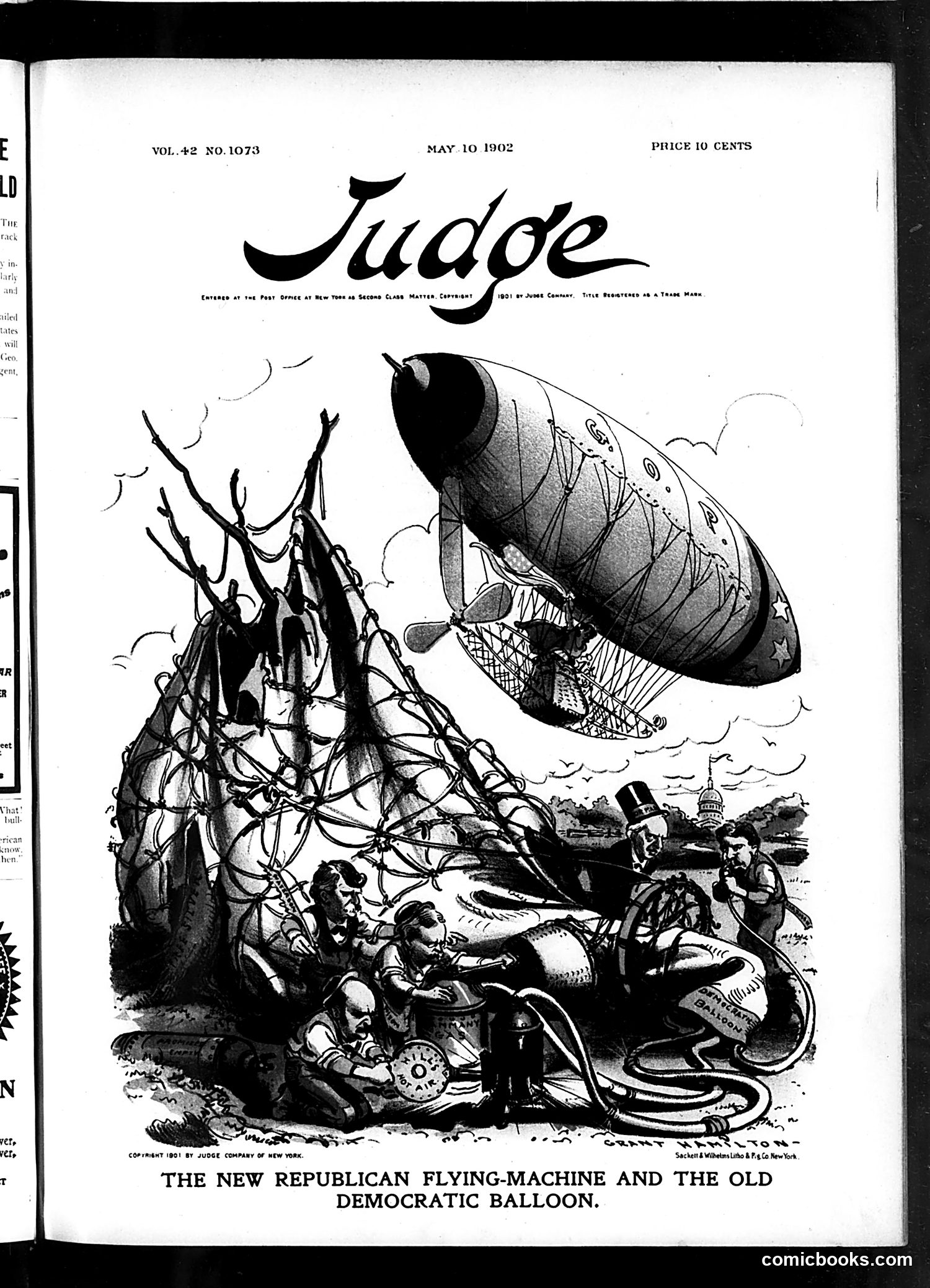
This May 10, 1902 *Judge* cartoon satirizes the Republican Party's technological progress versus Democratic stagnation. The Republican "flying-machine" (airship) represents modern innovation and forward momentum, soaring above the landscape with the Capitol visible below. In contrast, the Democratic "balloon" is tangled in dead tree branches—suggesting the party is stuck, outdated, and literally grounded. The figures below appear to be Democratic politicians or supporters struggling with the balloon's ropes, unable to launch or control their vessel. The satire mocks Democrats as backward-looking and ineffectual compared to the ascendant Republicans under Theodore Roosevelt's administration. The cartoon reflects early-1900s technological optimism while making partisan arguments about which party embodied progress.
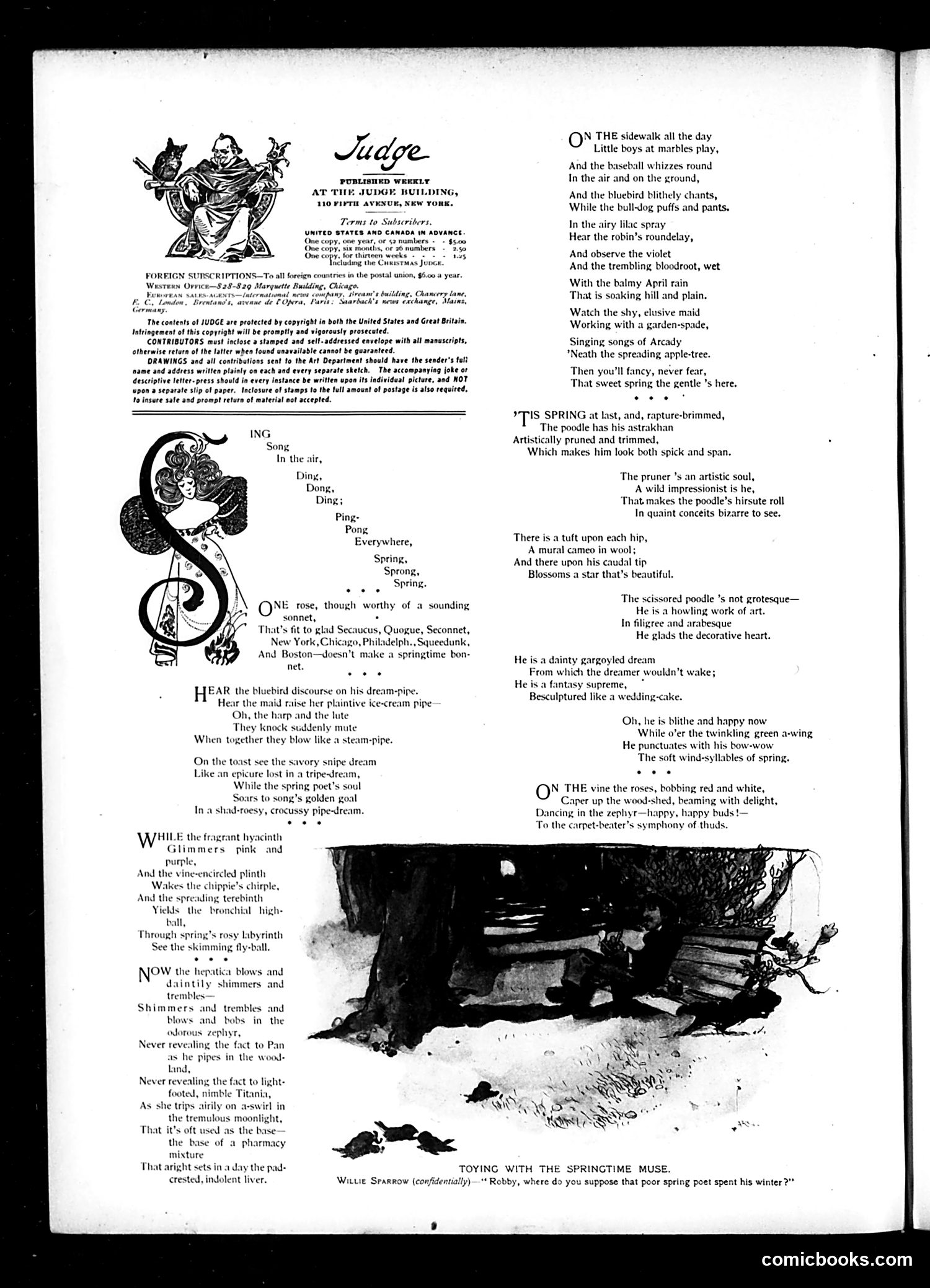
This page features spring-themed poetry and illustrations typical of Judge magazine's literary content. The main cartoon at bottom shows Willie Sparrow (a recurring character) questioning "Bobby" about where a poor spring poet spent his winter—likely a gentle joke about struggling artists and seasonal hardship. The decorative initial letters and ornamental designs frame poems celebrating spring imagery: robin calls, flowers, pruned poodles, and blossoms. The visual style reflects early 20th-century magazine aesthetics. Rather than political satire, this appears to be light cultural humor aimed at educated readers—playing on romantic notions of "springtime muses" and poetic inspiration while subtly mocking the financial precarity of artistic life. The tone is whimsical rather than sharp.
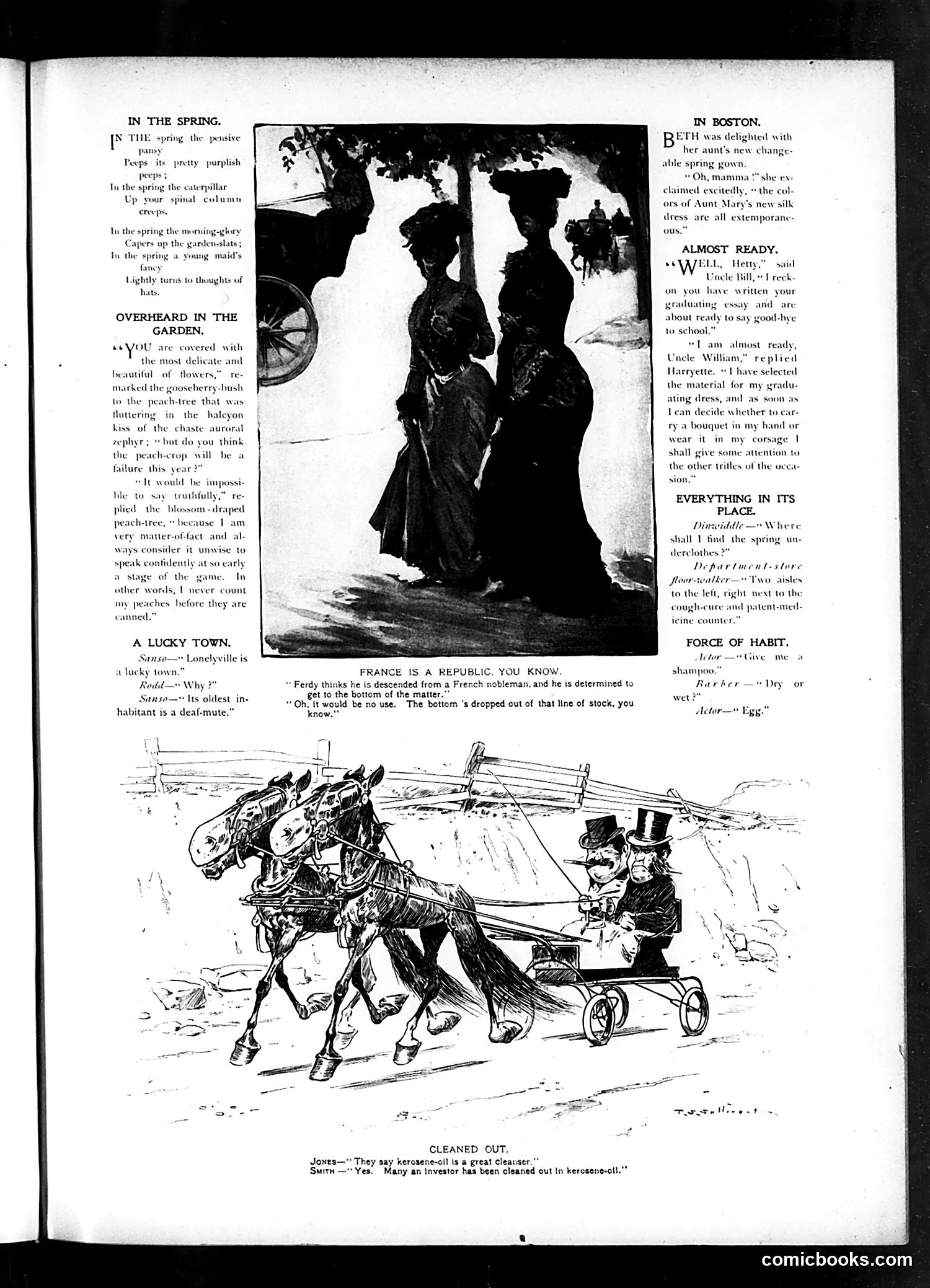
This page from *Judge* contains several brief satirical pieces typical of early 20th-century American humor: **"Overheard in the Garden"** mocks overly cautious people through personified plants—a peach tree refuses to predict its harvest, representing someone who won't commit to claims. **"A Lucky Town"** jokes that a town is fortunate because its oldest resident is deaf-mute, implying elderly people are tediously talkative. **"France is a Republic"** satirizes social climbers: a man named Ferdy seeks to prove French nobleman ancestry, but the joke suggests his family line has lost respectability ("the bottom's dropped out"). **"Cleaned Out"** is a pun: kerosene cleans things, but investors have been "cleaned out" (financially ruined) in kerosene-oil ventures—likely referencing speculative stock bubbles. The remaining pieces mock absent-mindedness and pretension in Boston society and theater culture. These represent genteel humor aimed at *Judge's* educated readership, emphasizing social follies rather than political content.
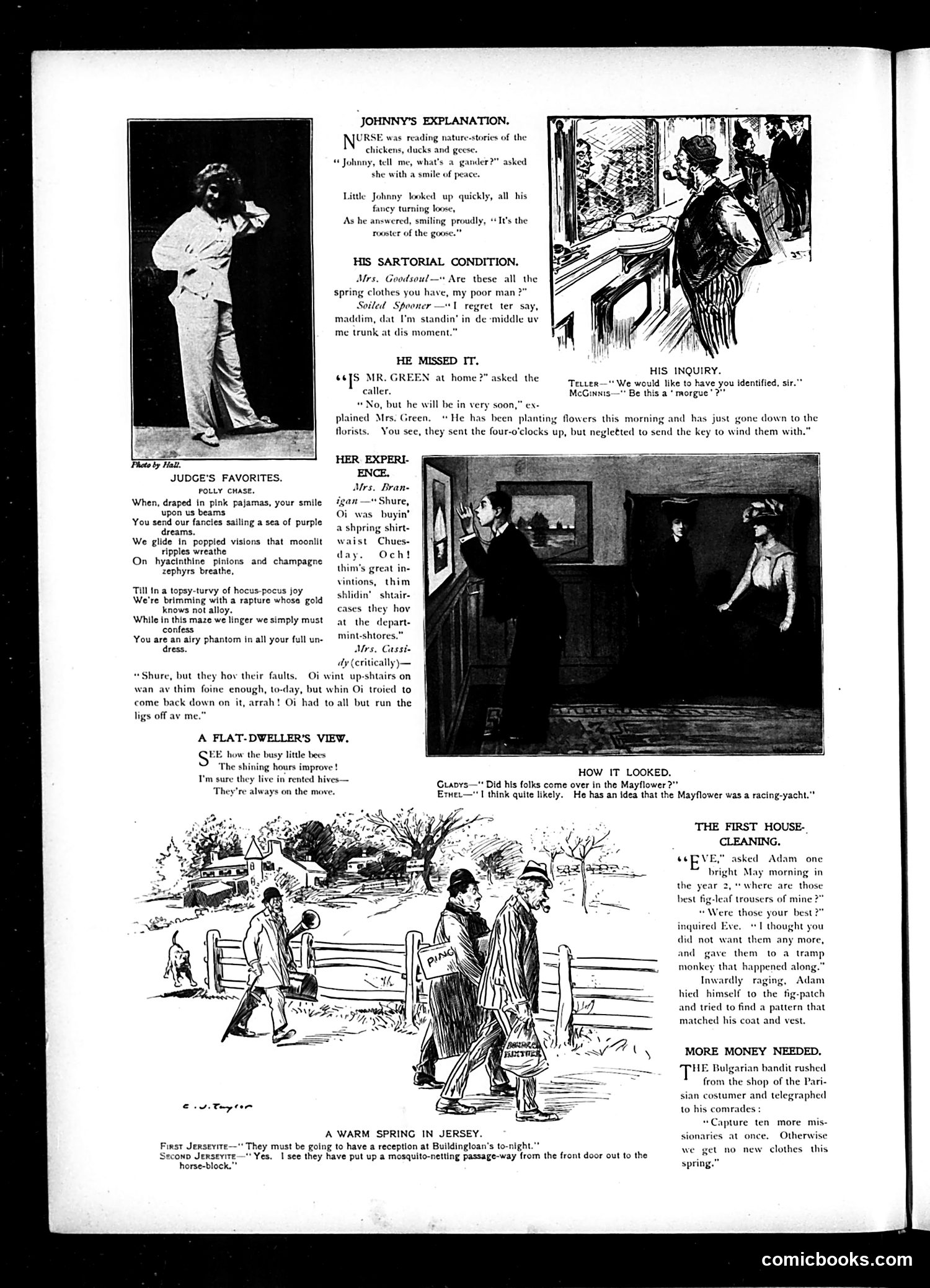
This page contains several unrelated satirical pieces typical of Judge magazine's format: **"Johnny's Explanation"** satirizes children's malapropisms—a young boy mistakes "gander" (male goose) for "rooster of the goose," a common humorous trope in period humor. **"His Sartorial Condition"** jokes about poverty through a poor man's claim that he's literally standing in the middle of his trunk—his only belongings—suggesting desperate circumstances. **"The First House-Cleaning"** appears to be a humorous fantasy about Adam and Eve, with Adam's wife giving away his fig-leaf trousers to a tramp monkey, playing on domesticity and the absurdity of prehistoric fashion concerns. **"More Money Needed"** satirizes contemporary perceptions of Bulgarian bandits (referencing Balkan conflicts of the era), joking that they need to kidnap more Christian missionaries to fund new costumes. The remaining pieces mock social pretension, flat-dwelling urban life, and genealogical snobbery about Mayflower ancestry. These are largely gentle domestic and social humor rather than pointed political satire.
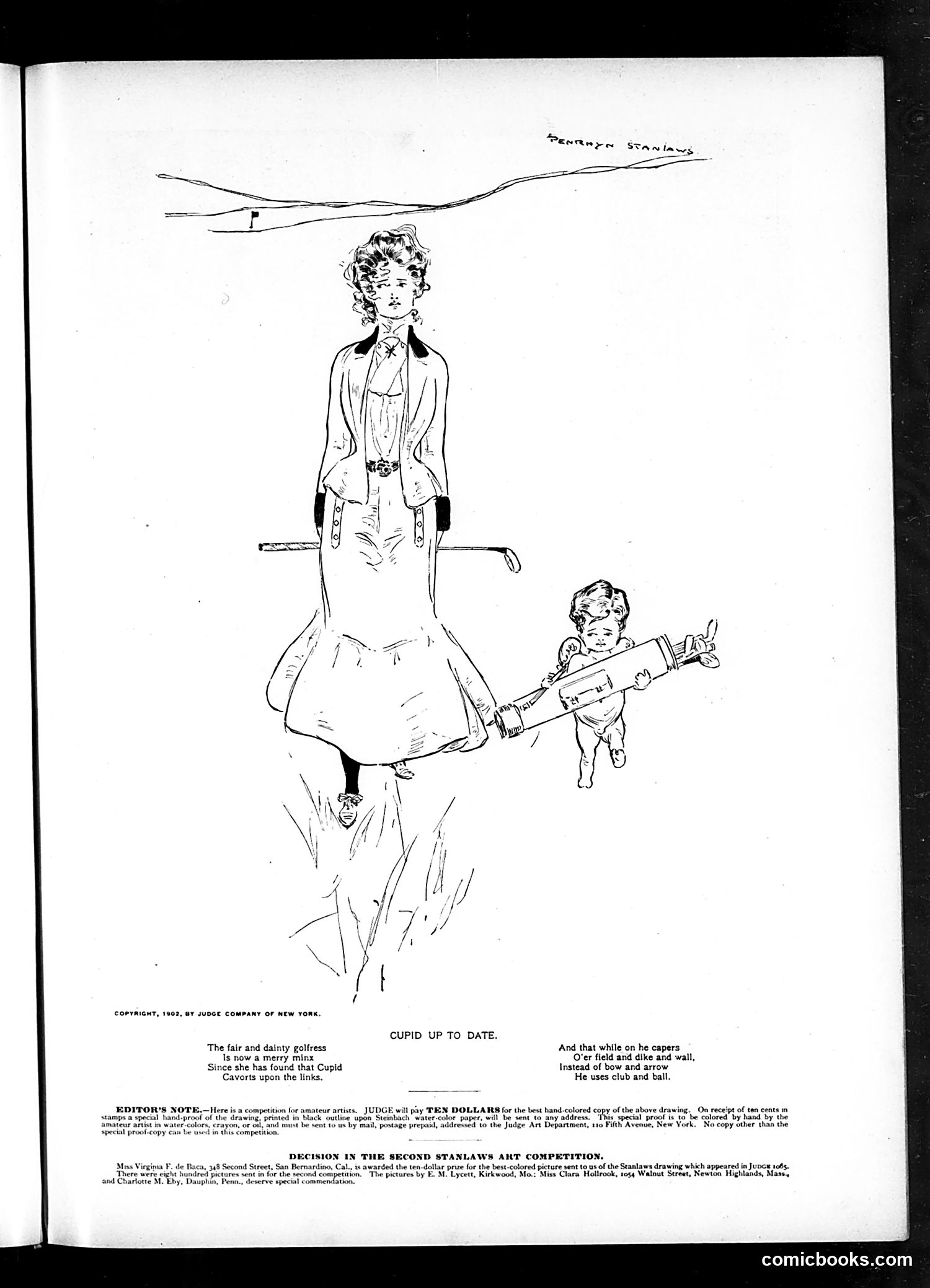
This satirical cartoon updates the classical figure of Cupid for modern times. Rather than the traditional cherub wielding bow and arrow, Cupid now carries a golf club and ball—reflecting the early 1900s golf craze, particularly among women. The drawing depicts an elegant woman golfer ("fair and dainty golfress") as a "merry minx" on the golf links, with Cupid as a caddy-like figure accompanying her. The joke: romance and courtship have been transformed by this new leisure activity. Golf courses became fashionable social spaces where unmarried men and women could interact relatively unsupervised, making it a modern venue for romantic encounters. The satire gently mocks both the rapid modernization of courtship rituals and the "New Woman" of the Edwardian era who participated in athletic pursuits previously reserved for men. This was Judge's art competition entry; readers could submit hand-colored versions for prizes.
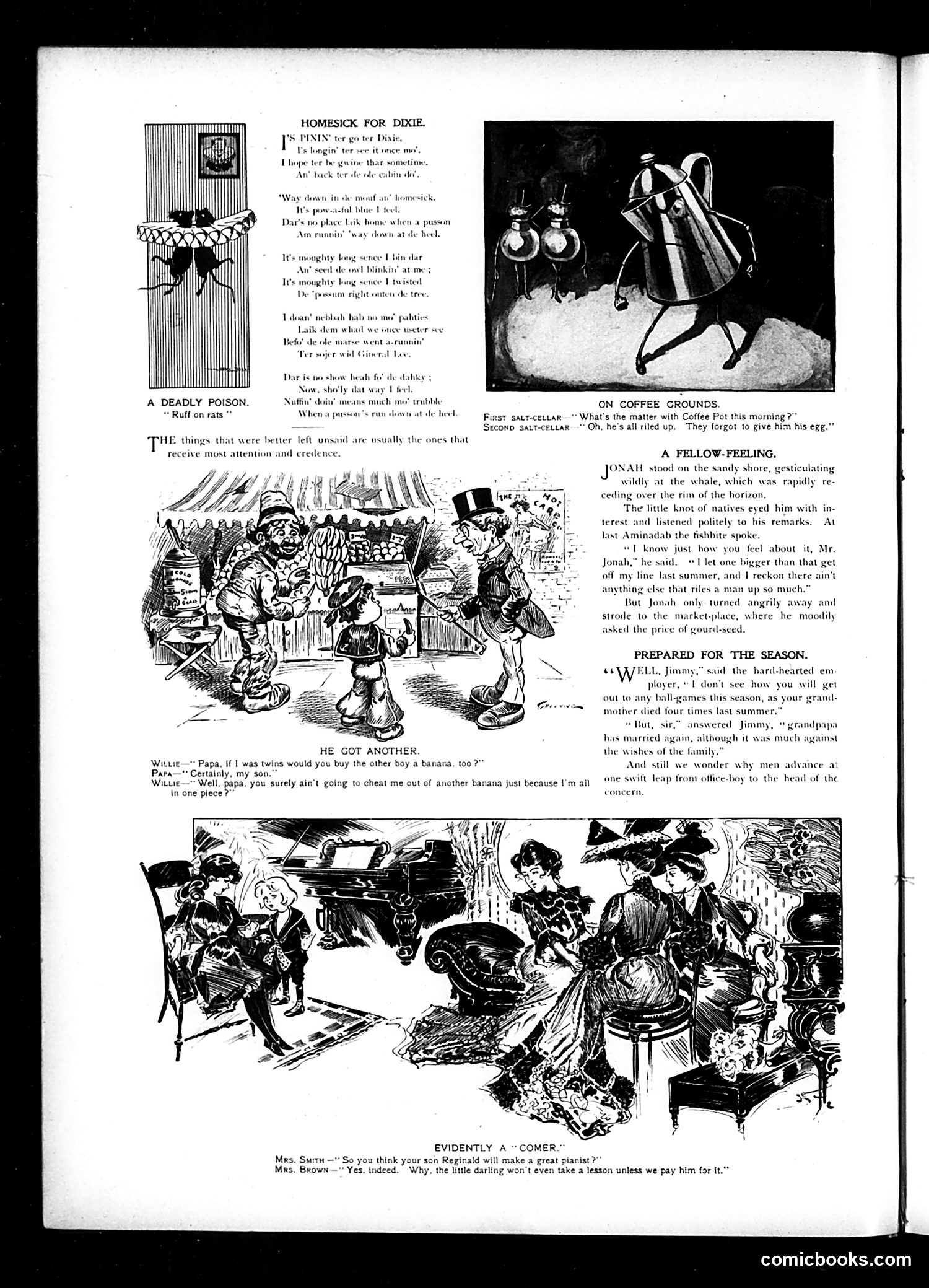
This page contains multiple satirical cartoons and brief comedic sketches typical of early 20th-century American humor: **"Homesick for Dixie"** presents a nostalgic poem in dialect about a Black Southerner longing for the antebellum South—satirizing sentimental Lost Cause mythology by exaggerating romanticized imagery of plantation life. **"A Deadly Poison"** and **"On Coffee Grounds"** are brief visual gags about household matters and servants. **"A Fellow-Feeling"** humorously recounts Jonah's whale encounter, with a native fisherman commiserating about lost catches—gentle absurdist humor. **"He Got Another"** and **"Evidently a Comer"** mock family dynamics: a child's logic about twins and fruit, and a wealthy family indulging their son's musical ambitions only if paid. These satirize parental indulgence and class attitudes toward children's development. The overall tone reflects Judge's focus on domestic comedy, racial caricature, and upper-class social observation rather than direct political commentary.
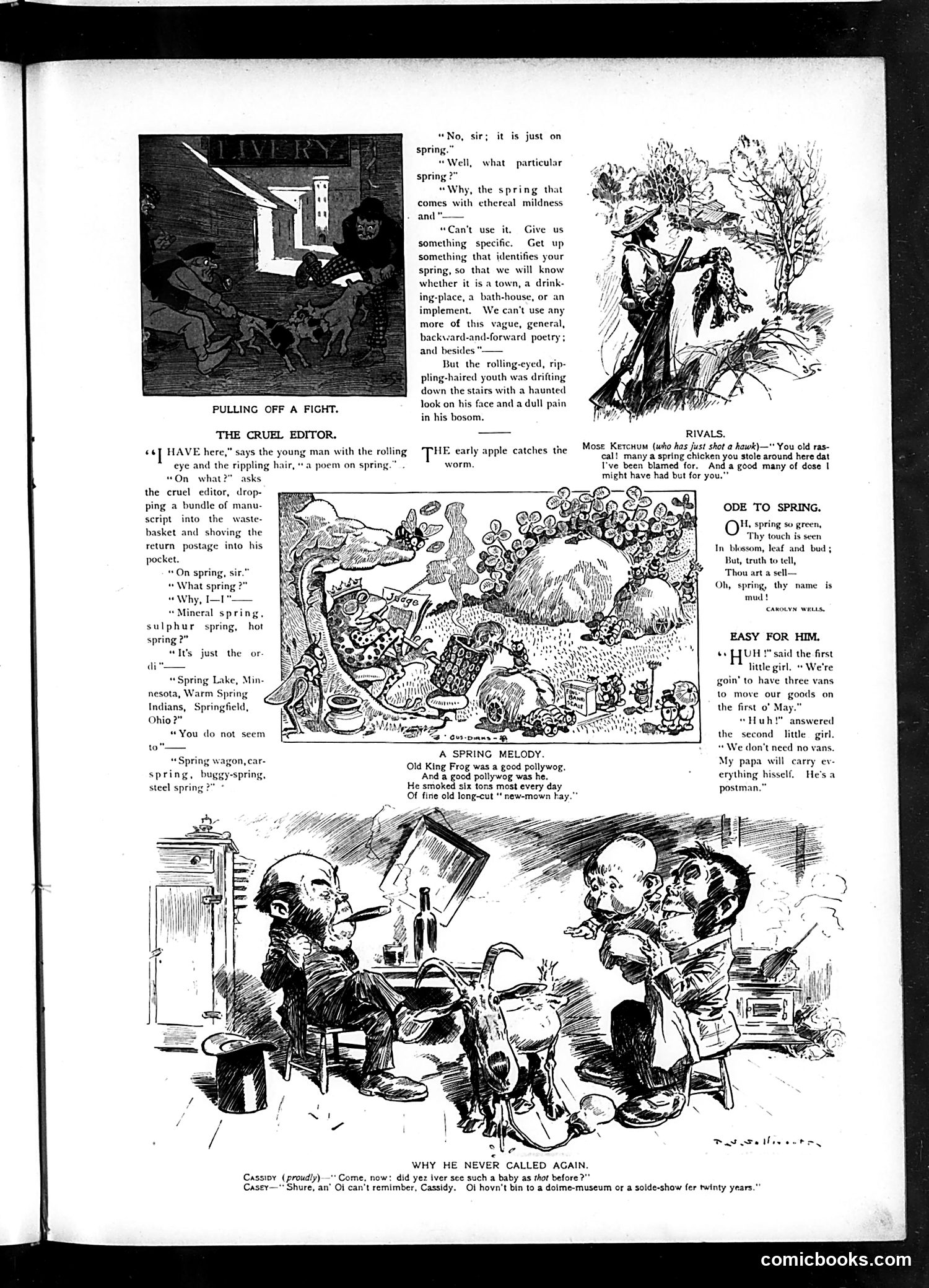
**"The Cruel Editor"** satirizes literary pretension. A young poet submits a vague spring poem; the editor demands specificity—is "spring" a town, bathhouse, drinking establishment, or mechanical device? The joke mocks both the poet's ethereal clichés and the editor's philistine demand for concrete commercial references. Spring poetry was a literary staple, but this editor represents modern journalism's impatience with romantic abstraction. **"Why He Never Called Again"** features two Irish characters (Cassidy and Casey, identified by dialect spelling). Cassidy proudly shows off his newborn; Casey's response—that he hasn't visited a dime museum or sideshow in twenty years—is a cutting insult implying the baby is a circus freak. The satire targets Irish-American stereotypes and working-class masculine humor. The page also includes miscellaneous spring-themed poems and humorous vignettes of varying quality, typical of Judge's mixed-content format.
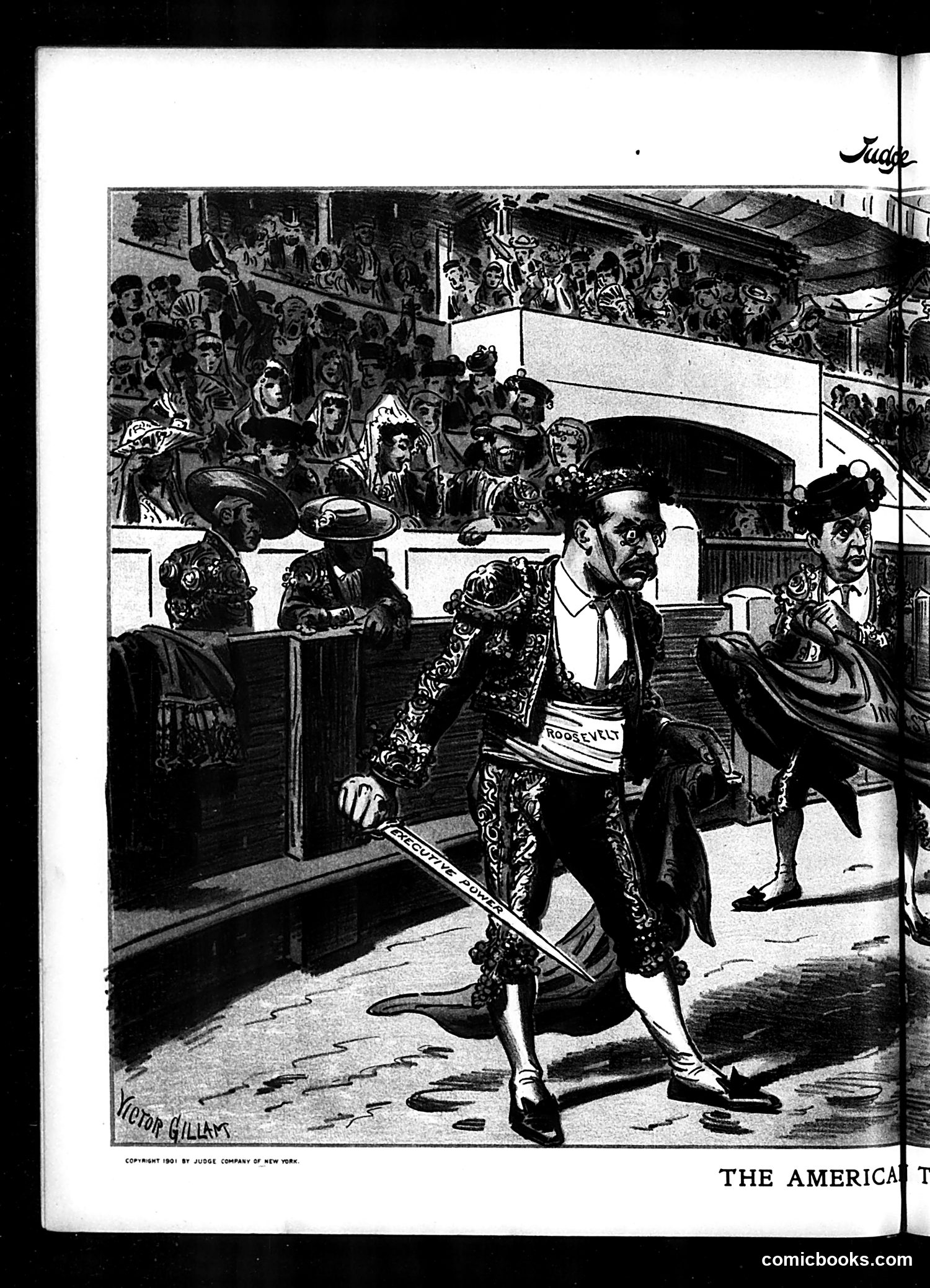
This Victor Gillam cartoon from Judge magazine depicts a bullfighting scene. The central figure wearing "ROOSEVELT" on his sash appears to be Theodore Roosevelt as a matador, wielding a sword in the bullring before a packed crowd of spectators in the stands. The satire likely comments on Roosevelt's aggressive political style or foreign policy—comparing his controversial actions to a dangerous bullfight performance. The ornate costume and theatrical setting suggest mockery of his dramatic public persona. The crowds watching imply public fascination with his bold moves, whether admiring or critical. Without the magazine's date and caption, the specific political event being satirized remains unclear, though Roosevelt's presidency (1901-1909) saw numerous controversial domestic and foreign policies that provided ample material for Judge's satire.
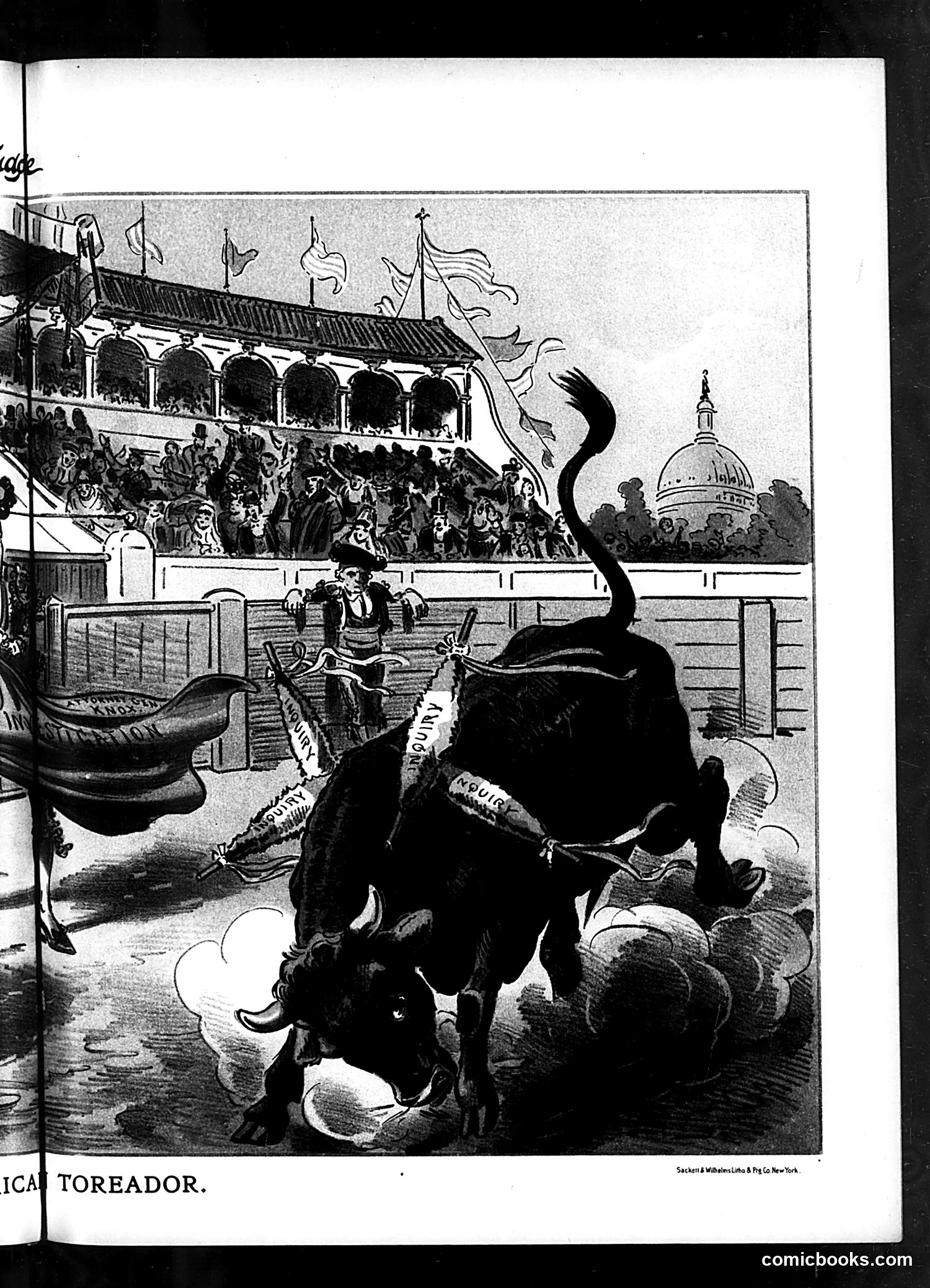
This Judge magazine cartoon depicts a bullfighting scene with a powerful bull labeled with what appear to be political or social issues (text on the bull is partially legible). The matador in the arena represents a political figure attempting to manage or "fight" these challenges before an ornate grandstand filled with spectators—likely representing the American public or Congress. The title "El Toreador" suggests this satirizes a political leader's attempt to handle dangerous issues with theatrical showmanship rather than substance. The bull's prominent, aggressive stance implies these problems are formidable and potentially uncontrollable. Without clearer label visibility, the specific political figures and issues remain unclear, but the satire targets political posturing and the gap between public performance and actual problem-solving.
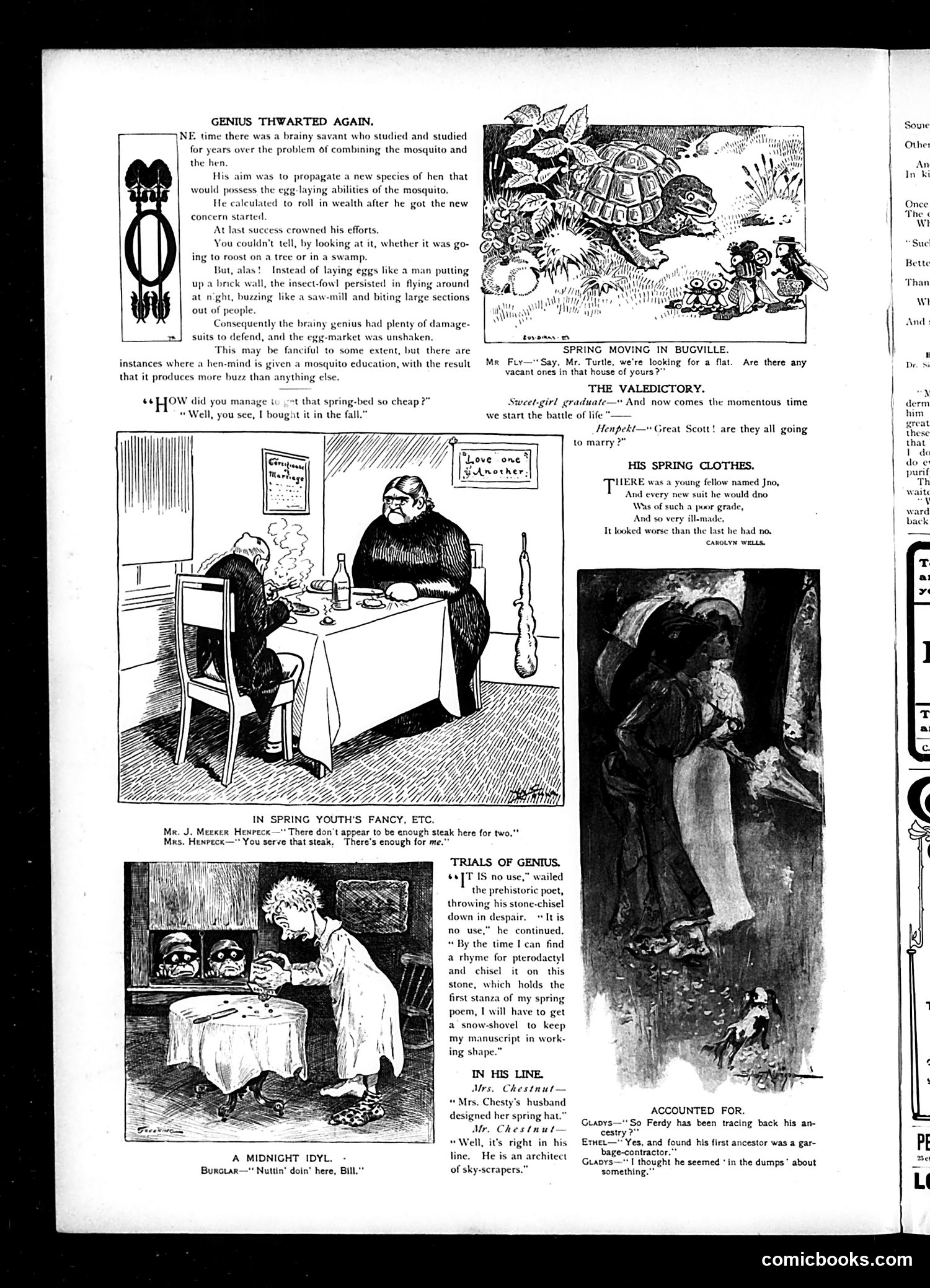
This satirical page from *Judge* contains several humor pieces mocking human pretension and spring-season follies: **"Genius Thwarted Again"** ridicules absurd scientific ambition—a inventor attempts to cross a mosquito with a hen to create egg-laying insects. The scheme predictably backfires: the hybrid creature bites people at night instead of laying eggs, leaving him with lawsuit damages and an unchanged egg market. The satire suggests that some "brainy" schemes are fundamentally foolish. **Other vignettes** mock spring social rituals: a couple's marital tension over spring steak portions; a prehistoric poet struggling to rhyme "pterodactyl"; a man whose architectural skills oddly manifest in his wife's absurdly tall hat design. **"Spring Moving in Bugville"** uses animals (turtles, beetles) as stand-ins for working-class tenants seeking spring apartments—likely commentary on seasonal urban housing shortages or tenant instability. The humor targets intellectual pretension, domestic tensions, and the chaos of spring's social transitions, using exaggeration and animal characters as mild satirical devices typical of early-20th-century American humor magazines.
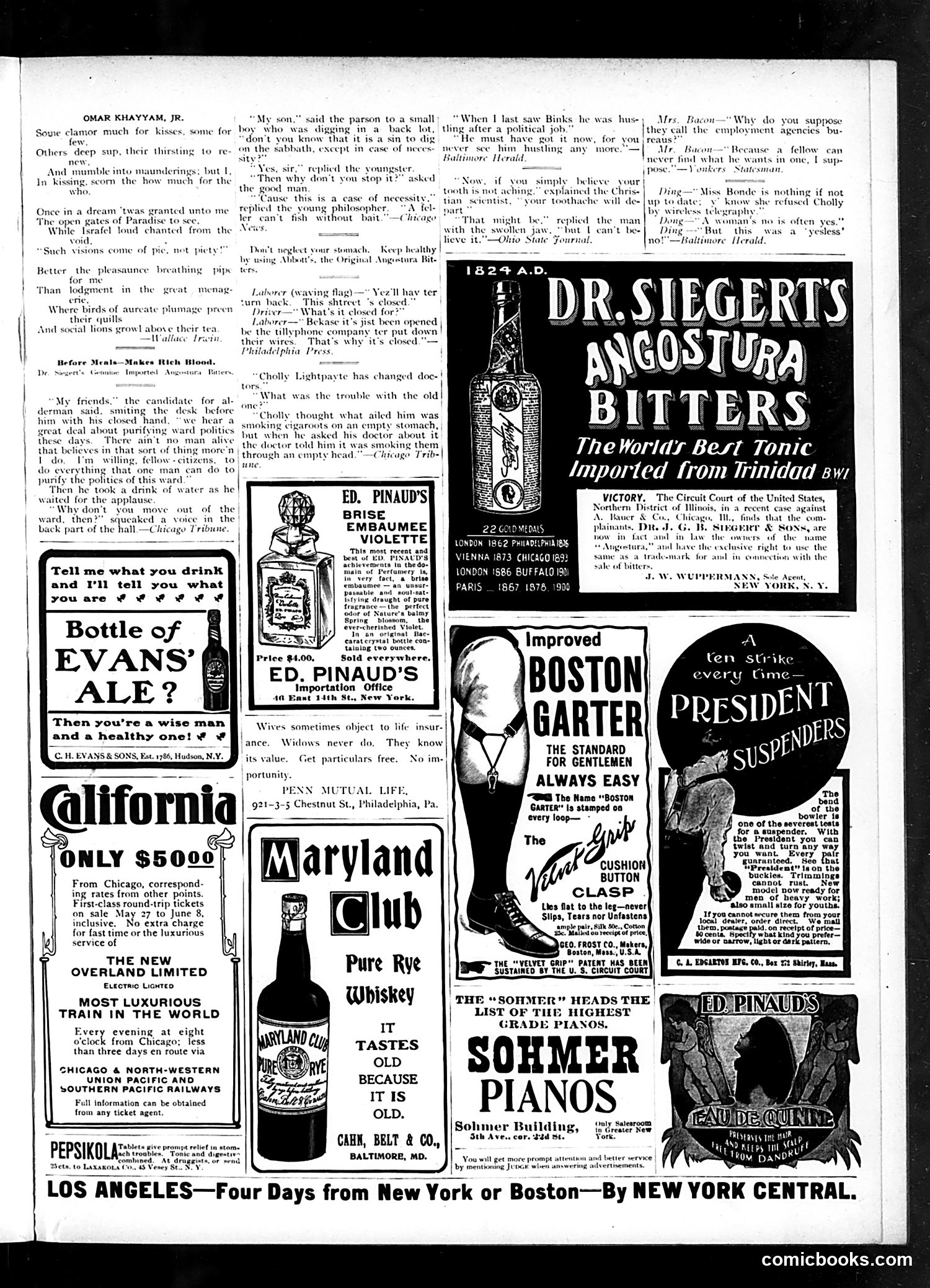
This page is primarily **advertisements and filler humor** rather than cohesive political satire. The content includes: **Text-based humor pieces:** Brief anecdotes mocking various social types—a moralistic parson, a politician giving hollow speeches about "purifying ward politics" while drinking water (suggesting hypocrisy), and workplace absurdities (telephone workers closing streets to install wires). **Key satirical point:** The alderman's speech parodying politicians who publicly espouse noble reform while privately doing nothing substantive—a recurring Progressive Era critique of corruption and empty rhetoric. **Advertisements:** Dr. Siegert's Angostura Bitters, Evans' Ale, Maryland Club whiskey, Sohmer Pianos, Boston Garter, and travel ads dominate the page. These ads are typical of Judge's revenue model. **No identifiable political figures or specific dated events** are referenced. The satire is generic—targeting universal hypocrisies rather than current news. The page lacks the sharp, timely commentary Judge was known for, suggesting this may be a lighter or filler issue.
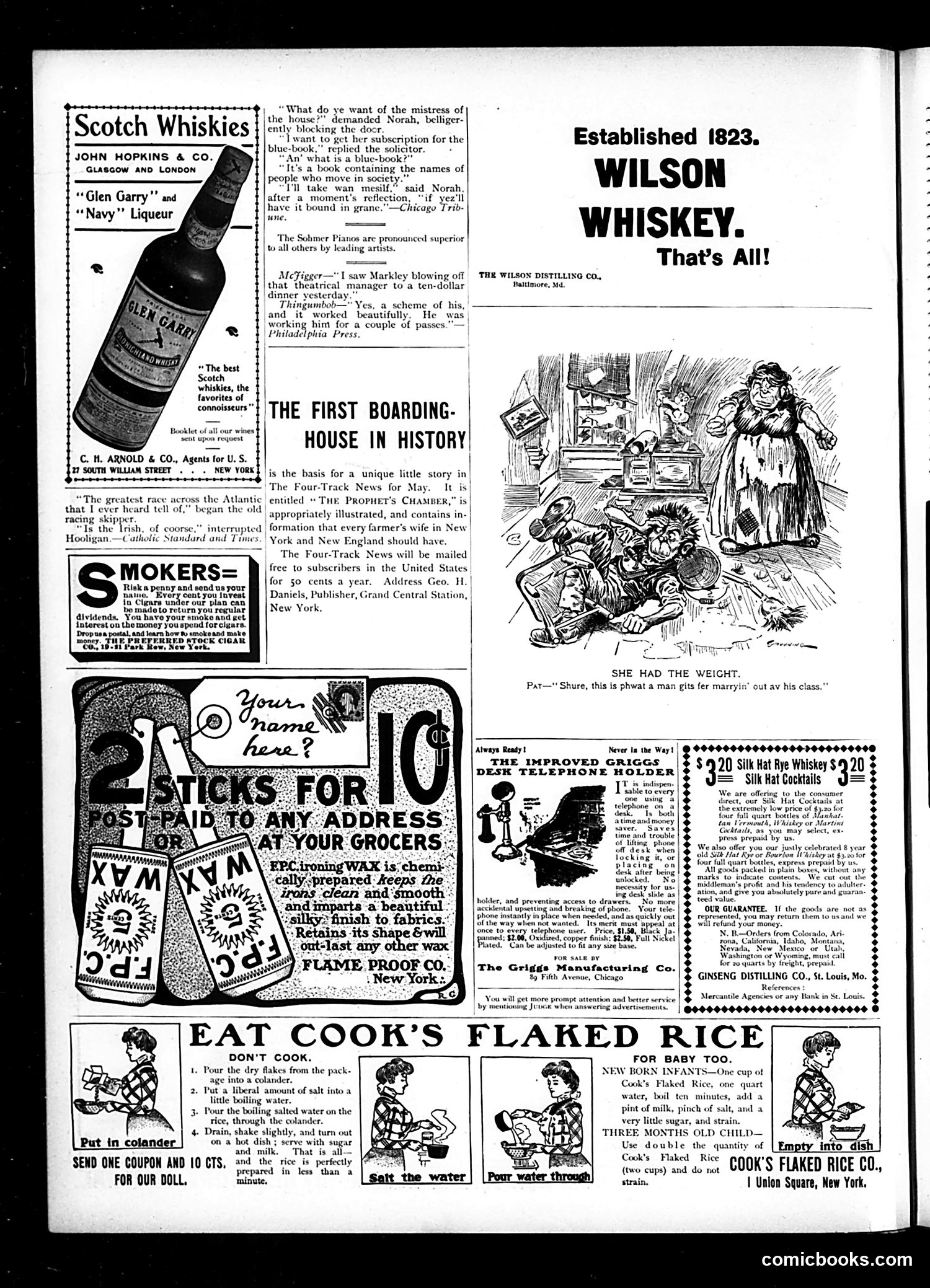
This page is primarily **advertising**, with minimal editorial content. The main items include: **Advertisements:** - Scotch whiskies (John Hopkins & Co., Glen Garry brand) - Wilson Whiskey (established 1823) - Silk Hat Rye Whiskey and cocktails - Cook's Flaked Rice (for adults and infants) - Various other products (pianos, wax, telephone holders) **Comic Vignettes:** The small illustrated jokes appear to be typical Judge-style social humor: - A dialogue about "blue-book" society (upper-class social registry) - A theater manager being manipulated for free passes - An Irish laborer (labeled "Pat") commenting on marrying "out of his class" — likely a stereotypical ethnic joke common to the period **Context:** The "She Had the Weight" caption suggests a commentary on class differences in marriage, reflecting early-20th-century anxieties about social stratification. The page reflects Judge's mixed model of satirical editorial content interspersed with paid advertising, targeting middle-class readers with disposable income.
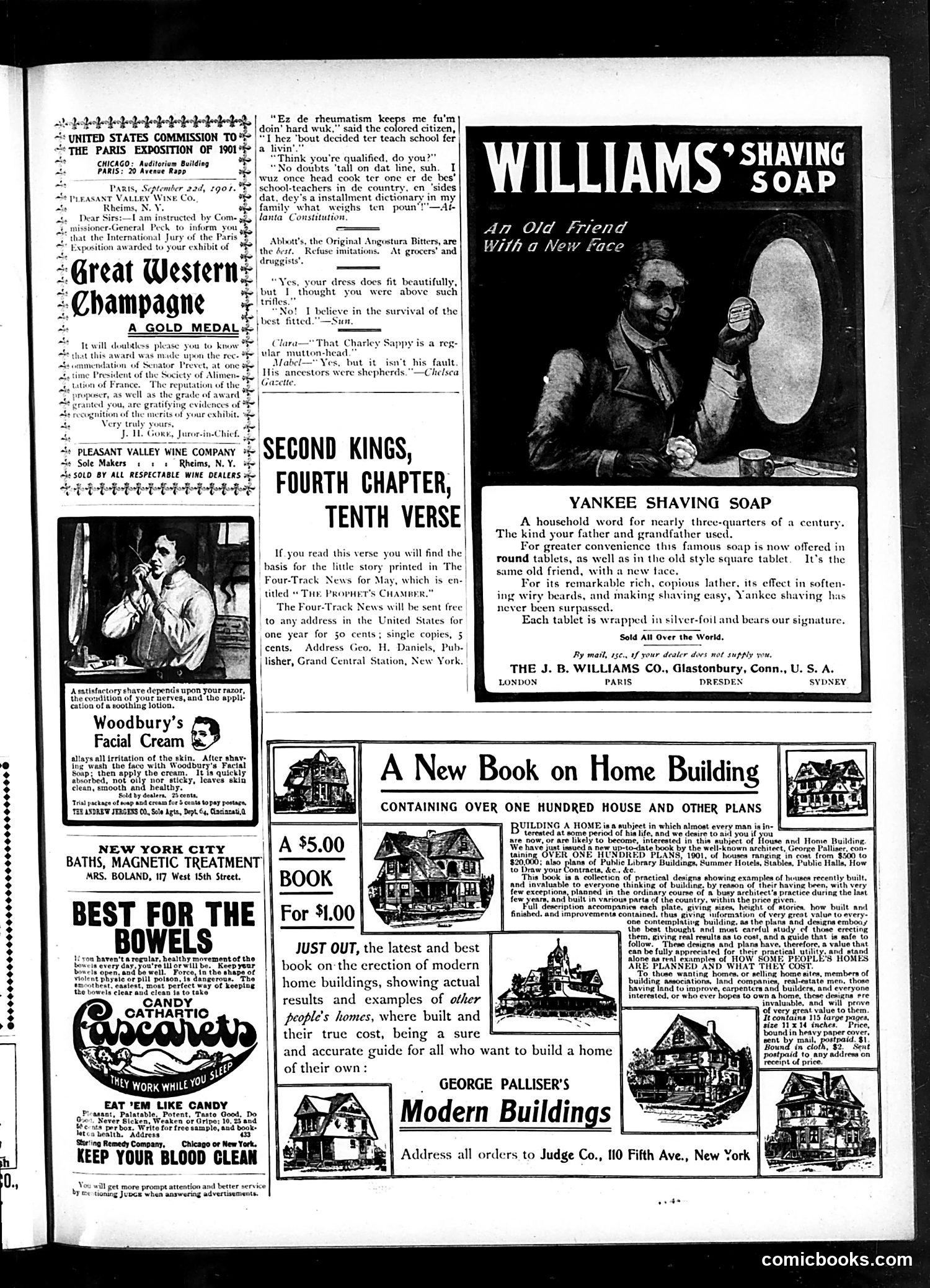
This page is primarily **advertising** rather than satirical content. The dominant features are product advertisements (Williams' Shaving Soap, Woodbury's Facial Cream, a home-building book) interspersed with minor editorial content. The small satirical elements visible include: 1. **"Second Kings, Fourth Chapter, Tenth Verse"** section: A brief dialogue joke about a colored citizen claiming qualifications to teach school based on being a former head cook—satirizing unqualified applicants for professional positions. 2. **Fashion dialogue**: A brief exchange mocking women's dress, with a quip about ancestral status ("His ancestors were shepherds"). These represent typical early-1900s Judge magazine humor: light social satire about class pretensions and gender roles. The overall page reflects Judge's business model: substantial advertising revenue subsidizing editorial content rather than dedicated political cartooning.
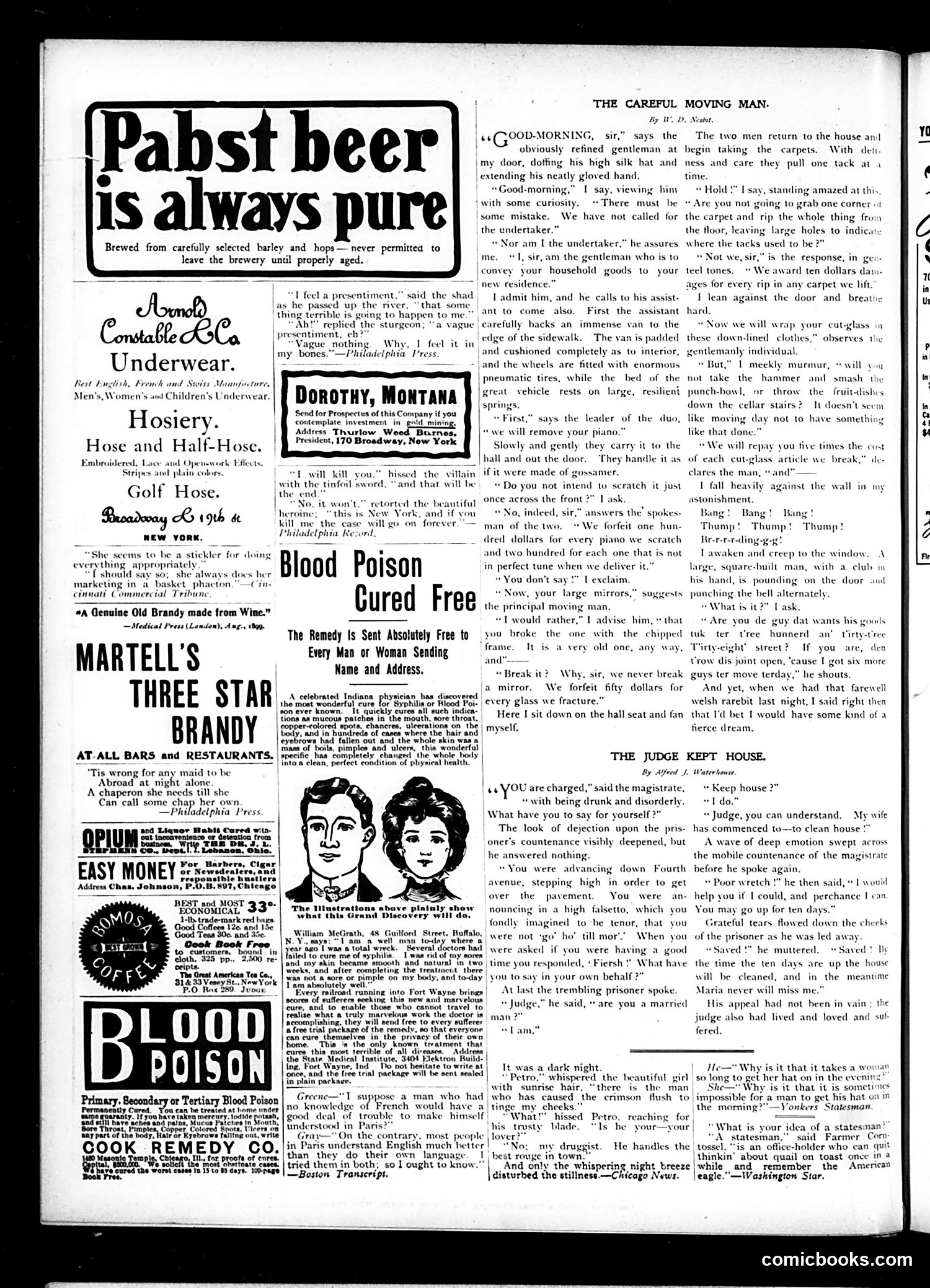
This page is primarily **advertising**, not political satire. It contains multiple commercial advertisements typical of early 1900s publications, including beer, brandy, underwear, hosiery, and patent medicines. The small **humorous stories** embedded between ads are light social comedy, not political commentary: - A joke about a woman's "appropriate" marketing in a phaeton (carriage) - A theatrical sketch about a villain threatening a heroine with a "tinfoil sword" in New York, joking that murder convictions never stick there - A pun about a shad fish's "presentiment" of doom The most prominent non-advertising content is a large advertisement for a "blood poison cure," which reflects the era's patent medicine industry—often fraudulent treatments marketed to desperate patients for venereal diseases. **No specific political figures or events are identifiable** on this page. The content reflects general early-20th-century social attitudes and commercial practices rather than satirizing particular political situations.
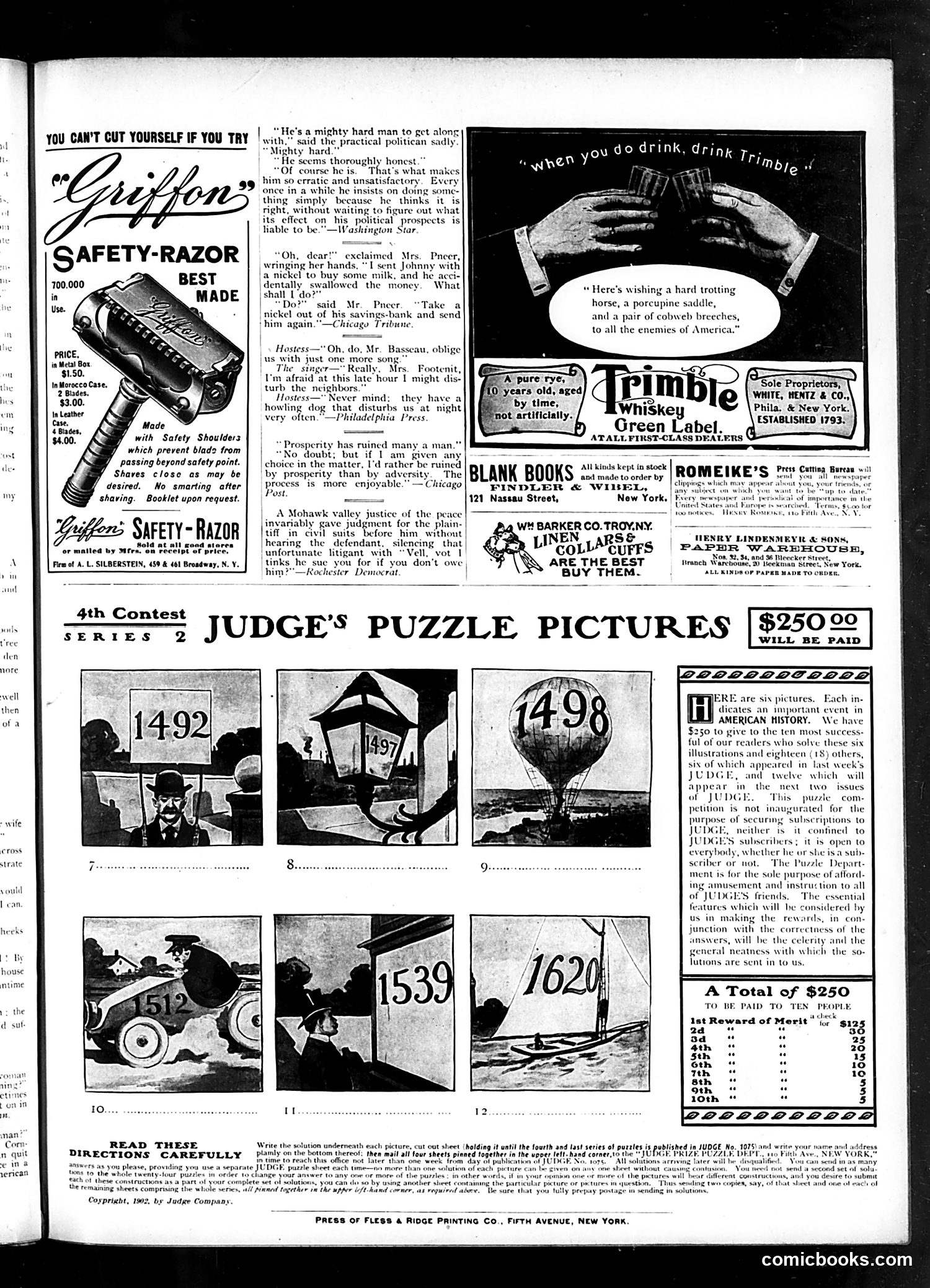
This page is primarily **advertisements and a puzzle contest**, not political satire. The upper portion contains brief humorous anecdotes (labeled "YOU CAN'T CUT YOURSELF IF YOU TRY") satirizing impractical politicians who act on principle rather than political calculation—a critique of idealistic naïveté in politics. These are framed as witty one-liners from various sources (Washington Star, Chicago Tribune). The main content is **Judge's Puzzle Pictures Contest**, a visual puzzle game where readers identify historical American events depicted in six numbered photographs (1492, 1497, 1498, 1539, 1620, and others showing colonial/early American scenes). Winners of the $250 prize pool are determined by correct identification and neatness of submission. The remainder consists of period **product advertisements**: Griffon Safety Razors, Trimble Whiskey, blank books, linen collars, and other commercial goods typical of early 20th-century Judge magazine. There is no sustained political cartoon or deeper satire on this particular page—it's largely a commercial/entertainment issue.
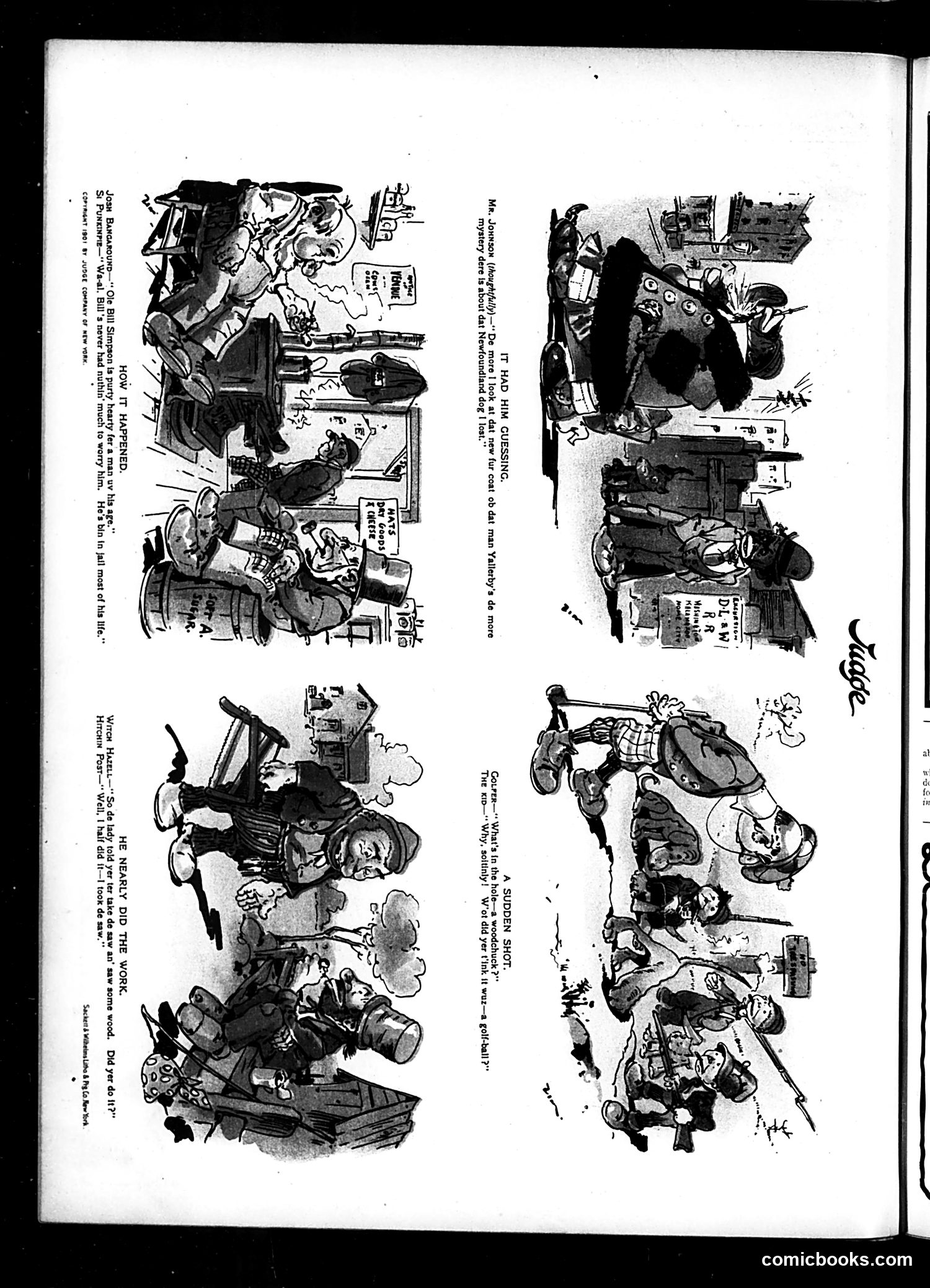
This page contains four separate comic vignettes using dialect humor popular in early 20th-century American satire: 1. **"It Had Him Guessing"**: A man suspects his neighbor acquired a stolen Newfoundland dog as a fur coat—implying the neighbor killed the dog for its pelt. 2. **"How It Happened"**: A joke about a man named Simpson staying healthy because jail kept him worry-free, playing on stereotypes about working-class criminality. 3. **"A Sudden Shot"**: A golf-themed joke where a caddy is asked if a hole contains a woodchuck, he sarcastically responds asking if they expected a golf ball instead. 4. **"He Nearly Did the Work"**: A pun where someone was asked to "saw wood" (work hard) but literally only took the saw without accomplishing anything. The humor relies on ethnic dialect stereotyping, class-based jokes, and wordplay typical of Judge's era. These cartoons mock working-class and immigrant characters through exaggerated speech patterns and simple-minded scenarios.
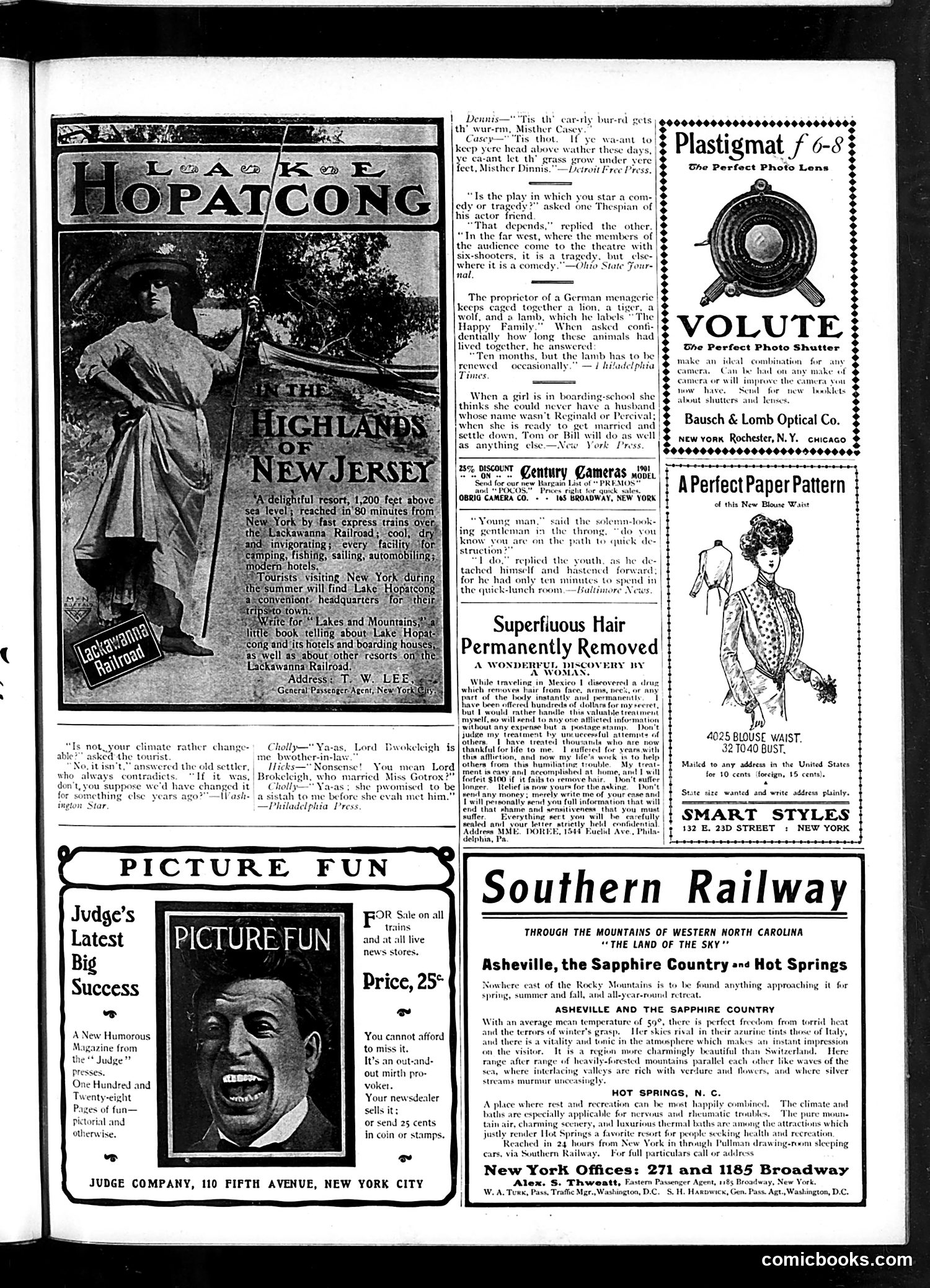
This page is primarily **advertising and light humor**, not political satire. The main content includes: **"The Lake Hopatcong" section** (top left): A travel advertisement for a New Jersey resort, featuring a woman in period dress. The accompanying text presents mild ethnic humor in Irish dialect ("Dennis," "Misther Casey"), typical of early 1900s American magazines. **Scattered jokes** throughout include light observations about theater, boarding school romance, and quick-lunch culture—reflecting everyday American social anxieties of the era. **Right column**: Camera and photographic equipment advertisements (Plastigmat lens, Volute shutter, Century Cameras) mixed with fashion pattern ads and a hair-removal advertisement. **Bottom section**: A Southern Railway advertisement promoting Asheville, North Carolina as a health resort—promising ideal climate and recreation. The page reflects **early 20th-century consumer culture** rather than political commentary. The humor is gentle, domesticated satire aimed at selling products and entertainment to middle-class readers.
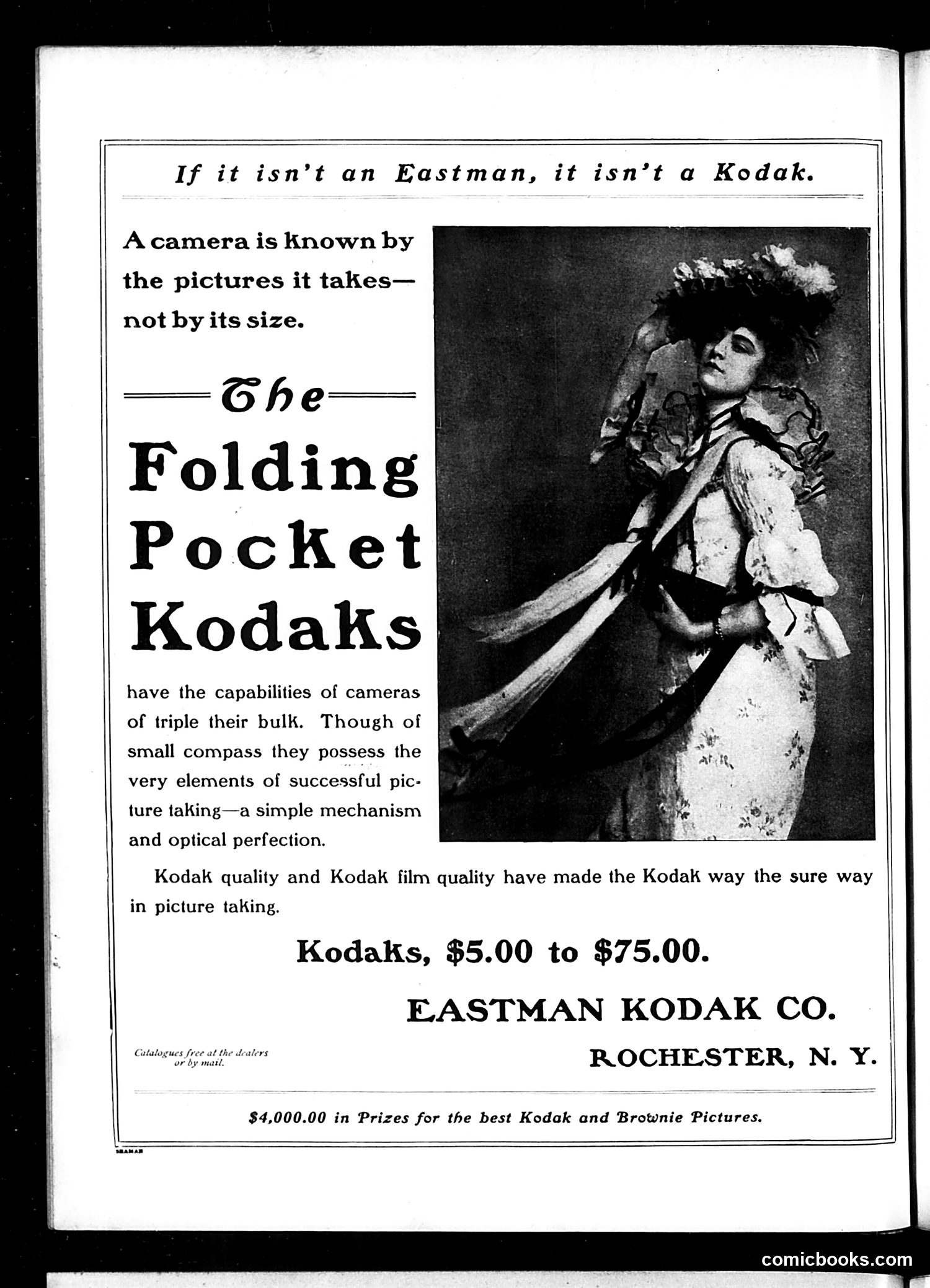
This is a **full-page advertisement**, not satire or political content. It promotes Eastman Kodak's "Folding Pocket Kodaks" cameras. The image shows a woman in early 1900s dress holding a folding camera, photographing upward. The ad's central message—"A camera is known by the pictures it takes—not by its size"—emphasizes that these compact cameras produce quality results despite their small size, rivaling larger models. The copy highlights the cameras' portability and optical quality, positioning them as reliable for amateur photographers. The price range ($5.00–$75.00) and $4,000 prize offer for best pictures indicate Kodak's marketing strategy to popularize photography among consumers. The tagline "If it isn't an Eastman, it isn't a Kodak" asserts brand dominance—Kodak is synonymous with cameras themselves.