
A complete issue · 16 pages · 1902
Judge — March 29, 1902
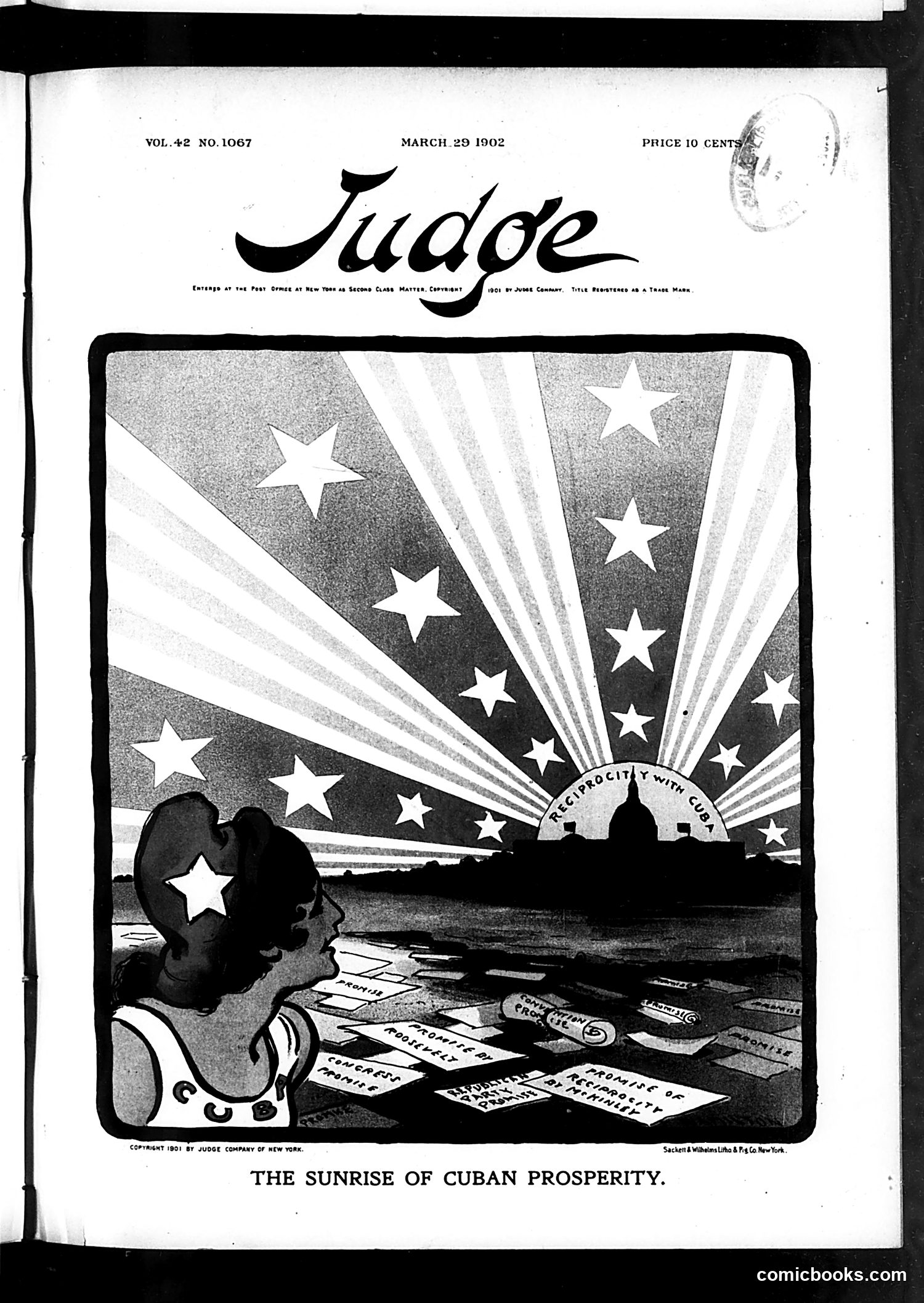
This Judge magazine cover from March 29, 1902 celebrates American economic interests following the Spanish-American War (1898) and Cuba's independence. The illustration shows a figure (likely representing American business or capital) viewing Cuba's sunrise/future, with the Capitol dome silhouetted on the horizon. Radiating stars suggest hope and American influence. The scattered papers at the figure's feet appear to list Cuban resources or business opportunities—suggesting American commercial interests in sugar, tobacco, and other Cuban exports. The phrase "reciprocity with Cuba" visible on the Capitol references trade agreements negotiated between the newly independent Cuba and the United States. The cartoon expresses contemporary American optimism about profitable economic relationships with Cuba under U.S. influence following the war.
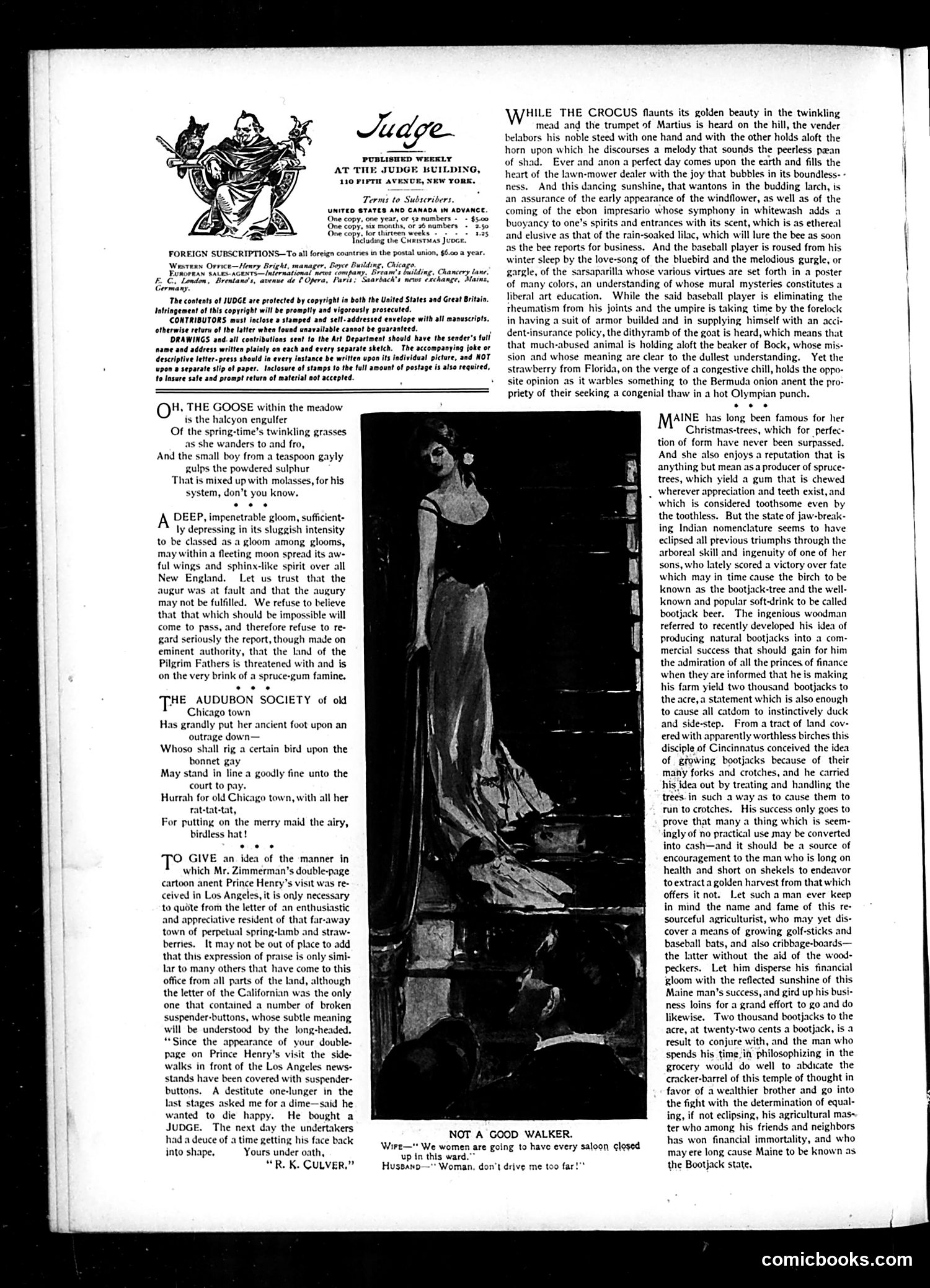
This page contains several satirical pieces typical of Judge magazine's format. The main cartoon titled "NOT A GOOD WALKER" depicts a woman and man, with dialogue about closing saloons. The joke appears to reference Prohibition-era debates, with the woman's comment "don't drive me too far!" suggesting her reluctance to walk long distances if saloons close. The surrounding text includes poems and prose pieces satirizing contemporary social issues, including commentary on the Audubon Society and agricultural schemes involving bootjack production. Without clearer visibility of all figures and specific historical dates, I cannot definitively identify particular politicians or events referenced. The overall tone mocks reformers, agricultural schemes, and Prohibition advocates—common Judge targets of the early 20th century.
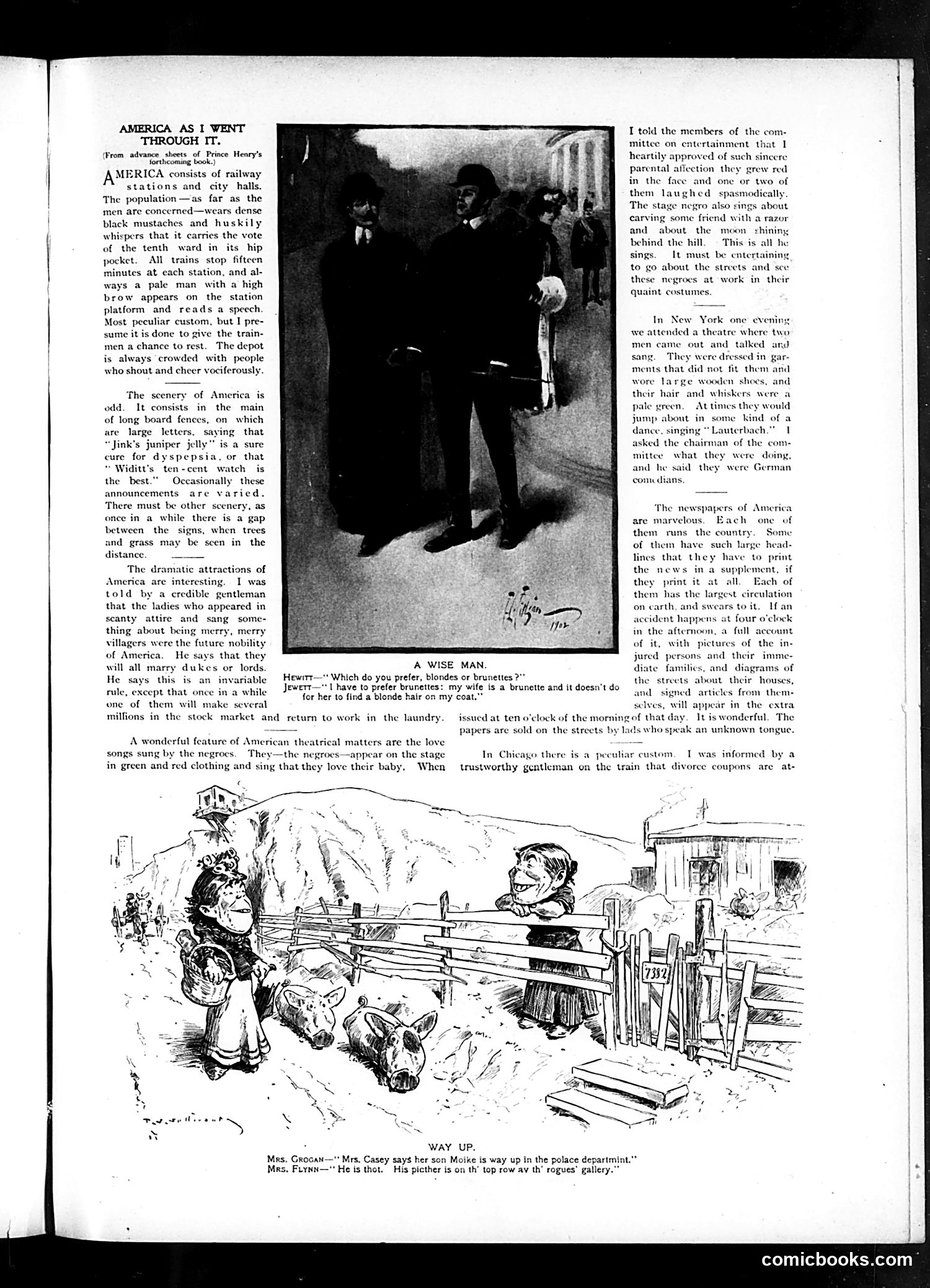
This page discusses American theatrical and cultural observations. The upper photograph labeled "A WISE MAN" shows a dialogue about marital preferences (blondes vs. brunettes), presented as social humor. The lower cartoon depicts two women ("Mrs. Grogan" and "Mrs. Flynn") discussing their sons' social advancement. Mrs. Grogan mentions her son "Moike" working in the palace guardroom, while Mrs. Flynn boasts her son's position is higher—"up in the 'gules' gallery" (likely a humorous reference to palace architecture). The satire targets Irish-American immigrants' aspirations and pride in their children's employment, no matter how modest. The exaggerated Irish dialect and names reinforce period stereotypes common in Judge's satirical humor about immigrant communities.
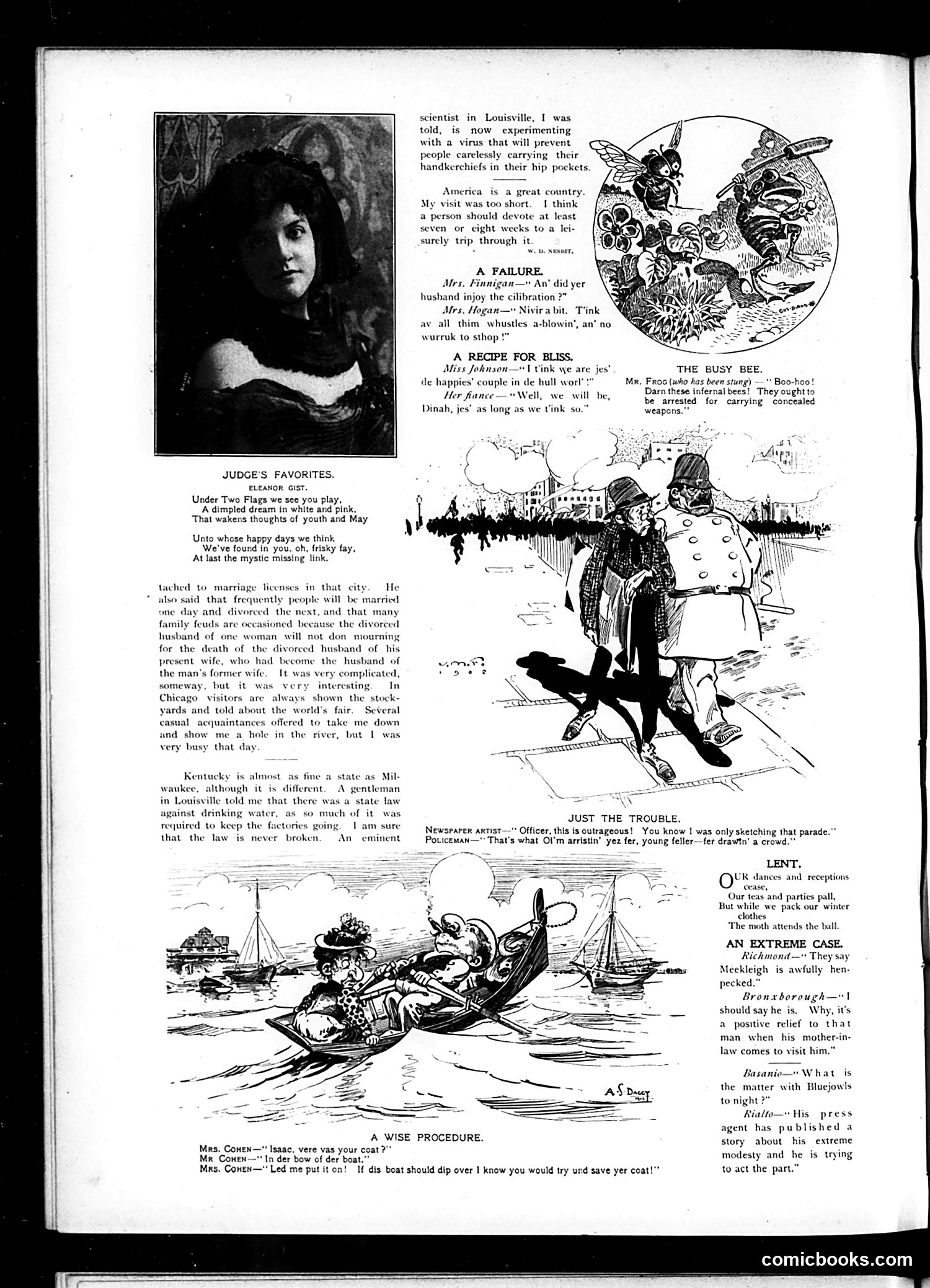
This page contains several humorous sketches satirizing early 20th-century American social life. "A Failure" mocks marital discord through brief dialogue exchanges. "A Recipe for Bliss" jokes about marriage compromise. "The Busy Bee" cartoon satirizes enforcement of weapons regulations, suggesting authorities should arrest people for "carrying concealed weapons" (likely referring to a specific contemporary gun-control debate). "Just the Trouble" depicts a newspaper artist and policeman discussing a parade sketch. "A Wise Procedure" shows a boating couple discussing coat insurance—humor derived from the wife's concern about her garment versus personal safety. The page primarily offers light domestic and social satire typical of Judge's humor, rather than pointed political commentary. The specific regulatory or legislative context for some jokes remains unclear without additional historical documentation.
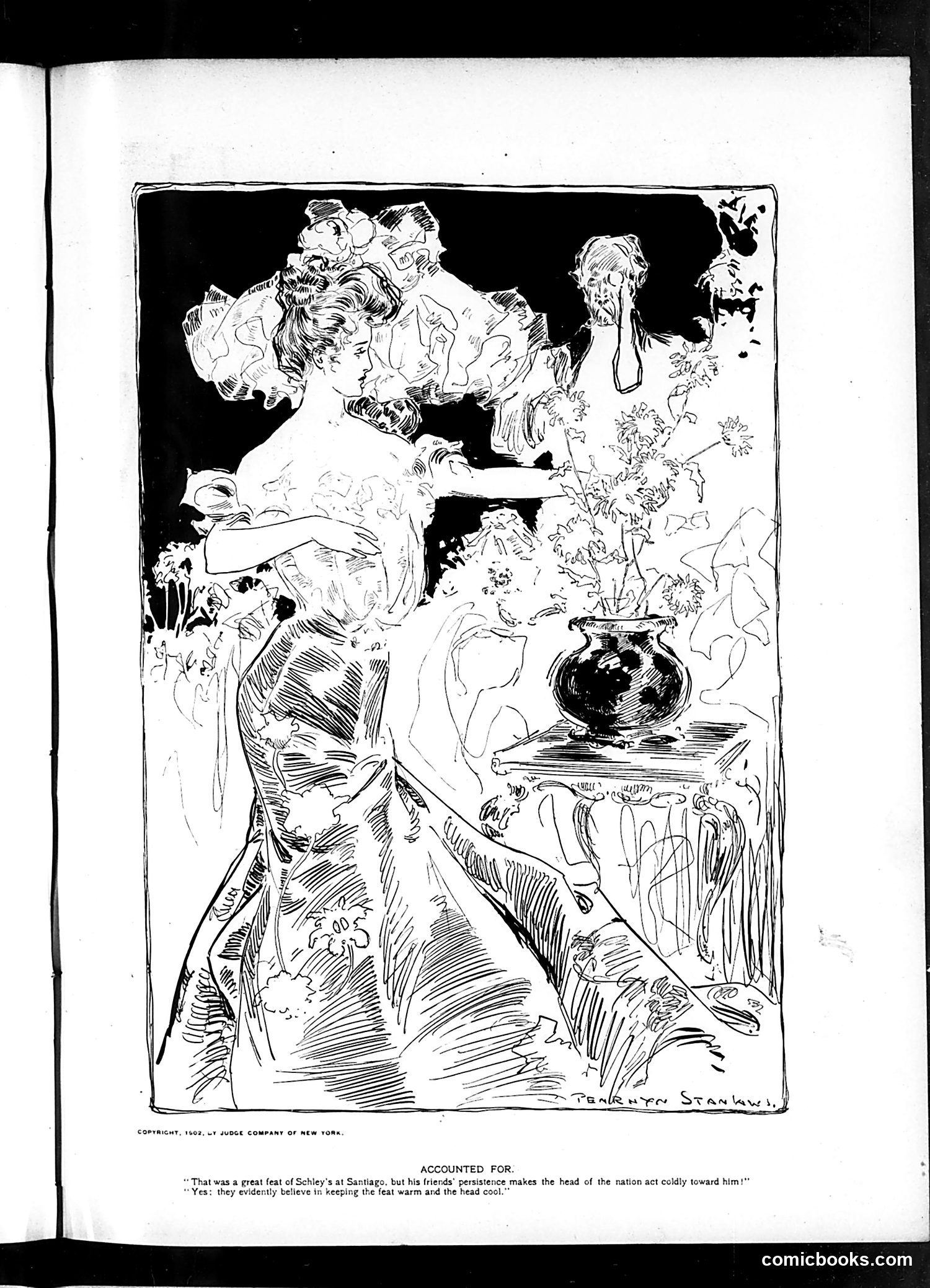
This 1902 Judge cartoon satirizes Admiral Winfield Scott Schley, a Spanish-American War hero. The caption references Schley's naval victory at Santiago during the 1898 war, but jokes that his supporters are so aggressively promoting him—keeping "the feat warm"—that they're actually damaging his reputation by making the nation's leadership treat him coldly. The elegant woman in the foreground appears to represent public opinion or society, while the men in the background likely represent Schley's overzealous political backers. The satire suggests that excessive self-promotion and aggressive campaigning can backfire, turning potential support into resentment. This reflects real post-war political friction over Schley's prominence and ambitions.
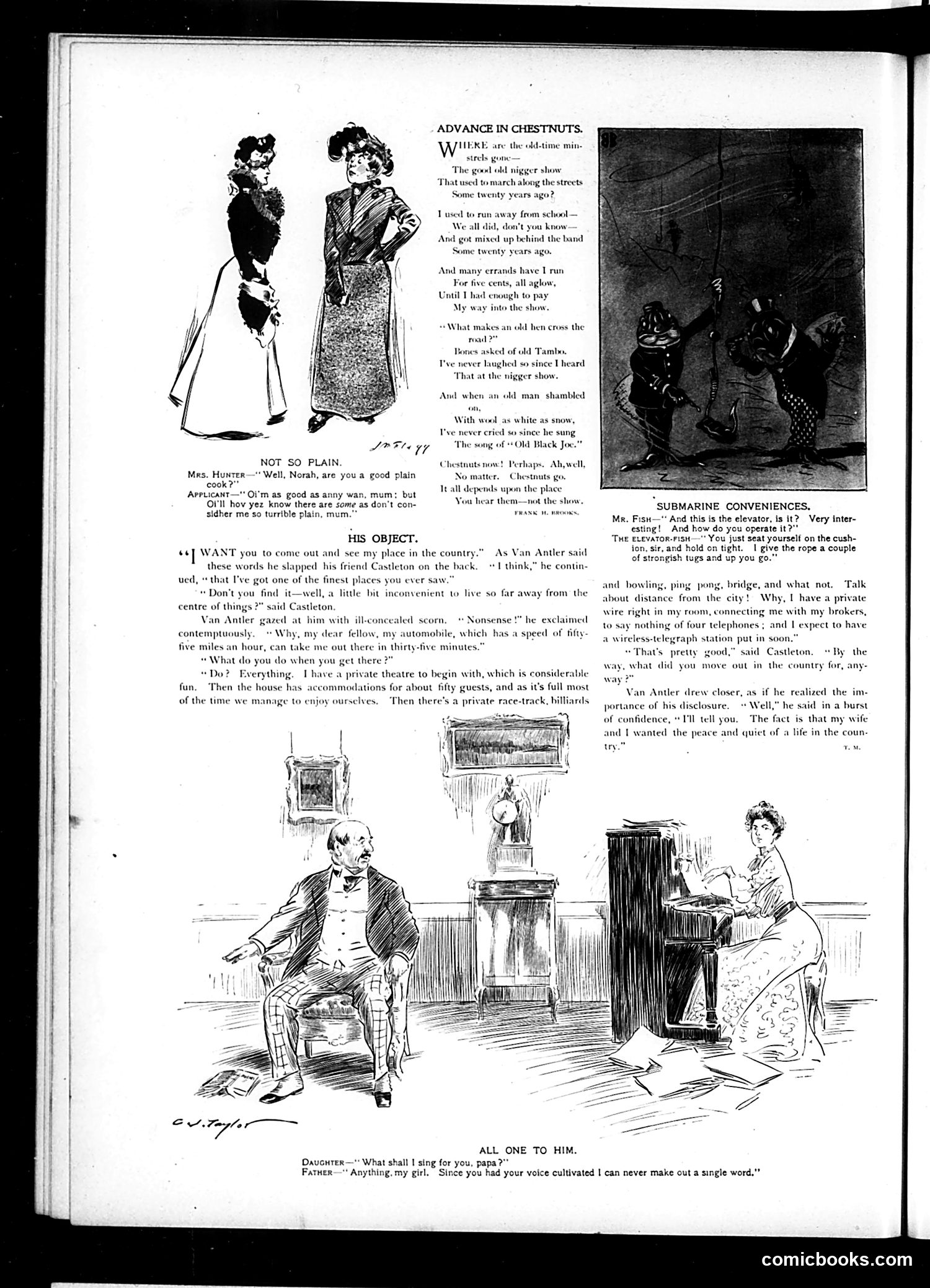
This page contains three separate satirical pieces typical of early-20th-century American humor: **"Advance in Chestnuts"** nostalgically mocks outdated minstrel show humor—specifically blackface entertainment that was fading by this era. The "chestnuts" (old, worn jokes) reference the racist minstrel tradition, with characters named "Tambo" and "Bones" (classic minstrel roles). The satire suggests this crude entertainment is becoming obsolete. **"Not So Plain"** is a brief domestic joke about an Irish servant girl claiming not to be "plain" (ordinary) despite her employer's assessment—playing on accent and class assumptions. **"His Object"** satirizes nouveau-riche excess: Van Antler boasts of his country estate with private theater, race-track, and billiards—only to reveal his real motivation was marital peace and quiet. The joke mocks wealthy men's pretentious justifications for extravagant spending. **"Submarine Conveniences"** appears to reference modern elevator technology with humorous operating instructions. The page reflects Belle Époque-era concerns: changing entertainment tastes, servant hierarchies, and conspicuous consumption among the wealthy.
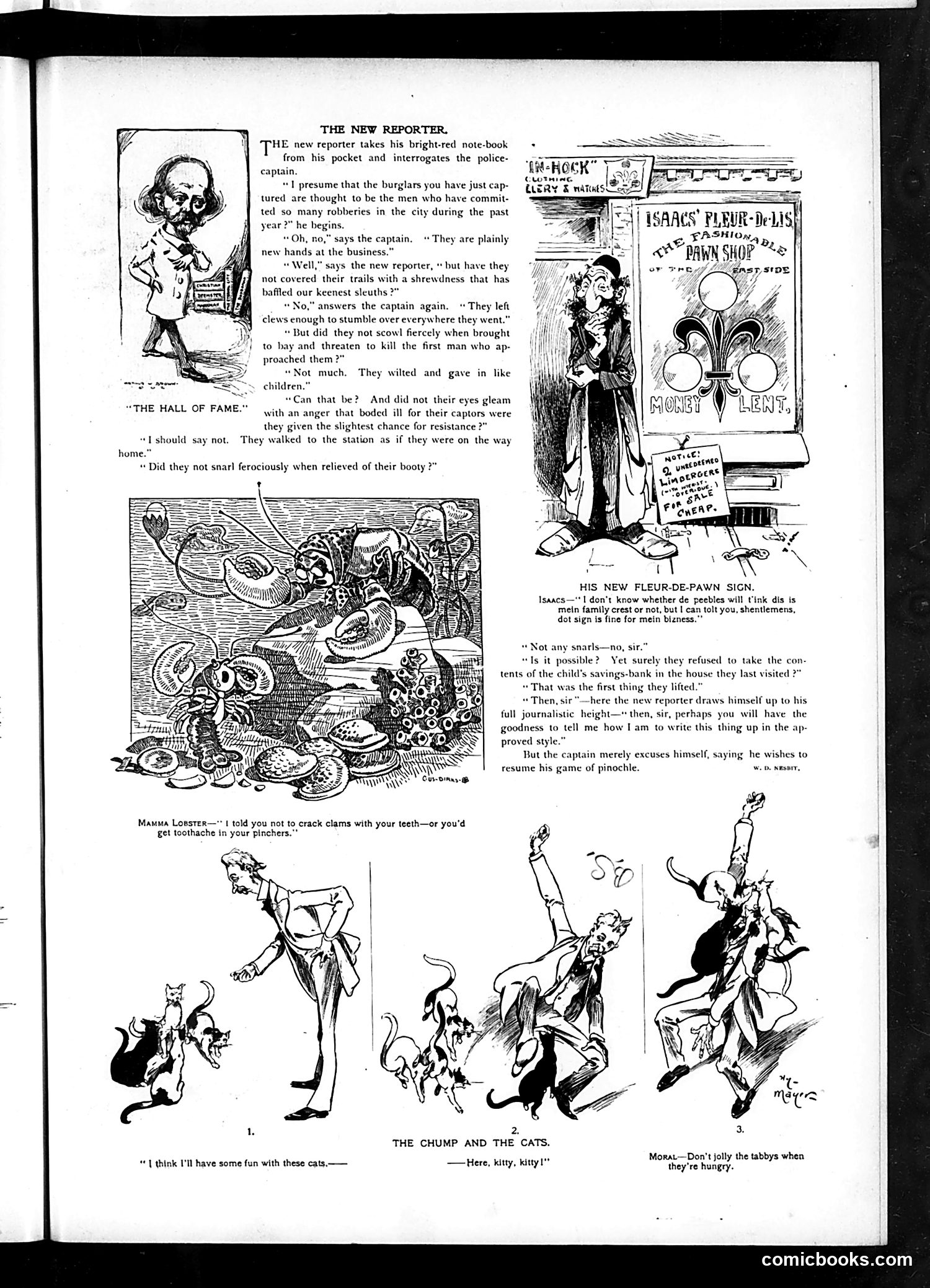
This page mocks inexperienced newspaper reporters who sensationalize crime stories. The main cartoon depicts a naive "new reporter" interrogating a police captain, asking leading questions designed to elicit dramatic details—wild chases, fierce resistance, gleaming eyes—typical of lurid crime reporting. The captain flatly contradicts each assumption: the burglars were amateurs, left obvious clues, surrendered meekly, and showed no theatrical villainy. The joke satirizes yellow journalism—reporters' tendency to invent or exaggerate narratives rather than report facts. The reporter is exposed as expecting criminals to perform like storybook villains, revealing how sensational newspapers distort reality for entertainment. Secondary cartoons mock other urban characters: a pawnbroker displaying a fake coat-of-arms, and a man harassed by hungry cats—lighter humor disconnected from the main satire.
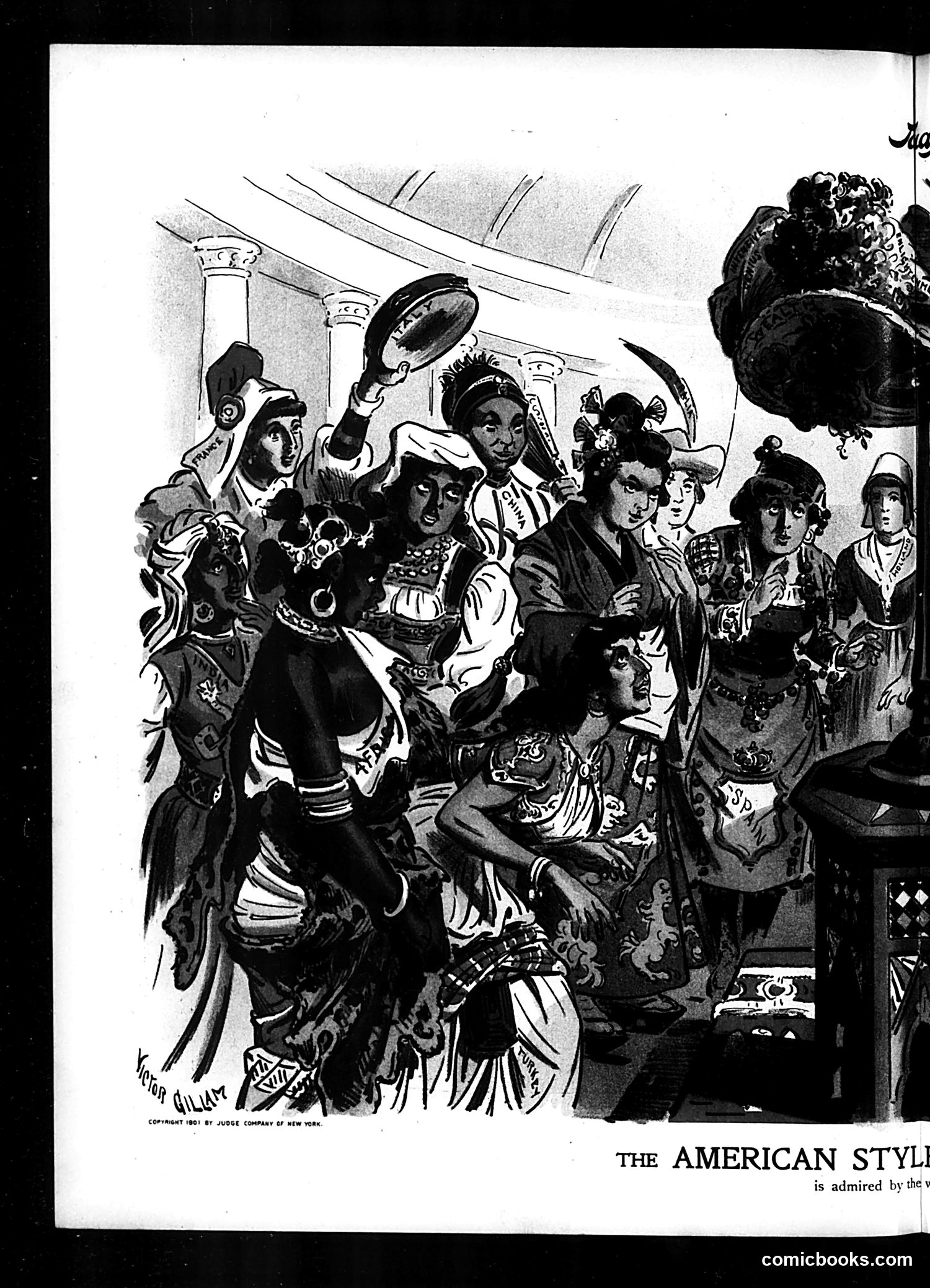
This illustration depicts a gathering of elegantly dressed figures in what appears to be an opulent interior with classical columns. The cartoon is credited to artist Cesare Cuningham (signed lower left) and copyrighted 1921 by Judge Company of New York. The incomplete caption reads "THE AMERICAN STYLI is admired by the..." suggesting the full text would complete the satirical point. The drawing shows multiple figures in fashionable dress and elaborate hats, apparently socializing or displaying themselves. The style and composition suggest this satirizes American high society's fashion trends or social pretensions during the early 1920s — likely mocking either American women's adoption of European fashion conventions or critiquing ostentatious displays of wealth and style among the upper classes. Without the complete caption, the specific target of satire remains unclear.
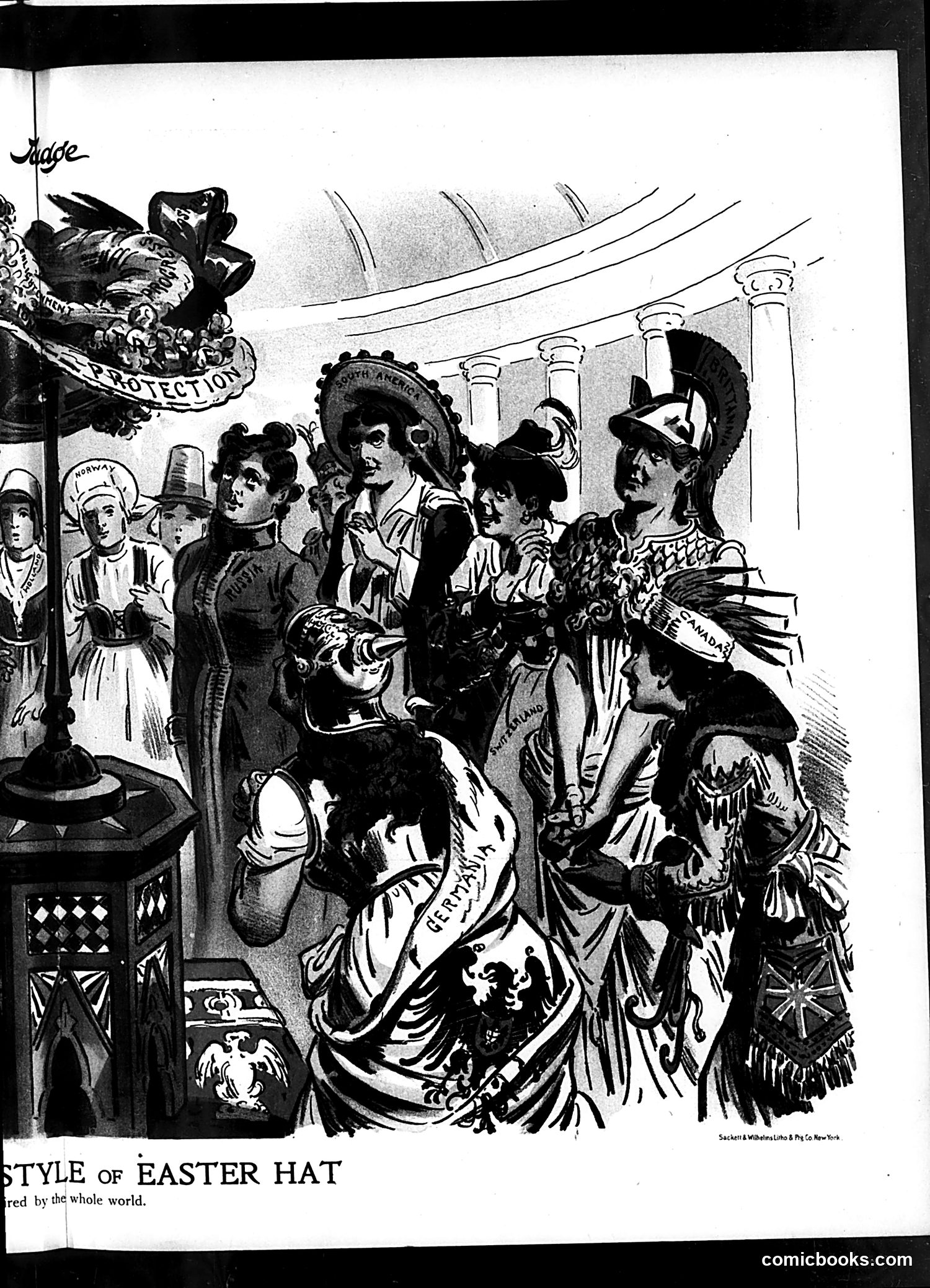
This appears to be a fashion satirical illustration titled "Style of Easter Hat" from Judge magazine. The cartoon depicts well-dressed women and men gathered indoors, examining and displaying elaborate Easter bonnets—the ornate, feathered hats that were fashionable accessories for Easter celebrations in the late 19th/early 20th century. The satire mocks the elaborate, ostentatious nature of Easter hat fashion and society's obsession with following these trends ("admired by the whole world," per the caption). The exaggerated headwear and the crowd's attention to these accessories ridicules both the impracticality of the fashions and the social pressure to participate in expensive, trendy displays of wealth and status. The formal architectural setting with columns suggests an upscale venue where such fashion competition occurs, emphasizing the pretension being satirized.
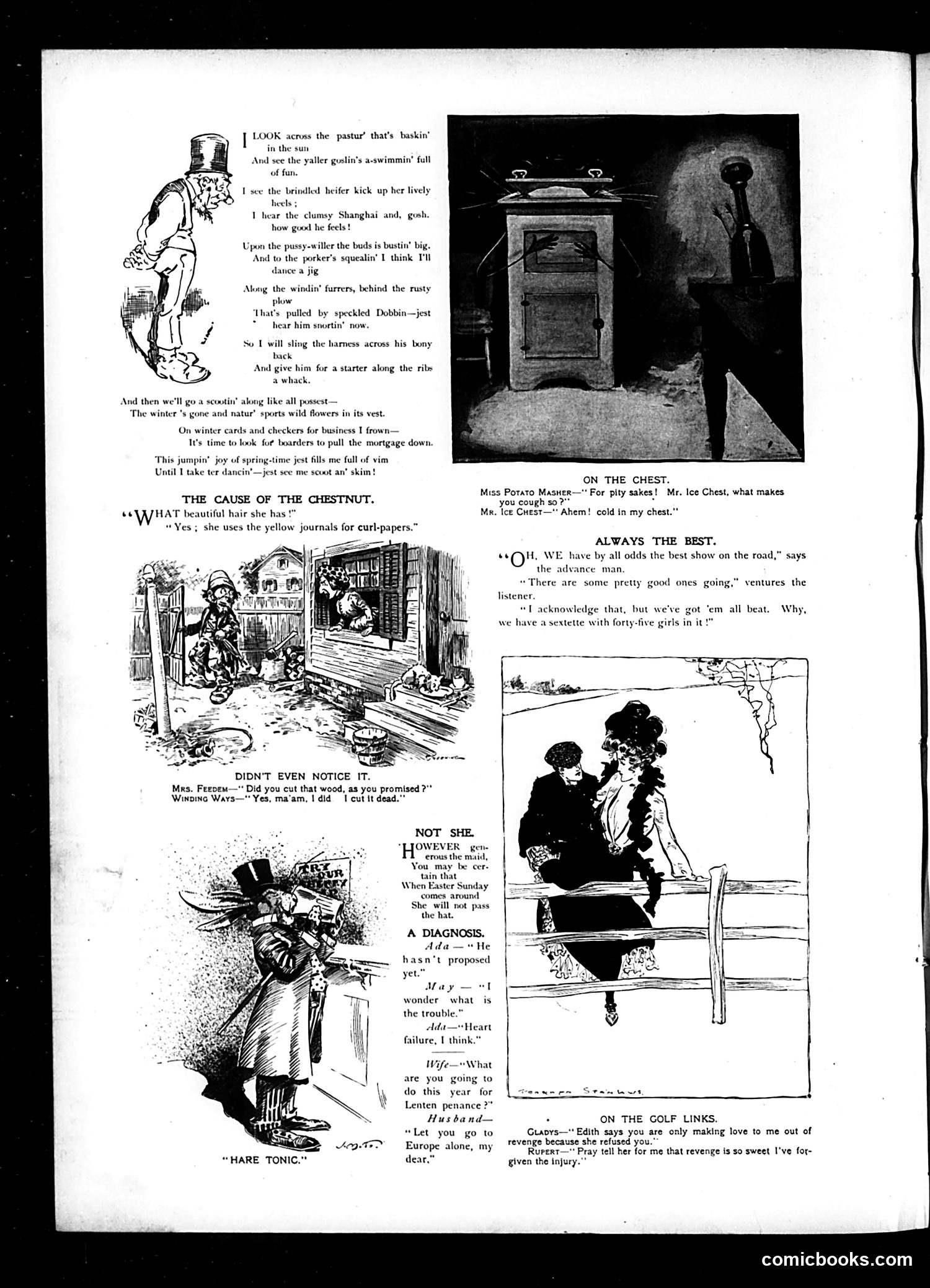
This page contains several brief satirical humor pieces typical of early 20th-century American magazines: **"The Cause of the Chestnut"** mocks women's vanity, joking that a woman uses "yellow journals" (sensationalist newspapers) as hair curlers. **"On the Chest"** is a pun: a personified ice chest complains of having "a cold in my chest." **"Always the Best"** satirizes traveling circus/show promoters who boast their acts are superior while admitting competitors are "pretty good"—the humor lies in the advance man's contradictory bragging about having "forty-five girls" in a sextette. **"A Diagnosis"** jokes about unmarried women: when a man hasn't proposed, the diagnosis is "heart failure." **"On the Golf Links"** involves romantic revenge humor between couples. The page also includes rural/pastoral poetry celebrating springtime. The overall tone reflects period humor: newspaper satire, domestic comedy, and social commentary on courtship and entertainment.
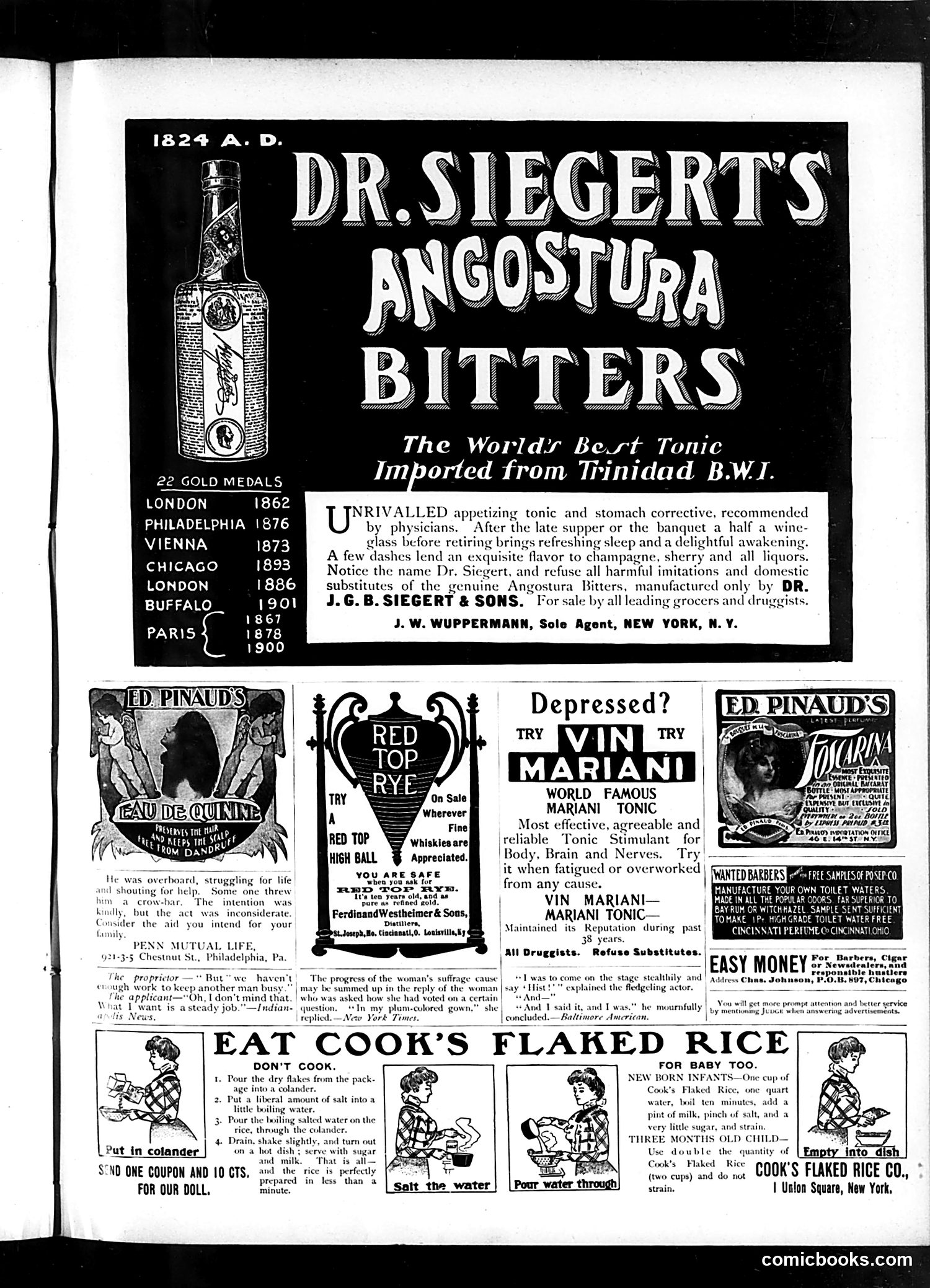
This page is **primarily advertising**, not political satire. It contains multiple product advertisements from circa 1900-1920s America. The main content includes: **Dr. Siegert's Angostura Bitters** (top): A medicinal tonic advertised as imported from Trinidad, listing 22 gold medals from international exhibitions. These "bitters" were patent medicines marketed for digestive and sleep issues—standard for the era. **Smaller ads** for other tonics and remedies (Vin Mariani, Red Top Rye), reflecting the period's widespread promotion of alcohol-based medicinal products. **Cook's Flaked Rice** (bottom): A food product with instructional cooking diagrams and a promotional coupon for a doll. **Ed Pinaud products**: Toiletries advertised with period illustration styles. One small narrative snippet about a job applicant wanting work appears to be filler content between ads rather than editorial satire. The page reflects early 20th-century American consumer culture and the prevalence of unregulated patent medicine advertising before FDA oversight.
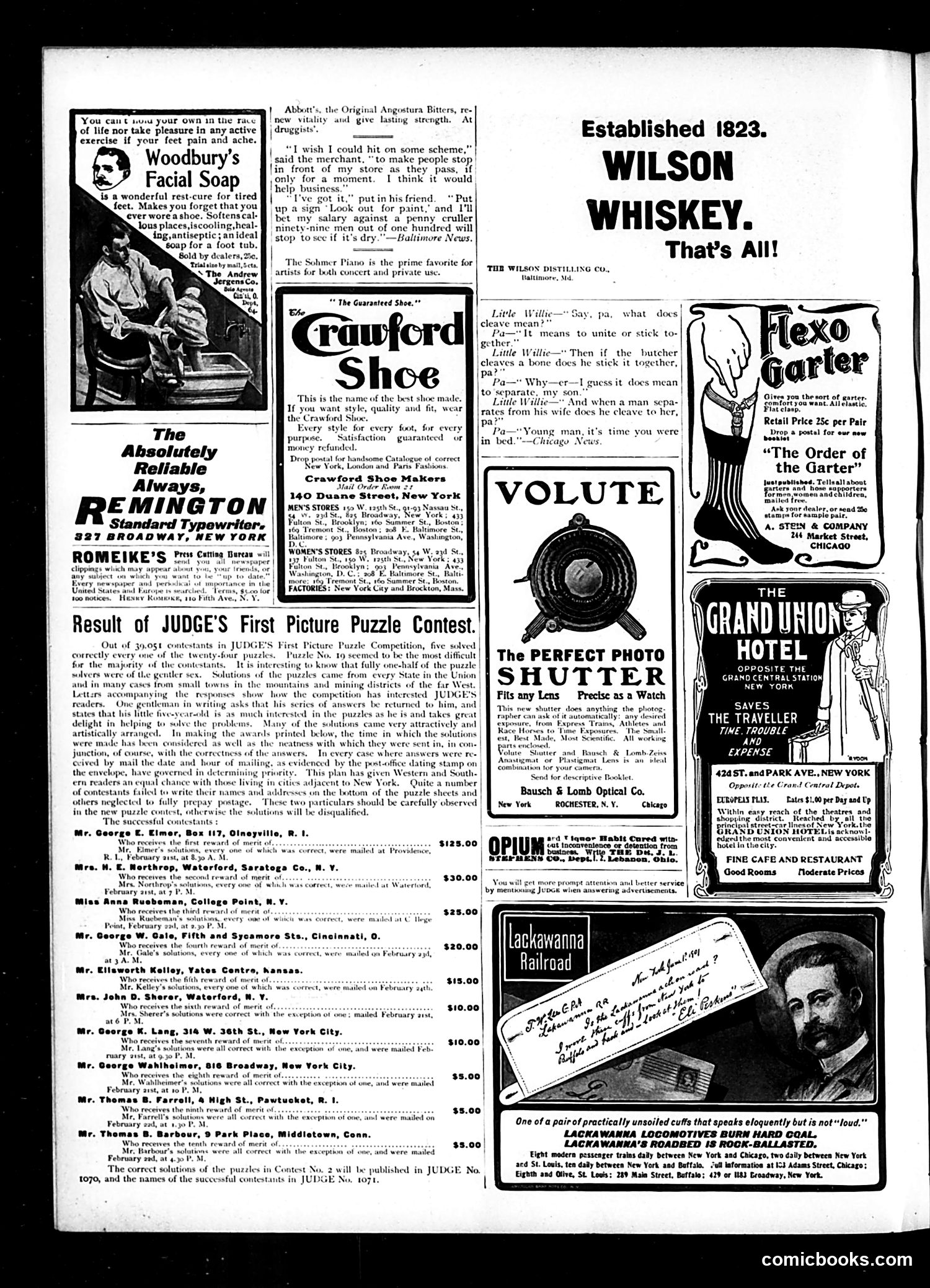
This page is primarily **advertisements and contest results**, not political satire. The main content includes: 1. **Product ads**: Woodbury's Facial Soap, Remington typewriters, Crawford Shoes, and the Sohmer Piano—typical early 20th-century luxury goods marketed to middle-class consumers. 2. **A brief joke** (under "The Guaranteed Shoe"): A merchant wants to attract foot traffic, so a friend suggests posting "Look out for paint" to make passersby stop and check if paint is dry. The humor relies on basic human curiosity and gullibility. 3. **Judge's Picture Puzzle Contest results**: The bulk of the page announces winners of a previous contest, listing names, addresses, and prize amounts ($125-$5). The text explains the competition drew thousands of entries nationwide. There is **no political cartoon or satire** on this page—it's a fairly standard editorial/advertising mix typical of Judge magazine's revenue model during this era.
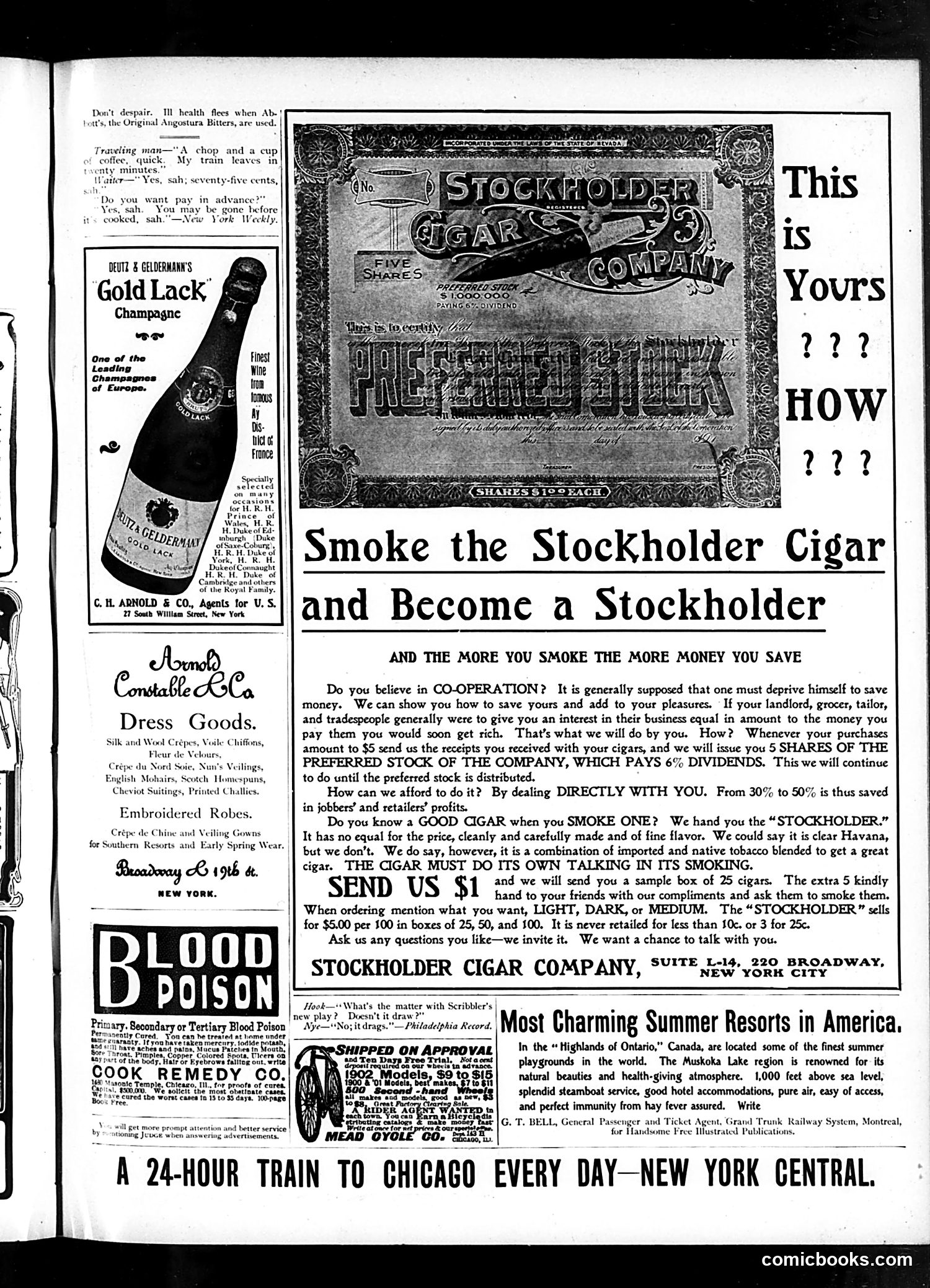
This page is primarily **advertising rather than political satire**. The dominant feature is a large advertisement for the "Stockholder Cigar Company" promoting an early cooperative business scheme. The cigar ad's pitch is its central joke: by purchasing cigars and collecting receipts, customers receive company stock paying 6% dividends. The company claims to offer this by eliminating middlemen—saving "30% to 50%" in jobber and retailer profits. This reflects early-1900s interest in cooperative economics and direct-to-consumer sales, positioned as benefiting working people. The surrounding ads (Gold Lack Champagne, dress goods, blood poison remedy, train service) are standard period advertising with no apparent satirical content. A small cartoon fragment appears at page bottom mentioning "Scribbler" and drawing criticism, but the image is too unclear to interpret its meaning or subject. The page demonstrates how Judge mixed satirical editorial content with straightforward commercial advertising.
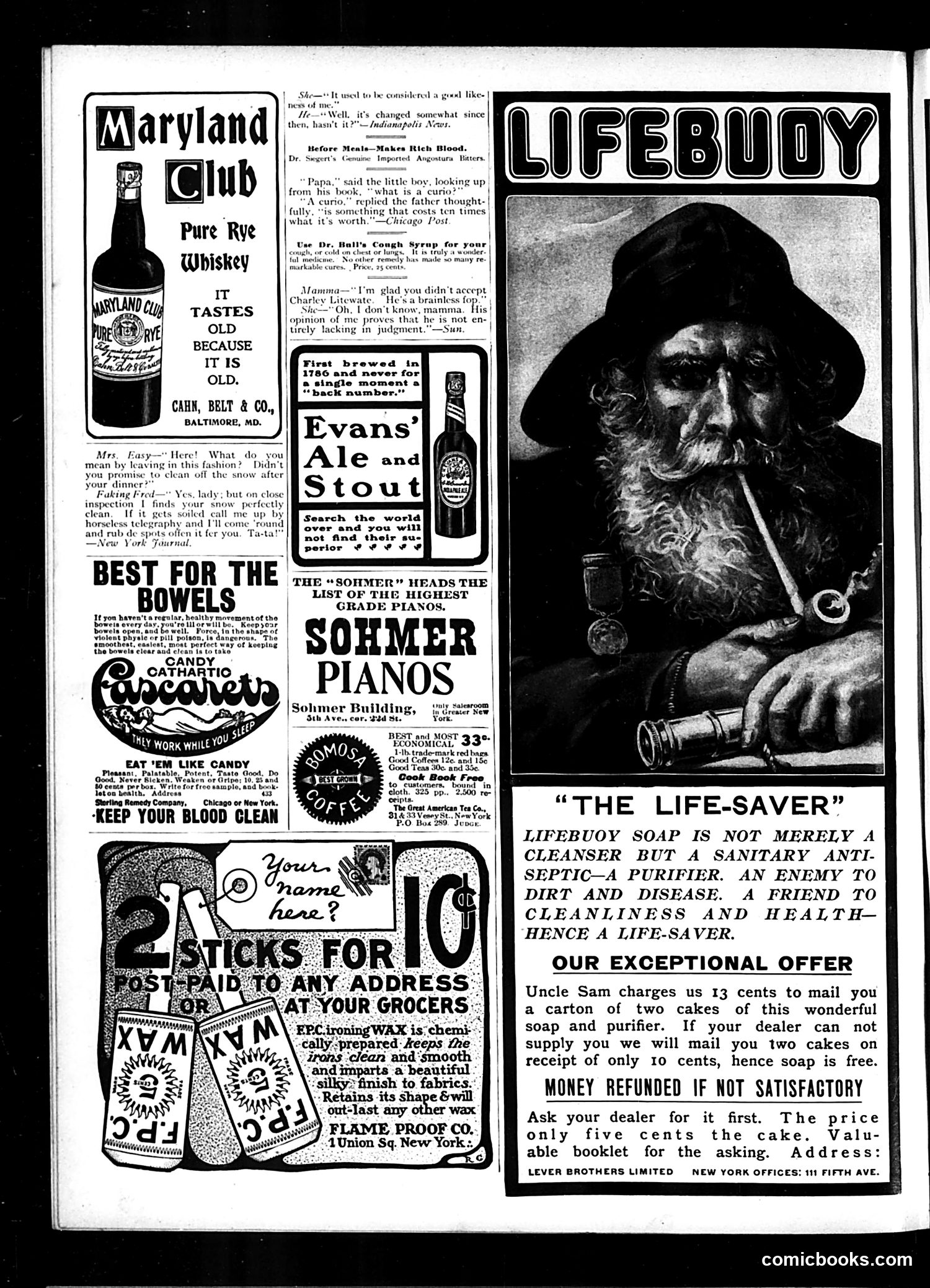
This is primarily a **vintage advertising page** (likely early 1900s) with minimal satirical content. The page features product advertisements interspersed with brief humorous dialogue snippets—typical filler for magazines of this era. **Key advertisements include:** - Maryland Club Pure Rye Whiskey (emphasizing age as quality) - Sohmer Pianos (luxury goods) - Cocoanut Candy for digestive health - Lifebuoy Soap, marketed as an "anti-septic" health product - XYM brand socks **The satirical elements** are mild: brief comic exchanges about fashion, children's definitions of "curio," and parental advice—standard domestic humor of the period with no clear political targets. The **Lifebuoy advertisement** reflects era-specific health anxieties about sanitation and disease prevention, positioning soap as a public health necessity—typical Progressive Era messaging linking consumer products to wellness. Overall, this page demonstrates how **Judge balanced satire with revenue** through advertising, rather than presenting sustained political commentary.
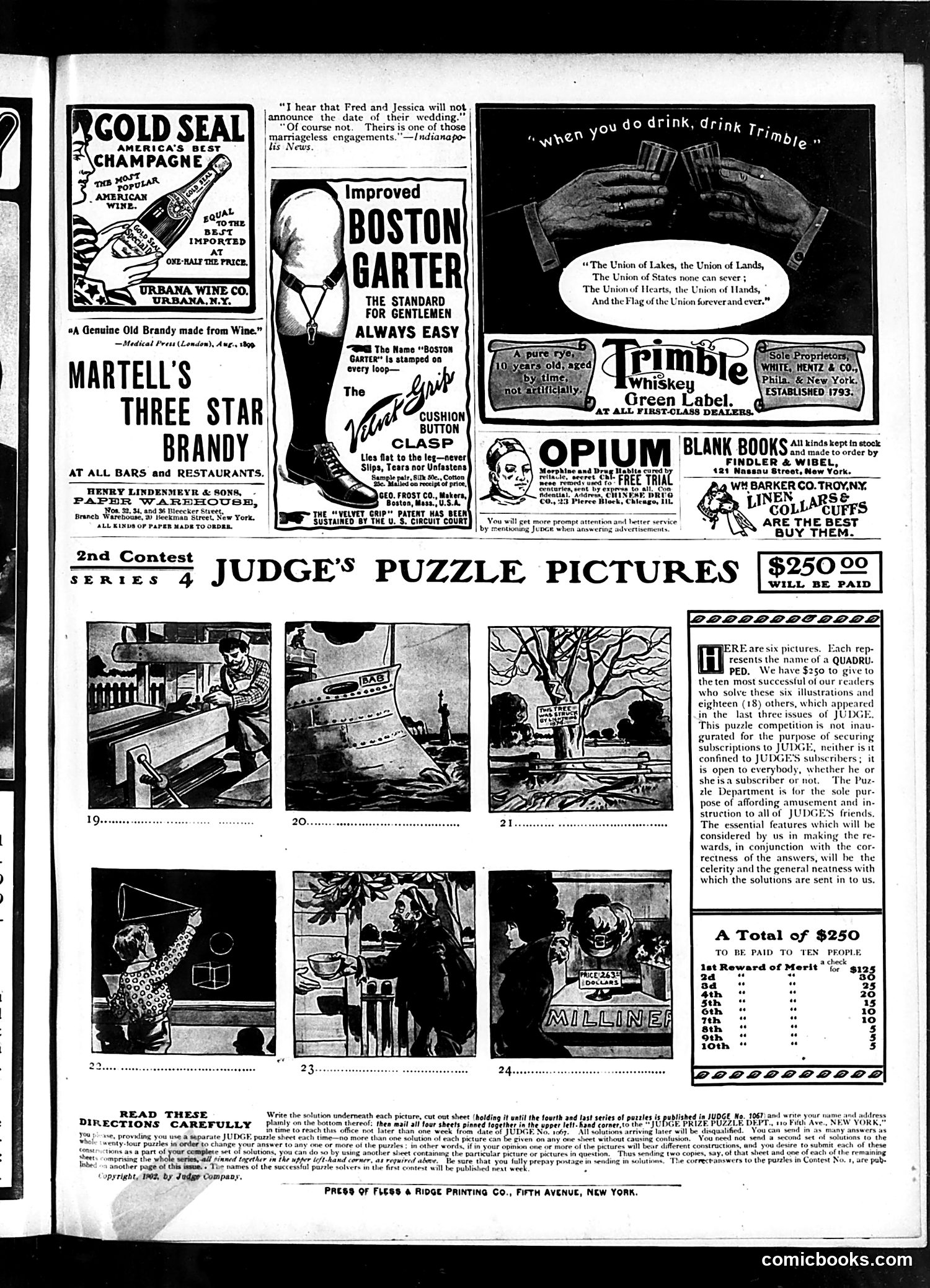
This is primarily an **advertising and puzzle page** from Judge magazine (1908), with minimal political or satirical content. **Main Content:** The page features "Judge's Puzzle Pictures" — a contest offering $250 total prize money to readers who identify six quadrupeds (four-legged animals) from illustrated clues. This was an interactive feature encouraging subscriptions and reader engagement. **Advertisements:** The margins contain period product ads: Cold Seal Champagne, Martell's Brandy, Boston Garter (men's garters), Trimble Whiskey, and notably an "Opium" product advertised as a cure-all with "free trial" — reflecting the era before opium regulation when such substances were openly marketed as medicines. **Social Note:** A brief joke about Fred and Jessica's "marriageless engagement" suggests societal gossip about delayed wedding announcements. **Historical Context:** The opium advertisement particularly illustrates how patent medicines and unregulated substances were normalized in early 20th-century American advertising, before FDA regulations and drug laws.
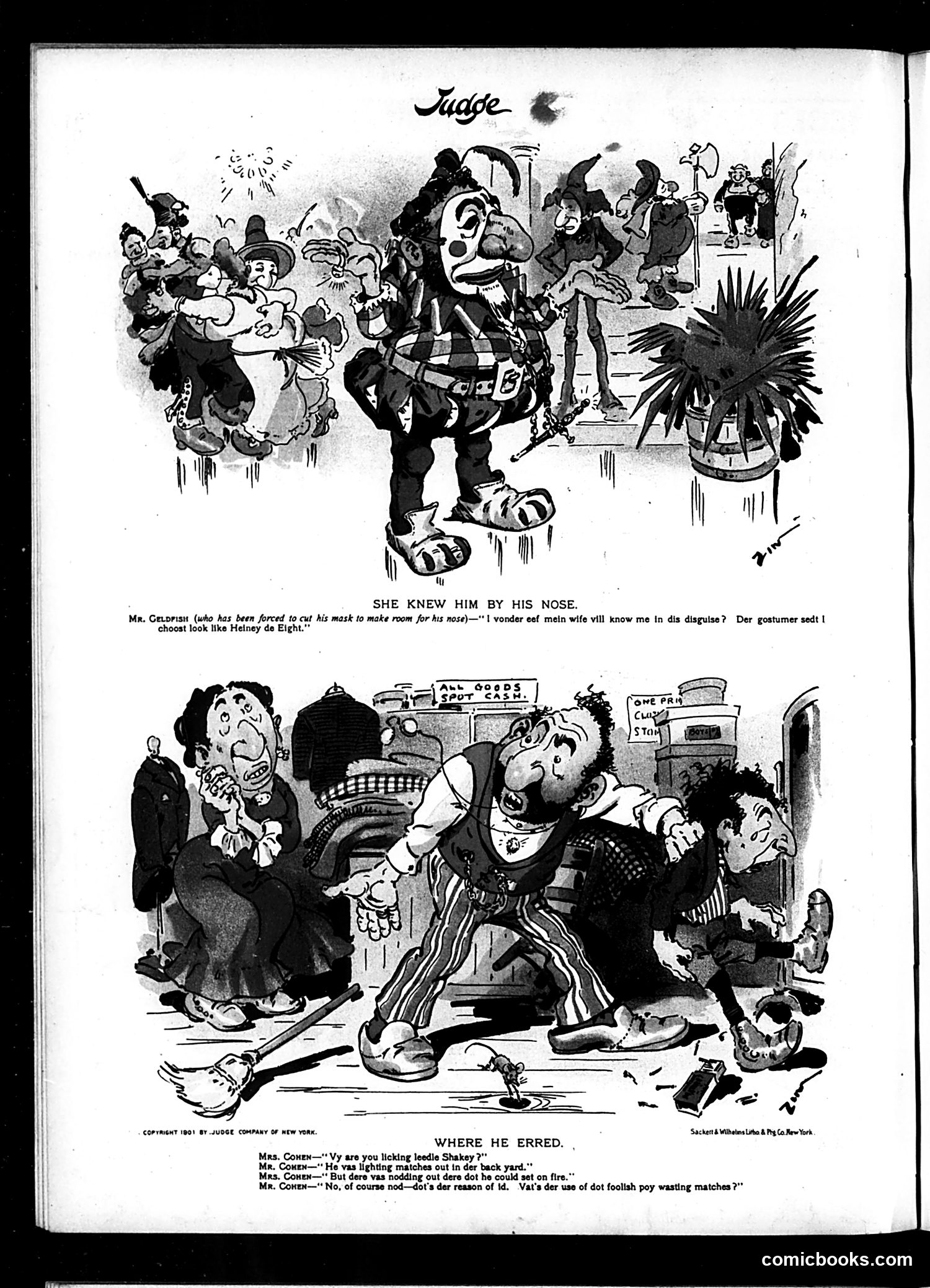
These two cartoons mock German-American immigrants through exaggerated dialect and stereotypical features, particularly their prominent noses. **Top cartoon ("She Knew Him by His Nose"):** A costumed man at what appears to a masquerade party worries his disguise won't fool his wife—but his large nose protrudes through the mask opening, making him instantly recognizable. The joke plays on the stereotype of German noses as comically oversized. **Bottom cartoon ("Where He Erred"):** Mr. Cohen (likely Jewish, not German, based on the name) catches a boy lighting matches outside. When his wife questions why he's licking the child, he explains the boy was "wasting" matches—implying there's nothing flammable to set on fire in the yard, so the boy shouldn't waste them. The humor derives from the immigrant father's penny-pinching and broken English. Both cartoons rely on period stereotypes about ethnic immigrants' appearance and speech patterns that were common in early 20th-century American humor magazines.