
A complete issue · 16 pages · 1902
Judge — March 22, 1902
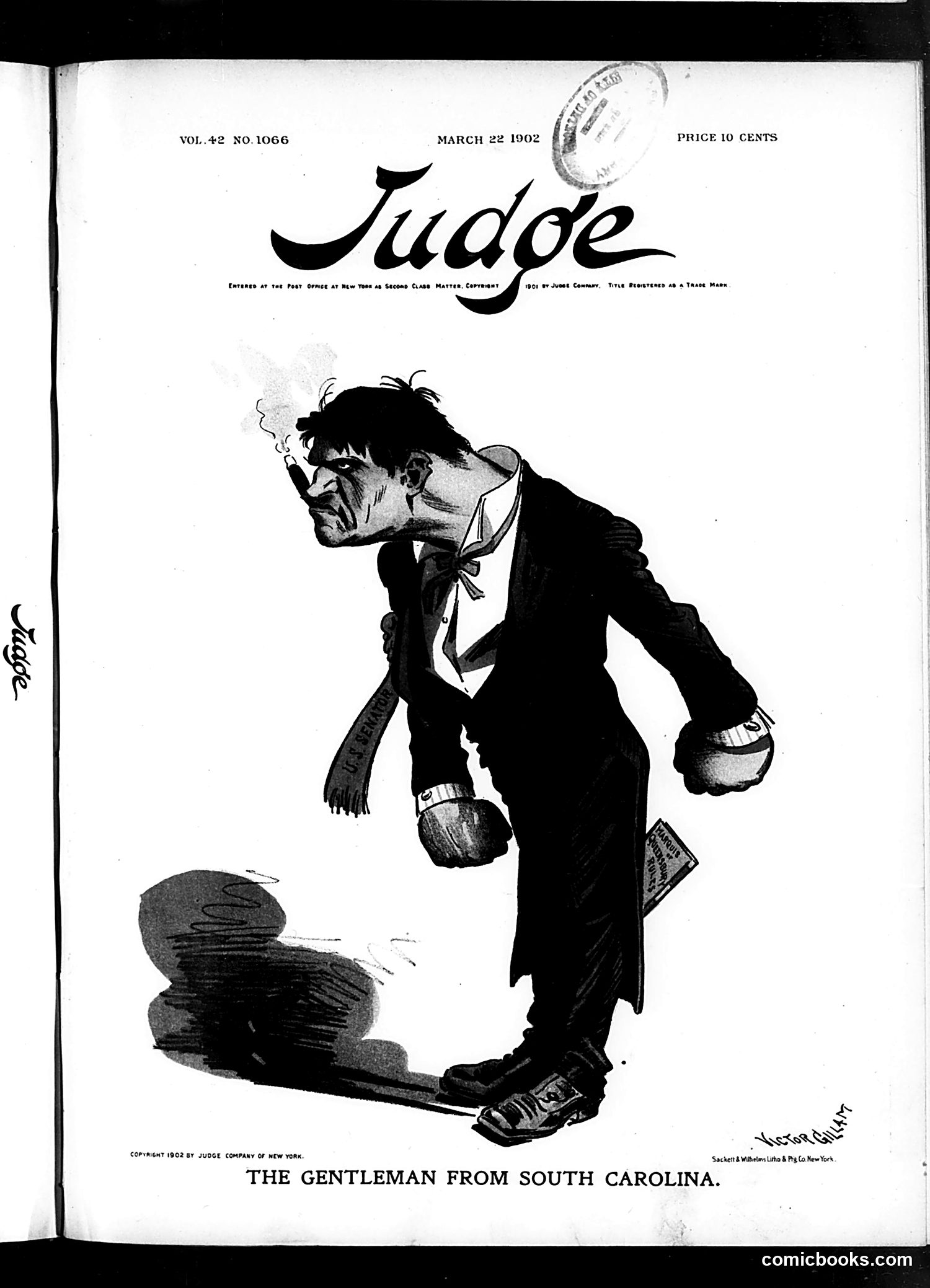
This Judge magazine cover from March 22, 1902 depicts a caricatured figure in formal dress with exaggerated facial features, boxing gloves, and a cigar. The title "The Gentleman from South Carolina" is satirical. The caricature appears to reference a prominent South Carolina political or public figure of that era, likely involved in controversy. The boxing gloves suggest aggressive behavior or combative conduct, while the formal attire ironically contrasts with the crude caricature and aggressive posture—suggesting hypocrisy between claimed gentility and actual conduct. The satirical "gentleman" designation combined with the unflattering depiction indicates Judge was mocking someone's pretensions to respectability. Without additional context identifying the specific figure, the exact reference remains unclear, though it likely concerns a notable 1902 South Carolina scandal or political figure.
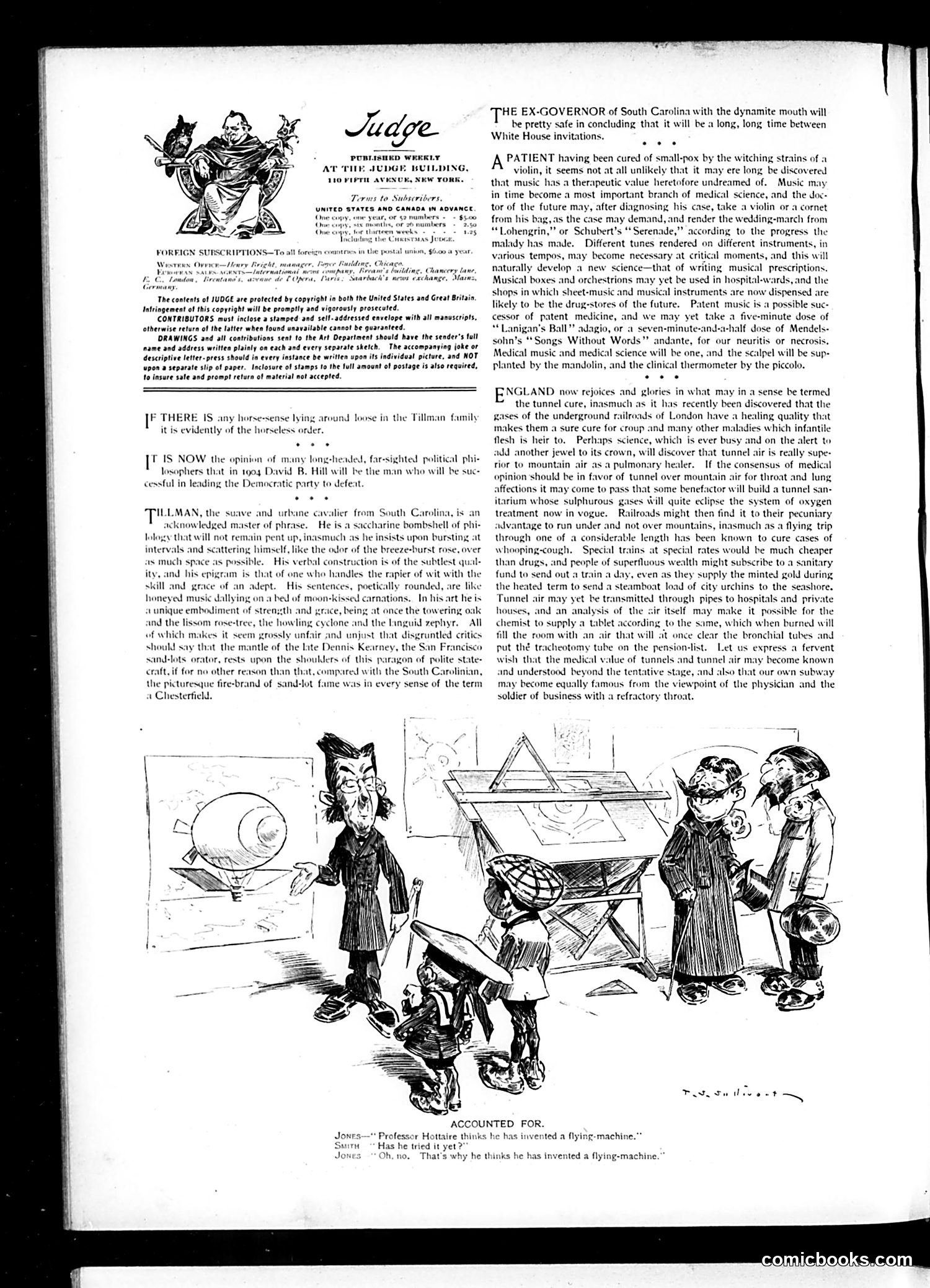
This page contains political commentary and a cartoon. The top section discusses South Carolina's ex-governor (likely William Tillman, based on the text) as a potential Democratic Party leader, portraying him as an ineffective "suave and urbane cavalier" prone to self-aggrandizing behavior. The cartoon below, captioned "ACCOUNTED FOR," depicts three men examining what appears to be an early flying machine or experimental aircraft. The dialogue suggests Professor Huxley has "invented a flying-machine," with the punchline being it's actually just broken/failed equipment. The satire appears to mock both scientific pretension and political incompetence—using the flying machine metaphor to ridicule overhyped claims or failed ventures, possibly alluding to contemporary aviation experiments or political promises.
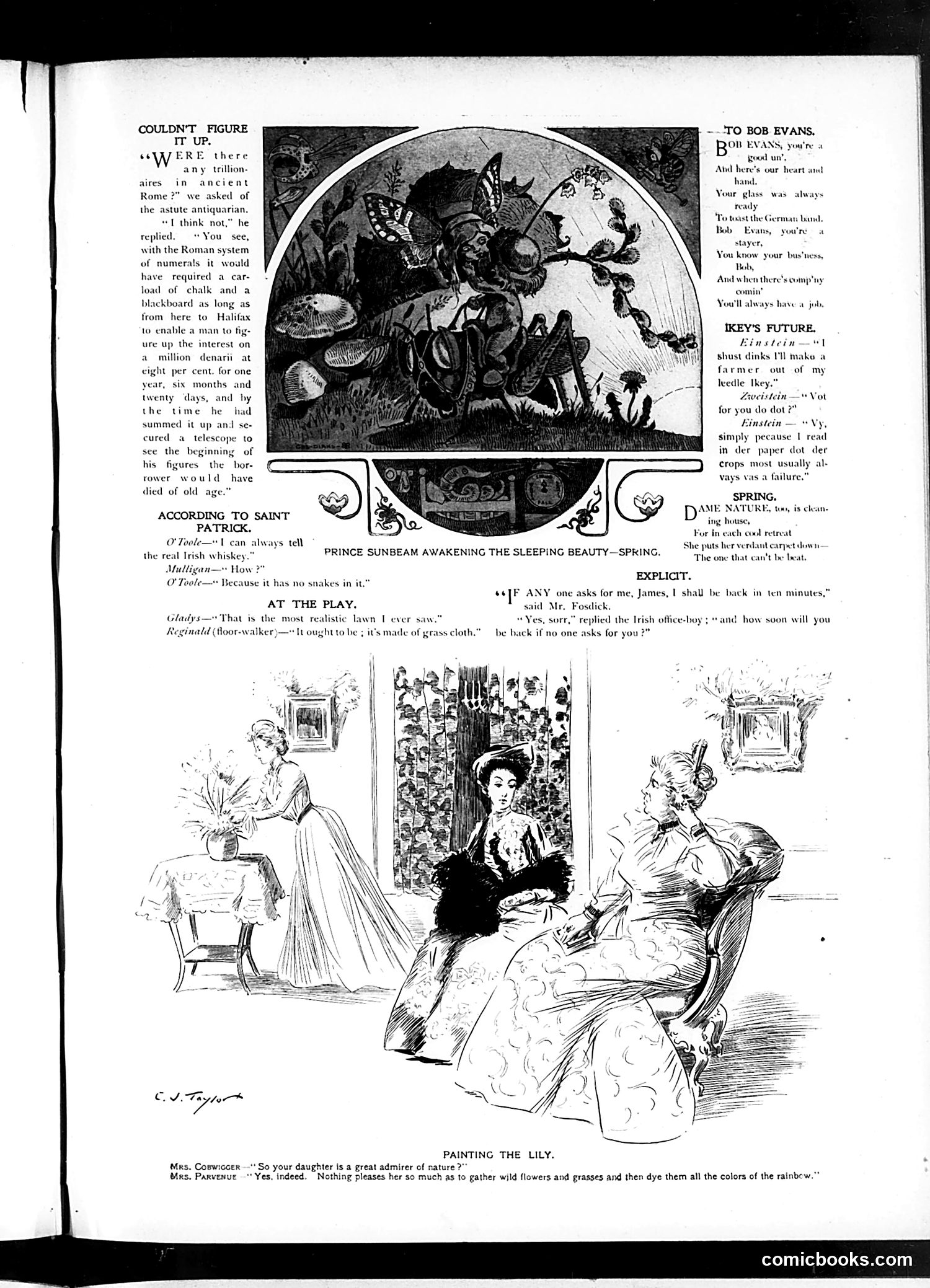
This page contains several unrelated satirical pieces rather than a unified cartoon: 1. **"Couldn't Figure It Up"** (left column): A dialogue joke about Irish contractors and numeracy—stereotyping Irish workers as poor at mathematics. 2. **"Prince Sunbeam Awakening the Sleeping Beauty—Spring"** (top): A fantastical illustration with no obvious political content; appears to be whimsical seasonal humor. 3. **"At the Play"** and **"Painting the Lily"** (bottom): Theater and domestic social humor with no discernible political satire. 4. **Various short jokes** ("To Bob Evans," "Ickey's Future," "Spring"): Light humor about contemporary figures and situations. The page is primarily entertainment-focused rather than politically satirical, featuring social observation, puns, and stereotypes typical of early 20th-century American humor magazines.
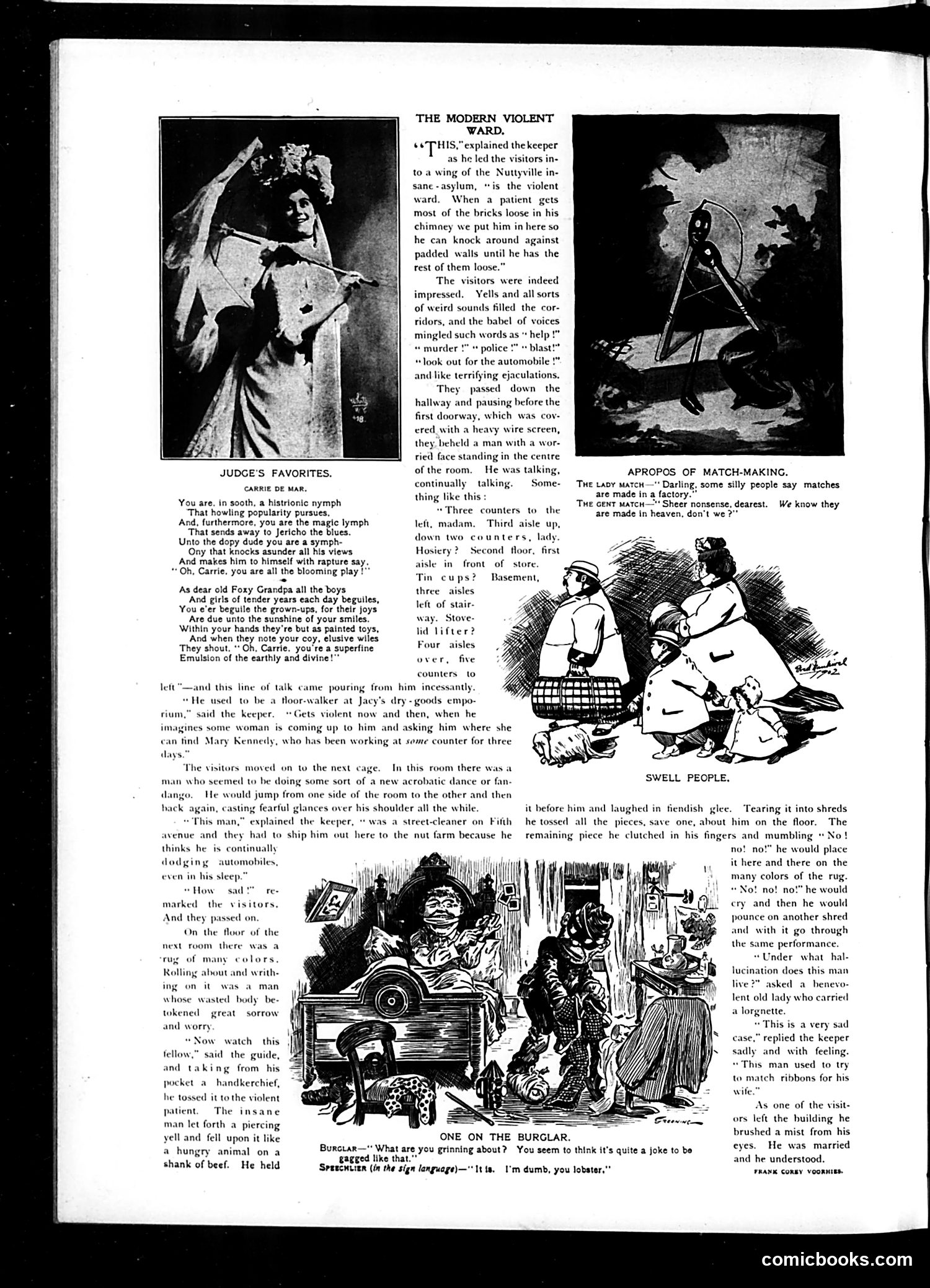
This page contains three satirical illustrations about institutional life and human behavior: **"The Modern Violent Ward"** depicts an asylum's violent ward where patients are confined. The satire critiques both the treatment of mentally ill patients and visitors' morbid fascination with observing them—treating human suffering as entertainment. **"Apropos of Match-Making"** and **"Swell People"** are lighter social commentaries about courtship and matchmaking practices, poking fun at romantic conventions. **"One on the Burglar"** shows a burglar being outsmarted, likely satirizing crime or urban social issues of the era. The page overall reflects Judge's typical approach: satirizing American institutions, social practices, and human folly through exaggerated illustrations and witty accompanying text. The exact historical moment is unclear from context provided.
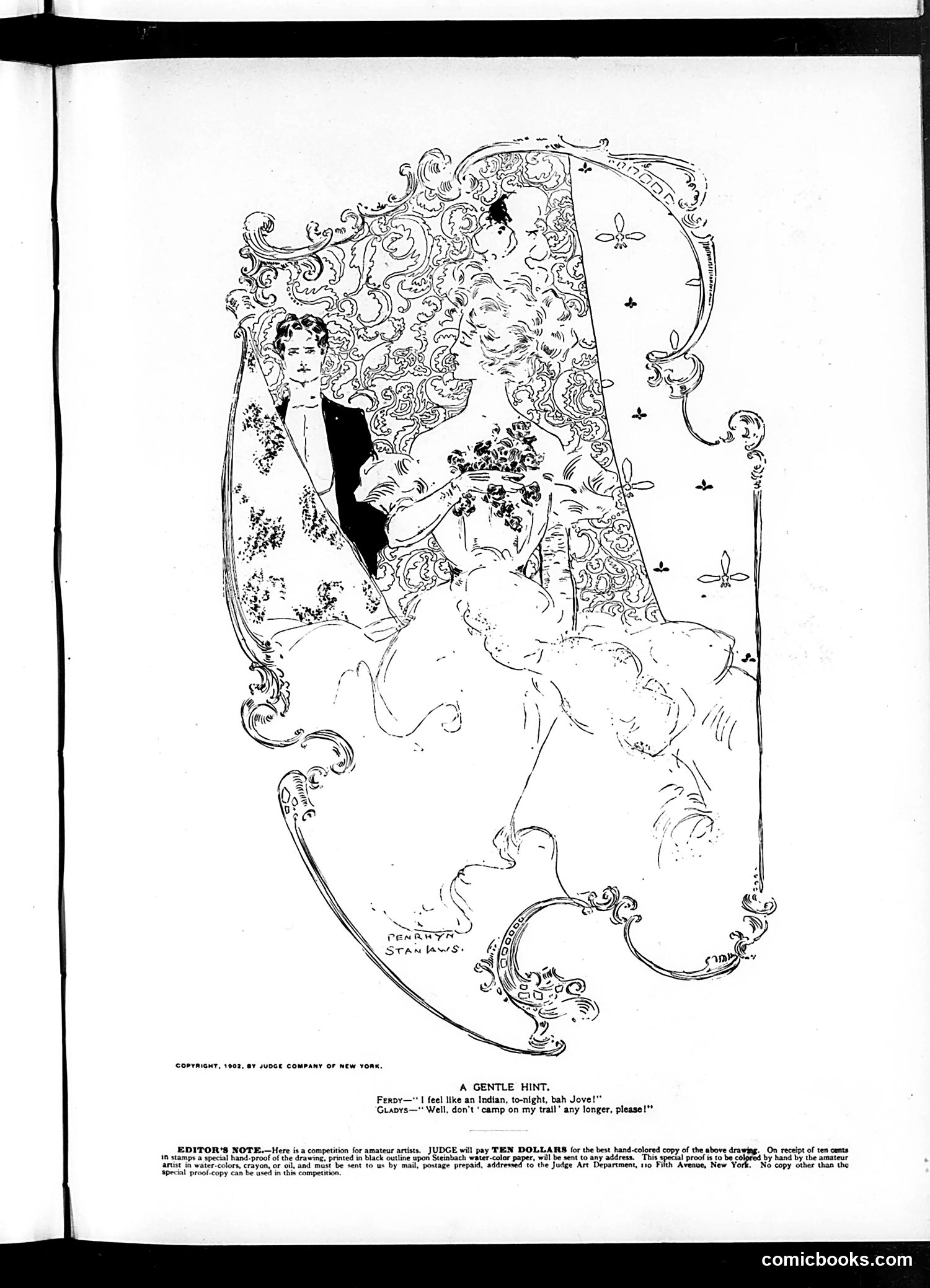
This 1902 cartoon plays on contemporaneous anxieties about Native Americans and dating etiquette. Two figures appear to be on a romantic outing: "Perry" (a young man) declares he "feels like an Indian tonight," likely meaning he wants to behave boldly or romantically. "Gladys" (the woman) responds by asking him not to "camp on my trail" any longer—a pun combining the Native American camping metaphor with a plea for personal space. The humor derives from the double meaning: Perry's comment about feeling "Indian" is reinterpreted as literal camping behavior, allowing Gladys to humorously reject his advances while playing along with his metaphor. The ornate decorative border and classical cherub figures suggest this appeared in a humor magazine aimed at middle-class readers familiar with both flirtation conventions and stereotypical imagery of Native Americans.
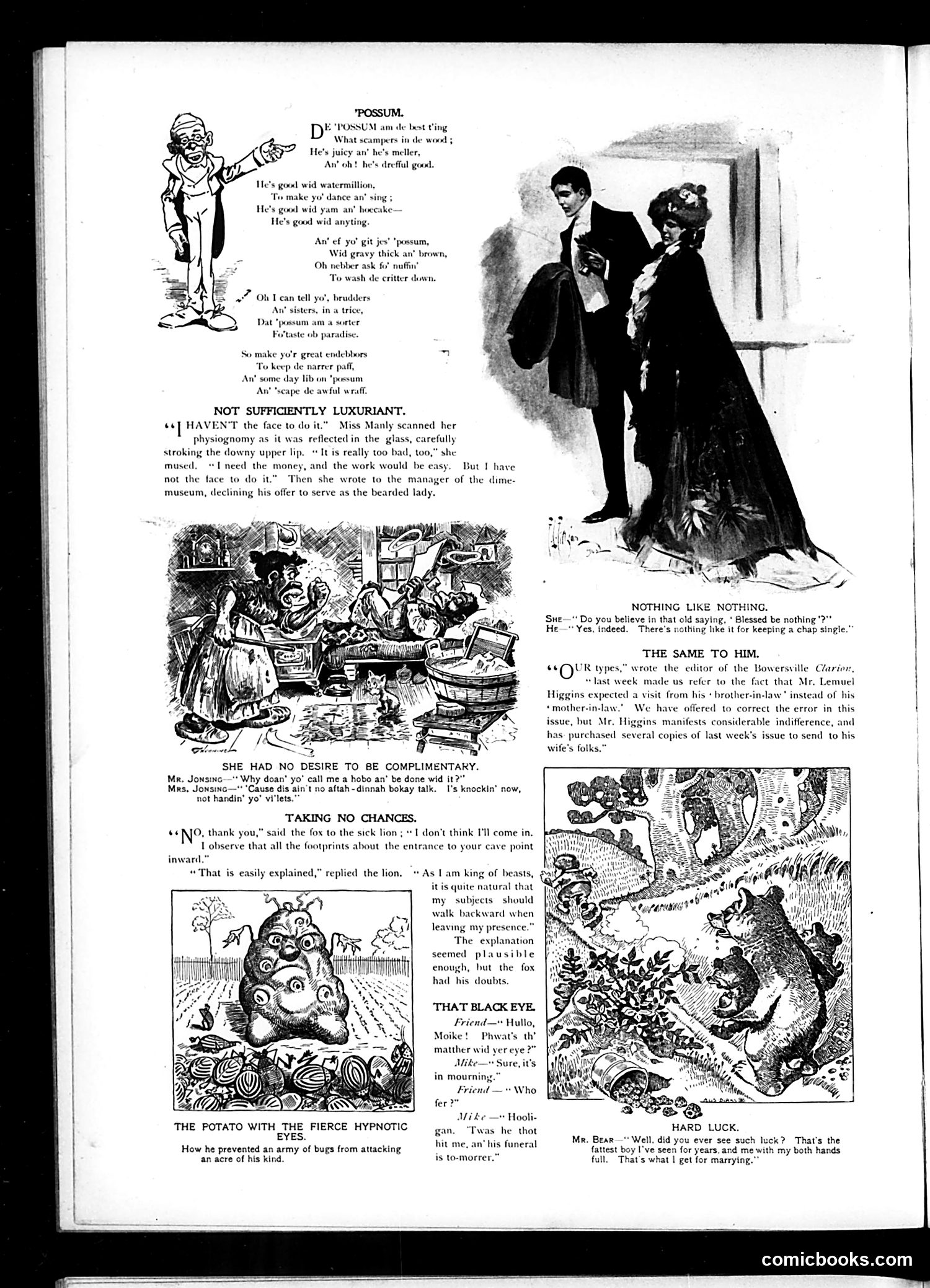
This page contains multiple short humorous pieces typical of Judge's satirical style: **"Possum"** features dialect humor mocking African American speech patterns—common in early 20th-century American humor magazines, though offensive by modern standards. It celebrates possum as food in exaggerated vernacular. **"Not Sufficiently Luxuriant"** jokes about a woman declining work as a bearded lady sideshow attraction because she lacks sufficient facial hair. **"Nothing Like Nothing"** is a wordplay joke about bachelorhood. **"The Same to Him"** mocks a newspaper editor's correction error regarding in-law terminology. **"Taking No Chances"** presents a fable where a fox wisely avoids a lion's cave, noting all footprints lead inward—a cautionary tale about deception. **"That Black Eye"** and **"Hard Luck"** are brief anecdotal jokes about personal misfortunes. The illustrations are cartoons accompanying these brief comedic pieces. The page represents Judge's typical mix of wordplay, social observation, and visual humor targeting middle-class readers.
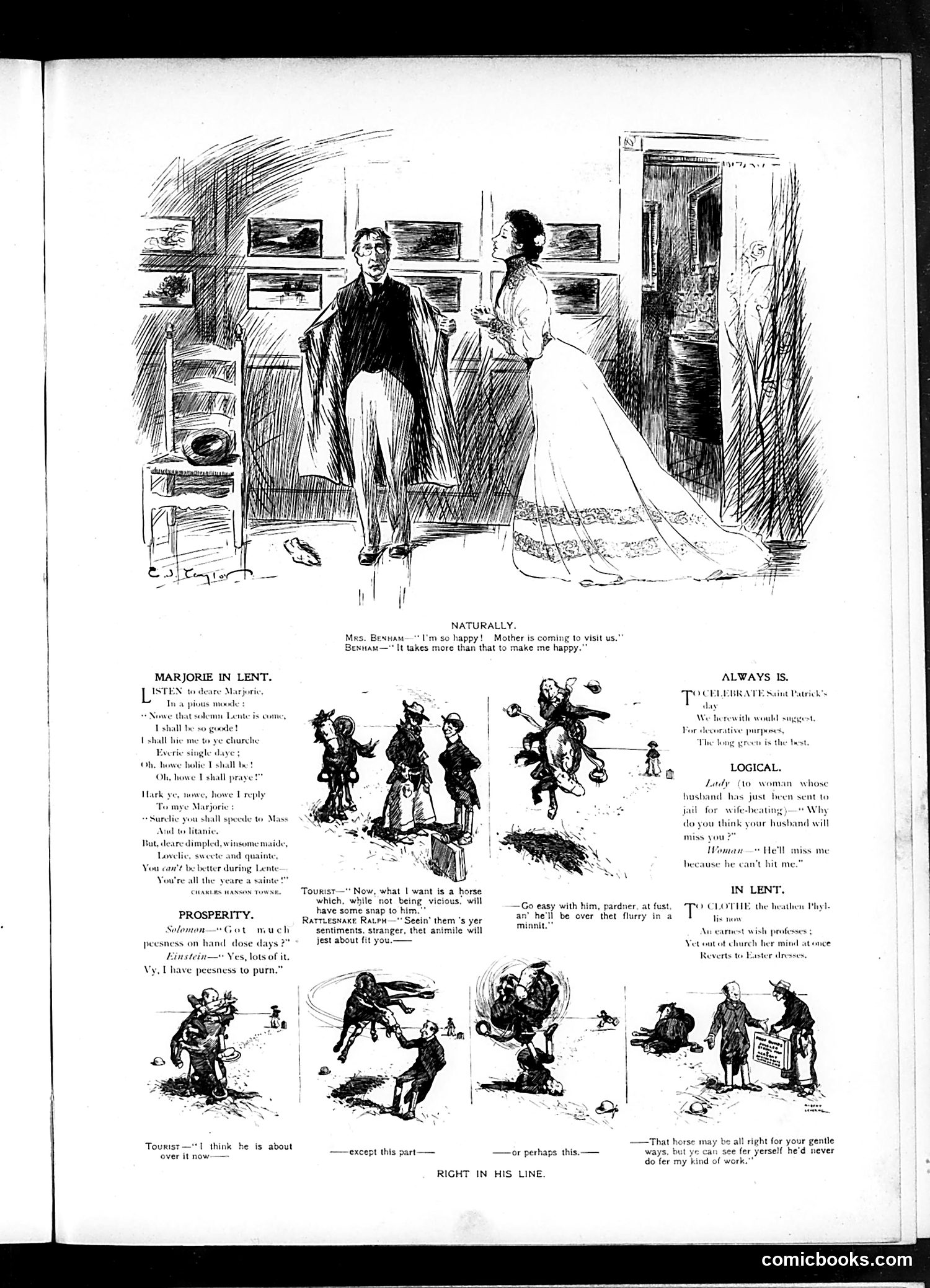
This page collects brief satirical jokes typical of early 20th-century humor magazines. The main cartoon "Naturally" depicts a husband unmoved by his mother-in-law's impending visit—a common domestic complaint of the era used for comedy. The smaller sections mock various social situations: a wife-beater's spouse logically noting he'll "miss" hitting her; religious hypocrisy around Lenten observance; economic "prosperity" (likely post-WWI); and a tourist seeking an insufficiently broken horse. The humor relies on period stereotypes: the exasperated husband, domestic violence as joke fodder, class differences between tourists and working men ("pardner"), and religious pretense. The "Einstein" reference appears to invoke the famous physicist as shorthand for intellectual absurdity about prosperity during economic uncertainty. These jokes reflect attitudes—particularly toward violence and gender relations—that modern readers would find offensive rather than amusing.
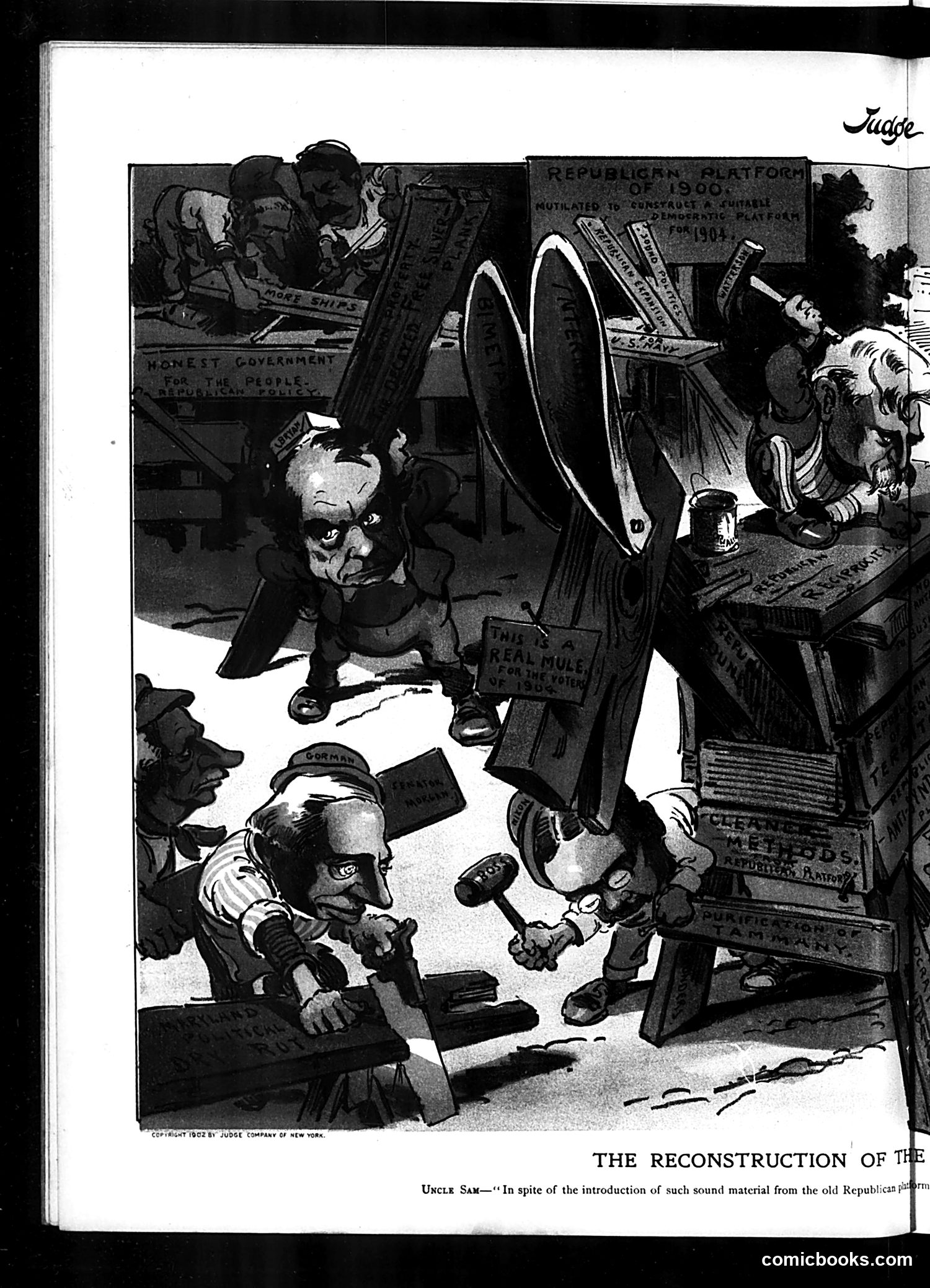
This political cartoon satirizes the "Reconstruction of the" Republican Party (title appears cut off). The image depicts Uncle Sam as a builder/carpenter, working to reconstruct or repair a structure labeled with Republican platform elements and planks from 1904. The cartoon criticizes the Republican Party's attempt to rebuild itself using "sound material from the old Republican platform"—suggesting these old ideas are insufficient or outdated for current needs. Various caricatured figures (likely political figures of the era) are shown as workers, some appearing skeptical or struggling with the construction project. The satire implies that merely recycling old Republican positions won't effectively address contemporary political challenges, mocking the party's reliance on past rhetoric rather than fresh ideas.
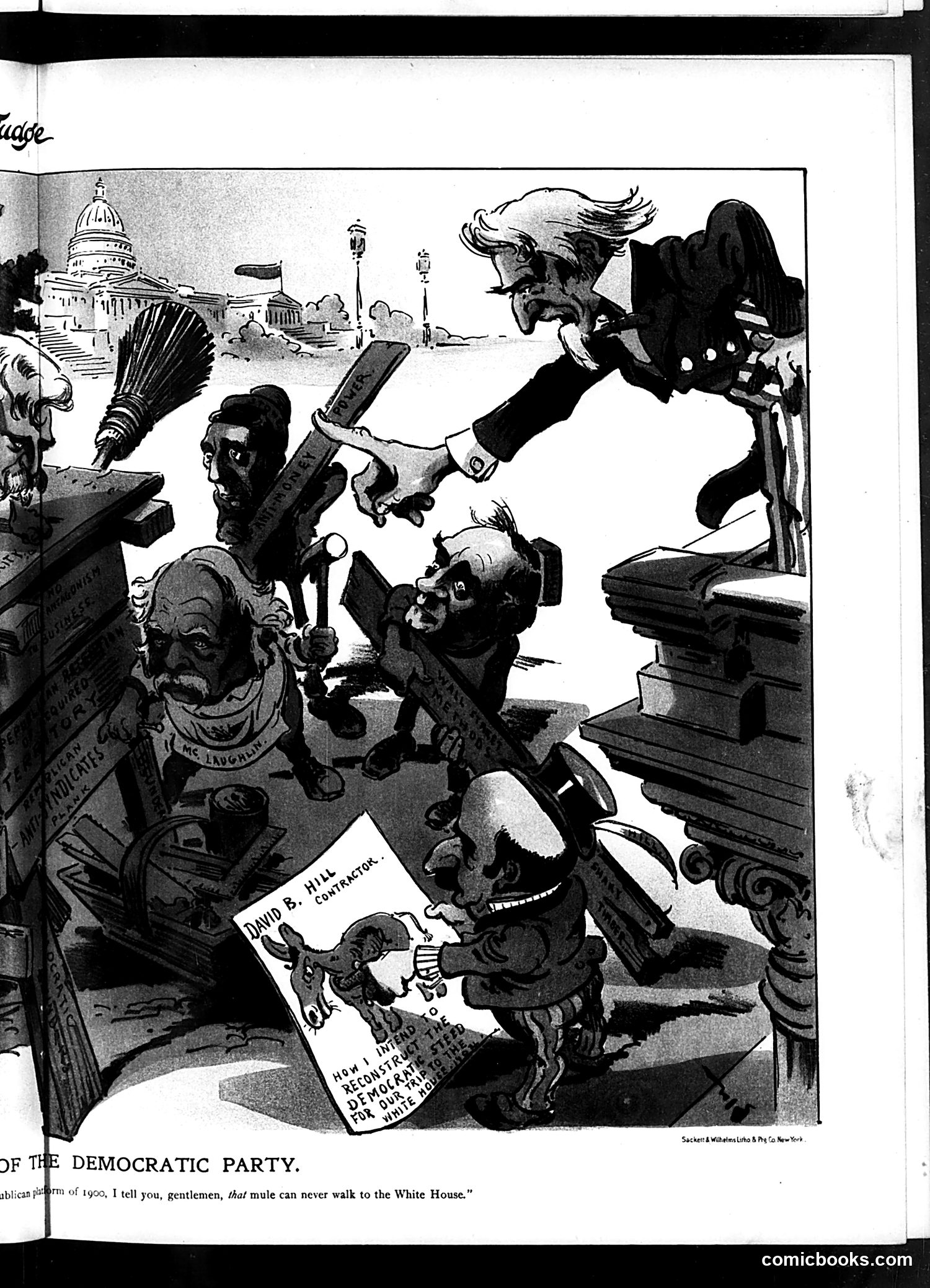
This 1900 political cartoon depicts a mule—a traditional symbol of stubbornness and the Democratic Party—being whipped and driven by caricatured figures toward the Capitol building visible in the background. The quote "that mule can never walk to the White House" suggests Republican confidence that the Democratic candidate cannot win the presidency. The cartoon satirizes Democratic electoral prospects in 1900, likely referencing William Jennings Bryan's second failed presidential campaign. The exaggerated caricatures driving the mule represent Democratic party leadership struggling to control their party's direction. The imagery implies the Democrats are being forced along an impossible path—mocking both the party's internal divisions and Republican claims of inevitable victory.
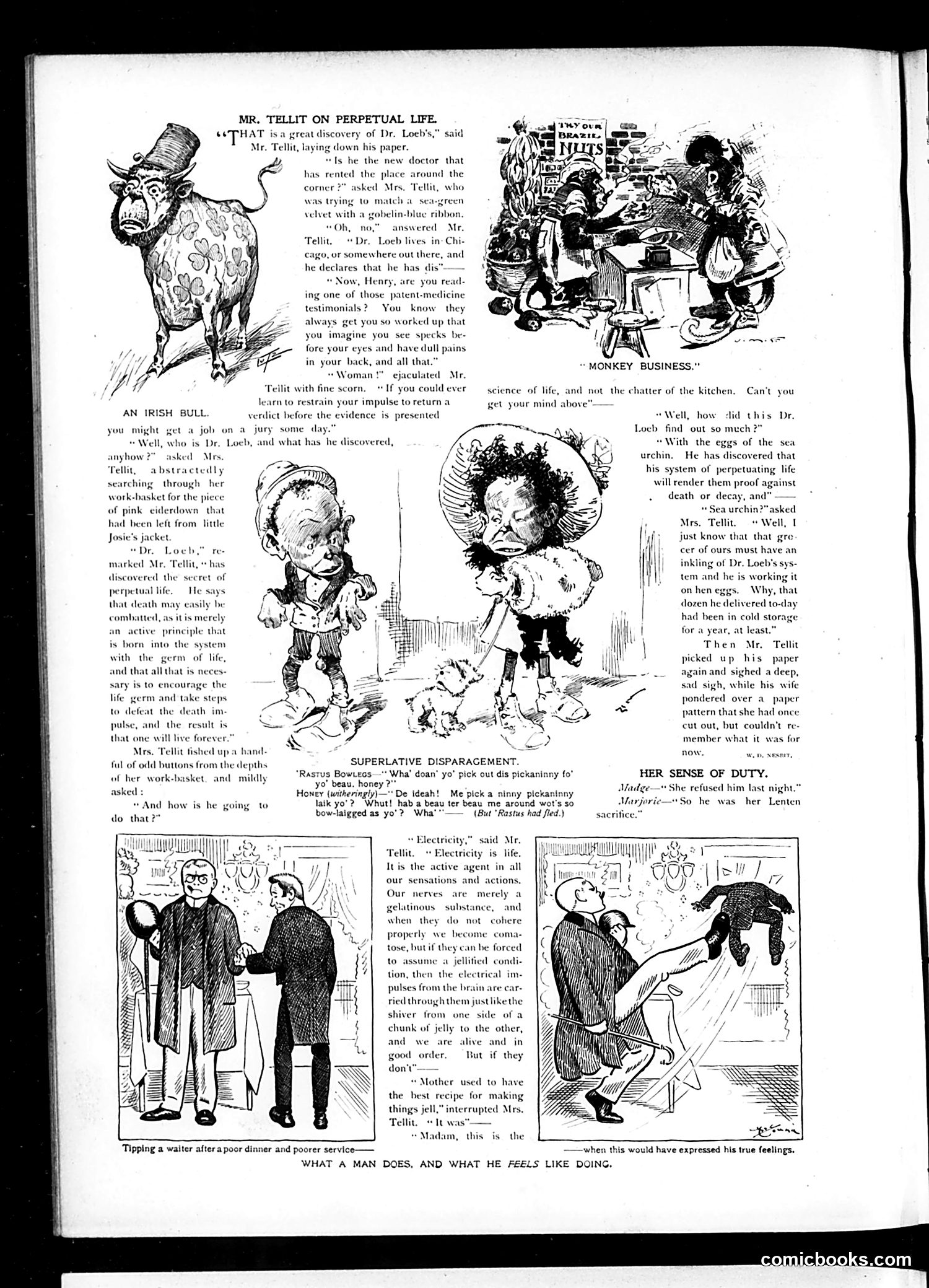
This page satirizes early 20th-century scientific pretension through the character Mr. Tellit and his wife's conversations. The main target is **Dr. Jacques Loeb**, a real biologist famous for experimental work on sea urchin eggs, who claimed discoveries about "perpetual life" and defeating death through controlling nerve impulses—claims that seemed absurd to ordinary people. The satire works through Mrs. Tellit's innocent, practical responses that deflate Tellit's reverent explanations. When he pontificates about electricity in nerves being like "jelly," she interrupts with recipes. When he explains complex biological theory, she applies it literally to her grocer's stale eggs, undermining the scientific grandeur. The surrounding cartoons mock racial stereotypes, poor service workers, and gender dynamics—typical Judge content of the era. The overall point: pseudo-scientific jargon about immortality sounds ridiculous when confronted with ordinary domestic life.
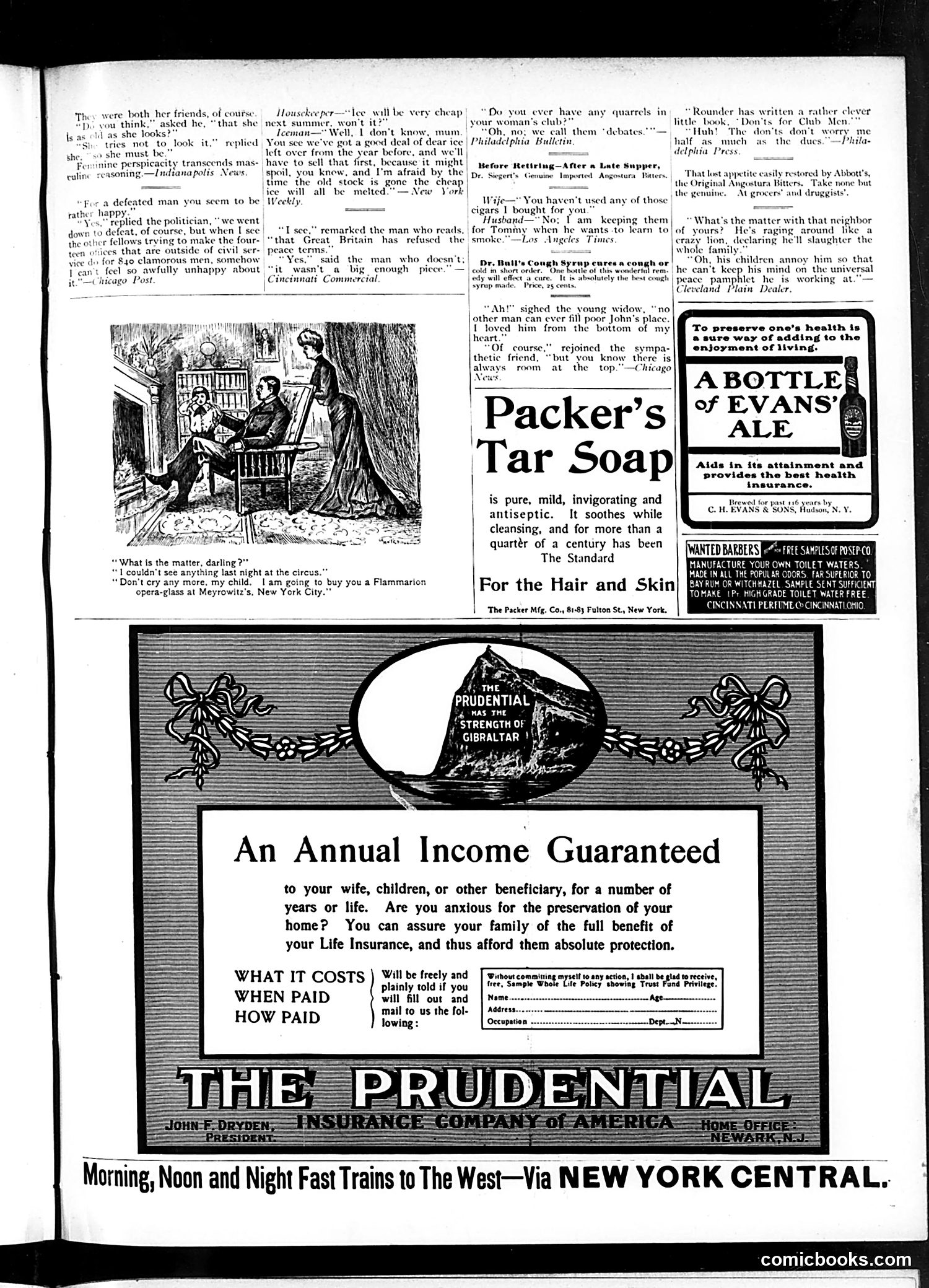
This page from Judge magazine contains several brief humorous anecdotes and advertisements typical of early 20th-century satirical publishing. ## Key Humor Pieces: **The main cartoons satirize:** - **Gender dynamics**: A joke about a woman's appearance—her friends debate whether she "tries not to look" bad or genuinely is bad-looking, highlighting feminine vanity and social pretense. - **Politics**: A defeated politician finding solace in others' failures—satirizing sore losers and schadenfreude in electoral politics. - **Class/consumerism**: A child disappointed at the circus; the solution is buying an expensive opera glass—mocking consumerism as a parental solution to disappointment. - **Marital life**: A widow's claim of undying devotion undercut by a friend's observation that there's "always room at the top"—cynical commentary on widow remarriage and self-interest. **The advertisements** (Packer's Tar Soap, Evans' Ale, The Prudential Insurance Company) represent period commercial appeals to health and family security. The page reflects early 1900s preoccupations: gender relations, political corruption, consumer culture, and mortality/insurance anxieties.
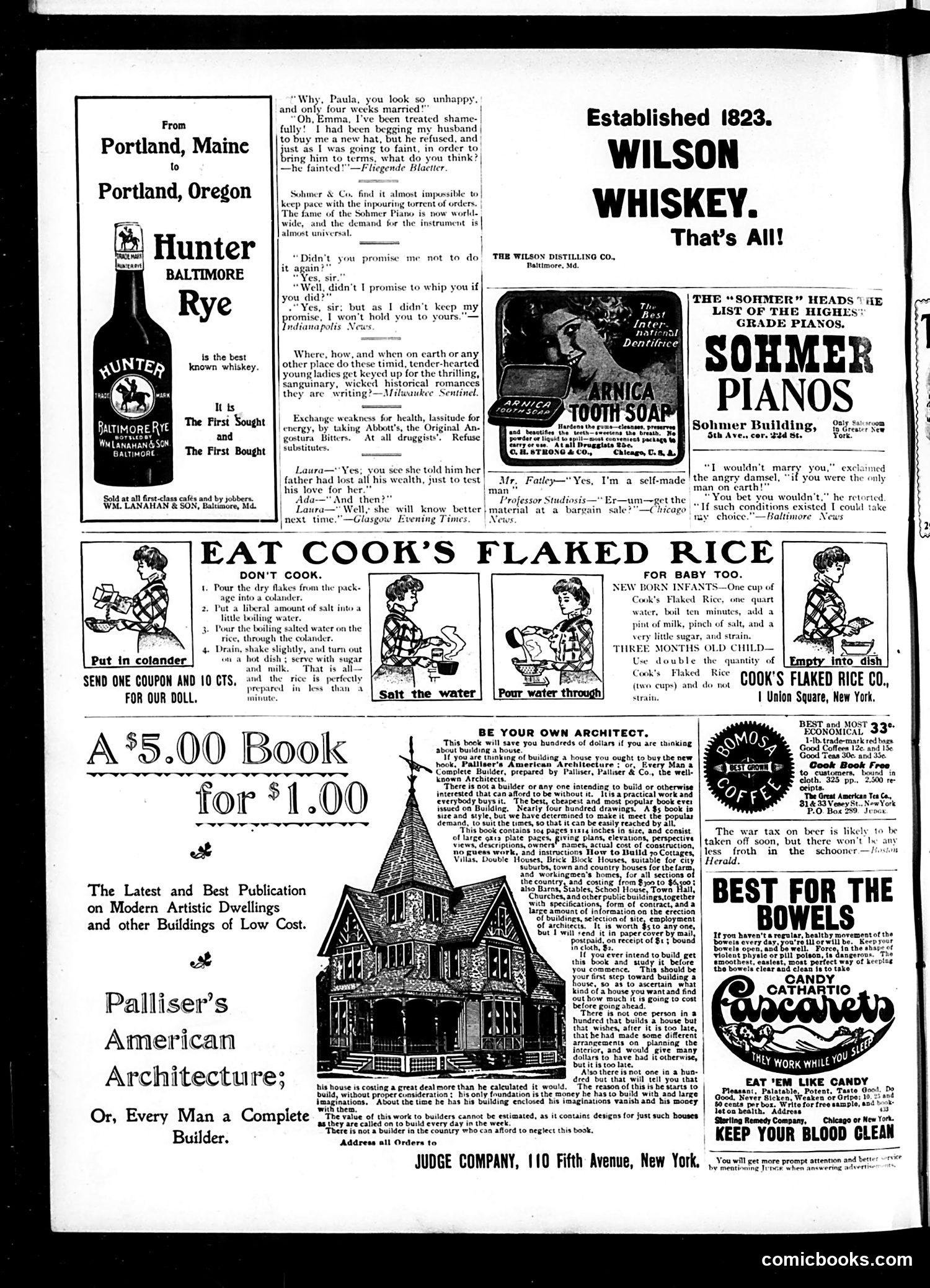
This page is primarily **advertising and filler content** rather than political satire. It contains several unrelated comic vignettes and product advertisements typical of early 1900s magazines. The brief comic dialogues include domestic humor (a newlywed complaining about her husband's stinginess; a couple discussing broken promises) and a literary observation about where romance writers get inspiration for their "timid" heroines. The page is dominated by **product advertisements**: Hunter Rye whiskey, Sohmer Pianos, Cook's Flaked Rice (marketed for babies and infants), Rimosa Coffee, Cascarets candy laxative, and Palliser's American Architecture book. Each ad uses period illustrations and marketing copy typical of the era. There is **no apparent political satire or caricature** on this page—it represents the commercial magazine format of the time, where editorial content filled space between advertisements. The humor is domestic and genteel rather than satirical.
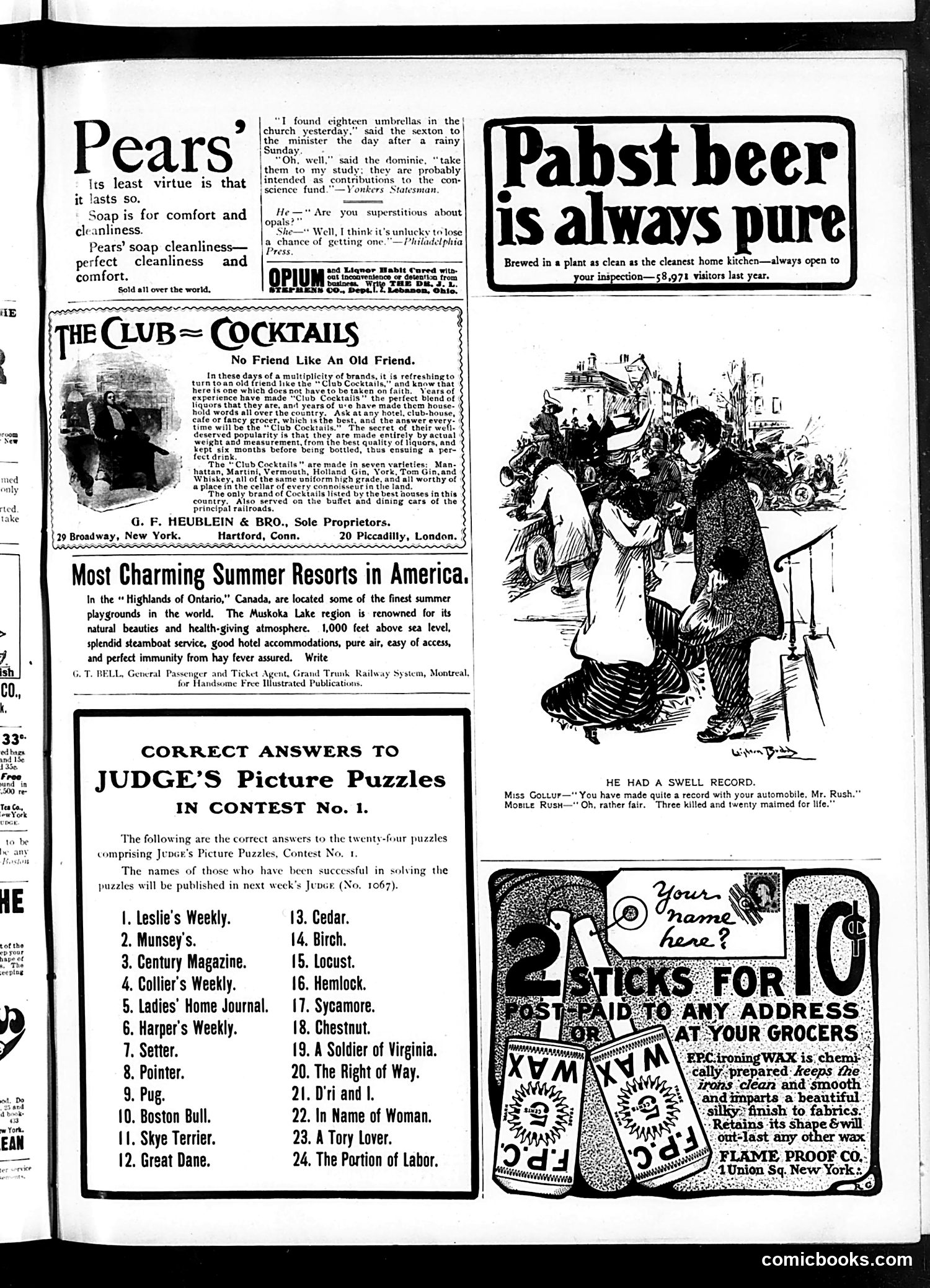
This page is primarily **advertisements and contest answers**, with one editorial cartoon. ## The Main Cartoon The single cartoon titled "HE HAD A SWELL RECORD" depicts a conversation between Miss Collum and Mobile Rush about his automobile. She compliments his "record," expecting praise; he responds that his car has killed three people and injured twenty-two others. **The satire:** This mocks the dangerous, reckless driving of the early automobile era and society's casual attitude toward automotive deaths. The "record" is darkly ironic—what should be a badge of honor becomes evidence of negligence. The cartoon suggests wealthy motorists like "Mobile Rush" treated traffic fatalities as acceptable collateral damage, a commentary on both poor road safety and class indifference to working-class victims. ## Context Early 1900s automobiles were notorious death traps with minimal safety features, speed limits, or driver regulation. This cartoon critiques both the vehicles themselves and the cavalier attitude of affluent owners. The rest of the page contains period advertisements (Pabst beer, Pears' soap, Heublein cocktails) and puzzle contest answers—typical Judge filler content.
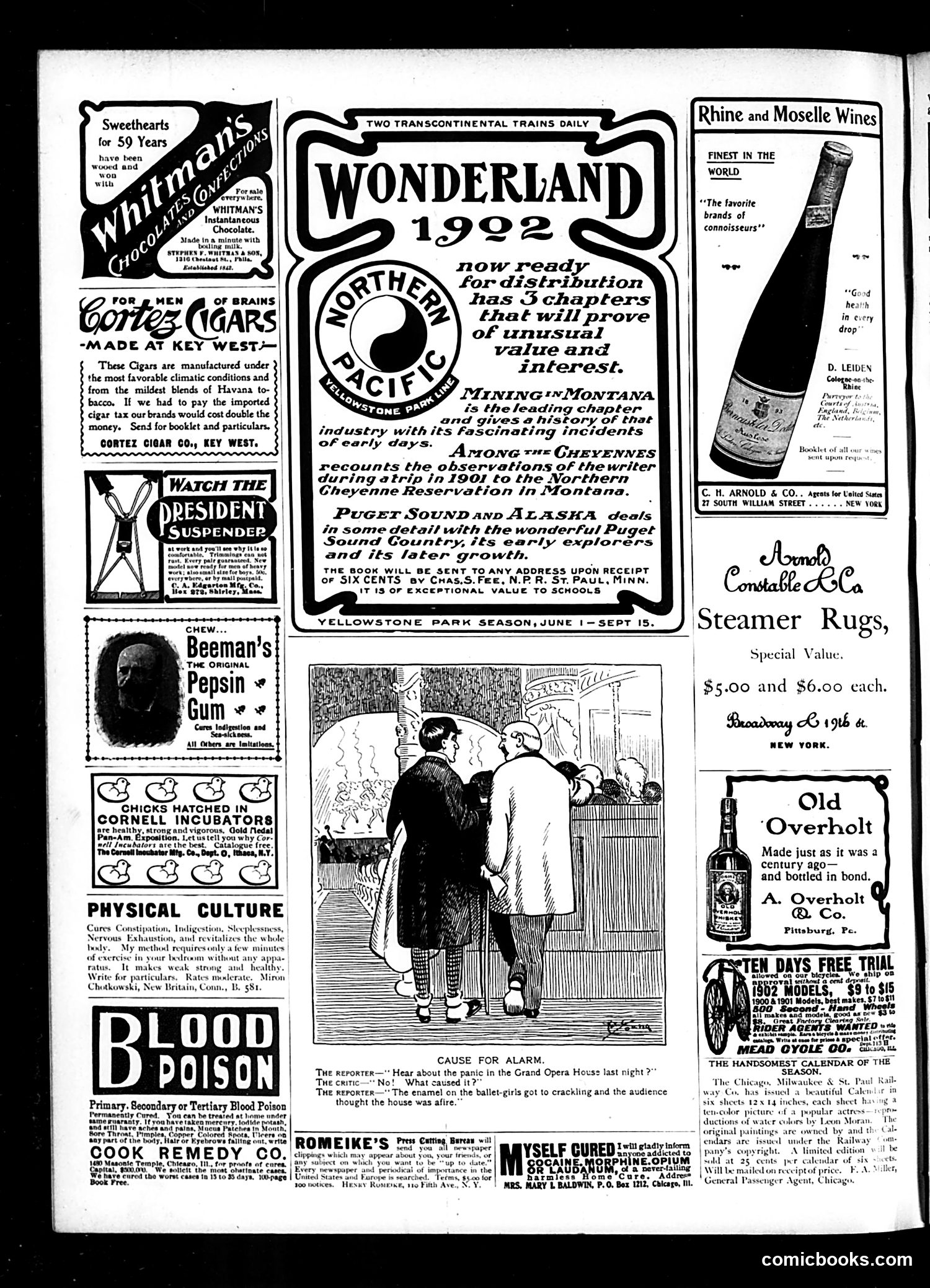
This single-panel joke cartoon depicts a scene at the Grand Opera House. A reporter asks a critic about a panic that occurred during the previous night's performance. The critic explains that the panic was caused by the *enamel paint on the ballet dancers' legs cracking and peeling*, which the audience mistook for fire. The satire targets the artificiality and poor quality of theatrical productions—specifically, the cheap cosmetics or body makeup used on performers. The joke mocks both the shoddy materials (paint that cracks visibly) and the audience's gullibility in mistaking cosmetic failure for genuine danger. It's a commentary on theatrical deception and the gap between glamorous performance and backstage reality. The humor relies on the absurdity of such a trivial technical failure causing mass panic.
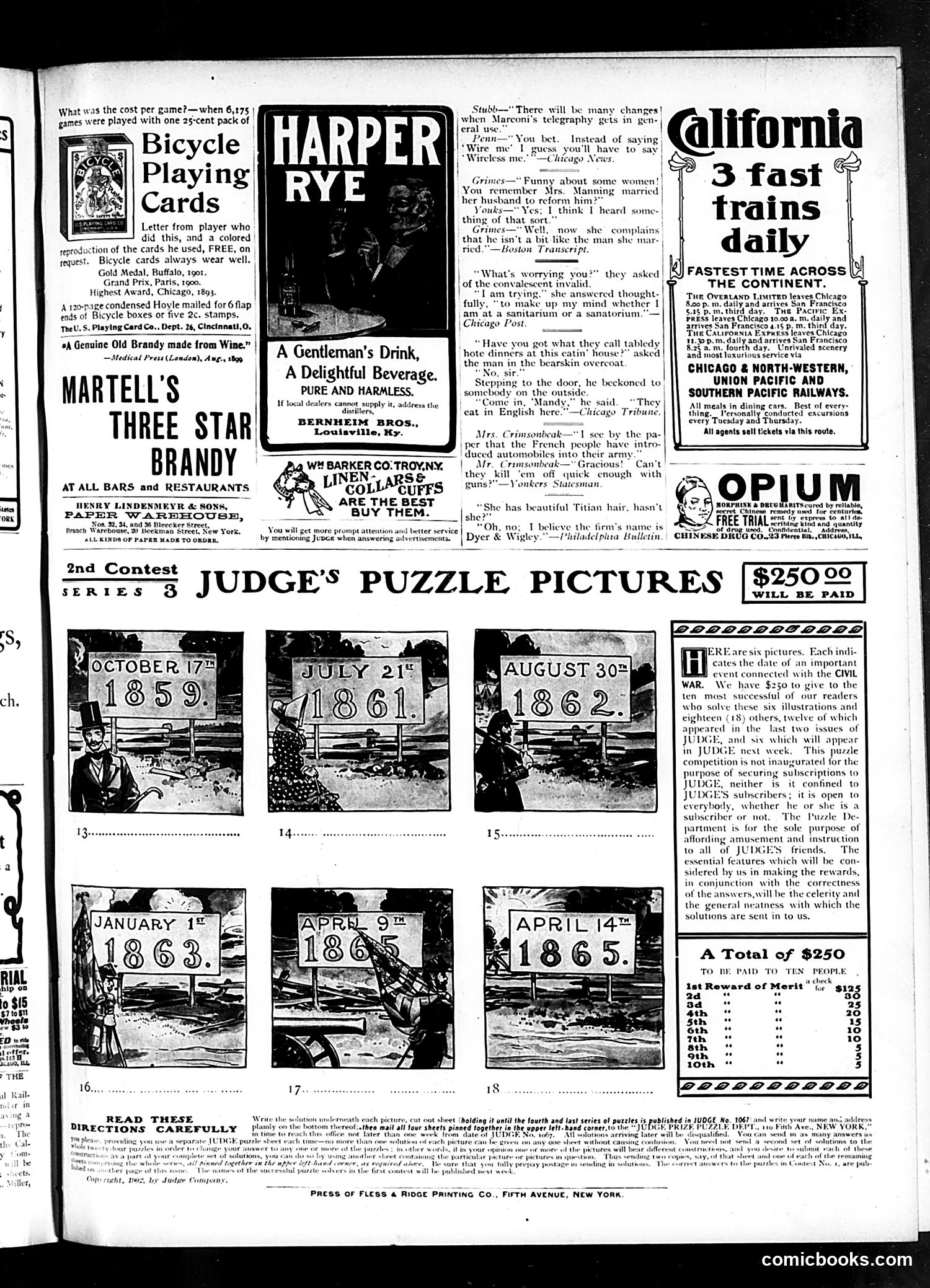
This page is primarily **advertising and puzzle content** rather than political satire. The advertisements include playing cards, brandy, paper products, and railroad services typical of the 1900s era. The small **text humor pieces** scattered throughout are brief jokes about contemporary topics: - Marconi's wireless technology becoming common - A woman marrying to "reform" a man, finding him unchanged - Confusion over "sanitarium" vs. "sanatorium" terminology - The French military adopting automobiles (appearing modern/absurd to readers) - A woman's hair color and its source These represent *mild social observation* rather than sharp political satire—observations about marriage dynamics, technological change, and language quirks that would amuse Judge's middle-class readership. The dominant feature is **"Judge's Puzzle Pictures" (Series 3)**, a contest offering $250 in prizes for solving historical image puzzles related to Civil War dates. This was typical Judge reader engagement content from this period.
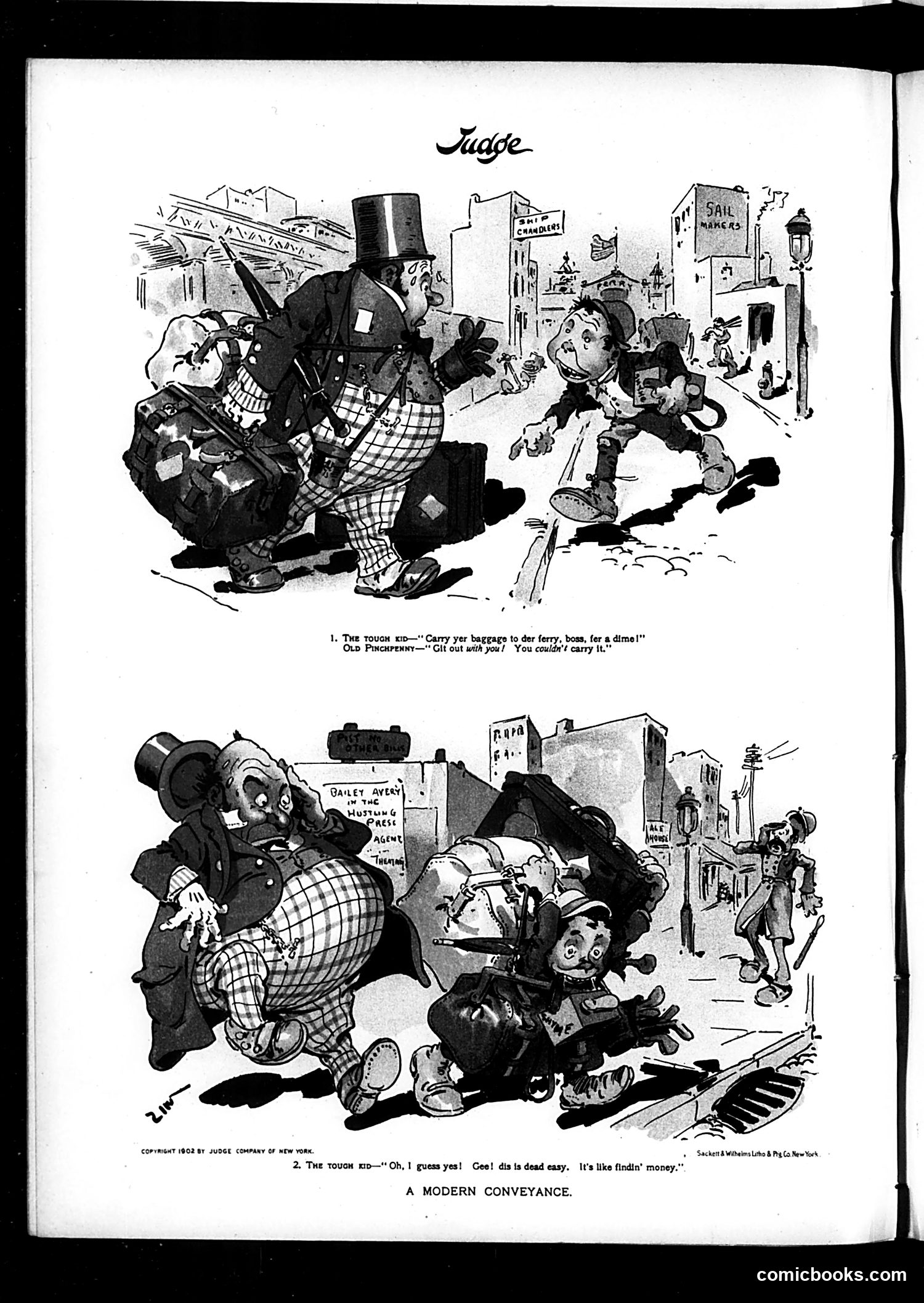
This two-panel comic satirizes urban street hustlers and immigrants through the character "The Tough Kid." In panel 1, a street porter with an exaggerated immigrant accent ("der ferry," "boss") offers to carry an old pinchpenny's baggage for a dime. The cheapskate refuses, claiming the porter couldn't manage it. Panel 2 shows the porter has simply picked up the old man himself, carrying him like luggage to the ferry. His delighted comment—"It's like findin' money"—plays on the ironic humor: he's found an easy way to get paid by literally transporting the customer. The joke relies on period stereotypes of immigrant laborers and con-artist street kids, mocking both the working poor's resourcefulness and the miserly wealthy. The title suggests this is a "modern" (early 1900s) alternative to conventional transportation.