
A complete issue · 18 pages · 1901
Judge — November 30, 1901
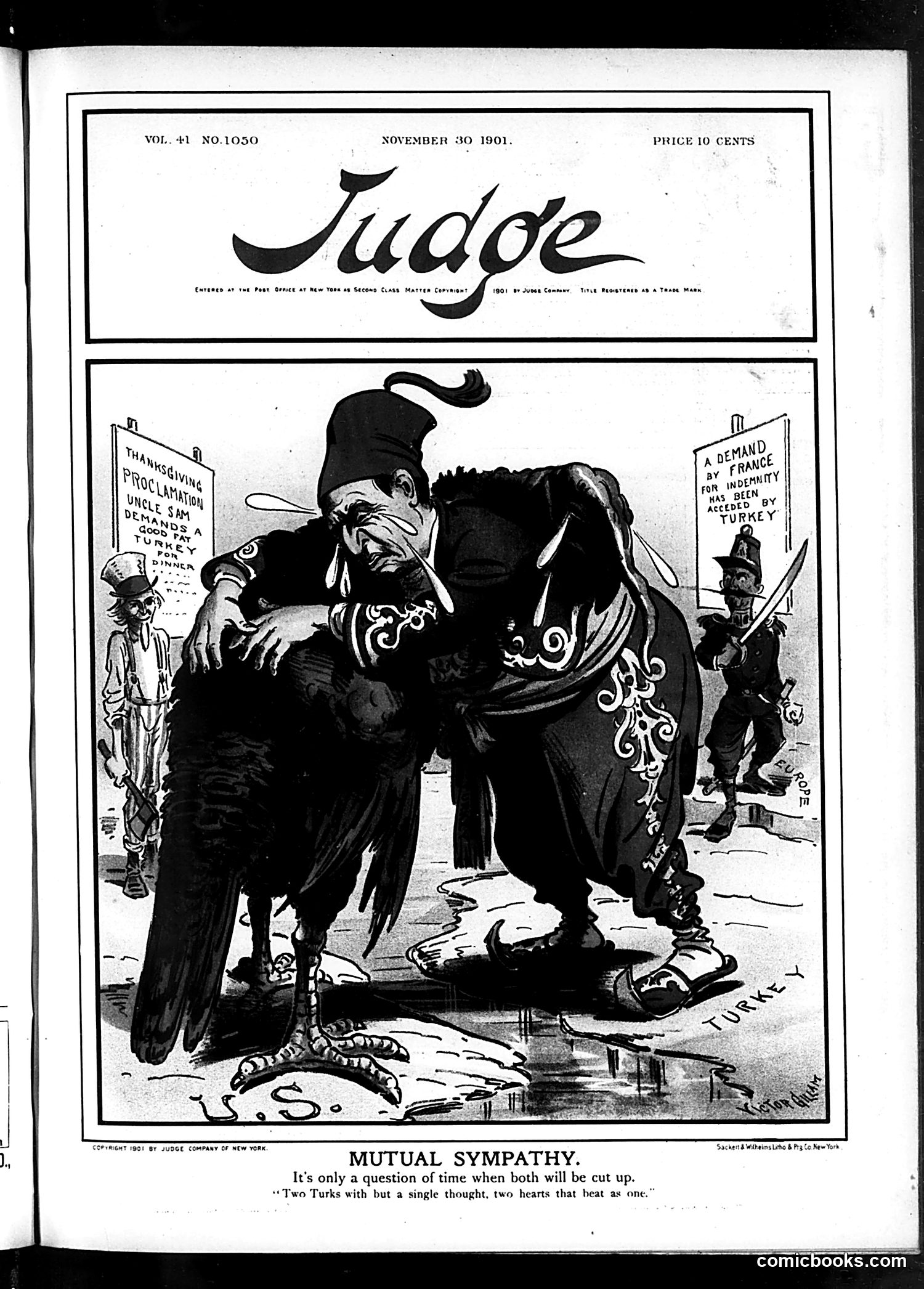
This political cartoon depicts two figures in Ottoman Turkish dress with exaggerated caricatured features. The left sign references "Thanksgiving Proclamation" and mentions "5 PM Dinner," while the right sign demands "Indemnity" for unspecified wrongs "assessed by Turkey." The title "Mutual Sympathy" and subtitle—"It's only a question of time when both will be cut up. 'Two Turks with but a single thought, two hearts that beat as one'"—suggests dark humor about Turkey's anticipated dismemberment or partition. This likely references the Ottoman Empire's weakening position circa 1901, when European powers anticipated dividing Turkish territories. The cartoon cynically equates Turkish political troubles with Thanksgiving dinner preparations, mocking both Turkish demands for compensation and predictions of imperial collapse.
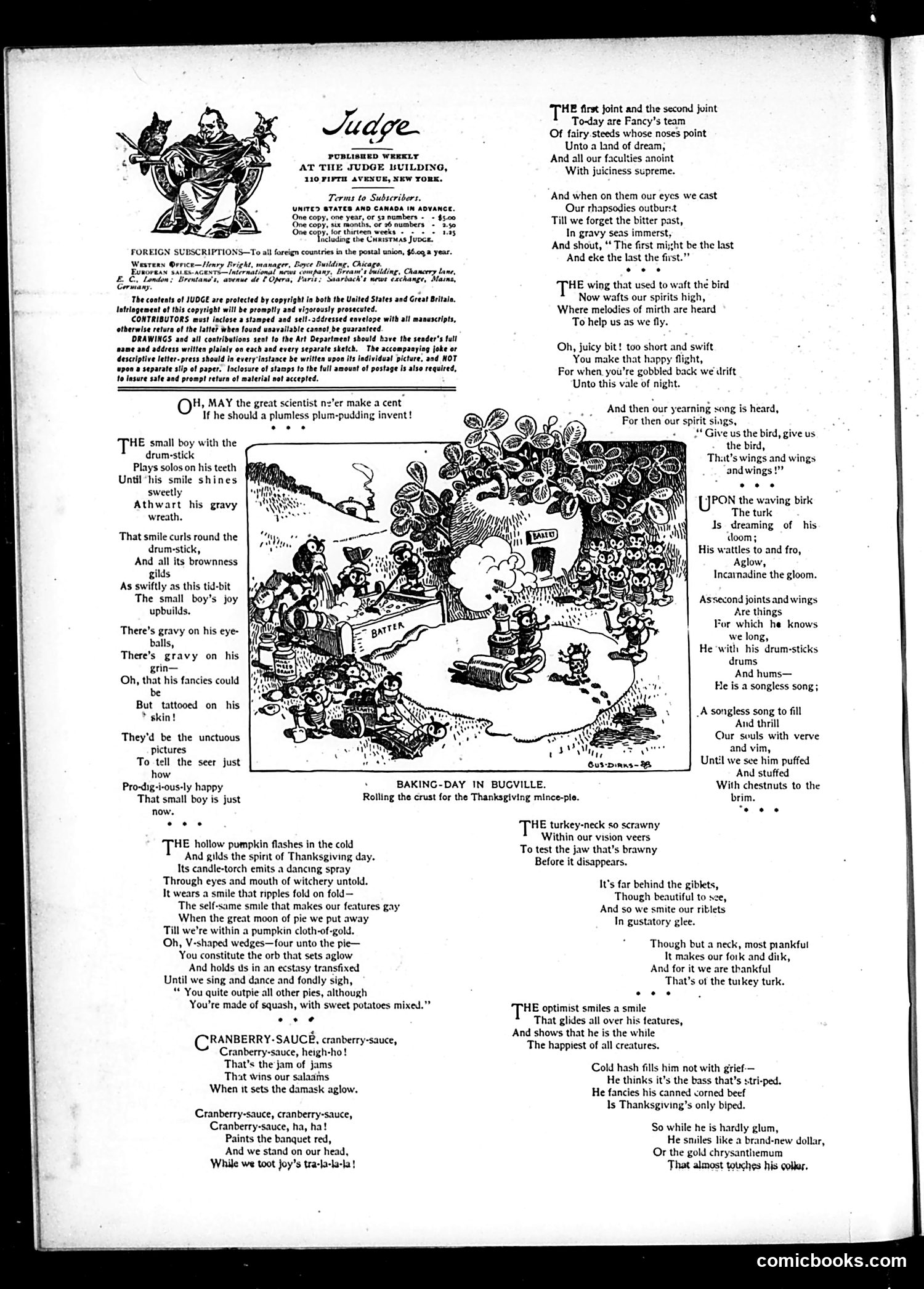
This page contains **Thanksgiving-themed poetry and verse**, not political satire. The central illustration depicts a whimsical "Baking-Day in Bugville"—anthropomorphic insects engaged in holiday cooking activities, with detailed linework showing them preparing food around barrels and kitchen implements. The accompanying poems celebrate Thanksgiving imagery: pumpkins, cranberry sauce, and turkey. One section mocks the turkey's appearance ("turkey-neck so scrawny") while another celebrates humble holiday foods like cold hash and canned corned beef. The overall content is **light domestic humor** focused on holiday traditions rather than political commentary. The "Bugville" setting suggests this is children's or family-oriented verse, typical of Judge's broader editorial content beyond its satirical political cartoons.
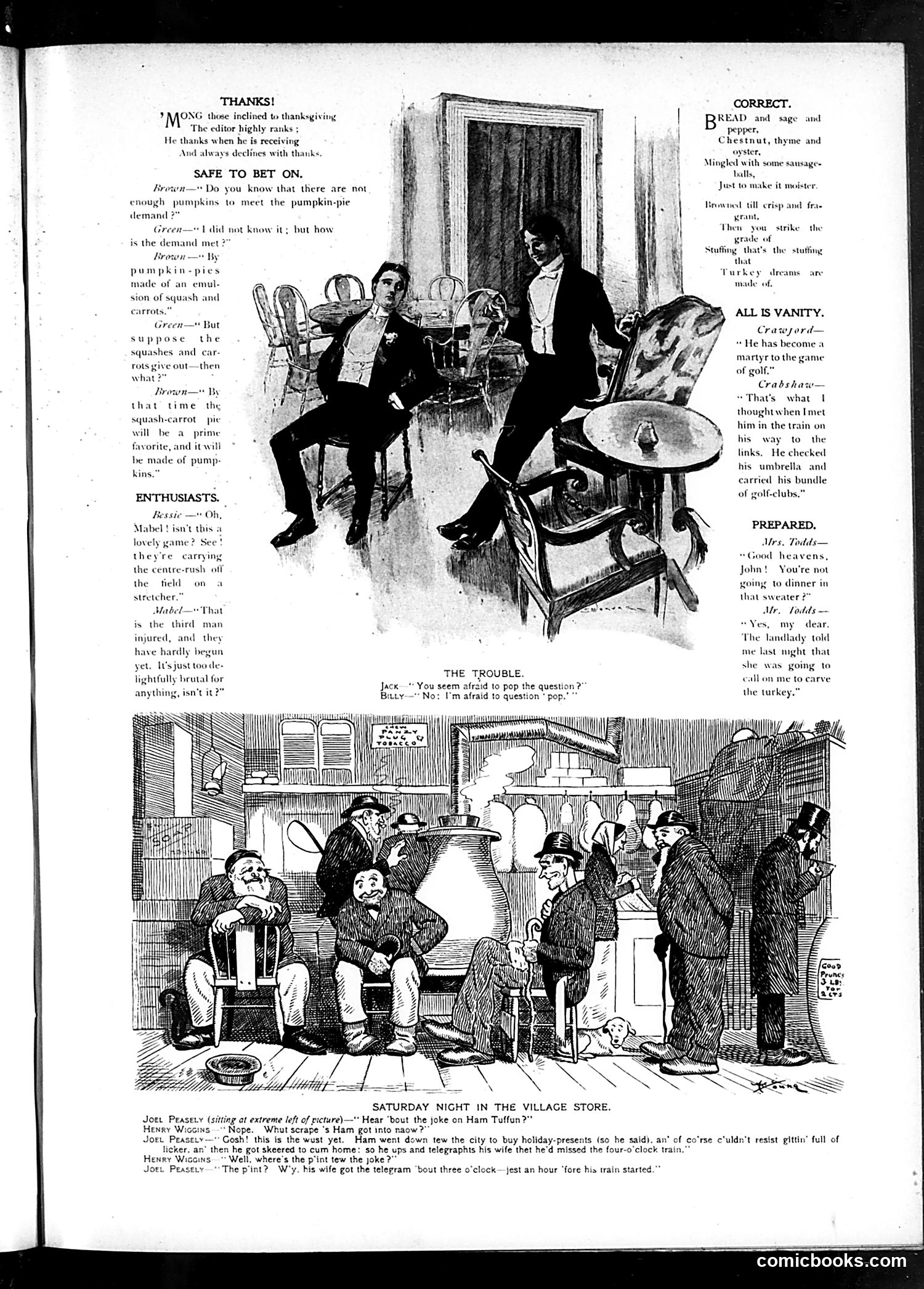
This page contains three distinct humor pieces: **"Thanks!"** and **"Safe to Bet On"** are brief dialogue jokes about Thanksgiving preparation—discussing pumpkin-pie ingredients and squash-carrot pie recipes. These are generic domestic humor with no political content. **"The Trouble"** (top illustration) shows men in formal dress debating whether pumpkins suffice for pie-making, likely satirizing overly earnest dinner-table debates among the upper classes. **"Saturday Night in the Village Store"** (bottom) depicts rural men gathered around a stove, discussing local gossip and missing trains—a gentle caricature of small-town life and village culture. The humor relies on stereotypes about rural communication and simple living rather than political satire. Overall, this page offers domestic and social humor rather than political commentary, typical of Judge's lighter entertainment content.
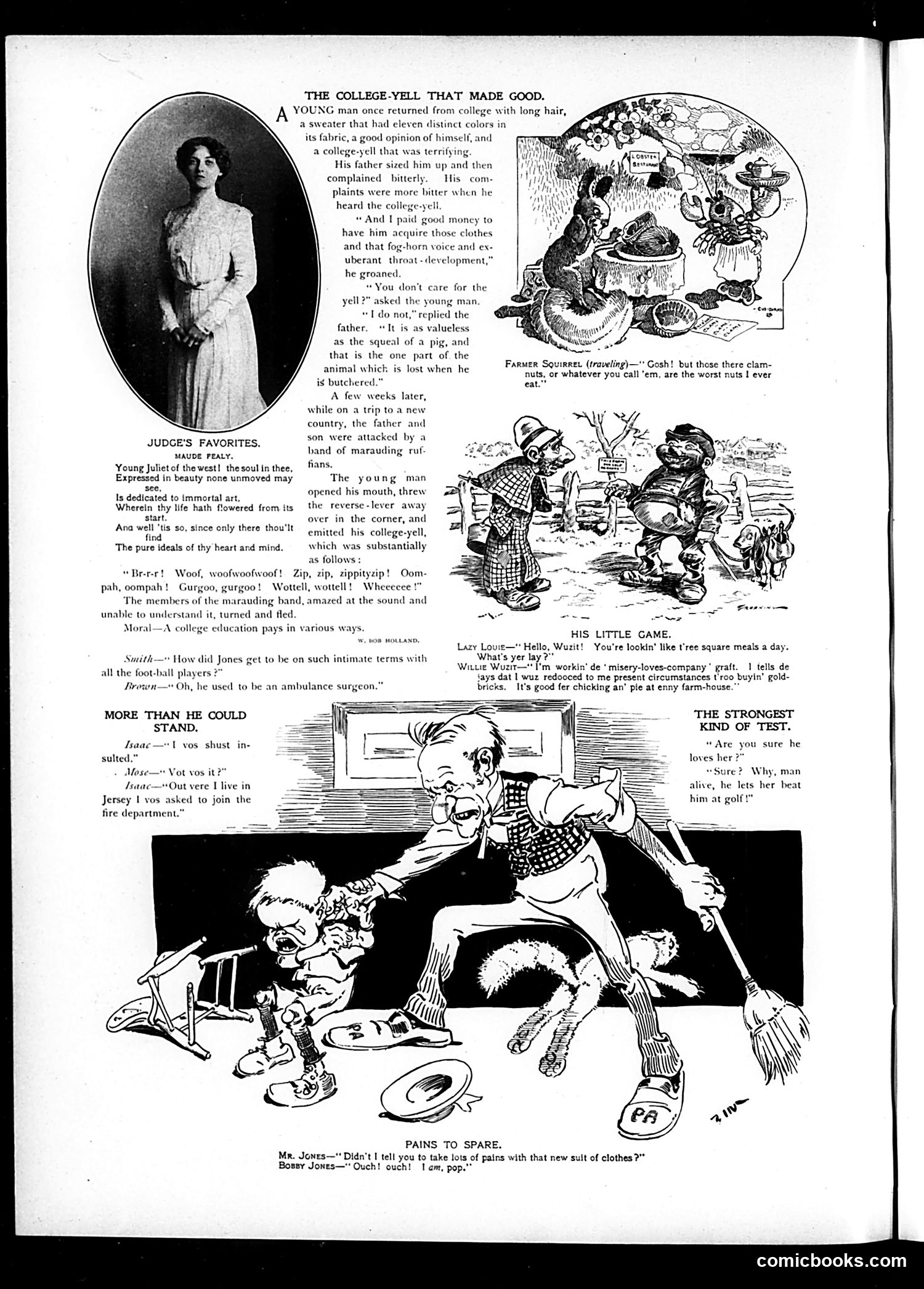
This page contains several satirical pieces targeting early 20th-century social attitudes: **"The College-Yell That Made Good"** mocks a father's disapproval of his son's college experiences—his long hair, colorful sweater, and "fog-horn voice." The father considers the college yell worthless, comparing it to "the squeal of a pig." This satirizes generational conflict over changing college culture and masculine expression. **"Judge's Favorites"** and other short comedic pieces use dialect humor and social observation typical of the era. **"Pains to Spare"** depicts a caricatured man (likely representing a wealthy or foolish figure) with multiple small children, satirizing either large families or irresponsible parenting. The cartoons broadly target class pretensions, generational anxiety, and social respectability—common Judge magazine themes reflecting Progressive Era concerns about modernization and cultural change.
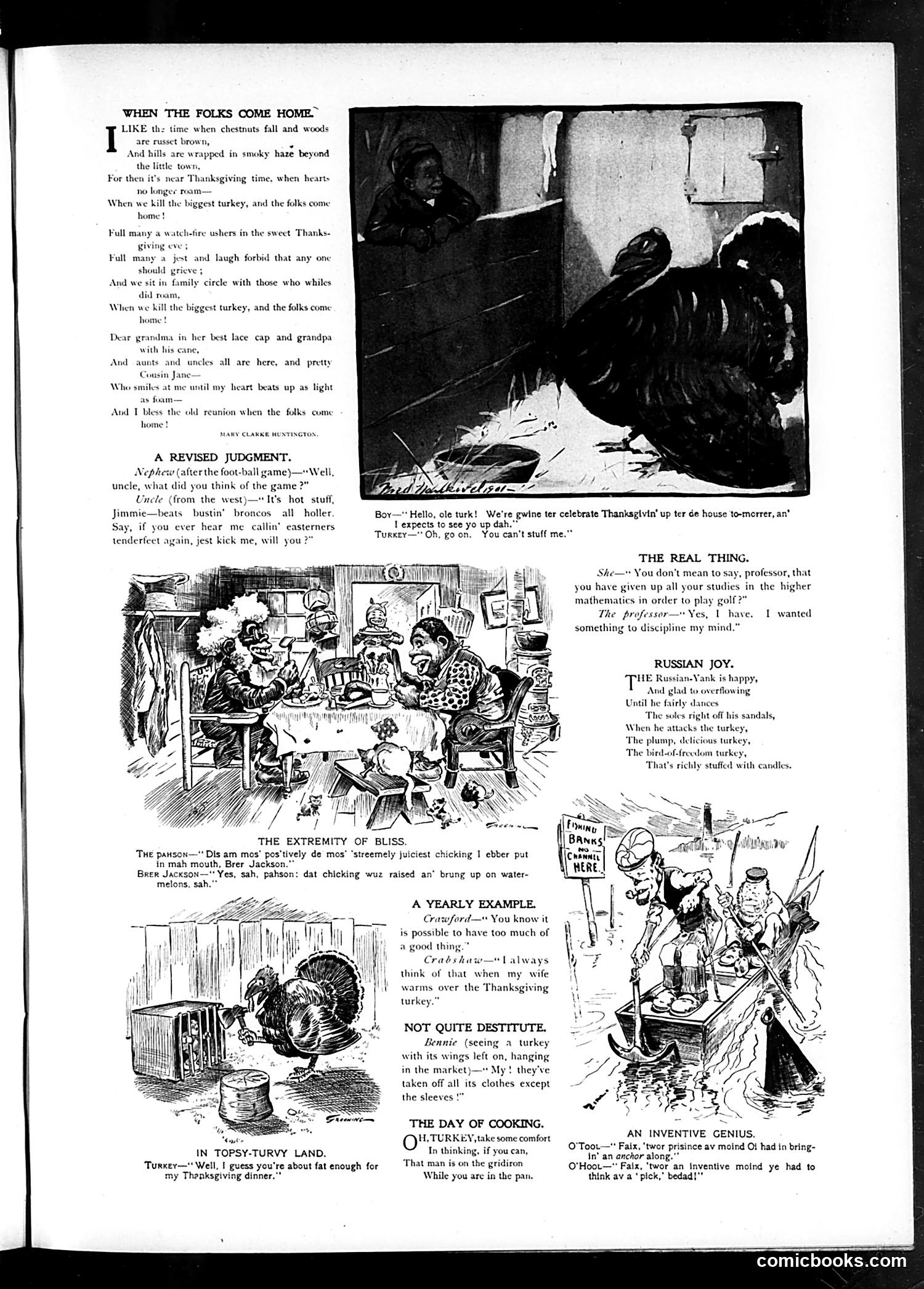
This Thanksgiving-themed page from *Judge* consists of multiple short humorous pieces rather than political cartoons. **Main content:** - A sentimental poem "When the Folks Come Home" about family reunions at Thanksgiving - Several brief joke dialogues featuring ethnic stereotypes common to the era: - A nephew and uncle discussing football - African American characters ("Brer Jackson," "de pahson") making malapropisms about cooking chicken - Irish characters ("O'Toot," "O'Hoot") speaking in exaggerated brogue **The satire:** These pieces mock regional accents, ethnic dialects, and working-class speech patterns—standard practice in early 20th-century American humor. The jokes rely on caricatured pronunciation and vocabulary to generate laughs. **Historical context:** The content reflects period attitudes toward non-Anglo populations, using blackface-style humor and Irish stereotypes that would be considered offensive today. A professor abandoning mathematics for golf represents mild criticism of misplaced priorities. The page is primarily entertainment rather than political commentary, featuring domestic holiday humor aimed at *Judge*'s middle-class readership.
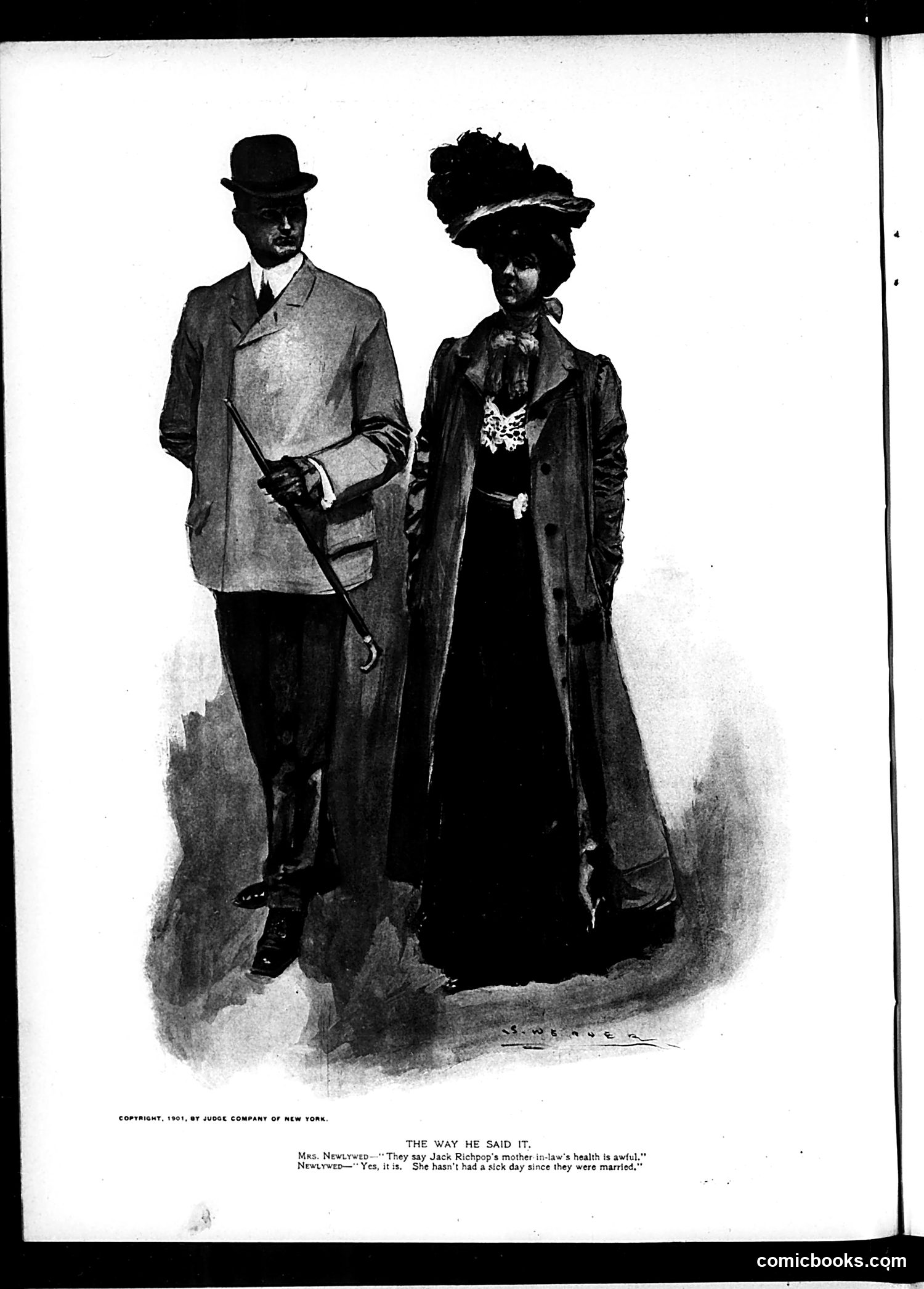
This 1901 *Judge* cartoon satirizes newlywed dynamics and family relations. The titled couple represents a newly married pair discussing Jack Richpop's mother-in-law. The joke relies on verbal irony: when the wife expresses concern about the mother-in-law's poor health, the husband responds that she "hasn't had a sick day since they were married"—implying the marriage itself has made her *well*, not ill. The satire targets the common stereotype of tension between newlyweds and in-laws, particularly mothers-in-law. The humor suggests the husband is either genuinely praising the positive effects of his marriage or, more likely, making a sardonic comment implying the mother-in-law has been insufferable but at least physically healthy. The illustration shows the couple in formal Edwardian dress, presenting them as respectable society figures.
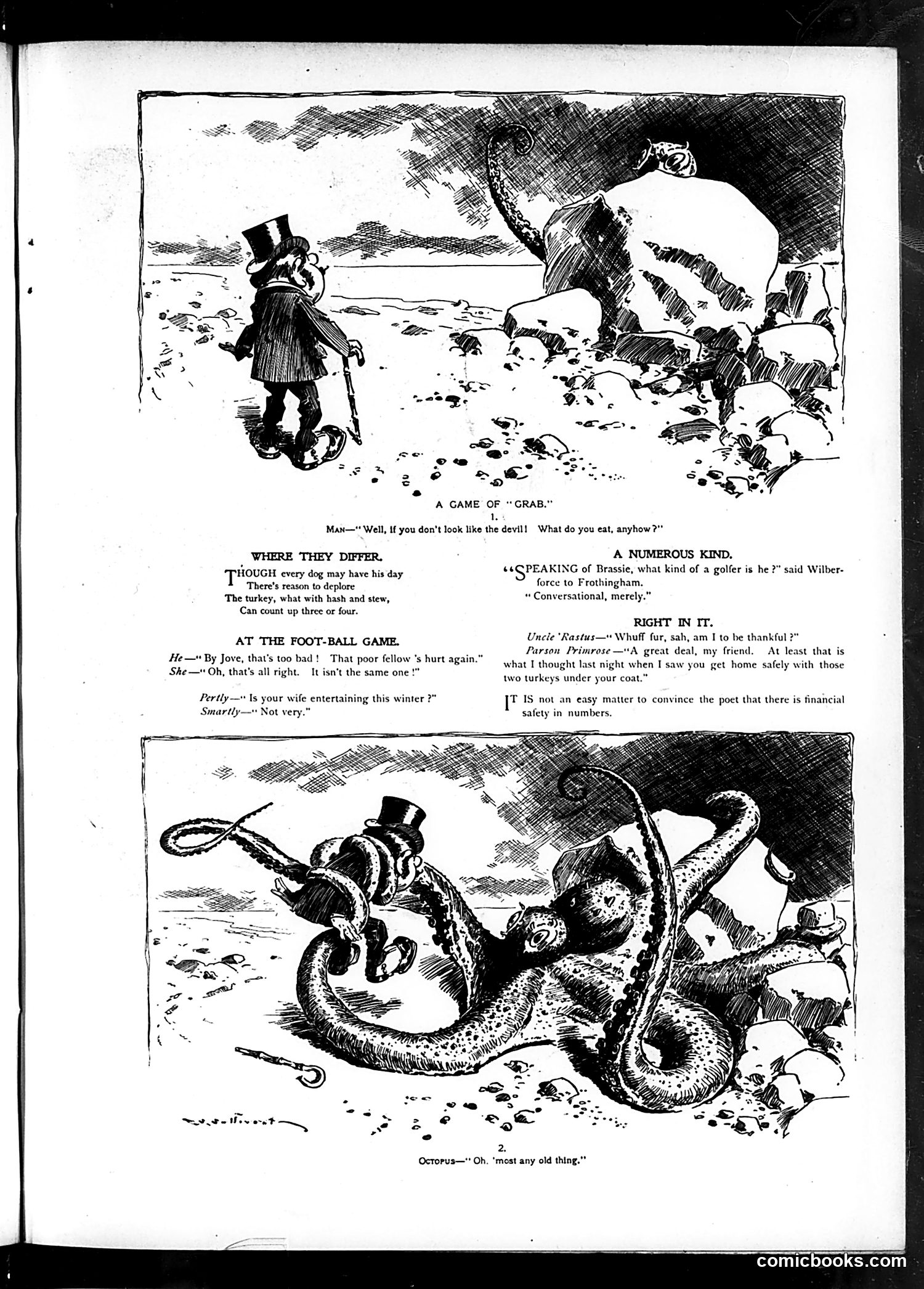
This page contains multiple brief satirical jokes typical of early 20th-century American humor magazines. **"A Game of Grab"** (top): A gentleman in a top hat confronts what appears to be a disheveled person, asking what they eat. The illustration below shows the man wrestling with an octopus—likely satirizing aggressive business practices or financial "grabbing" of the era. **"Where They Differ"** and **"At the Foot-Ball Game"**: Brief conversational jokes about golf and sports injuries, typical of period social satire. **"Right In It"**: Features "Uncle 'Rastus" (a stereotypical African American character) and "Parson Primrose" discussing turkeys. The joke relies on racist caricature humor common to the era—playing on stereotypes about theft and dishonesty. The page is primarily humor and light satire rather than serious political commentary. The racist dialect and characterization reflect the deeply prejudiced entertainment standards of early Judge magazine, which would be considered offensive today.
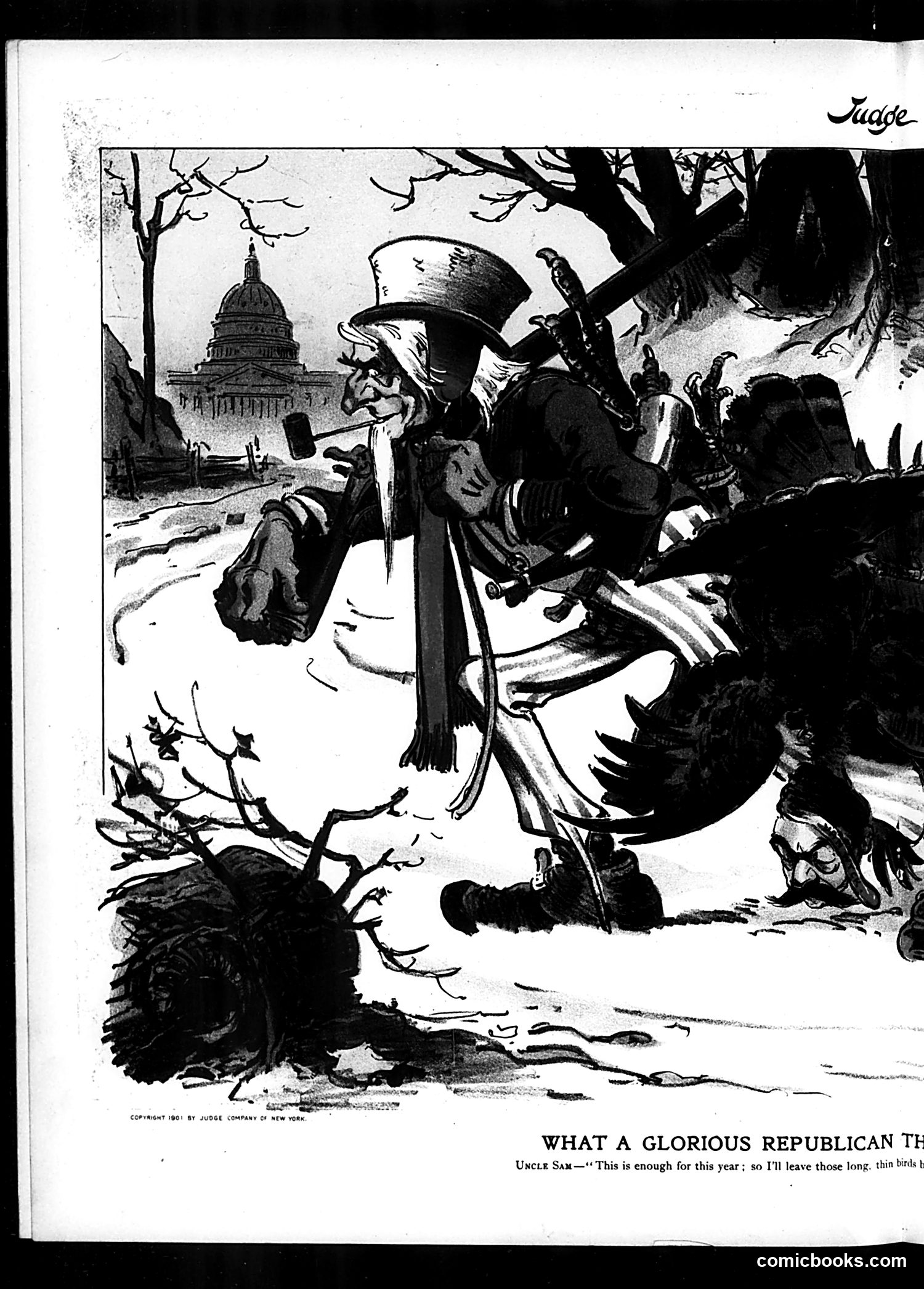
This 1901 *Judge* cartoon satirizes Republican governance under what appears to be the McKinley administration. Uncle Sam, depicted in his characteristic tall hat, stands amid bare winter trees with the Capitol building visible in the background. He's surrounded by vultures or similar predatory birds, which symbolize political corruption or opportunism. The caption suggests Uncle Sam is declaring he's "had enough" for the year and will "leave those long, thin birds"—a reference to the vultures, likely representing corrupt politicians or special interests exploiting the Republican party. The satire criticizes how the GOP has become infested with parasitic figures feeding on the nation's resources. The winter setting reinforces bleakness and decay in the political landscape.
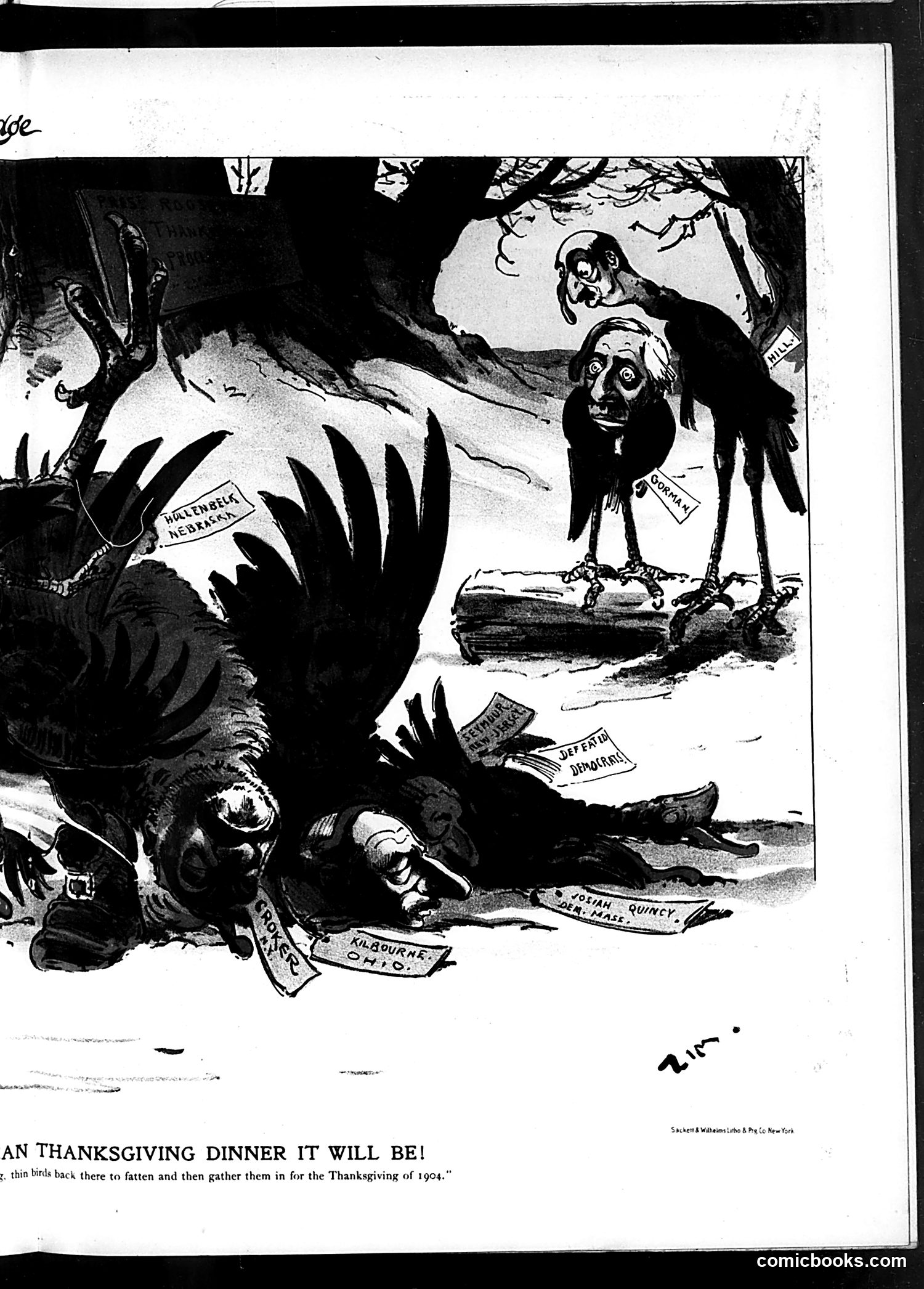
This 1904 *Judge* cartoon satirizes American imperialist expansion. The vultures represent the U.S. and its allies, identified by labels including "Baltimore," "Newark," and what appears to be "Josiah Quincy" (a Massachusetts politician). They're depicted as predatory birds circling emaciated, frightened figures labeled as foreign nations or territories—the "thin birds" mentioned in the caption. The satire mocks American political leaders who view distant peoples as resources to "fatten and gather in" for national profit, comparing imperial ambitions to fattening livestock for slaughter. The 1904 dating references Theodore Roosevelt's presidency and America's active imperial period, including control of the Philippines and Caribbean territories. The cartoon critiques this exploitation as morally equivalent to vultures preying on the weak.
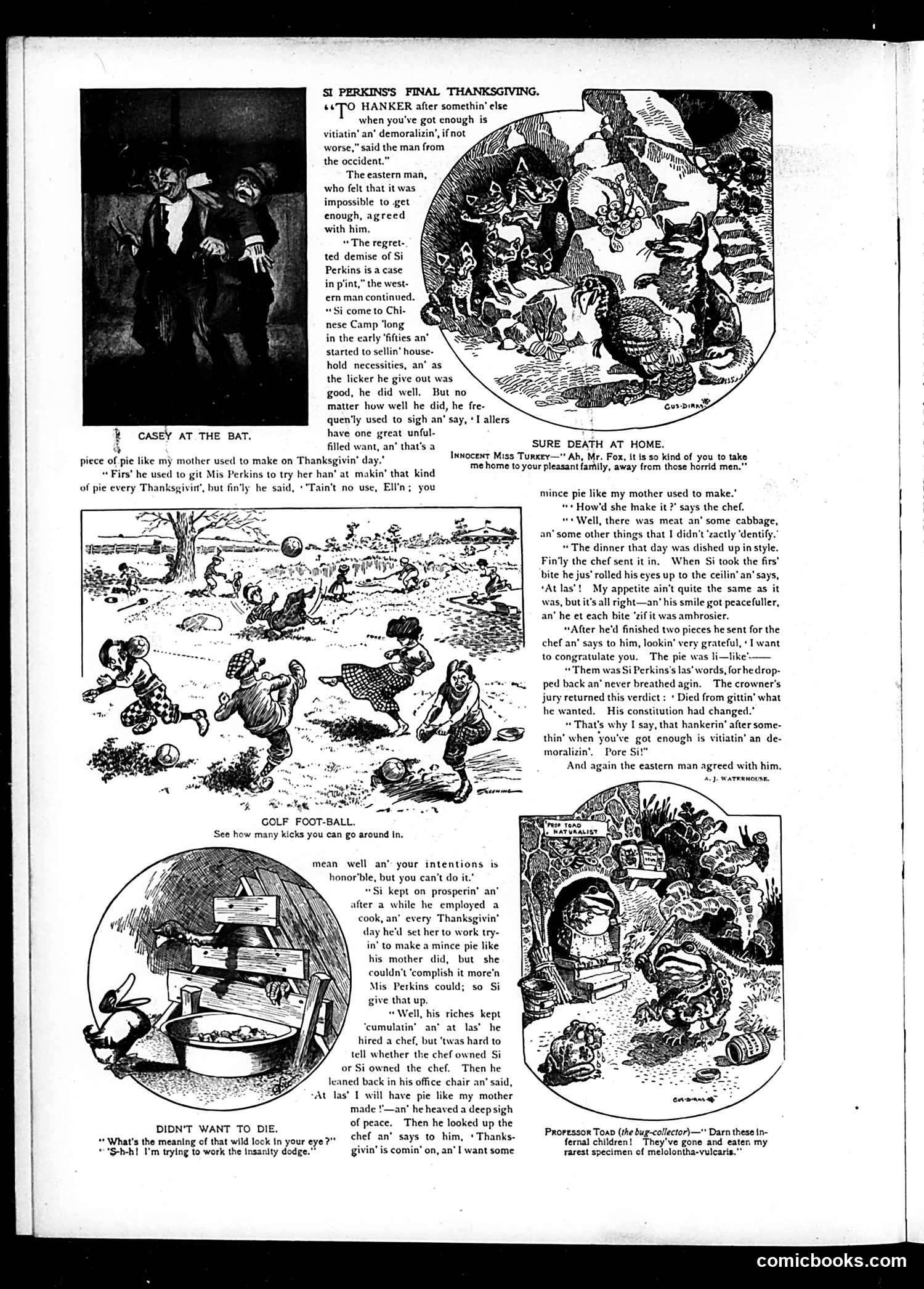
This page from *Judge* magazine contains multiple satirical pieces. The main story, "Si Perkins's Final Thanksgiving," tells of a wealthy California businessman who, despite his success, remains obsessed with recreating his mother's mince pie. The satire critiques American materialism and consumerism: no amount of wealth satisfies Si's longing for this childhood comfort. He eventually dies from eating the pie his chef finally produces—a darkly comic moral about how excessive desire, even for simple things, can be destructive. The accompanying illustrations include "Casey at the Bat" (the famous poem), "Golf Football" (satirizing sports), and "Sure Death at Home" (a fox seducing a turkey, likely mocking naive optimism). The overall message: American prosperity hasn't brought contentment; wealthy men remain trapped by nostalgic wants. The frontier/Western setting emphasizes this critique of American character.
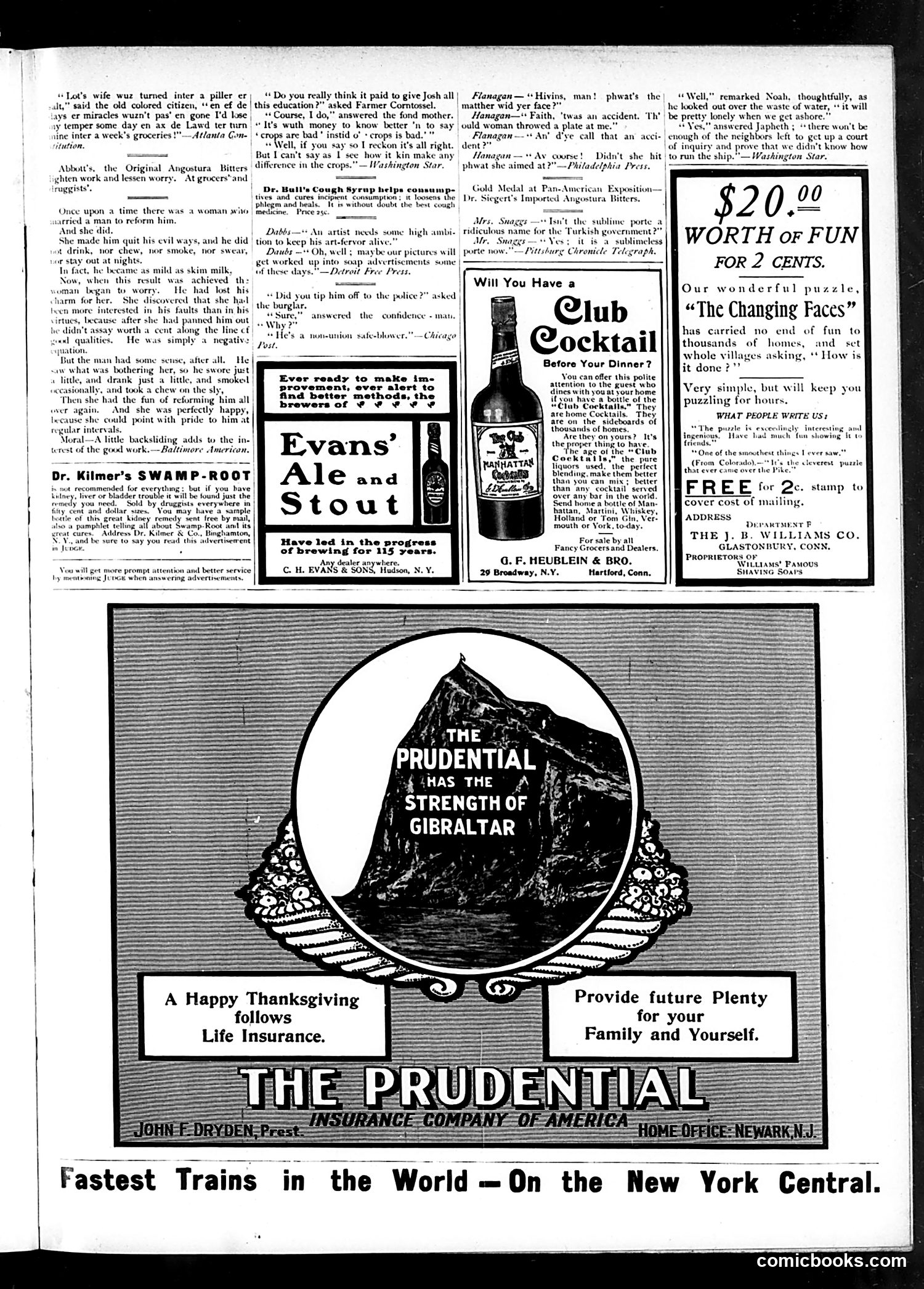
This page is primarily **advertising**, typical of early 20th-century magazines. The prominent content includes ads for Evans' Ale and Stout, Dr. Kilmer's Swamp-Root (a patent medicine), Dr. Bull's Cough Syrup, The Prudential Insurance Company, and Heublein cocktails. The small humorous sketches scattered throughout are brief comedic anecdotes rather than political cartoons—they're filler material between ads. They include jokes about: - A man complaining that turning his wife into groceries wouldn't help crops - A woman "reforming" a man by pointing out his faults, only to appreciate him once he returns to minor vices - An artist hoping his paintings get used in soap advertisements The **Prudential Insurance ad** features Gibraltar imagery, emphasizing strength and security for families. The page reflects **consumer culture and commercial humor** rather than political satire—typical of Judge's advertising-heavy model where short jokes entertained readers while promoting products.
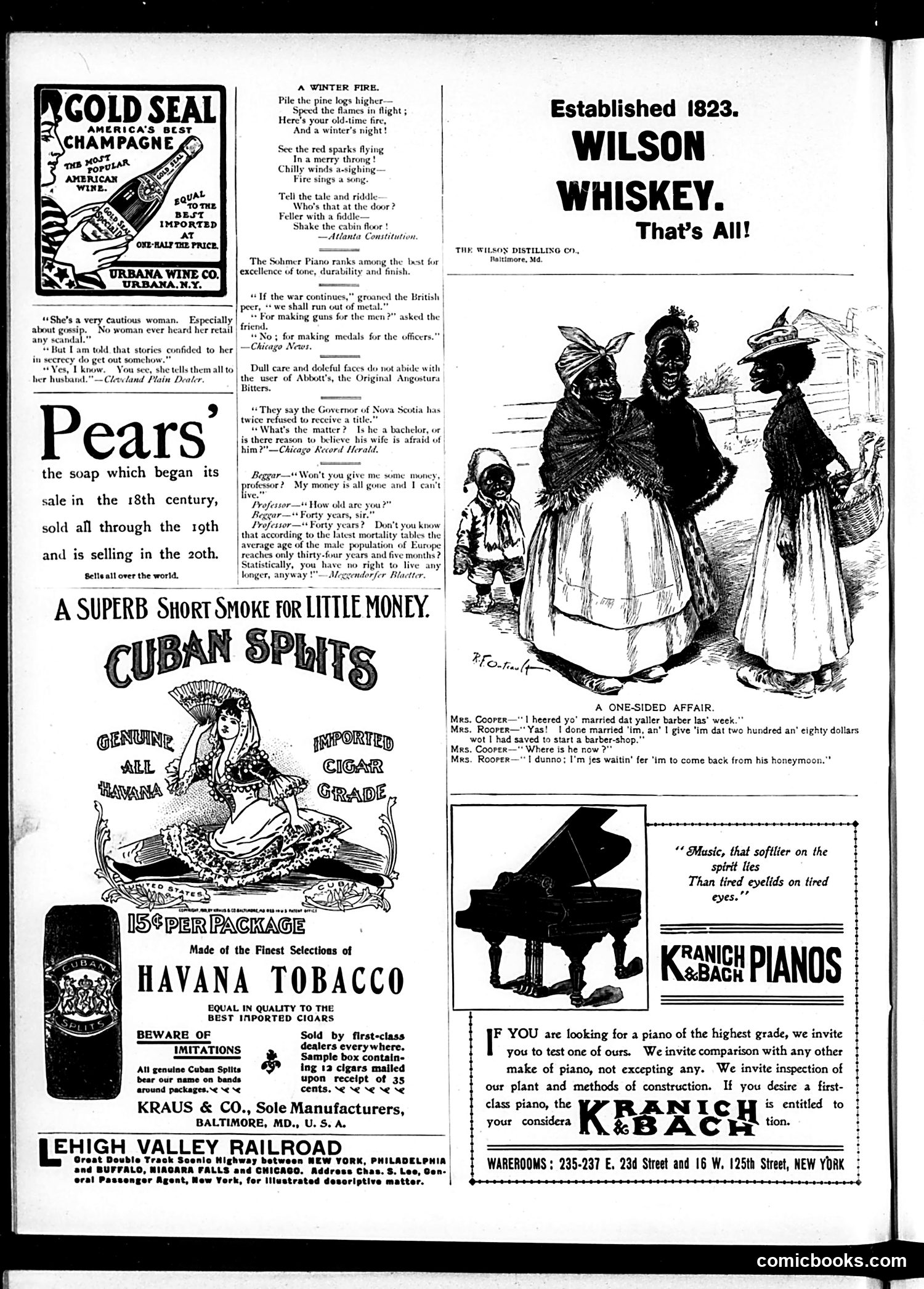
This cartoon depicts a racist caricature of an African American woman (Mrs. Roorer) who has married a "yaller barber" and given him $280 of her savings to start a barbershop. The joke's "point" is that he has abandoned her on their honeymoon, leaving her waiting for his return. The satire relies on contemporary racist stereotypes: the exaggerated dialect, the implication that Black men are unreliable or predatory, and the mockery of Black economic aspiration. The cartoon presents the woman as foolish for trusting her husband with her money. This reflects early 20th-century Judge magazine's casual racism—depicting Black subjects as objects of ridicule rather than sympathy. The "one-sided affair" implies she was duped into a marriage that was never genuine, framed as humorous rather than tragic or condemnable. A modern reader should understand this as period racism, not actual commentary on actual people or relationships.
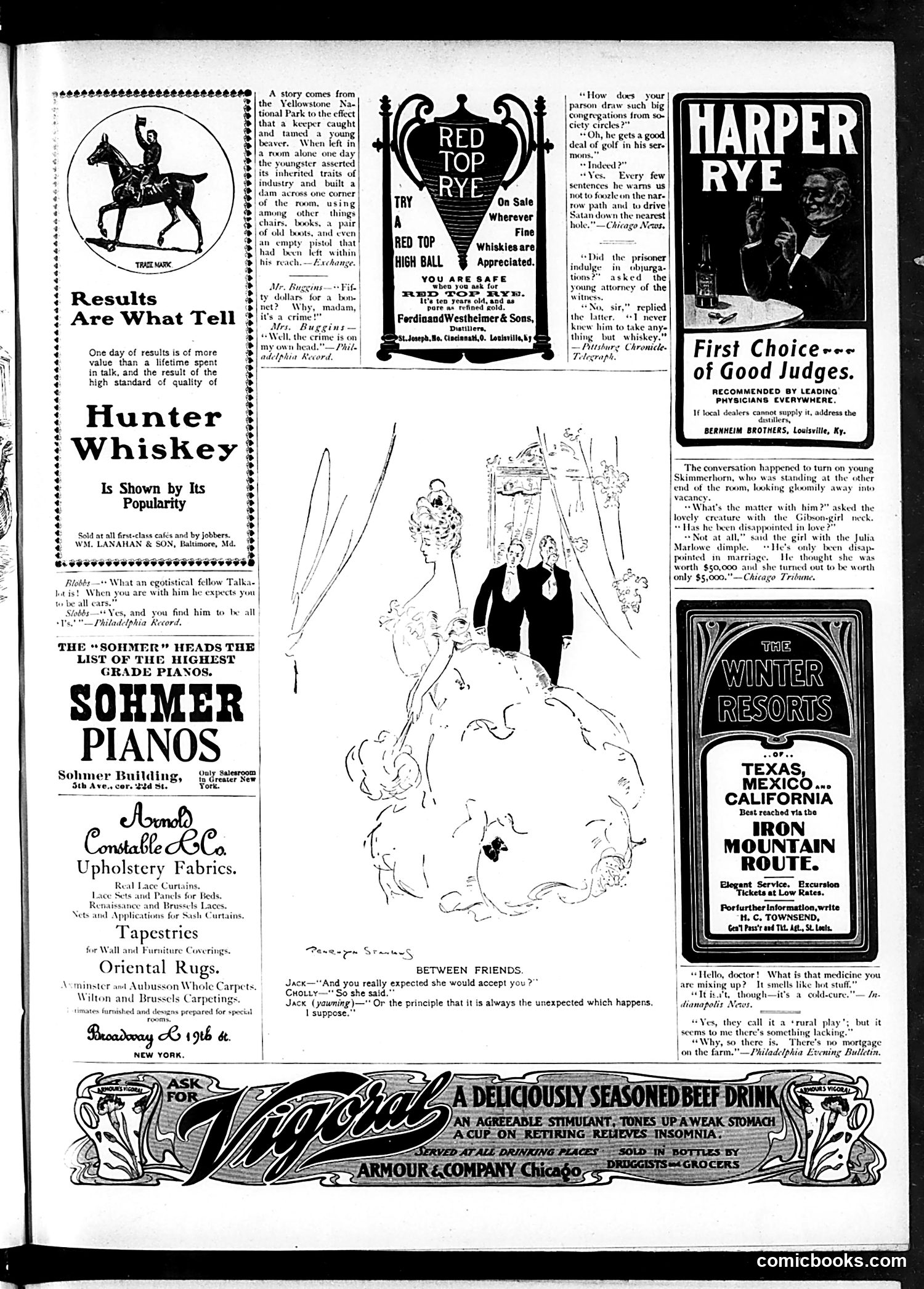
This page is primarily **advertisements and filler humor**, not political satire. The main content includes: **Central Cartoon ("Between Friends"):** A brief comedic exchange where Jack expresses surprise that a woman accepted his proposal, and Chouty responds with philosophical wordplay about the unexpected—a gentle joke about romantic uncertainty and acceptance. **Advertisements:** The page is dominated by product ads—Hunter Whiskey, Sohmer Pianos, Arnold Constable upholstery fabrics, Harper Rye whiskey, and Vivrol beef drink. These reflect early 1910s consumer goods marketed to middle/upper-class readers. **Minor Humor Items:** Small jokes about egotistical men and courtroom testimony, typical of Judge's light satirical style. **No clear political content** is visible. This appears to be a standard issue page mixing modest social humor with commercial advertising—representative of how Judge magazine balanced editorial content with revenue from paid advertisements.
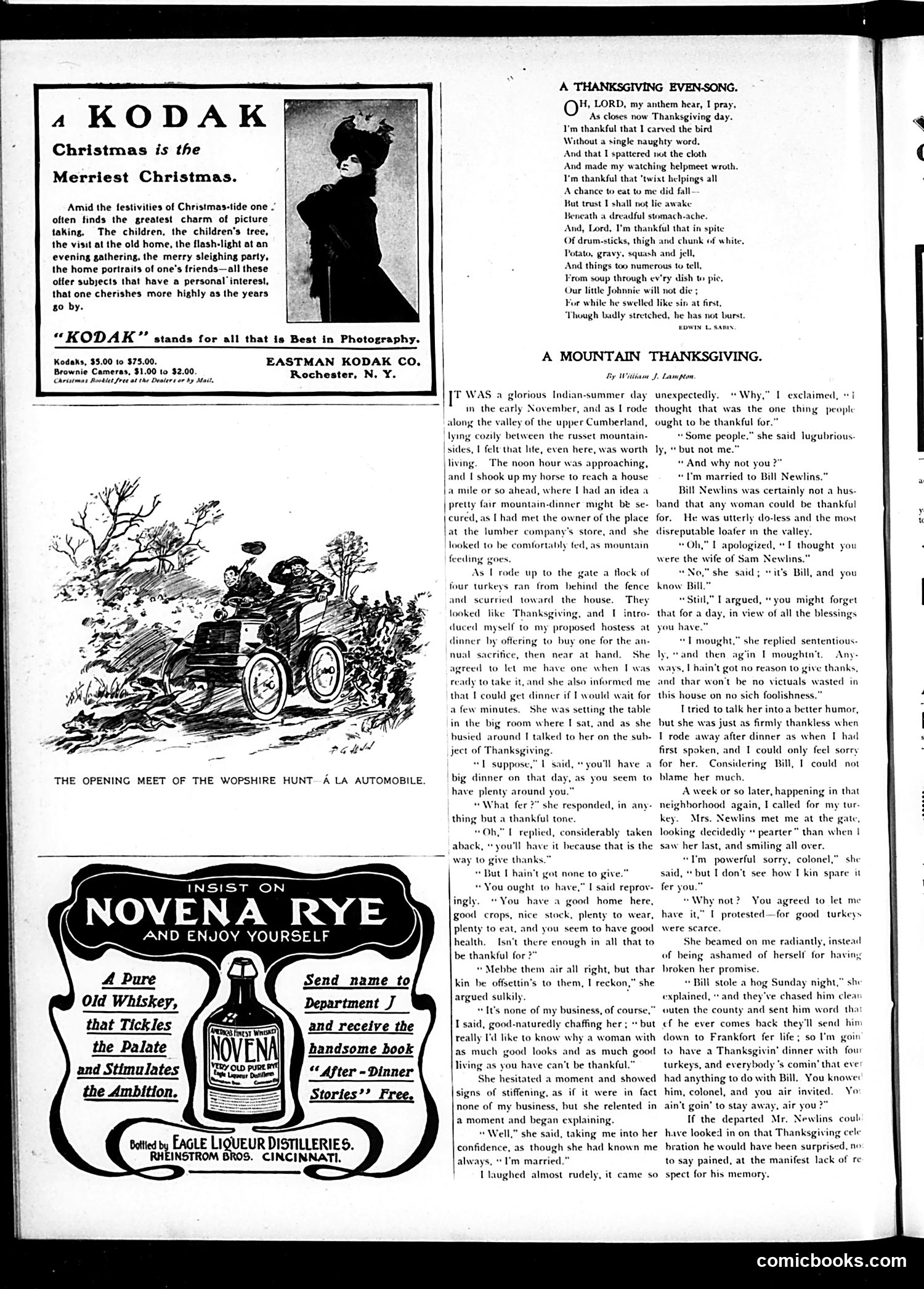
This Judge magazine page from the early 1900s contains advertisements and two stories about Thanksgiving, reflecting period attitudes about rural life and gender roles. **The Kodak Advertisement** promotes photography as ideal for capturing Christmas memories—children, family gatherings, sleighing parties—positioning the camera as essential to preserving domestic sentimentality. **"The Opening Meet of the Wopshire Hunt"** cartoon illustrates early-automobile culture replacing traditional English fox-hunting. The humor likely derives from the incongruity of horseless carriages disrupting centuries-old sporting traditions. **The Main Story: "A Mountain Thanksgiving"** presents a condescending narrative where an urban visitor attempts to convince a rural Appalachian woman to be grateful for her life. She resists, ultimately revealing her complaint: "I'm married." This punchline relies on period misogyny—suggesting marriage itself negates any woman's capacity for happiness, which contemporary readers found humorous. The story reflects class attitudes treating rural people as quaint and emotionally simple. The **Novena Rye whiskey advertisement** occupies significant space, typical of early-1900s magazine economics.
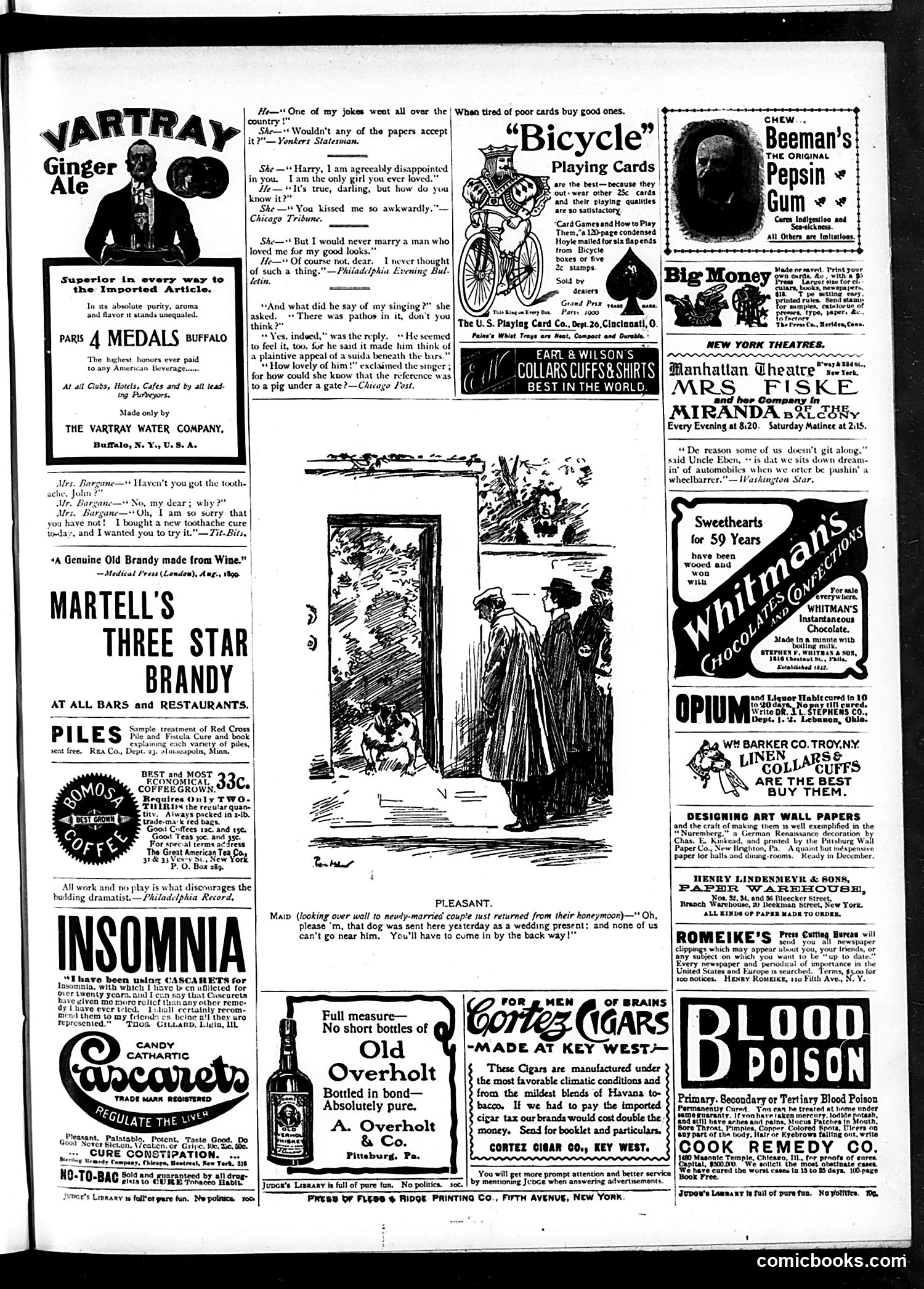
This page is **primarily advertising** with minimal editorial cartooning. The major content consists of period product advertisements (Vartray Ginger Ale, Martell's Brandy, Cascarets, Cortez Cigars, Blood Poison remedy, etc.). The few **joke/cartoon items** present are brief, captionless social humor typical of early 20th-century magazines: - A joke about a man whose "joke went all over the country" but no newspaper accepted it—satirizing either the man's poor humor or publication standards - Romantic/domestic humor about kissing, marriage, and singing—standard light fare with no political content - A cartoon captioned "PLEASANT" showing a newlywed couple unable to approach a wedding-gift dog There's **one theatrical advertisement** for *Miranda* at the Manhattan Theatre. The page contains **no identifiable political cartoons, caricatures of public figures, or satirical commentary** on current events. It represents Judge functioning primarily as an advertising vehicle with light, generic humor filler—not the sharp political satire the magazine was known for.
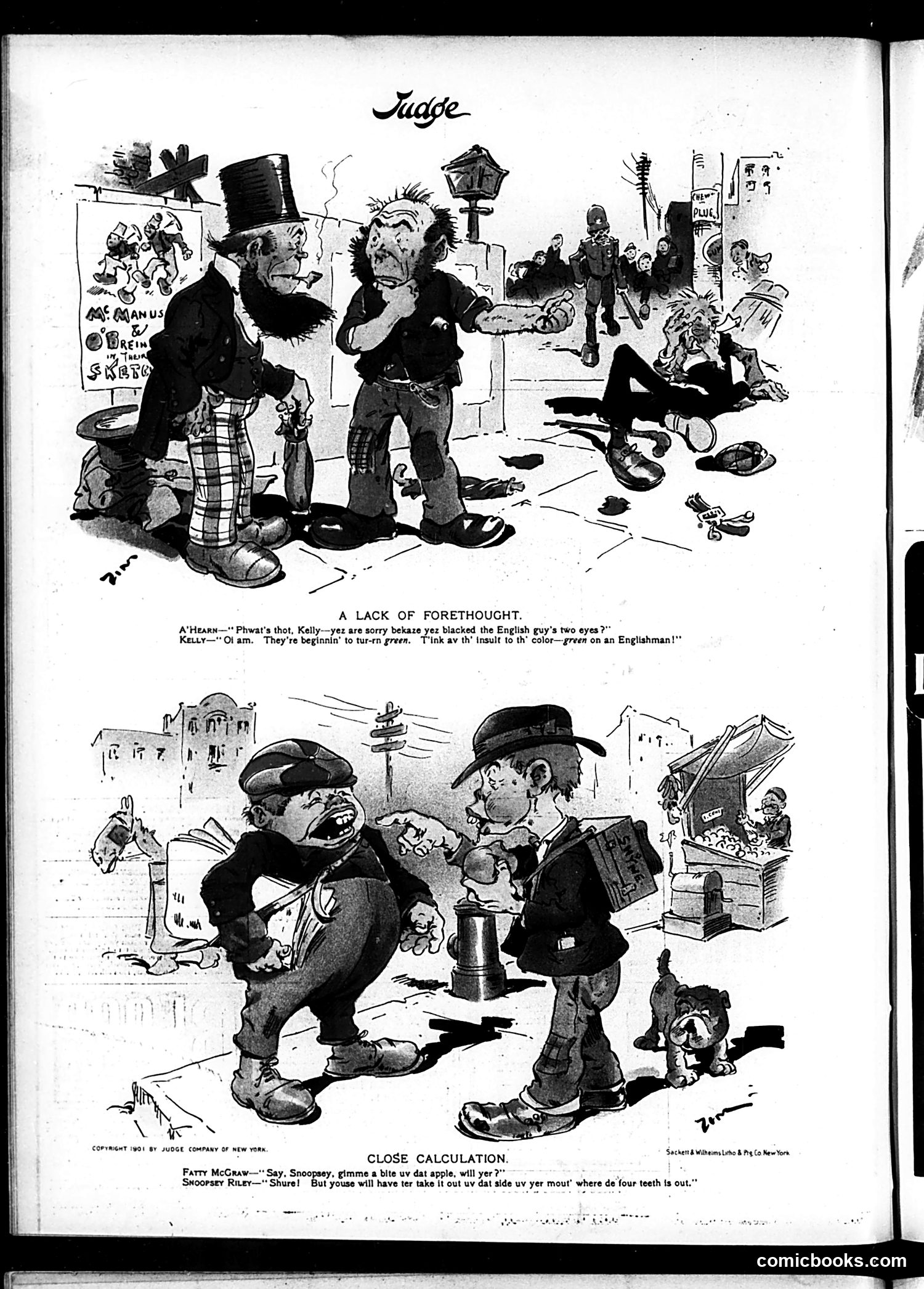
These two cartoons use Irish-American immigrant characters (identified by their dialect and names like O'Hearn, Kelly, and Riley) as vehicles for humor. **"A Lack of Forethought"** satirizes Irish-American working-class violence. Two Irishmen regret beating an Englishman because his bruises are turning green—making the injuries patriotically symbolic of Ireland, thus accidentally honoring rather than insulting their English victim. The joke mocks both Irish pugnacity and their contradictory feelings about nationality. **"Close Calculation"** depicts two poor Irish characters haggling over sharing an apple, with one warning the other must eat from the side where he's missing teeth. It's a crude joke about poverty and dental neglect among Irish immigrants. Both reflect how Judge's middle-class audience viewed Irish immigrants: as violent, poor, dialect-speaking "others," using exaggerated caricature and broken English for comedic effect. This was standard ethnic humor of the early 20th century.
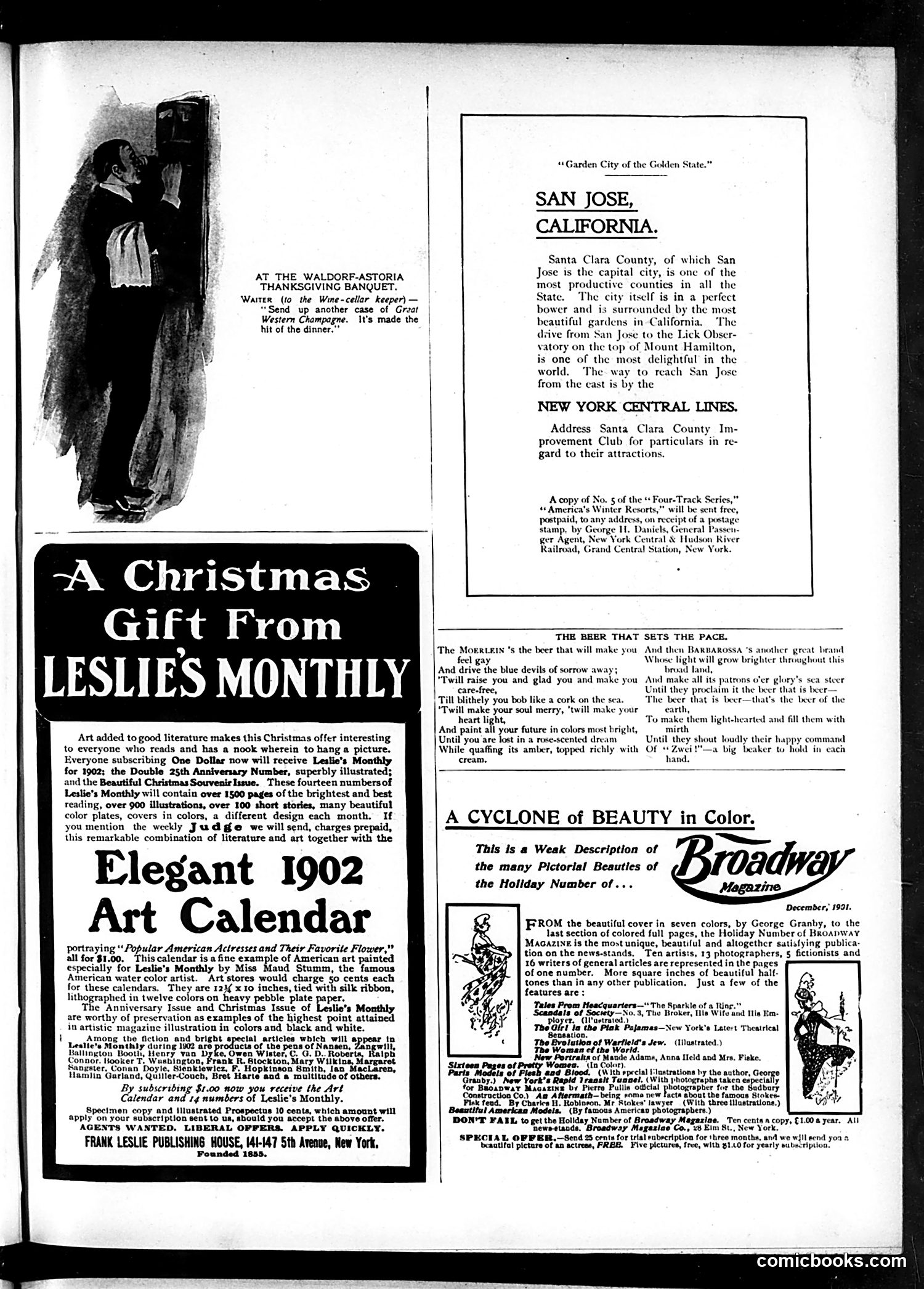
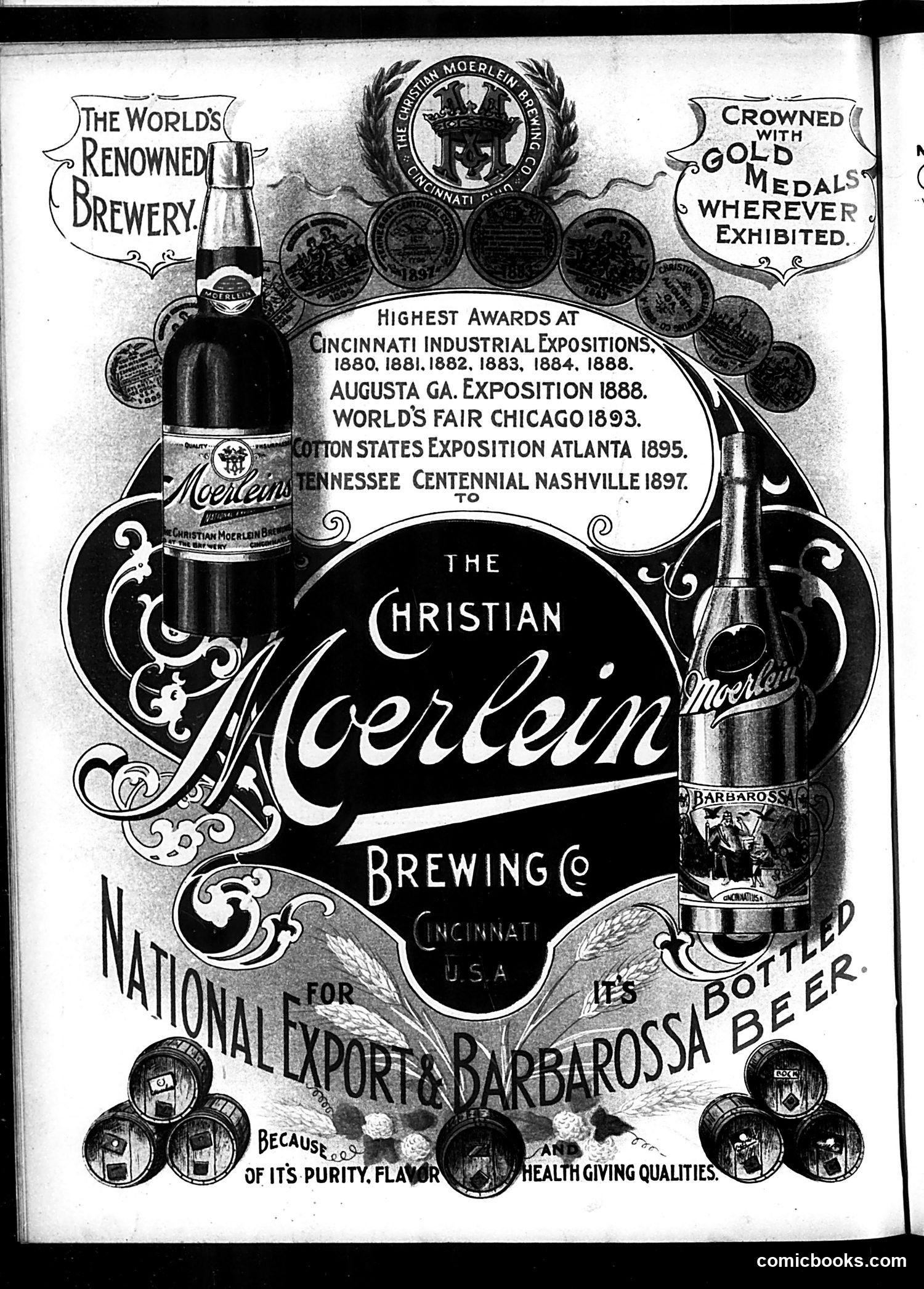
This is primarily a **beer advertisement**, not political satire. The Christian Moerlein Brewing Company of Cincinnati uses ornate Victorian design to promote their "Barbarossa Bottled Beer" as a national export. The page emphasizes the brewery's legitimacy through **medal awards** from major American expositions (Cincinnati Industrial Expositions 1880-1888, World's Fair Chicago 1893, Atlanta Cotton States Exposition 1895, and Nashville Tennessee Centennial 1897). These medals appear as decorative circular seals around the composition. The advertisement highlights the product's qualities—"purity, flavor" and "health giving qualities"—typical marketing claims for beer in the 1890s. The name "Barbarossa" likely invoked strength and heritage. This appears in *Judge* magazine possibly as paid advertising rather than editorial content, representing the commercialism of the Gilded Age. There is no apparent satire here—just branded promotion.