
A complete issue · 16 pages · 1901
Judge — February 16, 1901
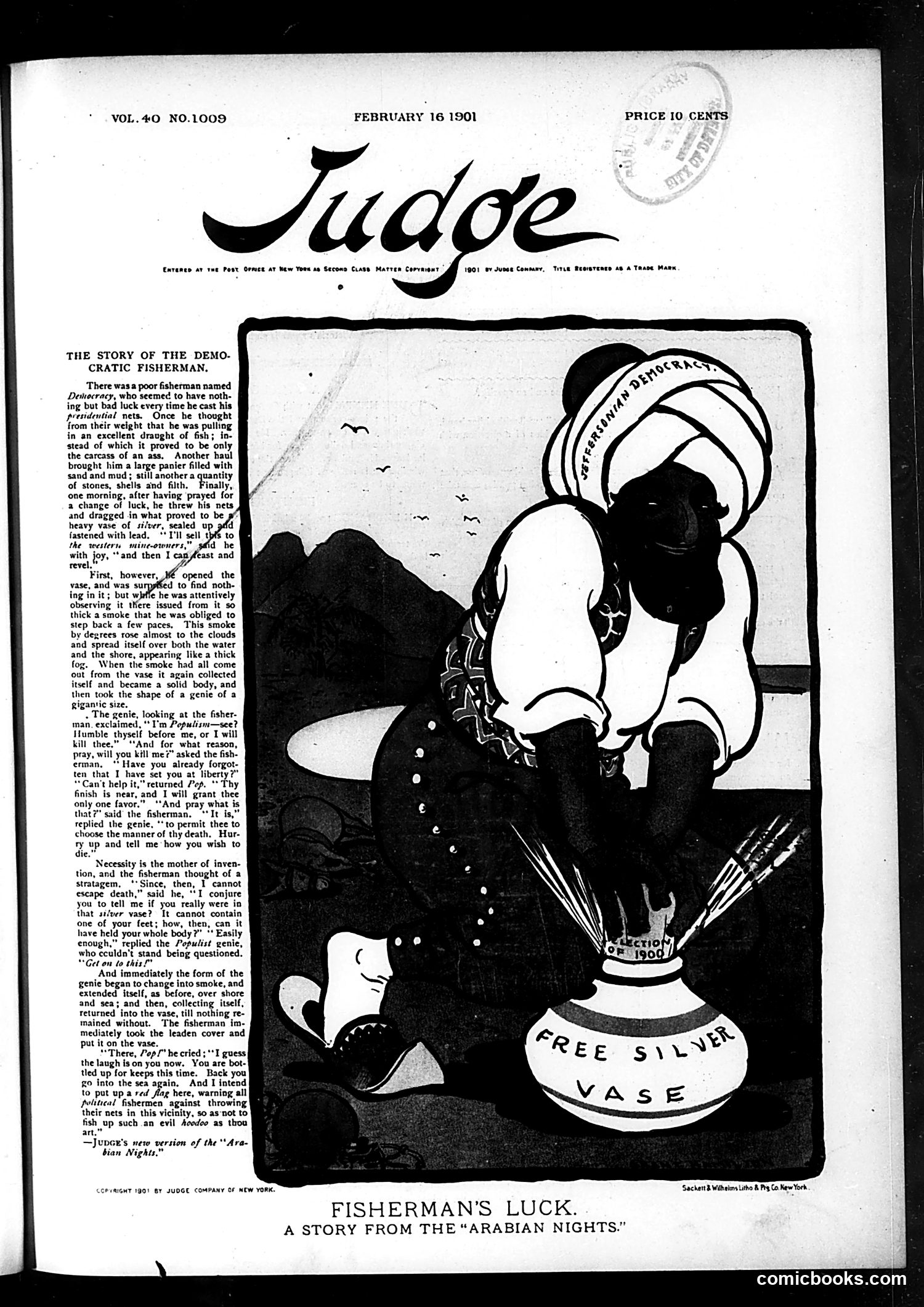
This page presents a fictional story titled "The Story of the Democratic Fisherman." The narrative describes a poor fisherman named Democracy who repeatedly pulls up a magical vase from the sea. Each time the genie emerges from the vase, Democracy requests favors, but the genie consistently refuses and returns to the vase. The accompanying illustration shows the vase labeled "Free Silver Vase" with an ethereal female figure (the genie) emerging from it. The cartoon satirizes Democratic Party political hopes—specifically their pursuit of "free silver" (unlimited coinage of silver), a major 1890s policy issue. The joke suggests that Democrats repeatedly invoke this same failed political promise, expecting different results, much like the fisherman's futile exchanges with the genie. It's political commentary on Democratic Party repetition and failed policy aspirations.
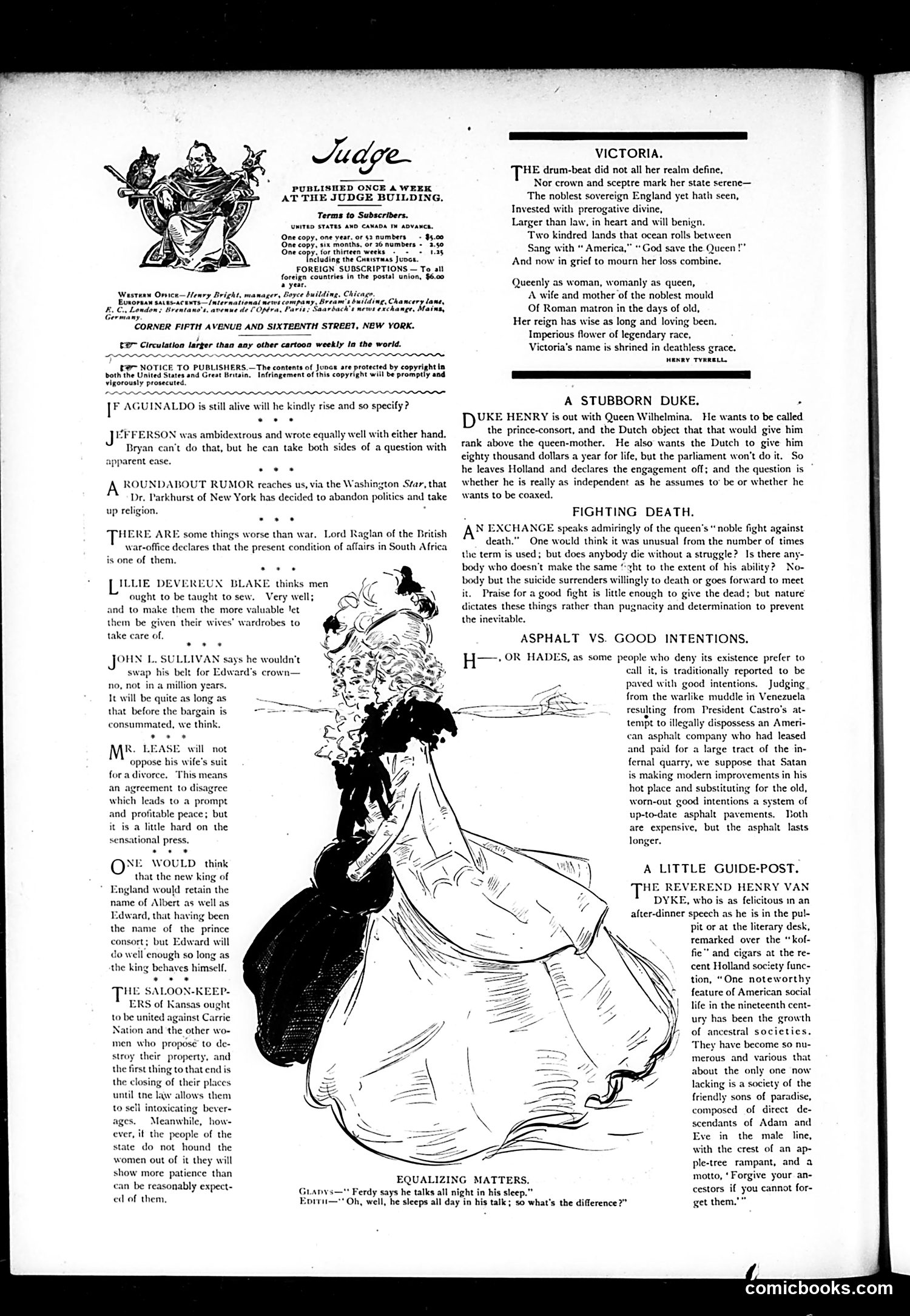
The large central cartoon depicts a woman in elaborate dress being physically restrained or grappled with by a dark figure. Based on the visible text sections ("A Stubborn Duke," "Fighting Death," "Asphalt vs. Good Intentions"), this appears to be satirizing European nobility and social issues rather than U.S. politics specifically. The "Victoria" poem at top right references Queen Victoria and British monarchy. The scattered text items below the cartoon mock various contemporary figures and situations—including references to Jefferson, Lord Raglan, and John L. Sullivan—suggesting commentary on political independence, military affairs, and celebrity. Without clearer caption text visible in the image, the specific satirical target of the main illustration remains somewhat unclear, though it appears to critique aristocratic pretension or romantic/dynastic conflicts among European nobility.
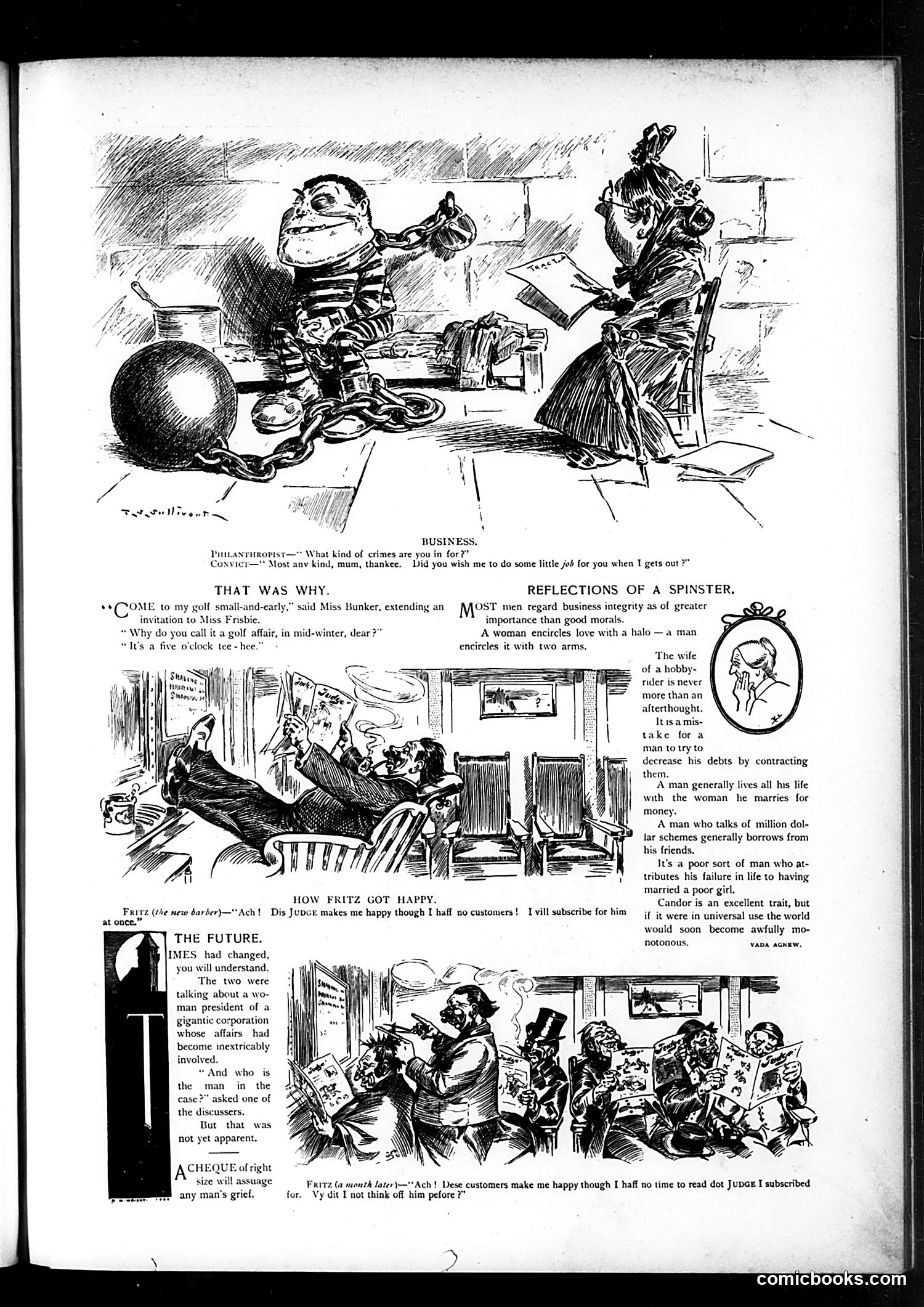
This page contains several satirical sketches: **"Business"** depicts a convict in chains meeting a philanthropist, mocking the irony of criminals seeking charity work—commentary on criminal justice and rehabilitation debates. **"That Was Why"** appears to satirize marital infidelity, with dialogue about a "golf affair" suggesting wealthy men's excuses for absence. **"Reflections of a Spinster"** offers cynical observations on marriage and women's financial dependence, noting that wives become "hobble-rulers" and men marry for money. **"How Fritz Got Happy"** and **"The Future"** sketch scenarios about business dealings and corporate consolidation, with characters named Fritz and references to a judge figure, likely commenting on Gilded Age corporate power and monopolies. The overall tone is satirical, targeting Victorian social hypocrisy around class, marriage, and business ethics.
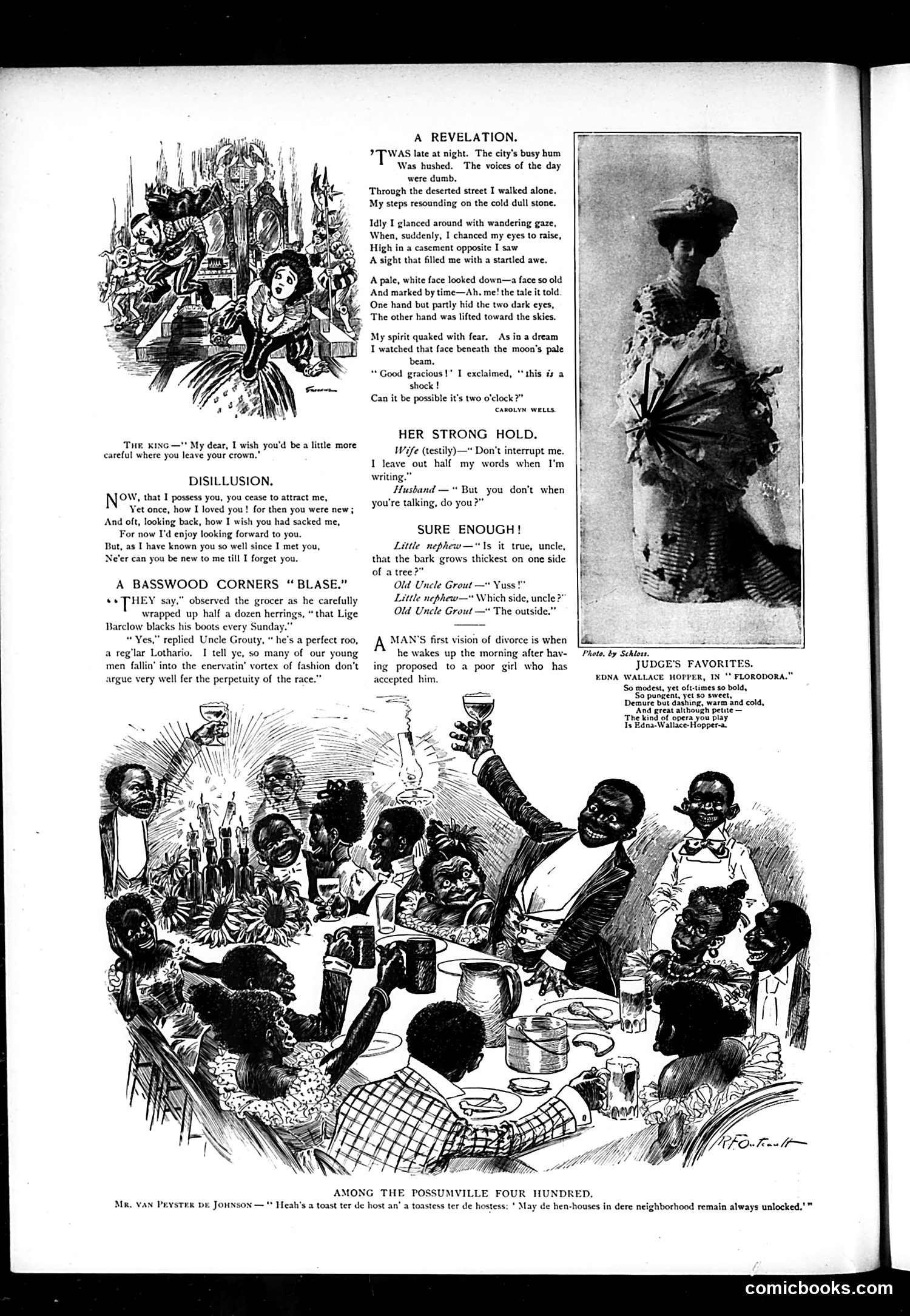
This page contains several satirical pieces. The bottom illustration, captioned "Among the Possum ville Four Hundred," depicts a caricatured dinner party with exaggerated racial features—a common and deeply offensive convention of early 20th-century American humor magazines. The caption references "possum" (a Southern food stereotype) and mocks social pretension by suggesting even in an African American community, inhabitants mimic upper-class white dining customs and social hierarchies. The upper text selections include literary pieces like "A Revelation" and social commentary. "A Man's First Vision of Divorce" critiques marriage dissolution. The content reflects Judge's approach: mixing literary satire with visual caricature, often relying on racial and ethnic stereotypes considered acceptable—though offensive—to its era's audience.
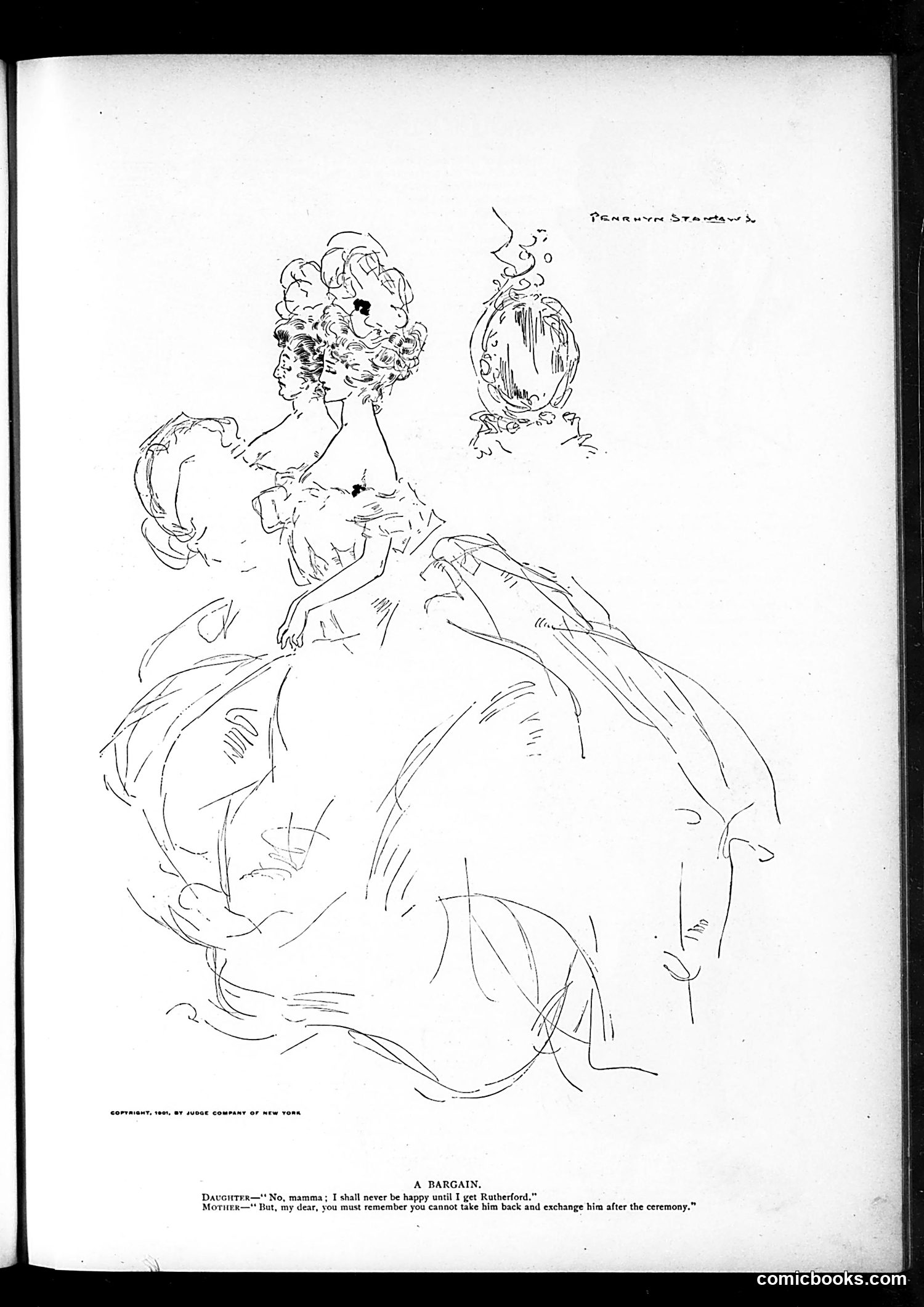
This cartoon depicts a mother-daughter negotiation about marriage. The daughter (labeled "Davenport") refuses her mother's pressure, declaring "I shall never be happy until I get Rutherford." The mother counters that the daughter cannot "take him back and exchange him after the ceremony." The satire mocks the transactional nature of Victorian marriages, where women were essentially traded like goods. The elaborate dress and fashionable styling emphasize the daughter's status as a commodity being "sold" through matrimony. The "bargain" framing—suggesting marriage is a purchase with no returns—ridicules both the economic reality underlying upper-class marriages and maternal pressure to marry advantageously. The specific identities of "Davenport" and "Rutherford" remain unclear without additional context, though they appear to reference contemporary social figures recognizable to Judge's 1880s audience.
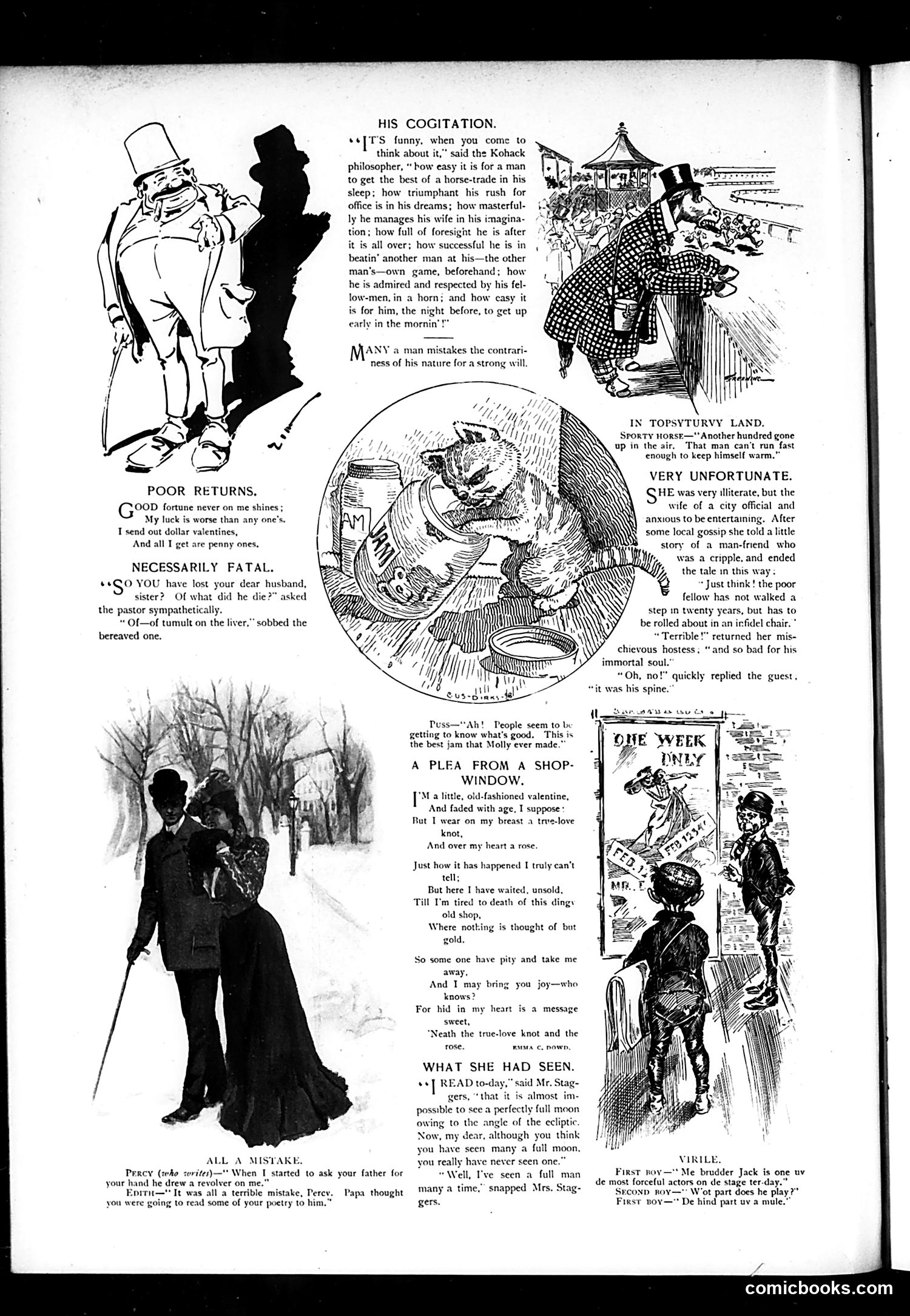
This Judge magazine page contains several short humorous pieces typical of early 20th-century American satire: **"His Cogitation"** mocks how men fantasize about their own competence—winning business deals, gaining office, managing wives—only to fail in reality. It satirizes masculine self-delusion. **"Poor Returns"** jokes about failed romance: a man sends expensive dollar valentines but receives only cheap penny ones in return. **"Necessarily Fatal"** is a pun-based joke where a widow says her husband died of "tumult on the liver"—likely meaning cirrhosis, but the pastor misunderstands the malapropism. **"A Plea from a Shop-Window"** personifies an unsold, faded valentine longing to find a buyer, lamenting its obsolescence in a shop focused only on profit. **Other pieces** include light romantic misunderstandings and wordplay humor. The overall tone is genteel Victorian-era comedy—sentimental, punning, and gently mocking human folly rather than targeting specific political figures or events.
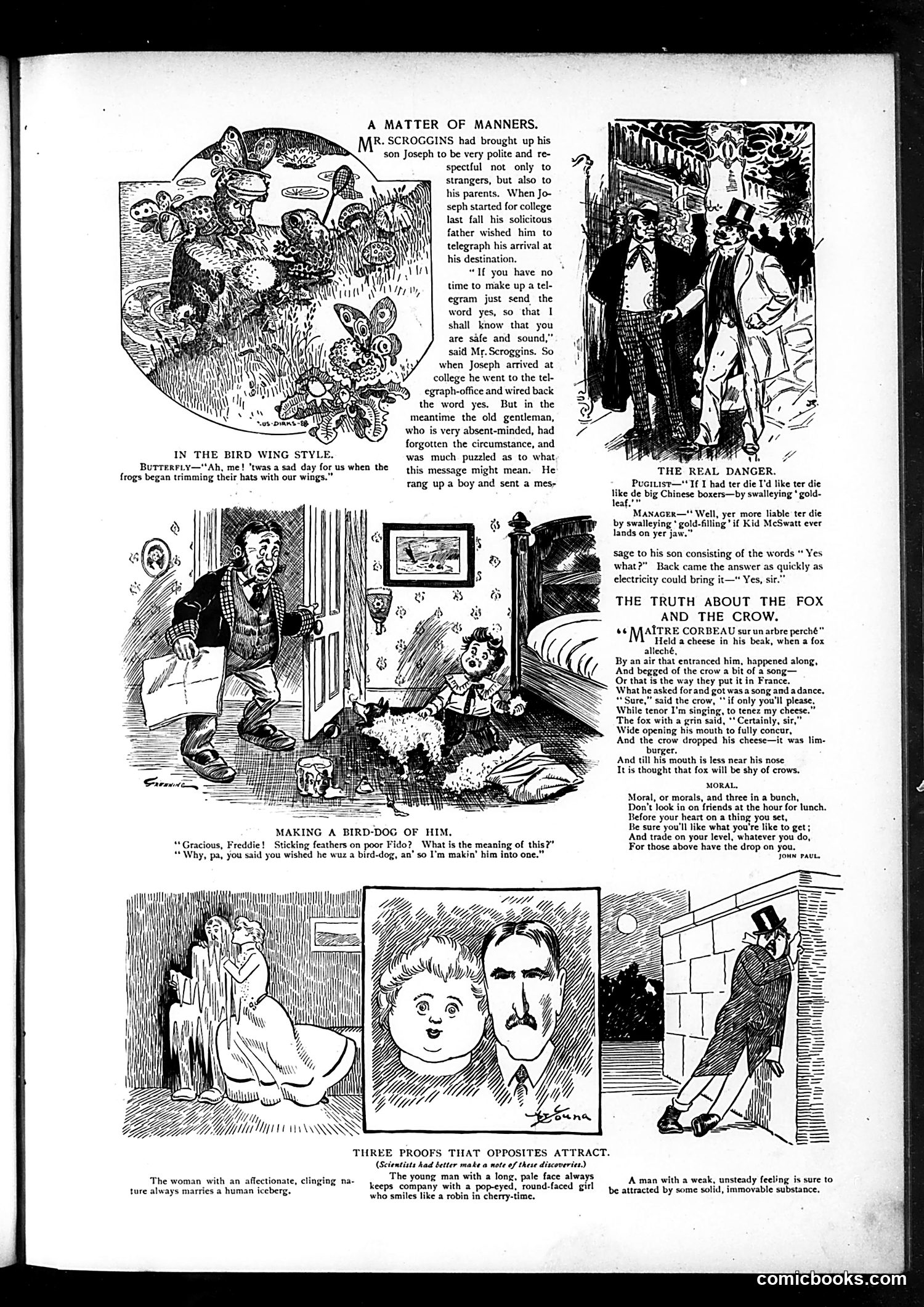
This page contains several humorous vignettes satirizing social behavior and manners: **"A Matter of Manners"** mocks absent-minded parenting. Mr. Scroggins asks his college-bound son Joseph to telegraph arrival safely. Joseph dutifully sends "Yes"—but the forgetful father, not remembering his own request, receives the cryptic message and wires back "Yes what?" The satire targets Victorian politeness conventions and the gap between intention and execution. **"The Truth About the Fox and the Crow"** retells the Aesop fable with French affectations, explaining why foxes now avoid crows (the crow drops cheese in the fox's mouth). It's gentle humor mocking literary pretension. **"Making a Bird-Dog of Him"** shows a child literally gluing feathers onto a dog after his father wished for a "bird-dog"—satire on taking figures of speech literally. **"Three Proofs That Opposites Attract"** presents relationship observations: affectionate women marry cold men, pale men attract rosy women, weak men attract strong women. It's lighthearted social commentary on romantic compatibility through type-casting.
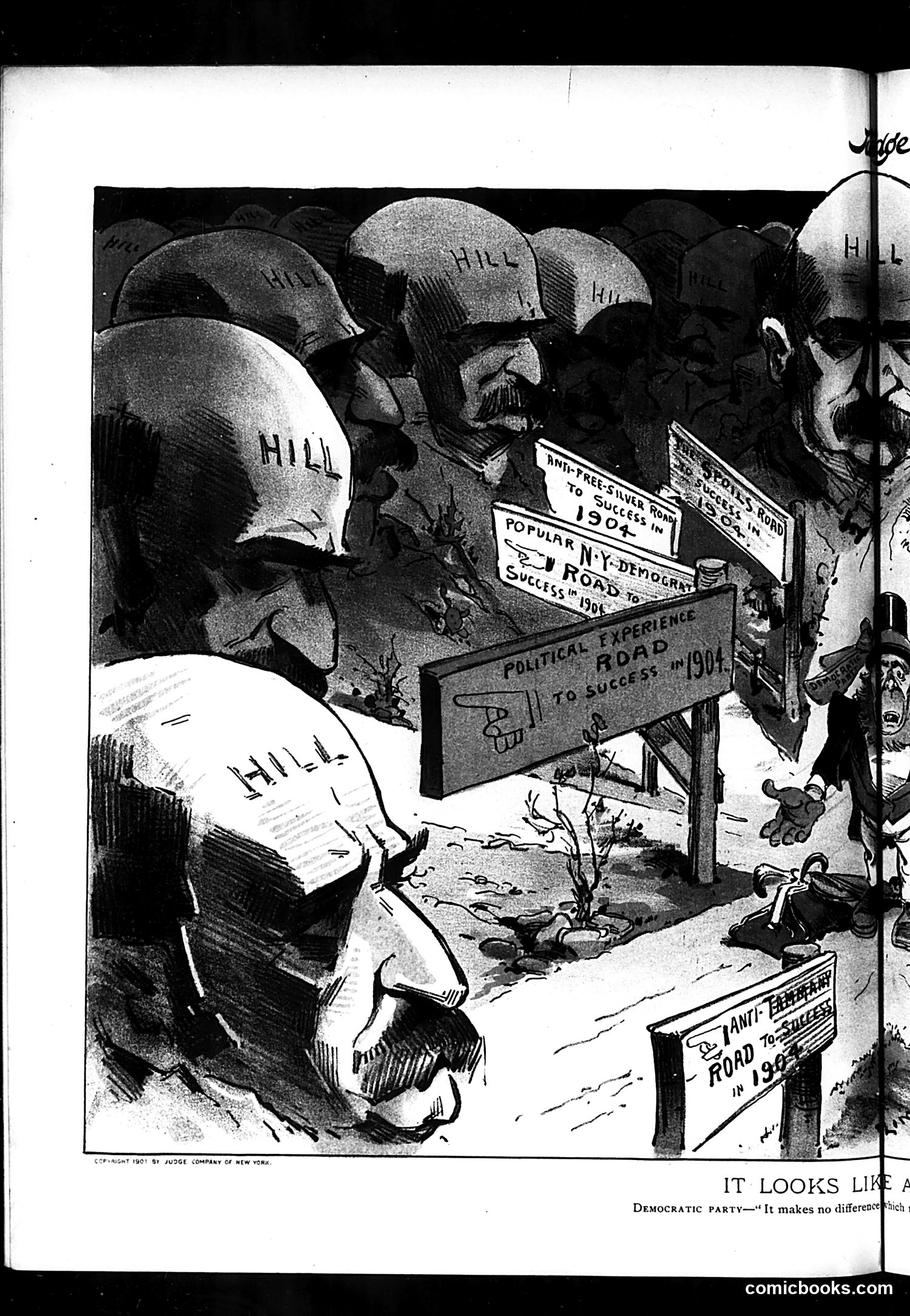
This 1901 Judge cartoon satirizes the Democratic Party's political confusion and lack of direction. Multiple figures wearing "HILL" labels (likely referring to Democratic politician David B. Hill) stand at a crossroads marked with conflicting signs about routes to "success"—labeled "Popular N.Y. Democracy," "Anti-Free Silver Road," and "Political Experience Road to Success 1904." The cartoon suggests the Democratic Party cannot decide which path forward to take and has no clear leadership or unified vision. The dead vegetation and barren landscape emphasize the party's stagnation. The caption "It looks like a Democratic party—'It makes no difference'" mocks their apparent inability to choose meaningfully between options, implying their decisions are arbitrary or inconsequential.
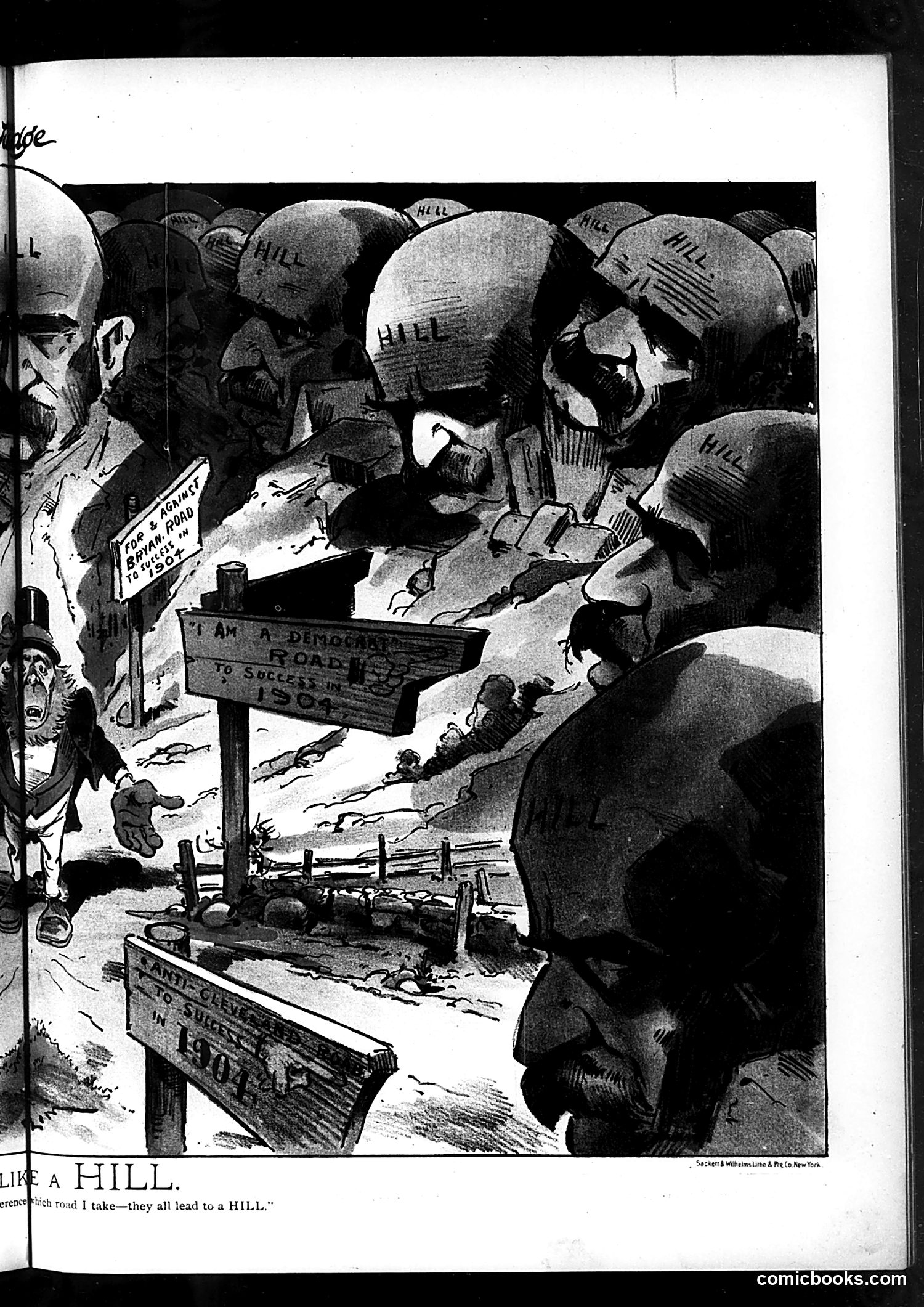
This appears to be a World War I-era satirical cartoon from *Judge* magazine. The image shows soldiers in military helmets (marked "HILL") gathered around what appear to be graves or casualty markers labeled with phrases like "I AM A DESERTER" and references to "ROAD TO SUCCESS." The cartoon's caption—"which road I take—they all lead to a HILL"—is a dark pun: "hill" refers both to the literal terrain soldiers must fight over and serves as a metaphor for death/casualties. The satire critiques how different choices or paths all lead to the same tragic outcome: soldiers dying in combat, regardless of their decisions or circumstances. The graves and skeletal figures on the left reinforce the death theme.
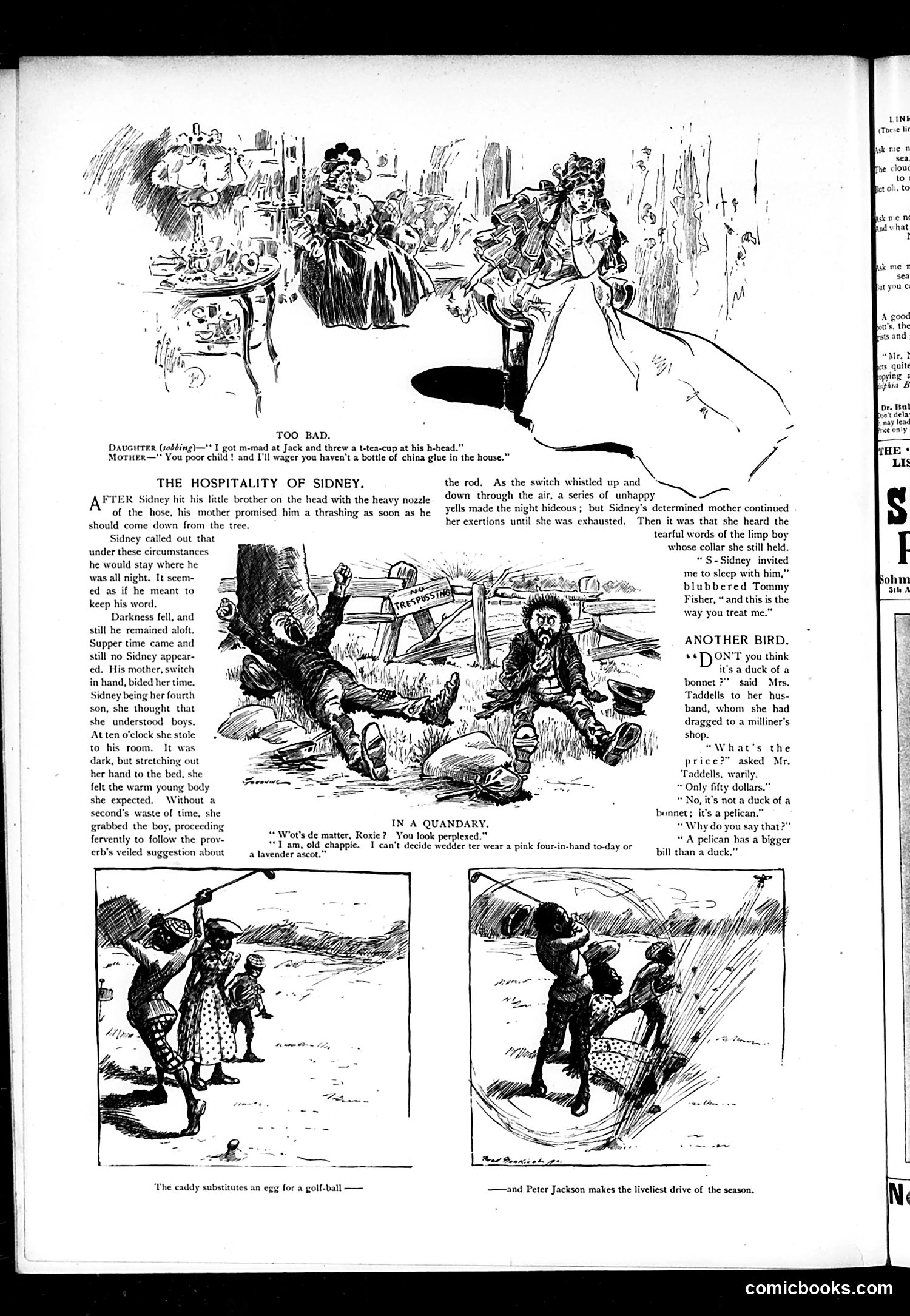
This page contains several unrelated comic vignettes satirizing domestic life and social behaviors: **"Too Bad"** mocks a mother's practicality—her concern isn't her daughter's anger at throwing a teacup, but rather the lack of "china glue" to repair it. **"The Hospitality of Sidney"** depicts a boy who climbs a tree to avoid punishment after hitting his brother. His mother waits below with a switch, but when she finally beats the figure she assumes is Sidney in the dark, it's actually Sidney's guest, Tommy Fisher, whom Sidney had invited for a sleepover. The joke satirizes both Sidney's cunning and his mother's assumption. **"In a Quandary"** shows confusion over fashion—a woman can't decide between two neckties, suggesting either gender ambiguity or satirizing indecisiveness about trivial matters. **"Another Bird"** is a visual pun—a milliner's bonnet is compared unfavorably to a pelican because of its large "bill" (beak/cost). Mr. Taddells makes a weak joke about the bonnet's expense. The page emphasizes humor through wordplay, domestic mishaps, and visual gags typical of early-20th-century American satirical magazines.
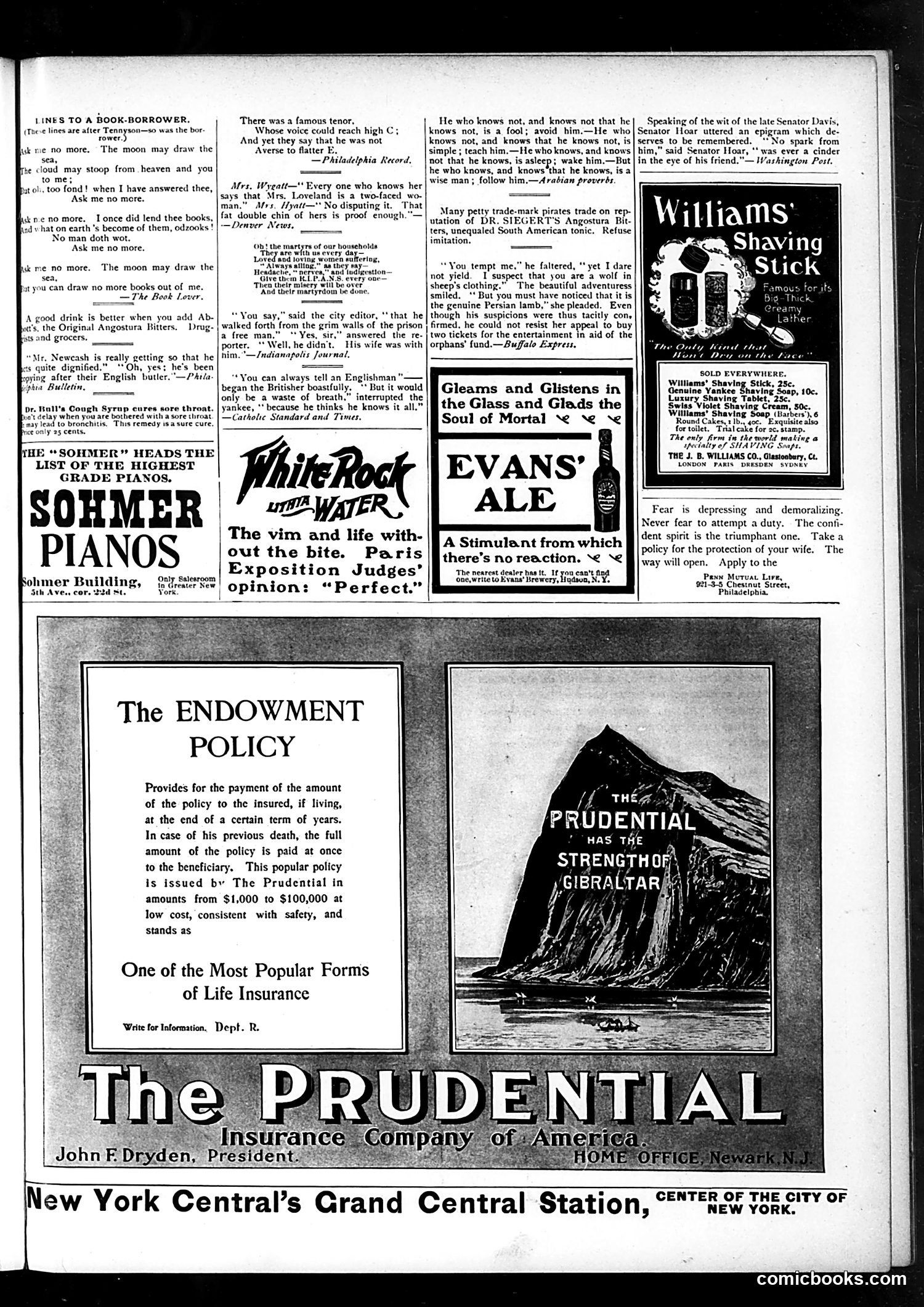
This page is primarily **advertisements and humorous short pieces**, typical of Judge magazine's format. The satirical content includes: **"Lines to a Book-Borrower"**: A poem mockingly comparing someone who borrows books (and doesn't return them) to a famous tenor, playing on Tennyson's romantic verse. The joke: book-borrowers are as notorious for theft as the tenor was famous. **Scattered one-liners** poke fun at: - A woman's vanity (the "two-faced" double-chin joke) - Marital dynamics (a freed prisoner's wife still accompanying him) - National stereotypes (the "you can always tell an Englishman" bit about British superiority) **The rest is advertising** for patent medicines (Dr. Siegert's Bitters, Hall's Cough Syrup), pianos, insurance, and shaving products—common in period magazines. These ads often made dubious health claims now considered fraudulent. The humor reflects early 20th-century tastes: domestic comedy, ethnic stereotyping, and light social commentary rather than sharp political satire.
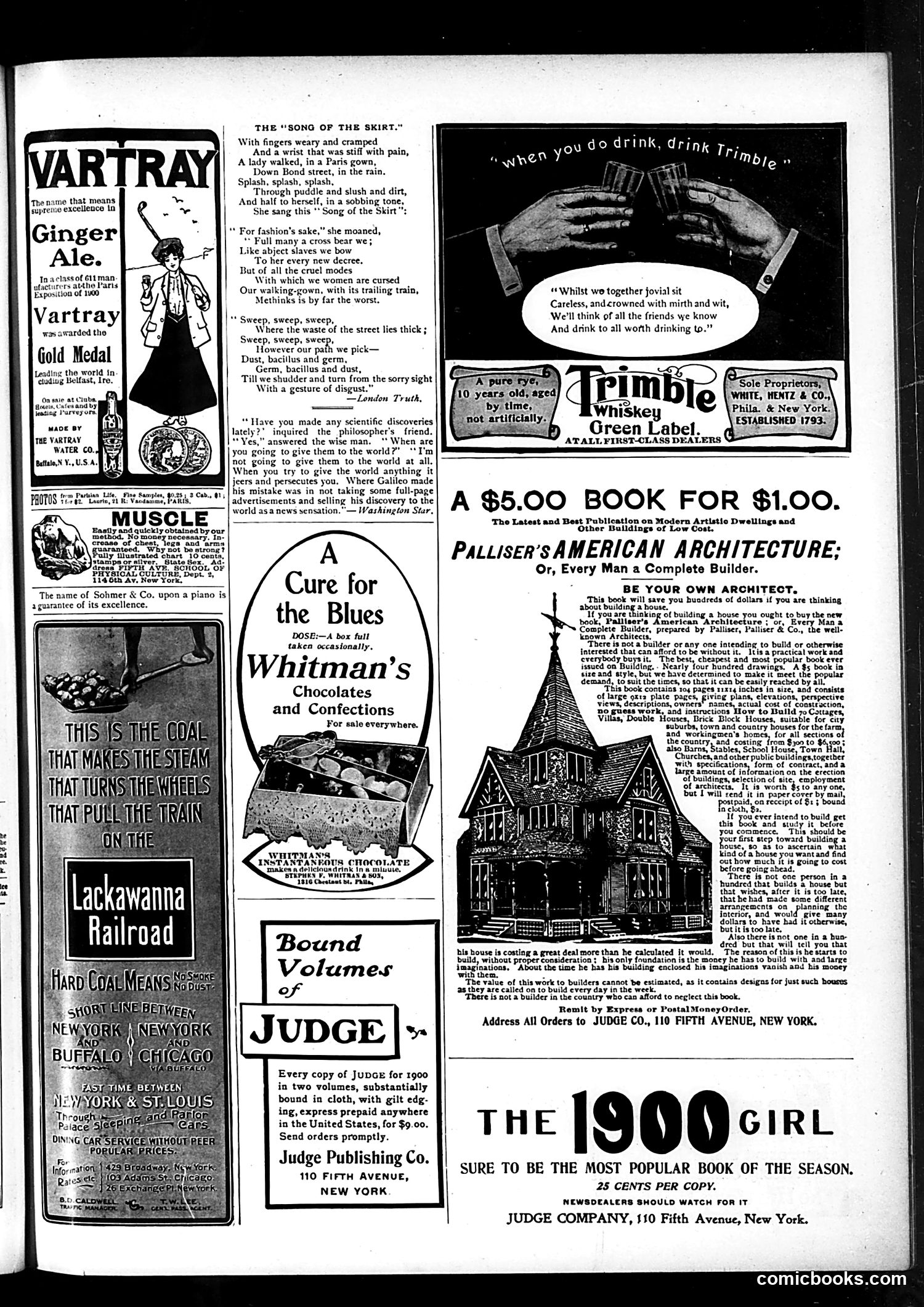
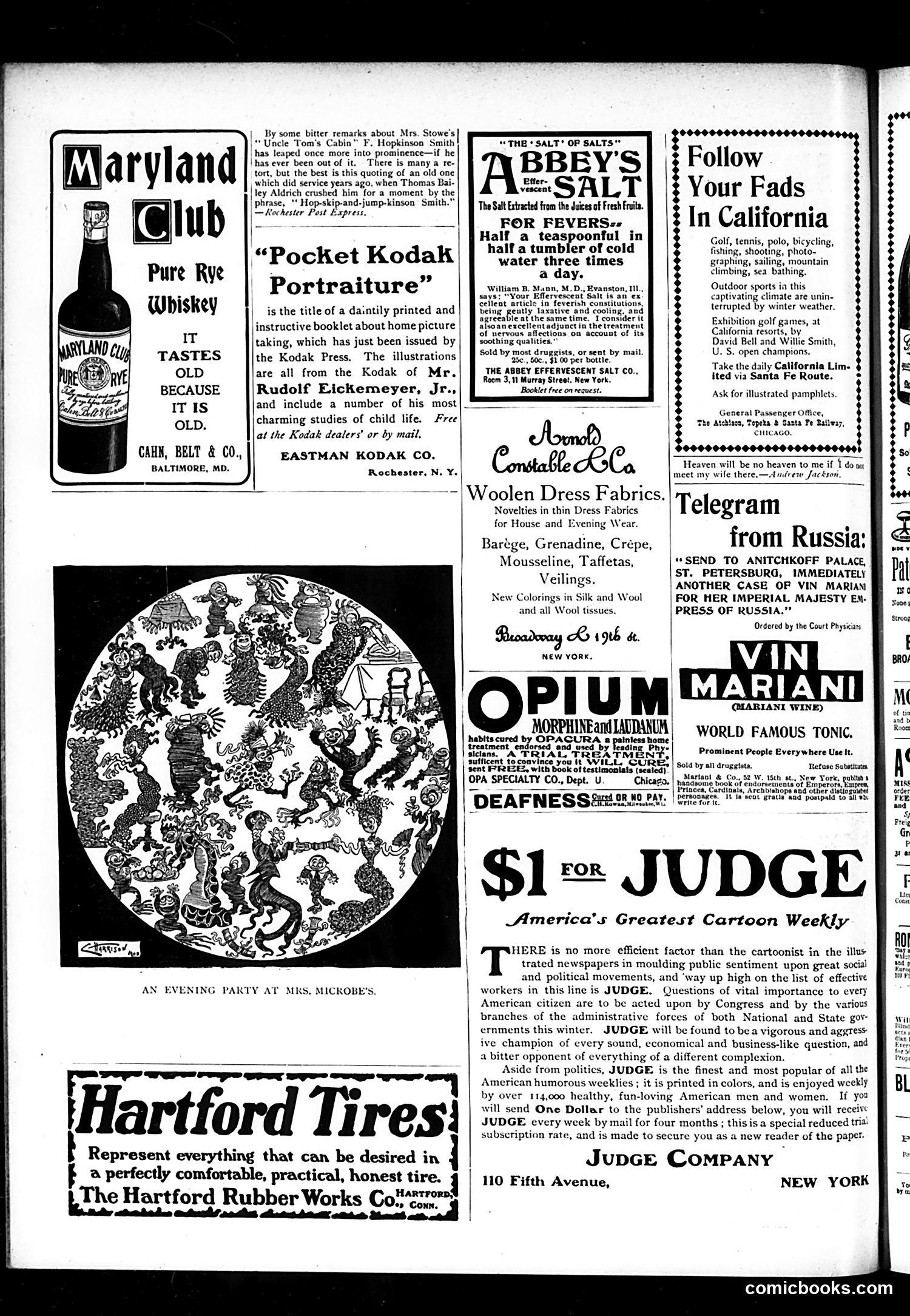
This page is primarily **advertising with minimal editorial content**. The main illustration—"An Evening Party at Mrs. Mickobe's"—is a decorative circular composition showing people at a social gathering, but lacks clear satirical commentary visible in the image. The page's text includes a brief literary jab at F. Hopkinson Smith, referencing Thomas Bailey Aldrich's earlier mockery of him with the phrase "Hop-skip-and-jump-kinson Smith," but this occupies minimal space. The bulk of the page consists of product advertisements typical of the era: whiskey, Kodak cameras, patent medicines (including opium treatments and "Vin Mariani" wine), Hartford Tires, and woolen fabrics. Notable is the advertisement for **Judge itself**, emphasizing its role as a cartoonist-driven publication influencing public sentiment on "great social movements" and political questions—presenting the magazine as an important voice in American civic debate. The page demonstrates how early 20th-century satirical magazines relied heavily on advertising revenue, with editorial content secondary to commercial interests.
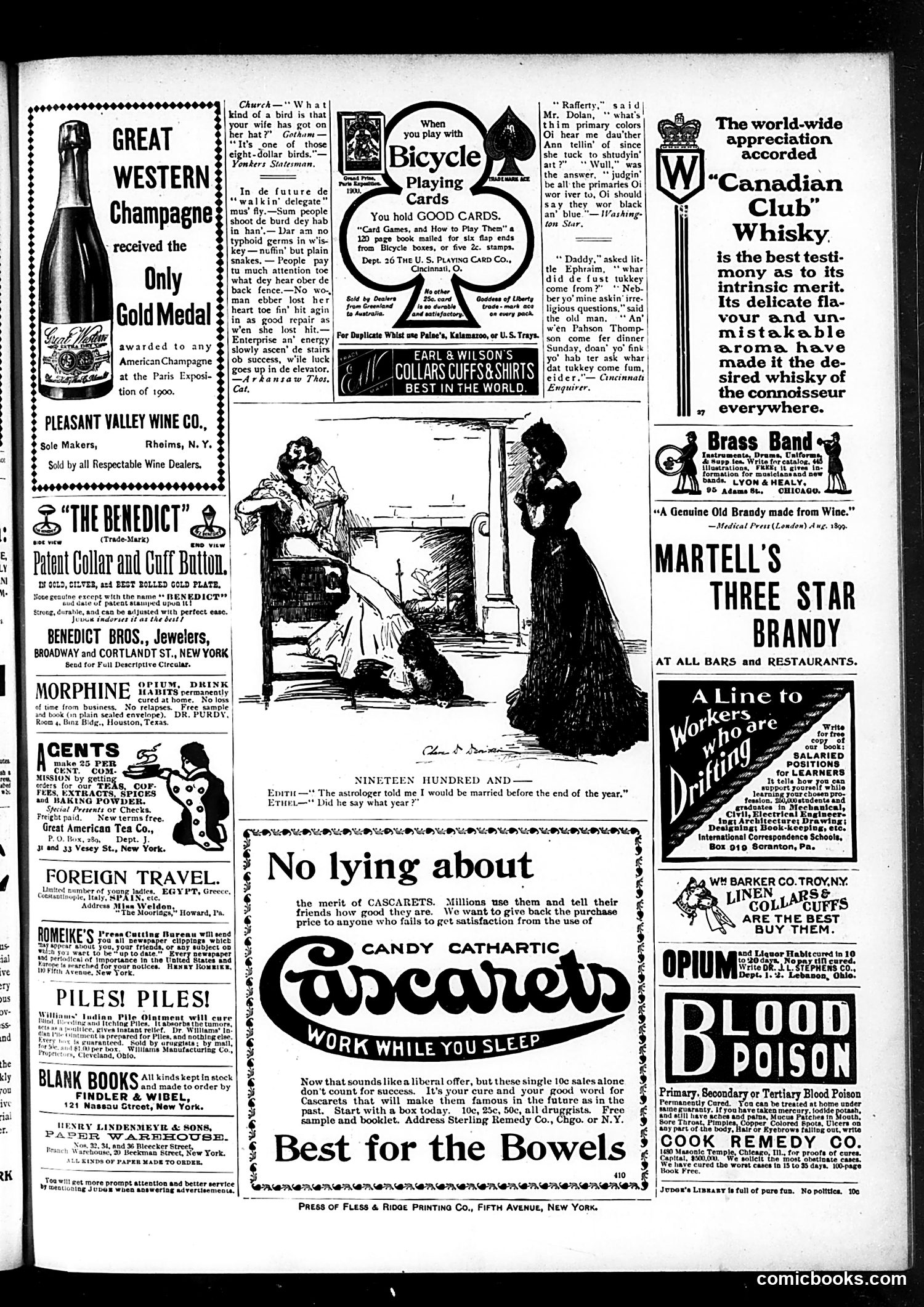
This page is primarily **advertising**, with one satirical cartoon. The main cartoon ("Nineteen Hundred and —") depicts a young woman (Ethel) and an astrologer. The joke turns on a romantic prediction: the astrologer claimed she'd marry before year's end, but when she asks *which year*, the implication is the prediction was vague enough to be meaningless—poking fun at astrology's lack of specificity and credibility. The other content is mostly product advertisements typical of the era: patent medicines (morphine and opium cures, blood poison treatments), whiskey, brandy, playing cards, and various remedies. The scattered dialect jokes throughout (Irish and African American vernacular) reflect period humor conventions that modern readers would recognize as stereotypical. The page overall captures early-1900s American commercial culture and contemporary attitudes toward dubious medical products now understood as dangerous.
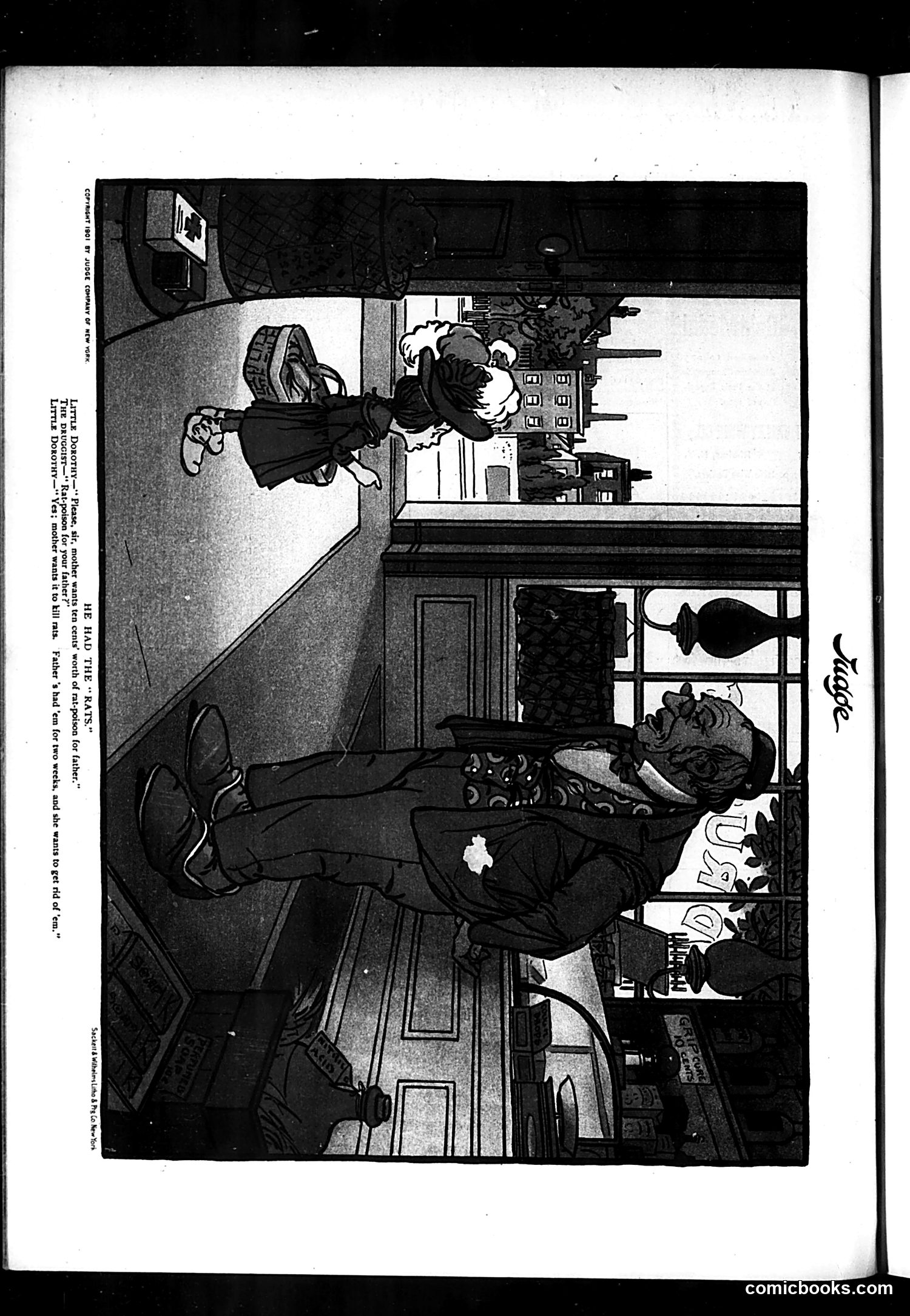
This is a comedic domestic scene playing on a misunderstanding. A small girl, "Little Dorothy," asks a pharmacist for rat poison "for father," claiming her mother wants to eliminate rats that "father's had for two weeks." The joke relies on the pharmacist's confused double-take—he initially misinterprets the girl's innocent request as suggesting her mother wants to poison her husband. The humor derives from the awkward implication before the clarification that they're dealing with actual rodent pests. The cartoon satirizes the literal-mindedness of children and plays on marital discord themes common to early 1900s humor. The exaggerated facial expressions of both characters emphasize the comedic misunderstanding. This reflects period attitudes treating spousal conflict as fodder for public amusement.