
A complete issue · 16 pages · 1900
Judge — June 2, 1900
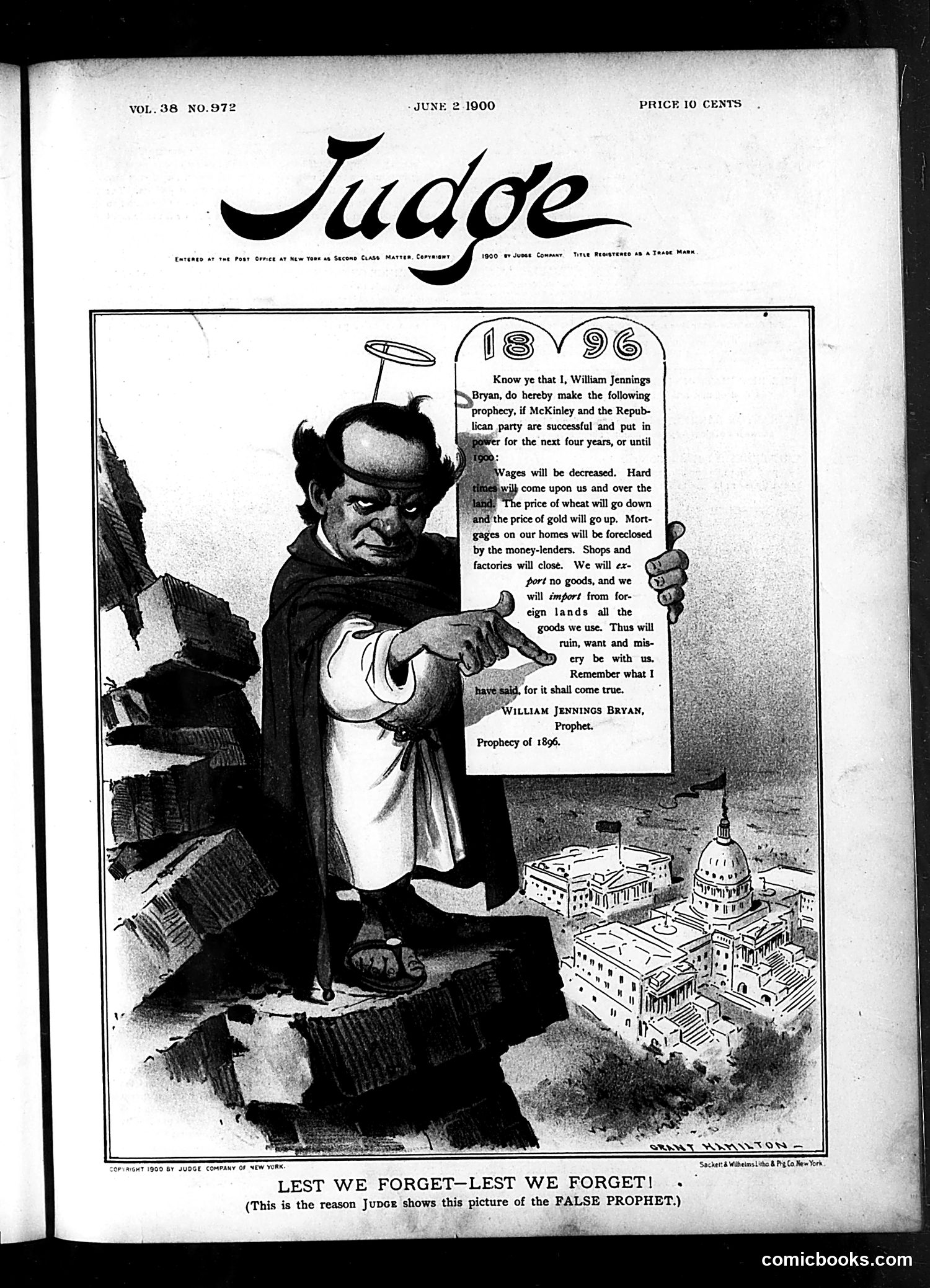
This satirical cartoon attacks **William Jennings Bryan**, the Democratic presidential candidate, by resurrecting his failed 1896 prophecy. The caricatured figure (appearing demonic or devil-like) holds a scroll quoting Bryan's prediction that McKinley's election would cause economic disaster: declining wages, foreclosed mortgages, and factory closures. The cartoon's message is clear: Bryan was proven **wrong**. By 1900, the economy had actually improved under Republican President McKinley, contradicting the "False Prophet's" dire warnings. The Capitol building in the background anchors this as political commentary. The title "LEST WE FORGET—LEST WE FORGET!" emphasizes this point as McKinley sought re-election, reminding voters of Bryan's discredited predictions to discredit his 1900 comeback bid.
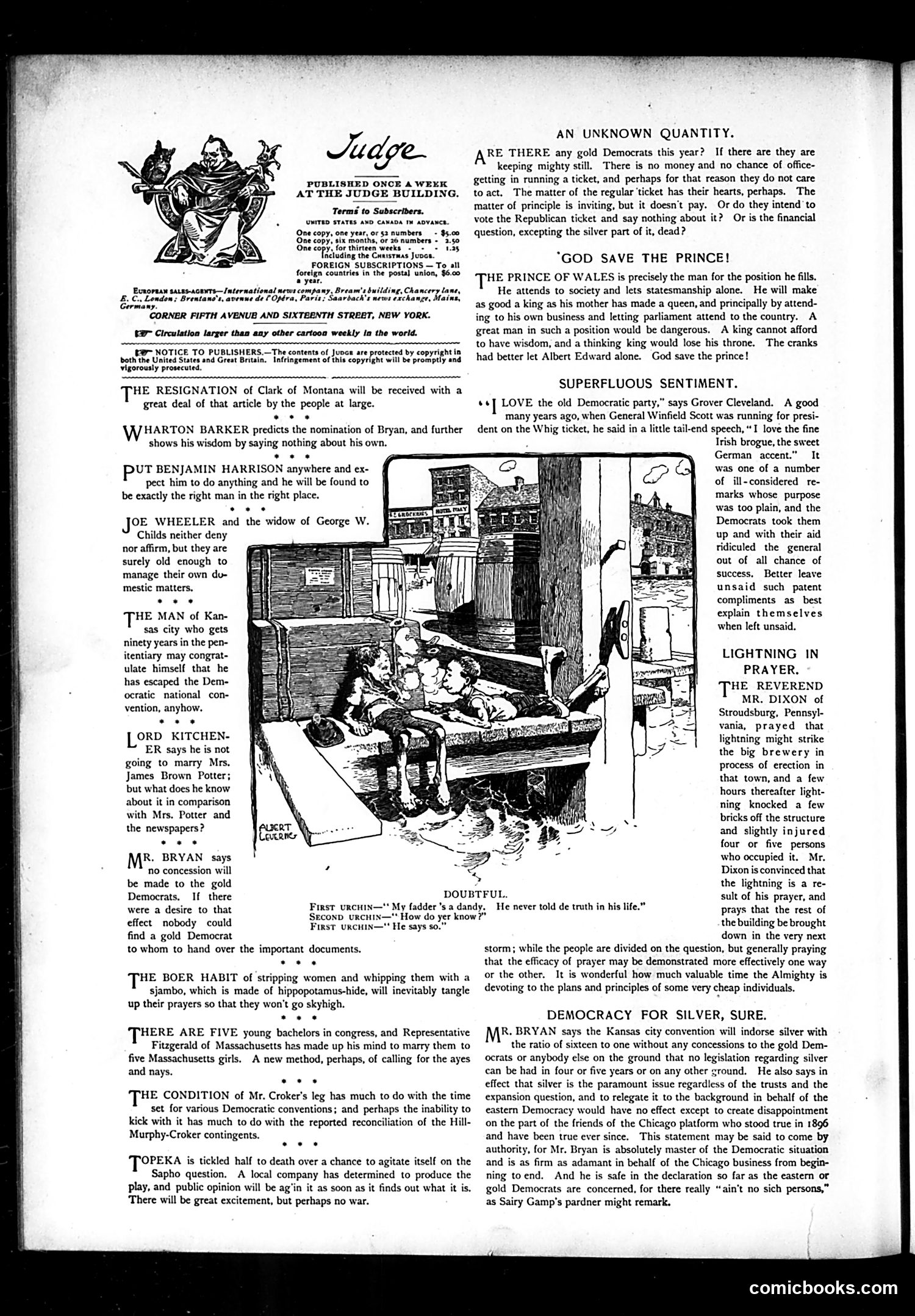
The main cartoon depicts a scene titled "Poverty!!!" showing poor children in a tenement setting. The accompanying text snippets mock various Democratic and Republican political figures of the era, including references to Bryan, Cleveland, and Kansas City politics. The satire appears to target Democratic leadership's hypocrisy: while they claim concern for working people and the poor (evidenced by the poverty illustration), the text suggests Democratic politicians like Bryan prioritize silver currency debates over actually addressing poverty. The cartoon juxtaposes images of genuine hardship with politicians' empty rhetoric about economic policy, implying the Democratic party exploits poverty as a political issue while doing little substantive about it. The overall message critiques Democratic candidates for focusing on divisive currency questions rather than meaningful poverty relief.
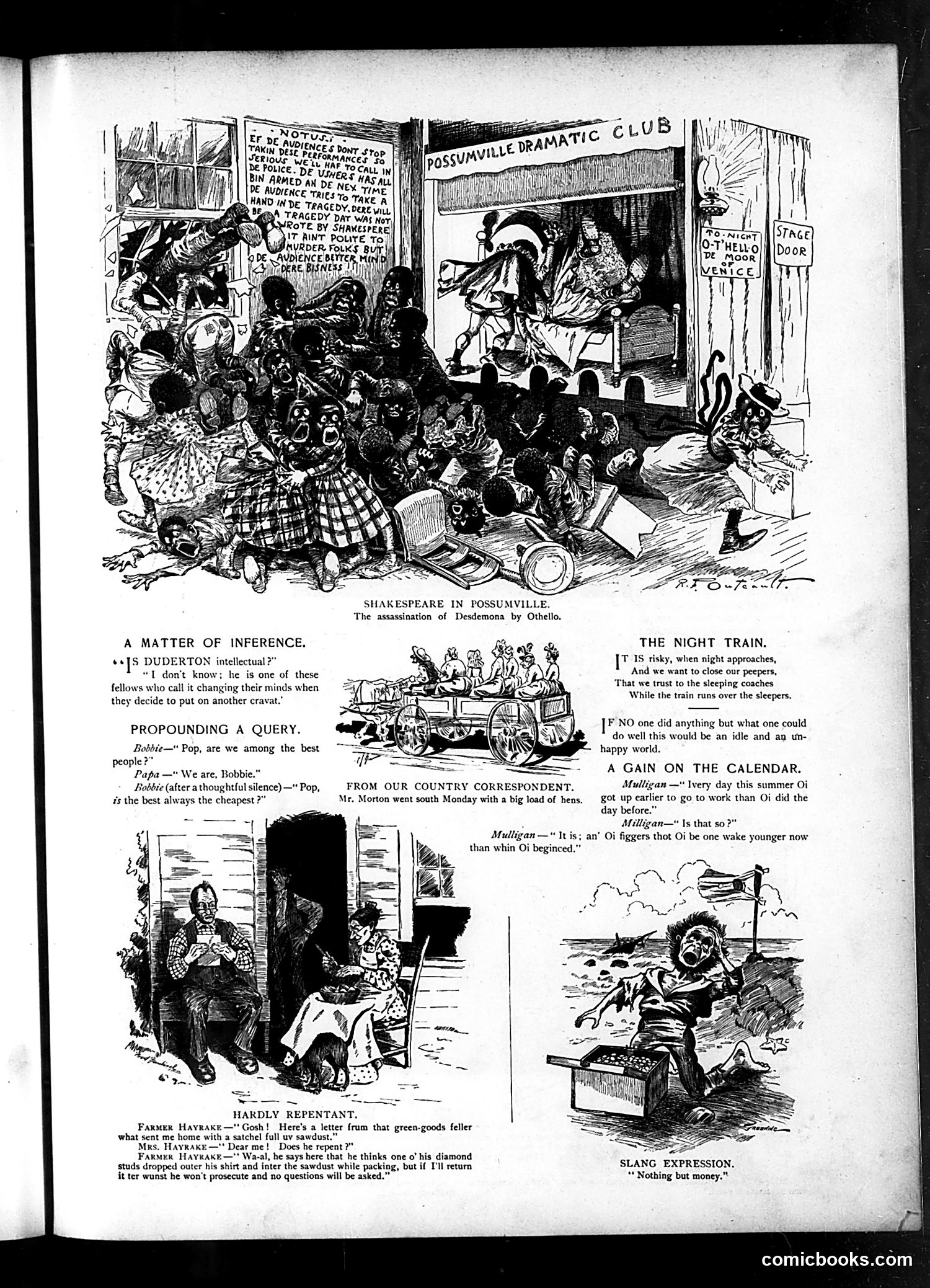
This page contains multiple satirical sketches and humorous vignettes rather than a single political cartoon. **"Shakespeare in Possumiville"** (top) mocks rural theatrical productions, showing an audience of animals watching a crude performance of Othello at the "Possumiville Dramatic Club." The other sketches appear to be general humor pieces: "A Matter of Inference" jokes about distinguishing among people; "The Night Train" and "A Gain on the Calendar" feature brief comedic dialogues; "Hardly Repentant" shows a farmer dealing with a letter about lost goods; and "Slang Expression" presents a pun about money. These are examples of Judge's typical light, domestic humor content—satirizing rural life, everyday confusion, and wordplay—rather than political commentary. The focus is entertainment rather than social critique.
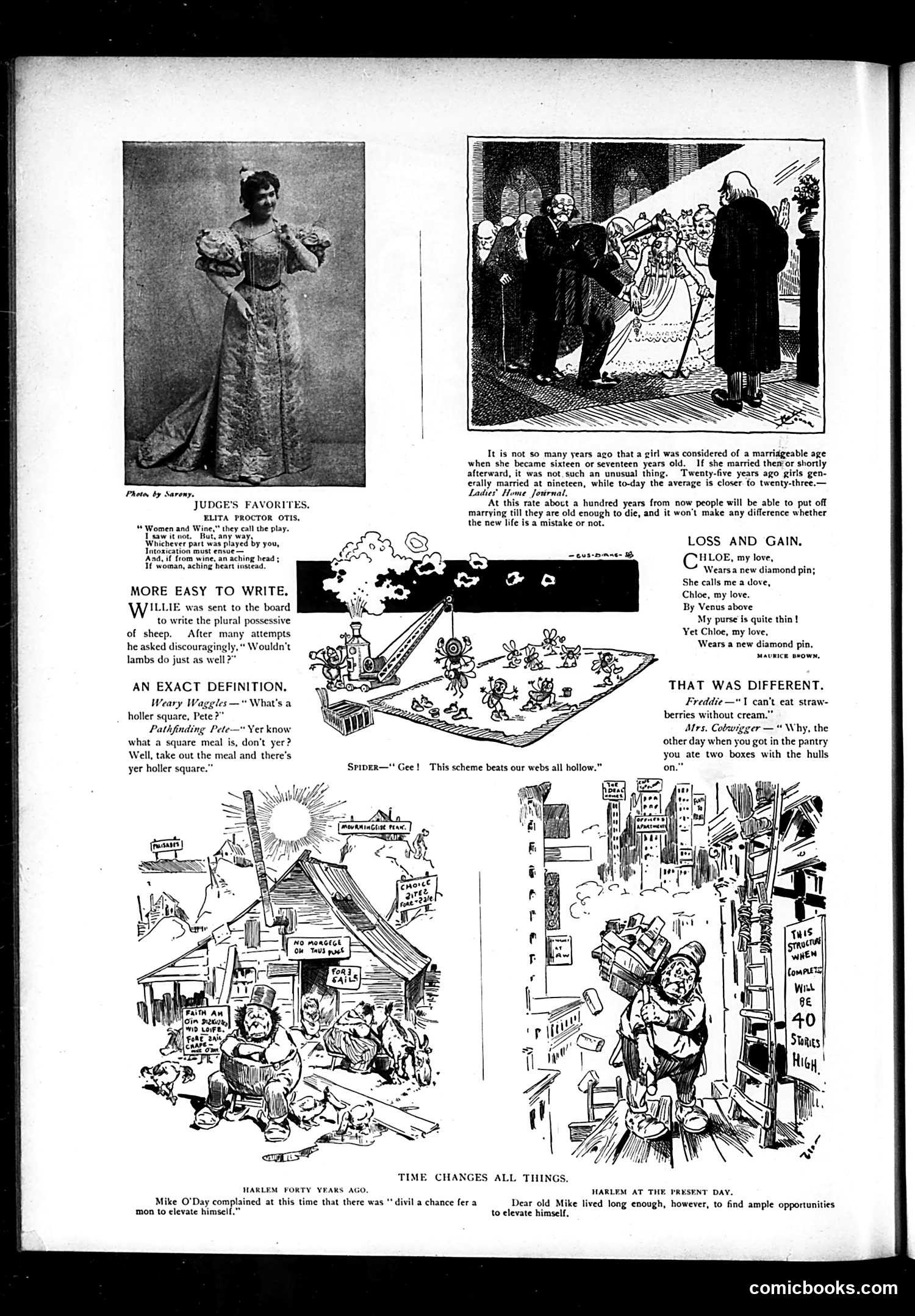
This page contains several satirical pieces about contemporary social issues: **"Judge's Favorites"** features Edna Proctor, apparently a notable figure, with a poem about women's education and suffrage—mocking women's intellectual ambitions. **"More Easy to Write"** jokes about Willie struggling with grammar (plural possessives), suggesting educational deficiencies. **"An Exact Definition"** presents humorous word definitions—light satirical fare. The larger cartoons appear to contrast **Harlem's past and present**: one depicts the neighborhood forty years earlier as rural farmland with humble folk; the other shows modern-day Harlem as a densely packed urban tenement district. This reflects early-20th-century anxiety about rapid urbanization and demographic change in New York City. The "Loss and Gain" section satirizes materialism and courtship rituals of the era.
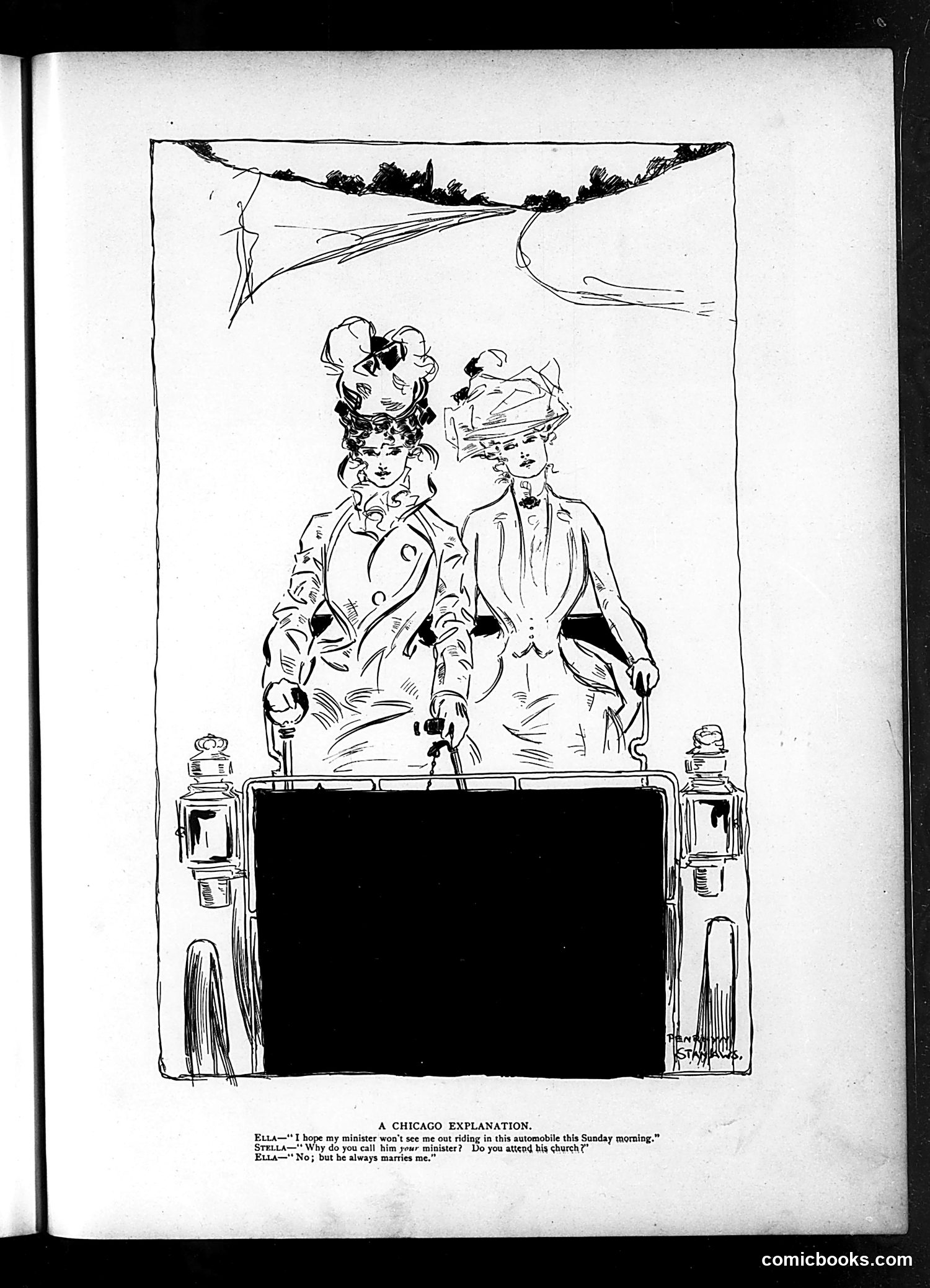
This cartoon satirizes the hypocrisy of Chicago clergy regarding automobile use on Sundays. The two fashionably dressed women are riding in an automobile on Sunday morning—traditionally considered sinful leisure activity that violated religious observance. The joke centers on Ella's concern about encountering her minister, whom she doesn't attend church with. The implication is that her minister preaches against Sunday automobile driving from the pulpit but regularly engages in it himself—hence he "always marries me" (likely a garbled OCR of "marries us" or similar, suggesting he performs ceremonies for the women). The satire targets clergy moral inconsistency: they condemn secular Sunday activities while practicing them. This reflects early 20th-century tensions between traditional religious restrictions and modern leisure technologies, with particular mockery of Chicago's religious establishment for their perceived hypocrisy.
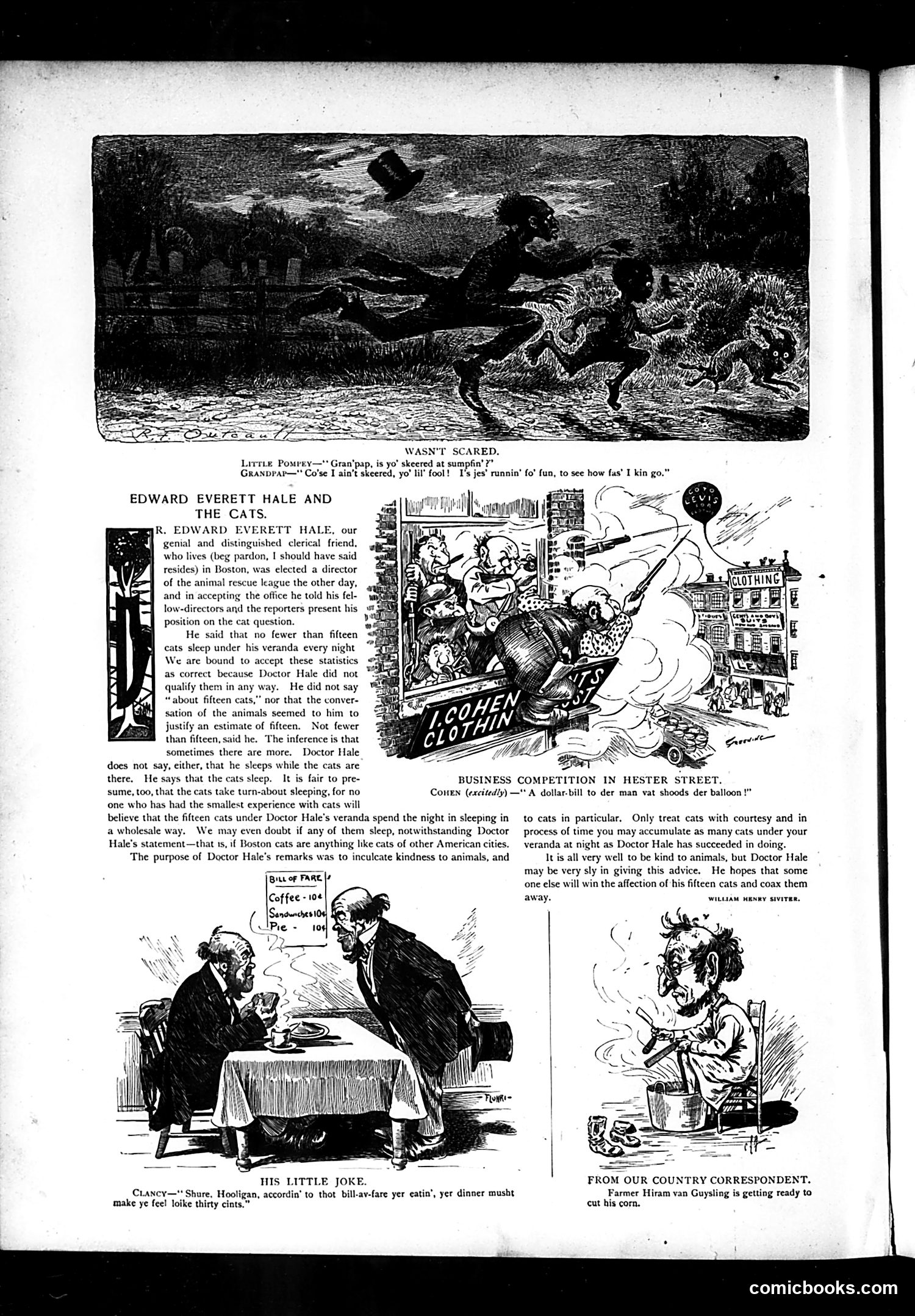
This page from the satirical magazine **Judge** contains several unrelated humorous pieces: **Top illustration**: A racist caricature depicting Black figures ("Gran'pap" and "Little Posey") supposedly running for "fun"—likely mocking Black dialect and perpetuating harmful stereotypes common to the era. **Main article**: Edward Everett Hale, a Boston clergyman and animal welfare advocate, is gently mocked for claiming fifteen cats sleep under his veranda nightly. The satire suggests he's either exaggerating or naive about cat behavior, humorously questioning whether cats actually sleep peacefully together. **Lower cartoons**: "His Little Joke" depicts working-class Irish immigrants ("Clancy" and "Hooligan") at a cheap restaurant, while "Business Competition in Hester Street" shows Jewish immigrants haggling over a balloon game—ethnic stereotypes typical of Judge's satirical approach to urban immigrant communities. The page exemplifies Judge's mix of gentle social commentary and crude ethnic caricature reflecting late 19th/early 20th-century American prejudices.
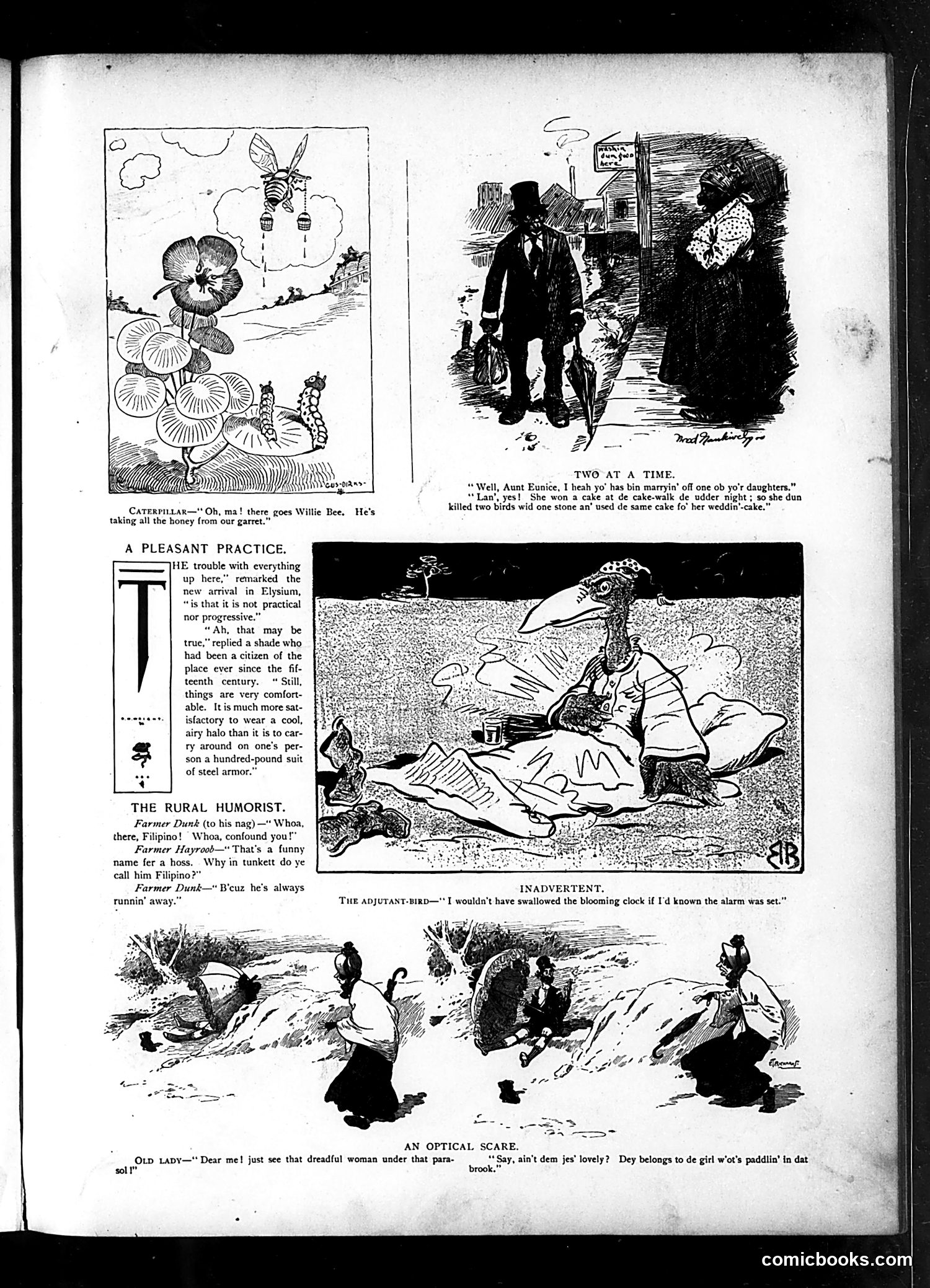
This page contains several unrelated satirical cartoons and jokes typical of Judge's format: **"Two at a Time"** satirizes African American wedding customs through dialect humor, portraying a rural couple repurposing a cake-walk prize as a wedding cake—reflecting period racial stereotypes. **"A Pleasant Practice"** presents a heavenly dialogue contrasting comfort (modern halos) with historical burden (medieval armor), likely commenting on progress versus tradition. **"The Rural Humorist"** jokes that a farmer names his horse "Filipino," punning on the horse always "running away"—referencing the Filipino-American War (1899-1902), when American forces pursued Filipino insurgents. The humor relies on conflating Filipinos with flight/resistance. **"Inadvertent"** offers simple slapstick: a bird swallows a clock and regrets it when the alarm activates. **"An Optical Scare"** presents two women mistaking ducks for fashionable accessories, mocking vanity and visual confusion. The page exemplifies Judge's mix of social satire, racial caricature, and period-specific political references now requiring historical context.
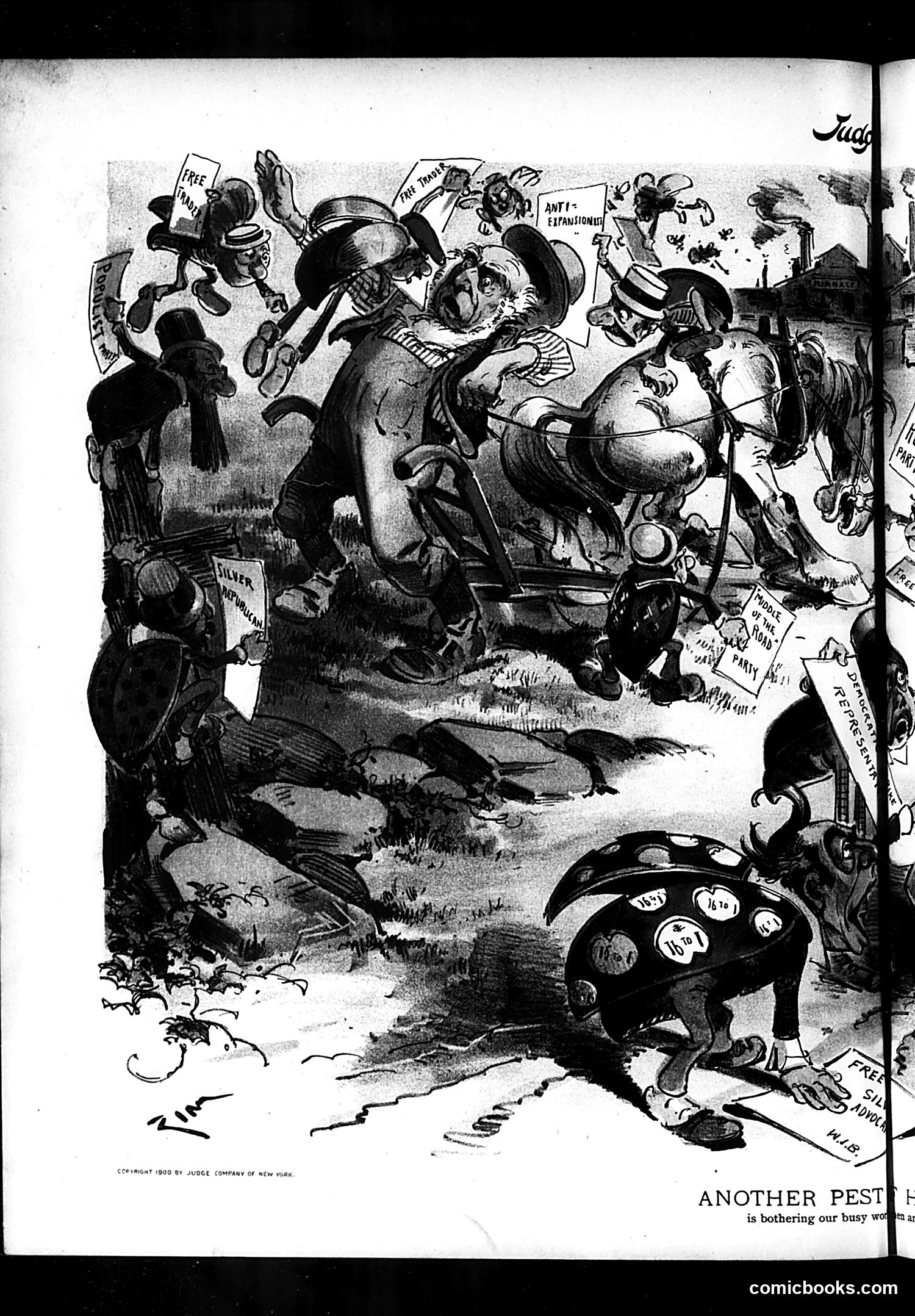
This 1900 Judge cartoon satirizes American imperial expansion. The central figure—appearing to be Uncle Sam or a similar American authority figure—is besieged by various "pests" depicted as small caricatured figures swarming around him, holding signs referencing expansion and related issues. The cartoon criticizes how territorial expansion (likely referring to post-Spanish-American War acquisitions like the Philippines, Cuba, and Puerto Rico) created ongoing problems. The "pests" represent the complications and conflicts arising from managing these new territories—insurgencies, resistance movements, and administrative headaches. The title "Another Pest" suggests this is one in a series of problems plaguing American policymakers. The satire mocks the consequences of expansionist policies, depicting them as bothersome nuisances rather than triumphs of American power.
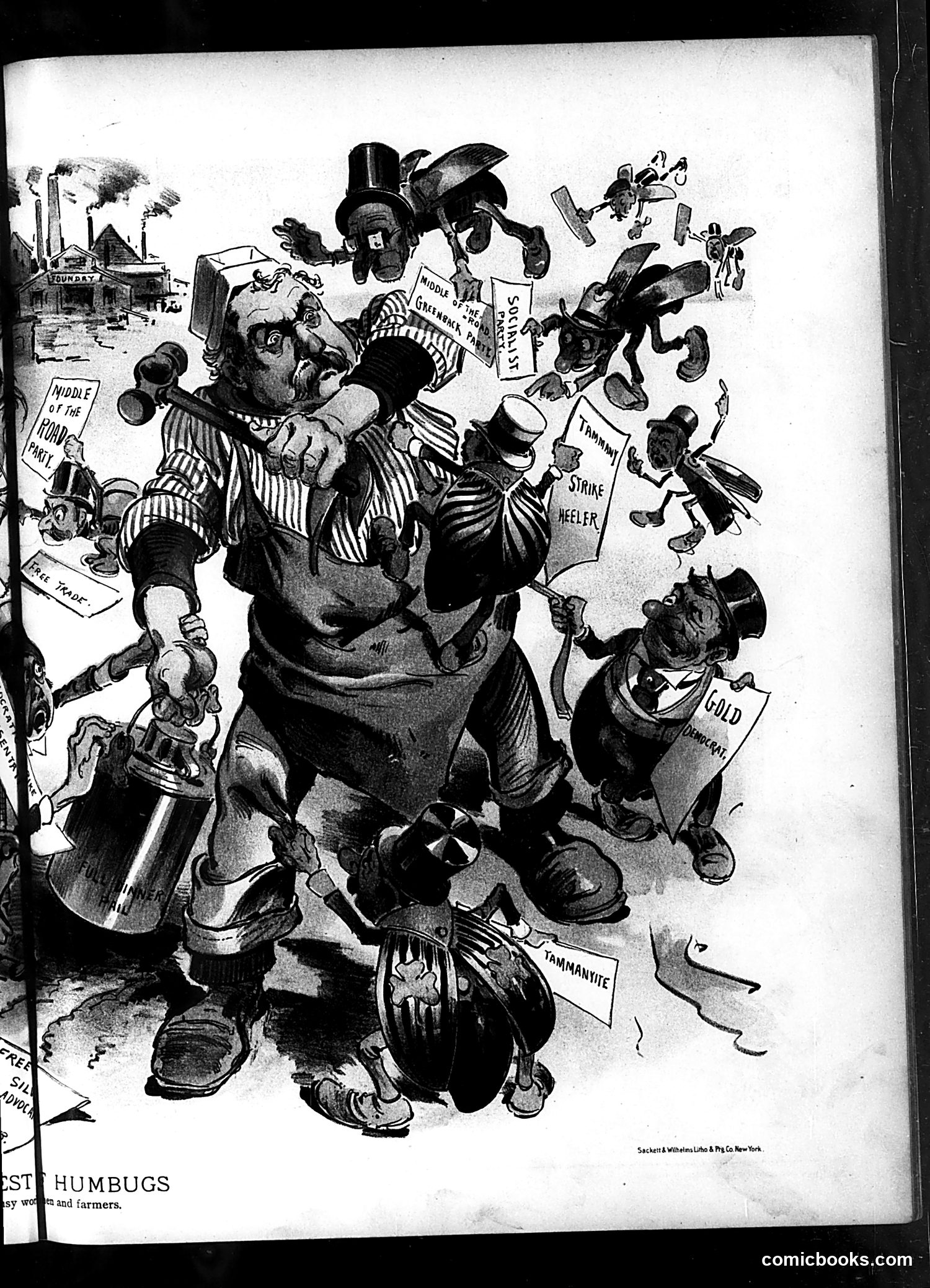
This is a satirical cartoon titled "Humbugs" depicting a large, corpulent central figure surrounded by smaller caricatured characters carrying labels including "Strike Heeler," "Tammany," "Gold Democrat," "Middle of the Road," and other political references. The cartoon appears to criticize political opportunism and corruption, likely from the 1890s based on the references to Tammany Hall (New York's Democratic political machine) and monetary policy debates of that era. The bloated central figure represents either a corrupt political boss or plutocrat being surrounded by various political factions and hangers-on—depicted as parasitic "humbugs" exploiting him or the system. The text references "farmers," suggesting agricultural interests were part of the satirical commentary on late-19th-century American politics.
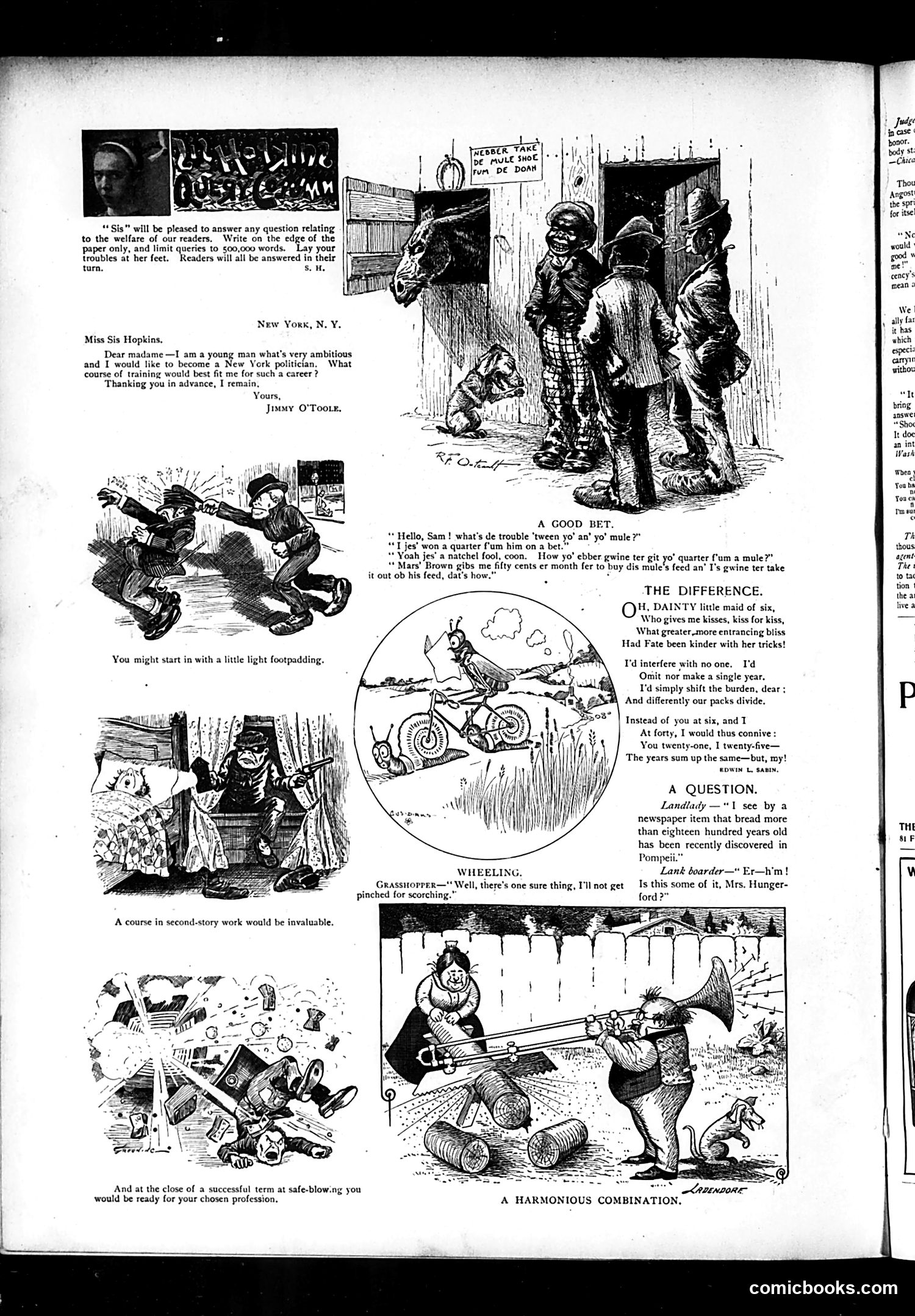
This page contains satirical humor typical of late 19th/early 20th-century American magazines: **"A Good Bet"** depicts a racist dialogue between Black characters about a mule and feed money—a crude stereotype reflecting the era's prevalent racial humor in mainstream publications. **"The Difference"** is sentimental verse about an older man wishing he and a six-year-old girl were closer in age (both aged 23 and 25 respectively). While framed poetically, the premise reflects uncomfortable attitudes toward childhood that modern readers would recognize as deeply problematic. **"A Question"** is a boarding-house joke: the landlady mentions ancient Pompeian bread; the boarder asks if *that's* what he's being served—implying his landlady feeds him stale, ancient food. **"Wheeling"** appears to mock a cyclist for reckless riding endangering others. The page reflects *Judge*'s formula: mixing crude racial comedy, domestic humor, and light satirical jabs at social situations—all normalized for that era's audience but requiring significant historical context for modern understanding.
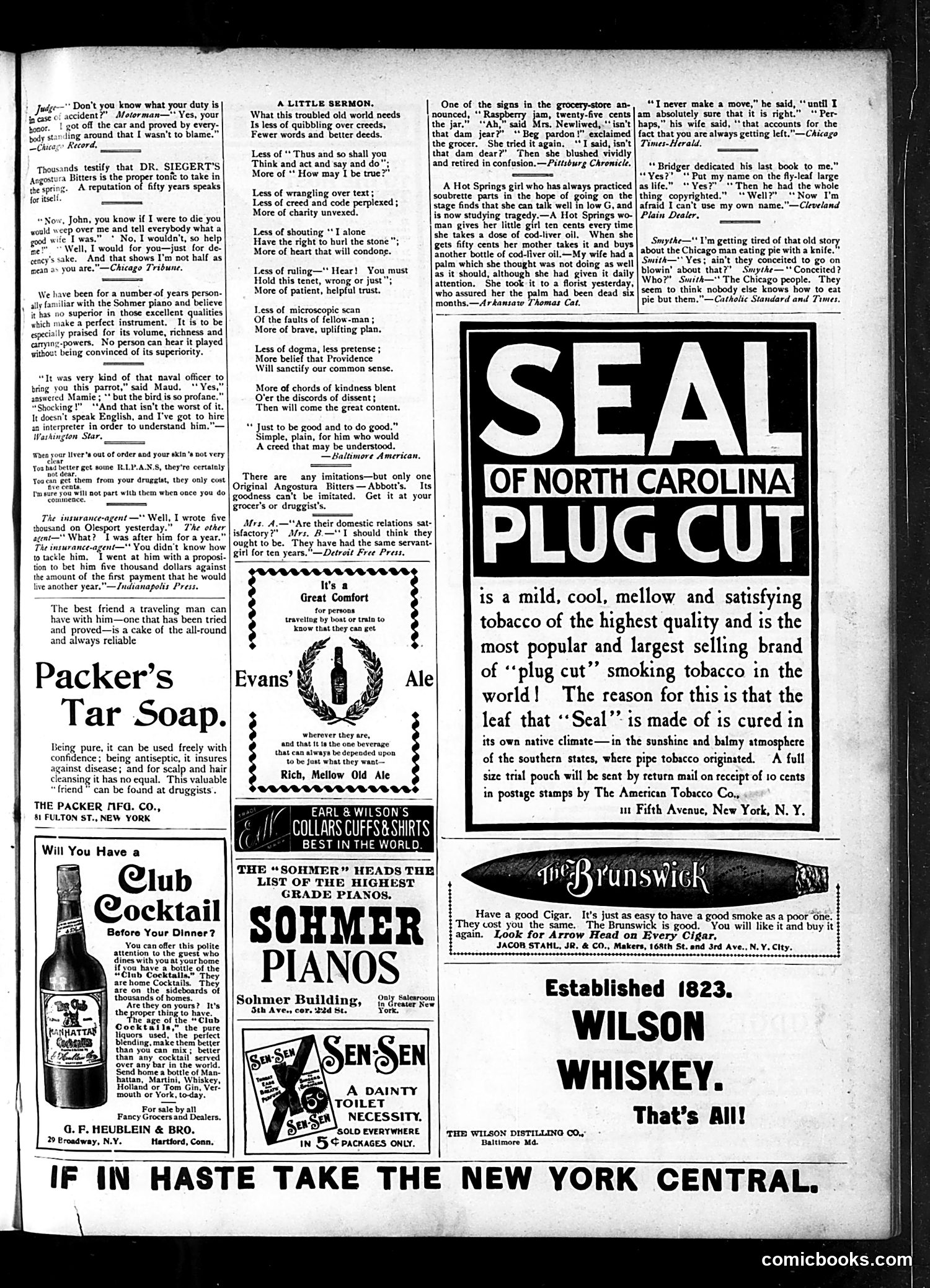
This page is primarily **advertising**, not political satire. The dominant content consists of commercial advertisements for products like Wilson Whiskey, Evans' Ale, Sohmer Pianos, and various patent medicines and toiletries popular in early 20th-century America. The small text snippets interspersed throughout are humorous anecdotes typical of Judge's filler content—jokes about marriage, insurance agents, and social awkwardness—rather than political commentary. The "Little Sermon" poem advocates for kindness and pragmatism over rigid doctrine, reflecting Progressive-era sentiments, but it's generic moral messaging rather than targeted satire. Notable: The large **"Sea Plug Cut" tobacco advertisement** emphasizes the product's Southern origins and natural qualities—typical marketing that wouldn't raise modern eyebrows but reflects period regionalism. Overall, this appears to be a **back page of advertising with light comedic filler**, not a page showcasing Judge's satirical cartoon work.
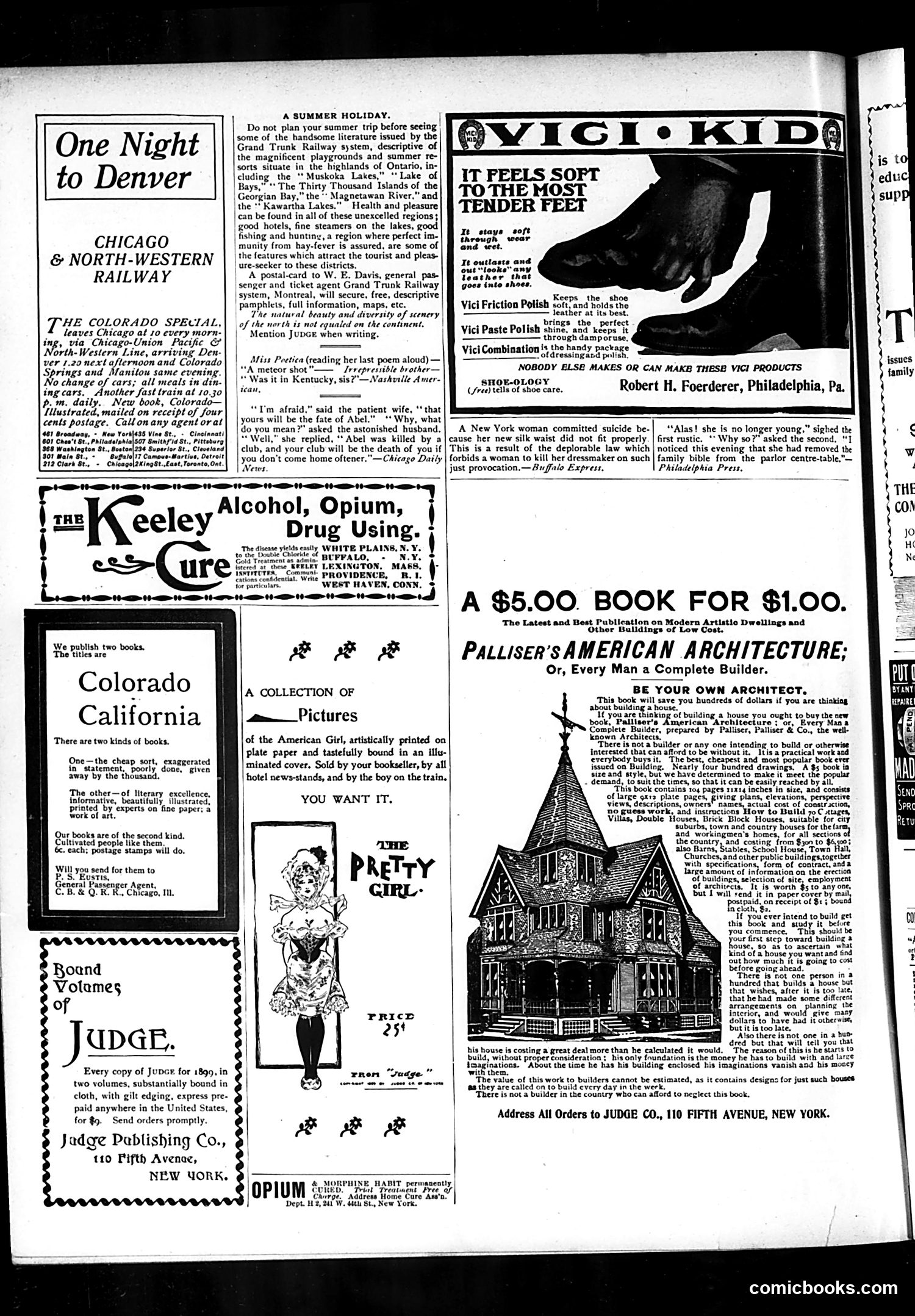
This is primarily an **advertising page** from Judge magazine, with minimal editorial content. The few jokes present are brief and domestic in nature: 1. **"Miss Poetica" anecdote**: A brother interrupts his sister's poetry reading ("A meteor shot") by asking if it's about Kentucky—a mild joke about interrupting creative pursuits. 2. **Wife's warning to husband**: A woman tells her husband his golf club will kill him like Abel's club did, urging him to come home more often—satirizing men's leisure activities keeping them from domestic duties. 3. **Suicide joke**: Mocking a New York woman who killed herself over a poorly-fitting silk waist, with commentary that she should have killed her dressmaker instead—dark satire on vanity and impractical women. 4. **Bible removal**: A rustic observes a young woman has removed the family Bible from the parlor, suggesting moral decline. The page is **dominated by commercial advertisements** for railroads, shoe polish (Vici products), books, and medical treatments for drug addiction—typical of Judge's revenue model rather than satirical content.
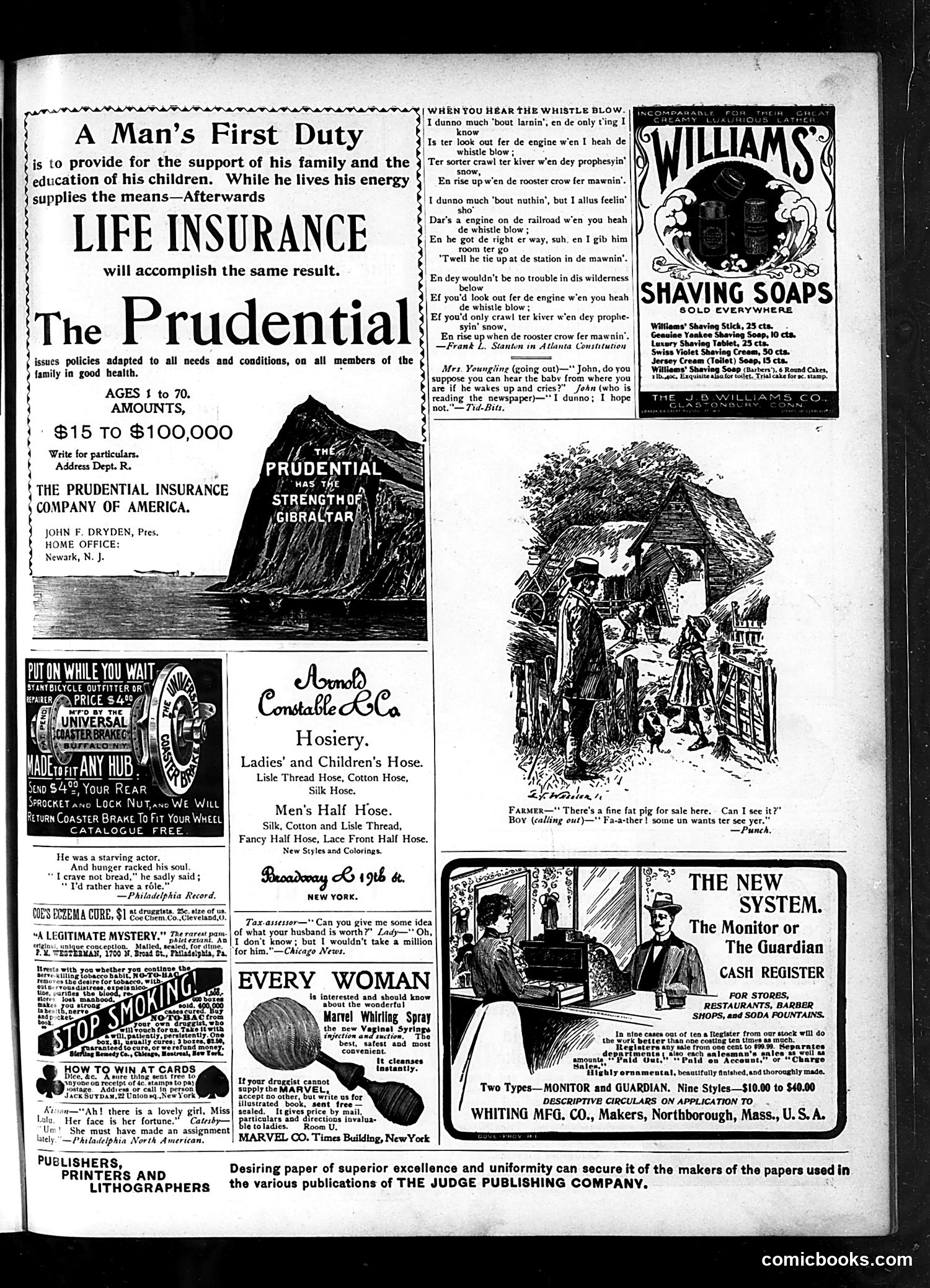
This page is primarily **advertisements and humorous filler content**, not political satire. The notable items are: **"When You Hear the Whistle Blow"** — a poem in dialect by Frank L. Stanton depicting an African American character's simple wisdom about railroad safety. The piece uses stereotypical "plantation dialect" common to the era, with the speaker warning against the dangers of trains. This reflects late 19th/early 20th-century attitudes toward both racial representation and industrial safety. **Comic one-liners** scattered throughout mock domestic life and commerce — a starving actor, tax assessors, card games, etc. These are generic humor with no specific political target. **The remaining content** consists entirely of product advertisements: life insurance (Prudential), hosiery, shaving soaps, carriage brakes, and cash registers. The page demonstrates Judge's dual nature as both satirical magazine and advertising vehicle, though this particular issue leans heavily toward the latter.
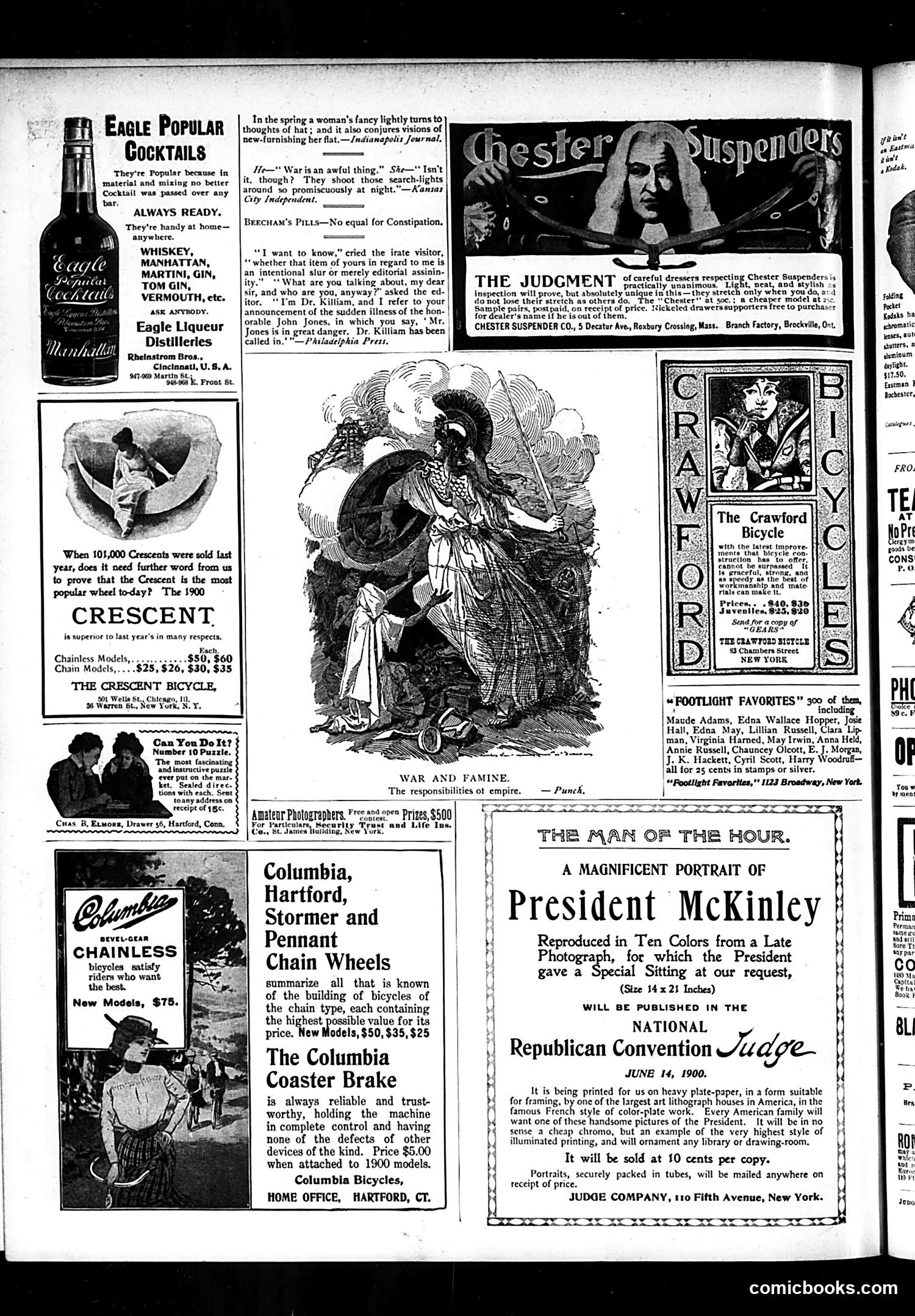
This page is primarily **advertising**, with one notable political cartoon. ## The Main Cartoon: "War and Famine" The central engraving depicts a allegorical female figure (representing Empire or imperial power) surrounded by chaos—soldiers, weapons, and suffering masses. The caption reads "The responsibilities of empire" and is credited to Puck (a competing satirical publication). **Meaning for modern readers:** This satirizes American imperial ambitions around 1900. The U.S. had recently acquired overseas territories (Philippines, Puerto Rico, Guam) following the Spanish-American War. The cartoon criticizes the moral costs of imperialism—suggesting that empire-building inevitably brings war, famine, and human suffering rather than civilization or progress. ## Other Content The page features advertisements for bicycles (Crescent, Columbia, Crawford brands), liquor (Eagle Popular Cocktails), and other period goods. A separate box advertises a portrait of President McKinley to be published in the **National Republican Convention** Judge, dated June 14, 1900—suggesting this issue was published during that convention season.
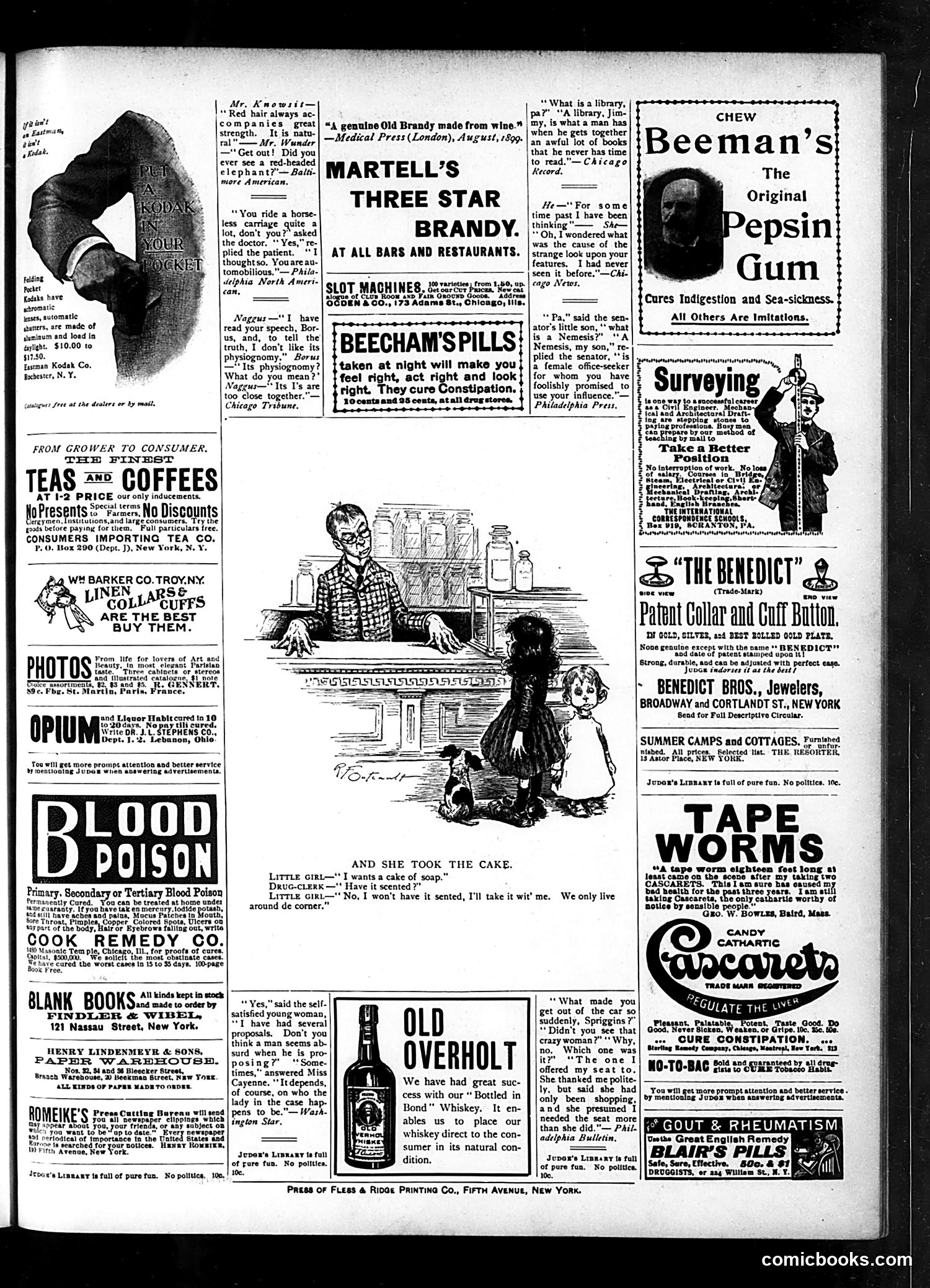
This is primarily an **advertising page** from Judge magazine (an American satirical weekly), featuring numerous patent medicine and commercial advertisements typical of the late 19th century. The small **cartoon** depicts a domestic scene: a druggist or pharmacist behind a counter serves a working-class woman and child. The humor relies on a verbal misunderstanding—the child asks for "cake of soap" but the adult mishears it as something else, leading to the punchline about their poverty ("We only live around the corner"). **Social context**: The page reflects Gilded Age America's unregulated patent medicine market. Advertisements promote dubious "cures" for opium addiction, blood poisoning, constipation, and tapeworms—many dangerous by modern standards. This satirizes both consumer gullibility and manufacturers' false claims. The cartoon itself is gentle domestic humor rather than political satire, typical of Judge's lighter content mixed among advertisements.
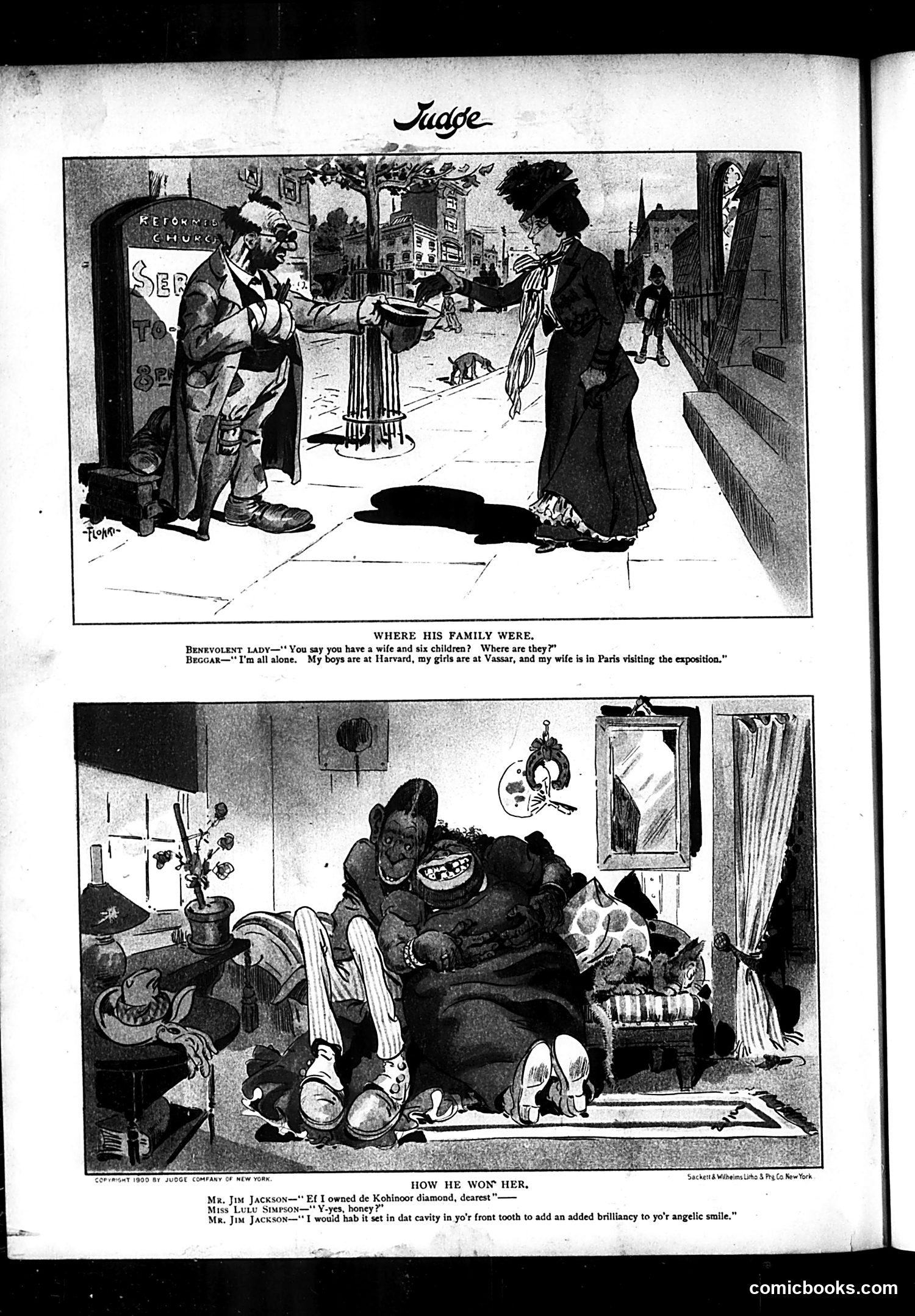
**Top Cartoon ("Where His Family Were"):** A beggar claims poverty to a benevolent woman, yet reveals his family scattered across America's elite institutions (Harvard, Vassar) and Paris. The satire mocks either: (1) a fraudulent beggar concealing wealth, or (2) absurdly misplaced priorities—spending on expensive education and European travel while claiming destitution. It satirizes social pretension and financial hypocrisy among the supposedly poor. **Bottom Cartoon ("How He Won Her"):** This appears to mock courtship through crude flattery and racial caricature. A man compliments a woman by proposing to set a diamond in a cavity of her front tooth. The satire targets both ridiculous romantic gestures and, given the exaggerated facial features and dialect ("Ef," "hab"), relies on now-offensive racial stereotyping common to period humor. The joke hinges on absurd vanity and hollow romantic rhetoric. Both cartoons employ social satire typical of *Judge*'s commentary on class, wealth, and courtship conventions.