
A complete issue · 18 pages · 1900
Judge — April 21, 1900
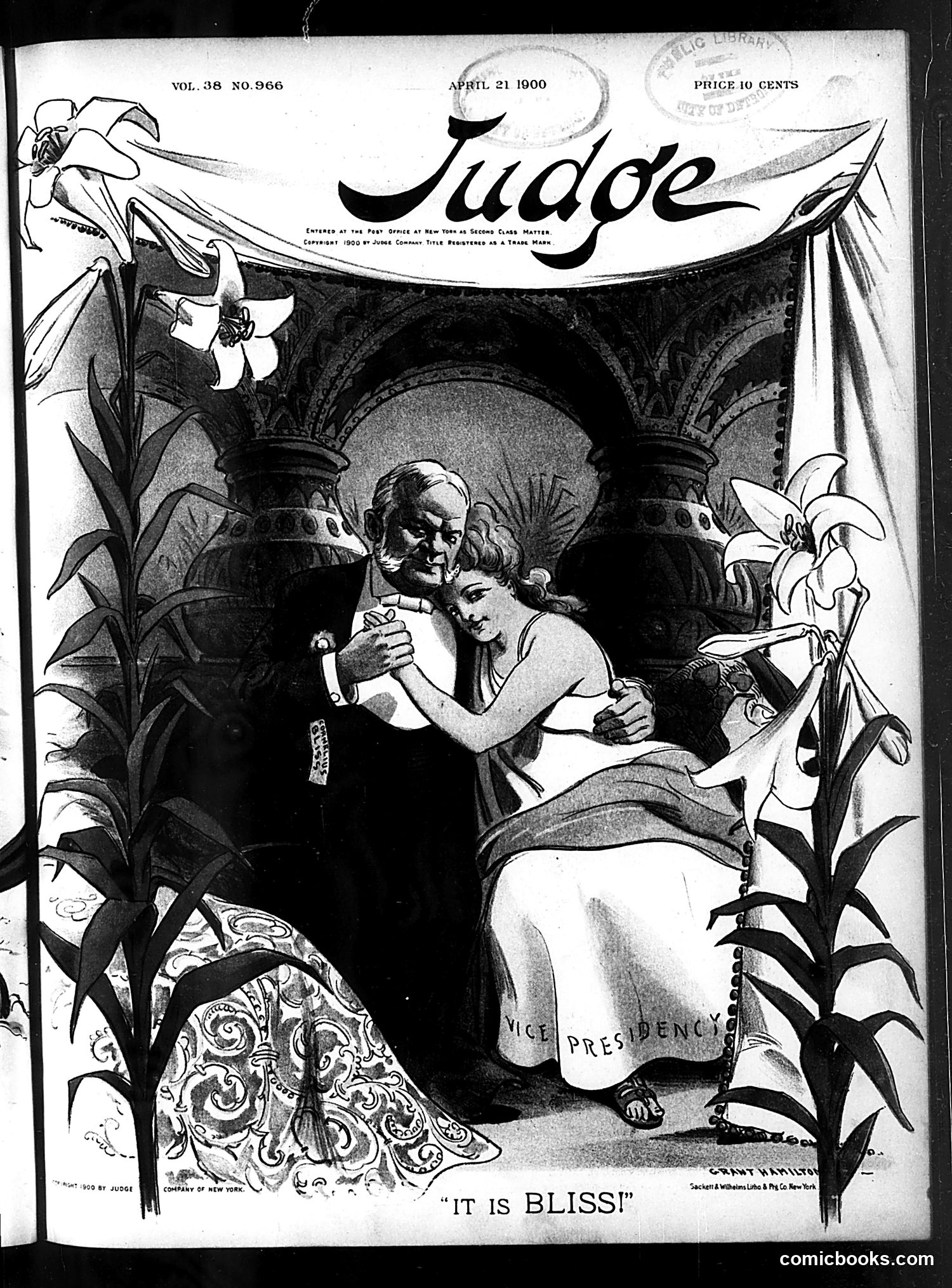
This satirical cartoon depicts an elderly man and young woman in an ornate garden setting, with text reading "Vice Presidency" on the woman's garment. The title "It Is Bliss!" appears to mock a romantic or idealized relationship. Given the 1900 date and "Vice Presidency" reference, this likely comments on **Theodore Roosevelt's recent appointment as Vice President** (he assumed office in March 1901, but the appointment was announced/discussed in 1900). The cartoon appears to satirize the political "marriage" between Roosevelt and the vice presidency—treating it as an unlikely or absurd romantic pairing. The elderly man likely represents the Republican establishment or political machine. The joke seems to be about the uncomfortable alliance or the perceived mismatch of Roosevelt with this traditionally powerless position.
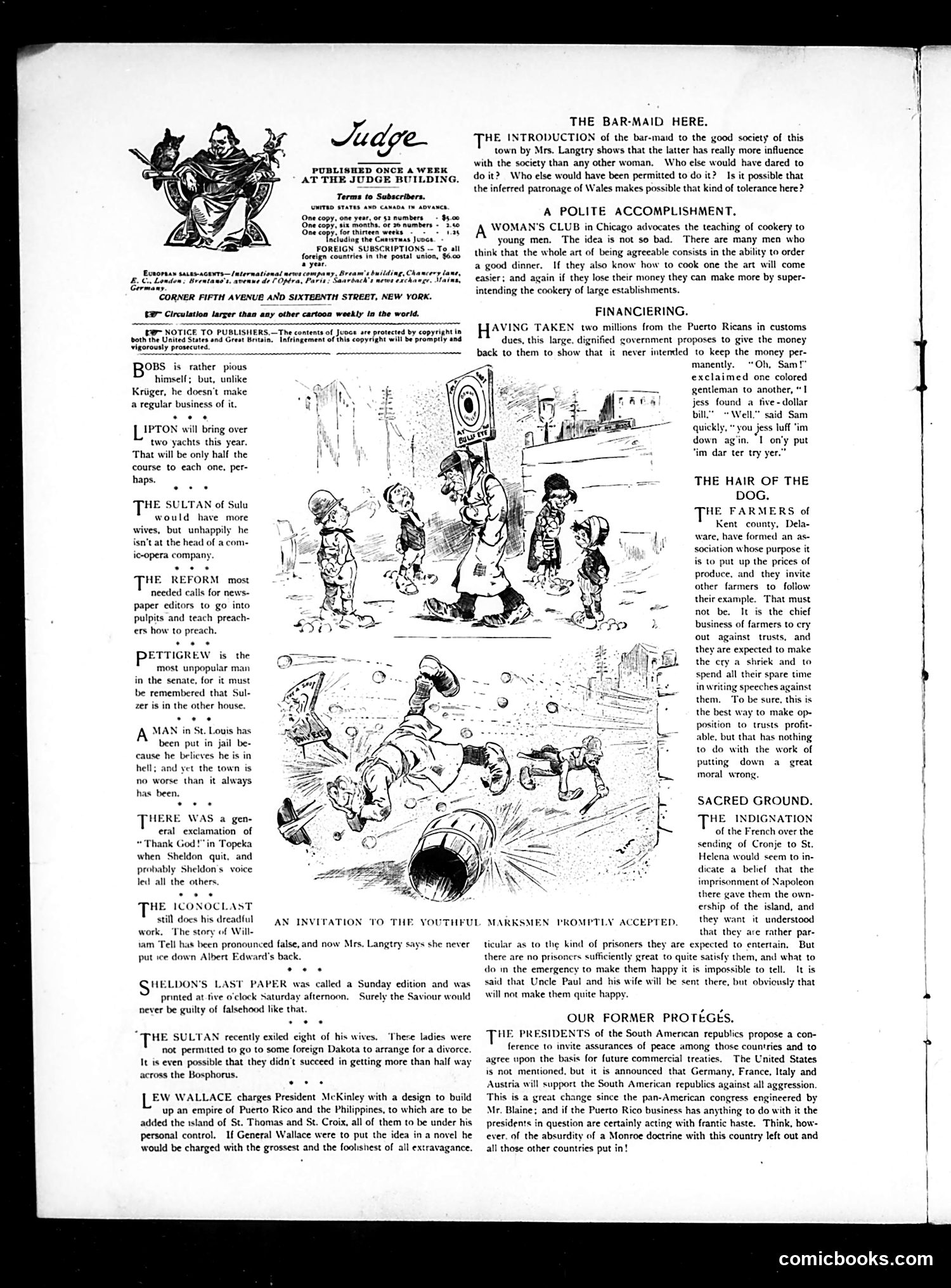
The main cartoon, titled "AN INVITATION TO THE YOUTHFUL MARKSMEN PROMPTLY ACCEPTED," depicts children playing with what appears to be explosive devices or dangerous toys in a street setting. The satire critiques the casual danger posed to youth, likely referencing turn-of-the-century concerns about child safety in urban areas. The surrounding text includes brief satirical items mocking political and social figures: mentions of "Kruger," "Lipton," "the Sultan of Sulu," and "Pettigrew." These appear to be topical jabs at contemporary politicians and personalities, though specific references are unclear without additional historical context. The page combines visual humor with cutting social commentary typical of Judge's satirical approach to American life and politics during this period.
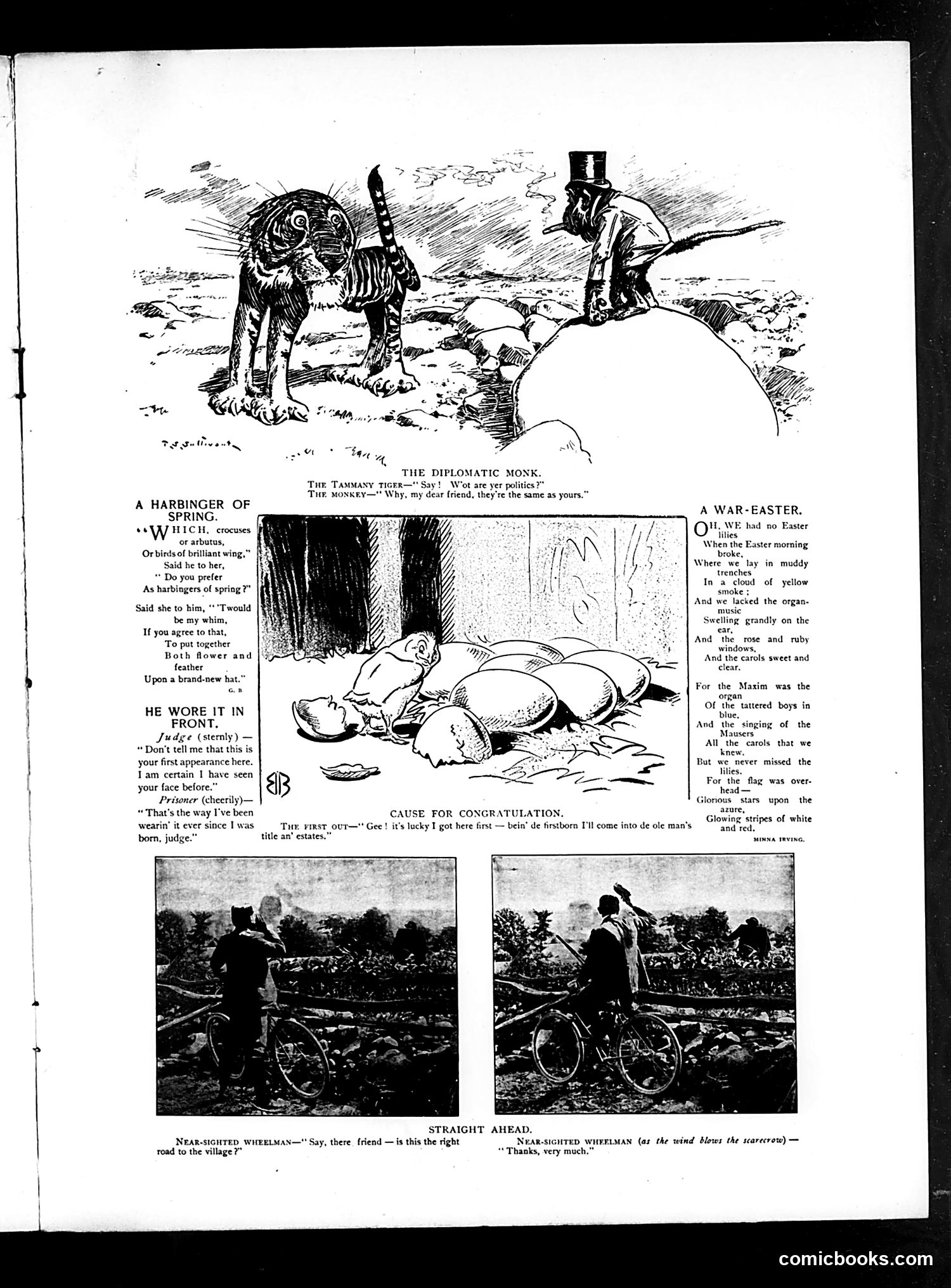
This page contains several satirical pieces from Judge magazine, apparently from the early 20th century (likely World War I era, based on "War-Easter" reference). **Top cartoon**: Shows a "Tammany Tiger" (representing New York's corrupt Tammany Hall political machine) and a monkey discussing politics—satire on machine politics and political corruption. **Middle section**: Includes poetry/verse about spring and Easter, with a small cartoon showing eggs, titled "Cause for Congratulation." **Bottom photographs**: Show cyclists on country roads, titled "Straight Ahead" with captions about "near-sighted wheelmen" finding their way to village. This appears to be gentle satire about bicycle tourism. The overall page mixes political commentary with lighthearted social observation typical of Judge's satirical approach.
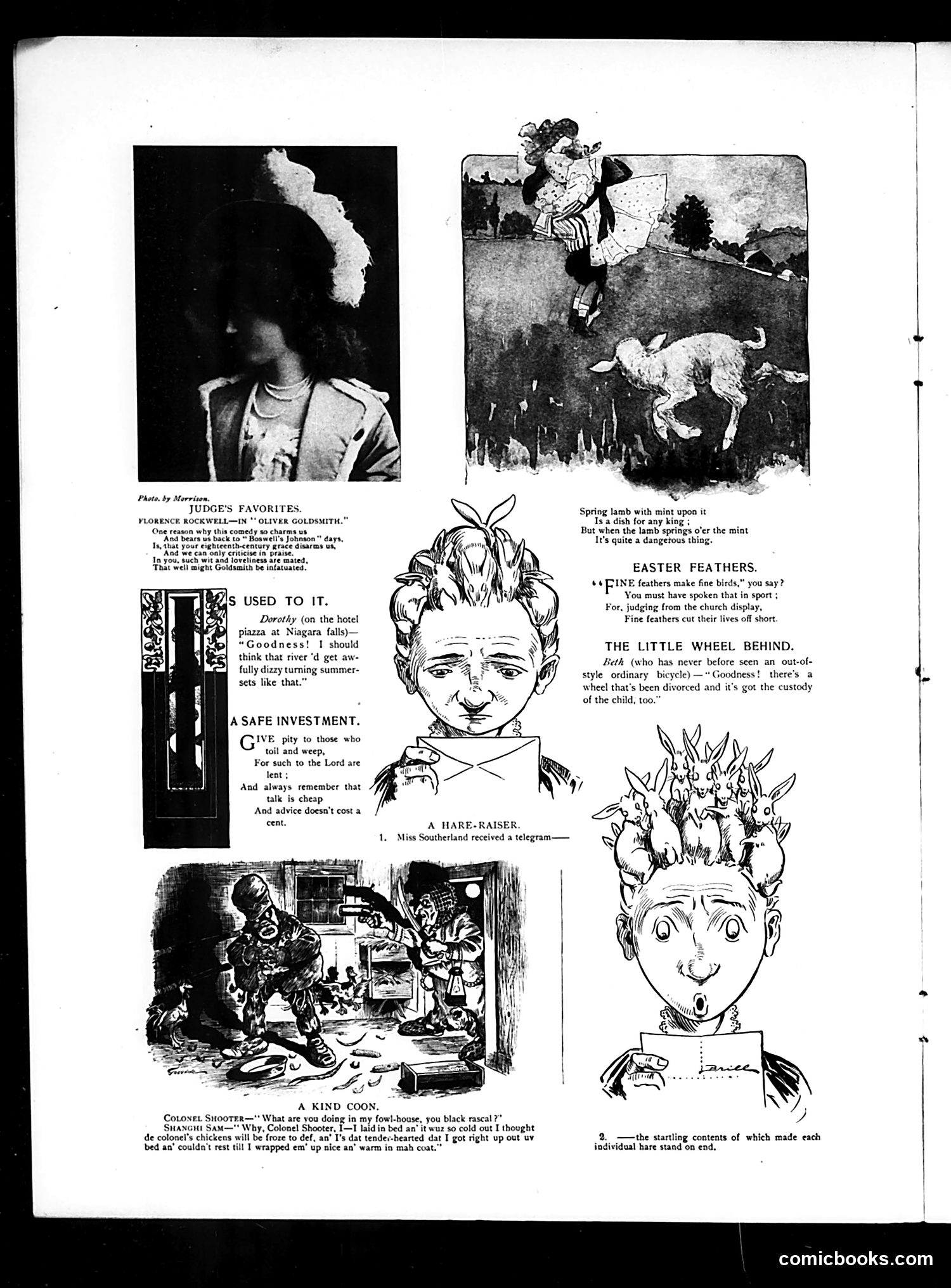
This page contains **humorous short stories and illustrations** rather than political satire. The content includes: **"Judge's Favorites"** - A photograph labeled "Florence Rockwell as 'Oliver Goldsmith'" with accompanying theatrical commentary. **Comic narratives** including: - "It Used to It" - A hotel anecdote about summer accommodations - "A Safe Investment" - Charitable advice about giving to the poor - "Easter Feathers" - A quip about fine feathers and church display - "The Little Wheel Behind" - A joke about a child's bicycle - "A Hare-Raiser" - Beginning of a story involving Miss Southerland receiving a telegram - "A Kind Coon" - A dialect story (period-typical racial humor) The page primarily showcases **light entertainment and domestic humor** typical of early 20th-century magazines, with minimal political content. The illustrations are humorous rather than satirical.
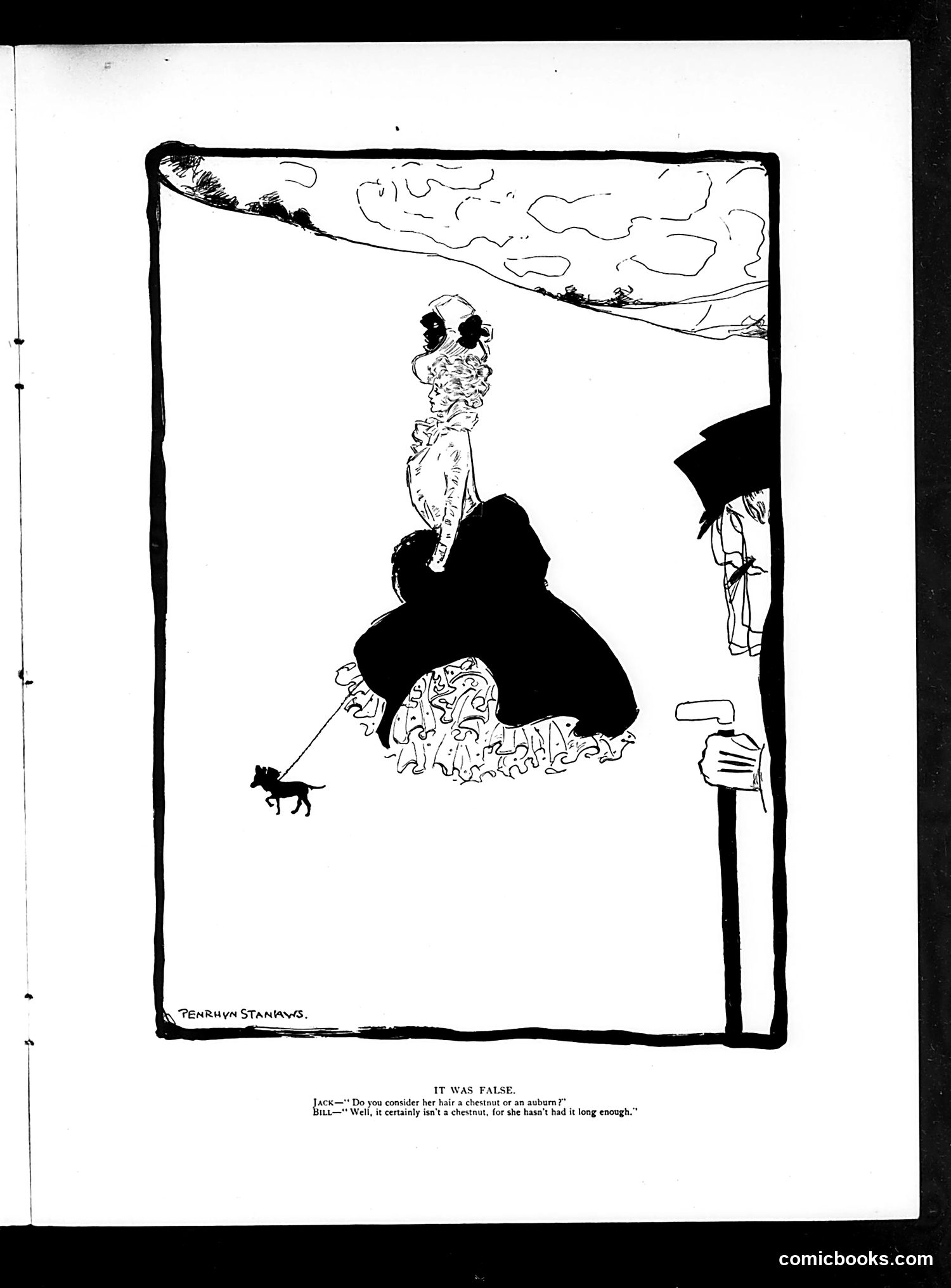
This cartoon by Penrhyn Stannaws satirizes women's fashion, specifically the wearing of hairpieces or wigs. The joke hinges on a double meaning: Jack asks whether a woman's hair is "chestnut" or "auburn" (natural hair colors), but Bill's response—that it "isn't a chestnut, for she hasn't had it long enough"—implies the hair is fake or borrowed, treating it like a rented object with a time limit. The elegantly dressed woman with her small dog represents fashionable society. The satire mocks both the artificiality of women's appearance in high society and the pretense involved in maintaining such looks. This reflects early 20th-century concerns about cosmetics, hair treatments, and the authenticity (or lack thereof) of feminine beauty standards.
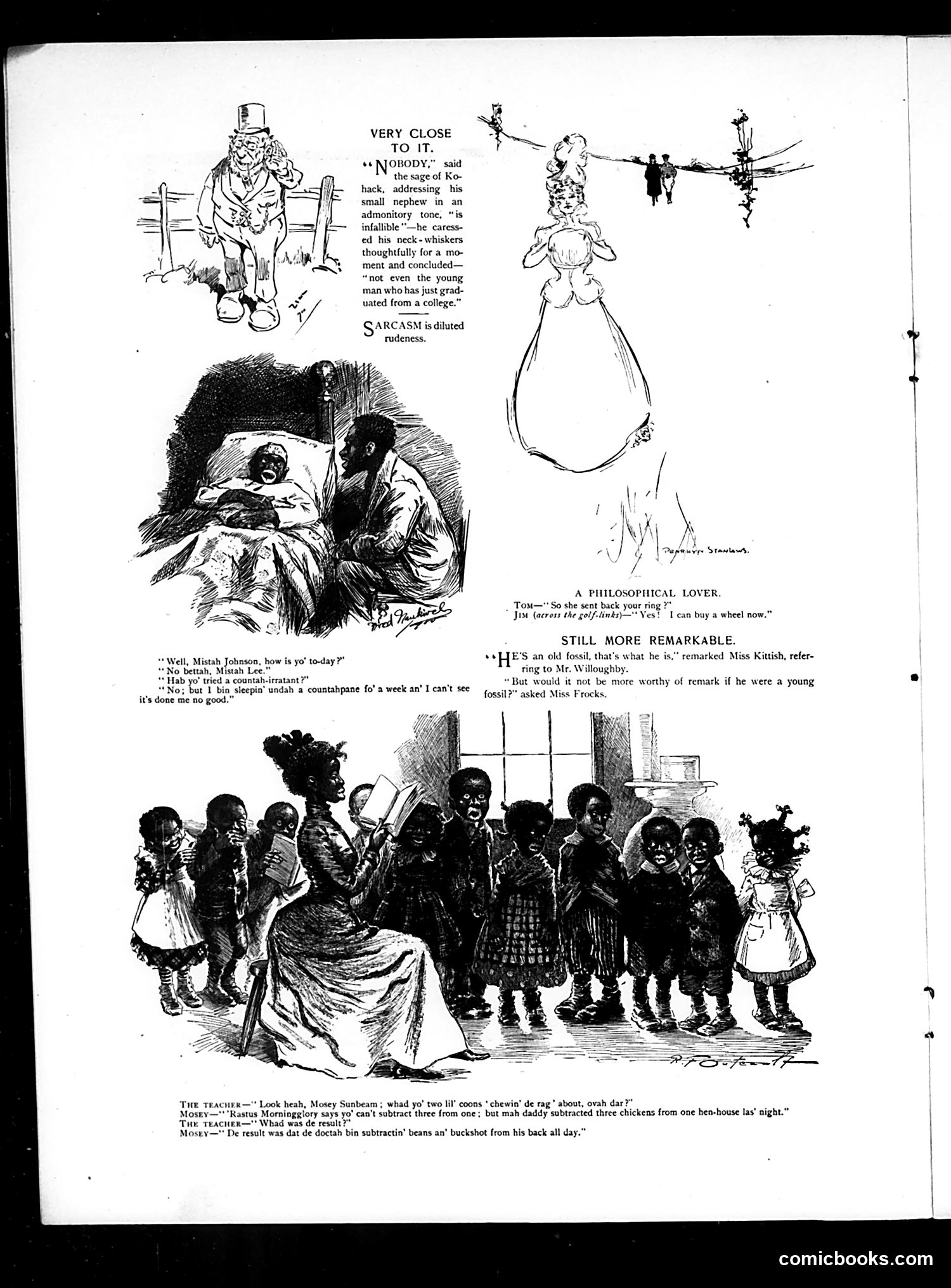
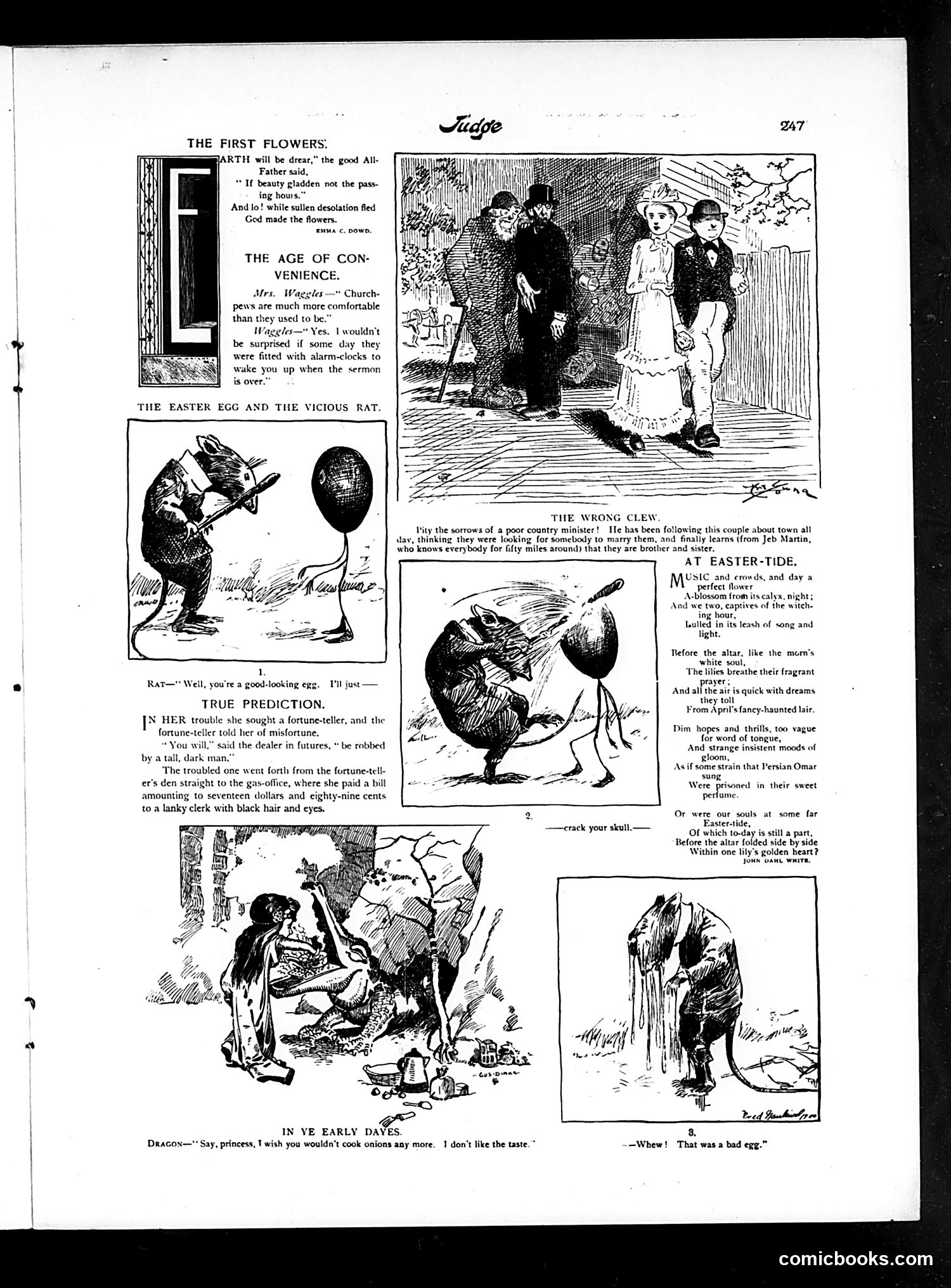
This page contains several short humorous pieces typical of early 20th-century American satire: **"The Age of Convenience"** mocks modern church comfort, joking that pews have become so comfortable that alarm-clocks might be needed to wake sleeping parishioners during sermons—satirizing both the softening of religious discipline and contemporary obsession with labor-saving devices. **"The Wrong Clew"** depicts a country minister chasing what he assumes is a couple seeking marriage, only to discover they're siblings—poking fun at small-town gossip and misunderstandings. **"True Prediction"** shows a woman robbed after visiting a fortune-teller, then paying gas bills—suggesting the "real fortune-teller" is the gas company extracting money, a dig at utility companies' perceived greed. The remaining pieces are lighter: Easter poetry, dragon/princess humor about cooking, and a rat admiring an Easter egg. The overall tone reflects Judge's blend of social commentary, domestic humor, and gentle mockery of contemporary American life and institutions.
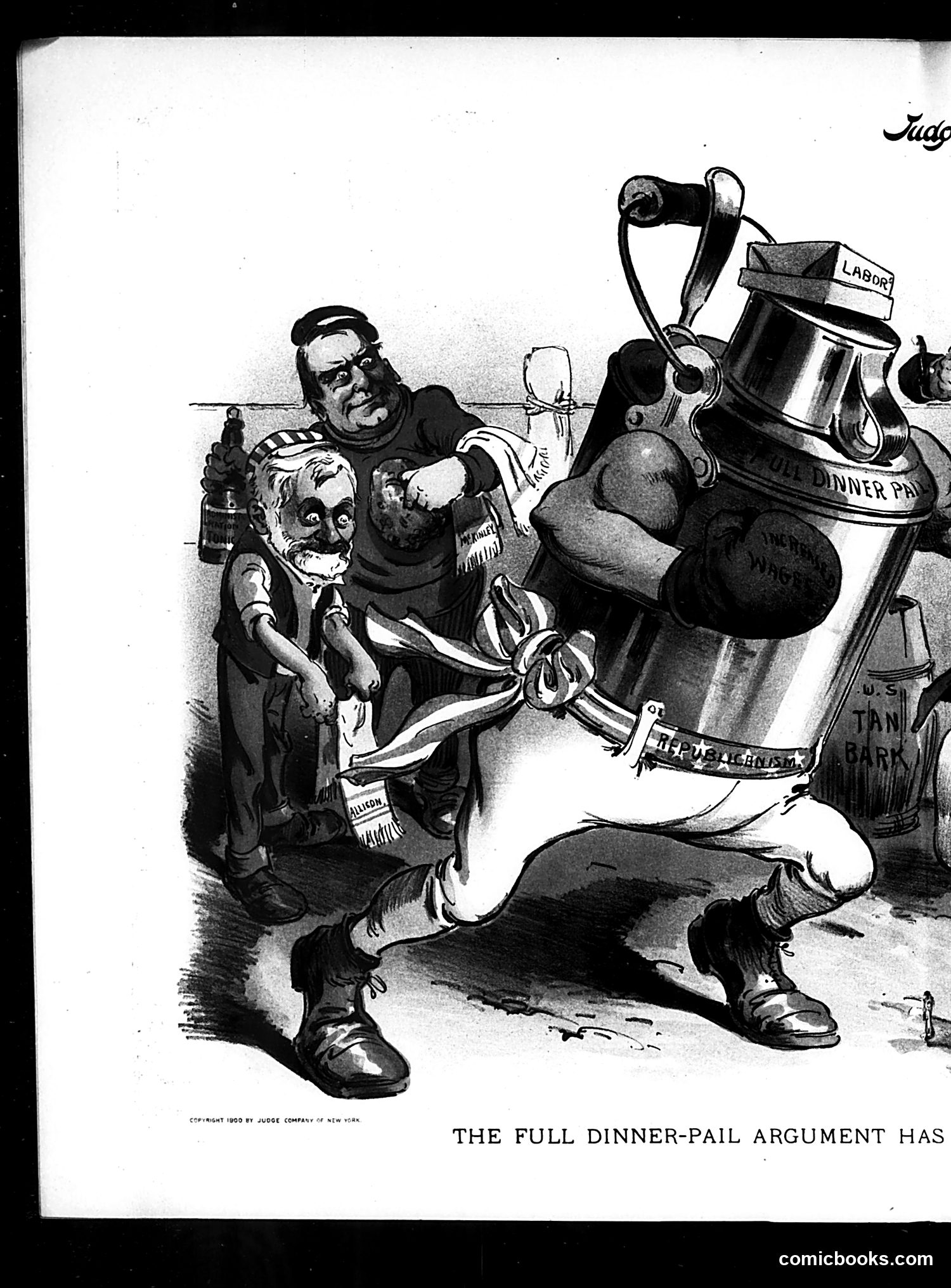
This political cartoon references the "Full Dinner Pail," a campaign slogan from William McKinley's 1900 presidential reelection, promising American workers prosperity and employment. The image shows a figure (likely representing labor or the working class) being force-fed or coerced by what appears to be a political operative holding a large dinner pail labeled "LABOR." The caricatured victim's distressed expression suggests the satire mocks the campaign's promise as hollow or forced propaganda rather than genuine benefit to workers. The surrounding implements (wrench, various tools) emphasize the industrial labor context. The cartoon appears to criticize the gap between McKinley's optimistic "Full Dinner Pail" rhetoric and actual working-class conditions.
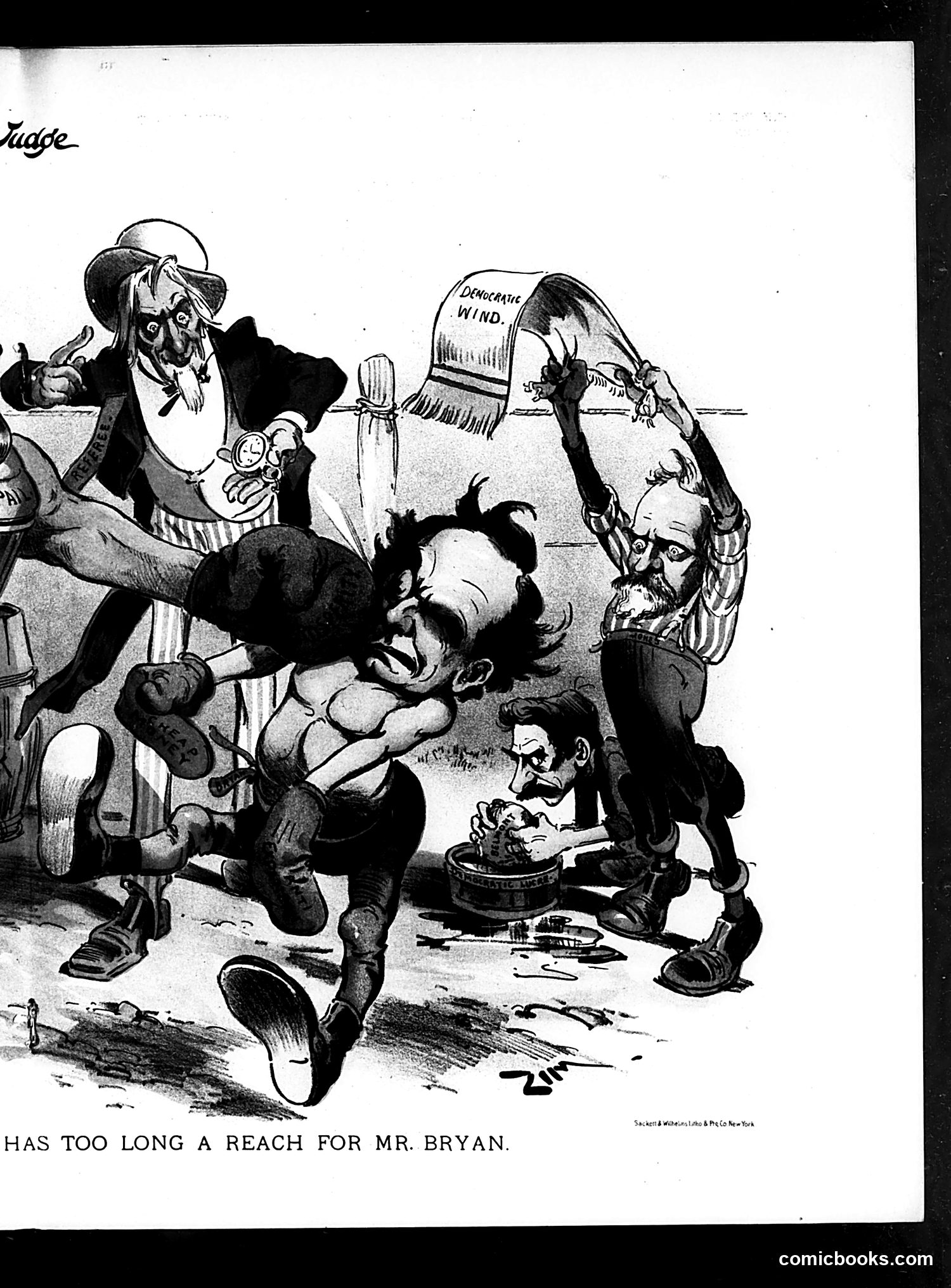
This Judge magazine cartoon satirizes William Jennings Bryan, the three-time presidential candidate and prominent Democrat. The caption "Has Too Long a Reach for Mr. Bryan" suggests Bryan cannot grasp or control the "Democratic Wind" — depicted as a sweeping force represented by the broom labeled with that phrase. The caricatured figures appear to represent political forces or opponents manipulating events beyond Bryan's reach. The exaggerated physical caricatures and chaotic scene suggest Bryan's political influence or relevance was waning or that Democratic Party forces moved beyond his control. The satire likely comments on Bryan's diminishing power within Democratic politics or his inability to shape party direction during a particular election cycle, though the specific historical moment requires additional context to confirm precisely.
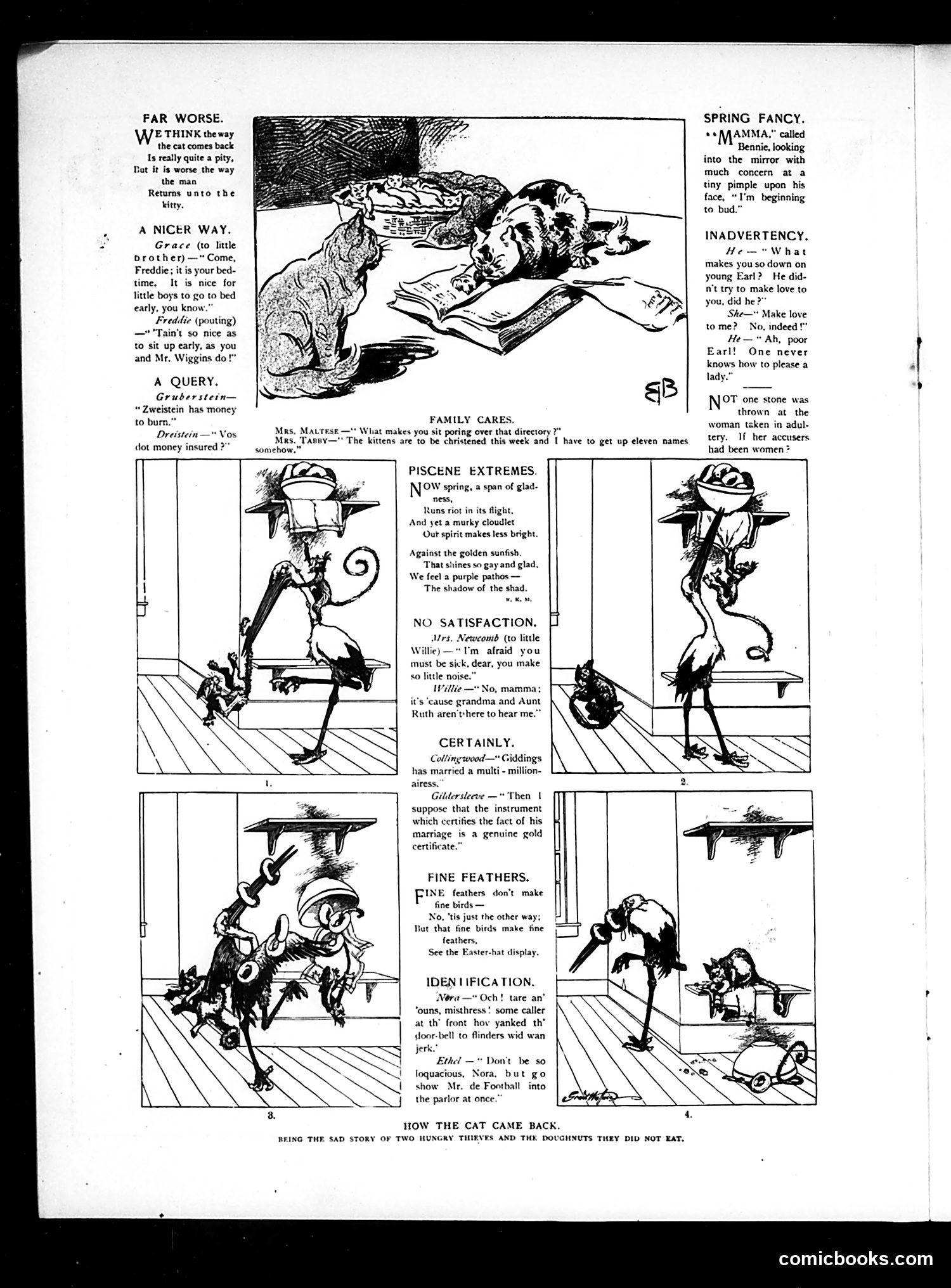
This page contains multiple short satirical pieces typical of early 20th-century American humor magazines: **Main content includes:** - Brief joke exchanges mocking Jewish immigrants (names like "Gruberstein," "Zweistein") using Yiddish-inflected English—common ethnic humor of the era - A domestic joke about a child staying up late like adults do - Romantic/courtship humor about a young man named Earl who apparently offended a woman by *not* attempting flirtation - A multi-panel comic titled "How the Cat Came Back" about hungry thieves and doughnuts (plot unclear from OCR) - A maid character "Nora" with Irish brogue attempting to announce a visitor named "Mr. de Football" - Wordplay jokes about "gold certificates" and marriage to wealthy women - Social observation about Easter fashion and spring romance **The satire targets:** immigrant dialects, class anxiety around wealth, gender dynamics in courtship, and domestic servant stereotypes. The humor relies heavily on ethnic/national caricature now considered offensive, standard for Judge's audience at the time.
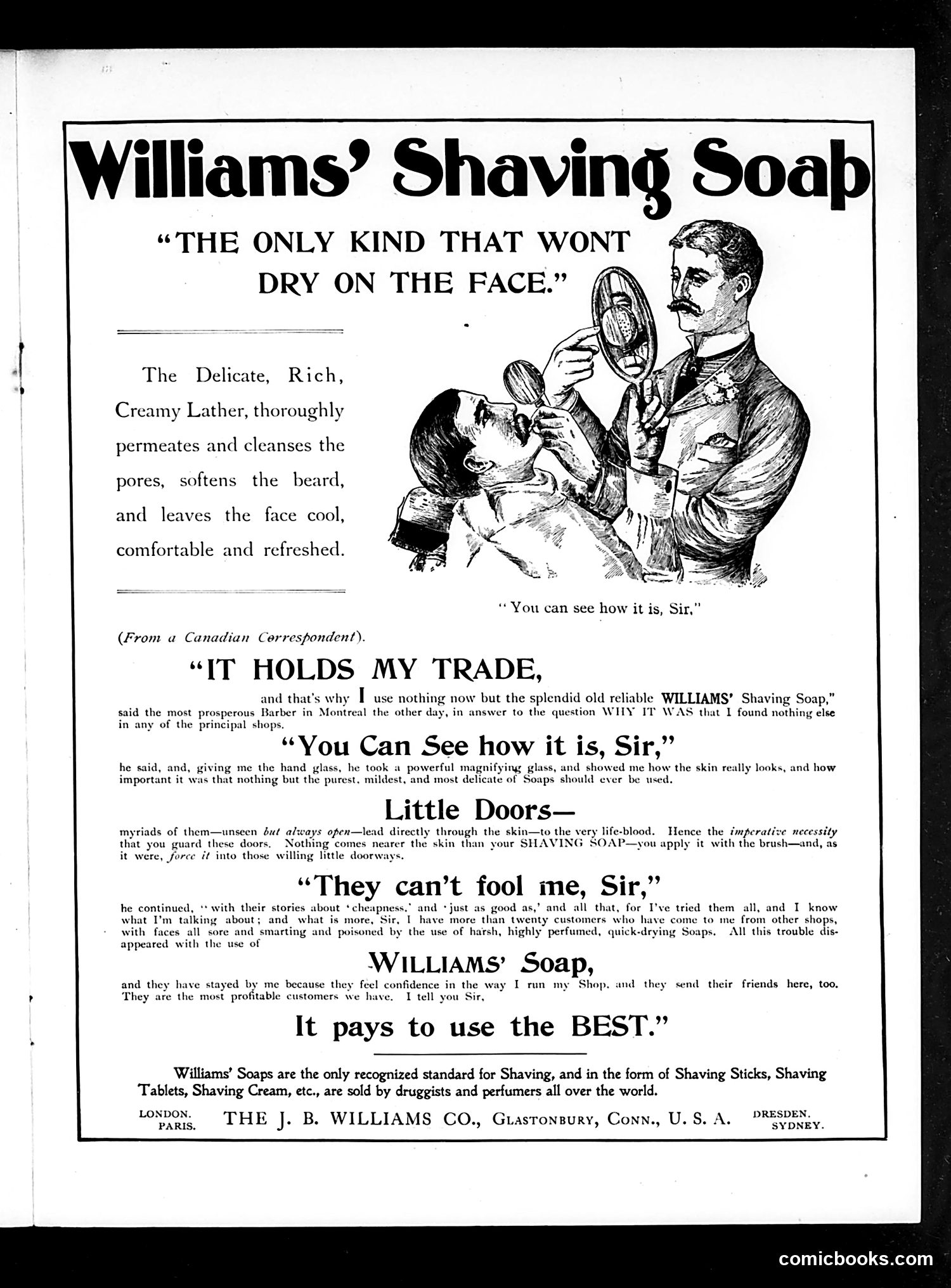
This is a **advertisement**, not political satire—it's a full-page Williams' Shaving Soap promotion disguised as testimonial journalism. The "cartoon" consists of an illustration of a barber showing a customer his face through magnifying glasses. The framing device presents a Montreal barber as an authority figure endorsing the product over competitors. The pitch uses pseudo-scientific language ("Little Doors"—pores leading to "life-blood") to justify why inferior soaps cause irritation while Williams' soap is "pure" and "mild." The barber claims twenty defected customers from other shops who suffered "sore and smarting" faces from "harsh, highly perfumed, quick-drying Soaps." **For modern readers**: This exploits early 20th-century anxieties about product safety and skin health, using expert testimony (the barber) and pseudo-medical reasoning to position Williams' as the only trustworthy choice. The "Canadian Correspondent" framing adds false authenticity. It's essentially native advertising dressed as editorial content.
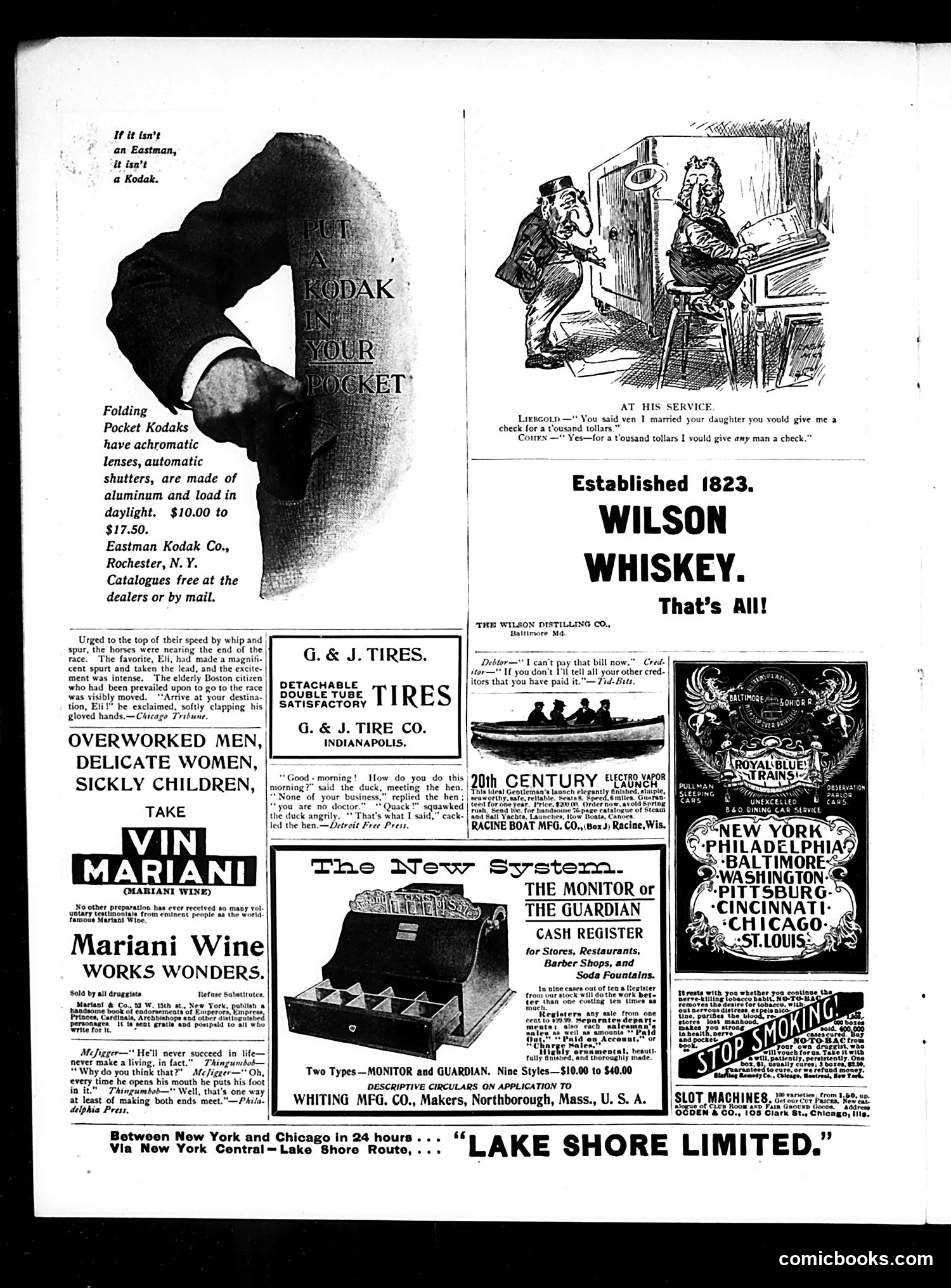
This is primarily an **advertising page** from Judge magazine, with one small cartoon and several product advertisements typical of early 1900s publications. ## The Cartoon The main cartoon ("At His Service") depicts a **father-in-law confrontation** using ethnic dialect humor. A man with a heavy accent (indicated by phonetic spelling: "t'ousand tollars," "vould") demands the promised check his father-in-law offered upon marrying his daughter. The joke's punchline—that the father-in-law would "give any man a check" for that amount—suggests the son-in-law is such poor husband material that any man would accept such a deal to take him off his hands. This reflects common early-20th-century humor mocking immigrant accents and stereotyping them as undesirable sons-in-law. ## Advertisements The page features Kodak cameras, tires, whiskey, Mariani Wine (a patent medicine), and cash registers—typical products advertised in period magazines.
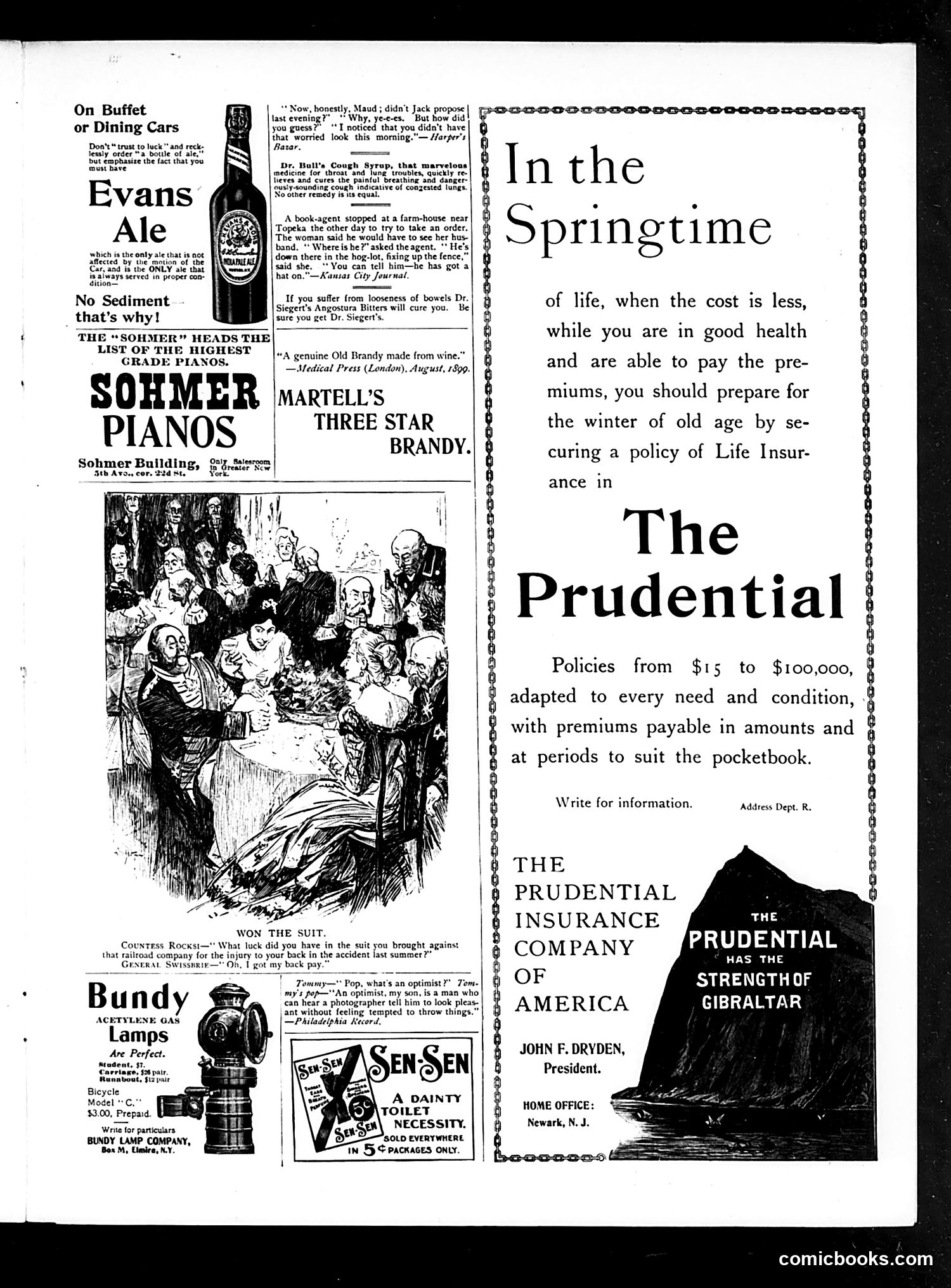
This page is primarily **advertising** from what appears to be an early 1900s issue of Judge magazine, with minimal satirical content. The one notable **cartoon** depicts "Countess Rocks" winning a lawsuit against a railroad company for injuries from an accident. The humor lies in the caption's ironic twist: despite winning, the countess appears dissatisfied—the joke being that legal victory often brings disappointment (perhaps inadequate compensation or a pyrrhic win). The page is otherwise dominated by **product advertisements** for Evans Ale, Sohmer Pianos, Martell's Brandy, Bundy Acetylene Lamps, Sen-Sen breath mints, and prominently, **The Prudential Insurance Company**, which takes up the right half of the page. Three brief **jokes** appear in the text, typical of Judge's humor: one about a woman inferring a proposal by a man's lack of worry, another about a book agent visiting a farmer, and one defining an optimist. The content reflects early 20th-century American consumer culture and middle-class anxieties (life insurance, respectability, modern conveniences).
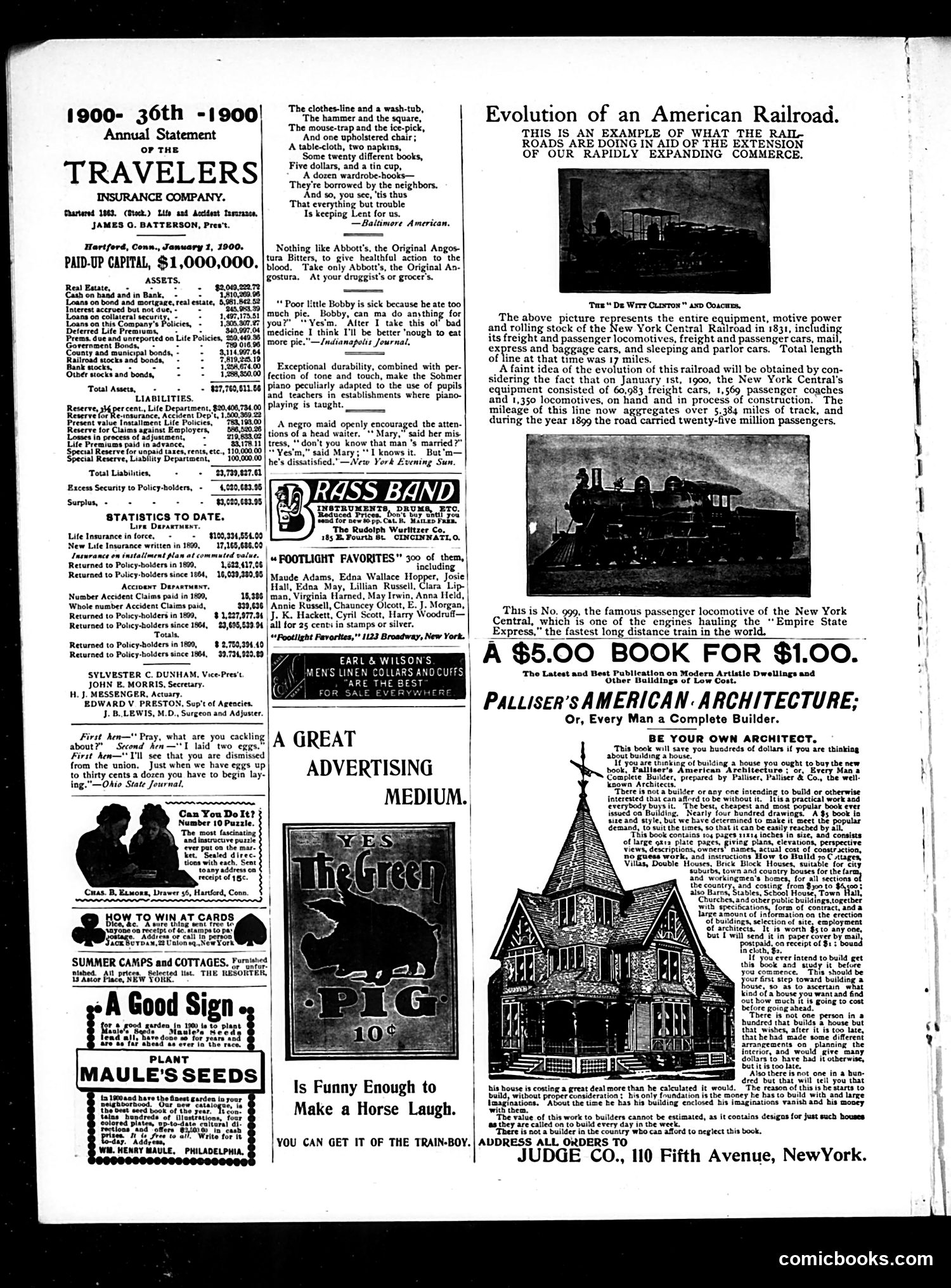
This page is primarily a **financial/corporate document and advertising compilation**, not a political cartoon page. The main content is the Travelers Insurance Company's 1900 Annual Statement—essentially a corporate financial report showing assets of $27.7 million and various insurance statistics. The page includes scattered **light humor and advertisements** typical of Judge magazine: - A brief joke about hen unionization and egg prices (labor/economic humor) - Various product ads (seeds, card games, architecture books, pianos, bitters) - A small cartoon titled "The Great PDQ" about a puzzle/game The railroad content in the upper right discusses the New York Central's locomotive equipment and expansion—presented as business news rather than satire. **Context**: By 1900, Judge mixed serious corporate advertising with genteel, non-partisan humor. This wasn't a heavily satirical issue but rather a standard commercial publication mixing news, ads, and mild jokes for affluent readers.
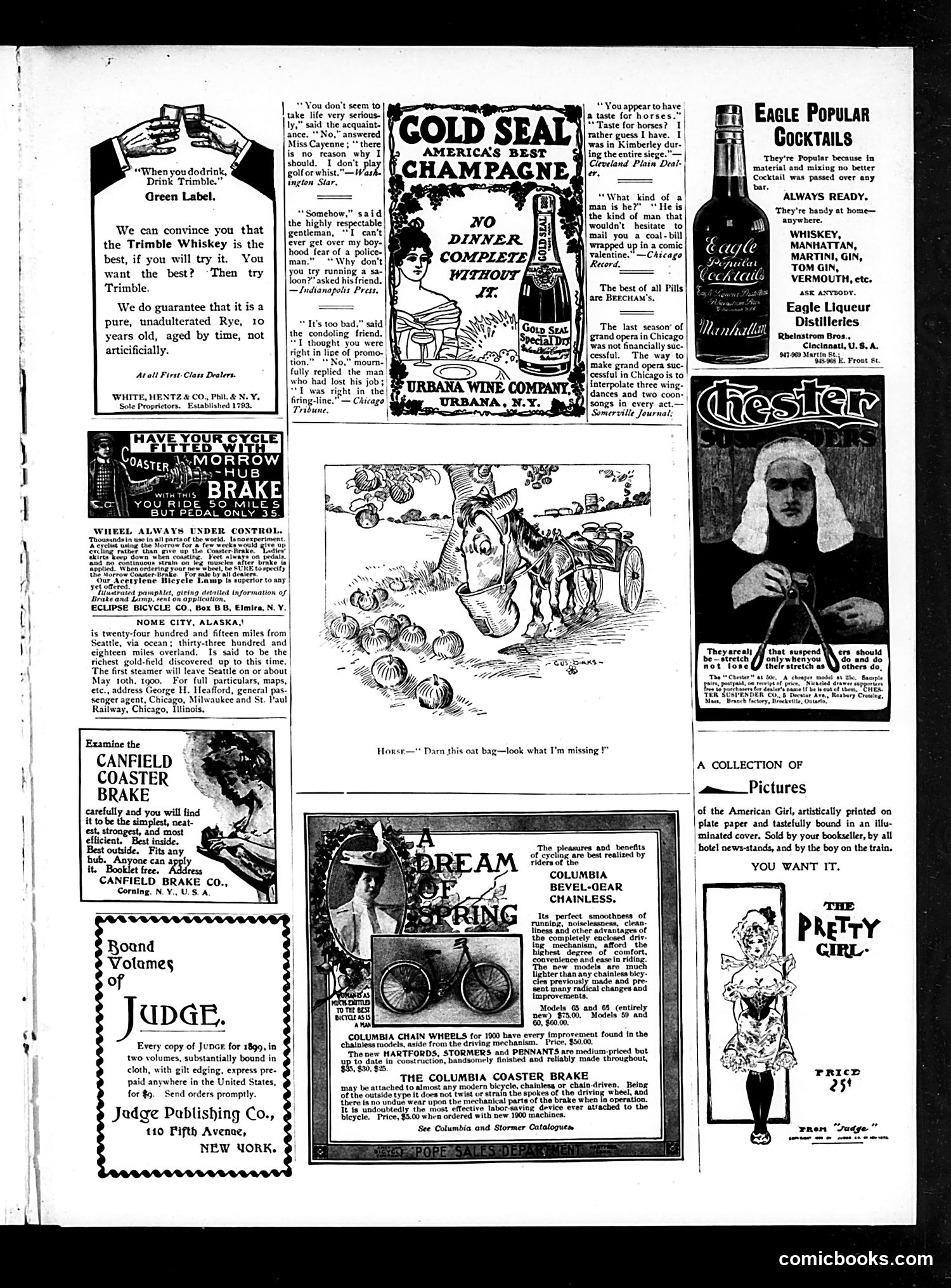
This is primarily an **advertising page** from Judge magazine (circa 1900), with one small cartoon and multiple product advertisements. The single cartoon shows a **horse complaining about a missing oat** from its feed bag—a simple, lighthearted visual gag with no political content. The advertisements reflect **turn-of-the-century consumer products**: whiskey and liqueur brands (Trimble, Eagle), bicycles and bicycle brakes (Canfield, Columbia, Eclipse), a book collection (Judge Publishing), and information about the Alaska gold rush settlement of Nome City. A recurring theme is **bicycle technology**, featuring advertisements emphasizing modern mechanical innovations (coaster brakes, chainless designs, improved efficiency)—reflecting the bicycle craze of the 1890s-1900s. The page also includes brief **humorous quotations** about topics like golf, opera in Chicago, and romantic mishaps—typical filler material for magazines of this era. Overall, this is a **commercial page** showcasing products targeted at middle-class readers rather than satirical commentary.
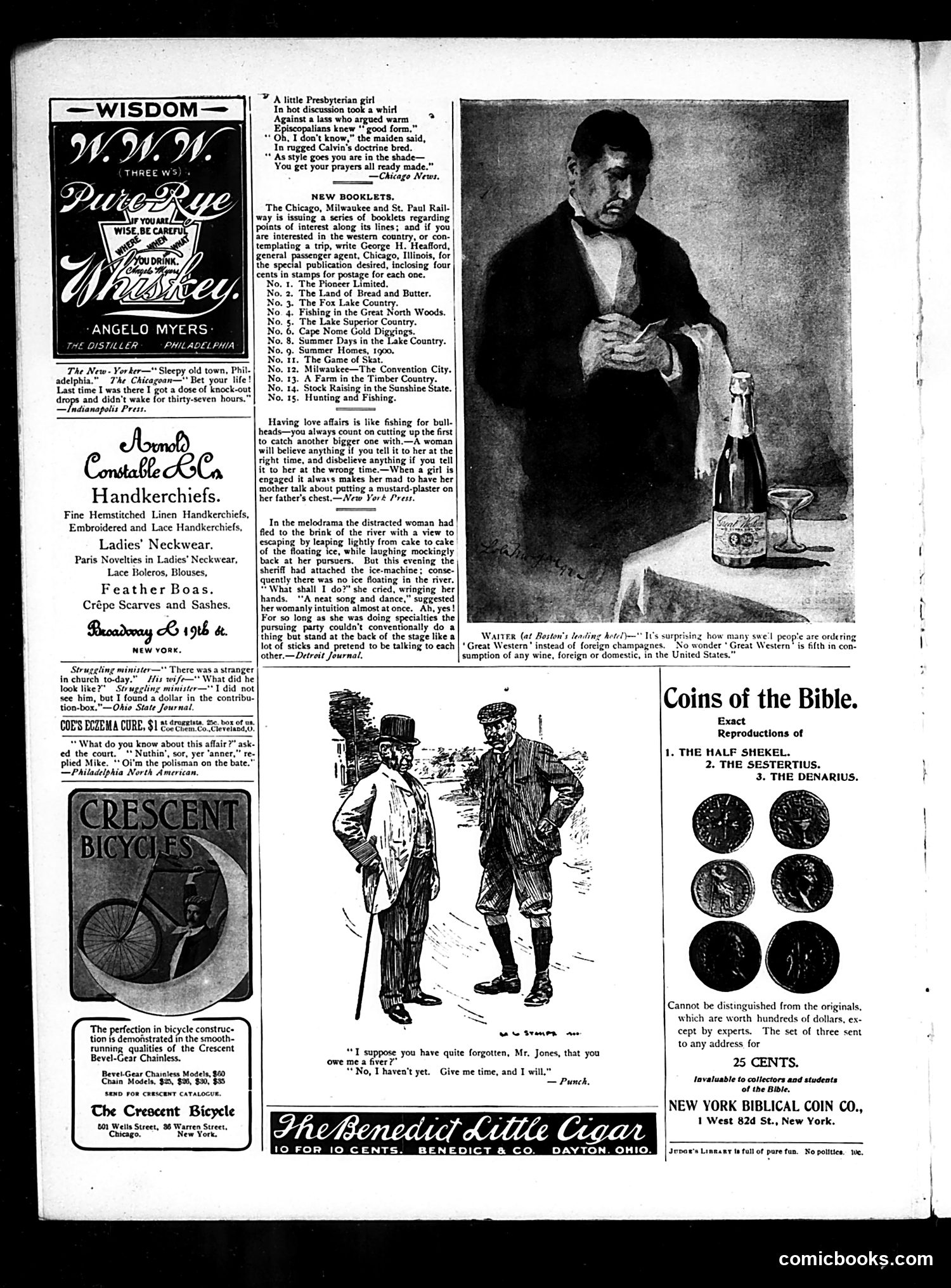
This page is primarily **advertisements and humor columns** rather than political cartoons. The main joke content includes: **"Presbyterian Girl" Poem**: Satirizes religious denomination differences—a Presbyterian girl mocks another girl's faith as relying on "ready made" prayers, suggesting Calvinist superiority through doctrinal rigor. **"Love Affairs" Aphorisms**: Cynical observations about relationships and female psychology, typical of Judge's era humor—dismissive and patronizing toward women. **Melodrama Sketch**: Mocks theatrical conventions of the period, particularly the absurdity of staged escape scenes (ice-skating across frozen rivers) and how actors awkwardly stand about waiting for the next scene. **Boston Waiter Joke**: Promotes American "Great Western" wine over foreign imports, reflecting early 1900s American nationalism and marketing. The page is otherwise dominated by **product advertisements** (bicycles, handkerchiefs, railroad booklets, cigars, coins) typical of magazine monetization from this era. No significant political satire is present.
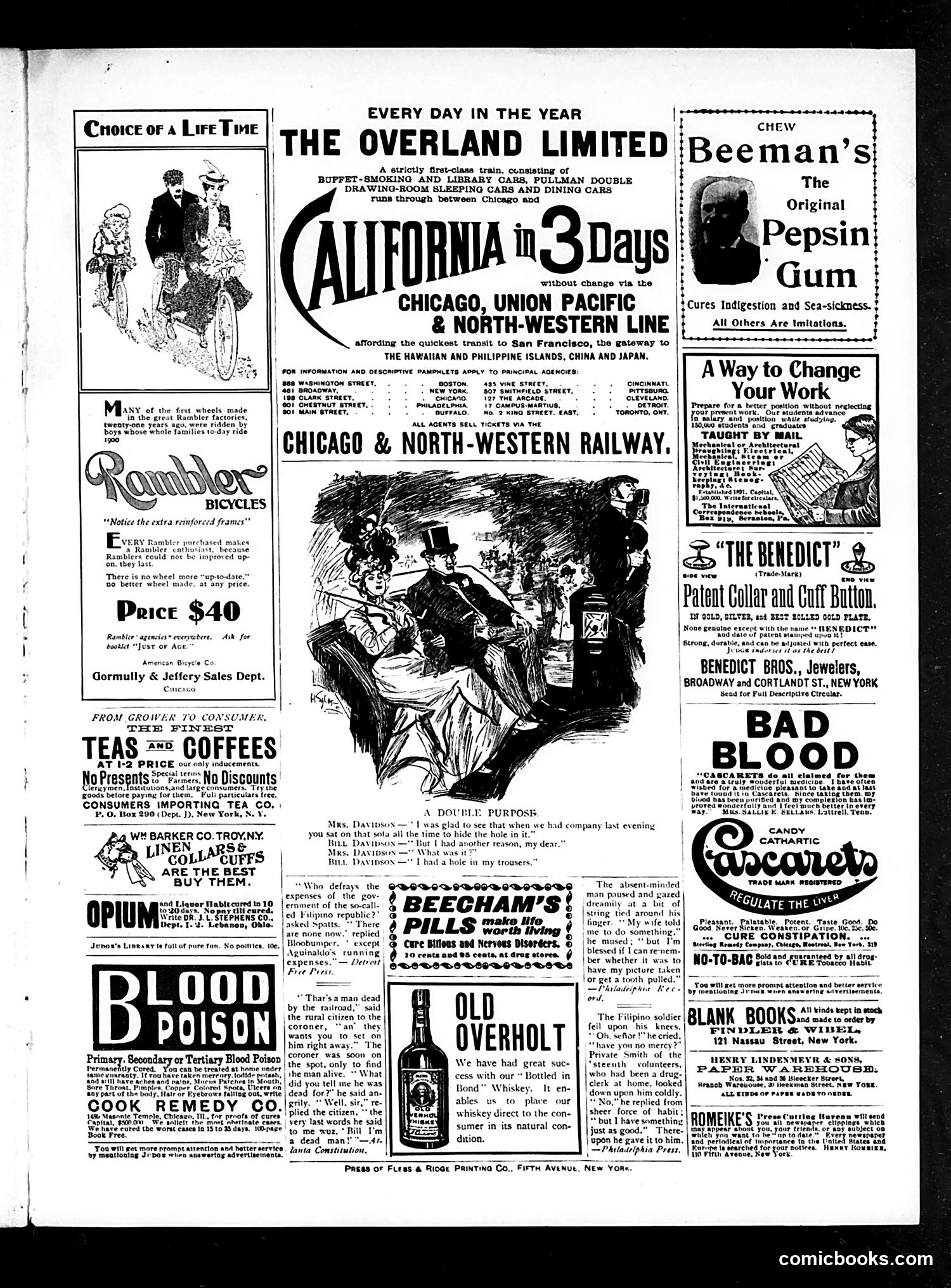
This is a Judge magazine page dominated by commercial advertisements rather than political cartoons or satire. The major ads include: **Transportation**: The Overland Limited railway (Chicago to San Francisco) occupies the center, promoting luxury travel to the Pacific coast and Hawaii/Philippines. **Products**: Rambler bicycles ($40), Beeman's Pepsin Gum, patent collar buttons, "Old Overholt" whiskey, various patent medicines (for blood poison, indigestion), and teas/coffees. **Small humor pieces** appear interspersed—brief comedic exchanges (like a husband hiding a hole in his trousers, or a coroner's misunderstanding)—but these are light domestic jokes, not political satire. The page reflects turn-of-the-century American commercial culture and marketing, with remedies for ailments now recognized as requiring actual medical care. No identifiable political figures or satire are visible.
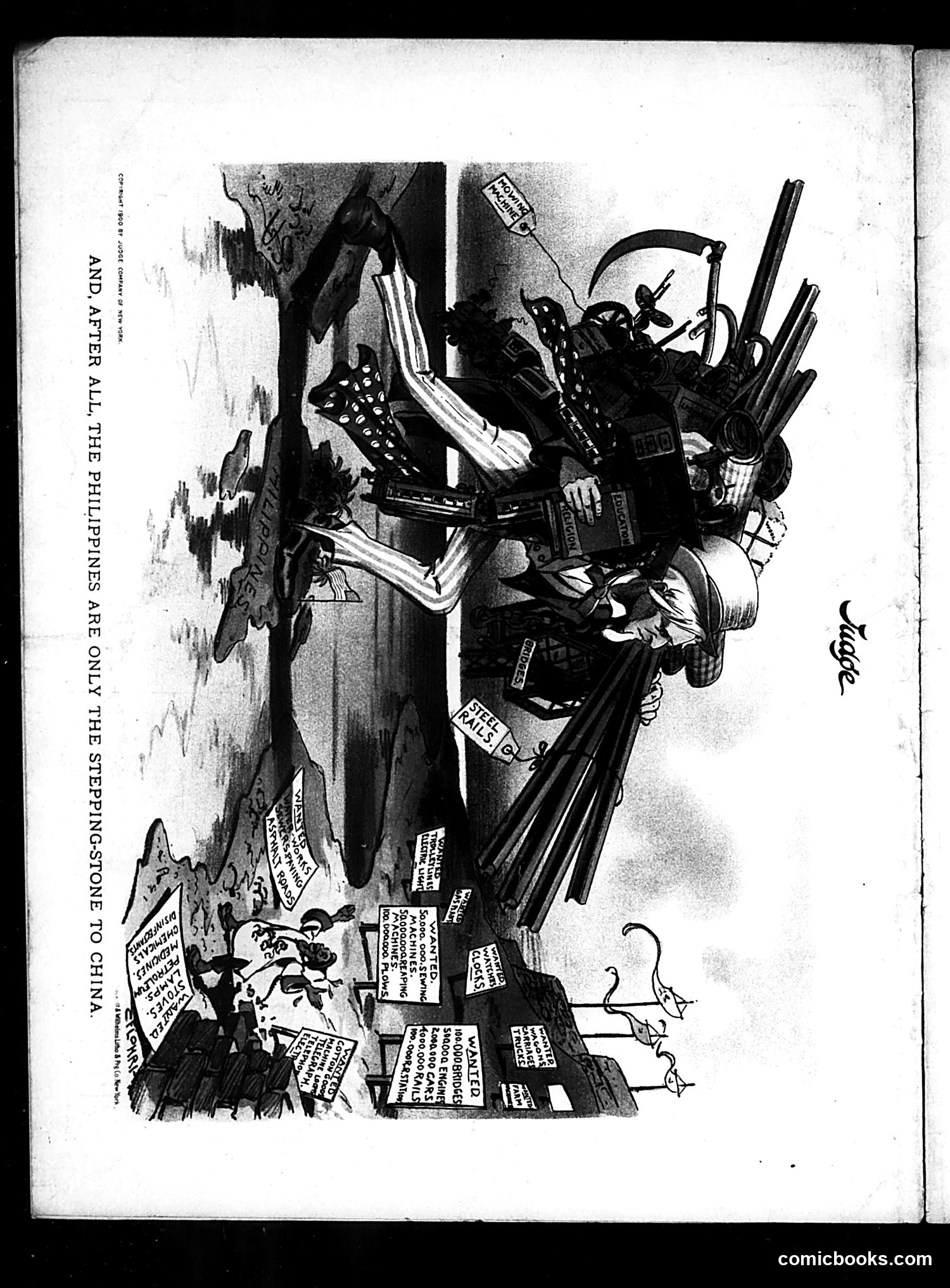
This 1900 Judge cartoon satirizes American imperial ambitions following the Spanish-American War. The image depicts an armed American military figure atop a precarious stack of boxes labeled "50,000,000 Sewing Machines" and "50,000,000 Reaping Machines"—representing commercial goods destined for China's massive market. The cartoon mocks the justification for acquiring the Philippines: that they served merely as a convenient stepping-stone toward exploiting China's vast population and wealth. The wobbly tower of machinery suggests the instability and absurdity of this imperial logic. The satire critiques how American expansionism was framed as commercial necessity rather than colonial conquest. The cartoon questions whether controlling the Philippines was truly justified by trade opportunities or merely a pretext for empire-building in Asia during the era of Western imperialism.