
A complete issue · 16 pages · 1900
Judge — April 7, 1900
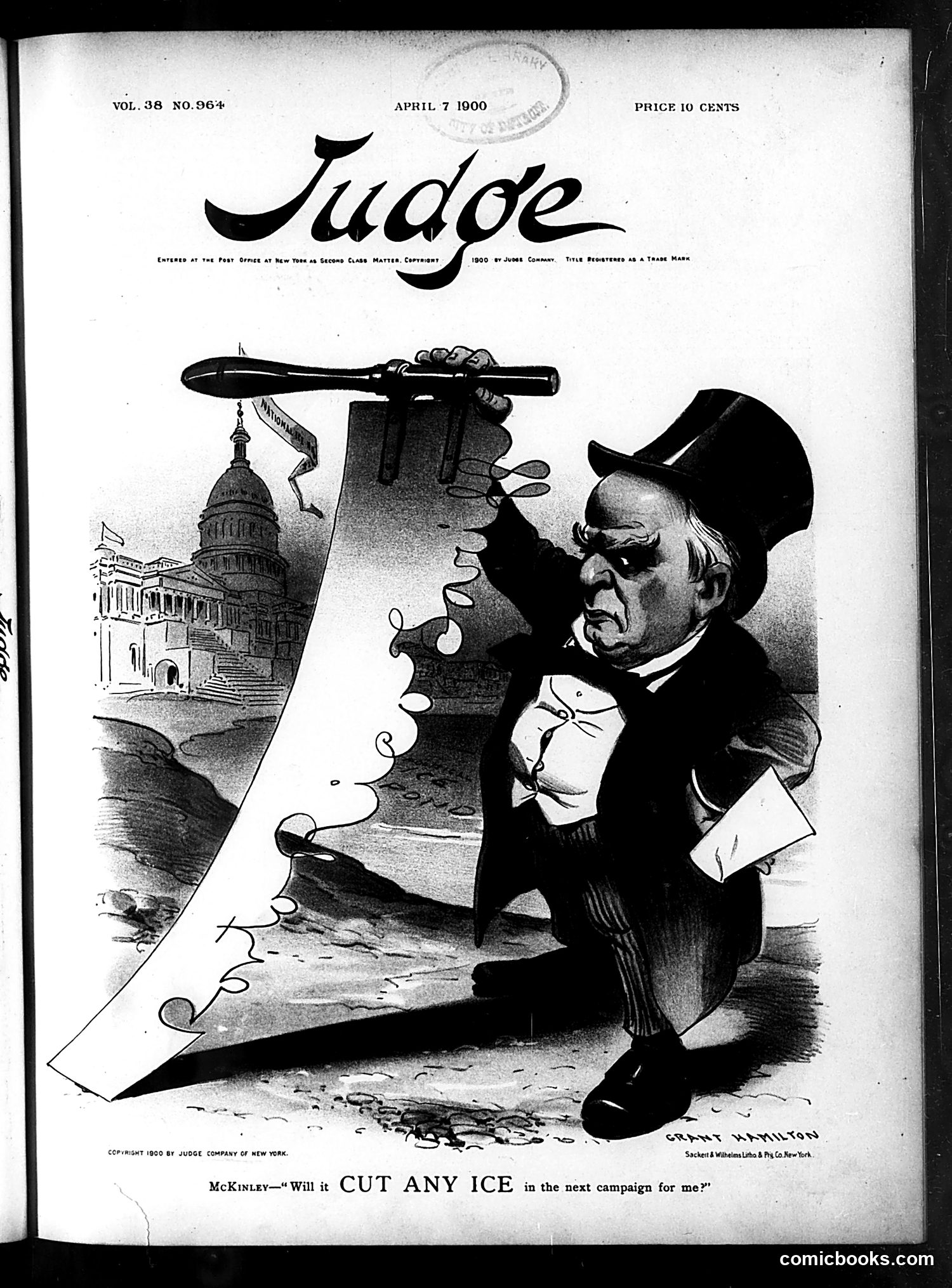
This cartoon by Grant Hamilton satirizes President **William McKinley** (identified in the caption), depicted as a man using a surveying telescope to examine the Capitol building in the distance. The caption reads: "Will it **CUT ANY ICE** in the next campaign for me?" The joke appears to reference McKinley's political positioning or accomplishments ahead of the 1900 presidential election. "Cut any ice" is a period slang phrase meaning "make an impression" or "matter." The cartoon suggests McKinley is carefully assessing whether his record or policies will resonate with voters in the upcoming campaign. The satirical intent mocks his apparent anxiety about his electoral prospects or the relevance of his administration's work.
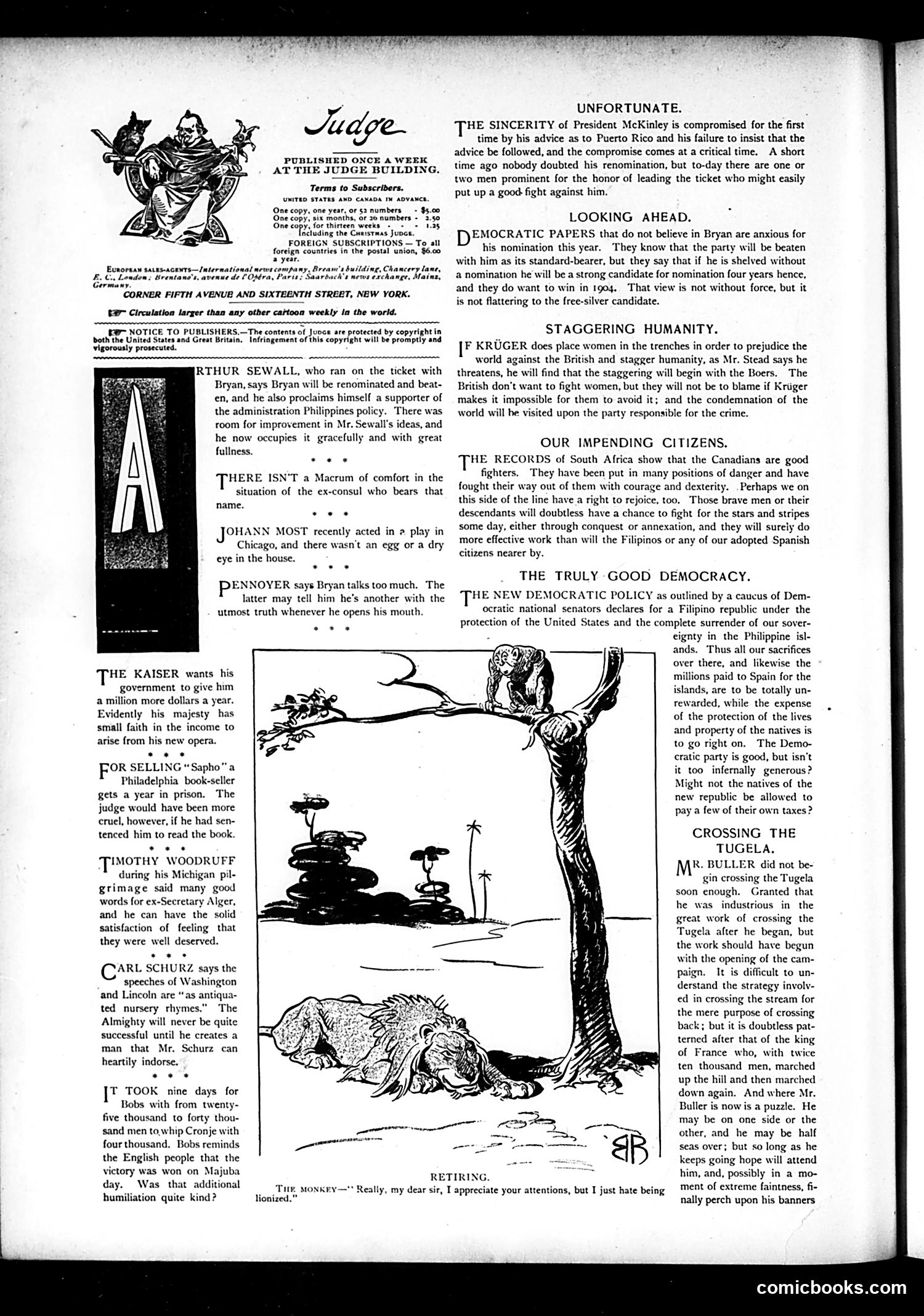
The main cartoon depicts a skeletal, emaciated figure labeled "RETIRING" that appears to represent a war casualty or the human cost of conflict. The caption's quote—"Really, my dear sir, I appreciate your attentions, but I just hate being lionized"—suggests dark irony about glorifying military service or warfare. The surrounding text criticizes U.S. policy regarding the Philippines and Puerto Rico, particularly McKinley's administration. Articles titled "UNFORTUNATE," "LOOKING AHEAD," and "STAGGERING HUMANITY" express concern about colonial expansion, potential war with European powers, and the treatment of colonial subjects. The overall message appears satirical commentary on American imperialism and its human costs during the early 1900s expansionist period.
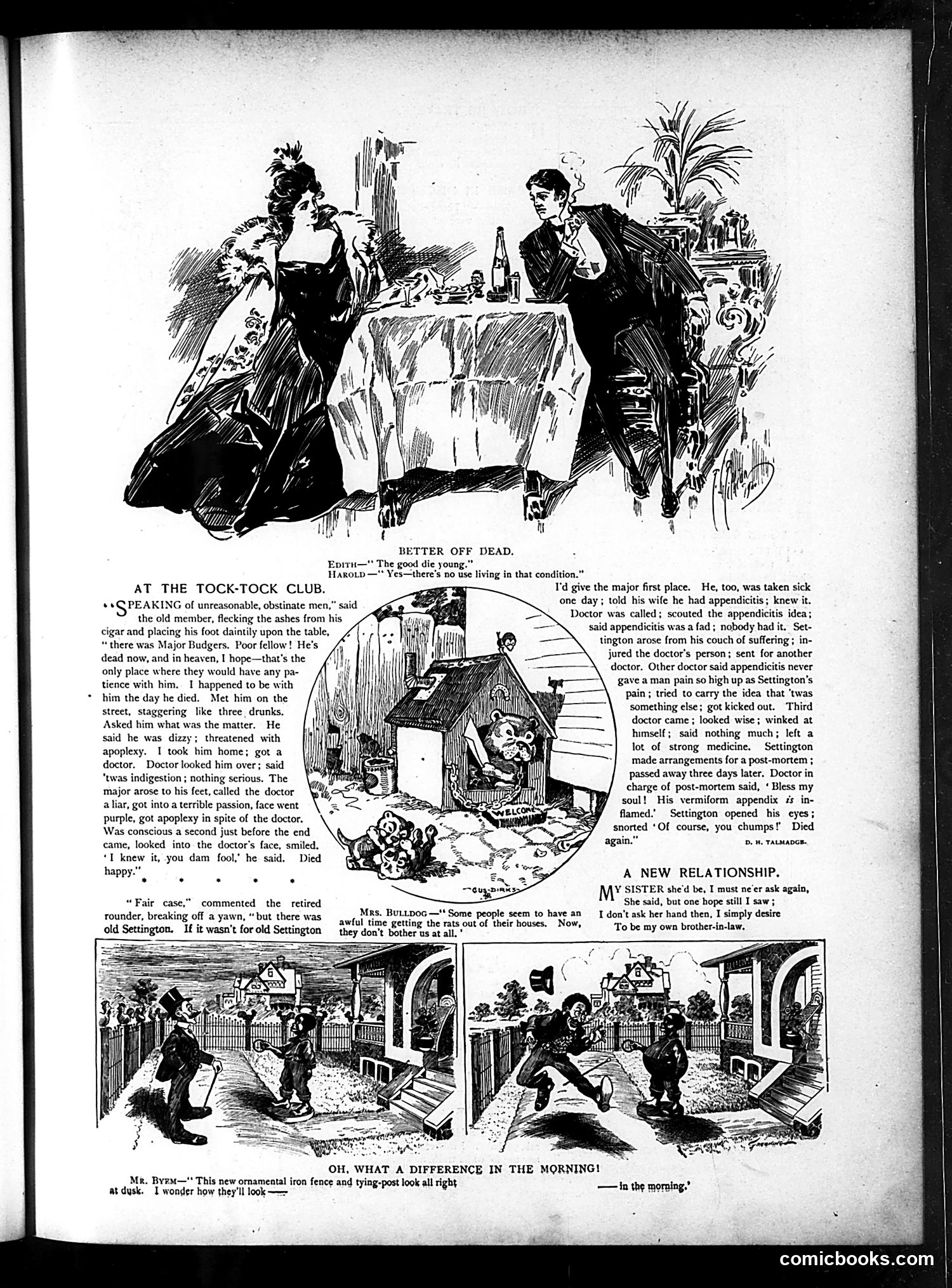
This page contains three separate satirical pieces: 1. **"Better Off Dead"** (top): A domestic scene mocking a couple's conversation, likely satirizing attitudes toward marriage or relationships. 2. **"At the Tock-Tock Club"** (center): A story about someone named Settington whose appendicitis diagnosis proves false. The satire targets medical misdiagnosis and doctors' tendency to prescribe unnecessary surgery—a common early 20th-century complaint about the medical profession. 3. **"A New Relationship"** and **"Oh, What a Difference in the Morning!"** (bottom): These appear to mock domestic life, possibly satirizing decorative choices or home furnishings, though the specific reference is unclear without additional context. The page's humor relies on domestic and social observation rather than explicit political content.
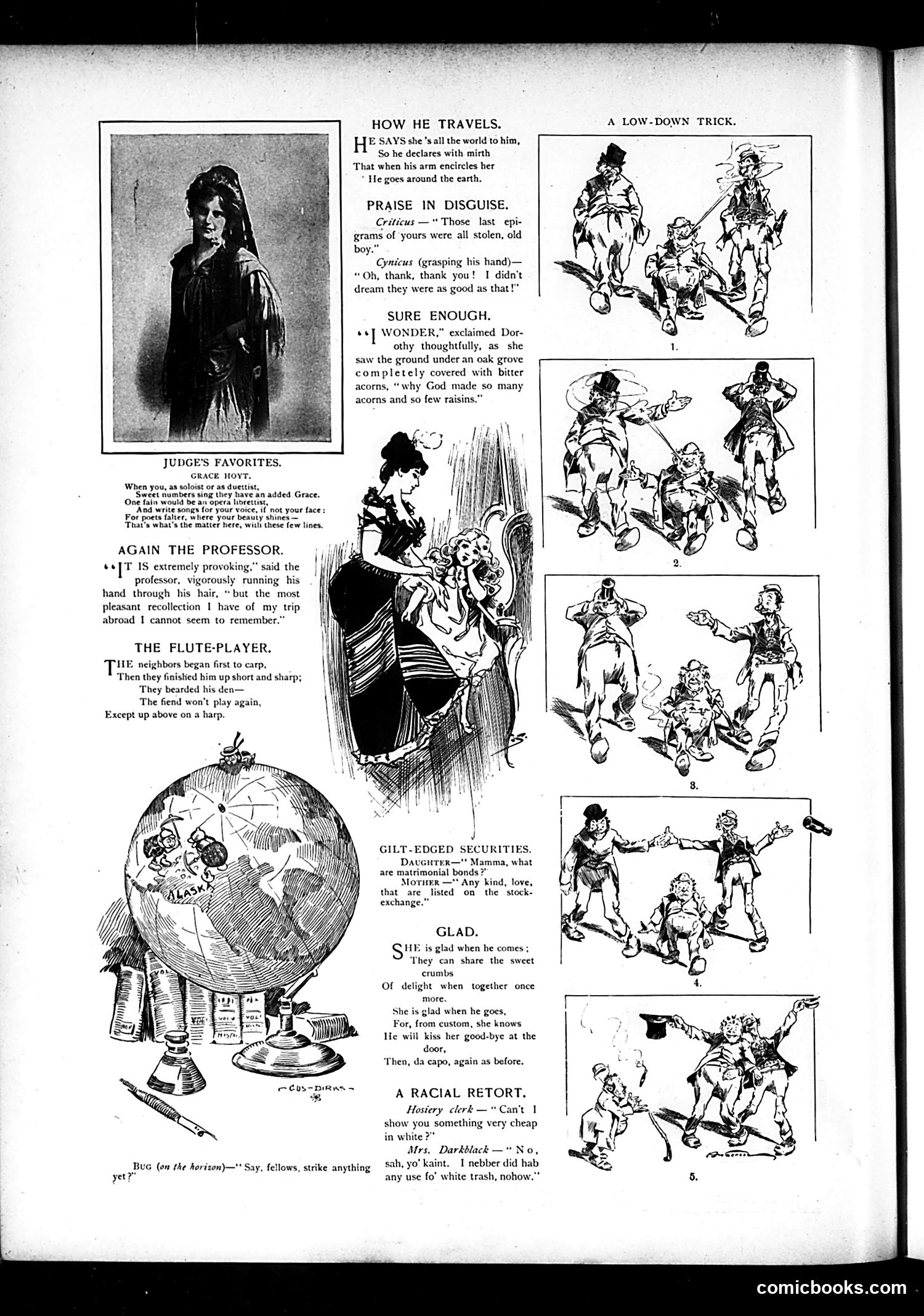
This page contains several unrelated humorous items typical of Judge's format: **Left side** features poems and jokes about social types: a professor abroad, a flute-player neighbor, and racial humor ("A Racial Retort"). The photograph labeled "Judge's Favorites" shows a woman in period dress. **Center** includes an illustration of a woman with a globe, likely satirizing something about world travel or geography, though the specific reference is unclear without additional context. **Right side** titled "A Low-Down Trick" depicts a sequence of illustrated scenes showing what appears to be street performers or con artists interacting with children—suggesting satire about urban deception or exploitation of minors. The scattered nature and lack of clear political messaging suggests this is primarily **entertainment-focused satire** rather than commentary on specific contemporary events. Most references are too ambiguous to identify without Judge's publication date.
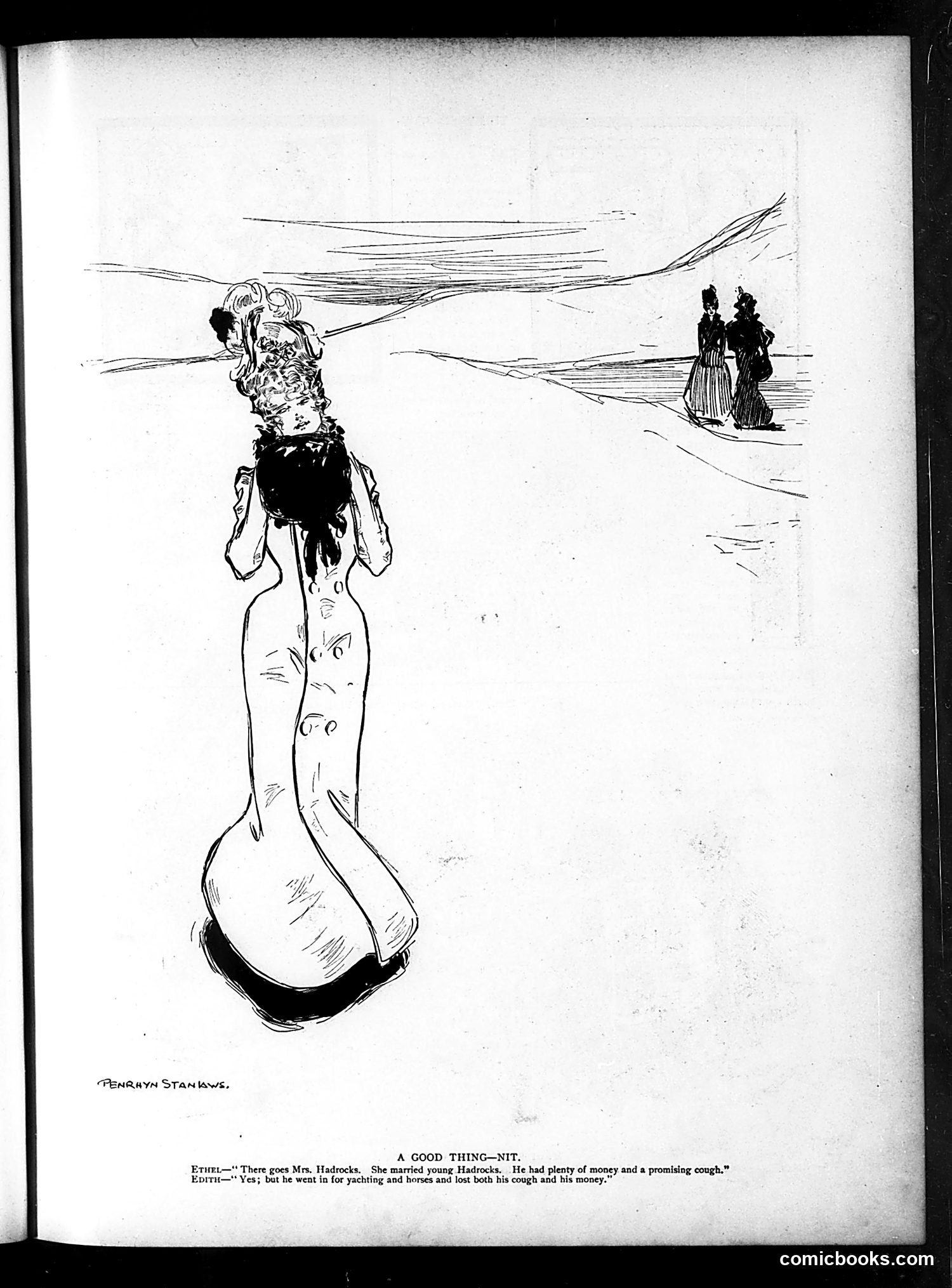
This Judge magazine cartoon satirizes wealthy socialites and their frivolous pursuits. Two figures observe "Mrs. Hadrocks" — a wealthy woman whose husband inherited money and appeared tubercular (the "promising cough" was ironic, as tuberculosis was a status marker among the rich). The joke's dark humor: young Hadrocks squandered his fortune on expensive hobbies like yachting and horses, losing both his wealth and his tuberculosis in the process. The satire mocks how the wealthy pursued luxurious but financially ruinous activities, and the absurdity of considering disease a social asset. The title "A Good Thing—Nit" suggests sarcasm—what initially seemed advantageous (his money and fashionable illness) proved worthless once spent on indulgent leisure.
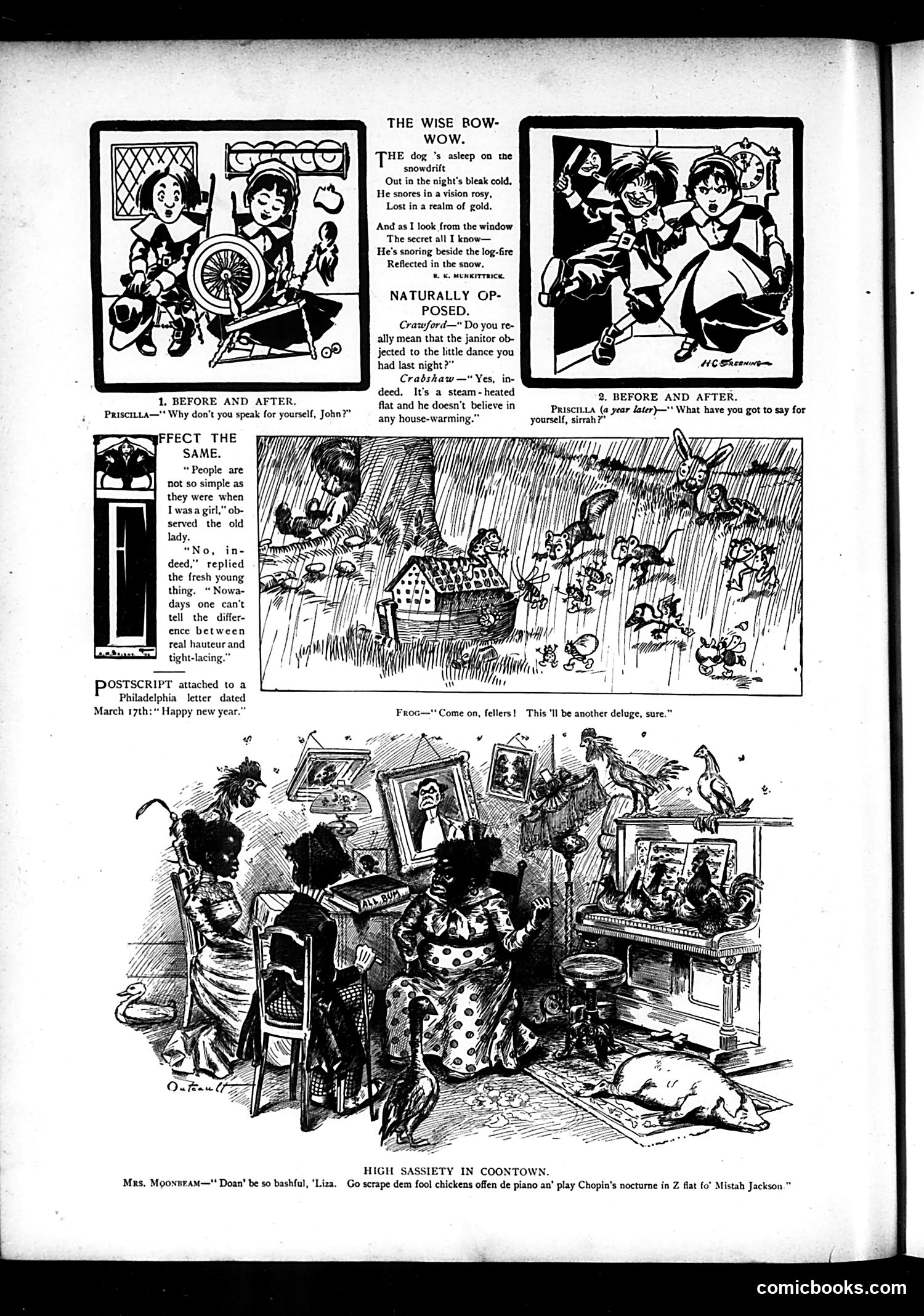
This page contains several satirical pieces typical of early 20th-century American humor: **"The Wise Bow-Wow"** is a sentimental poem with illustration about a dog dreaming by a fire, its reflection visible in snow—gentle whimsy rather than satire. **"Naturally Opposed"** jokes about a janitor objecting to tenants' dancing in a steam-heated apartment, playing on class tensions between working-class building staff and residents. **"Before and After"** (two versions) shows romantic couples; the captions suggest domestic discord after marriage—standard "marriage humor" of the era mocking newlyweds' disillusionment. **"Effect the Same"** contrasts old-fashioned "hauteur" (haughty behavior) with modern "tight-lacing," suggesting women's fashion and deportment haven't fundamentally changed despite claims of progress. **"High Sassiety in Coontown"** uses racist caricature and dialect to mock African Americans aspiring to gentility—depicting Black residents attempting classical music as inherently ridiculous. This reflects the era's pervasive racial stereotyping in mainstream publications.
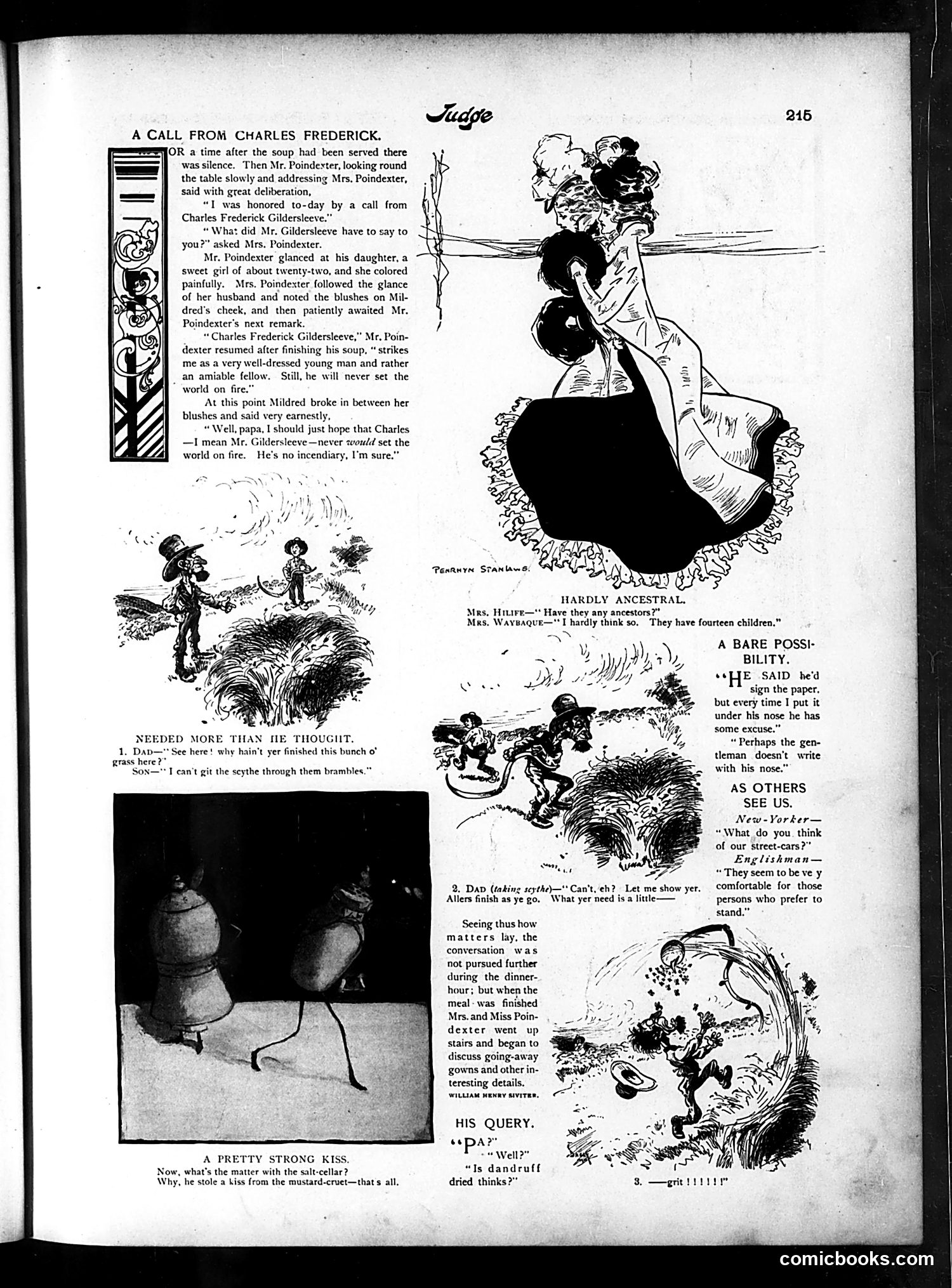
This page contains multiple unrelated satirical cartoons typical of Judge's format. **"A Call from Charles Frederick"** depicts a domestic scene where Mr. Poindexter mentions a visit from young Charles Frederick Gildersleeve. His daughter Mildred blushes noticeably, revealing romantic interest. The satire mocks Victorian courtship proprieties—the father's lukewarm assessment ("never set the world on fire") and Mildred's earnest, awkward defense of the suitor's character demonstrate how seriously the era treated marriage prospects and social standing. **Remaining cartoons** include: - "Hardly Ancestral": A joke about social pretension—wealthy families with many children but no aristocratic lineage - "As Others See Us": British criticism of American street-cars as uncomfortable - Various farm and domestic humor scenes The page exemplifies Judge's mix of middle-class social satire and slapstick comedy, mocking Victorian manners, class anxiety, and courtship customs that modern readers would find quaint.
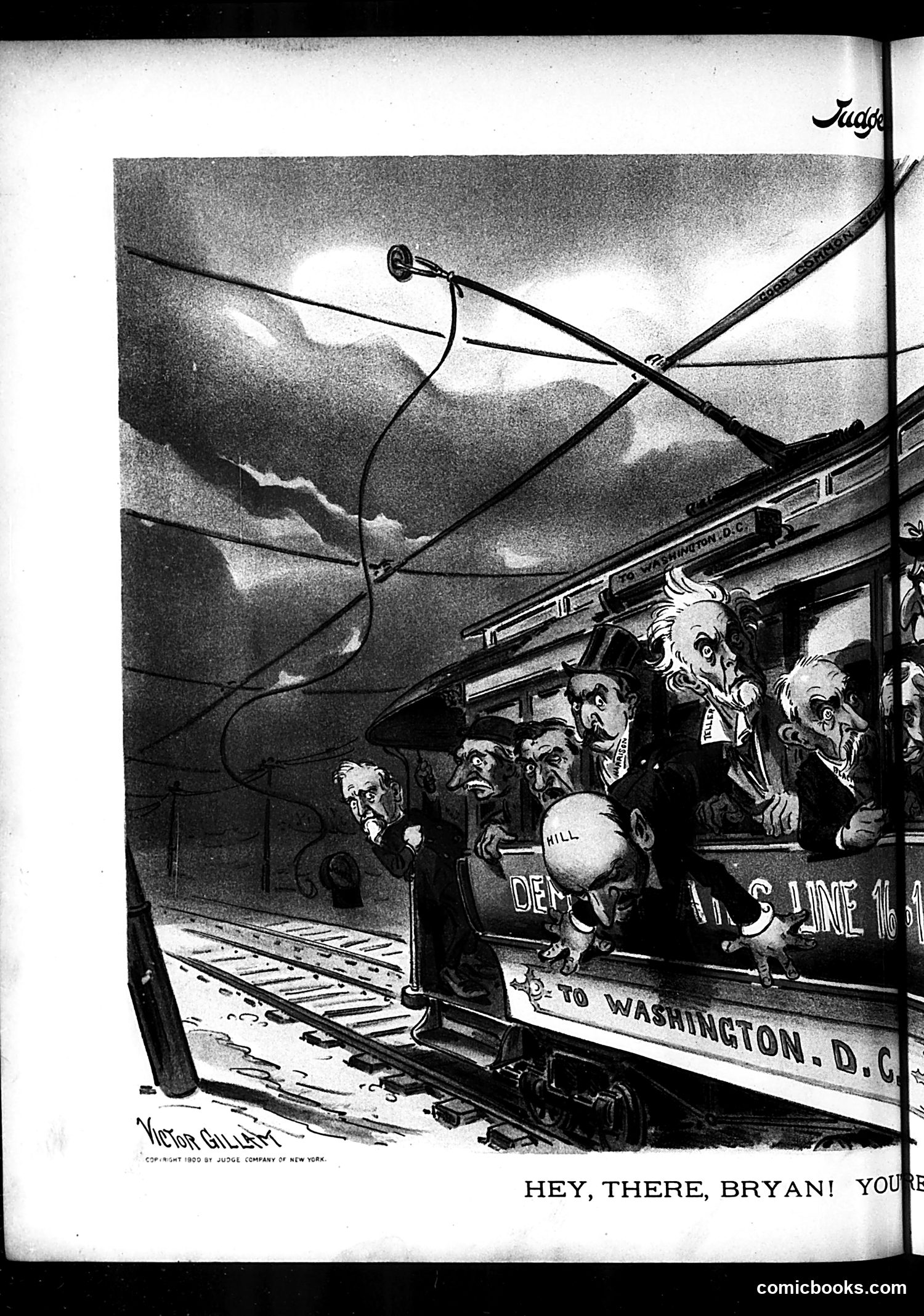
This Judge magazine cartoon satirizes political opposition to William Jennings Bryan, the populist Democratic candidate who ran for president multiple times around 1900. The caricatured figures appear to be Republican or establishment politicians boarding a train headed "TO WASHINGTON, D.C." with what's labeled "HILL" (likely referring to Capitol Hill). The caption "HEY, THERE, BRYAN! YOU'RE—" (cut off) suggests the cartoon depicts Bryan being left behind or excluded from power. The exaggerated facial features and crowded train car convey mockery of Bryan's opponents or critics. The overhead electrical line and industrial setting emphasize the modern, technological world of early 1900s politics. The satire likely targets establishment Republicans celebrating their political dominance while dismissing Bryan's populist movement.
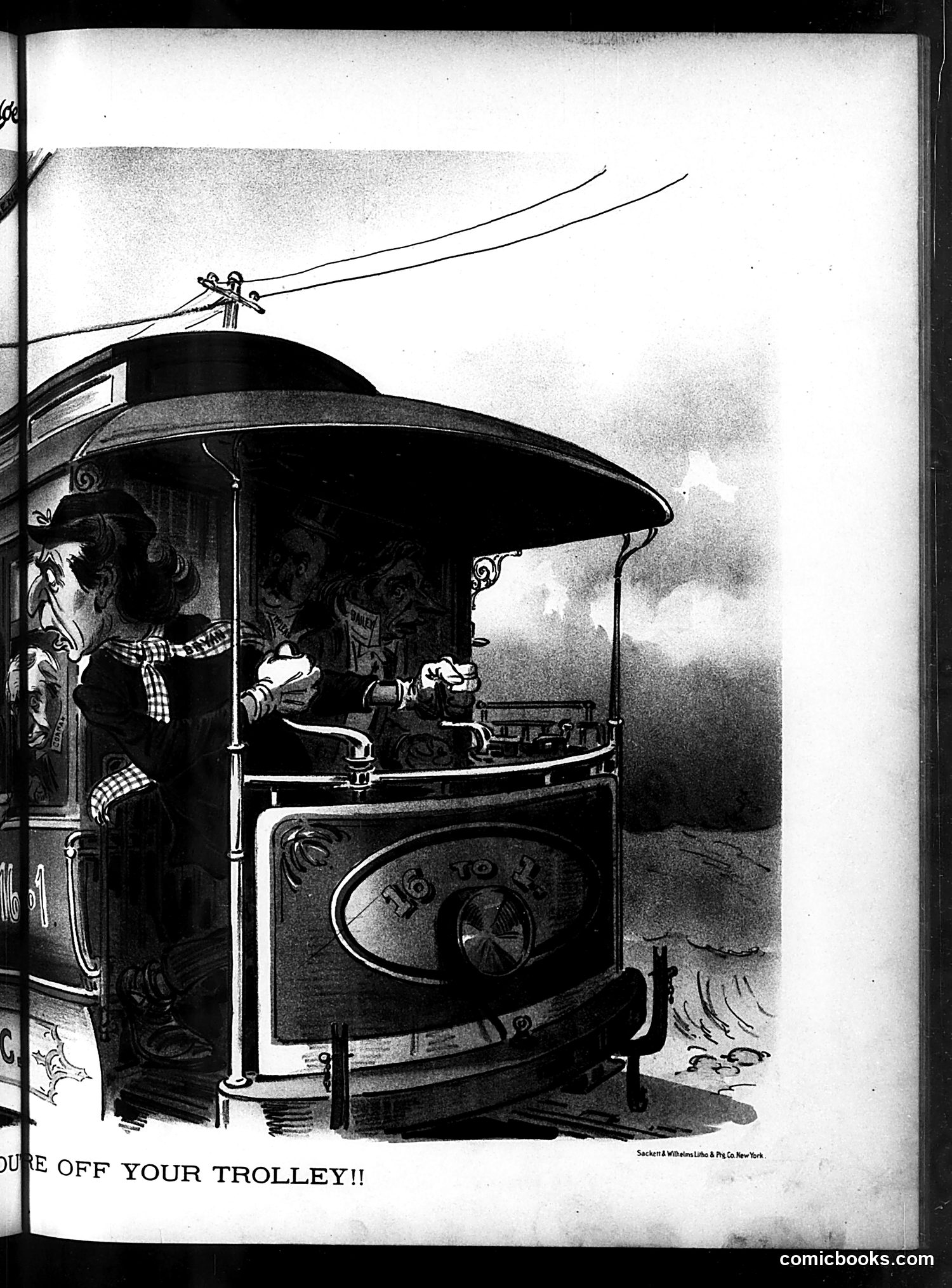
This appears to be a satirical cartoon about electric trolley cars, which were a modern transportation technology in early-20th-century America. The phrase "off your trolley" was contemporary slang meaning "crazy" or "out of your mind." The cartoon depicts passengers inside a trolley car with exaggerated, distressed expressions. The caricatured figures likely represent ordinary commuters, possibly including ethnic stereotypes common to Judge magazine's era. The joke seems to satirize either the chaos of crowded urban transit, the danger or discomfort of riding trolleys, or possibly public anxiety about this new technology. The overhead electrical lines are visible at top, emphasizing the trolley's modern, somewhat unfamiliar electrical systems—which may have contributed to period anxieties about safety or propriety around this new form of public transportation.
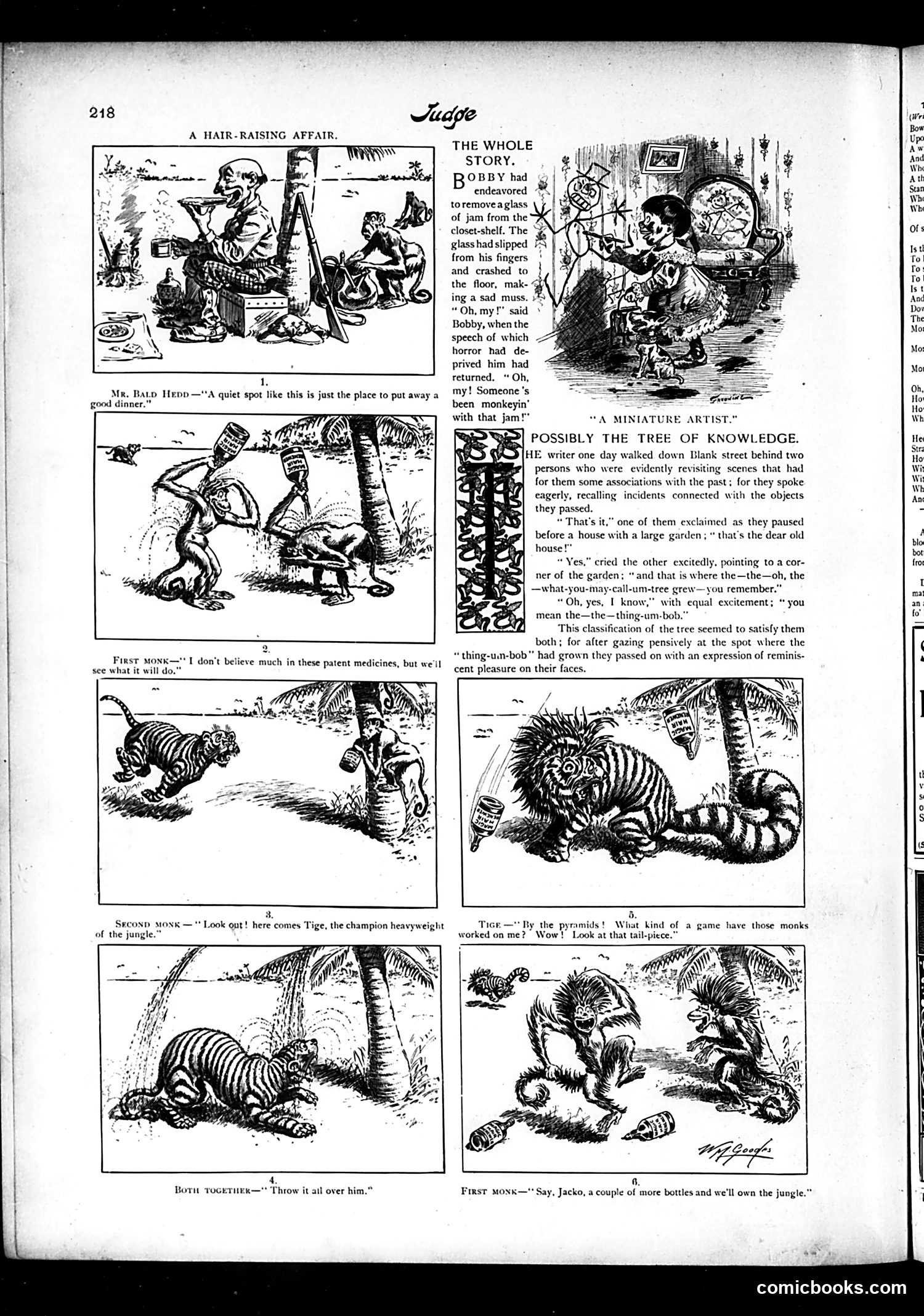
This page contains two separate humorous pieces: **"The Whole Story"** (top): A brief comic about Bobby breaking a jam jar. It's a simple domestic humor piece with no political content—just a child's accident and his colorful reaction. **"Possibly the Tree of Knowledge"** (center): Two people revisit an old neighborhood, trying to recall a significant tree from their past. They can't remember its name, settling on vague terms like "thing-um-bob." The satire targets human memory and nostalgia—how people romanticize the past while unable to recall specific details. The "Tree of Knowledge" title suggests this tree held personal significance, now largely forgotten. **The Monkey Comics** (bottom): A series of cartoon panels depicting monkeys (appearing to be named Jacko, Tige, and others) in comedic situations involving bottles and jungle behavior. These appear to be straightforward animal humor with no deeper satirical meaning—typical early Judge entertainment content using animals for slapstick comedy. The page overall mixes domestic humor, nostalgic satire, and animal comics—representative of Judge's varied comedic offerings.
This page is primarily a collection of advertisements and short satirical pieces rather than a single coherent cartoon. The main literary content is "The Woman with the Broom," a poem about an exhausted housewife worn down by domestic labor. The piece uses her as a symbol of women's oppression, asking rhetorically who made her a "slave to sweeping and soap." The poem's final stanza suggests a political warning: when these overworked women gain voting rights, they will "sweep away the dust of centuries" and overturn existing social structures built on "cant of politics" and "hypocrisy and greed." This reflects early-1900s anxieties about women's suffrage—the piece uses the housewife's condition to both sympathize with women's burdens and express concern about their potential political power. The rest of the page contains typical period advertisements for whiskey, perfume, pianos, soap, and patent medicines, interspersed with brief humorous anecdotes.
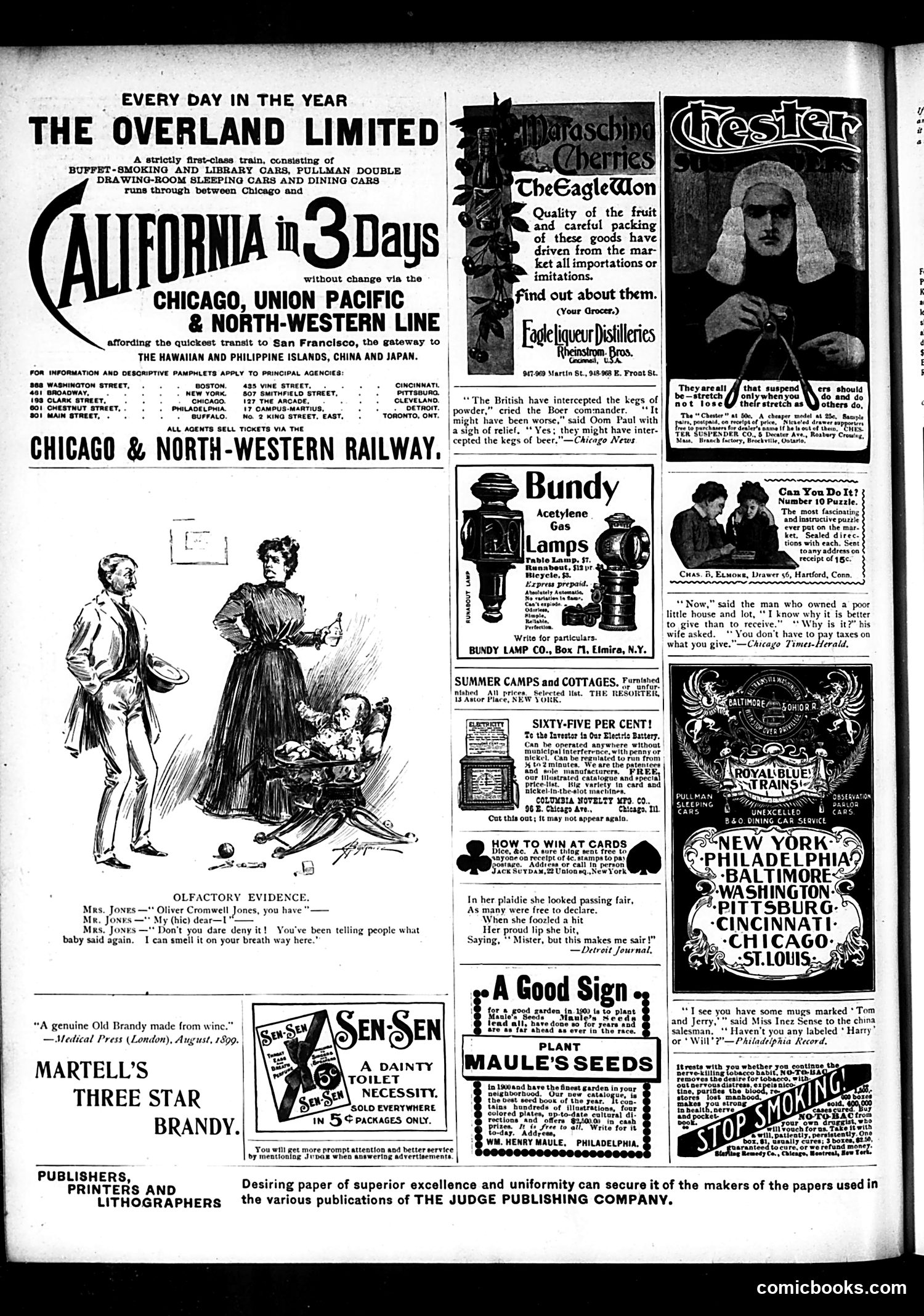
This page is primarily **advertising**, typical of Judge magazine's revenue model. The dominant feature is a large railroad advertisement for "The Overland Limited" train service via Chicago & North-Western Railway, promoting 3-day passage to California and connections to Hawaii, Philippines, China, and Japan—reflecting American imperial interests of the era. The small cartoon labeled **"Olfactory Evidence"** depicts a domestic scene where a wife confronts her husband (Oliver Cromwell Jones) about drinking, claiming she can smell it on his breath. The humor relies on the wife's accusatory tone and the husband's apparent denial or sheepishness. Other minor content includes jokes referencing the Boer War (British intercepting "kegs of powder"), domestic humor about taxation and charity, and scattered product advertisements (brandy, lamps, seeds, etc.). The page lacks sophisticated political satire—it's primarily a commercial vehicle with light domestic humor typical of early 1900s Judge content.
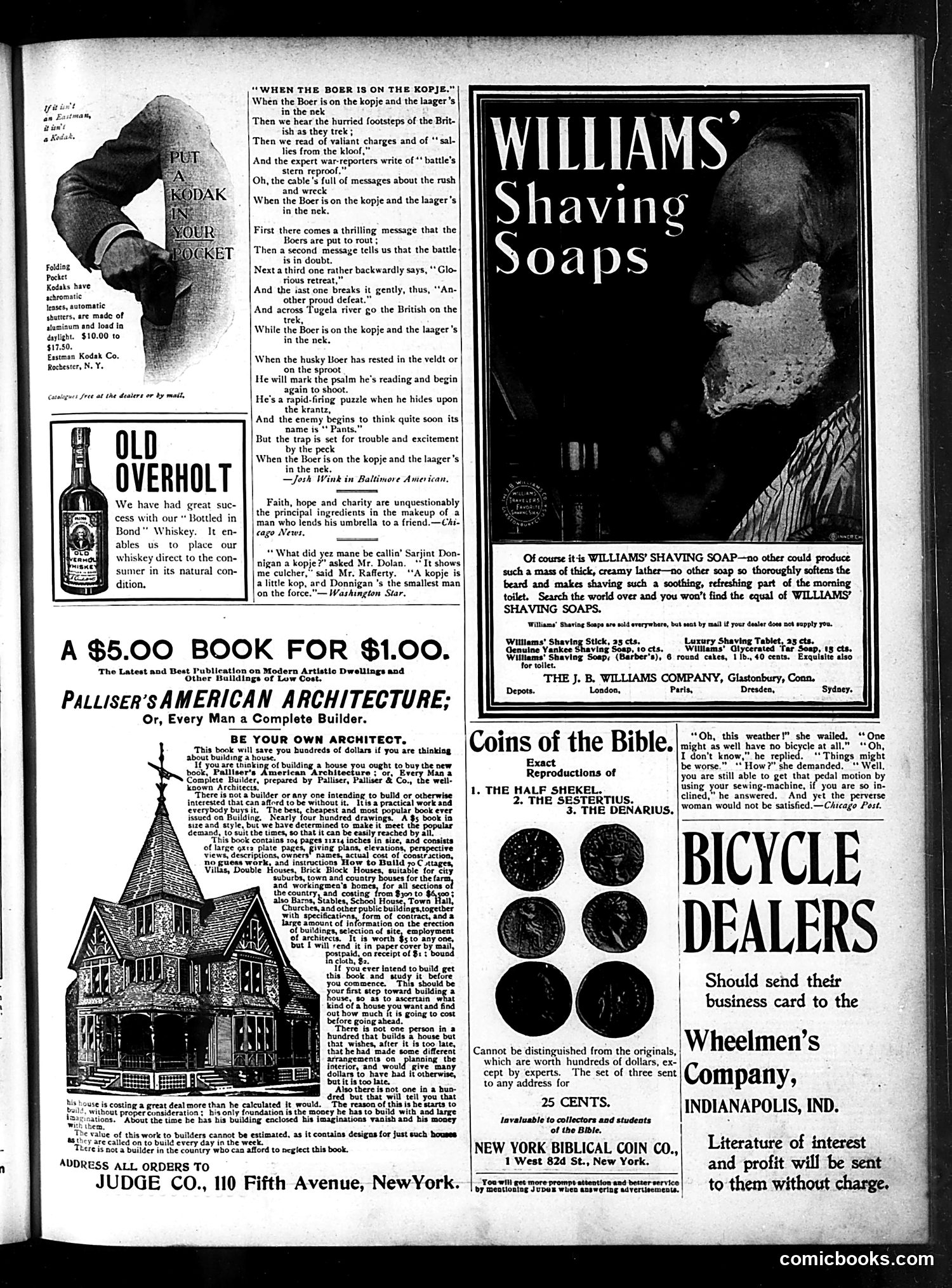
This page primarily contains **advertisements and verse rather than political cartoons**. The main content is a satirical poem titled "When the Boer Is on the Kopje," apparently by Josh Wink, referencing the **Second Boer War** (1899-1902). The poem mocks British military incompetence during the conflict with the Boers (Dutch settlers in South Africa). It uses military terminology—"kopje" (hill), "laager" (fortified camp), "krantz" (cliff)—to satirize the repetitive cycle of British advances followed by retreats. The humor lies in the absurdity: contradictory war reports arriving in quick succession ("battle is in doubt," then "proud defeat"), suggesting either chaos or dishonest war correspondence. The remaining space features commercial advertisements (Kodak cameras, Old Overholt whiskey, architectural books, shaving soaps, bicycle dealers) typical of Judge's business model. The page is not primarily satirical commentary but rather a mixed editorial-advertising format common to period magazines.
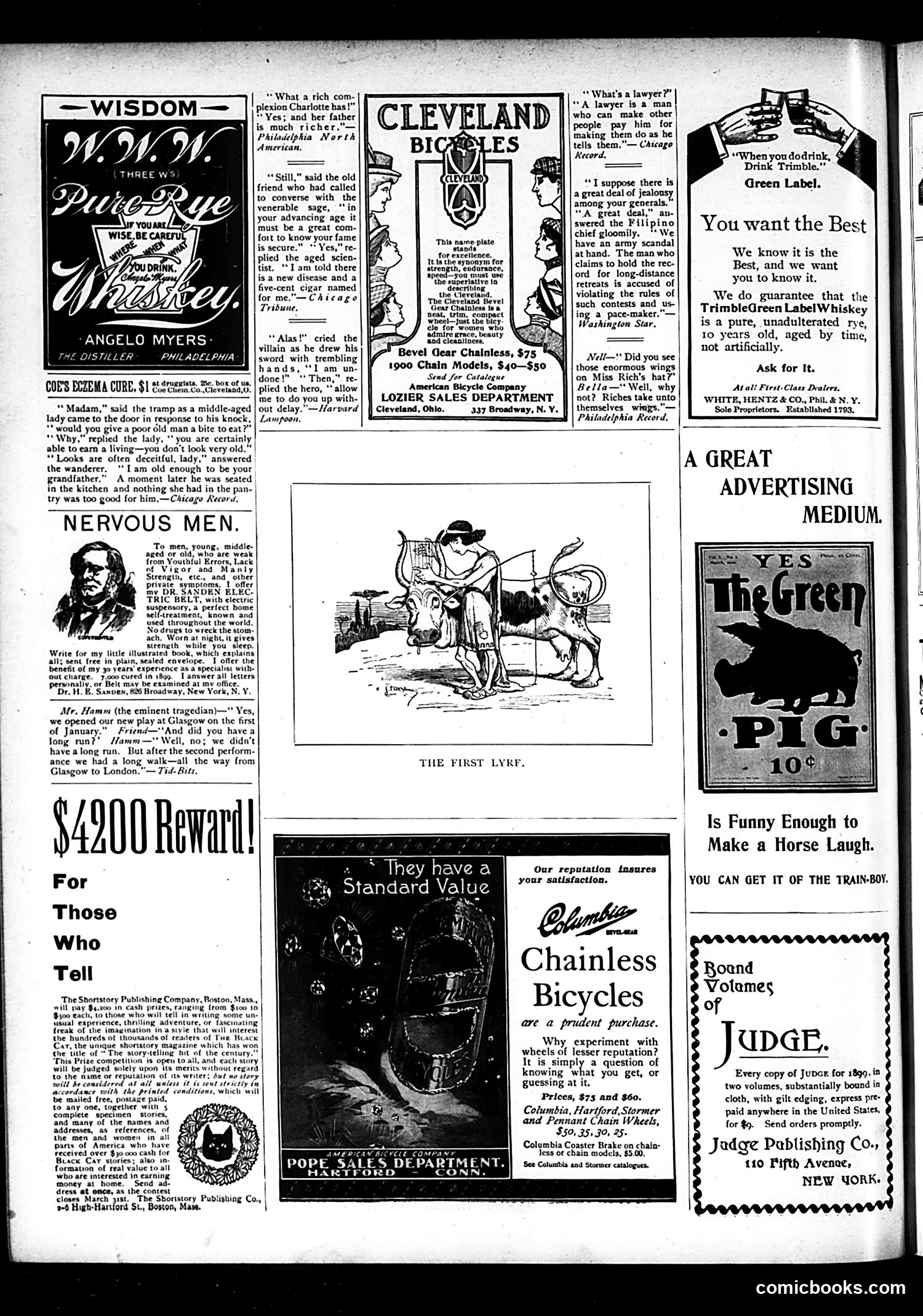
This page from *Judge* magazine contains primarily **advertisements and brief humorous anecdotes** rather than political cartoons. The main content includes: **"The First Lyrf"** — A sketch depicting a rustic figure playing a stringed instrument, illustrating a sentimental or comedic scene, though the joke's specific reference is unclear from the visible text. **Product advertisements** dominate: Cleveland Bicycles, Trimblegeen Whiskey, "The Green Pig" (a 10-cent publication), and Dr. Sanden's Electric Belt (a patent medicine for male sexual dysfunction — a common pitch in period publications). **Short jokes and anecdotes** scattered throughout mock various subjects: wealth, aging, theatrical failures, and professions. For instance, one jokes that a scientist has a disease and cheap cigar named after him — satirizing how fame can be trivial or embarrassing. The page reflects *Judge's* format as a humor magazine mixing social satire with commercial advertising, aimed at middle-class readers. The content is light rather than pointed political commentary.
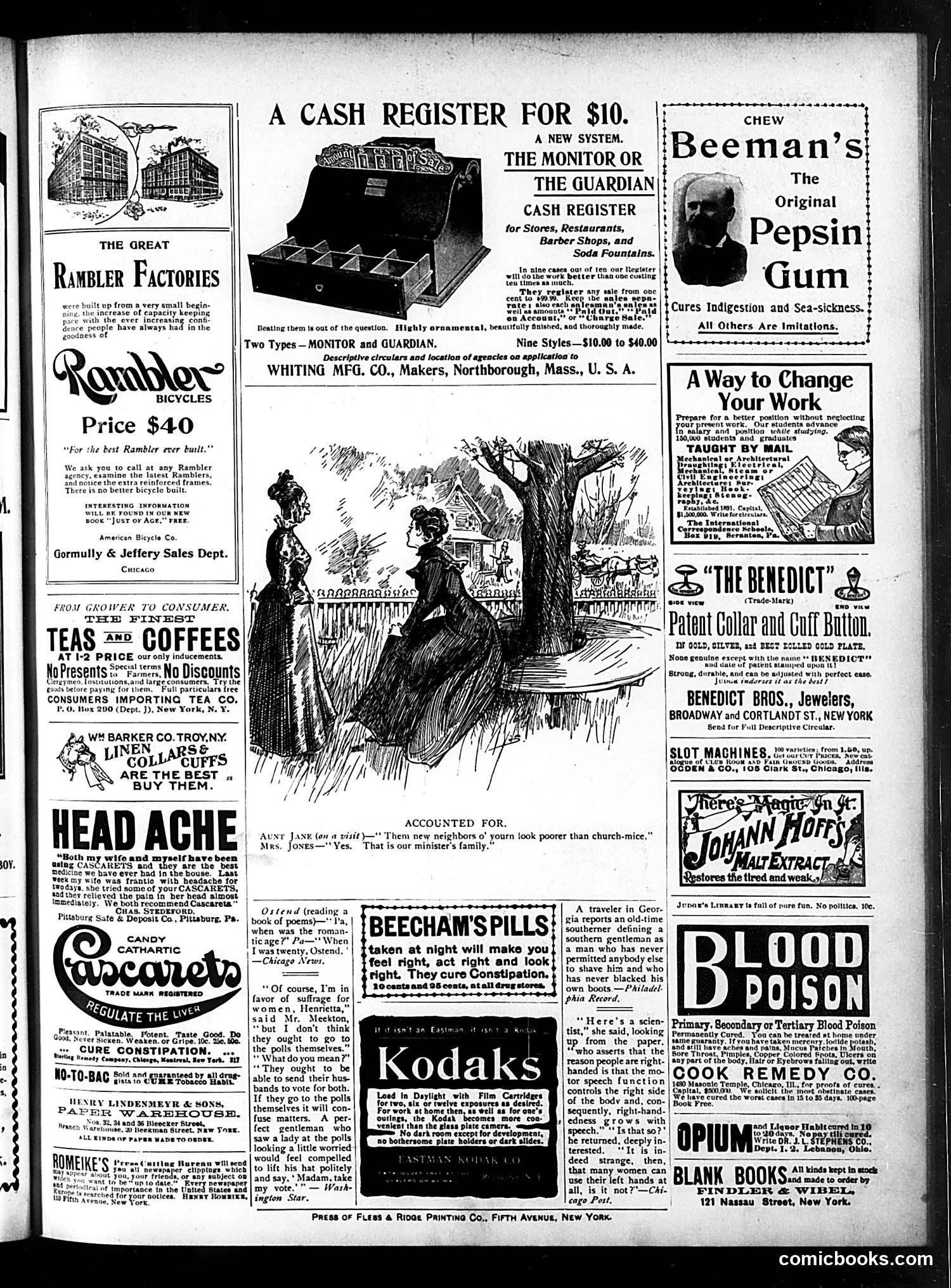
This page is primarily **advertising**, typical of Judge magazine's revenue model. The central cartoon depicts a domestic scene labeled "ACCOUNTED FOR," showing a minister's family appearing poor—a gentle social commentary on clerical wages. The page features numerous patent medicines and consumer products advertised to early 1900s readers: - **Beeman's Pepsin Gum** promises to cure indigestion and seasickness - **Beecham's Pills** advertise constipation relief - **Blood Poison** remedy (likely mercury-based, reflecting period treatments for syphilis—a delicate topic handled obliquely) - **Opium** products for various ailments - Cash registers, bicycles, tea, and jewelry The advertisements reveal period anxieties: digestive problems, patent medicine dependency, and unregulated health claims. Most products lacked scientific validation; some contained dangerous substances. The small dialogue jokes and illustrations scattered throughout reflect Judge's satirical voice, but this page prioritizes commercial content over substantive political commentary.
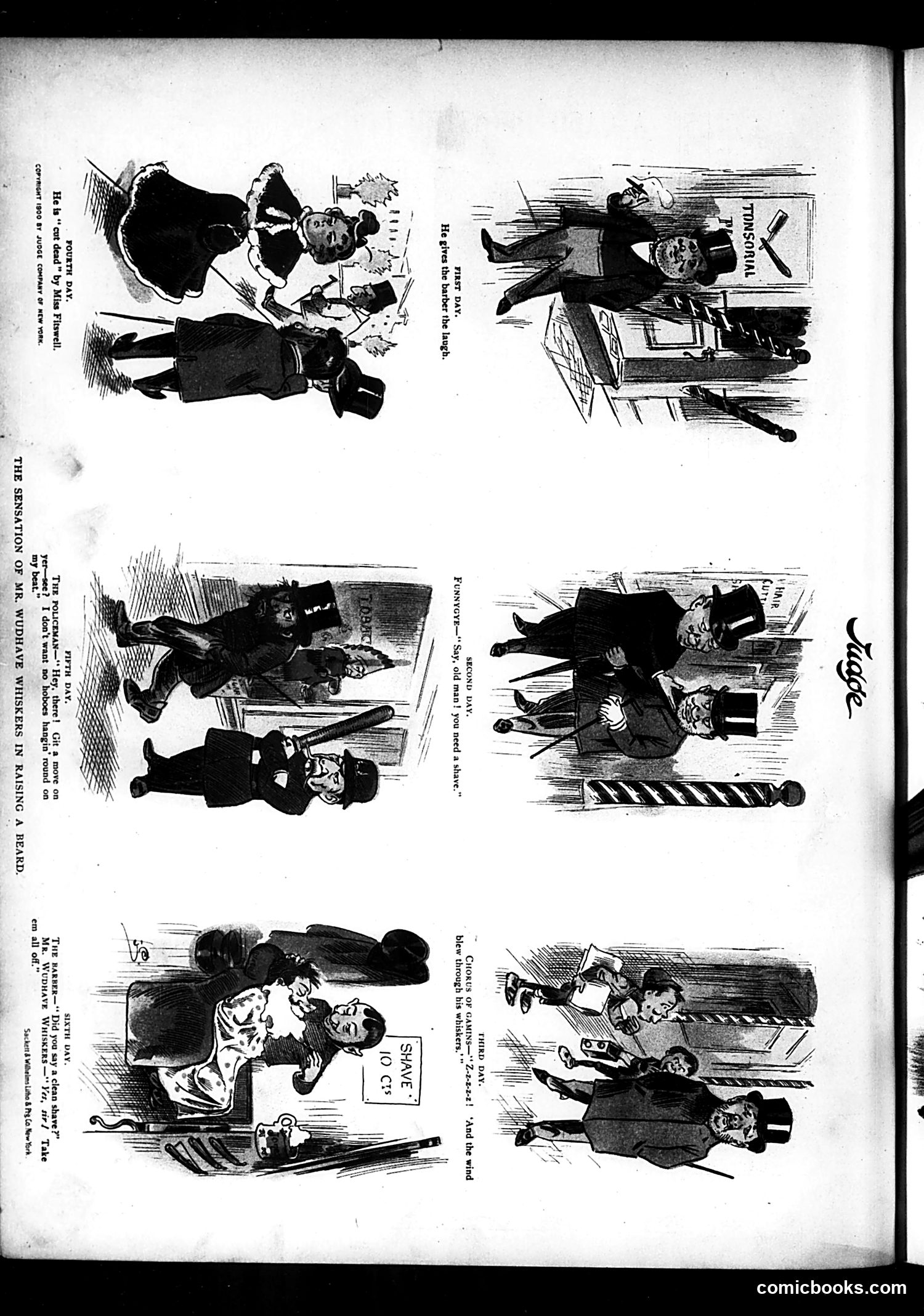
This 1900 Judge cartoon satirizes social consequences of facial hair fashion. The multi-panel sequence follows a man who refuses a barber's suggestion to shave, humorously depicting escalating social rejection: **Day 1-2:** The barber offers a shave; the man laughs it off. **Day 4:** A woman ("Miss Fitswell") deliberately snubs him ("cut dead"). **Day 6:** A policeman harasses him as a vagrant, suggesting his unkempt beard makes him appear homeless. The final panel shows him capitulating, requesting a complete shave. The joke reflects turn-of-the-century social anxiety about grooming standards and respectability. Facial hair—or lack thereof—signaled class and moral character. By the 1900s, clean-shaven faces were increasingly fashionable among respectable men, making a beard mark someone as socially undesirable or disreputable. The cartoon mocks how appearance-conscious society was, showing that refusing grooming norms brings real social consequences.