
A complete issue · 16 pages · 1900
Judge — March 31, 1900
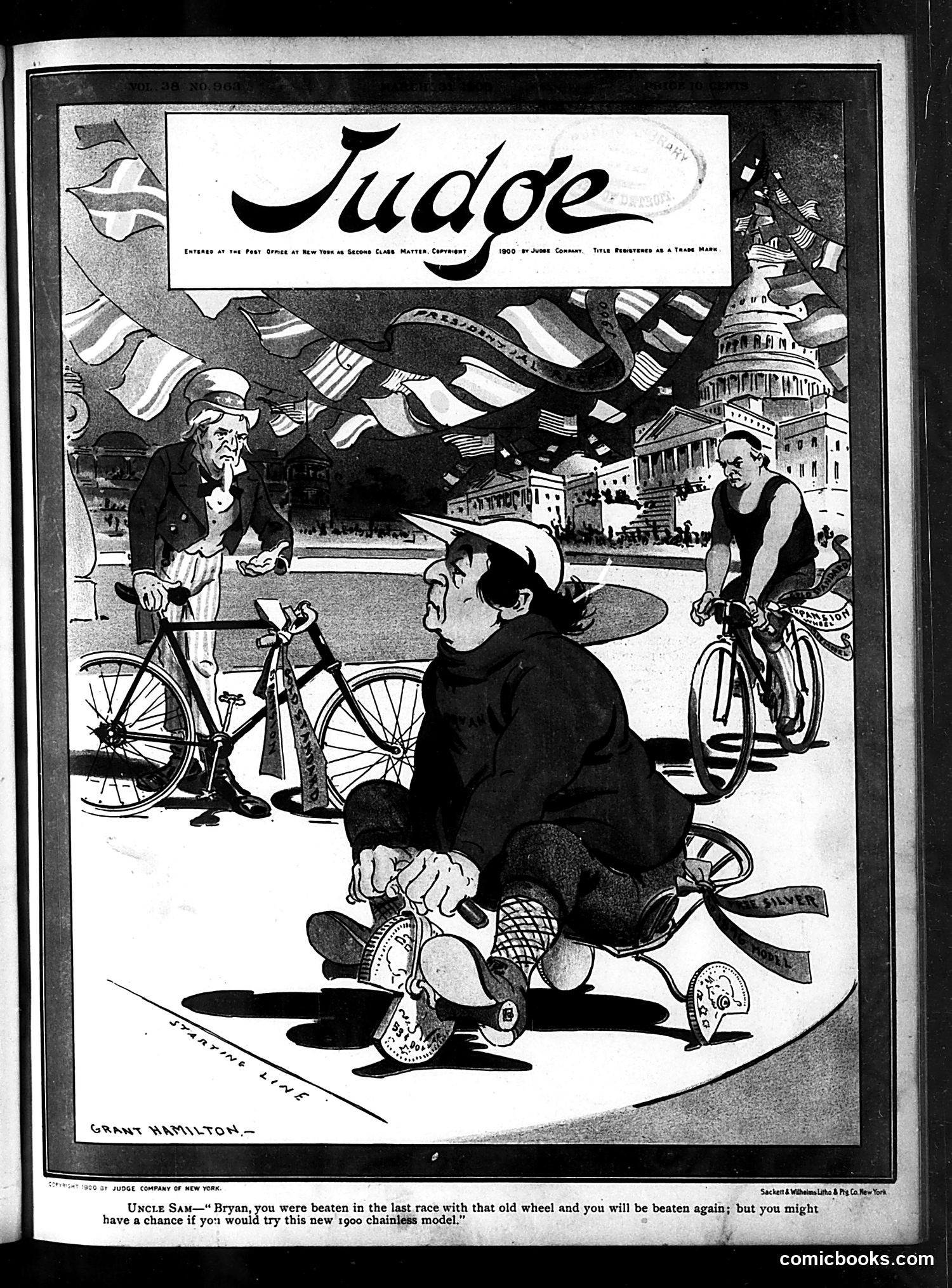
This cartoon by Grant Hamilton depicts Uncle Sam (the bearded figure in top hat, left) with a bicycle, being offered a new "1900 chainless model" by two other figures. The caption's dialogue suggests Uncle Sam lost a recent race using an old wheel and is being encouraged to try this newer technology. The satire likely references American politics around 1900, with the bicycle representing political or economic policy. The Capitol building visible in the background emphasizes the political context. The figures appear to represent different political positions or parties debating whether America should adopt new approaches versus maintaining traditional ones—possibly relating to imperialism, industrial policy, or electoral strategy during this era.
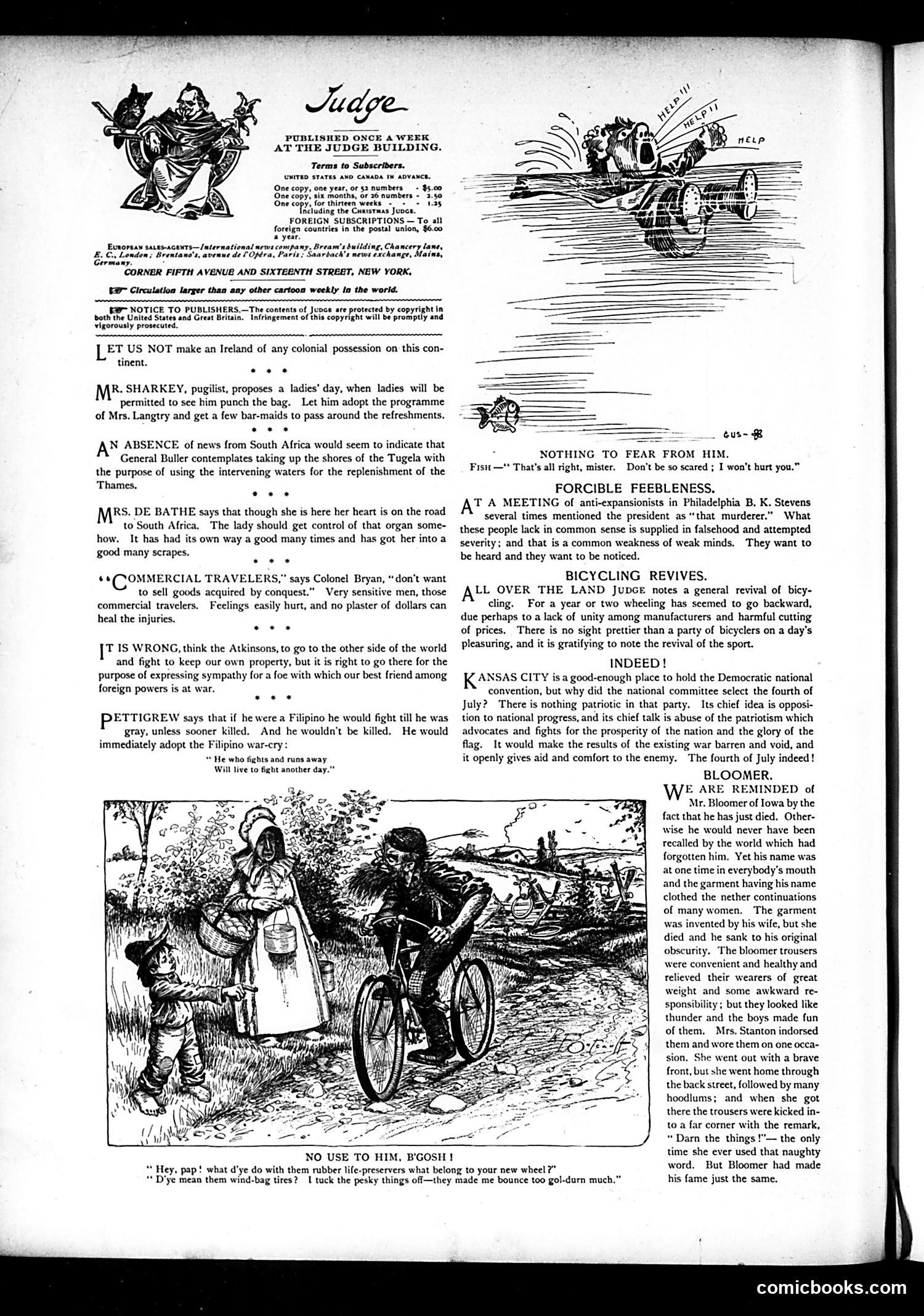
The page contains several editorial comments and two illustrations. The main cartoon depicts children with bicycles encountering what appears to be an adult—likely satirizing debates over bicycle safety and youth behavior that were prominent concerns during the cycling boom of the 1890s-1900s. The text sections address various topics: Irish colonial possessions, a proposed "ladies' day" featuring boxing ("punch the bag"), and criticism of expansionism regarding the Philippines and the Tugela River conflict, suggesting this is from the Boer War era (1899-1902). A lengthy section about "Bloomer" trousers—women's cycling attire—indicates the magazine was commenting on evolving social norms around women's fashion and activity. The overall page reflects Judge's satirical coverage of contemporary social and political controversies.
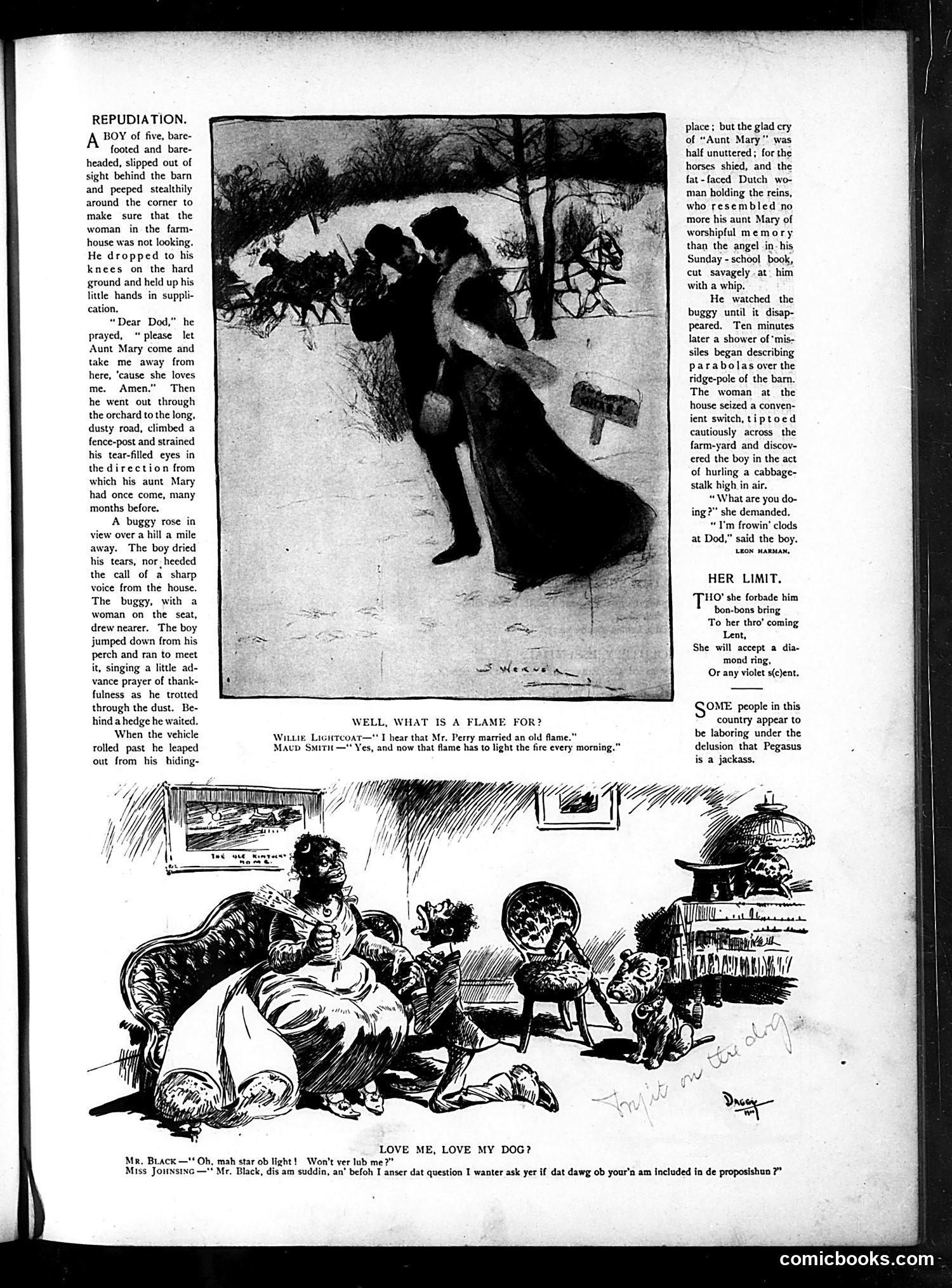
This page contains two distinct pieces: **"Repudiation" (top):** A sentimental story about a poor boy seeking his aunt Mary after months of separation. The narrative describes his emotional journey through the countryside and his eventual reunion—a straightforward, non-satirical narrative piece. **"Well, What Is a Flame For?" (bottom):** A cartoon joke about marriage. Willie Lightboat tells Maud Smith that Mr. Perry married "an old flame," and Maud quips she hopes he lights it every morning. Below, a comic illustration shows a domestic scene with dialogue from Mr. Black and Miss Johnstone making crude jokes about wives and dogs—typical early 20th-century humor about marriage being burdensome. The humor relies on treating marriage as a joke and wives as comparable to pets. The page appears primarily entertainment-focused rather than politically satirical.
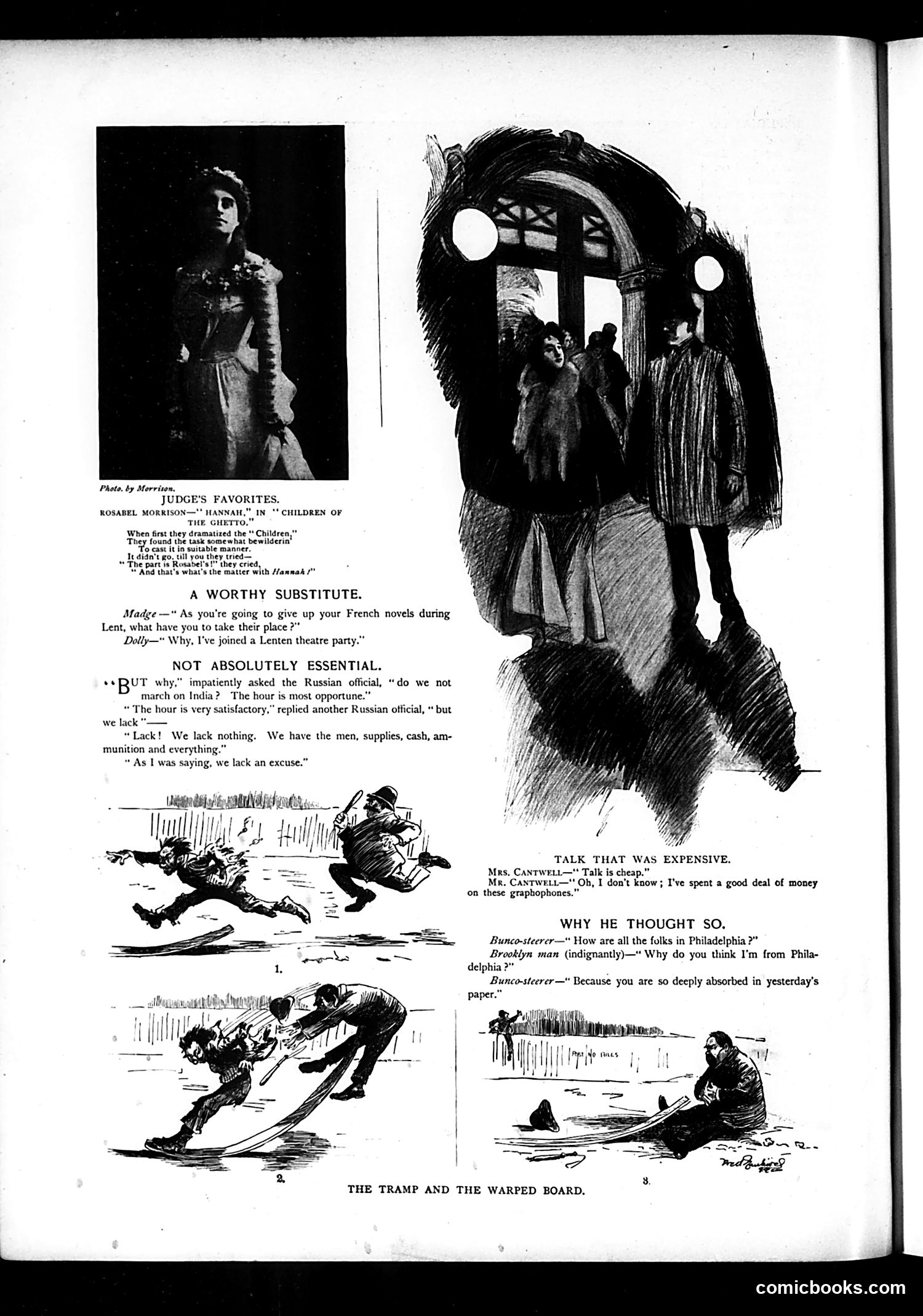
This page contains theatrical reviews and humorous sketches rather than political cartoons. The top photograph shows **Rosabel Morrison** as "Hannah" in a stage production of "Children of the Ghetto," with a caption praising her performance. Below are three separate joke sections with accompanying cartoon sketches: 1. **"A Worthy Substitute"** - A light joke about substituting French novels during Lent 2. **"Not Absolutely Essential"** - A satirical dialogue between Russian officials debating military strategy regarding India, mocking bureaucratic excuses 3. **"The Tramp and the Warped Board"** - Cartoon sketches (numbered 1-3) depicting a vagrant dealing with broken wooden planks, likely illustrating a humorous or pitiful situation The page appears to be entertainment-focused rather than explicitly political, using satire for social commentary on ordinary life and bureaucratic absurdity.
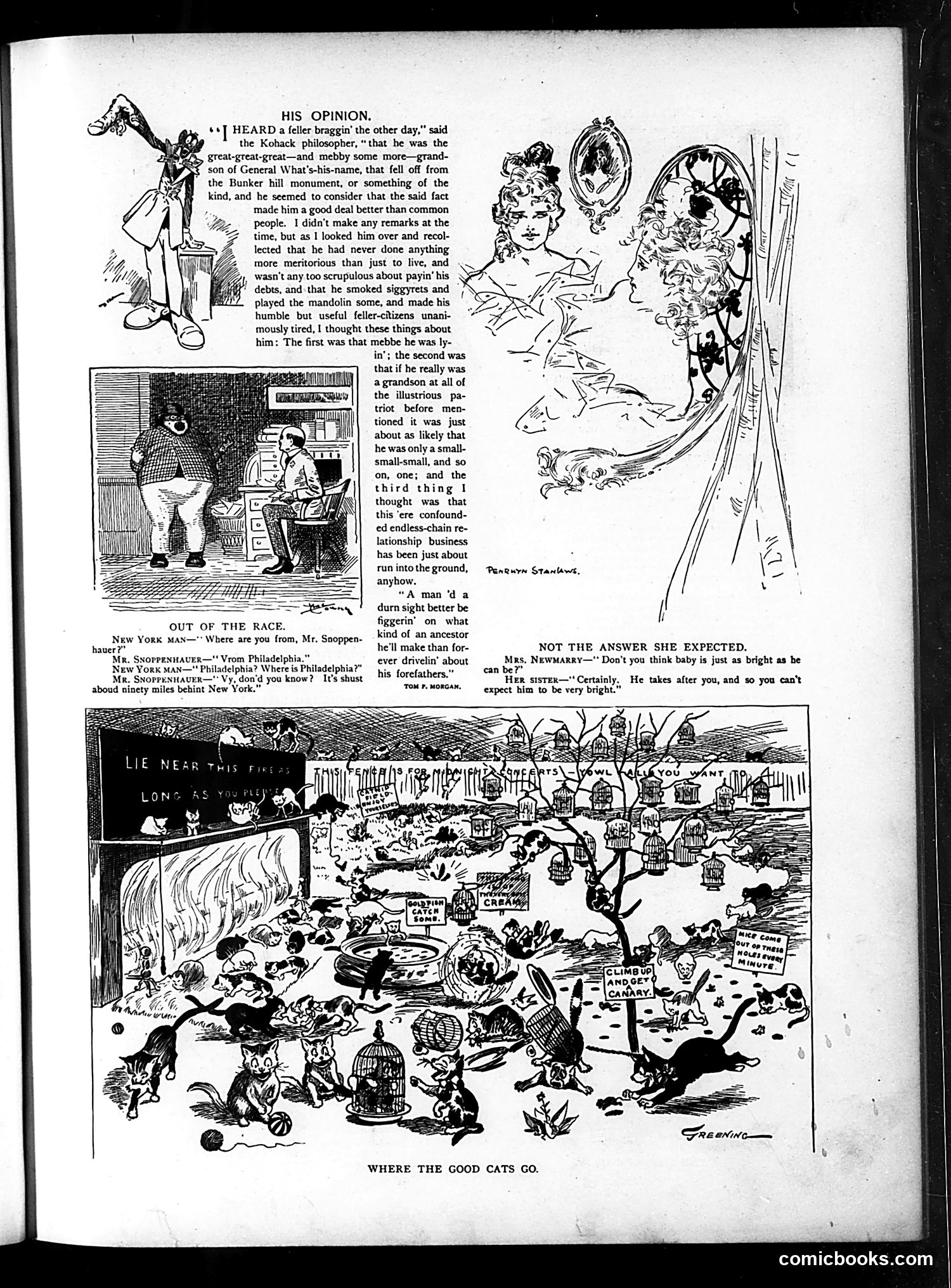
This page contains three separate satirical pieces: **"His Opinion"** mocks aristocratic pretension. A "Kobach philosopher" ridicules a man bragging about descending from a Revolutionary War general (who fell from Bunker Hill Monument). The satire argues that distant ancestry is meaningless—the descendant has done nothing meritorious, merely lived while accumulating debts and annoying people. The piece attacks Americans' obsession with genealogy and inherited status. **"Out of the Race"** is a brief ethnic joke. A New York man questions Mr. Snoppenhauser about Philadelphia's location, feigning ignorance. The humor relies on the character's apparent German accent and immigrant status—suggesting unfamiliarity with American geography. **"Not the Answer She Expected"** jokes about maternal blindness. A new mother asks if her baby is bright; her sister replies he takes after the mother, so he cannot be very bright—a backhanded insult. **"Where the Good Cats Go"** (bottom) is an elaborate illustrated scene of chaos, though specific details are unclear from the image quality provided.
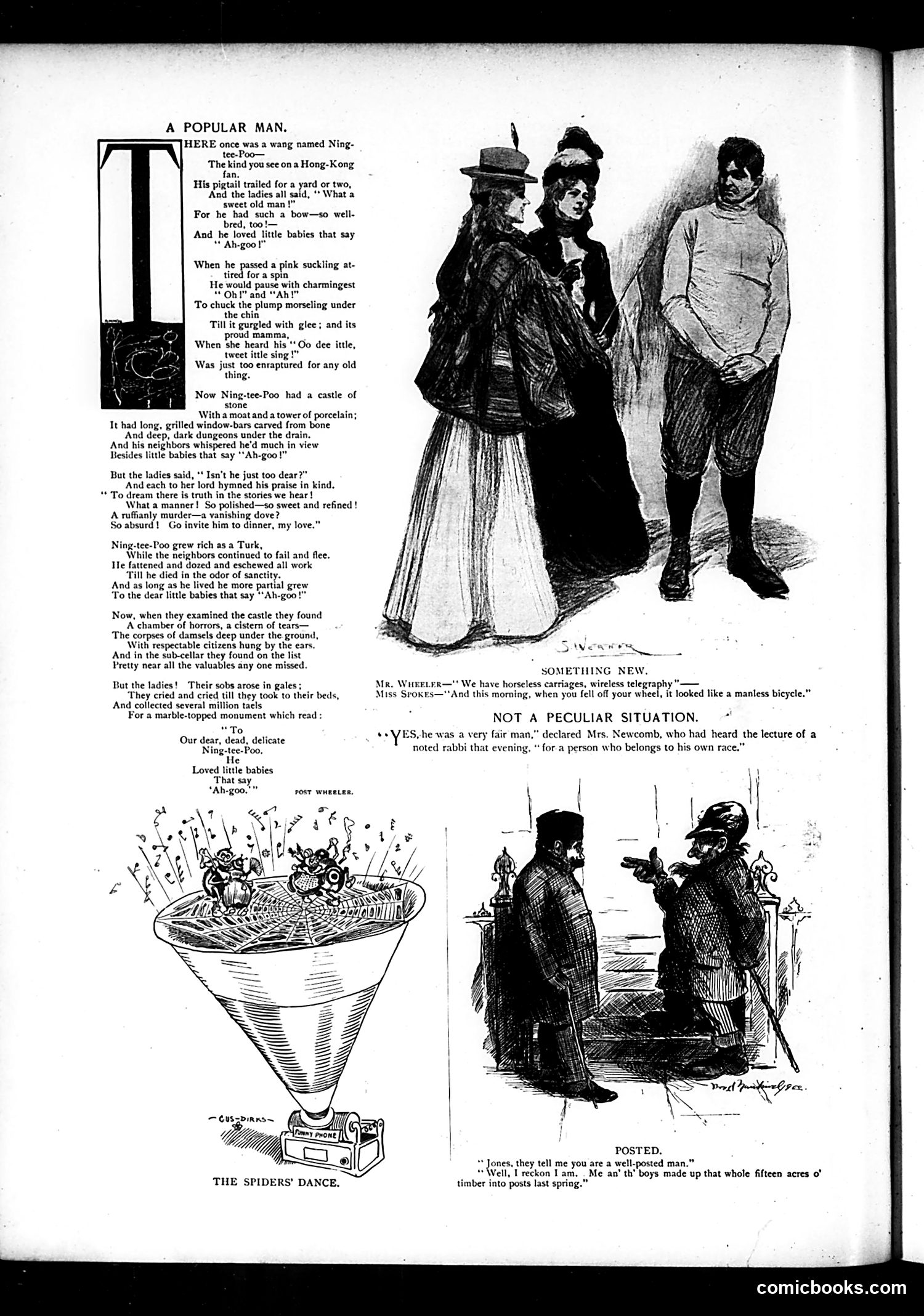
This satirical poem mocks Western naïveté about foreign cultures and the danger of judging by appearances. **Ning-tee-Poo**, a Chinese mandarin, cultivates a public persona as a genteel, baby-loving gentleman through affected mannerisms ("Oo dee ittle, tweet ittle sing"). Society ladies fawn over him despite neighbors' whispered warnings of murder and disappearances. The satire targets gullible high society: women dismiss obvious red flags (dungeons, vanishing people, murdered damsels) because his polished charm and courteous behavior seduce them into willful ignorance. When his castle is finally examined, it reveals chambers of horrors—yet the ladies' response is to erect a monument praising his affection for babies, missing the point entirely. The joke exposes how surface civility and exotic mystique can blind the privileged to moral reality, particularly regarding women's poor judgment and susceptibility to manipulation.
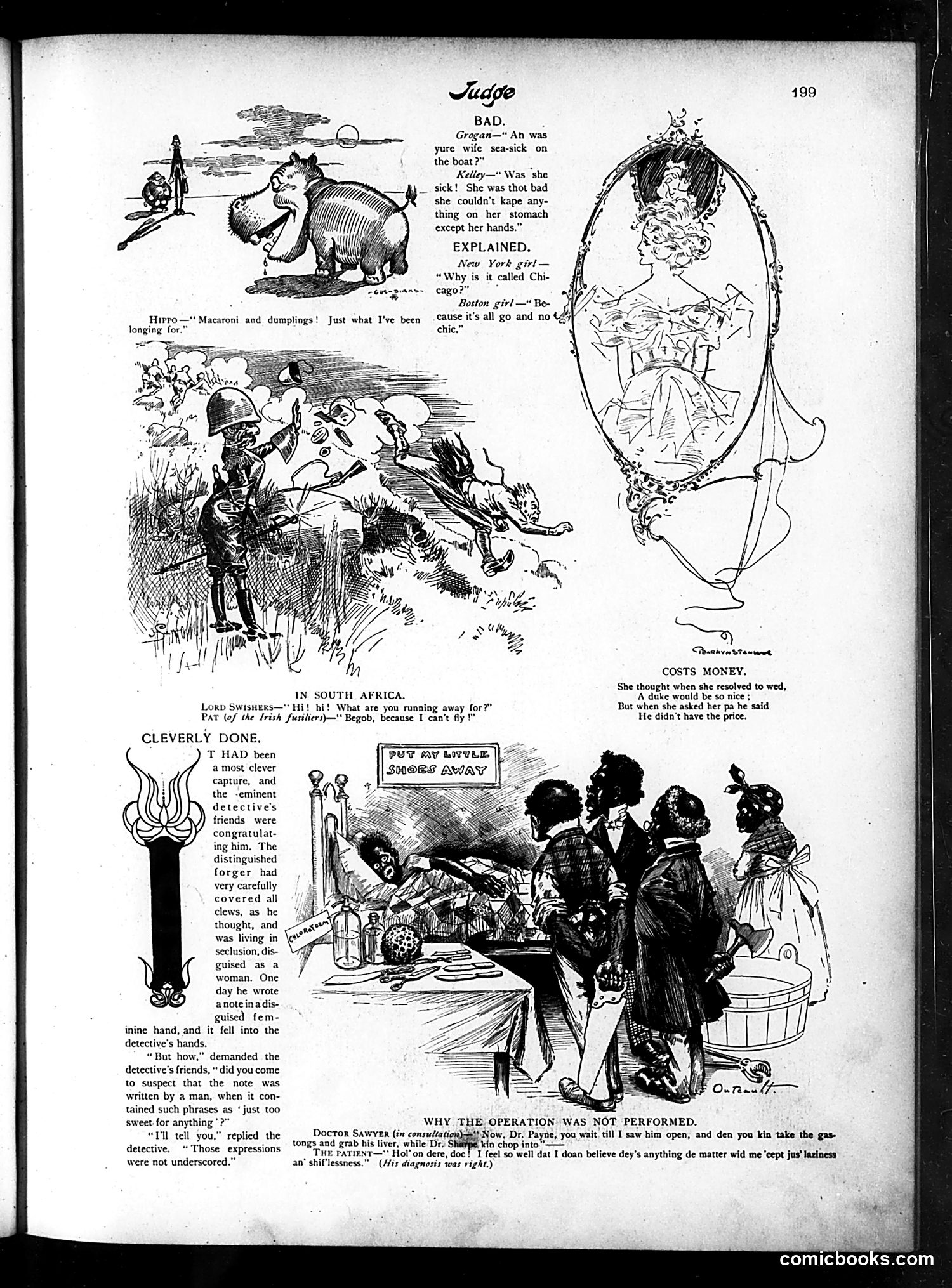
This page contains multiple satirical vignettes typical of early 20th-century American humor: **"Bad"** mocks Irish immigrants through dialect humor about seasickness. **"Explained"** jokes about regional American stereotypes—contrasting a New York girl's question about Chicago's name with a Boston girl's dismissive answer about the city lacking sophistication ("all go and no chic"). **"In South Africa"** references the Boer War, showing a British officer chasing an Irish soldier who claims he "can't fly"—satirizing Irish reluctance to fight Britain's colonial wars. **"Costs Money"** is a marriage joke: a woman wanted a wealthy duke but her father couldn't afford the dowry. **"Cleverly Done"** features a detective exposing a male forger disguised as a woman by noticing his use of feminine phrases like "just too sweet"—the humor relies on gender stereotype assumptions about language. **"Why the Operation Was Not Performed"** uses dialect humor with a Black patient refusing surgery, claiming laziness rather than actual illness. The page relies heavily on ethnic stereotypes and period prejudices now considered offensive.
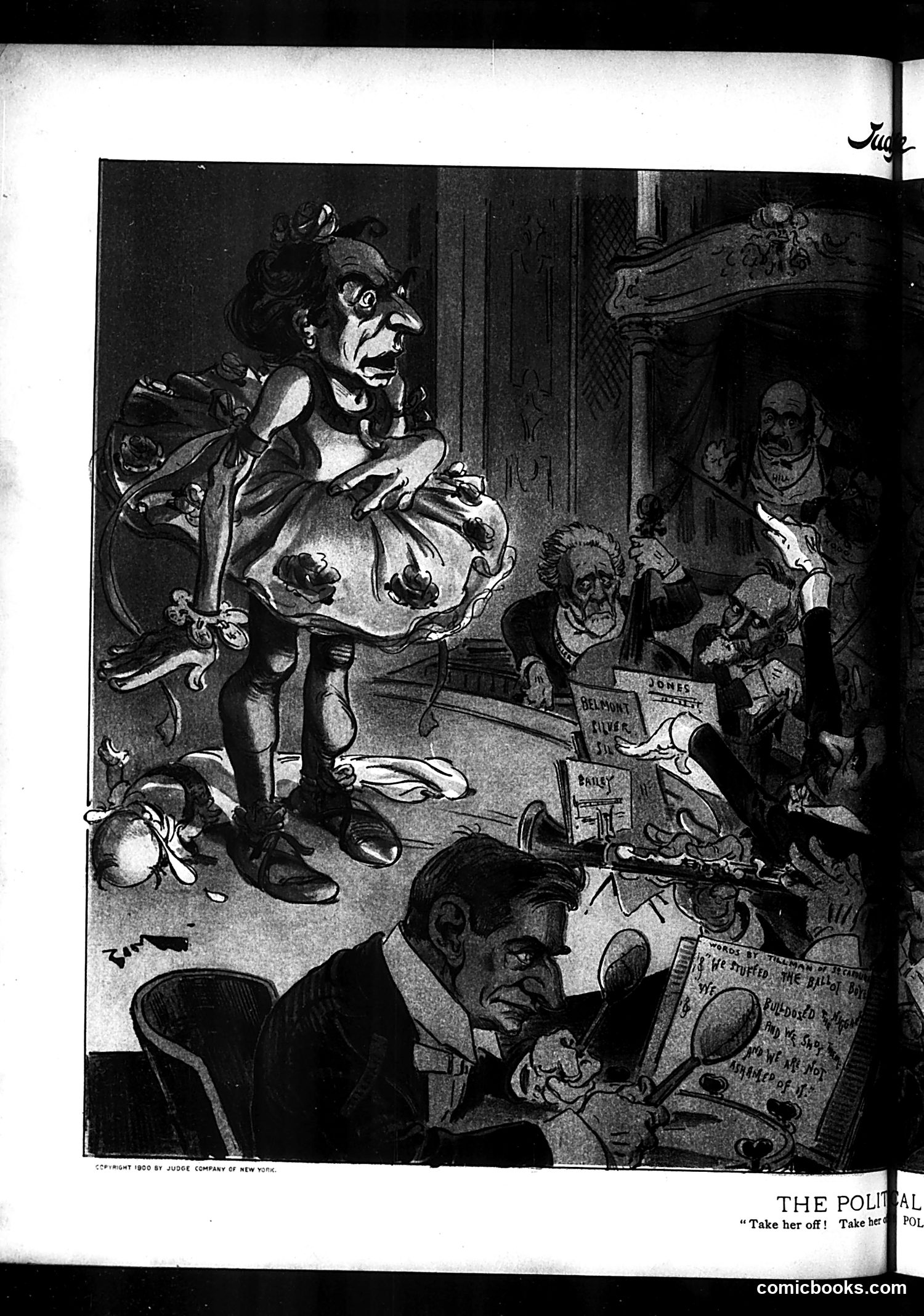
This is a satirical cartoon titled "THE POLITICAL" with the caption "Take her off! Take her—" The image depicts a caricatured female figure in exaggerated dress being displayed prominently, while several men in formal attire observe from the background, appearing distressed or scandalized. The cartoon appears to critique a female political figure or public personality through burlesque-style mockery. The men's shocked reactions suggest commentary on controversial behavior or inappropriate political conduct. Without clearer text or date information visible, the specific historical figure and event remain unclear, though the satire clearly targets political scandal or impropriety involving a woman in public life. The style is characteristic of early-20th-century satirical commentary using caricature and theatrical metaphor.
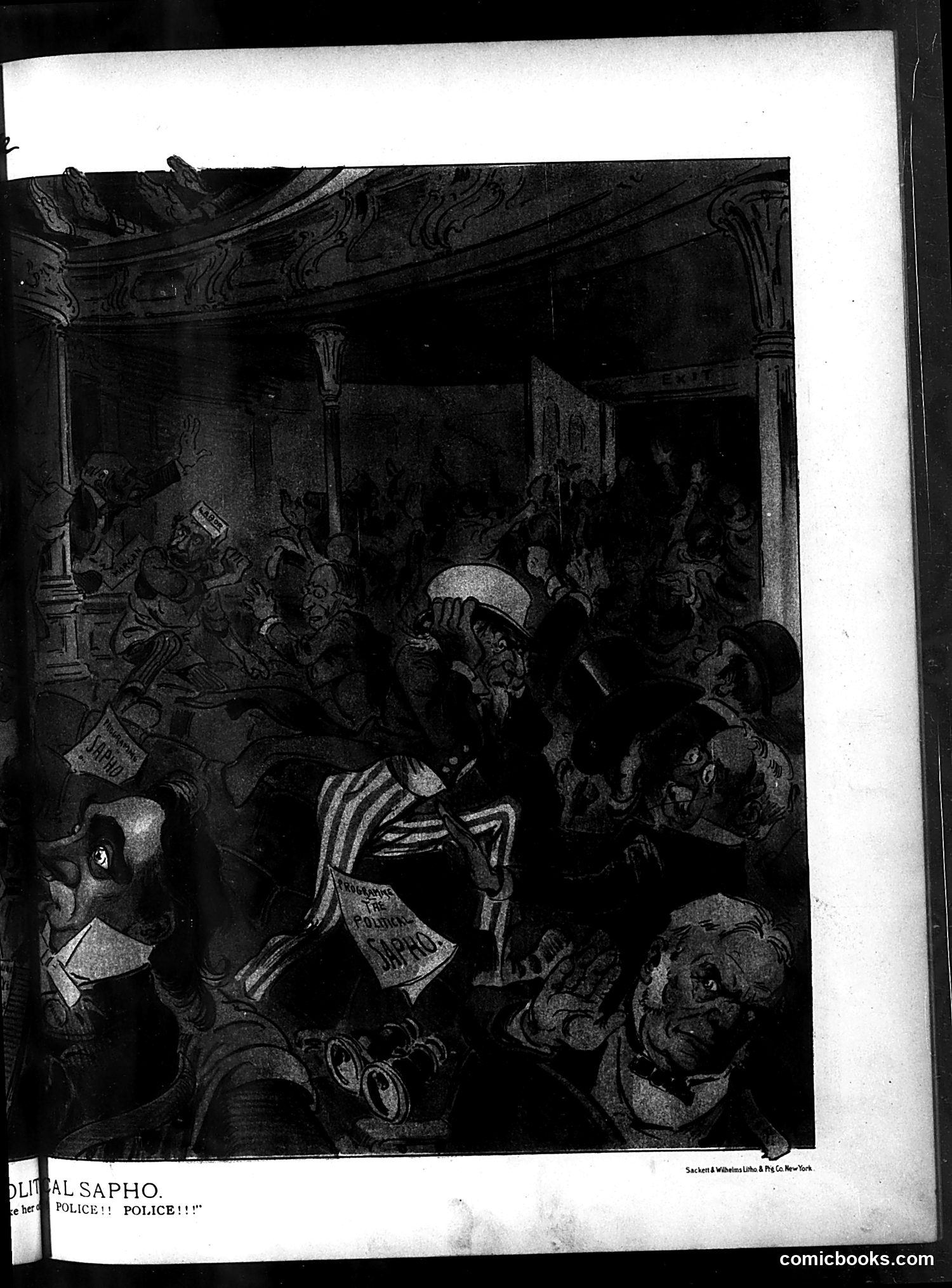
This appears to be a satirical cartoon from *Judge* magazine depicting a chaotic indoor scene. The visible text references "SAPPHO" and someone calling for "POLICE!!!" The cartoon likely satirizes a scandal or controversy involving someone associated with Sappho (the ancient Greek poet, or more likely a reference to sapphic/lesbian themes that were subjects of moral panic in late 19th/early 20th century America). The ornate setting and formally dressed figures suggest this mocks upper-class or theatrical society. However, **without knowing the specific publication date, I cannot identify the particular figure being caricatured or the exact scandal referenced.** The artistic style suggests early 1900s, but the specific political or social context remains unclear from the image alone.
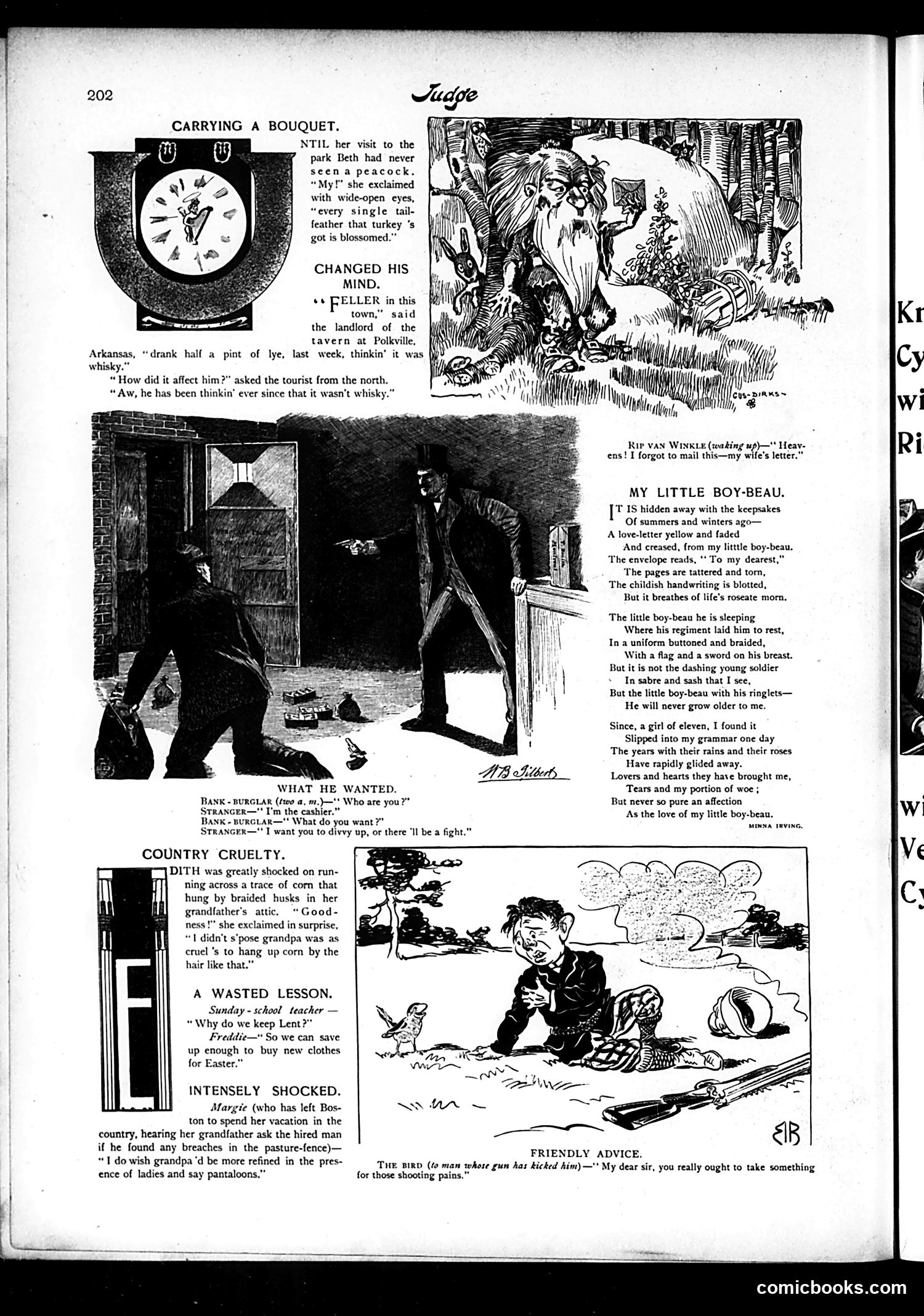
This page contains several brief humorous sketches typical of Judge's satirical style: **"Carrying a Bouquet"** jokes about urban ignorance—a city visitor mistakes a peacock for a "blossomed turkey," mocking unfamiliarity with nature. **"Changed His Mind"** is rural humor: a man drinks lye thinking it's whisky and survives, now perpetually confused about what he drank. **"What He Wanted"** depicts a burglar confronting a homeowner, with dark humor about robbery. **"My Little Boy-Beau"** is sentimental verse about a woman preserving a childhood love letter from a soldier who died in war (likely WWI-era, given the military references). **"Country Cruelty" and "Intensely Shocked"** mock city visitors' ignorance of rural life—misinterpreting corn storage and fencing terminology as cruel. **"Friendly Advice"** is a visual gag: a bird suggests the man with a kicked gun needs pain relief. The page emphasizes contrasts between urban sophistication and rural simplicity, typical Judge content blending sentiment with gentle mockery.
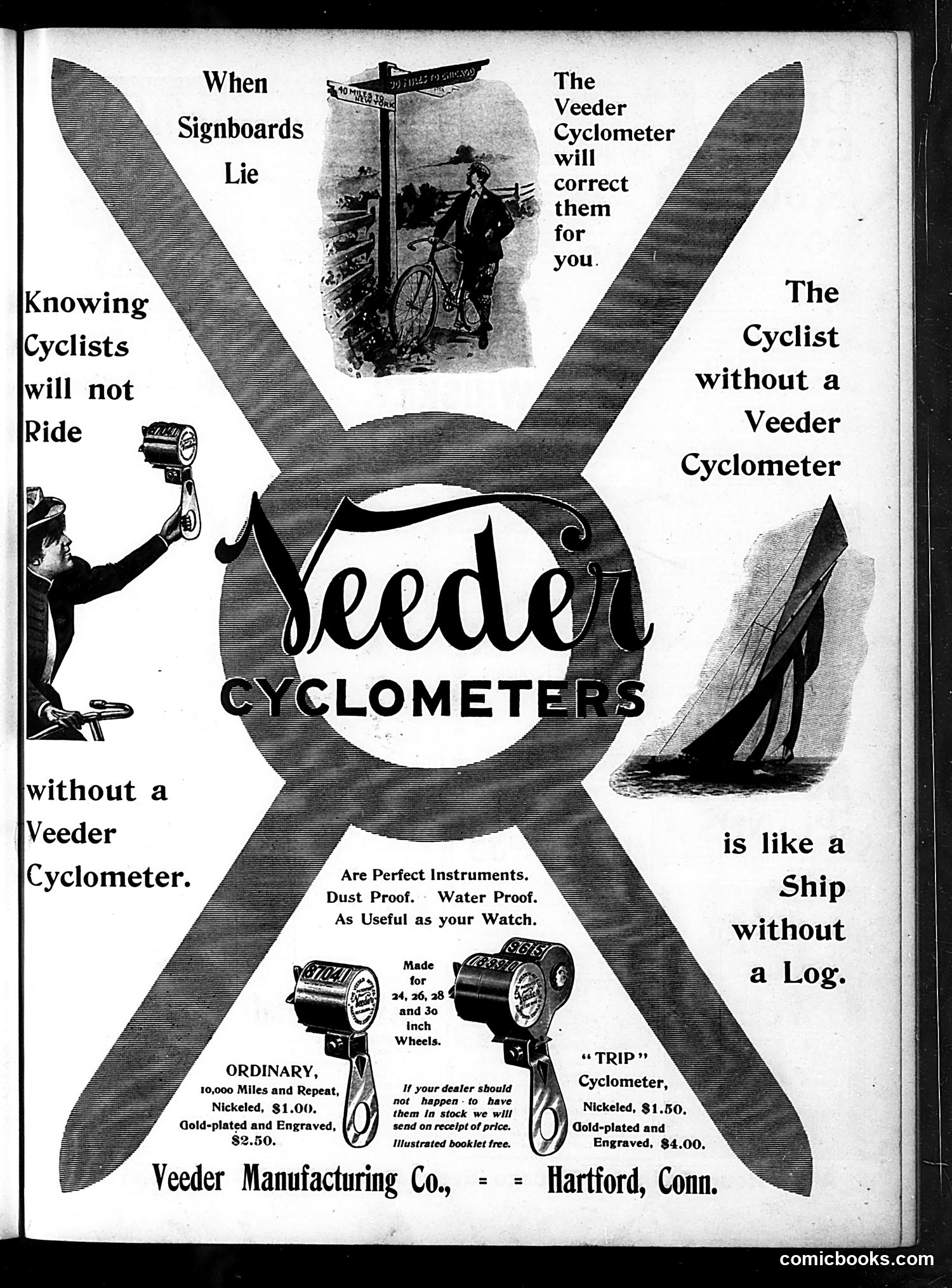
This is a **product advertisement**, not political satire. The Veeder Manufacturing Company of Hartford, Connecticut is marketing bicycle cyclometers—devices that measure distance traveled. The ad uses humorous comparisons to convince cyclists to buy the product: signboards lie about distances, so you need a cyclometer to verify them; cyclists without one are like ships without logs (navigation tools). The central "X" design frames product images and messaging about the cyclometer being "perfect," "dust proof," and "water proof." Pricing ranges from $1.00 (nickel-plated ordinary model) to $4.00 (gold-plated "Trip" version). This appears to be late 19th or early 20th-century advertising, when cycling was a popular recreational activity and such measuring devices were novel selling points.
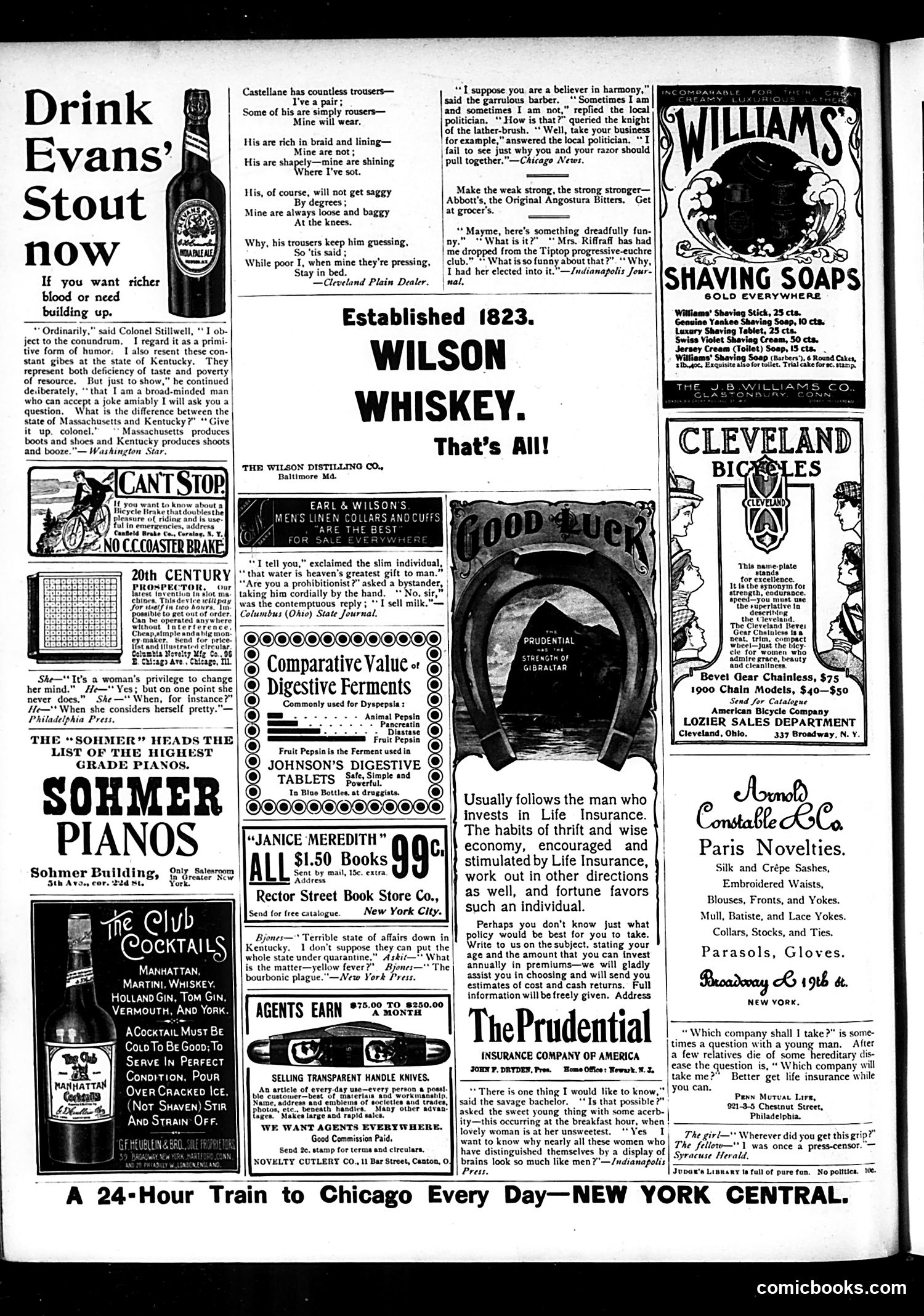
This page consists primarily of **advertisements and humorous filler content**, with limited editorial cartooning. The main satirical content appears to be brief jokes mocking **Kentucky**. One joke contrasts Massachusetts (producing "boots and shoes") with Kentucky (producing "shoots and booze")—a stereotypical jab at Kentucky's association with whiskey production and frontier violence. Another references quarantining Kentucky due to disease, with a pun about "bourbonic plague" (bourbon + bubonic). There's also a piece about **Castellane's trousers**, likely referencing a contemporary fashion or society figure, comparing expensive tailored pants to ordinary worn ones—gentle class-based humor. The bulk of the page features product advertisements (Evans' Stout, Wilson Whiskey, Sohmer Pianos, shaving soaps, knives, digestive tablets, and insurance), typical of Judge's revenue model. The visual cartooning is minimal; the page emphasizes text-based jokes and commercial messaging.
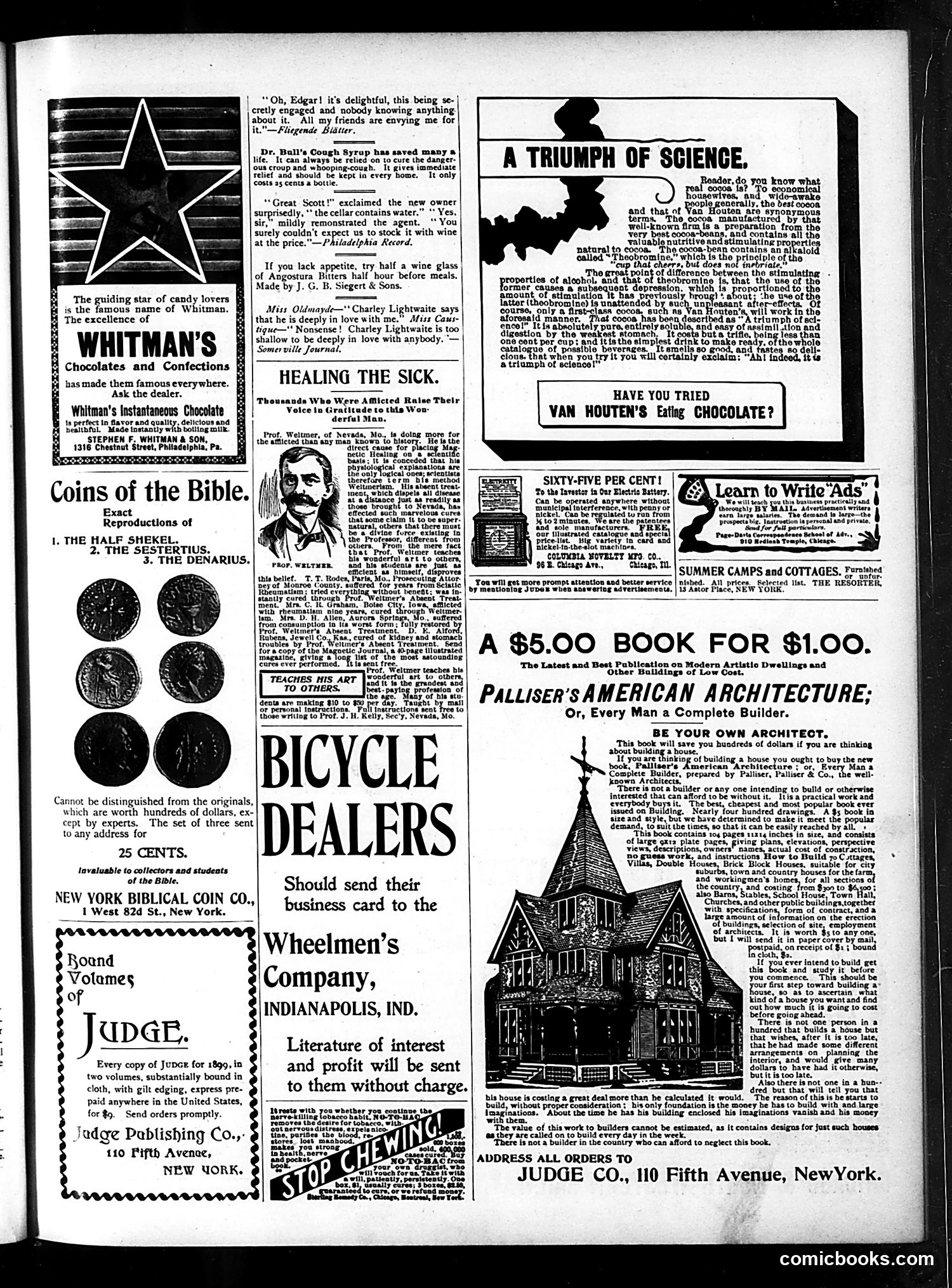
This is primarily an **advertising page** from Judge magazine, with minimal editorial content. The page consists almost entirely of commercial advertisements for various products and services typical of the 1890s-early 1900s era. Notable advertisements include: - **Whitman's Chocolates** (Philadelphia confectioner) - **Biblical coins** (replica ancient coins for collectors) - **Dr. Ball's Cough Syrup** and other patent medicines - **Prof. Weltmer's healing services** (a prominent mail-order medical practitioner claiming distance healing abilities) - **Palliser's American Architecture** (self-help building guide) - **Judge Publishing** (bound volumes of back issues) The page includes a few humorous short jokes/captions (likely reprinted from other sources like *Fliegende Blatter*), but these are minor. The "Healing the Sick" section appears to be paid advertising rather than editorial satire. This reflects Judge's business model: advertising revenue subsidized the publication of satirical content elsewhere in the magazine.
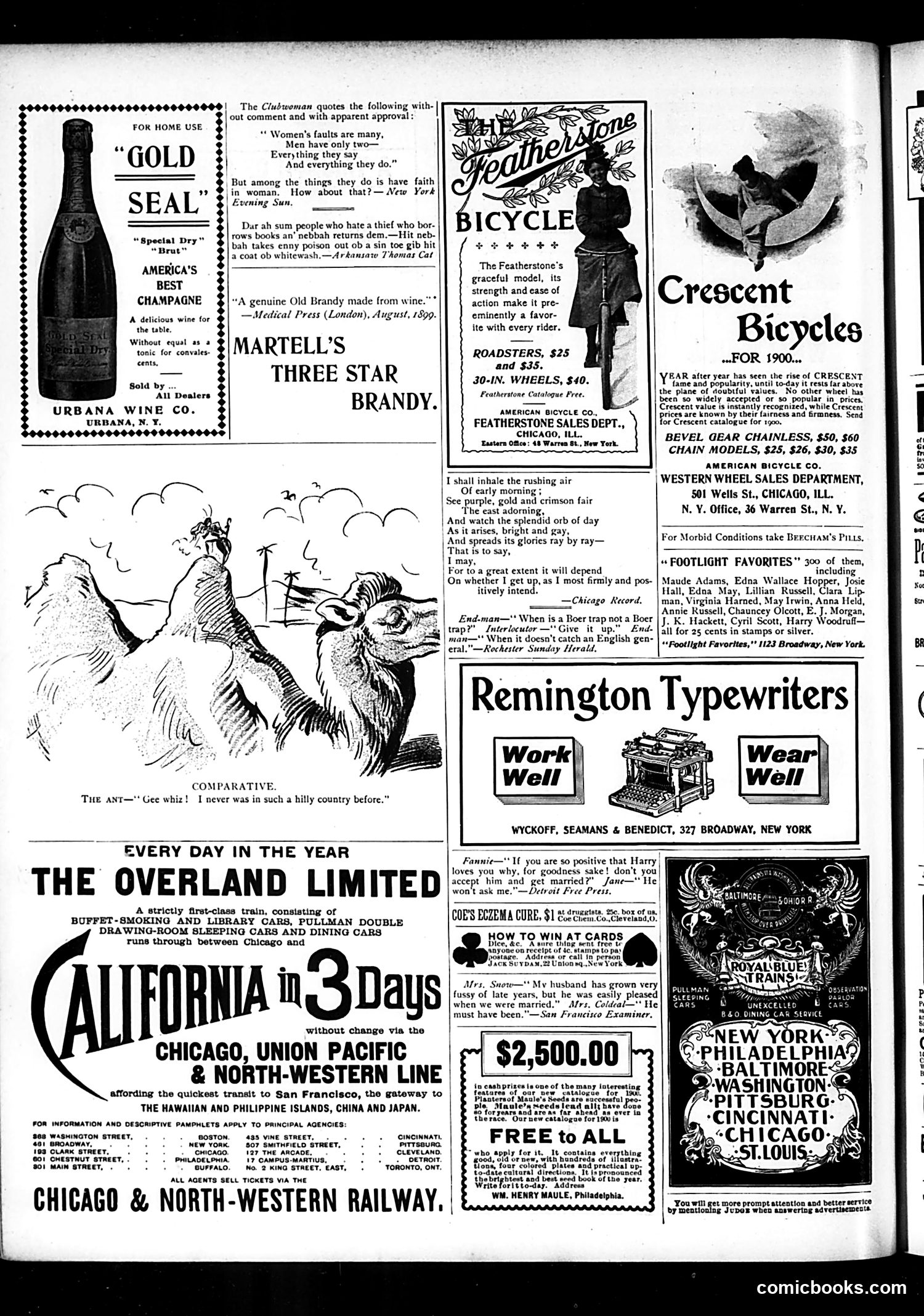
This page is primarily **advertising**, with minimal political cartoons. The notable content includes: **The cartoons present:** - A small comparative joke about an ant in "hilly country," satirizing simple-minded observation - Several brief humor exchanges mocking gender relations ("Women's faults are many, / Men have only two—/ Everything they say / And everything they do"), reflecting early 1900s attitudes toward women's roles **Historical context:** The page reflects turn-of-the-century American concerns: the Philippines conflict (referenced in railroad advertising), bicycles as new technology, and domestic gender dynamics. The "Clubwoman" quote suggests satirizing women's organizations gaining social prominence. **Dominant content:** The page is overwhelmingly commercial—advertisements for champagne, brandy, bicycles, typewriters, railroads, and patent medicines dominate. This reflects Judge's business model and the era's advertising landscape. **Verdict:** This is a typical Judge page mixing light social satire with commercial interests rather than focused political commentary.
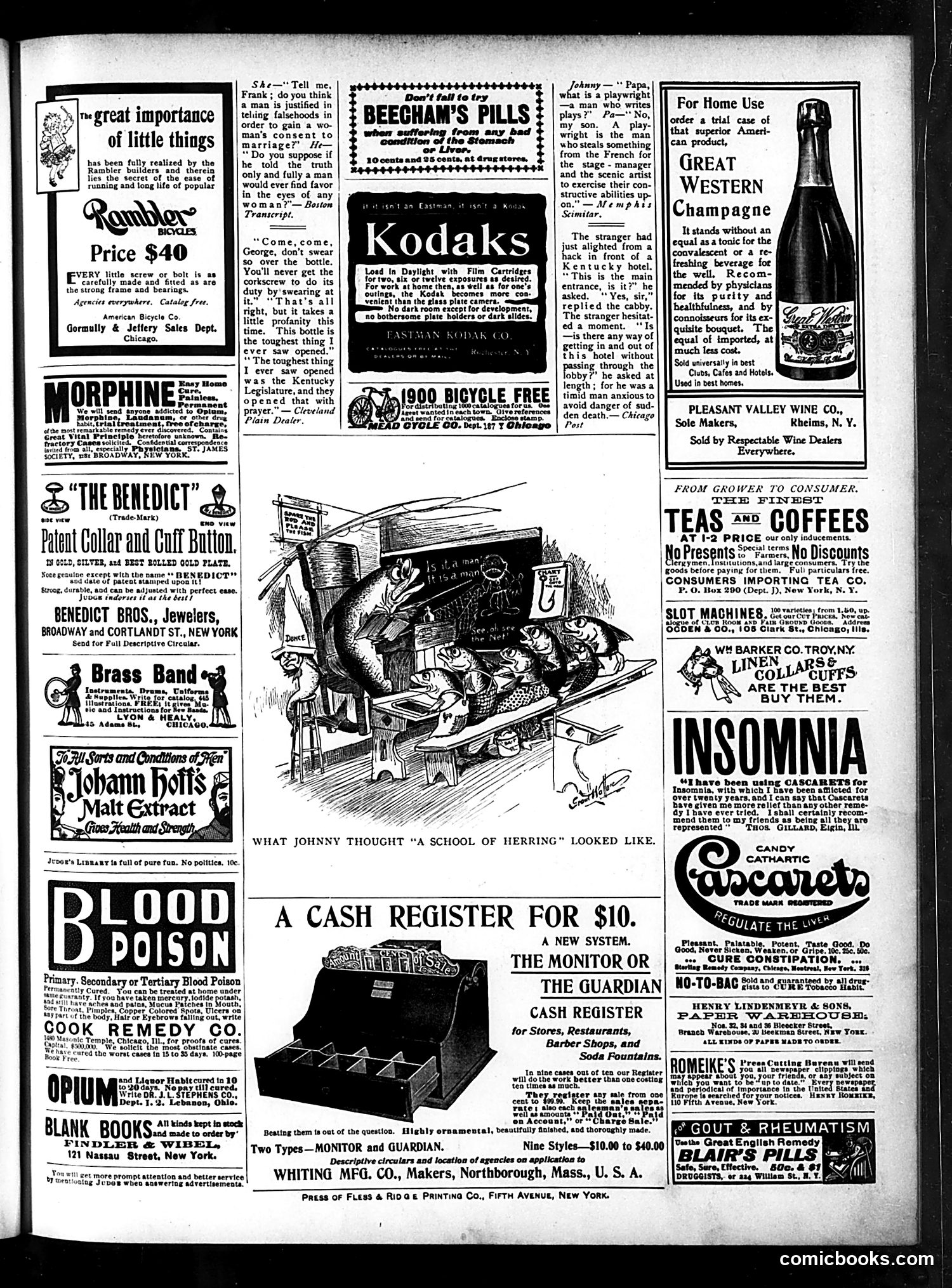
This is primarily an **advertising page** from Judge magazine, not a political cartoon page. However, it contains several period humor items: **"Johnny" Jokes**: Three brief comic exchanges mock common figures—a young boy misunderstanding "playwright" as someone who steals French scripts, another confusing "school of herring" (a fish term) with an actual school building (illustrated with the cartoon). These rely on innocent wordplay misunderstandings typical of early 1900s family humor. **Social Commentary**: A dialogue about men lying to win marriage consent satirizes courtship dishonesty, while another mocks swearing over difficult bottle corks as worse than profanity in the Kentucky legislature—a mild jab at political incompetence. **The Bulk**: Most content is vintage advertisements for products now obsolete or infamous (morphine treatments, "blood poison" cures, opium), bicycles, jewelry, and cash registers—reflecting what consumers bought in 1900. The page illustrates Judge's mix of light satire and commercial content rather than hard political commentary.
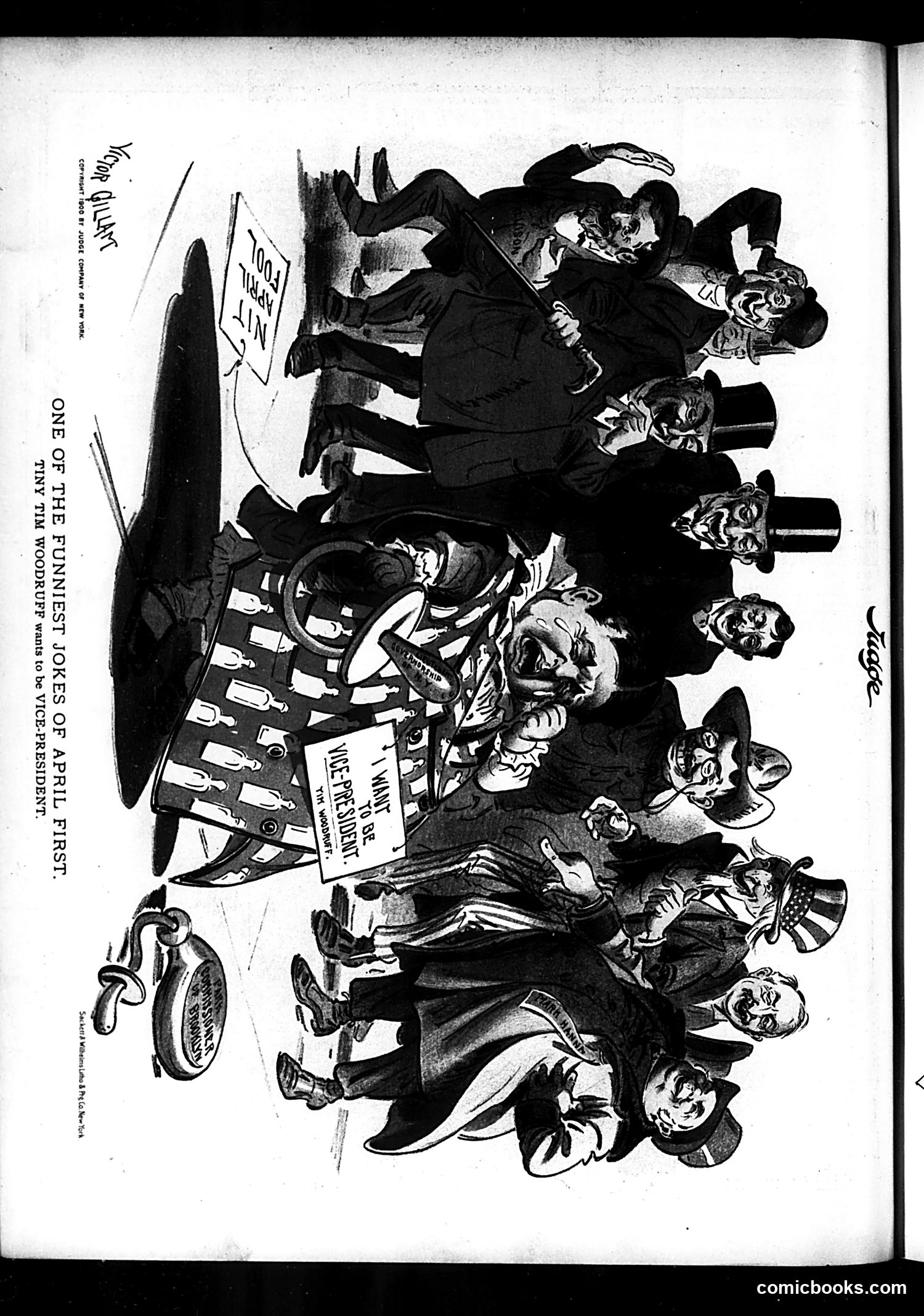
This is a satirical cartoon from *Judge* magazine mocking someone's ambition to become Vice-President on April Fools' Day—suggesting the aspiration itself is a joke. The cartoon depicts "Tiny Tim Woodruff" (likely a caricatured political figure, though the specific identity isn't entirely clear from context) being carried or pushed upward by various men in formal dress. The absurdist imagery—the exaggerated scale, the seemingly impossible conveyance—ridicules what the cartoonist considers a laughably implausible political ambition. The "April First" dating emphasizes the satirical intent: the cartoon treats Woodruff's VP aspirations as foolish enough to be an April Fools' prank. Without additional historical context, the specific political circumstances remain unclear, but the message is clear: the cartoonist views this candidacy as ridiculous.