
A complete issue · 17 pages · 1899
Judge — December 30, 1899
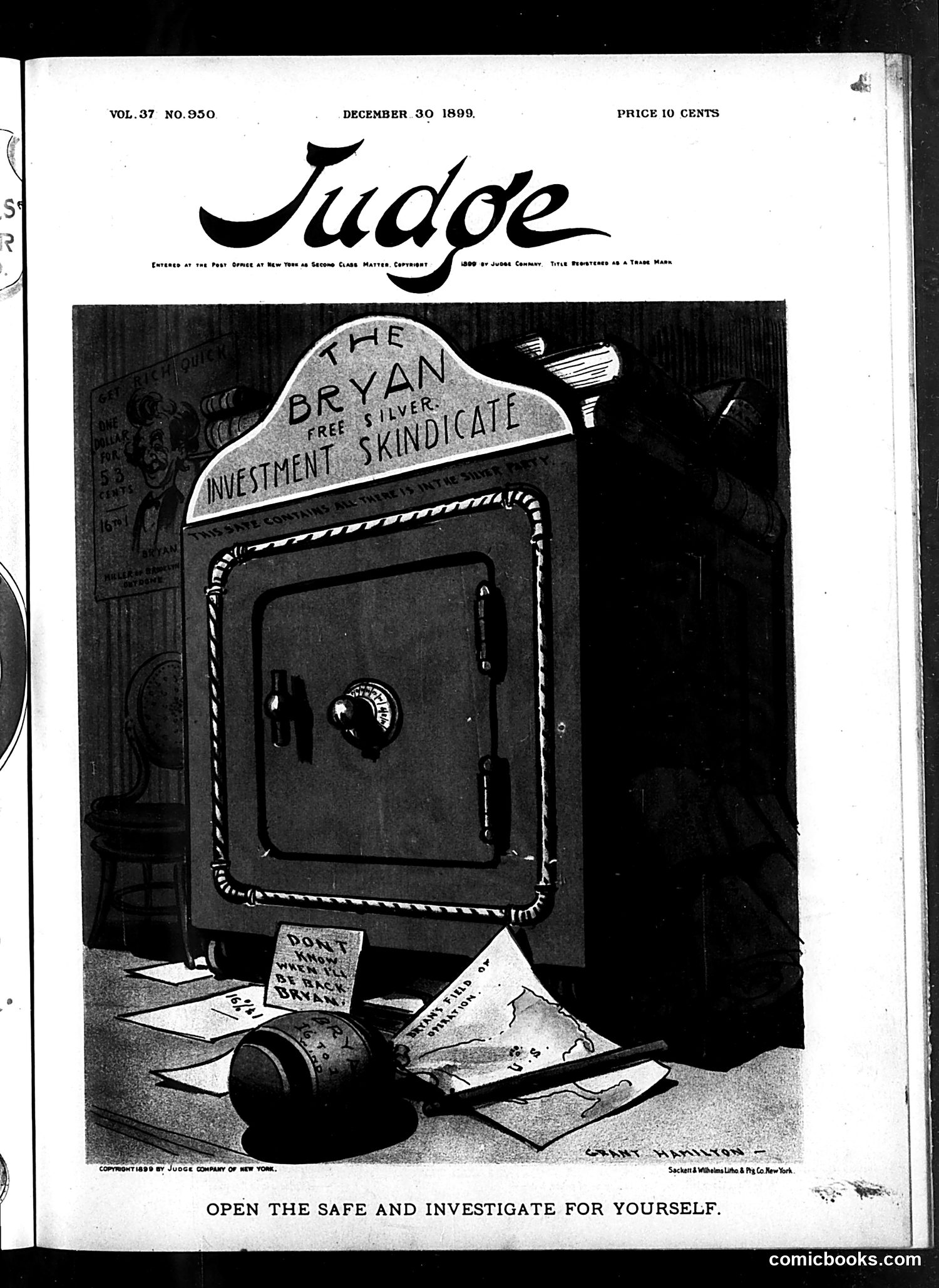
This satirical cover depicts "The Bryan Free Silver Investment Syndicate"—a safe labeled with William Jennings Bryan's political platform. The safe sits among scattered papers and a tipped-over container, suggesting financial disaster or fraud. The satire targets Bryan's 1896 and 1900 presidential campaigns, which championed "free silver" (unlimited coinage of silver). Opponents argued this policy would cause economic instability and ruin. Judge magazine, a Republican publication, used the safe as a visual pun: Bryan's investment scheme promises security but contains nothing of value—the safe is empty. The caption "Open the Safe and Investigate for Yourself" mocks Bryan's proposals as illusory financial protection, suggesting voters would find only disappointment inside.
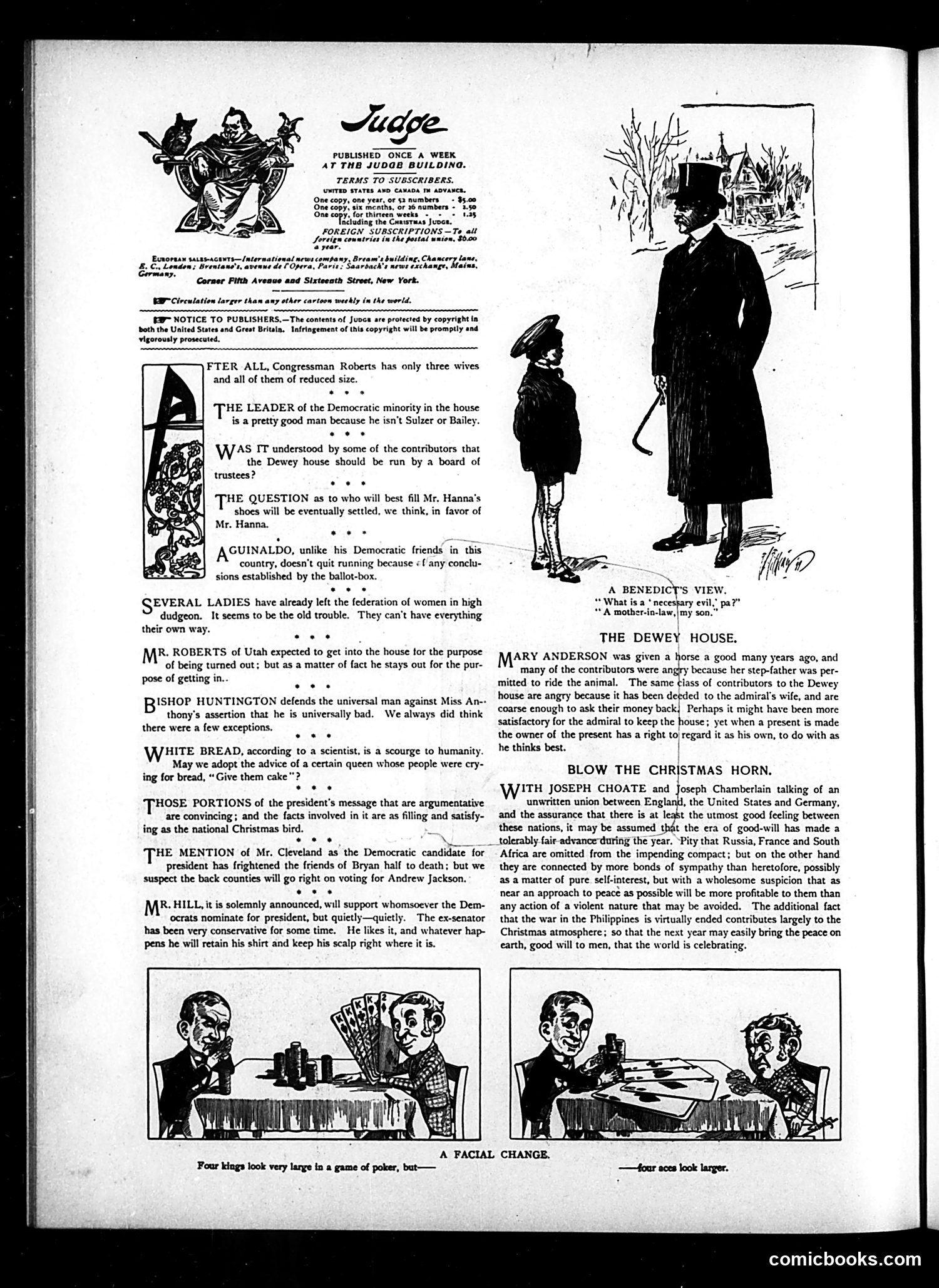
This page contains brief political commentary and satirical cartoons from Judge magazine. **Political Items Referenced:** - Congressman Roberts of Utah (mentioned as having "three wives") - Democratic minority leadership and "Sulzer or Bailey" - The Dewey House (apparently a disputed property or administration) - Joseph Choate and Joseph Chamberlain discussing international relations - References to Russia, France, South Africa, and the Philippines **Cartoons:** "Benedict's View" shows a tall figure with a child, captioned about a "necessary evil." "A Facial Change" depicts two poker players, where four kings appear valuable but four aces appear larger—a visual pun about perception. The commentary criticizes various political figures and discusses Christmas peace prospects. However, **without specific dates or clearer context about which politicians are being targeted, precise identification of most figures remains unclear.**
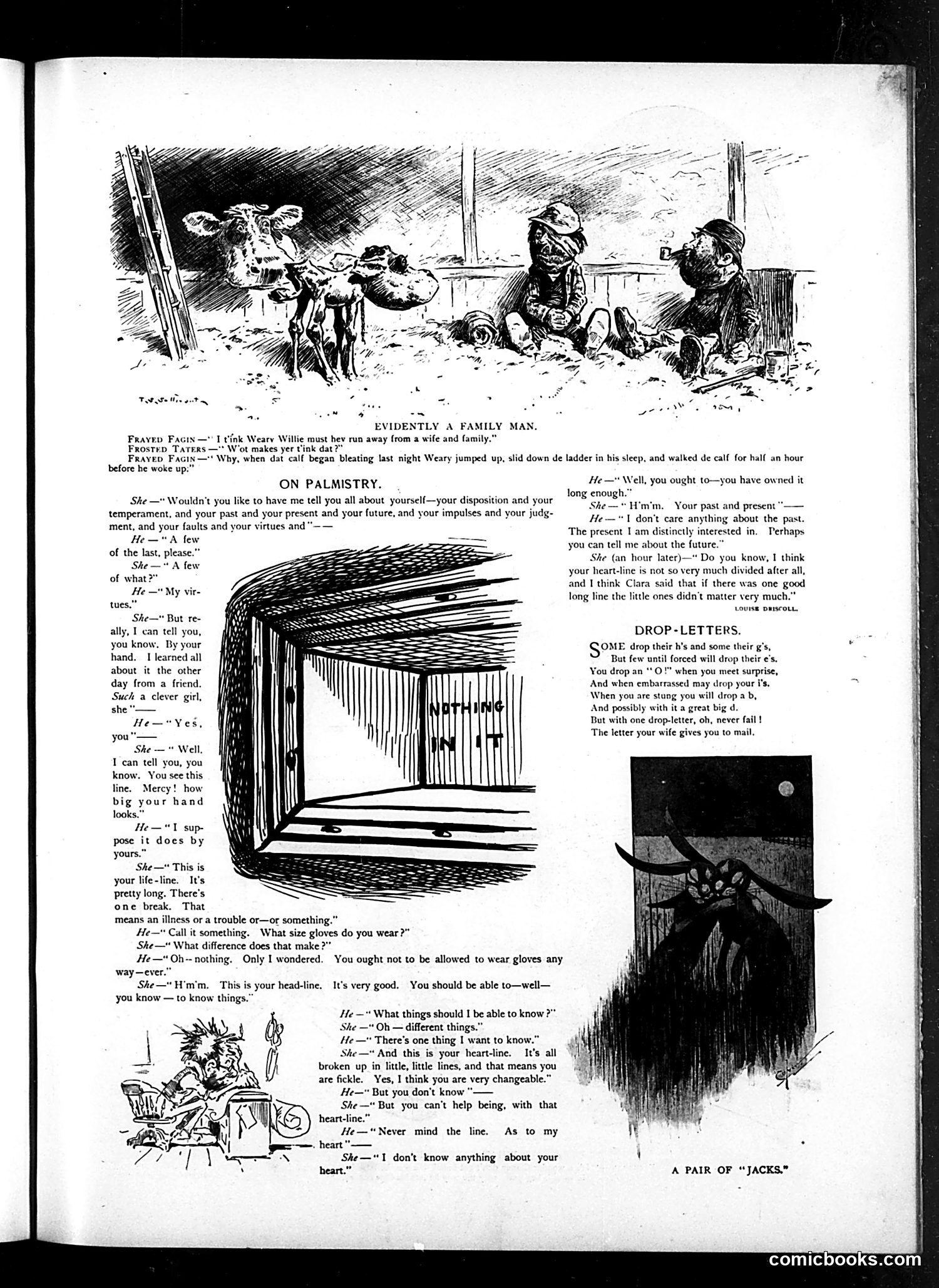
This page contains three distinct satirical pieces: 1. **"Evidently a Family Man"** (top cartoon): Shows what appears to be vagrant or poor figures, with dialogue about someone named Willie running away from wife and family. The satire mocks domestic irresponsibility and vagrancy. 2. **"On Palmistry"** (center): A dialogue between a man and woman about palm-reading, with an illustration of a hand. The satire ridicules both palmistry as pseudoscience and the woman's credulous belief in it, while poking fun at relationship dynamics and character assessment. 3. **"Drop-Letters"** and **"A Pair of 'Jacks'"** (right side): Brief humorous pieces about spelling mistakes and unclear references, with accompanying illustration of what appears to be a nighttime scene. The page reflects turn-of-century American humor targeting superstition, poverty, and domestic situations.
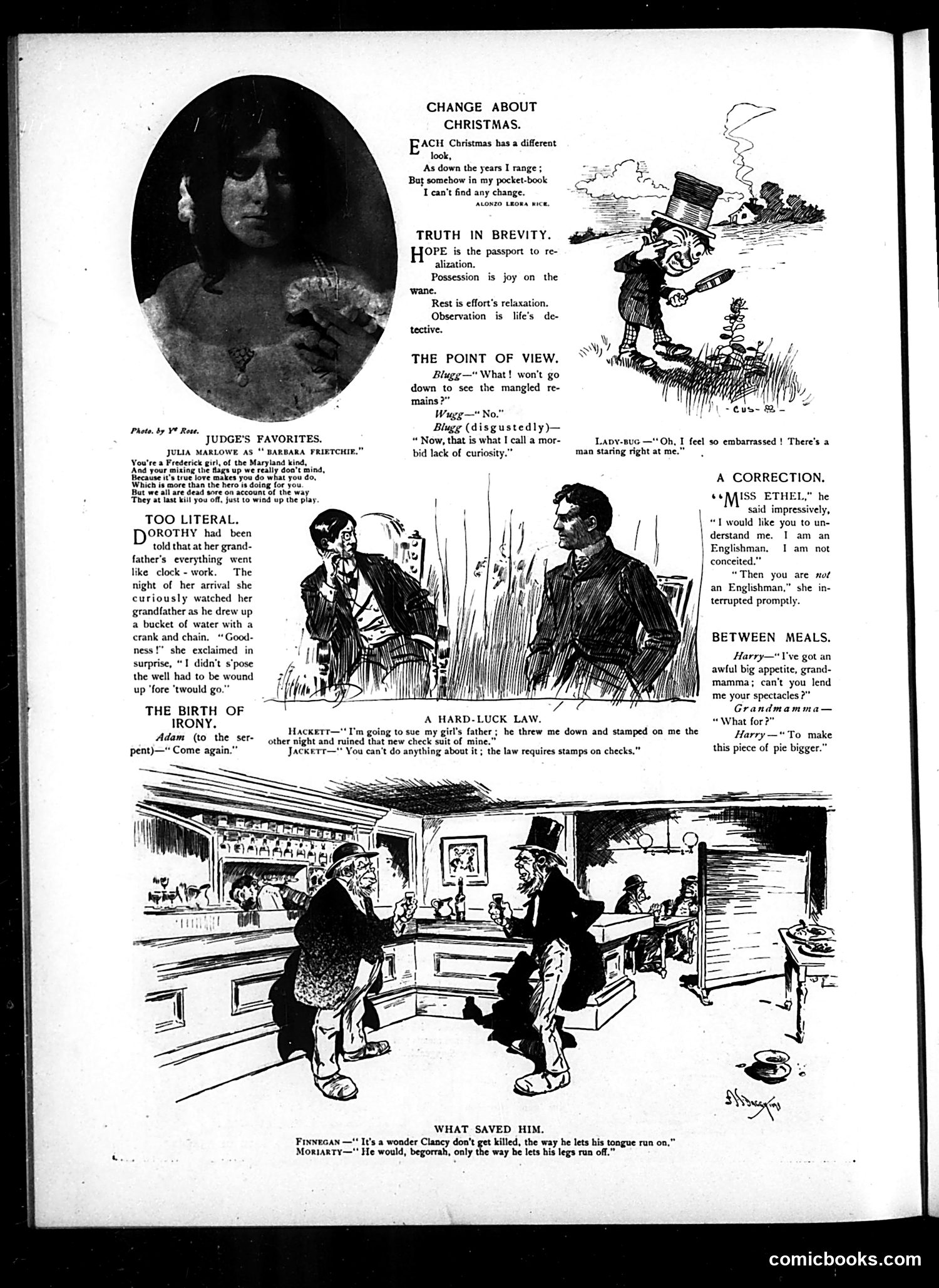
This page contains multiple unrelated satirical pieces and jokes typical of Judge's format: **"Change About Christmas"** is a brief poem about Christmas evolving over time. **"Judge's Favorites"** features a photograph of Julia Marlowe as "Barbara Frietchie," likely referencing the Civil War poem/play. The various cartoon jokes include: - **"Too Literal"**: Dorothy's grandmother misinterprets a figure of speech about a "bucket of water with a crank and chain." - **"The Birth of Irony"**: A brief comedic exchange - **"A Hard-Luck Law"**: A man threatening legal action over being thrown down and stamped on - **"What Saved Him"**: A joke about someone's ability to stick out his tongue These represent typical turn-of-century humor—wordplay, domestic misunderstandings, and absurdist scenarios—without apparent political content.
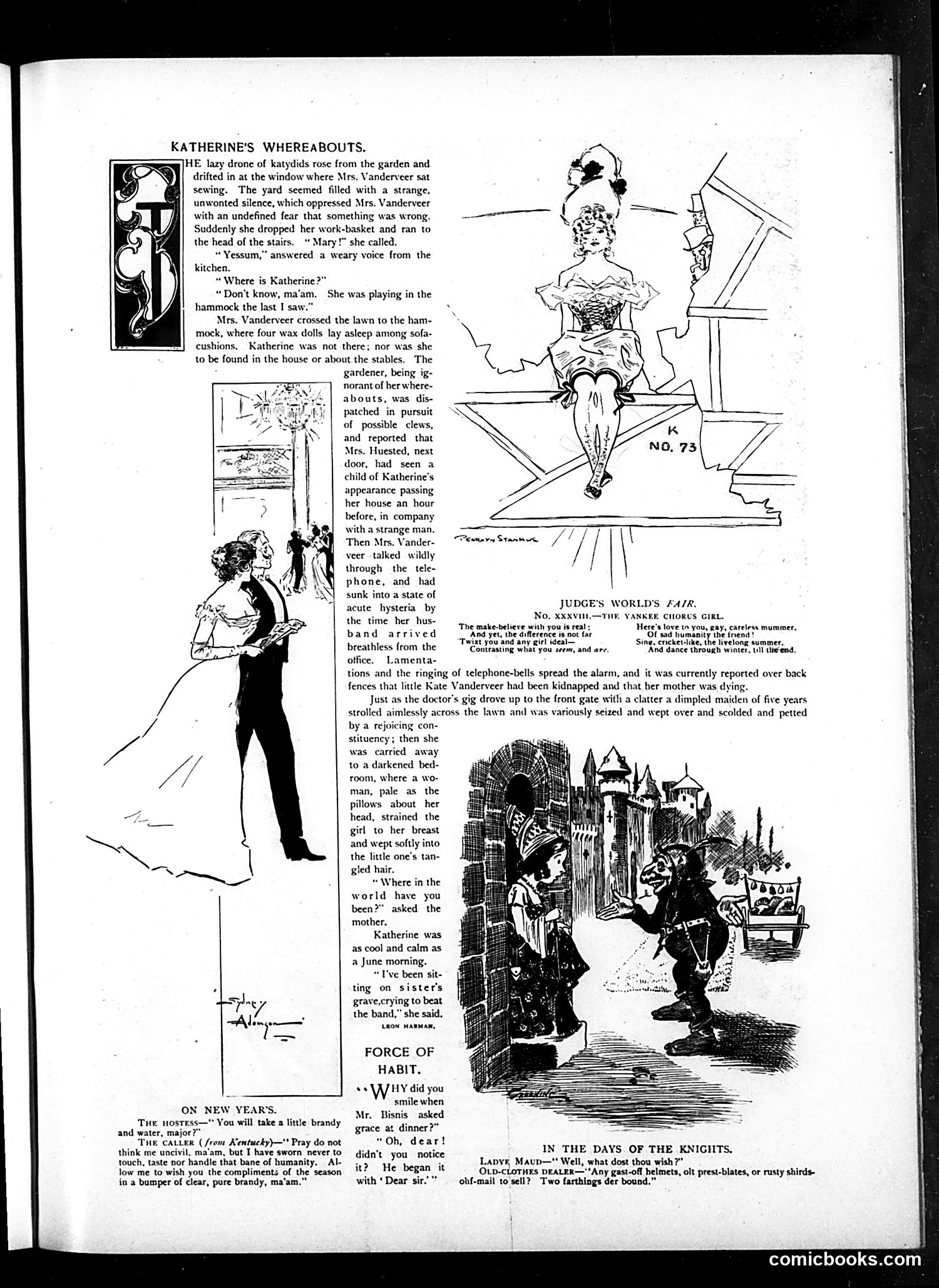
This page features a serialized domestic fiction story rather than political satire. "Katherine's Whereabouts" depicts upper-class anxiety: Mrs. Vanderveer panics when her young daughter Katherine disappears, imagining kidnapping after a neighbor reports seeing the child with a strange man. The dramatic tension—telephone hysteria, doctor summoned—culminates anticlimactically when Katherine returns calmly from sitting on her sister's grave. The accompanying verse and brief comic vignettes are unrelated humor pieces: one praising chorus girls, another a dated joke about a caller refusing brandy on principle, and a medieval "old-clothes dealer" pun. The page demonstrates *Judge*'s mix of serialized melodrama alongside light satirical verse—typical of late 19th/early 20th-century American humor magazines targeting middle and upper-class readers.
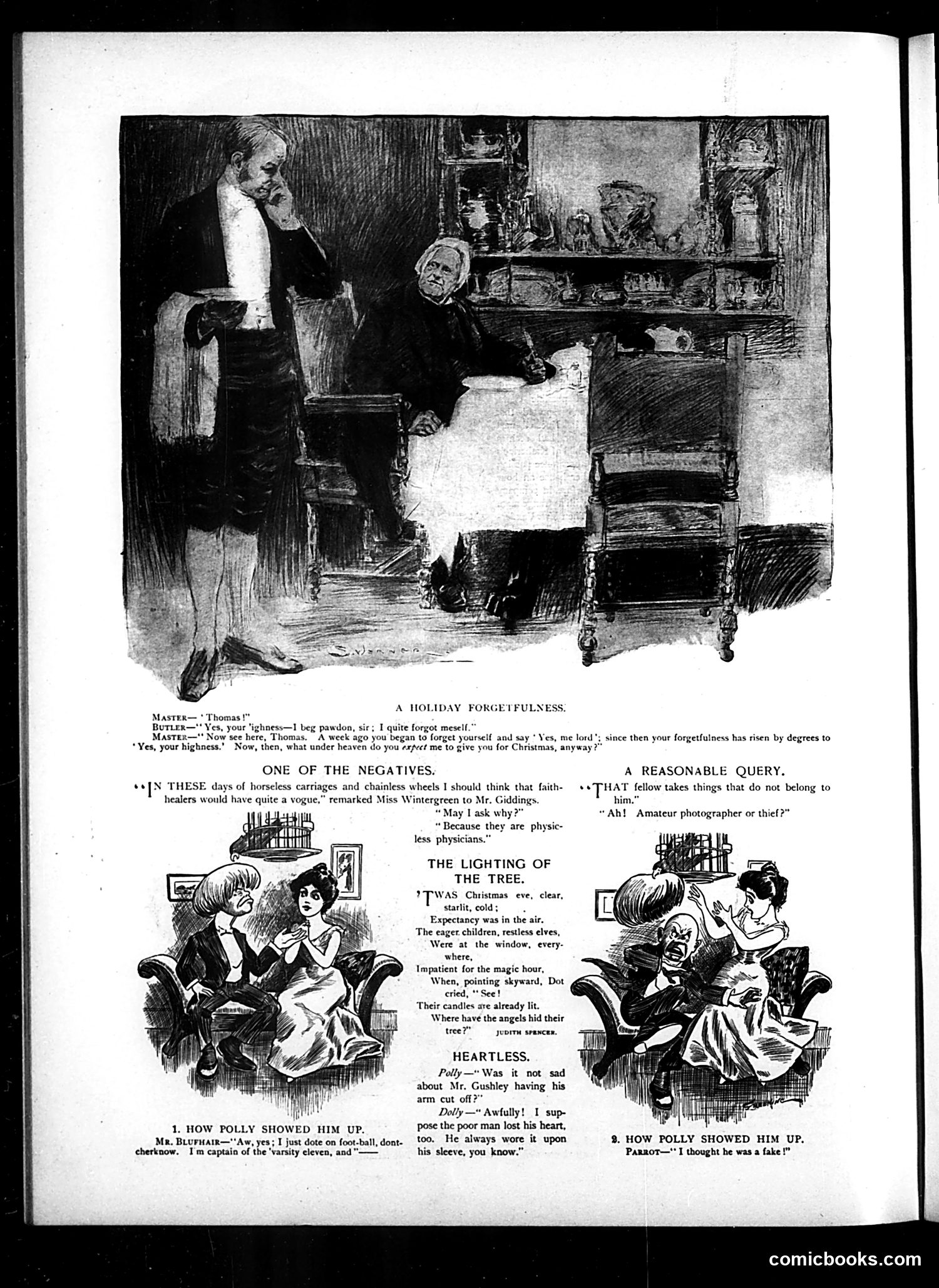
This page contains several satirical vignettes typical of early 20th-century American humor: **Top cartoon ("A Holiday Forgetfulness")**: A servant named Thomas gradually adopts aristocratic speech patterns, addressing his master as "your highness" instead of "sir." The satire mocks social climbing and mimicry—the master notes Thomas's forgetfulness has "risen by degrees," suggesting pretension is a progressive disease. **"One of the Negatives" & "A Reasonable Query"**: Brief jokes about modern skepticism. One quips that "horseless carriages" make faith-healers viable (since people need healing from accidents). The other questions whether a man taking things is an amateur photographer or thief—likely referencing early camera technology's novelty. **"The Lighting of the Tree"**: A sentimental poem about children mistaking stars for Christmas tree lights, contrasting with the page's satirical tone. **"Heartless" section**: Puns on a man losing his arm—one character sympathizes he "lost his heart," playing on the phrase "wearing one's heart on one's sleeve." The page satirizes social pretension, modern technology skepticism, and sentimental versus cynical Christmas attitudes.
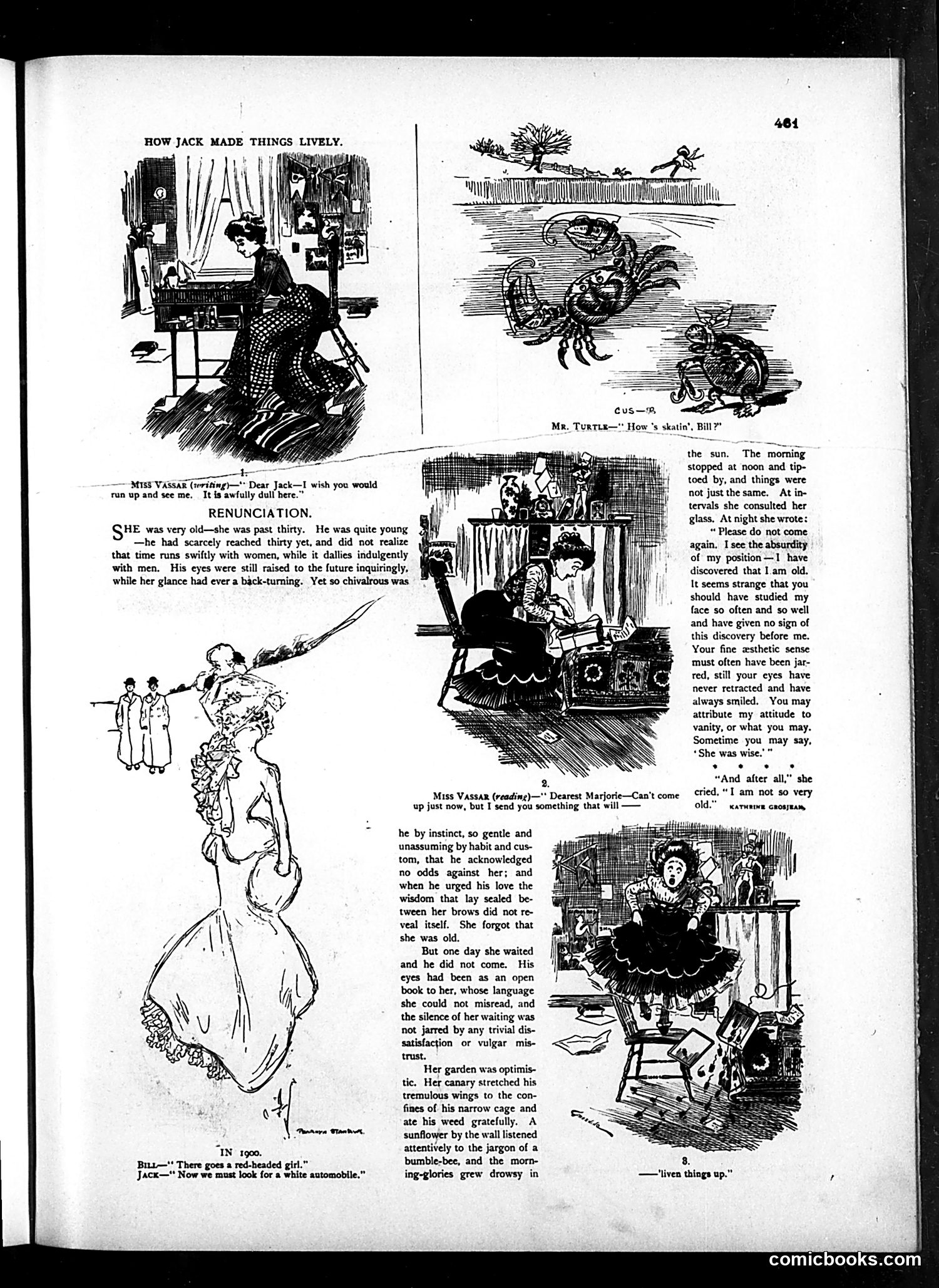
This page from Judge (circa 1900) contains two distinct pieces: **"Renunciation"** (main story with illustrations): A romantic narrative about an age-gap relationship. A woman over thirty falls for a younger man who doesn't realize time affects women differently. When he suddenly stops visiting, she writes him a letter acknowledging she's discovered she's old—and that he must have noticed too. The story explores vanity, love, and the social anxiety around female aging in 1900s America, where a woman's value was heavily tied to youth. **"How Jack Made Things Lively"** (top left): Shows a woman at her mirror/vanity with various illustrations around her—appears to be satirizing romantic pursuit or courtship drama. **Bottom cartoon**: A dated joke about spotting a "red-headed girl" and looking for a "white automobile"—likely referencing early 1900s automobiles as status symbols or novelties. The overall page reflects turn-of-the-century anxieties about romance, aging, gender roles, and modernity.
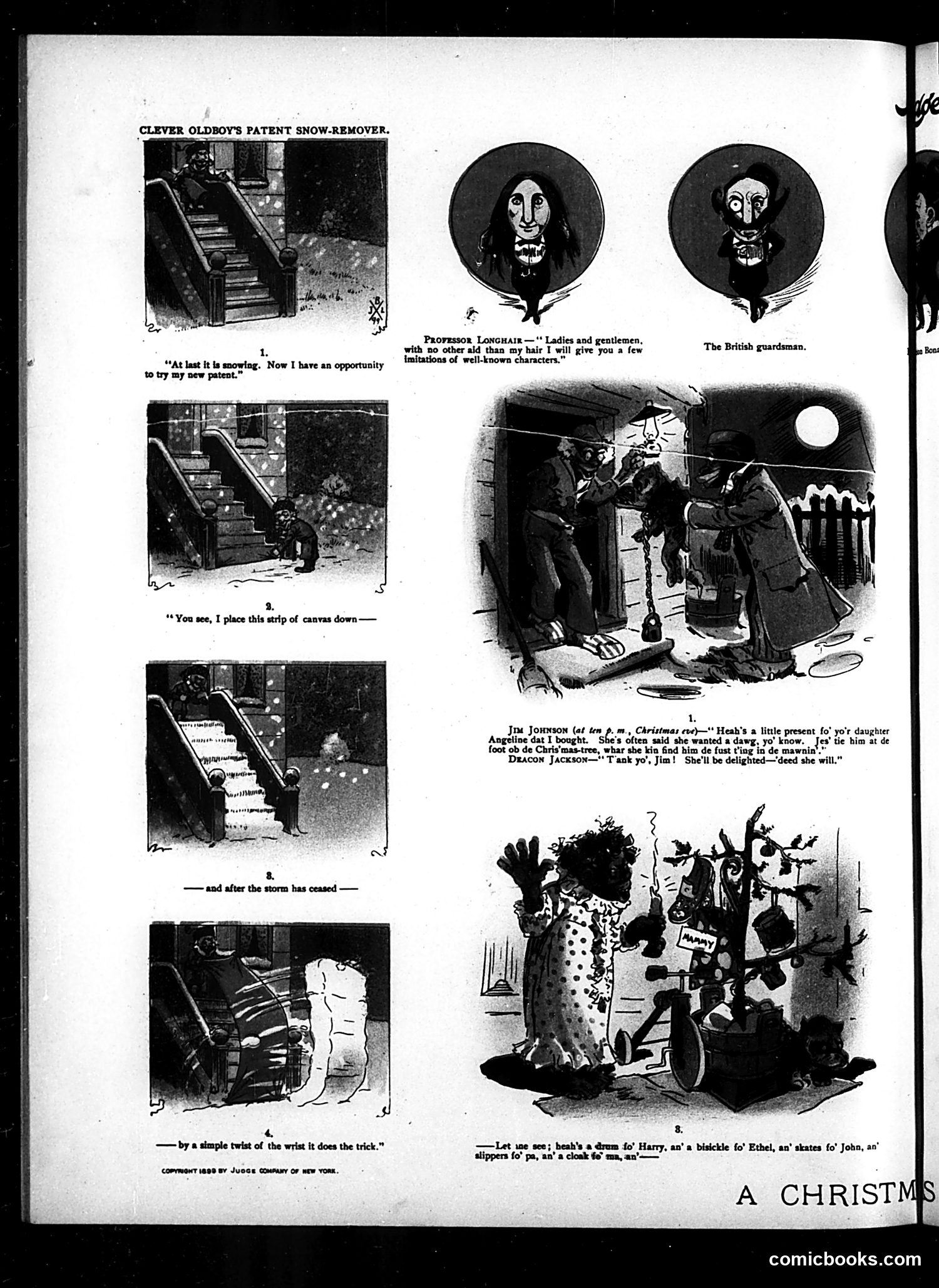
This page contains two unrelated pieces of 1890s humor: **Top left:** "Clever Oldboy's Patent Snow-Remover" depicts a Professor Longhair using his own hair as a stage prop to create "imitations of well-known characters"—a vaudeville-style performance joke about a bald man's impractical snow-removal invention. **Right side:** Two separate Christmas scenes featuring African American characters in dialect humor (typical of the era's racist comic conventions). In the first, "Jim Johnson" gives Deacon Jackson a dog as a Christmas gift for his daughter. In the second, a man inventories gifts: a "dram" (drink), bicycle, skates, cloak—satirizing the chaotic Christmas morning gift-giving process through exaggerated list-recitation. The page appears to be miscellaneous comic content rather than unified political satire. The racial caricatures reflect Judge's problematic historical attitudes, though the actual jokes focus on everyday holiday absurdities rather than explicit political commentary.
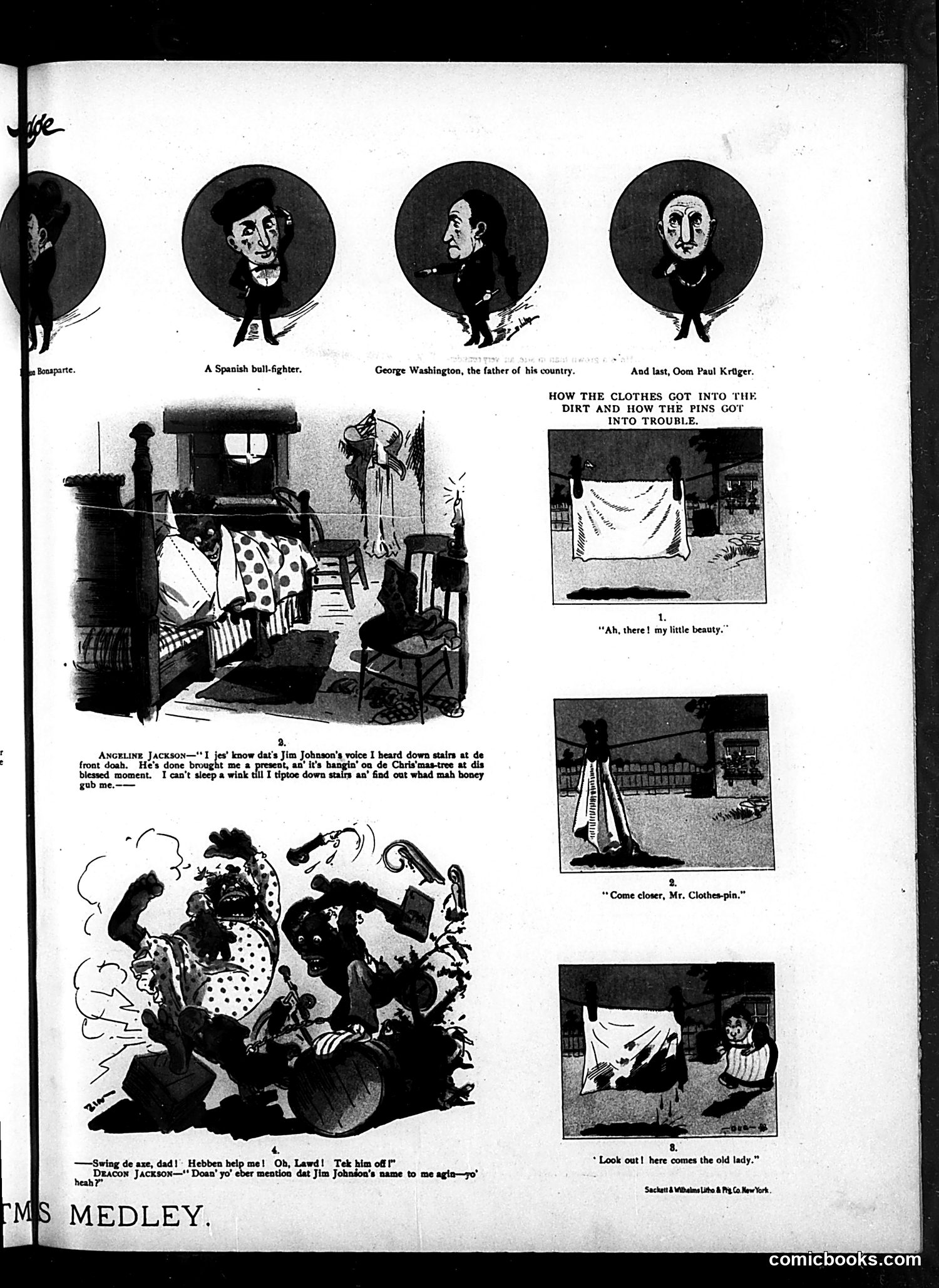
This page contains a racist comic strip using exaggerated dialect and blackface caricatures to depict African American characters. The narrative follows a domestic laundry mishap: a woman named Angeline Jackson hangs clothes to dry, then a male character ("Clothes-pin") arrives. The story progresses through numbered panels showing clothes falling in dirt and pins getting lost. The humor relies on ethnic stereotyping and dialect humor common to early 20th-century American satire—minstrelsy-influenced comedy that portrayed Black Americans through crude caricature for white audiences' entertainment. The page's top row shows unrelated caricatures including historical figures (George Washington, Oom Paul Kruger—a Boer War reference), establishing Judge's typical miscellaneous satirical format. The content reflects deeply offensive historical attitudes now recognized as racist propaganda, though presented as mainstream popular entertainment at the time of publication.
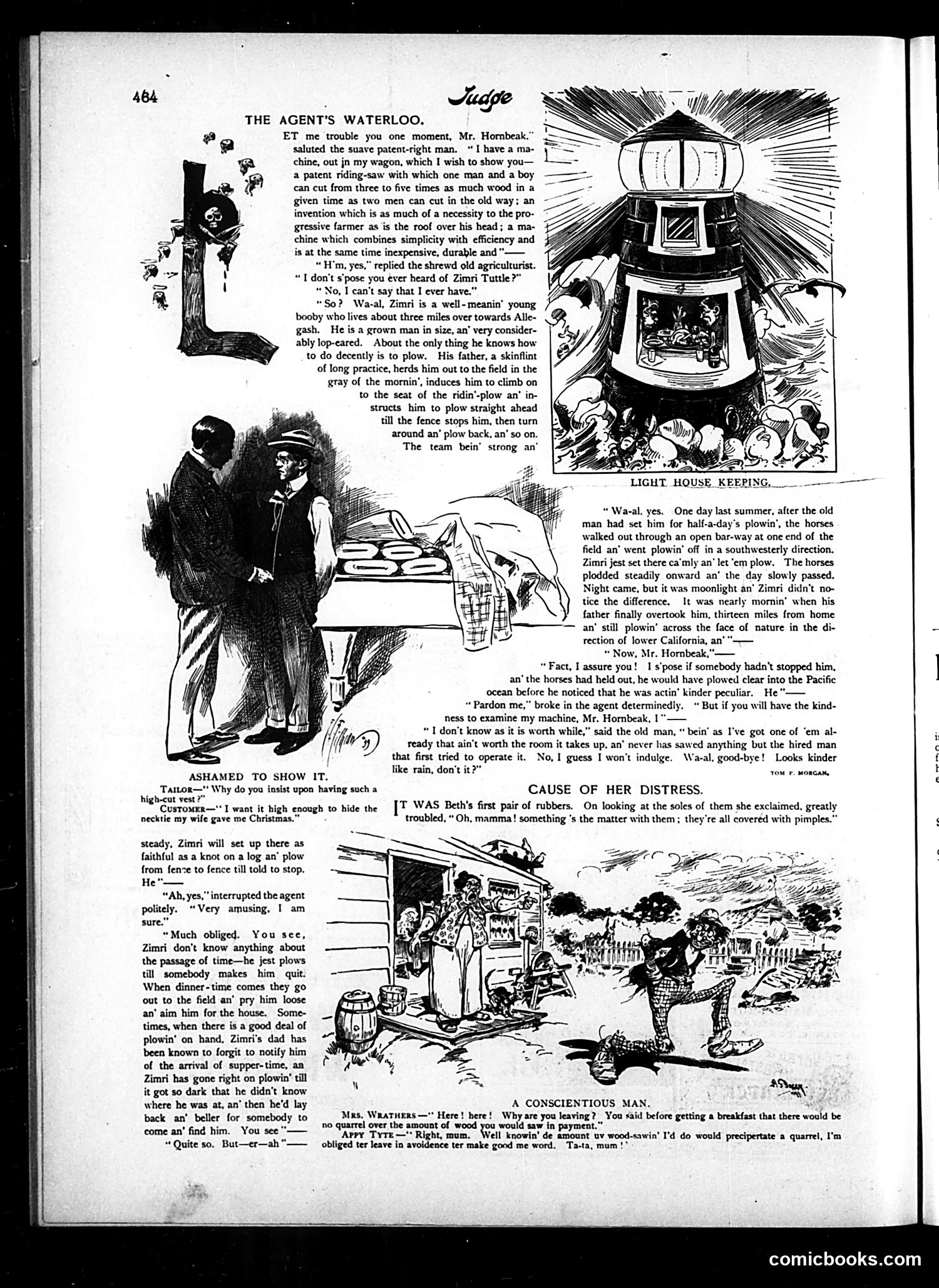
This page satirizes the persistent sales pitch through the folktale of Zimri Tuttle, a simpleton farmer so mechanically obedient he plows for hours without stopping—even plowing off into the wilderness at night without noticing. The shrewd old farmer Mr. Hornbeak uses this story to deflect a patent-medicine salesman's pitch for a labor-saving riding-saw. The joke: Zimri represents the absurdity of automation claims. Why buy a machine to save labor when you can employ someone so lacking in initiative he'll work indefinitely without question? The story mocks both the salesman's relentless optimism and rural gullibility. The sidebar cartoon "Ashamed to Show It" jokes about a man hiding an ugly Christmas necktie—mild domestic humor about gift-giving embarrassment. The page satirizes the gap between technological progress and actual rural conditions, where human labor (however limited) remained cheaper than investment in new machinery.
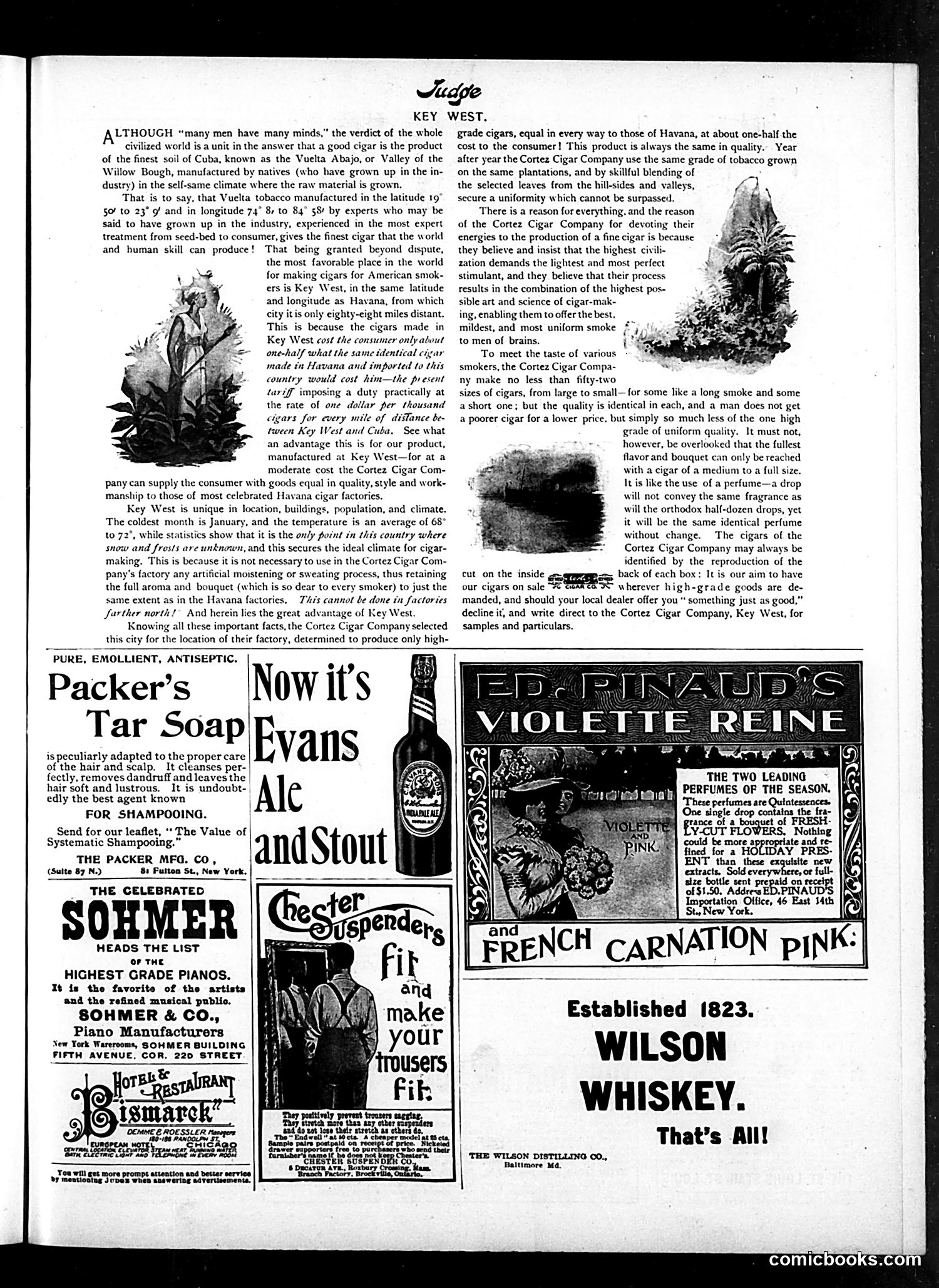
This page is primarily **advertising rather than political satire**. The dominant content is a lengthy promotional article for Cortez Cigars manufactured in Key West, Florida. The article's central argument: Key West cigars offer equal quality to famous Cuban Havana cigars at half the cost, due to identical latitude/longitude and climate. The piece emphasizes that Key West's tropical climate requires no artificial moistening, preserving natural aroma and bouquet better than northern factories. The page includes several other advertisements (Packer's Tar Soap, Chester Suspenders, Wilson Whiskey, Sohmer Pianos, Fernaud's Violette Reine perfume, and a hotel/restaurant). **No identifiable political figures or satirical cartoons appear on this page.** The small illustration appears to be decorative tobacco-plant imagery supporting the cigar advertisement. This represents Judge magazine functioning as a commercial publication supplementing its satirical content with substantial paid advertising.
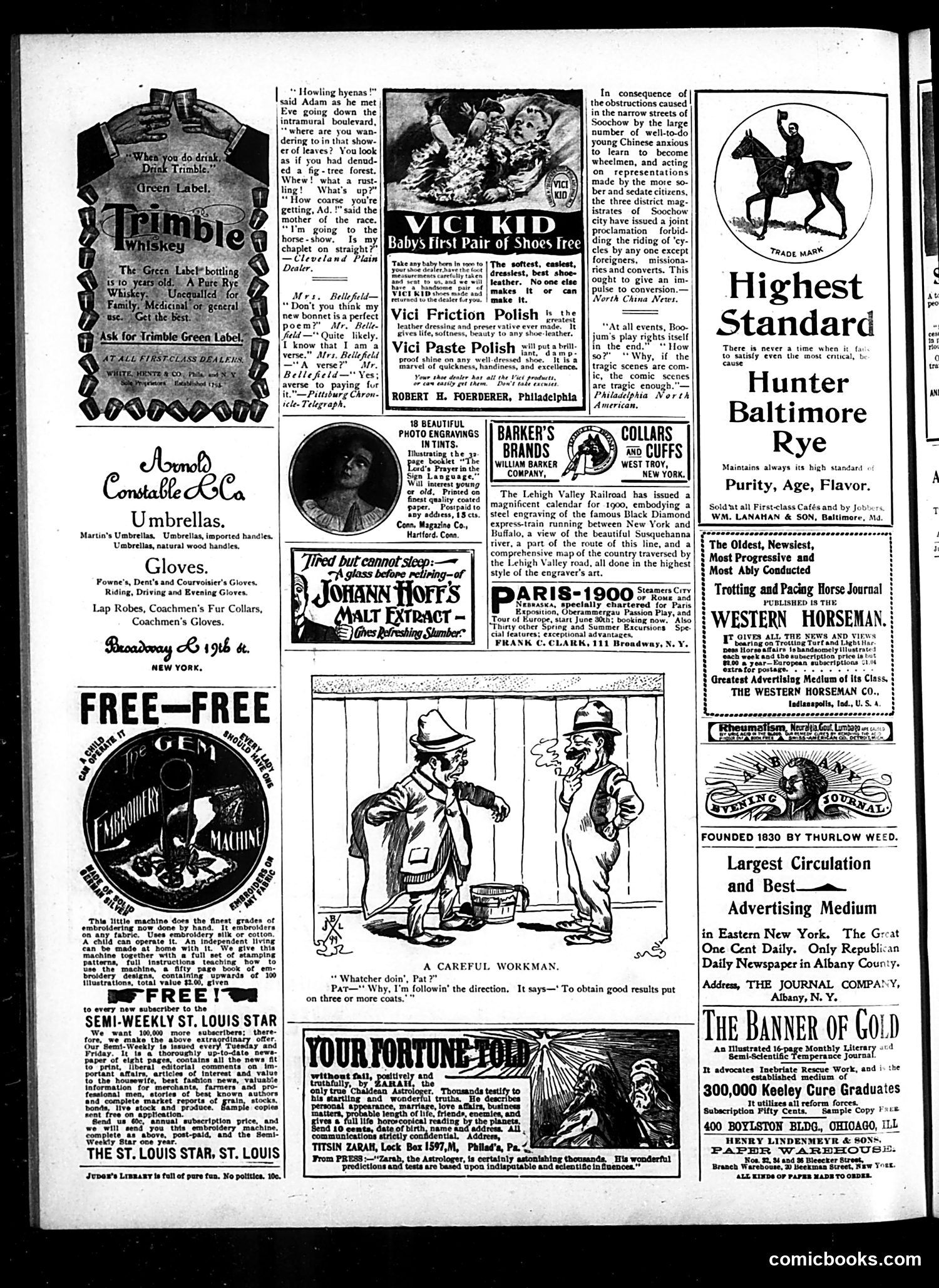
This page is primarily **advertising** for late-19th/early-20th century consumer goods (umbrellas, gloves, shoe polish, railroad calendars) interspersed with brief humorous items. The one discernible cartoon is titled **"A Careful Workman,"** depicting two men in conversation. The joke plays on literal interpretation: when instructions say "put on three or more coats," Pat misunderstands and applies paint coats repeatedly rather than applying the product to multiple surfaces. This is straightforward slapstick humor about working-class misunderstanding of directions—no political satire intended. The other short items are light domestic humor: - Adam and Eve joke about fig leaves and fashion - Mrs. Bellefield pun about poetry/verse regarding a bonnet purchase A **"North China News" brief** reports Chinese magistrates banning bicycle-riding except for foreigners and converts due to congestion—likely reflecting early-1900s Western amusement at "exotic" regulation of new technology in Asia. The page reflects Judge's era: middle-class consumer culture, light wordplay humor, and casual orientalism toward non-Western societies.
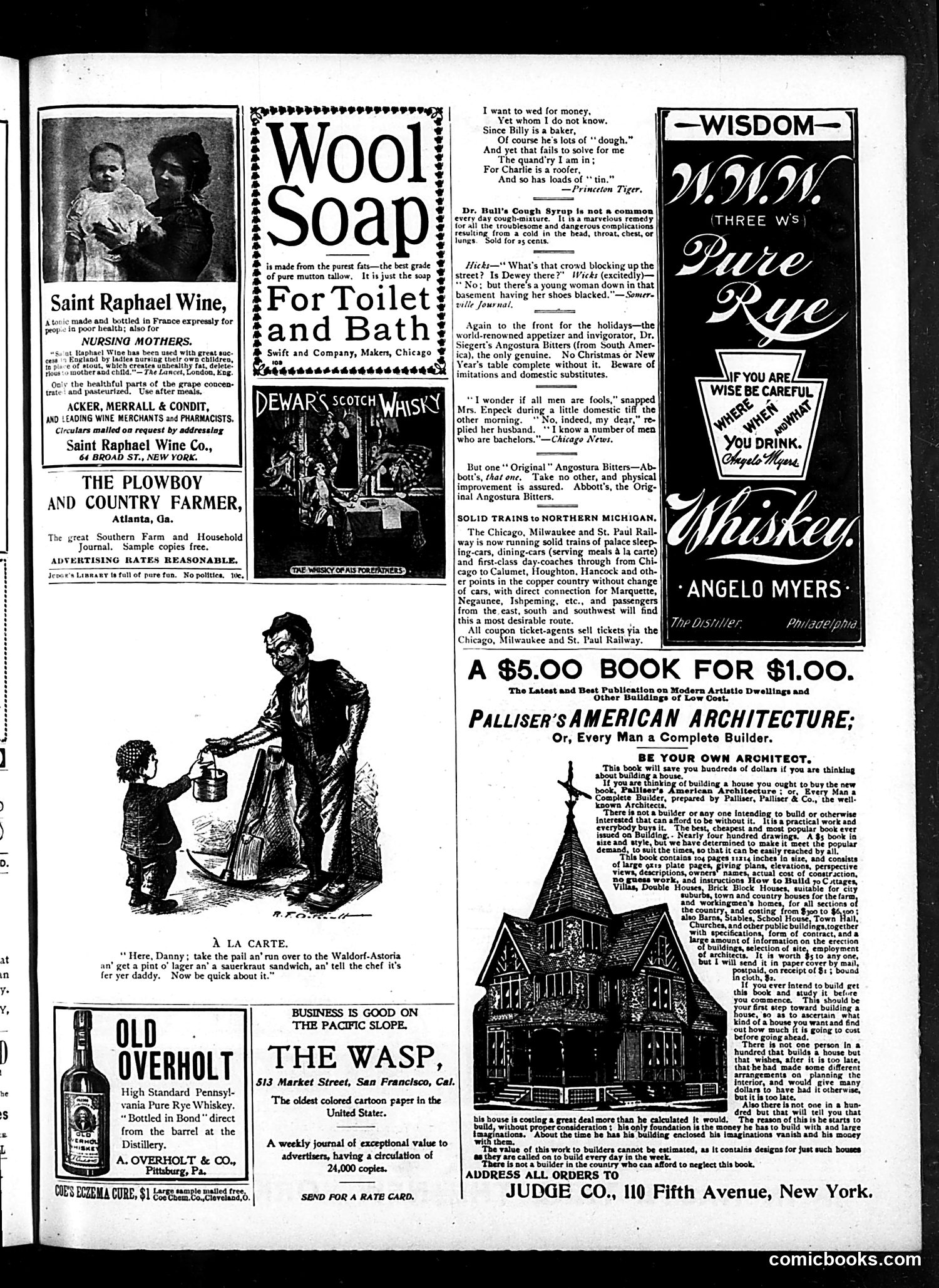
This single-panel cartoon depicts a working-class father sending his young son on an errand to the prestigious Waldorf-Astoria Hotel. The humor relies on class contrast: the father, speaking in broad dialect ("an' run over," "fer yer daddy"), instructs the boy to fetch "a pint o' lager an' a sauerkraut sandwich" and tell the chef "it's fer yer daddy"—treating the exclusive hotel like a common tavern. The satire mocks both the pretensions of the wealthy establishment and the audacity of working-class customers. The title "À la carte" (fine dining terminology) underscores the irony: the father is simultaneously unaware of or indifferent to the Waldorf-Astoria's status, or deliberately mocking it. The illustration style and dialect emphasize the immigrant or working-class identity of the characters, typical of Judge magazine's social humor of the era.
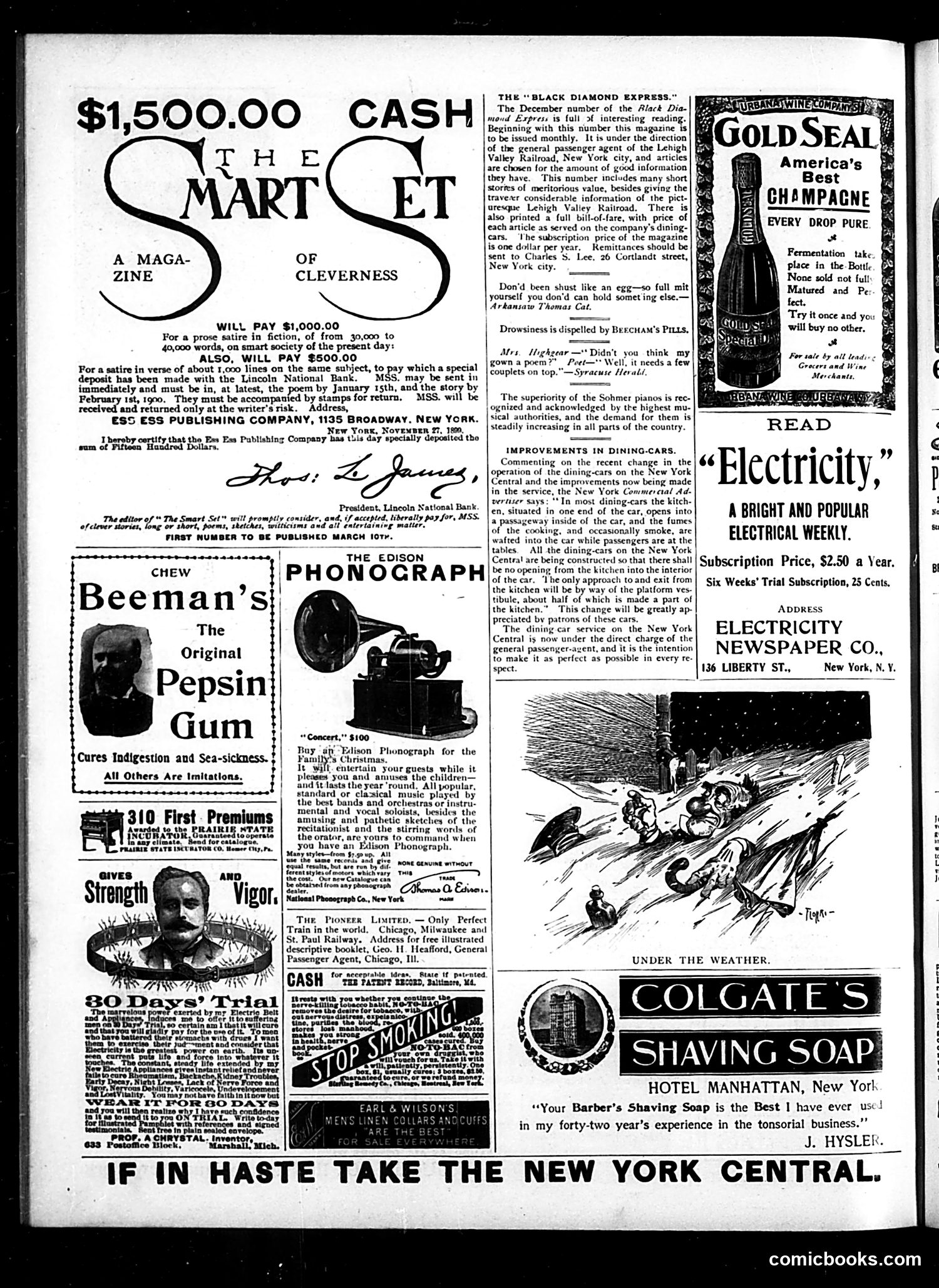
This is primarily an **advertising and announcements page** from Judge magazine (November 27, 1909), with minimal political or satirical content. The page's main feature announces a **writing contest**: Judge's publisher offers $1,000 for a 30,000-40,000 word prose satire about "smart society," and $500 for 1,000 lines of verse on the same topic. This reflects Judge's core mission—satirizing upper-class American life. The remainder consists of period advertisements for consumer products: Edison phonographs, Beeman's gum, incubators, trains, and patent services. A small cartoon labeled "Under the Weather" appears to show someone in distress (likely ill or hungover), playing on the slang phrase. Notable is the mention that Judge's sister publication, *The Smart Set*, will also accept satirical submissions—positioning these magazines as outlets for social commentary targeting the wealthy and fashionable.
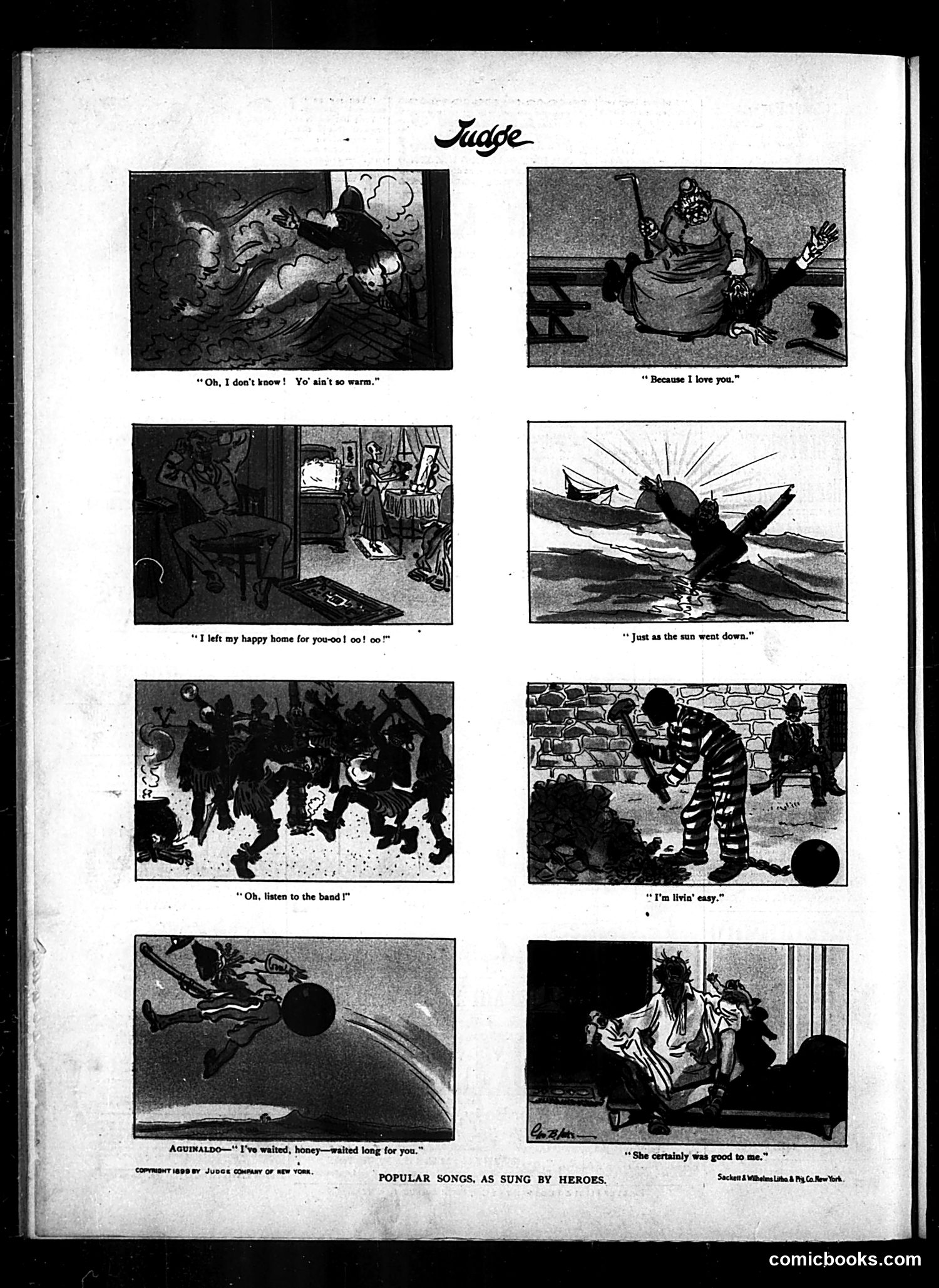
This satirical page from Judge uses song lyrics paired with historical scenes to mock military/political figures. The cartoons appear to reference the Philippine-American War era (suggested by "Aguinaldo" in the bottom caption—likely Emilio Aguinaldo, Filipino resistance leader). Each panel shows a dramatic scene with an ironic song lyric underneath, suggesting soldiers or leaders sing sentimental love songs while engaged in warfare or violence. The final panel references Aguinaldo "waiting" for someone, sarcastically romanticizing military conflict. The satire critiques how popular patriotic songs sentimentalize war and heroism, contrasting romantic lyrics with brutal or unseemly battlefield realities. Without seeing all captions clearly, the exact references remain partially unclear, but the overall effect mocks the glorification of military violence through popular culture.

I can see this is a page from *Judge* magazine, but the image is almost entirely black with minimal visible content. There's a white border on the left side and what appears to be a page number "6" in the lower left corner, along with the "comicbooks.com" watermark. The OCR text provides no substantive content to analyze. Without being able to discern any cartoon illustrations, caricatures, text, or political references in the actual image, I cannot identify the figures, explain the satire, or provide historical context for a modern reader. This appears to be either a blank page, a scanning error, or a page where the cartoon content failed to reproduce legibly in this digital format.