
A complete issue · 16 pages · 1899
Judge — August 19, 1899
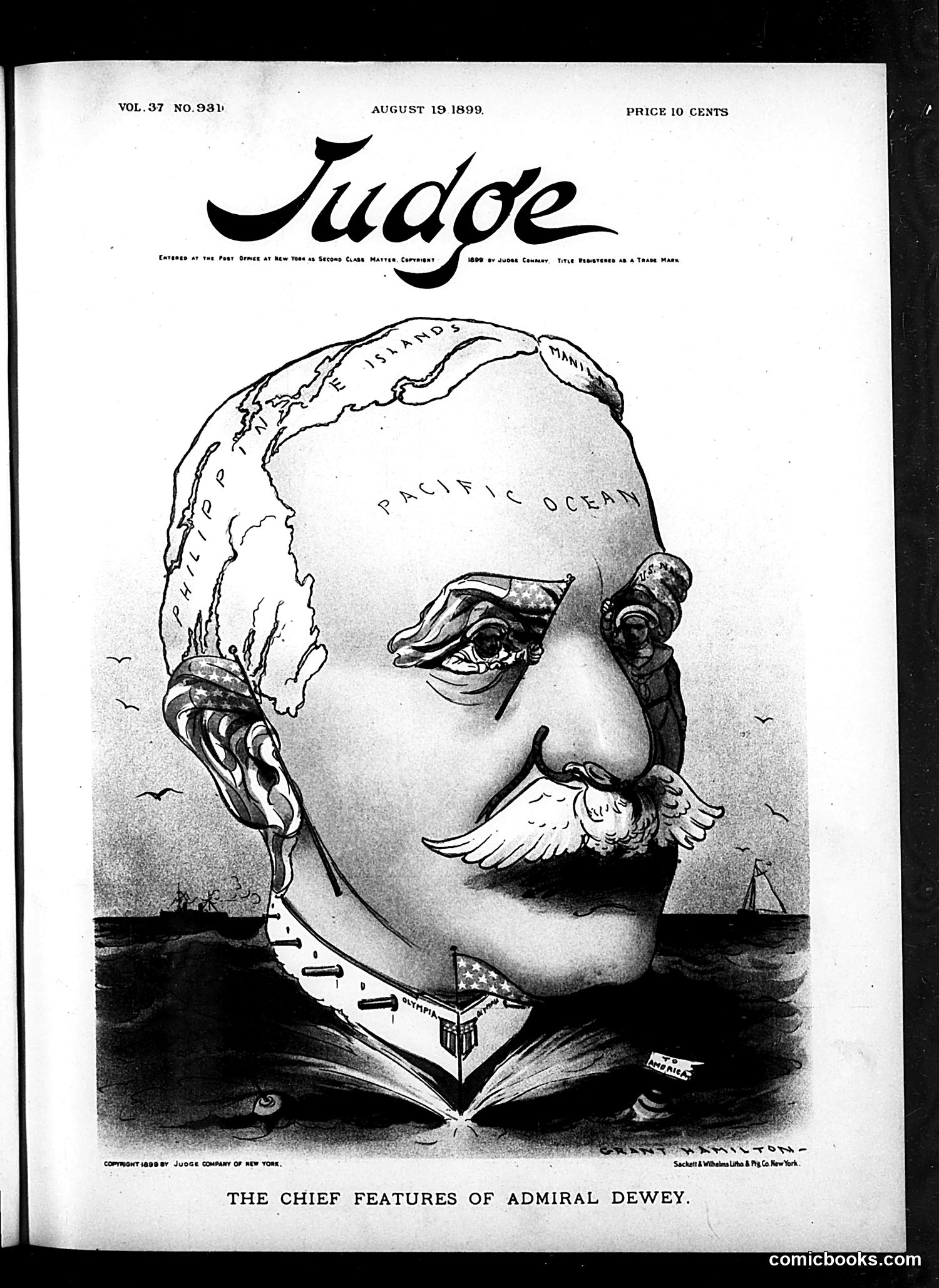
This is a caricature of Admiral George Dewey from Judge magazine's August 19, 1899 issue. The cartoon labels features of his head with geographical references: "Islands" on his skull, "Pacific Ocean" across his forehead. This satirizes Dewey's recent prominence following the Spanish-American War (1898), where he commanded the U.S. Navy's victory at Manila Bay in the Philippines. The Pacific geography labeling mocks how Dewey's military success made him a dominant figure in American expansion into the Pacific. The exaggerated facial features—particularly the prominent mustache and eye—were typical of period caricature style. This appears to be celebratory satire rather than harsh criticism, reflecting Dewey's popularity as a war hero in 1899.
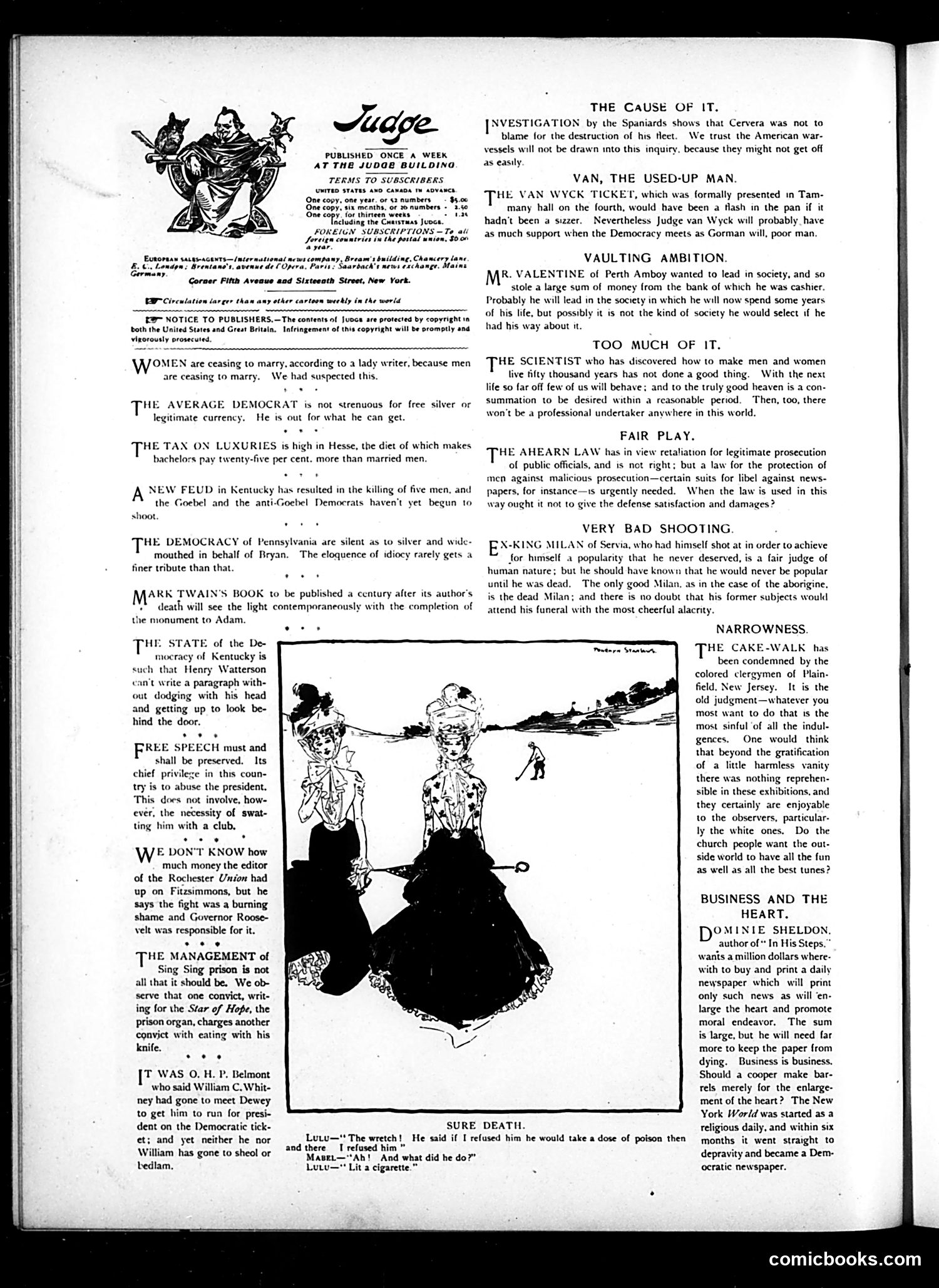
The main cartoon depicts two skeletal female figures in an exaggerated dance pose, labeled "SURE DEATH" below. This appears to satirize the "cake-walk," a popular dance craze of the era (likely early 1900s). The accompanying text condemns the cake-walk as frivolous entertainment condemned by colored clergymen in Plainfield, New Jersey. The satire criticizes both the dance itself and church authorities' moral judgment about it, suggesting the controversy over this dance—which had origins in African American culture—was overwrought. The piece questions whether condemning harmless entertainment serves genuine moral purposes. The cartoon mocks both the dance craze and the sanctimonious response to it.
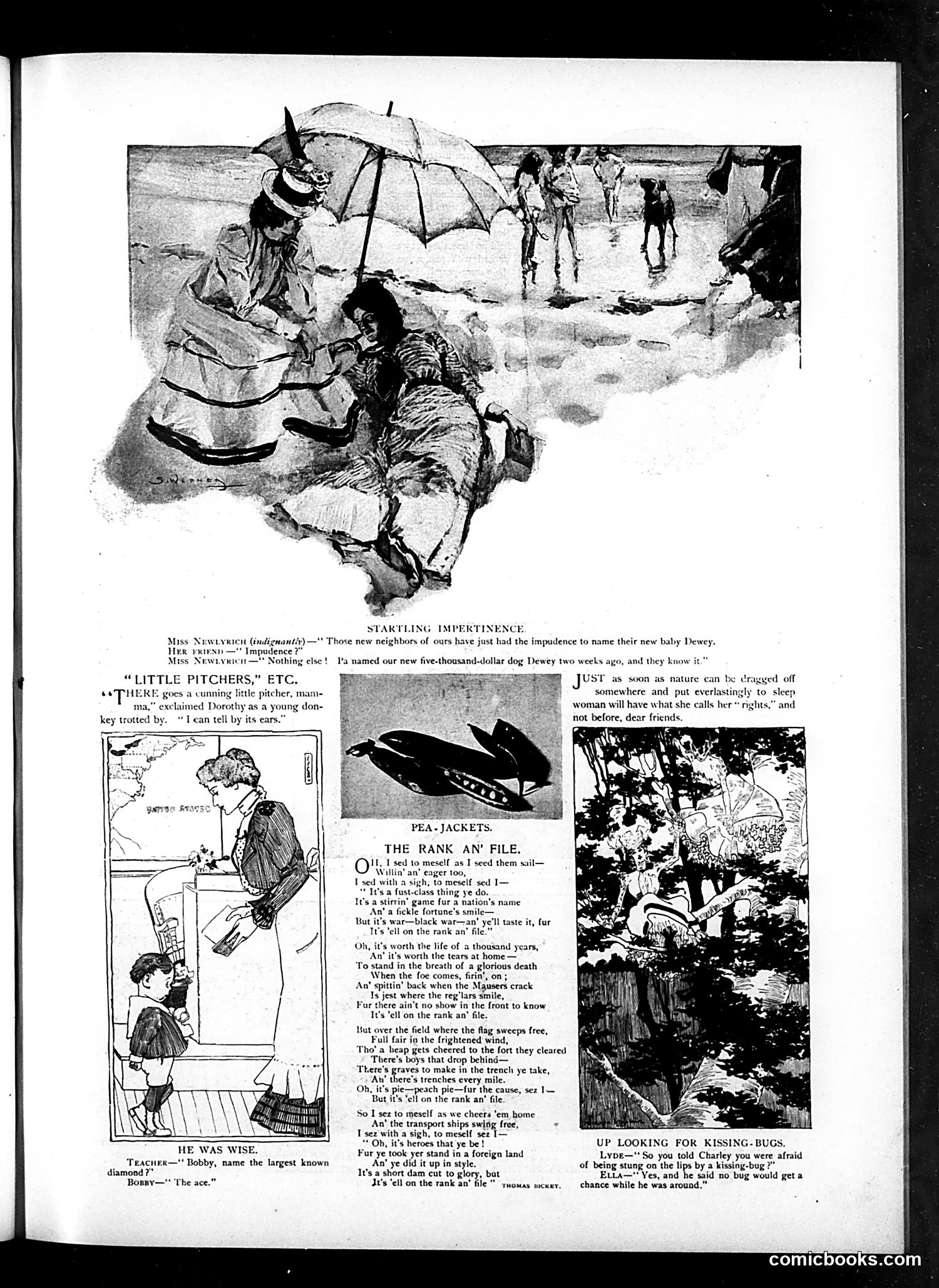
This page contains several unrelated humorous sketches and poems typical of Judge's satirical format. **"Startling Impertinence"** (top): Shows a fashionable woman with an umbrella encountering beach-goers. The joke concerns naming a new baby—a neighbor assumes the impudence to suggest naming it "Dewey" (likely referring to Admiral Dewey, a Spanish-American War hero), but the woman protests this is her private family matter. **"Little Pitchers"** (left): A domestic cartoon about children overhearing adult conversation, with traditional moralizing humor. **"The Rank an' File"** (center): A patriotic poem celebrating soldiers' sacrifice and national duty. **"Up Looking for Kissing-Bugs"** (right): A nature-themed joke about insects, likely playing on period terminology. The page reflects early 1900s American humor and values without clear contemporary political satire.
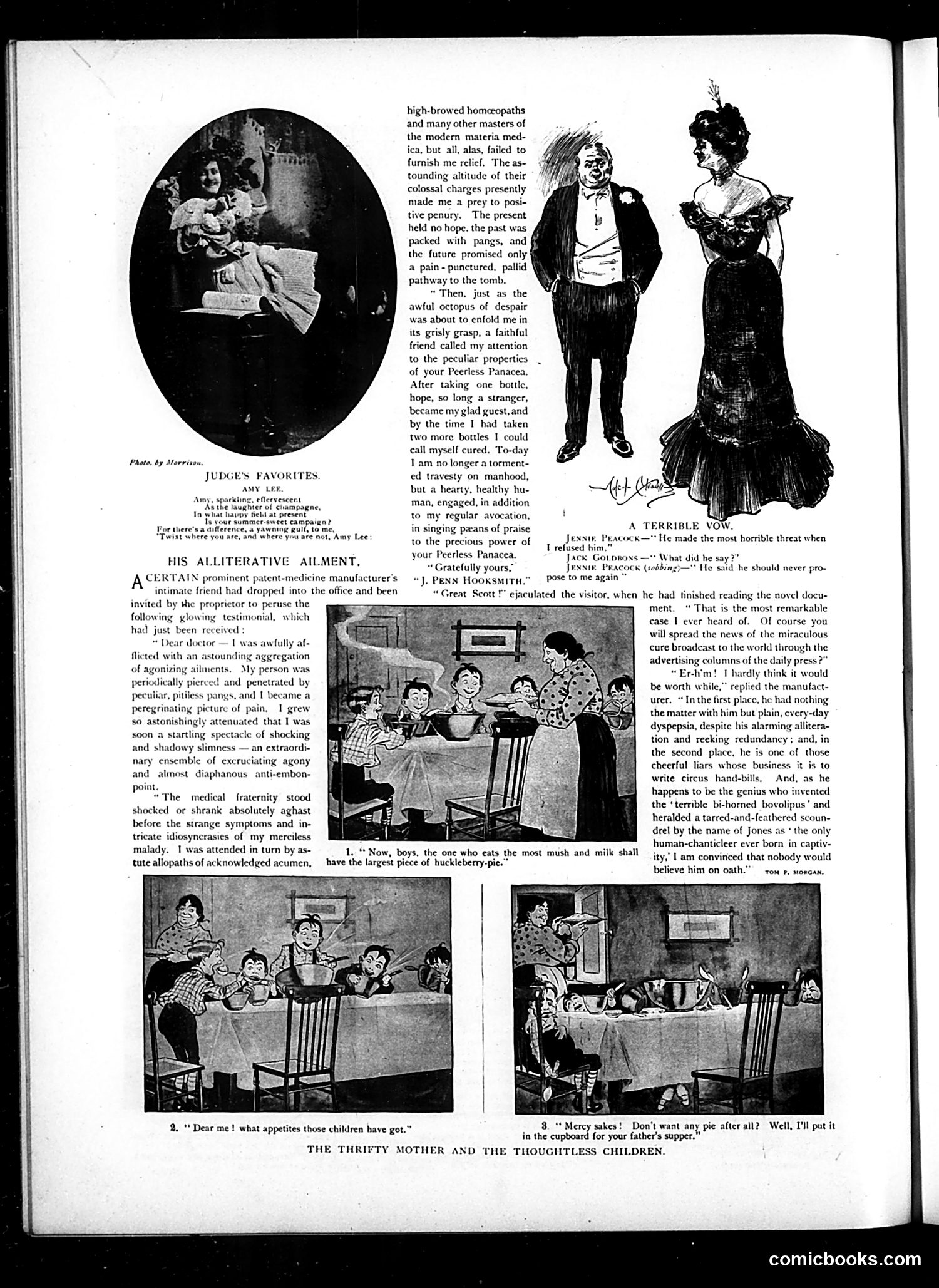
This page contains satirical fiction and illustrations mocking patent medicines and their false advertising claims. "His Alliterative Ailment" describes a man suffering from exaggerated hypochondria, attending countless doctors before being "cured" by a fraudulent product called "Peerless Panacea." The three sequential illustrations titled "The Thrifty Mother and the Thoughtless Children" appear to satirize parenting and household economics, showing a mother managing children's behavior around food/meals. The top illustration "Judge's Favorites" and "A Terrible Vow" feature society figures in formal dress, likely satirizing high-society pretension. The satire's primary target is the patent medicine industry's deceptive marketing and consumers' gullible belief in miraculous cures—a major Progressive-era social concern when dangerous, unregulated medicines made false health claims.
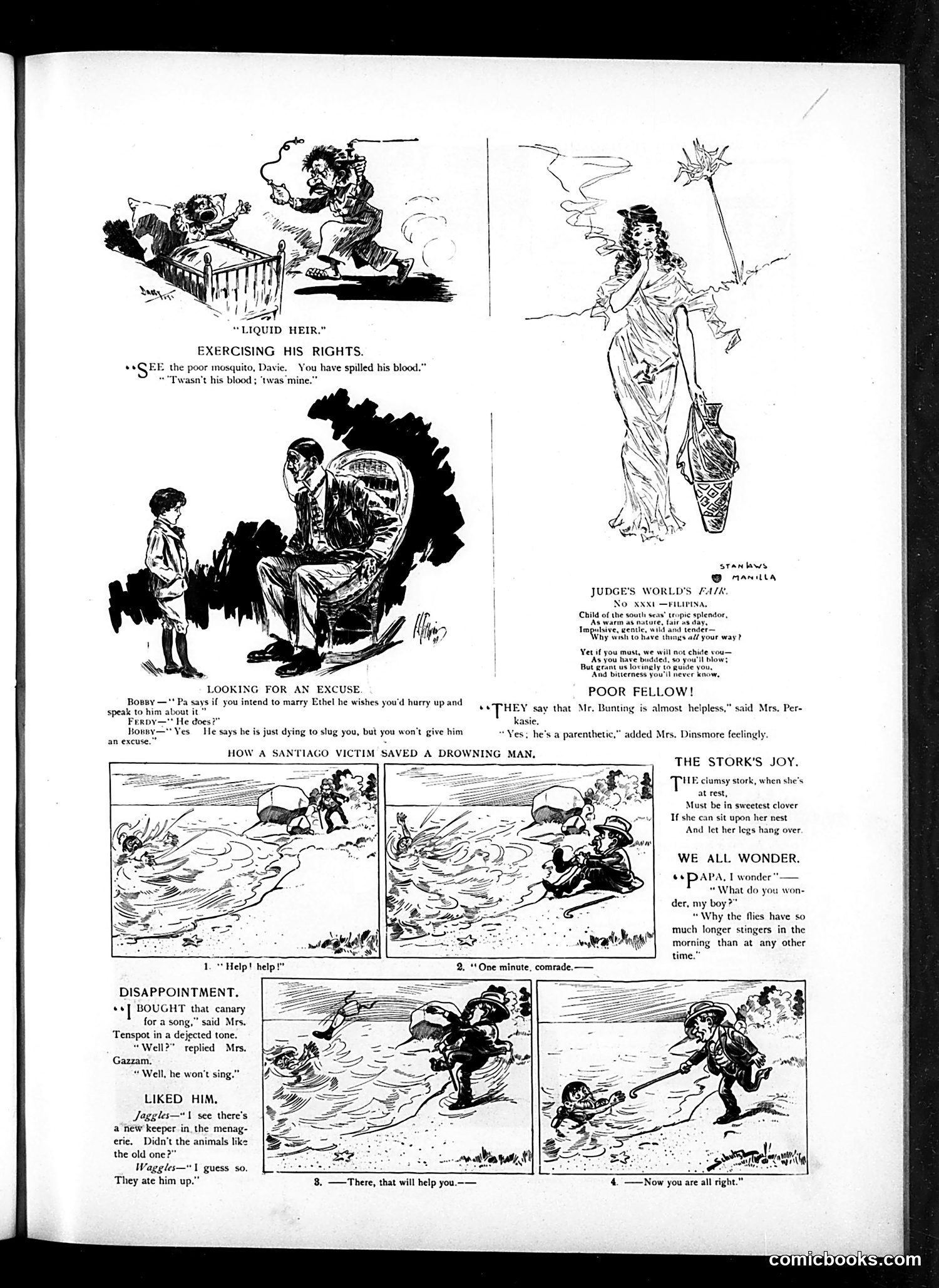
This page contains several unrelated satirical sketches and humorous short pieces typical of Judge magazine's format. **"Liquid Heir"** depicts a child inheriting property, playing on the double meaning of "heir/air." **"Exercising His Rights"** shows a dispute over spilled blood between two figures—likely commentary on property rights or legal disputes, with mosquito imagery suggesting petty quarrels. **"Santiago Victim" comic strip** references the Spanish-American War (1898), showing a drowning rescue—likely satirizing either combat conditions or wartime heroics. The remaining pieces are brief humorous vignettes: wordplay about a "parenthetic" (unclear reference), disappointment over a canary that won't sing, and dark humor about a zoo keeper being eaten by animals. **"Judge's World's Fair"** and **"Stork's Joy"** appear to be separate illustrated poems or whimsical observations. The overall page represents Judge's mix of political commentary, topical satire, and general humor rather than a unified theme.
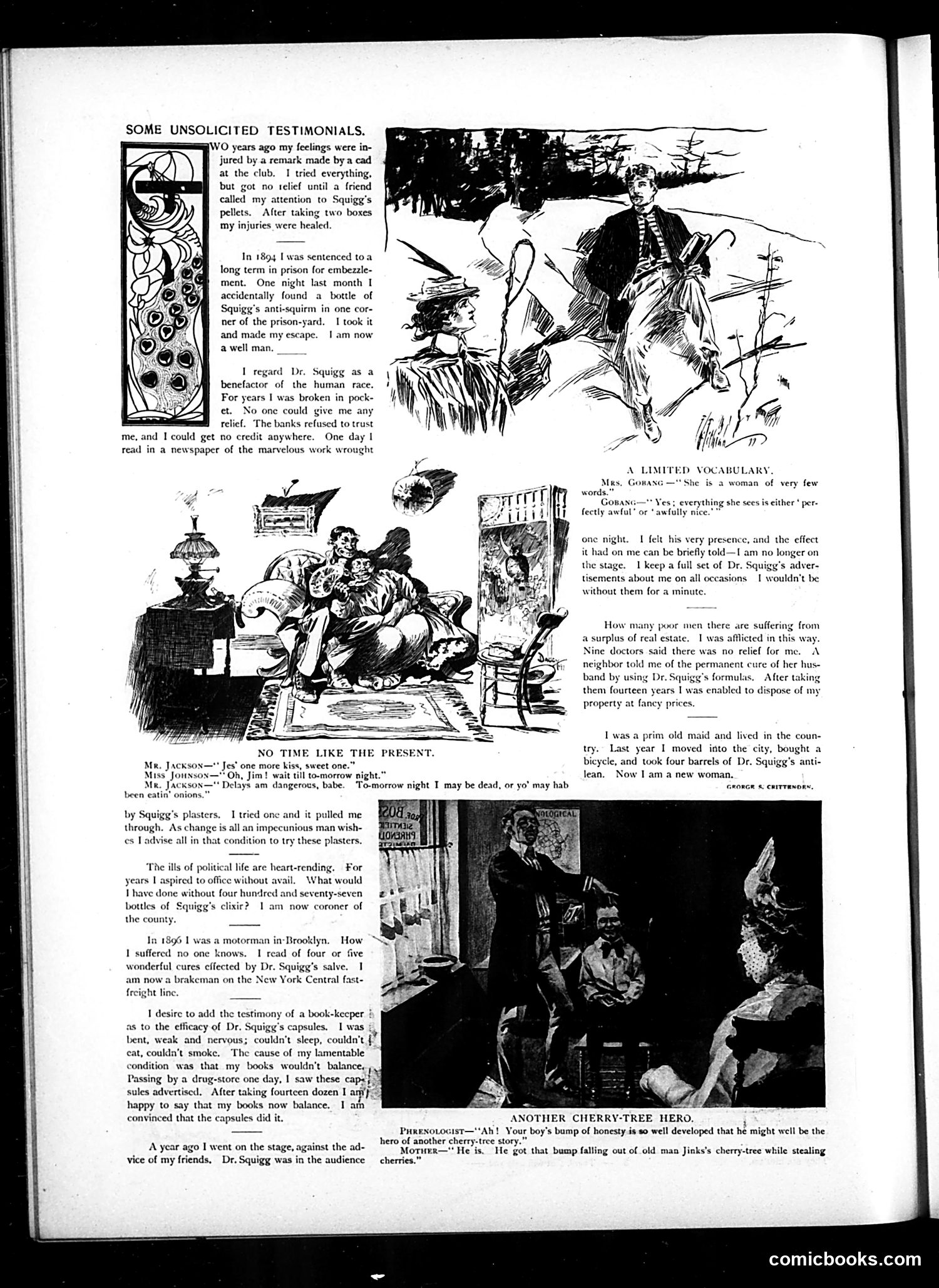
This page satirizes **patent medicine quackery** through fake testimonials for "Dr. Squigg's" miracle products. The satire mocks the absurd, exaggerated claims made in contemporary advertising. The testimonials claim Squigg's products cure everything: emotional hurt, imprisonment, poverty, political failure, and even unbalanced bookkeeping—suggesting these nostrums were utterly fraudulent yet wildly marketed. Each testimonial becomes increasingly ridiculous (a motorman becoming a brakeman; a woman becoming "new" after buying a bicycle). The page also includes unrelated humorous sketches: "A Limited Vocabulary" jokes about a woman's narrow word choices; "No Time Like the Present" depicts romantic delay; and "Another Cherry-Tree Hero" ridicules a boy's false claim of honesty (referencing the Washington cherry-tree myth). The overall message: American consumers were gullible marks for patent medicine hucksters peddling worthless products with impossible claims.
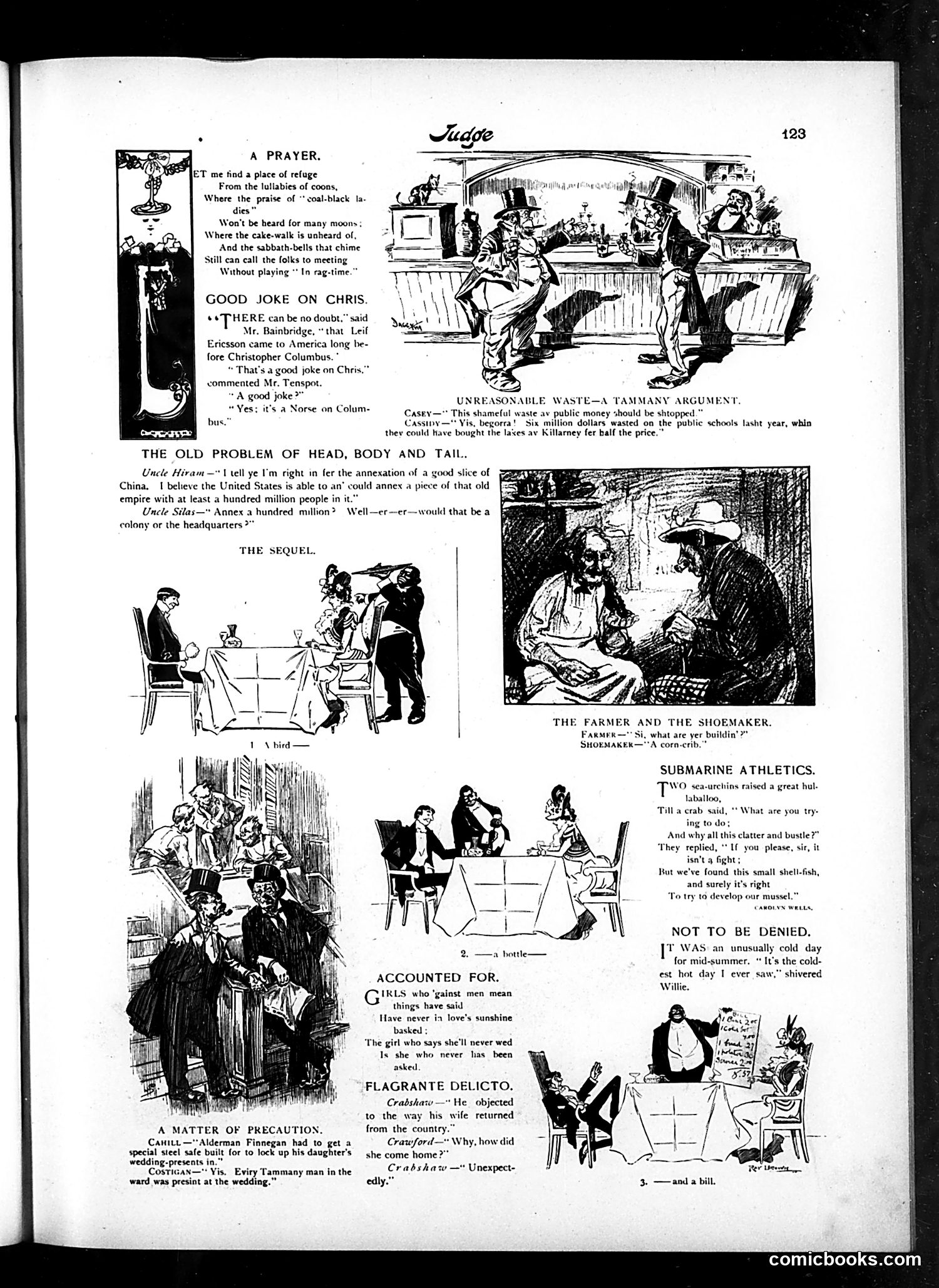
This page contains satirical humor typical of early-20th-century Judge magazine, mixing political commentary with social jokes: **"A Prayer"** mocks the popularity of African-American musical styles (ragtime, coon songs, cake-walk dancing) among white audiences—the author wants refuge from these "fads." **"Good Joke on Chris"** is a simple pun: Columbus gets outdone by Leif Ericsson, making it a "Norse on Columbus." **"Unreasonable Waste—A Tammany Argument"** satirizes Tammany Hall (NYC's corrupt Democratic machine). Irish politicians complain about $6 million spent on public schools while suggesting buying Irish land instead—exposing their misplaced priorities and ethnic favoritism. **"Head, Body and Tail"** jokes about American imperial expansion, specifically annexing Chinese territory—treating colonial ambitions as absurdly ambitious. The remaining items are lighter domestic humor: submarine creatures developing "mussel," a child's contradictory observation about weather, romantic verse, and marital infidelity jokes. The page blends political satire with general comedic filler typical of the era.
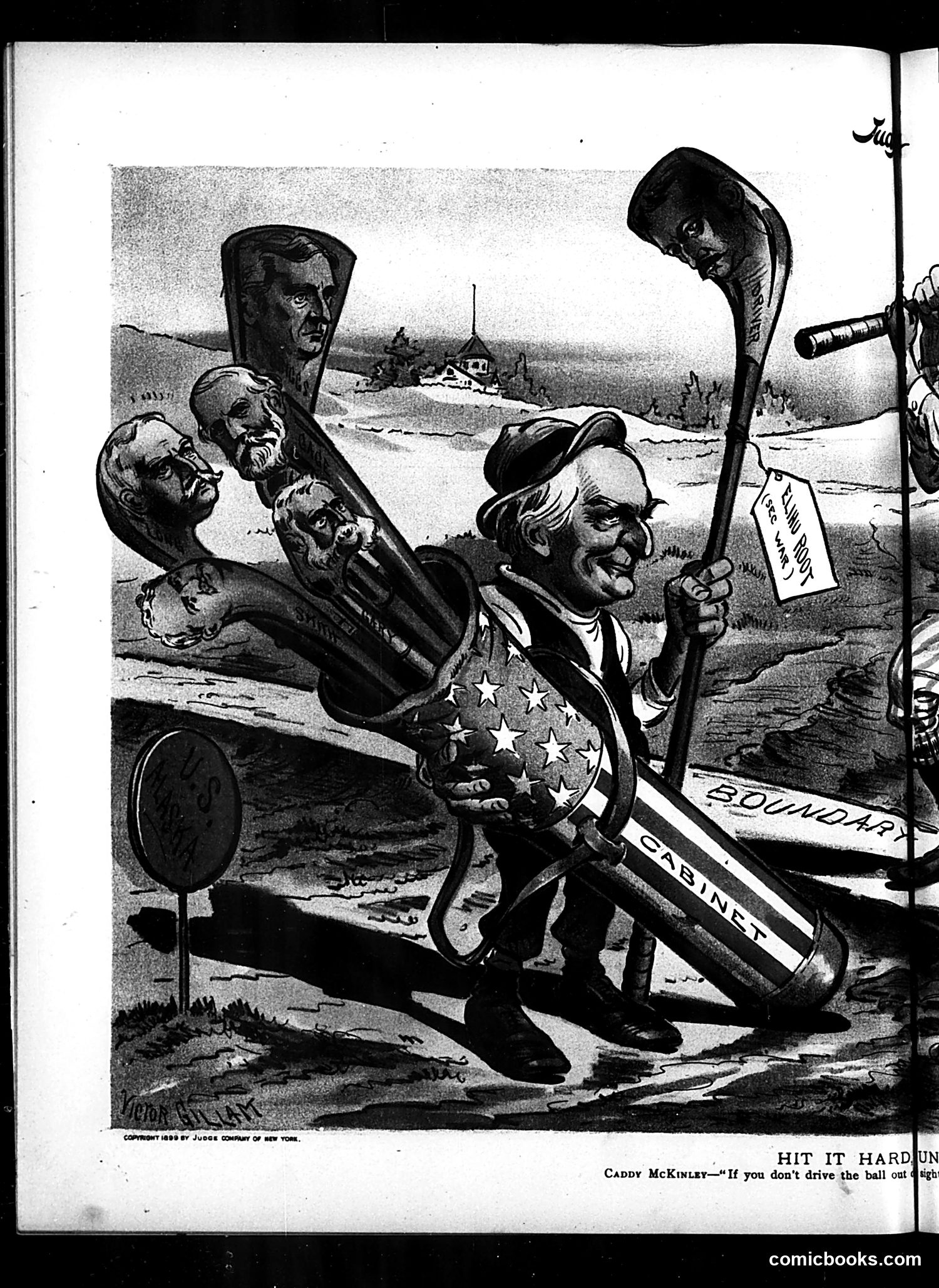
This Judge magazine cartoon depicts **Cappy McKinley** (a caricatured figure in the foreground wearing a star-decorated outfit) addressing what appear to be multiple political figures represented as heads mounted on a club or bat. The setting suggests a golf course or sports field, with a landscape visible behind them. The satire appears to use sports metaphor—specifically golf—to comment on political leadership or strategy. McKinley is encouraging these figures to "drive the ball out" with force, suggesting a call for aggressive political action or decisiveness from government figures. The mounted heads likely represent cabinet members or political allies, though their specific identities remain unclear from the image alone. The sporting context transforms political maneuvering into a game, likely critiquing the nature of political power or decision-making during this period.
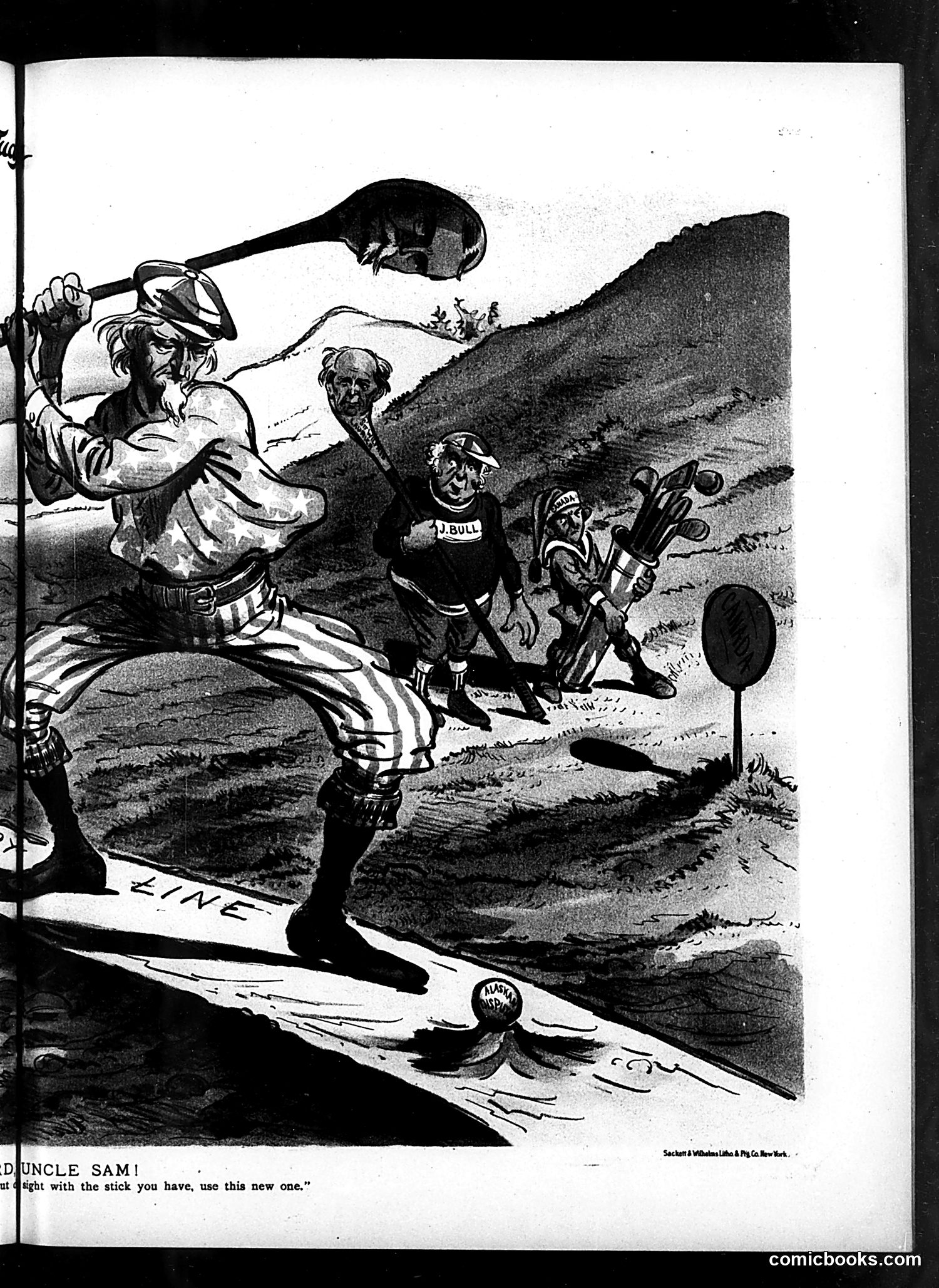
This political cartoon depicts Uncle Sam offering a new "stick" (weapon or tool) to smaller figures representing Allied nations during what appears to be World War I. The smaller characters—wearing military gear and appearing somewhat beleaguered—represent allied forces receiving American military support or intervention. The cartoon's message suggests the U.S. providing enhanced military aid or direct involvement to help its allies fight. The "new stick" likely references updated weapons, supplies, or American military power itself. The hillside terrain and military equipment suggest active combat conditions. The satire critiques or comments on America's role in supporting (or potentially entering) the war effort—whether encouraging greater military engagement or offering reinforcements to struggling allies.
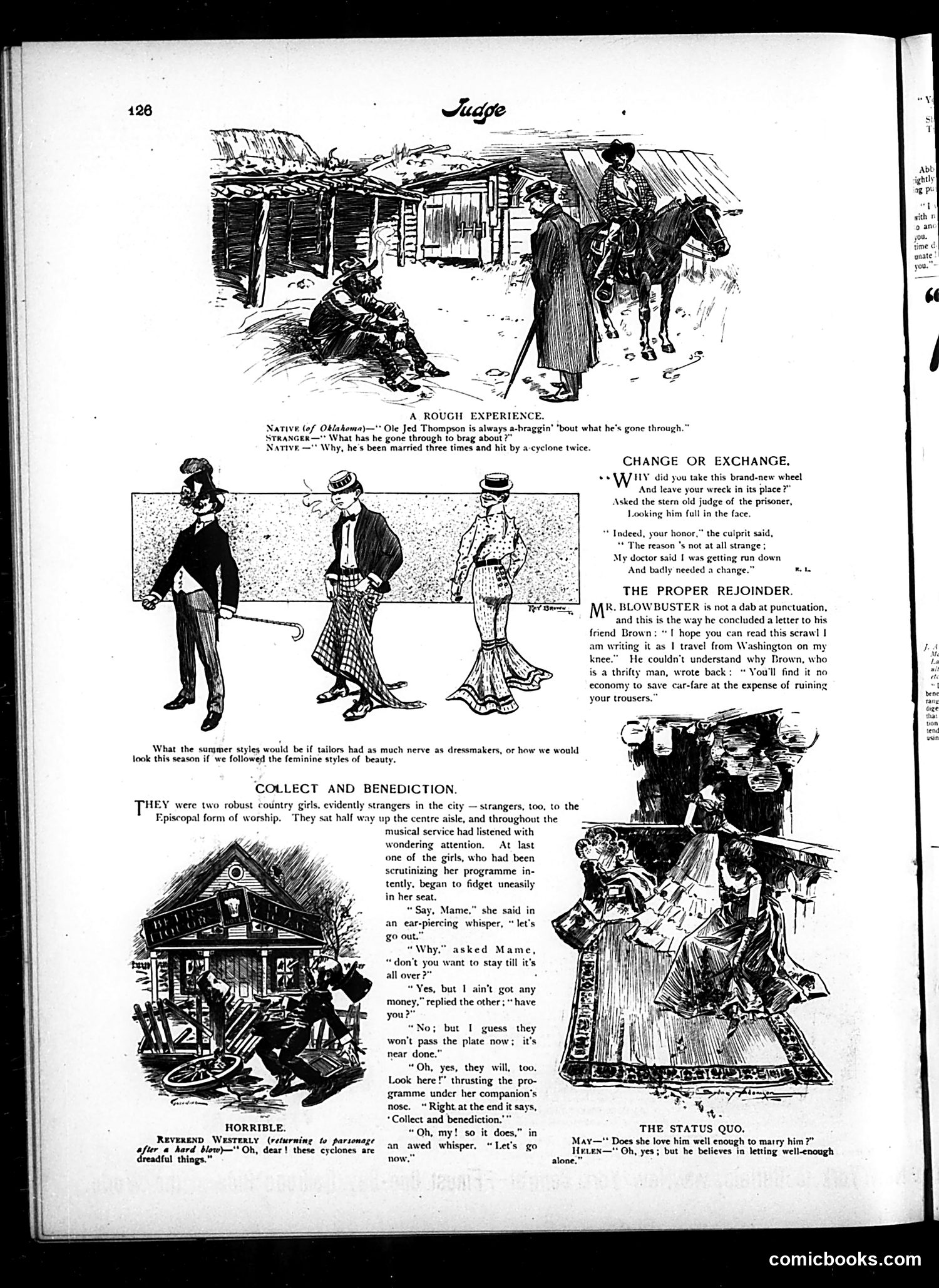
This satirical page contains multiple humor pieces typical of early 20th-century American magazine comedy: **"A Rough Experience"**: An Oklahoma native brags about hardships—three marriages and a cyclone strike—presenting misfortune as achievement. The joke mocks rural boasting culture. **"Change or Exchange"**: A prisoner argues to a judge that stealing a car was medically necessary ("needed a change"), punning on the doctor's advice. The satire targets both criminal excuses and health fads. **"The Proper Rejoinder"**: Mr. Blowbuster writes carelessly while traveling; his friend's witty response mocks pretentious behavior masquerading as efficiency. **"Collect and Benediction"**: Two country girls attending an Episcopal service misinterpret the church program's "Collect and benediction" as instructions to pass a collection plate, planning to leave before donations occur. The satire gently mocks rural unfamiliarity with formal worship. All pieces employ wordplay, mistaken assumptions, and class-based humor typical of Judge's audience.
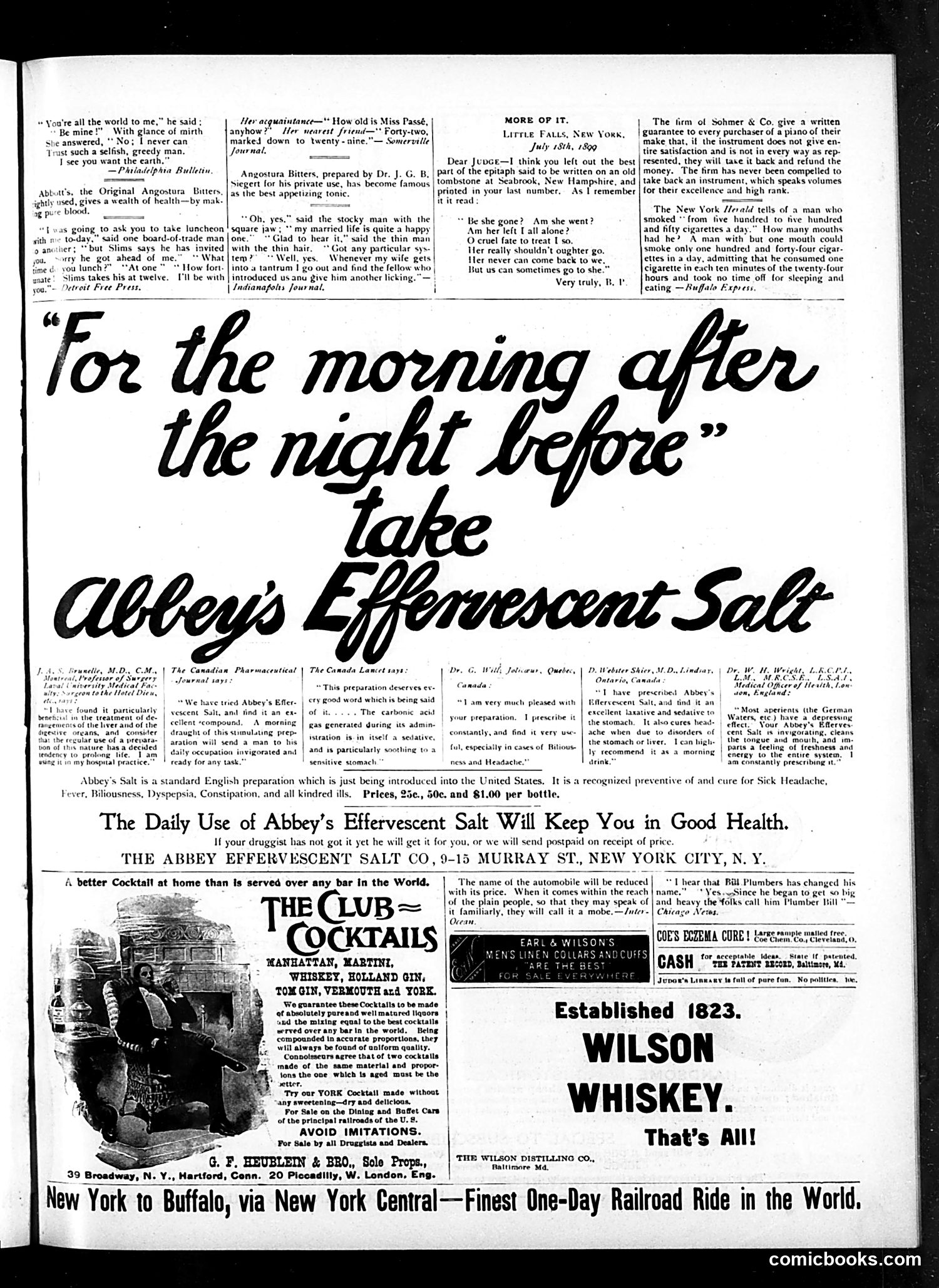
This page is primarily **advertising**, not political satire. It contains multiple product advertisements typical of an 1899 magazine, with minimal editorial content. The small humorous items at top are typical Judge filler jokes: a romantic dialogue where a woman rejects a greedy suitor; a board-of-trade lunch anecdote; and a joke about a woman's age being "marked down to twenty-nine." The dominant content is the large advertisement for **Abbey's Effervescent Salt**, a laxative/digestive aid. It includes testimonials from doctors claiming the product cures headaches, digestive issues, and constipation—common patent medicine marketing of the era. Below are ads for Wilson Whiskey and Club Cocktails. The only potentially satirical element is the repeated emphasis on Abbey's Salt as a "morning after" remedy, which may subtly reference hangovers from the alcohol advertisements surrounding it, though this isn't explicit satire. This page exemplifies how 19th-century magazines blended editorial content with extensive advertising, often without clear separation.
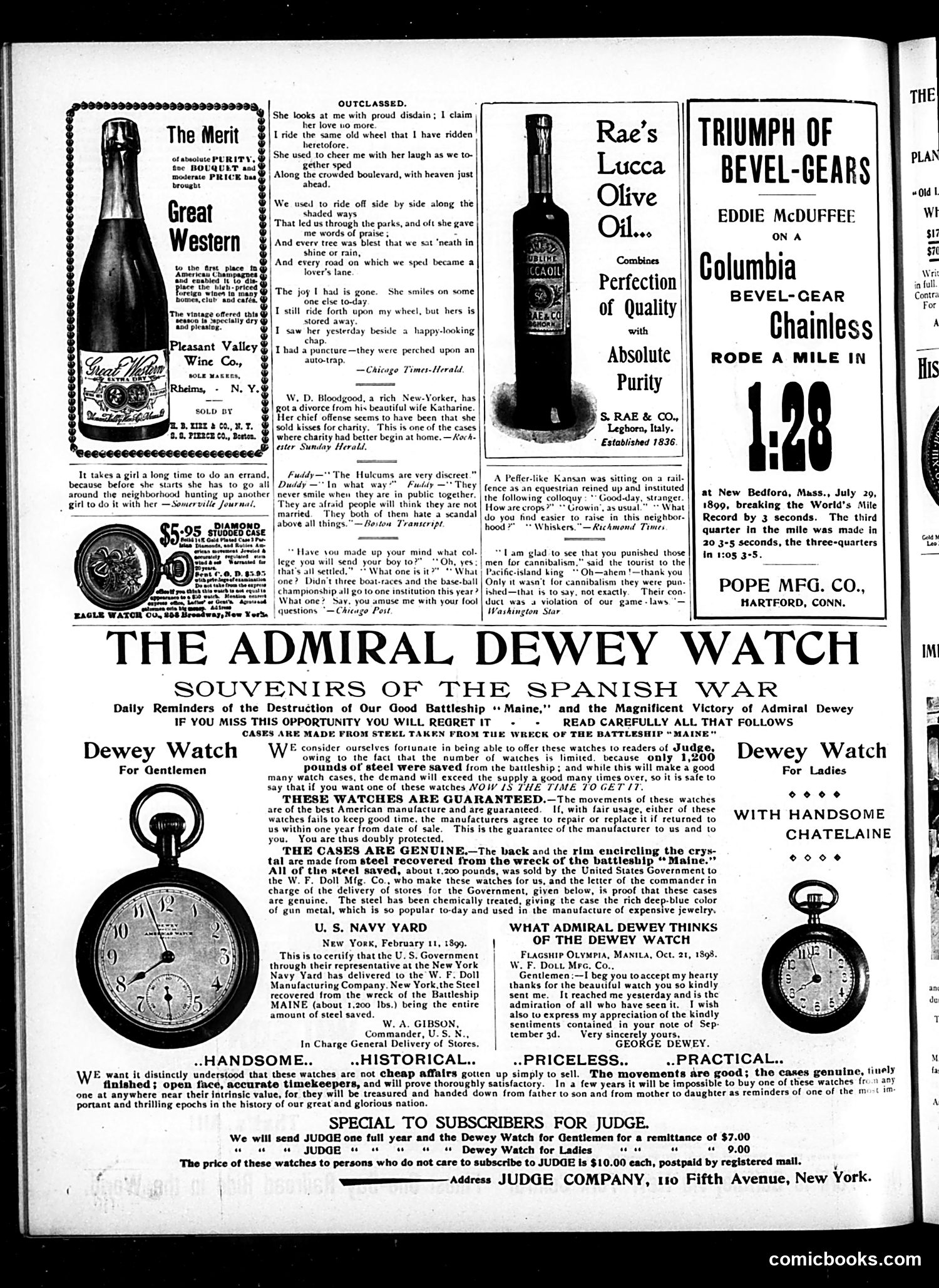
The poem satirizes how a cyclist has been replaced—both literally and romantically. His lover, whom he once rode with through parks enjoying shared romantic moments ("lover's lane"), now rides with another man in a motorcar ("auto-trap"). The speaker still "rides forth upon [his] wheel" while his former love has "outclassed" him by upgrading to modern automobile technology. The joke: bicycles—once romantic date vehicles—are becoming obsolete. The surrounding advertisements for bicycles (Columbia bevel-gear chainless model) underscore the irony: the page promotes bicycles while the poem mourns their irrelevance in courtship. The modern woman, literally and figuratively, has moved on to faster, newer transportation, leaving the bicycle-riding lover behind as an outdated relic.
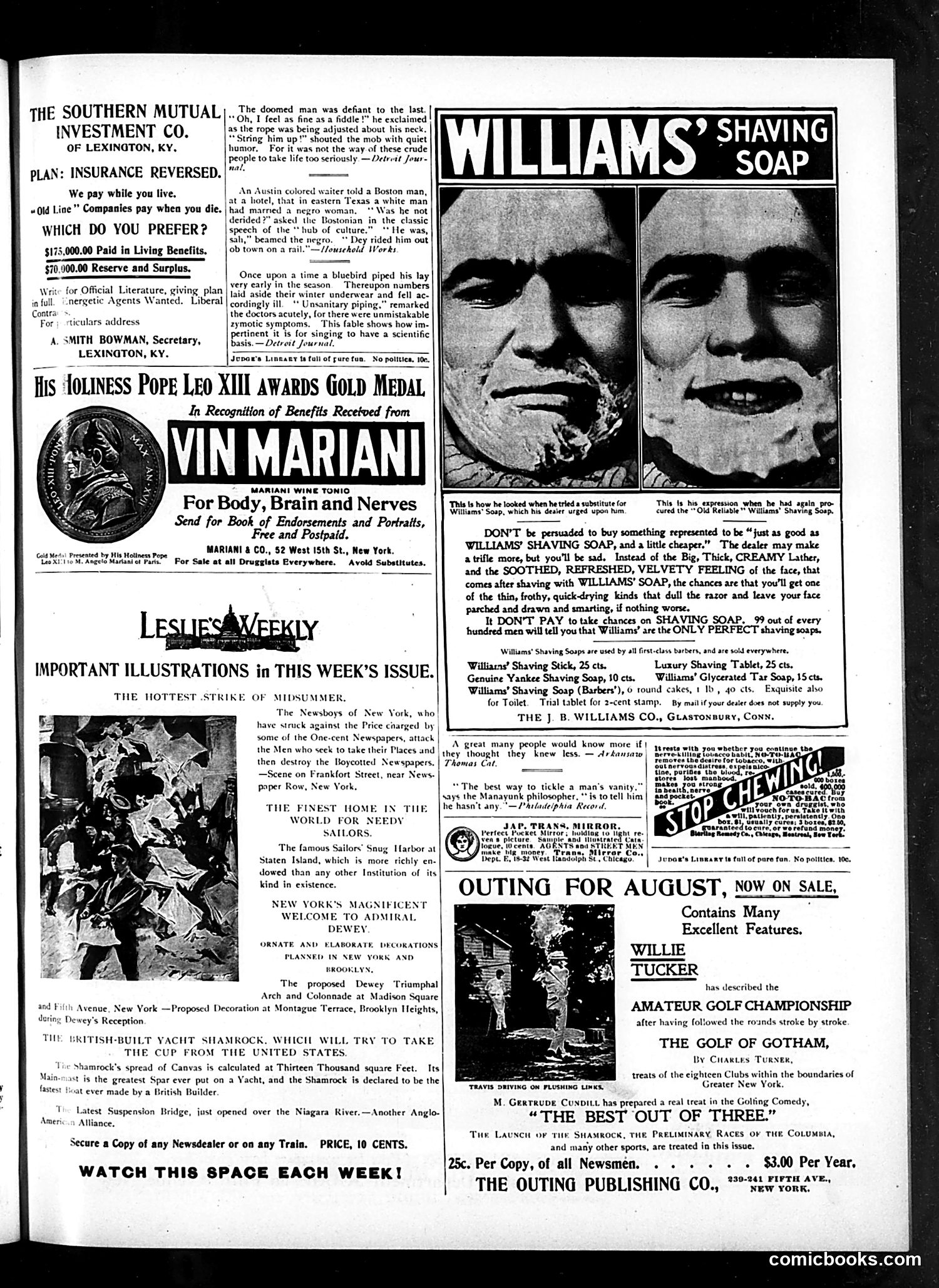
This page is primarily **advertising**, not political satire. The dominant feature is a Williams' Shaving Soap advertisement occupying roughly half the right side. The advertisement uses **before-and-after photographs** showing a man's facial expression: unhappy when trying a cheaper substitute soap, satisfied after using Williams' brand. The accompanying text warns consumers not to accept inferior "just as good" alternatives, emphasizing Williams' superior qualities—thick creamy lather and a soothed, refreshed feeling. This represents **typical early 1900s advertising strategy**: comparative product messaging and emotional appeals about consumer choice. The exaggerated facial expressions in the photographs are meant to humorously demonstrate product satisfaction differences. The rest of the page contains insurance advertisements and brief humorous anecdotes—standard Judge magazine filler content—alongside announcements of featured illustrations about newsboy strikes, Admiral Dewey's reception, and yacht racing.
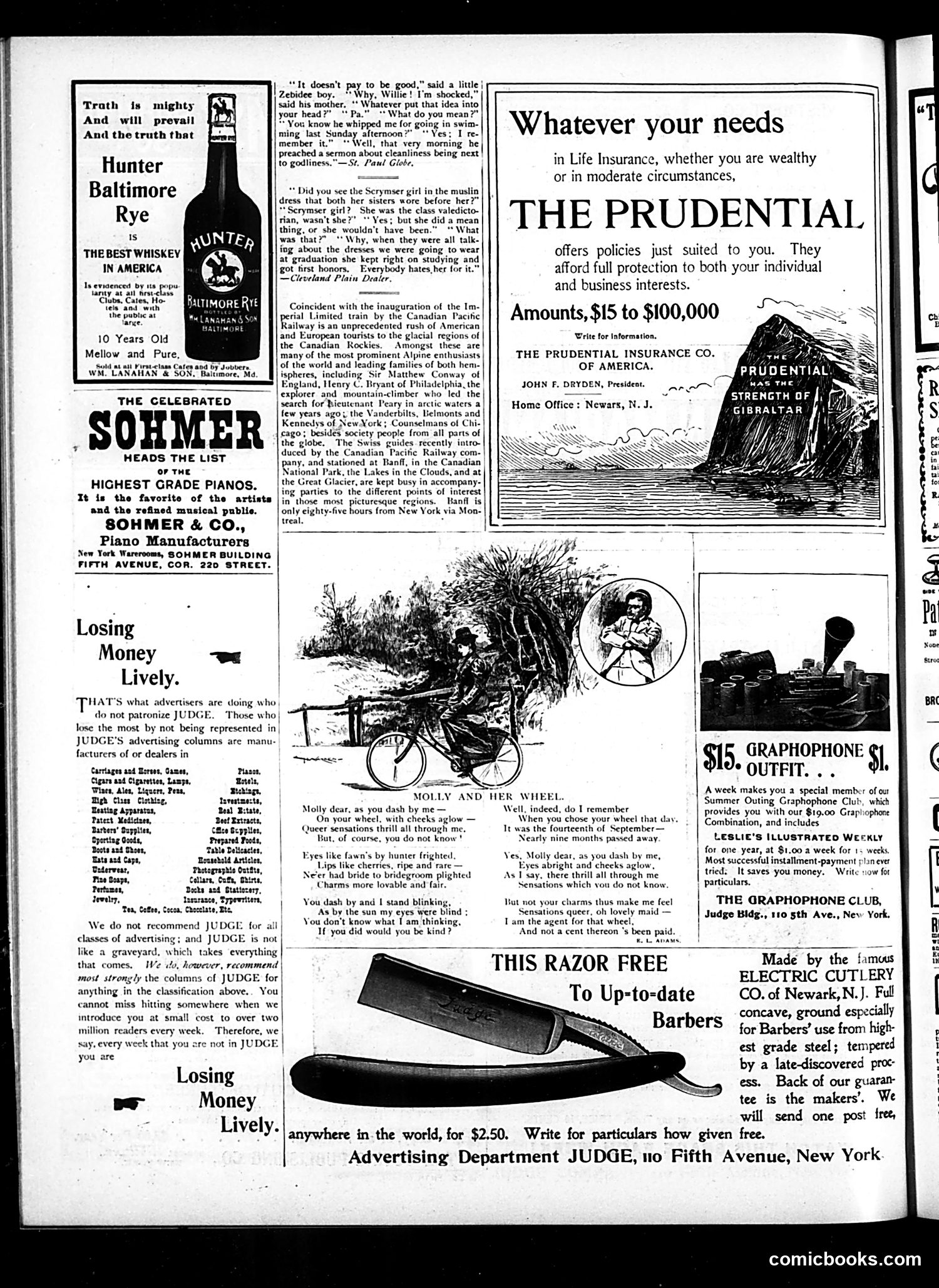
This page is primarily **advertising**, with one cartoon titled "Molly and Her Wheel" depicting a young woman on a bicycle. The cartoon accompanies a poem celebrating a girl cycling with rosy cheeks and visible joy. The accompanying verse romanticizes the activity, praising the "thrill" and "sensations" of wheel-riding while warning against losing one's "charms" through excessive cycling. **Context for modern readers:** This reflects late-Victorian anxiety about the bicycle's social impact on women. The bicycle represented newfound independence and mobility for women, but conservative commentators worried it was unfeminine or physically damaging. The poem here attempts a light, approving tone about female cyclists—yet the cautionary final lines ("not a cent there's 'een paid") suggest lingering concerns about propriety and respectability. The illustration's placement amid luxury product advertisements (pianos, whiskey, insurance) suggests this was aspirational content for Judge's affluent readership.
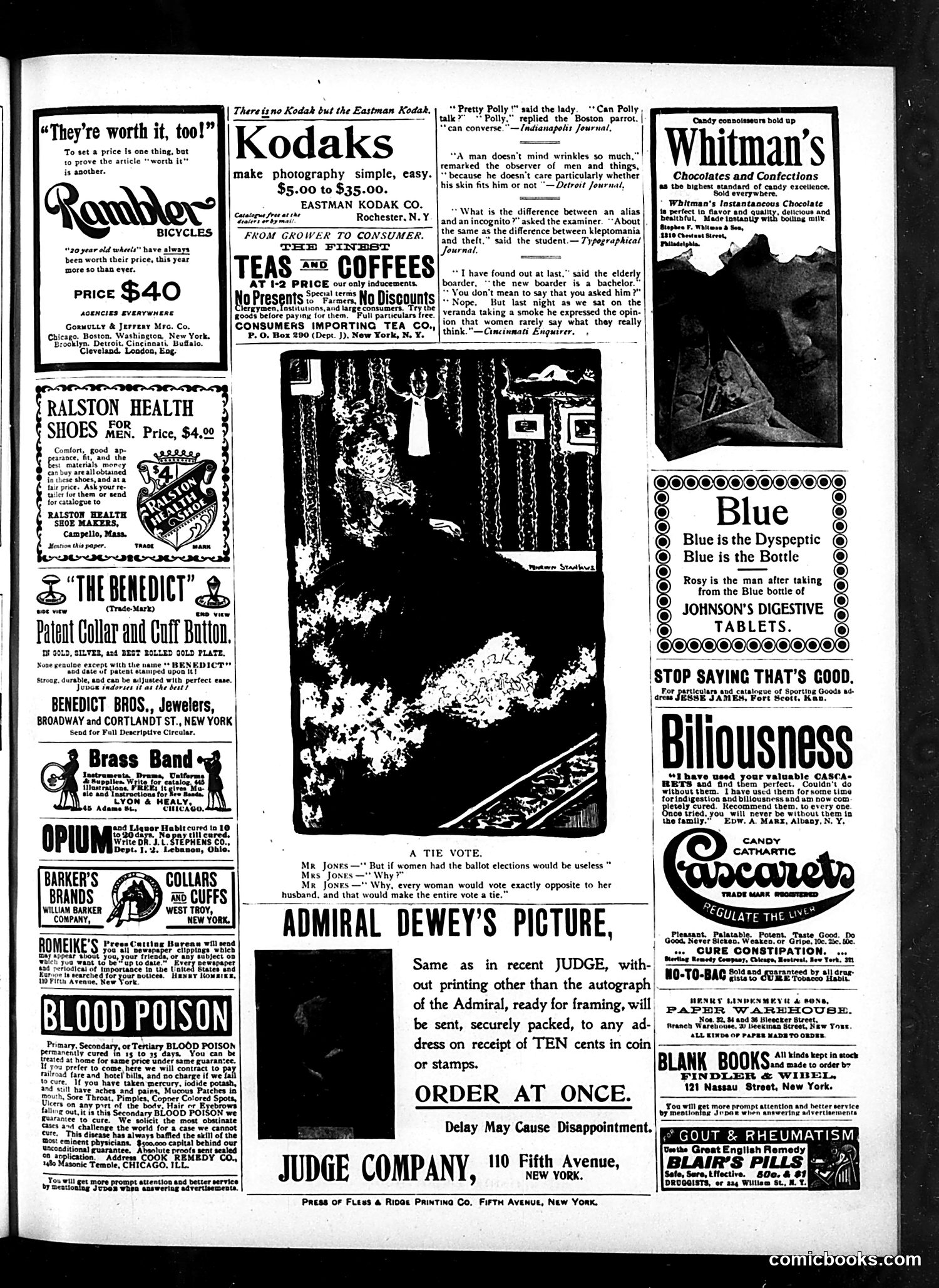
This page is primarily **advertisements** interspersed with short joke items, typical of Judge magazine's format. The main cartoon titled **"A Tie Vote"** satirizes women's suffrage (then a contentious political issue). Mr. Jones argues that if women could vote, they would "vote exactly opposite to her husband," resulting in a tie that would "make the entire vote useless." This reflects anti-suffrage arguments of the era—that women voters would merely contradict their husbands rather than think independently. The joke mocks this logic while indirectly critiquing opposition to women's voting rights. A secondary item references **Admiral Dewey's picture**, likely the Spanish-American War hero, offered for sale by Judge Company. The remaining content consists of patent medicines, shoes, bicycles, and other consumer goods—standard advertising for the period. The tone throughout is light satire mixed with commerce typical of early-1900s American humor magazines.
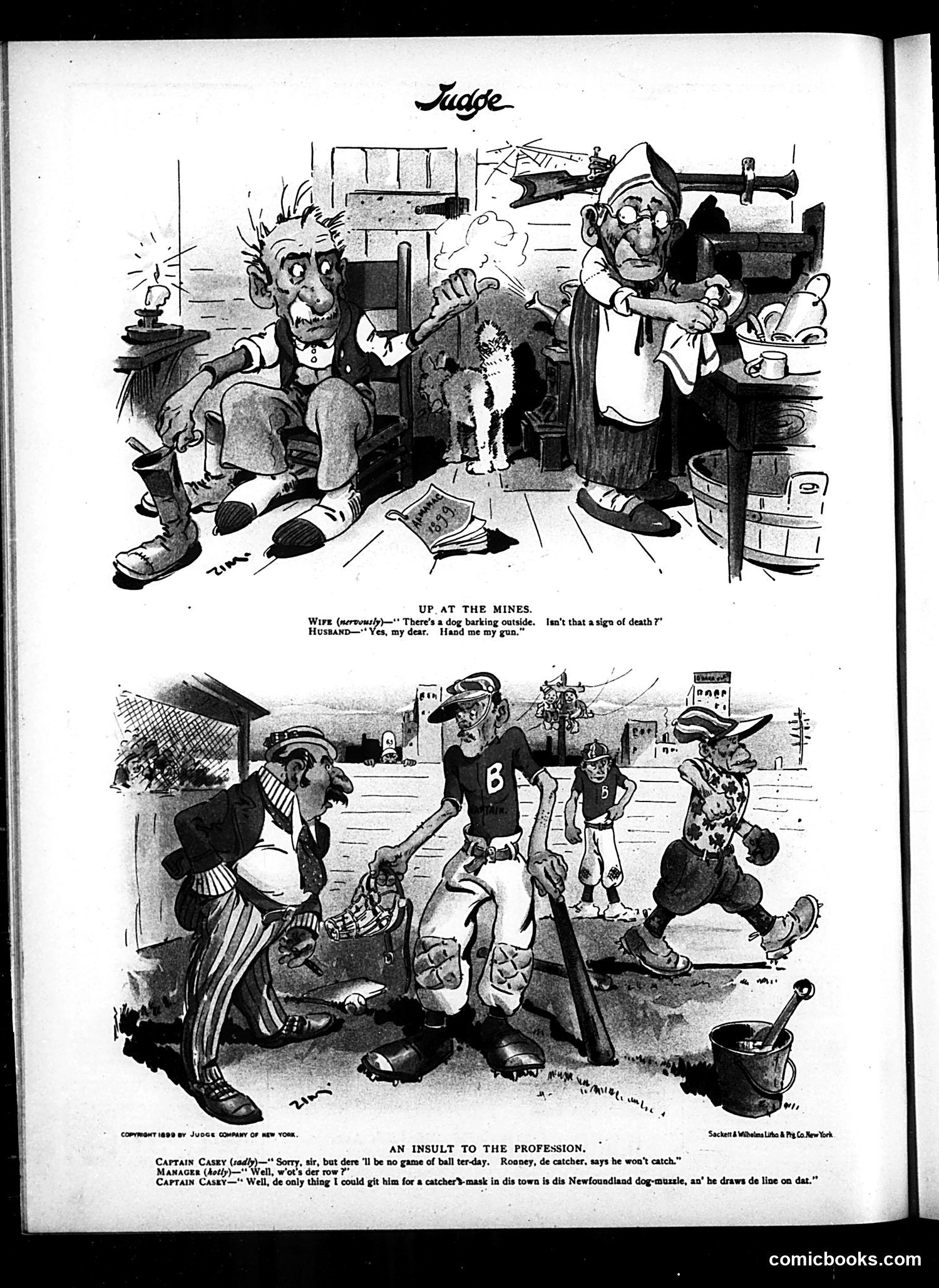
This page contains two separate cartoons satirizing different subjects: **"Up at the Mines"** depicts a nervous wife and husband at a mining camp. When she hears a dog barking and asks if it's a sign of death, he matter-of-factly hands her his gun—a dark joke about the dangerous, death-prone conditions of mining life in 1899. **"An Insult to the Profession"** is a baseball humor piece. A team captain explains they can't play because their catcher refuses to wear the only available face protection: a Newfoundland dog muzzle. The joke rests on the indignity of this substitution—using dog equipment for protective gear insults the catcher's profession enough that he'd rather not play. This reflects early baseball's rough conditions before proper safety equipment was standard. Both cartoons use exaggerated caricatures typical of Judge's satirical style, poking fun at mining dangers and baseball's primitive equipment standards.