
A complete issue · 16 pages · 1899
Judge — July 29, 1899
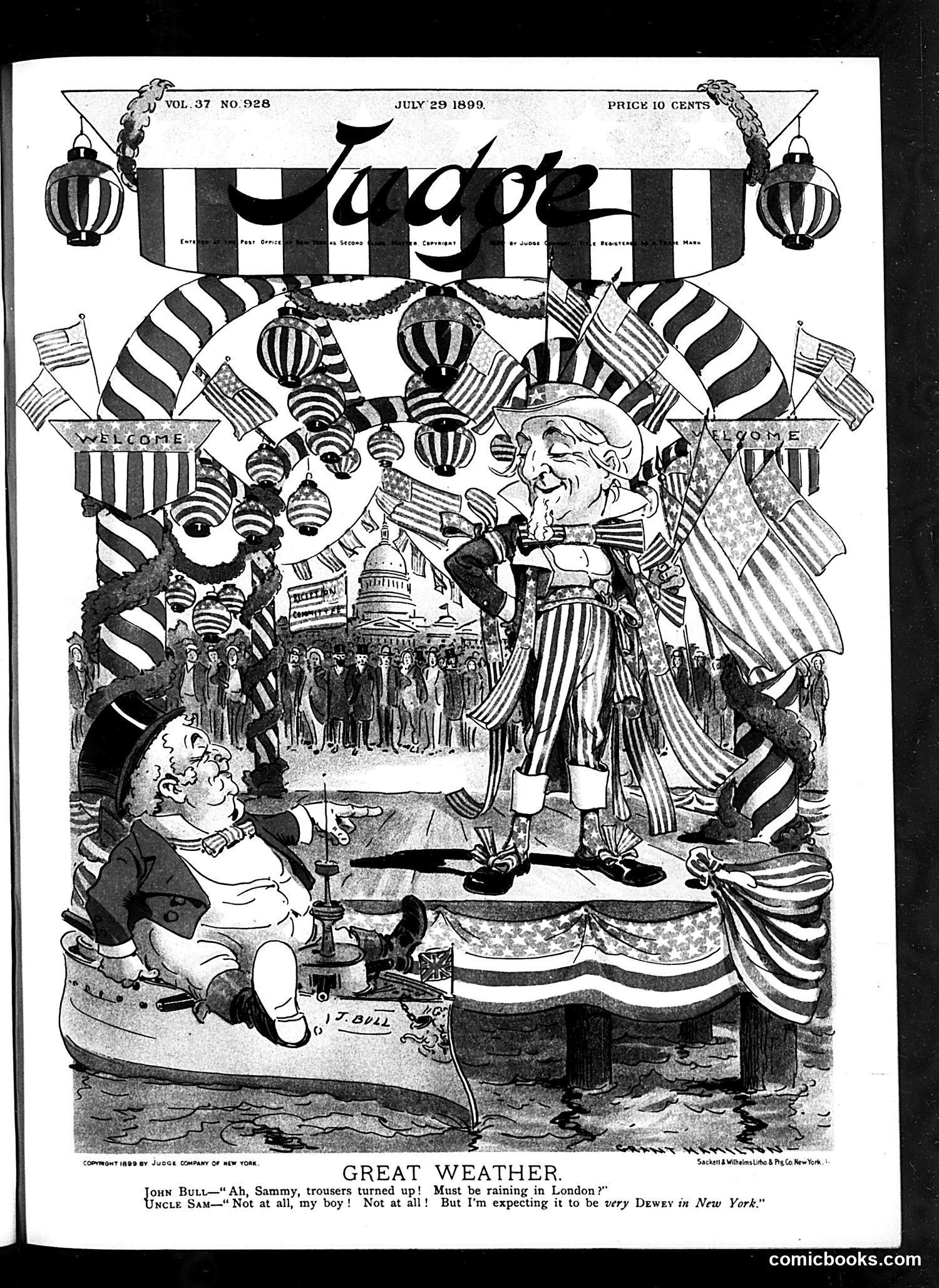
This political cartoon satirizes Anglo-American relations during a period of British imperial expansion. Uncle Sam (right, in striped suit) confidently predicts hot, "dewey" weather in New York, while John Bull (left, British figure) expresses concern about rain in London. The satire likely references the Second Boer War (beginning October 1899) or broader tensions over American versus British imperial ambitions. The "dewey" pun alludes to Admiral George Dewey, whose 1898 naval victory in Manila had made him a celebrated American expansionist figure. The crowded Capitol building and abundant American flags underscore American confidence and patriotic fervor. The cartoon mocks British anxieties while celebrating American imperial aspirations at century's end.
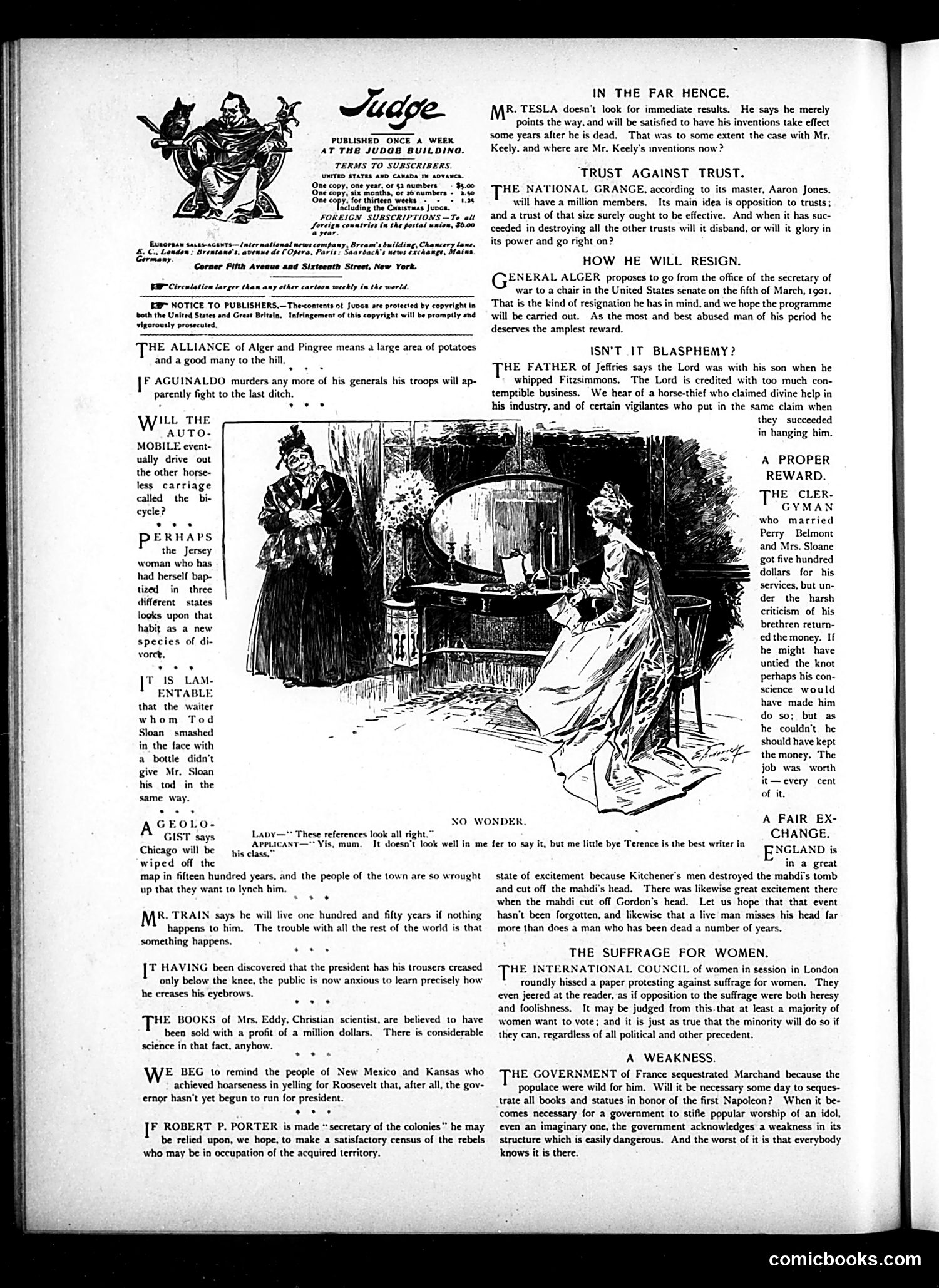
The main cartoon depicts a domestic scene with a woman reclining in a chair while a man stands nearby. The caption reads: "These references look all right. Lady—'These references look all right.' Applicant—'Yes, mum. It doesn't look well in me fer to say it, but me little boy Terence is the best writer in'—" This satirizes the job application process, likely mocking working-class applicants who naively promote their children's abilities during employment interviews. The humor stems from the applicant's inappropriate mixing of personal pride with professional qualifications. The surrounding text contains brief satirical commentary on contemporary political and social issues, including trusts, women's suffrage, and government matters, but these sections lack clear historical anchors without additional context about Judge's publication date.
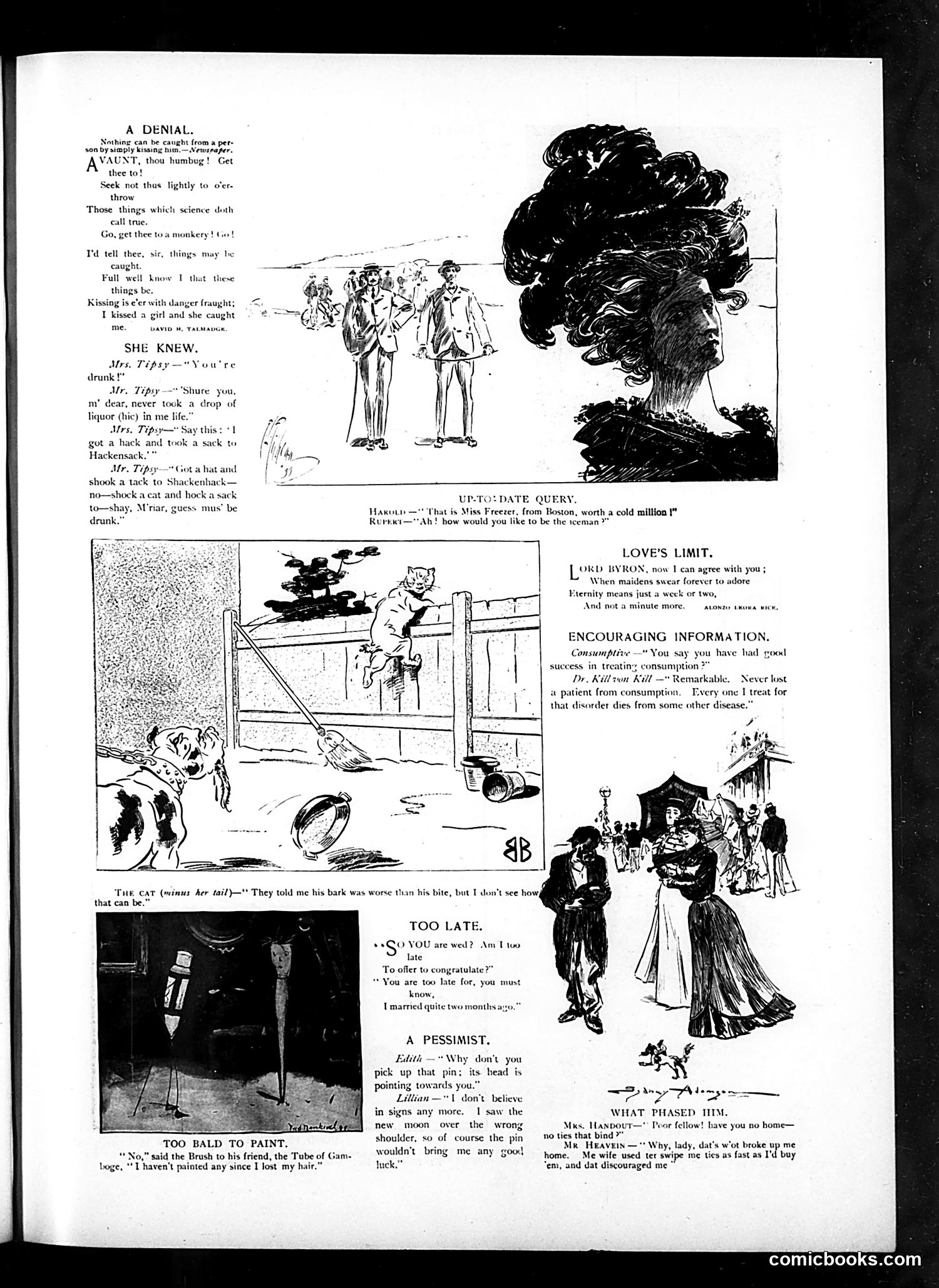
This page contains several humor sketches typical of early 20th-century satirical magazines. The content includes: **"A Denial"** and **"She Knew"**: Dialogue-based humor about infidelity and marital suspicion, with a woman catching her husband kissing a girl. **"Up-to-Date Query"**: A joke about a wealthy Bostonian woman (Miss Ferrer) worth "cold millions." **"Love's Limit"**: Byron's quote about fleeting romantic passion. **"Too Bald to Paint"**: A photograph-based joke about a man too bald for portraiture. **"Too Late"** and **"A Pessimist"**: Romantic misadventures and cynical observations about relationships. **"What Phased Him"**: A sketch about domestic life. The page emphasizes relationship humor—infidelity, aging, disappointment—reflecting period preoccupations with courtship and marriage, presented through brief comic scenarios typical of Judge's format.
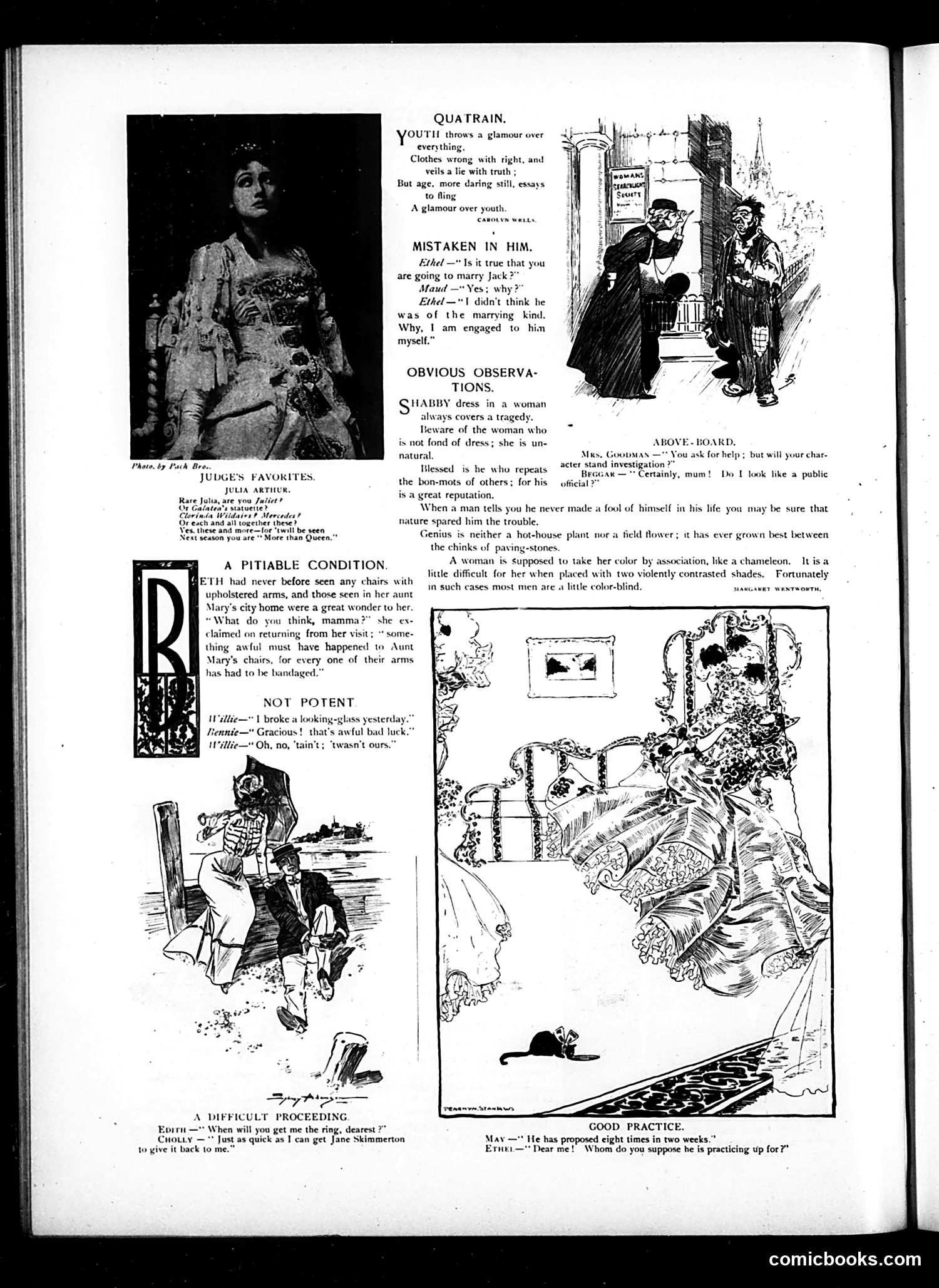
This page contains several humor pieces typical of early 20th-century satirical journalism. The content includes: **"Quatrain"** and **"Mistaken in Him"**: Short comedic dialogues about youth, romance, and marriage—social observations rather than political satire. **"Obvious Observations"**: Witty aphorisms about dress, reputation, genius, and women's nature—general social commentary on manners and conduct. **Illustrated Scenes**: Several cartoon vignettes with dialogue depicting everyday situations: a woman with broken glass, a couple's conversation, and what appears to be a marriage proposal scenario ("Good Practice"). The page is primarily **social satire** targeting human foibles—vanity, courtship mishaps, and social pretension—rather than political figures or events. It represents typical *Judge* content: lighthearted humor aimed at middle-class readers about universal social situations, with no apparent references to specific political events or identifiable public figures.
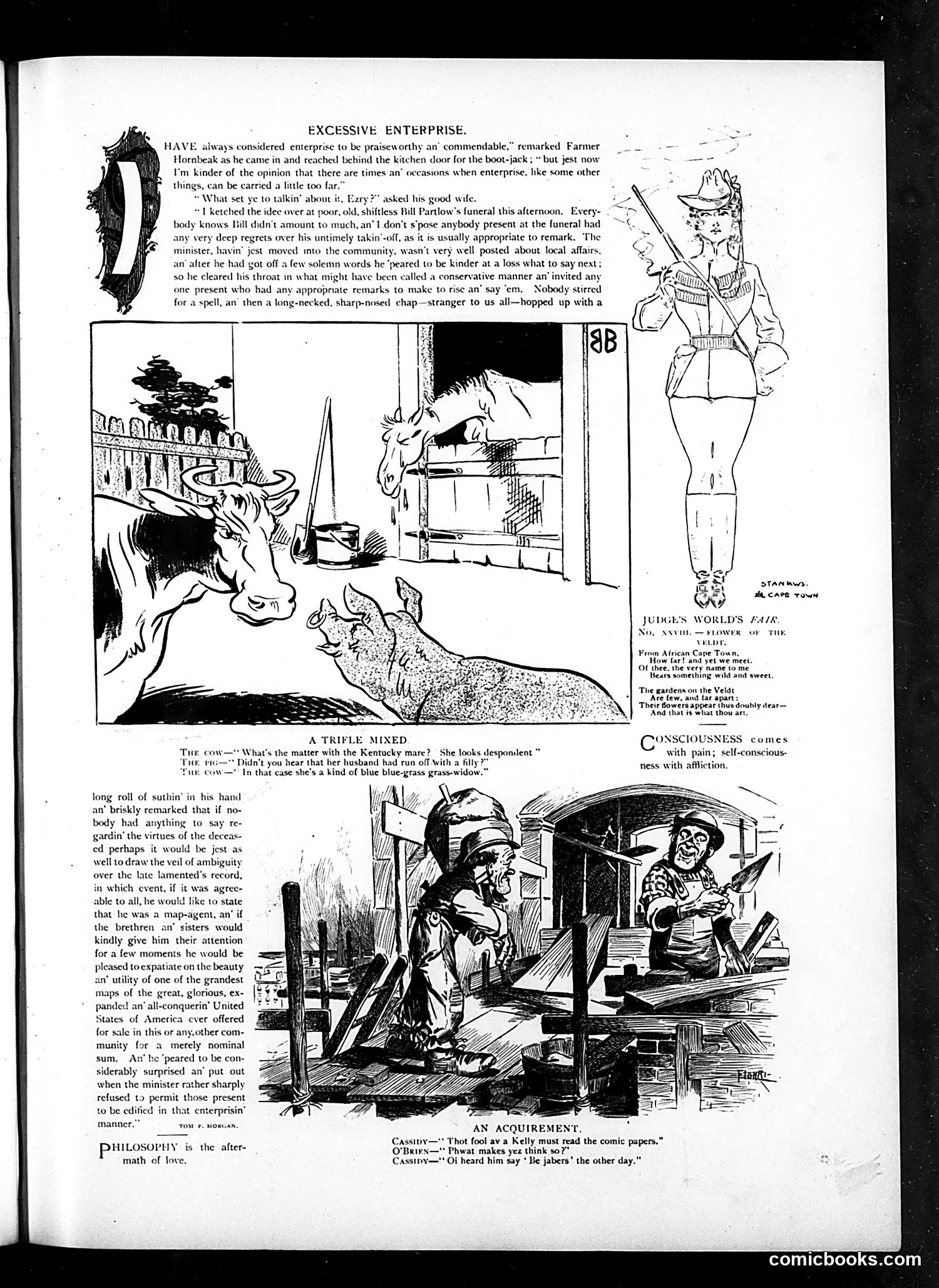
This page satirizes aggressive commercialism intruding into solemn occasions. The main story, narrated by Farmer Hornbeak, describes a funeral where a sharp-dressed stranger (likely a traveling salesman) exploits the minister's invitation for remarks about the deceased to instead pitch maps of the United States—turning a moment of mourning into a sales opportunity. The humor targets the era's relentless "enterprising" spirit: the salesman's audacity in converting a funeral into a captive audience for commercial hawking, and his indignation when the minister refuses. It's social criticism wrapped in rural dialect—mocking both the aggressive salesman culture and the vulnerability of small communities to such exploitation. The smaller cartoons below offer lighter humor about animals and relationships, typical of the magazine's mixed-content format.
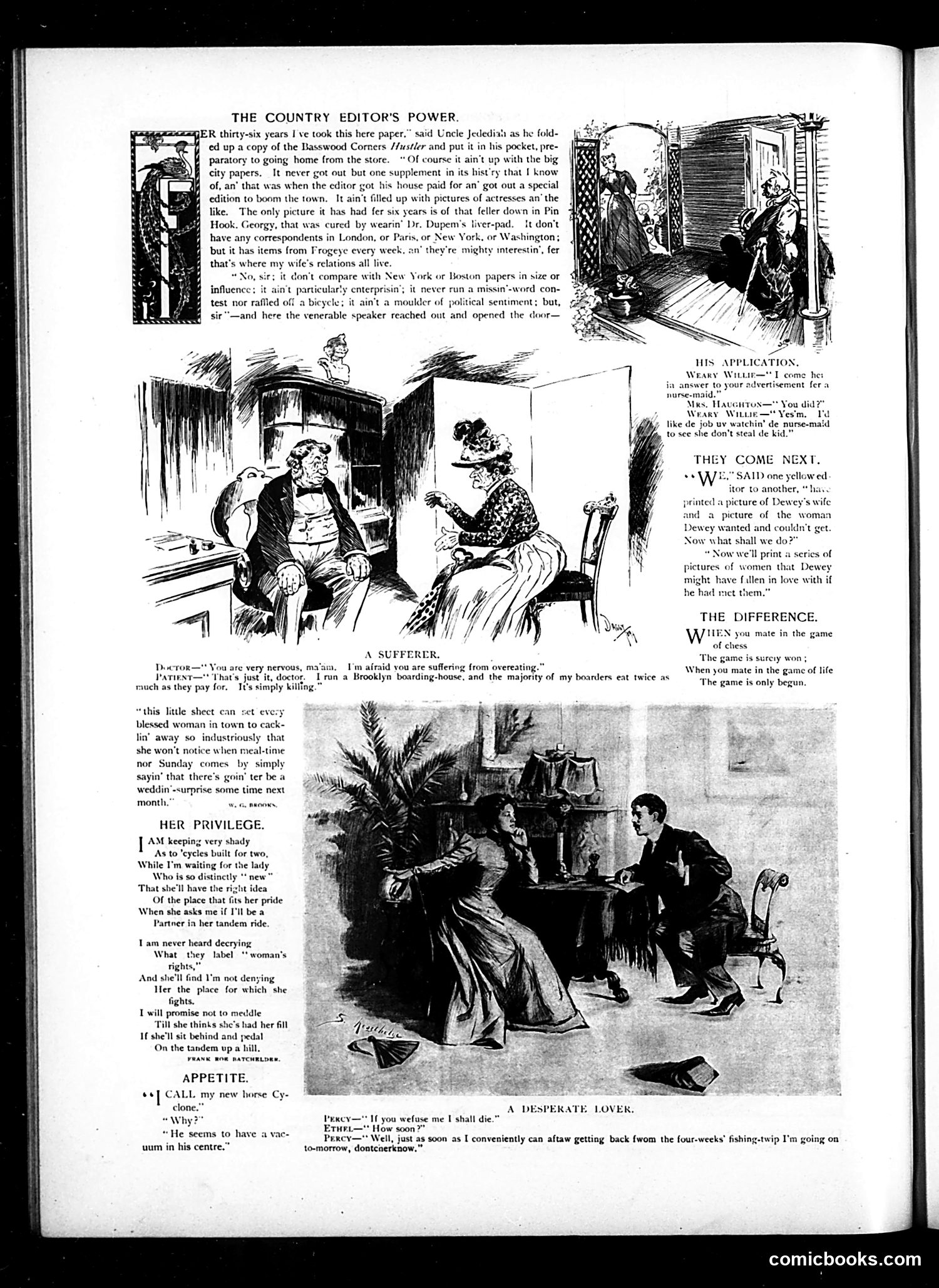
This page satirizes the pretensions and actual powerlessness of small-town journalism. The main feature mocks Uncle Jedediah, editor of the fictional *Basswood Corners Hustler*, who boasts about his 36-year tenure despite running a provincial paper with minimal circulation, no big-city correspondents, few advertisements, and ancient content (a single six-year-old photo of a man cured by a patent medicine). The satire's point: country editors fancy themselves influential "molders of political sentiment" when they're actually inconsequential—their only real power is local gossip and trivial announcements (like weddings). The accompanying jokes similarly mock rural life, Brooklyn boarding-house economics, and romantic desperation, suggesting the magazine's urban, sophisticated readership looking down on provincial America's pretensions.
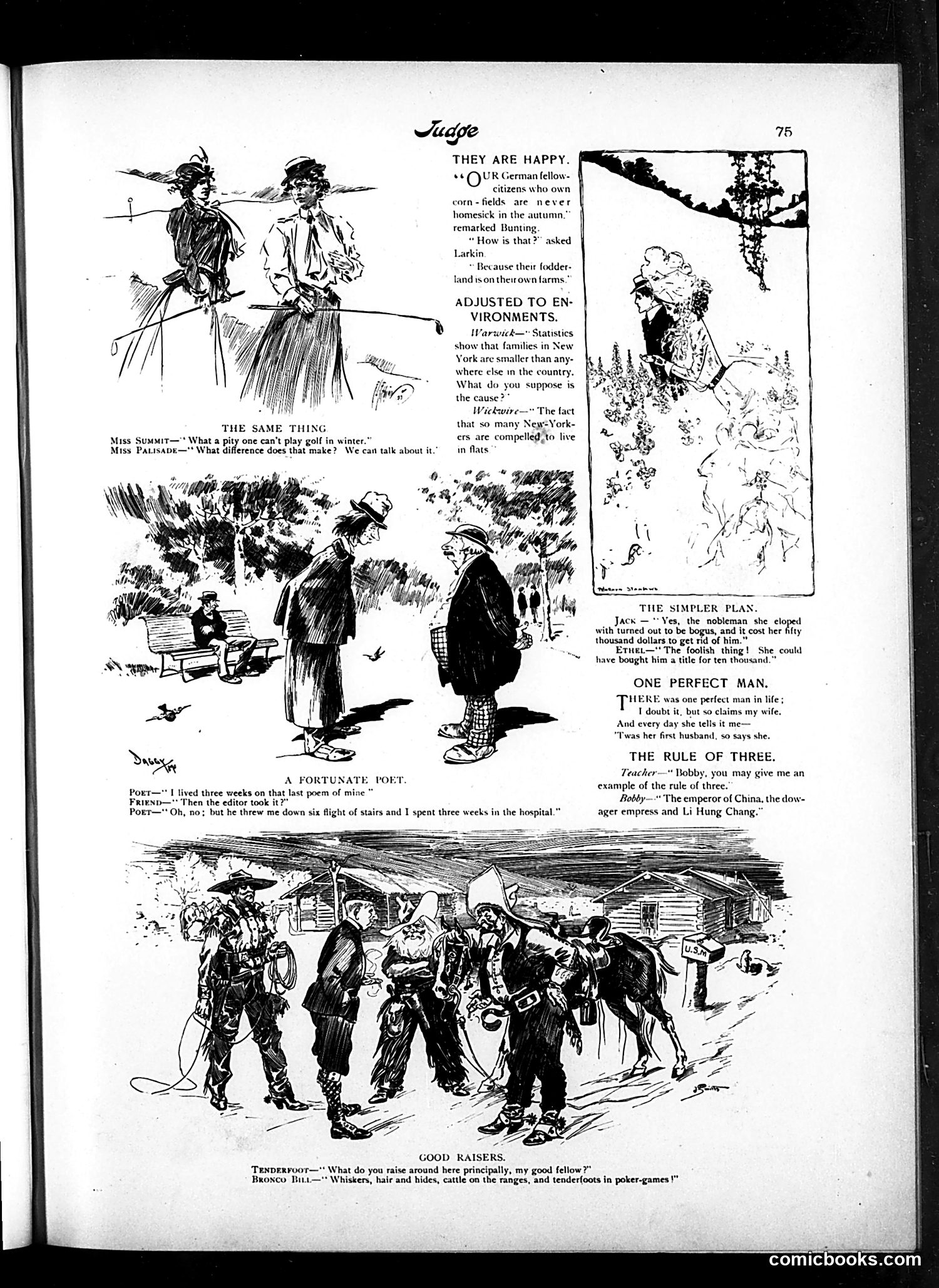
This page contains multiple brief satirical jokes and cartoons typical of early 20th-century American humor: **"They Are Happy"** mocks German immigrants' contentment with farmland, suggesting their attachment is merely practical rather than patriotic. **"Adjusted to Environments"** satirizes New York's cramped living conditions—families are smaller because tenement flats offer limited space, presented as a caustic observation on urban poverty. **"The Simpler Plan"** jokes about a woman who spent $50,000 escaping a bogus nobleman, when she could have "bought him a title" cheaper—mocking both social-climbing and marital foolishness. **"One Perfect Man"** presents a domestic joke: a wife insists her first husband was perfect, a common complaint about remarriage. **"Good Raisers"** features Western dialect humor where "Bronco Bill" lists what ranchers raise: whiskers, hair, hides, cattle, and *tenderfoots in poker-games*—implying they swindle inexperienced easterners at cards. The page exemplifies Judge's mix of class commentary, immigrant humor, marital jokes, and regional stereotypes.
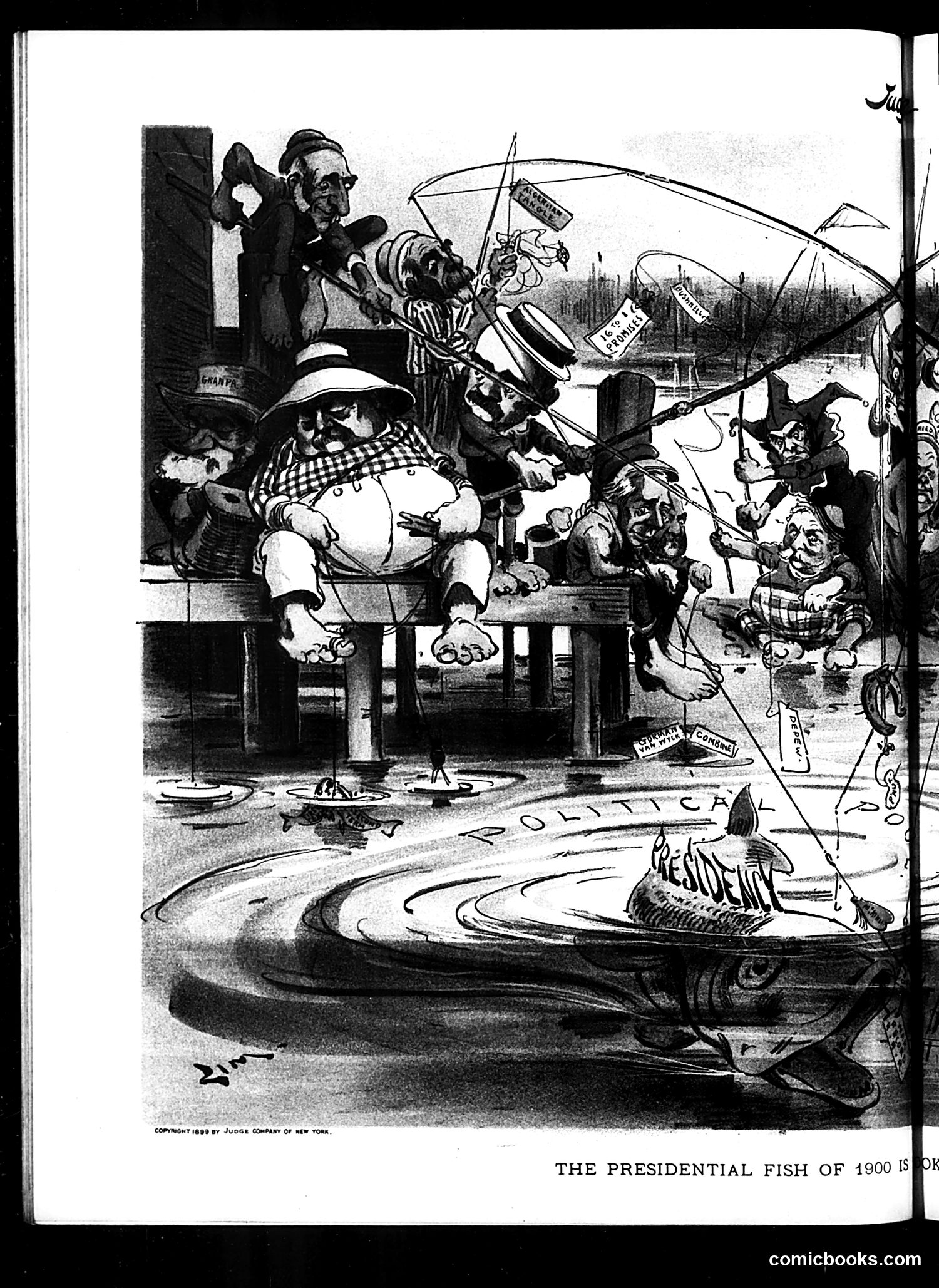
This political cartoon satirizes the 1900 U.S. presidential election. The central figure appears to be a large, rotund politician seated on a platform, fishing in a swirling pool labeled "POLITICS." Various smaller figures—likely representing political candidates or factions—are depicted as fish being caught or competing below. The satire mocks the chaotic nature of the election cycle, portraying politicians as engaged in a crude "fishing expedition" for votes and power. The exaggerated physical caricatures and carnival-like atmosphere emphasize how absurd and theatrical the author found presidential politics. The copyright attribution to Judge (a prominent American satirical magazine) confirms this as political commentary from the 1900 election year, though specific identities of individual caricatures remain unclear without additional historical documentation.
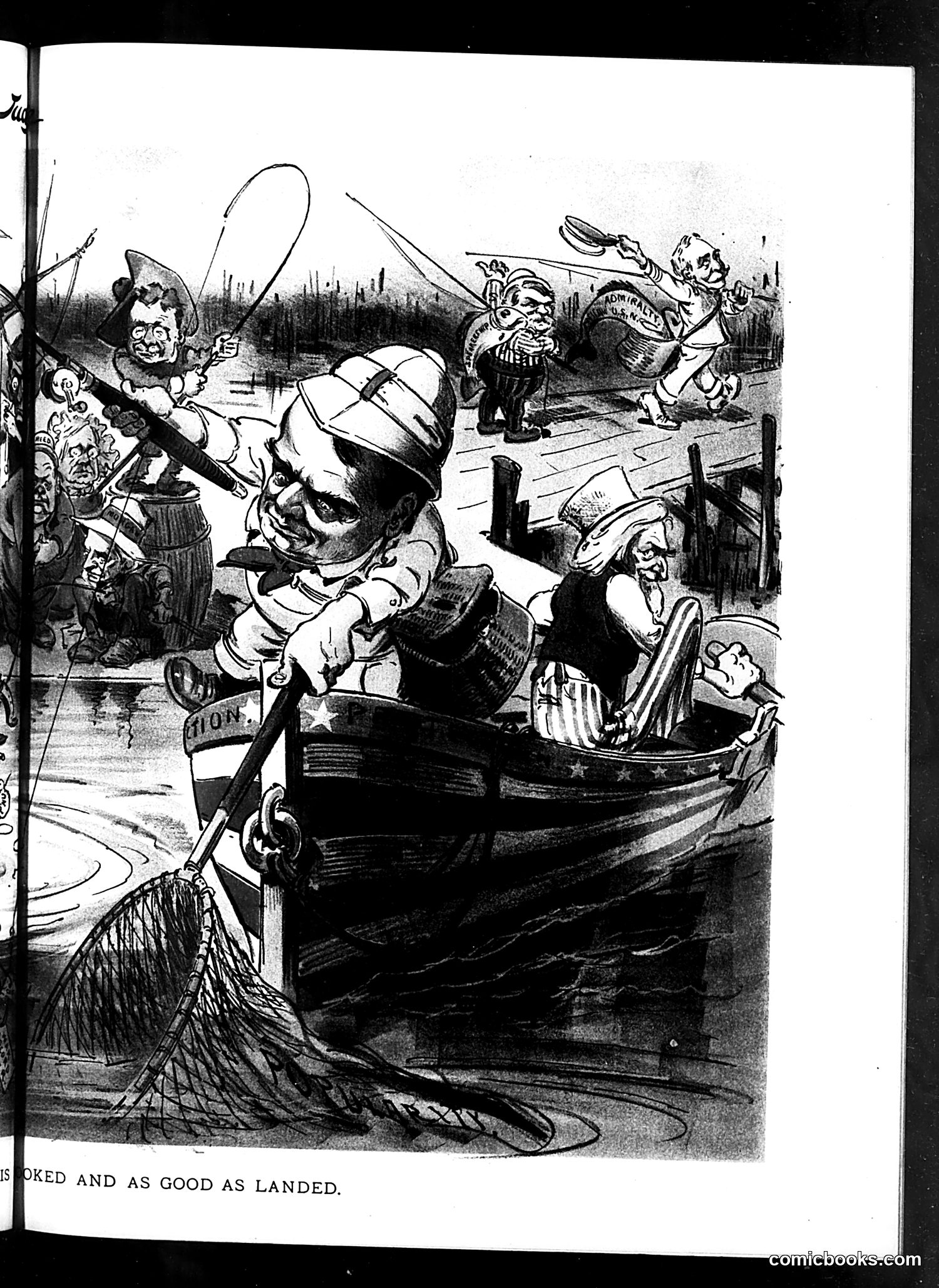
This Judge magazine cartoon depicts a fishing scene with caricatured figures in a boat. The visible text reads "SMOKED AND AS GOOD AS LANDED," suggesting the cartoon comments on political maneuvering or deception—what appears successful ("landed") is merely smoke and mirrors. The figures appear to be political caricatures, likely representing politicians or political factions from the Gilded Age or Progressive Era. The boat with American flag imagery and the fishing equipment suggest commentary on American politics "catching" or claiming credit for outcomes. Without being able to definitively identify the specific individuals caricatured or pinpoint the exact historical moment, the satire appears to critique politicians who claim victory or success through rhetorical manipulation rather than genuine accomplishment. The "smoked" reference likely plays on either obscuring truth or empty boasting.
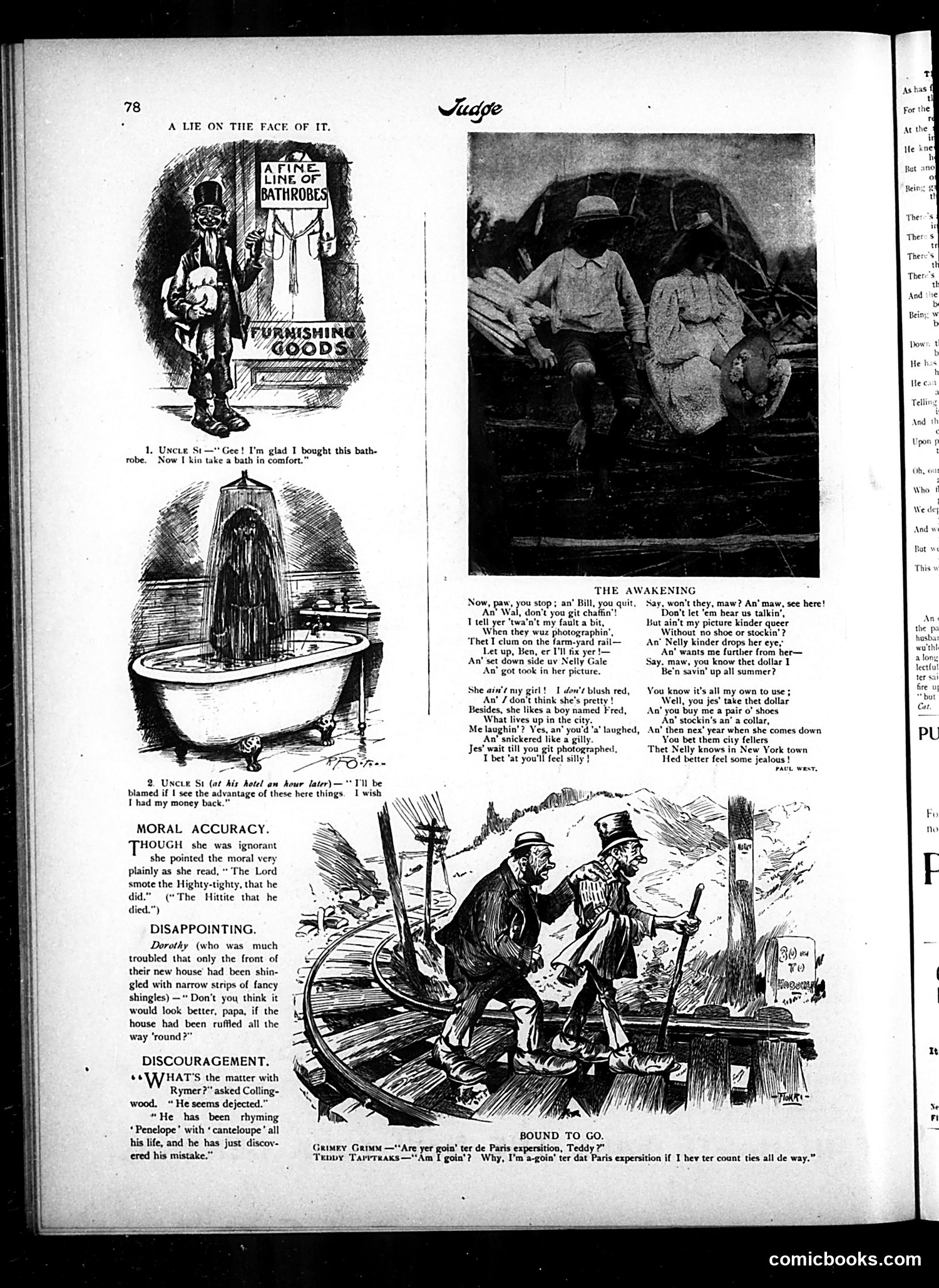
This page contains several satirical humor pieces typical of Judge magazine's content: **"Uncle Si" cartoons** (top left): A two-panel joke where a rural character buys a bathrobe for bathing comfort, then immediately regrets it—likely satirizing farmers' unfamiliarity with urban/refined goods, or the impracticality of fancy items for working-class people. **"The Awakening"** (center/right): A rural romance narrative where a young farm boy is embarrassed after being photographed sitting next to a girl named Nelly Gale. He denies liking her while clearly smitten, and resolves to buy shoes and stockings to impress her when she visits from New York—satirizing rural courtship customs and social anxiety about appearing unsophisticated to city visitors. **"Bound to Go"** (bottom): Two working-class characters discussing attending the Paris Exposition, with one determined to attend "if I hev ter count ties all de way"—satirizing working-class aspiration and the lengths people would go to attend prestigious events. The dialect and characterizations reflect period stereotypes about rural/working-class Americans.
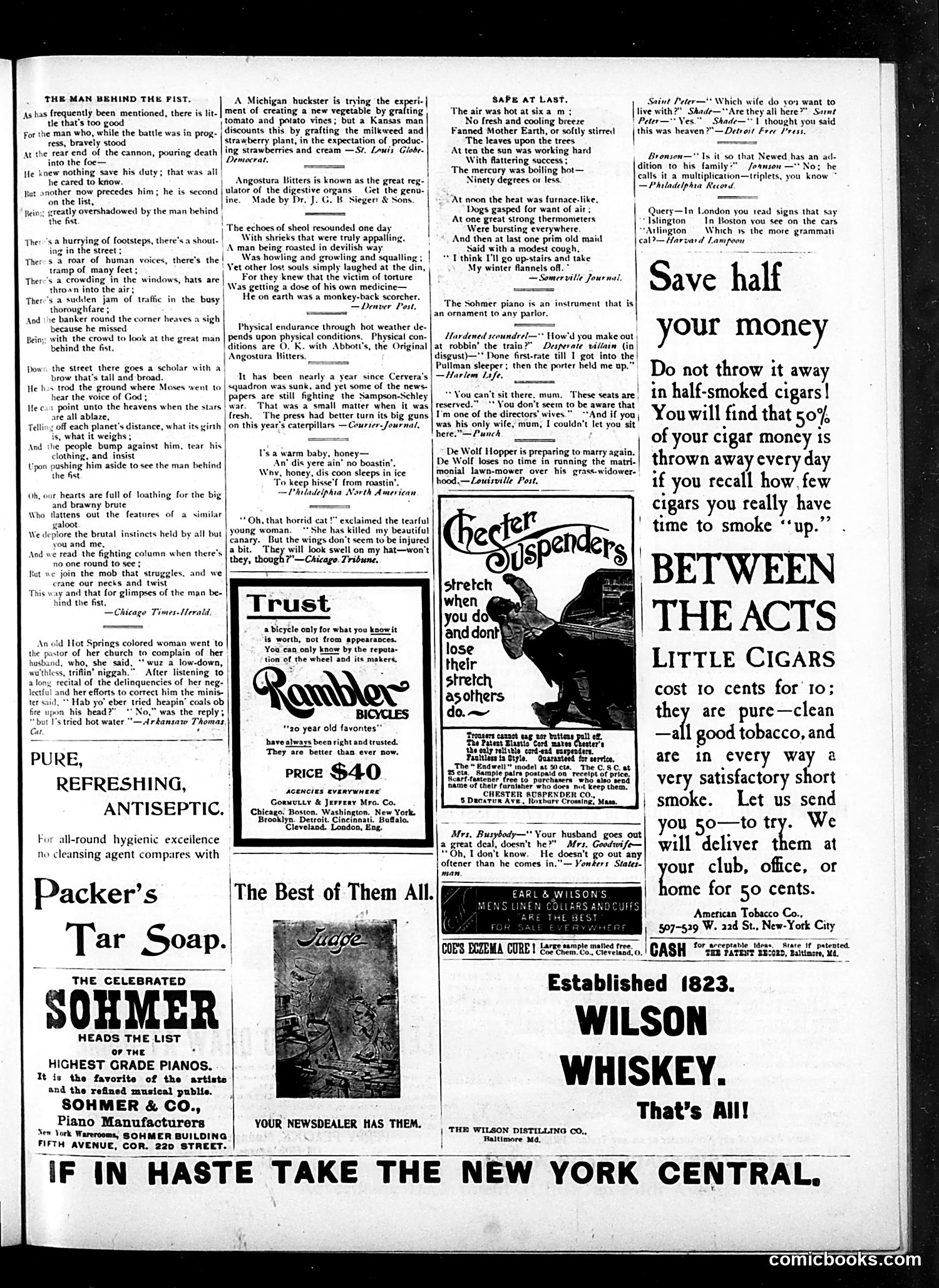
This page features a satirical poem criticizing American society's misplaced admiration for violence over intellect and scholarship. "The Man Behind the Fist" contrasts a boxer or fighter—celebrated by crowds who mob the streets to glimpse him—with a scholar of genuine accomplishment (someone who has studied where Moses received divine revelation, who understands astronomy and physics). The satire reveals society's hypocrisy: citizens claim to deplore brutality and fighting, yet eagerly abandon dignified pursuits to gawk at "the man behind the fist." The poem suggests that Americans irrationally idolize raw physical power while neglecting those who advance knowledge and culture. The "great man behind the fist" isn't identified as a specific boxer, but rather represents the archetypal celebrity athlete, contrasted sharply with the marginalized intellectual. This reflects turn-of-century anxieties about American values—particularly concerns that popular culture elevated prizefighting and physical dominance over education and refinement. The rest of the page comprises advertisements and minor miscellaneous content.
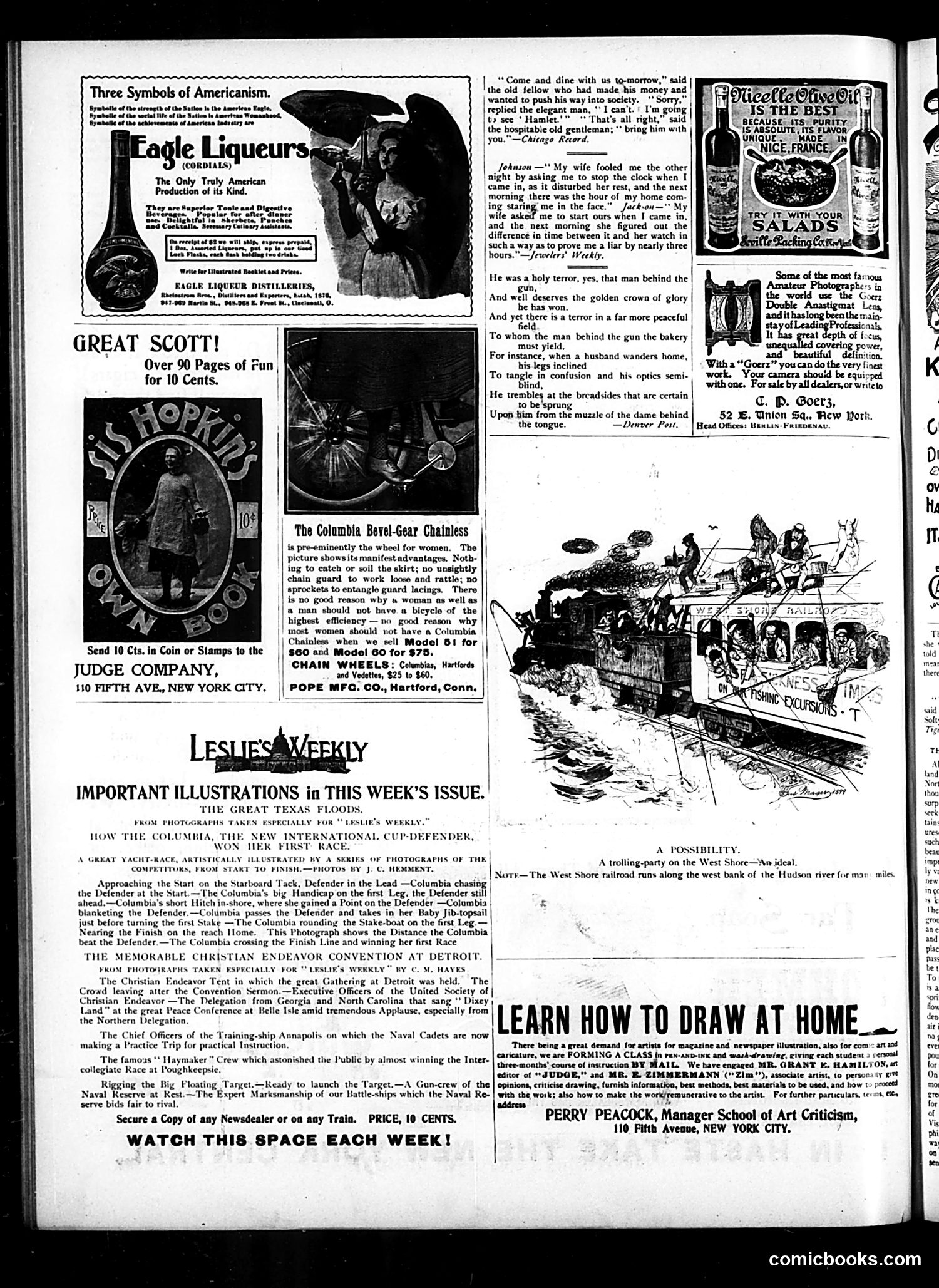
This page from *Judge* magazine (a satirical weekly) combines advertisements, humor, and announcements for upcoming content. **Main Content:** The page announces "Important Illustrations" for the upcoming issue, featuring coverage of: the Texas floods (contemporary disaster photography), the America's Cup yacht race between Columbia and Defender, the Christian Endeavor Convention in Detroit, and Naval Reserve training exercises. **Advertisements:** - Eagle Liqueur (claiming to be "The Only Truly American Production") - Columbia bicycles, emphasizing the "chainless" model as particularly suitable for women (no chain to soil skirts) - Judge magazine itself (90+ pages for 10 cents) **Humor:** A brief joke about a nouveau-riche man inviting someone to dinner, offering to have them bring Shakespeare's *Hamlet* as a guest—satirizing social climbers and their pretensions. **Context for Modern Readers:** This reflects turn-of-century American interests: technological progress (bicycles, yachts, naval power), social climbing anxieties, and gender norms regarding women's fashion and activities.
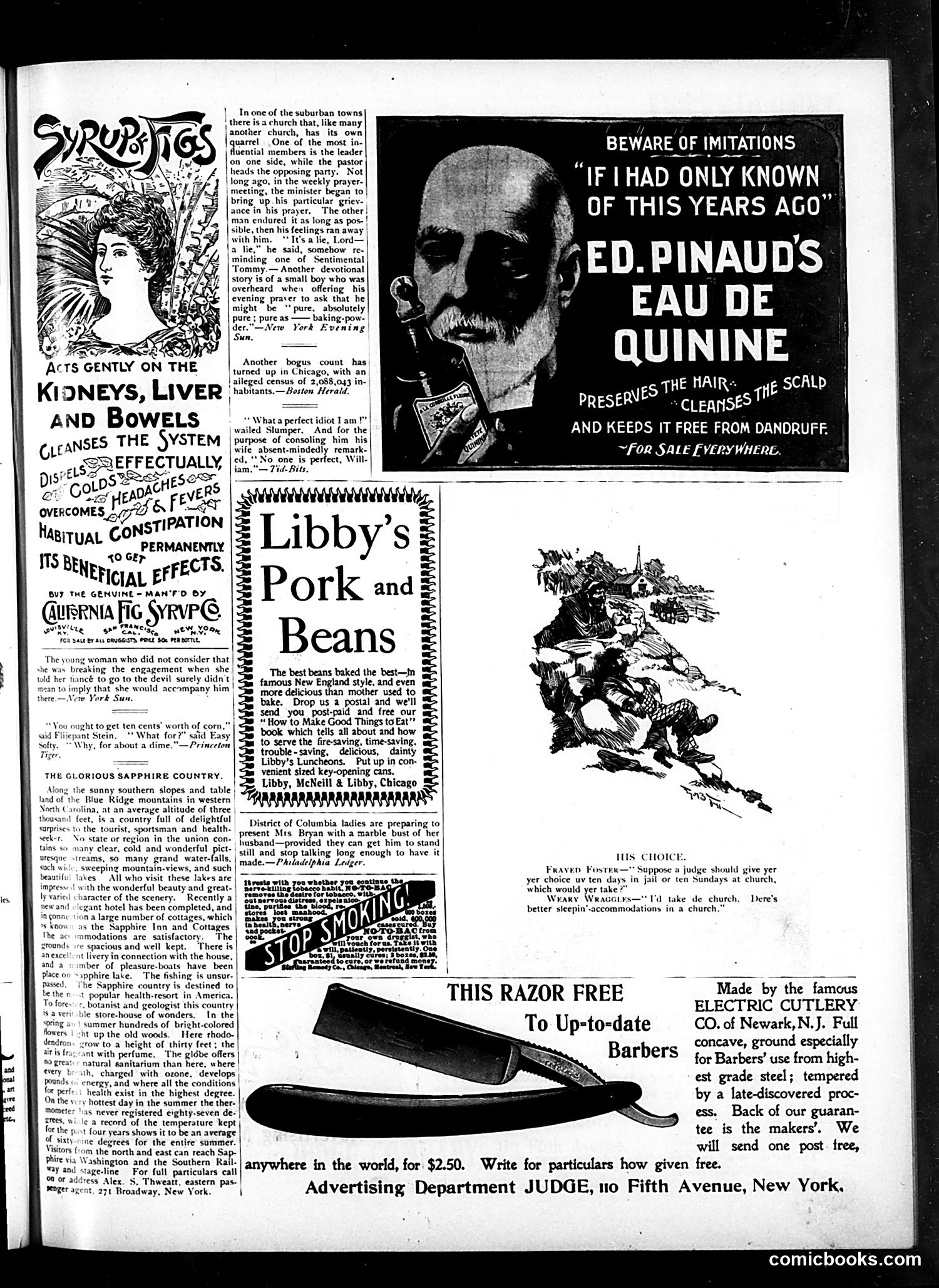
This page is primarily **advertisements and humorous filler content** rather than political satire. The main elements are: **Advertisements:** - Syrup of Figs (digestive tonic) - Ed. Pinaud's Eau de Quinine (hair product with counterfeit warning) - Libby's Pork and Beans - Electric Cutlery Co. razor **Short humor pieces:** - A church dispute story where a pastor and rival parishioner sarcastically thank God for victory in prayer - A joke about a census-taker in Chicago inflating numbers - Jokes about engagements and church accommodations - A piece promoting the Sapphire Mountains region as a tourist destination **No clear political figures or satire are present.** The content reflects early-1900s American consumer culture and genteel magazine humor—light anecdotes, product promotions, and gentle social comedy. The page demonstrates how Judge balanced satirical commentary (elsewhere) with advertising revenue and light entertainment.
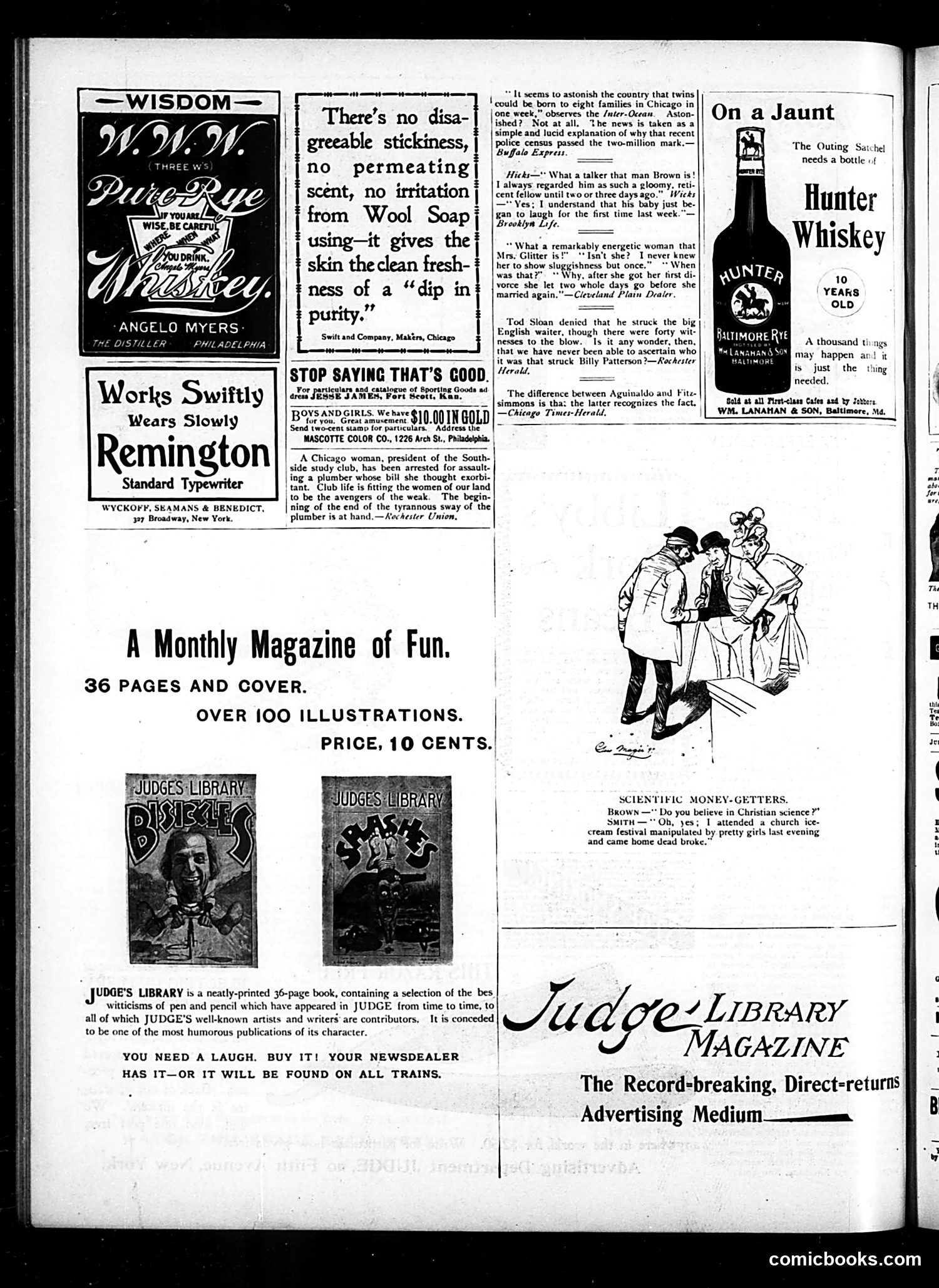
This is primarily an **advertising and promotional page** for Judge magazine itself, with several short satirical items interspersed. The main content includes: **Small satirical items:** - A joke about a Chicago woman (president of a study club) who assaults a plumber for overcharging, framed as women becoming "avengers of the weak" against tradesmen's tyranny - Wordplay about twins born in Chicago, sarcastically linking it to population statistics - Brief humor pieces about talkers, divorce, and Christian Science money-raising **The cartoon** shows three figures in what appears to be a street encounter, captioned "Scientific Money-Getters"—likely satirizing the ice cream social fundraising mentioned in the dialogue below it. **Key context for modern readers:** This reflects early 1900s concerns about urban plumbers' fees, women's increasing social activism through clubs, and the then-popular "Christian Science" movement. The humor is gentle social observation rather than sharp political satire. The page primarily **advertises Judge's Library books** (36-page compilations priced at 10 cents) and other products like Remington typewriters and Hunter Whiskey.
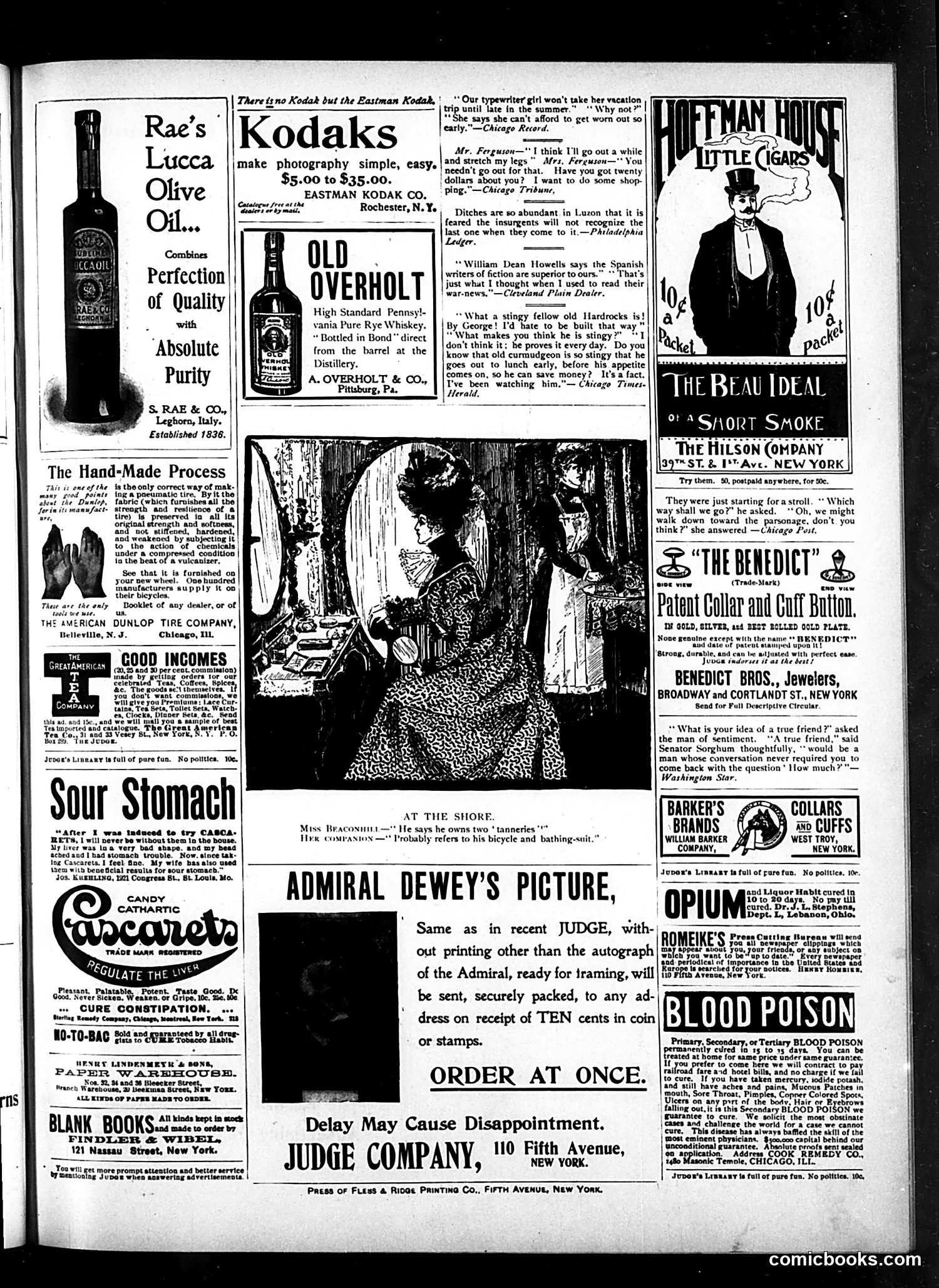
This is primarily an **advertising page** from Judge magazine with minimal editorial cartoon content. The page features numerous product advertisements (Kodak cameras, whiskey, olive oil, tires, jewelry, patent medicines) typical of early 1900s publications. The small editorial content consists of brief **humor snippets and jokes** rather than political cartoons: - A couple's dialogue about vacation timing and shopping - Quips about typewriter girls, Spanish writers, and pitcher abundance in Luzon (referencing the Philippine-American War context) - A humorous exchange about a stingy man named Hardrocks - A joke about choosing a walking route near the parsonage The **central illustration** shows "At the Shore" with a caption about a woman's bicycle and bathing suit—a lighthearted social observation rather than political satire. The page reflects Judge's dual nature: a satirical magazine that relied heavily on advertisements to fund operations, with humor scattered between product pitches aimed at wealthy readers.
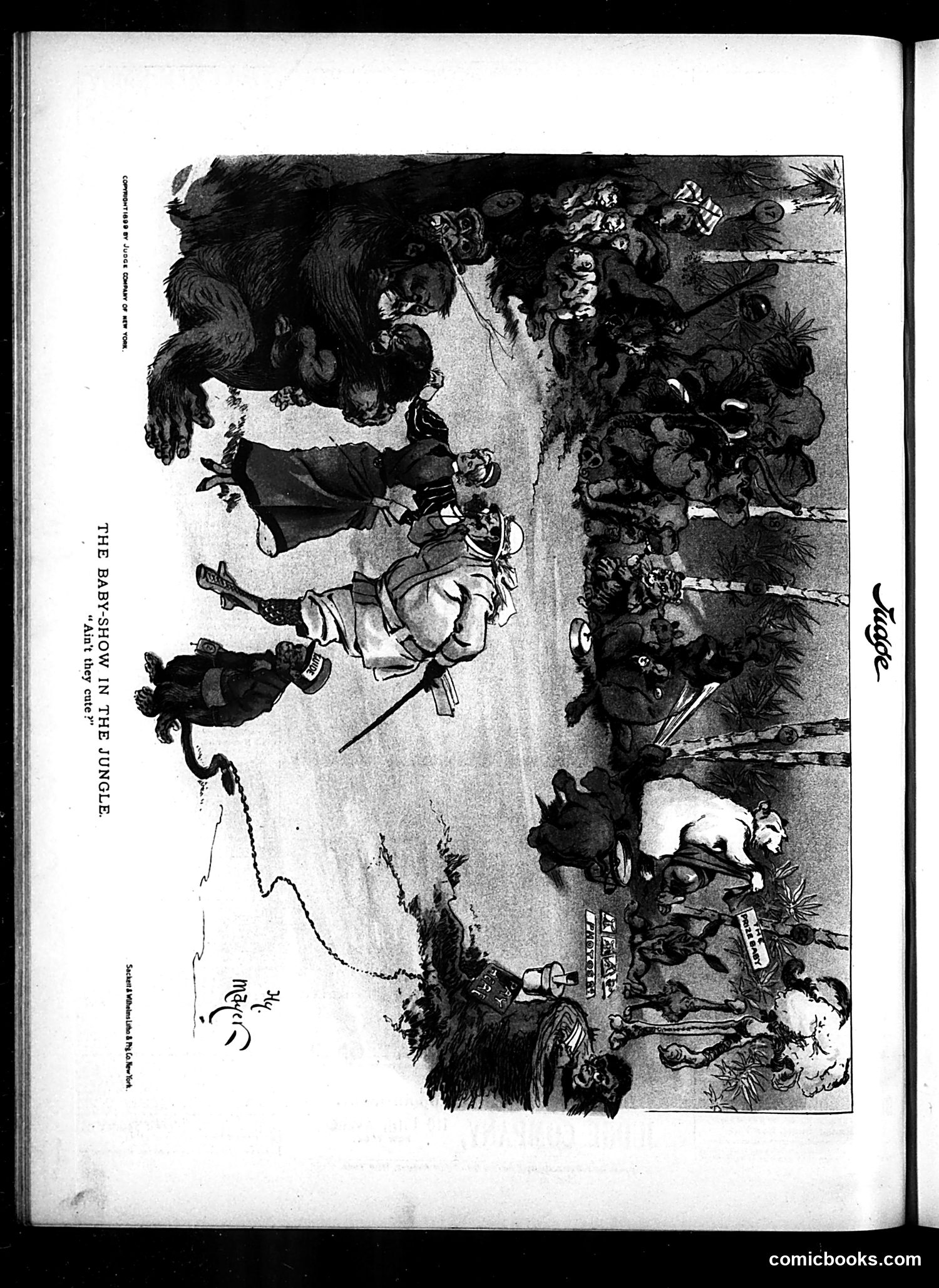
This appears to be a racist caricature cartoon from Judge magazine (copyright 1899). The illustration depicts animals and figures in a "jungle" setting styled as a baby show, with the caption "Ain't they cute?" Based on the title and era, this likely satirizes contemporary "human zoo" exhibitions that were popular in the late 19th century—spectacles where non-European peoples were displayed to Western audiences. The cartoon's framing as a "baby-show" and its dehumanizing presentation suggests it mocks both the exhibition practice and the subjects themselves through a dehumanizing animal metaphor. The satire's target and actual point remain unclear from the image alone—whether it criticizes the exhibitions as absurd or simply perpetuates the racism inherent in them. The casual tone ("Ain't they cute?") suggests crude mockery.