
A complete issue · 20 pages · 1899
Judge — July 8, 1899
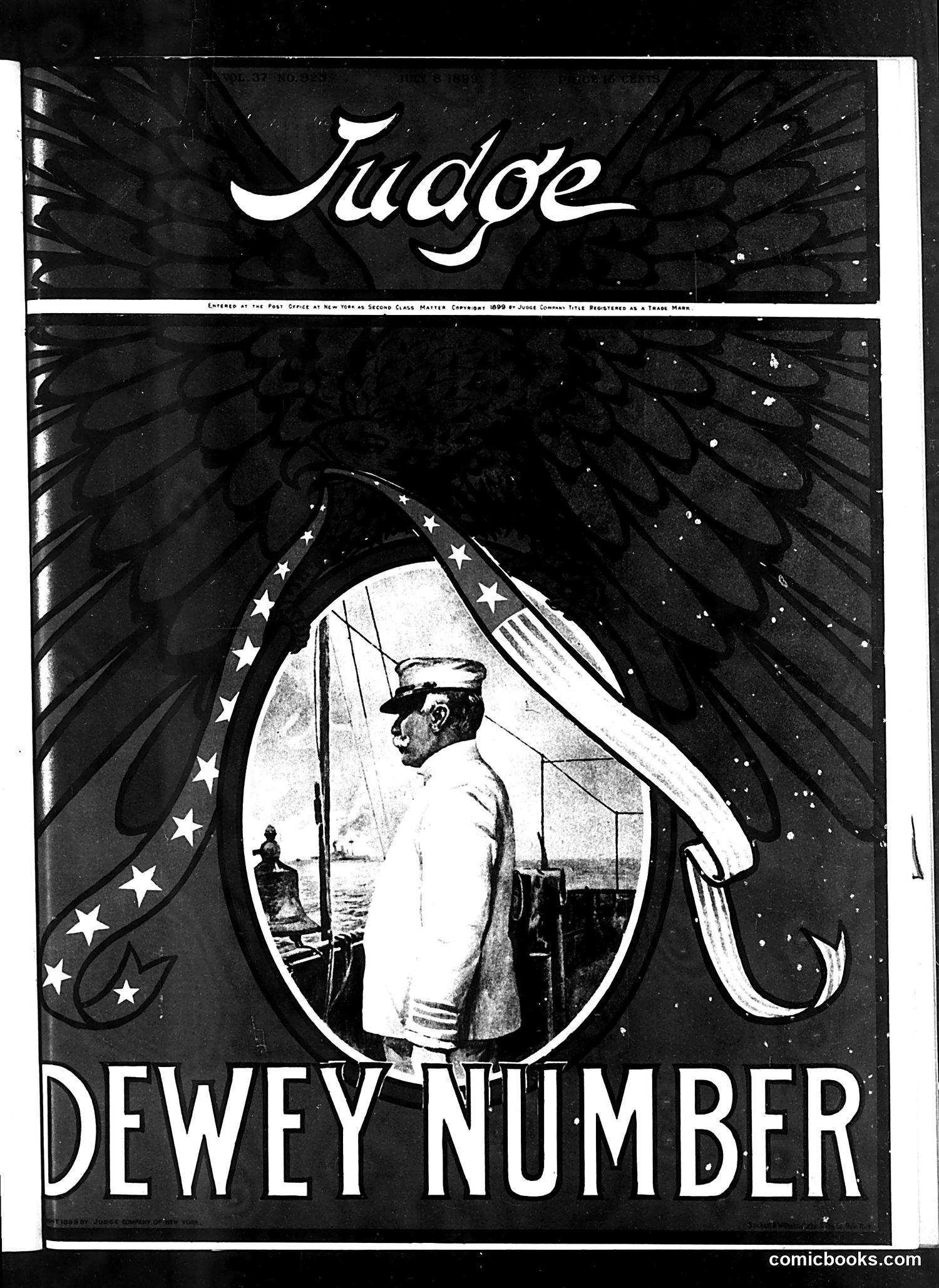
This is a satirical cover featuring Admiral George Dewey, the celebrated American naval commander from the Spanish-American War (1898). The illustration shows Dewey in profile within a decorative oval frame, surrounded by an ornate eagle with stars and stripes. The title "Dewey Number" appears to reference Dewey's enormous popularity following his decisive naval victory at Manila Bay. The satire likely comments on how Dewey's fame was being commercialized or exploited—Judge was a humor magazine known for mocking public figures and cultural trends. The elaborate, almost venerating artistic treatment of Dewey suggests ironic commentary on the public's hero-worship of the admiral, poking fun at both Dewey's celebrity status and American patriotic fervor of the period.
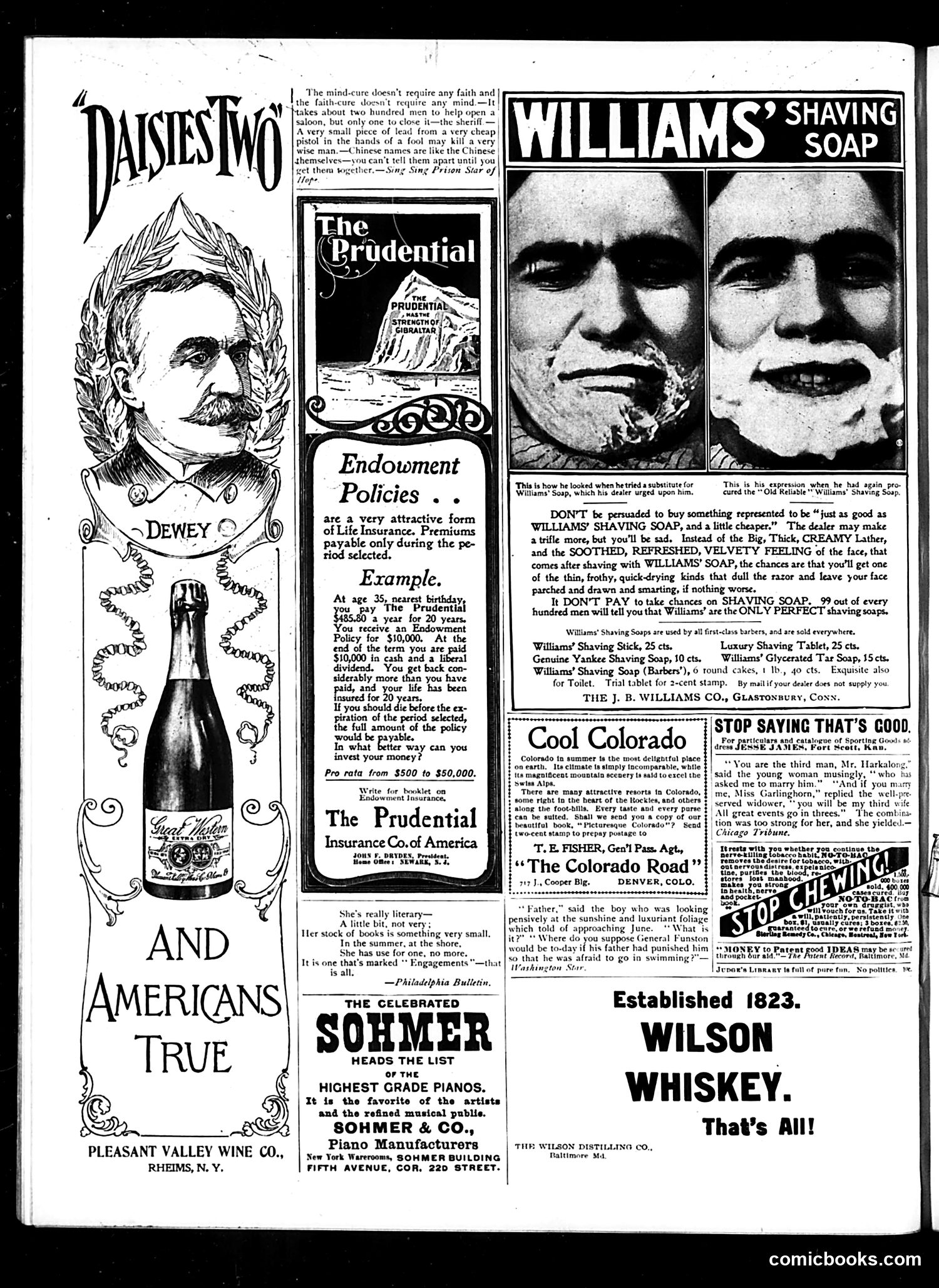
This page is primarily **advertising**, not political satire. The left side features a Daisies Two wine advertisement with a portrait labeled "Dewey"—likely Thomas Dewey, referencing the popular turn-of-century slogan "Dewey and Americans True." The other advertisements are commercial products: Prudential Insurance, Sohmer Pianos, Williams' Shaving Soap (with before/after images), Cool Colorado tourism, and Wilson Whiskey. The only potentially satirical element is the small "Stop Chawing That's Good" tobacco advertisement, which uses crude humor about oral hygiene, but this appears to be product advertising rather than political commentary. Overall, this page demonstrates Judge's reliance on paid advertisements rather than editorial content.
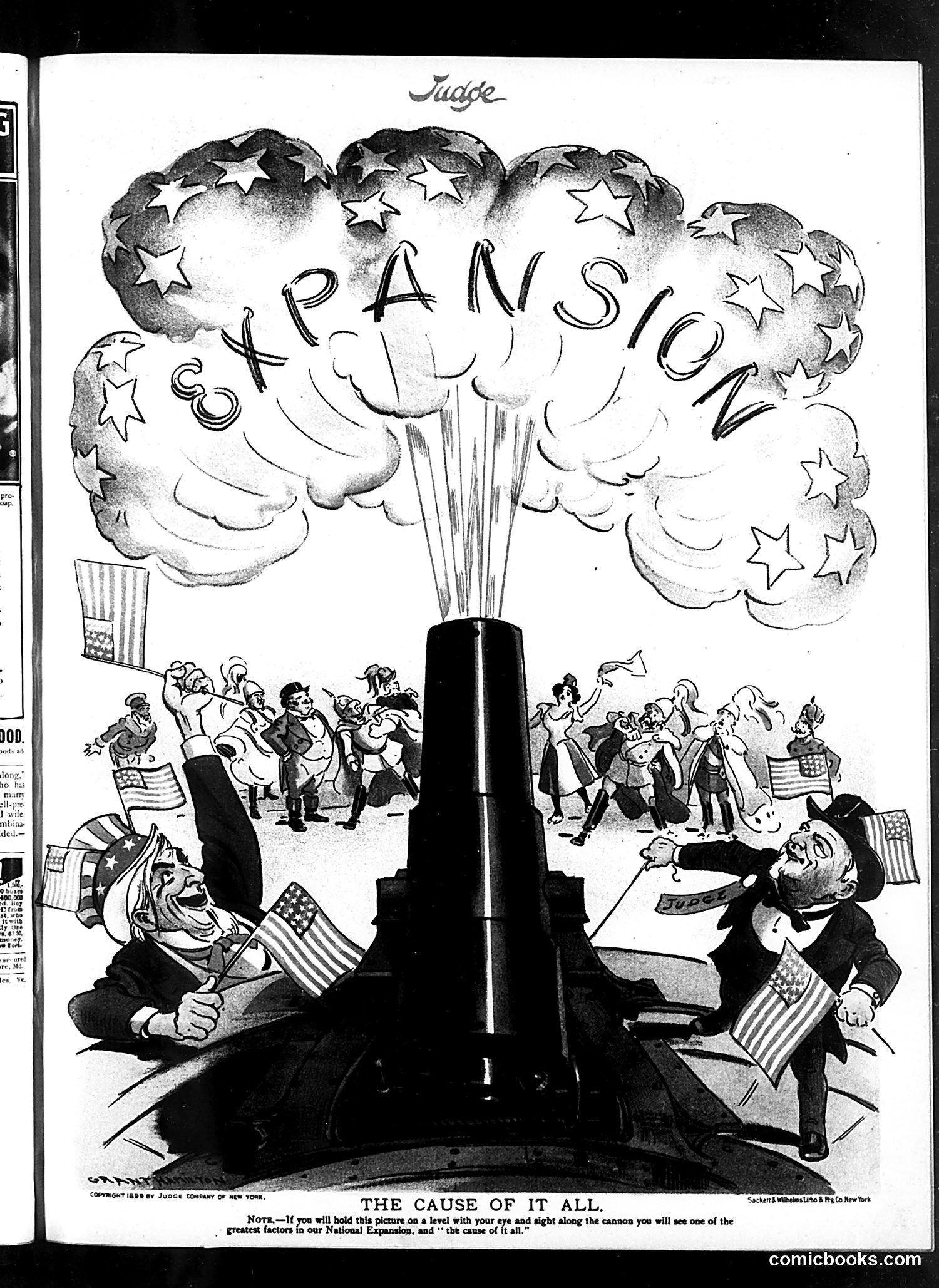
This cartoon depicts a large cannon labeled "EXPANSION" erupting clouds of confetti and stars above crowds of American citizens waving flags below. The caption "The Cause of It All" suggests the cartoon critiques American expansionism as the root cause of some contemporary problem or social upheaval. The imagery—with ordinary people celebrating beneath the explosive expansion rhetoric—appears satirical, implying that jingoistic expansionist policies have destabilized the nation. The cartoon likely references late 19th-century American imperialism (possibly the Spanish-American War era), criticizing how nationalist expansion rhetoric affects domestic society. The "greatest factors in our National Expansion" note at bottom reinforces this critical interpretation of expansion's consequences.
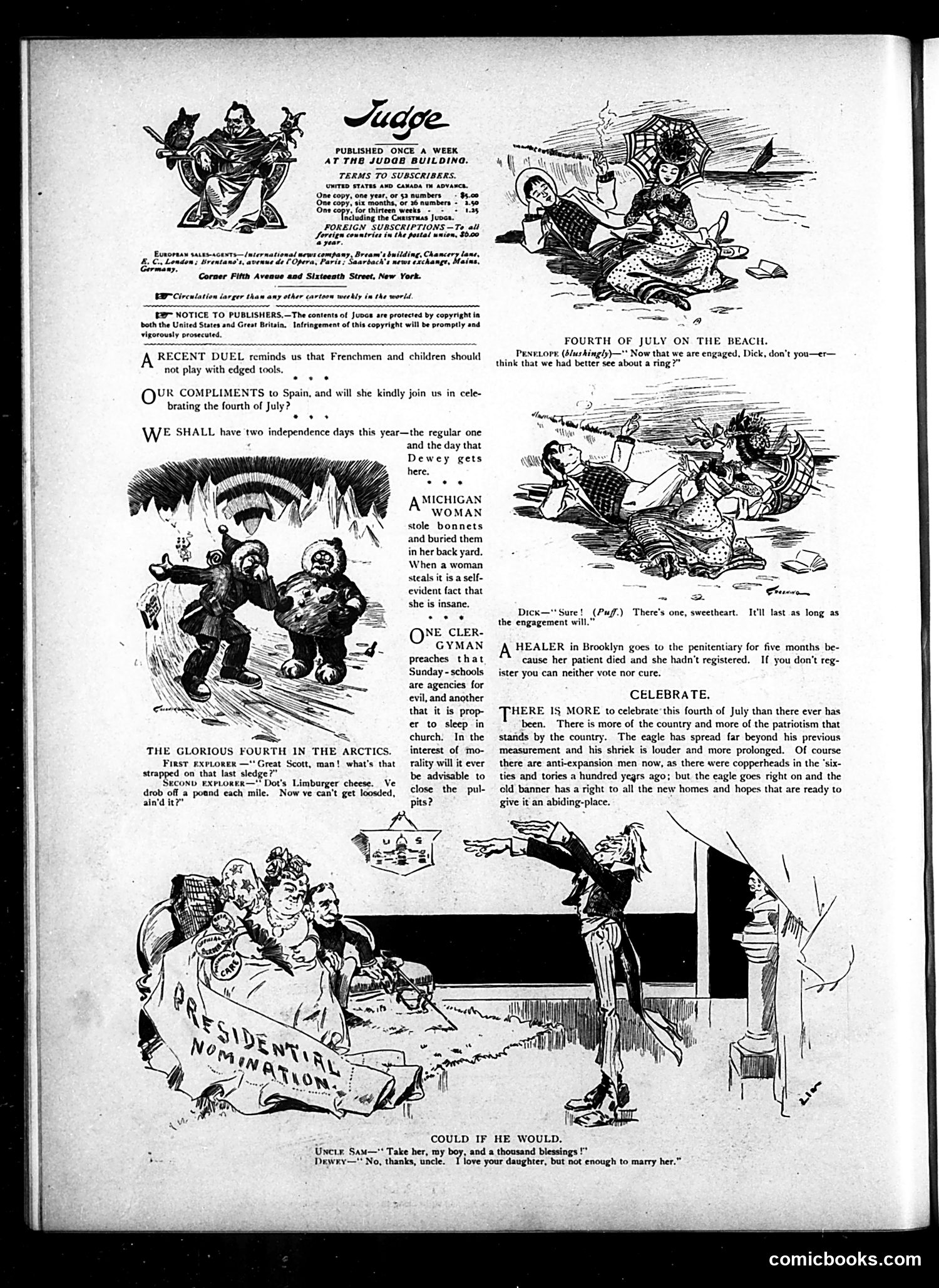
This appears to be a **Fourth of July themed issue** celebrating American independence. The cartoons include: 1. **"Fourth of July on the Beach"** – A romantic beach scene where a couple discusses an engagement ring, capturing holiday leisure. 2. **"The Glorious Fourth in the Arctics"** – Explorers celebrating Independence Day in Arctic conditions, with dialogue about provisions ("Jack's Limburger cheese"). 3. **"Could If He Would"** – A political cartoon featuring Uncle Sam declining a thousand blessings from Dewey regarding his daughter's marriage prospects. This appears to reference **William McKinley's presidency** and contemporary political tensions. The page mixes patriotic humor with social commentary typical of Judge's satirical approach, using holiday themes to critique political figures and contemporary social situations.
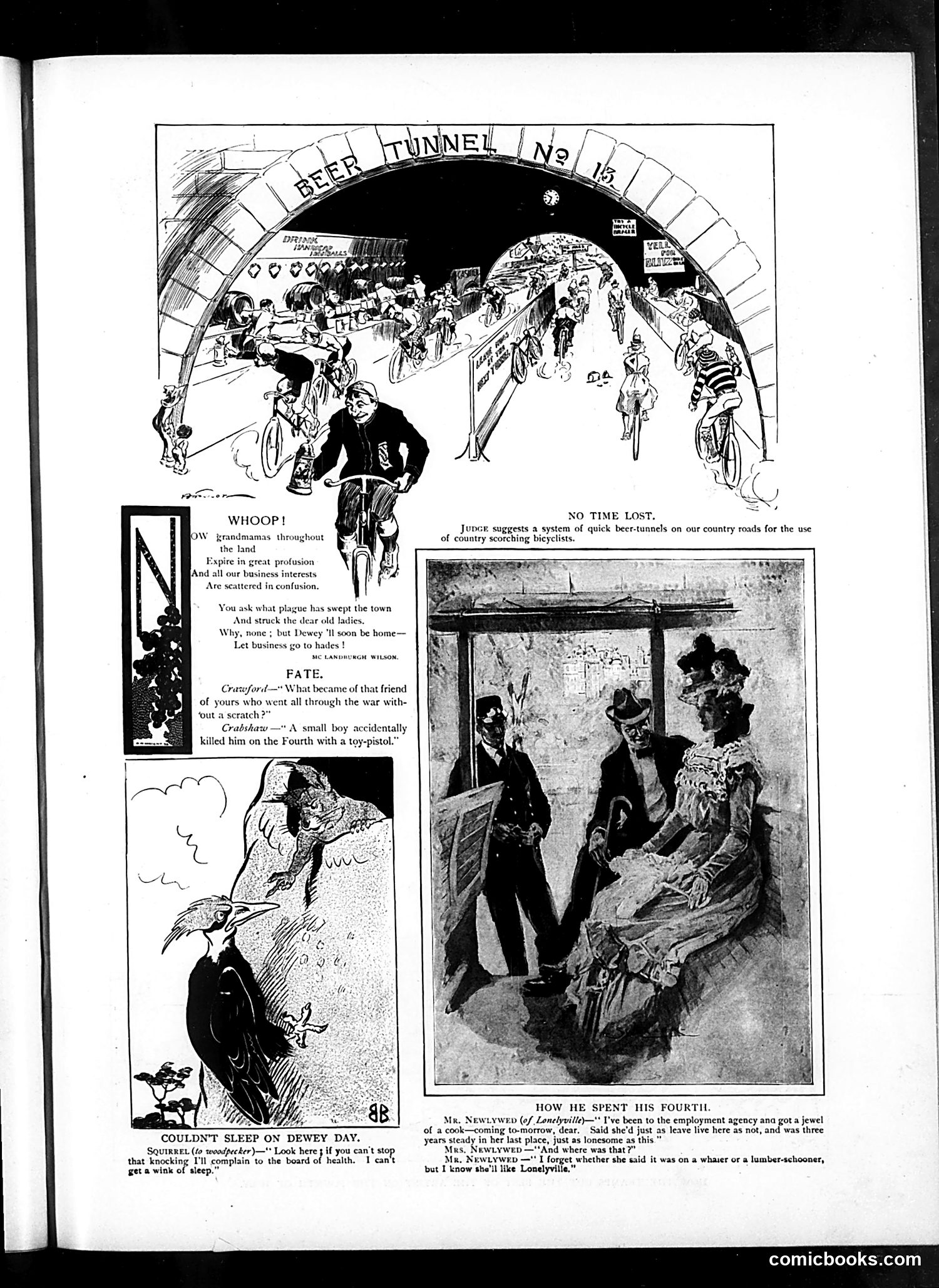
This Judge magazine page contains satirical commentary on Admiral George Dewey's expected return home (likely after the Spanish-American War). The central joke: his arrival has caused such civic excitement that normal business and life have ground to a halt—grandmothers are fainting, commerce is abandoned, even animals can't sleep. The "Beer Tunnel" cartoon mocks the frivolous concerns of wealthy cyclists who want quick access to beer while riding. The "Fate" anecdote darkly jokes about irony: a soldier survived the war unscathed only to be accidentally killed by a child's toy on Independence Day. The final piece satirizes a newly married man's naiveté—he's hired a cook who was apparently crew on a whaling or cargo ship, unaware this suggests she's been at sea for years in isolation (hence her desperation for any land-based employment). The humor relies on the reader catching his obliviousness.
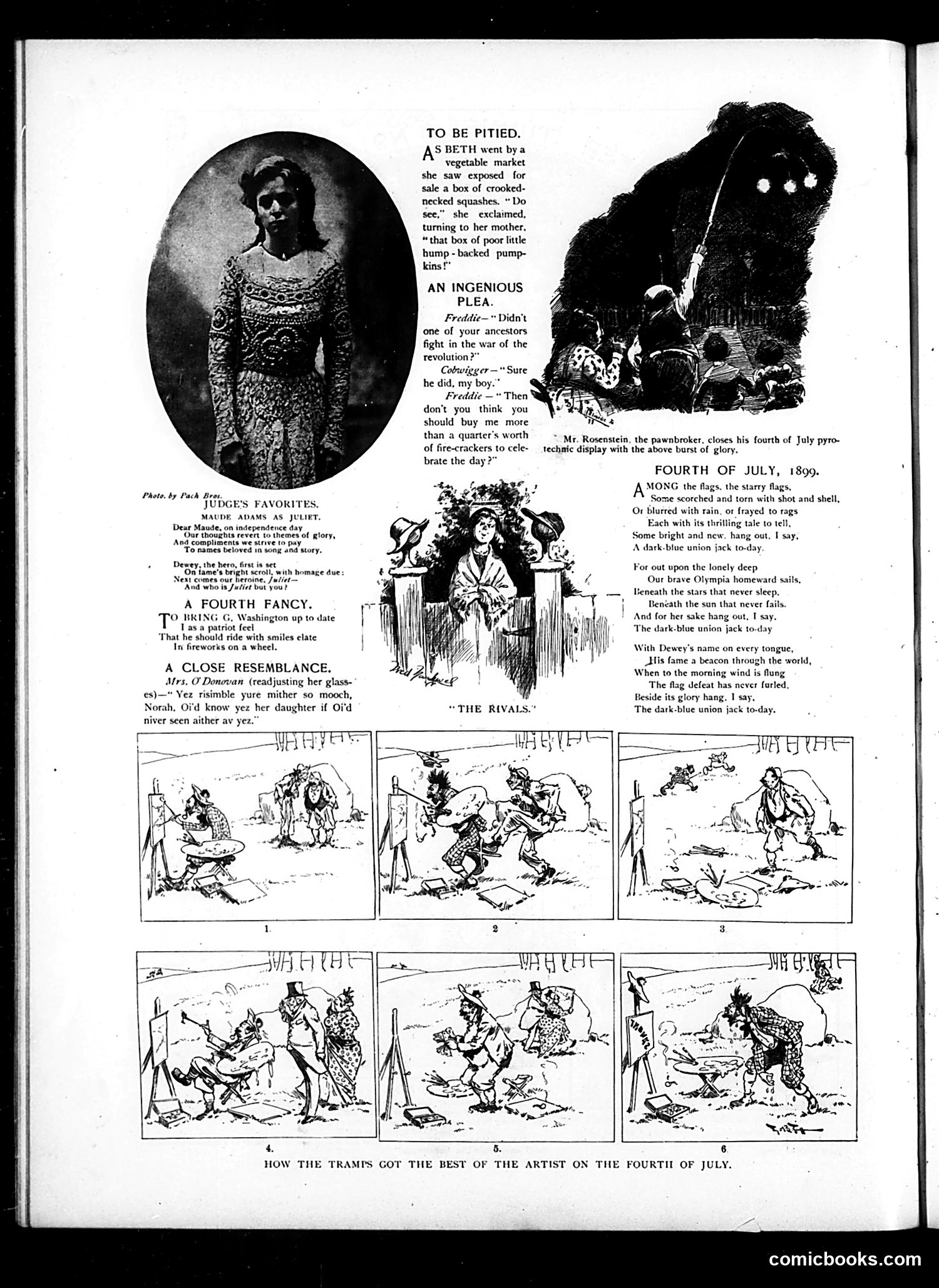
This page celebrates American Independence Day 1899 with multiple satirical items. The lead item praises actress **Maude Adams** as Shakespeare's Juliet, a popular stage performance of the era. The main satirical content mocks **Admiral Dewey**, the Spanish-American War hero whose naval victory at Manila Bay (May 1898) made him a national celebrity. The fantasy sketch imagines George Washington modernized, riding "fireworks on a wheel"—absurd Americana. **"How the Tramps Got the Best of the Artist"** is a comic strip about vagrants outwitting someone (likely a Fourth of July celebrant), reflecting class tensions and the presence of homeless people during holiday festivities. Other brief jokes target Irish immigrants' dialect humor and children's Independence Day antics. The page concludes with a patriotic poem referencing the USS Olympia (Dewey's flagship) returning home, reinforcing the Dewey-worship dominating American culture post-Spanish-American War. The overall tone is lighthearted yet revealing of 1899's social anxieties around class, immigration, and jingoistic militarism.
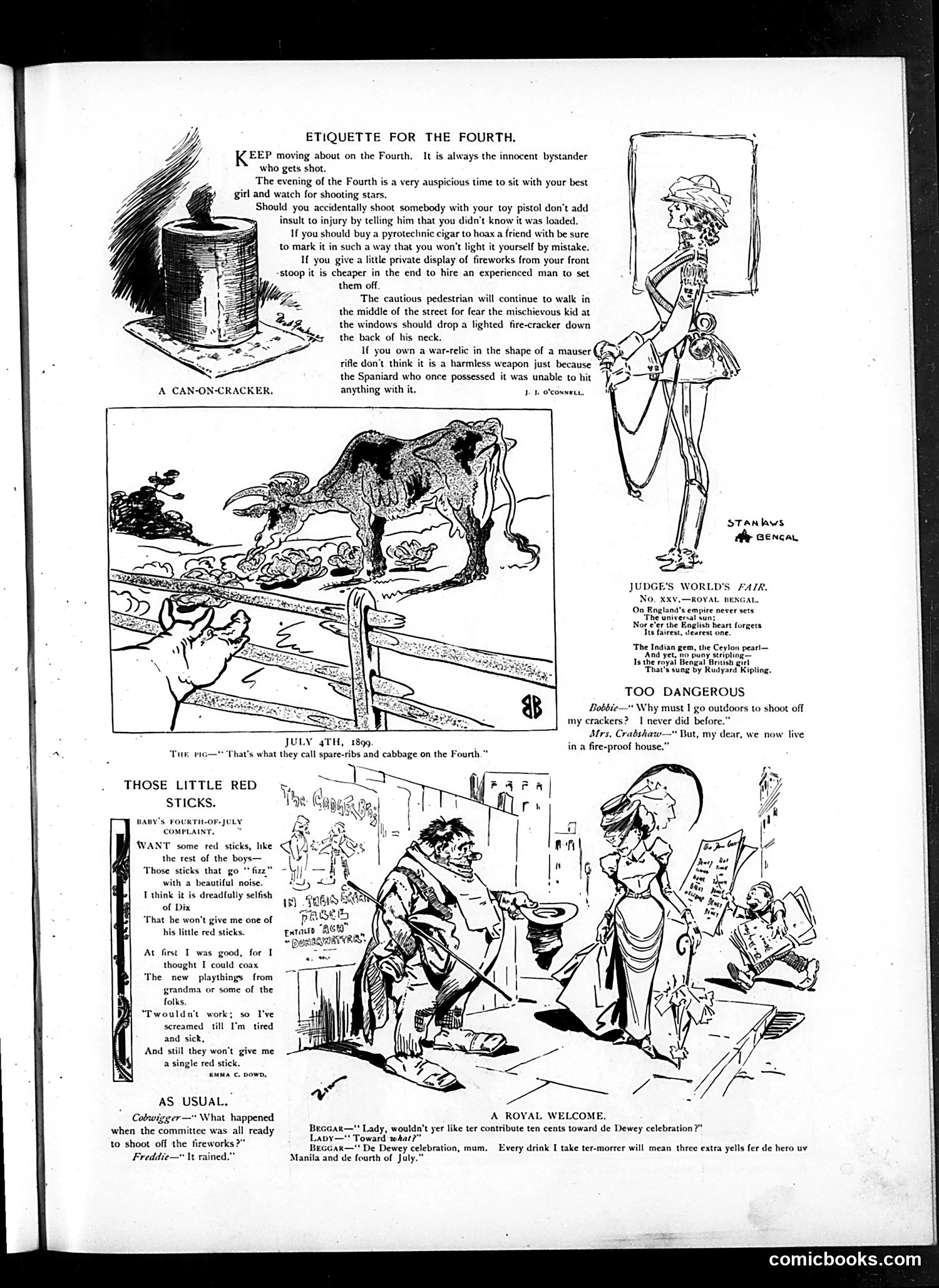
This page satirizes Fourth of July safety hazards and contemporary events. The "Etiquette for the Fourth" column humorously warns readers about firecracker dangers—accidental shootings, dropped firecrackers on pedestrians, and the risks of war souvenirs (referencing the Spanish-American War that ended months earlier, mentioning a captured Mauser rifle). "Those Little Red Sticks" presents a child's complaint about being denied firecrackers, satirizing parental overprotection. The "Royal Welcome" cartoon references Admiral Dewey's victory at Manila Bay (1898), mocking Irish-American saloon culture by showing someone soliciting donations for a "Dewey celebration" while conflating it with drinking—suggesting the commemoration is merely an excuse for alcohol consumption. The overall tone ridicules American Fourth of July excess, parental anxiety, and opportunistic commercialism around patriotic events.
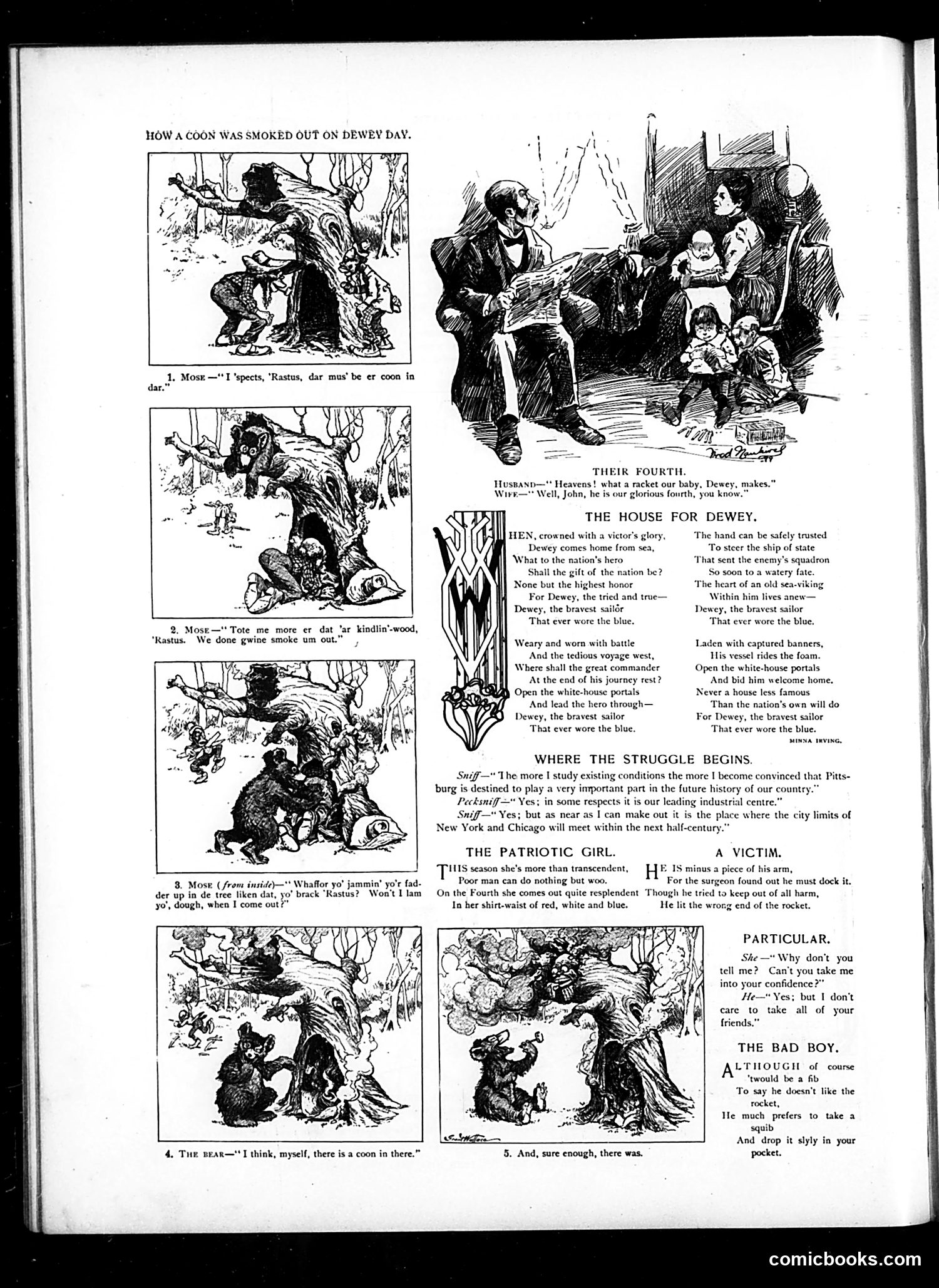
This page celebrates Admiral George Dewey's return from the Spanish-American War (1898), when he became a national hero after the Battle of Manila Bay. The main content praises a proposed "House for Dewey"—a patriotic gift to honor the victorious sailor. However, the left side contains racist caricatures titled "How a Coon Was Smoked Out on Dewey Day." These depict Black characters ("Mose" and "Rastus") using period-offensive dialect, apparently being driven from a tree during Fourth of July celebrations. The "coon" refers both to raccoons (literally) and uses a racial slur common in that era's "humor." The surrounding vignettes—"The Patriotic Girl," "A Victim," "The Bad Boy"—humorously depict Fourth of July misadventures (accidents with fireworks). The industrial satire "Where the Struggle Begins" jokes that Pittsburgh will eventually be consumed by expanding New York and Chicago. The page reflects 1890s American attitudes: celebrating military victory while casually incorporating racist content as entertainment.
I can see this is a blank or nearly blank page from Judge magazine, with only some minor dust specks and printing artifacts visible. There is no discernible cartoon, illustration, or readable text content on this page to analyze. The OCR text provided appears to be empty or failed to capture any actual content. Without visible imagery, recognizable figures, captions, or legible text, I cannot identify any political figures, satirical references, social commentary, or jokes that would require historical context to explain. This appears to be either a blank page, a title page, or an advertising page from the publication, rather than a cartoon or satirical content page.
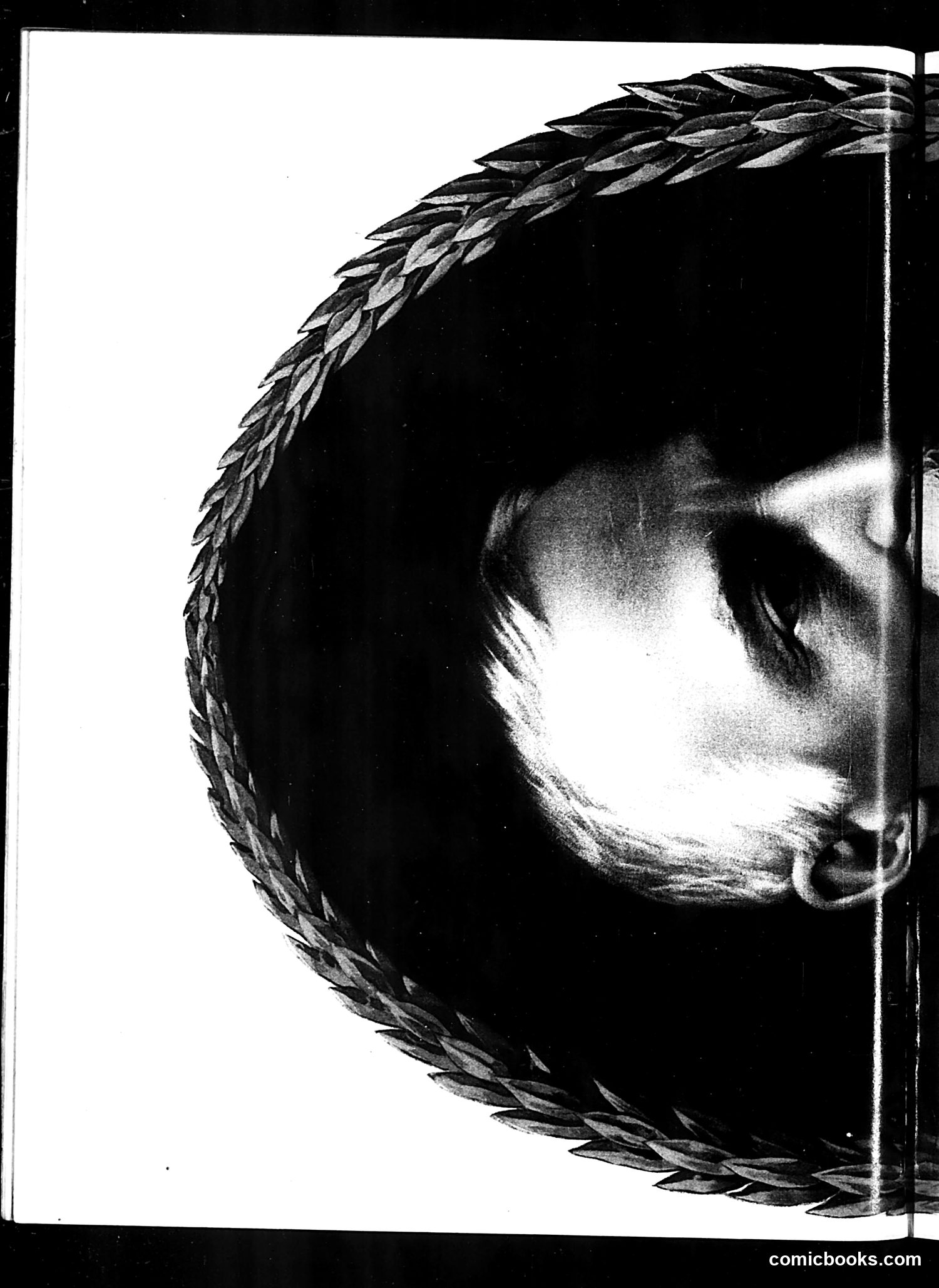
I can see this is a black and white illustration showing what appears to be a face or head in profile, framed by decorative wheat or grain stalks. The image is heavily contrasted with dark shadows and a bright center. However, **I cannot reliably determine the specific political or social reference from the image alone**. The OCR text only provides "comicbooks.com," which appears to be a watermark rather than actual magazine content. To explain this cartoon's meaning to a modern reader, I would need: - The actual OCR'd text/caption from the original Judge page - The publication date - Any identifying labels or text within the illustration Without these elements, I cannot accurately identify which historical figures or events this satirizes. I can only confirm this appears to be a Judge magazine illustration with deliberate artistic framing.
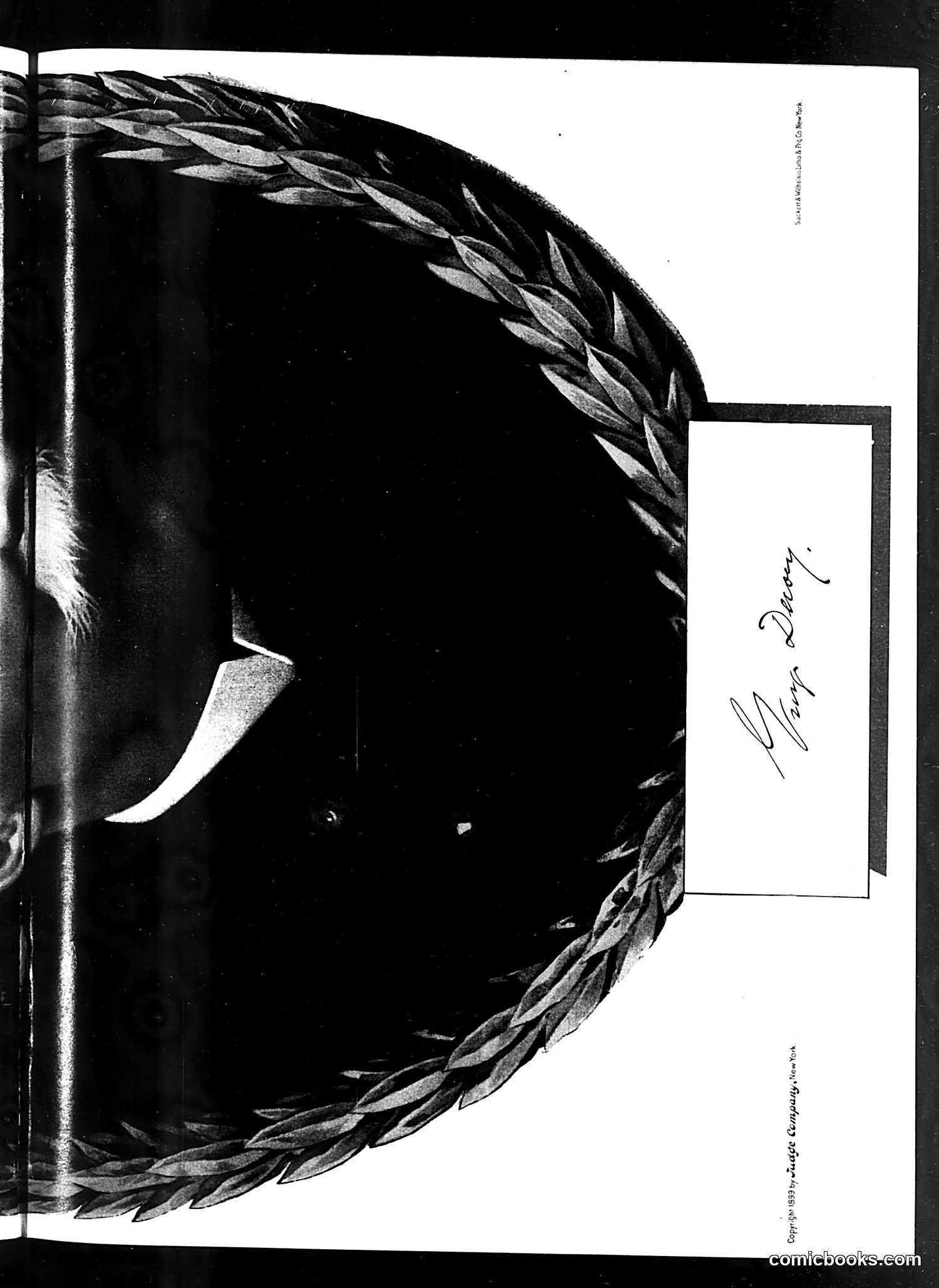
This appears to be a title page or cover from Judge magazine rather than a cartoon with political commentary. The page features a stylized black and white illustration of what looks like a wreath or laurel crown arrangement, with a curved horn or cornucopia shape visible on the left side. There is a handwritten inscription that reads "War Dress" in the white rectangular space on the right. Without additional visible text or context, the specific satirical point is unclear. The wreath imagery and "War Dress" notation suggest possible commentary on military themes or formal conflict-related attire, but I cannot definitively identify the particular historical event, figures, or satirical intent from this image alone.

This page appears to be nearly blank or contains only OCR artifacts that don't represent actual readable text. The image shows what looks like a mostly white/blank page from a spiral-bound publication with a binding visible on the right edge and left margin. There is no discernible cartoon, illustration, readable text, or satirical content visible on this particular page. This may be a blank page, verso of an advertisement, or a page where the original content failed to scan or reproduce clearly in this digitized version. Without visible content, I cannot identify figures, political references, or satire.
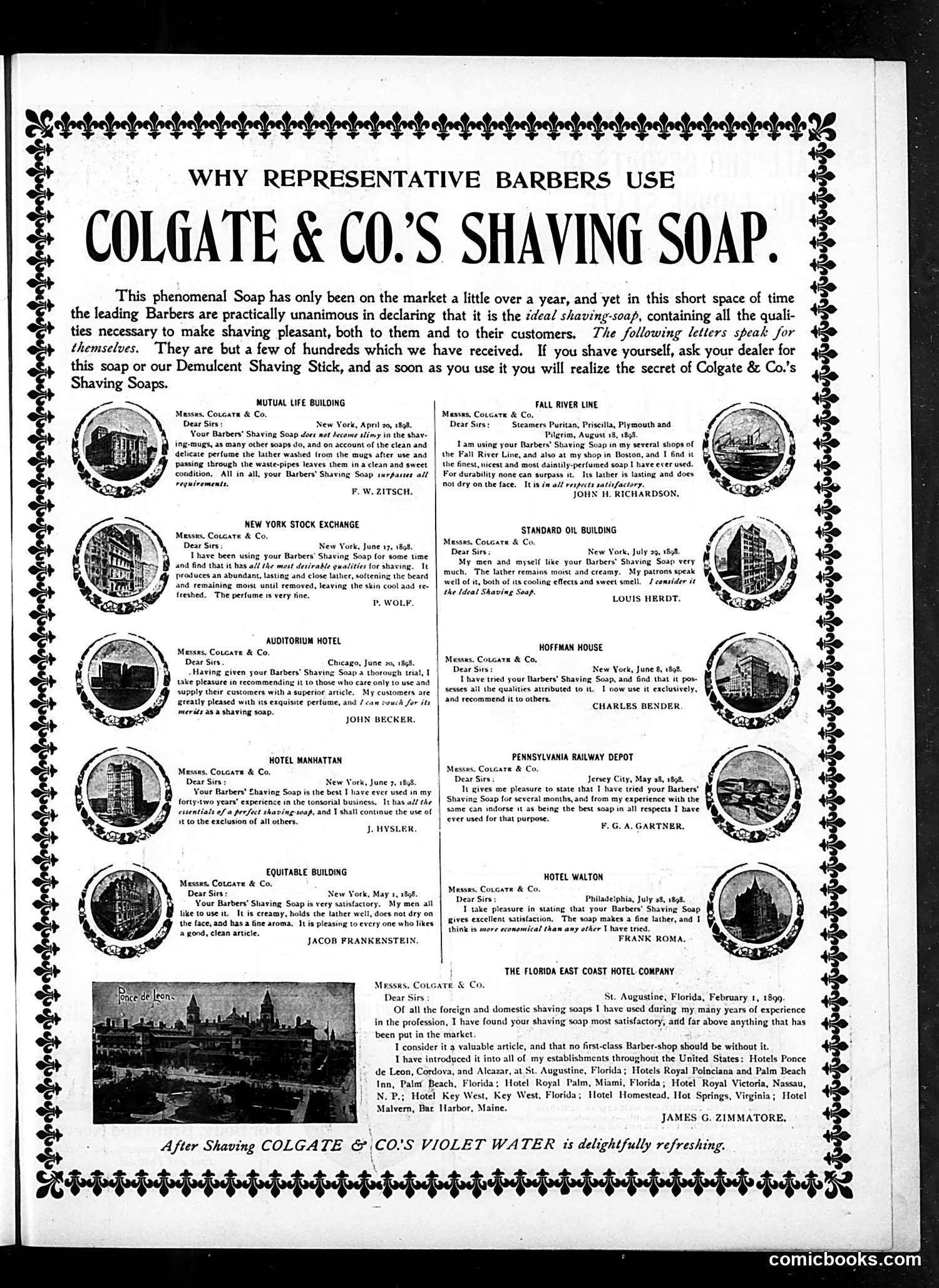
This is **not a cartoon or satirical content**—it's a full-page **advertisement** for Colgate & Co.'s Shaving Soap, disguised as editorial endorsements. The page presents itself as testimonial letters from prominent New York establishments (hotels, office buildings, the Stock Exchange, Standard Oil Building) praising the product's qualities: lather, perfume, durability, and cleanliness. The circular vignettes show recognizable Manhattan landmarks. **The satire lies in the framing**: Judge magazine is presenting commercial advertising as if it were genuine business correspondence from prestigious institutions. For 1898 readers, this would be either tongue-in-cheek product placement or actual paid advertising presented with mock-credibility. The appeal targets male grooming standards and business-class vanity—suggesting that respectable businessmen and establishments endorse this soap. It's essentially early advertising dressed up to look like objective testimonials, a marketing technique Judge's sophisticated audience would recognize and find amusing.
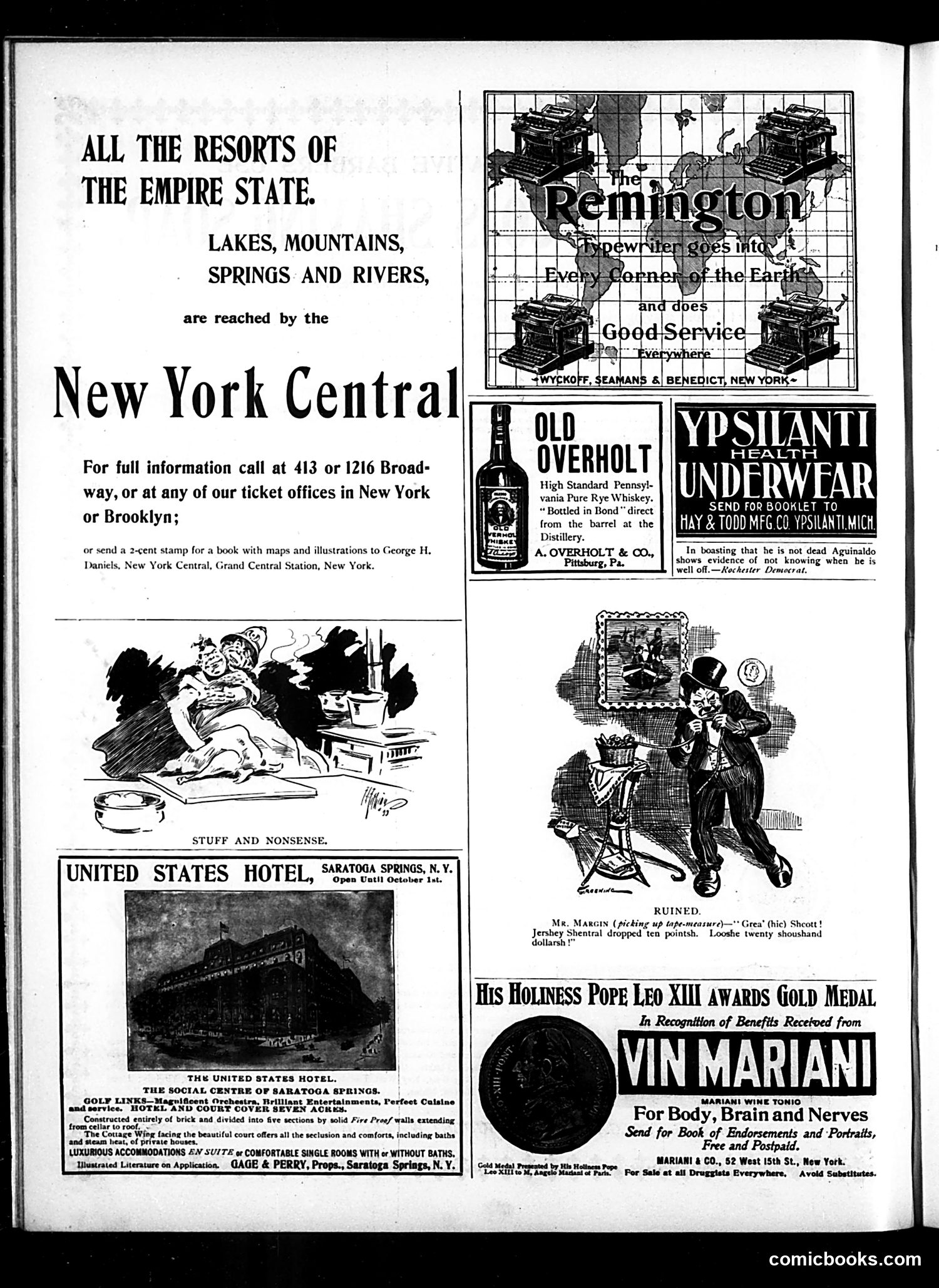
This page is primarily **advertising** for New York resorts and patent medicines, with one small political cartoon. The only substantive cartoon appears in the "RUINED" section: a man labeled "Mr. Margin" has lost money in the stock market—"Jersey Central dropped ten points"—costing him twenty thousand dollars. The humor relies on his drunken speech ("Grea' (hic) Shcott!"), suggesting financial panic and alcohol consumption go together. A brief editorial jab appears below, mocking Filipino leader Aguinaldo by suggesting his boasts about being alive prove he doesn't know "when he is well off"—likely referencing the ongoing Philippine-American War (1899-1902) and American frustration with prolonged resistance. The rest of the page consists of advertisements: the New York Central Railroad, liquor, hotels, and "Vin Mariani" wine tonic (falsely endorsed by Pope Leo XIII). These reflect Judge's commercial content, common in early-1900s magazines.
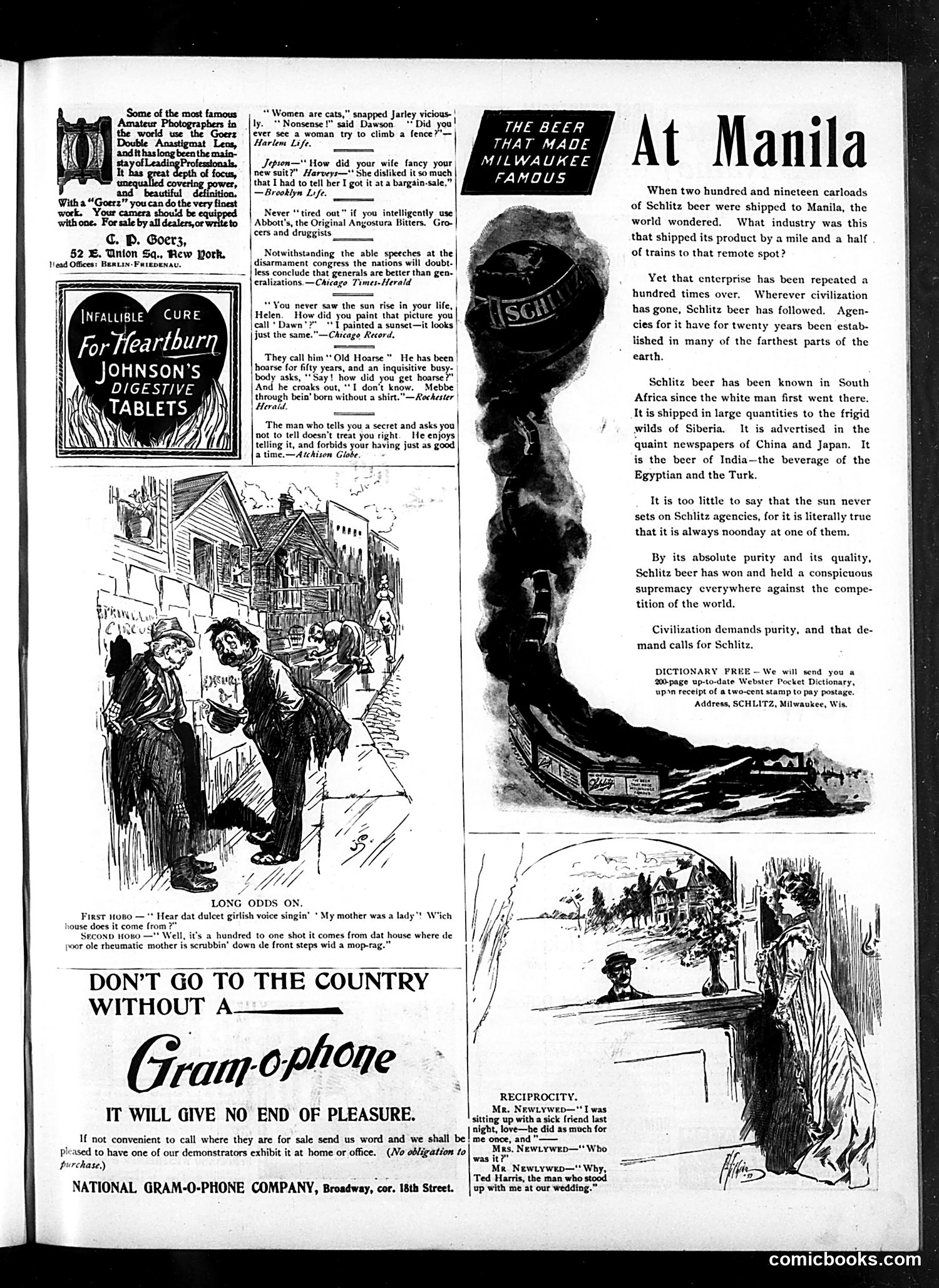
This Judge magazine page (circa early 1900s) contains mostly **advertisements and brief humor jokes**, not political cartoons requiring historical context. The main content is a **Schlitz beer advertisement** celebrating the brand's global reach—noting that 219 carloads were shipped to Manila, and claiming Schlitz agencies exist everywhere from Siberia to Egypt to India. The ad emphasizes "purity" as the product's competitive advantage. The other material consists of short jokes and product ads (Johnson's Digestive Tablets, Gram-o-phone) with minimal satirical intent. One cartoon depicts two people discussing a woman's singing, with the punchline implying that an elderly woman scrubbing steps (domestic servant) is producing the sound—a class-based joke about servant labor masquerading as refined music. The "Long Odds" section makes similar class humor: working-class Irish or immigrant speakers using nonstandard English dialect for comic effect—common in period publications but reflecting outdated ethnic stereotyping. **No significant political satire is present on this page.**
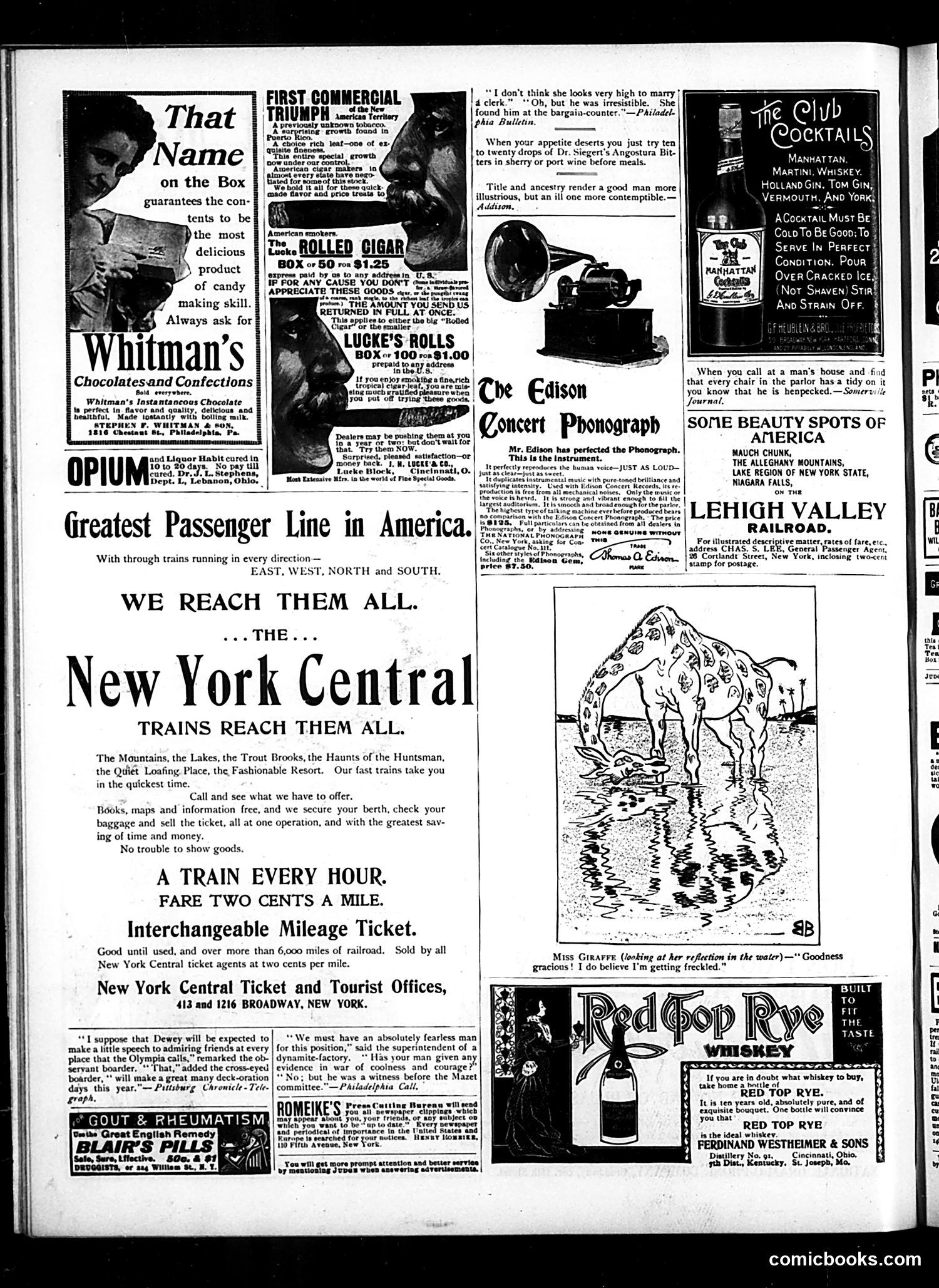
This page is primarily **advertisements** rather than satirical cartoons. The dominant feature is a large New York Central Railroad ad promoting train travel with the slogan "A TRAIN EVERY HOUR. FARE TWO CENTS A MILE." The few cartoon-related items are minor: **Upper right**: A small quip about "henpecked" husbands—a period joke about wives who dominate their marriages (evidence: "every chair...has a tidy on it"). **Bottom**: Two brief anecdotes without illustration: one mocking Admiral Dewey's expected speeches after his naval victory, another joking about hiring a fearless dynamite-factory worker. **Center**: An illustration of a giraffe, captioned as "Miss Giraffe" looking at her reflection, suggesting vanity over a trivial concern (freckles). These are light, non-political humor items typical of Judge's advertising pages. The page functions primarily as a vehicle for commercial pitches—candy, chocolate, phonographs, whiskey, and transportation—with humor serving mostly to fill space between ads.
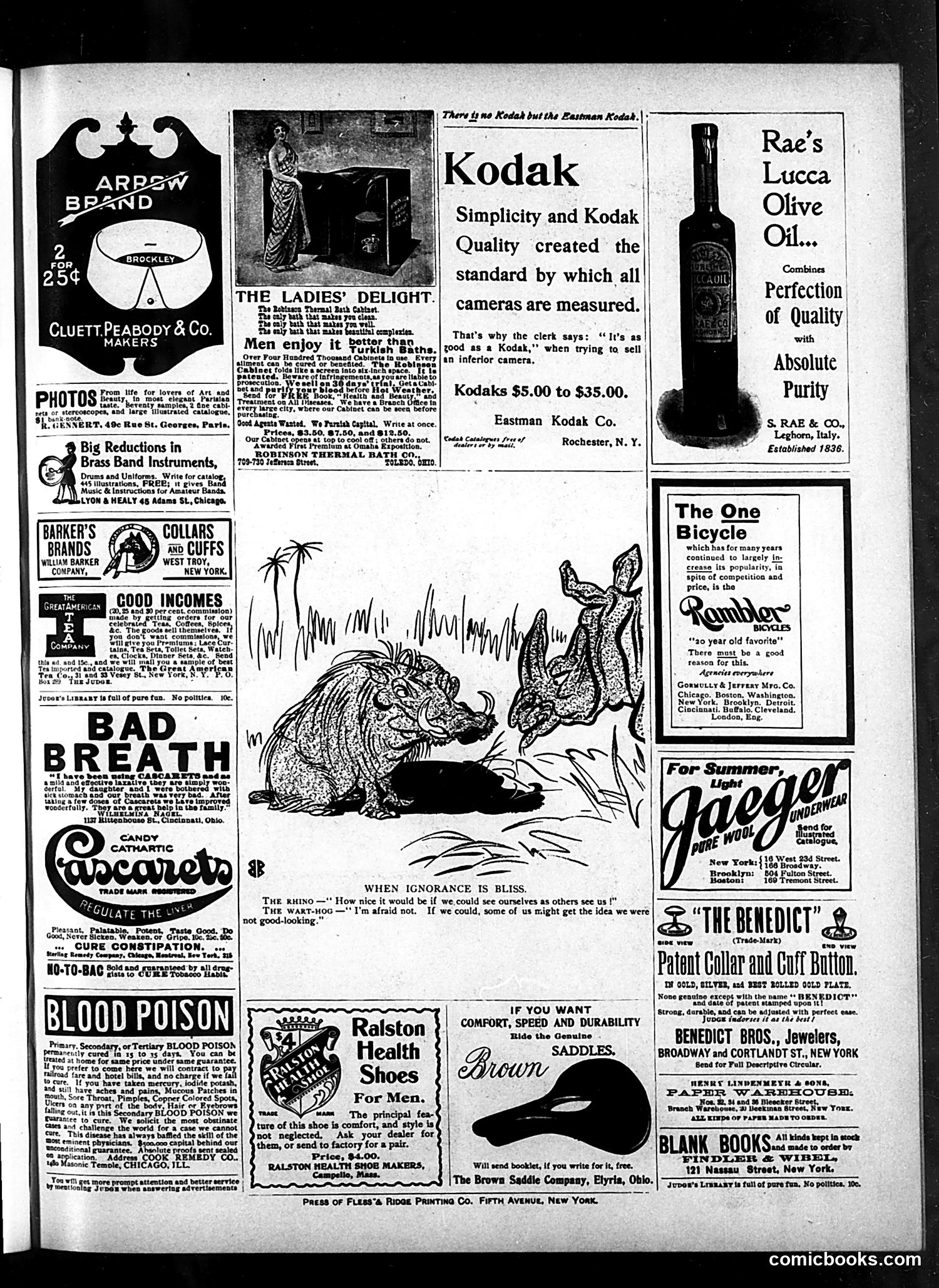
This page is primarily **advertisements** from Judge magazine, with one notable **political cartoon** at the center. The cartoon depicts a rhinoceros and a wart-hog in conversation. The rhino says: "How nice it would be if we could see ourselves as others see us!" The wart-hog replies: "I'm afraid not. If we could, some of us might get the idea we were not good-looking." **The satire**: This is a commentary on **willful self-delusion**—the idea that ignorance of one's flaws is preferable to harsh self-awareness. The animals represent people who benefit from not knowing how others perceive them. It's a gentle, philosophical joke about human vanity and the comfortable lies we tell ourselves. The cartoon contains no specific political figures or dated references—rather, it's a timeless observation about human nature dressed in animal fable form, typical of Judge's satirical approach.
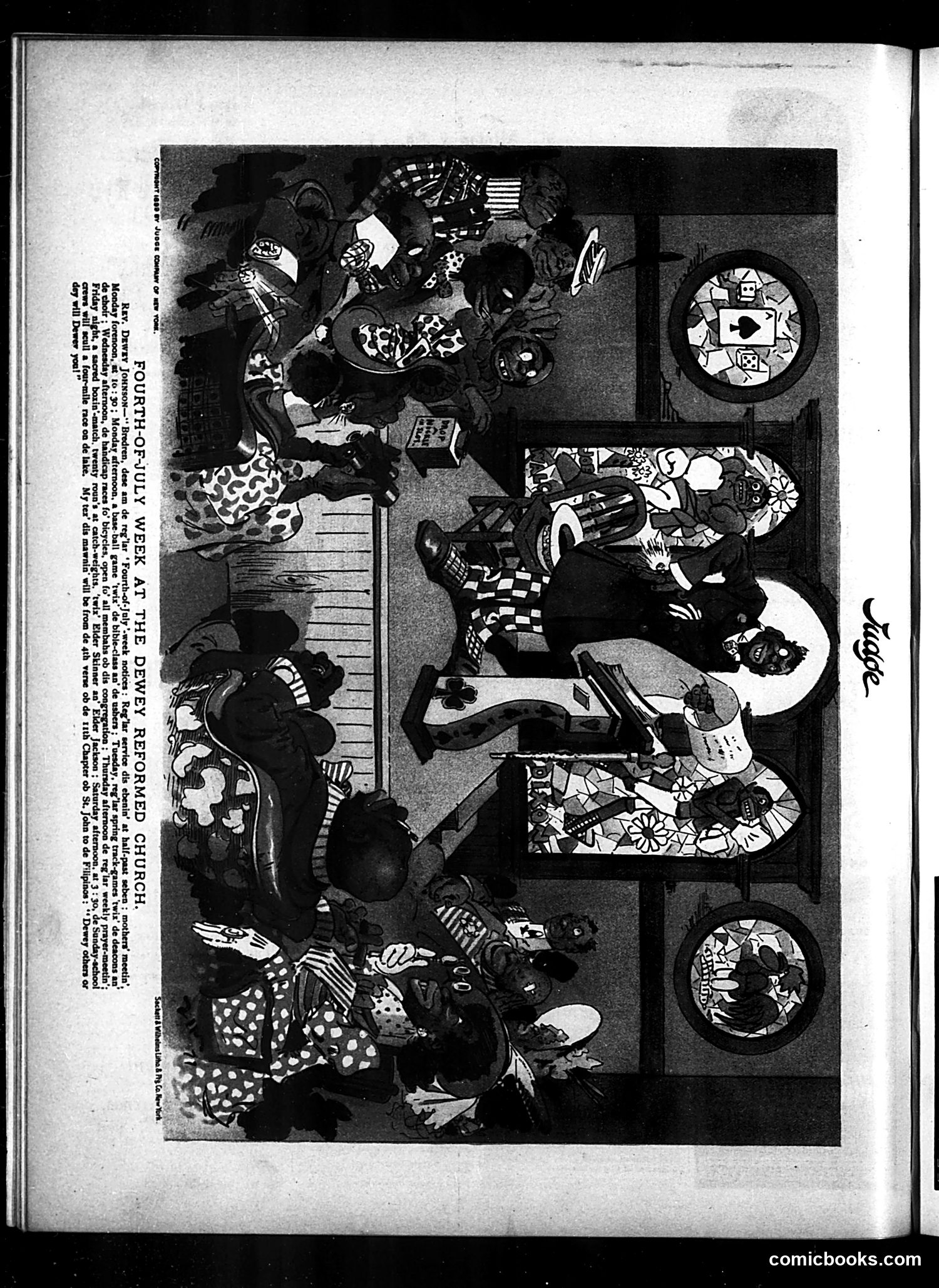
I can see this is a page from *Judge* magazine, but the image quality and orientation make it difficult to read the OCR text clearly or identify specific figures with confidence. The page appears to contain satirical illustrations arranged in a multi-panel layout, with what looks like caricatured figures in period dress (possibly late 19th or early 20th century based on clothing styles). There are circular emblems or seals visible, and the compositions suggest political or social commentary typical of *Judge*'s satirical style. However, without being able to reliably read the accompanying text or clearly identify the specific individuals depicted, I cannot accurately explain the particular political references, targets, or jokes intended by these cartoons. The page would require higher resolution or proper orientation to analyze responsibly.
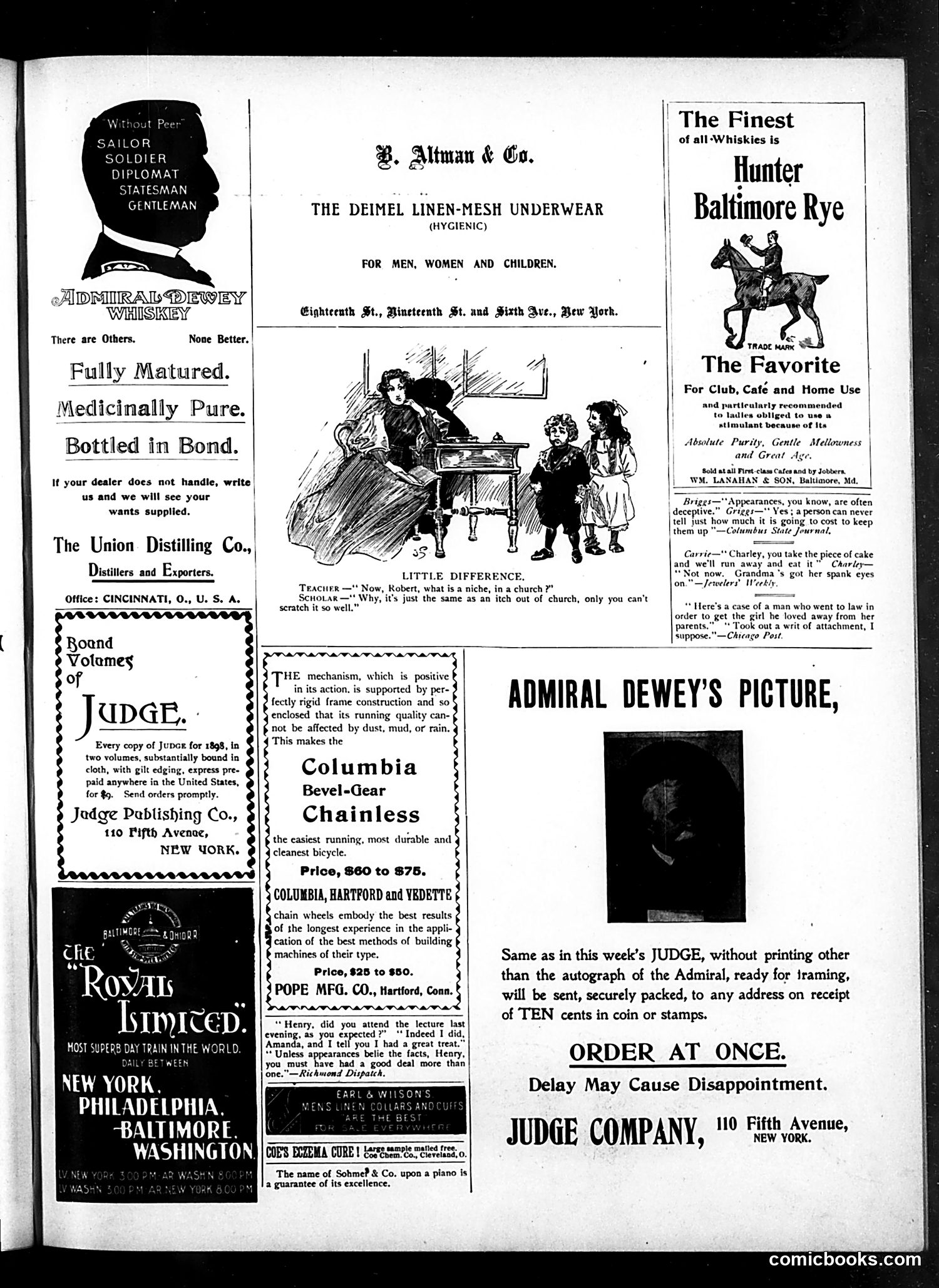
This page is primarily **advertisements and filler content** rather than satirical cartoons. The main illustrated piece, "Little Difference," is a mild joke contrasting church etiquette with secular behavior—a Scholar asks what a "niche" is in church, and Robert quips it's the same as an "itch" outside church, except you can't scratch it in church. The page features numerous product ads (Admiral Dewey Whiskey, Columbia bicycles, Judge Publishing Company) and brief humor snippets typical of the era—short, domestic jokes about courtship and marriage with no specific political content. **Admiral Dewey** appears in whiskey advertising, likely referencing Commodore George Dewey, the Spanish-American War naval hero (1898 context). His name was widely commercialized following his fame. Overall, this represents typical late-1890s magazine filler: light domestic humor, product placement, and celebrity-name exploitation—not substantive satire.
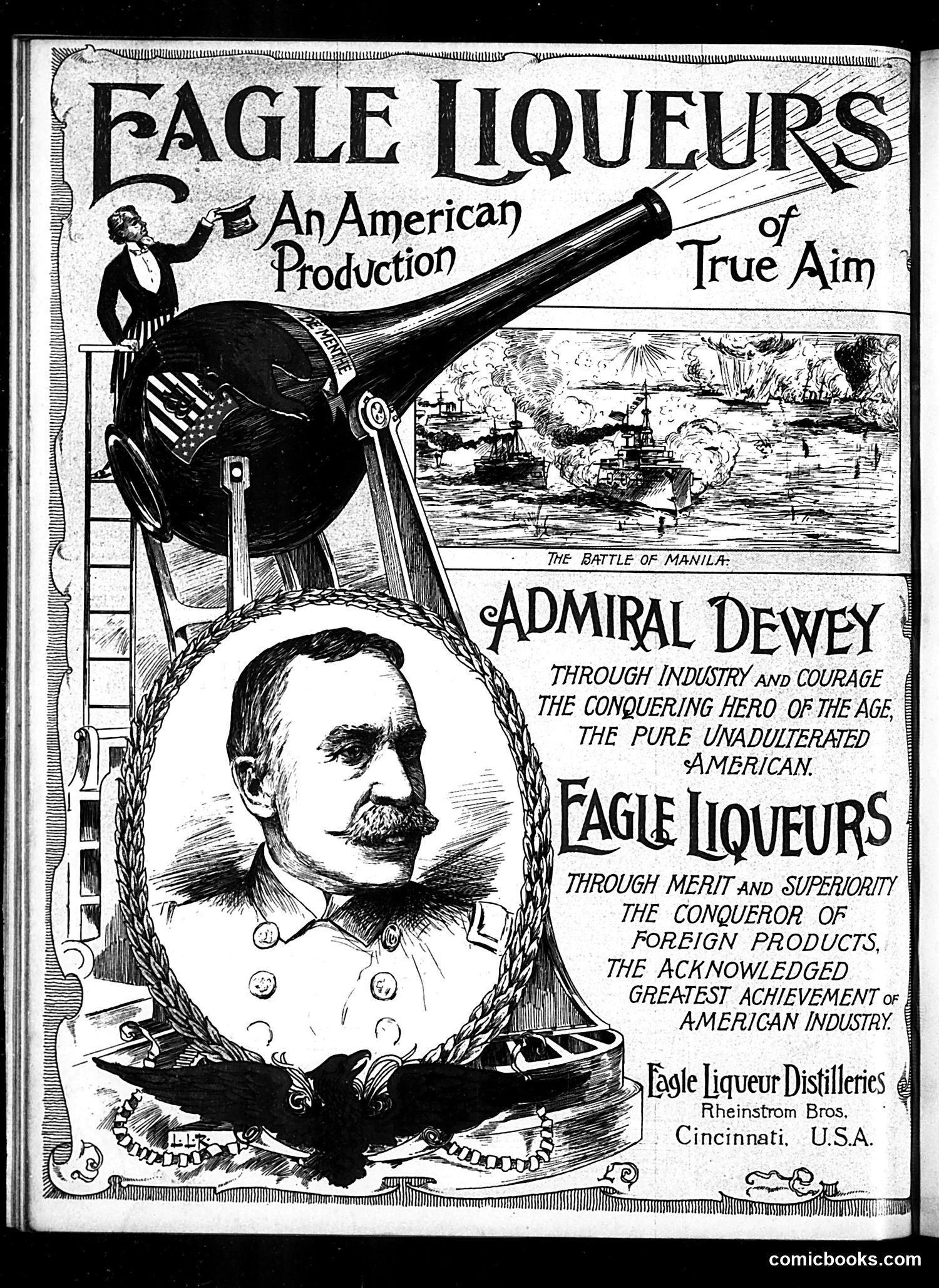
This is primarily a **liquor advertisement**, not political satire. The page promotes Eagle Liqueurs, an American-made product from Cincinnati distillery Rheinstrom Bros. The central image depicts **Admiral Dewey**, the American naval hero famous for his victory at the Battle of Manila (1898) during the Spanish-American War, shown in his military uniform within a decorative rope frame. The advertisement uses patriotic rhetoric to market the liqueur: it's presented as a "pure unadulterated American" product that has "conquered foreign products" through "merit and superiority." By associating Eagle Liqueurs with Dewey—a celebrated symbol of American military triumph and industrial capability—the ad claims the liqueur represents American industrial achievement and superiority. The small naval battle scene at top reinforces this patriotic, jingoistic marketing approach typical of early 1900s American advertising.