
A complete issue · 16 pages · 1899
Judge — June 10, 1899
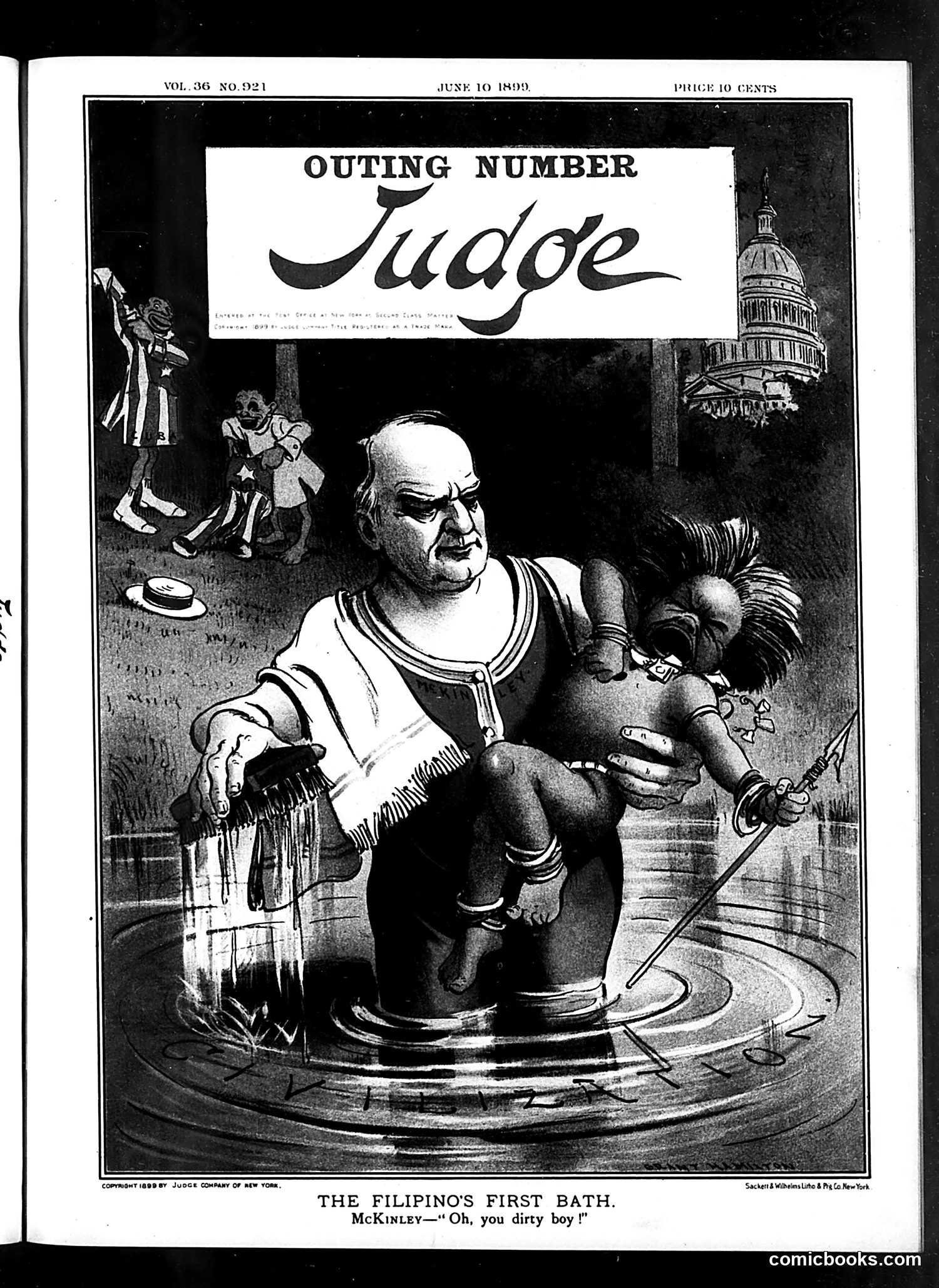
This 1898 Judge cartoon satirizes American imperial attitudes toward the Philippines following the Spanish-American War. The central figure appears to be McKinley (labeled in the caption), depicted as a stern authority figure forcibly bathing a small Filipino child—a racist caricature representing the Philippines as uncivilized and requiring American "civilizing" intervention. The Capitol building visible in the background anchors this as commentary on American government policy. The satire criticizes the paternalistic justification for American colonialism: the notion that the U.S. was "cleaning up" or "civilizing" the Philippines through occupation, portrayed here as an uncomfortable, imposed process. The caption "Oh, you dirty boy!" reinforces the dehumanizing racial stereotypes underlying turn-of-the-century imperialism.
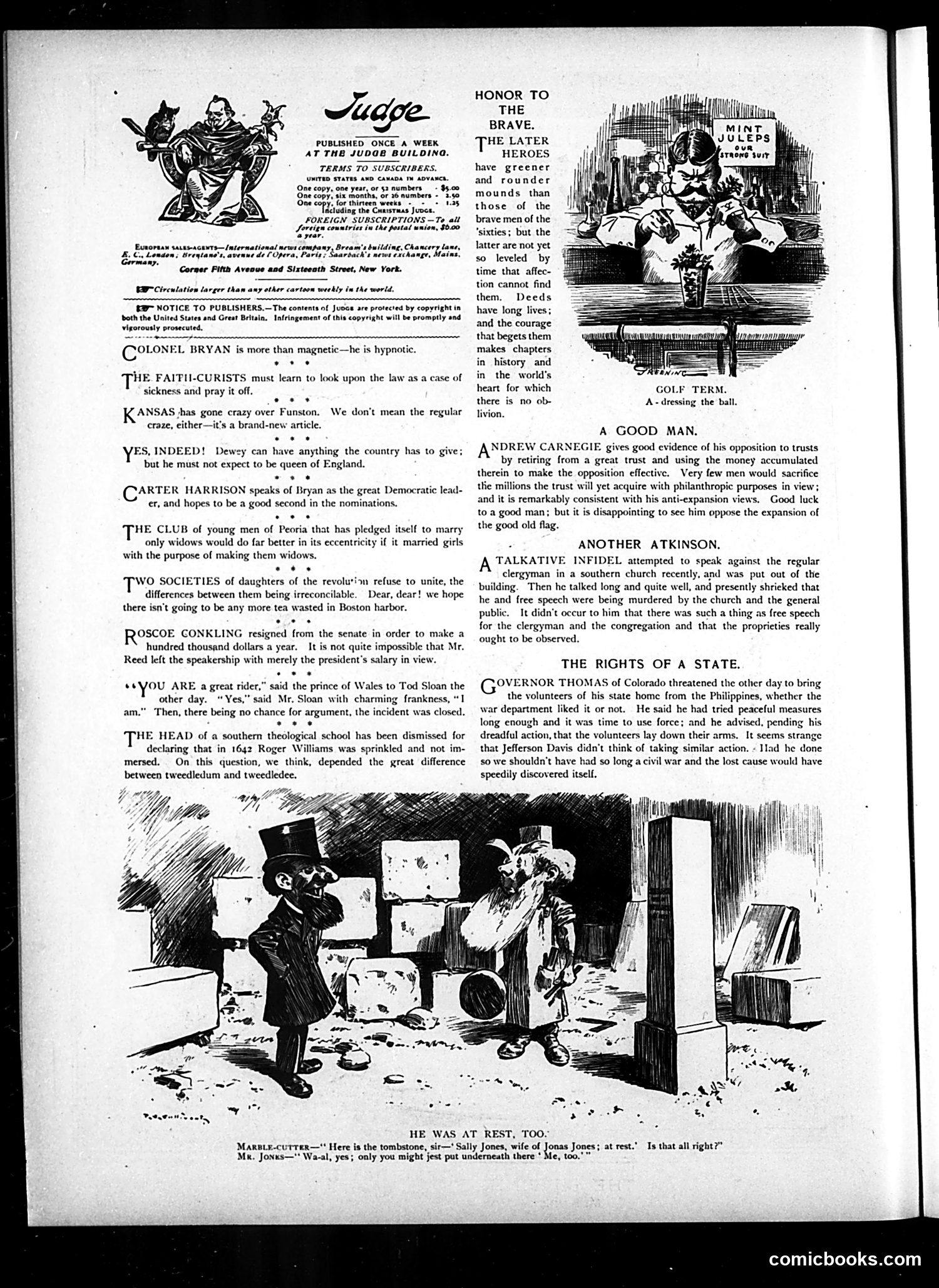
This page contains editorial commentary and two cartoons. The text pieces critique various political figures: Colonel Bryan (likely William Jennings Bryan), Andrew Carnegie's philanthropy, and Governor Thomas of Colorado's handling of state volunteers. The bottom cartoon, titled "He Was at Rest, Too," depicts a domestic scene mocking working-class poverty. A man in a top hat (representing wealth/authority) converses with a woman amid squalor and broken furniture. The caption's dark humor—"at rest" implying death or destitution—satirizes the gap between rich and poor. The marble-cutter reference suggests commentary on labor conditions. The page reflects Judge's conservative editorial stance, critiquing populist politicians and radical labor movements while mocking both wealthy hypocrisy and working-class desperation.
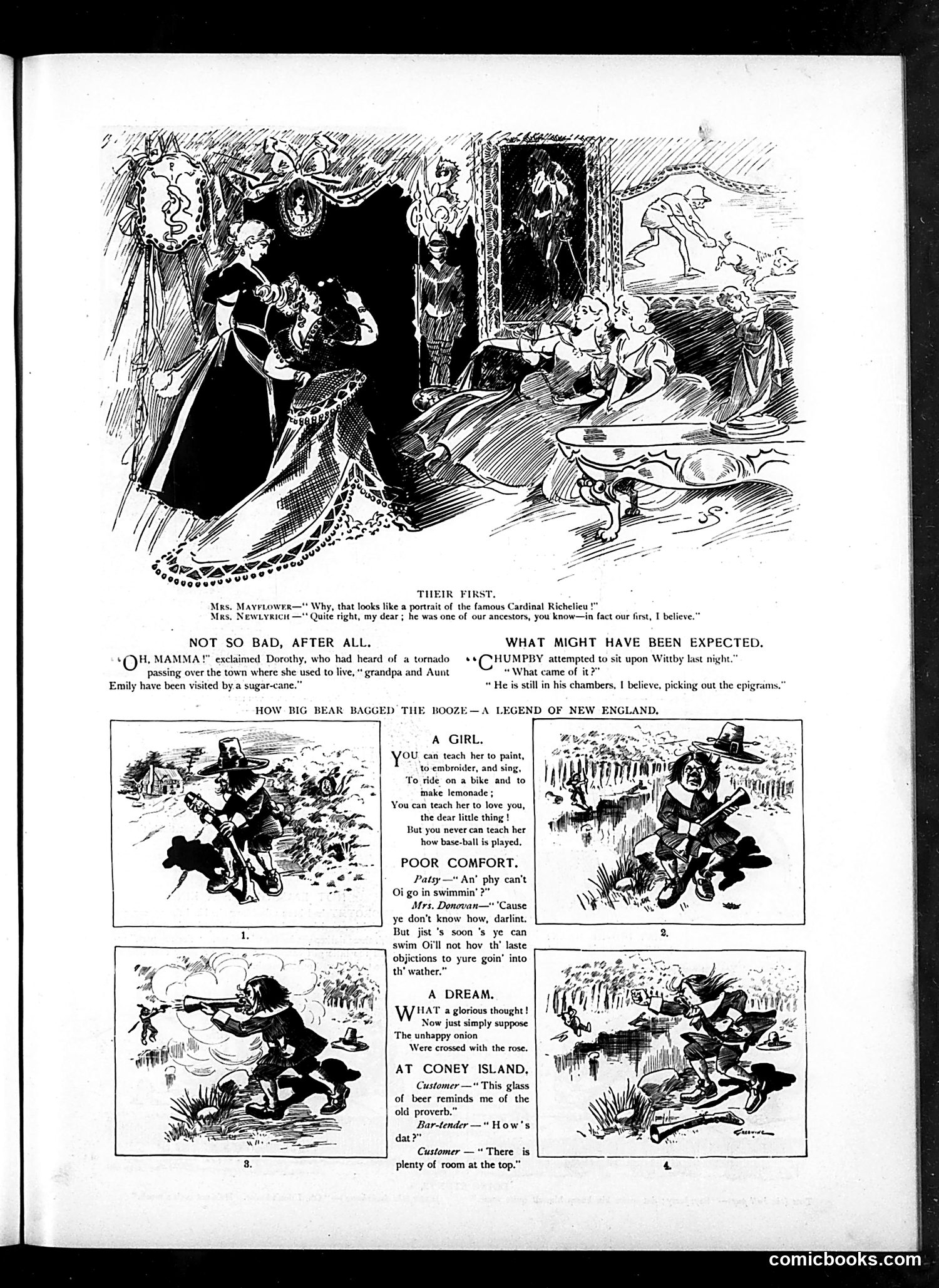
This page contains **social humor rather than political satire**. The top illustration depicts a Victorian-era parlor scene with two women discussing what appears to be a portrait—one mentions "the famous Cardinal Richelieu," establishing an upper-class domestic setting. Below are four captioned comic panels titled "How Big Bear Bagged the Booze—A Legend of New England." These appear to be **humorous anecdotes about alcohol consumption**, featuring working-class characters in rural New England settings. The jokes reference swimming, baseball, beer, and Coney Island amusements. The satire targets **class attitudes and regional stereotypes** rather than specific political figures. It mocks rural New England speech patterns and lower-class leisure activities, presenting them as quaint or amusing to Judge's educated urban readership.
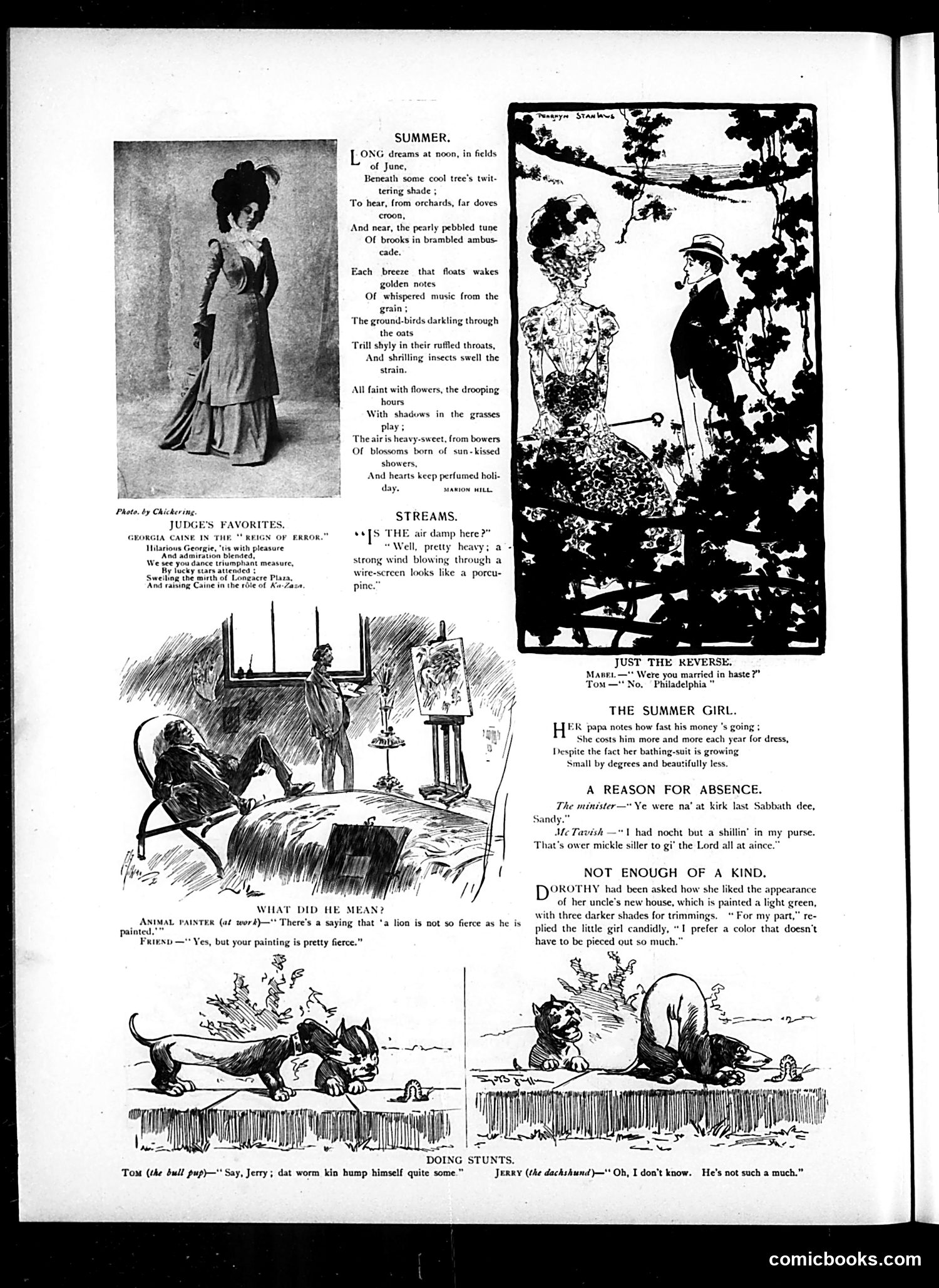
This page contains literary and illustrative content rather than political cartoons. The main pieces include: **"Summer"** — A poem by Baron Hill celebrating pastoral imagery: fields, orchards, birdsong, and flowers. **"Dune's Favorites"** — A photograph of actress Georgia Caine from "The Reign of Error," accompanied by laudatory verse. **Humorous Sketches** — Several comic vignettes with captions like "What Did He Mean?" (about a lion painting), "Just the Reverse" (marriage joke), and "Doing Stunts" (depicting dogs performing tricks). **Short Stories** — Brief pieces like "The Summer Girl" and "Not Enough of a Kind" offering light domestic humor. The page appears to be general entertainment content typical of Judge magazine's mix of satire, humor, and cultural commentary, though without specific political references or identifiable caricatures targeting contemporary figures or events.
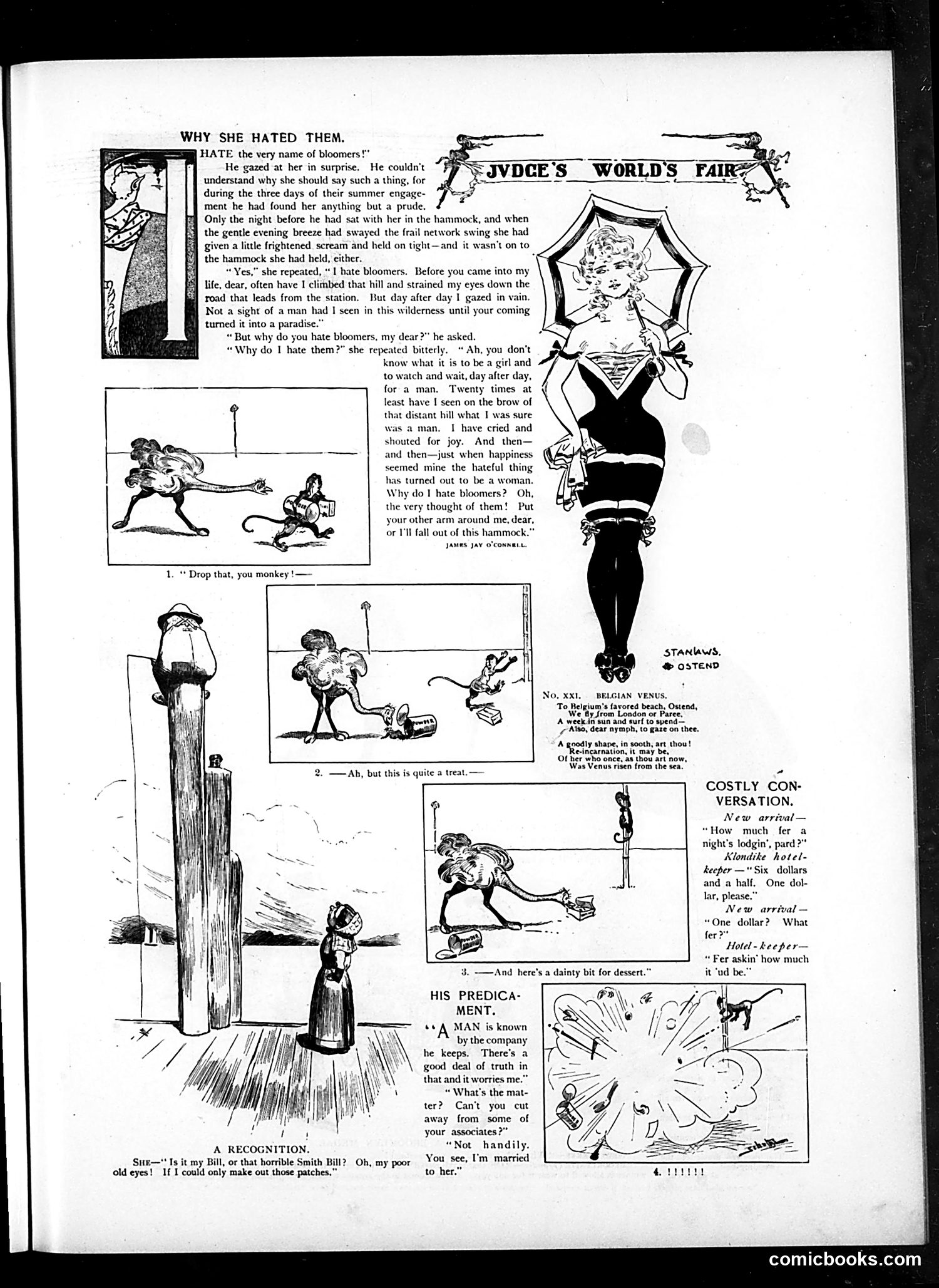
This page contains multiple humorous pieces satirizing early 1900s gender and social conventions: **"Why She Hated Them"** mocks the "bloomer" controversy—women's divided skirts worn for cycling and athletics. The joke: a woman claims to hate bloomers because they've repeatedly disappointed her. From a distance, she mistook women in bloomers for men on the hill, ruining her romantic hopes. The satire targets both the fashion debate and female sexuality, suggesting women's real interests lie in romantic pursuits rather than practical clothing. **"Belgian Venus"** is advertising copy objectifying a woman at Ostend beach, using classical mythology to romanticize tourism. **"Costly Conversation"** makes light of Klondike gold-rush pricing by joking that asking prices itself costs money—frontier humor about inflated costs. **"His Predicament"** plays on the proverb about being "known by company kept," suggesting a man cannot escape an undesirable marriage. The cartoons reflect period attitudes: dismissal of women's fashion choices as frivolous, casual misogyny, and class-based humor.
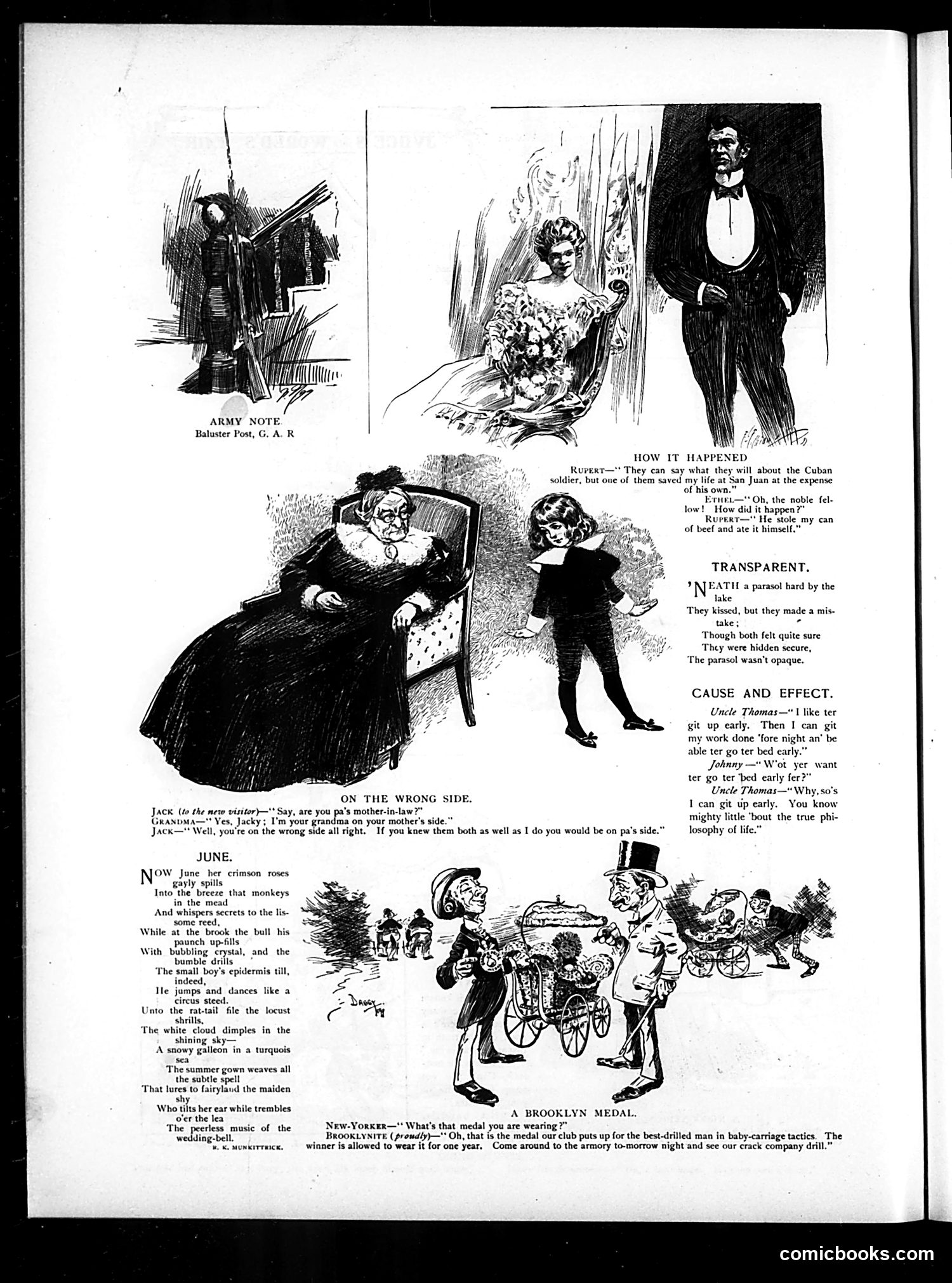
This page contains several satirical pieces typical of Judge's humor: **"How It Happened"** mocks romantic melodrama about the Spanish-American War, with a soldier claiming a Cuban soldier saved his life "at the expense of his own"—only to reveal the Cuban simply ate the beef meant for the speaker. **"On the Wrong Side"** is a domestic joke: a child tells his grandmother she's standing on "the wrong side" because she's his father's mother-in-law, implying wives are preferable to mothers-in-law. **"Transparent"** plays on the phrase's double meaning—a couple kisses beneath a parasol believing themselves hidden, but the parasol proves literally see-through. **"A Brooklyn Medal"** satirizes working-class immigrant culture in Brooklyn, mocking a baby-carriage drill competition as mock-militaristic pretension. The page also includes poetry about June and a brief "Cause and Effect" dialogue about bedtime routines. Overall, the humor targets romantic conventions, family dynamics, immigrant communities, and everyday absurdities.
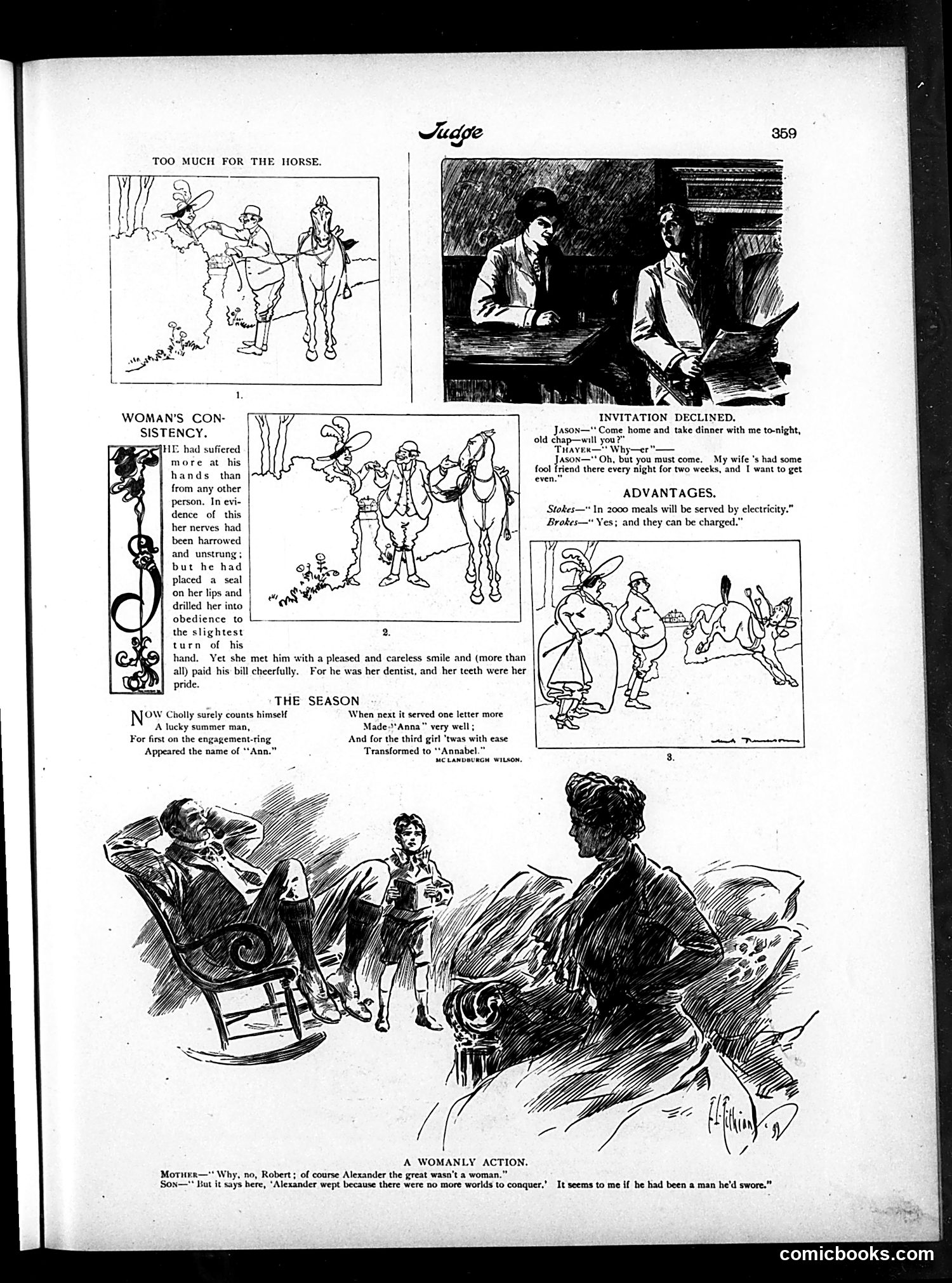
This page collects several brief satirical humor pieces typical of early-20th-century Judge magazine: **"Too Much for the Horse"** and **"Woman's Consistency"**: These two pieces mock women's perceived contradictions and emotional volatility—common misogynistic tropes of the era. The first references a woman's nervous hands; the second depicts a woman who, despite suffering at her dentist's hands, paid his bills cheerfully out of vanity about her teeth. **"Invitation Declined," "Advantages," and "The Season"**: Short comedic vignettes about social situations—a man avoiding dinner because his wife goes out nightly, electricity powering meal service, and play on women's names. **"A Womanly Action"**: The final cartoon jokes that women swear/curse differently than men, contrasting Alexander the Great's weeping over unconquered worlds with how a "real man" would respond. It stereotypes feminine emotional expression as inferior to masculine. The overall tone reflects early-1900s humor rooted in gender stereotypes portraying women as emotionally unstable, vain, and fundamentally different from men.
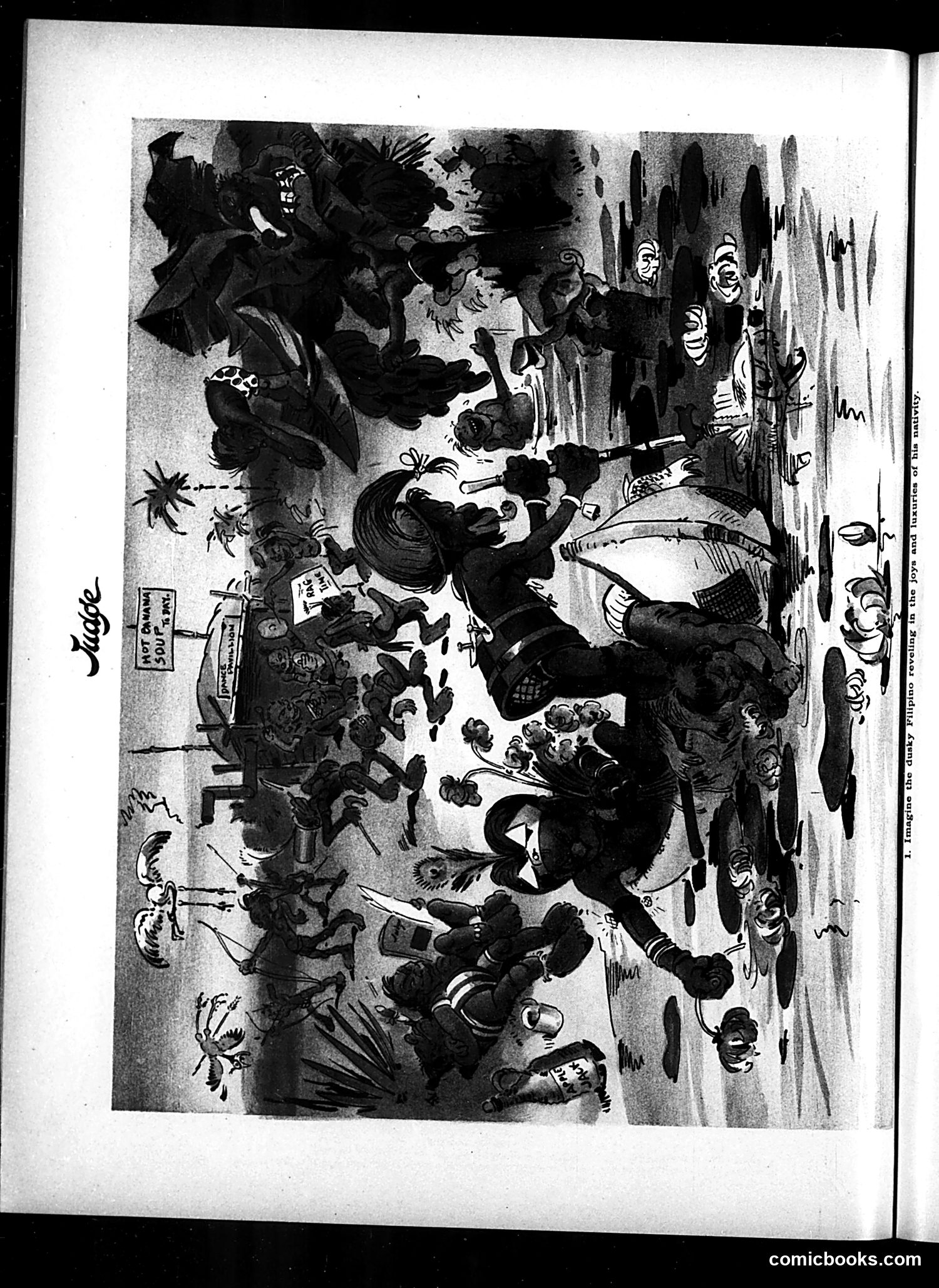
The OCR text is too corrupted to read. Based on the image alone, this appears to be a satirical cartoon printed upside-down (rotated 180 degrees). It depicts a chaotic scene with multiple figures in exaggerated caricature style, typical of Judge magazine's political satire. The illustration shows what appears to be a crowded, tumultuous gathering with various characters in animated poses, some holding objects that might be weapons or tools. The heavy use of black ink and dramatic composition suggests urgent, dramatic subject matter—likely political commentary on a contemporary event or social issue. Without legible text or publication date visible, I cannot identify the specific figures or the satire's target. The style is consistent with early-to-mid 20th century American editorial cartooning.
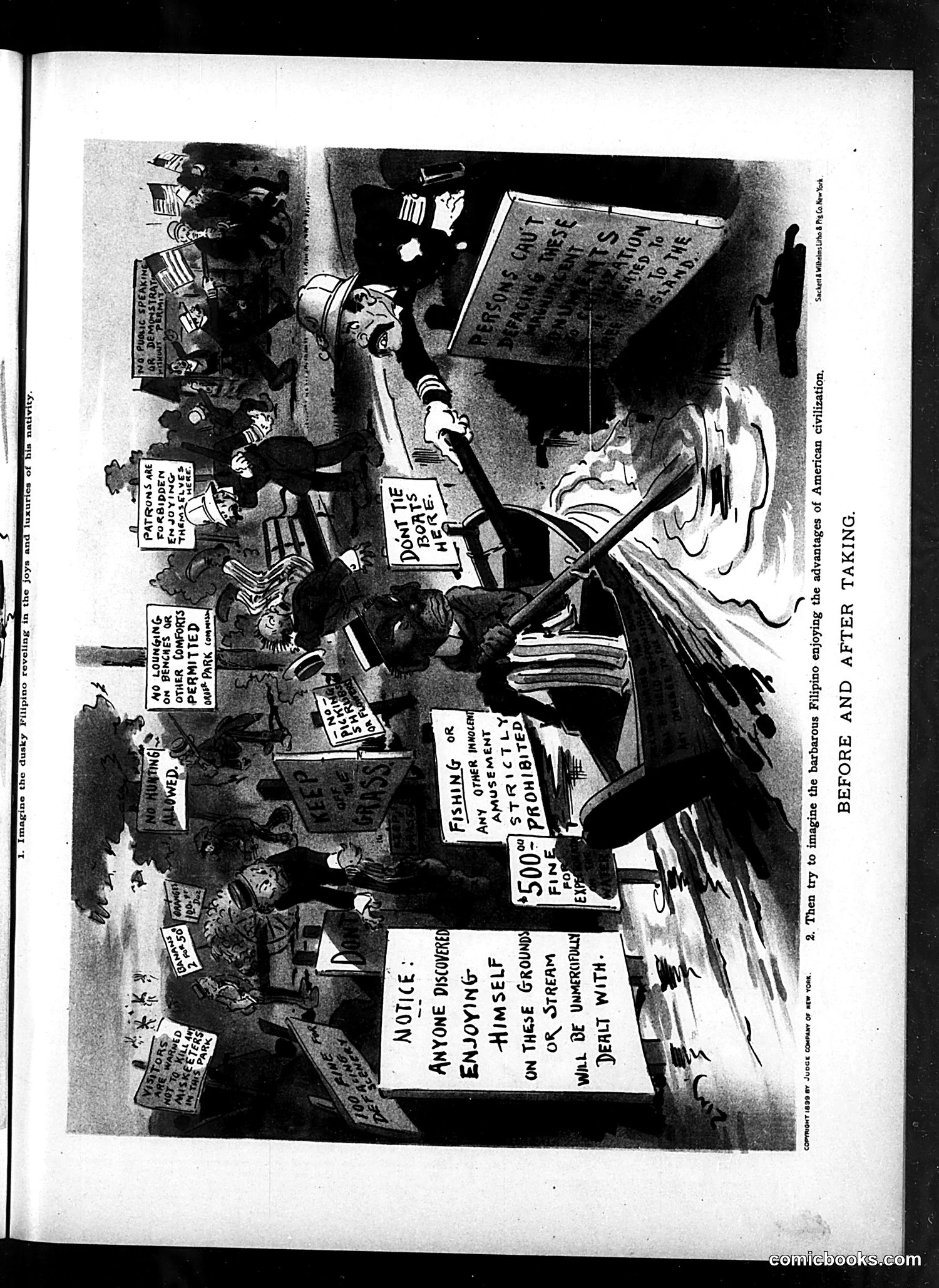
This satirical cartoon critiques American imperialism and the rhetoric surrounding it. The image appears to depict a figure (likely representing an indigenous or colonized people) surrounded by various signs advertising "American" products and values—labeled with prices and commercial claims. The satire targets the contradictory promise that American "civilization" brings progress and prosperity. The figure is overwhelmed by commercial signs and markers, suggesting that American expansion actually means commercial exploitation disguised as benevolent development. The "before and after" framing in the title is ironic: the cartoon implies that "taking advantage of American civilization" actually means being taken advantage *of* by American commercial interests. This reflects early-20th-century Judge magazine's skepticism toward American imperialism and commercial expansion, particularly relevant during the era of American overseas territorial acquisition. The cartoon mocks both the imperial project and the ideological justification that portrayed it as civilizing rather than exploitative.
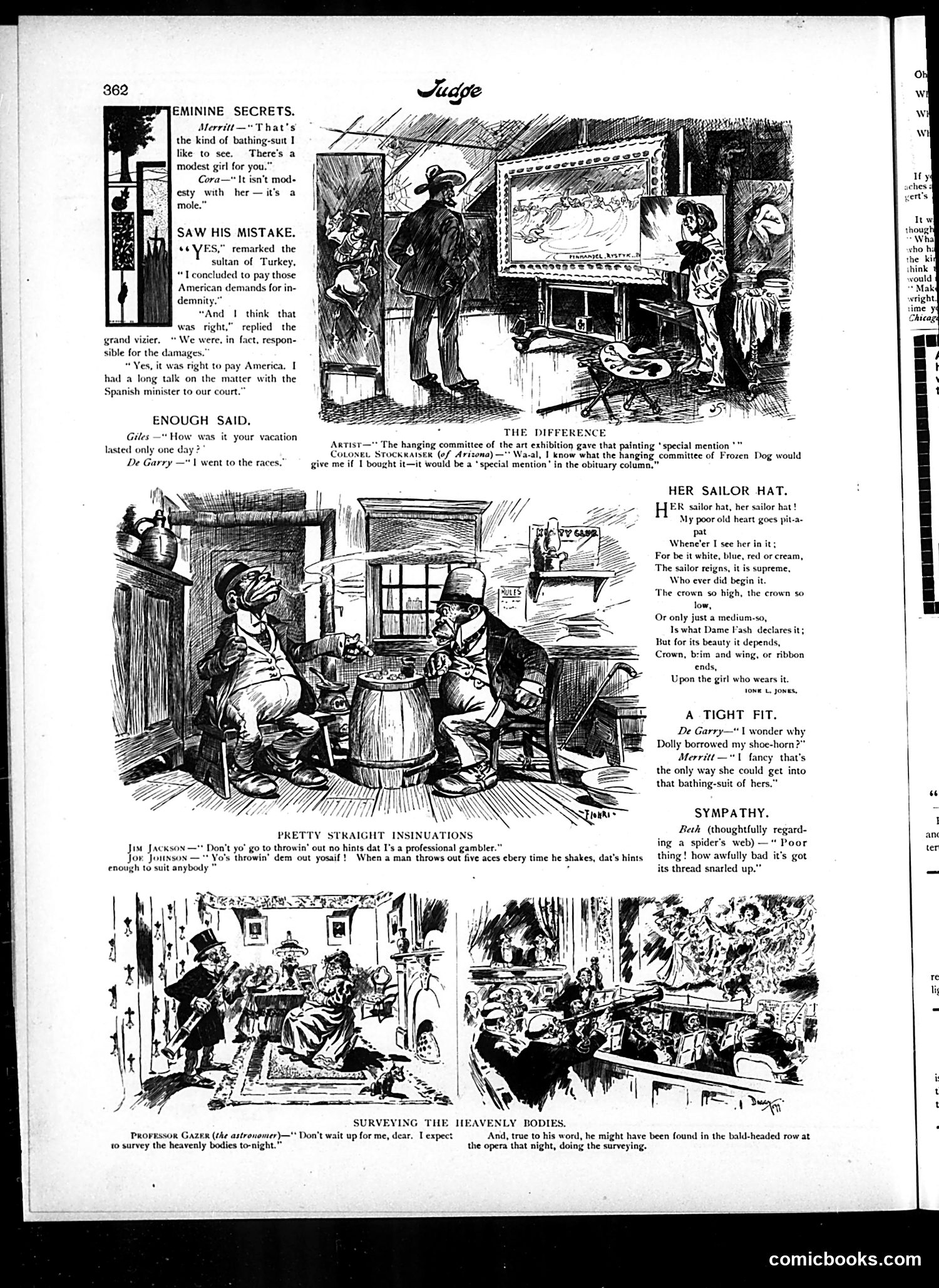
This page contains several short humorous sketches typical of early-20th-century American satirical humor: **"Feminine Secrets"** mocks women's fashion pretenses—a woman's modest bathing suit isn't about propriety but conceals a skin blemish. **"Saw His Mistake"** satirizes the Ottoman Sultan's decision to pay American indemnity claims (likely referencing diplomatic disputes over damages), suggesting he consulted a Spanish minister—implying Spain's poor judgment made his decision questionable by association. **"The Difference"** contrasts art world vanity: a painting earning "special mention" from a hanging committee versus being displayed in rural Arizona, where it would merit mention only in an obituary column. **"Pretty Straight Insinuations"** uses dialect humor (common in period comics) about a professional gambler's obvious cheating—throwing five aces repeatedly requires no explicit accusation. **"Surveying the Heavenly Bodies"** contains a double entendre: an astronomer's wife misunderstands his "surveying" intentions at the opera's "bald-headed row" (front seats with older men). Other sketches employ similar period-typical domestic humor and fashion commentary.
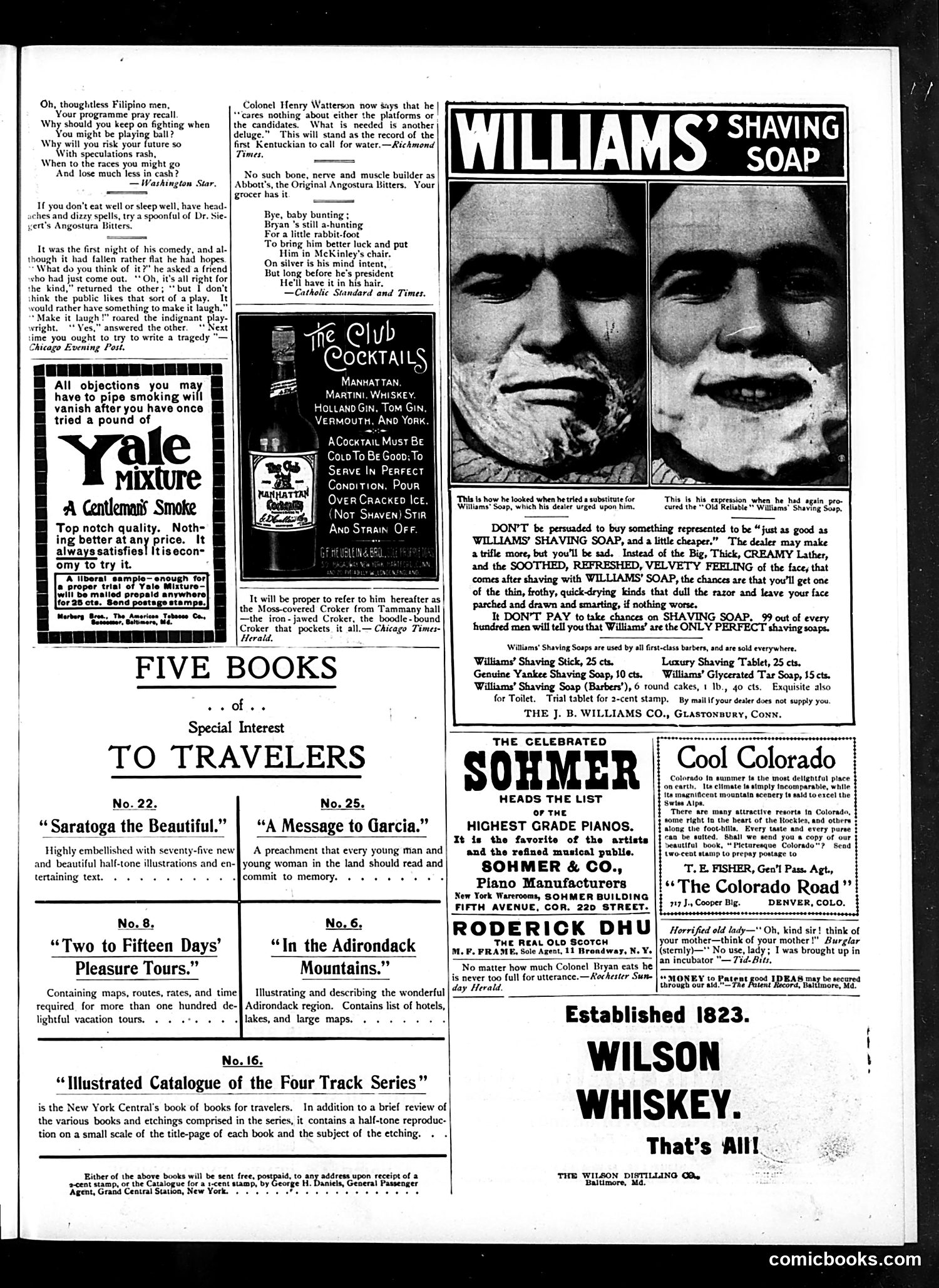
This page is primarily **advertising and filler content** from Judge magazine, with minimal political satire. The small satirical poem at top-left mocks **Filipino insurgents** during the Philippine-American War (context: America was fighting to suppress Philippine independence around this period). The joke dismisses their resistance as foolish when they could instead enjoy leisure activities like baseball and horse racing—a patronizing colonial attitude. A brief text item references **Colonel Henry Watterson** (a Kentucky newspaper editor), joking that he's the "first Kentuckian to call for water" because he advocates for a political candidate rather than alcohol—a temperance jab. There's a quip about **Richard Croker** (Tammany Hall Democratic boss), calling him corrupt ("boodle-bound"). The remainder consists of **product advertisements** (Yale tobacco, Williams' Shaving Soap, Wilson Whiskey, Abbott's Bitters) and travel guides from the New York Central Railroad. The page demonstrates Judge's mix of mild political humor alongside substantial advertising revenue.
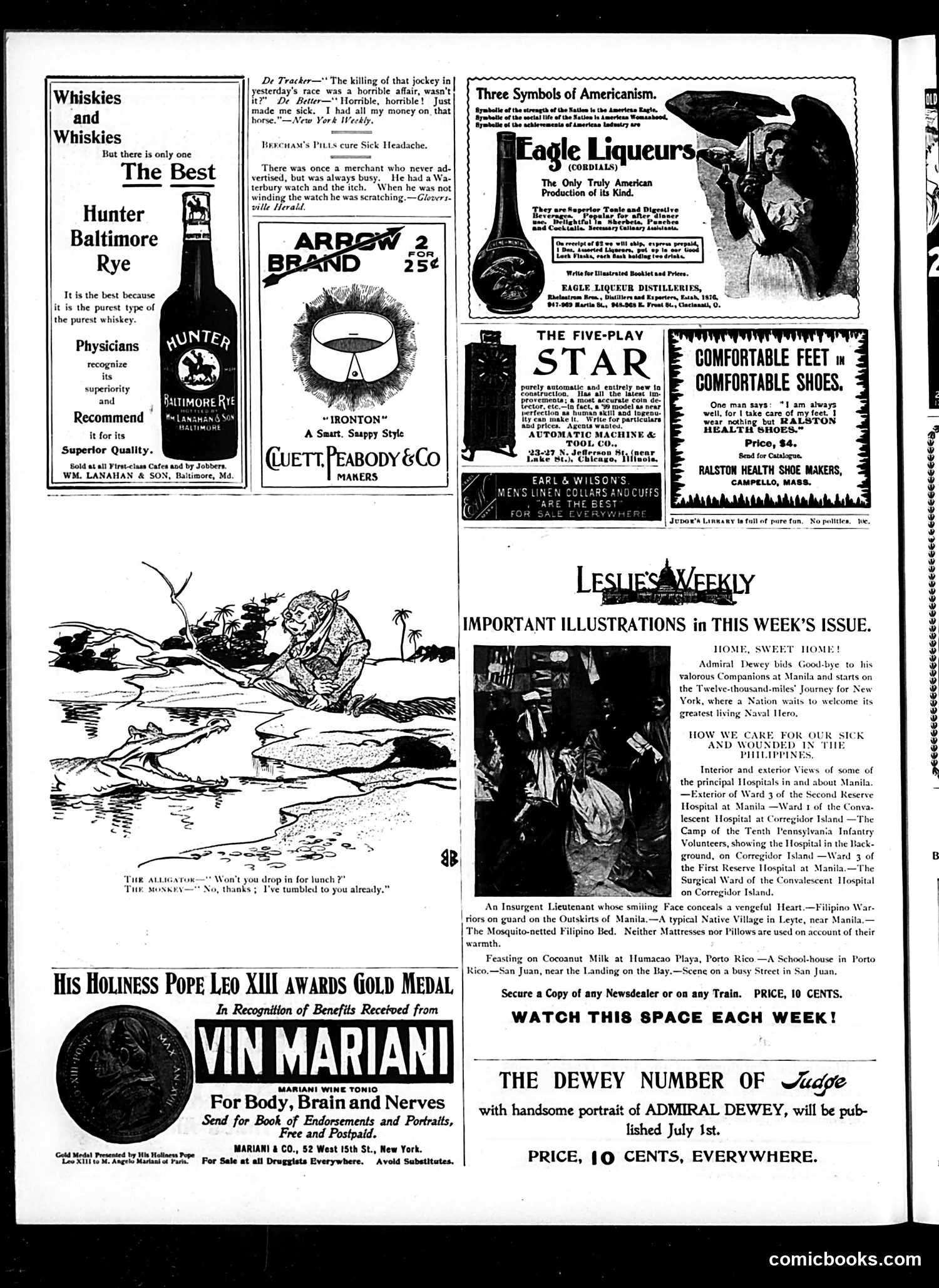
This page is primarily **advertising and promotional content** rather than satirical cartoons requiring historical context. The main satirical element is a small **two-panel animal cartoon** featuring an alligator and monkey discussing lunch—a simple, timeless joke about the alligator's predatory nature. The page's significant editorial content is promotional material celebrating **Admiral Dewey's return from the Philippines**. The bottom section advertises an upcoming "Dewey Number" (July 1st issue) featuring his portrait, capitalizing on his fame as the American naval hero of the Spanish-American War. The illustrations promise interior and exterior views of hospitals in the Philippines, reflecting contemporary American interest in the ongoing military campaign there. References to "Filipino Warriors," "Insurgent Lieutenants," and scenes from Leyte and Manila indicate this is from the period of American military involvement in the Philippines (1898-1902). The rest of the page contains period product advertisements (whiskey, liqueurs, shoes, collars) typical of early 1900s magazines.
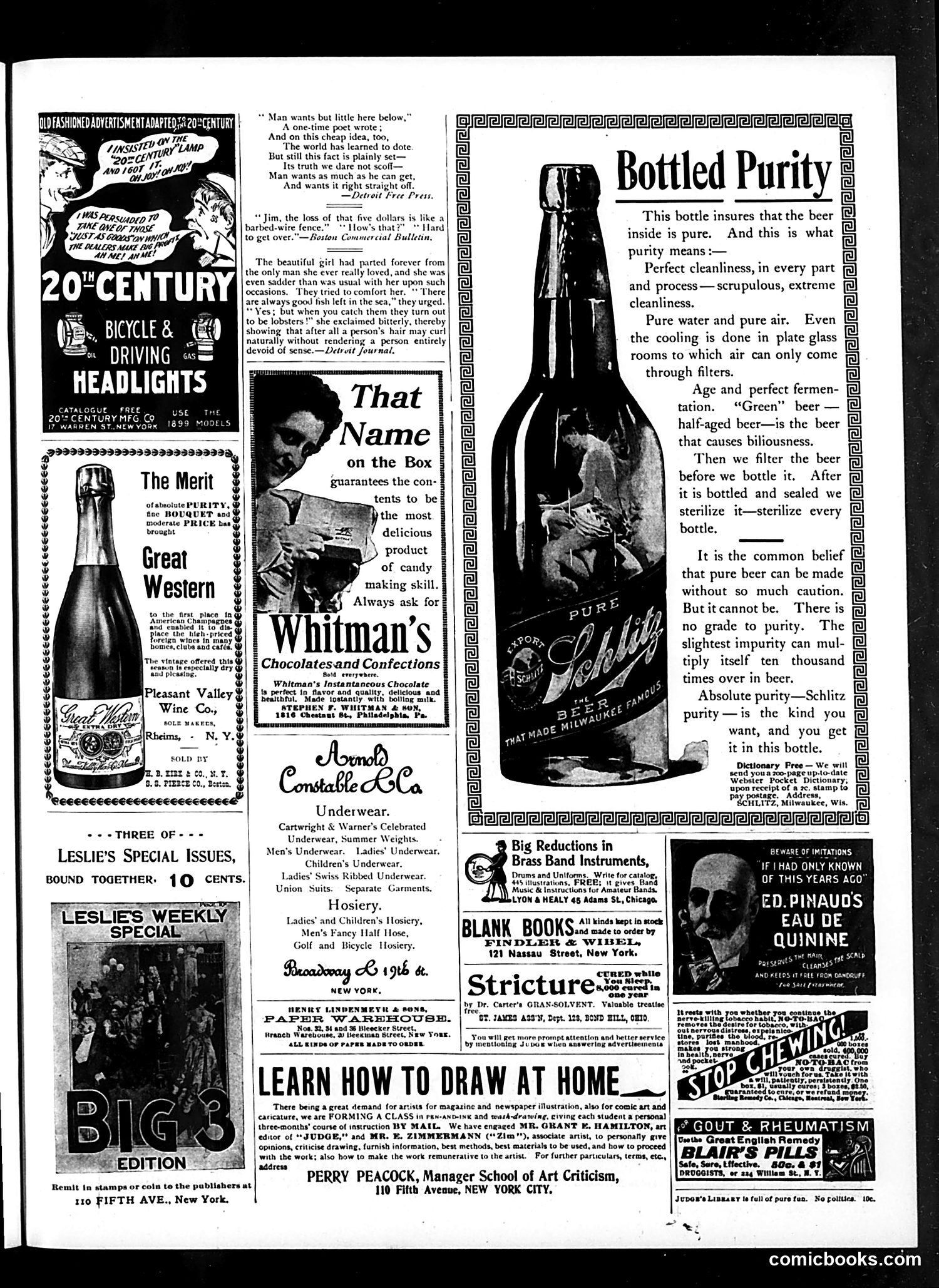
This is primarily an **advertising page** from an early 20th-century issue of Judge magazine, with minimal satirical content. The one notable cartoon appears at top left—an "Old Fashioned Advertisement Adapted to 20th Century" featuring exaggerated figures hawking a bicycle headlight. The joke contrasts old-fashioned peddler enthusiasm with modern advertising claims, satirizing how contemporary ads recycled melodramatic sales tactics from earlier eras. The rest of the page is commercial: beer purity claims (Schlitz), Whitman's chocolates, underwear, hosiery, art instruction courses, and patent medicines (including a dubious "stricture" treatment and E.D. Pinaud's eau de cologne). Several small jokes appear in quotation sections—mild domestic humor about fishing and lost love—but these are filler, not sustained satire. The page reflects early 1900s consumer culture and advertising practices, including unregulated health claims that would later be restricted.
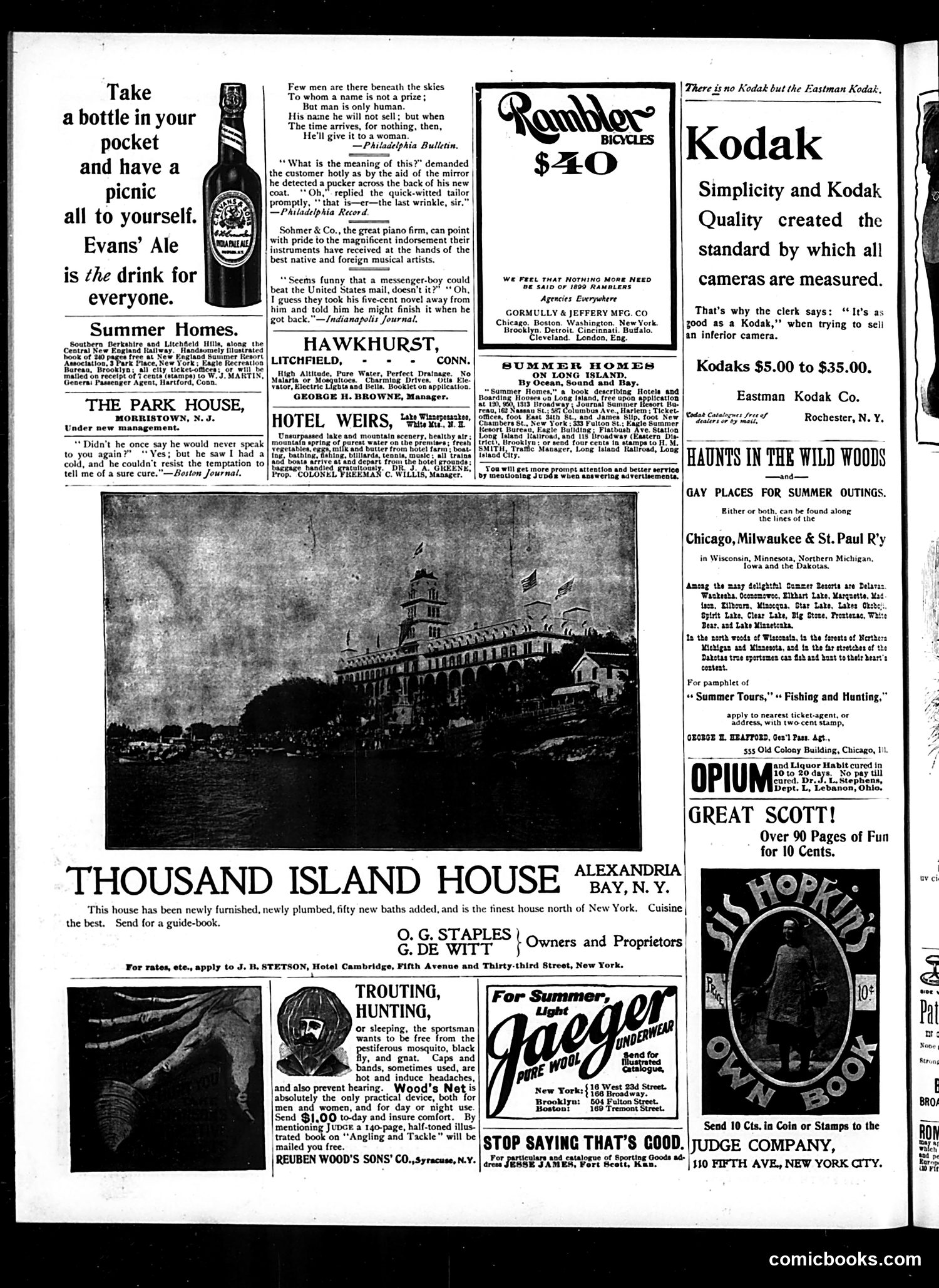
This is primarily an **advertising page** from Judge magazine, with minimal satirical content. The page consists almost entirely of advertisements for summer hotels, sporting goods, bicycles, cameras, and beverages. The few joke items included are brief, generic humor unrelated to politics or current events: - A joke about a man with a cold unable to resist sharing a "cure" - A tailor's pun about a coat's wrinkle being "the last wrinkle" - A quip about a messenger boy being faster than mail because he finished reading his novel The dominant content advertises leisure activities and luxury goods for wealthy Americans—summer homes in New York and Connecticut, the Thousand Island House hotel, Ramblex bicycles ($40), Eastman Kodak cameras, and Evans' Ale. This reflects Judge's audience: affluent readers with disposable income for vacation travel and consumer goods during what appears to be the Gilded Age or early Progressive Era. No political satire, caricatures, or recognizable public figures appear on this page.
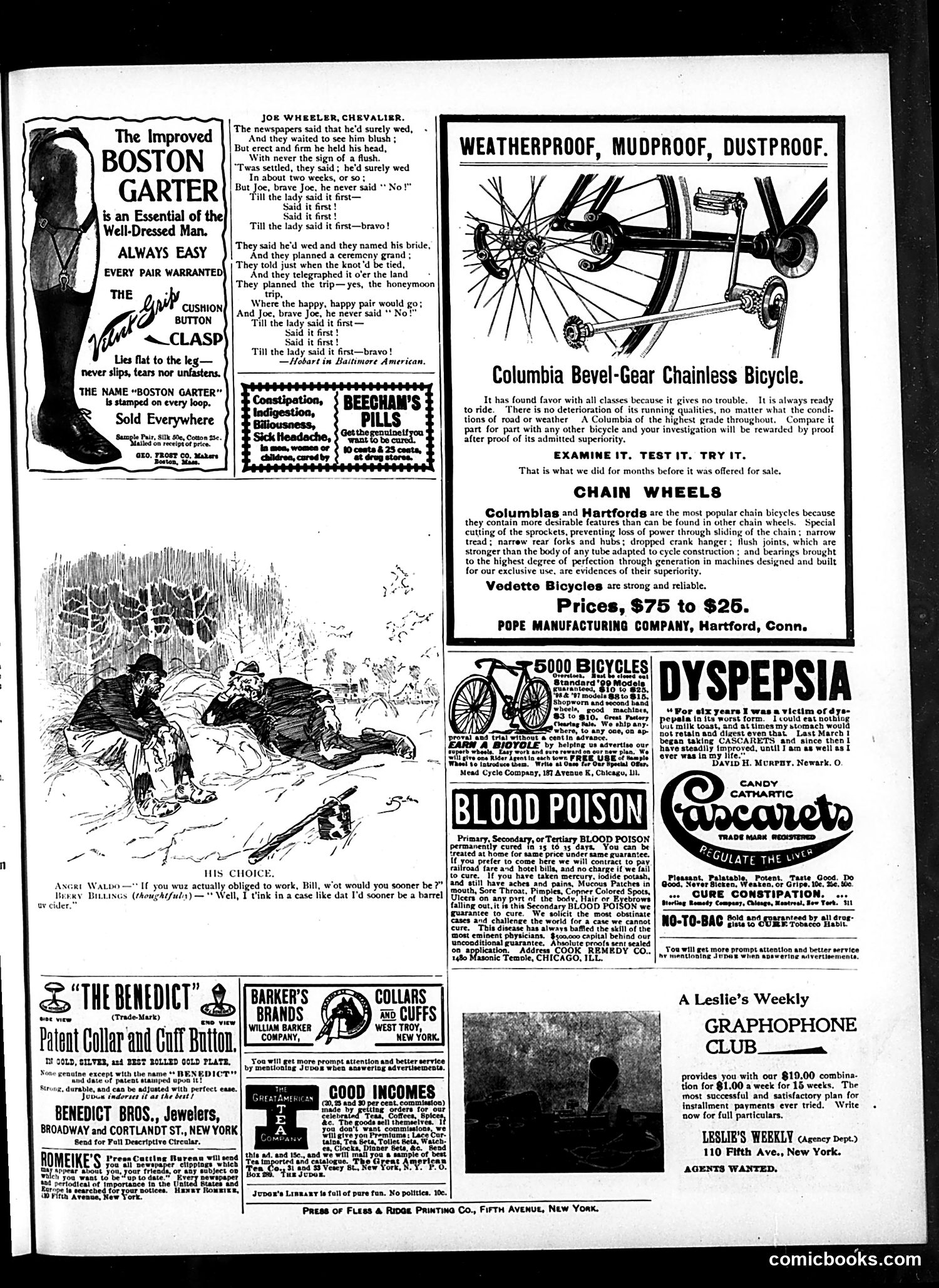
This page is primarily **advertisements** with one cartoon feature. The main satirical content is "His Choice," a brief comic dialogue between two working-class characters—Angel Waldo and Bluey Billings—debating what occupation they'd prefer if forced to work. Billings responds he'd "sooner be a barrel ov cider," a joke playing on the stereotype of Irish laborers and drinking (suggested by the dialect spelling). The humor relies on period prejudices about immigrant workers. The page is otherwise dominated by product advertisements typical of early 1900s magazines: Boston Garters (men's hosiery), bicycles, patent collars, medical "cures" for blood poison and dyspepsia, and a graphophone club membership. These ads reveal contemporary consumer culture and the prevalence of dubious medical remedies marketed without modern regulatory oversight. The poem "Joe Wheeler, Chevalier" above celebrates masculine restraint—a man who doesn't eagerly rush into marriage but lets the woman propose first, framed as brave behavior.
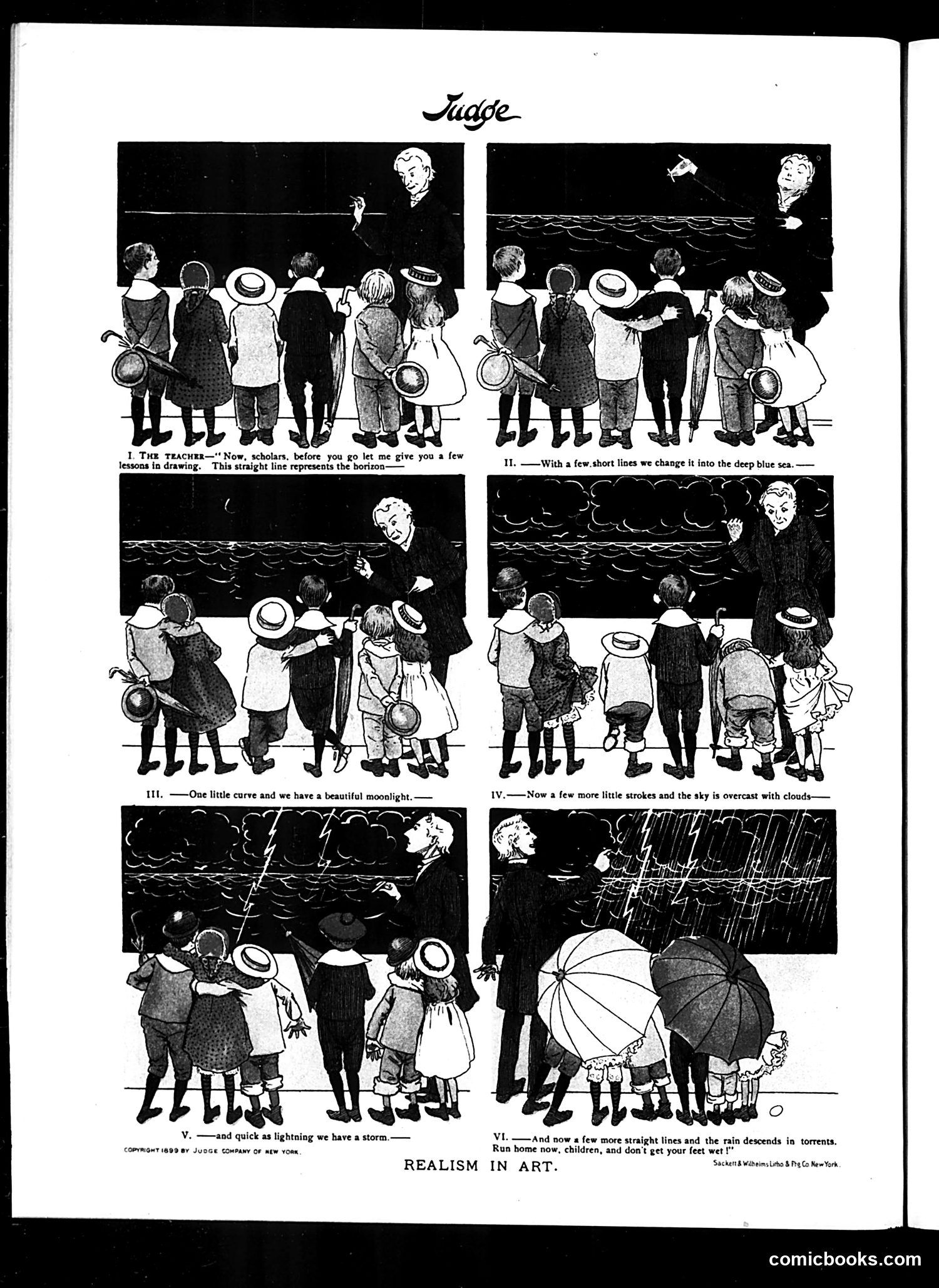
This is a six-panel comic satirizing overly literal artistic instruction. A teacher demonstrates drawing by progressively adding lines to represent natural elements: a horizon line, then water, a curved line becomes moonlight, clouds follow, lightning, and finally rain. The satire mocks the mechanical, reductionist approach to teaching art—reducing complex natural phenomena to simple straight lines. By the final panel, the comic absurdly suggests that a few pen strokes somehow create an actual storm that sends children running home wet. The title "Realism in Art" is ironic: the teacher's method is anything but realistic, yet he presents it as instructional truth. This likely critiques contemporary art instruction or artistic movements that claimed to represent reality through overly simplified formulas. The joke is that such mechanical approaches fail to capture actual visual truth, despite their claims to "realism."