
Judge, 1899-06-10 · page 2 of 16
Judge — June 10, 1899 — page 2: what you’re looking at
What you’re looking at
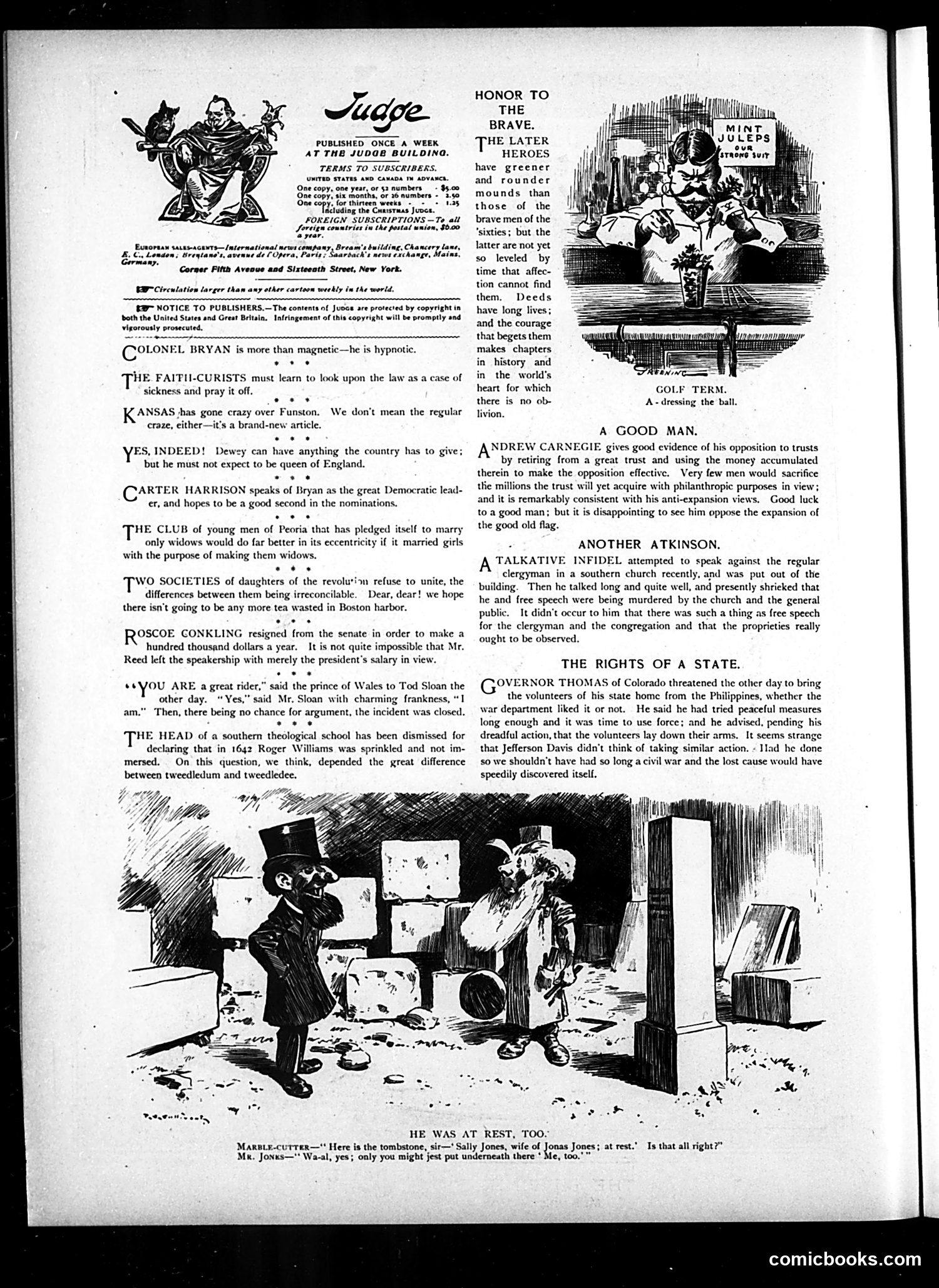
This page contains editorial commentary and two cartoons. The text pieces critique various political figures: Colonel Bryan (likely William Jennings Bryan), Andrew Carnegie's philanthropy, and Governor Thomas of Colorado's handling of state volunteers. The bottom cartoon, titled "He Was at Rest, Too," depicts a domestic scene mocking working-class poverty. A man in a top hat (representing wealth/authority) converses with a woman amid squalor and broken furniture. The caption's dark humor—"at rest" implying death or destitution—satirizes the gap between rich and poor. The marble-cutter reference suggests commentary on labor conditions. The page reflects Judge's conservative editorial stance, critiquing populist politicians and radical labor movements while mocking both wealthy hypocrisy and working-class desperation.
📄 Transcribed text from this page (OCR, searchable)
Machine-transcribed from the original scan — historical spelling and the odd misread are preserved.
muage. PUBLISHED ONCE A WEEK AT THE JUDGE BUILDING. One copy, one year, oF §: One copy, six mont} One copy: for thir fncludi Sorcign countries im the postal Evnorean satss-acenrs—, Bream's building, Chancery lar Ki, C., Londen, Breytane’s, ‘Saarbach's news exchange, Mains, Corner Fifth Aveoue and Sixteeath Street, New York. [ar-Circulation larger than any other cartoon weekly in the world, EB NOTICE TO PUBLISHERS.—The contents of Juoce are protected by copyright in both the United States and Great Britain, Infringement of this copyright will be promptly and vigorously prosecuted, G@OLONeEL BRYAN is more than magnetic—he is hypnotic. Paar Tue FAITI-CURISTS must learn to look upon the law as a case of sickness and pray it off. KANSAS zhas gone crazy over Funston. We don't mean the regular craze, either—it's a brand-new article. Siete ES, INDEED! Dewey can have anything the country has to give; but he must not expect to be queen of England. eee CARTER HARRISON speaks of Bryan as the great Democratic lead- er, and hopes to be a good second in the nominations. THE CLUB of young men of Peoria that has pledged itself to marry only widows would do far better in its eccentricity if it married girls with the purpose of making them widows. eee TWO SOCIETIES of daughters of the revolu'inn refuse to unite, the differences between them being irreconcilable. Dear, dear! we hope there isn’t going to be any more tea wasted in Boston harbor. ROSCOE CONKLING resigned from the senate in order to make a hundred thousand dollars a year. It is not quite impossible that Mr. Reed left the speakership with merely the president's salary in view. sHYOU ARE a great rider,” said the prince of Wales to Tod Sloan the other day. “Yes,” said Mr, Sloan with charming frankness, “I am.” Then, there being no chance for argument, the incident was closed. . cee ‘THE HEAD of a southern theslogical school has been dismissed for declaring that in 1642 Roger Williams was sprinkled and not im- mersed. On this question, we think, depended the great difference between tweedledum and tweedledee. HE WAS MAareir-cu HONOR TO THE BRAVE. THE LATER HEROES have greener and rounder mounds than those of the brave men of the ‘sixties; but the latter are not yet so leveled by time that affec- tion cannot find them. Deeds have long lives; and the courage that begets them makes chapters in history and the world’s heart for which there is no ob- livion. GOLF TERM. A- dressing the ball. A GOOD MAN. ANDREW CARNEGIE gives good evidence of his opposition to trusts by retiring from a great trust and using the money accumulated therein to make the opposition effective. Very few men would sacrifice thie millions the trust will yet acquire with philanthropic purposes in view ; and it is remarkably consistent with his anti-expansion views. Good luck toa good man; but it is disappointing to sec him oppose the expansion of the good old flag. a ANOTHER ATKINSON. TALKATIVE INFIDEL attempted to speak against the regular clergyman in a southern church recently, and was put out of the building. Then he talked long and quite well, and presently shrieked that he and free speech were being murdered by the church and the general public. It didn’t occur to him that there was such a thing as free speech for the clergyman and the congregation and that the proprieties really ought to be observed. THE RIGHTS OF A STATE. OVERNOR THOMAS of Colorado threatened the other day to bring the volunteers of his state home from the Philippines, whether the war department liked it or not. He said he had tried peaceful measures long enough and it was time to use force; and he advised, pending his dreadful action, that the volunteers lay down their arms. It seems strange that Jefferson Davis didn’t think of taking similar action. - Iad he done so we shouldn't have had so long a civil war and the lost cause would have speedily discovered itself. ss AT REST, TOO. cx—‘‘ Here is the tombstone, sir—' Sally Jones, wife of Jonas Jones; at rest.’ Is that all right?" Mk. Jonxs—'"* Wa-al, yes; only you might jest put underneath there * se je, too.’ comicbooks.com