
A complete issue · 16 pages · 1898
Judge — December 10, 1898
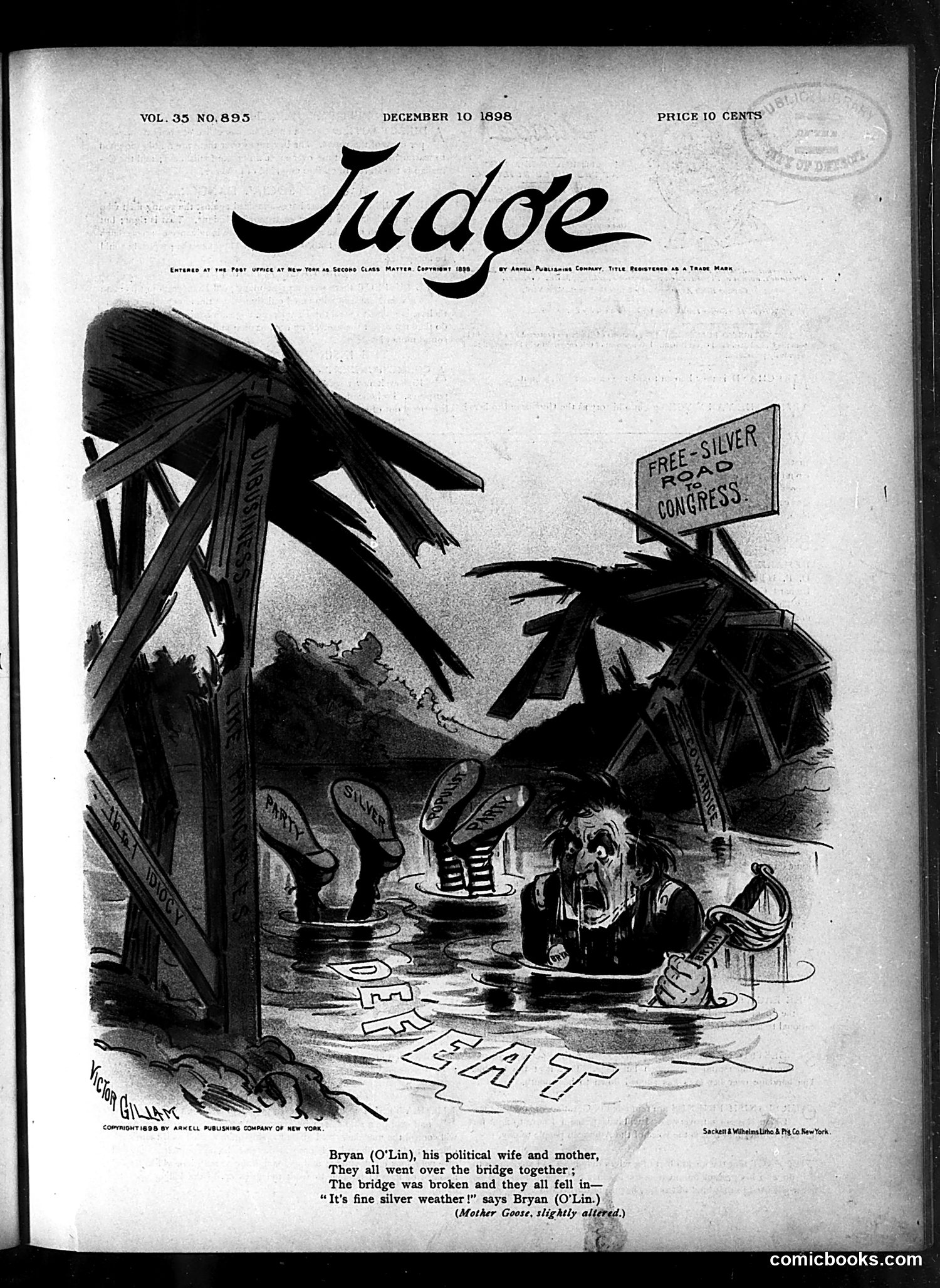
This cartoon satirizes William Jennings Bryan and the Free Silver political movement. The collapsing bridge labeled "FREE SILVER ROAD TO CONGRESS" represents the failure of Bryan's 1896 presidential campaign and his silver-backed currency platform. The figure depicted is Bryan with his "political wife and mother"—likely referencing his close relationship with his mother and his wife's political influence. They're falling through the broken bridge into water marked "DEFEAT." The verse parodies "Mother Goose" to mock Bryan's loss and the collapse of the Free Silver movement as a viable political platform. The grotesque artistic style emphasizes the cartoon's contemptuous tone toward Bryan's political ambitions.
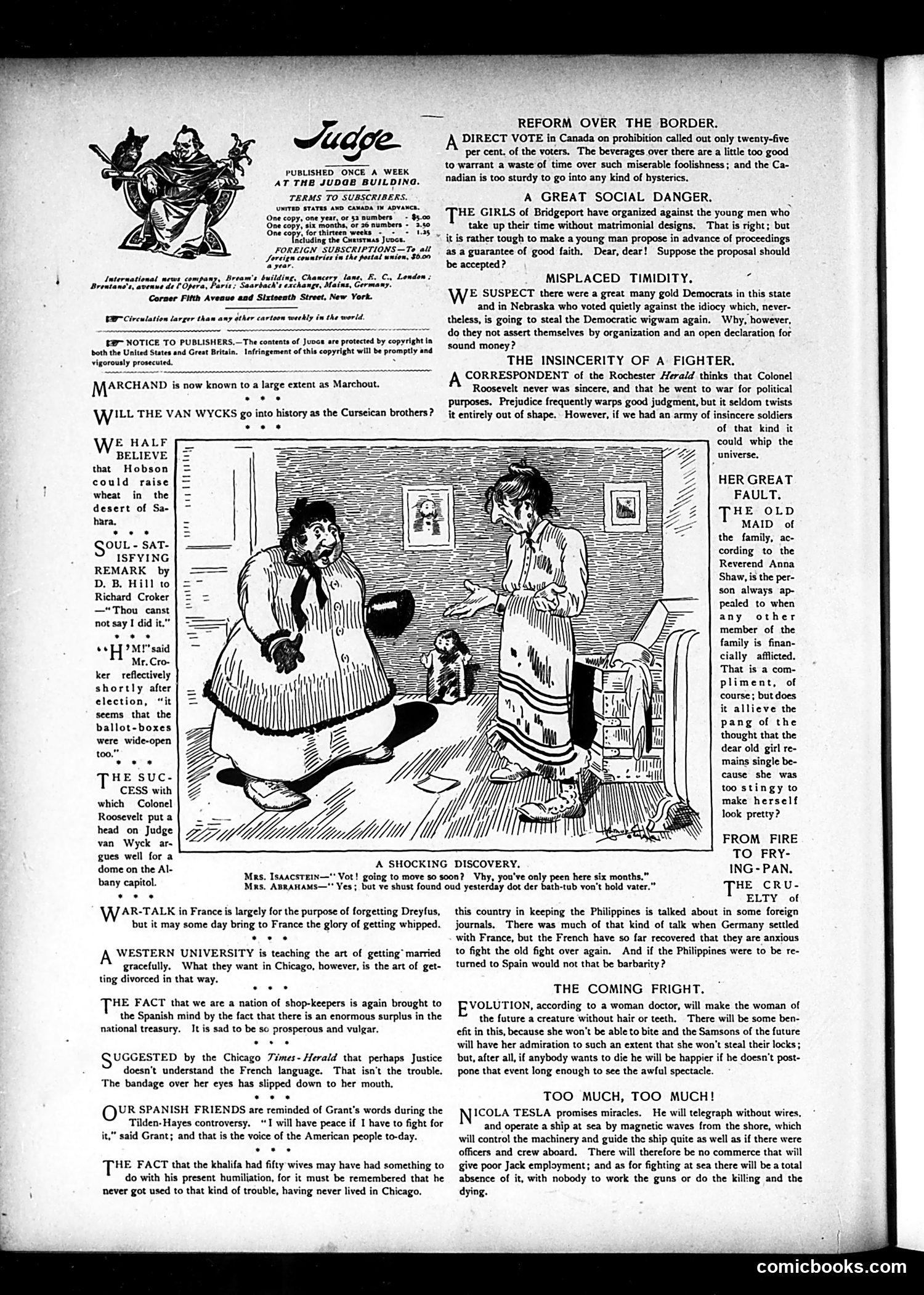
The main cartoon depicts "A Shocking Discovery," showing a woman (Mrs. Isaacstein) telling another woman she's moving soon after only six months residence. The accompanying text suggests this satirizes rapid tenant turnover or housing instability, possibly commenting on urban immigration patterns or housing conditions of the era. The surrounding text contains various brief satirical items, including references to political figures like Colonel Roosevelt and critiques of Democratic politics. One item mocks a Western University course on "getting married gracefully," while another jokes about Nikola Tesla's wireless technology promises. The overall page exemplifies Judge's style: sharp social and political commentary on contemporary issues through brief jokes, sketches, and observations about American life, politics, and technology circa early 1900s.
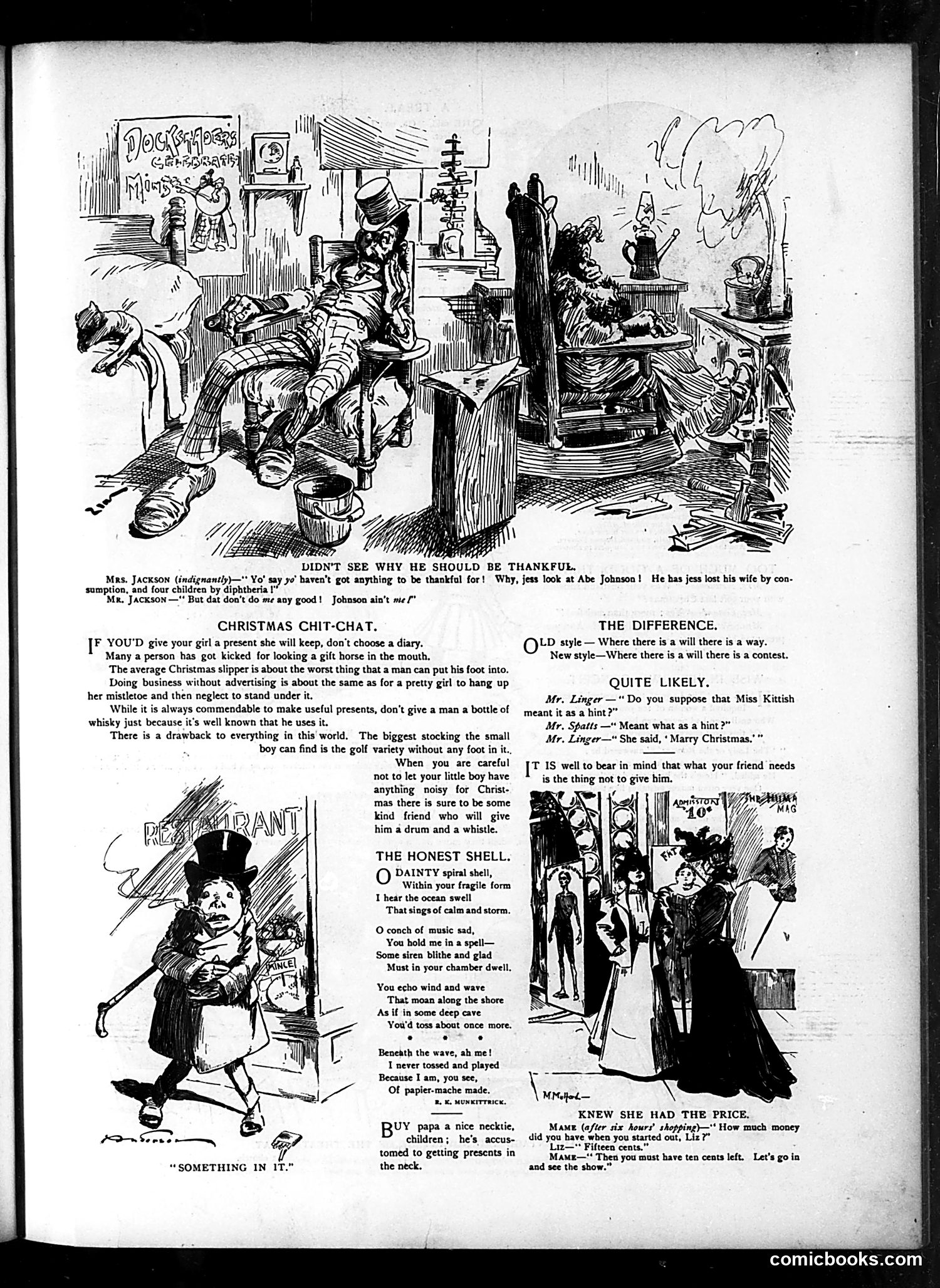
This page contains Christmas-themed humor and social commentary typical of early 20th-century American satire. **"Didn't See Why He Should Be Thankful"** depicts a working-class man (Mr. Jackson) complaining about lost income and family hardship, contrasting with wealthier figures' expectations for gratitude. The satire critiques class disparities and the disconnect between rich and poor during the holiday season. **"Something in It"** shows a figure at a restaurant, likely satirizing consumer culture and materialism around Christmas gift-giving. The remaining pieces—"Christmas Chit-Chat," "The Difference," "Quite Likely," and "The Honest Shell"—offer brief jokes about gift-giving etiquette, romantic miscommunication, and holiday spending habits. The overall theme mocks commercial holiday culture and social pretense.
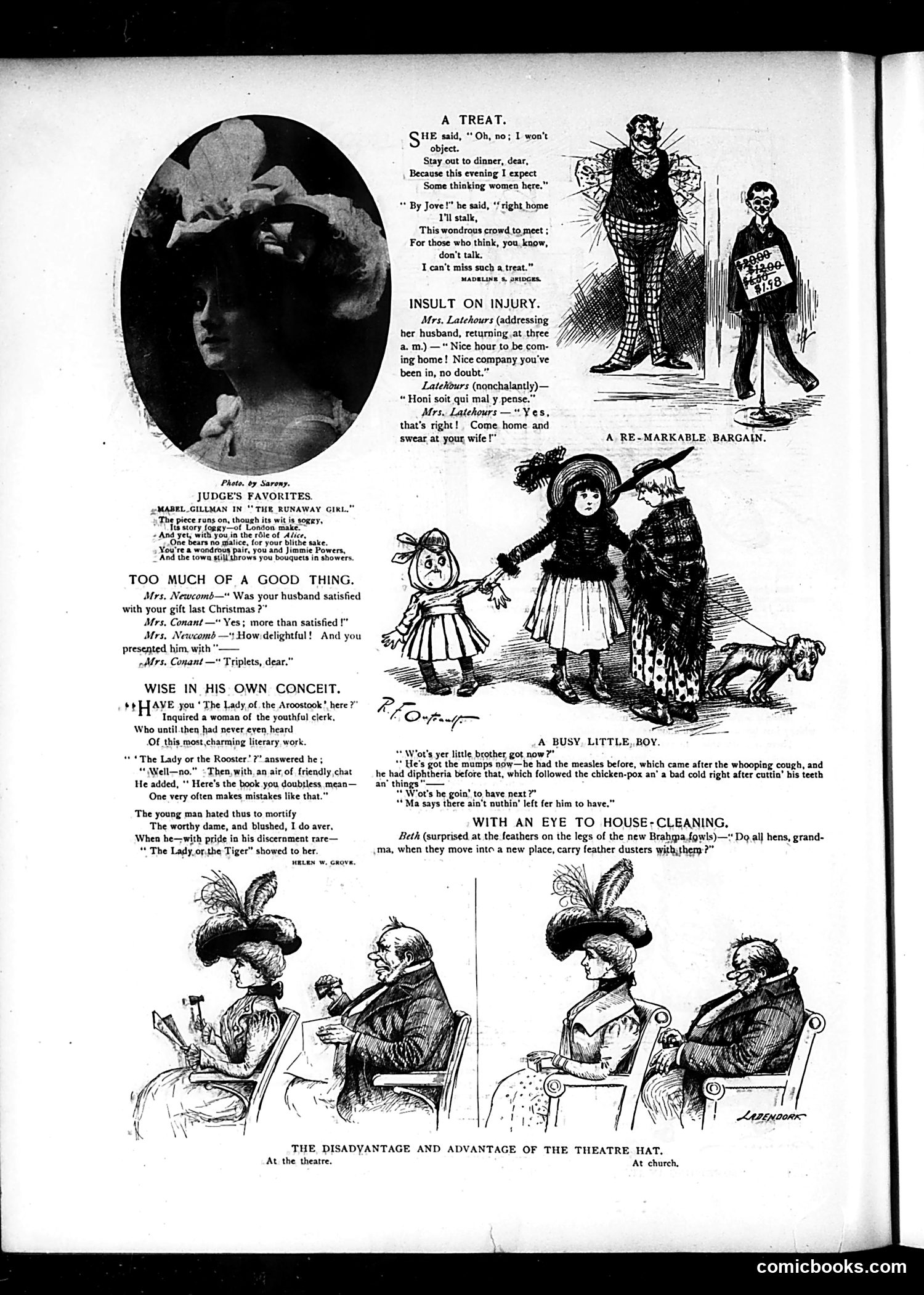
This page contains several discrete humor pieces typical of early 20th-century Judge magazine: **"A Treat"** satirizes women's intellectual pretensions—a husband objects to his wife hosting a dinner for "thinking women," suggesting such gatherings were seen as pretentious or tedious. **"Judge's Favorites"** highlights actress Mabel Gillman in "The Runaway Girl." **Other vignettes** mock domestic situations: husbands disappointed with Christmas gifts, a woman asking about "The Lady of the Armostat," and exchanges about theater etiquette. **"The Disadvantage and Advantage of the Theatre Hat"** contrasts women wearing elaborate feathered hats at theaters (blocking views) versus at church (where they're appropriate). This reflects genuine period complaints about theater fashion obstruction. The humor relies on gender stereotypes and domestic situations recognizable to contemporary readers, rather than specific political references.
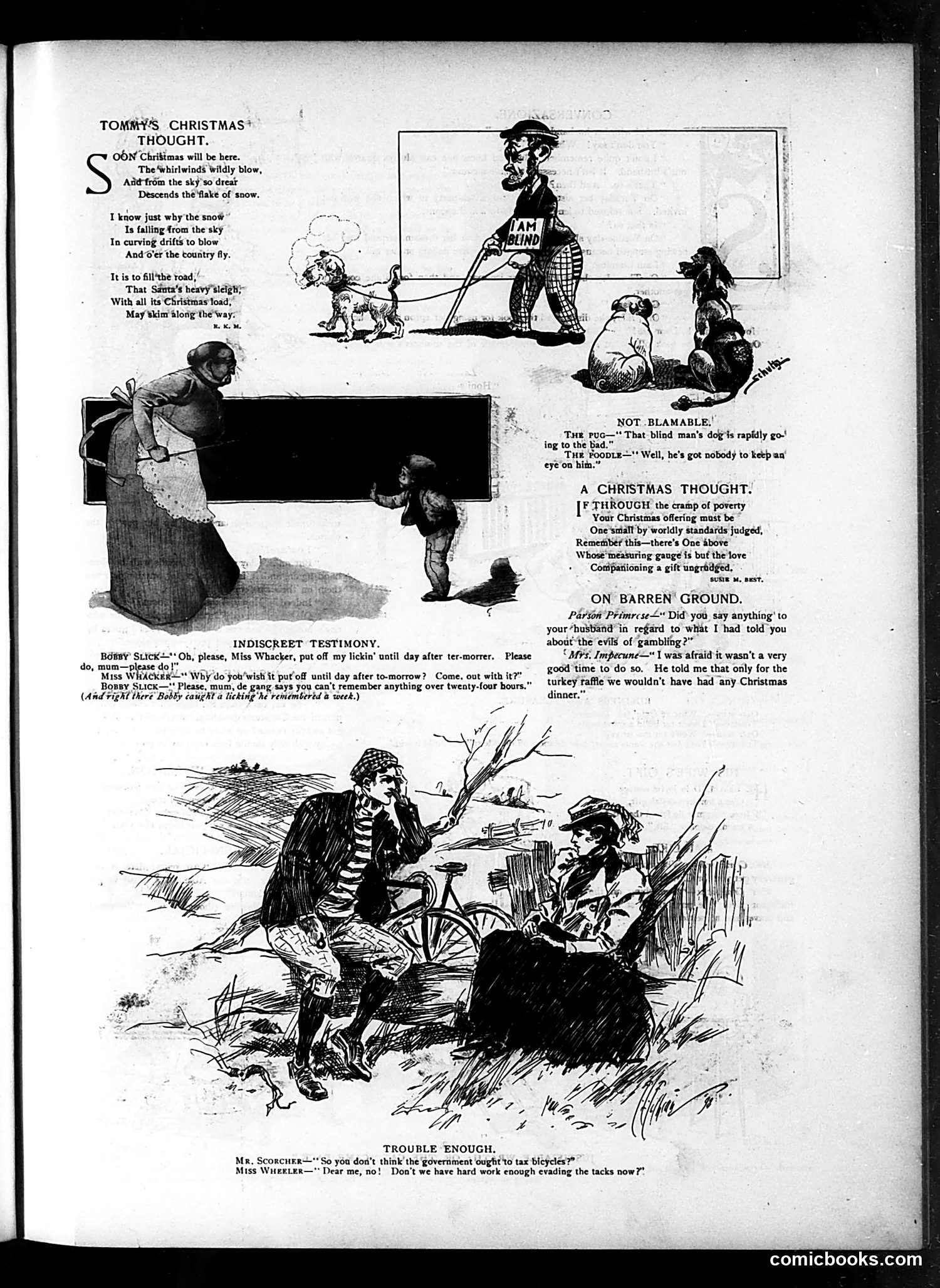
This page contains multiple satirical pieces reflecting early 20th-century American social concerns: **"Tommy's Christmas Thought"** presents a child's innocent poem about snow, likely contrasting childhood simplicity with adult hardship. **"Not Blamable"** mocks indifference toward vulnerable people—a blind man and his dog struggling while others ignore them, suggesting society shouldn't blame the poor for their circumstances. **"A Christmas Thought"** offers moral commentary: true Christmas charity isn't measured by monetary value but by sincere love, regardless of poverty. **"Indiscreet Testimony"** satirizes a boy caught between his mother's punishment and gang peer pressure—social commentary on child welfare and urban gang influence. **"On Barren Ground"** depicts a clergyman's failed attempt to convince a poor family to abandon gambling, showing the limits of moral persuasion against economic desperation. **"Trouble Enough"** jokes about bicycle taxation, with characters suggesting people already struggle avoiding other taxes—commentary on government overreach and citizen frustration with taxation. The overall theme addresses poverty, morality, social responsibility, and government during economically uncertain times.
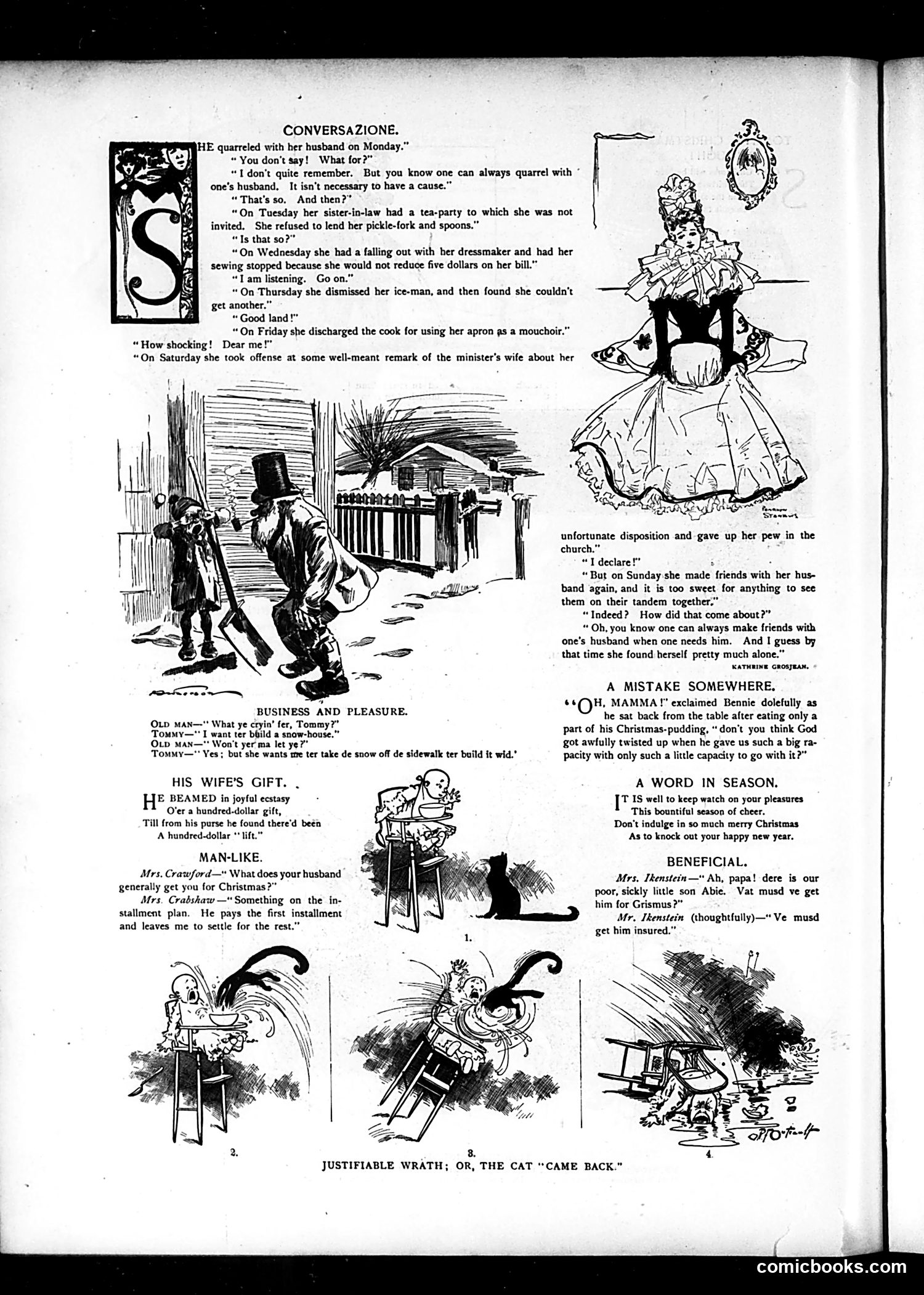
This page contains several satirical pieces targeting domestic life and social hypocrisy of the late 19th/early 20th century. **"Conversazione"** mocks quarrelsome wives, cataloging a woman's daily conflicts (with husband, sister-in-law, dressmaker, ice-man, cook, minister's wife) over trivial matters. The joke: she finds reconciliation only when needing her husband's help—satirizing both female pettiness and marital self-interest. **"Business and Pleasure"** shows a child wanting to build a snow-house but needing to clear the sidewalk first—depicting parental hypocrisy masking chores as play. **"His Wife's Gift"** jokes that a wife's $100 present ultimately came from her husband's wallet anyway. **"Man-Like"** presents husbands as deadbeats: paying only the first installment on Christmas gifts, leaving wives responsible. **"Justifiable Wrath"** (the comic strip sequence) appears to show a cat's revenge—likely referencing the 1897 song "The Cat Came Back," depicting consequences for mistreatment. Minor pieces mock Jewish stereotypes and children's greed. The overall theme: domestic life is riddled with petty conflicts, female irresponsibility, and financial trickery.
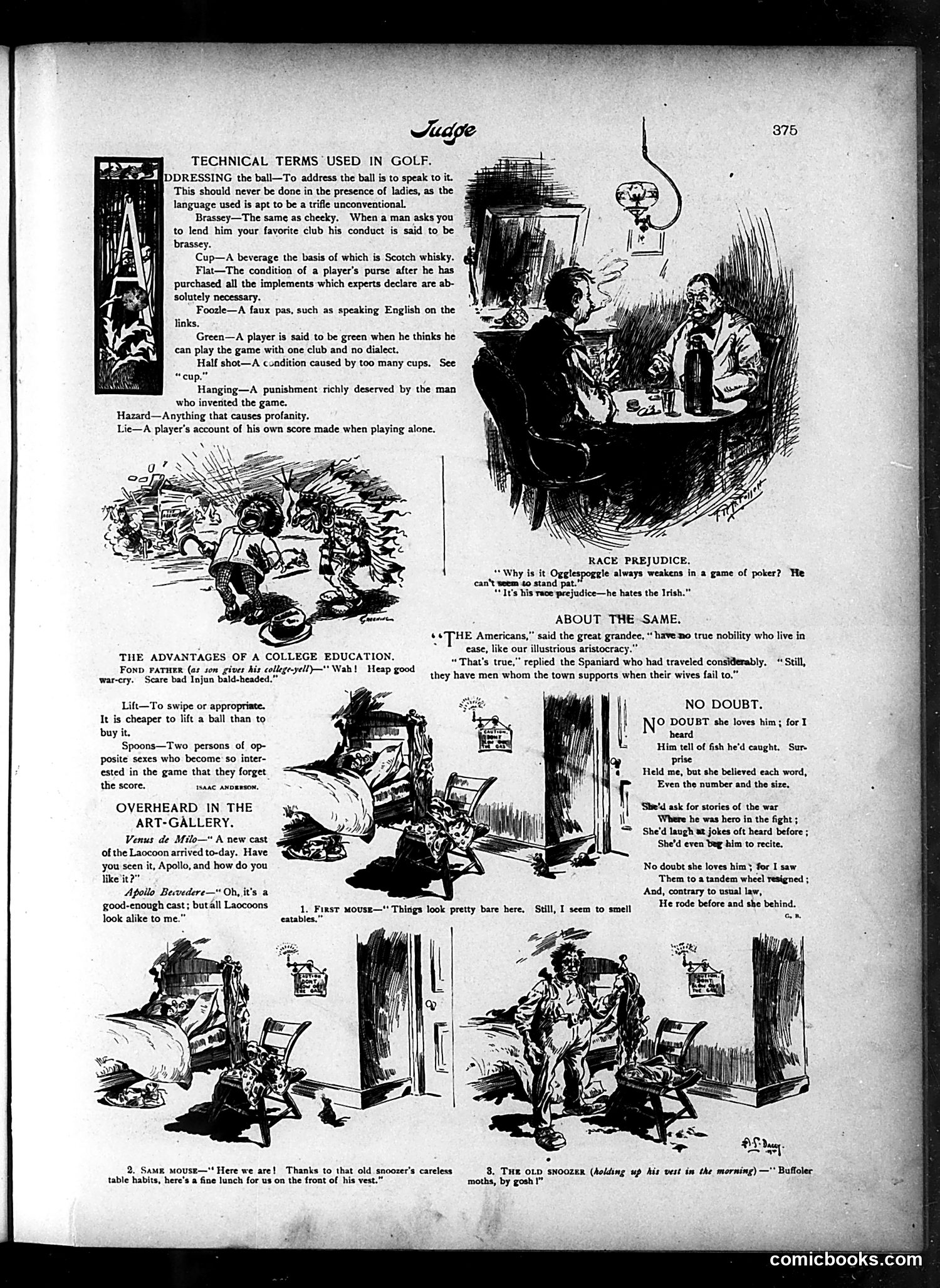
This page contains multiple satirical pieces typical of early 20th-century American humor: **Golf Terminology**: A mock glossary defining golf terms through social commentary. "Cup" means whisky; "Flat" refers to an empty wallet after buying golf equipment; "Lie" mocks players' dishonest scoring when alone. The satire targets golf's pretensions and the drinking culture surrounding it. **College Education**: Mocks Native American stereotypes—a father praises his son's college yell as useful for "scaring bad Injun[s]," reflecting the period's casual racism. **Race Prejudice/About the Same**: Two brief jokes contrasting American and Spanish attitudes toward class and nobility, suggesting both societies have similar hypocrisies. **Art Gallery**: Pedantic museum-goers discuss classical sculptures with indifference. **Mouse Comics and Poetry**: Domestic humor about mice scavenging and a sentimental poem about a woman's devotion to her (apparently boastful or mediocre) boyfriend. The page reflects early 1900s satirical magazine conventions: social observation, ethnic stereotyping, and gentle mockery of contemporary middle-class concerns.
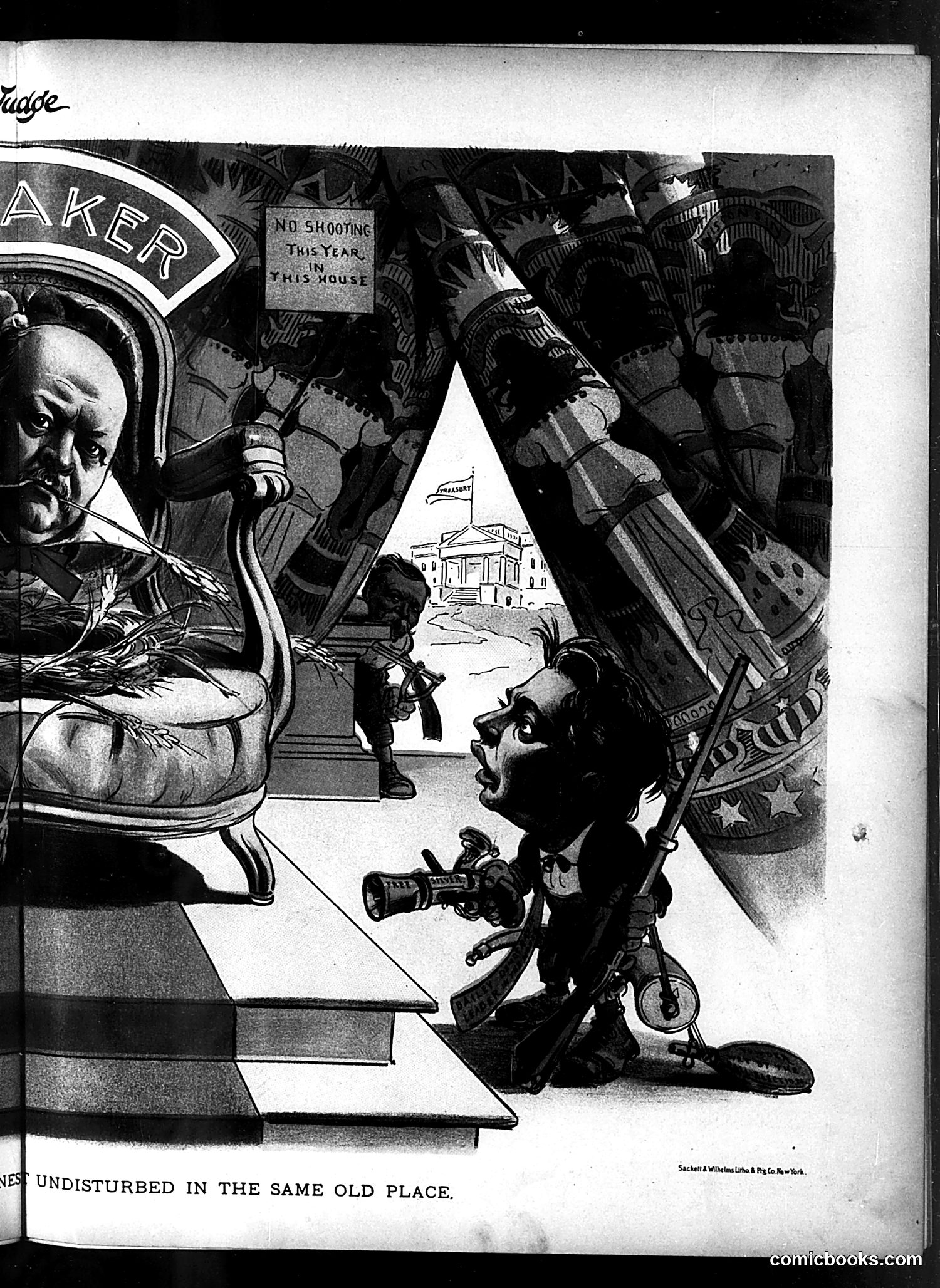
This political cartoon depicts a caricatured figure (likely representing a political opponent or satirical target) confidently standing before the White House, holding what appears to be a megaphone or trumpet. He's surrounded by menacing military or police figures with rifles in a dramatic architectural setting. The sign reading "NO SHOOTING THIS YEAR AT THIS HOUSE" suggests the cartoon comments on political violence, intimidation, or threats. The title "Undisturbed in the Same Old Place" implies the figure remains in power despite pressure or danger. Without the publication date visible, the specific political context—whether referencing an election, incumbent protection, or contemporary threats—remains unclear. The satirical point appears critical of either the figure's persistence in office or his immunity from consequences others might face.
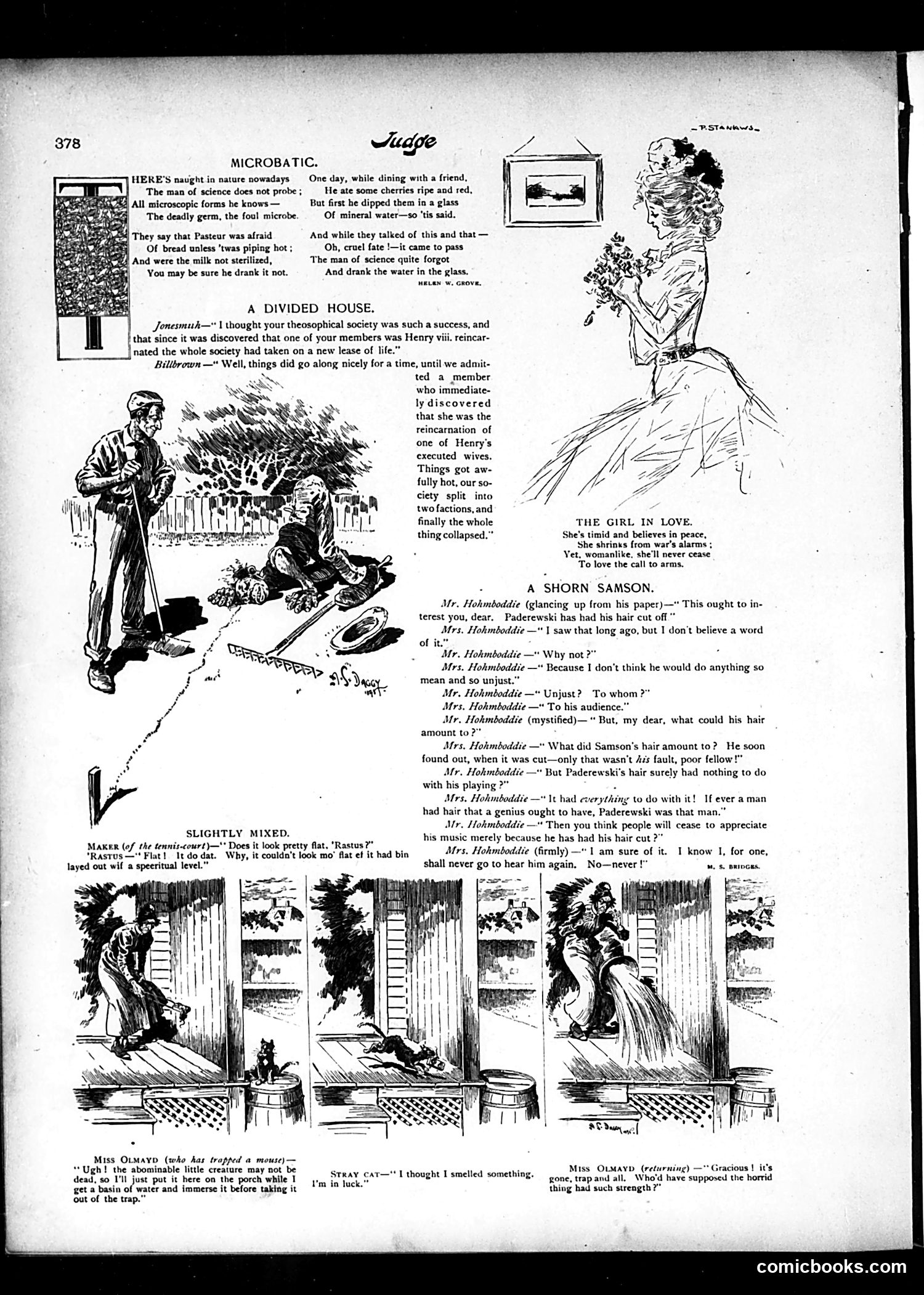
This page contains several unrelated satirical pieces typical of early-20th-century humor magazines: **"Microbatic"** mocks scientists' obsession with germ theory. The irony: a man so paranoid about microbes that he sterilizes milk and avoids unheated bread—yet carelessly drinks contaminated water. It satirizes the period's growing awareness of bacterial contamination as somewhat overwrought. **"A Divided House"** jokes about Theosophy, a popular mystical movement claiming reincarnation. The society splits when members discover conflicting past lives (one claims to be Henry VIII; another claims to be his executed wife). It ridicules the movement's logical absurdities. **"A Shorn Samson"** references pianist Ignacy Jan Paderewski, famous for his long hair. Mrs. Hohmboddie compares his hair to Samson's—implying his musical genius depends on it—making her husband seem obtuse for not grasping this "obvious" connection. It gently mocks both celebrity worship and spousal logic. The cartoons use domestic situations and recognizable figures to satirize period preoccupations: scientific advancement, spiritualist fads, and celebrity culture.
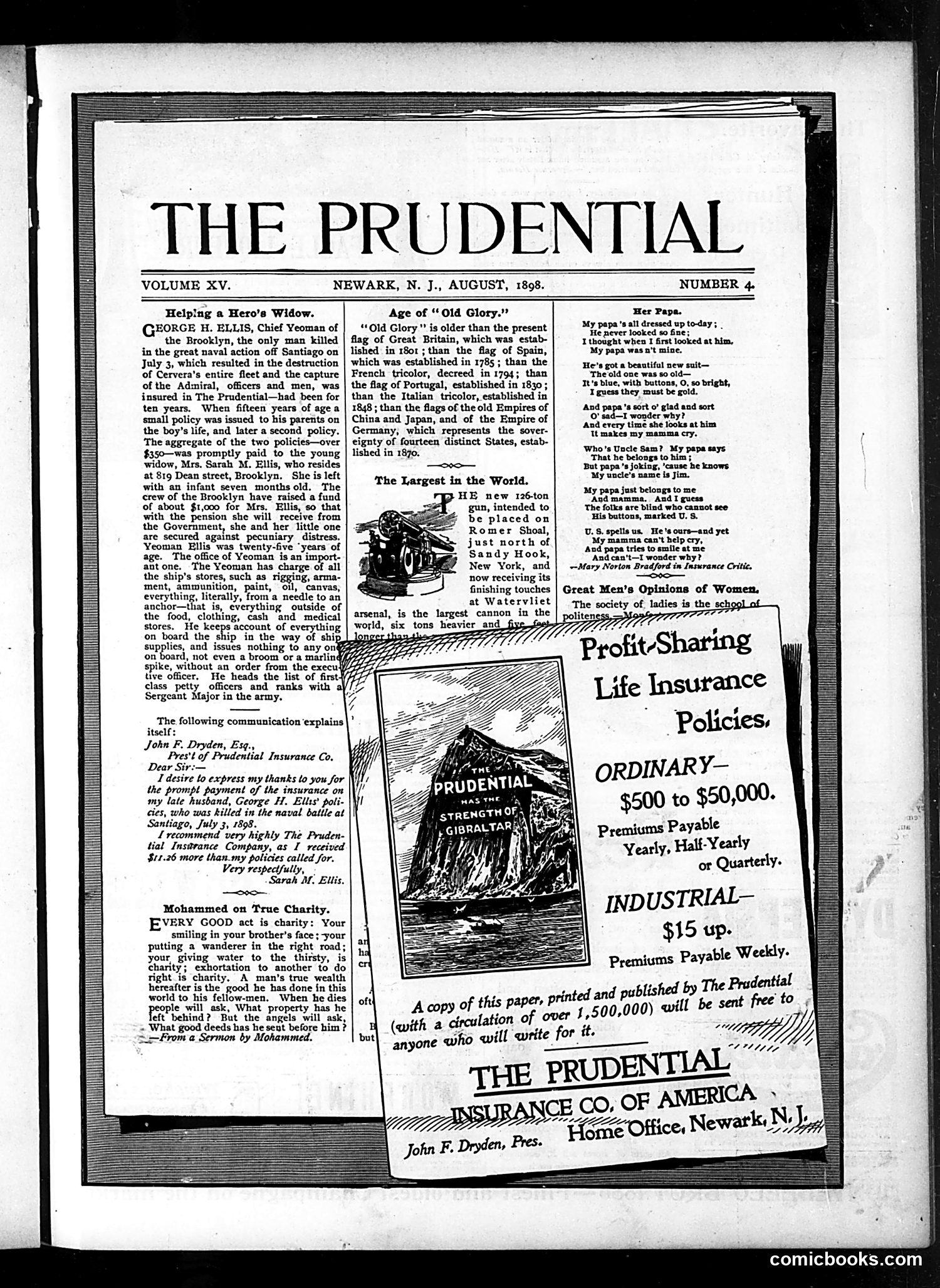
This is primarily a **house advertising page** for The Prudential Insurance Company, using news and human interest content to promote its products. The main content celebrates **George H. Ellis, a U.S. Navy Yeoman killed in the Spanish-American War** (the Battle of Santiago, July 3, 1898). The article promotes The Prudential by detailing how the company promptly paid Ellis's widow her $350 insurance benefit, securing her and their infant child against hardship. A testimonial letter from Mrs. Ellis herself endorses the company's efficiency and generosity. **Secondary content** includes trivia about the American flag's age compared to other nations' flags, and a piece on a massive new 126-ton naval gun—all reinforcing patriotic themes around America's recent military victory. The **sidebar advertisements** offer life insurance policies for ordinary ($500-$50,000) and industrial ($15+) coverage with flexible payment terms. For modern readers: this represents early American **corporate public relations**—using wartime heroism and family welfare narratives to build brand trust and sell insurance.
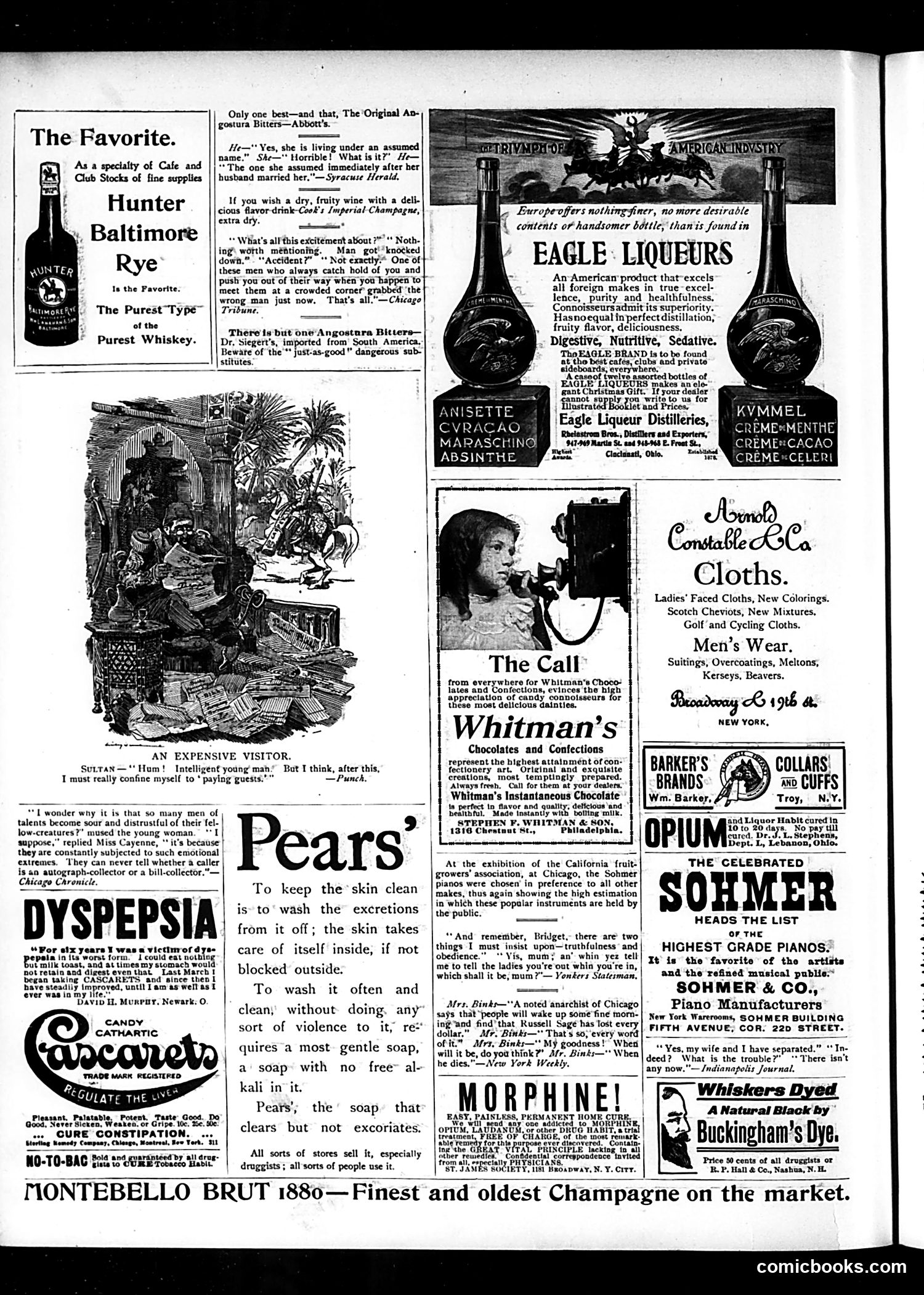
This page is primarily advertising with one small cartoon titled "An Expensive Visitor." The joke depicts a host (Sultan) speaking to a servant about an intelligent young male visitor, concluding he must thereafter "confine myself to paying guests." The humor relies on a class-based assumption: an intelligent, cultured visitor is assumed to be a *bill collector* rather than a social guest—implying that such refined visitors typically appear to demand payment rather than to socialize pleasantly. It's satirizing both the anxiety of debtors and the stereotype of bill collectors as unwelcome callers. The page otherwise contains numerous period advertisements for whiskey, champagne, liqueurs, soap, chocolate, clothing, and patent medicines—typical of Judge magazine's revenue model circa early 1900s.
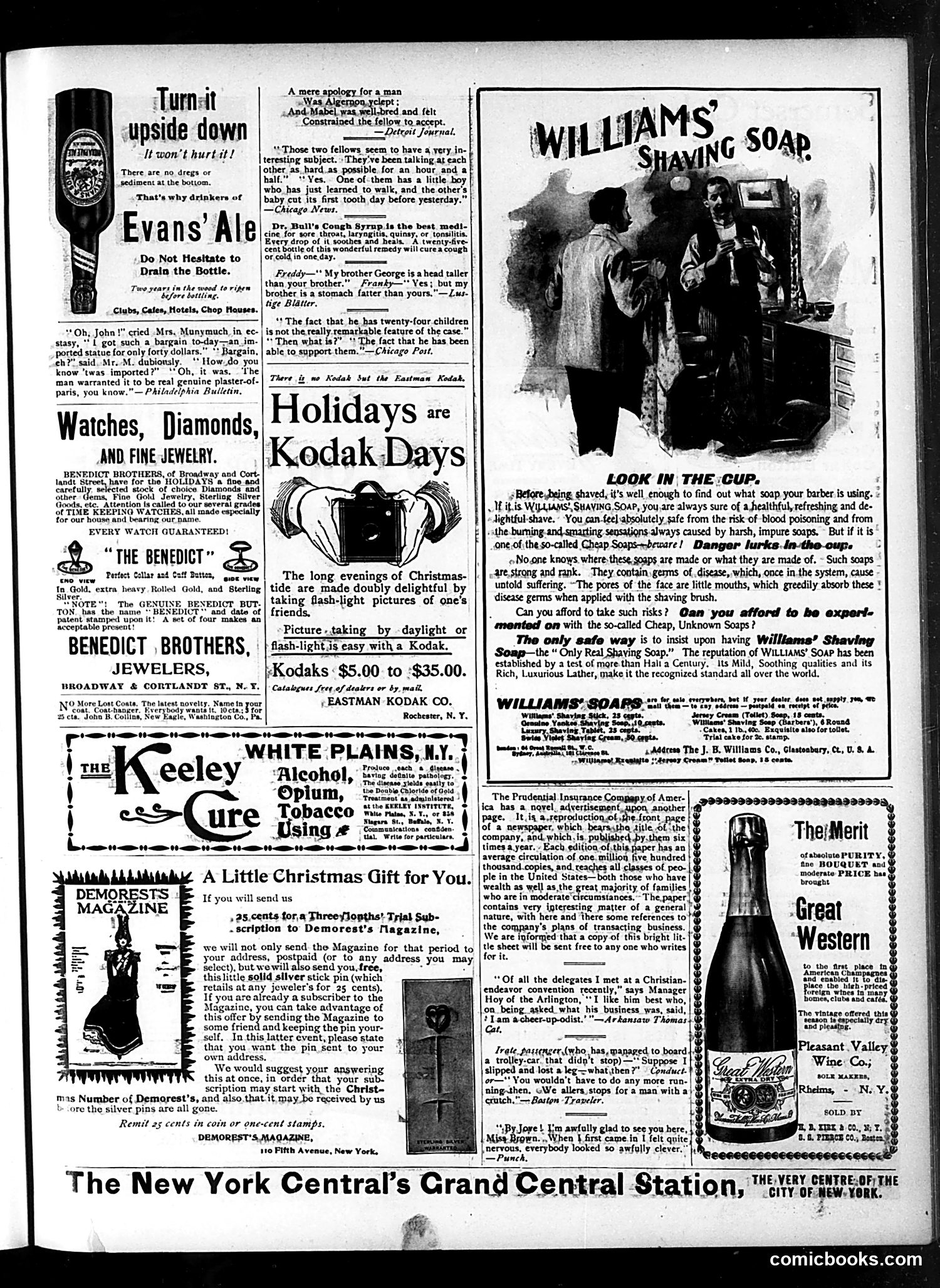
This page is primarily **advertisements and light humor** rather than political satire. The text fragments show **genteel comic anecdotes** typical of Judge magazine—short joke pieces about domestic life. One depicts neighbors competing to discuss their children's milestones (walking, teething), another jokes about a woman buying an "imported" plaster statue, and a third plays on the humor of supporting 24 children. The dominant content is **advertising**: prominently featured are ads for Evans' Ale, Benedict Brothers jewelers, Keeley Cure for alcoholism, Eastman Kodak cameras, and especially **Williams' Shaving Soap**, which occupies a large section warning against cheap, dangerous soaps and promoting its safety and quality. The soap ad uses period-typical health anxiety—disease germs, blood poisoning—to sell the product as safe and "recognized standard all over the world." There is **no identifiable political cartoon** on this visible page; it functions as a typical magazine spread mixing light humor with commercial content.
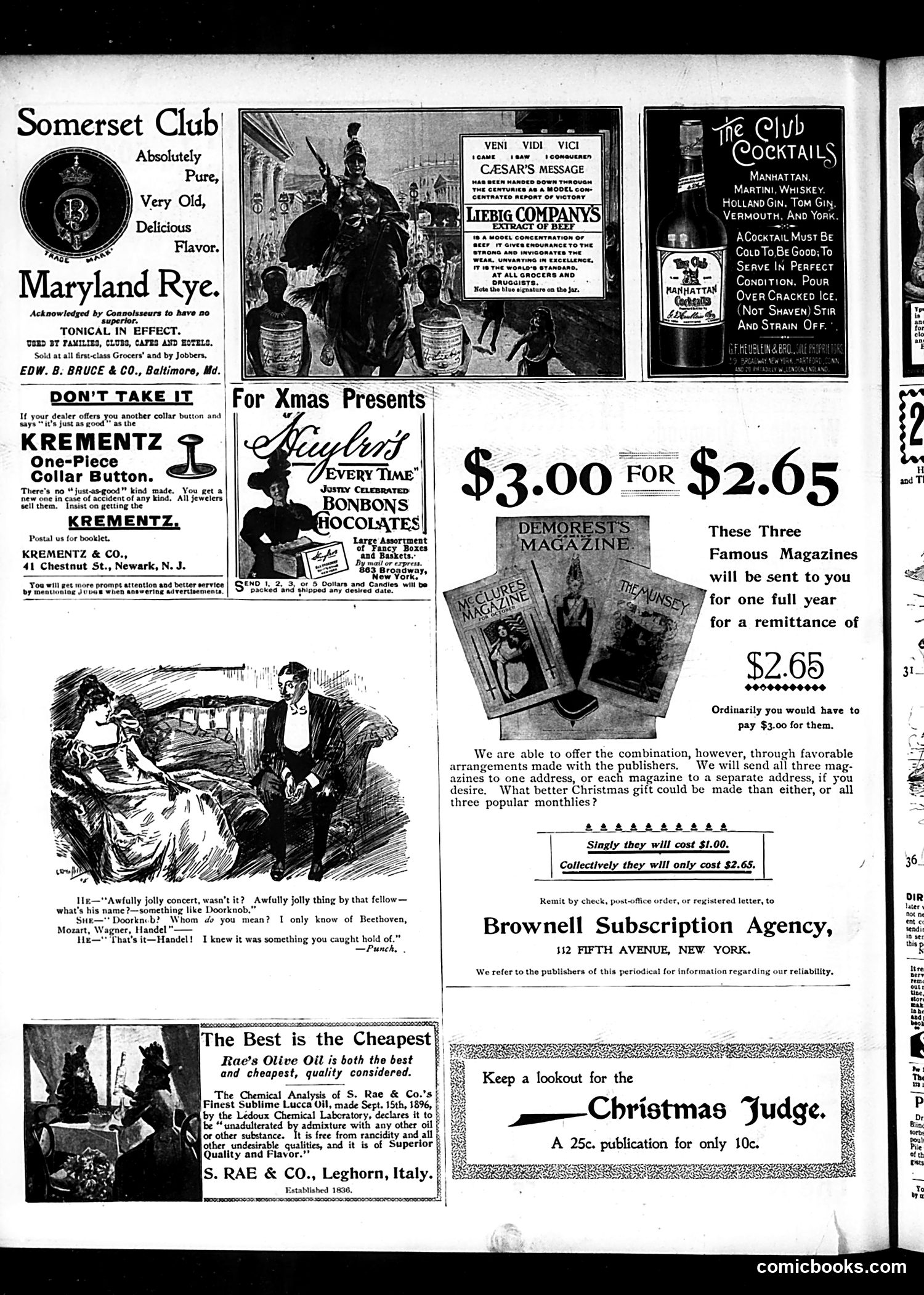
This page is primarily **advertising and promotional content** rather than political satire. It features: **Main Elements:** - Liquor advertisements (Somerset Club Maryland Rye, cocktail recipes) - A small cartoon/joke about a concert-goer confusing "Beethoven" with "Doorknob"—a pun playing on similar-sounding names, with no political significance - Collar button and olive oil product ads - A magazine subscription offer bundling three publications (Demorests, McClure's, and The Argosy) for $2.65 instead of $3.00 **Historical Context:** The page reflects early 1900s consumer culture, with heavy emphasis on luxury goods marketed to middle/upper-class readers. The "Christmas Judge" advertisement at bottom references Judge magazine's own holiday publication. **The Satire:** Minimal here. The concert joke is simple wordplay without social commentary. This page represents Judge functioning primarily as a **vehicle for premium product advertising** rather than political cartooning—reflecting how magazines sustained themselves commercially in this era.
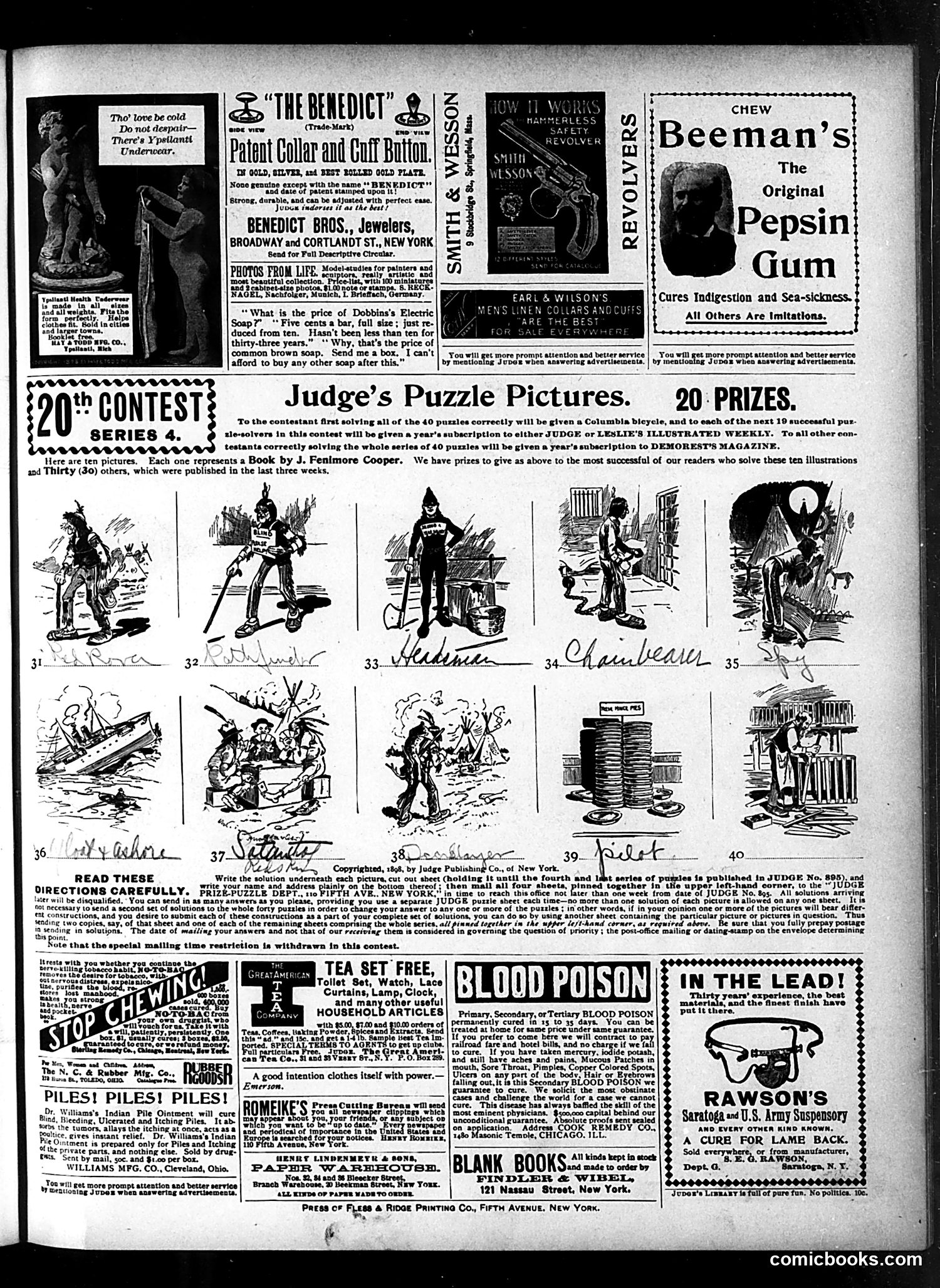
This page is primarily **advertising and contest material** rather than political satire. The dominant feature is a "Judge's Puzzle Pictures" contest (Series 4) offering prizes including a Columbia bicycle to winners who correctly identify literary references in ten illustrations. The illustrations appear to depict scenes from **James Fenimore Cooper novels**—a popular 19th-century American author. Contestants must match each picture to a Cooper book title. Surrounding the puzzle contest are period product advertisements: Benedict Bros. jewelry (patent collar buttons), Smith & Wesson revolvers, Beeman's Pepsin Gum, Earl & Wilson men's clothing, and various patent medicines and household items. The page reflects typical late-19th-century magazine marketing: combining light entertainment (literary puzzles) with consumer advertising. There is no apparent political satire or social commentary visible on this particular page—it functions primarily as a revenue generator through both contest participation and advertisements.
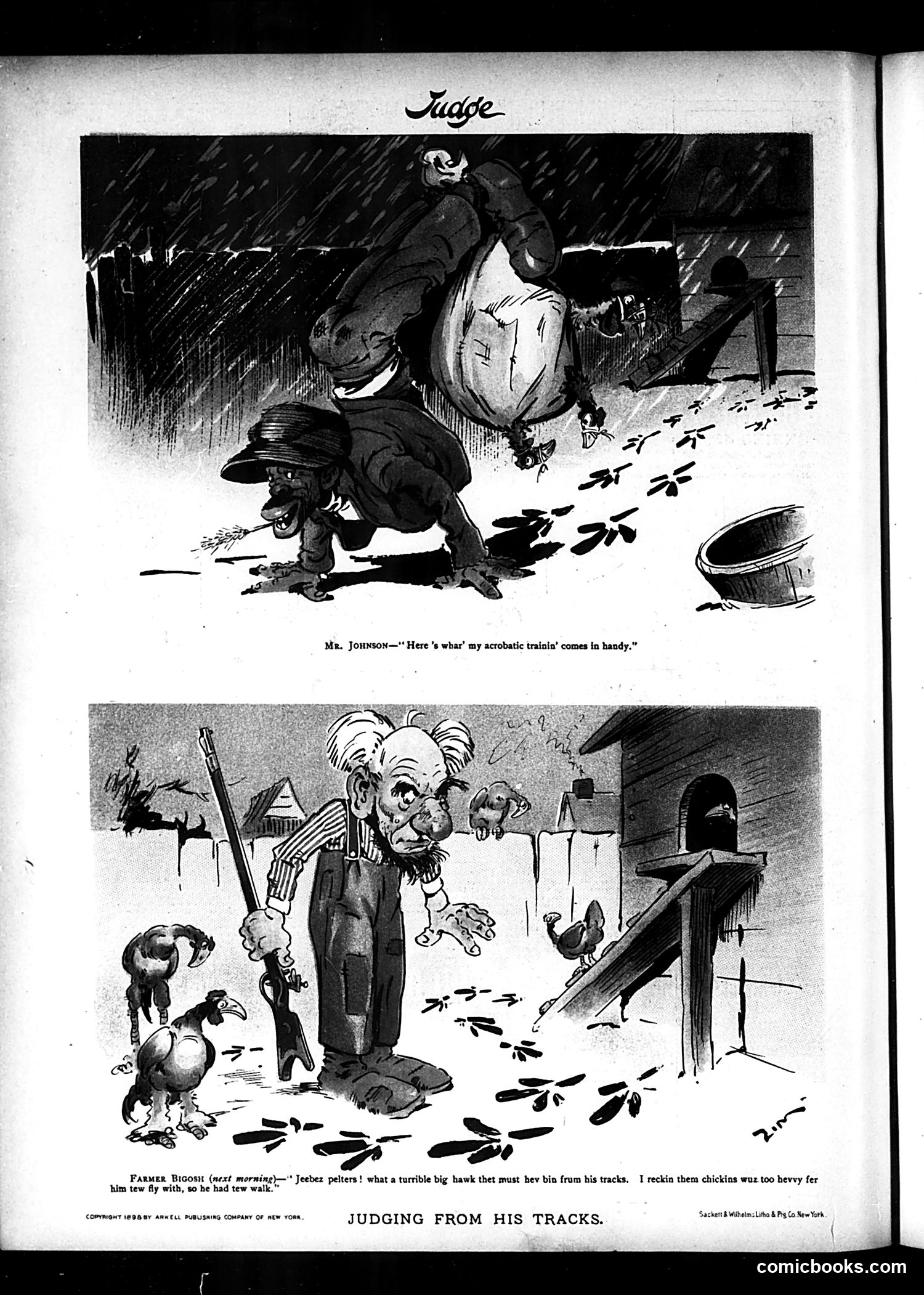
This two-panel comic satirizes poor judgment based on incomplete evidence. In the top panel, "Mr. Johnson" performs acrobatic contortions to escape a predicament, claiming his "acrobatic training" helps. In the bottom panel, Farmer Bigosh discovers animal tracks the next morning and misinterprets them—he assumes a large hawk stole his chickens and *walked* away because the birds were too heavy to carry. The farmer is "judging from his tracks" alone, reaching an absurd conclusion. The joke is that both Johnson and the farmer jump to wrong conclusions from limited information: Johnson exaggerates his training's usefulness, while the farmer fabricates an impossible explanation (a hawk walking) rather than considering simpler alternatives. The satire mocks human tendency toward false reasoning and overconfident interpretation of scant evidence.