
A complete issue · 20 pages · 1898
Judge — November 26, 1898
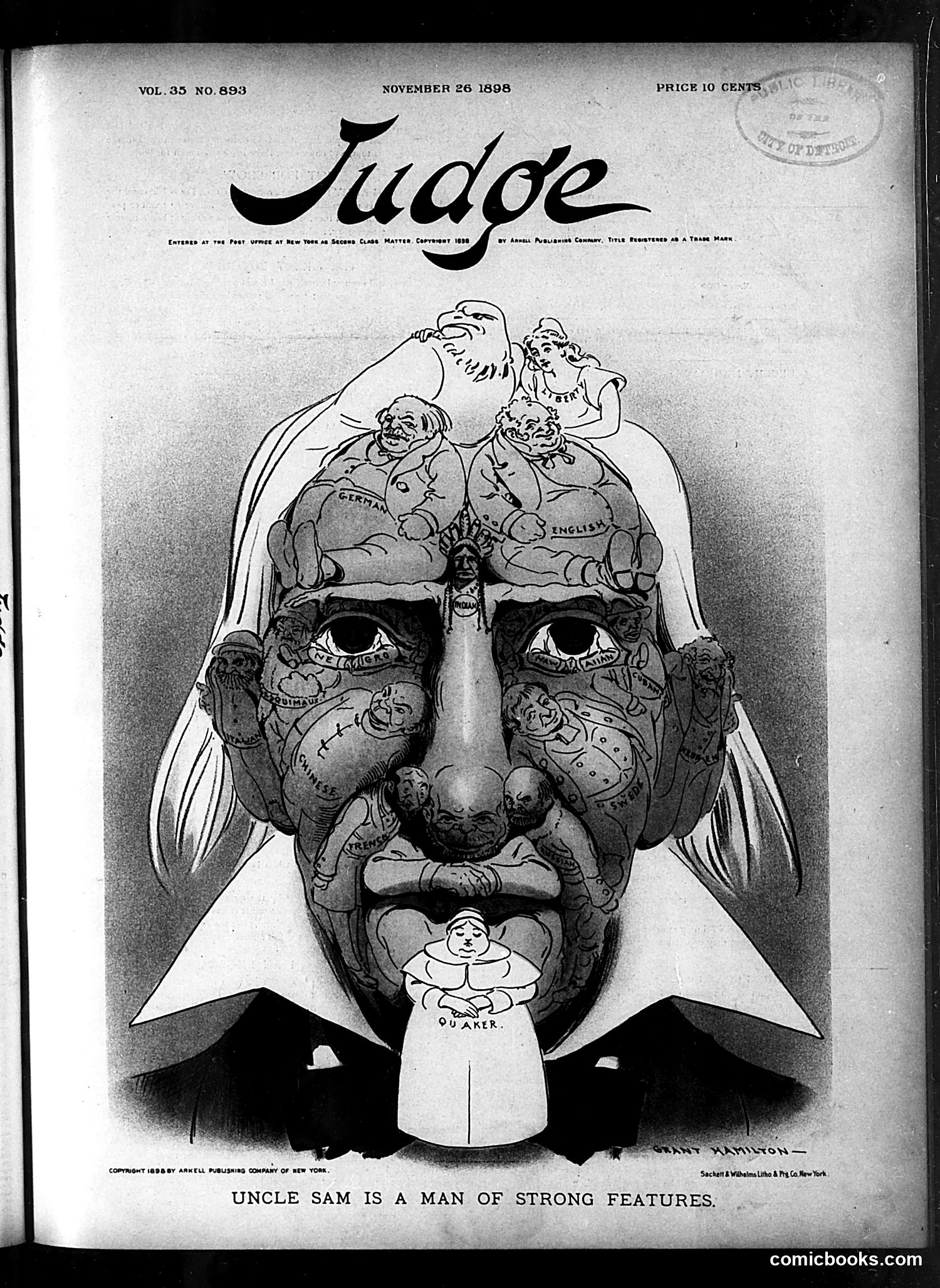
This November 1898 *Judge* cartoon uses anatomical satire to critique American imperialism. The central figure is Uncle Sam's head, dissected to reveal his internal composition: various ethnic or national groups fill the cranial cavity (labeled regions appear to reference different territories), while smaller caricatured figures ride atop his head like passengers. The satirical point seems to be that Uncle Sam—representing America—is literally constructed from or "filled with" diverse peoples and colonial possessions, particularly following the Spanish-American War (1898) and American acquisition of territories like the Philippines, Guam, and Puerto Rico. The caption's irony undercuts American confidence: Uncle Sam's "strong features" are satirized as grotesque, overstuffed, and unstable—questioning whether imperial expansion actually strengthens the nation.
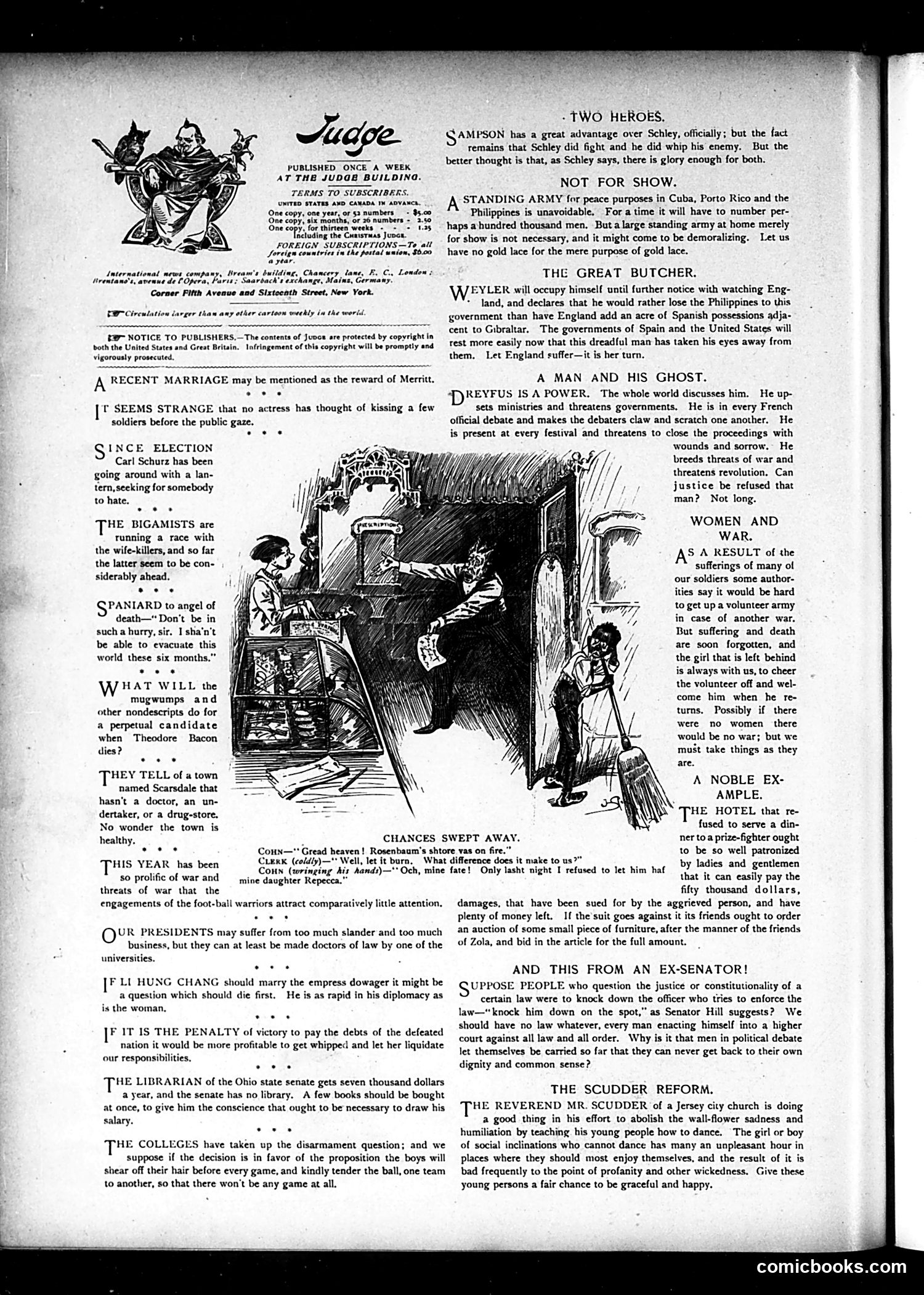
The main cartoon depicts two figures in what appears to be a bedroom or private chamber. Based on the OCR text referencing "Rosenbaum's ashore was on fire" and dialogue about "mine fate," this appears to satirize a domestic or romantic scandal involving named individuals. The accompanying text discusses various political and social issues: standing armies, Spanish colonial possessions, Dreyfus (likely the Dreyfus Affair), women's suffrage, and church reform efforts. Without clearer identification of the specific individuals caricatured or the exact historical moment, I cannot definitively state which scandal or event is being mocked. The cartoon's subject remains unclear from the visual alone—the text references are too fragmented to pinpoint the specific satire.
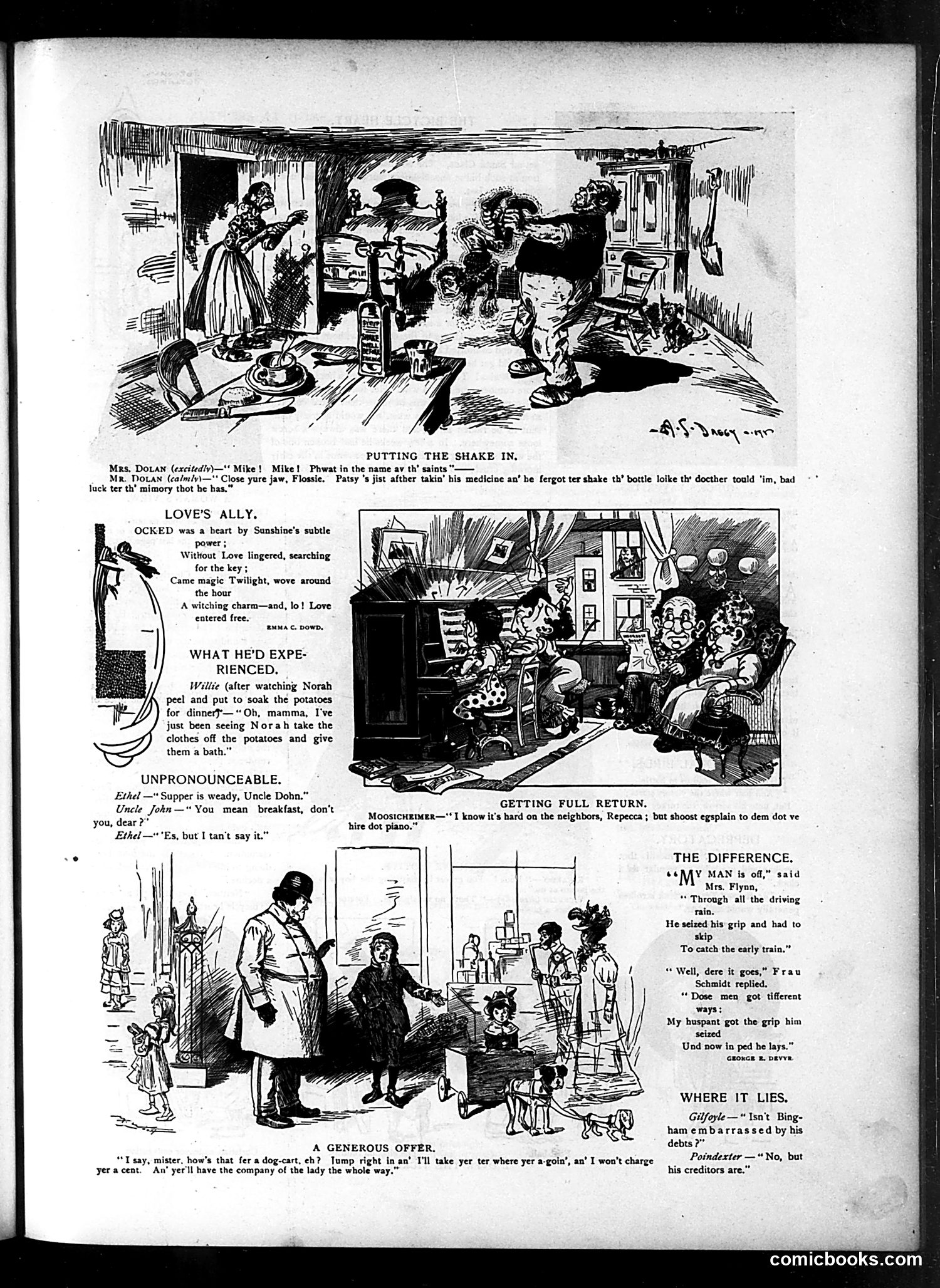
This page from *Judge* magazine contains humorous domestic and social sketches rather than political cartoons. The pieces include: **"Putting the Shake In"** — A chaotic kitchen scene satirizing housewives attempting to prepare food, with exaggerated domestic disorder. **"Love's Alley"** and other vignettes — Short comedic sketches about everyday life, including marital mishaps and social awkwardness. **"Generous Offer"** — A joke about negotiating with a dog-cart operator over pricing. The humor targets middle-class domestic life, marital relationships, and class interactions. The satirical tone mocks both housewives' incompetence in the kitchen and men's inability to handle domestic challenges. These are gentle social satires reflecting early 20th-century attitudes toward gender roles and class distinctions, lacking serious political commentary.
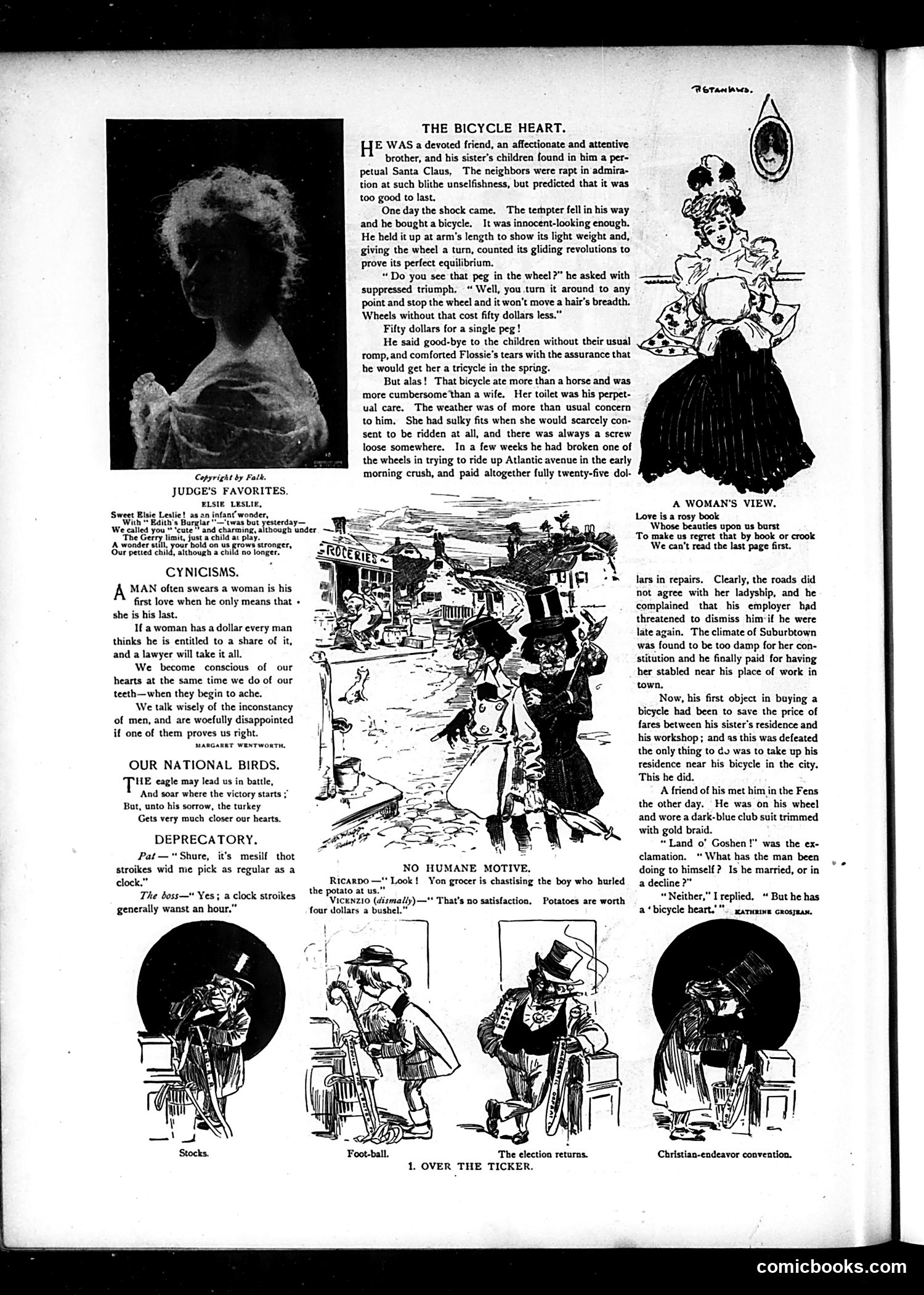
This page contains several satirical pieces reflecting late-19th or early-20th-century social commentary: **"The Bicycle Heart"** presents a sentimental story about a poor man buying a bicycle as a gift, only to find it too expensive and troublesome to maintain—a critique of consumerism and false promises of affordable luxury. **"Cynicisms"** mocks both male attitudes toward women and social pretense, suggesting men swear women are their "last love" while viewing them cynically. **"No Humane Motive"** appears to satirize political discourse, with characters discussing potato prices and value—likely commentary on politicians' economic claims. **"Over the Ticker"** shows stock market-related cartoons labeled "Stocks," "Foot-ball," election returns, and "Christian-endeavor convention"—grouping financial speculation with other contemporary concerns as objects of satirical scrutiny.
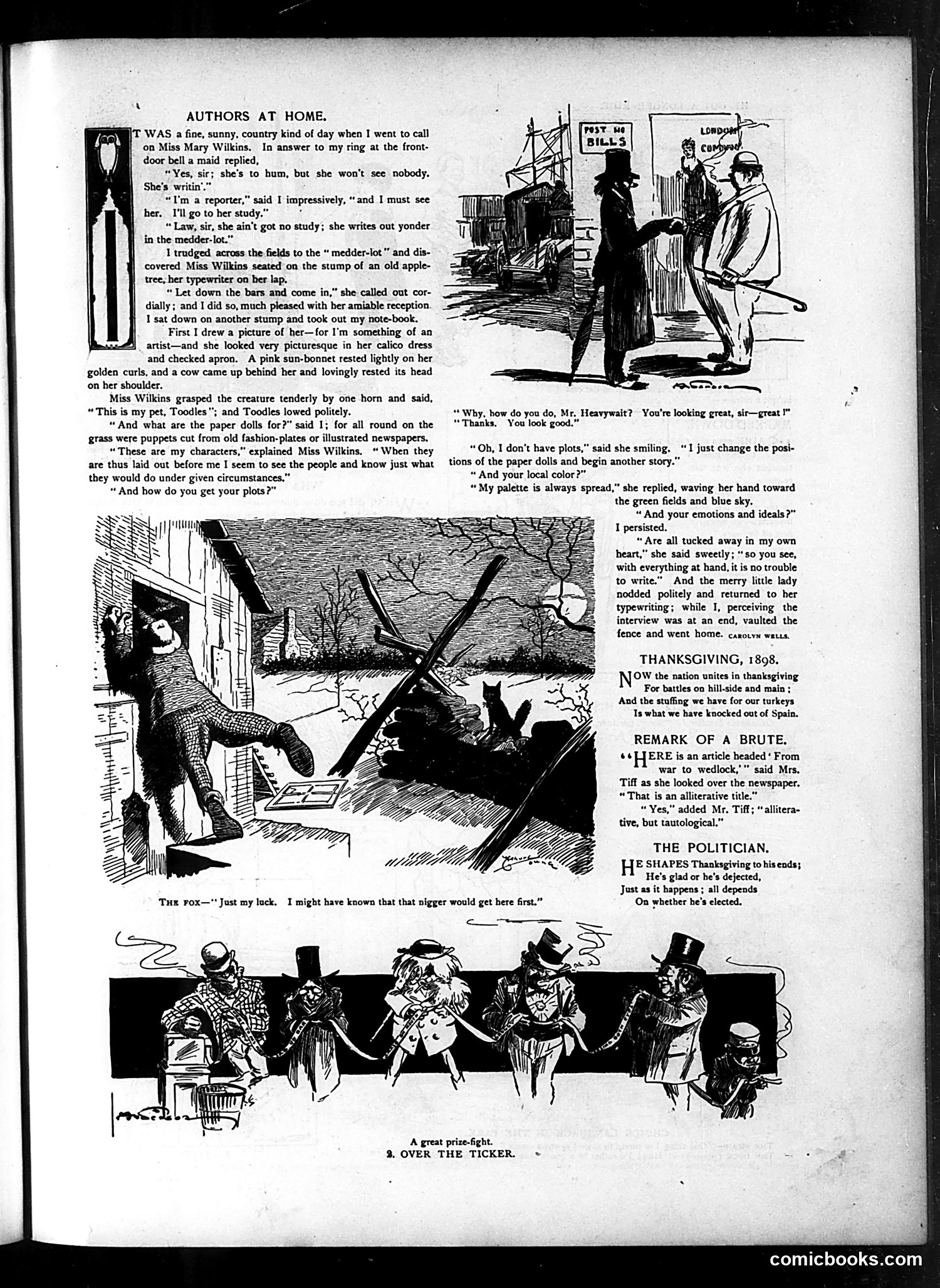
This page satirizes American life circa 1898 through multiple pieces: **"Authors at Home"** mocks the romanticized notion of the writer's life. The narrator visits author Mary Wilkins (a real contemporary writer) expecting artistic inspiration, but finds her composing stories mechanically in a field using paper-doll cutouts as characters—suggesting fiction-writing is formulaic assembly rather than genuine creativity. The joke undercuts the "bohemian artist" myth. **"Thanksgiving, 1898"** is topical satire about the Spanish-American War (recently concluded). The verse cynically equates national "stuffing" with conquests from Spain, mocking jingoistic celebration of military victory. The remaining items—"Remark of a Brute," "The Politician," and illustrations—are brief satirical verses on social hypocrisy and political opportunism. The fox cartoon's caption contains a racial slur reflecting period attitudes (historically significant but offensive today). Overall, the page uses humor to critique literary pretension, war glorification, and political/social dishonesty.
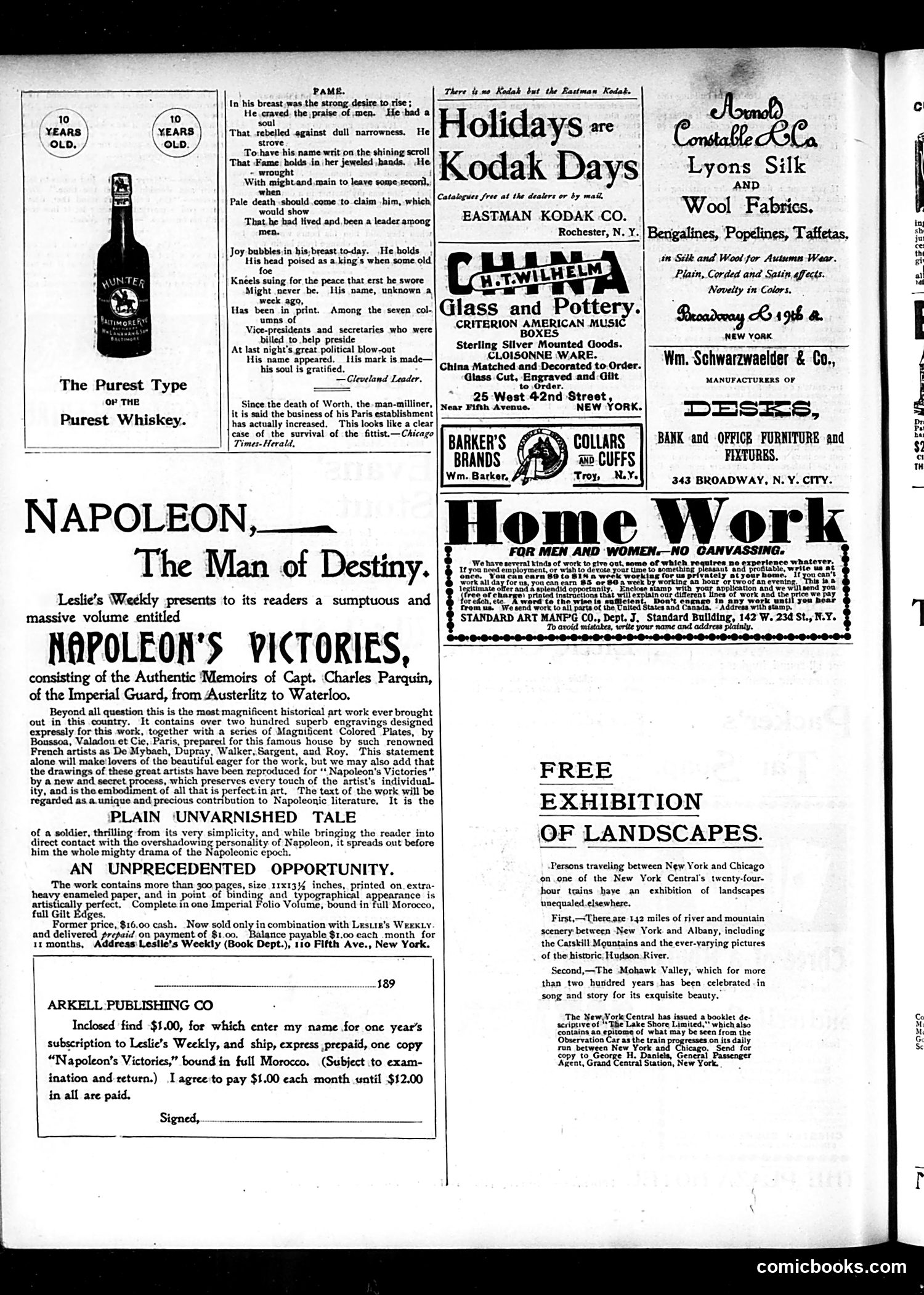
This page is primarily **advertising and promotional material** rather than political satire. The main content includes: 1. **A sentimental poem** titled "FAME" (left column) about ambition and recognition, seemingly unrelated to current events—it depicts someone's pride at seeing his name printed as a minor official at a political gathering. 2. **Napoleon book promotion** (center-left): Leslie's Weekly advertises a lavish multi-volume biography of Napoleon with 200+ engravings and colored plates, marketed as a subscription offer. 3. **Commercial advertisements** dominating the page: Kodak cameras, Eastman Kodak Co., silk fabrics, glass and pottery, furniture, banking services, and a "Home Work" employment scheme. The page reflects typical turn-of-the-century magazine format, blending editorial content with extensive paid advertising. There is **no clear political cartoon or satirical commentary** visible. The brief item about Worth the Parisian fashion designer's posthumous business success is the closest to satirical observation, but it's minor.
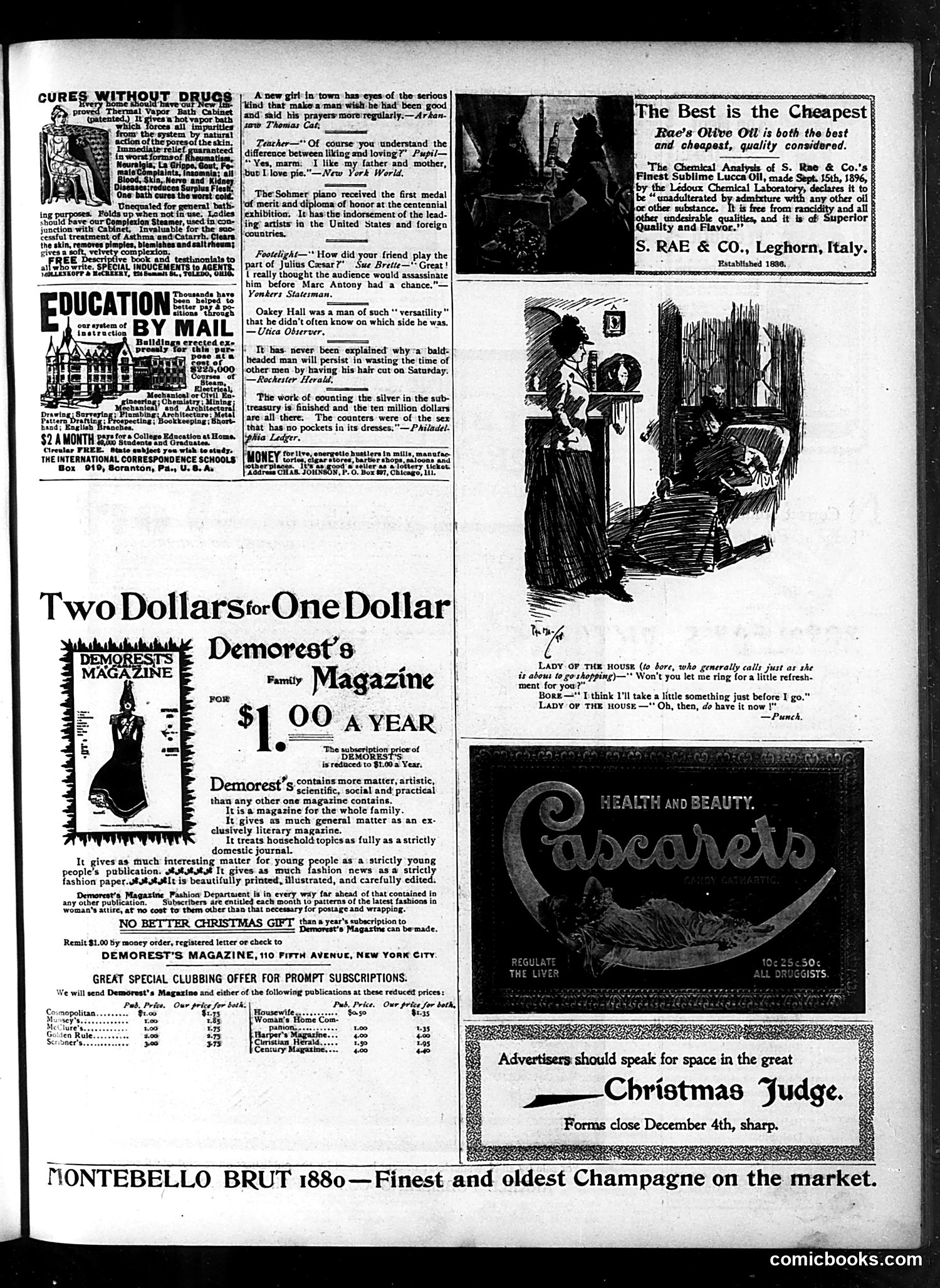
This page is primarily **advertising and promotional content** rather than political satire. The dominant feature is a full-page ad for **Demorest's Magazine** ($1/year), emphasizing its broad appeal across fashion, literature, household topics, and young people's content. The small scattered jokes and quips throughout are typical filler material: - A **theater joke** about Julius Caesar being "assassinated" before the play ends (audience criticism) - **Oakey Hall reference**: Hall was a real New York politician (Tammany Hall associate), noted here as a man of unclear principles - A joke about **women lacking pockets** (social observation about women's clothing) - **"Lady of the House"** domestic humor about unexpected visitors The cartoons are minor—one sketch shows a servant/maid scenario, typical of period domestic humor. The page also includes ads for **olive oil, champagne, and a correspondence school**, reflecting typical late-19th-century magazine advertising. The "Christmas Judge" notice at bottom indicates deadline for holiday advertisers. **Overall**: A routine magazine page mixing light humor with commercial announcements, not significant political content.
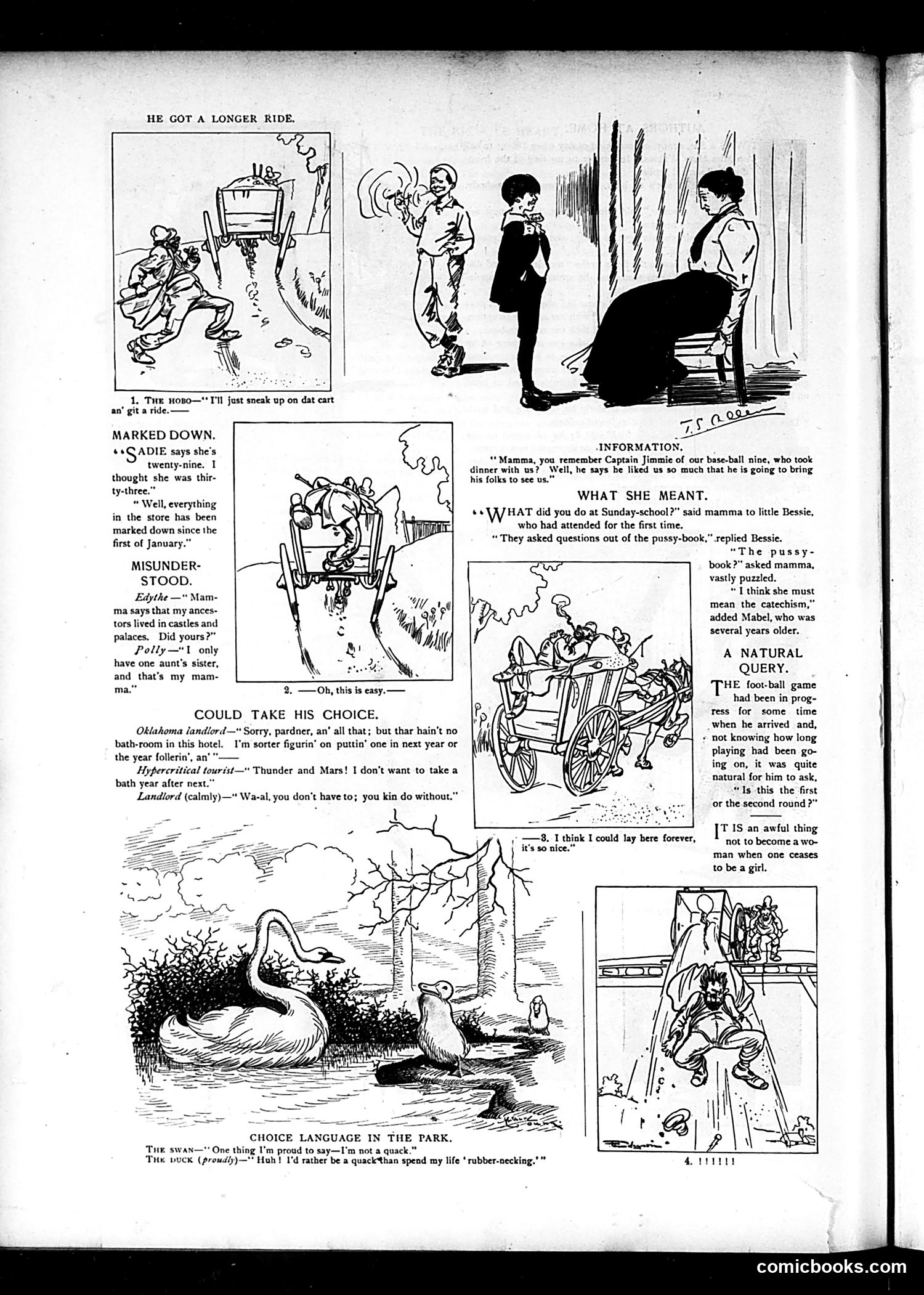
This page contains six separate comic vignettes satirizing everyday social situations and language misunderstandings: **"He Got a Longer Ride"** mocks a hobo attempting to steal a cart ride. **"Marked Down"** jokes about a woman's age being reduced like store merchandise after New Year's sales. **"Misunderstood"** plays on class pretension—a girl misinterprets her mother's aristocratic ancestry claim, thinking only of her aunt. **"Information"** depicts a child confusing "catechism" (religious instruction) with "pussy-book" (likely a children's primer), creating innocent humor through malapropism. **"Could Take His Choice"** satirizes an Oklahoma hotel owner's casual dismissal of modern amenities—offering the tourist a choice between waiting years for a bathroom or doing without entirely. **"Natural Query"** jokes about a football spectator's ignorance, asking if a mid-game moment is the "first or second round." **"Choice Language in the Park"** contrasts a swan's pride in not being a "quack" with a duck's preference for "rubber-necking" over respectability. The humor relies on wordplay, class commentary, and absurdist logic typical of early 20th-century American satire.
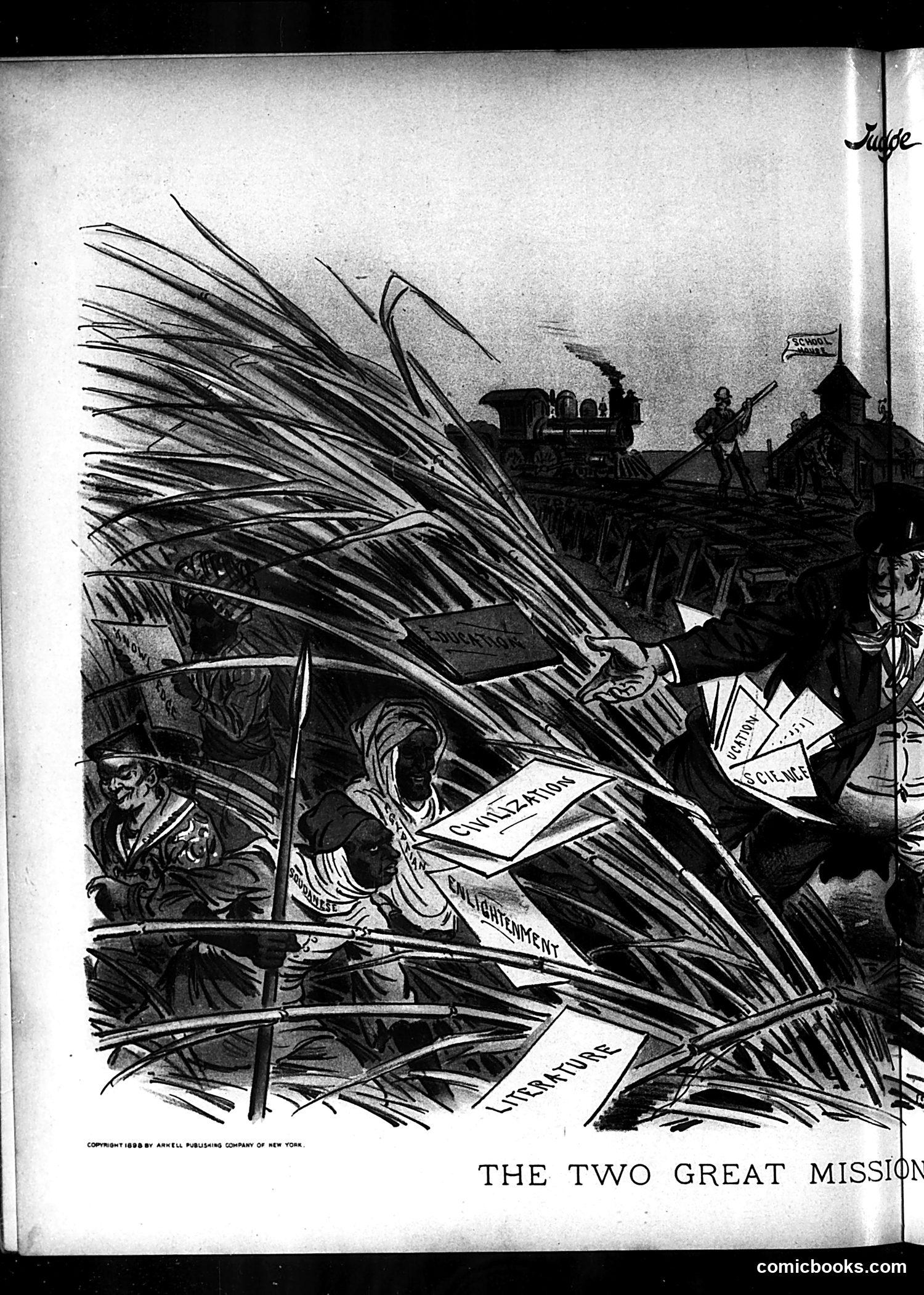
This political cartoon depicts a chaotic scene with papers labeled "CIVILIZATION" and "ENLIGHTENMENT" being blown about violently. On the left, a figure appears distressed amid the turmoil, while on the right, observers watch from a distance near a train and buildings. The satire appears to criticize ambitious missionary or civilizing efforts—likely referring to American imperial or colonial ventures of Judge magazine's era (late 1800s-early 1900s). The swirling, destructive imagery suggests these grand "missions" to spread civilization and enlightenment were chaotic, ineffective, or themselves destructive rather than beneficent. The cartoon mocks the disconnect between stated noble intentions and actual chaotic outcomes on the ground.
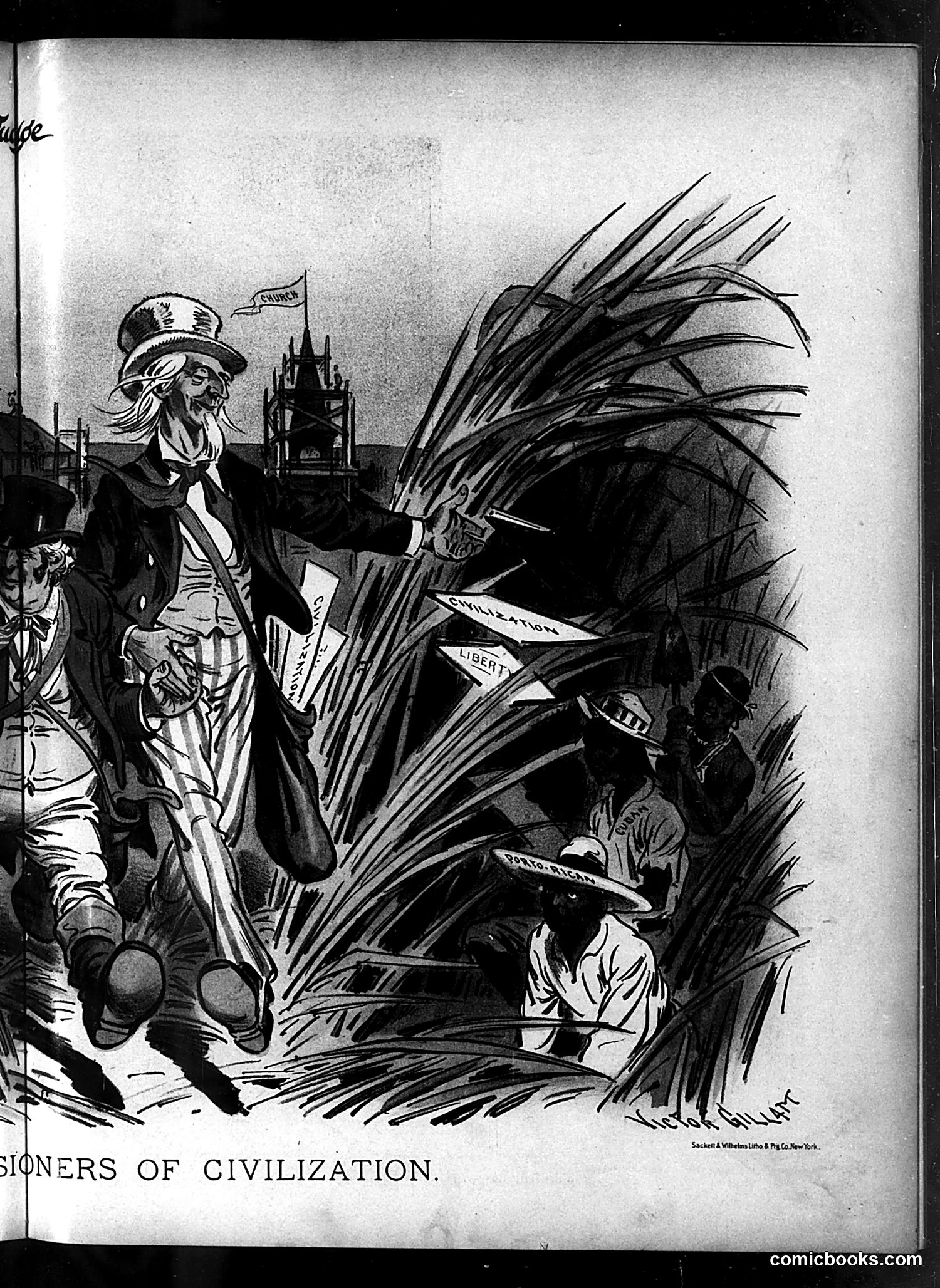
This political cartoon depicts **Uncle Sam** (the bearded American figure in the top hat) presenting bundles of wheat or grain labeled "CIVILIZATION" and "LIBERTY" to what appear to be impoverished or colonized peoples huddled below. The title, "IONERS OF CIVILIZATION" (likely "MISSIONARIES OF CIVILIZATION"), uses sardonic irony. The satire critiques American imperialism and foreign policy, suggesting that the U.S. presents itself as bringing "civilization" and "liberty" to other nations, when the actual benefits appear meager or cynically distributed. The contrast between Uncle Sam's grandiose posture and the desperate figures receiving aid undercuts American humanitarian claims. The cartoon likely dates to the late 19th or early 20th century, when debates over American expansion and the Philippines were prominent. It represents anti-imperialist sentiment within American political discourse.
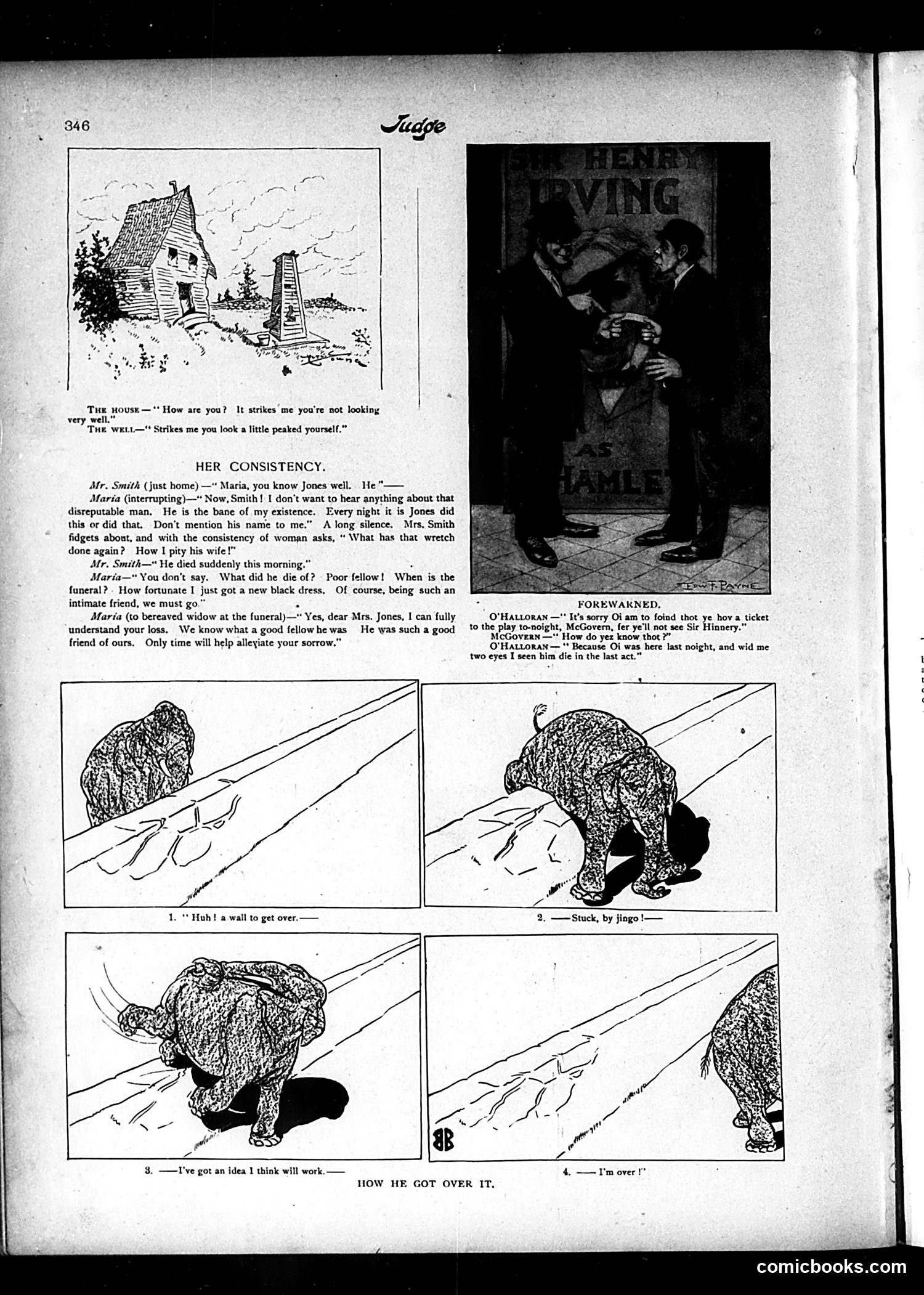
This page contains three separate satirical pieces from *Judge* magazine: **"Her Consistency"** mocks female hypocrisy. Maria vehemently denounces her neighbor Jones as "the bane of my existence," refusing to hear his name mentioned. Yet when he dies, she immediately pivots—expressing sympathy, attending the funeral in her new black dress, and claiming intimate friendship. The joke is that her moral certainty vanishes instantly when social convention or personal advantage changes. **"Forewarned"** is a brief Irish-dialect joke about someone who saw a play the previous night and witnessed an actor's death in the final act—apparently unaware he was watching a theatrical performance, not reality. **"How He Got Over It"** is a four-panel wordless comic showing an animal (appears to be a dog or similar creature) attempting to climb a steep incline, getting stuck, having an idea, and finally succeeding. It's straightforward slapstick humor about problem-solving through persistence.
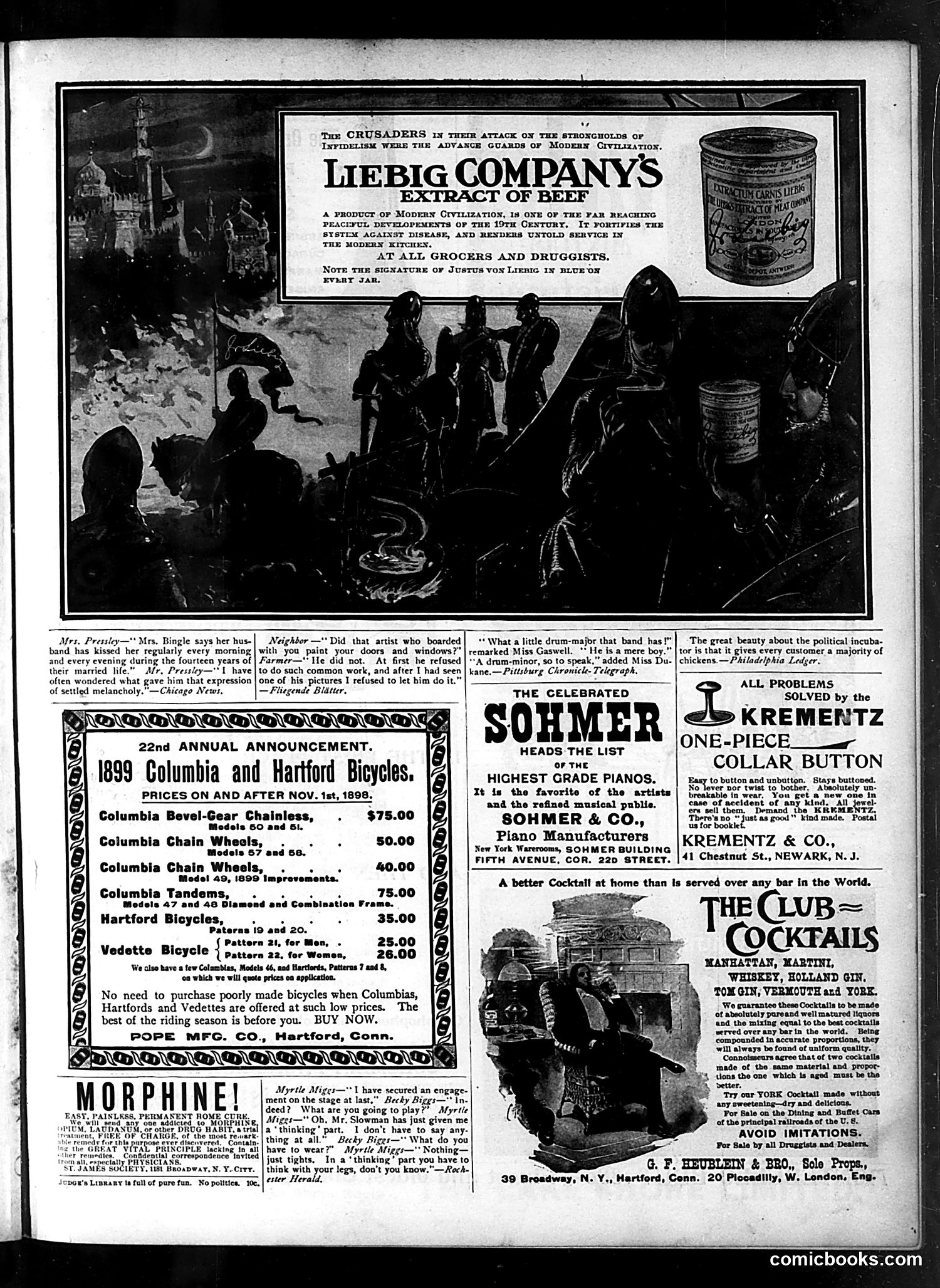
This page is primarily **advertising**, not editorial cartooning. The dominant feature is a Liebig Company beef extract advertisement using a Crusades painting to invoke notions of civilization and progress—comparing medieval religious warriors to modern commercialism as "advance guards of civilization." The small **comic snippets** scattered throughout are domestic humor pieces common to Judge: - A joke about a husband's perpetually melancholy expression from years of daily kissing - An artist-farmer exchange mocking pretentious painters who refuse common labor - Theater jokes about actors in silent "thinking" roles These aren't satirical—they're gentle observational humor typical of the era's mainstream magazines. The remainder is **product advertising**: Columbia/Hartford bicycles, Sohmer pianos, Krementz collar buttons, and "Club Cocktails." The cocktail ad particularly reflects late-1890s upper-class consumer culture. **Context for modern readers**: This reflects Judge's transformation from purely satirical publication into a magazine where advertising increasingly filled editorial space, appealing to affluent readers.
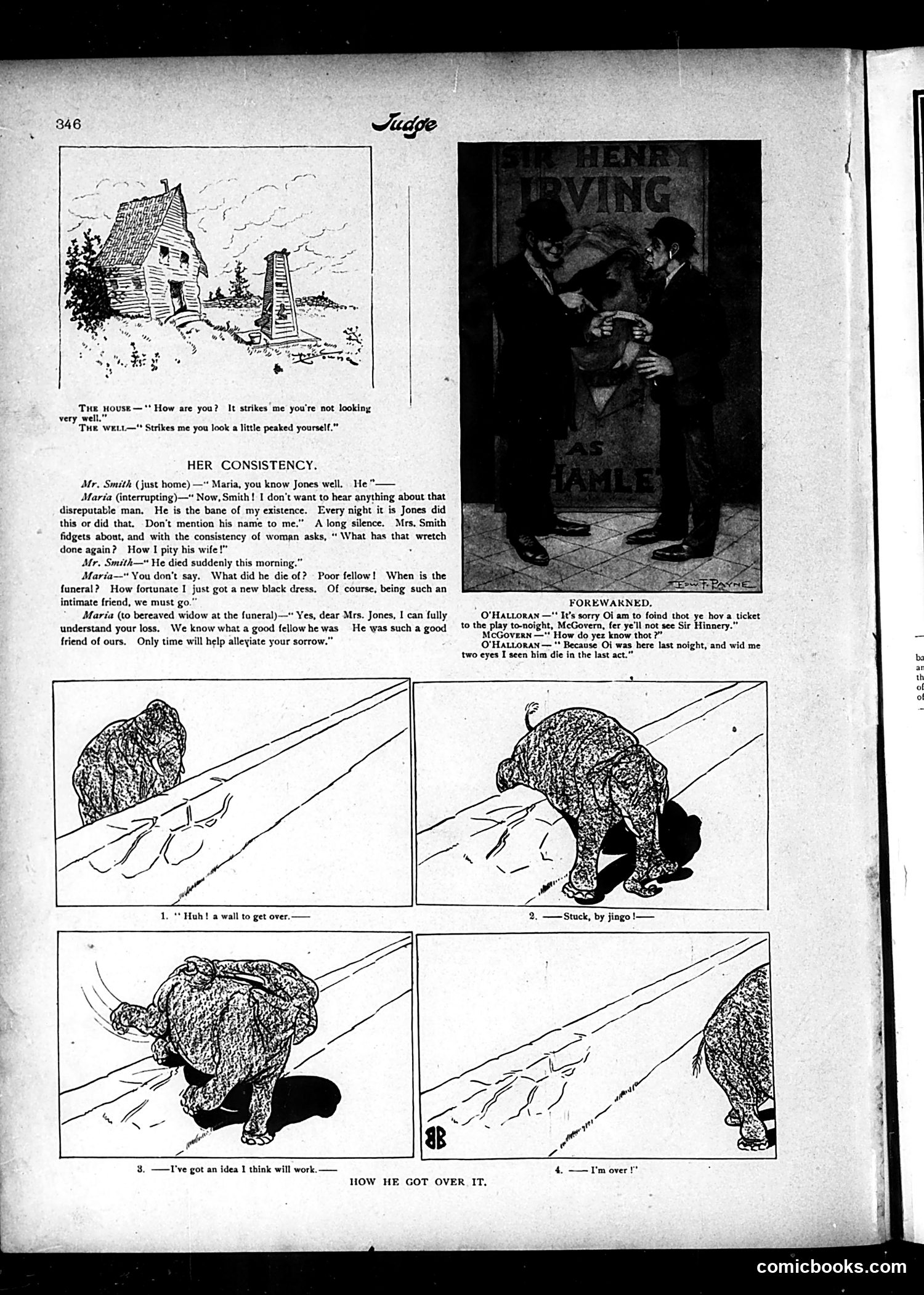
This page contains two separate satirical pieces mocking human (particularly female) behavior through exaggeration. **"Her Consistency"** depicts a wife who vehemently denounces a man named Jones as "disreputable" and forbids mention of him. When Mr. Smith announces Jones's death, she immediately reverses course—expressing sympathy, lamenting his loss, purchasing mourning clothes, and attending the funeral as an "intimate friend." The satire targets the inconsistency of social performance: her private contempt contradicts her public mourning display. **"Forewarned"** (below) is an Irish-accented joke about theater: O'Halloran warns McGovern against attending a play tonight because "Sir Henry" dies in the last act—implying he witnessed the performance the night before and spoiled the ending. Both items mock hypocrisy and social pretense through humor: one targeting gendered social conventions around respectability and mourning; the other, the obliviousness of spoiling surprises.
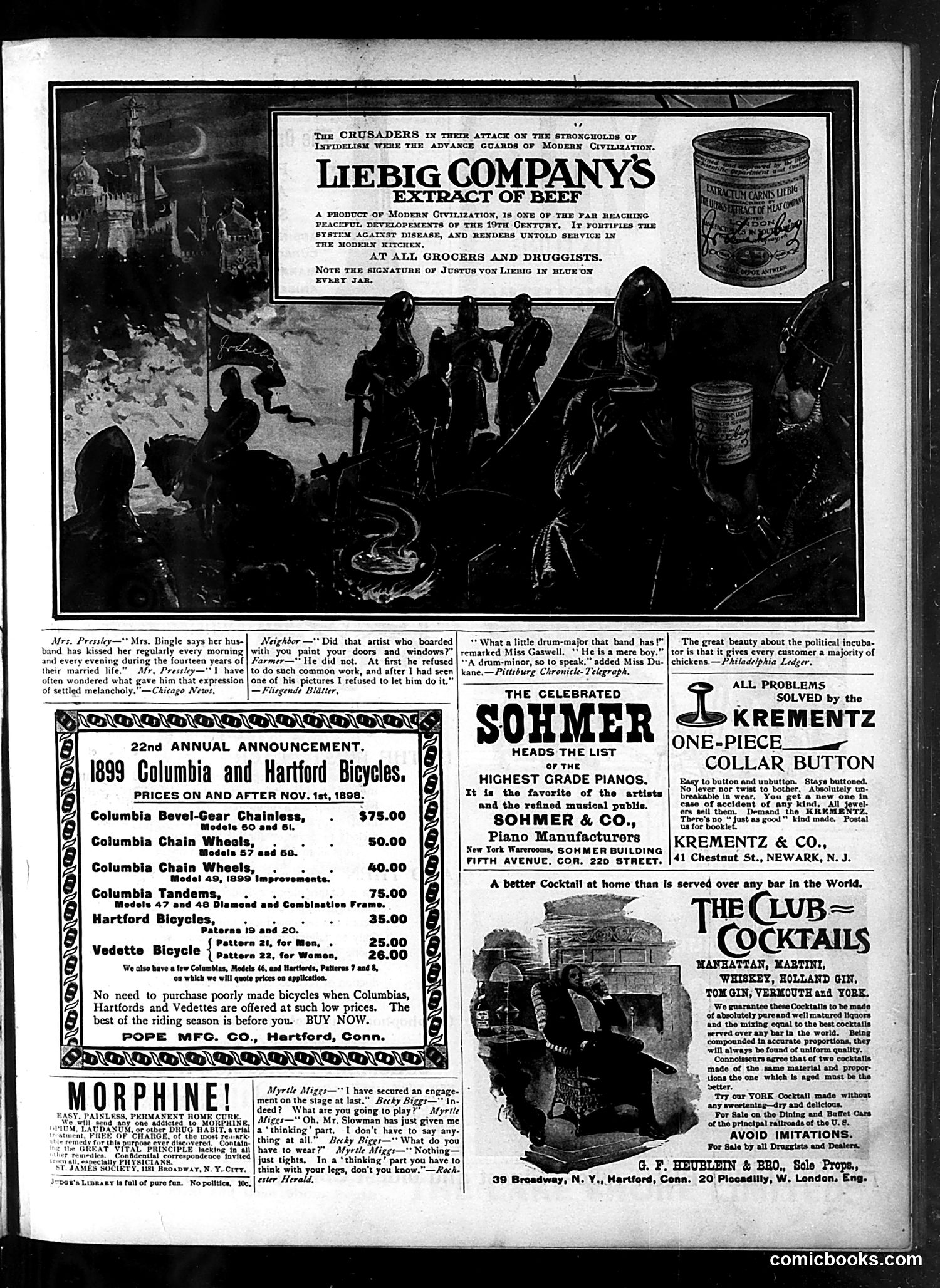
This page is primarily **advertising**, typical of late-19th-century publications. The dominant content includes ads for bicycles (Columbia and Hartford brands), pianos (Sohmer), collar buttons (Krementz), and cocktail mixers—all positioned as products of "modern civilization." The **single satirical cartoon** at top depicts medieval Crusaders attacking castle strongholds, which Liebig Company repurposes as a metaphor: just as Crusaders were "advance guards of Modern Civilization," so too is their beef extract a product advancing civilization by fighting disease. Below are **brief humor snippets** (common to Judge): jokes about marital kissing, a farmer rejecting an artist's work, and theatrical mishaps. These are lightweight social observations rather than political satire. The page reflects **Gilded Age advertising culture**—equating consumer products with progress and civilization itself. The messaging targets affluent readers with discretionary income for bicycles and pianos, using pseudo-intellectual framing to justify luxury consumption. **No political figures or events are referenced.**
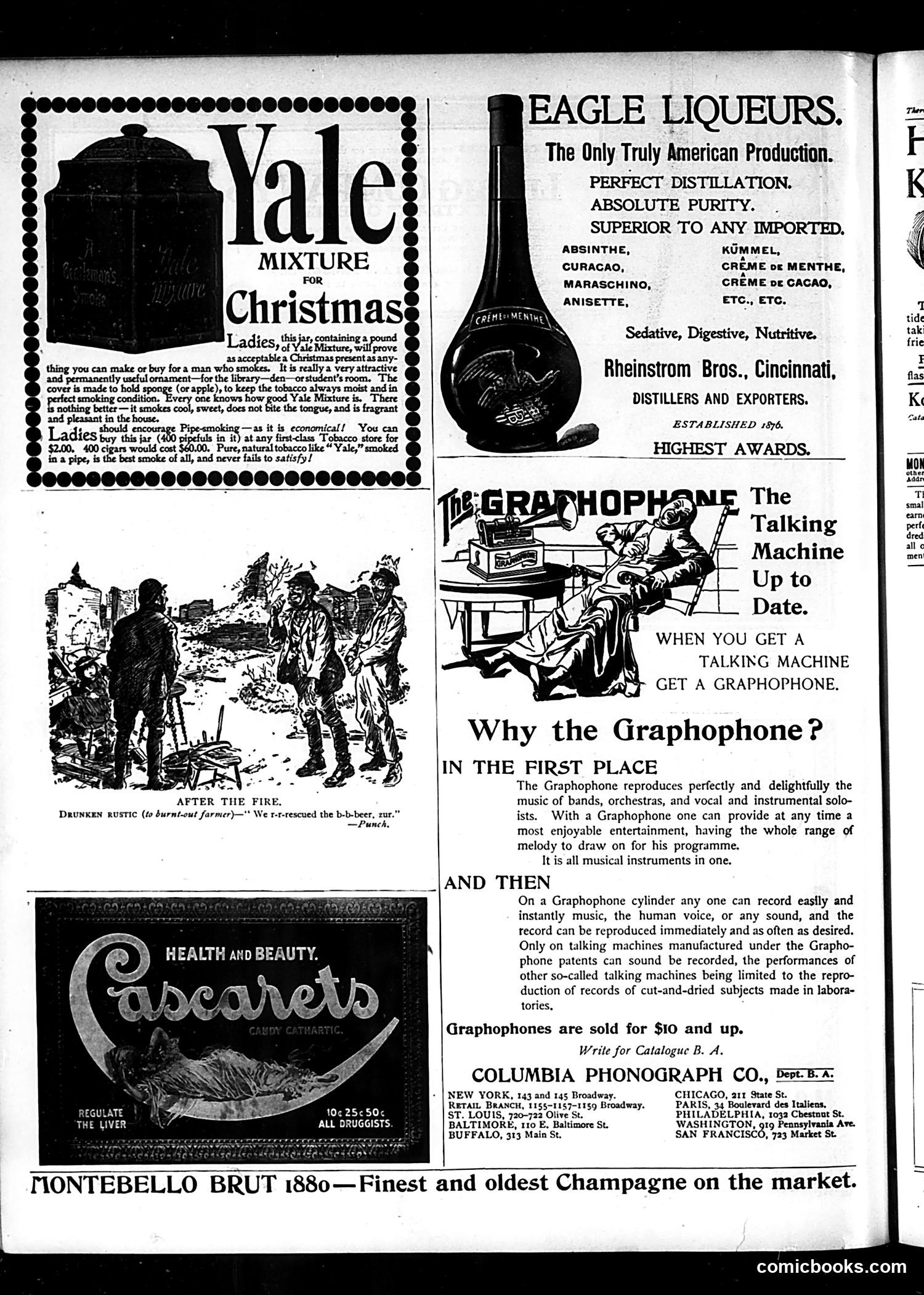
This page is primarily **advertising**, not satirical editorial content. The main items are: 1. **Vale Mixture tobacco jar** (top left): A Christmas gift advertisement targeting men, marketed as an attractive, functional desk ornament that keeps pipe tobacco moist. 2. **"Drunken Rustic" cartoon** (bottom left): A brief Punch reprint showing a drunk farmer claiming to have rescued "the b-b-beer" from a burnt-out barn—a simple joke about alcohol priorities during disaster. 3. **Eagle Liqueurs & Graphophone ads** (right side): Straightforward product promotions. The Graphophone section emphasizes recording capability as superior to competitors, claiming exclusivity under their patents. 4. **Cascara health product & Montebello Champagne** (bottom): Additional advertisements. The page contains **no substantial political satire or social commentary**. It's a commercial page typical of Judge magazine's revenue model, mixing minimal editorial humor with paid advertisements for consumer goods popular in the early 1900s.
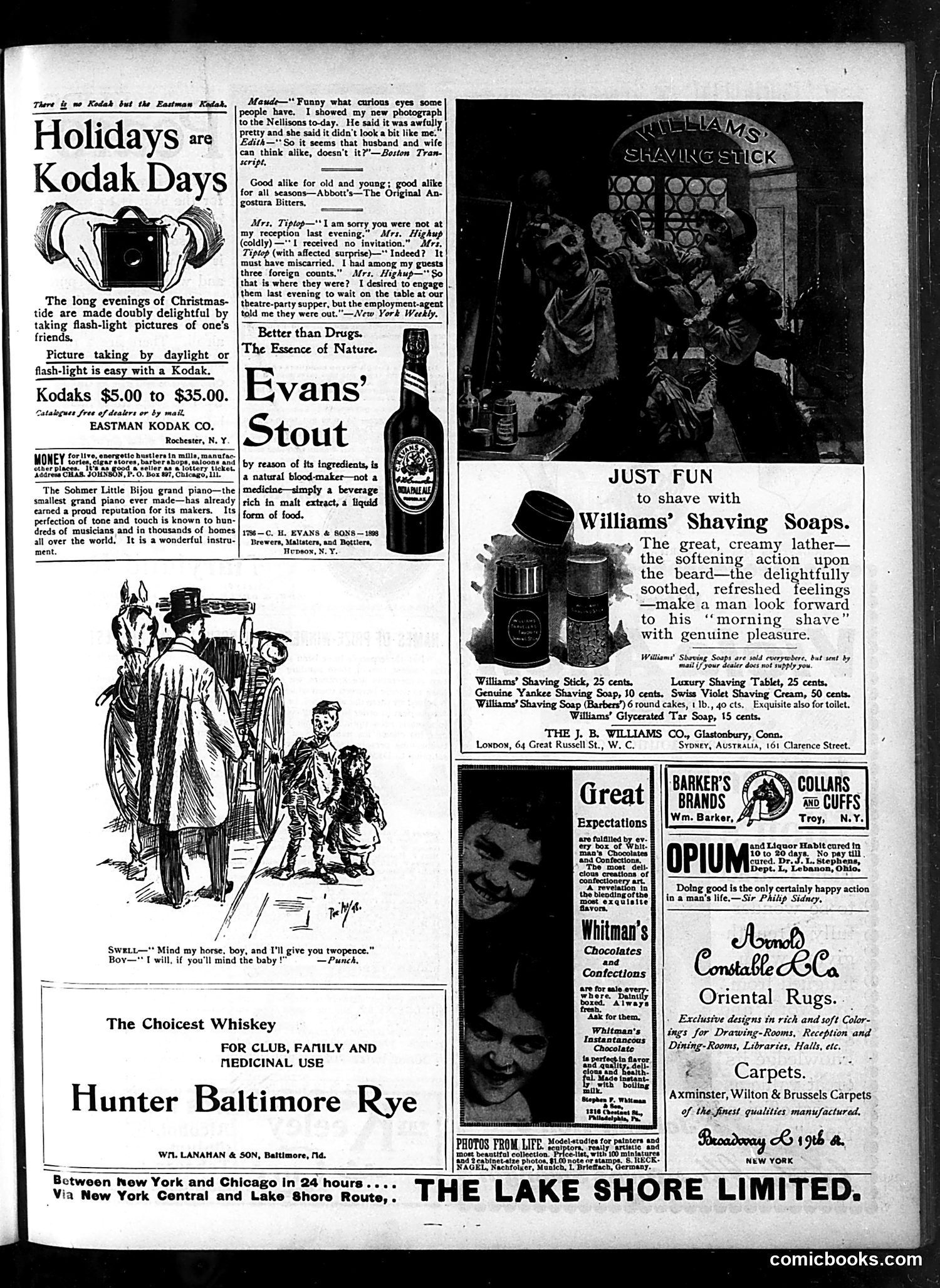
This page is primarily **advertising**, not editorial content or political satire. The bulk consists of product advertisements typical of early 20th-century magazines: Kodak cameras, Evans' Stout beer, Williams' Shaving Soaps, Hunter Baltimore Rye whiskey, and various luxury goods. The small comic elements are **brief, apolitical jokes** rather than satire: - A dialogue about a woman showing unflattering photographs to neighbors - A domestic humor sketch about a man minding a horse while someone else minds a baby - Light observational humor about social awkwardness **No political figures or references appear.** The page reflects consumer culture and genteel domestic comedy aimed at middle-class readers. The advertisements emphasize leisure activities (photography, grooming) and quality goods—standard Judge magazine content promoting luxury consumer products to affluent readers.
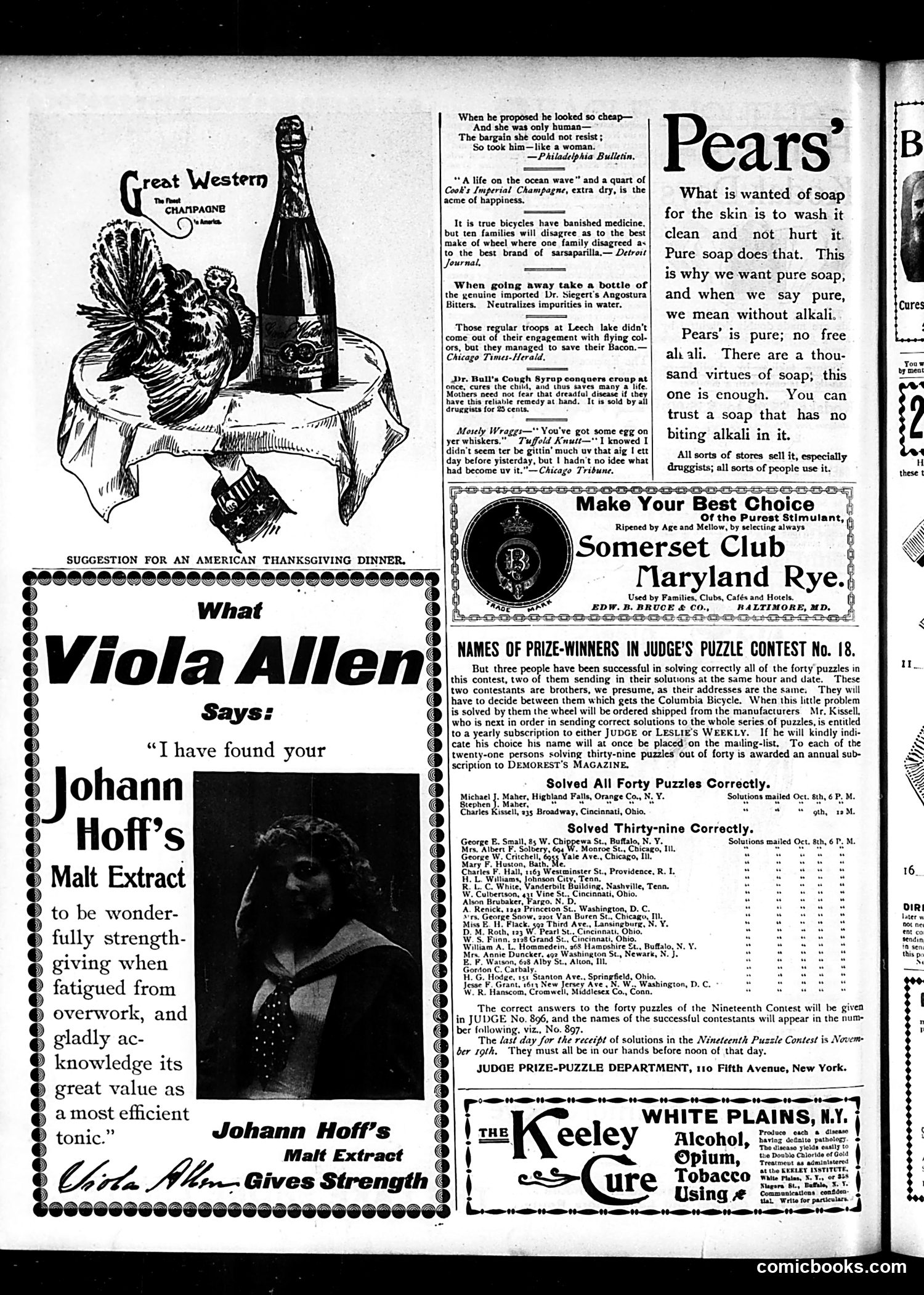
This is primarily an **advertising and editorial content page** rather than a satirical cartoon page. The main elements are: **Advertisement Features:** - A testimonial from actress **Viola Allen** endorsing Johann Hoff's Malt Extract as a strength-giving tonic - Ads for Pears' soap (emphasizing purity and lack of alkali) - Somerset Club Maryland Rye whiskey advertisement - Keeley Cure tobacco/alcohol treatment ad **Editorial Content:** - "Suggestion for an American Thanksgiving Dinner" — a humorous column offering satirical quotes about food, medicine, bicycles, and current events (references to "Leech Lake" troops, sarsaparilla brands) - A puzzle contest results section announcing winners **Social Context for Modern Readers:** The page reflects turn-of-century American consumer culture: patent medicines, tonics, and dubious "cures" were heavily advertised in magazines. Viola Allen's celebrity endorsement was a common marketing tactic. The casual references to alcoholic beverages as health tonics reflect pre-Prohibition attitudes. The puzzle contests kept readers engaged with magazines as entertainment. The page is primarily **commercial** rather than satirical.
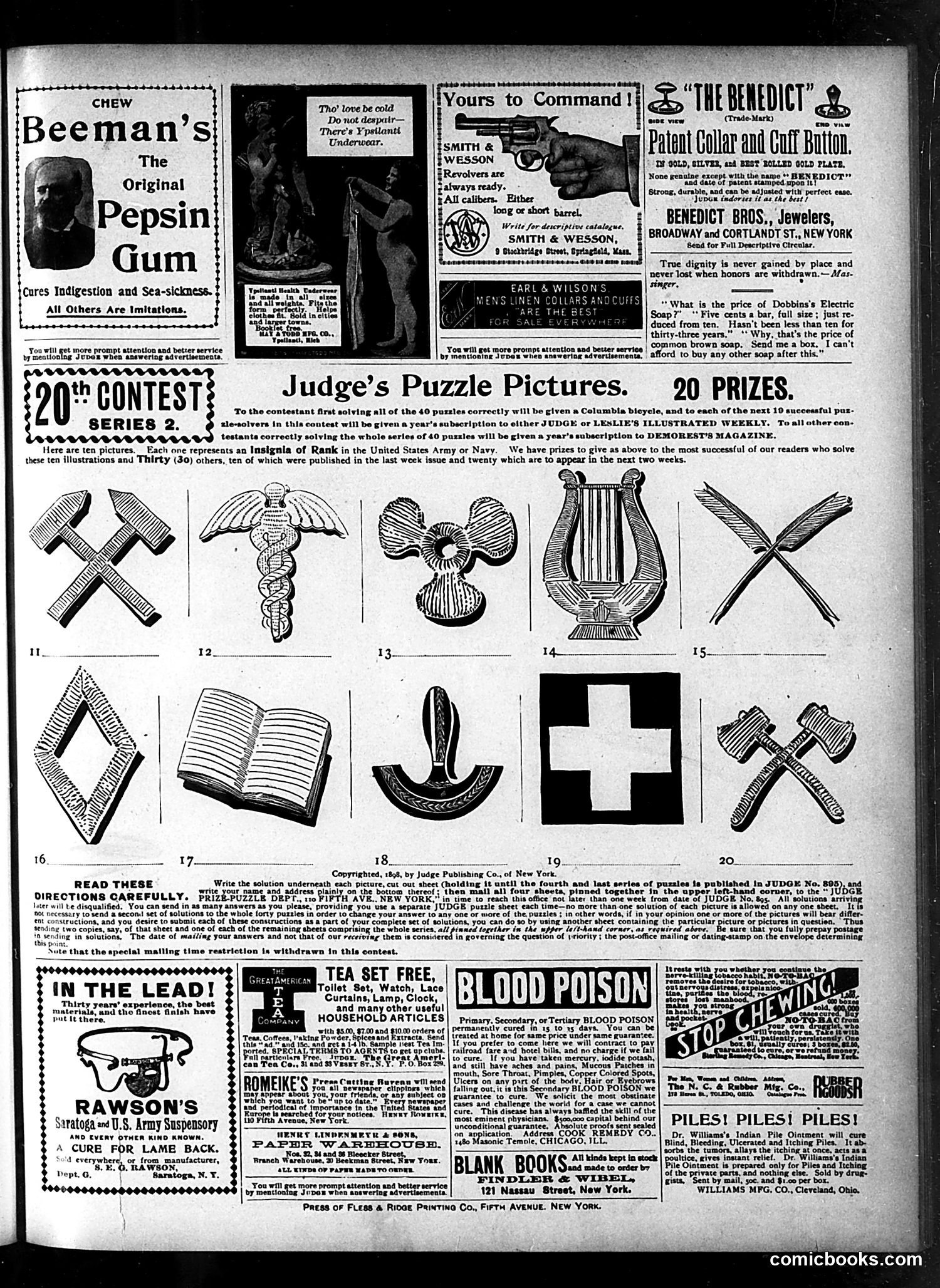
This page is primarily **advertising and a puzzle contest**, not political satire. The main content is "Judge's Puzzle Pictures," a contest offering a Columbia bicycle and magazine subscriptions to readers who correctly identify 40 military insignia (ranks from the U.S. Army and Navy). Contestants must solve the puzzles and mail solutions to the "Prize Puzzle Dept." The surrounding advertisements include patent medicines (Beeman's Pepsin Gum for indigestion, "Blood Poison" cure), men's accessories (Benedict collar buttons, Earl & Wilson collars), household items (Dobbins soap), and various other products—typical late-1890s commercial pitches. The page contains **no political cartoons or satire**. It represents Judge magazine's business model: entertainment (puzzles) wrapped around profitable advertising space. The content reflects contemporary consumer culture and available products of that era.
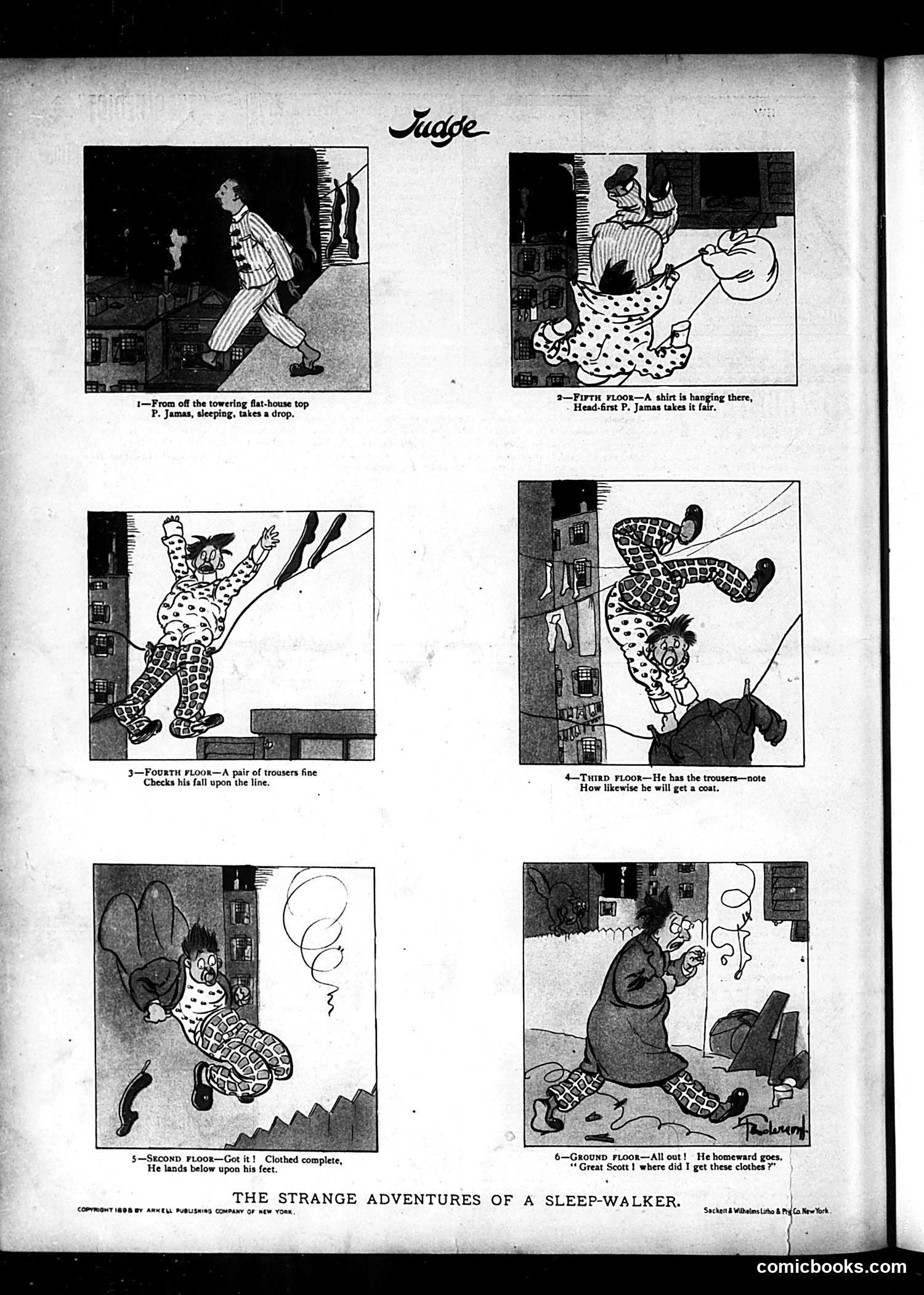
This 1898 comic strip from *Judge* depicts a humorous sequence of a sleepwalker's nighttime misadventure. A man named P. James, intoxicated ("takes a drop"), falls asleep on a high-rise building's roof and begins descending through successive floors while unconscious. As he falls, he accidentally collects clothing from each level: a shirt, trousers, and a coat—dressing himself completely by accident. The satire plays on the absurdity of the situation and period attitudes toward drunkenness as a source of comedy. The final panel shows James awakening at ground level, bewildered by his fully clothed state and unable to remember where the garments came from ("where did I get these clothes?"). The joke relies on slapstick physical comedy and the incongruity of gaining a complete outfit through such chaotic means—typical humor conventions of late-19th-century American satirical magazines.