
A complete issue · 16 pages · 1898
Judge — September 17, 1898
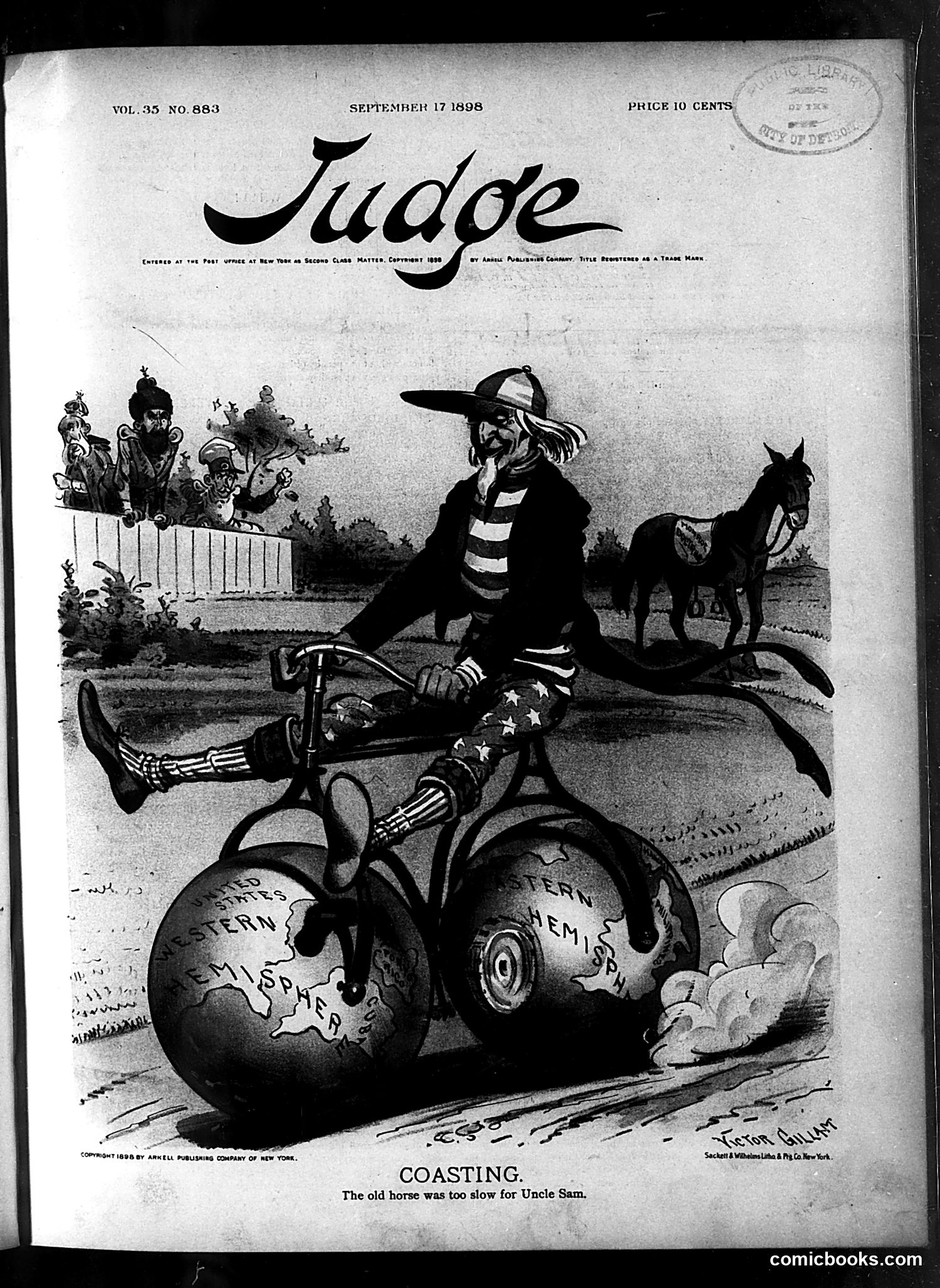
This 1898 political cartoon depicts Uncle Sam (identifiable by his characteristic top hat and stars-and-stripes outfit) riding a bicycle with oversized wheels labeled "Eastern Hemisphere" and "Western Hemisphere." He's coasting downhill with one leg extended, leaving a horse behind—representing outdated methods of transportation and diplomacy. The satire critiques Uncle Sam's aggressive, accelerating imperial expansion during the 1898 period (likely referencing the Spanish-American War and American overseas territorial ambitions). The "old horse" symbolizes traditional isolationist or slower foreign policy, which the cartoon suggests has become obsolete. The image celebrates America's rapid imperial "coasting" into global dominance, treating aggressive expansionism as inevitable progress.
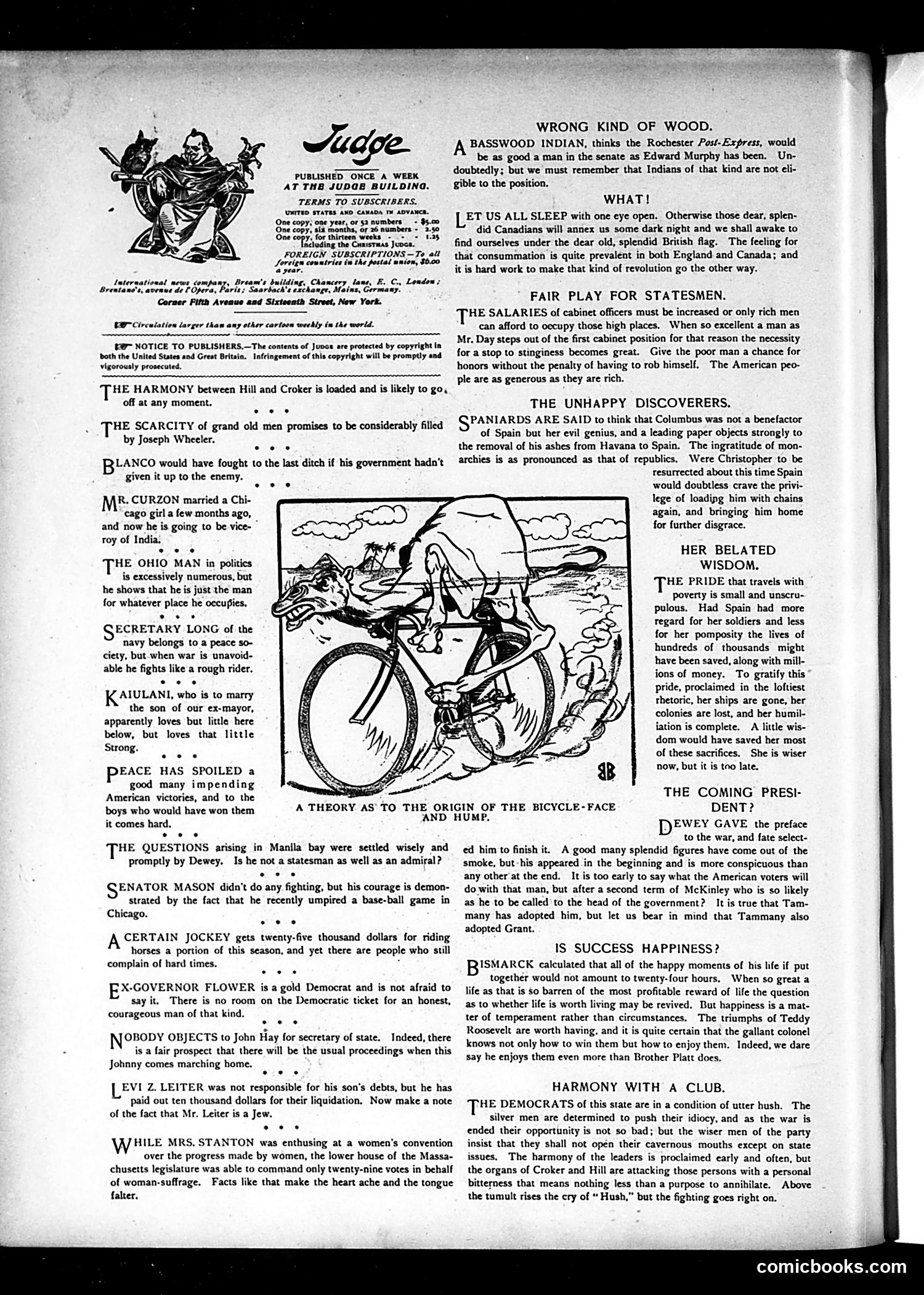
The main cartoon, titled "A Theory as to the Origin of the Bicycle-Face and Hump," depicts two cyclists in exaggerated postures—hunched over their handlebars with distorted facial expressions. This satirizes the "bicycle face" phenomenon, a genuine Victorian-era medical concern claiming that cycling caused permanent facial deformity and poor posture in riders, particularly women. The surrounding editorial snippets mock various political figures and issues of the era, including references to cabinet salaries, Columbus, and Democratic Party conflicts. The overall tone combines social commentary on emerging technologies with political criticism typical of Judge's satirical approach during the early 20th century.
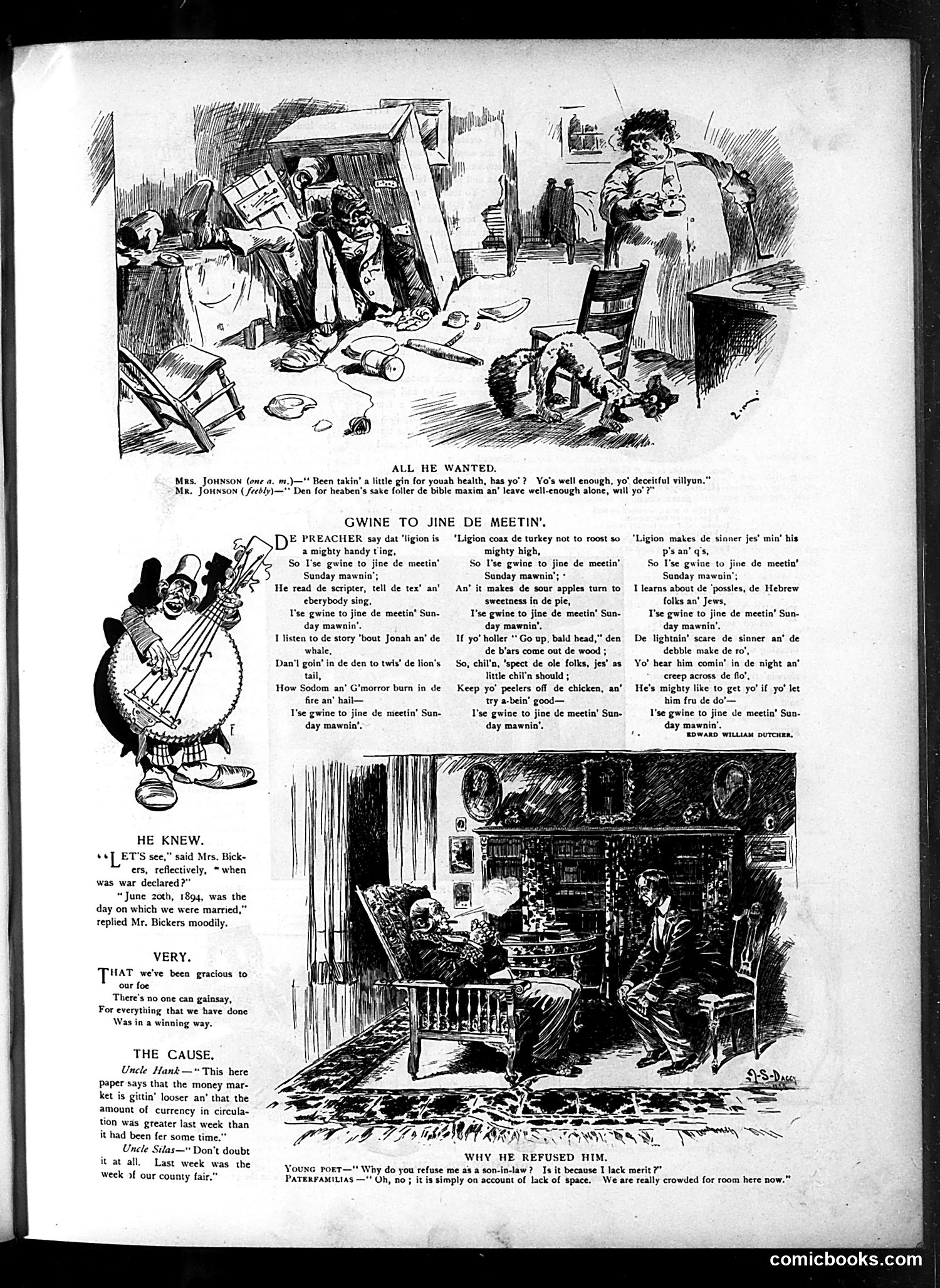
This page contains several satirical sketches and poems satirizing contemporary social issues and character types: **"All He Wanted"** depicts a messy domestic scene, likely critiquing poverty or working-class life, with dialogue about providing "gin" for health. **"Gwine to Jine de Meetin'"** is a dialect poem mocking African American religious practices through exaggerated phonetic spelling—reflecting the racist humor typical of this era. **"He Knew"** appears a brief anecdote about marital discord. **"Why He Refused Him"** shows two men in conversation about refusing someone as a son-in-law due to overcrowding, suggesting class or social anxiety about housing and respectability. The overall tone reflects Judge's satirical approach to American social life, though much relies on period-specific prejudices now recognized as offensive.
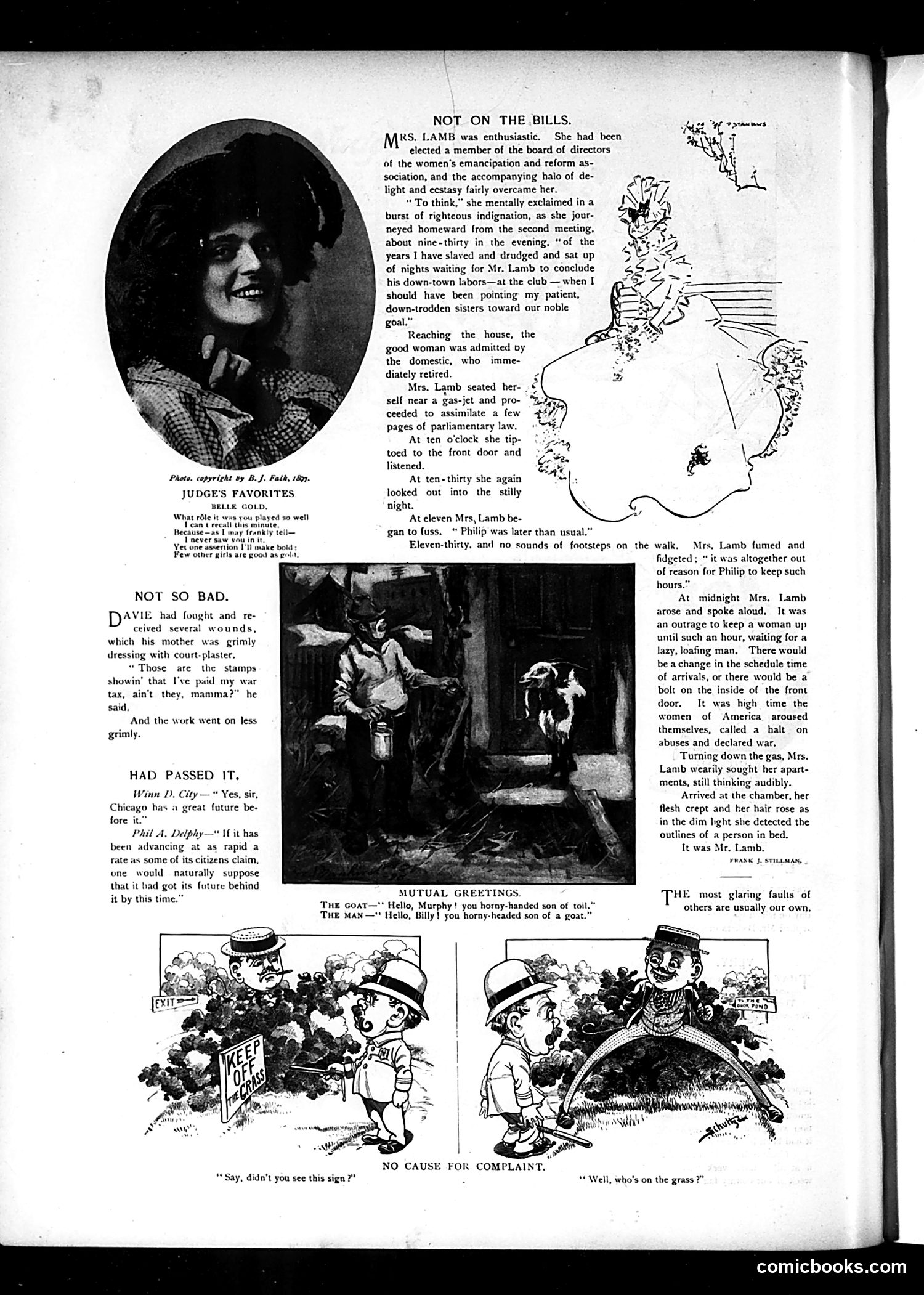
This page contains three distinct sections satirizing early 20th-century American social and political issues: **"Not On the Bills"** features Mrs. Lamb, a women's suffrage advocate elected to a board of directors. The satire mocks her activism, suggesting her commitment to reform causes conflicts with her domestic duties—a common anti-suffrage argument of the era. **"Not So Bad"** and **"Had Passed It"** briefly discuss war expenses and Chicago's economic future, appearing to reference post-WWI fiscal concerns. **Bottom cartoons** labeled "Mutual Greetings" and "No Cause for Complaint" use anthropomorphized animals (goats) making puns about their nature—simple visual humor typical of Judge's comedic filler. The overall page reflects early 1900s anxieties about women's political participation and post-war economic adjustment.
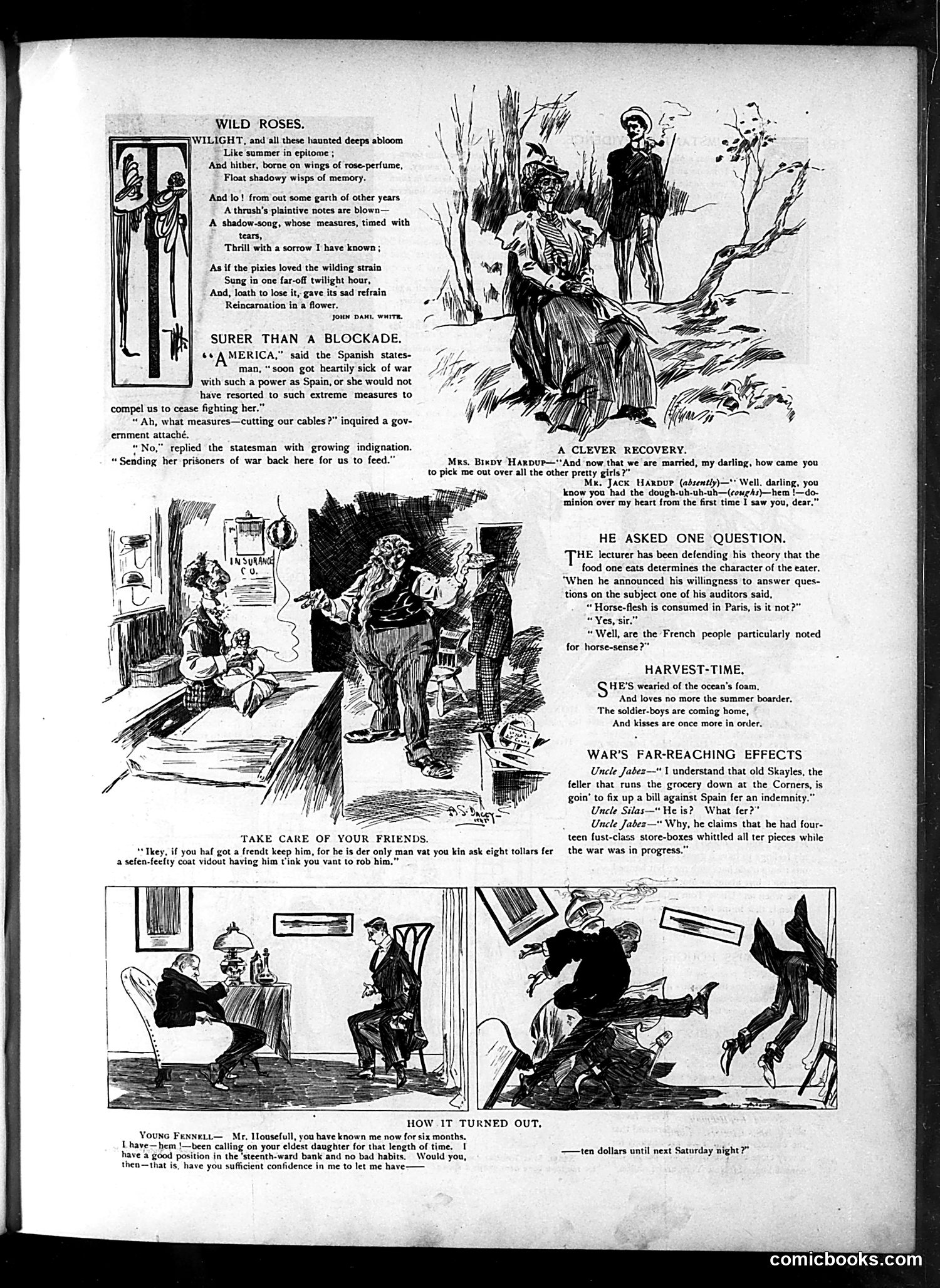
This page contains multiple short satirical pieces from Judge, likely from the Spanish-American War era (1898). **"Surer Than a Blockade"** mocks Spanish diplomatic arguments: a Spanish statesman claims America wouldn't have fought Spain so intensely, yet admits Spain's real problem is feeding Spanish prisoners of war sent back—an ironic "blockade" that starves rather than militarily defeats them. **"A Clever Recovery"** depicts a newlywed husband accidentally revealing he married for money ("dough") before catching himself mid-sentence—typical magazine humor about mercenary marriages. **"He Asked One Question"** makes a pun: a lecturer argues food determines character, then gets asked if horse-eating French people possess "horse-sense" (common sense)—they famously don't, the joke implies. **"War's Far-Reaching Effects"** shows rural characters discussing how a grocer plans to bill Spain for merchandise damaged during wartime—absurdist humor about civilian war profiteering. The remaining pieces are domestic humor about romance and social aspiration, unrelated to current events.
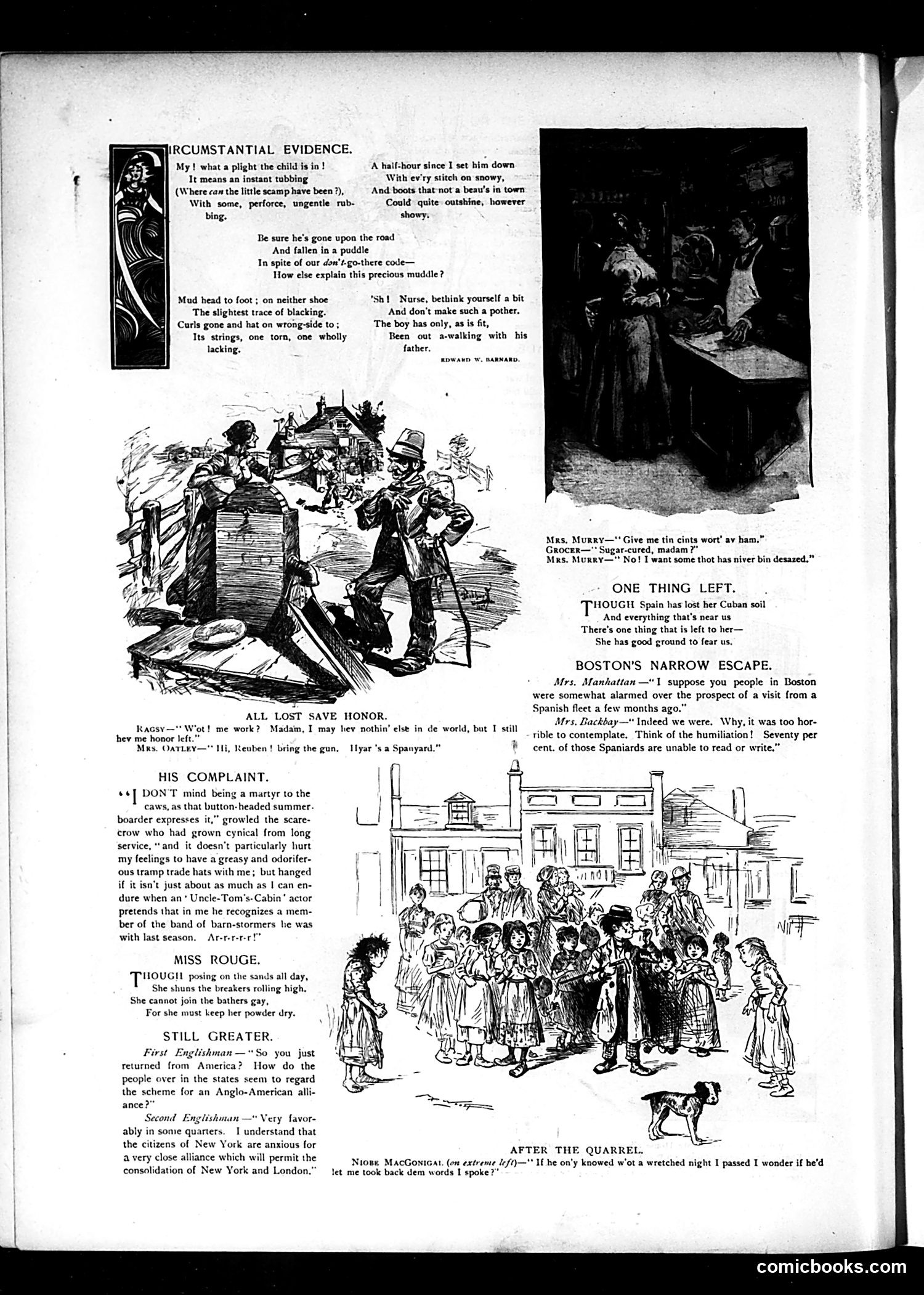
This page contains multiple satirical pieces reflecting turn-of-century American concerns: **"Circumstantial Evidence"** depicts a mother blaming a child's muddy appearance on wandering, while a nurse reveals he was legitimately out with his father—mocking parents' hasty assumptions. **"One Thing Left"** and **"Boston's Narrow Escape"** reference the Spanish-American War era (appears to be 1898 or shortly after). They mock Boston society's fear of Spanish naval attack, with a snobbish Bostonian bragging that 70% of Spanish soldiers are illiterate—satirizing both war anxiety and American arrogance. **"His Complaint"** ridicules a theatrical scarecrow irritated when a touring actor recognizes him as a fellow barn-stormer. **"Miss Rouge"** jokes that a vain woman won't bathe in the ocean lest she ruin her makeup. The Anglo-American alliance piece reflects contemporary political discussion about U.S.-British cooperation. Overall, the page mixes domestic humor with post-war jingoism and social satire typical of 1890s-era Judge magazine.
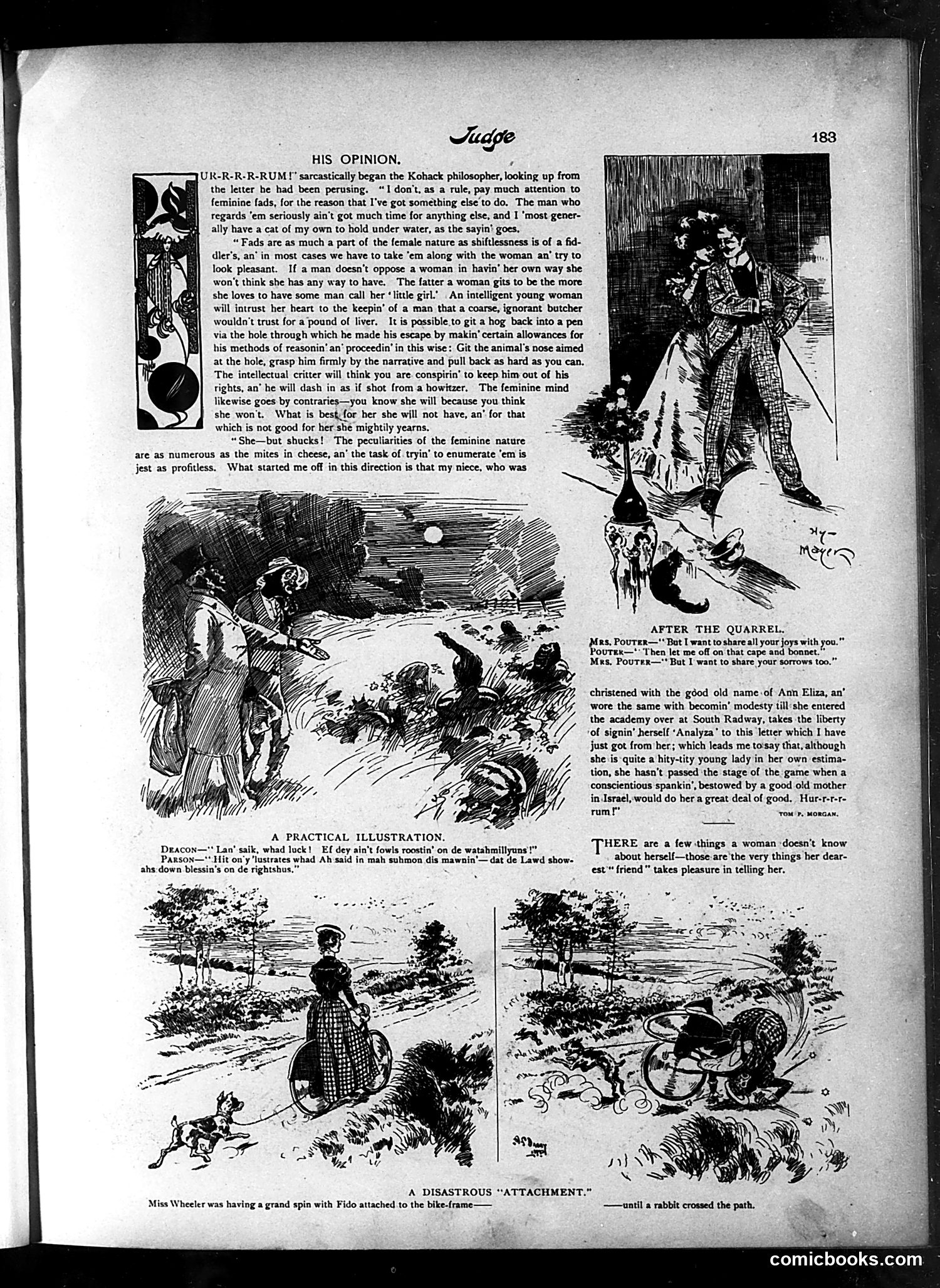
This page contains a misogynistic opinion piece disguised as humor, typical of early 20th-century satire. **"His Opinion"** presents a curmudgeonly male philosopher (the "Kohack philosopher") expounding on women's nature—portraying them as irrational, vain, and inherently contradictory. He uses crude analogies (comparing women to hogs) to argue that feminine psychology operates on reverse logic: women reject what's good for them and crave what's harmful. The specific trigger is his niece "Ann Eliza" renaming herself "Analyza" upon entering an academy, which he views as pretentious affectation deserving punishment. The accompanying illustrations satirize women's behavior: a quarrel between spouses over sharing joys versus sorrows; a woman's bicycle mishap when her dog causes a crash upon spotting a rabbit. **The satire's target** isn't actually women's behavior but rather male anxiety about female independence and self-determination. The magazine presents this misogyny as commonsense philosophy, reflecting period attitudes about women's education, autonomy, and "proper" gender roles.
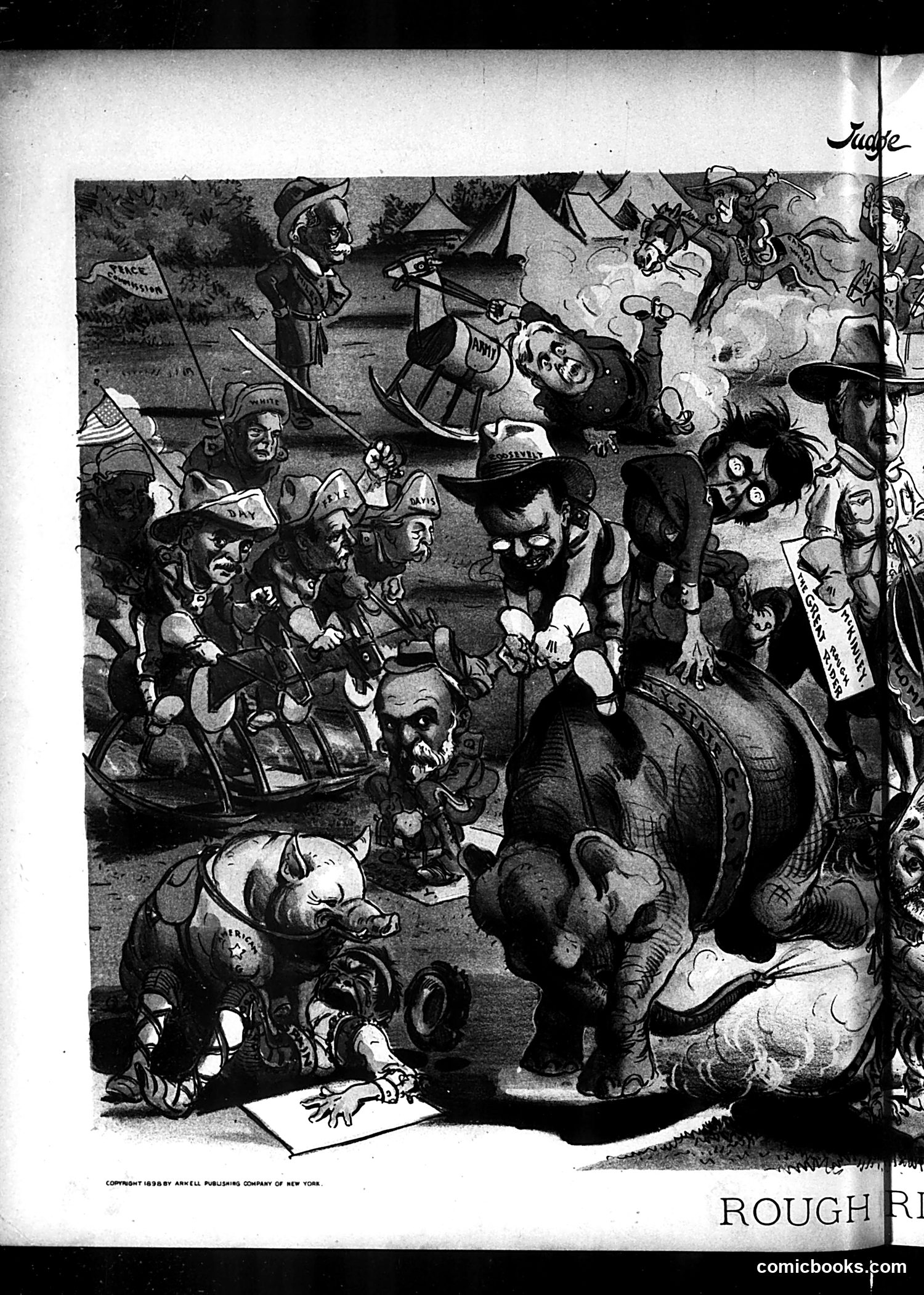
This appears to be a political cartoon from Judge magazine (copyright 1918 by Ames Publishing Company). The image depicts a chaotic circus or carnival scene with anthropomorphized animals and caricatured human figures in military/political dress. The setting suggests wartime satire, likely related to World War I given the 1918 date and military uniforms visible. The cartoon seems to mock political or military leadership through exaggerated animal caricatures and circus imagery, suggesting incompetence or absurdity in governance. Without clearer identifying labels or the complete title visible (only "ROUGH RI" appears), I cannot definitively identify specific political figures being satirized. The overall tone suggests criticism of wartime management or political chaos.
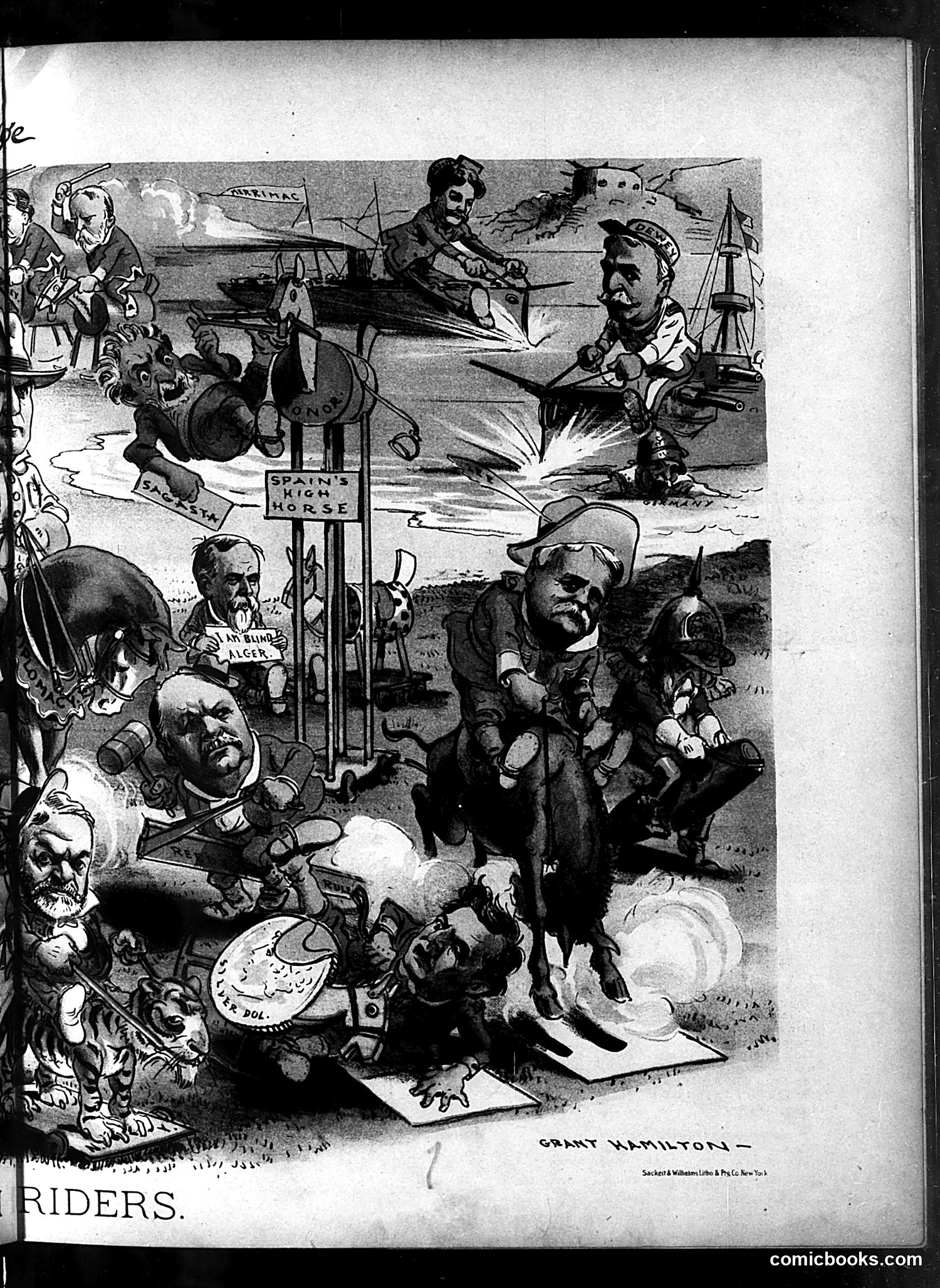
This Judge magazine cartoon satirizes American military and political leadership, likely from the late 19th century. The title "Grant Hamilton—Riders" appears at bottom. The central figures are caricatured military/political leaders depicted as riders on various creatures and contraptions. Text visible includes "Spain's Horse" and references to "Dollar" and "Algier," suggesting commentary on American imperial ambitions and foreign policy—possibly regarding Spain's colonies or North African interests. The style uses exaggerated facial features typical of period political satire to mock these leaders. Multiple caricatured heads and figures in the foreground and background suggest a broader critique of American power-brokers and their competing agendas. Without clearer text visibility, the precise historical moment and specific individuals targeted remain unclear, though the maritime/naval imagery and imperial themes are evident.
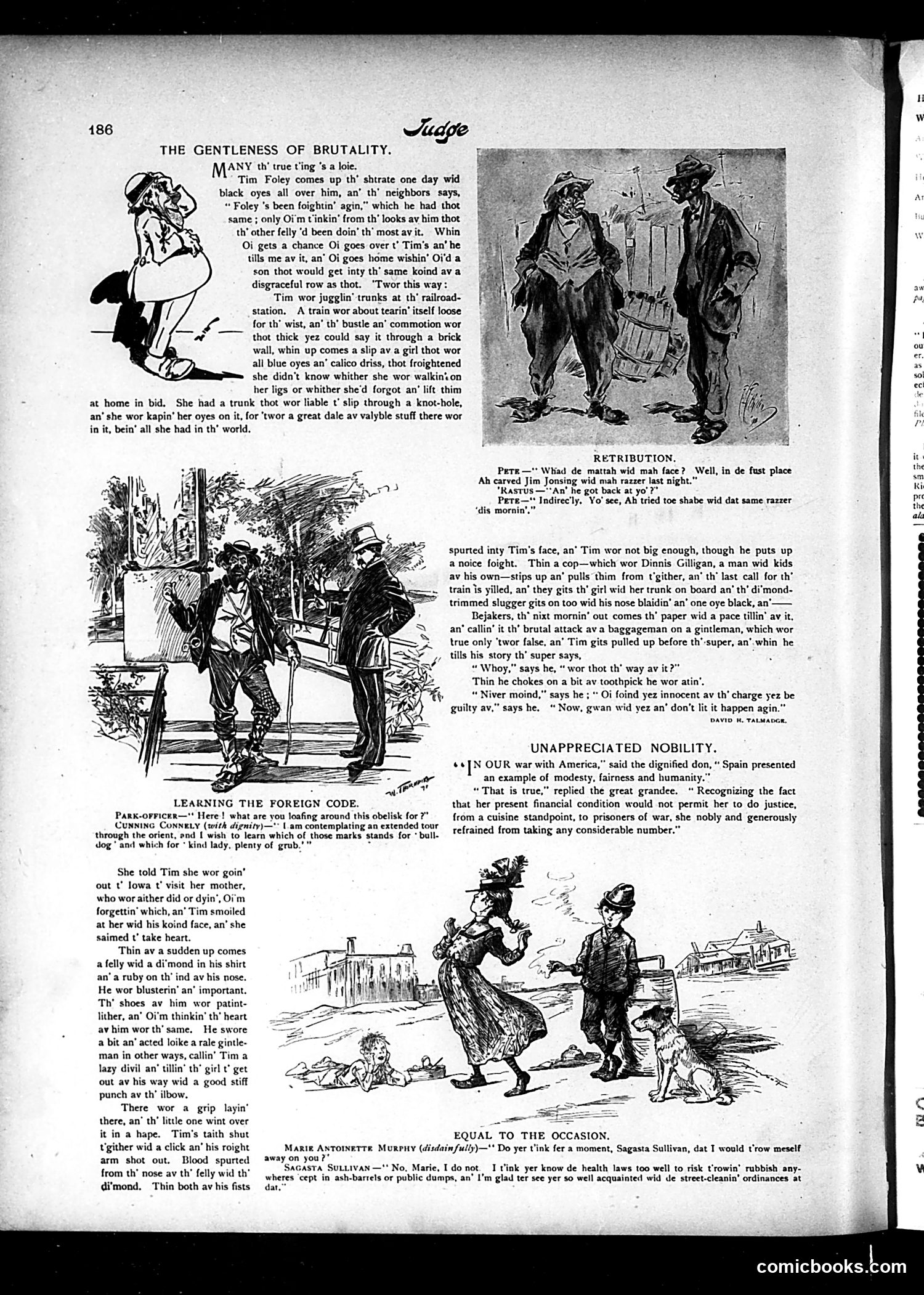
This page contains three satirical pieces lampooning American social hypocrisy: **"The Gentleness of Brutality"** tells of Tim Foley, a railroad baggage handler, who defends a frightened immigrant girl from a wealthy, arrogant man ("dimond in his shirt"). Tim is beaten but wins the fight. Newspapers falsely report Tim brutalized a gentleman. A corrupt police superintendent exonerates Tim while winking at injustice—the satire being that working-class decency is criminalized while upper-class rudeness escapes consequences. **"Retribution"** depicts racial violence: a Black man's scarred face results from a razor fight and botched shaving attempt—dark humor about cycles of brutality. **"Unappreciated Nobility"** mocks Spain's conduct in the Spanish-American War, sarcastically praising Spanish "modesty" while noting their poverty prevented feeding American prisoners—satire targeting both Spanish hypocrisy and American jingoism. The cartoons use exaggerated dialect and caricature typical of the era's crude ethnic humor while critiquing class injustice and imperial warfare.
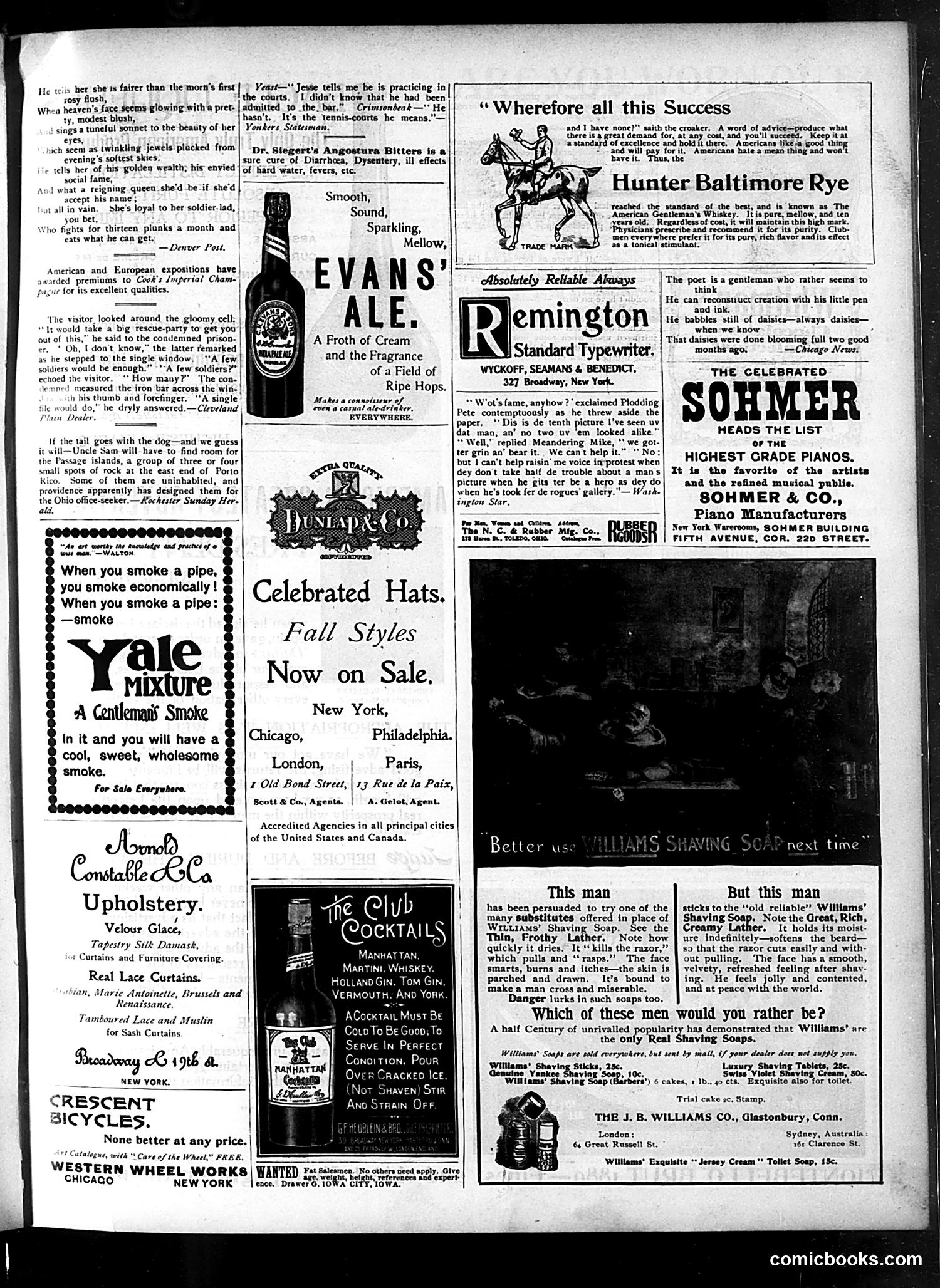
This page is primarily **advertisements and short humor pieces**, not political cartoons. The visible jokes include: - **"Jesse tells me he is practicing in courts"**: A pun where someone thinks their friend practices law, but he actually practices tennis on tennis courts. - **"A single bar would do"**: A condemned prisoner in a cell jokes that he only needs one iron bar to escape (implying he could bend/remove a single bar), playing on the visitor's suggestion that "a big rescue-party" would be needed. - **Porto Rico office-seekers**: A satirical reference to the U.S. acquiring Puerto Rico (likely post-Spanish-American War context) and suggesting the U.S. government will send unwanted Ohio political appointees there. The remainder is **product advertising** for whiskey, ale, hats, bicycles, upholstery, shaving soap, and typewriters—typical of Judge magazine's revenue model. The page lacks significant political or social satire beyond mild workplace and regional humor.
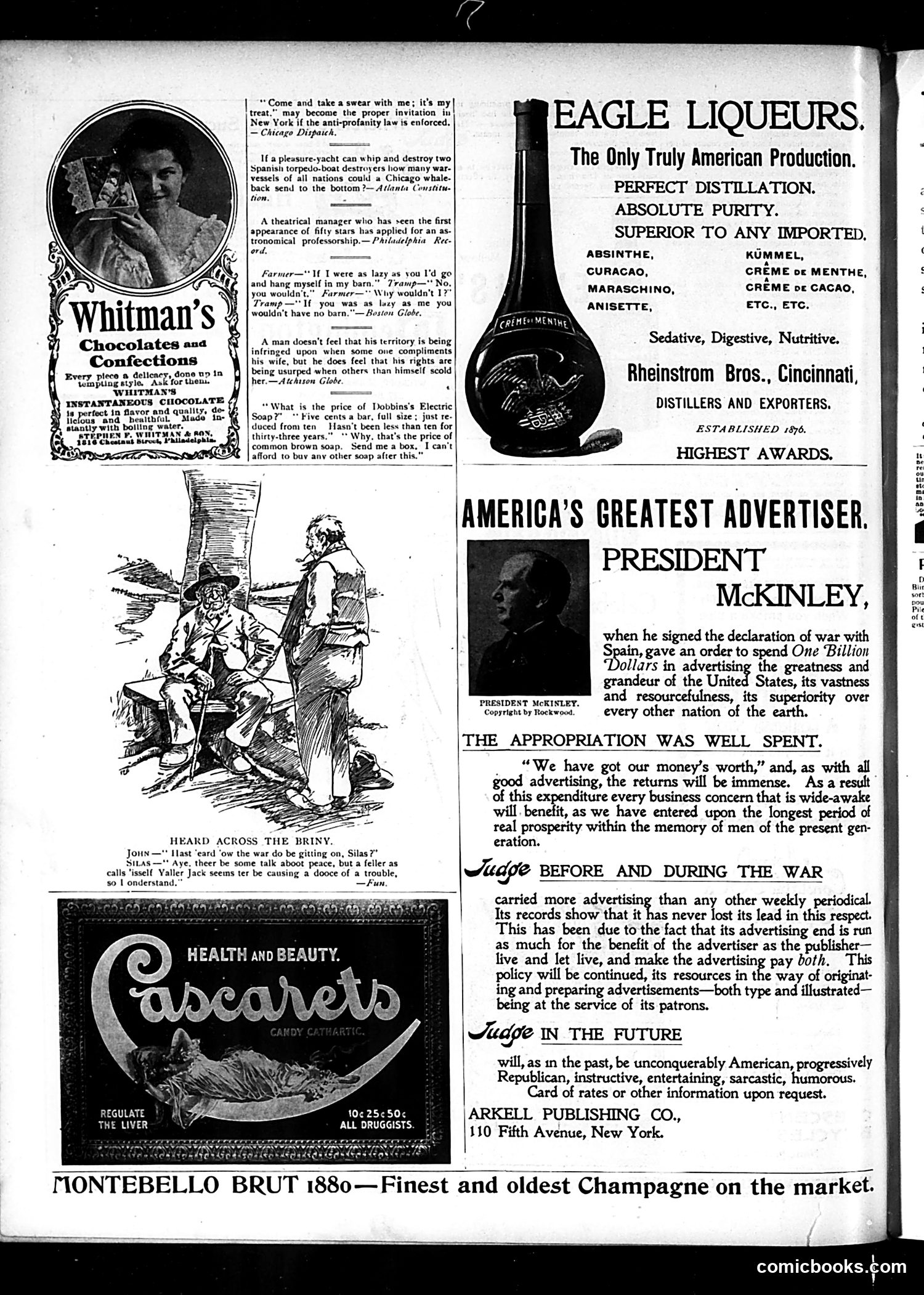
This page from *Judge* (a satirical weekly) primarily showcases **advertisements** alongside editorial commentary, likely from around 1898 during the Spanish-American War. **Main Content:** The dominant feature celebrates President **McKinley's war expenditure**. The text ironically praises McKinley for ordering "$One Billion Dollars in advertising the greatness and grandeur of the United States" when declaring war on Spain. The satire suggests that war itself functions as national advertising—a way to demonstrate American superiority and military power to the world. **The Joke:** *Judge* claims this massive spending was justified because it generated economic prosperity and business confidence. The magazine self-congratulates for carrying more war-related advertising than competitors, positioning itself as benefiting both advertisers and readers through this "live and let live" approach. **Context:** This reflects turn-of-century American imperialism and the emerging belief that military dominance and commercial expansion were intertwined—that warfare could be justified economically as a form of national brand-building. The scattered short jokes above are unrelated fillers typical of the era.
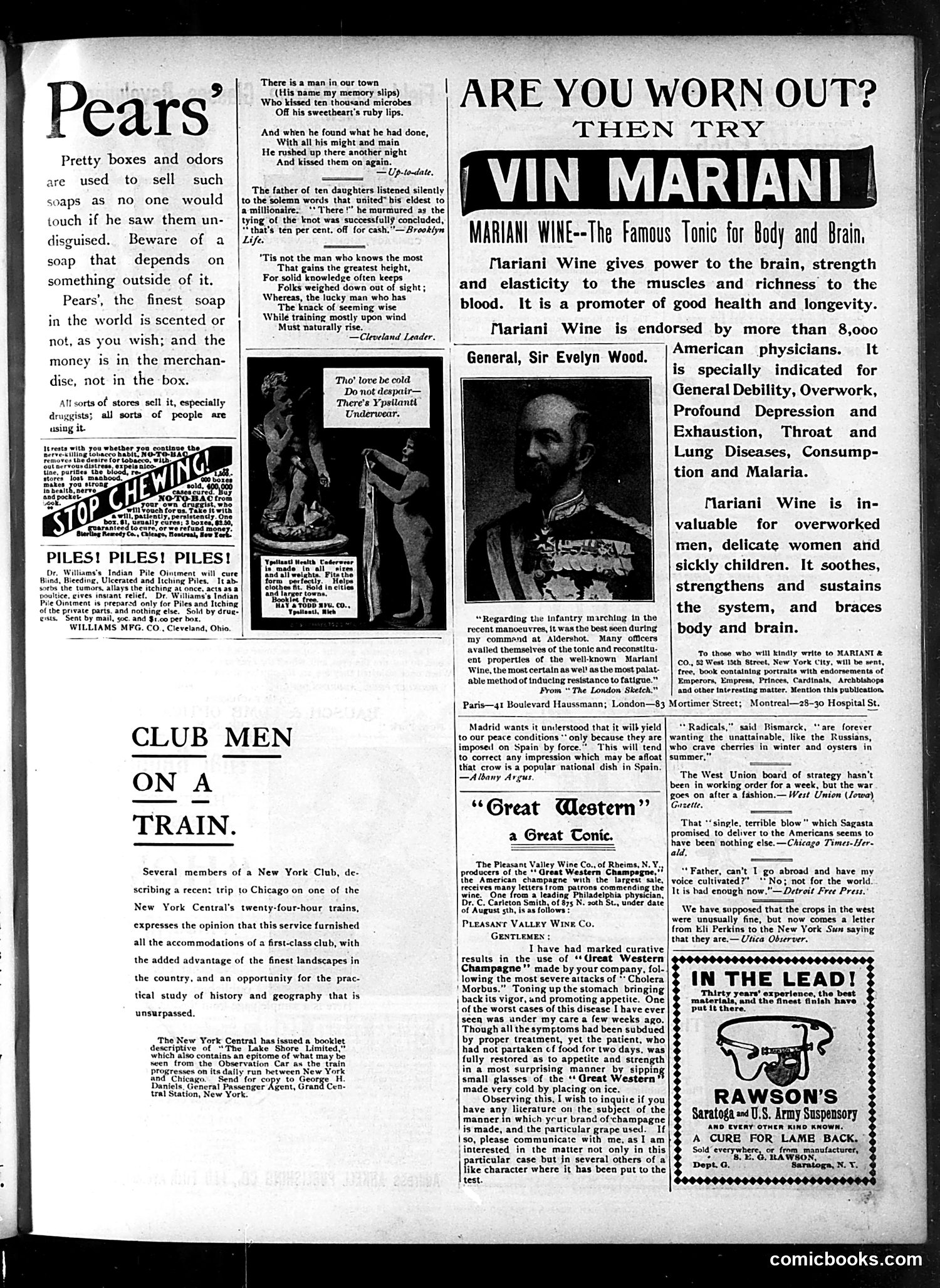
This page is primarily **advertising**, with several vintage patent medicine and product ads alongside humorous verses and a brief article. The main satire targets **marketing deception**: the Pears' soap ad criticizes how products rely on attractive packaging rather than quality—"Pretty boxes and odors are used to sell soaps as no one would touch if he saw them undisguised." The humorous verses mock social conventions: one jokes about a man kissing microbes off his sweetheart's lips; another satirizes a father calculating his daughter's marriage as a financial discount ("ten per cent. off for cash"). The dominant advertisements promote **dubious medicinal tonics** typical of the era: Mariani Wine (endorsed by "8,000 American physicians" and military figures like General Evelyn Wood) claims to cure exhaustion, malaria, and consumption; Dr. Williams's Indian Pile Ointment promises hemorrhoid relief. These reflect the era's widespread snake-oil marketing before FDA regulation. The "Club Men on a Train" article praises the New York Central's luxury service—contemporary lifestyle content rather than satire.
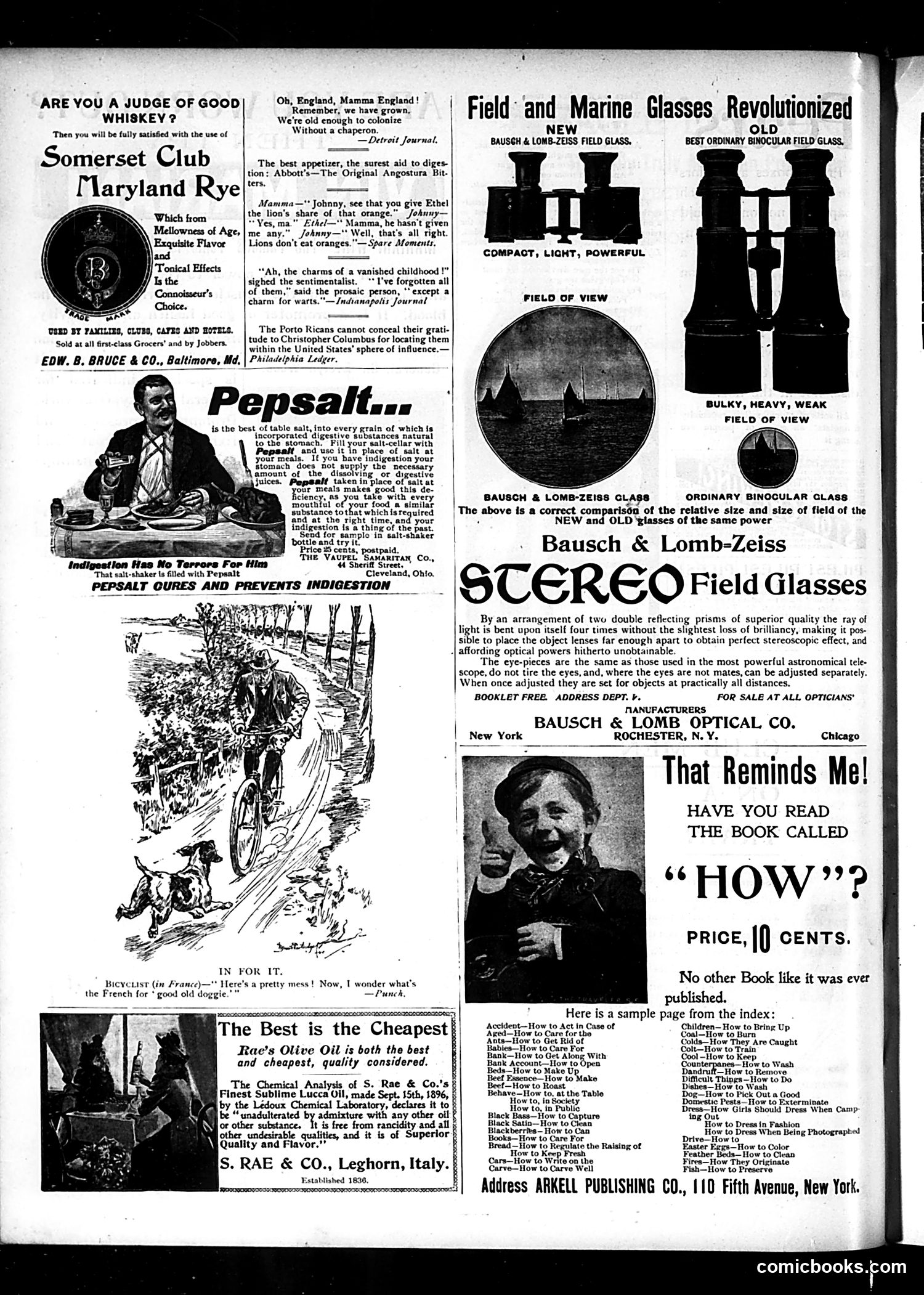
This page is primarily **advertising** from Judge magazine, with minimal satirical content. The notable cartoon appears in the lower left: a cyclist in France encountering a dog, captioning "good old doggie"—a light joke about language barriers. The political reference is a brief editorial quip about **Puerto Rico**: "The Porto Ricans cannot conceal their gratitude to Christopher Columbus for locating them within the United States' sphere of influence." This sarcastically comments on American imperialism following the Spanish-American War (1898), when the U.S. acquired Puerto Rico. The "gratitude" is obviously ironic—suggesting Puerto Ricans had no choice in becoming American territory. The rest of the page consists of product advertisements: Somerset Club whiskey, Pepsalt digestive salt, Rae's olive oil, Bausch & Lomb field glasses, and a self-help book called "How?" None contain significant satire or cultural commentary.
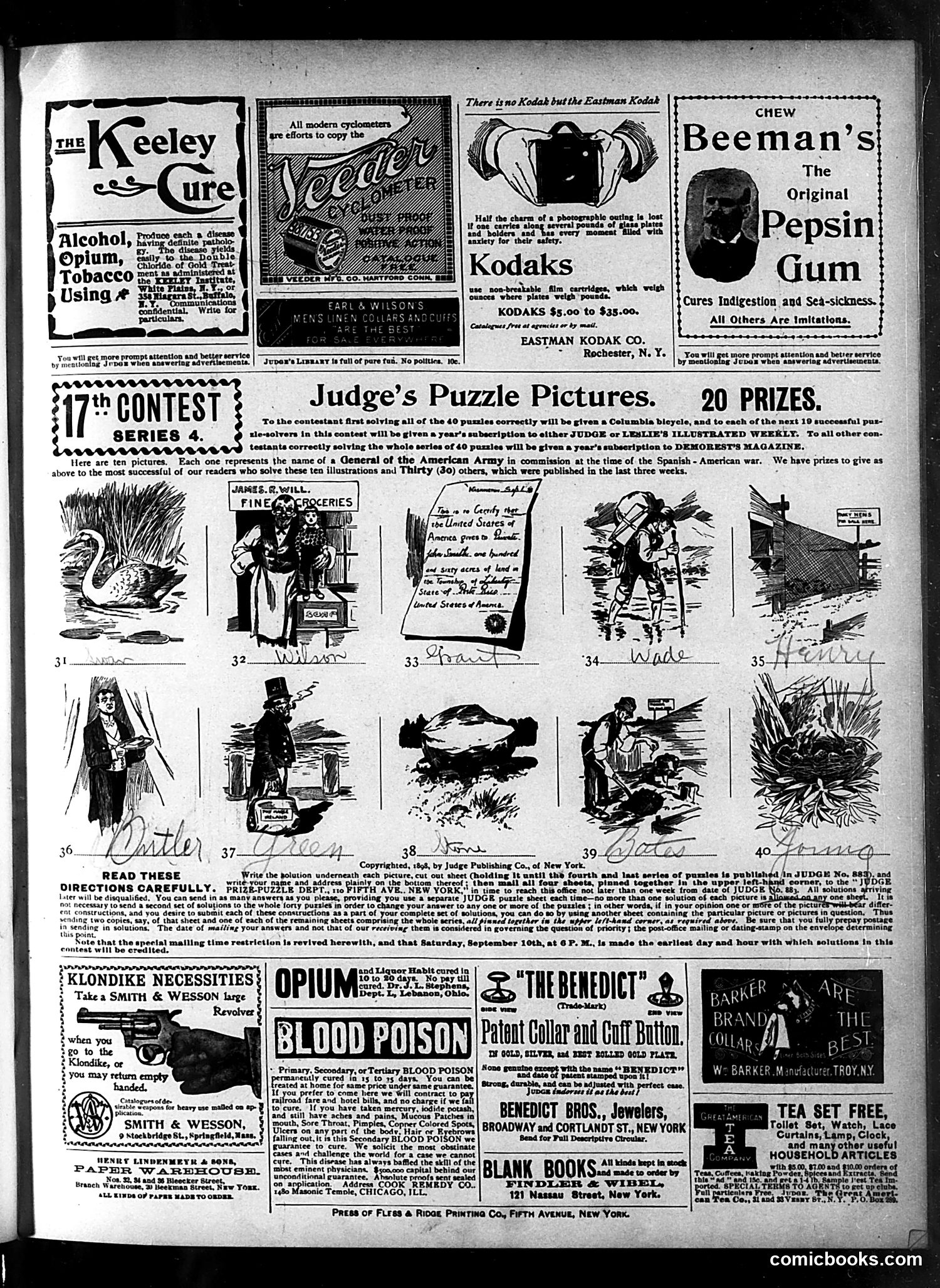
This page is primarily **advertising and a puzzle contest**, not political satire. The main content is Judge's "17th Contest, Series 4"—a puzzle competition where readers identify ten illustrations representing names of American generals from the Spanish-American War (circa 1898). Winners receive a Columbia bicycle and magazine subscriptions. The page is dense with period advertisements for now-notorious products: **Keeley Cure** (claiming to treat alcohol, opium, and tobacco addiction), **Beeman's Pepsin Gum** (for indigestion), **Kodak cameras**, and most strikingly, **"Opium Blood Poison"** treatment and a "Patent Collar and Cuff Button." These ads reveal what modern readers would find shocking: the casual marketing of addictive substances and dubious medical "cures" as legitimate products. The Keeley Institute advertisement, for instance, promises relief from substance abuse through their proprietary treatment—reflecting an era before drug regulation and medical standards. The puzzle itself appears to be a patriotic exercise celebrating recent American military heroes.
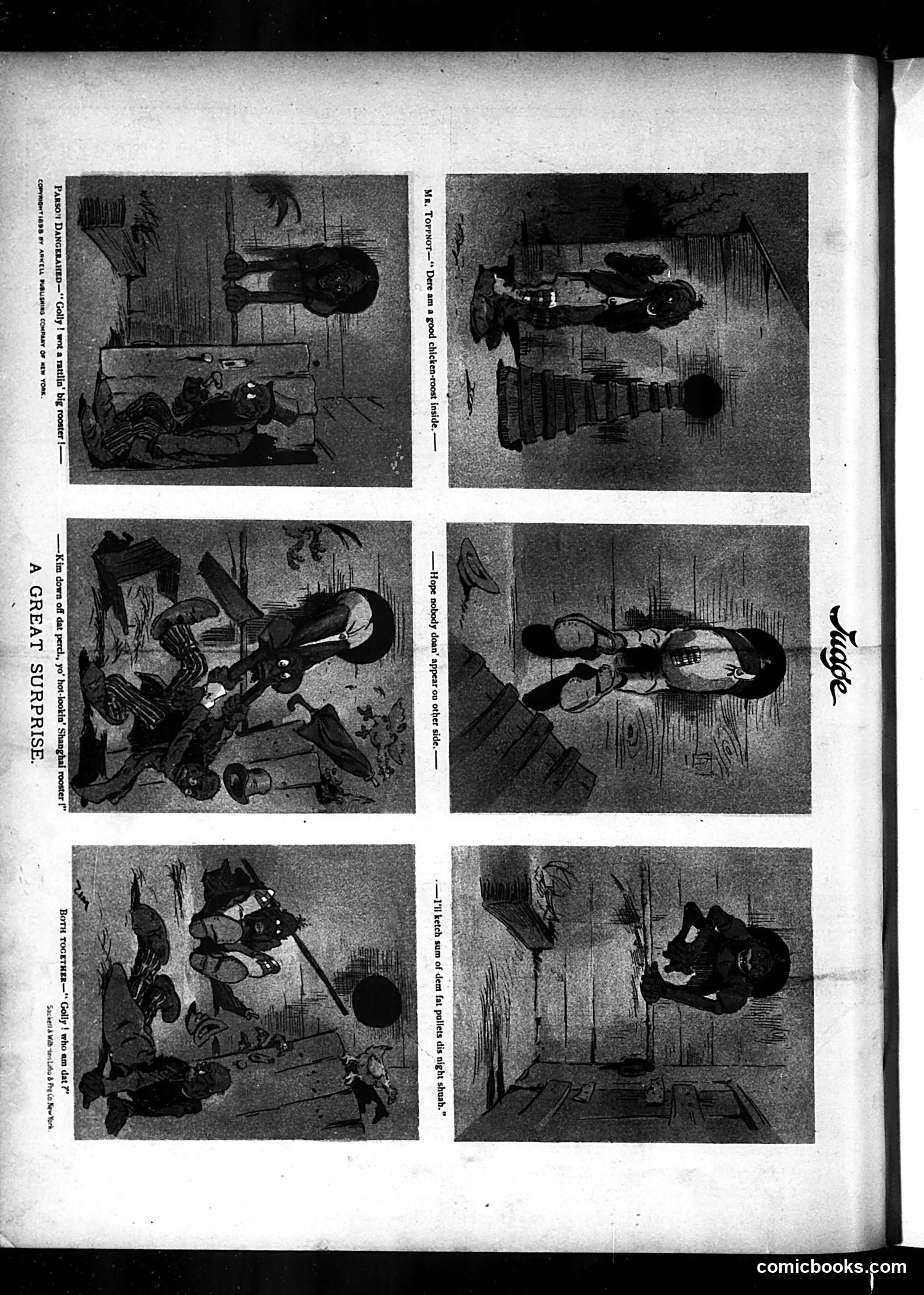
This Judge magazine cartoon uses racist caricatures and dialect to depict what appears to be two Black figures discovering a large rooster. The narrative follows their escalating reactions: first spotting a chicken-roost, then marveling at an enormous "Shanghai rooster" (a large breed), warning each other to stay quiet so "nobody" appears, and finally both jumping back in fright at the bird's appearance. The satire likely mocks both the figures' superstitious fear and rural simplicity—a common racist trope of the era. The "great surprise" is the comical revelation that what they feared was merely a rooster. The heavy use of exaggerated dialect and the setup suggest this targets turn-of-the-century stereotypes about Black Americans and rural life for white middle-class Judge readers' entertainment.