
A complete issue · 17 pages · 1898
Judge — June 25, 1898
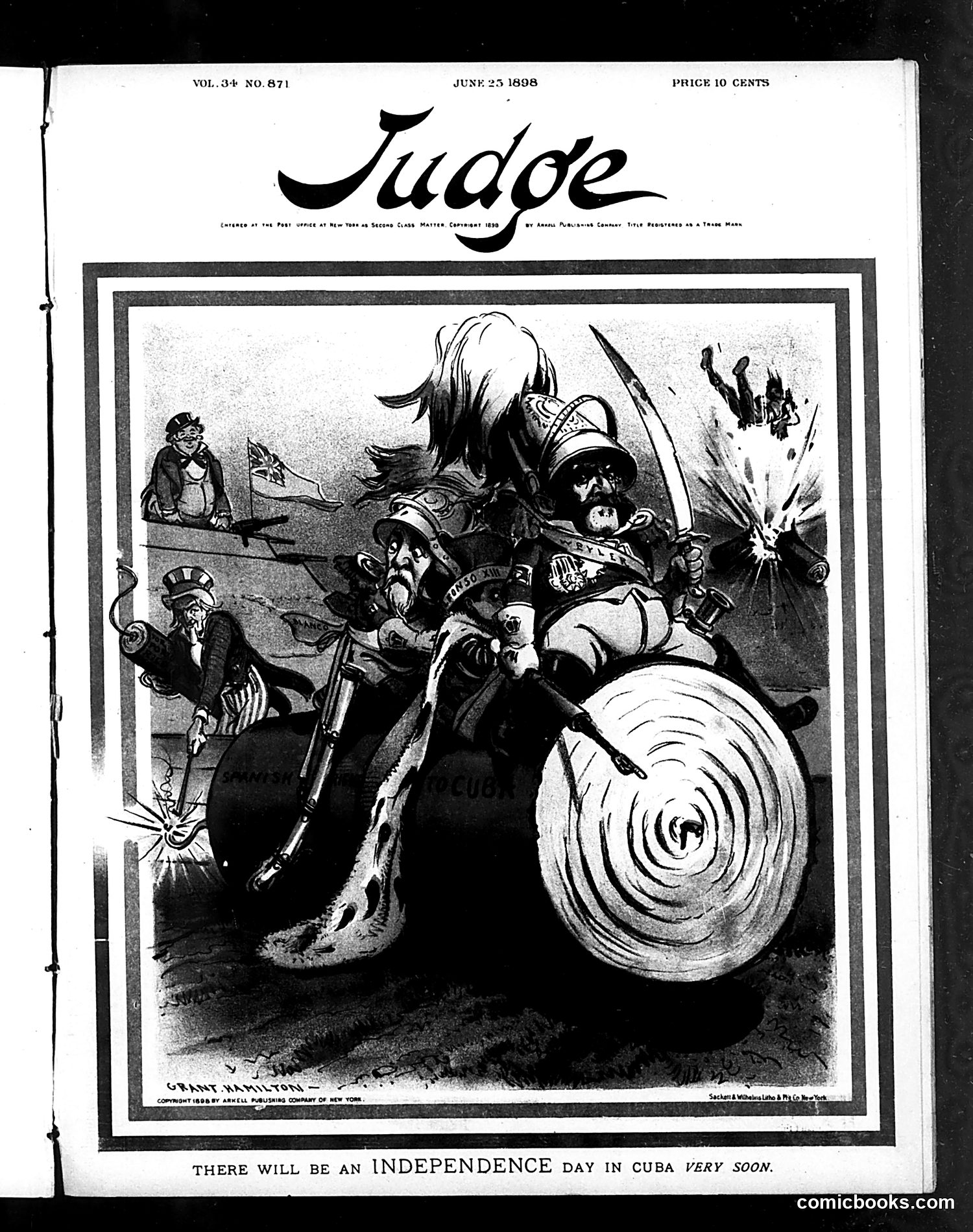
**Context:** This cartoon addresses the Spanish-American War and Cuban independence. The caption reads "There will be an Independence Day in Cuba Very Soon." **The Cartoon:** Military figures (likely representing American and Spanish forces) are depicted in violent conflict on what appears to be a motorcycle or wheeled vehicle—a modern war machine. The exaggerated caricatures and chaotic action suggest satirical commentary on the military intervention in Cuba. **The Point:** Published in 1898 during America's war with Spain over Cuban independence, the cartoon appears to mock or comment on the coming liberation of Cuba through American military force. The absurd imagery of armed conflict on a modern vehicle likely satirizes the nature of this "splendid little war" and its promised outcome for Cuban freedom.
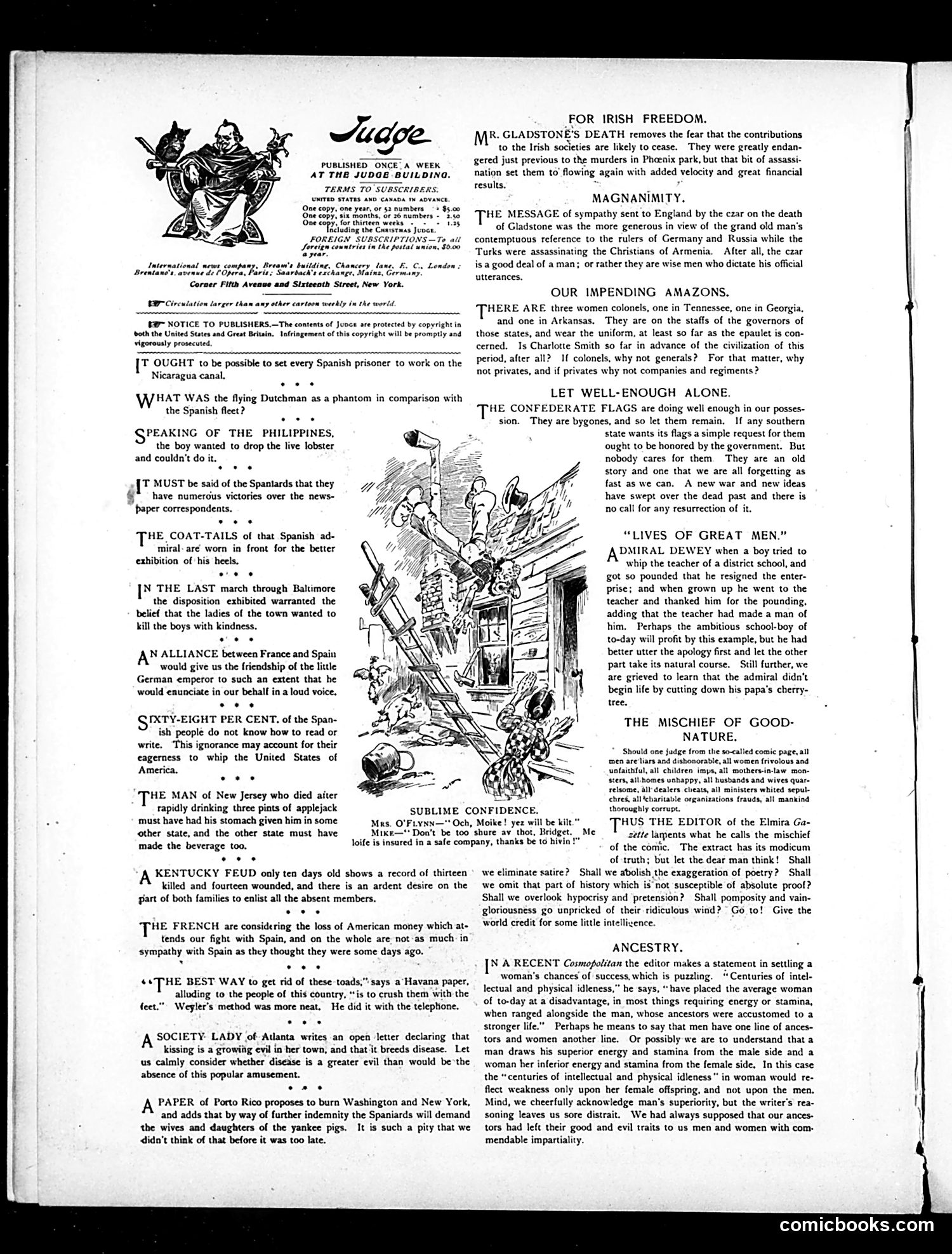
The main cartoon depicts a chaotic scene of destruction—a building explodes with figures being thrown into the air. Based on the surrounding text columns, this appears to satirize anarchist or radical political violence, specifically referencing dynamite attacks that were a genuine concern during this era of labor unrest. The caption "Mrs. O'Flynn—'Och, Moke! ye'll be kilt!'/'Mike—'Don't be too shore av then, Bridget. Me loife is insured in a safe company, thanks be to him!'" uses Irish-immigrant caricature dialect to make dark humor about insurance and explosions—suggesting working-class anxiety about industrial accidents or political violence. The surrounding editorial columns address Spanish-American War politics, women's rights, and French-Spanish relations, typical of Judge's satirical coverage of contemporary affairs.
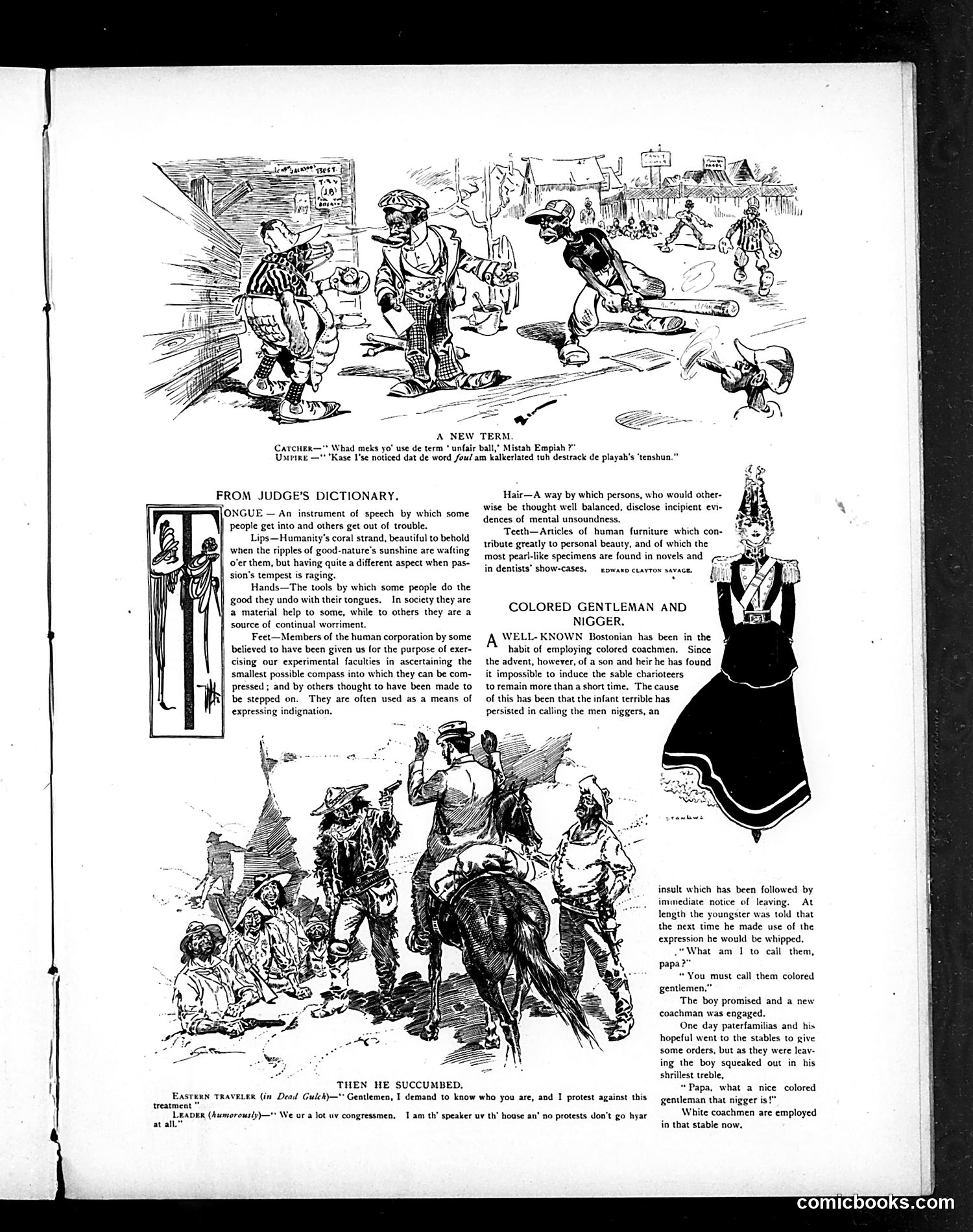
**Top Cartoon ("A New Term")**: Shows children playing baseball, with dialogue about an "unfair ball." The humor involves children misusing sophisticated vocabulary—one child references "Tennyson's 'tenebrae,'" suggesting pretentious language among youth. **Middle Section ("From Judge's Dictionary")**: Satirical definitions of words like "Tongue," "Lips," and "Feet," presented with mock-erudite commentary typical of Judge's style. **Bottom Cartoon ("Then He Succumbed")**: Depicts an "Eastern Traveler" confronting a coachman, with dialect humor. The caption references social tensions around employment of colored workers in the North, likely satirizing class or racial anxieties of the era. **Right Section ("Colored Gentleman and Nigger")**: The text describes a Bostonian's difficulty employing "colored coachmen," ending with a story about a child's language and parental embarrassment. The page reflects late-19th-century American social commentary on race, class, and language.
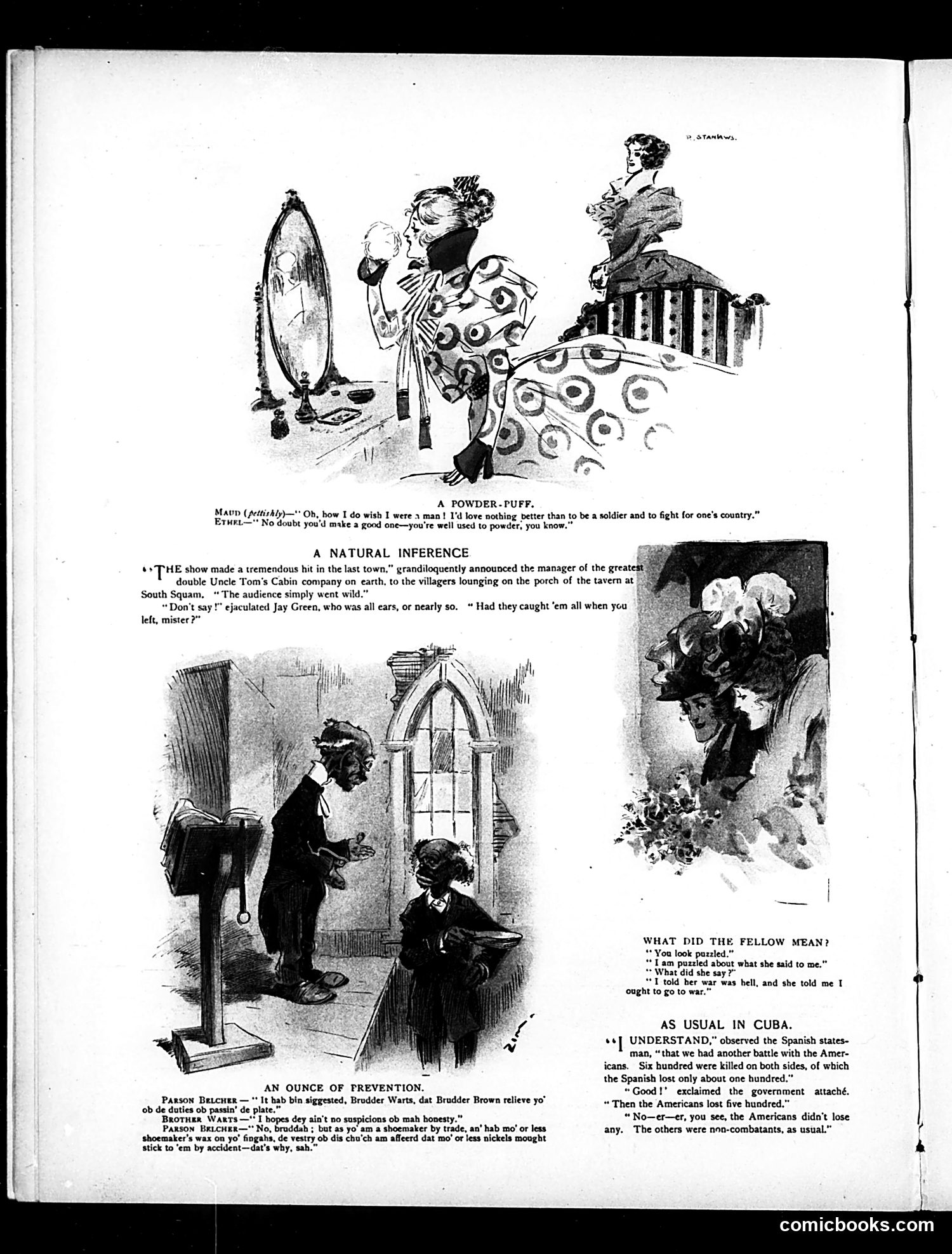
This page contains three satirical cartoons from an era when Judge frequently mocked military and political matters. **"A Natural Inference"** mocks the theatrical self-promotion of theater managers, who exaggerated success claims about shows like "Uncle Tom's Cabin." The joke plays on how audiences might naturally assume an ear-catching manager was deaf to his own exaggerations. **"An Ounce of Prevention"** appears to satirize working-class advice-givers (Parson Belcher and Brudder Warts), likely poking fun at folk remedies or superstitious prevention methods. **"As Usual in Cuba"** references Spanish-American War casualties, with a Spanish statesman coolly accepting combat losses as routine—suggesting cynical indifference to bloodshed. The page dates to the Spanish-American War era (1898), when Judge frequently satirized jingoism and military excess.
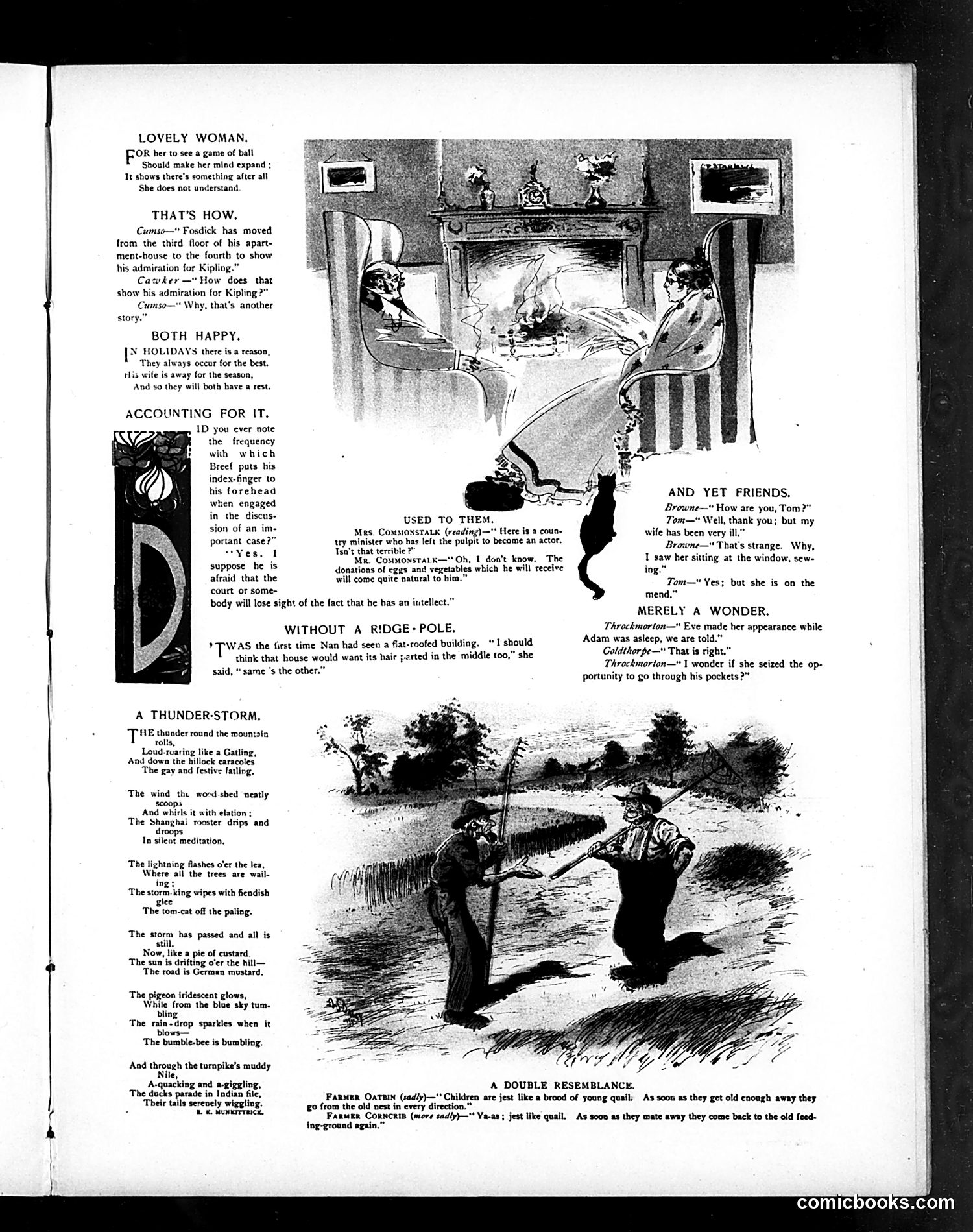
This page contains several satirical sketches and humorous verses typical of late 19th-century American humor: **Main cartoons:** - "Lovely Woman" and "That's How" mock domestic life and male pretension - "Both Happy" satirizes marital discord by suggesting husbands and wives are relieved when separated - "Accounting for It" jokes about a lawyer's nervous habit indicating lack of intellect - "Without a Ridge-Pole" presents a woman's naive observation about flat-roofed buildings - "A Thunder-Storm" is whimsical verse personifying weather effects on animals - "A Double Resemblance" compares children to quail—both eventually return to their origins **Social commentary:** The sketches reflect period attitudes toward marriage (as mutually tolerable rather than loving), women's supposed intellectual limitations, and class-based humor about farmers and ministers. The page is mostly light domestic satire with no apparent political references, relying on puns, observational humor, and gentle mockery of everyday life rather than topical commentary.
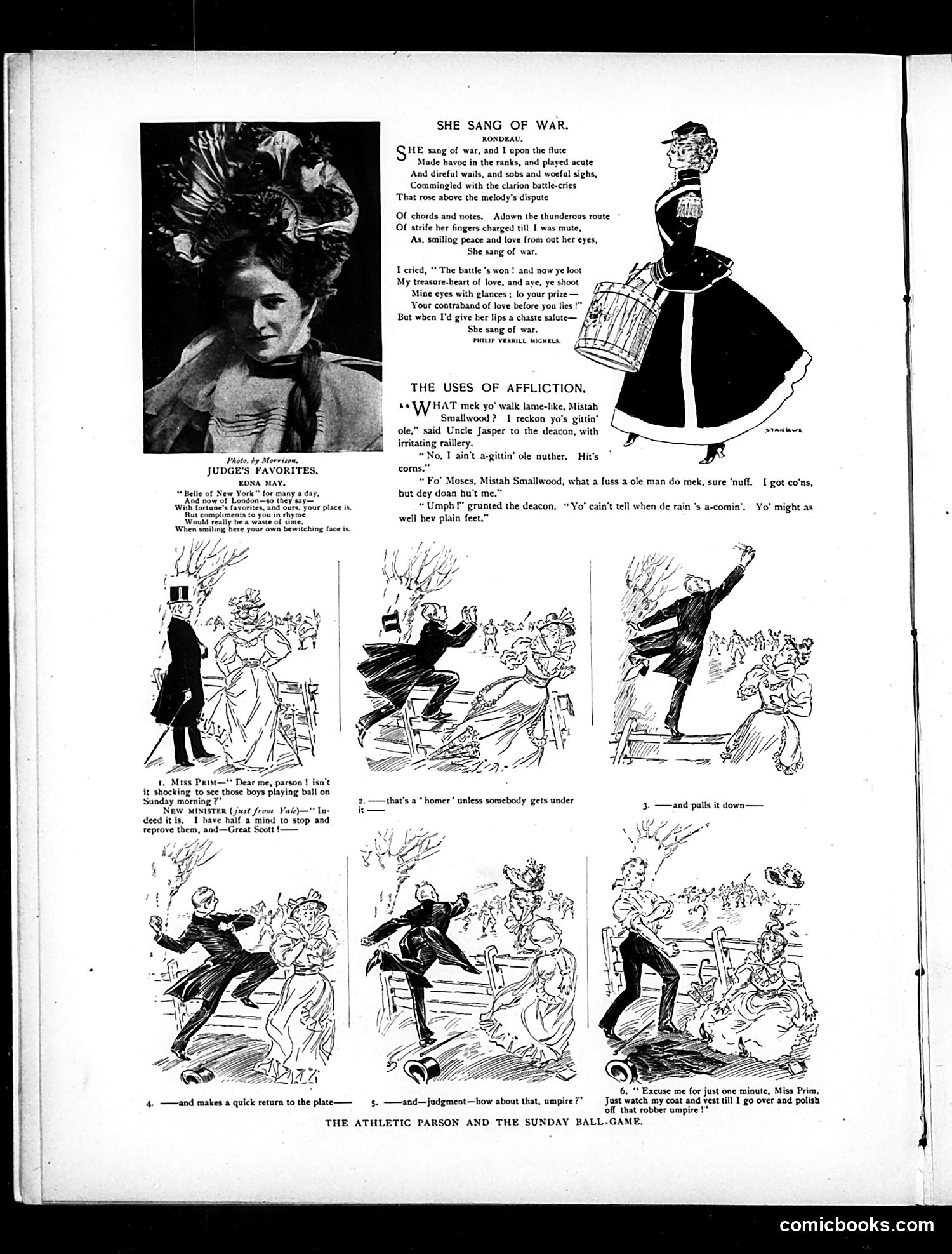
This page contains three distinct pieces of satire: **"She Sang of War"** is a romantic poem by Philip Verrill Moxell about conflicting emotions—a woman singing martial songs while the narrator professes love. The juxtaposition mocks the tension between romance and warfare, likely contemporary to World War I era. **"Judge's Favorites"** features Edna May, a Broadway actress, with a promotional caption—essentially advertising content rather than satire. **"The Athletic Parson and the Sunday Ball-Game"** is the main comic strip, satirizing religious hypocrisy. It shows a young Yale-educated minister condemning boys playing baseball on Sunday as sinful, then immediately abandoning his principles to play ball himself—and becoming so competitive he threatens violence against the umpire. The joke targets clerical sanctimoniousness and the gap between preached morality and actual behavior, a common Judge theme mocking Progressive-era social contradictions.
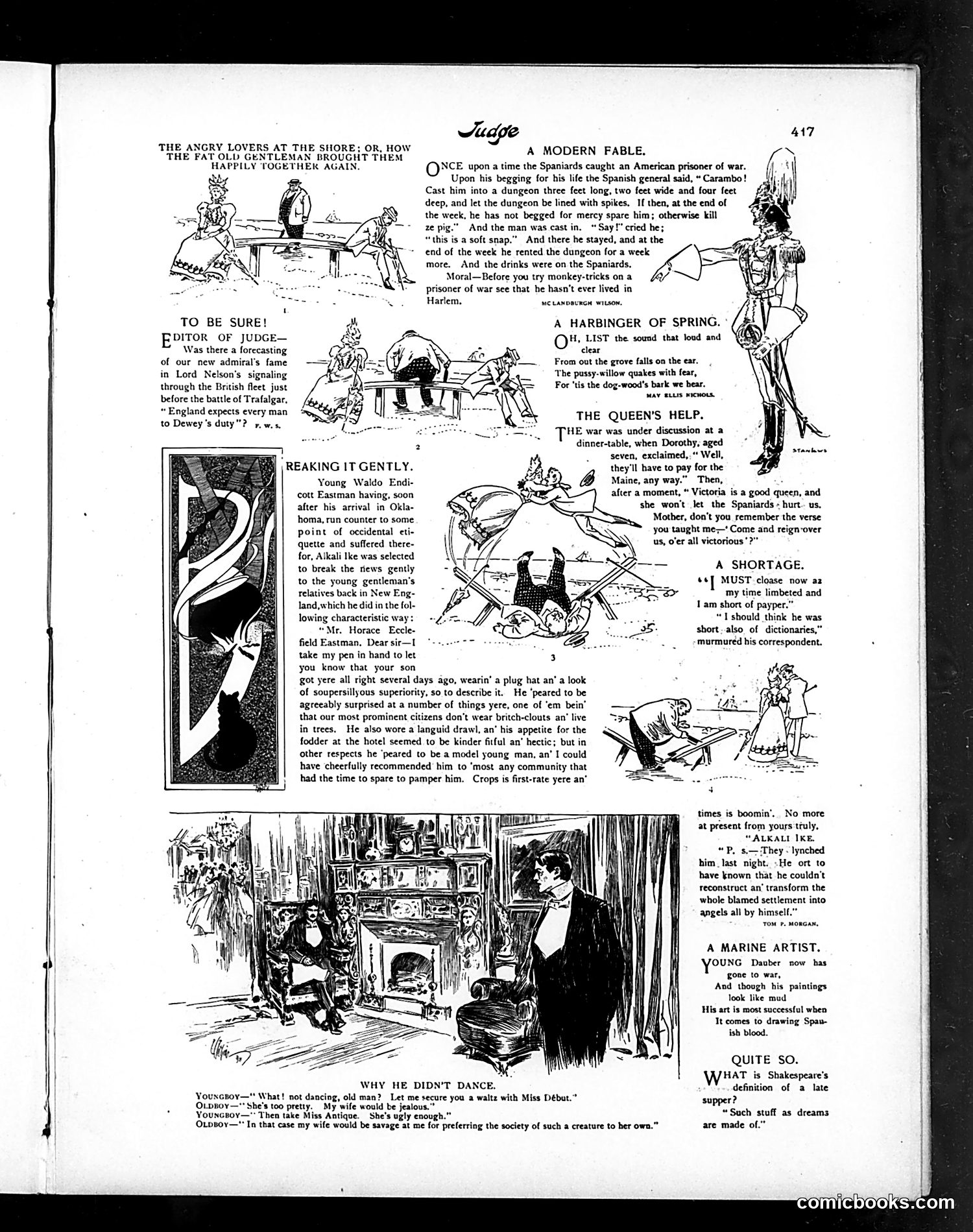
This page from *Judge* magazine (circa 1898, based on Spanish-American War references) contains several satirical pieces: **"A Modern Fable"** mocks American toughness: an American prisoner in a Spanish dungeon finds conditions so mild he rents it for another week. The moral suggests Americans from Harlem are exceptionally hardy—a racial stereotype joke. **"Why He Didn't Dance"** is a brief social satire about an older gentleman refusing to dance with a young woman, joking he won't risk his wife's jealousy—typical Victorian propriety humor. **"Breaking It Gently"** depicts a frontier character (Alkali Ike) writing to inform a New England father that his pretentious son has been lynched in Oklahoma for trying to "civilize" the settlement. This reflects contemporary anxieties about regional differences and mob violence presented as comic. **Other pieces** include light verses on spring and naval references to Admiral Dewey (recent hero of the Spanish-American War). The overall tone treats lynching, cultural superiority, and war casually as humor fodder.
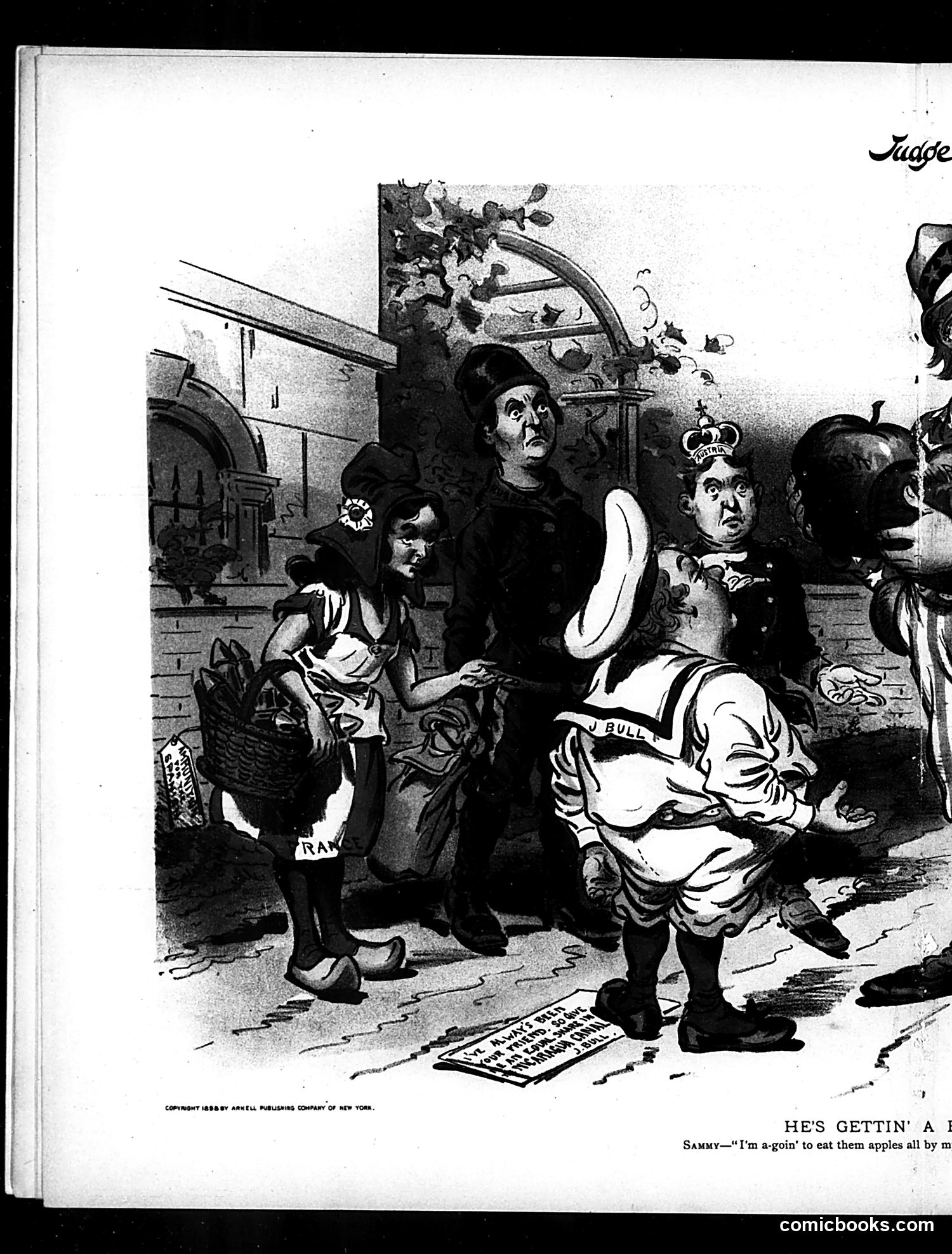
This Judge magazine cartoon appears to satirize food distribution or wealth inequality. The scene shows multiple figures in period dress (appearing to be late 19th century) gathered around what seems to be a dispute over apples. The character labeled "Sammy" declares he'll eat all the apples "by m[yself]" — suggesting selfish monopolization of resources. The other figures' expressions of concern or protest suggest social commentary on inequality or unfair hoarding of goods. The elaborate dress and exaggerated facial features typical of Judge's satirical style indicate these are caricatured social types or classes. The specific political reference remains unclear without publication date context, but the cartoon likely critiques either economic greed, labor disputes, or class conflict over basic resources — common Judge subjects of that era.
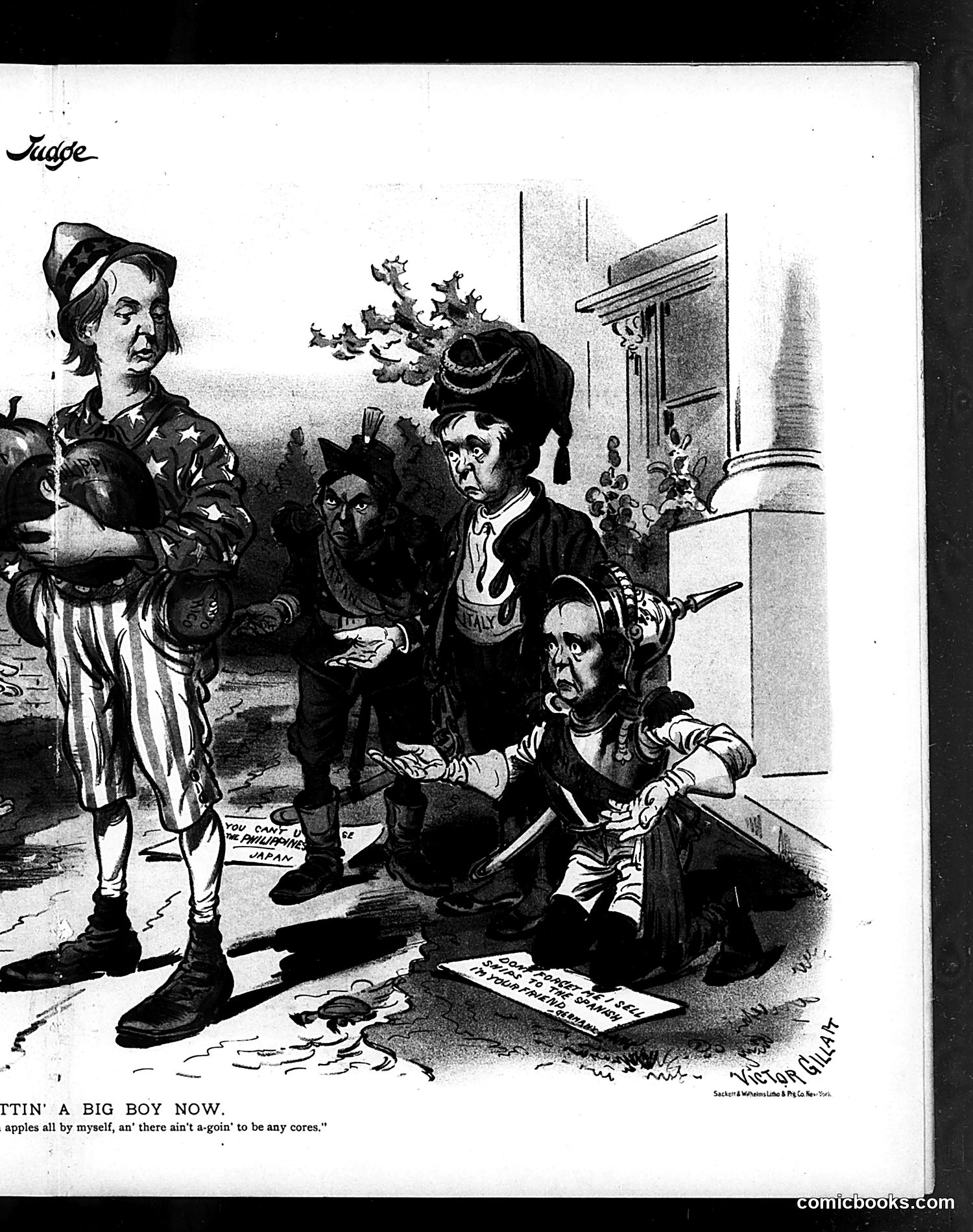
This Judge cartoon satirizes American imperialism, likely from the early 1900s. A young boy (representing the United States, identifiable by his starred clothing) boasts he can handle "apples" independently with "no cores"—metaphorically claiming America can manage foreign territories without complications. The caricatured figures surrounding him appear to represent other nations or colonial powers, seemingly skeptical or concerned about American expansionism. The "cores" reference suggests the cartoon critiques American naïveté about imperial governance—the assumption that controlling distant territories would be simple, ignoring the inherent difficulties and resistance ("cores") such colonization involves. The overall message warns that America, acting like an overconfident child, underestimates the complexities of imperial ambitions.
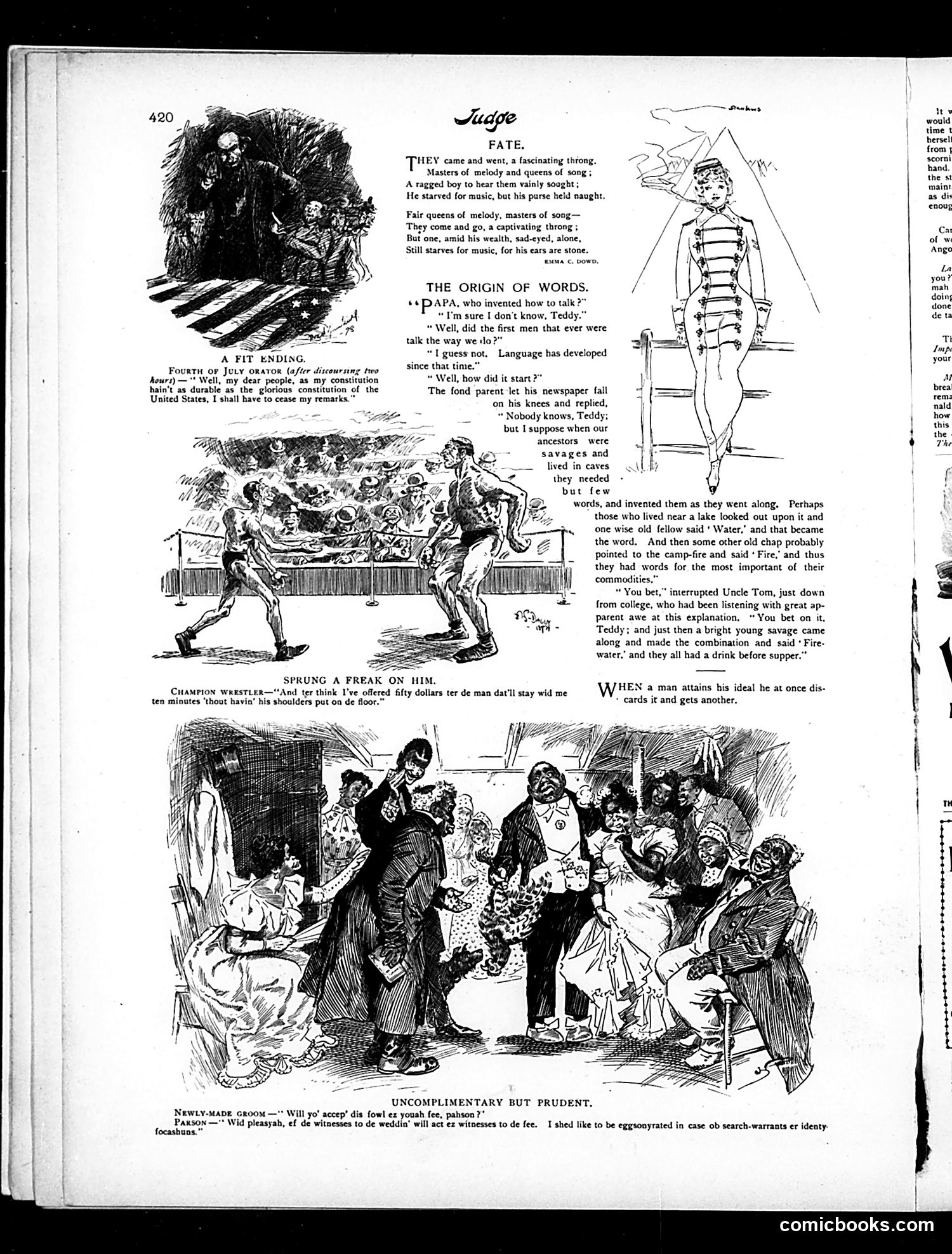
This page contains four satirical pieces: **"Fate"** contrasts wealthy musicians with a poor boy starving for music despite having money—satirizing how material wealth doesn't guarantee cultural satisfaction. **"The Origin of Words"** shows a father explaining language development to his son Teddy through natural examples (water, fire). Uncle Tom's interruption—combining "fire" and "water" into "firewater" (whiskey)—is the joke: it suggests Native Americans/savages' primary innovation was alcohol, a common racist stereotype of the era. **"Sprung a Freak on Him"** depicts a champion wrestler advertising his strength; the humor relies on wrestling terminology and physical comedy. **"Uncomplimentary but Prudent"** shows a newly-married groom offering a chicken to a parson as payment, with the parson making legal jokes about needing witnesses and avoiding "search-warrants"—likely satirizing rural/African American dialect and marriage customs. The page uses period-typical racial caricature and dialect humor common to 1880s-90s American satire.
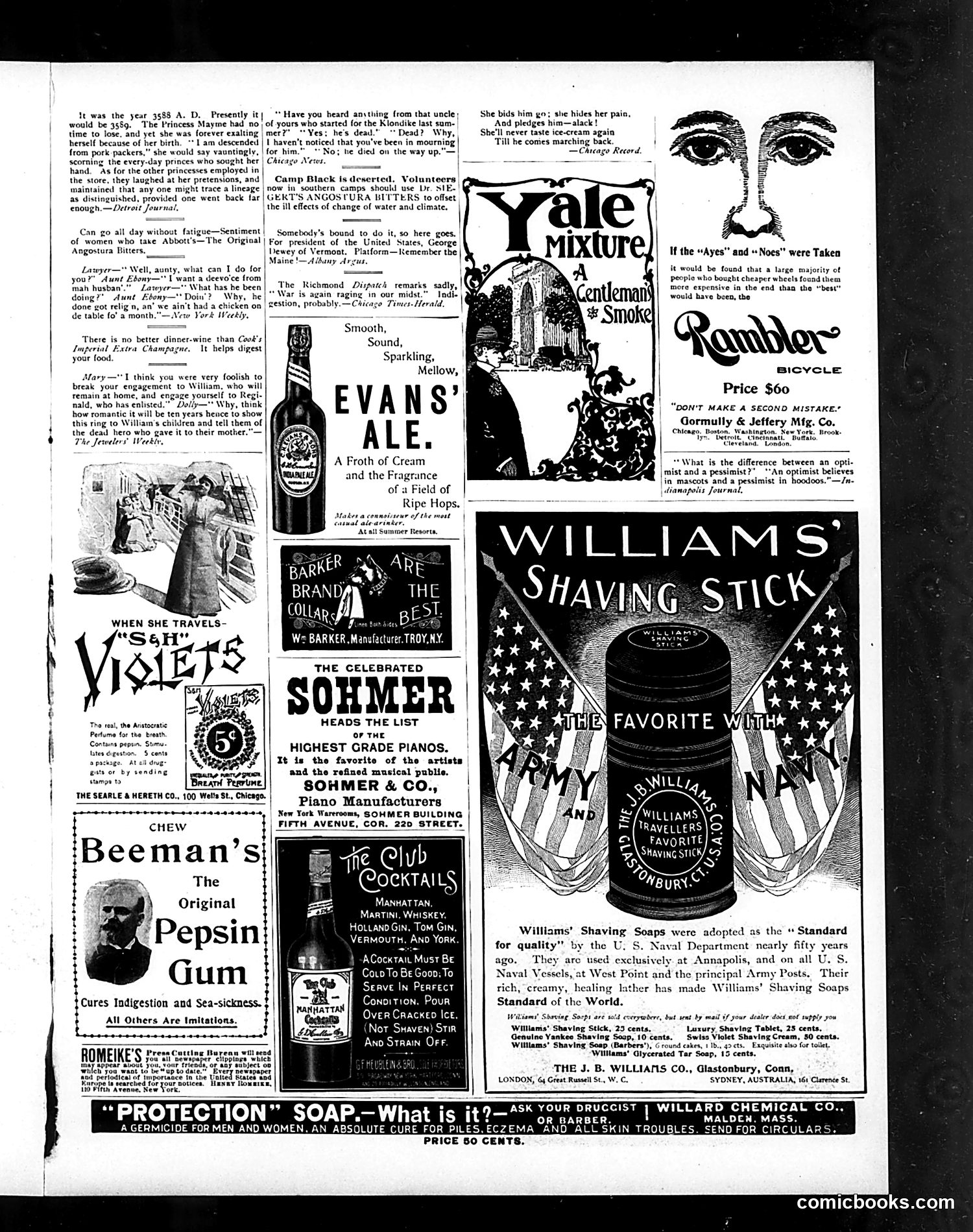
This page consists primarily of **advertisements and brief humorous anecdotes** rather than political cartoons. The notable content includes: **Satirical pieces:** Short jokes mocking social pretension (a princess boasting of "pork packer" ancestry in the year 3588), romantic foolishness (a woman breaking an engagement), and racial stereotypes (dialect humor about a Black woman). **Products advertised:** Evans' Ale, Sohmer pianos, Williams' Shaving Stick (notably adopted as the U.S. Naval Department standard), Rambler bicycles, Beeman's Pepsin Gum, and various patent medicines and spirits. **Historical context:** References to the Klondike gold rush and Admiral Dewey suggest this is from the 1890s. The "Protection Soap" advertisement claims germicidal properties—reflecting era-typical health claims. The page reflects period attitudes: casual racism, class commentary, consumer culture, and patent-medicine marketing. There is **no significant political satire**—Judge here functions as a general humor and advertising publication.
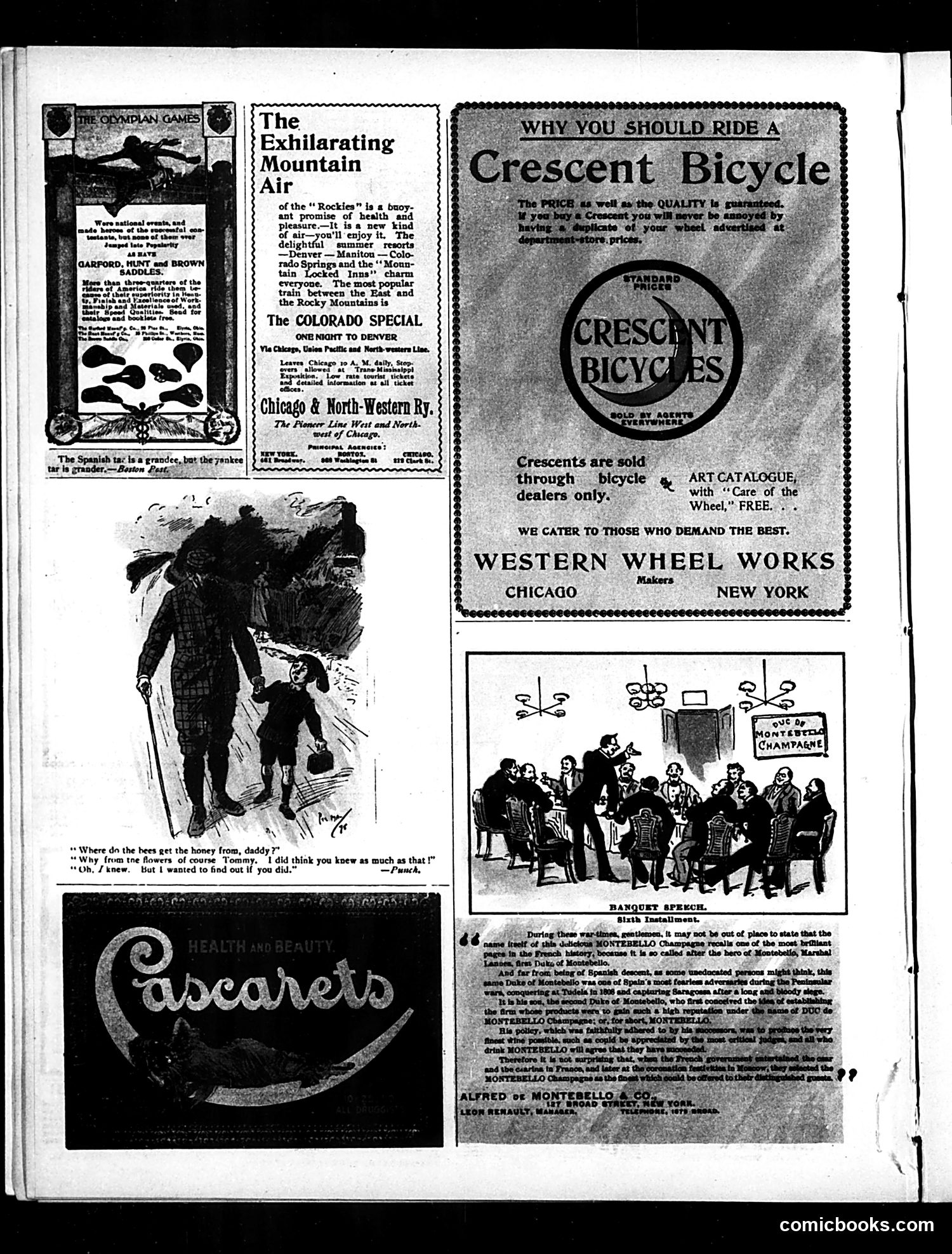
This page primarily contains **advertisements and light humor** rather than political satire. The main cartoon shows a father-child dialogue about where bees get honey from flowers—a gentle joke about the child testing whether the father actually knows what he claims to know (from *Punch* magazine). The **advertisements** promote: - The Colorado Special railroad service to Denver/Colorado Springs, emphasizing mountain air and health tourism - Crescent Bicycles by Western Wheel Works, marketed as quality products for discerning buyers At the bottom is the beginning of what appears to be a serialized story about **Montbello** (likely Marshal Augereau, a Napoleonic figure), discussing military campaigns during the Peninsular Wars, though the OCR text is heavily corrupted and difficult to parse clearly. The page reflects turn-of-the-century American consumer culture—promoting leisure travel and modern bicycles—rather than offering political commentary.
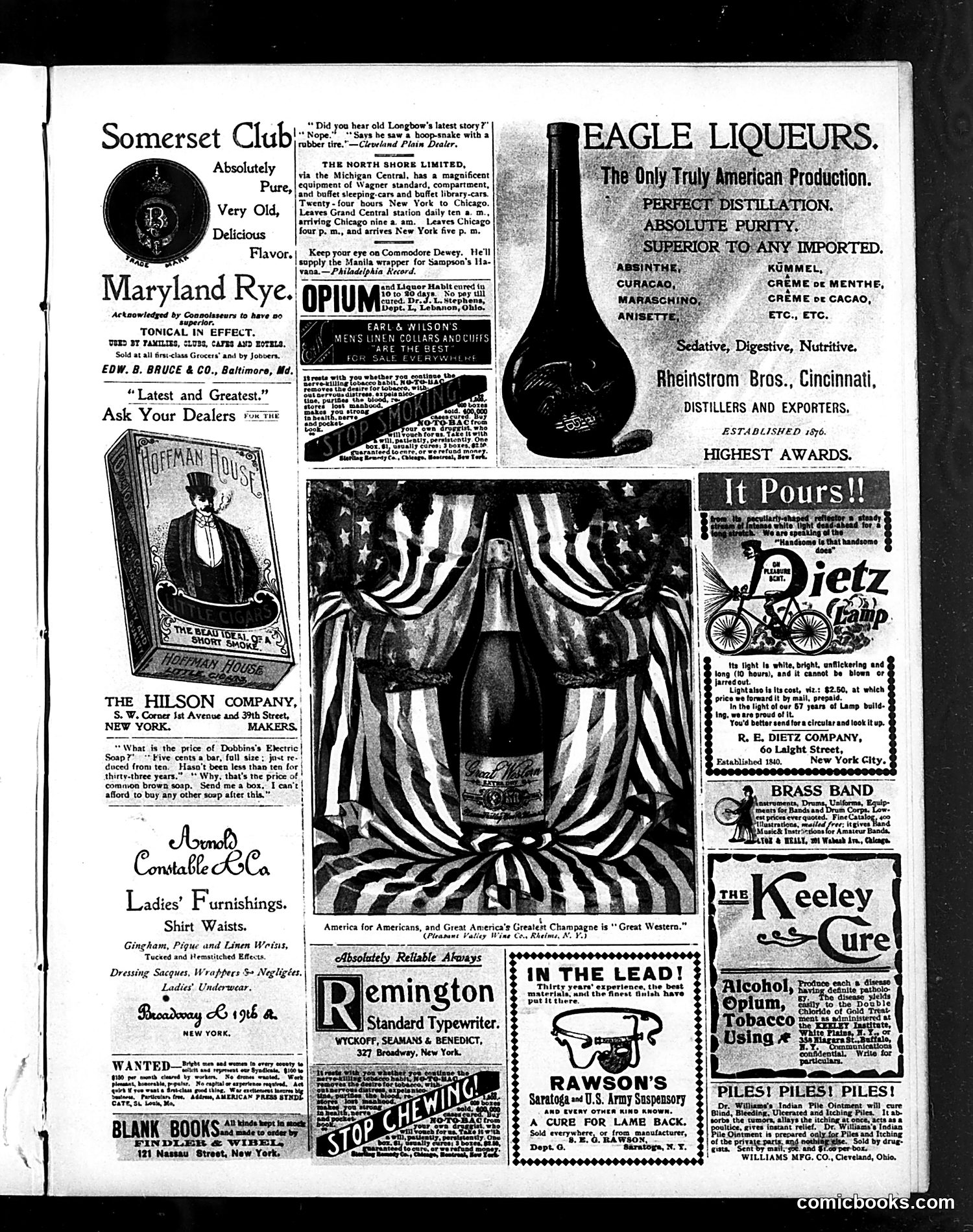
This is primarily an **advertising page** from Judge magazine, likely from around 1898-1899, based on historical references. The single notable satirical element is a brief text snippet mentioning **Commodore Dewey**, the American naval commander who became famous during the Spanish-American War (1898). The reference jokes about Dewey "supplying the Manila wrapper" for Sampson (likely Admiral Sampson), playing on recent military victories in the Philippines and the patriotic fervor of the period. The bulk of the page consists of period product advertisements: spirits (Maryland Rye whiskey, Eagle Liqueurs), typewriters, lamps, soaps, ladies' clothing, and patent medicines. These ads reflect late-19th-century consumer goods and marketing styles. The "hoop-snake with a rubber tire" reference appears to be a tall tale or folk joke, unrelated to political content. This page lacks significant political cartooning—it's essentially a commercial advertisement section typical of Judge's revenue model.
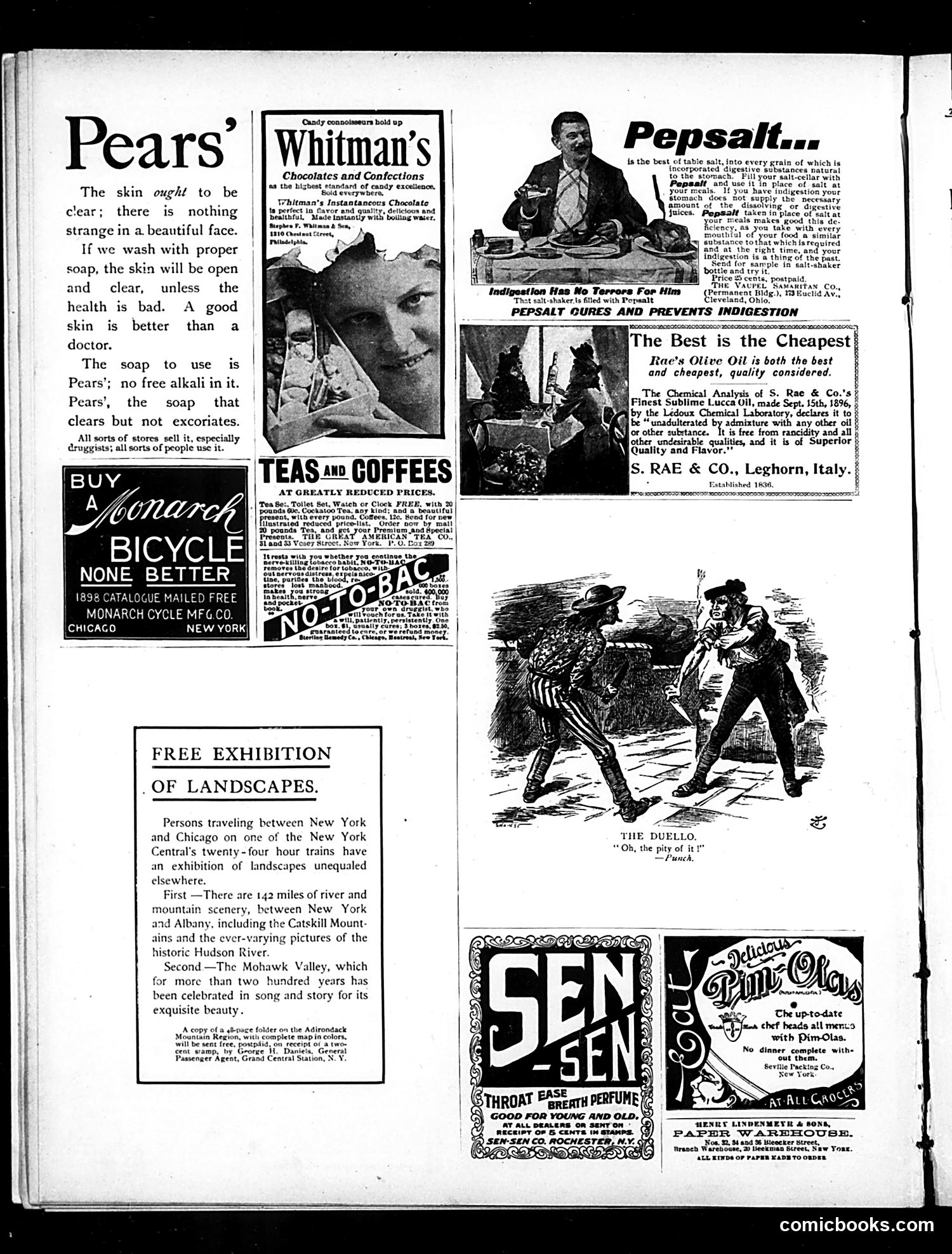
This is primarily an **advertising page** with one cartoon. The main satirical content is "The Duello" illustration—a Victorian-era comic scene showing two gentlemen in an exaggerated confrontation, likely depicting a trivial quarrel blown into mock-serious conflict. The caption "Oh, the pity of it!" (attributed to Punch magazine) suggests the satire mocks the absurdity of honor-driven disputes over minor matters—a common theme in period satire about aristocratic or upper-class pretension. The surrounding advertisements are typical of 1890s-era products: Pears' soap, Whitman's chocolates, Pepsalt (a digestive salt), bicycles, tea, and Pim-Olas (a beverage). These ads reflect consumer culture and patent medicines popular in the era. The page contains no identifiable political figures or specific dated events—it's gentle social satire rather than hard-hitting political commentary, alongside commercial matter typical of Judge's revenue model.
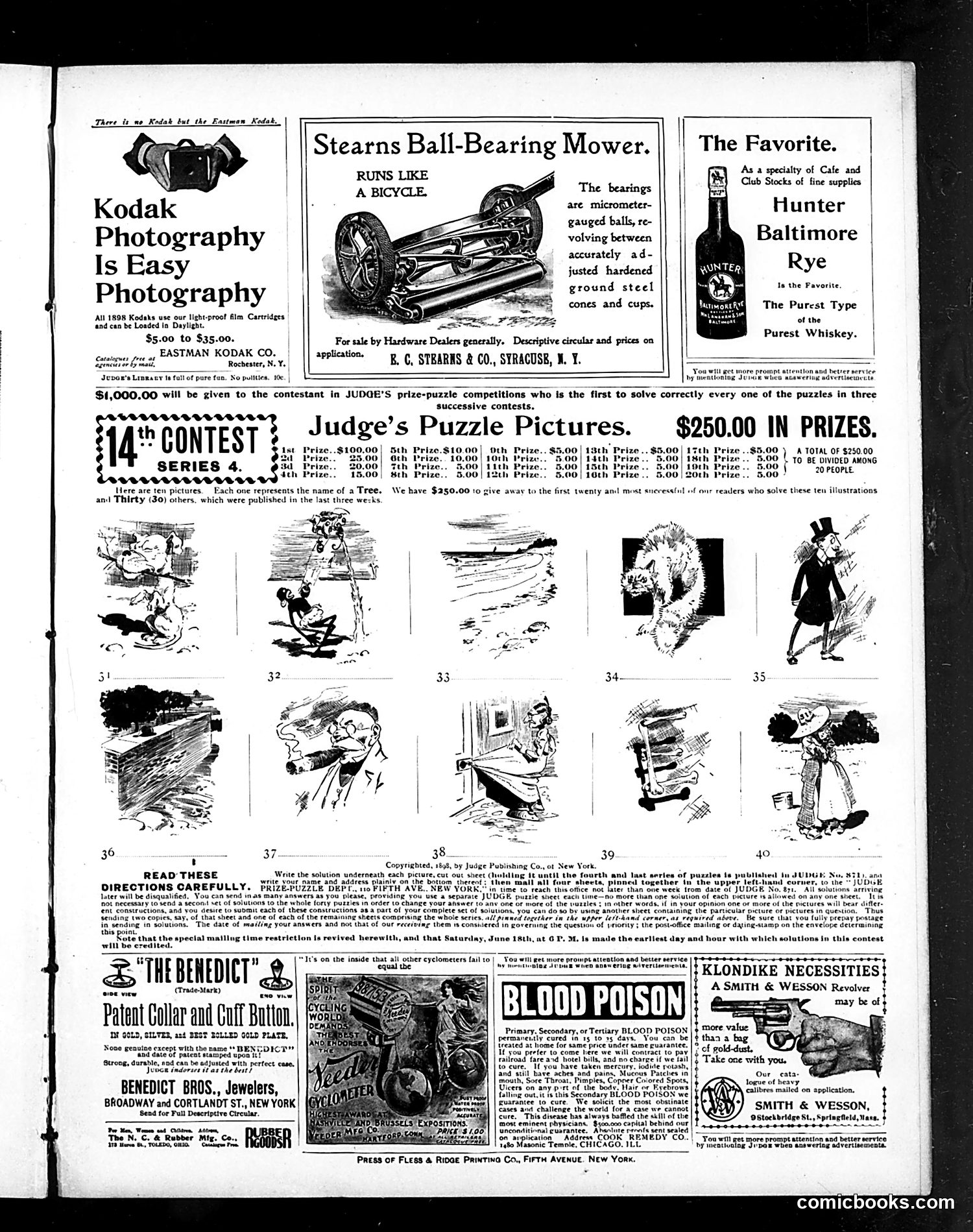
This is primarily an **advertising and contest page** from Judge magazine (1898), with minimal political satire. The main content features **Judge's Puzzle Pictures Contest Series 4**—a competition offering $250 in prizes to readers who correctly identify ten tree names from illustrations. Contestants could enter repeatedly across successive contests, with the grand prize of $1,000 going to anyone solving all three series perfectly. The page is dominated by **period product advertisements**: Kodak cameras, Stearns lawn mowers, Hunter Baltimore Rye whiskey, and patent collar buttons. Lower sections advertise remedies for "blood poison" (likely syphilis treatment), Klondike prospecting necessities, and Smith & Wesson revolvers—reflecting contemporary commercial interests. The cartoon illustrations themselves (numbered 31-40) appear to be the actual puzzle images readers were meant to solve, though their specific tree references are unclear from this reproduction. **No significant political satire is evident** on this page; it functions as a commercial vehicle combining entertainment contests with advertising revenue.
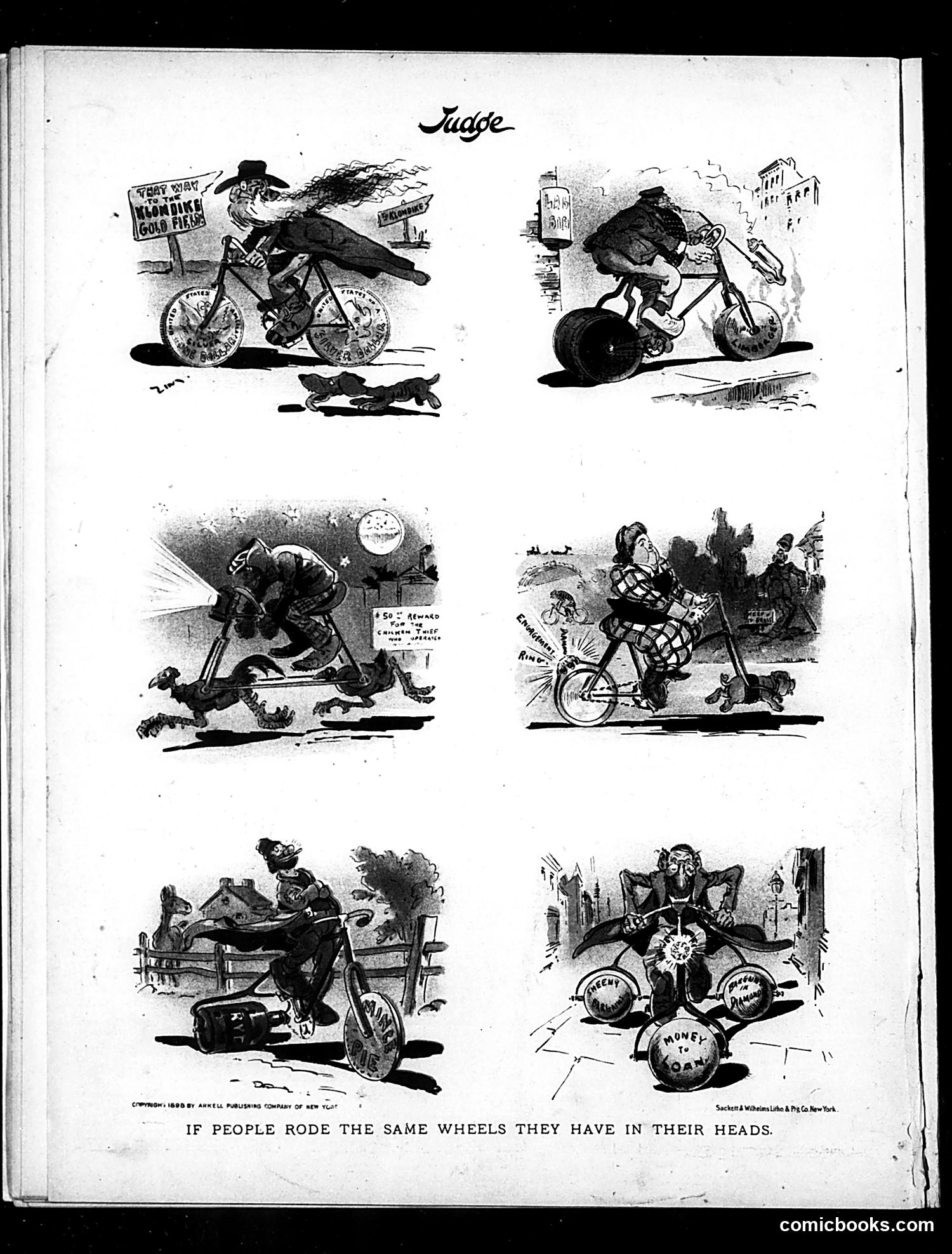
This 1898 Judge cartoon satirizes human foolishness through six panels showing people on bicycles reflecting their mental states. Each illustration depicts someone riding a bicycle whose wheels match the absurdity of their thinking: - Top panels: A distracted person with advertisements in their head; someone weighted down by obstacles - Middle panels: Figures struggling with various mental burdens—one appears to deal with business/financial concerns - Bottom panels: Characters preoccupied with romance and money The satire suggests that people's actual choices and trajectories are determined by their flawed, cluttered, or misguided thoughts. The bicycle—a popular 1890s technology—serves as a metaphor for life's progress, implying that mental confusion directly translates to life's difficulties. It's a commentary on human irrationality and how our thinking shapes our outcomes.

I can see this is a very dark image from what appears to be a Judge magazine page, with only a white margin visible on the left side and the comicbooks.com watermark visible in the lower right. The image is almost entirely black, making it impossible to discern any cartoon illustrations, caricatures, text, or satirical content that would normally be present on a magazine page. Without being able to see the actual artwork or read the page content clearly, I cannot identify any figures, political references, or explain the satire or joke as requested. The image quality or reproduction has rendered the page content illegible. A clearer image would be needed to provide meaningful analysis.