
A complete issue · 16 pages · 1898
Judge — June 11, 1898
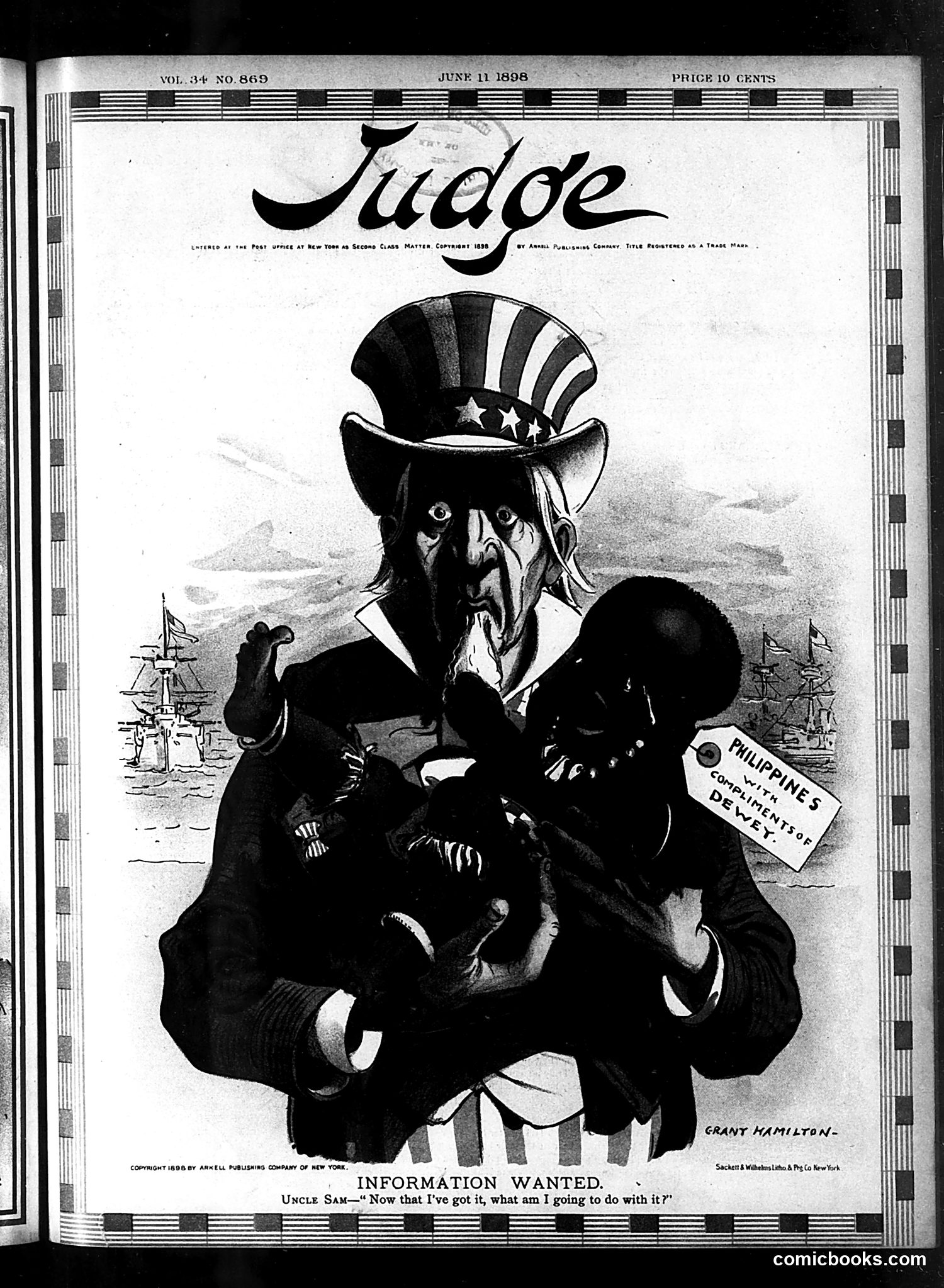
This cartoon depicts **Uncle Sam** (representing the United States) holding a dark figure labeled "Philippines' Dept. of Development," reflecting America's recent acquisition of the Philippines following the Spanish-American War (1898). The caption reads "INFORMATION WANTED," with Uncle Sam appearing uncertain or troubled about what to do with this new colonial possession. The warships in the background reference the naval conflict that secured U.S. control of the islands. The satire critiques American uncertainty about imperial expansion—the government had won territory but lacked clear policy for governing it. The dark, ambiguous figure symbolizes the problematic nature of colonialism itself. This captures contemporary debate about whether America should become an imperial power, a contentious issue in 1898.
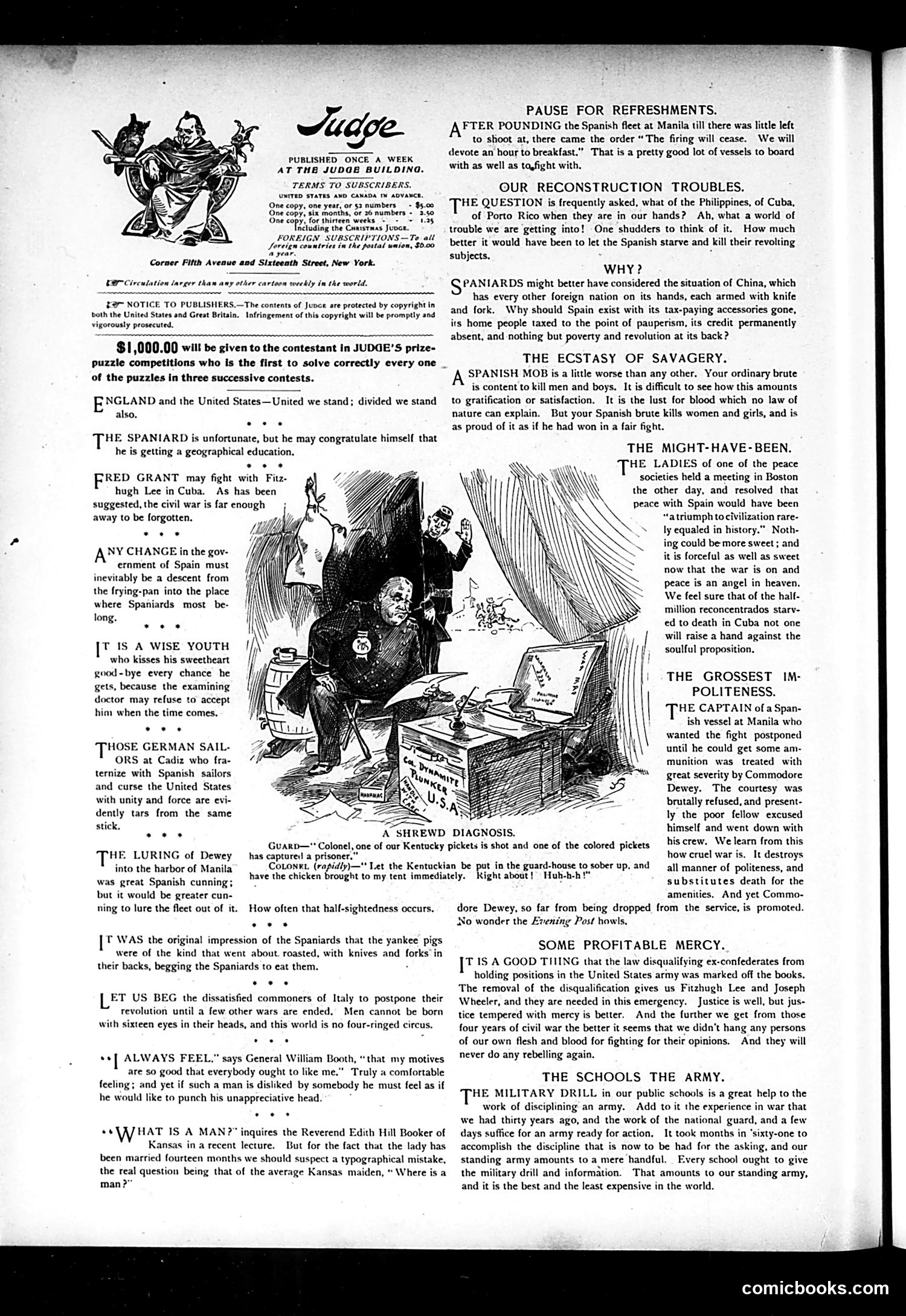
This page from Judge magazine contains political commentary on the Spanish-American War (1898). The central cartoon, "A Shrewd Diagnosis," depicts a military doctor examining a sick soldier labeled "U.S." while discussing Commodore Dewey's conduct at Manila. The surrounding text criticizes Spanish colonial rule in Cuba and the Philippines, mocking Spanish brutality while questioning whether American intervention was justified. One section sarcastically notes that Spaniards "kill women and girls" with pride, contrasting this with alleged American moral superiority. The commentary also addresses domestic issues: disqualification of Confederate officers from government positions, military drilling in schools, and various political opinions on the war's righteousness. The overall tone satirizes American self-righteousness about the conflict while commenting on its actual conduct and consequences.
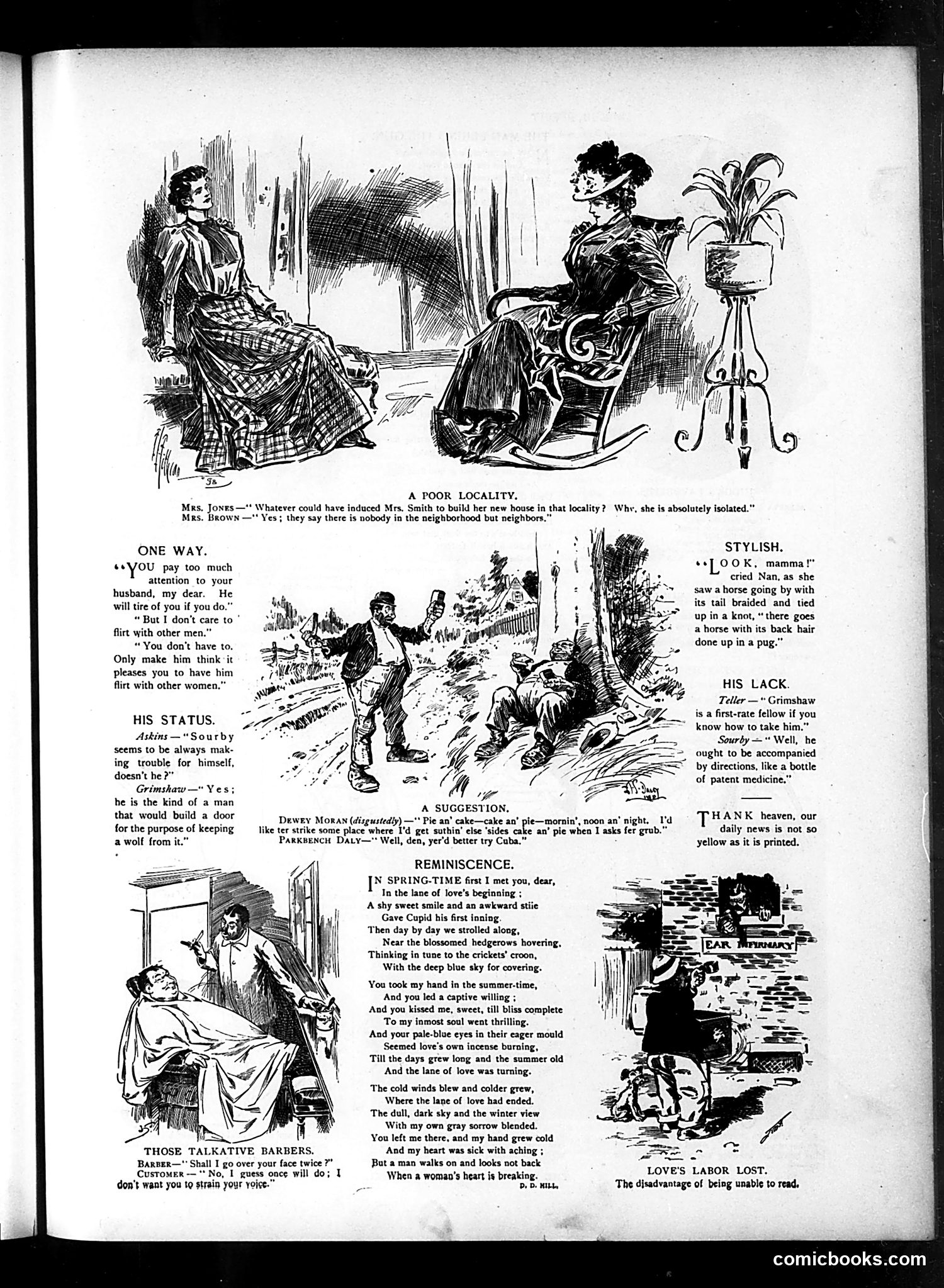
This page from *Judge* magazine contains several short satirical pieces and illustrations targeting social behaviors and gender relations of the era. "A Poor Locality" mocks women's social status anxiety—Mrs. Jones criticizes Mrs. Smith's neighborhood choice, claiming isolation is preferable to having "nobody in the neighborhood but neighbors." The remaining sketches ridicule marital dynamics and courtship: "One Way" jokes about managing husbands through indifference; "His Status" satirizes men's need for ego validation; "Stylish" mocks fashionable affectations; and "His Lack" humorously depicts male incompetence. "Those Talkative Barbers" and "Love's Labor Lost" continue the theme of social pretension and romantic disappointment. The poem "Reminiscence" offers sentimental contrast, reflecting on lost love. Overall, the page satirizes late 19th/early 20th-century gender relations, marital power dynamics, and social climbing aspirations through humor.
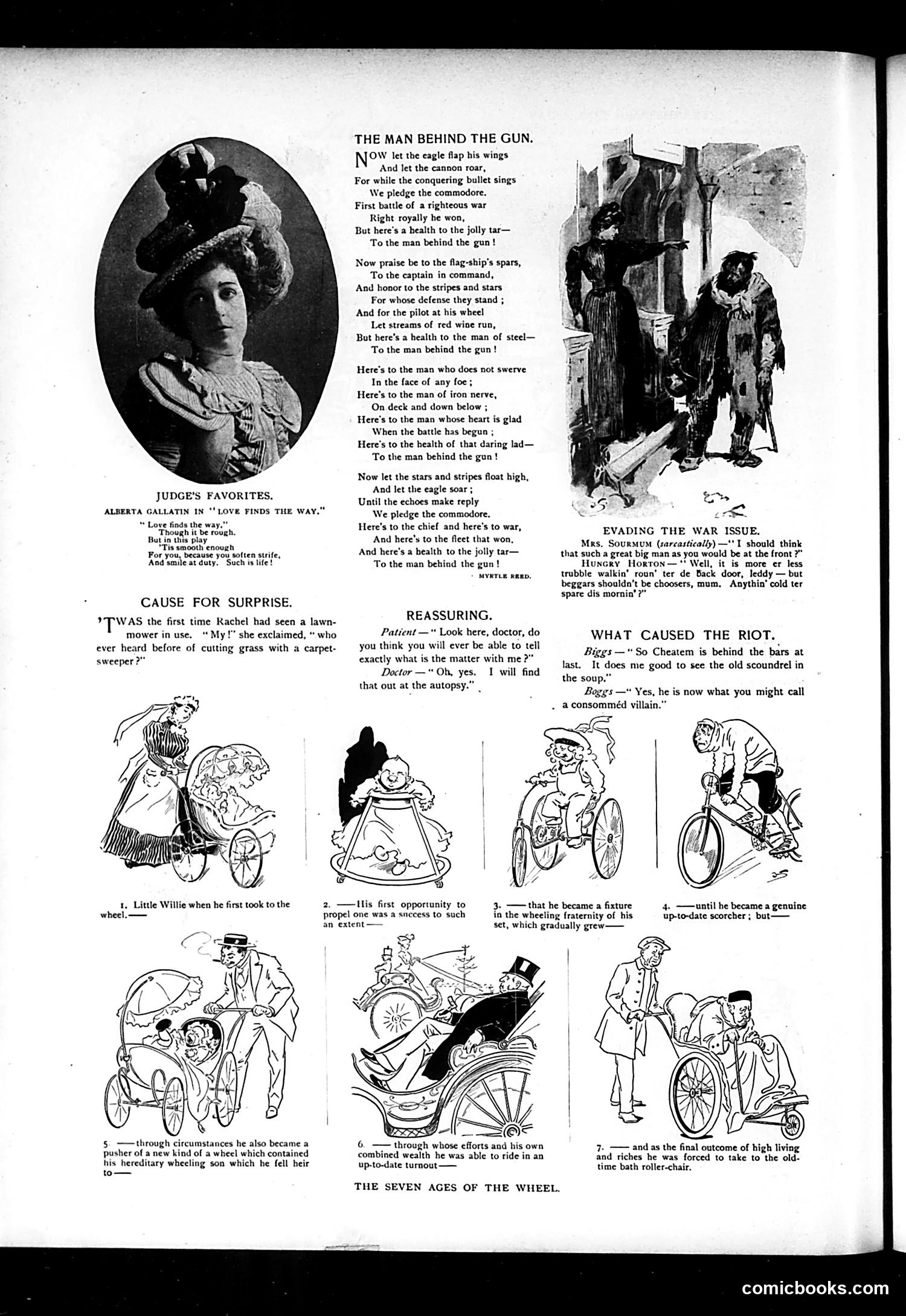
This page contains three distinct satirical pieces: **"The Man Behind the Gun"** (top): A patriotic poem celebrating military personnel during wartime, likely WWI-era based on the rhetoric of "righteous war" and naval imagery. **"Judge's Favorites"** (left): A brief humorous anecdote about a woman named Alberta Gallatin encountering a mechanical lawn-mower—the joke being her surprise at the device's noise. **"The Seven Ages of the Wheel"** (bottom): A sequential cartoon satirizing the bicycle's cultural impact, showing a child's introduction to cycling through adulthood, culminating in elderly decline. This reflects late 19th/early 20th-century bicycle mania when cycling represented progress and social mobility. The remaining text snippets ("Cause for Surprise," "Reassuring," "What Caused the Riot") are brief joke columns typical of Judge's format.
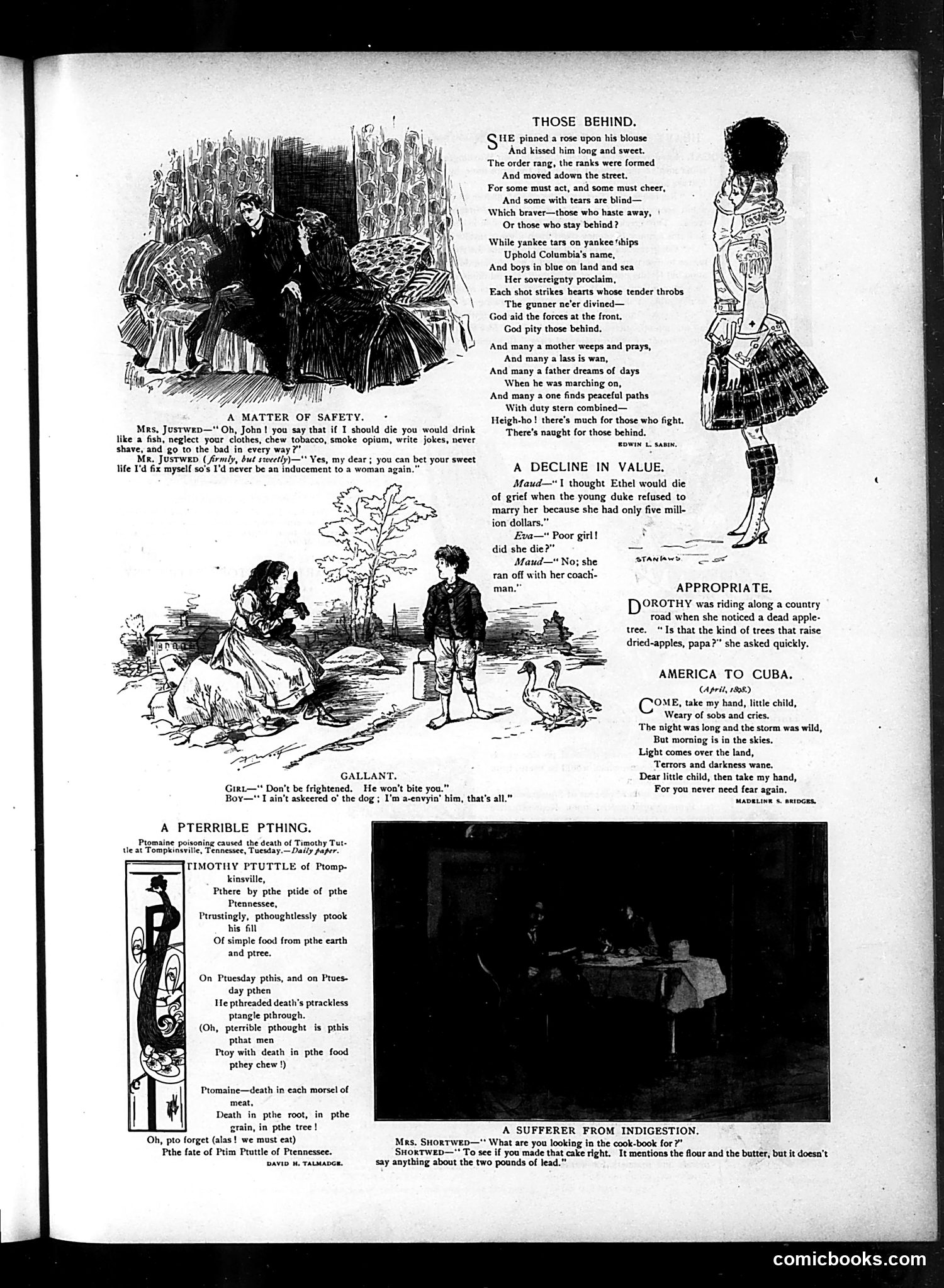
This page from Judge contains multiple satirical pieces addressing late-19th-century American concerns: **"Those Behind"** is a serious patriotic poem about the emotional toll of war on families left home—mothers, sweethearts, and fathers—while soldiers fight. It appears to reference the Spanish-American War era (1898). **The domestic humor pieces** mock Victorian marriage anxieties and gender relations: a wife ensuring her husband won't misbehave if she dies; a girl's naïve question about apple trees; and a husband "envying" a dog's freedom. **"A Pterrible Pthing"** satirizes contemporary anxieties about food safety and ptomaine poisoning (bacterial contamination), a genuine health concern of the era. The exaggerated "pt" sounds mock overwrought newspaper sensationalism. **"America to Cuba"** is likely a pro-intervention poem supporting American involvement in Cuba's independence struggle (1898). The "Indigestion" joke mocks wives' cooking by suggesting mysterious toxic ingredients. Overall, the page blends patriotic sentiment with satirical domestic humor typical of Judge's upper-class audience.
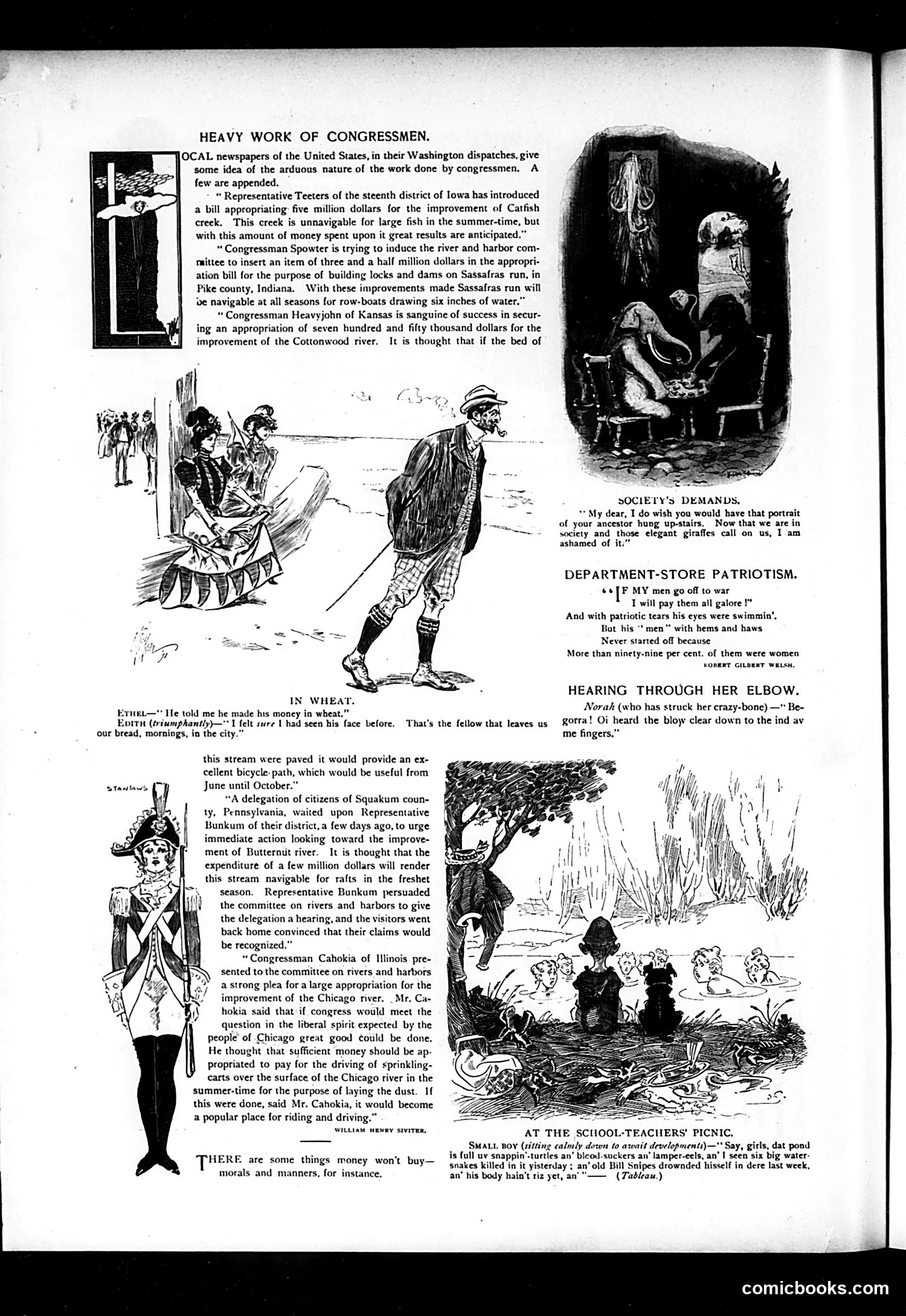
This page satirizes **Congressional spending inefficiency** through mock "serious" reports of absurd appropriations bills. Representatives Teeters, Spowter, Heavyjohn, Bunkum, and Cahokia introduce legislation requesting millions for improving utterly useless waterways—Catfish Creek (unnavigable), Sassafras Run (needs six-inch depth), and the Chicago River (for dust-laying carts). The satire mocks how congressmen secure federal funds for their districts by disguising trivial local projects in inflated language about "improvements" and "navigation." The accompanying vignettes target other social absurdities: a woman ashamed of ancestors but proud to display giraffes; a department-store owner claiming patriotic support for workers while employing 99 percent women (who wouldn't enlist); and misheard dialogue creating comedy through class/linguistic differences. The overall message: Congress wastes taxpayer money on meaningless regional pork-barrel projects justified through grandiloquent rhetoric.
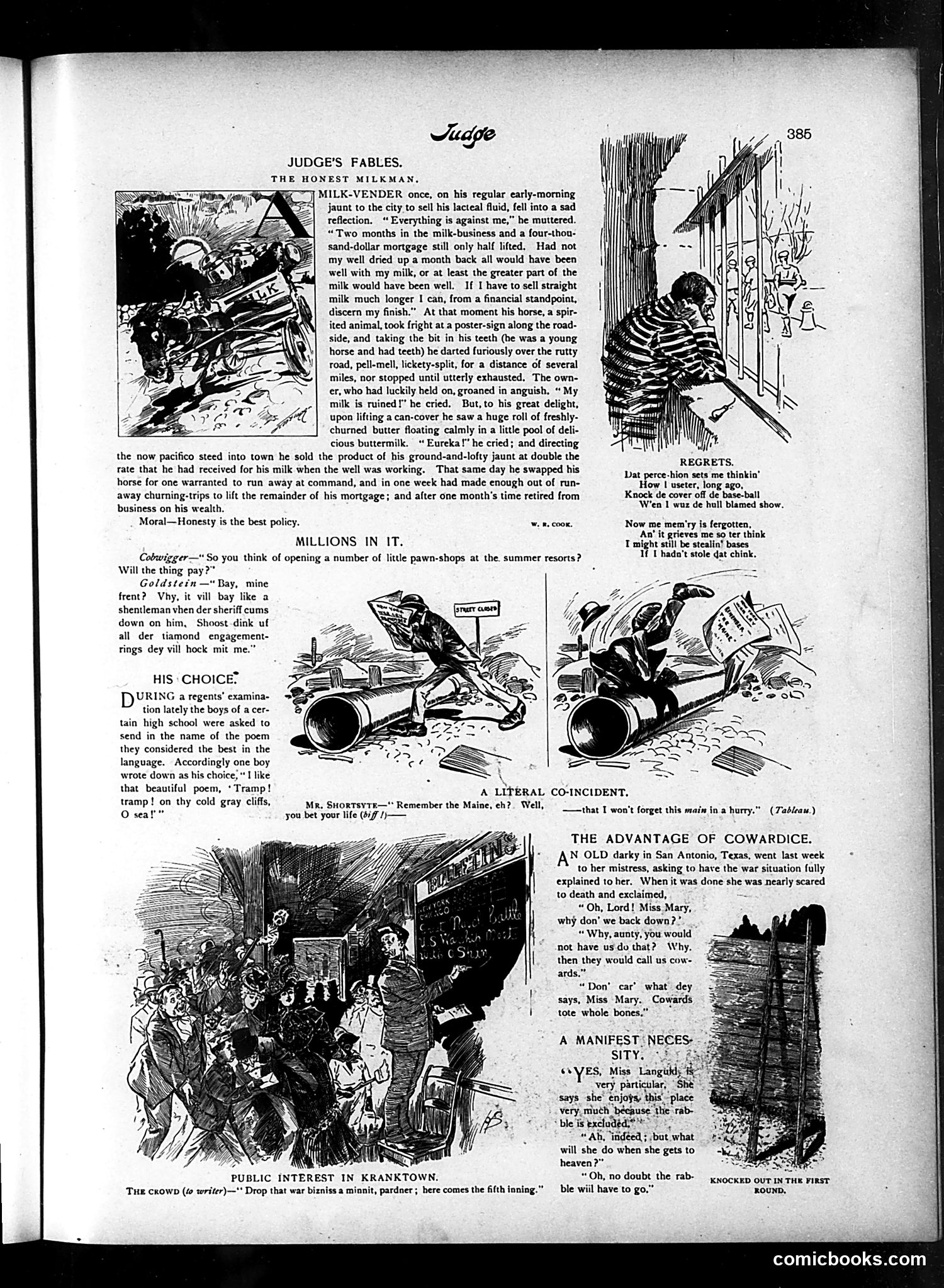
This page contains several short satirical pieces typical of Judge magazine's humor: **"The Honest Milkman"** (main fable): A struggling milkman's horse bolts and runs away, churning his milk into butter during the wild ride. He sells it for double the price, becomes wealthy, and deliberately causes more runaway trips. The satire mocks the irony that dishonesty (deliberately causing accidents) succeeds better than honest work—contradicting the stated "moral" that honesty is best. **"Millions in It"**: Two Jewish characters (indicated by dialect spelling) discuss opening pawnshops at summer resorts, expecting to profit from stolen engagement rings. This reflects period antisemitic stereotypes about Jewish merchants and pawnbrokers. **"The Advantage of Cowardice"**: A Black domestic worker suggests her mistress avoid war by backing down, arguing cowardice preserves life better than pride. This appears to reference contemporary war debates, using racist dialect humor. The other brief items use similar period stereotypes and wordplay. The page reflects Judge's reliance on ethnic caricature and dialect humor as standard comedic devices.
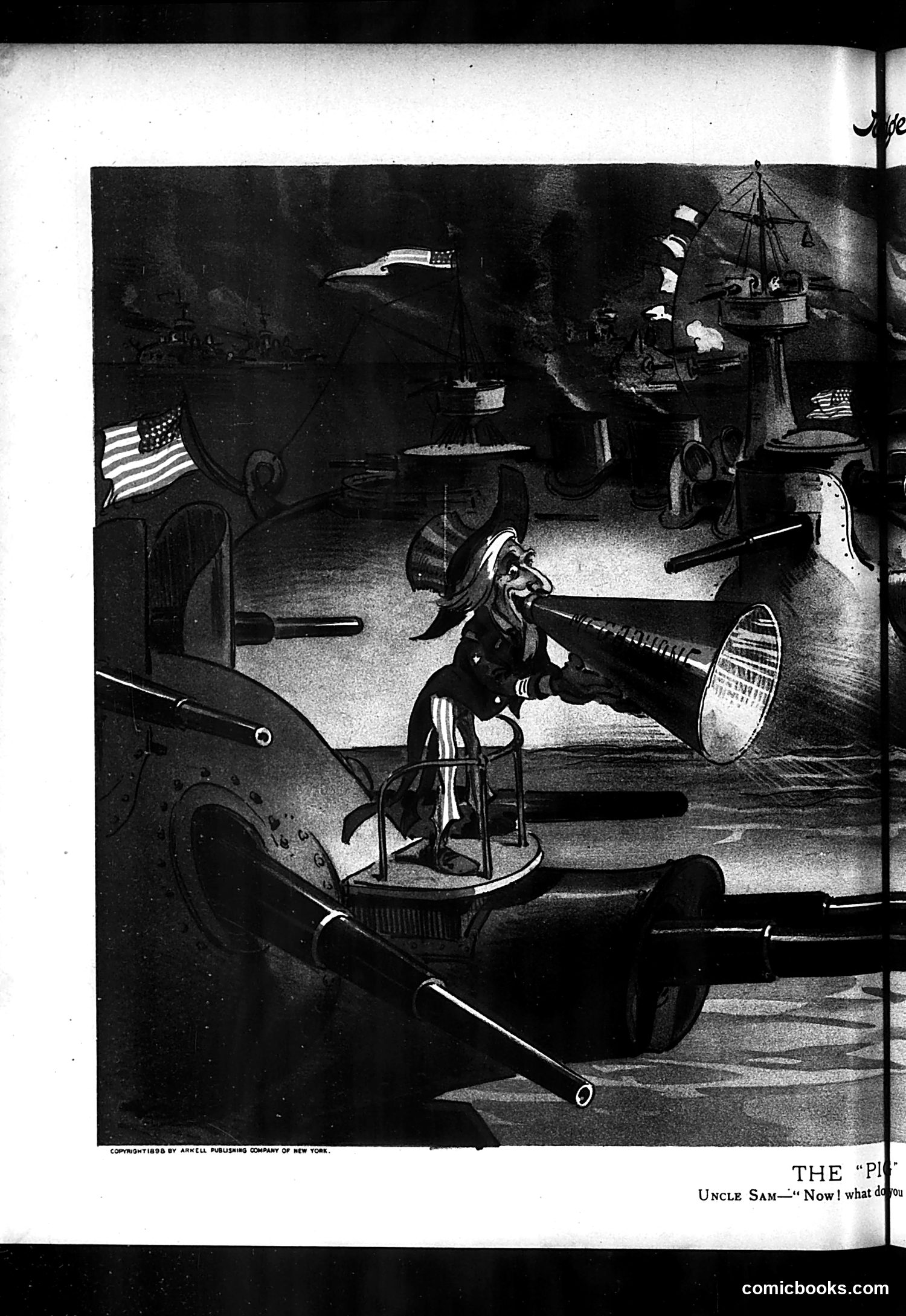
This appears to be a political cartoon titled "THE 'PIG'" with a caption referencing Uncle Sam ("Now I what do you..."). The image depicts Uncle Sam as a caricatured figure operating what looks like a searchlight or spotlight in the center foreground. He's surrounded by various military vessels and ships, with an American flag visible on the left. The composition suggests naval or military power projection. The "pig" reference likely refers to a derogatory term for military vessels or possibly critiques American imperialism/militarism. Without the complete caption and publication date, the specific historical event remains unclear—it could reference WWI-era naval policy, American interventionism, or military-industrial expansion. The satirical intent appears to target American military ambitions or foreign policy through personification of Uncle Sam.
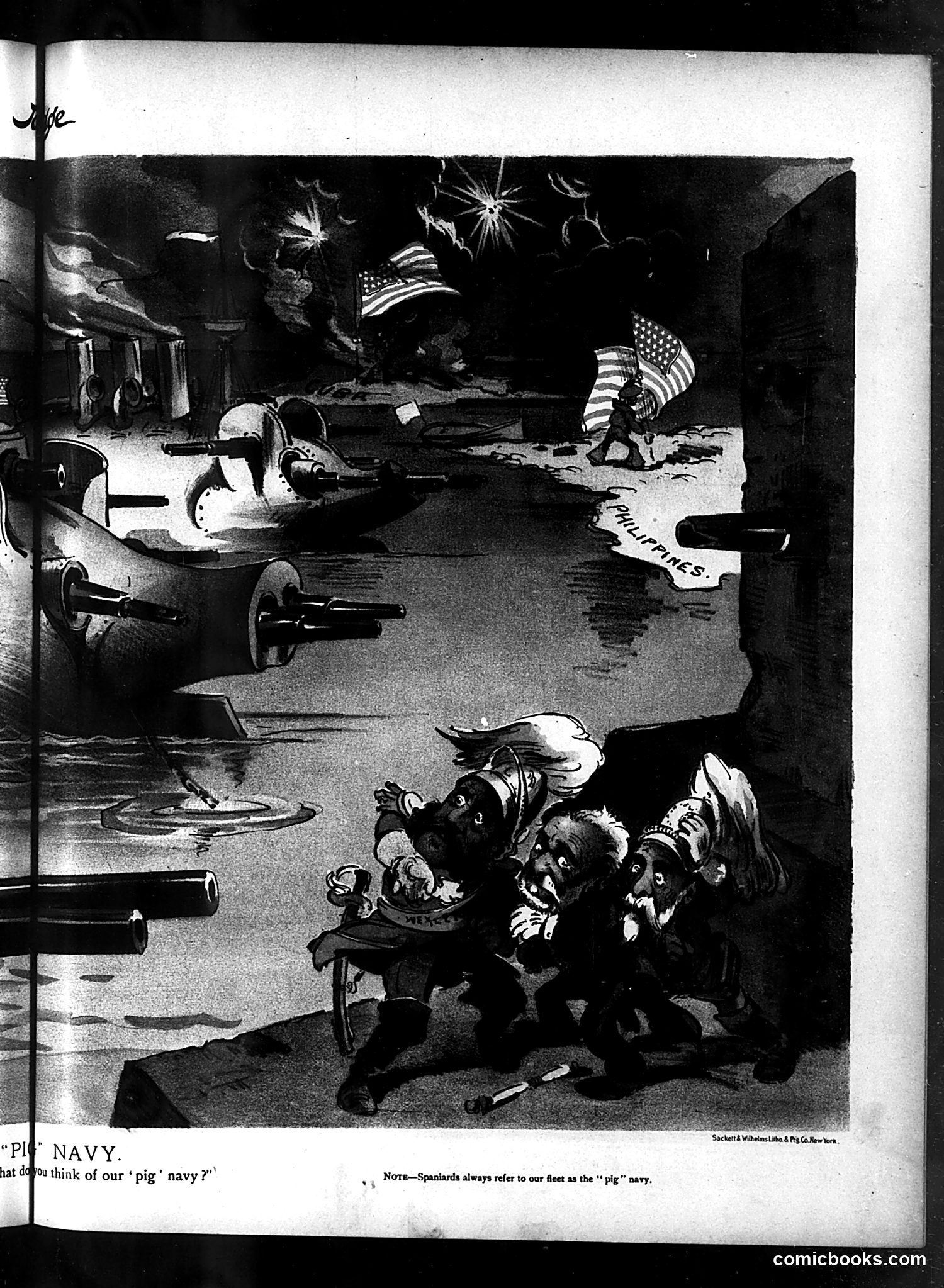
This appears to be a WWI-era satirical cartoon from *Judge* magazine mocking Spain's derogatory term for the American Navy. The image depicts caricatured Spanish figures (identifiable by their exaggerated facial features, period clothing, and what appear to be Spanish flags) reacting with apparent shock or dismay to American naval power. The cartoon's central joke plays on a supposed Spanish insult—calling the U.S. fleet the "pig navy"—while showing American military might (explosions, cannons, warships) overwhelming them. The text's note explaining the "pig" reference suggests the magazine is mocking Spanish naval weakness or contempt while celebrating American military superiority. This reflects early 20th-century American jingoism and anti-Spanish sentiment during a period of U.S. imperial expansion.
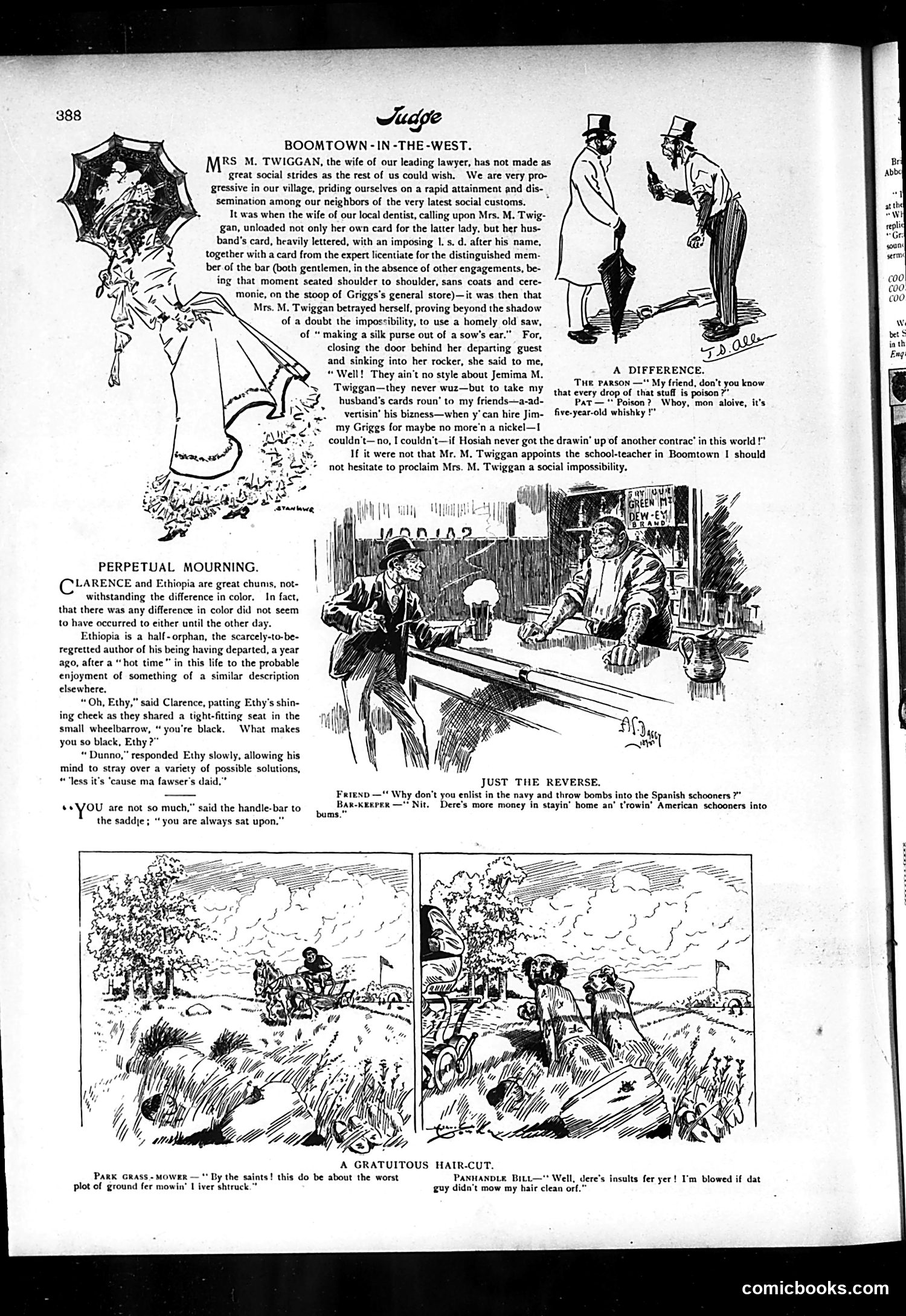
This page contains several satirical pieces targeting American social pretensions and rural/frontier life around the turn of the 20th century. **"Boomtown-in-the-West"** mocks Mrs. M. Twiggan, a lawyer's wife in a frontier town, for lacking social refinement. The joke: she's scandalized when the dentist's wife distributes professional business cards, seeing it as crass self-promotion rather than genteel behavior. The narrator implies only her husband's political appointment as school-teacher prevents declaring her a "social impossibility." **"Perpetual Mourning"** presents a brief exchange between Clarence (white) and Ethiopia (Black), childhood friends. Ethiopia attributes his dark skin to his father's death, creating morbid humor typical of the era's casual racism. **"Just the Reverse"** jokes about Irish-American military service, contrasting naval warfare against Spain with domestic violence ("t'rowin' American schooners"). **"A Gratuitous Hair-Cut"** features a working-class "Panhandle Bill" annoyed that a grass mower accidentally trimmed his hair while cutting his lawn. The cartoons reflect period attitudes toward class, ethnicity, and frontier manners.
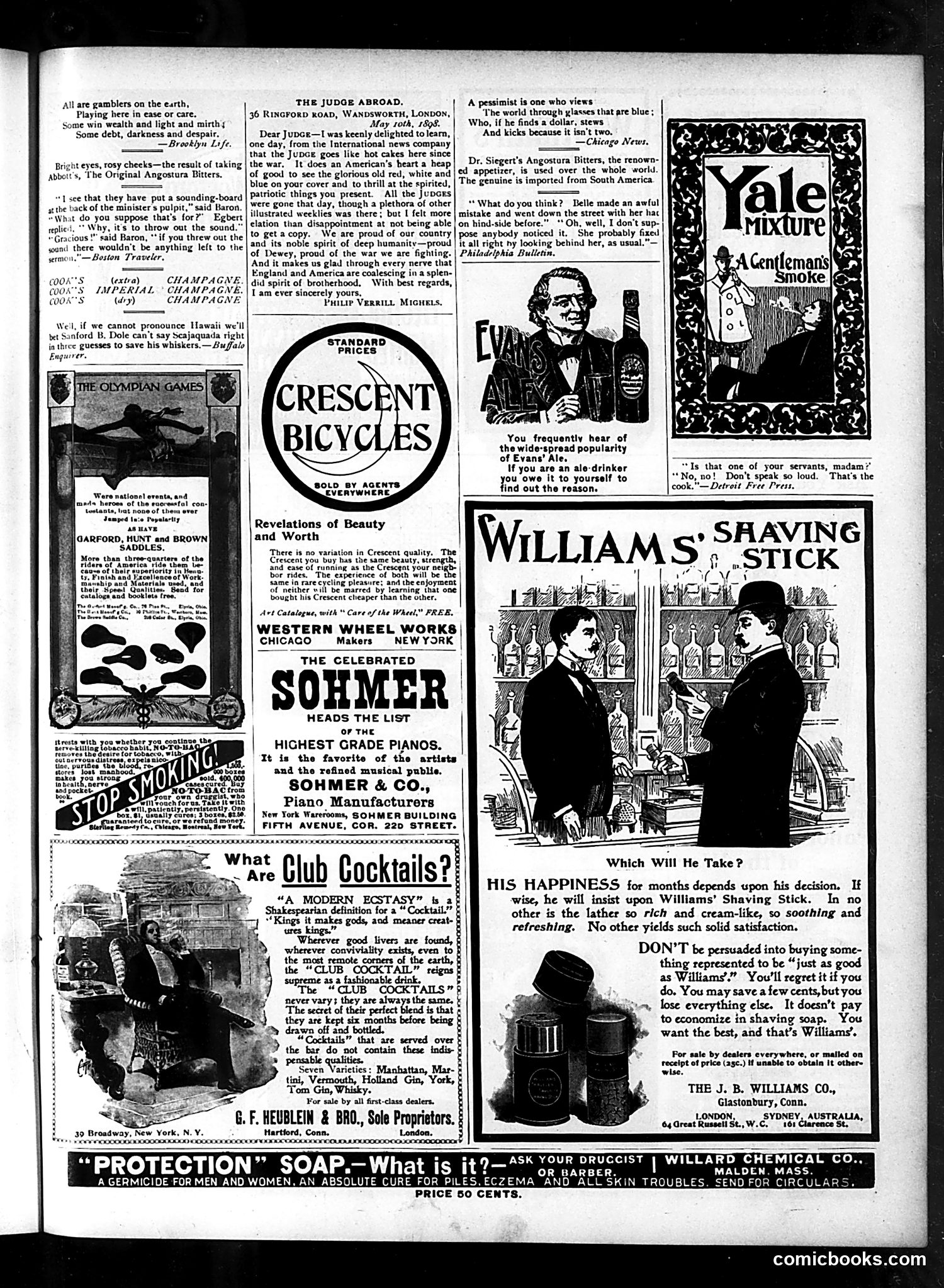
This page is primarily **advertising** with minimal satirical content. The main political reference appears in "The Judge Abroad" — a letter from London dated May 10, 1898, celebrating American military success in the Spanish-American War. The correspondent praises Judge magazine's "spirited, patriotic things" and expresses pride in American naval victories (referencing Dewey's triumph) and Anglo-American alliance during the conflict. A brief joke references **Sanford B. Dole**, Hawaii's territorial governor, mocking Americans' difficulty pronouncing Hawaiian place names — likely satirizing America's recent imperial expansion into Hawaii (annexed 1898). The remaining content consists entirely of period advertisements for bicycles, champagne, pianos, shaving products, and patent medicines — typical of Judge's revenue model. No other significant political or social satire is evident on this page.
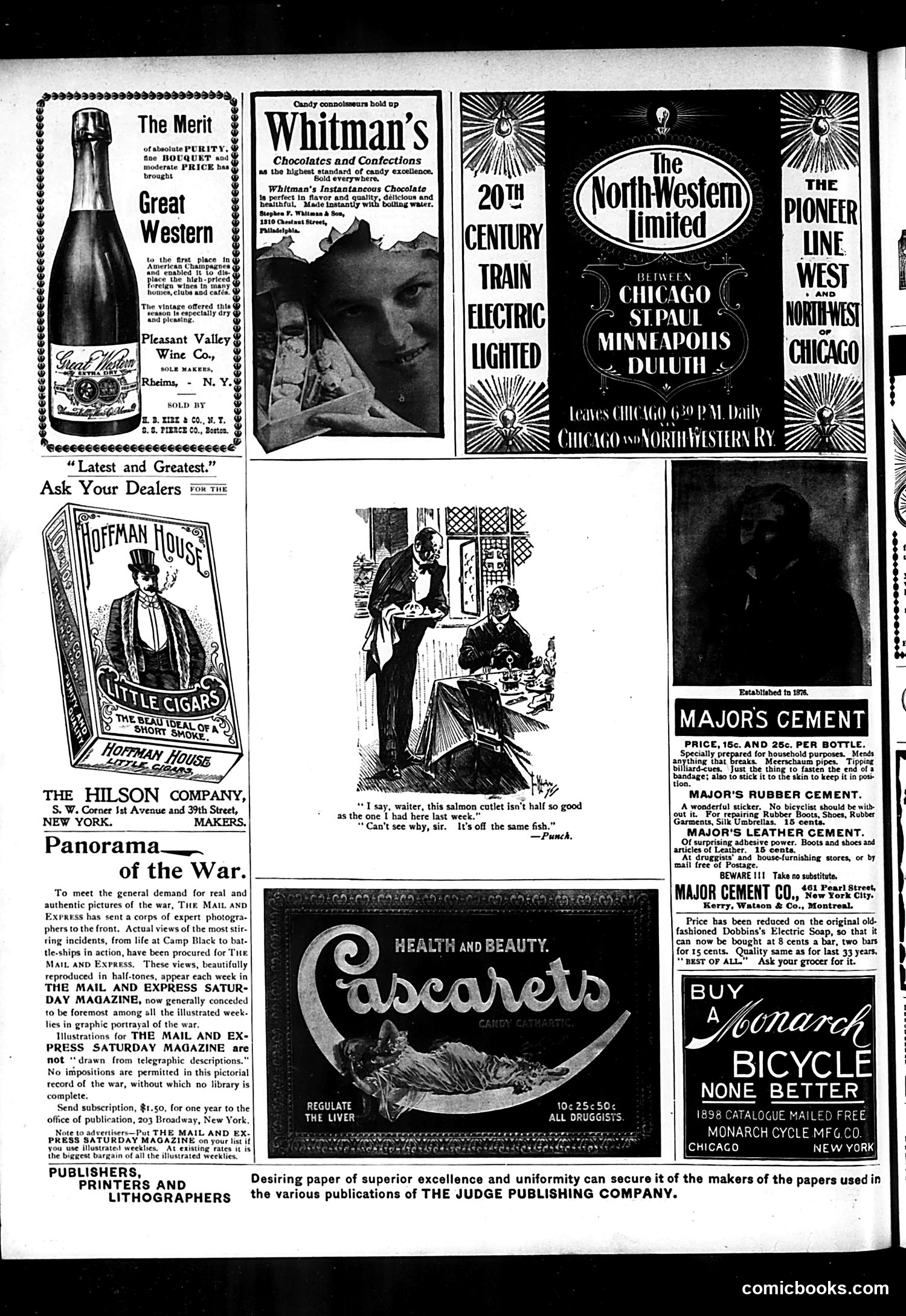
This page is primarily **advertising**, not political satire. It contains vintage product advertisements from the early 1900s, including: - **Whitman's Chocolates** — a premium candy brand - **Great Western Wine** — American champagne - **The North-Western Limited Train** — luxury rail service to Chicago/Minneapolis/Duluth - **Hoffman House Cigars** — a tobacco product - **Major's Cement** — various adhesive products - **Monarch Bicycles** — cycling equipment - **Dobbins's Electric Soap** — laundry soap The page includes one small cartoon captioned with dialogue from *Punch* magazine about a waiter and salmon cutlet, which is a mild domestic humor joke rather than political satire. There is also promotional text for *The Mail and Express Saturday Magazine*, advertising their war photography coverage (appears to reference the Spanish-American War era based on context). **This is not a satirical editorial page** but rather a commercial advertising section of the Judge Publishing Company.
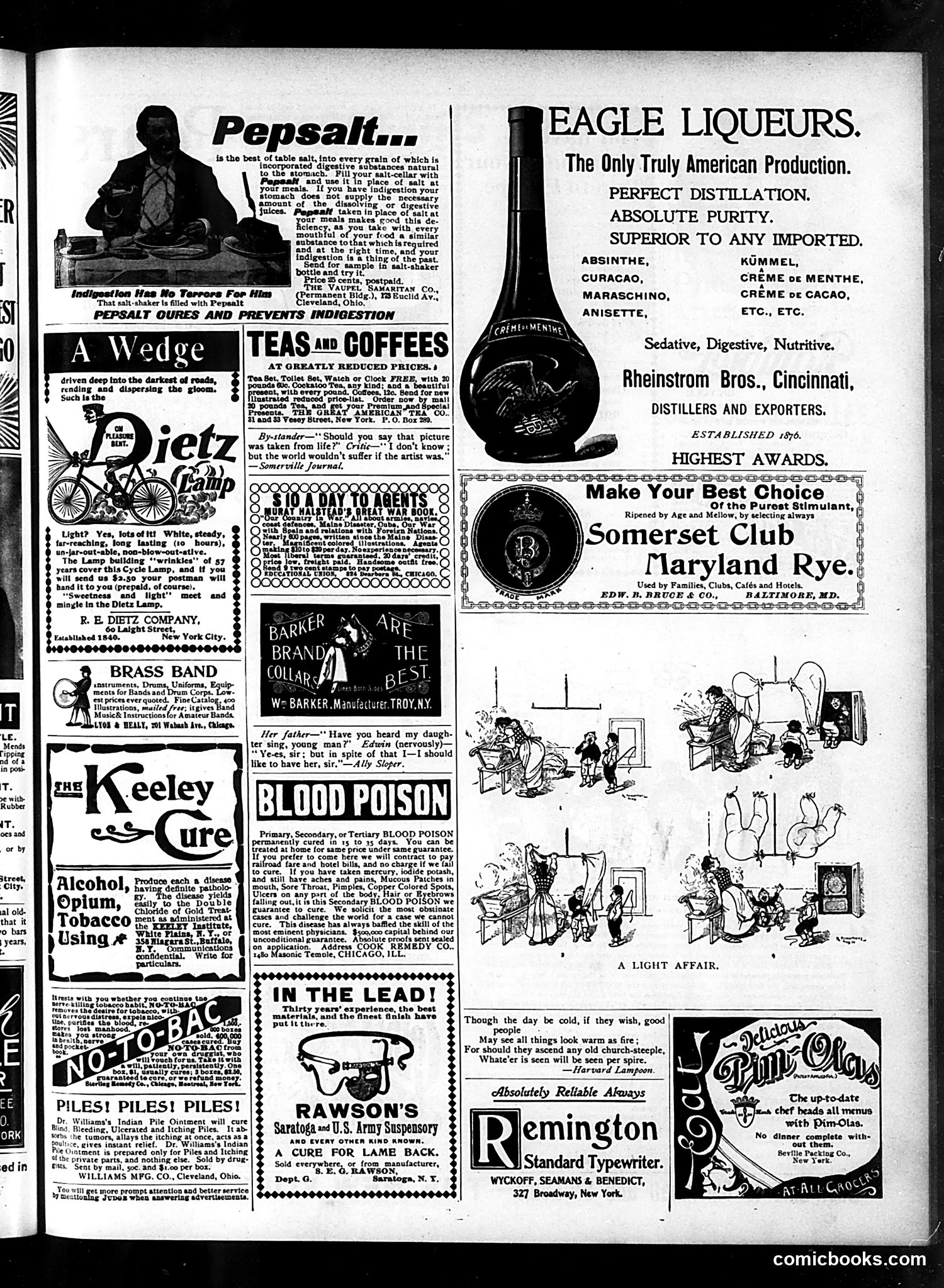
This is primarily an **advertising page** from Judge magazine, featuring various patent medicines, liquors, and consumer products typical of the early 20th century. The main content includes ads for **Eagle Liqueurs** (Cincinnati distillery), **Somerset Club Maryland Rye whiskey**, **Pepsalt** (an indigestion remedy), **Dietz lamps**, and various dubious medical treatments—notably a "**Blood Poison**" cure claiming to treat venereal disease in 15-35 days. The page contains a few small **comic snippets**: jokes about a critic not caring if an artwork was "from life," a nervous suitor, and a Harvard Lampoon quip about church spires. These are filler humor typical of Judge's format. The **satire lies implicitly** in Judge's juxtaposition: a humor magazine surrounded by ads for fraudulent cures and overproof spirits—products that embodied the very social problems (alcoholism, untreated STDs) that humor magazines often mocked. The page reveals period attitudes toward "patent medicine" marketing and casual acceptance of unregulated health claims.
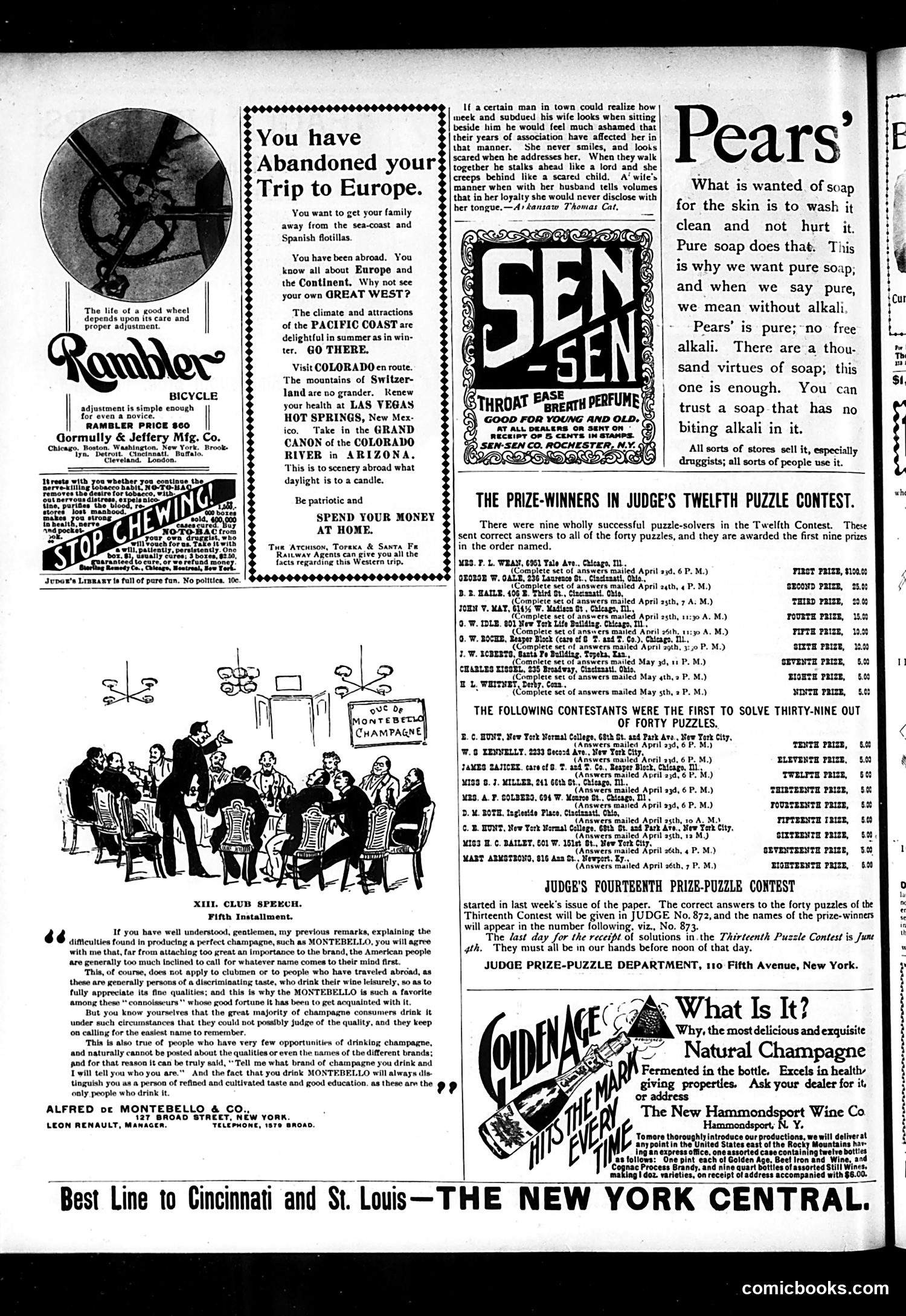
This page primarily contains **advertisements and contest announcements** rather than political cartoons. The main content includes: 1. **Travel advertisements** encouraging Americans to visit the American West (Colorado, Arizona, Grand Canyon) instead of Europe—likely a response to Spanish naval threats during the Spanish-American War era, when coastal travel seemed risky. 2. **A "Club Speech" promoting Montebello champagne**, which uses class-conscious language about refined taste and education—suggesting that drinking this brand signals good breeding and cultivation. 3. **Judge's Twelfth Puzzle Contest results**, listing prize-winners from across America. 4. **Product advertisements** for Pears' soap and Rambler bicycles. The only editorial content is a brief quoted passage about marital dynamics, critiquing husbands who diminish their wives' spirits. This appears to be a typical Judge magazine page mixing humor, advertising, and contests rather than featuring satirical political cartoons.
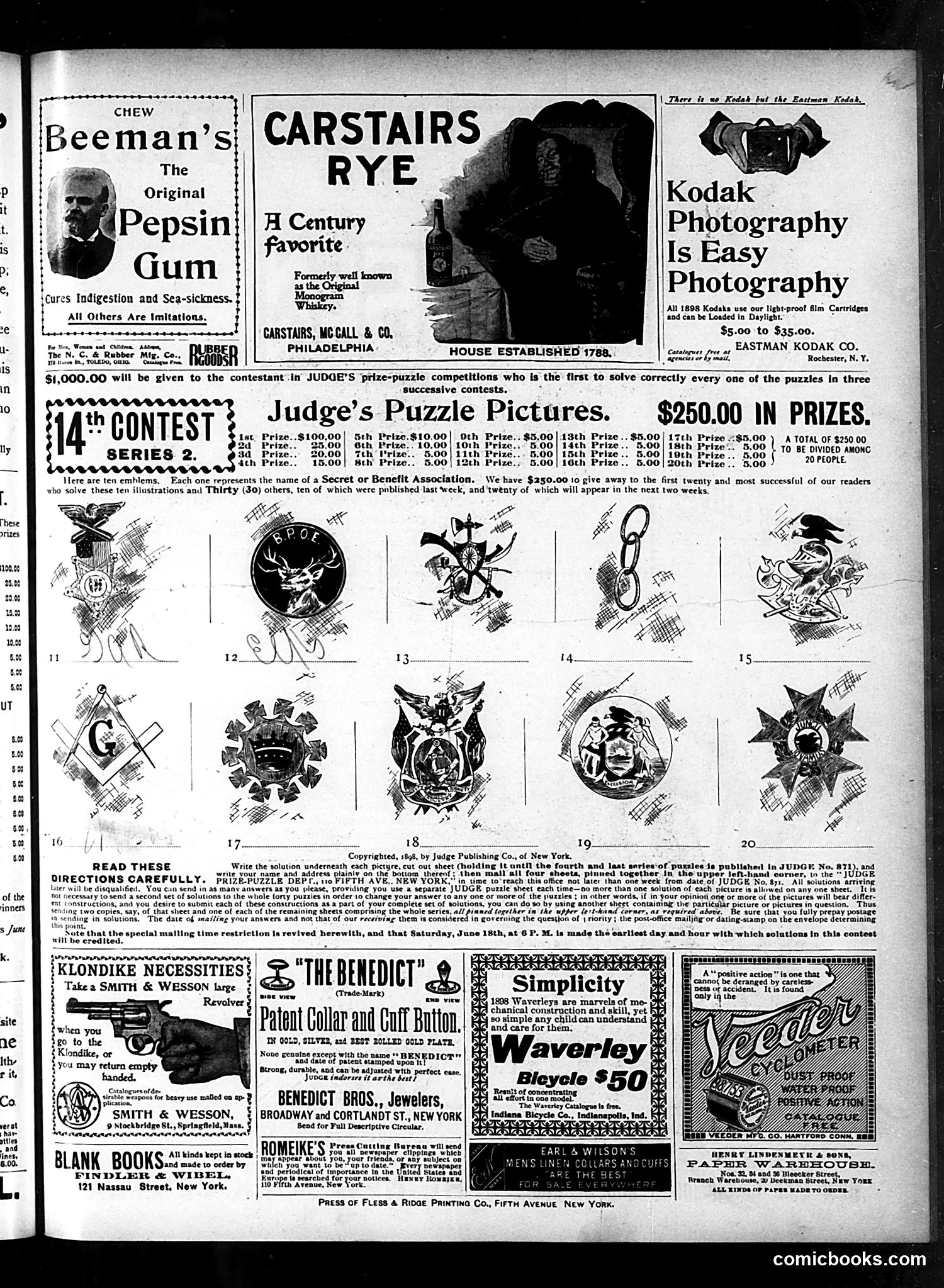
This page is primarily **advertising and a puzzle contest**, not political satire. The main content is Judge's "Puzzle Pictures" contest offering $250 in prizes. Readers must identify ten emblems representing "Secret or Benefit Associations"—fraternal and mutual-aid organizations that were popular in the 1890s. The illustrations show various fraternal symbols (Masonic compass, deer emblems, stars, ornate crests) that readers would identify by name. The upper portion contains period advertisements: Beeman's Pepsin Gum (claimed to cure indigestion), Carstairs Rye whiskey, and Kodak cameras. A smaller ad promotes a Smith & Wesson revolver, while lower ads feature bicycles, collar buttons, and blank books. The puzzle itself is the entertainment—a common Judge feature where readers competed for cash prizes by solving visual riddles about contemporary civic institutions.
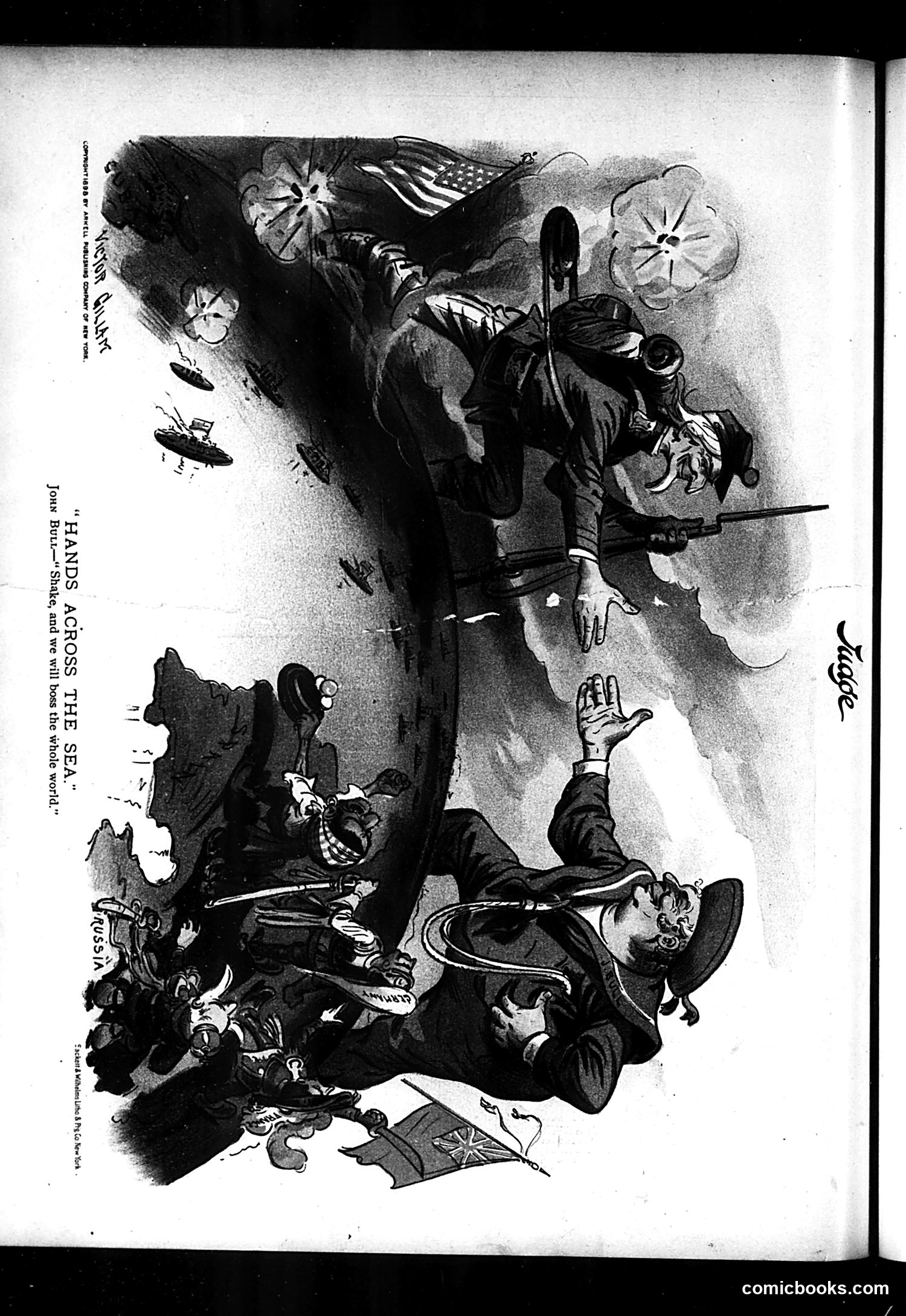
This Judge magazine cartoon depicts an apparent alliance between two figures. The caption identifies one as "Johnny Butt" (likely a caricature representing a specific political figure, though the exact identity is unclear from the image alone). The cartoon shows figures shaking hands across a divide, with one holding what appears to be an American flag and another holding a British flag. The satire critiques an international alliance or cooperation agreement, with the phrase "Hands Across the Sea" suggesting friendly diplomatic relations. "Johnny Butt's" boast that "we will boss the whole world" mocks the arrogance of such partnerships. The surrounding imagery—including what appear to be ships and conflicts—suggests the cartoon addresses imperialistic ambitions or military alliances of the era. Without the specific publication date visible, the exact historical context remains unclear.