
A complete issue · 16 pages · 1894
Judge — June 23, 1894
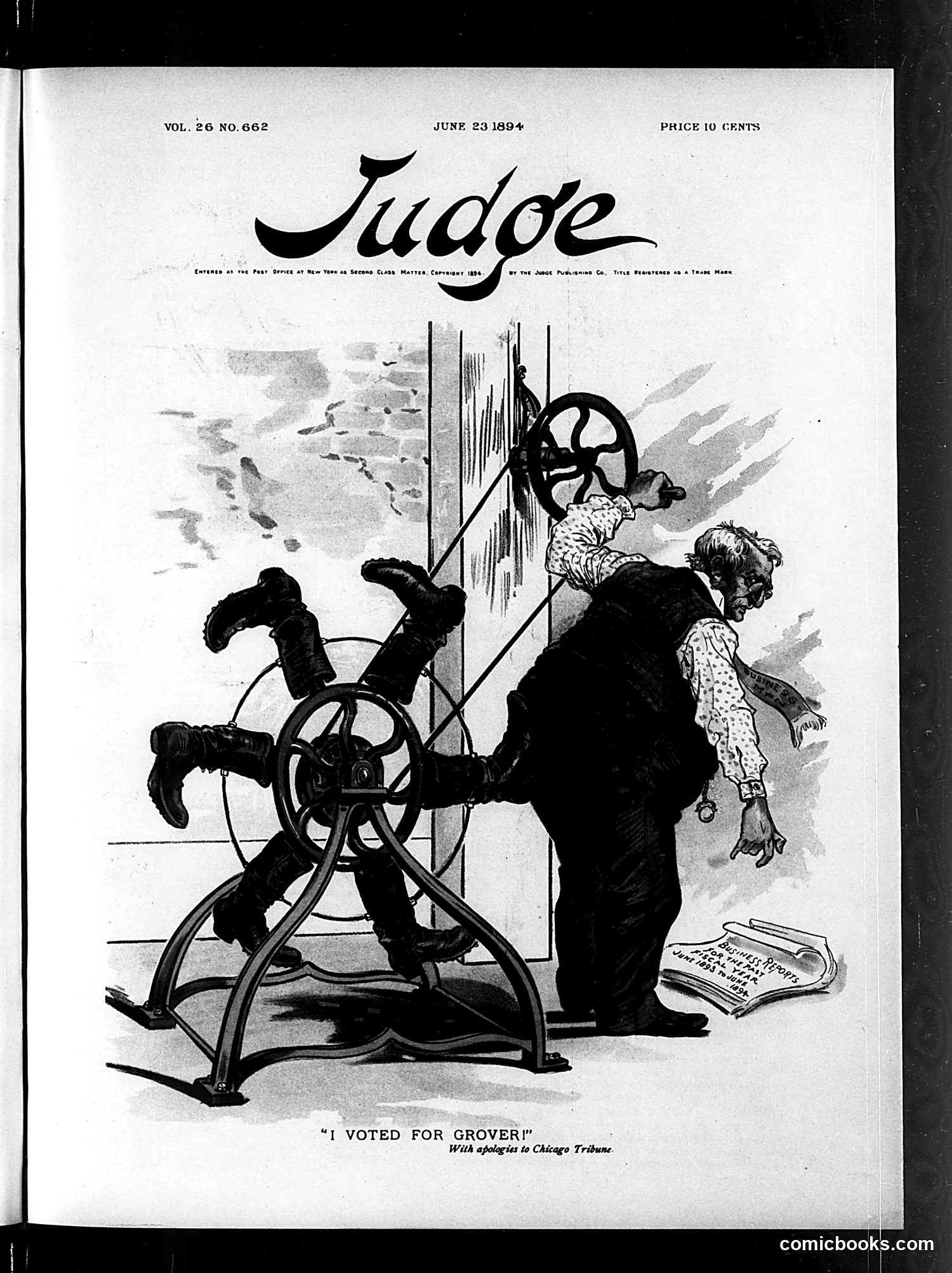
This political cartoon satirizes a Chicago Tribune reader caught in a dangerous industrial machine. The figure, who claims to have voted for President Grover Cleveland, is being mangled by mechanical gears while seemingly oblivious to the danger. The cartoon appears to mock voters who supported Cleveland's policies during the severe economic depression of 1893-1894—a period of massive unemployment and labor unrest. The implication is bitter: those who voted for Cleveland got "caught in the machinery" of economic disaster. The machine imagery represents industrial chaos and economic hardship that followed Cleveland's administration. With "apologies to Chicago Tribune," Judge suggests the Tribune bore some responsibility for promoting this political choice.
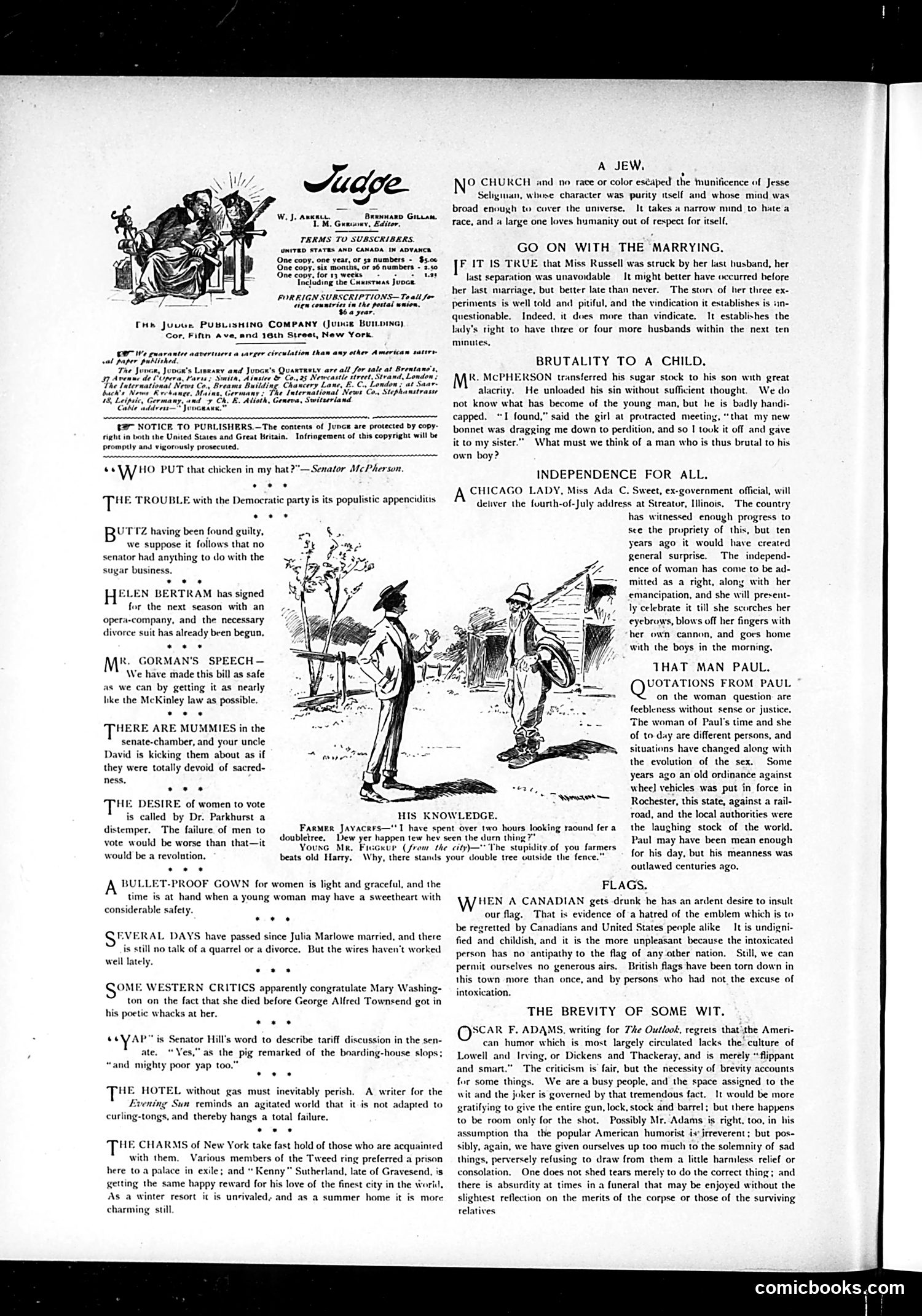
This page contains several satirical commentary pieces rather than a single cartoon. The main illustrated section shows "HIS KNOWLEDGE" — a farmer and young man discussing agricultural matters, with the farmer boasting about his experience while the young man appears skeptical. The text pieces mock various contemporary figures and issues: Senator Hill's tariff rhetoric, Mary Washington's divorce prospects, and George Alfred Townsend's poetry. There's commentary on women's independence, child brutality cases, and Canadian flag desecration. One section, "FLAGS," criticizes Americans who disrespect the Canadian flag while drunk, arguing such behavior damages international relations. The final piece discusses American humor lacking refinement compared to British wit. The overall tone is typical Judge satire: mocking political figures, social hypocrisy, and contemporary scandals through brief, sharp commentary.
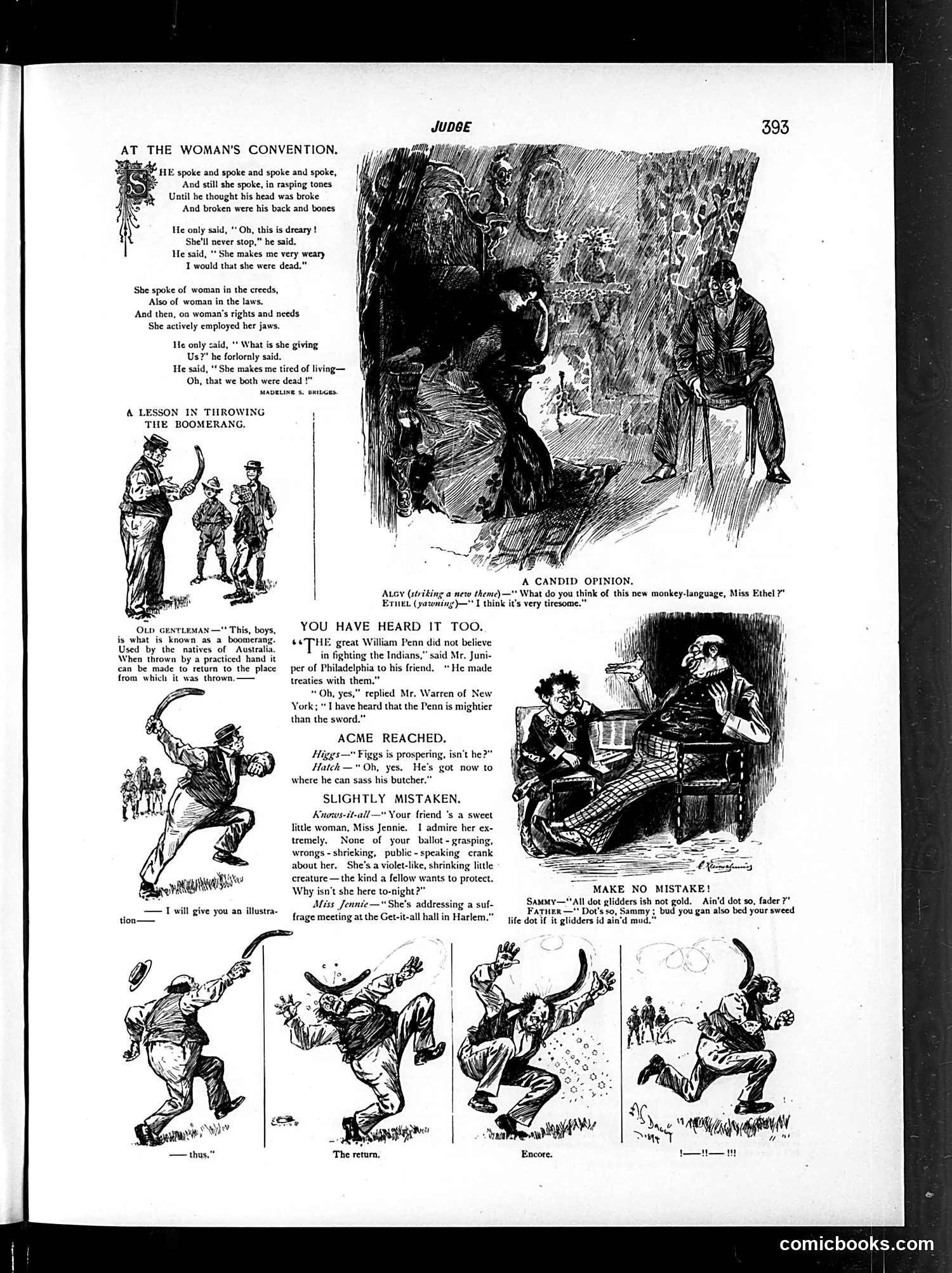
This page contains several satirical pieces: **"At the Woman's Convention"** criticizes a man's complaints about women's activism and rights advocacy, mocking his dismissive attitude toward their organizing efforts. **"A Lesson in Throwing the Boomerang"** depicts an Australian throwing implement, illustrating the phrase "what goes around comes around"—likely referencing consequences for past actions. **"You Have Heard It Too"** presents anecdotes about military comparisons (Penn vs. sword, fighting Indians), satirizing men's tendency to one-up each other with tall tales. **"Make No Mistake!"** shows domestic conflict where a father warns his son about "gliders" (girls), suggesting deception in courtship. The remaining pieces ("Acme Reached," "Slightly Mistaken," and boomerang illustrations) appear to be brief humorous vignettes typical of Judge's satirical format, mocking contemporary social pretensions and gender relations.
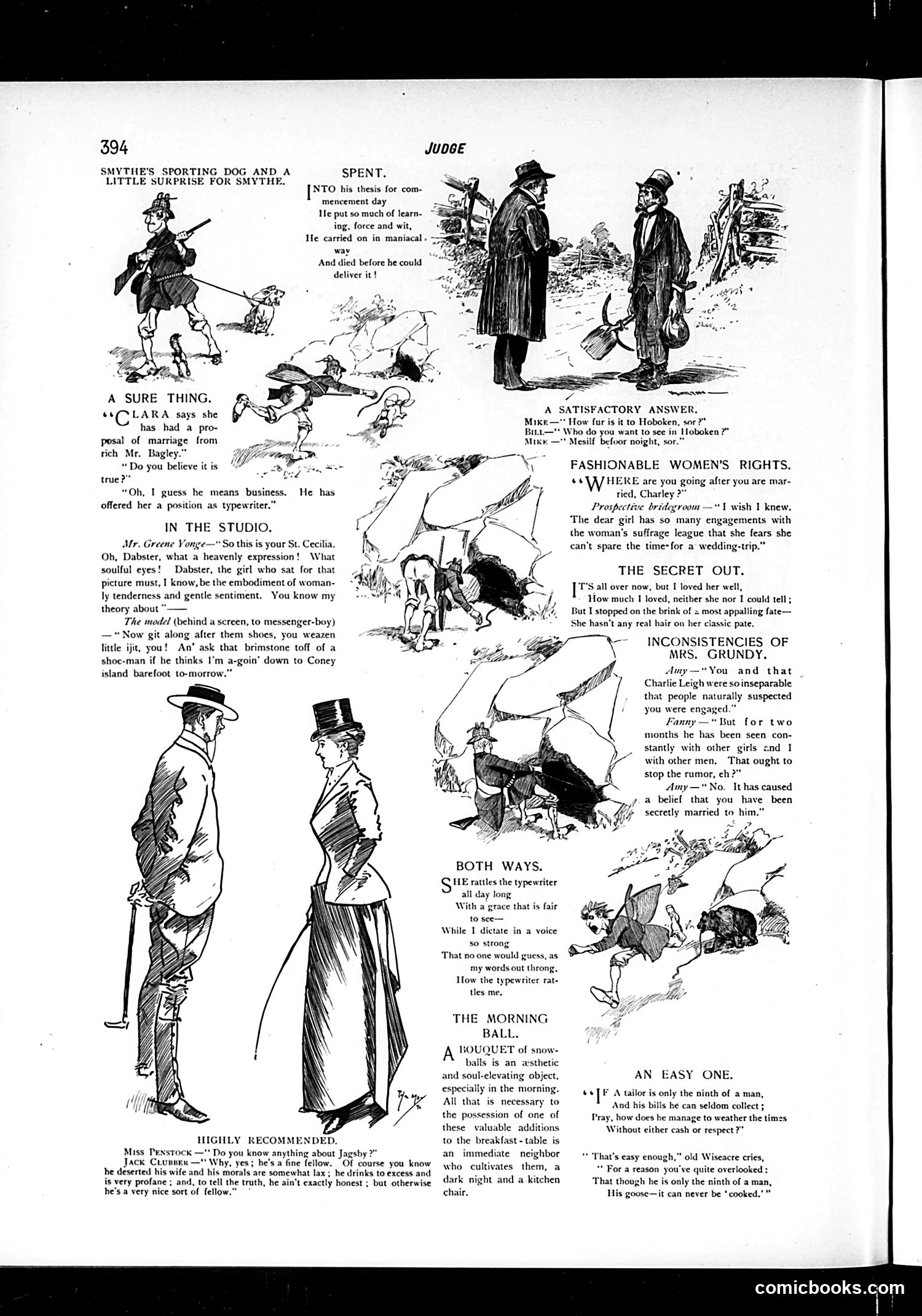
This page contains multiple satirical vignettes mocking Victorian-era social conventions: **"A Sure Thing"** mocks marriage proposals—a man offers a woman a typist position rather than genuine courtship, reducing marriage to employment. **"In the Studio"** contrasts artistic pretension with reality: a painter romanticizes his model as embodying "tenderness and sentiment," while she (behind a screen) is crude and practical, ordering shoes delivered. **"The Secret Out"** satirizes male vanity—a man almost married a woman until discovering she wore a hairpiece. **"Inconsistencies of Mrs. Grundy"** ridicules social gossip: appearing together causes engagement rumors; appearing separately *also* causes rumors, highlighting the arbitrary nature of social judgment. **"Fashionable Women's Rights"** mocks the women's suffrage movement, suggesting newly empowered women prioritize League activities over marriage—implying activism makes them poor wives. The page's humor relies on exposing hypocrisy in Victorian courtship, vanity, and social expectations while satirizing emerging feminist activism as socially disruptive.
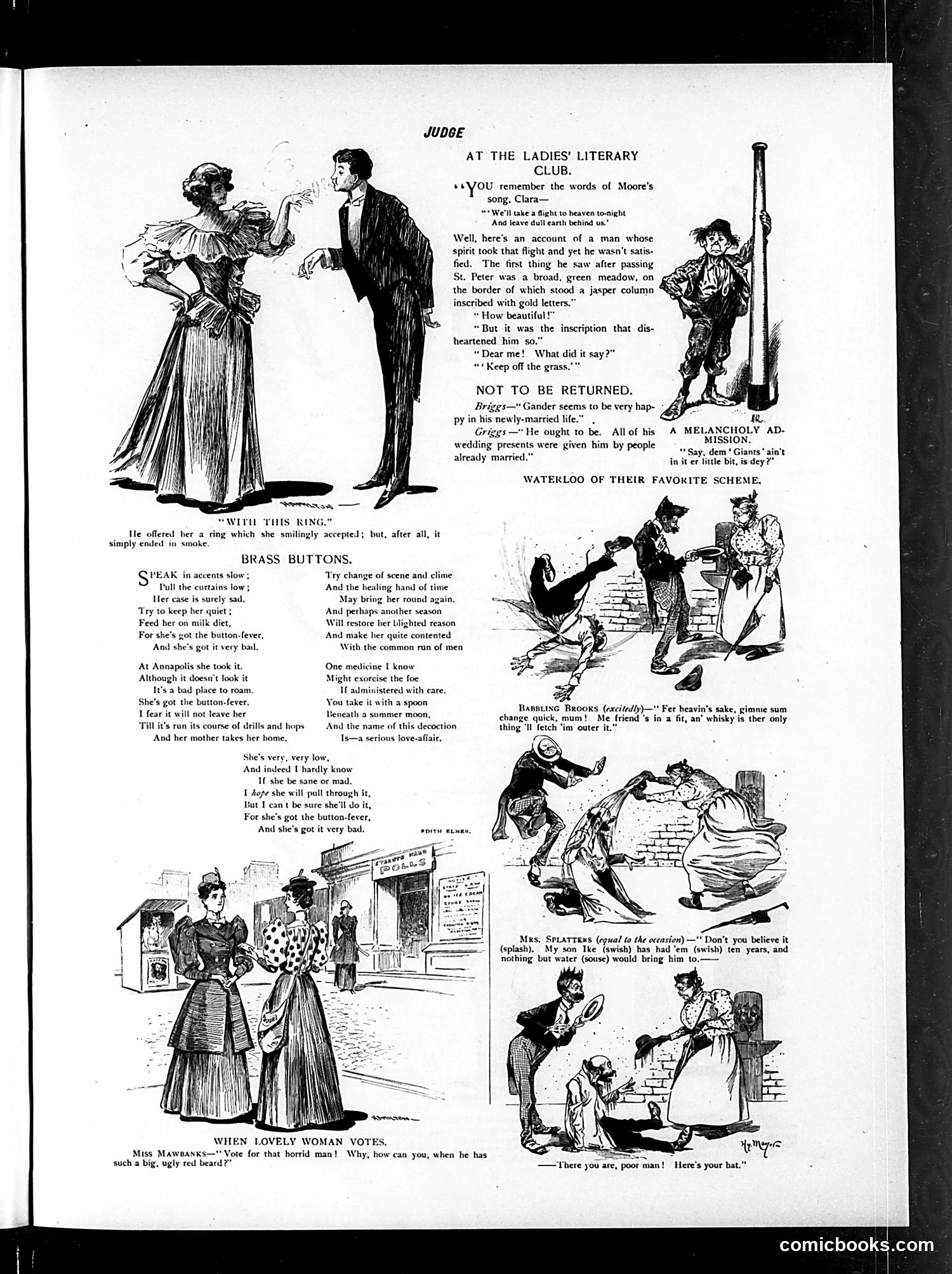
This page contains multiple satirical cartoons addressing turn-of-the-century American social concerns: **"At the Ladies' Literary Club"** mocks women's intellectual pretensions through a heavenly vision joke with a "Keep off the grass" sign—suggesting even paradise has mundane restrictions. **"Brass Buttons"** satirizes young women's infatuation with naval officers at Annapolis, depicted as a fever or affliction. The poem suggests this romantic obsession is an illness requiring treatment, reflecting period anxiety about female sexuality and military romance. **"When Lovely Woman Votes"** references women's suffrage debates, showing a woman dismissing a man's political candidacy based on his appearance (red beard) rather than merit—implying women voters would be irrational and shallow, a common anti-suffrage argument. **"Waterloo of Their Favorite Scheme"** and other smaller vignettes continue the domestic humor typical of Judge's era, focusing on marriage, courtship, and class interactions. The overall tone reflects late 19th/early 20th-century anxieties about changing gender roles and women's expanding public participation.
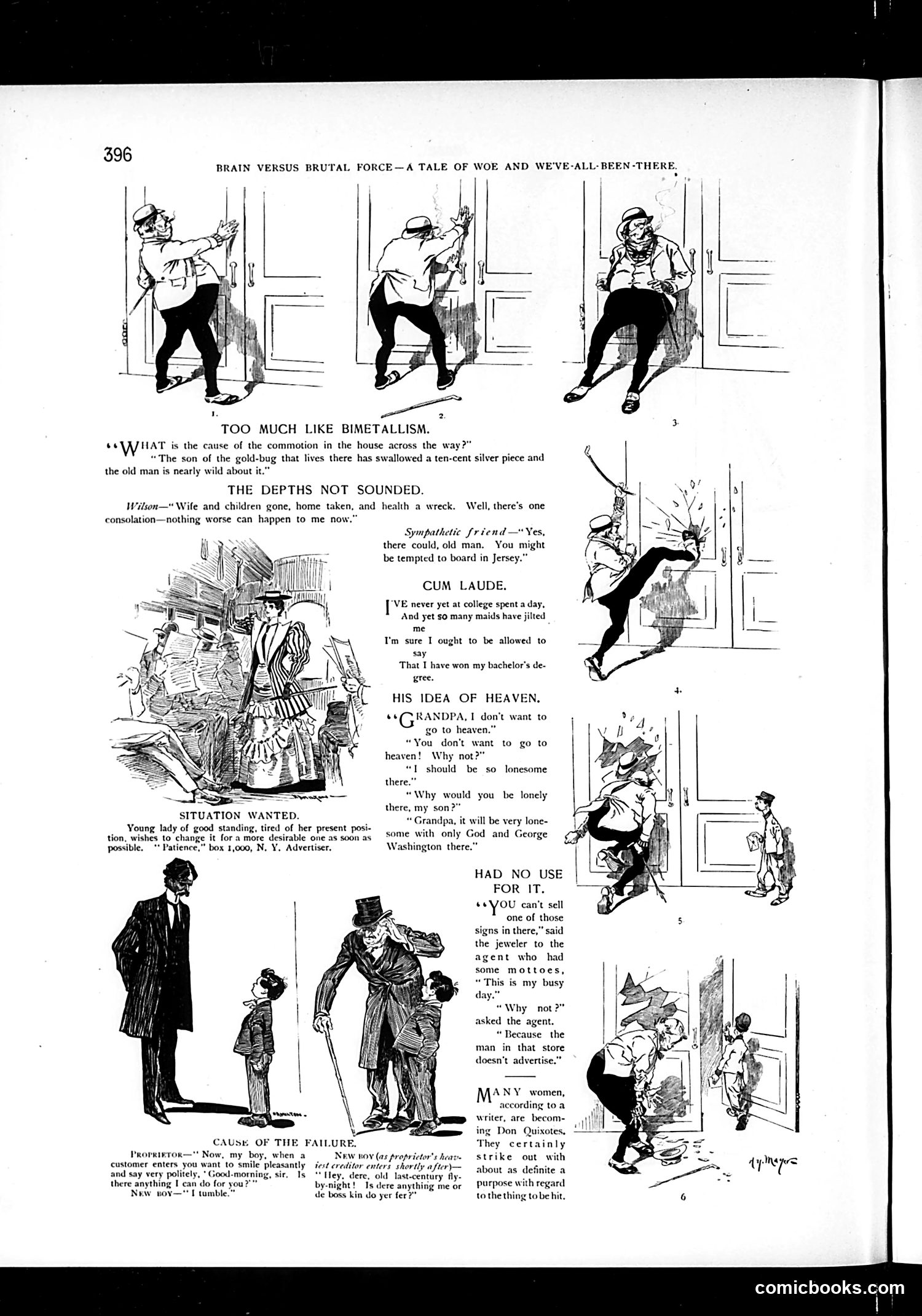
This Judge magazine page contains multiple unrelated satirical pieces typical of late 19th-century American humor: **"Brain Versus Brutal Force"** (top): A visual gag about a child swallowing a ten-cent silver piece. The "gold-bug" reference alludes to the bimetallism debate—a major political issue pitting those favoring gold currency against silver advocates. The humor conflates personal and economic crises. **"The Depths Not Sounded"**: A dark joke about a ruined man whose wife and children have left, and his only remaining fear is boarding in Jersey (suggesting New Jersey was considered undesirable). **"His Idea of Heaven"**: A gentle joke where a child fears heaven would be lonely, brightened only by George Washington's presence—poking fun at American civic mythology. **"Situation Wanted" and "Had No Use for It"**: Short social comedies about employment and advertising effectiveness among merchants. **"Cause of the Failure"**: A proprietor's failed attempt to train a rude employee in customer service etiquette. The page is primarily humor rather than political commentary, reflecting Judge's mix of social satire and everyday observations.
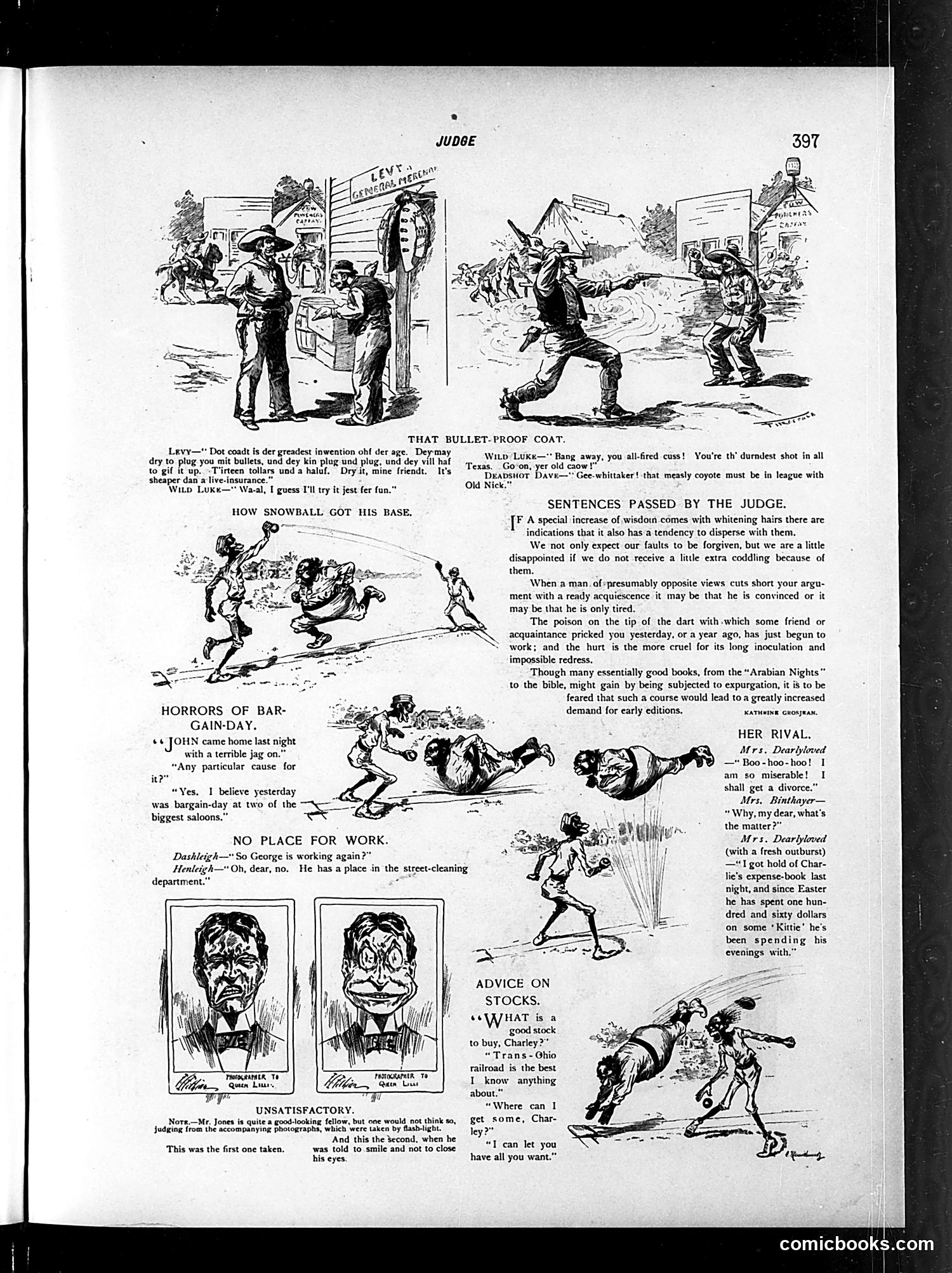
This page contains several humorous sketches and satirical commentaries typical of late 19th-century American humor magazines. **"That Bullet-Proof Coat"** mocks a dubious invention—a supposedly bulletproof coat—through dialogue between characters with ethnic accents (Levy, Wild Luke, Deadshot Dave). The joke satirizes both the gullible inventor and the reckless testing of untested products. **"Sentences Passed by the Judge"** offers philosophical observations on human nature—people expect forgiveness plus sympathy, old grudges hurt worst, and censoring books paradoxically increases demand for them. **Additional sketches** humorously depict everyday situations: "How Snowball Got His Base" (unclear reference), "Horrors of Bargain-Day" (satirizing saloon drunkenness), "No Place for Work" (a man unemployed in street-cleaning), and domestic comedy sketches about infidelity and stock-market advice. The two portrait photographs labeled "Unsatisfactory" mock photographer Jones, contrasting a natural photograph with a forced, smiling pose—satirizing the awkwardness of early portrait photography. Overall, this reflects Judge's mix of social satire, ethnic humor, and domestic comedy aimed at middle-class readers.
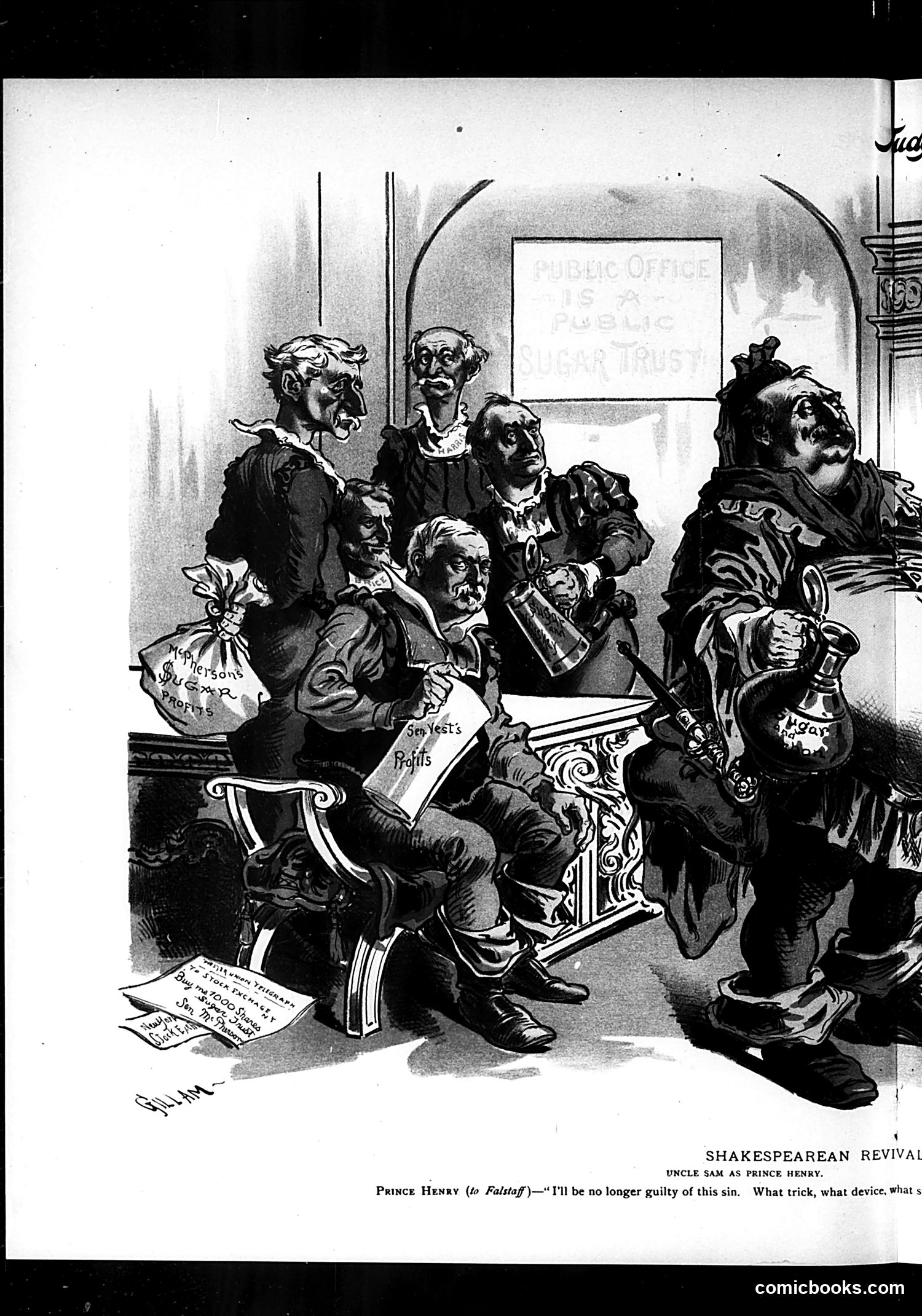
This Judge magazine cartoon satirizes American political corruption through a Shakespeare reference. It depicts Uncle Sam as Prince Henry from *Henry IV*, addressing various corrupt figures portrayed as Falstaff and his associates—caricatured as demonic or grotesque characters labeled with terms like "Profits" and "Graft." The satire compares Uncle Sam's promise to reform the nation (echoing Prince Henry's vow to abandon Falstaff's corrupting influence) to Shakespeare's moral redemption arc. The figures around him represent different forms of corruption and malfeasance the U.S. government must purge. A sign reading "PUBLIC OFFICE IS PUBLIC TRUST" reinforces the reform message. The cartoon advocates for governmental cleanup of corruption and return to ethical principles, using classical literary allusion to elevate the political critique.
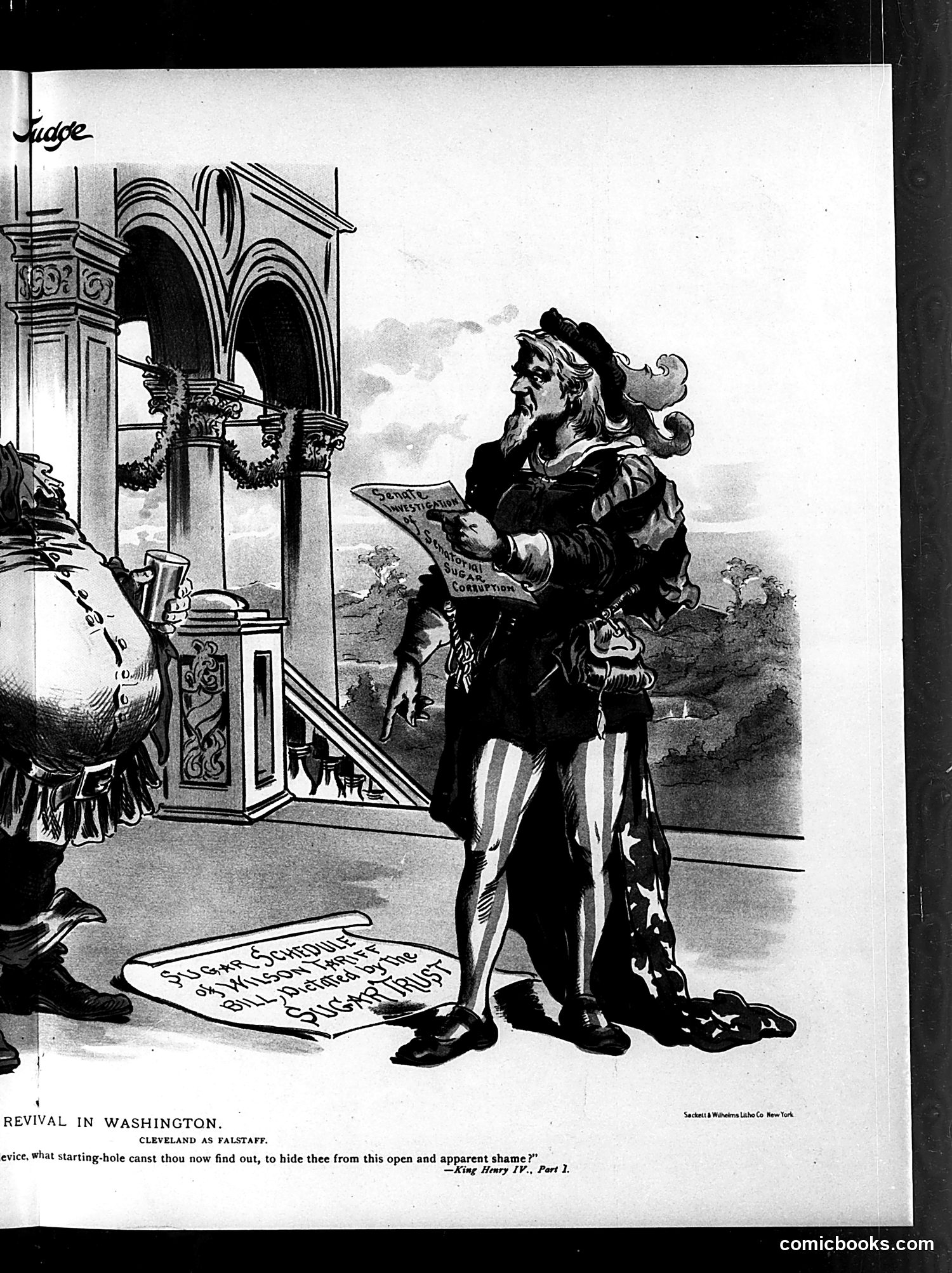
This cartoon depicts Cleveland (likely President Grover Cleveland) dressed as Falstaff, Shakespeare's corpulent comic character known for deception and moral weakness. The figure holds a document labeled with corrupt practices and stands before an ornate government building, suggesting Washington D.C. The satire equates Cleveland with Falstaff—a character famous for hiding shameful behavior behind excuses. The quoted Shakespeare passage ("what starting-hole canst thou now find out, to hide thee from this open and apparent shame?") reinforces this parallel, suggesting Cleveland is attempting to conceal corruption or scandal through political maneuvering. The cartoon criticizes Cleveland's administration as morally compromised, using classical literary allusion to suggest his dishonesty and evasion are as transparent as Falstaff's in the play.
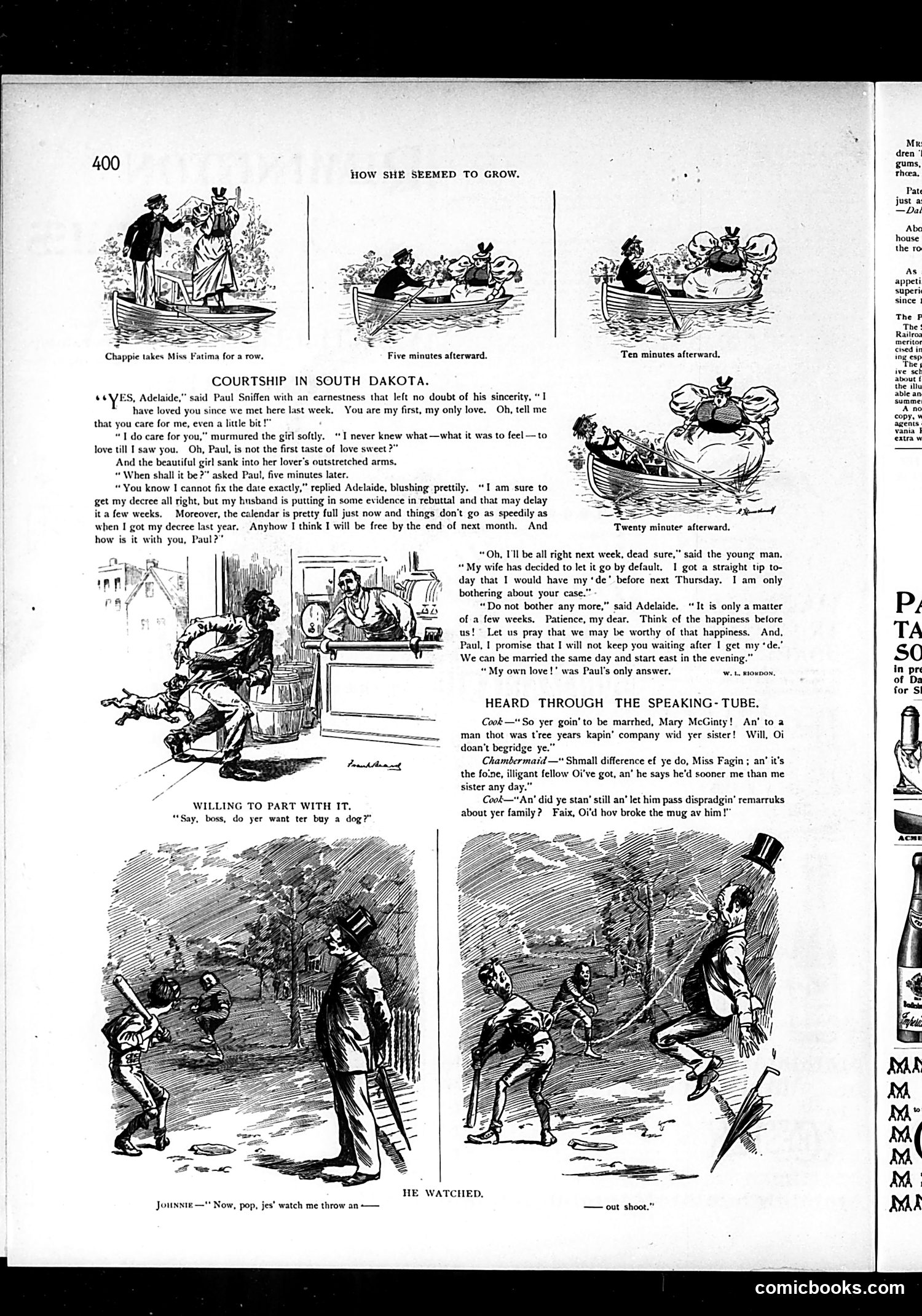
This page contains humorous satire about rapid divorce and remarriage in South Dakota, which had notoriously lenient divorce laws at this time. **"Courtship in South Dakota"** depicts the absurdity: Paul proposes to Adelaide after one week, and she accepts—but both are currently going through divorces. The joke is that they casually discuss waiting "a few weeks" for their respective divorce decrees to finalize before marrying each other. The calendar reference and "evidence in rebuttal" mock how divorce proceedings were treated as mere bureaucratic formalities rather than serious matters. The three boat illustrations showing Adelaide appearing to grow larger are a visual gag about how quickly the relationship progresses—she literally seems to expand as time passes. **"Willing to Part With It"** is unrelated commentary on a man trying to sell his dog, likely satirizing casual disposability of relationships and possessions. **"Heard Through the Speaking-Tube"** jokes about Irish servants gossiping about a woman marrying her sister's ex-boyfriend, playing on ethnic stereotypes common to the era. The satire targets South Dakota's reputation as a divorce destination where people could dissolve marriages with minimal consequence.
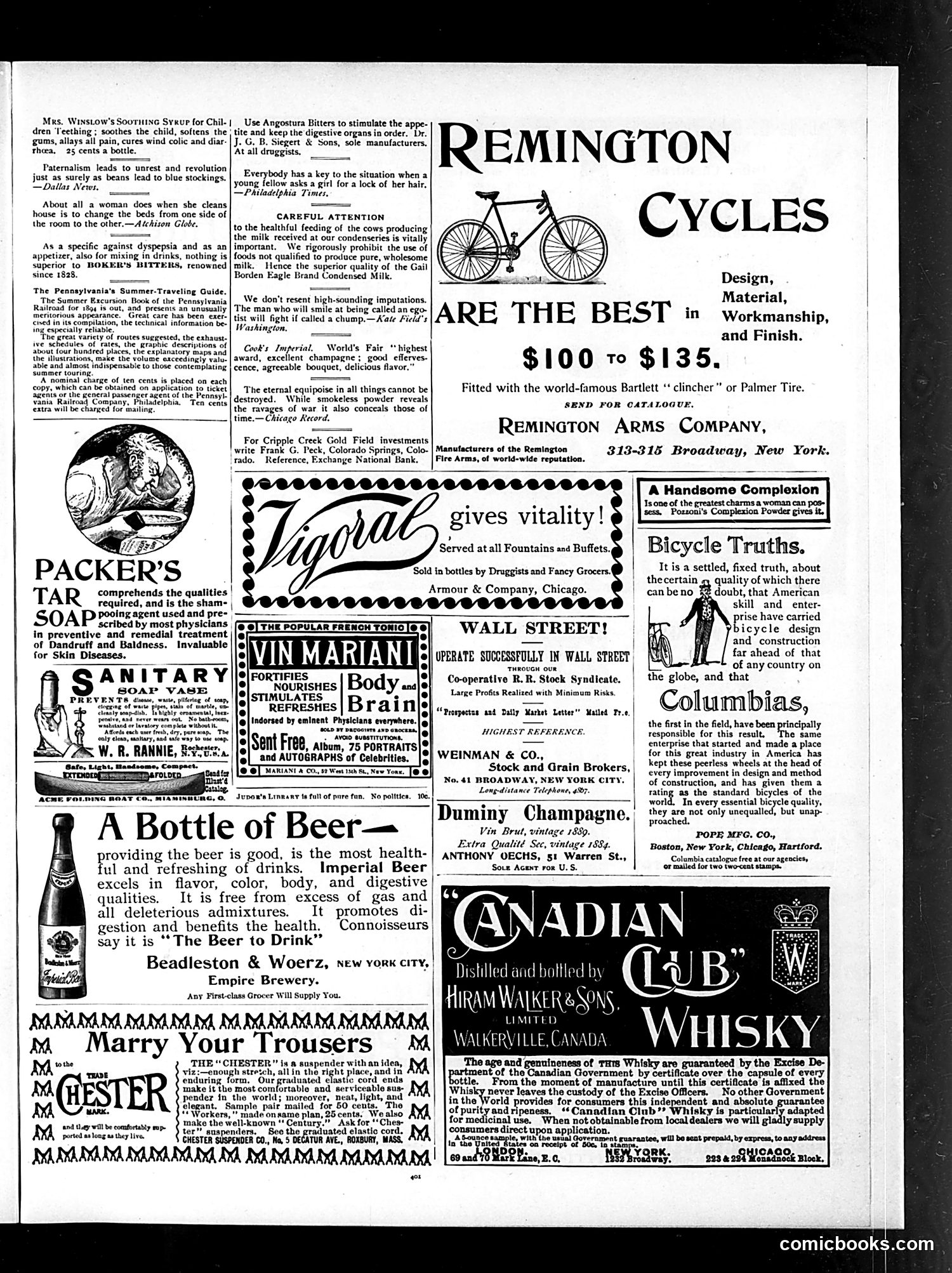
This is primarily an **advertising page** from Judge magazine, containing numerous product advertisements typical of the late 19th/early 20th century. There are no significant political cartoons or satirical content. The page showcases period remedies and products: Mrs. Winslow's Soothing Syrup (a common children's medicine), various bitters and tonics marketed for digestive health, Packer's Tar Soap for hair/skin conditions, and beverages including beer and whisky. The only quasi-satirical element appears in the small quoted jokes scattered among ads—brief quips about relationships and behavior that reflect contemporary attitudes toward women and courtship. The **Remington Cycles advertisement** is the largest display ad, promoting bicycles as high-quality products ($100-$135), reflecting the bicycle boom of the 1890s as a major consumer good and symbol of mobility. Overall, this page reflects **consumer culture and patent medicine advertising** of the Gilded Age, when such publications mixed humor with commerce and unregulated health product marketing.
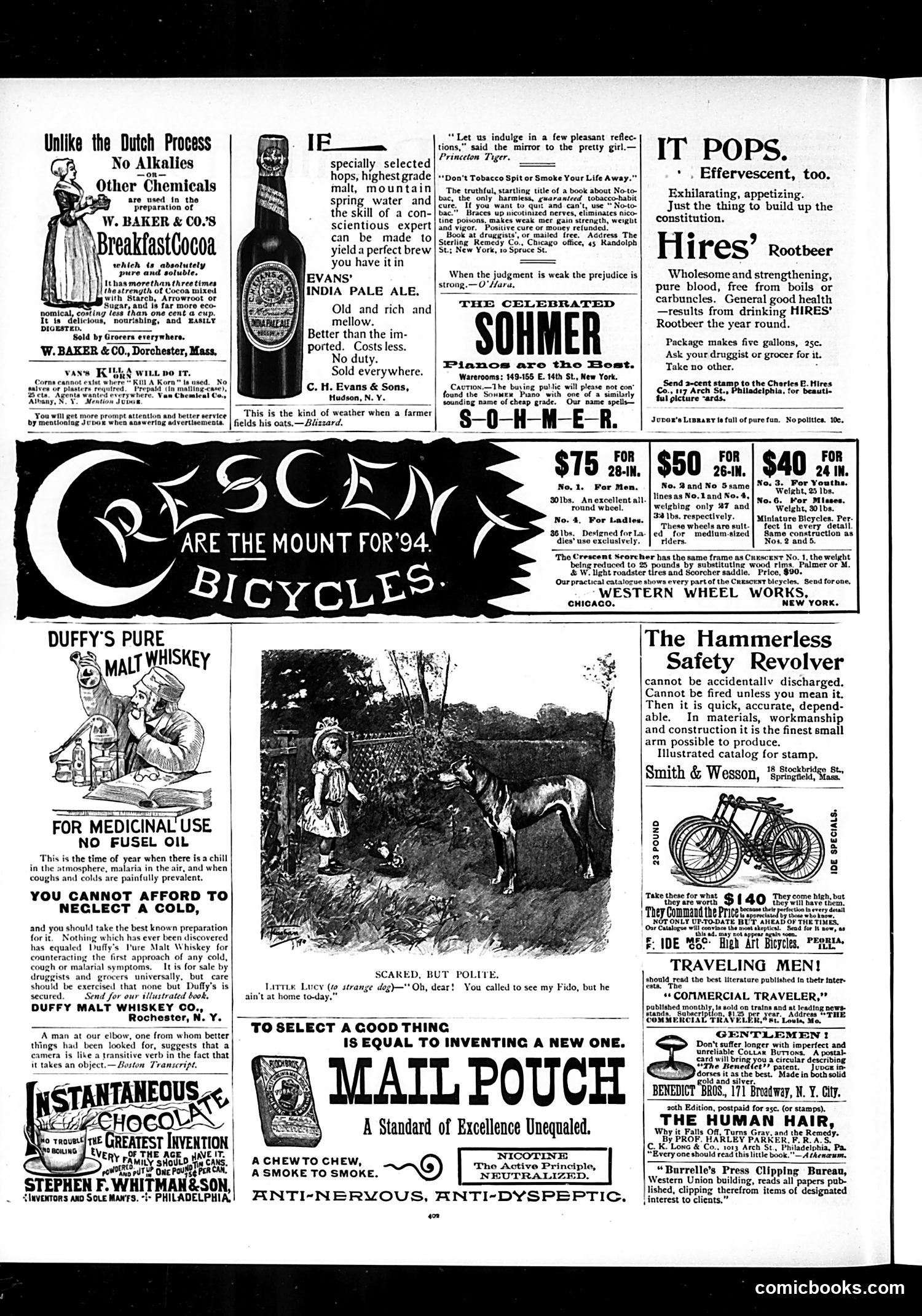
This page is primarily **advertisements** for consumer products popular in the 1890s, with minimal satirical content. The small jokes scattered throughout are typical Judge fare: light wordplay rather than political satire. For example, a mirror tells a pretty girl to "indulge in pleasant reflections" (pun on reflection), and a comparison between cameras and transitive verbs (both "take objects"). The bulk of the page advertises patent medicines, bicycles, cocoa, whiskey, and piano—reflecting late-Victorian consumer culture. Notable is the prominence of medicinal alcohol (Duffy's Malt Whiskey "for medicinal use") and nicotine-cure products, addressing contemporary health anxieties. The large bicycle advertisement ("Crescents Are the Mount for '94") indicates the 1890s bicycle craze. The "Hammerless Safety Revolver" ad is notable—a gun marketed as safe/reliable, typical of period advertising casualness about weapons. This appears to be a typical Judge issue: mostly a vehicle for paying advertisements rather than sustained political or social satire.
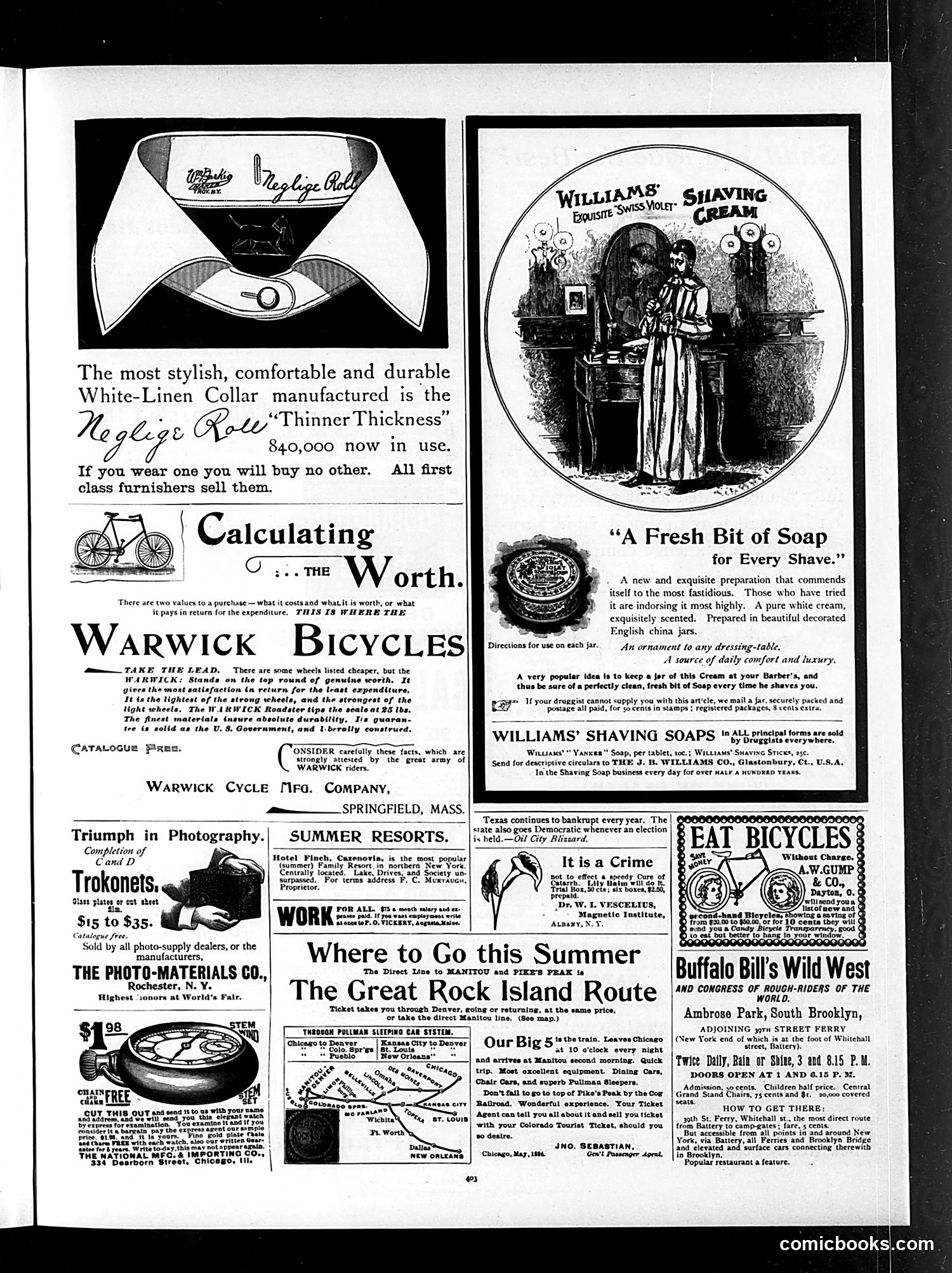
This page is primarily **advertisements**, not satirical cartoons. It contains commercial promotions typical of 1890s publications. **Key advertisements include:** - **Neglect Roll Collars**: White-linen dress collars claiming 40,000 in use - **Warwick Bicycles**: Emphasizing durability and value ("Calculating Worth") - **Williams Shaving Cream**: A "fresh bit of soap for every shave" in decorative jars - **Trokonets Photography**: Glass plates or cut sheet materials - **Great Rock Island Route**: Summer travel to Manitou and Pike's Peak, Colorado - **Buffalo Bill's Wild West**: Show at Ambrose Park, South Brooklyn - **EAT Bicycles**: Advertisement with cycling imagery **The only political content** is a small Texas joke: "Texas continues to bankrupt every year. The state also goes Democratic whenever an election is held." The page reflects **1890s consumer culture**: bicycles, grooming products, photography equipment, and tourism—marketed to middle-class readers with period-appropriate illustrations and manufacturing claims emphasizing quality and durability.
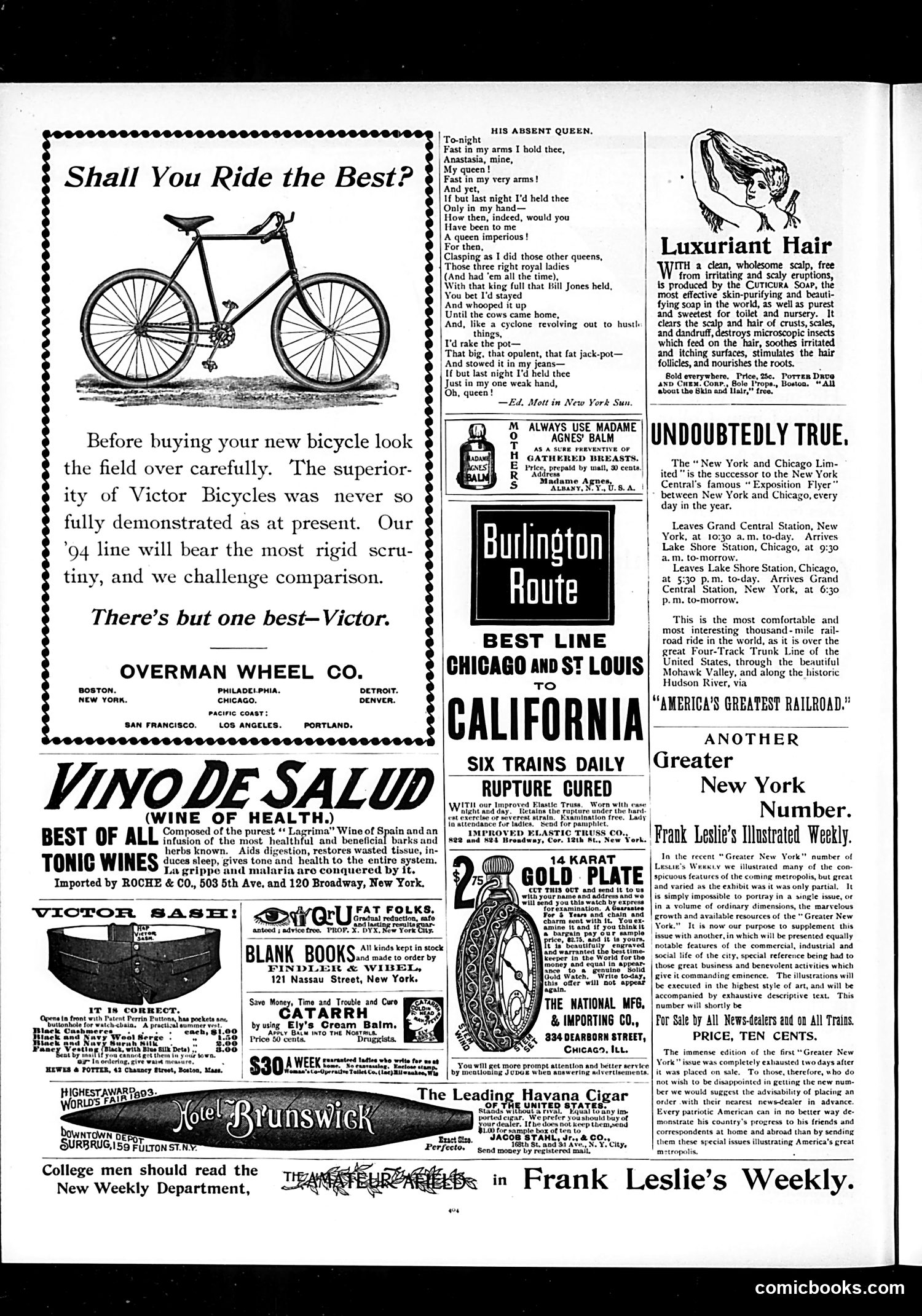
This page is primarily **advertising**, with one notable poem. The main content includes: **"His Absent Queen"** (center-right): A poem by Ed. Mott in the New York Sun about a poker player who wishes his wife were merely "in his hand" (as a card) rather than physically present, so he could focus on winning a large pot. The satire mocks male preoccupation with gambling over marriage, presenting the husband's desire to abandon his "queen" (wife) for financial gain as darkly comic. **Advertisements**: The page features typical 1890s-era ads for bicycles (Victor brand), tonic wine, patent medicines (Madame Agnes' Balm for "gathered breasts"), railroad service (Burlington Route to California), and beauty products (Cuticura Soap). These ads reflect period consumer goods and dubious medical claims common to the era. The poem's humor relies on poker terminology and the husband's casual disregard for matrimony—themes recognizable to contemporary readers familiar with gambling culture and gender dynamics of the period.
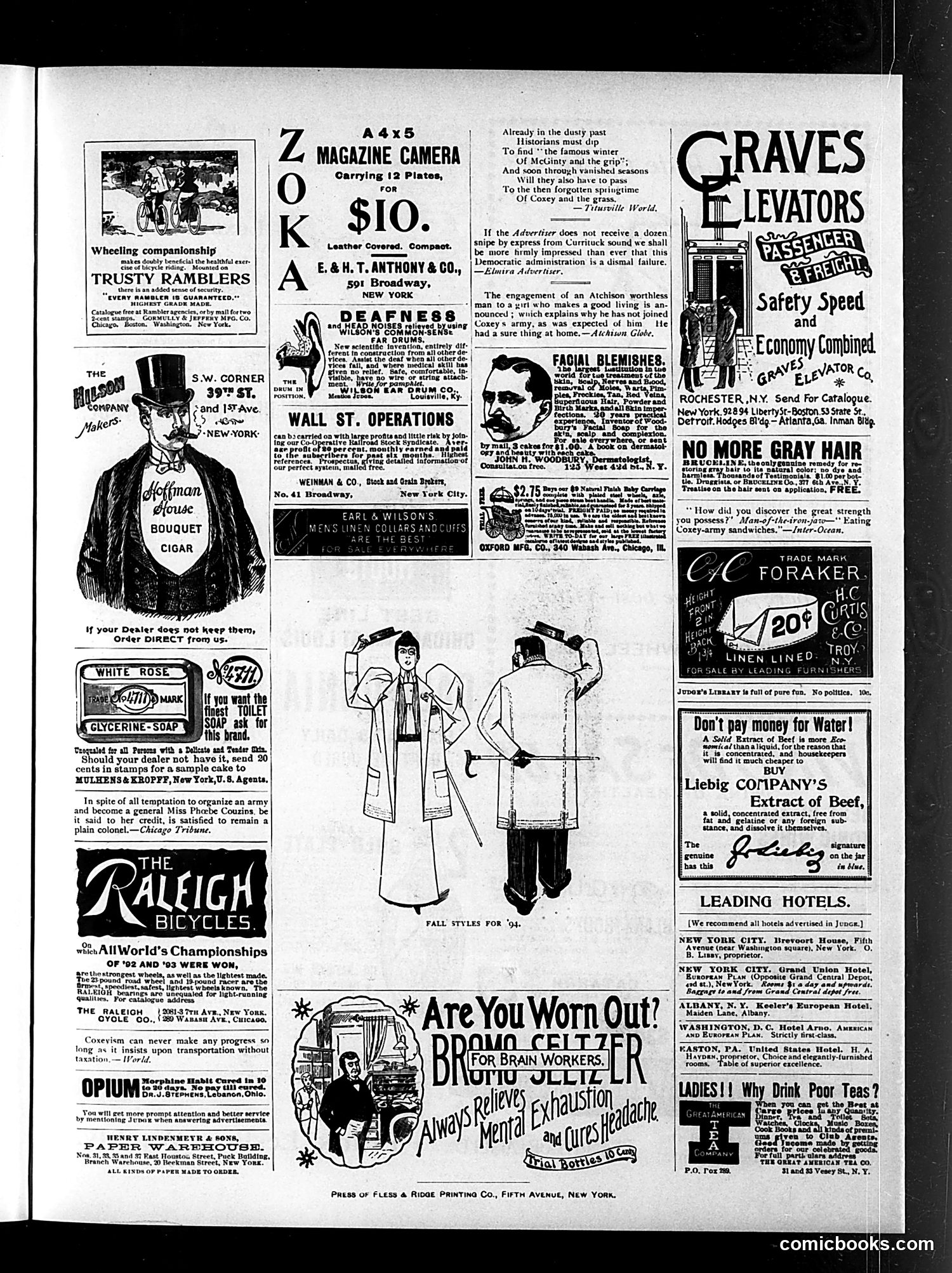
This is primarily an **advertising page** from Judge magazine, with limited political cartooning. The few satirical references are: **"Coxey and the grass"** (top): A poem mocking Coxey's Army—an 1894 march of unemployed workers led by Jacob Coxey demanding federal jobs. The satirist dismisses it as historically insignificant ("dusty past"), suggesting it will be forgotten like previous crises. **"Coxevism" references** (bottom): Brief jokes about Coxey's movement. One quip mocks the movement's logic regarding "transportation without taxation." Another plays on "Coxey-army sandwiches" as a strength-building food—sarcasm about the march's hardships. **The cartoon figure** (left page) appears to be a generic dandy or businessman in top hat—not a specific political figure, just promotional imagery for tobacco products. The page is dominated by period advertisements for cameras, bicycles, soap, hotels, and patent medicines—typical Judge content balancing satire with commercial revenue.
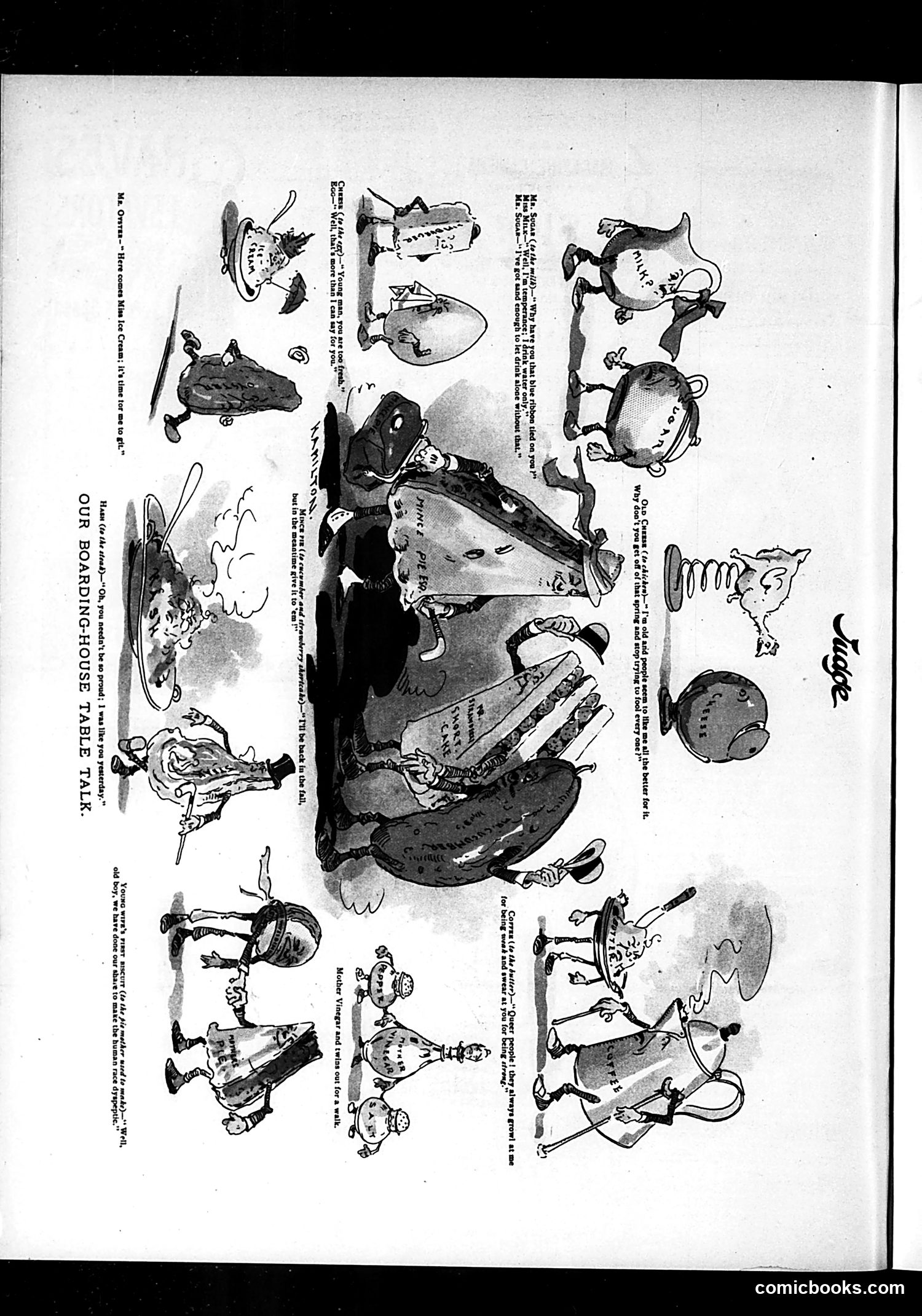
This page features a humorous domestic satire about boarding-house meals and residents' food preferences. The cartoon presents personified food items (chicken, butter, ice cream, pie, steak, and other dishes) conversing with each other and boarding-house guests at mealtimes. The jokes center on food quality complaints and dining etiquette: guests criticize chicken for being old, butter for being weak, steak for yesterday's leftovers, and pie for not matching home cooking. The food items respond defensively or philosophically to these insults. One figure warns a young man he's "too fresh," while another boasts about past quality. The satire targets both boarding-house food quality and guests' entitled complaining about meals. It reflects late 19th/early 20th-century American anxieties about commercial dining establishments versus home cooking, presenting a lighthearted commentary on the mutual frustrations between diners and food service.