A complete issue · 16 pages · 1893
Judge — April 8, 1893
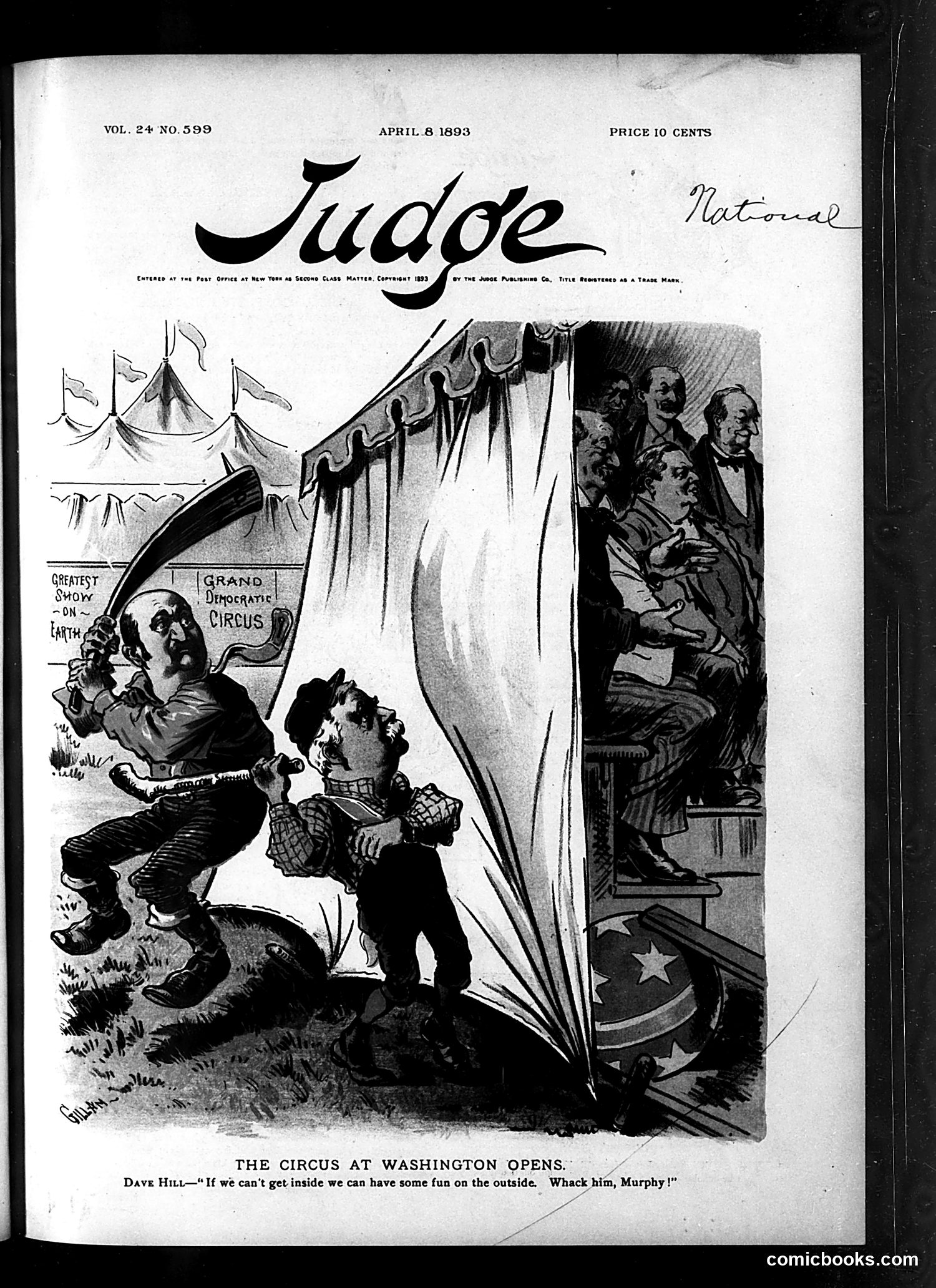
This Judge cartoon from April 8, 1893 satirizes political circus-like chaos in Washington, D.C. The image shows two figures outside a "Grand Democratic Circus" tent labeled "Greatest Show on Earth." One character (identified as "Dave Hill" in the caption) suggests to his companion Murphy that since they can't get inside to see the main spectacle, they should "have some fun on the outside" and "whack him, Murphy!" The satire mocks the Democratic administration's chaotic governance as entertainment—a literal circus. The contrast between the dignified proceedings visible inside the tent and the rowdy behavior outside suggests public frustration with political disorder. This likely references early Cleveland administration turmoil during the 1893 economic depression.
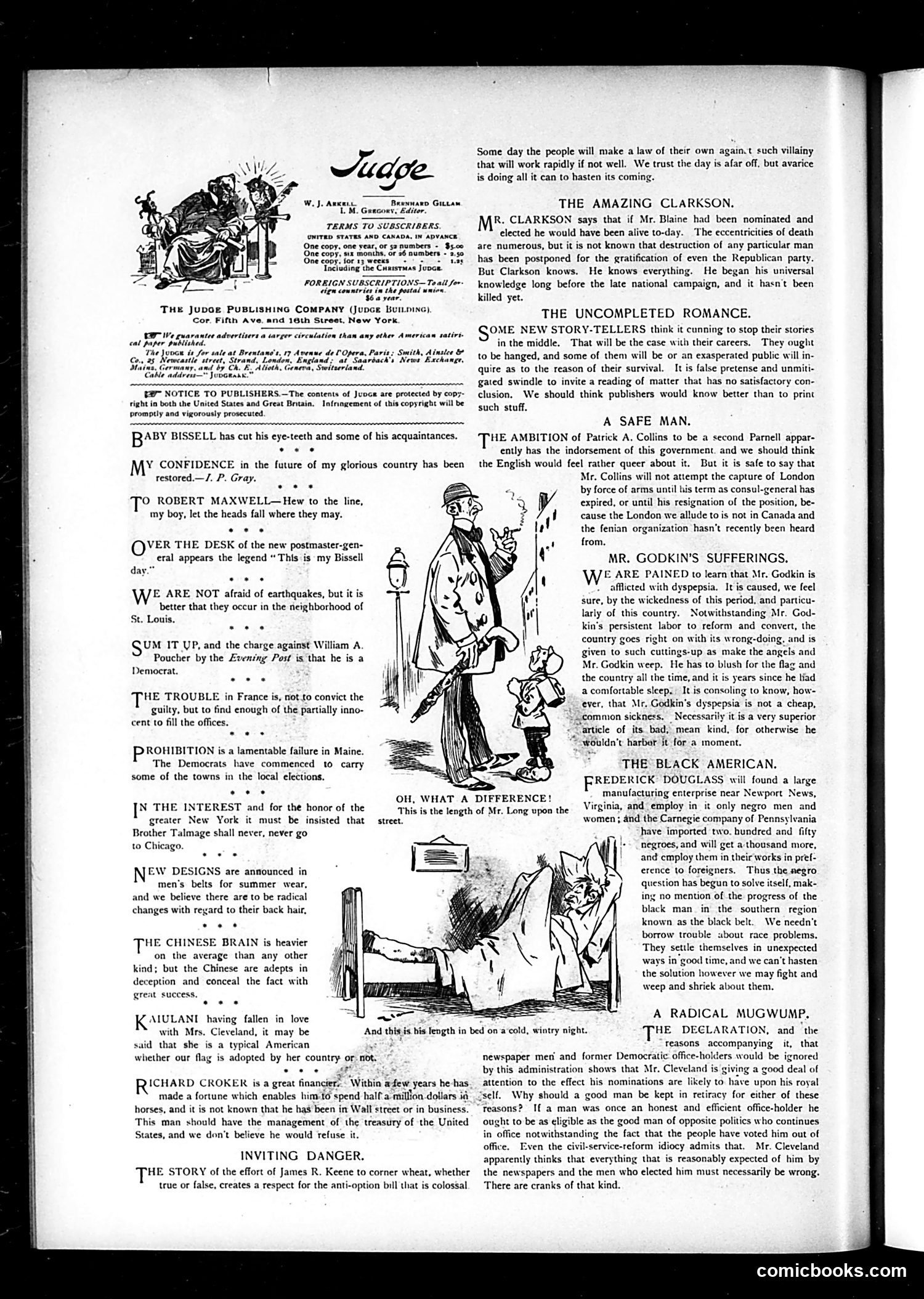
This page contains political commentary rather than a single cartoon. The main illustrated piece shows a tall figure (appears to be a political or public figure) bending down to interact with a small child, captioned "And this is the length of Mr. Long upon the street." The text articles below mock various political figures and policies. "Mr. Godkin's Sufferings" discusses chronic dyspepsia (indigestion) as a metaphor for political troubles. "The Black American" addresses the employment of Black workers by industrialists, presenting it as progress on racial questions. The overall tone is satirical commentary on contemporary political figures, government policies, and social issues of the era, though specific identifications of individuals referenced (beyond "Mr. Long") remain unclear without additional historical context.
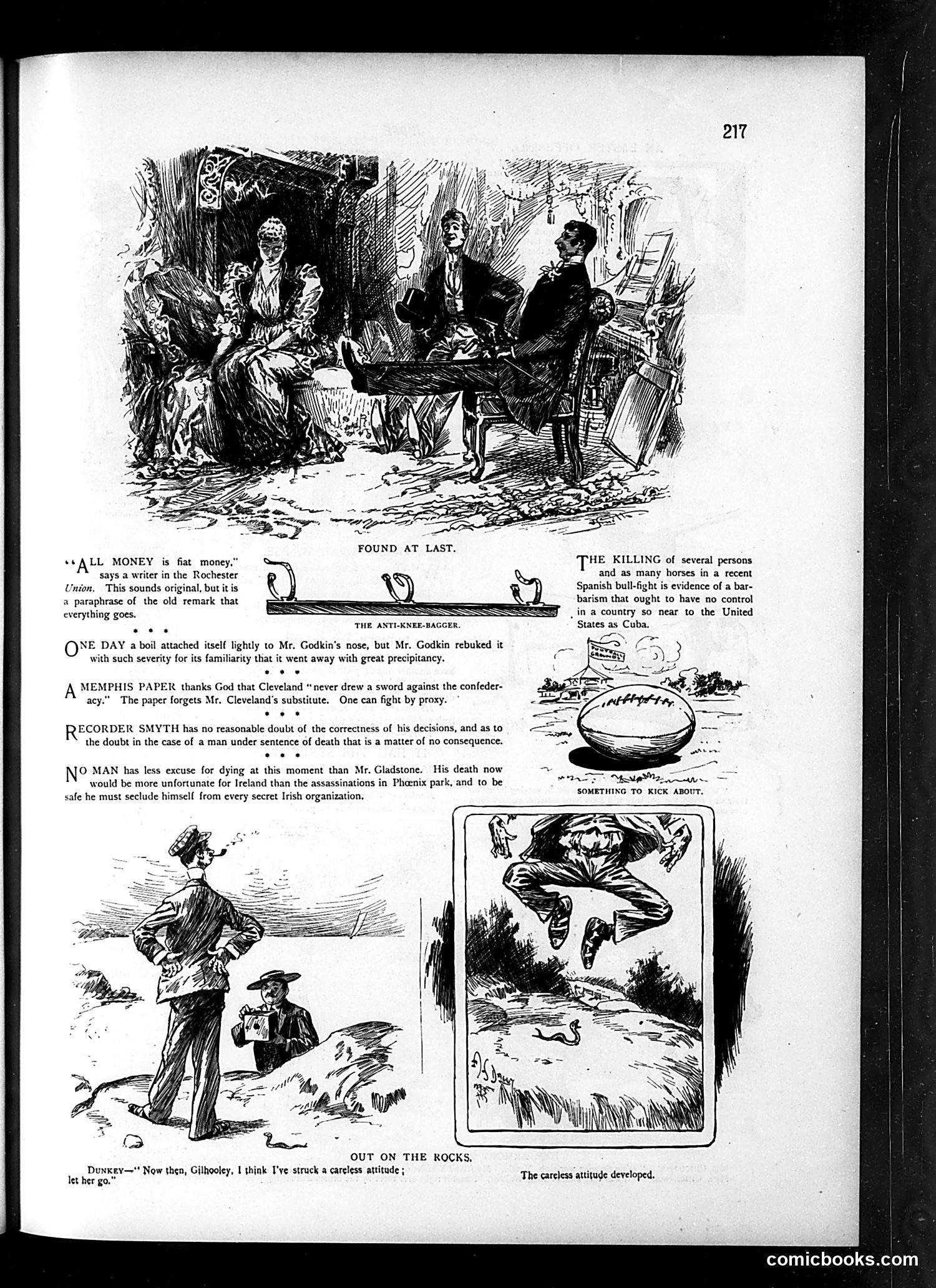
This page contains political commentary on late 19th-century American figures and issues: **"Found at Last"** (top): References a discussion about money, quoting a Rochester Union paper. The satire appears to critique political rhetoric about currency. **Named commentaries** reference: - **Mr. Godkin**: Editor of The Nation, rebutting political claims - **Memphis Paper**: Commentary on Cleveland (likely President Grover Cleveland) - **Recorder Smyth**: Judicial decision-maker - **Mr. Gladstone**: Likely British PM William Gladstone - **Cuba reference**: Commentary on American foreign policy toward Spanish colonial control The cartoons mock political hypocrisy and incompetence through visual gags ("Something to Kick About," "The Careless Attitude Developed," "Out on the Rocks"). The overall tone is cynical toward establishment political figures.
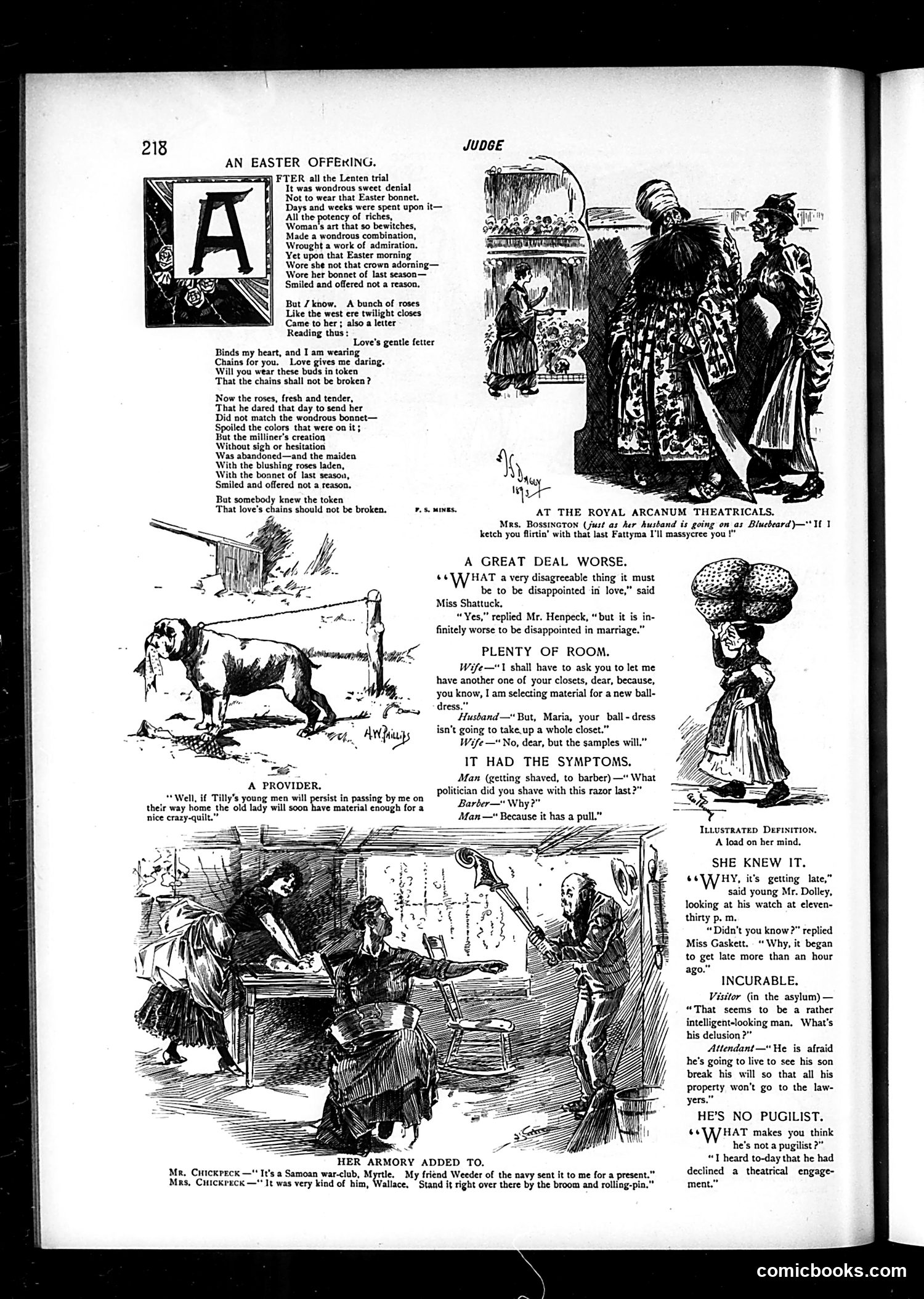
This page collects brief satirical pieces typical of early 20th-century humor magazines. Key content: **"An Easter Offering"** (top): A sentimental poem about a woman who abandons her new Easter bonnet when her suitor sends roses—prioritizing love over fashion display. The satire targets women's materialism and vanity. **Marriage/Gender Humor**: Several brief jokes mock marital dynamics—wives' disappointment in husbands versus romance ("A Great Deal Worse"), wives monopolizing closet space for dress samples ("Plenty of Room"), and a husband fearing his son will squander inherited wealth on lawyers rather than estate matters ("He's No Pugilist"). **Social Commentary**: Jokes about political disappointment (razor "has a pull"—unclear specific reference), barber shop gossip, and theatrical infidelity concerns. **"Her Armory Added To"**: A woman receives a Samoan war club, stored among household items (broom, rolling pin)—satirizing domestic clutter and possibly women's unexpected interests. The humor reflects period anxieties: women's consumer habits, marriage dissatisfaction, and evolving gender roles.
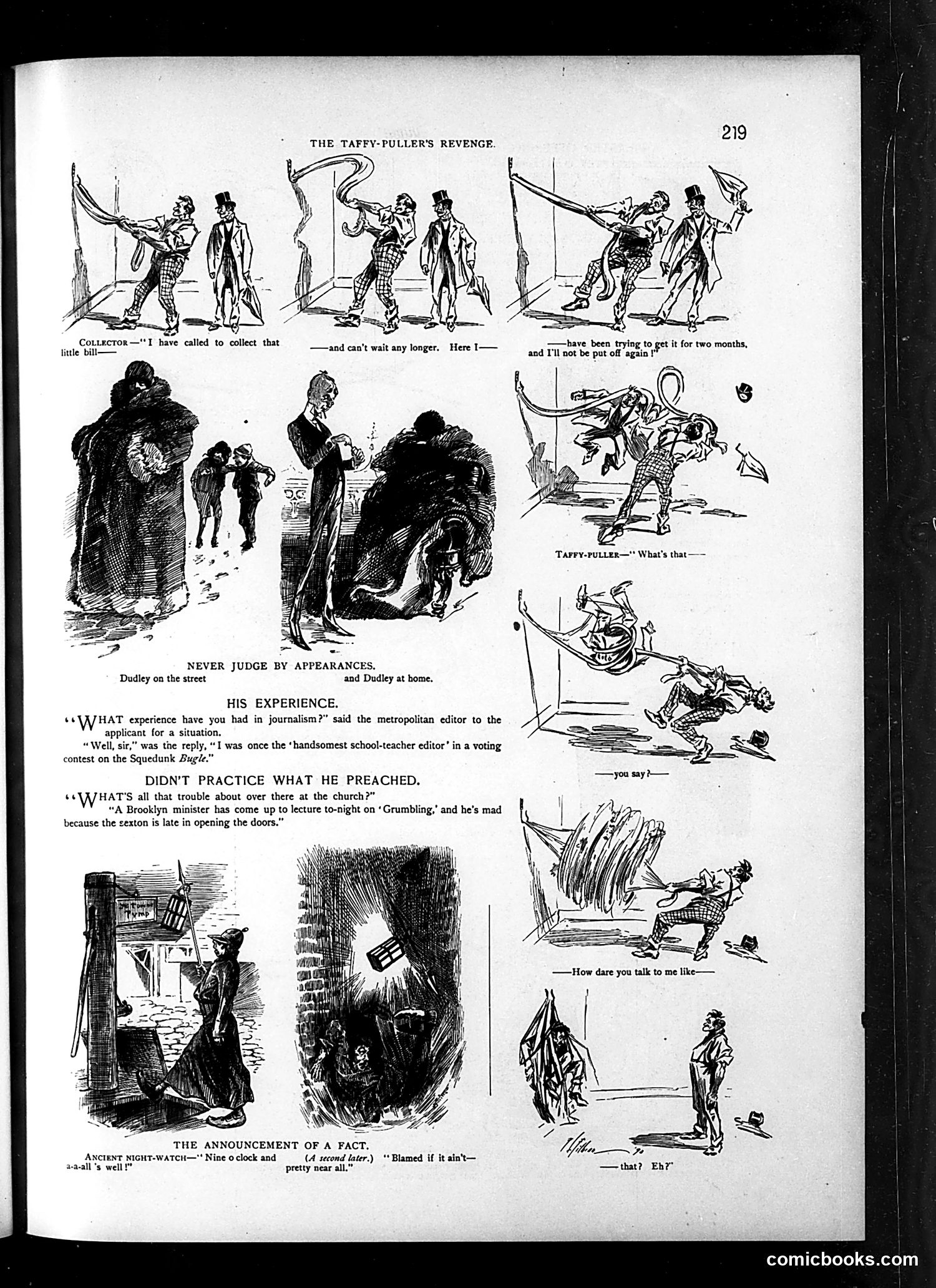
This page contains multiple unrelated satirical sketches typical of Judge magazine's format: **Top strip**: A debt collector repeatedly confronts someone ("Taffy-Fuller") about an unpaid bill, growing increasingly aggressive. The "revenge" suggests the debtor finally loses patience and physically throws him out. **Middle section**: Three separate, brief satirical jokes: - A section on "Never Judge by Appearances" contrasting someone's street versus home behavior - An applicant claiming journalism experience from being voted "handsomest school-teacher editor" in a small-town newspaper—mocking both the applicant's thin credentials and small-town vanity contests - A hypocritical Brooklyn minister lecturing about "Grumbling" while angrily complaining about the sexton's tardiness—the satire being his failure to practice what he preaches **Bottom section**: A night watchman's mundane announcement about the hour, with dark humor about how little actually remains "well" in the city. The page satirizes American social pretension, workplace incompetence, and hypocrisy through quick, irreverent vignettes.
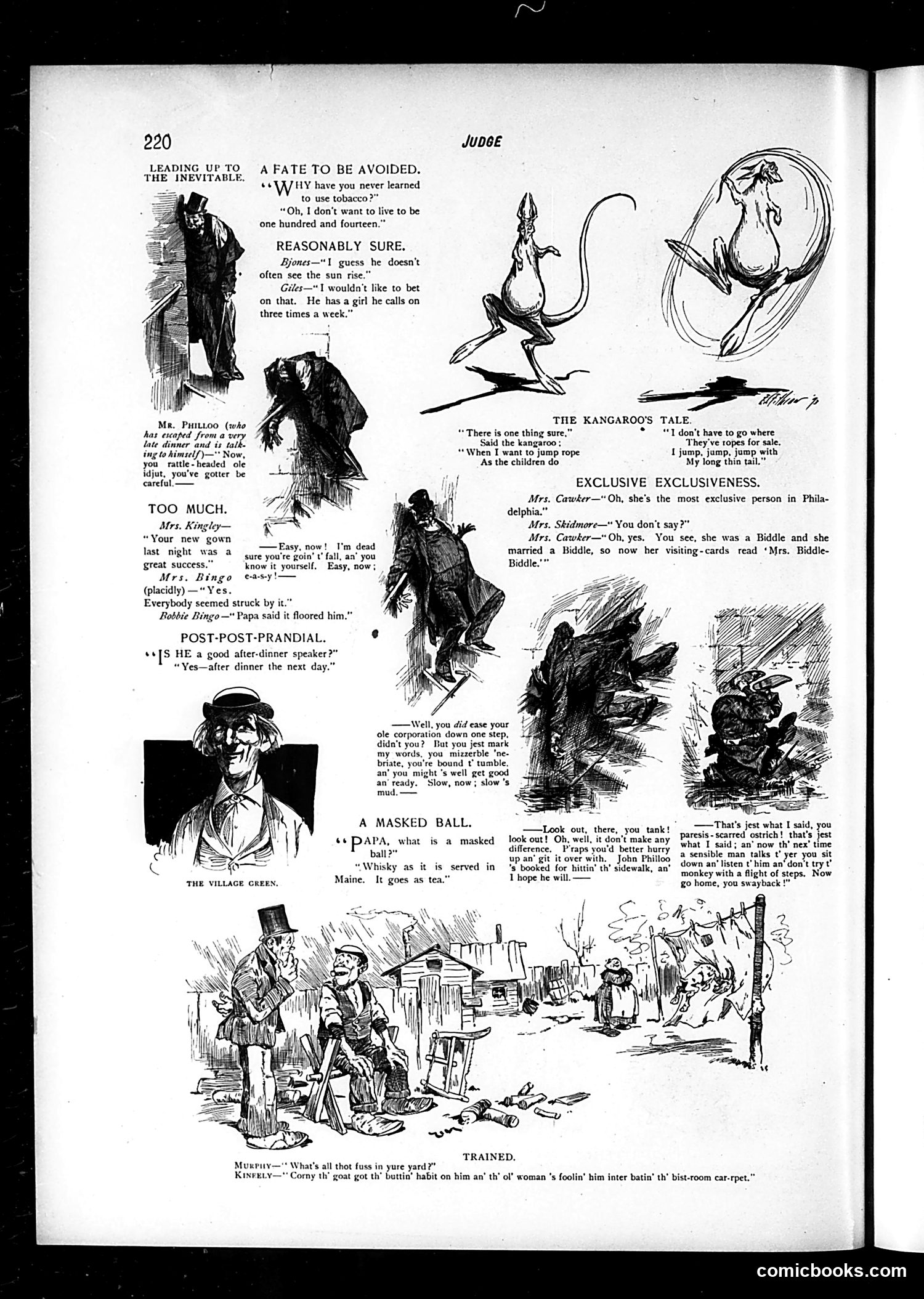
This page collects brief jokes and cartoons typical of Judge's humor circa early 1900s. Most target domestic life and social pretension: **"A Fate to Avoided"** and **"Too Much"** mock excessive behavior—tobacco use leading to longevity, and a woman's new gown being "too much" a success. **"The Kangaroo's Tale"** is whimsical animal fable humor, showing a kangaroo boasting it needs no rope for jumping. **"Exclusive Exclusiveness"** satirizes Philadelphia's upper-class social snobbery, specifically the Biddle family—marrying within the same family name to maintain exclusivity through visiting cards. **"A Masked Ball"** makes a crude joke equating Maine whisky served at masked balls to drinking tea. **"Trained"** depicts working-class dialect humor about animals and domestic chaos. The page reflects period-typical Judge content: light domestic satire, class humor, and animal anecdotes rather than overt political commentary.
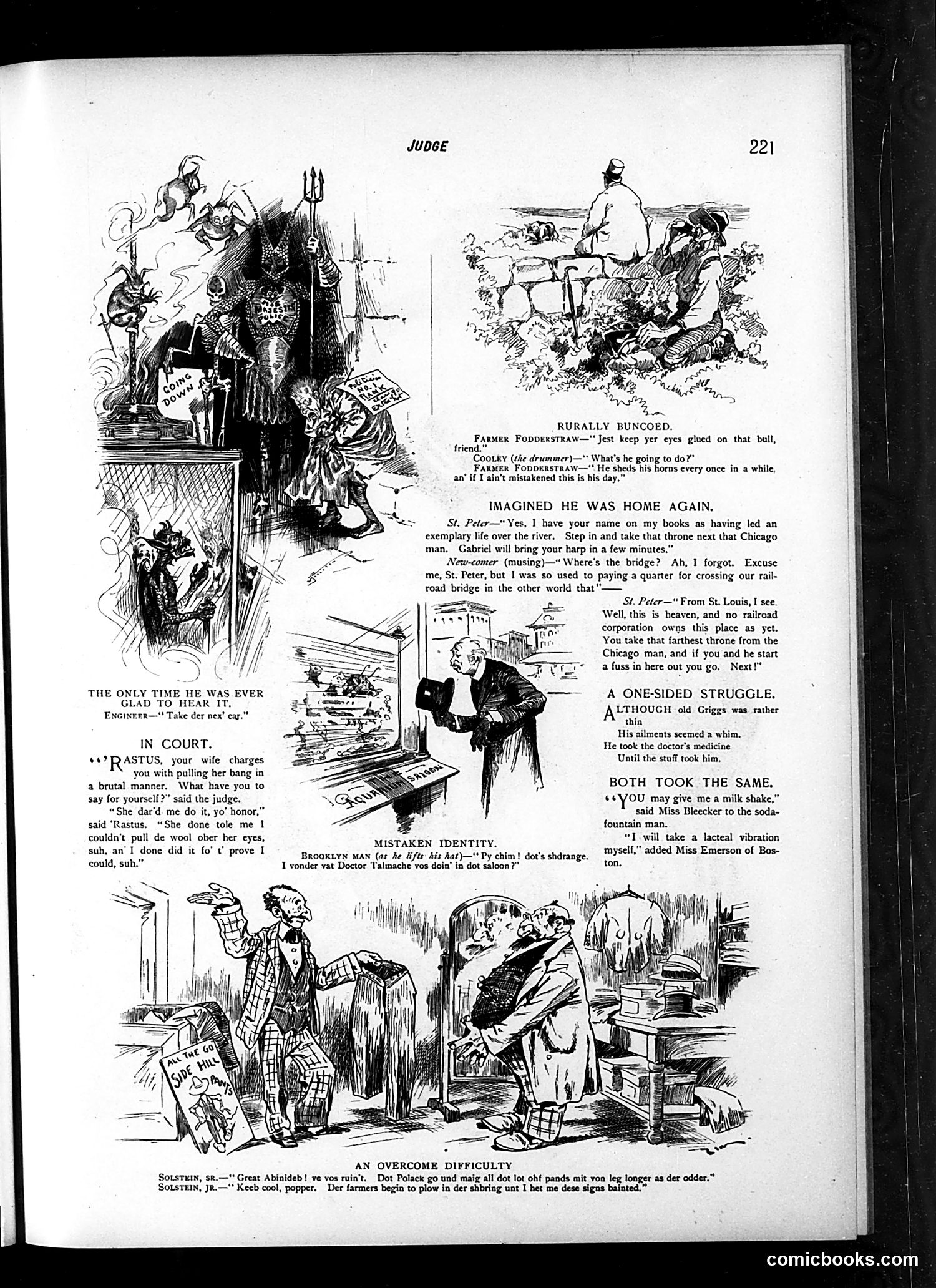
This page contains several brief comic vignettes targeting common stereotypes of the era: **"In Court"** mocks African American dialect and legal naiveté, playing on racist assumptions about Black defendants. **"Rurally Buncoed"** depicts a traveling salesman (drummer) being tricked by a rural farmer claiming a bull sheds its horns—a con game exploiting the city visitor's gullibility. **"Imagined He Was Home Again"** satirizes railroad toll systems by depicting a recently deceased man surprised that heaven doesn't charge bridge tolls like the railroad did (likely referencing St. Louis rail infrastructure). The joke includes a dig at Chicago corruption. **"Mistaken Identity"** features a Yiddish-accented Brooklyn man confused about seeing a clergyman in a saloon—playing on both immigrant speech patterns and Prohibition-era hypocrisy. **"An Overcome Difficulty"** depicts Polish immigrants using broken English while farming, with a practical solution to uneven land. The page reflects Judge's typical early-1900s humor: immigrant and ethnic caricatures, urban-rural contrasts, and working-class characters rendered as objects of mockery.
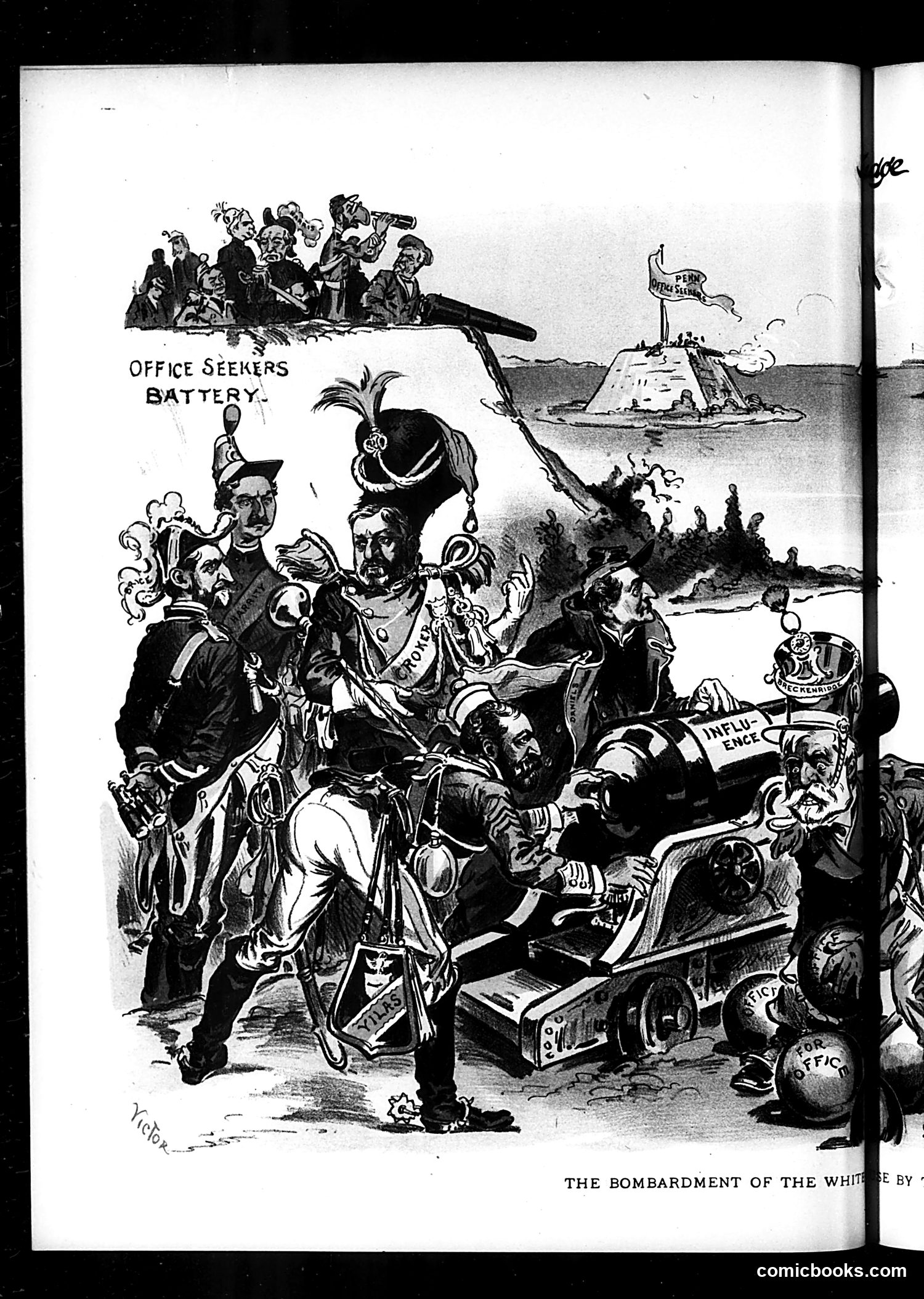
This **Judge** magazine cartoon satirizes "Office Seekers Battery"—politicians scrambling for government jobs. The upper left shows a crowd of eager applicants manning a cannon aimed at the White House (visible on the right with its flag). The central figure appears to be a decorated military or political leader surrounded by various job-seekers carrying labeled ammunition barrels marked "FOR OFFICE." The cannon represents their collective pressure on the presidency to secure positions. The satire mocks the post-election frenzy of patronage-seeking: politicians and their supporters bombarding the administration with requests for lucrative government appointments. The militaristic imagery emphasizes the aggressive, coordinated nature of this "battery" of office-hunters, treating their pursuit as a coordinated assault on presidential decision-making rather than merit-based hiring.
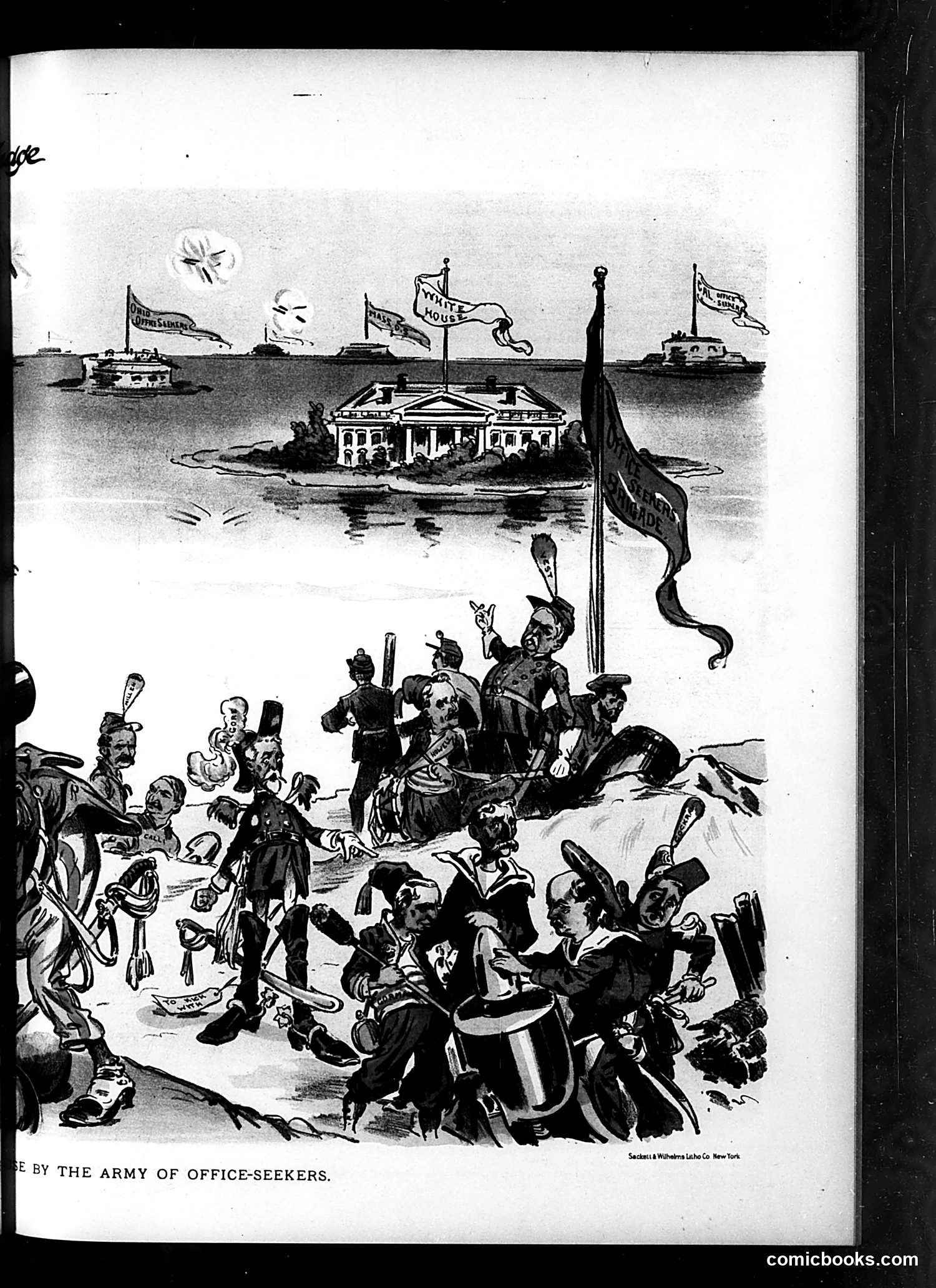
This political cartoon satirizes the pressure placed on the White House by job applicants seeking government positions. The White House appears as a besieged fortress on an island, surrounded by boats flying flags labeled "POLICE" and other offices, while cannons and weapons surround it. In the foreground, a chaotic "army" of caricatured office-seekers—depicted as disheveled, aggressive figures with various implements—assault the building. The satire mocks the relentless patronage system where candidates pursued federal jobs, particularly following elections when administrations changed. The cartoon suggests that office-seekers represent an overwhelming invasion threatening the presidency itself. This was a recurring complaint in Gilded Age political discourse about corruption and the spoils system.
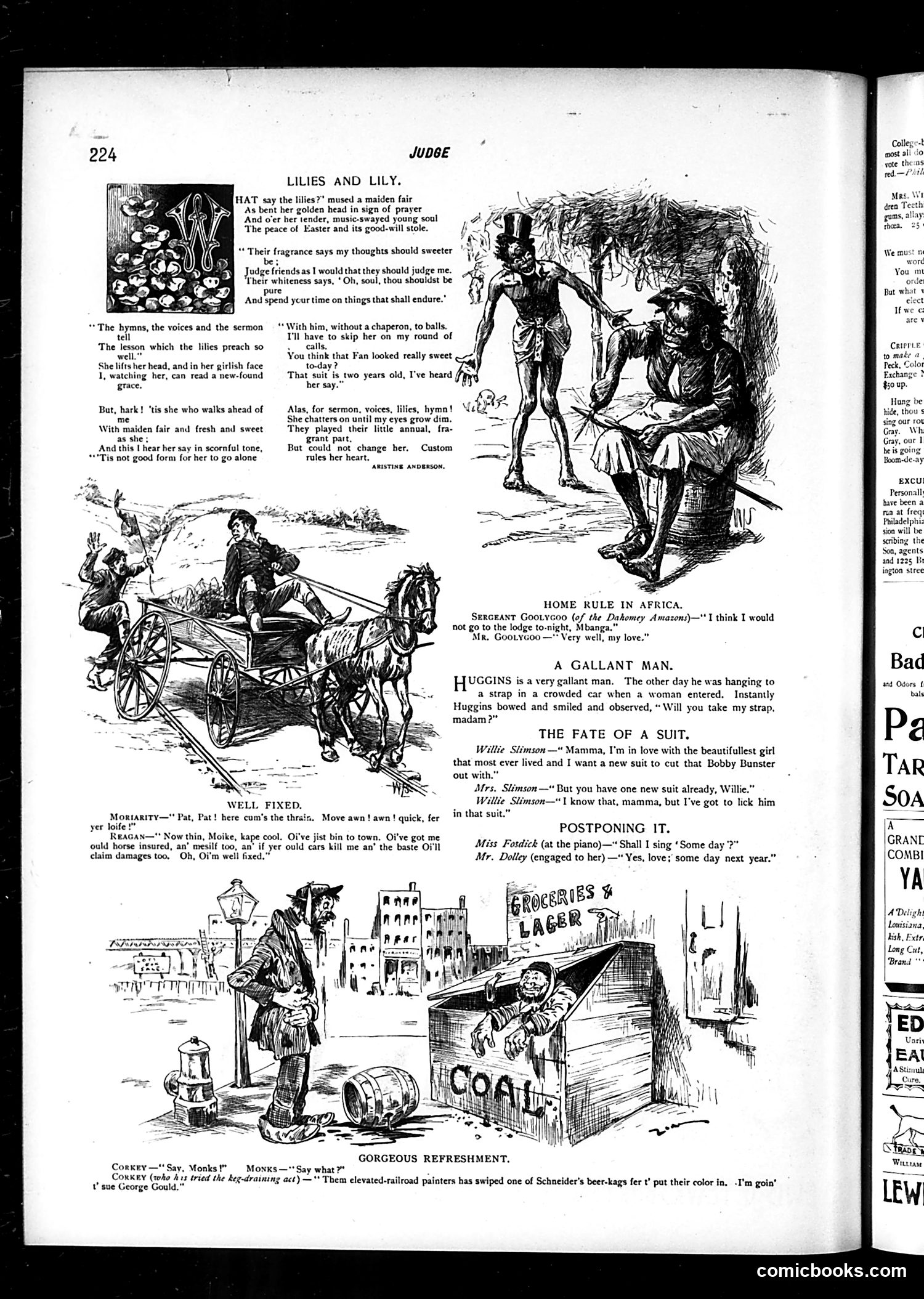
This page from Judge contains multiple satirical pieces typical of the magazine's social commentary: **"Lilies and Lily"** critiques female hypocrisy. A young woman finds spiritual inspiration in Easter lilies, reflecting on kindness and purity. Yet immediately after, we see her gossiping spitefully about another woman—criticizing her old dress and improper conduct walking alone with a man. The satire: Christian virtue preached in church vanishes when social convention (represented by "Custom") governs behavior instead. **Other brief satirical items** mock contemporary life: "Well Fixed" features Irish working-class characters discussing accident insurance; "Home Rule in Africa" plays on colonial attitudes; "A Gallant Man" satirizes performative chivalry; and "Gorgeous Refreshment" depicts working-class theft of beer kegs. The cartoons use exaggerated dialect and caricature typical of 1890s Judge humor, often reflecting period prejudices while targeting hypocrisy across social classes—from pretentious society women to corrupt insurance schemes.
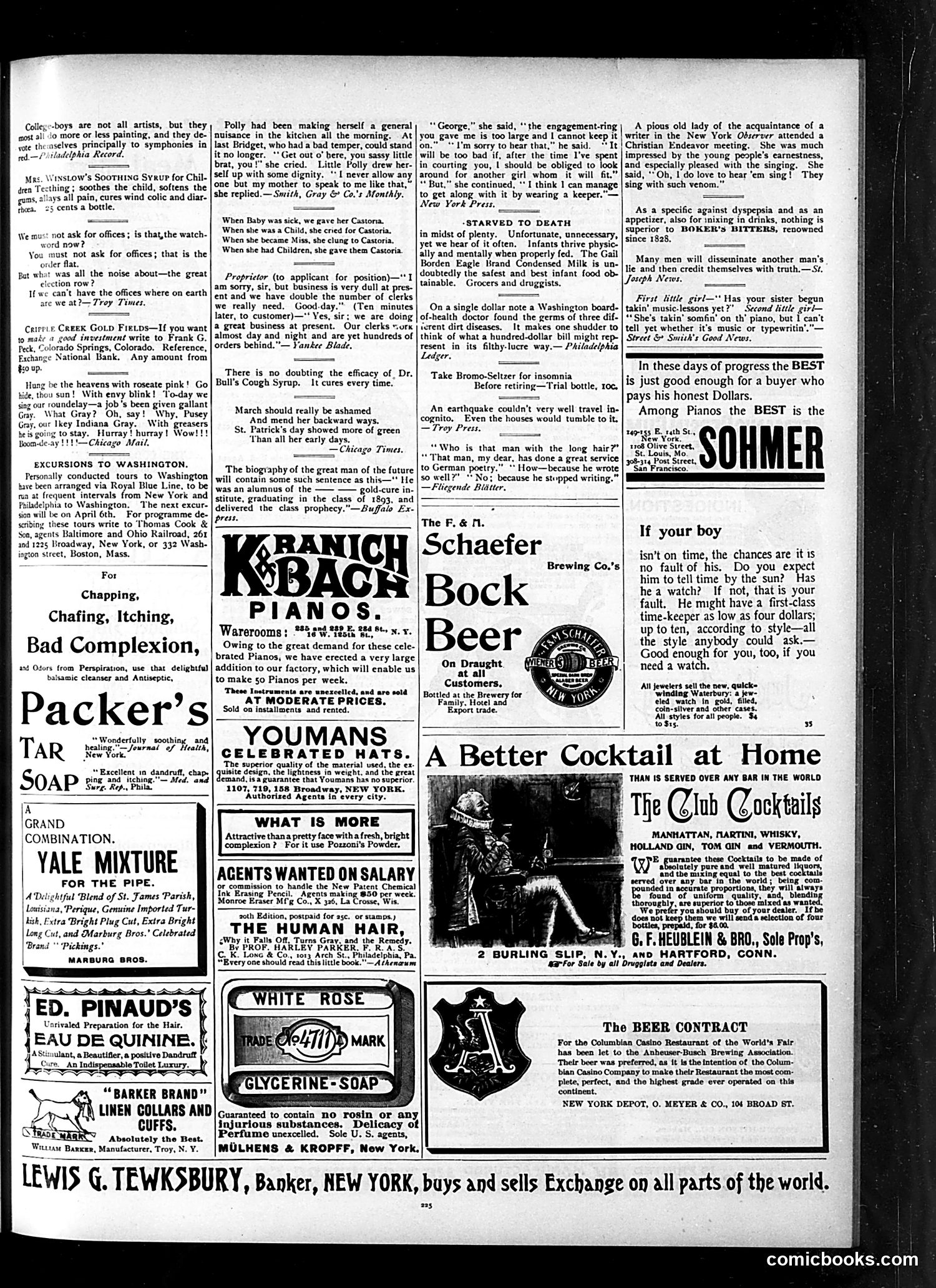
This page is primarily **advertising**, not political satire. The bulk of the content consists of period advertisements for consumer products (Packer's Tar Soap, Youmans Hats, Kranaich & Bach Pianos, Schaefer Bock Beer, Yale Mixture tobacco, and others). The scattered editorial text items appear to be brief humorous quips typical of Judge's satirical sections—jokes about college students, office-seeking, and minor social observations. One anecdote depicts a child named Polly rudely corrected by a servant named Bridget, illustrating class and domestic dynamics of the era. The "Beer Contract" box at bottom references the Columbian Casino Restaurant at the World's Fair selecting Anheuser-Busch brewing for their establishment—a straightforward commercial announcement rather than satire. No clear political cartoon or identifiable caricatures of public figures appear visible on this page.
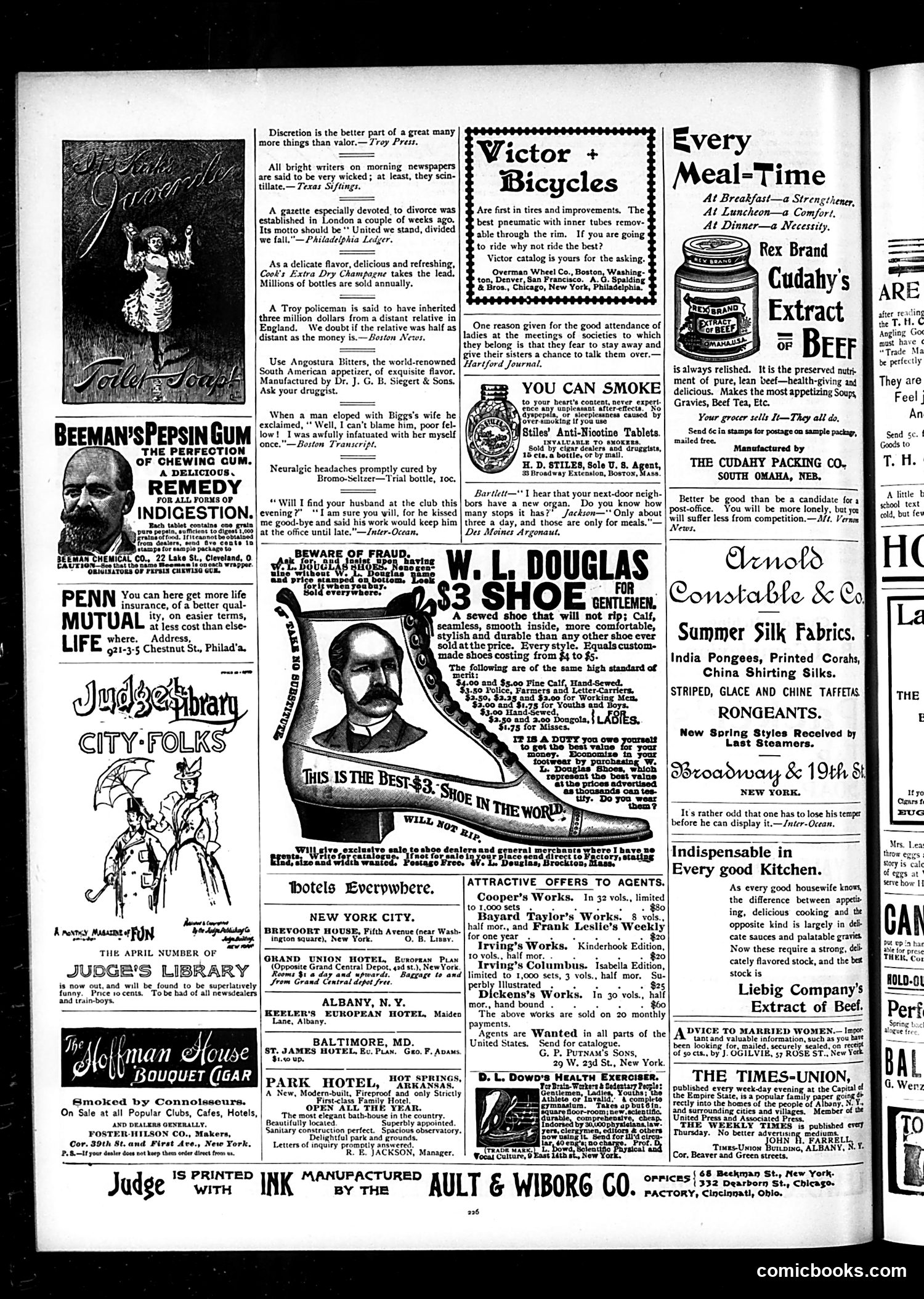
This page is primarily a collection of advertisements and short satirical quips typical of Judge magazine. Rather than a coherent cartoon with identifiable caricatured figures, the content consists of: **Humorous brief jokes** with social commentary—poking fun at divorce ("United we stand, divided we fall"), infidelity, women's society gossip, and urban life. **Product advertisements** (Beeman's Gum, Bromo-Seltzer, Victor Bicycles, W.L. Douglas Shoes, etc.) interspersed throughout. The **titled sections** like "JUDGE'S LIBRARY" promote the magazine itself. **No major political figures or events** are explicitly referenced. The satire is mild, domestic, and contemporaneous—mocking middle-class behaviors rather than targeting specific politicians or scandals. This appears to be an **April issue** (circa early 1900s based on advertisement styling) functioning largely as an advertising vehicle disguised as editorial content.
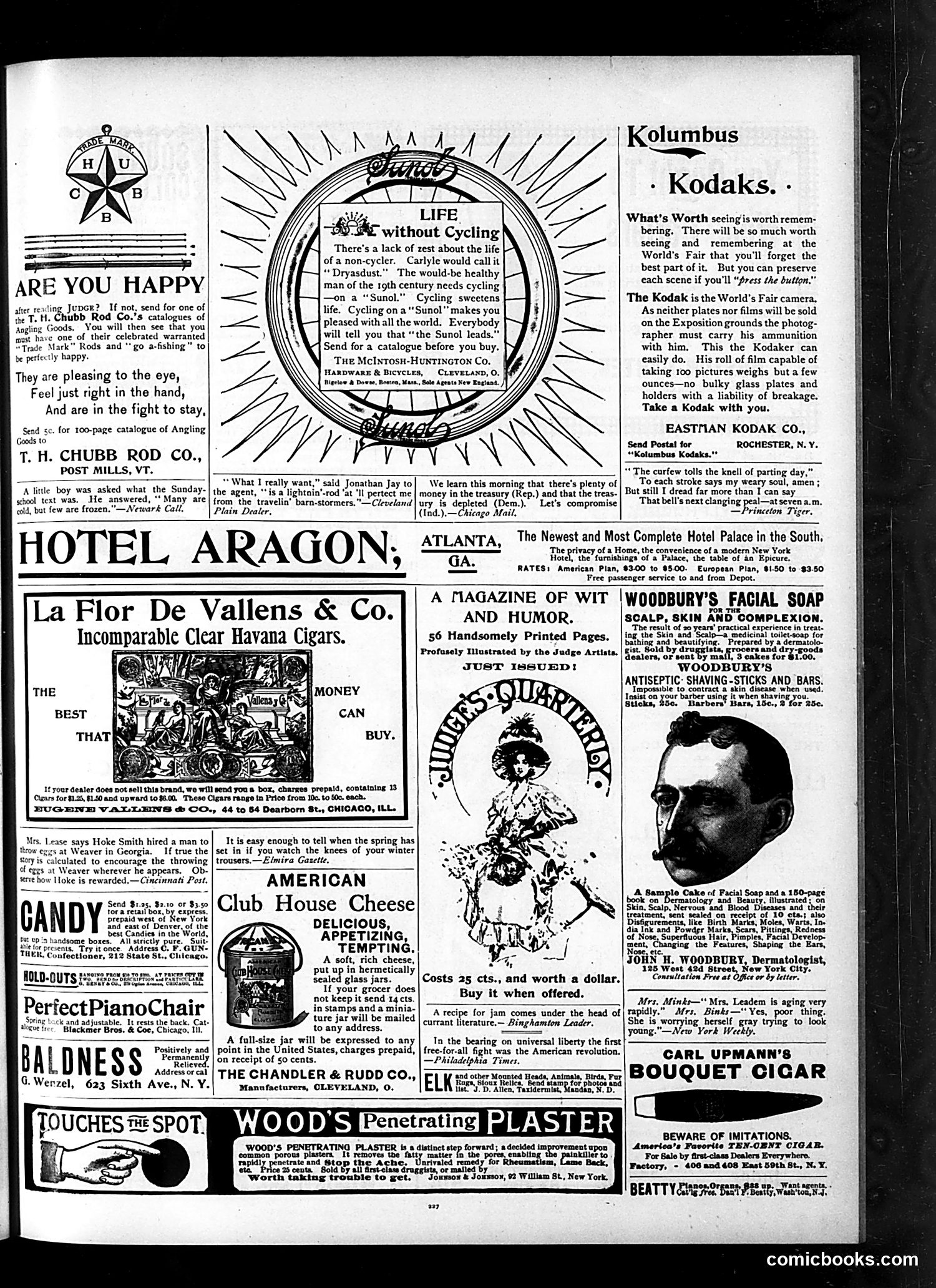
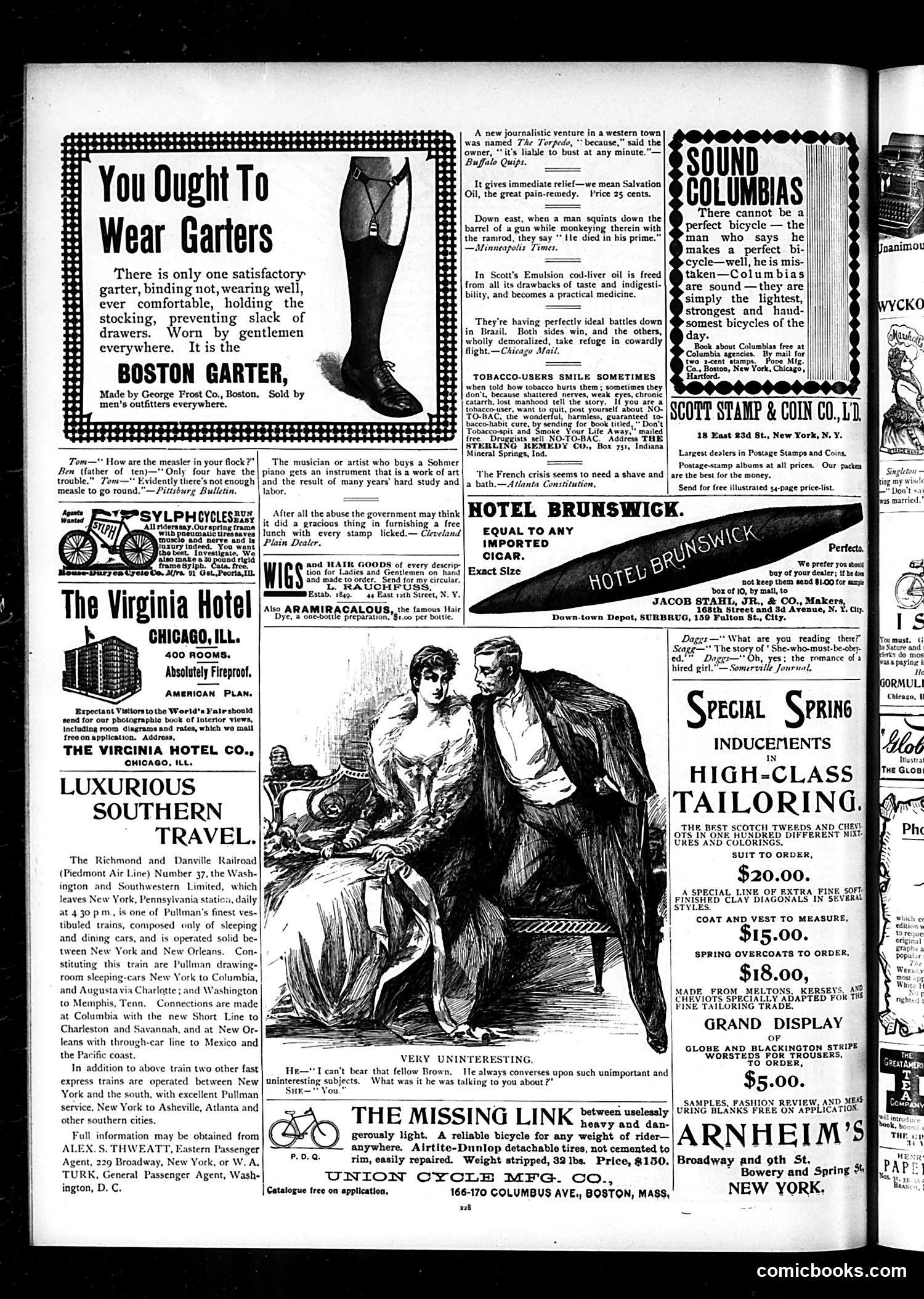
This page is primarily **advertising**, not political satire. It contains numerous product advertisements (Boston Garters, Salvation Oil, Scott's Emulsion, hotels, bicycles, tailoring services) interspersed with brief humorous anecdotes and jokes—typical Judge magazine filler content. The illustrated cartoon titled "Very Uninteresting" depicts two figures in conversation, with the caption explaining a mundane domestic dispute: one man says he can't bear his friend Brown because Brown constantly discusses unimportant matters, asking "What was it he was talking to you about?" The humor relies on the anticlimax—the answer is simply "You." The page also includes "The Missing Link," a brief joke about a reliable bicycle, and various one-liners about measles, tobacco, and Brazilian battles that were typical period humor. **For modern readers:** This reflects early 1900s magazine advertising practices and the era's mild, family-friendly comic sensibility before sophisticated editorial cartooning became Judge's primary focus.
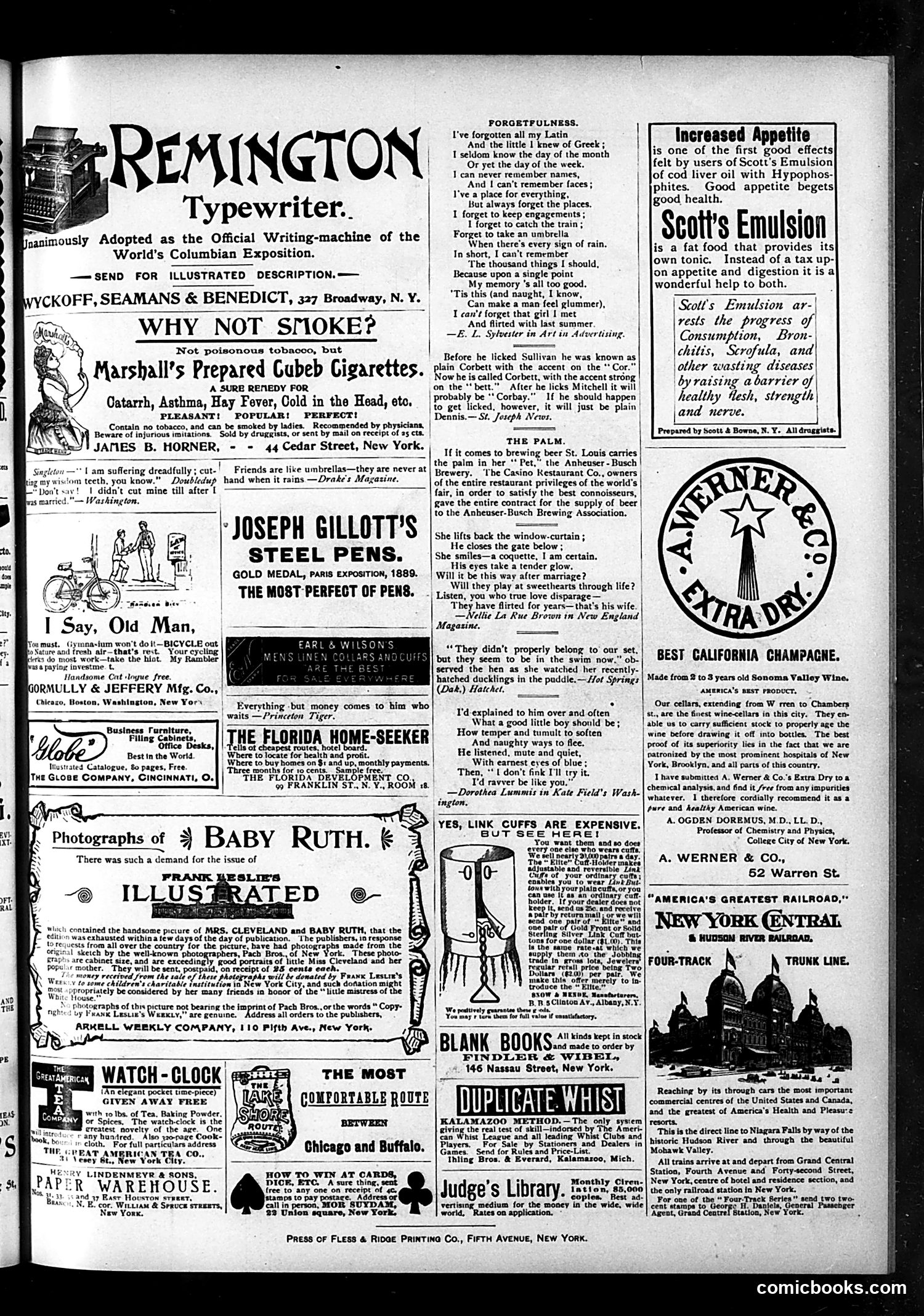
This is primarily an **advertising page** from Judge magazine, circa 1893 (referencing the World's Columbian Exposition). The page contains minimal satirical content—mostly commercial advertisements interspersed with light humorous quotes. The notable exception is a small section titled "FORGETFULNESS," a self-deprecating poem about absent-mindedness that was common humor of the era. It's not political satire but rather gentle, relatable social commentary on everyday memory lapses—a common theme in period magazines. The dominant content includes ads for typewriters (Remington), cigarettes (Marshall's Gubeb), bicycles, steel pens, and various business services. One notable ad features **photographs of Mrs. Cleveland and Baby Ruth** (President Cleveland's daughter), with profits donated to children's charities—a celebrity endorsement strategy unusual for the 1890s. The page reflects the magazine's dual function: satirical publication *and* advertising vehicle, with commercial content substantially outweighing editorial commentary.