
A complete issue · 16 pages · 1893
Judge — February 18, 1893
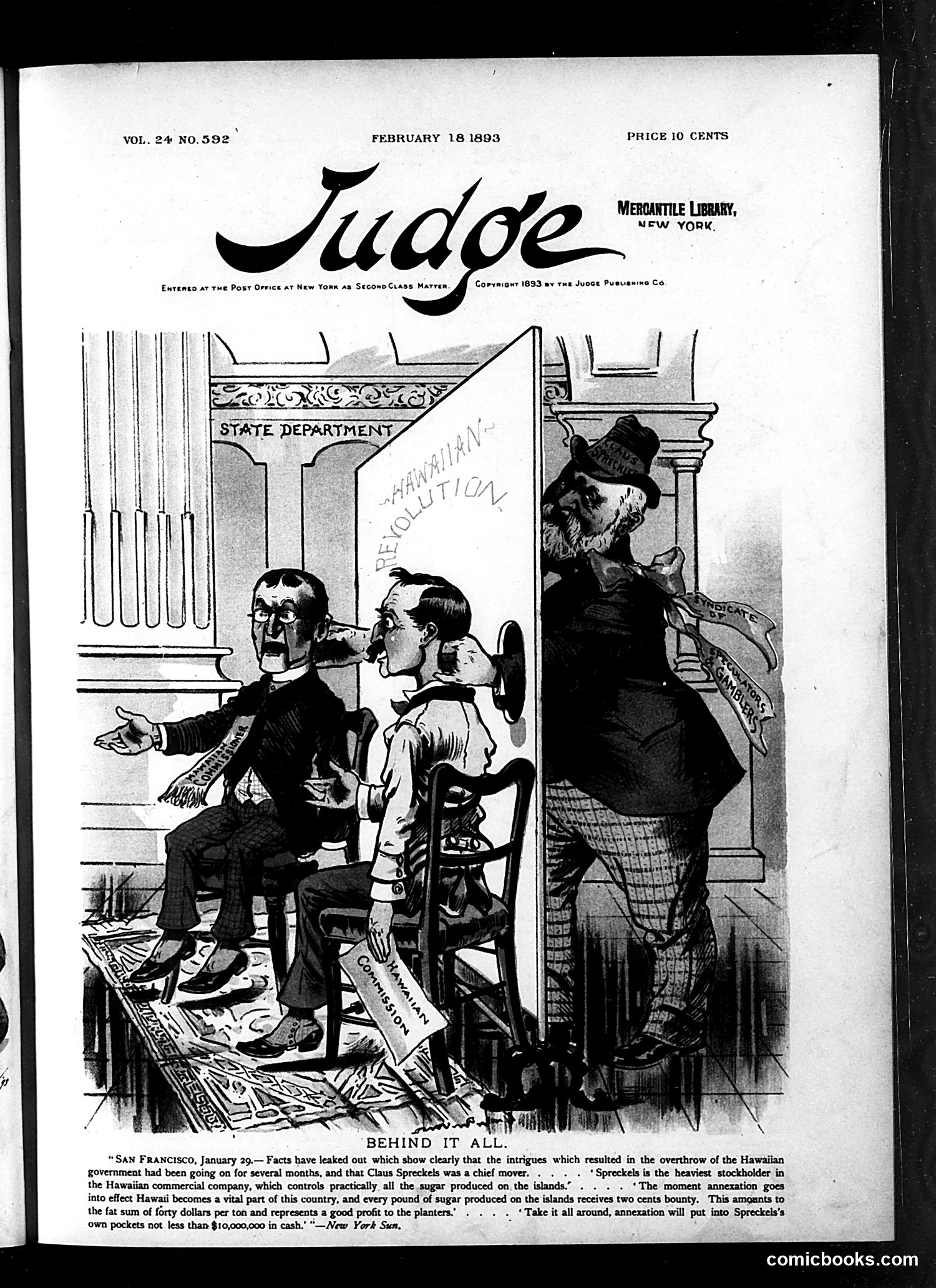
This cartoon satirizes the 1893 Hawaiian Revolution and American imperialist involvement. Two men in the State Department (identifiable by the label) manipulate Hawaiian affairs like puppeteers controlling marionettes, while a bearded figure (appearing to represent a Hawaiian or business interests) watches from the doorway. The text explicitly names Claus Spreckels, a sugar magnate who allegedly orchestrated the overthrow of the Hawaiian government to protect his commercial interests. The satire suggests American diplomatic officials are complicit in this corporate-driven coup—that behind the rhetoric of revolution lies profit motive and foreign manipulation of Hawaiian sovereignty for sugar industry benefit.
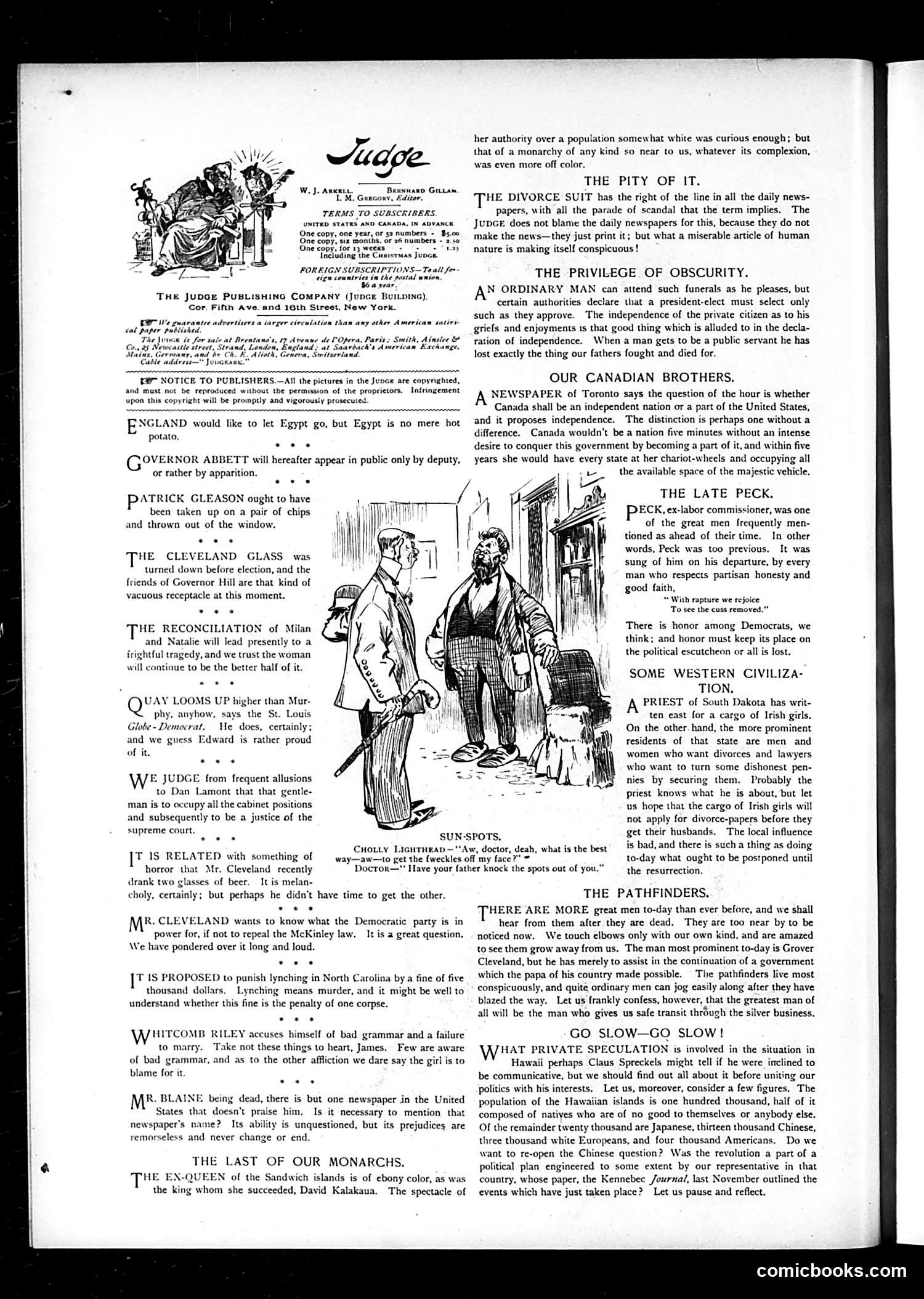
The page contains several short satirical commentary pieces rather than a single cartoon. The most prominent illustration shows two men in conversation, labeled "Sun-Spots" with the caption "Cholly Lightheaed" asking a doctor about facial spots. This appears to be a light humor piece about skin conditions. The text sections address contemporary political and social issues, including remarks about Egypt's independence, Canadian sovereignty debates, and commentary on various political figures. One piece discusses "The Late Peck," apparently a prominent political figure who was "too previous" (acted too hastily). Without clearer identification of the specific figures and dates, the exact political references remain unclear, though the tone throughout is satirical commentary on current events and public figures of the era.
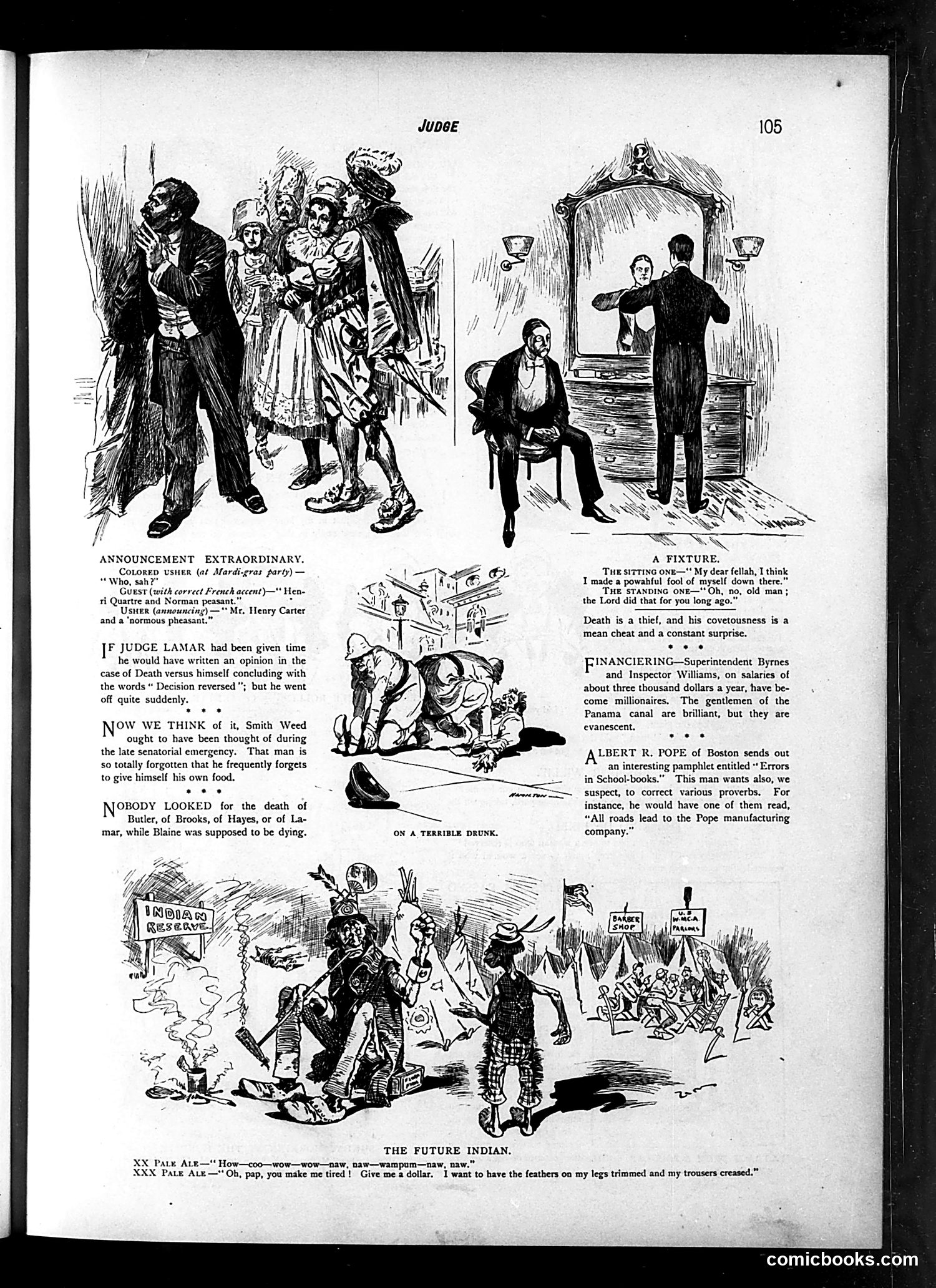
This page contains several satirical pieces from Judge magazine: **"An Amusement Extraordinary"** (top left): Depicts what appears to be a social gathering or party scene with multiple figures in Victorian dress, likely satirizing upper-class social pretensions or a specific contemporary event. **Mirror scene** (top right): Shows a man examining himself in a mirror with commentary about vanity and self-deception, a common moralistic satire theme. **"On a Terrible Drunk"** (middle): Cartoon of an intoxicated man, reflecting period concerns about alcohol abuse. **"The Future Indian"** (bottom): Depicts Native Americans in what appears to be a satirical commentary on their future assimilation or marginalization in American society—a darkly satirical take on American expansionism and Indigenous displacement. The text includes brief satirical vignettes and social commentary typical of Judge's editorial approach.
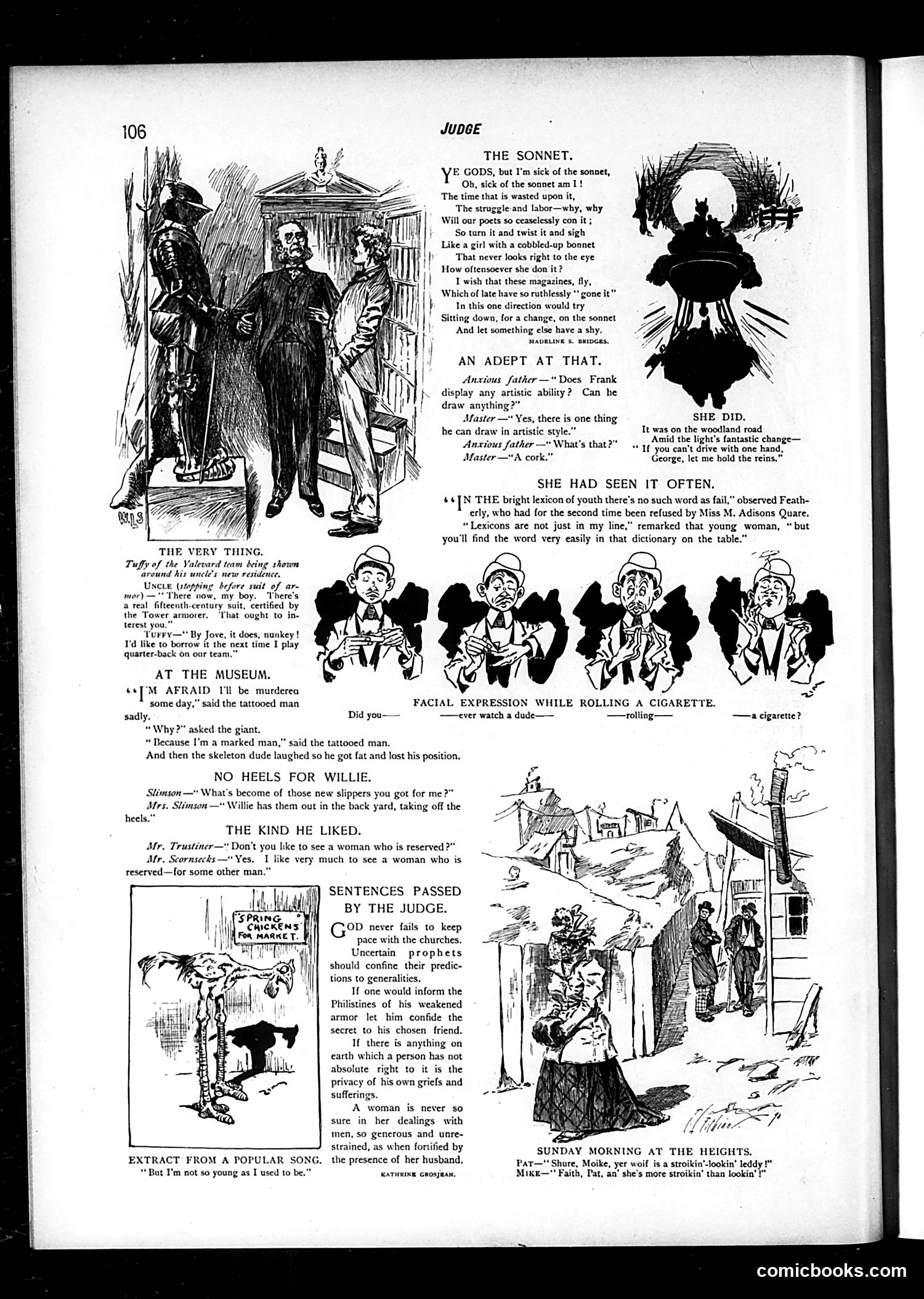
This page contains multiple short humorous pieces typical of 1890s-era satirical journalism: **"The Sonnet"** mocks the Victorian literary obsession with sonnet-writing, portraying it as tedious and overwrought—a jab at Romantic-era poetic conventions that had become exhausted clichés. **"An Adept at That"** jokes about a boy who can only draw in "artistic style" by drawing a cork—absurdist humor about pretentious art instruction. **"She Had Seen It Often"** presents a rejected suitor being rebuffed with wit—the woman sardonically suggests he consult a dictionary for the word "fail." **"The Very Thing"** depicts a Yale football player wanting to borrow medieval armor for quarterback play—satire of privileged college athletics. **Other shorts** include jokes about tattoos, women's reserved behavior, and various social observations. The page's overall tone ridicules Victorian affectations, artistic pretension, and contemporary social conventions through lighthearted anecdotes and puns rather than pointed political commentary.
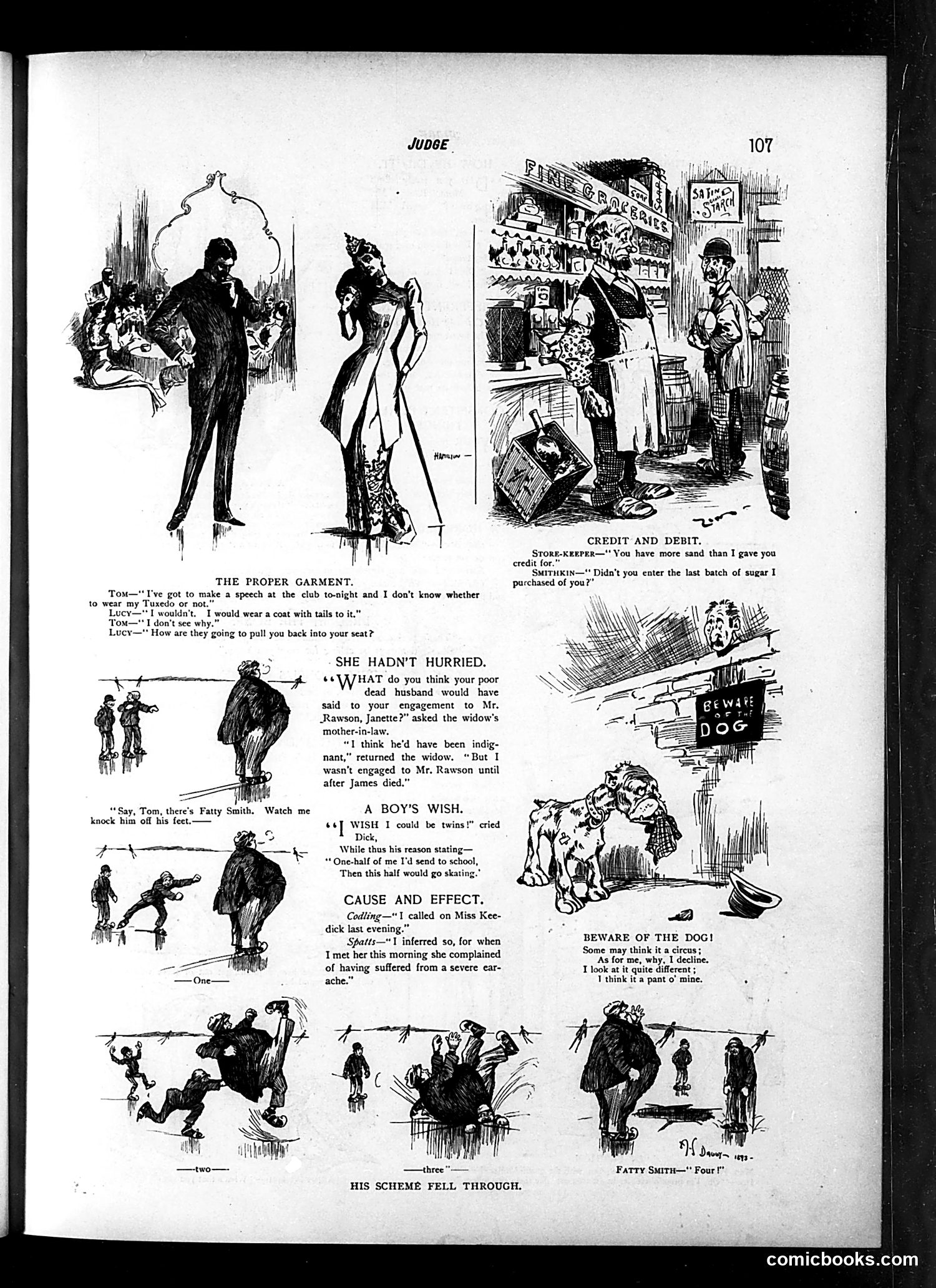
This page contains multiple brief humorous sketches typical of Judge's satirical style: **"The Proper Garment"** jokes about formal dress—a man uncertain whether to wear a tuxedo or tails to a speech, with the punchline that tails would help pull him back into his seat if he falls. **"Credit and Debit"** depicts a storekeeper complimenting a customer's nerve for claiming more sugar was given than credited. **"She Hadn't Hurried"** satirizes a widow's convenient timing—she claims she wasn't engaged to her new fiancé until *after* her previous husband died, implying the opposite was true. **"A Boy's Wish"** presents innocent childhood logic: a boy wishes to be twins so one half attends school while the other goes skating. **"Cause and Effect"** suggests a man's visit caused a woman's earache (likely implying he was boring or annoying). **"Beware of the Dog"** features wordplay about a "pant o' mine" (panto/pantomime), treating a dog circus as personal entertainment. The page exemplifies Judge's light, domestic humor targeting middle-class social situations.
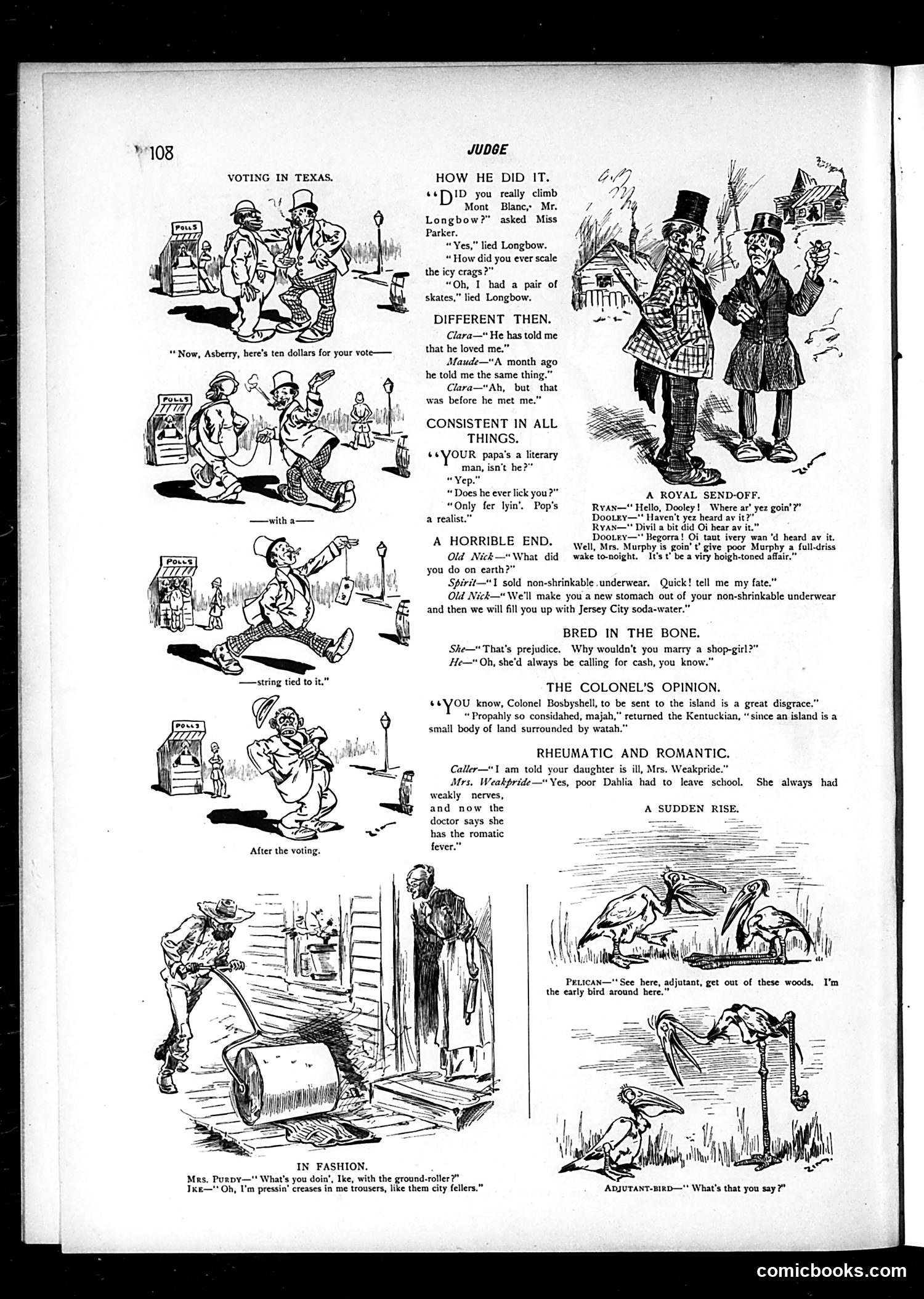
This page from *Judge* (a late 19th/early 20th-century satirical magazine) contains multiple unrelated short humor pieces rather than a unified political cartoon. The content includes: **"Voting in Texas"** – A series of comic strips about election bribery, showing a man being paid for his vote, likely satirizing Texas electoral corruption. **Various society jokes** – Pieces like "Different Then" and "Consistent in All Things" mock romance, parental discipline, and class pretension among the wealthy. **"A Horrible End"** – Dark satire about a salesman of fraudulent "non-shrinkable underwear" receiving divine punishment. **Character stereotypes** – "A Royal Send-Off" features Irish-dialect characters (Dooley, Mrs. Murphy); "The Colonel's Opinion" uses a Kentucky accent. These reflect the era's casual ethnic caricature humor. **"In Fashion"** – Rural/working-class satire about someone mimicking urban fashion by literally pressing trouser creases with a roller. The overall tone is typical of *Judge*'s mix of political satire, class humor, and broad ethnic comedy targeting both the wealthy and working classes.
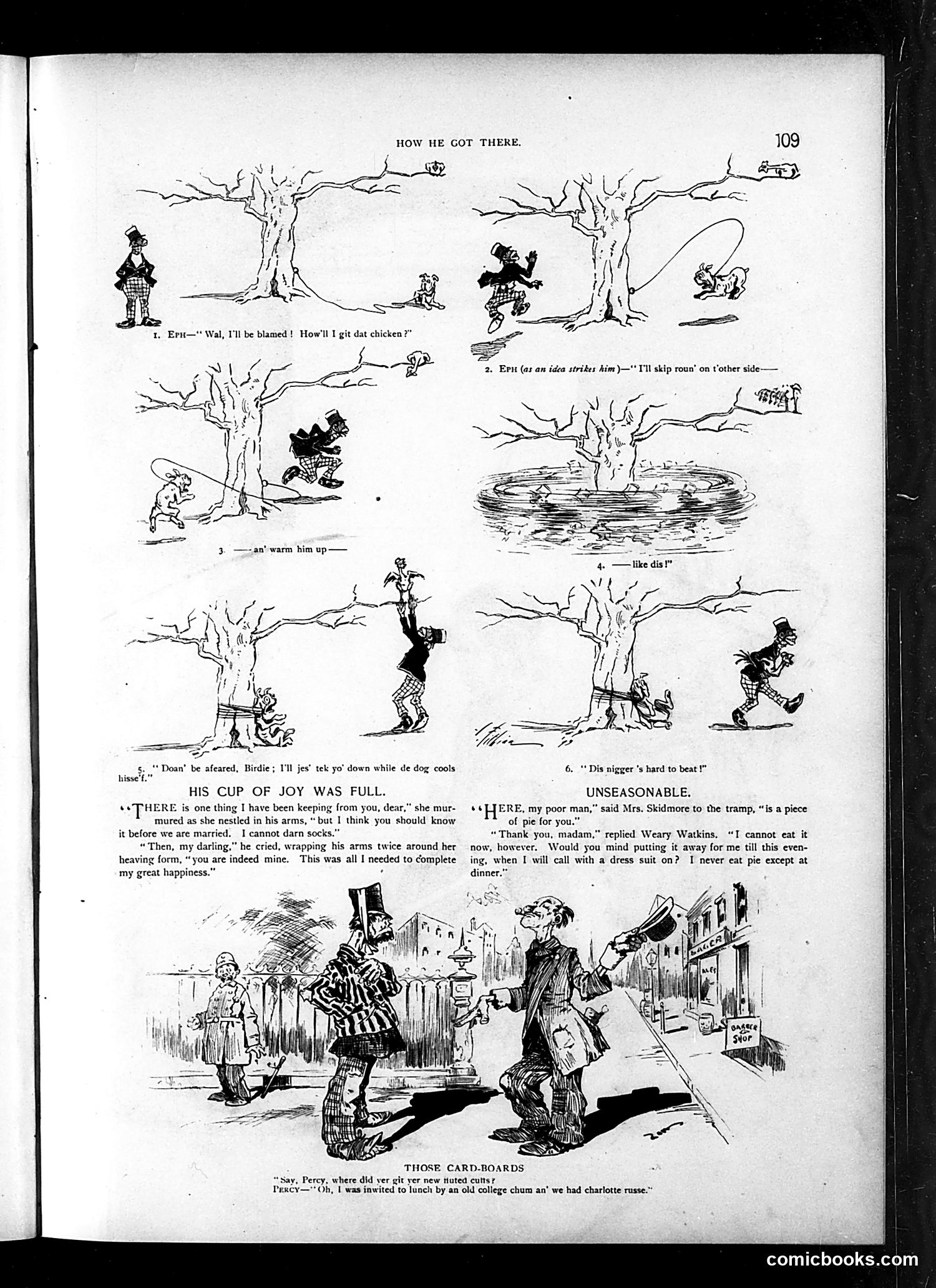
**Top Comic Strip:** A slapstick sequence showing a man chasing a chicken that escapes across a stream. The joke satirizes male incompetence—he cannot catch a simple farm bird, hence the title's irony about "how he got there" (presumably to courtship/marriage despite being useless). **"His Cup of Joy Was Full":** Sentimental romance parody. A woman confesses she cannot darn socks; the man dramatically declares this is all he needed for happiness. The satire mocks both excessive sentimentality in romantic literature and the era's domestic expectations—the joke being that a man would overlook a wife's practical incompetence if sufficiently smitten. **"Unseasonable":** A vagrant (Weary Watkins) refuses immediate pie, asking a wealthy woman to store it for him until evening so he can eat it wearing a dress suit at dinner. The satire ridicules either the tramp's absurd pretensions or, possibly, mocks wealthy people's condescension toward the poor. **"Those Card-Boards":** Two men discuss obtaining new suits, mentioning a college lunch where "charlotte russe" (a dessert) was served—unclear satirical point without fuller context.
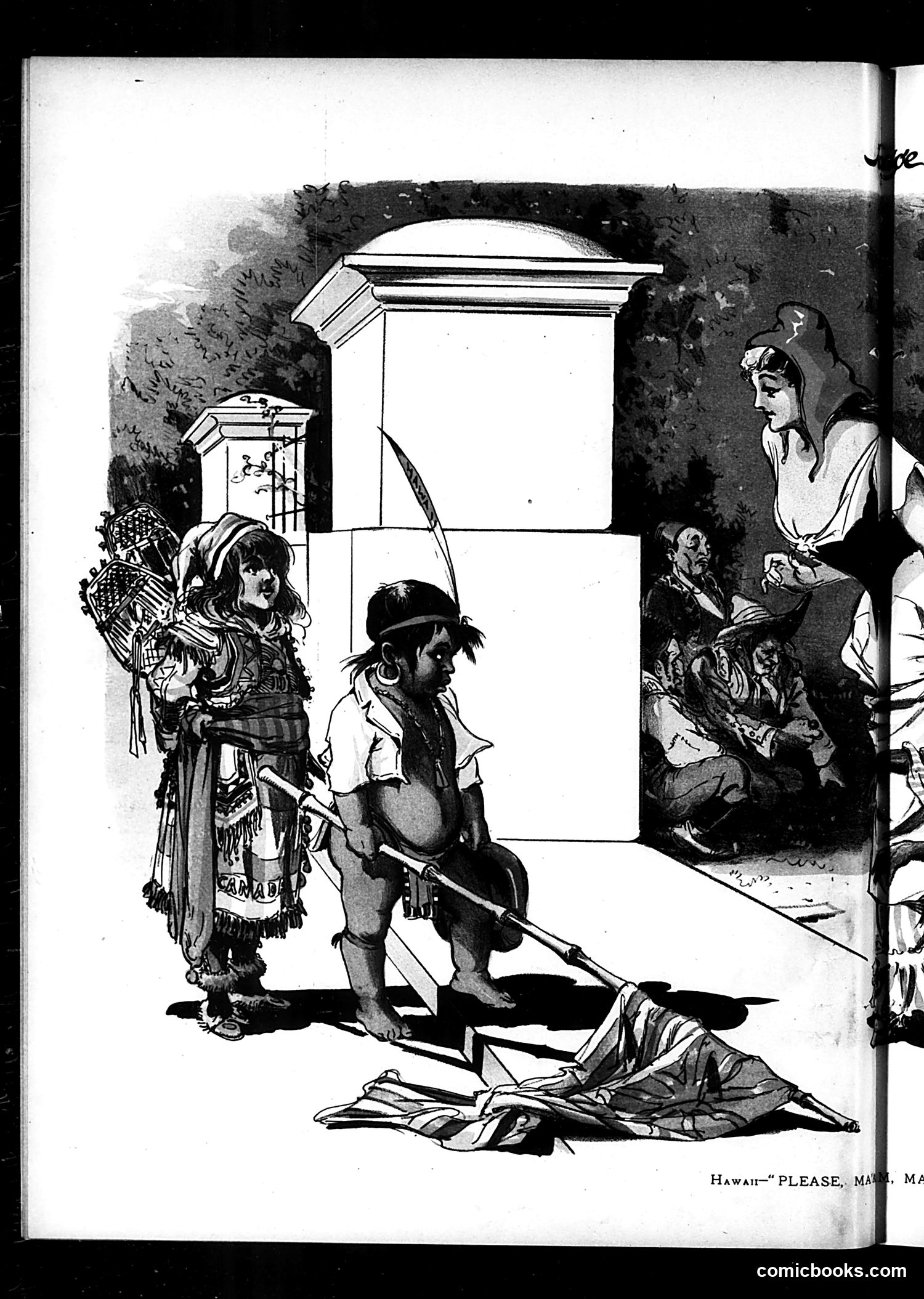
This appears to be a satirical cartoon from *Judge* magazine depicting a scene set in Hawaii. The caption reads "HAWAII—'PLEASE, MAM,'" suggesting dialogue or a plea being made. The image shows what appears to be a Native Hawaiian figure (depicted in period-stereotypical style) gesturing toward or addressing a well-dressed white woman, with colonial-era architecture and other figures visible in the background. Given the magazine's focus on American political satire and the Hawaiian setting, this likely satirizes American imperial expansion or colonial relations with Hawaii in the late 19th or early 20th century. The exact political point remains unclear without the complete caption or article context, but the juxtaposition suggests commentary on power dynamics between colonizers and indigenous peoples.
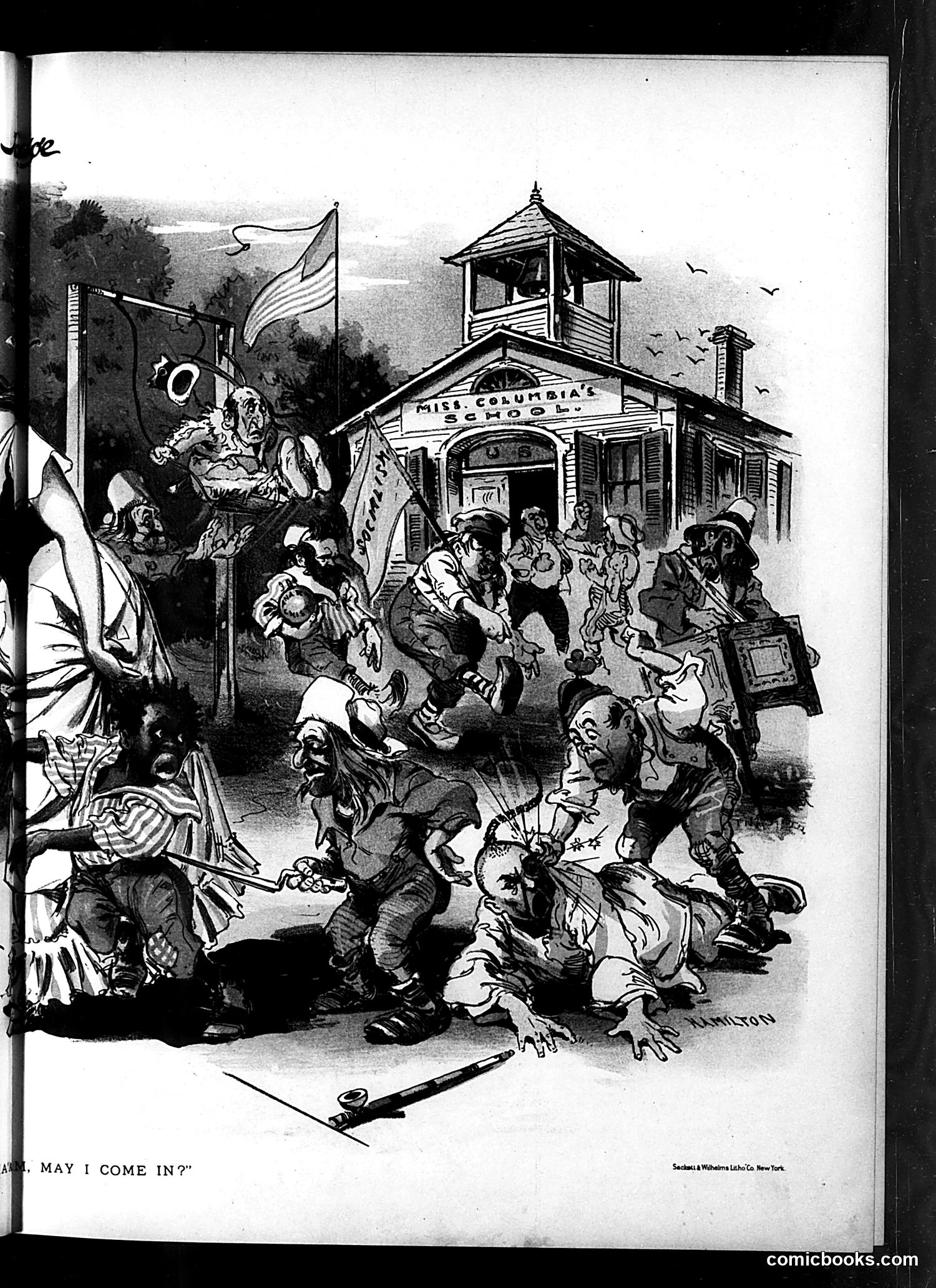
This cartoon depicts a scene at "Miss Columbia's School" (Columbia being the personification of America). The caption "May I Come IN?" suggests someone seeking entry or admission. The cartoon appears to use exaggerated caricatures of what seem to be foreign or immigrant figures attempting to enter the schoolhouse, while Columbia (represented by the flag and authority figure) controls access. The crowded, chaotic scene with various figures of different appearances satirizes contemporary anxieties about immigration and who should be admitted to American society. This reflects early 20th-century debates about immigration policy and American identity—specifically, who was deemed acceptable for entry into the nation and its institutions. The "school" metaphor suggests questions about assimilation and American values. Without a clear date visible, the specific political controversy referenced remains uncertain.
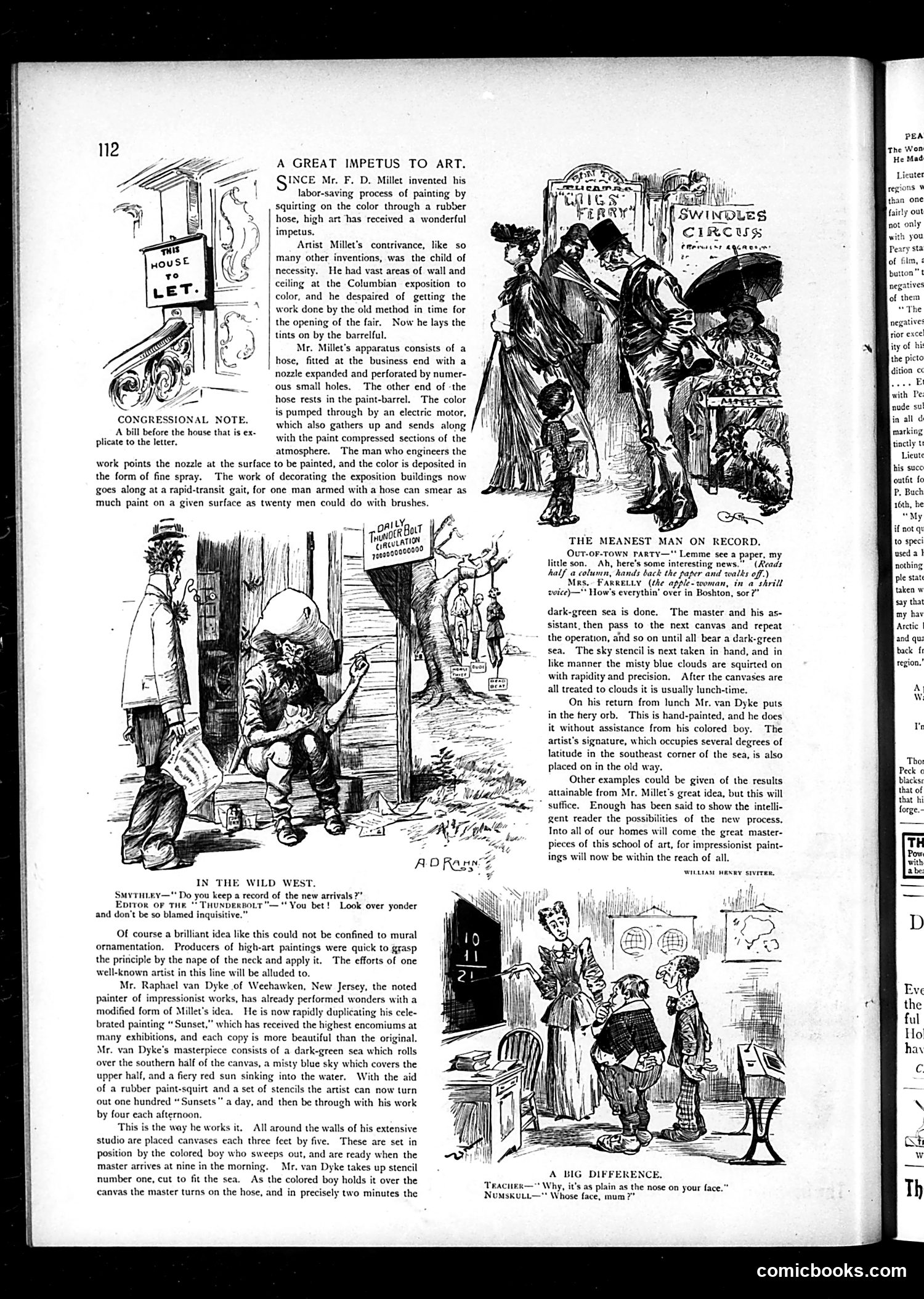
This satirical piece mocks the labor-saving paint-spraying invention of F.D. Millet, used at the Columbian Exposition. The article describes how artist Raphael van Dyke applies Millet's technique to mass-produce copies of his celebrated painting "Sunset" — using stencils and a rubber hose to mechanically spray identical dark-green seas, misty blue skies, and red suns onto canvases at industrial speed (one hundred per day). The satire targets the commodification of fine art: by reducing painting to formulaic assembly-line production, the invention transforms genuine artistic creation into mere manufacturing. The joke exposes how "impressionist paintings will now be within the reach of all" — implying that mass-produced, technically made art has lost all aesthetic value. It's a critique of both technological shortcuts and the lowbrow commercialization of high culture.
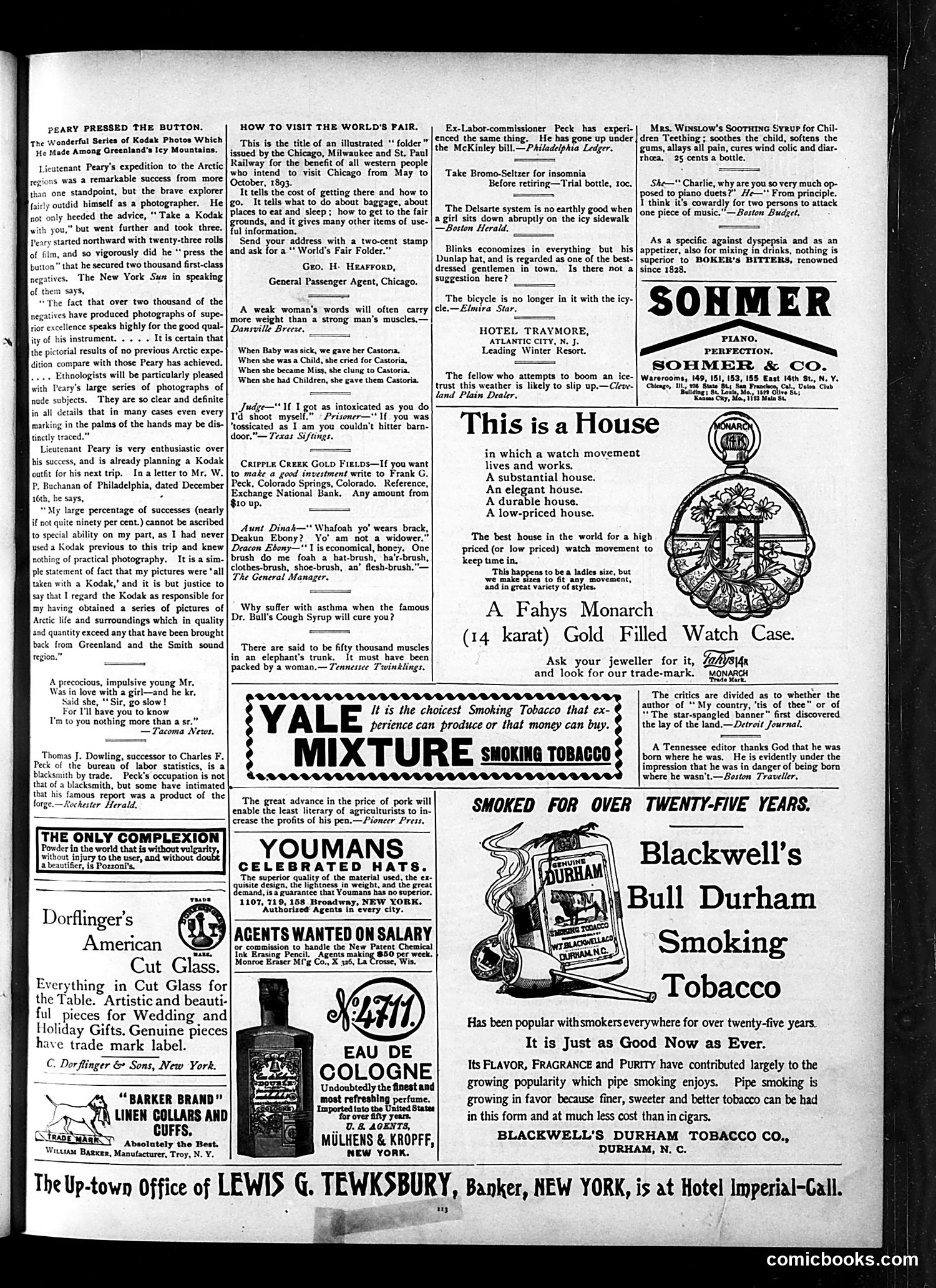
This is primarily an **advertising page** from Judge magazine, not a political cartoon page. The substantive editorial content is minimal. The one notable piece is a brief **tribute to Lieutenant Peary's Arctic photography**, celebrating his use of Kodak cameras to document his Greenland expedition. The text quotes praise from the New York Sun about the superior quality of his 2,000+ photographs, emphasizing that even amateur photographers could achieve such results with Kodak equipment. Peary himself is quoted crediting the camera's reliability for his success. This is essentially **corporate advertising dressed as editorial content**, promoting Kodak's reliability and ease of use. The remainder consists of advertisements for various products: Yale Mixture smoking tobacco, Blackwell's Bull Durham tobacco, Eau de Cologne, cut glass, collars/cuffs, and railway travel information for the 1893 Chicago World's Fair. There are no political cartoons or satirical commentary of note on this page.
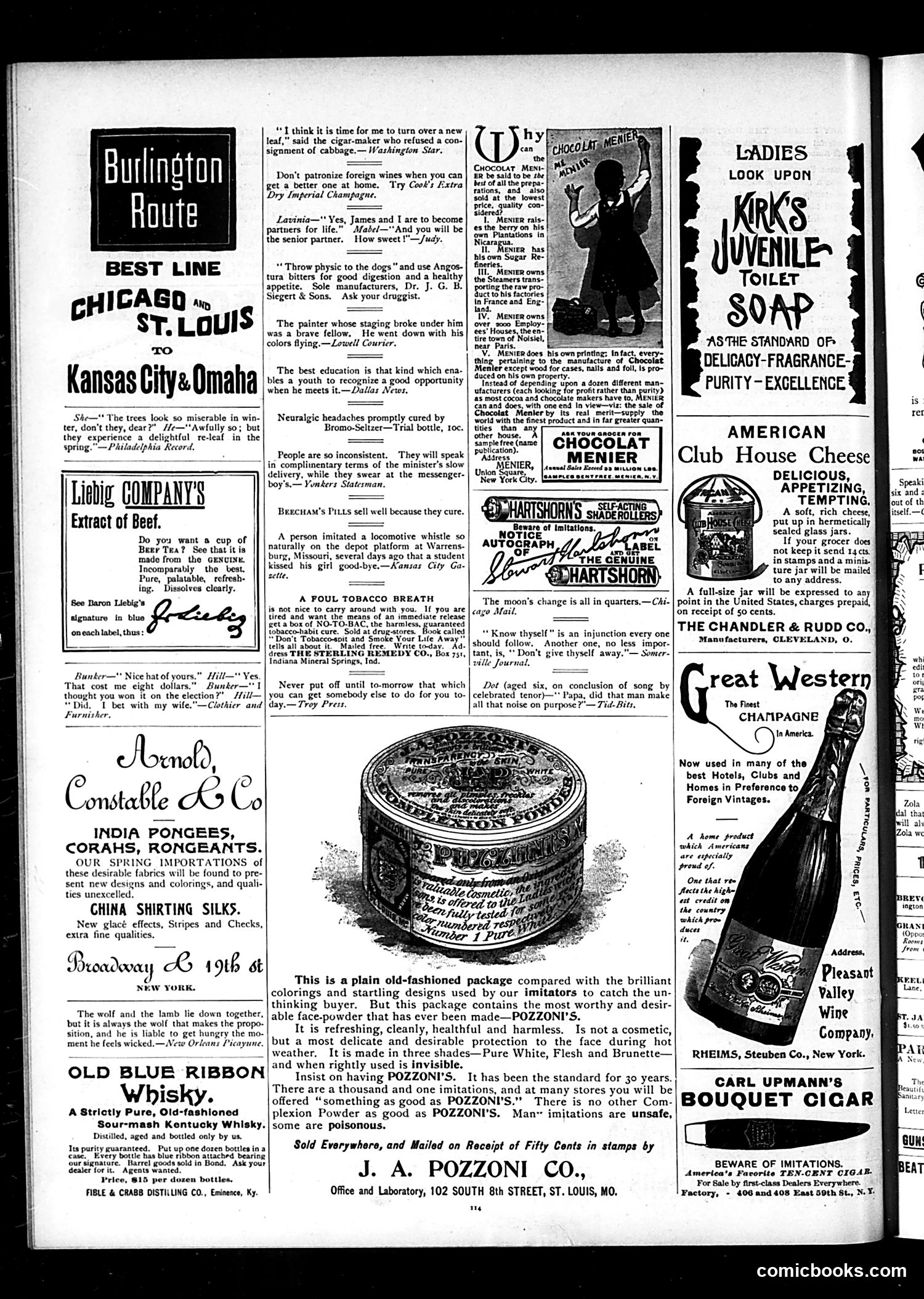
This page is primarily **advertisements and humorous short jokes**, not political cartoons. The content reflects early 20th-century American commercial culture. The jokes use wordplay and social observation: a woman complains trees look "miserable" in winter; a man bets his hat on an election with his wife (implying wives control husbands); a cigar-maker refuses "cabbage" (low-quality cigars). These are gentle domestic humor reflecting gender dynamics and business ethics of the era. The ads promote patent medicines (Bromo-Seltzer for headaches, No-To-Bac for tobacco addiction), alcohol (whisky, champagne), and fabrics. One substantial ad describes Pozzoni's face powder as superior to competitors, emphasizing its "30 years" of market dominance—a sales pitch comparing against unnamed imitators. The Mennier chocolate advertisement highlights vertical integration: the company controls production from cocoa to packaging, positioning this as superior quality assurance. No clear political satire appears on this page.
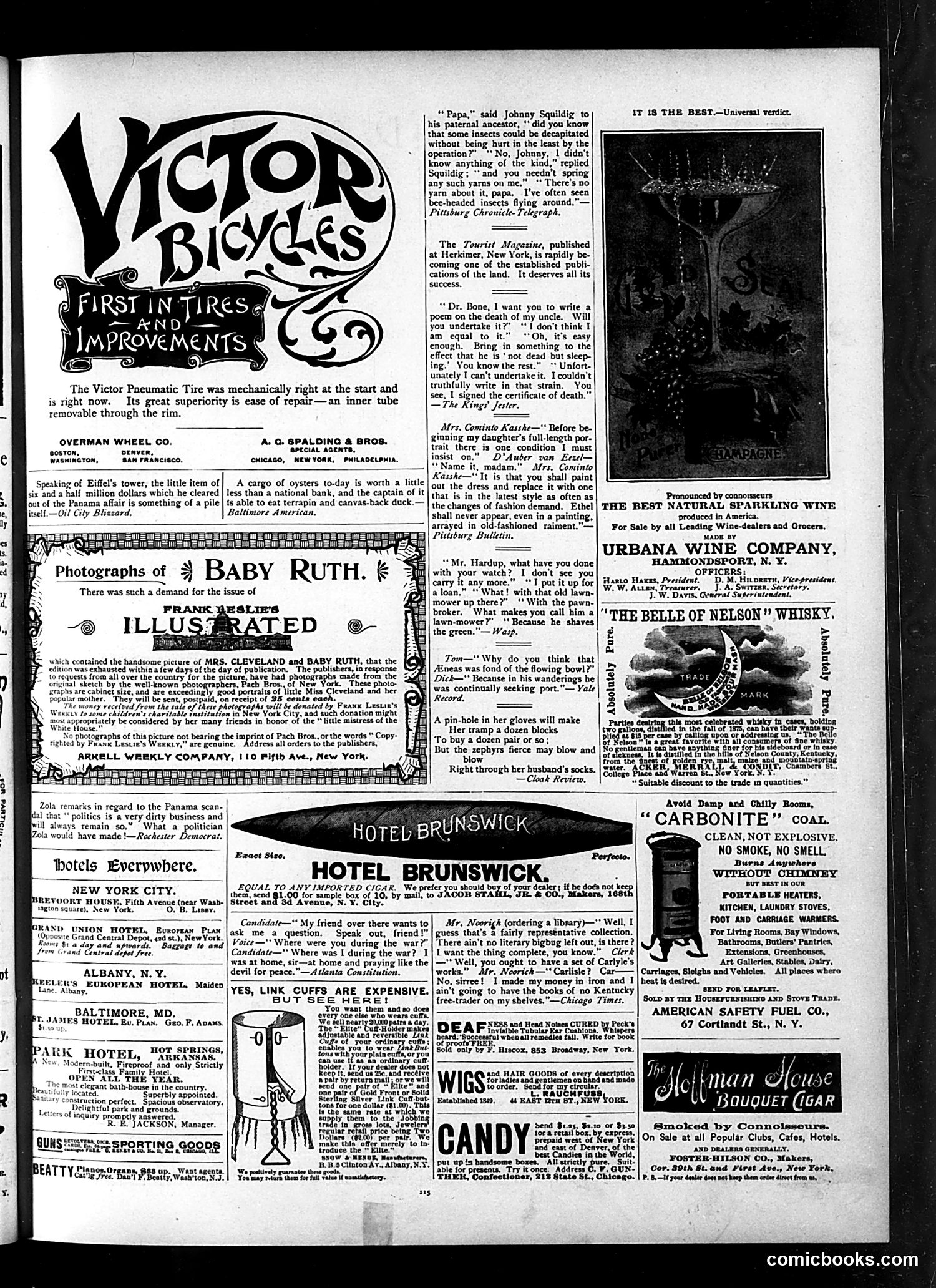
This page is primarily **advertising and filler content** rather than political satire. The main elements are: 1. **Victor Bicycles ad** — promoting pneumatic tires and their ease of repair 2. **Hotel Brunswick ad** — a substantial hotel advertisement 3. **"Photographs of Baby Ruth"** — a notice offering cabinet photographs of Mrs. Cleveland and her daughter for 95 cents, with proceeds donated to a New York children's charity. This references the recent Cleveland presidency and public interest in the First Family. 4. **Various humorous anecdotes and jokes** — including puns about insects, poetry writing, portrait painting, and pawned watches. These are gentle, domestic humor typical of the era. 5. **Multiple product advertisements** — for wines, coal, wigs, candy, and other goods The page lacks cohesive political commentary. The Cleveland reference is the only clear historical note, but it's purely commercial rather than satirical. The jokes are mild Victorian-era wordplay with no apparent social critique.
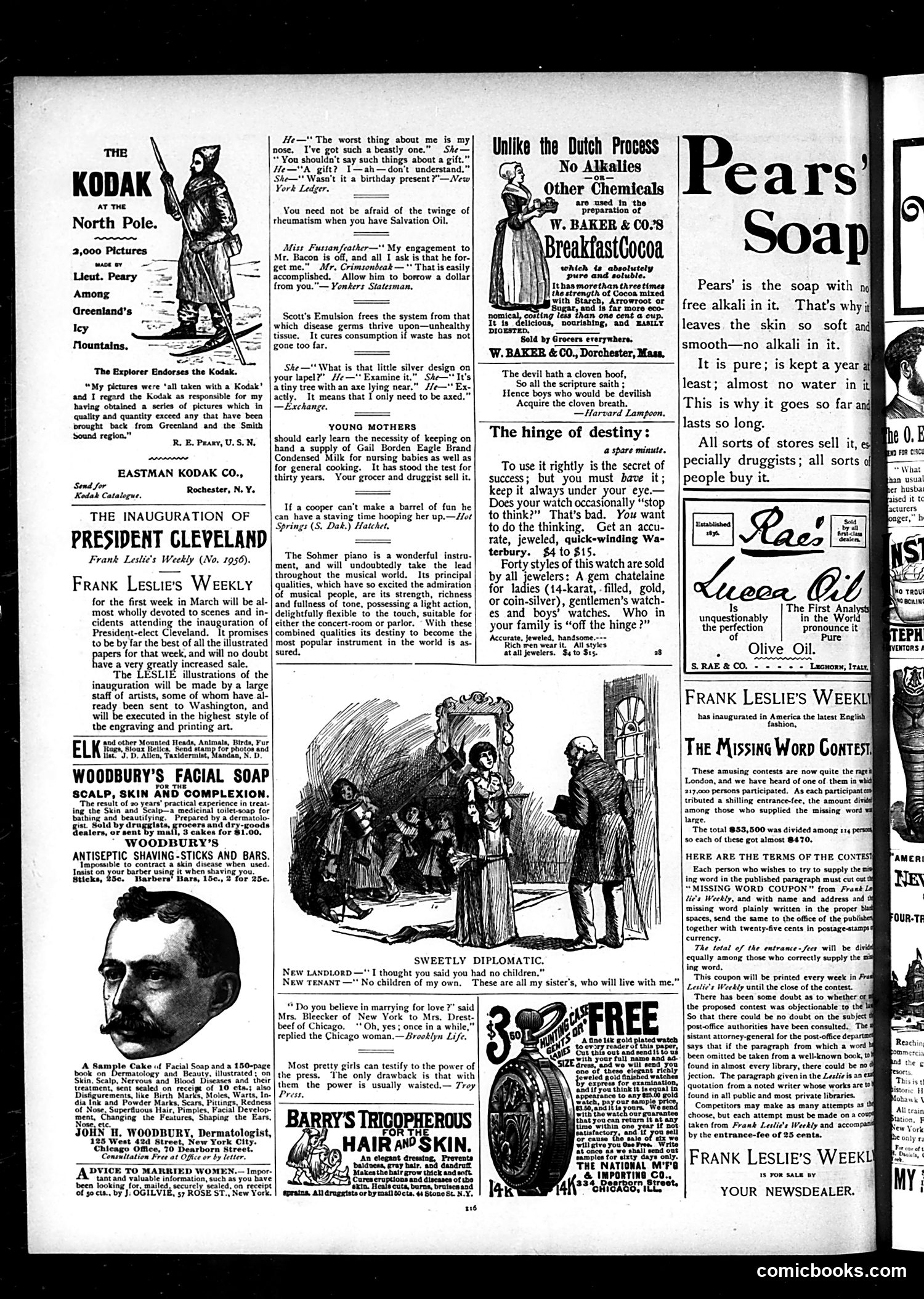
This page from *Frank Leslie's Weekly* (not Judge, despite the header reference) is primarily **advertising with minimal editorial content**. The main cartoon appears in the center—a sketch labeled "SWEETLY DIPLOMATIC" showing what appears to be a landlord-tenant exchange about children and inheritance. The page is dominated by period product advertisements (Kodak, Woodbury's soap, piano manufacturers) interspersed with short humor pieces—brief jokes about engagements, professions, and domestic life typical of the era's light comedy. **The political/social context:** The Kodak endorsement by "Lieut. Peary" references Arctic explorer Robert Peary's recent expeditions (early 1900s), using celebrity endorsement as marketing. Most other content reflects safe, genteel humor for middle-class readers rather than serious satire. **The satire is minimal here**—this is primarily a commercial publication page rather than a vehicle for political commentary.
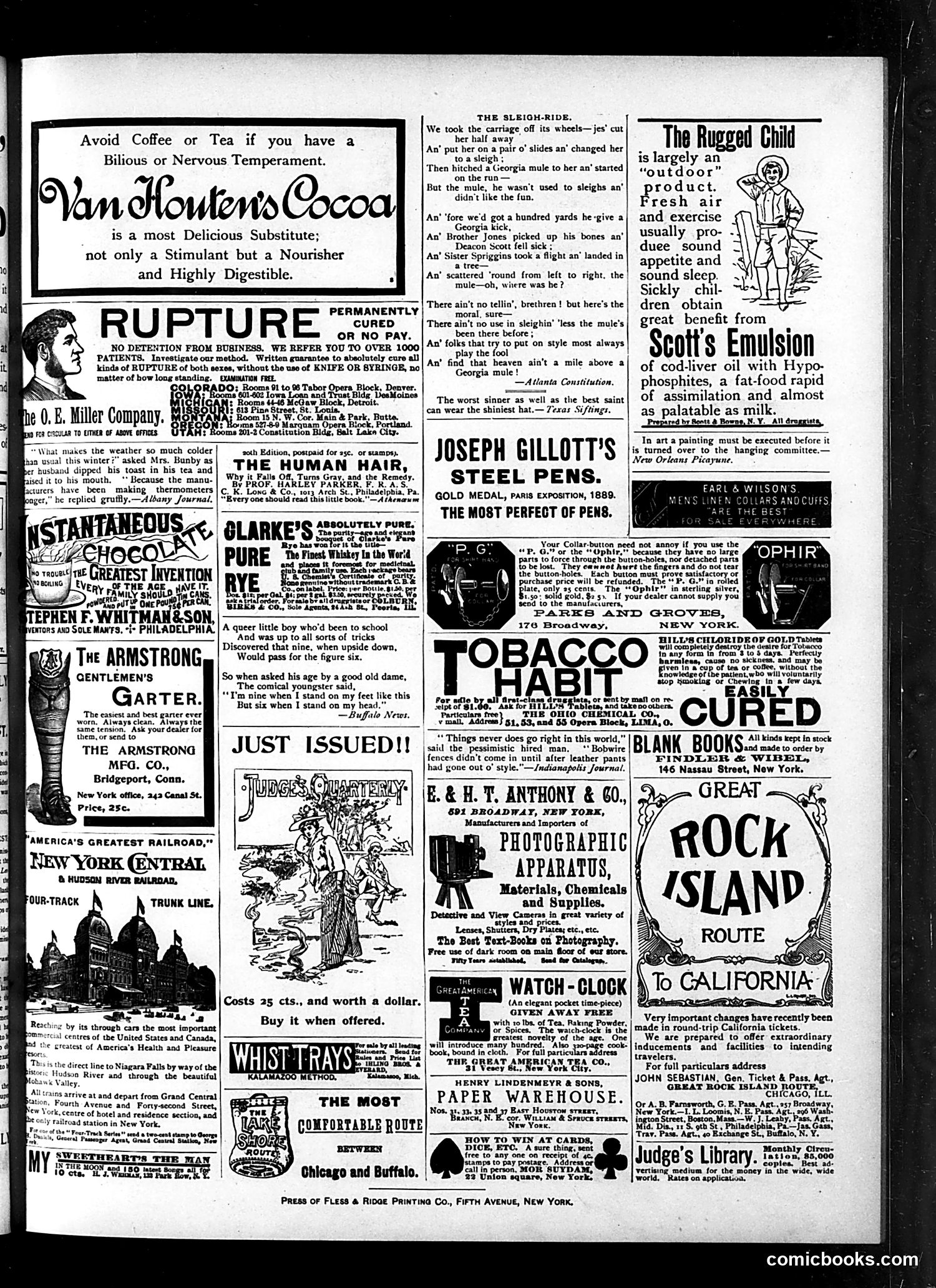
This page is primarily **advertising with entertainment content**, typical of Judge magazine's format. The main literary piece, "The Sleigh-Ride," is a humorous dialect poem narrating a comedic mishap: a Southern farmer converts a carriage into a sleigh using a Georgia mule unfamiliar with winter transportation. The mule panics, bucking passengers into trees and snow, scattering the party chaotically. **The satire works on multiple levels:** - **Regional humor**: The "Georgia" setting and dialect ("jes'," "an'") were popular period comedy vehicles - **Social commentary**: The moral warns against pretentious "style" — attempting fashionable activities (sleighing) without proper preparation leads to foolish failure - **Class subtext**: The mule owner's attempt to adopt Northern winter recreation exposes his unsuitability, suggesting rural/Southern unfamiliarity with urban customs The poem's closing couplet moralizes that virtue matters more than appearances — "the worst sinner as well as the best saint can wear the shiniest hat." **Surrounding advertising** pitches period remedies (cocoa, rupture cures, hair treatments) typical of Judge's commercial base.
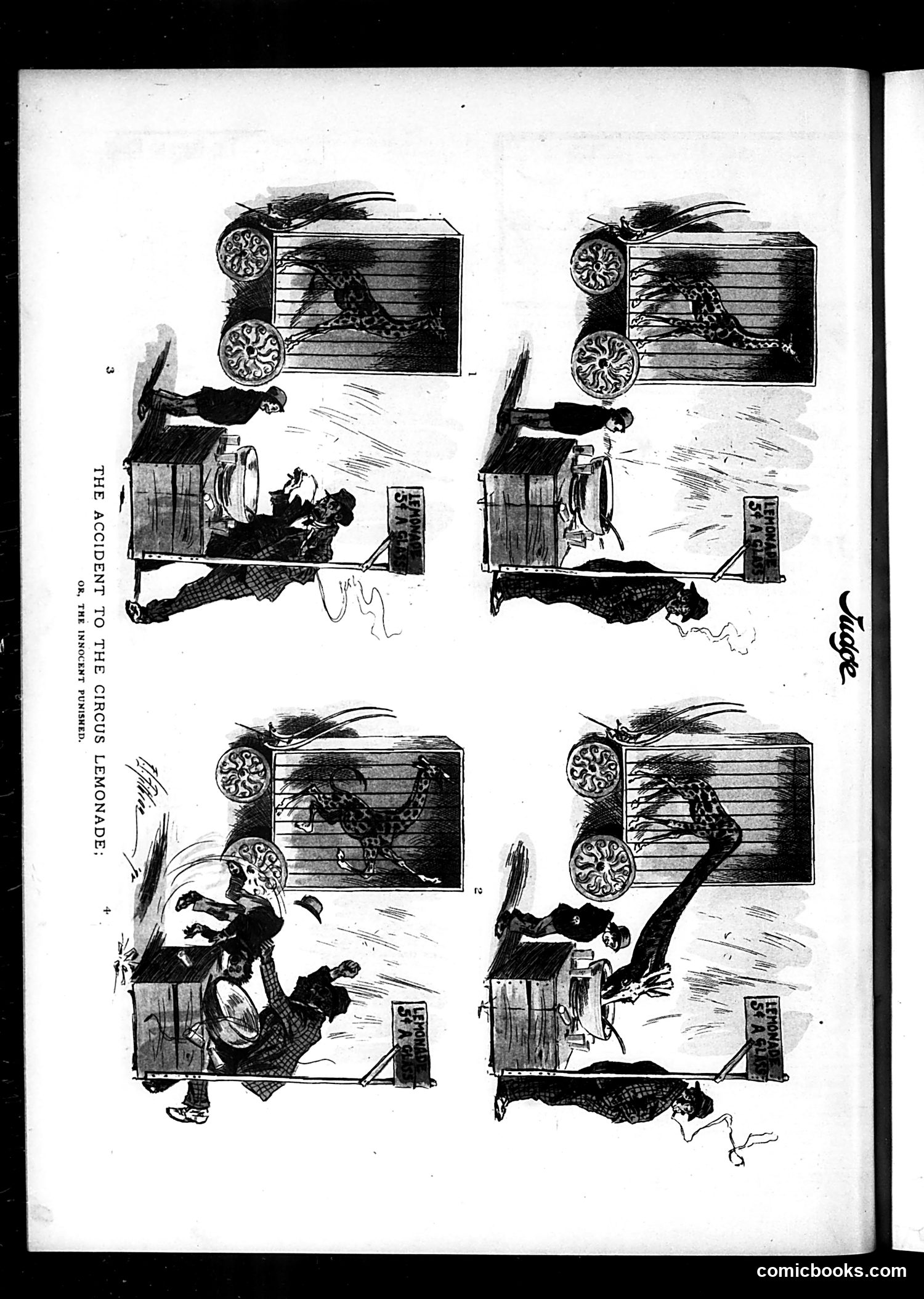
This appears to be a four-panel sequential comic strip showing an accident involving circus equipment and lemonade. The OCR text is garbled and unhelpful for interpretation. The panels depict a person operating what looks like a mechanical device or carnival equipment (possibly a lemonade stand apparatus with wheels), which appears to malfunction or tip over in successive frames. The person's posture and the equipment's orientation change dramatically across the panels, suggesting physical comedy or slapstick humor. Without clearer text or identifying details visible in the image, I cannot determine the specific satirical target or political reference this may have contained for Judge magazine's 1880s-1890s audience. The humor appears to be primarily physical/situational rather than overtly political.