
A complete issue · 16 pages · 1892
Judge — October 8, 1892
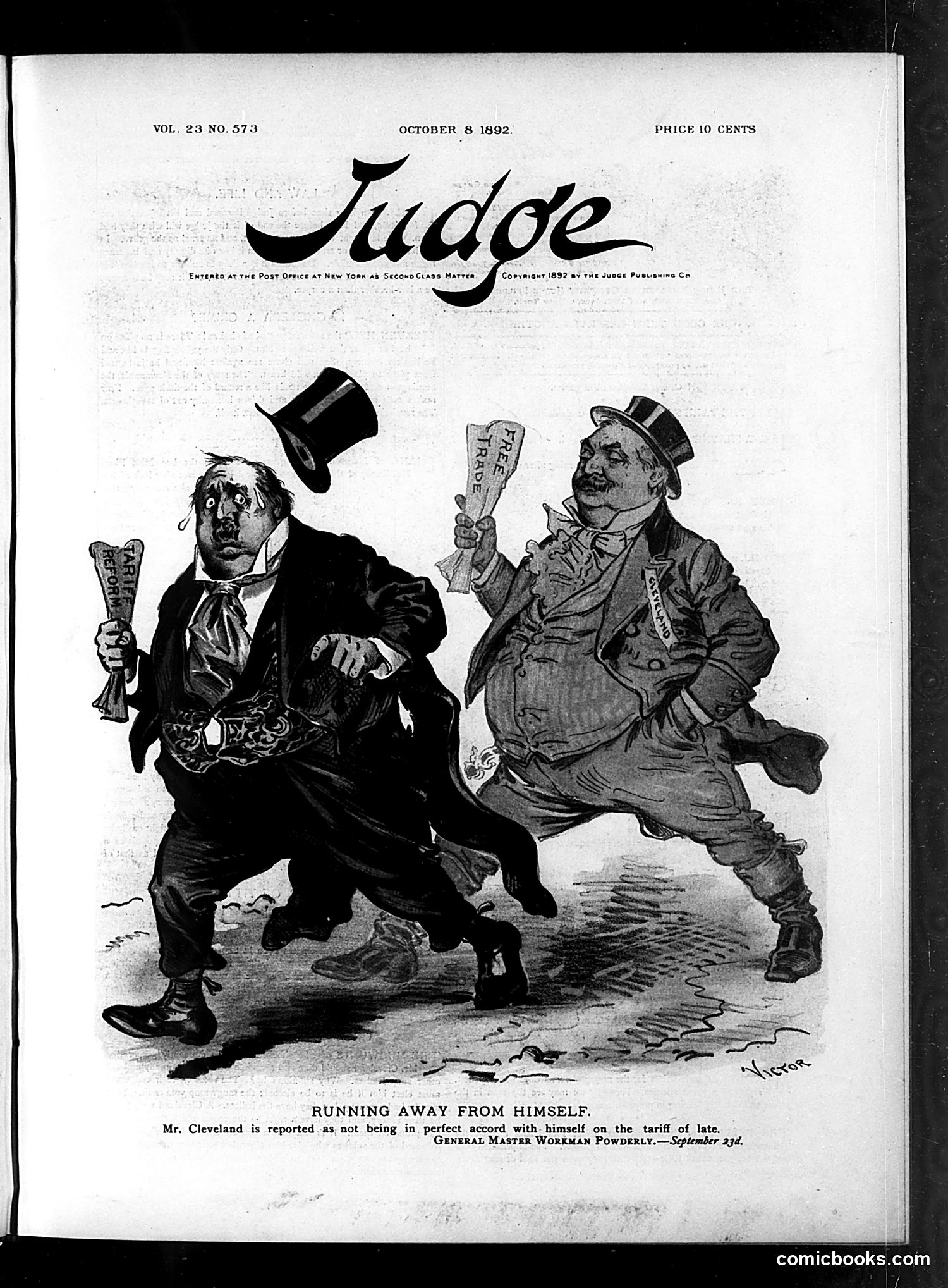
This political cartoon satirizes President **Grover Cleveland** regarding tariff policy disputes. The caption references Cleveland being "not in perfect accord with himself on the tariff of late," citing General Master Workman Powderly (labor leader) from September 23rd. The cartoon depicts two caricatured figures—apparently representing different aspects of Cleveland's position—literally running from each other while holding conflicting papers labeled "FREE TRADE" and what appears to be protectionist positions. The top hat flying away emphasizes the chaos. The satire suggests Cleveland was contradicting himself on tariffs, a major 1892 election issue. The "running away from himself" metaphor mocks his apparent inconsistency between stated free-trade principles and actual policy positions affecting labor and workers.
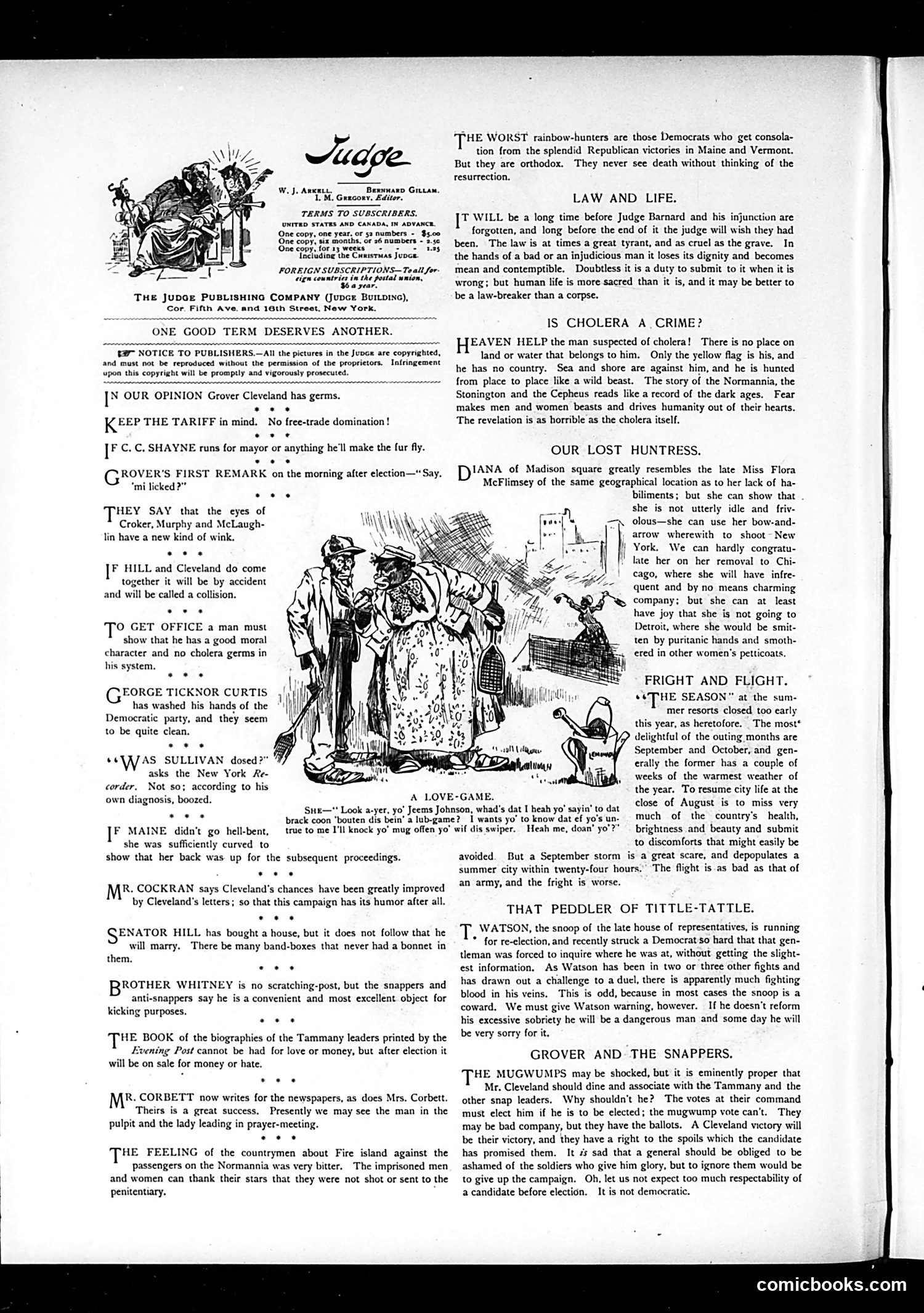
This page from Judge magazine contains multiple political jabs at 1880s-era figures and issues. References include: - **Grover Cleveland**: Multiple items mock the presidential candidate, including jokes about his "germs" and a collision with "Hill" (likely James G. Blaine's running mate). - **The tariff debate**: A recurring political issue, with lines like "KEEP THE TARIFF in mind. No free-trade domination!" - **Fire Island/immigration**: One piece references prisoners and the Normandia ship, touching on late-19th-century nativist anxieties about immigrants. - **T. Watson**: Described as "snoop of the late house of representatives," running for re-election amid scandal involving a duel challenge. The cartoons employ visual caricature and wordplay typical of 1880s satirical journalism, targeting both major party figures and contemporary social controversies.
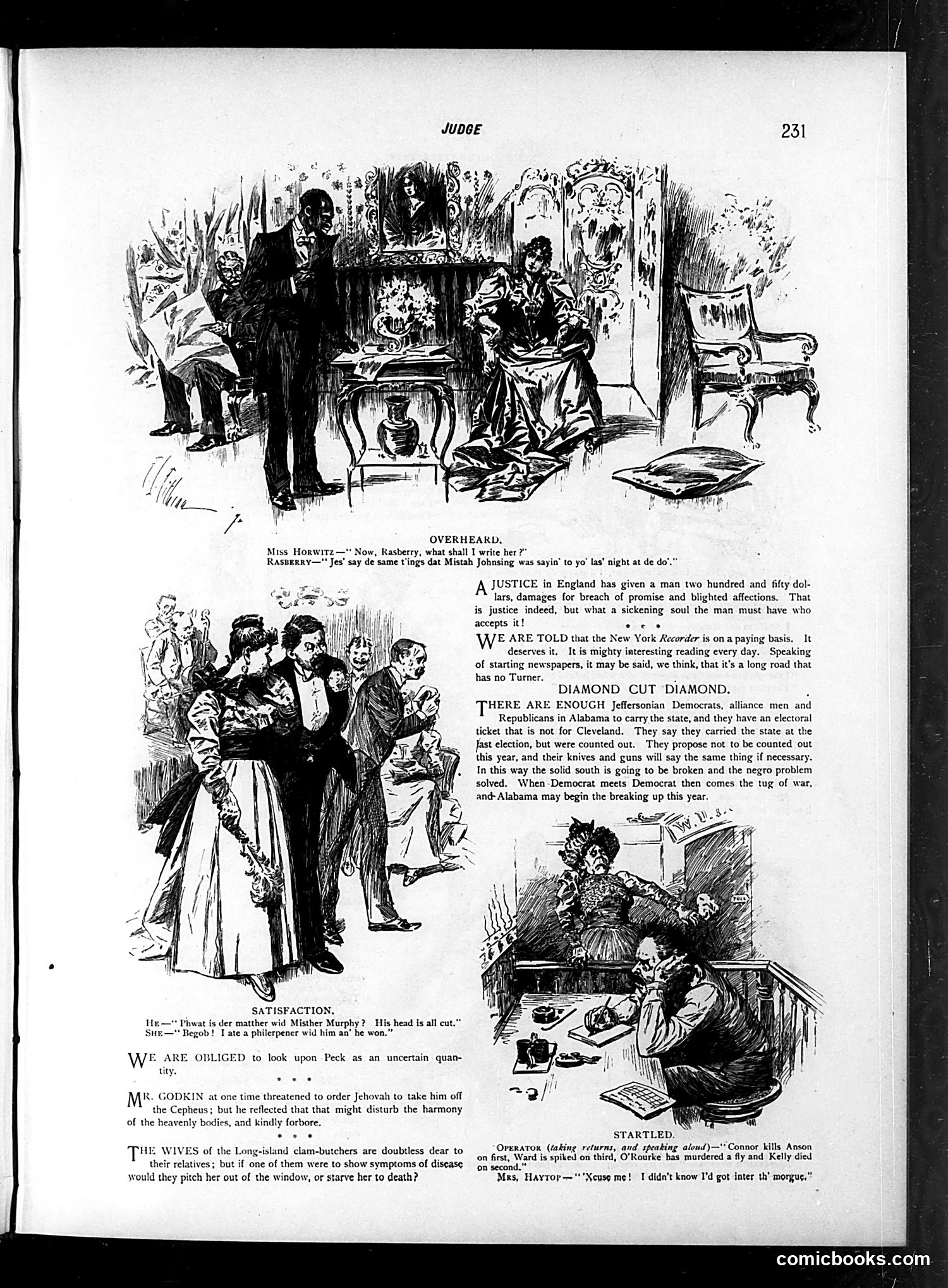
This page contains several satirical pieces from Judge, a late 19th/early 20th-century humor magazine. **"Overheard"** mocks a conversation between Miss Horwitz and Kasberry about writing letters, using dialect humor common to the era's ethnic stereotyping. **"Diamond Cut Diamond"** criticizes Alabama Democrats and Republicans, referencing disputed electoral practices and threats of violence ("knives and guns") to resolve political conflicts—likely referencing Reconstruction-era or Gilded Age political violence and voter intimidation. **"Satisfaction"** and **"Startled"** appear to be domestic humor vignettes unrelated to politics. The overall page reflects Judge's mix of political commentary on election fraud and sectional conflict alongside lighter domestic comedy, using caricature and dialect humor typical of the publication's satirical approach.
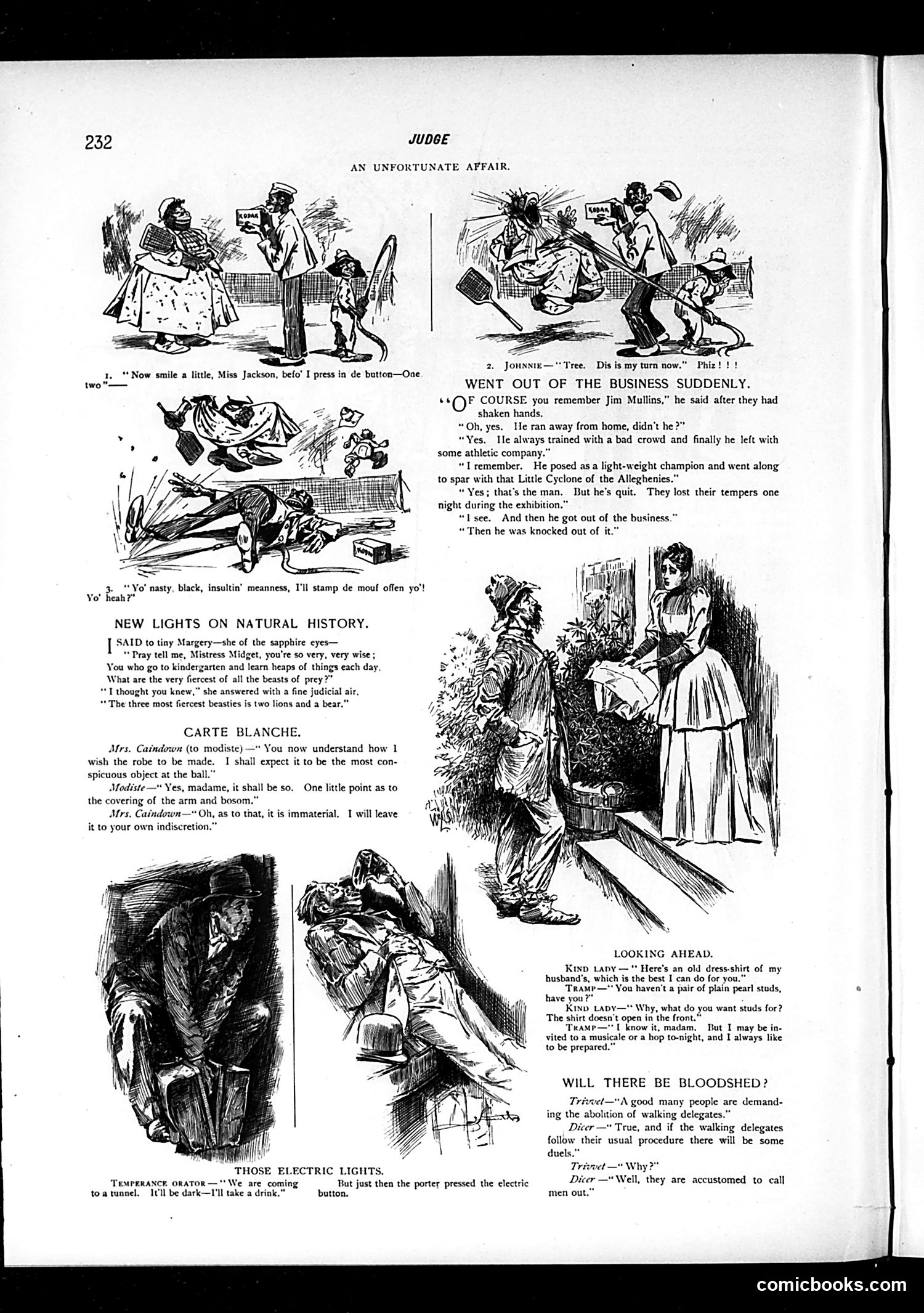
This page contains several distinct satirical items typical of 1890s American humor: **"An Unfortunate Affair"** depicts a violent altercation, likely between a photographer and subject, using racist dialect ("befo' I press in de button"). The accompanying text mockingly recounts a boxer named Jim Mullins who trained with a "bad crowd," fought as a lightweight champion against "the Little Cyclone of the Alleghenies," lost his temper during an exhibition, and was literally "knocked out of" the boxing business—a pun on both boxing and abandoning one's profession. **Other sketches** include: - "New Lights on Natural History"—a child's humorous misdefinition of dangerous animals - "Carte Blanche"—a wealthy woman indifferently instructing a dressmaker to make an immodest gown - "Looking Ahead"—a tramp's absurd vanity about wearing studs to potential evening events - "Will There Be Bloodshed?"—commentary on labor disputes and "walking delegates" (union organizers) The page exemplifies Judge's mix of social satire, class humor, and period racism.
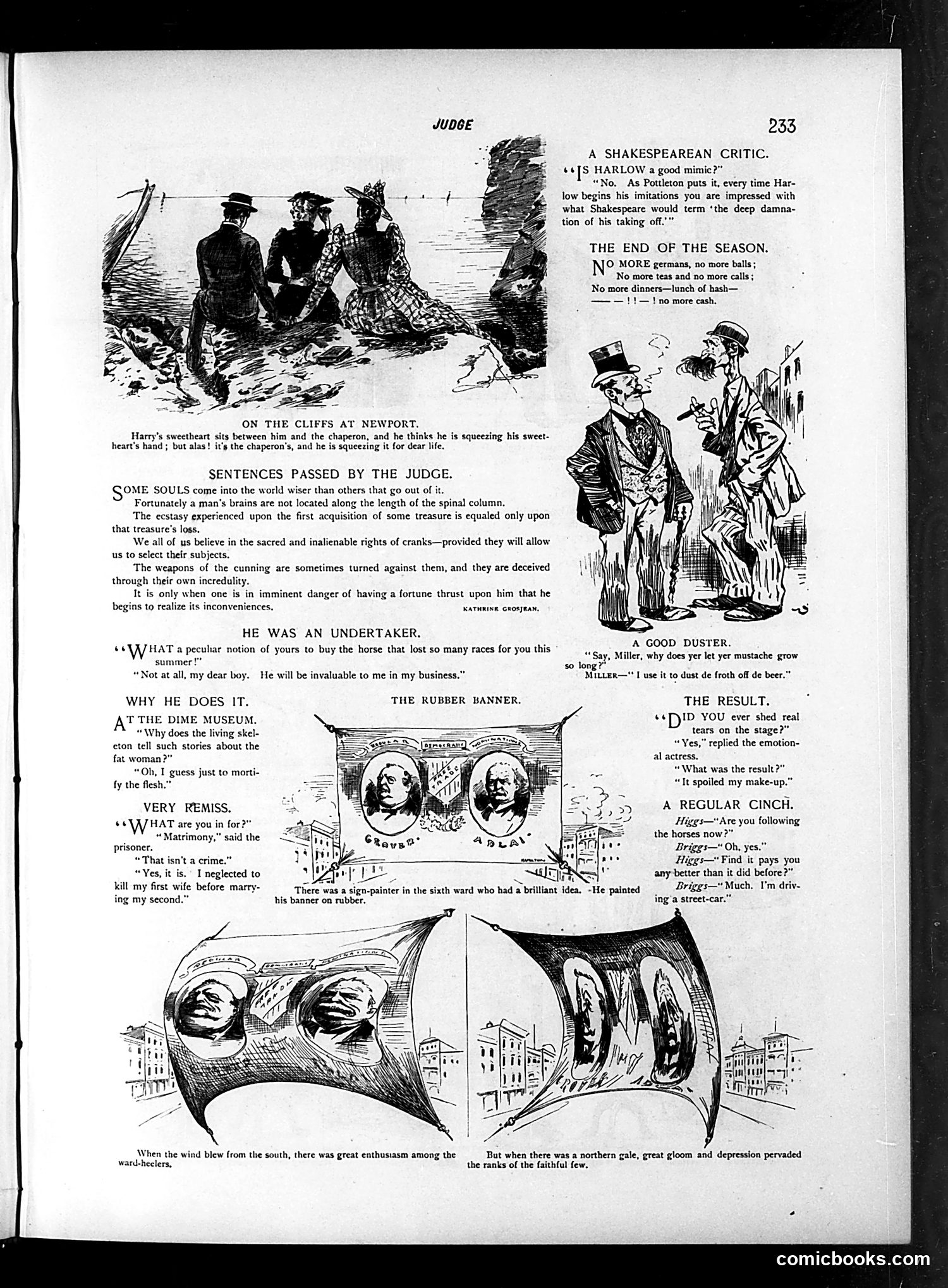
This page contains multiple short satirical pieces typical of late 19th-century humor magazines: **"On the Cliffs at Newport"**: Social comedy about a young man at the fashionable Newport resort who mistakenly squeezes his chaperone's hand instead of his sweetheart's—satirizing the awkwardness of courtship under strict Victorian supervision. **"The Rubber Banner"**: Political cartoon showing two faces in a banner that changes expression based on wind direction. The captions reference "watch-heelers" and "ward-heelers" (local political operatives), suggesting politicians who shift positions based on political winds—their enthusiasm or gloom depending on which way power blows. **Various short jokes**: Including an undertaker who buys a losing racehorse (for his business—bodies), a dime museum skeleton mocking a fat woman, and domestic humor about failed marriages. The page satirizes social pretension, political opportunism, and Victorian courtship customs—standard Judge fare mocking American manners and politics.
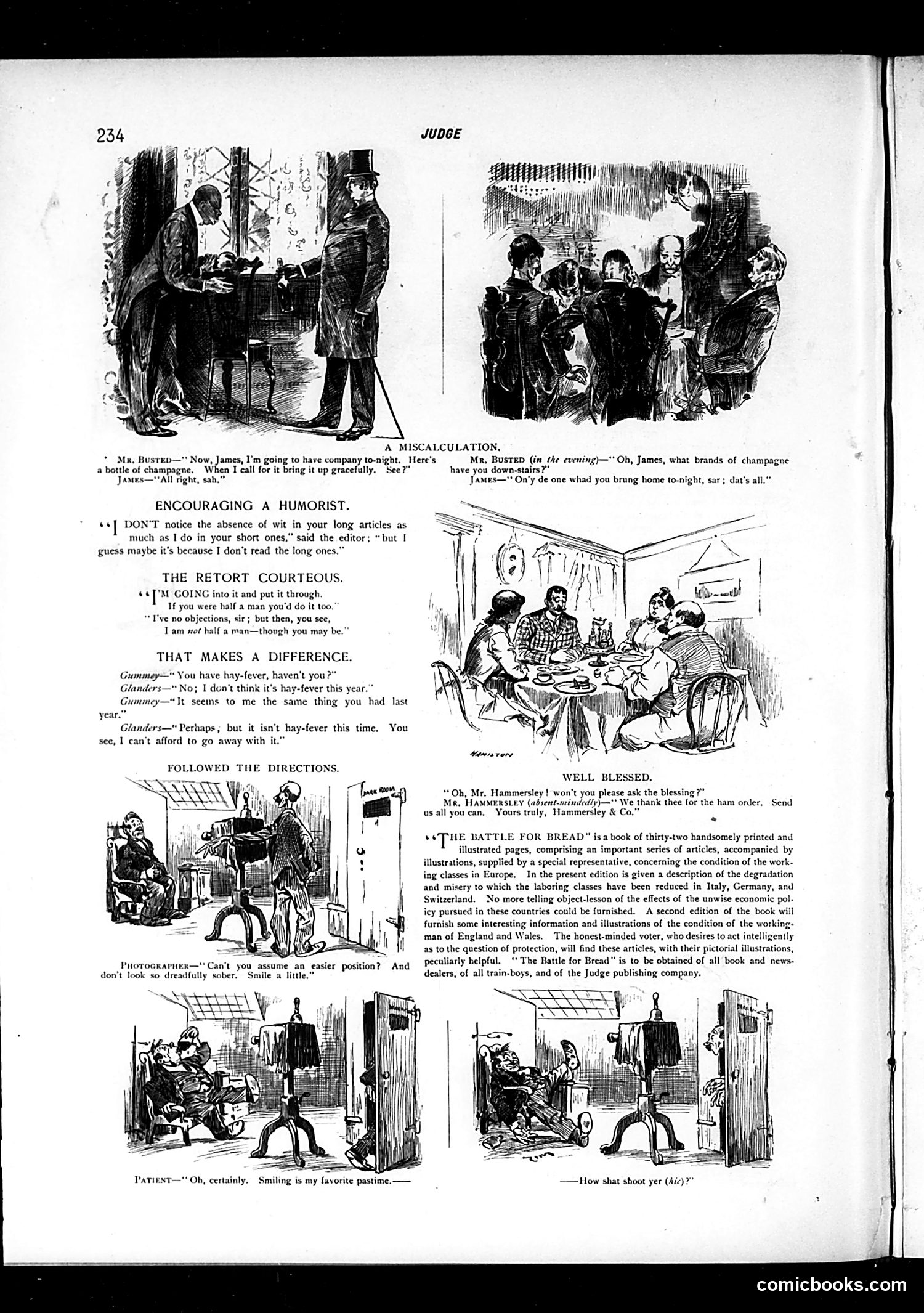
This page contains several brief satirical vignettes typical of Judge's humor: **"A Miscalculation"** mocks class pretension: A wealthy Mrs. Busted instructs her servant James to serve champagne "gracefully" when entertaining guests, but James deflates her pretensions by revealing she only owns one bottle—the one she brought home that night, suggesting modest circumstances. **Other humor snippets** include editorial banter about wit in articles, workplace repartee, and a scene where an absent-minded Mr. Hammersley accidentally recites a business blessing ("We thank thee for the ham order") instead of grace at dinner. **The bottom portion** advertises *"The Battle for Bread,"* a book about European working-class degradation in Italy, Germany, Switzerland, and Wales—reflecting Judge's interest in labor and economic conditions during the Gilded Age. **The cartoon vignettes** (photographer, patient) offer light workplace humor unrelated to political commentary. The page emphasizes class humor and social observation typical of late-19th-century American satire.
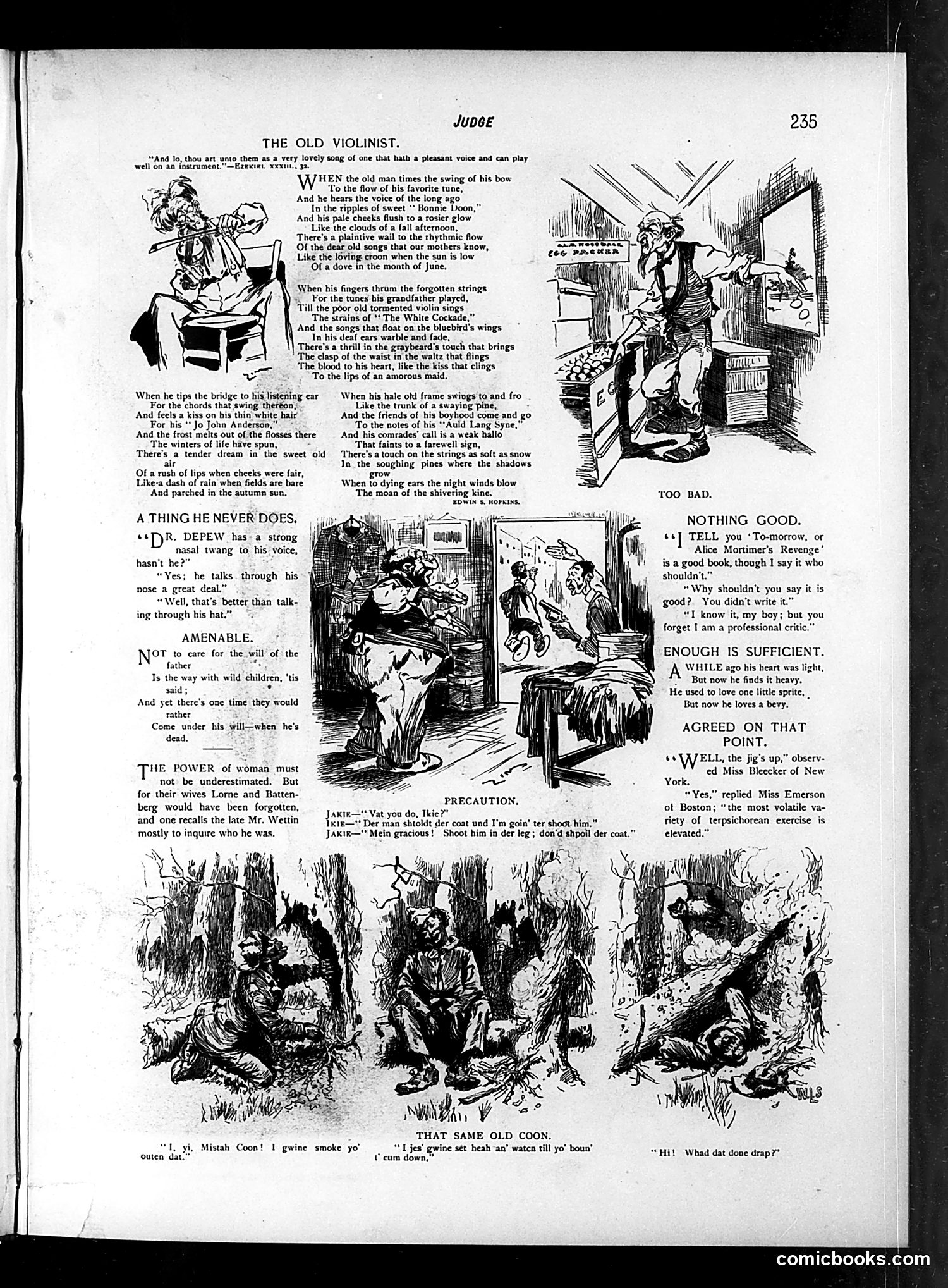
This page contains several unrelated satirical pieces typical of Judge magazine's format: **"The Old Violinist"** is a sentimental poem about an elderly man finding emotional solace playing violin—his only stated connection to satire is the ironic epigraph about being "a lovely song." **"A Thing He Never Does"** mocks Senator Chauncey Depew's distinctive nasal voice, joking he "talks through his nose" rather than "through his hat" (meaning speaking nonsense). **Other brief satirical items** include observations on children disrespecting fathers' wills, women's power (referencing forgotten royal consorts), and a crude ethnic "coon" dialect joke about waiting for something to "come down"—representing the casual racism common to period American humor. **"Nothing Good"** and **"Agreed on That Point"** feature light social comedy about critics and dancing terminology. The page reflects Judge's typical mix: sentimental verse, political/social commentary on notable figures, and period-appropriate (though offensive by modern standards) ethnic humor. Most references require no specific historical event knowledge.
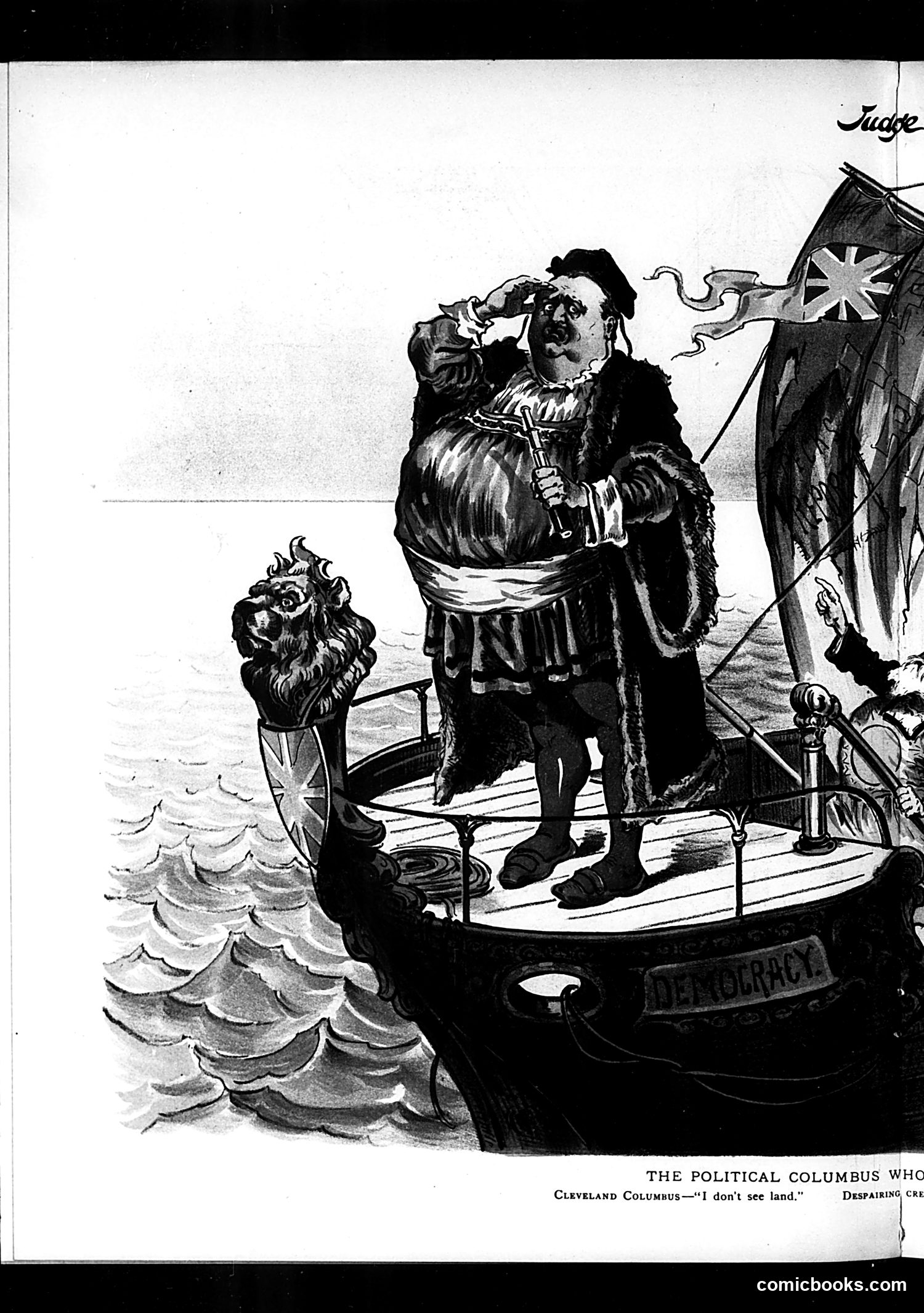
This Judge magazine cartoon satirizes **Cleveland Columbus** (likely President Grover Cleveland), depicted as Christopher Columbus on a ship. The caption reads "I don't see land," a play on Columbus's famous voyage. The cartoon critiques Cleveland's political vision or leadership—suggesting he cannot see a clear direction forward, much like Columbus searching for land. The lion figurehead represents American strength, while the flag suggests national identity. The satire appears to comment on Cleveland's inability to navigate political or economic challenges of his era (likely referencing his presidency during the 1893 economic depression). The "Political Columbus" metaphor suggests his leadership lacks clear purpose or foresight, leaving the nation adrift without direction—a common critique used against leaders perceived as ineffective or indecisive.
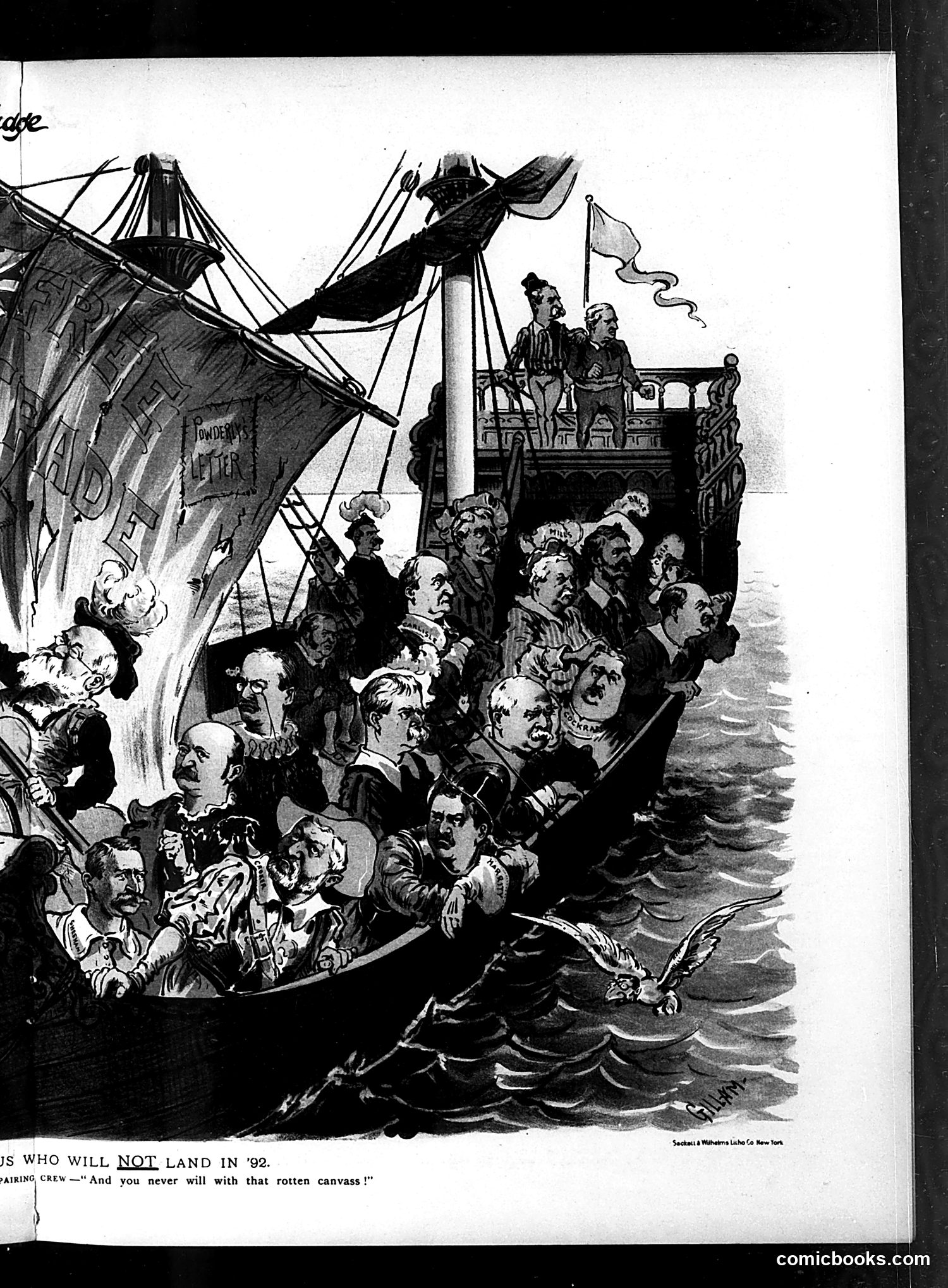
This 1892 Judge cartoon satirizes European political figures who refuse to visit America. The ship's captain declares "And you never will with that rotten canvas!"—a pun on both literal sails and the "canvas" of American democracy. The crowded vessel depicts caricatured European leaders and nobility with exaggerated features, apparently representing those unwilling to acknowledge or engage with American republican ideals. The "rotten canvas" suggests America views their reluctance as evidence of their corrupted, antiquated systems. The cartoon reflects late-19th-century American confidence in democratic superiority and mocks European aristocrats' supposed disdain for the United States. The specific identities of individual figures remain unclear from the image alone, though their formal dress and facial caricatures indicate they represent specific contemporary European leaders or types.
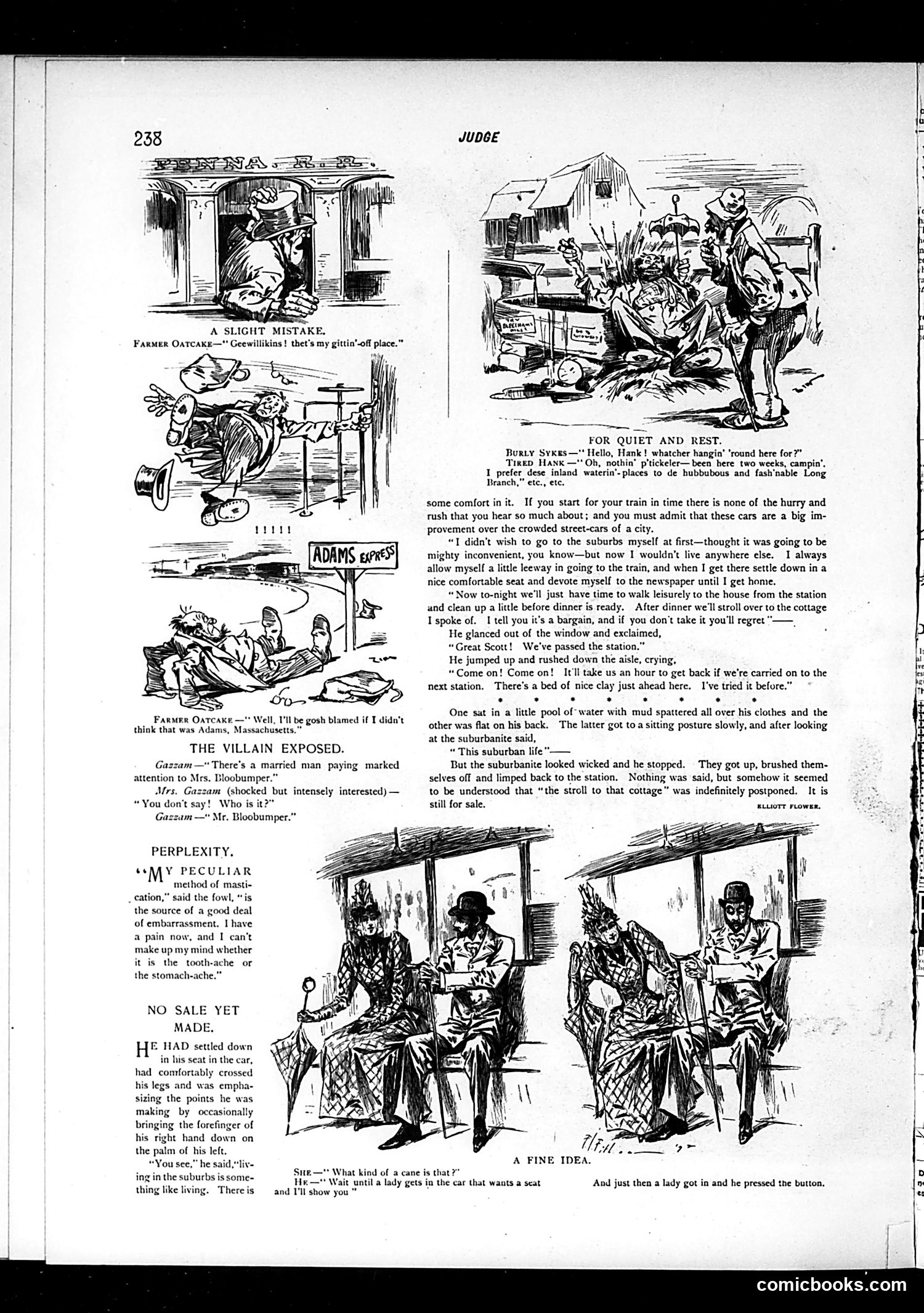
This page collects several unrelated humorous sketches typical of Judge magazine's format. The main story, "For Quiet and Rest," mocks the emerging suburban lifestyle. A man extols the virtues of commuting from the suburbs—the leisure, comfort, and escape from city chaos—then ironically misses his train stop while pontificating. He and his companion end up literally diving into mud attempting a shortcut, returning filthy and dejected. The joke satirizes suburban pretension: the man's smug boasting about suburban superiority is undercut by physical disaster. The smaller cartoons address domestic life: "The Villain Exposed" jokes about infidelity suspicions, "Perplexity" features a fowl's digestive confusion, and "A Fine Idea" depicts a man strategically pressing a train button only when a lady boards (suggesting gallant but self-serving behavior). The humor relies on physical comedy, social embarrassment, and gentle mockery of middle-class aspirations typical of early Judge humor.
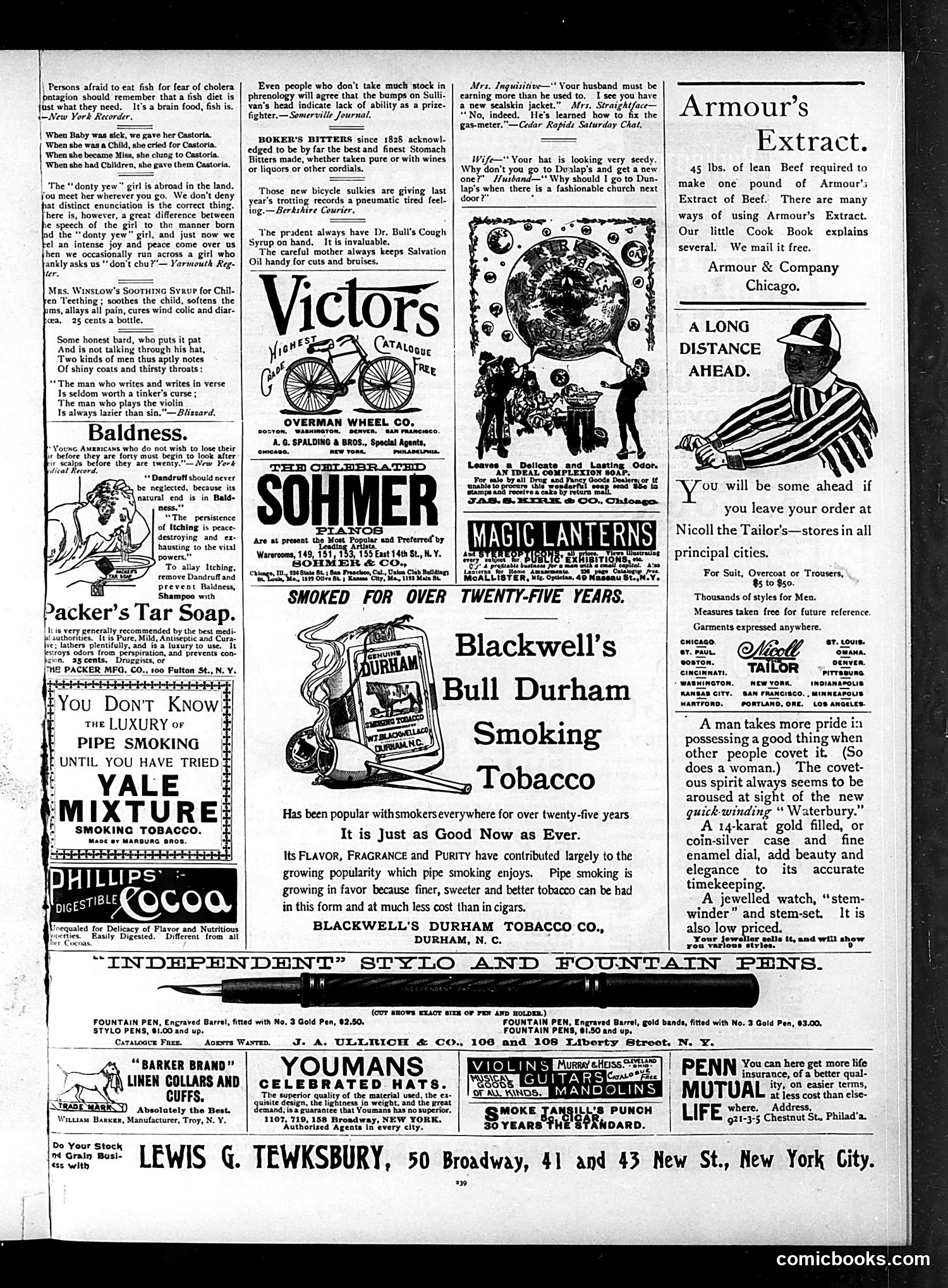
This is primarily an **advertising page** with minimal editorial cartoons. The advertisements showcase popular consumer products of the era: smoking tobacco (Yale Mixture, Blackwell's Bull Durham), patent medicines (Mrs. Winslow's Soothing Syrup, Dr. Bull's Cough Syrup), bicycles (Victor, Overman), and toiletries (Packer's Tar Soap). The few editorial jokes scattered among ads make light social commentary: - A jab at **John L. Sullivan** (famous boxer), mocking his intelligence via phrenology - Humor about **women's pronunciation** ("donty yew" vs. proper English) - Domestic comedy about a husband avoiding buying a new hat by suggesting a church visit instead The **Nicoll the Tailor advertisement** features a drawing of a confident man in striped clothing labeled "A Long Distance Ahead," promoting tailoring services. Overall, this reflects late 19th-century middle-class consumer culture and gentle satire rather than serious political commentary.
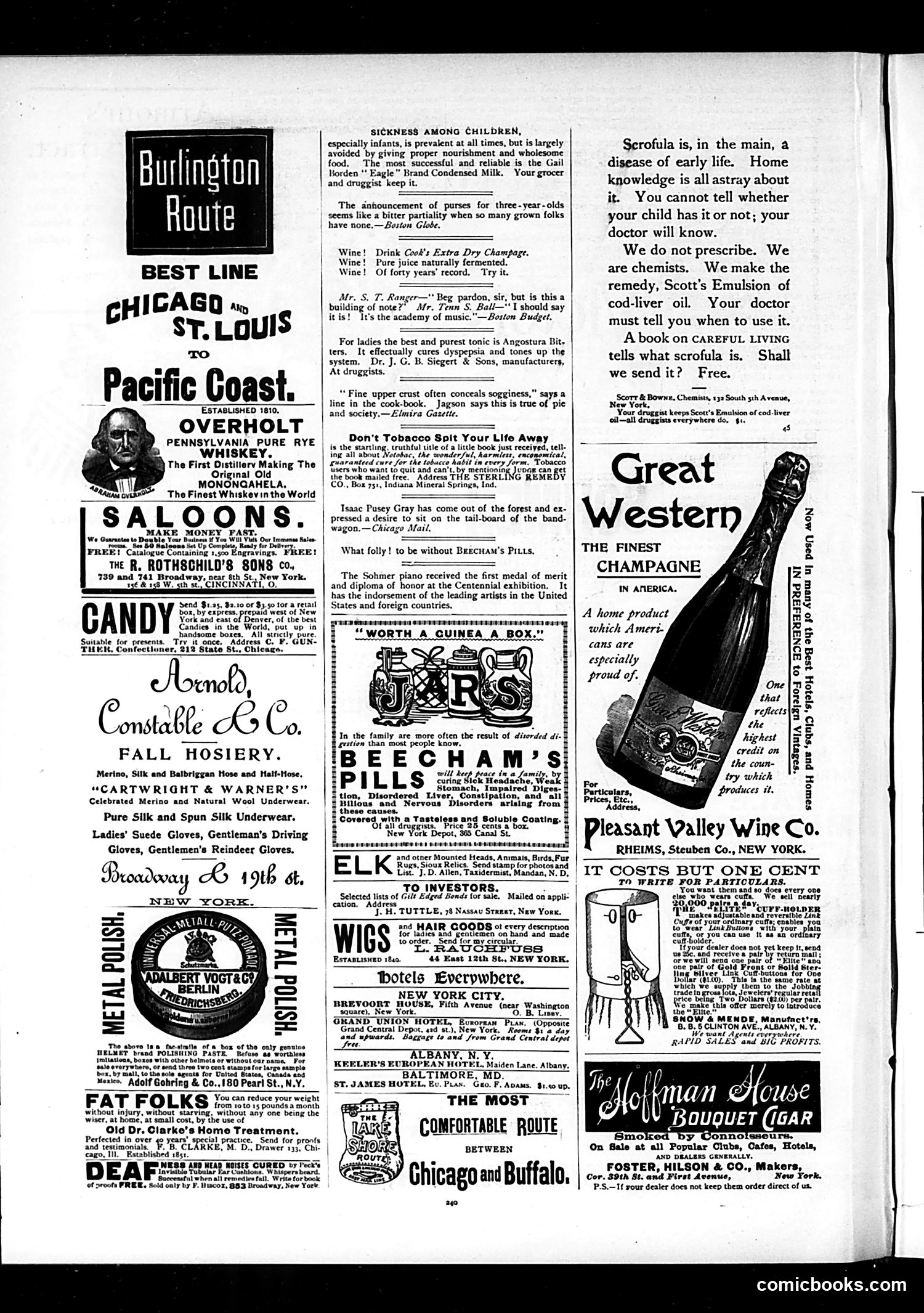
This page is primarily **advertisements** from late 19th-century American businesses—railroad services, whiskeys, candies, hosiery, medicines, wines, and various consumer products. There are no political cartoons visible. The content reflects the era's aggressive marketing culture and patent medicine industry. Notable elements include: - **Dubious health claims**: Angostura Bitters and Beecham's Pills marketed as cures for serious ailments; "Old Dr. Clarke's Home Treatment" for weight loss; tobacco cessation products. - **Social humor snippets**: Brief jokes about fashion, wine, and railroad businesses inserted between ads. - **Period products**: References to condensed milk, haute wines, and gentlemen's wear typical of the 1880s-90s. - **Deceptive advertising practices**: No regulation of medical claims—products promised miraculous results without scientific evidence. This is a commercial advertising page demonstrating how *Judge* magazine funded itself and the kinds of businesses seeking wealthy readers during the Gilded Age.
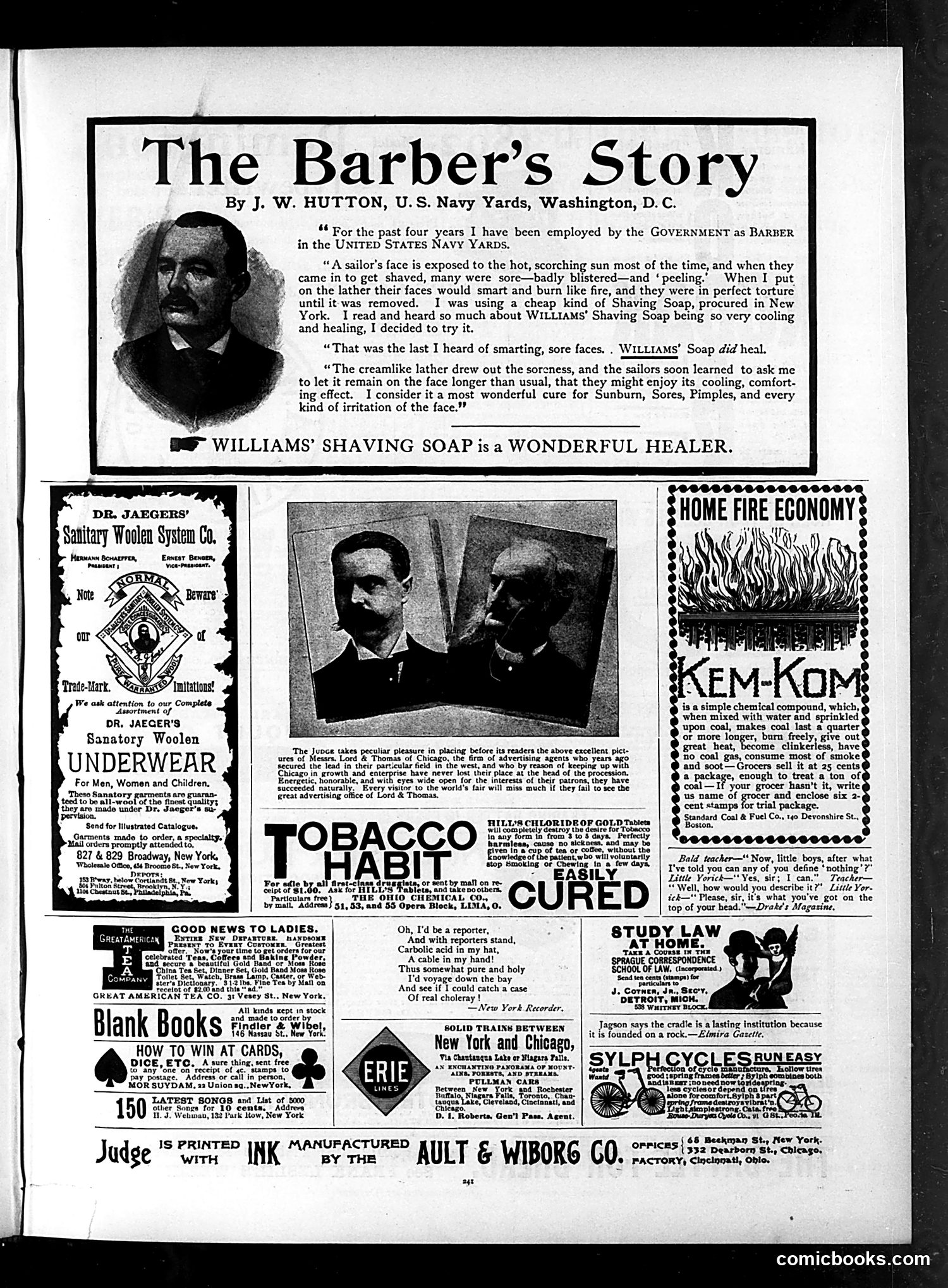
This page is primarily **advertising disguised as testimonial journalism**—a common early advertising technique. The main feature is a testimonial from J.W. Hutton, a U.S. Navy barber, endorsing **Williams' Shaving Soap**. Hutton describes how sailors suffered painful sunburn and facial irritation from cheap soap, but Williams' product—with its "creamlike lather"—healed their sores and became so popular sailors requested it by name. This is straightforward product promotion using the credibility of a government employee and the relatable problem of workplace discomfort. The accompanying photograph shows two men examining the advertised soap. The remainder of the page contains typical period advertisements for various products: Dr. Jaeger's wool underwear, tobacco-habit cure, coal treatment, correspondence law school, and other goods. The small joke about a "bald teacher" appears unrelated to the main content. The page demonstrates how early *Judge* magazine blended advertising revenue with editorial content.
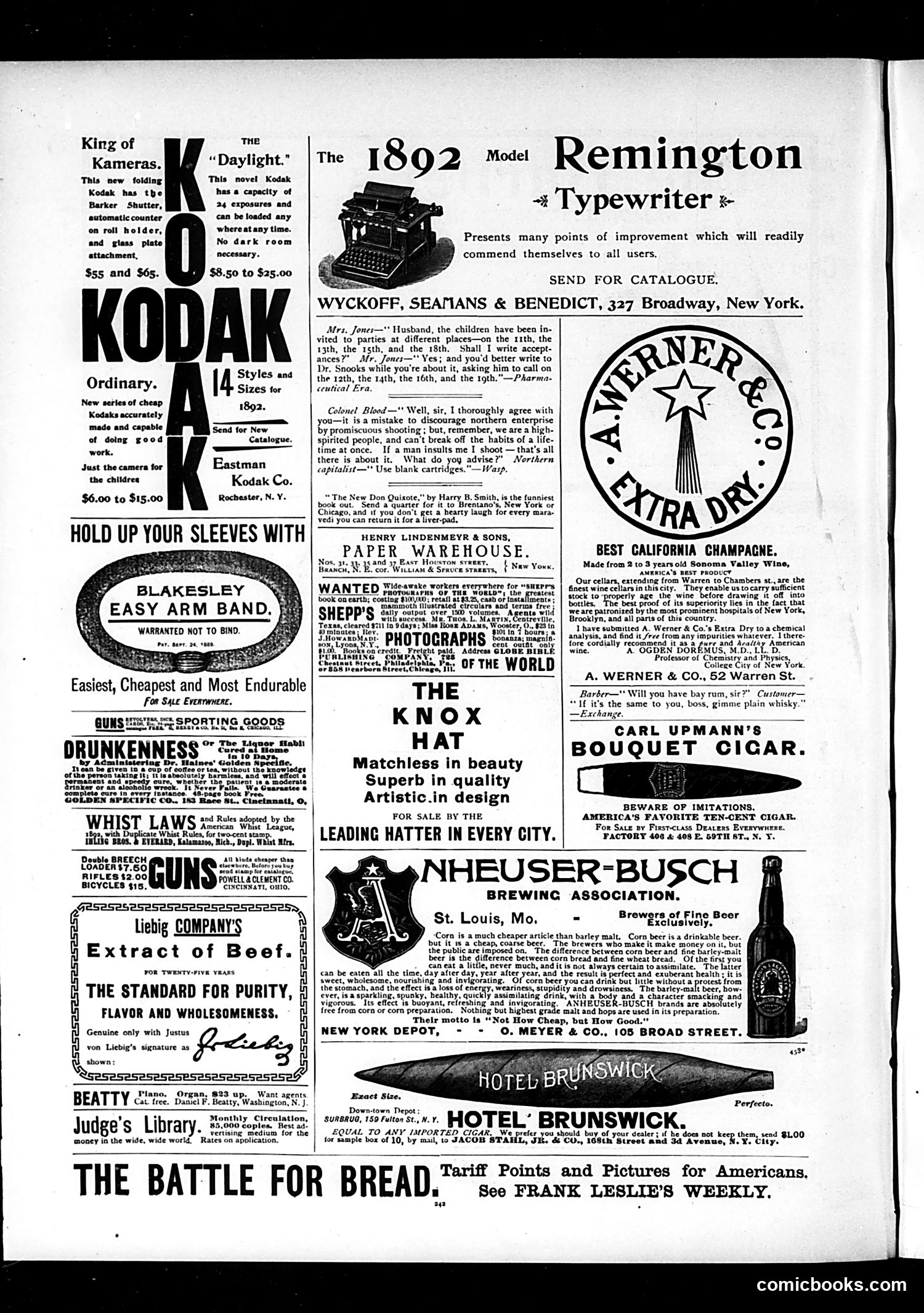
This is primarily an **advertising page** from Judge magazine, circa 1892. Rather than political cartoons, it features commercial advertisements interspersed with brief humorous anecdotes and product promotions typical of the era. Notable content includes: **Products advertised**: Kodak cameras (emphasizing the novel "no dark room necessary" feature), Remington typewriters, Knox hats, Anheuser-Busch beer, and various other goods reflecting 1890s consumer culture. **Humor snippets**: Brief jokes about domestic life (Mrs. Jones scheduling children's parties) and regional attitudes (a "Colonel Blood" defending Southern "honor" through shooting), presented as satirical social commentary. **No significant political cartoons** are visible on this page. The satire is mild and consumer-focused rather than addressing major political issues. This represents Judge's shift toward lifestyle and commercial content alongside its satirical commentary.
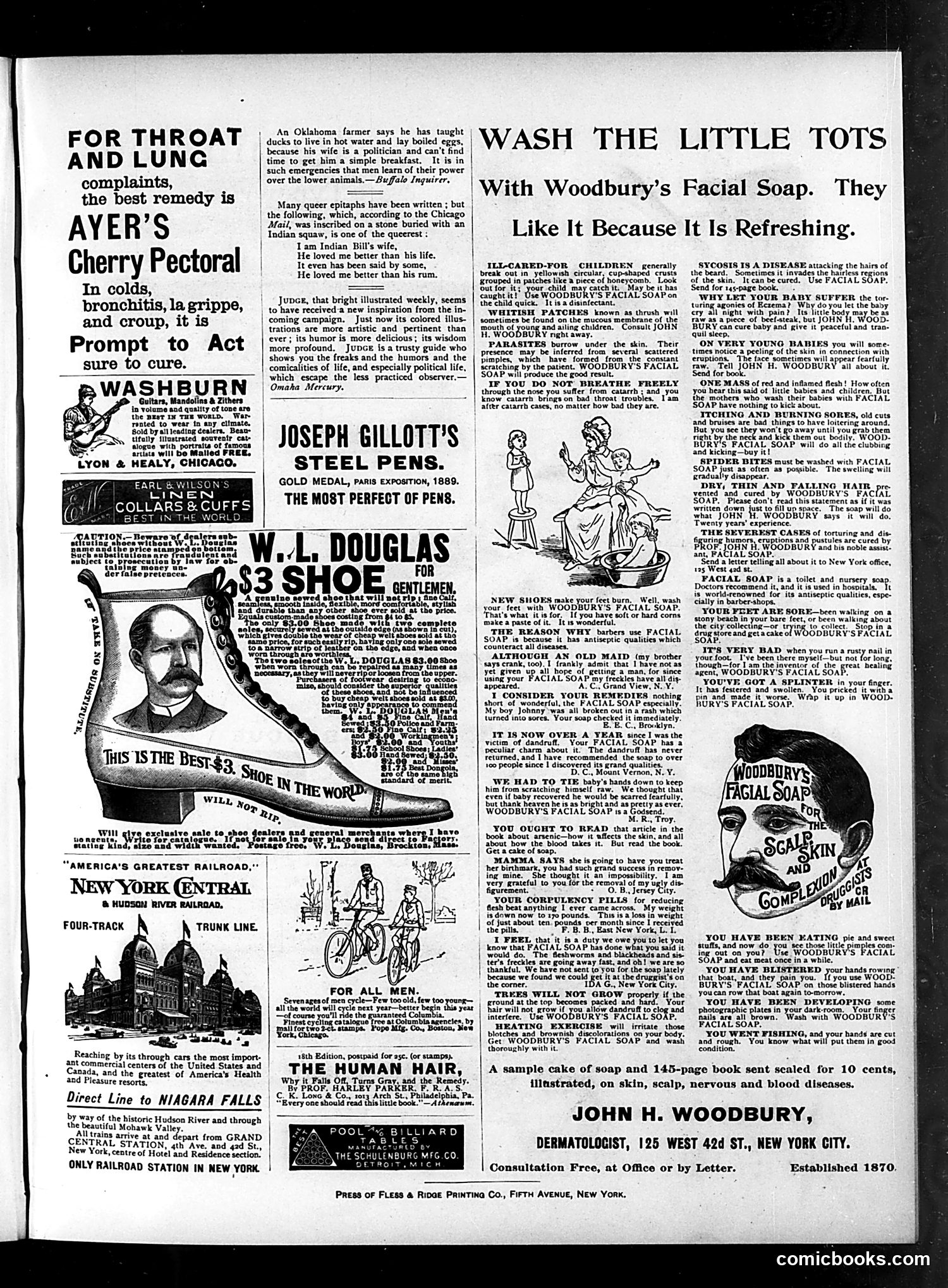
This is primarily an **advertising page** from Judge magazine, not a political cartoon. The page consists almost entirely of period advertisements (circa 1890s-1900s based on style and references). The main content advertises **Woodbury's Facial Soap**, marketed specifically for children's skin conditions—describing treatments for various ailments including infections, thrush, parasites, and respiratory issues. The soap is presented as a medicinal product with quasi-scientific medical advice. Surrounding advertisements promote other products typical of the era: Ayer's Cherry Pectoral (cough medicine), W.L. Douglas shoes, Gillott's Steel Pens, railroad travel, bicycles, and hair-loss remedies. The single **non-advertising joke** describes an Oklahoma farmer who taught ducks to lay boiled eggs because his wife (a politician) is too busy for housework—a mild satirical jab at women in politics and domestic negligence. This page reflects late-19th-century American consumer culture and the prevalence of patent medicines marketed with exaggerated health claims.
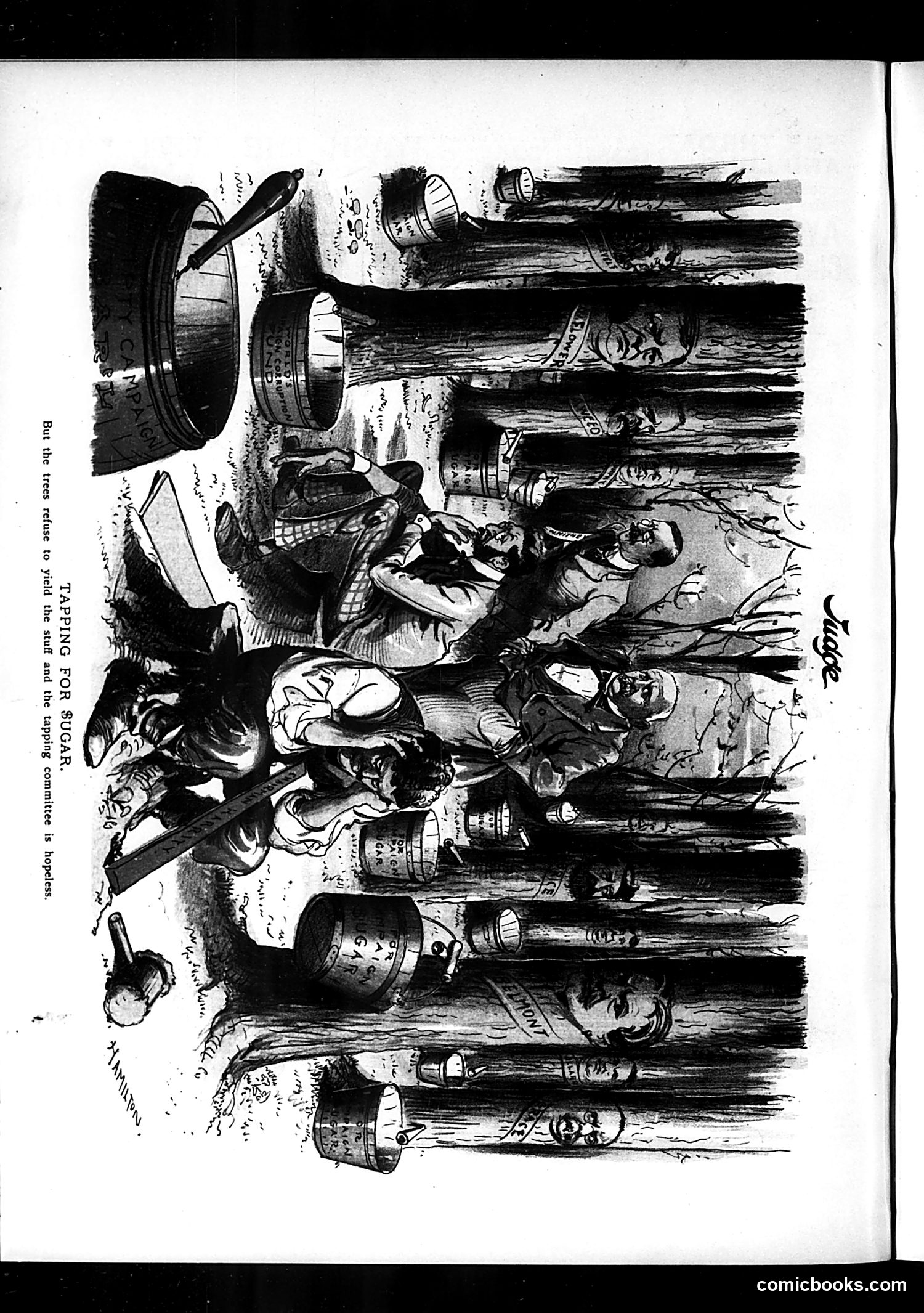
I can see this is a satirical illustration from Judge magazine, but the image quality and orientation make it difficult to read with certainty. The OCR text appears corrupted or reversed, which suggests technical processing issues. From what's visible, the cartoon depicts multiple figures in what appears to be a crowded, chaotic scene with barrels or containers and period clothing suggesting late 19th or early 20th century. The style is characteristic of Judge's political satire, likely targeting social issues, labor disputes, or public figures of that era. However, without being able to reliably identify specific individuals, read all visible text clearly, or confirm the exact subject matter, I cannot accurately explain the cartoon's specific political or social references to a modern reader. A clearer image or confirmed publication date would be necessary for accurate interpretation.