
Judge, 1892-10-08 · page 5 of 16
Judge — October 8, 1892 — page 5: what you’re looking at
What you’re looking at
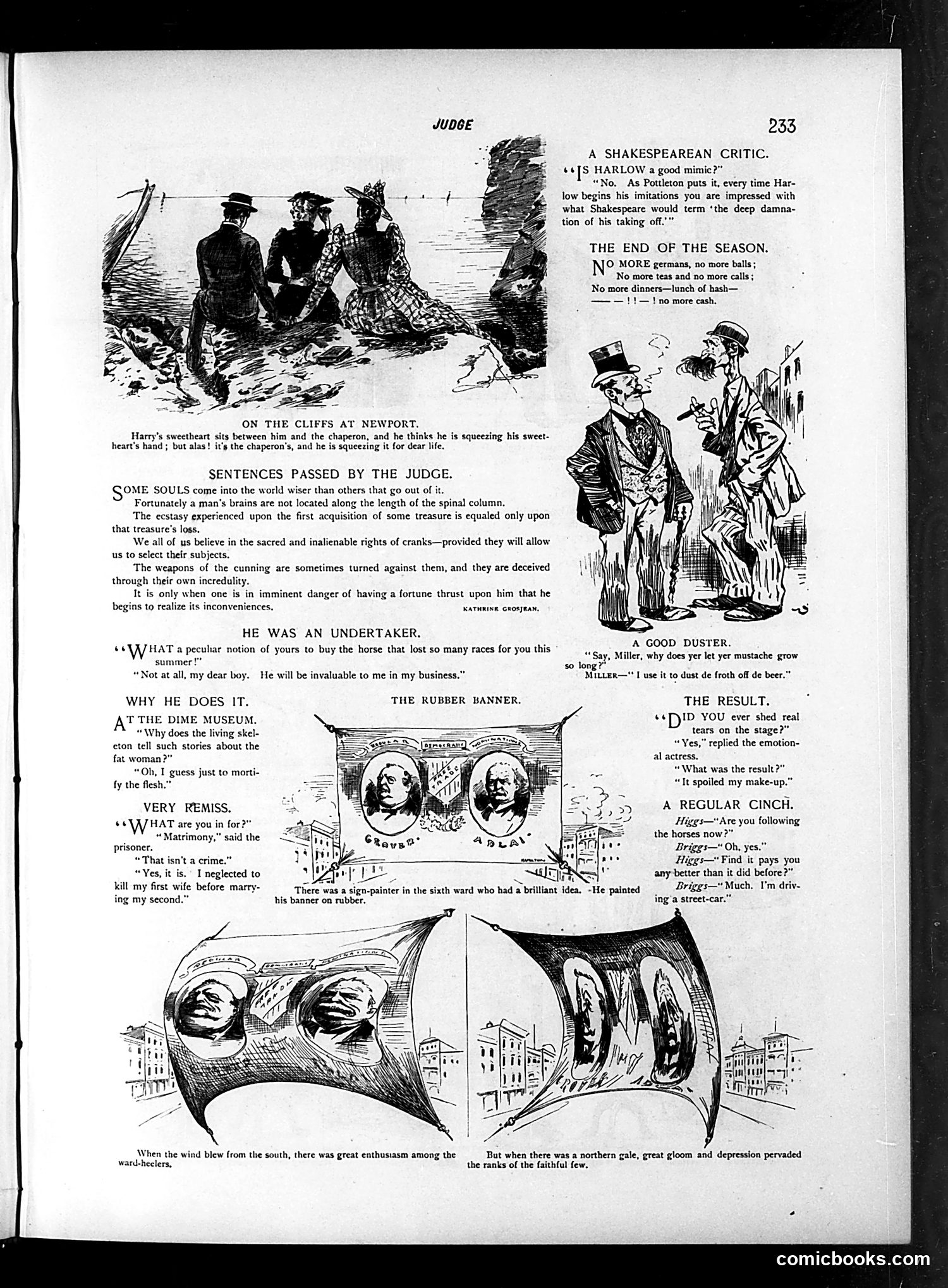
This page contains multiple short satirical pieces typical of late 19th-century humor magazines: **"On the Cliffs at Newport"**: Social comedy about a young man at the fashionable Newport resort who mistakenly squeezes his chaperone's hand instead of his sweetheart's—satirizing the awkwardness of courtship under strict Victorian supervision. **"The Rubber Banner"**: Political cartoon showing two faces in a banner that changes expression based on wind direction. The captions reference "watch-heelers" and "ward-heelers" (local political operatives), suggesting politicians who shift positions based on political winds—their enthusiasm or gloom depending on which way power blows. **Various short jokes**: Including an undertaker who buys a losing racehorse (for his business—bodies), a dime museum skeleton mocking a fat woman, and domestic humor about failed marriages. The page satirizes social pretension, political opportunism, and Victorian courtship customs—standard Judge fare mocking American manners and politics.
📄 Transcribed text from this page (OCR, searchable)
Machine-transcribed from the original scan — historical spelling and the odd misread are preserved.
eee Se ON THE CLIFFS AT NEWPORT. Harry's sweetheart sits between him and the chaperon, and he thinks he is squeezing his sweet- heart's hand ; but alas! it’s the chaperon’s, and he is squeezing it for dear life. SENTENCES PASSED BY THE JUDGE. SOME SOULS come into the world wiser than others that go out of it. Fortunately a man’s brains are not located along the length of the spinal column. The ecstasy experienced upon the first acquisition of some treasure is equaled only upon that treasure’s loss. We alll of us believe in the sacred and inalienable rights of cranks—provided they will allow us to select thelr subjects. The weapons of the cunning are sometimes turned against them, and they are deceived through their own incredulit It is only when one is in imminent danger of having a fortune thrust upon him that he begins to realize its inconveniences. KATIRINE GROSJEAN. HE WAS AN UNDERTAKER, Se YVHAT a pecuhar notion of yours to buy the horse that lost so many races for you this, summer!” “Not at all, my dear boy. He will be invaluable to me in my business.” WHY HE DOES IT. AT™ THE DIME MUSEUM. “ Why does the living skel- THE RUBBER BANNER. eton tell such stories about the fat woman?” “Oh, I guess just to morti- fy the flesh.” VERY REMISS. 0\YVHAT are you in for?” “ Matrimony,” said the prisoner. “That a crime.” “Yes, it is. I neglected to kill my first wife before marry- ing my second.” When the wind blew from the south, there was great enthusiasm among the 233 A SHAKESPEAREAN CRITIC. +4 ]S HARLOW a good mimic?” “No. As Pottleton puts it, every time Har- low begins his imitations you are impressed with what Shakespeare would term ‘the deep damna- tion of his taking off.’” THE END OF THE SEASON. NO MORE germans, no more balls ; No more teas and no more calls ; No more dinners—lunch of hash— ———!!—!no more cash. A GOOD DUSTER. “Say, Miller, why does yer let yer mustache grow so long?” MILLER—"'I use it to dust de froth off de beer." THE RESULT. ‘éPjID YOU ever shed real tears on the stage?” “Yes,” replied the emotion- al actress. “ What was the result?” “It spoiled my make-up.” A REGULAR CINCH. Higgs—Are you following the horses now?” Briggs— Oh, yes.” Higgs—" Find it pays you any better than it did before?” Briggs—“ Much, I'm driv- ing’a street-car.”” But when there was a northern gale, great gloom and depression pervaded ward-heelers, the ranks of the faithful few. comicbooks.com