
A complete issue · 18 pages · 1892
Judge — February 27, 1892
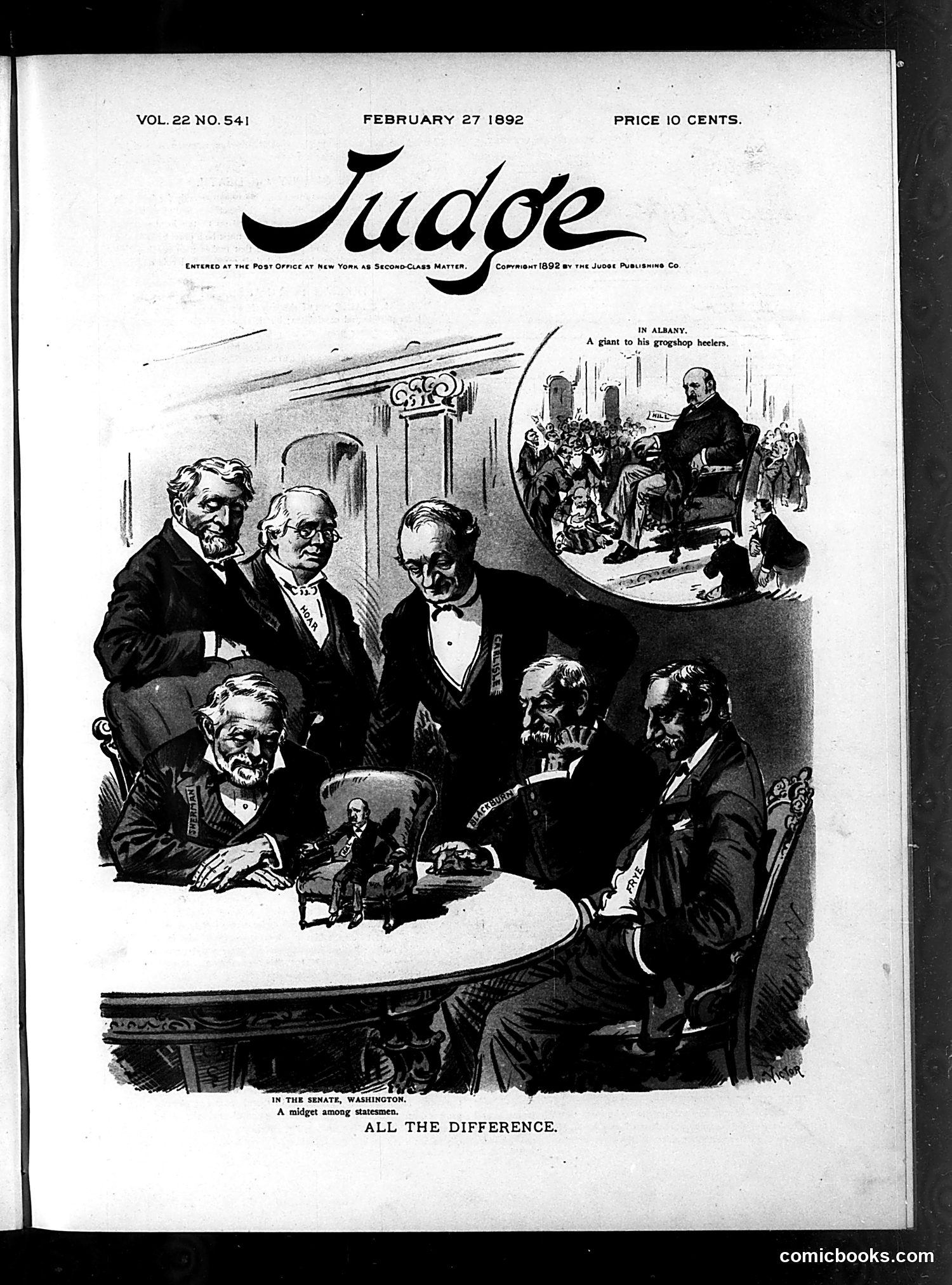
This political cartoon presents two contrasting scenes titled "ALL THE DIFFERENCE": **Bottom panel** ("In the Senate, Washington"): Shows a tiny figure seated among full-sized senators at a table, captioned "A midget among statesmen." **Top panel** ("In Albany"): Depicts a giant looming over a crowd of normal-sized people in what appears to be a state legislature or court setting. The satire compares relative political power and status—likely contrasting a figure's importance or influence in New York State (Albany) versus the U.S. Senate (Washington). The "midget among statesmen" suggests someone diminished by comparison to federal lawmakers, while their prominence in state affairs illustrates the stark difference in scale between state and national political influence. The specific identities of the figures remain unclear without additional historical documentation.
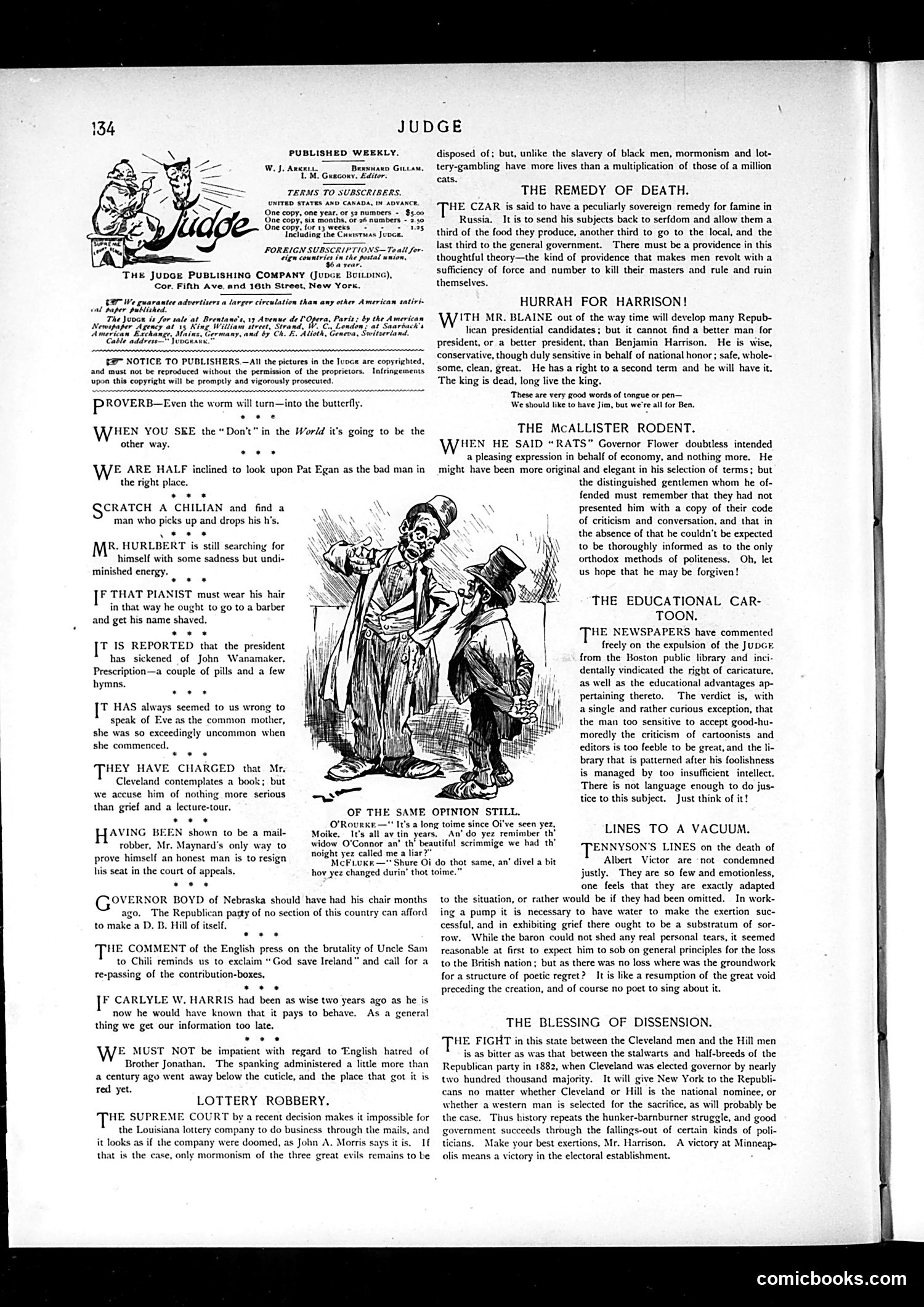
This page contains multiple short political commentaries and one cartoon rather than a single unified cartoon. The main illustration shows an interaction between what appears to be two figures in 19th-century dress. The accompanying text "OF THE SAME OPINION STILL" references an exchange about "O'Connor" and a widow, though the specific political reference is unclear without additional context. The page's written sections address various topics: Benjamin Harrison's presidential prospects, criticism of Governor Flower's "rats" comment, and disputes between Cleveland and Hill faction Republicans in New York state politics (1882-1884 era, based on references). The satire relies on contemporary political feuds and personality clashes rather than universal themes, making the specific targets difficult for modern readers to identify without historical research into 1880s New York politics and figures like O'Connor and Governor Boyd.
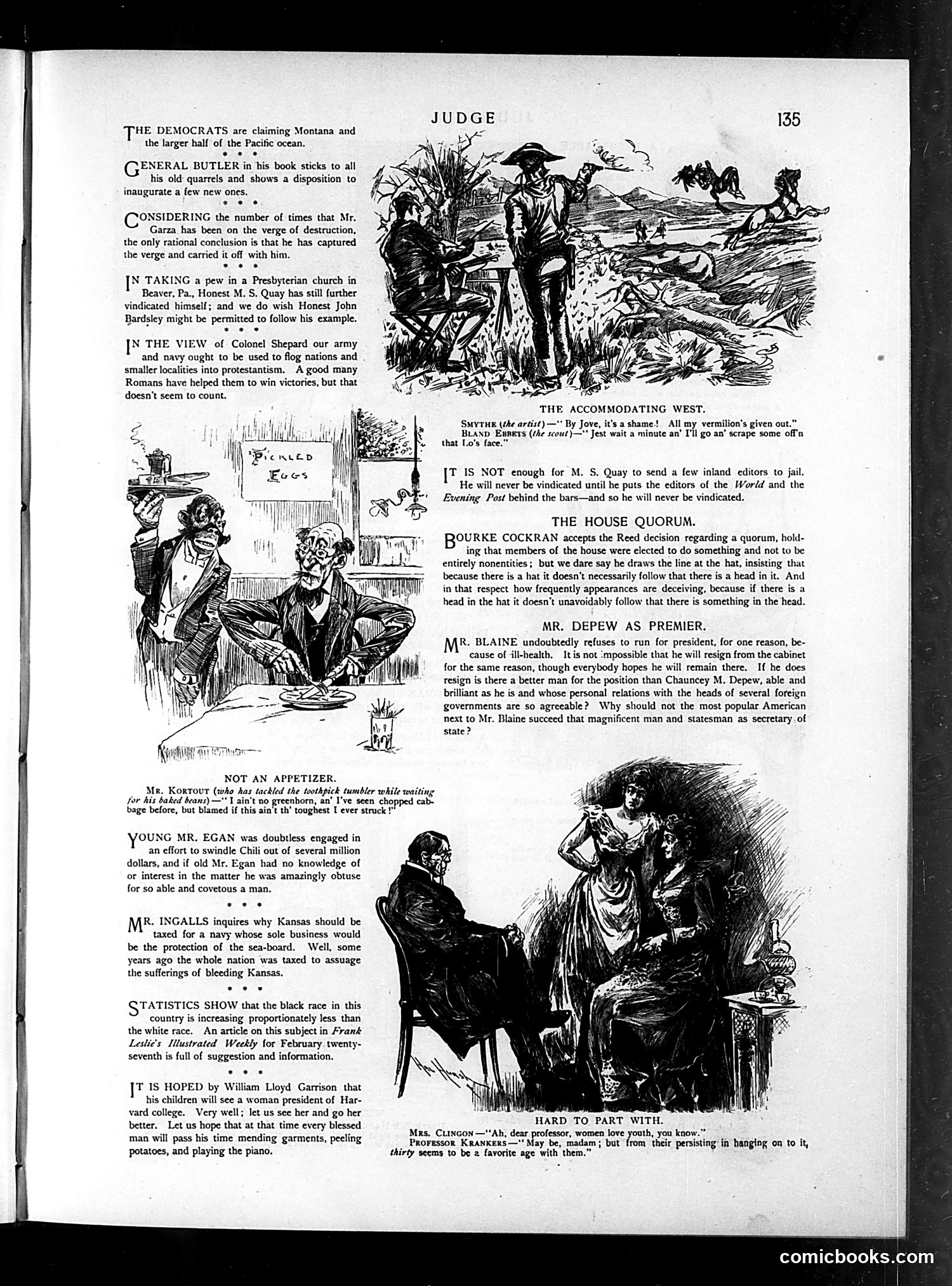
This page contains several political satirical items from Judge magazine (a late 19th/early 20th-century publication): **"The Accommodating West"** depicts a frontier character complaining that his "vermillion is given out"—likely satirizing Western politicians or figures as accommodating or compromised. **"The House Quorum"** criticizes Bourke Cockran regarding parliamentary procedure and quorum requirements, suggesting deception in legislative attendance. **"Mr. Depew as Premier"** discusses Chauncey Depew's potential political advancement, questioning whether popular American figures should lead foreign governments. **"Not an Appetizer"** references M. Kortright and financial matters. The cartoons employ exaggerated caricatures typical of Judge's satirical style, targeting contemporary political figures and governmental practices with pointed social commentary. Without specific dates or clearer image resolution, precise identifications of some figures remain uncertain.
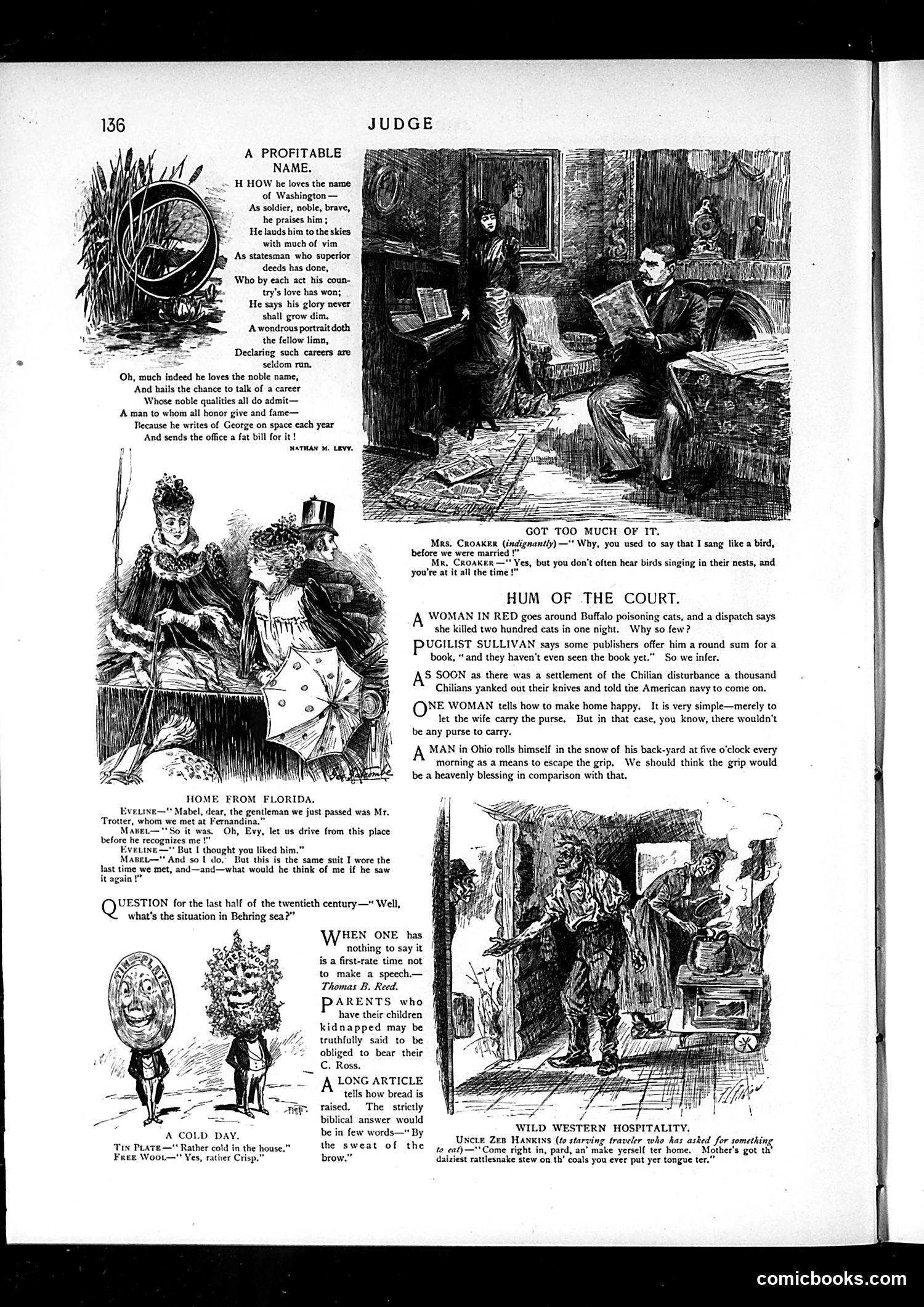
This page from *Judge* contains multiple brief satirical items typical of the magazine's format. The main pieces include: **"A Profitable Name"** mocks a writer who constantly praises George Washington to justify sending expense bills to his publisher—satirizing opportunistic use of patriotic sentiment for profit. **"Got Too Much of It"** is a domestic humor piece where a husband complains his wife sings constantly at home, contrasting her pre-marriage behavior. It's gentle marital satire. **"Hum of the Court"** collects brief jabs: at a woman poisoning cats in Buffalo, at publishers buying books unseen, at Chilean threats following a settlement, and at wives controlling household finances. **"Home from Florida"** shows a woman avoiding a gentleman because she's wearing the same dress she wore when they last met—mocking vanity and fashion consciousness. The remaining items are brief quips on various social topics (Ohio snow-bathing, the Behring Sea dispute, kidnapping, bread-making, and "Wild Western Hospitality"). These are topical humor rather than coherent political commentary.
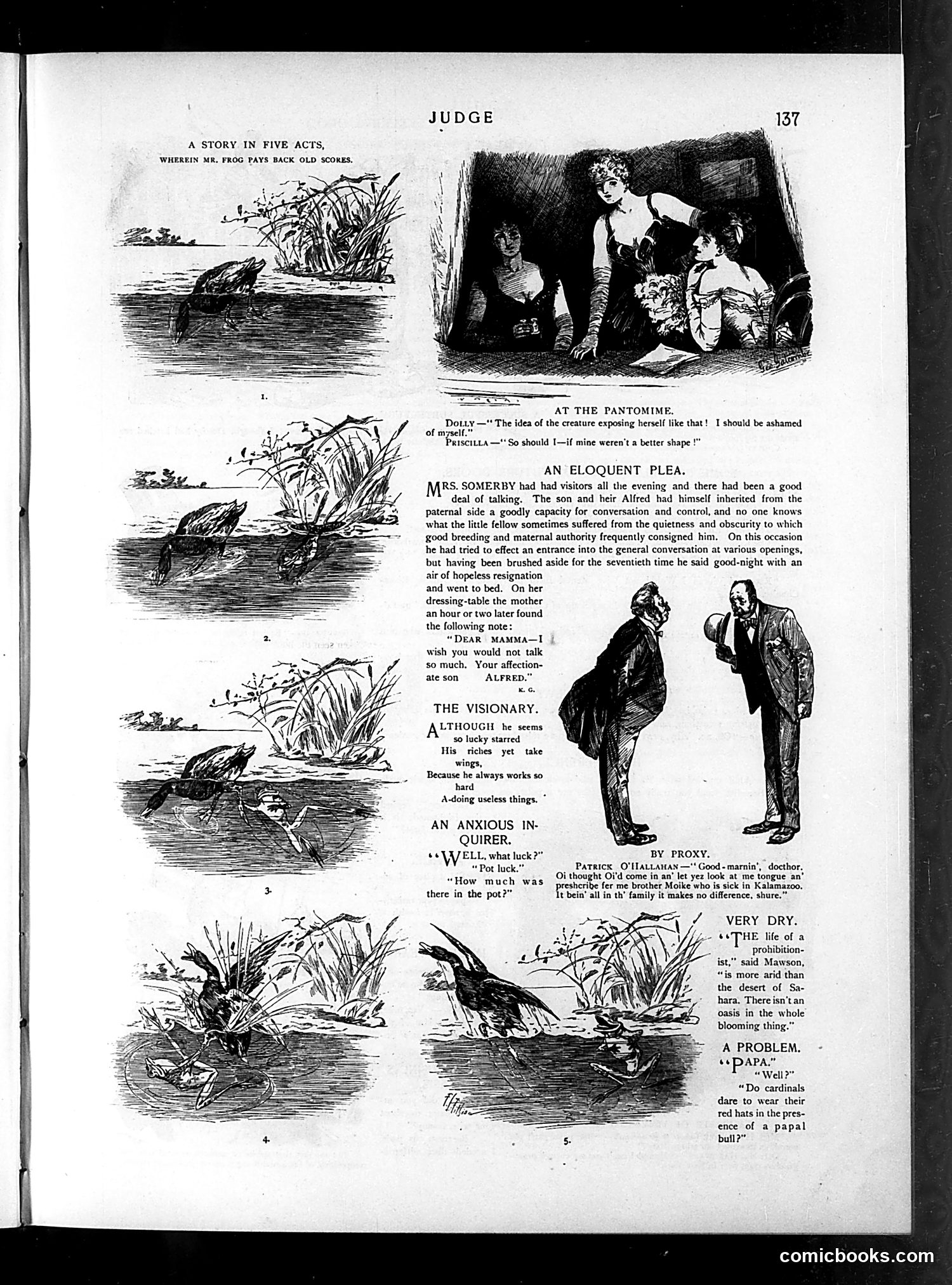
This page contains several unrelated satirical sketches typical of Judge magazine's format: **"A Story in Five Acts"** (left): A visual gag showing a frog repeatedly entering and exiting water, with a pantomime joke about female modesty—two women at a theater comment on a creature exposing itself, with Priscilla smugly noting her own figure is superior. **"An Eloquent Plea"**: A domestic humor sketch where young Alfred leaves his mother a note complaining she talks too much, denying him conversation time. **Additional sketches** include: a commentary on wealthy people who waste money on "useless things"; an Irishman (Patrick O'Hallahan) seeking free medical advice by proxy for his sick brother; a joke about prohibition's dreariness; and a pun on cardinals wearing red hats near a "papal bull." The page represents Judge's typical blend of visual comedy, domestic satire, ethnic humor (Irish stereotypes), and wordplay—reflecting early 20th-century American magazine humor conventions that modern readers would find dated in style and sensibility.
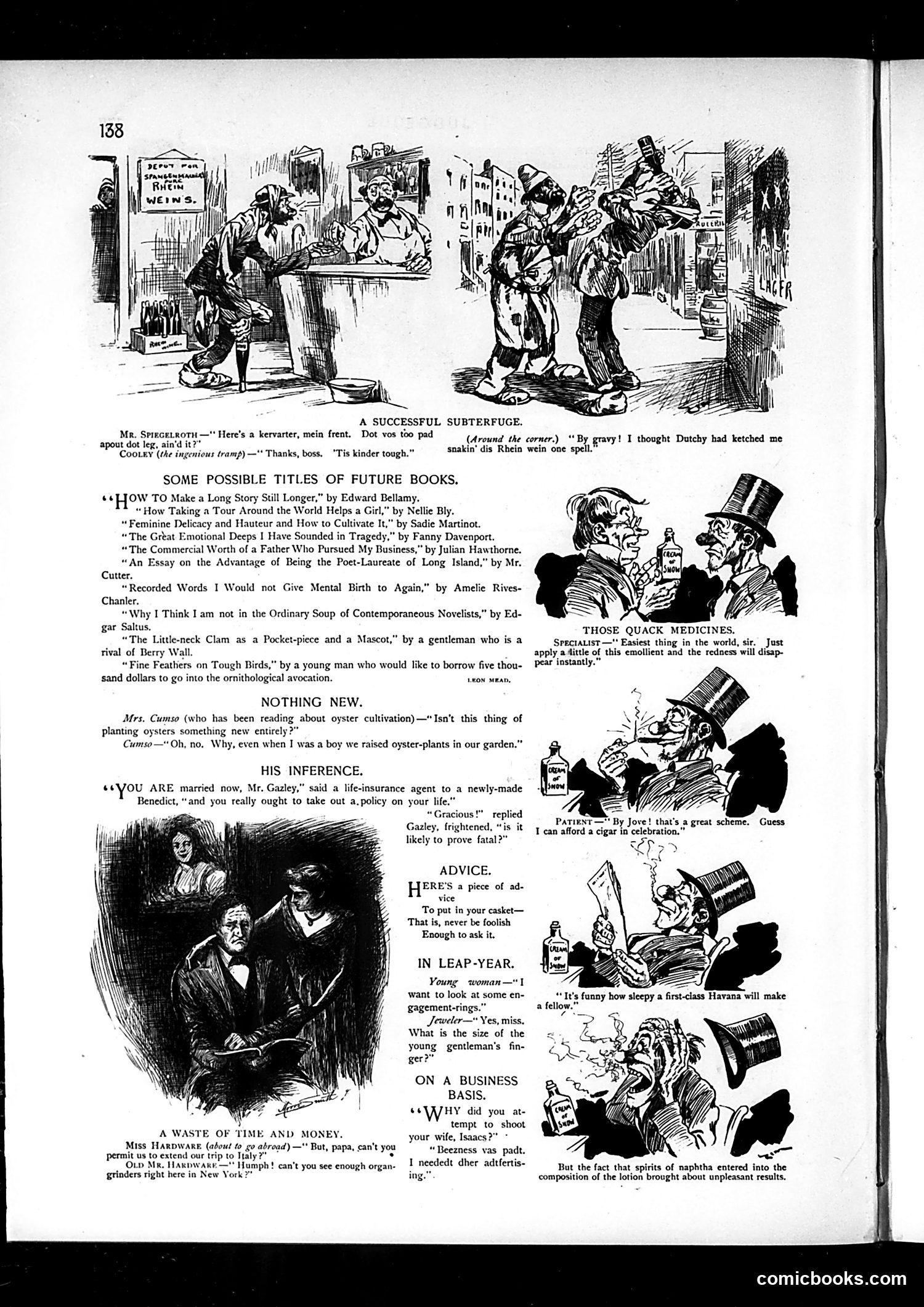
This page collects satirical vignettes mocking contemporary American life and figures. **Top cartoon**: A German immigrant ("Dutchy") tricks a man into giving him money by feigning injury, then boasts to a tramp about escaping detection. The joke satirizes both immigrant cunning and transient schemes. **"Some Possible Titles of Future Books"**: This section parodies famous contemporary American writers (Edward Bellamy, Nellie Bly, Edgar Saltus) by inventing absurdly self-aggrandizing book titles—mocking their perceived vanity and tendency toward verbose, self-important works. **Other vignettes** mock: - People inventing false novelty ("oyster cultivation") - A newlywed's dark inference about life insurance implying death - Quack medicine advertisements - Gender role reversals in leap-year proposals - Domestic violence treated comedically The page reflects Gilded Age anxieties about immigration, literary pretension, commercialism, and social change, using exaggeration and stereotype-based humor typical of 1880s-90s satirical magazines.
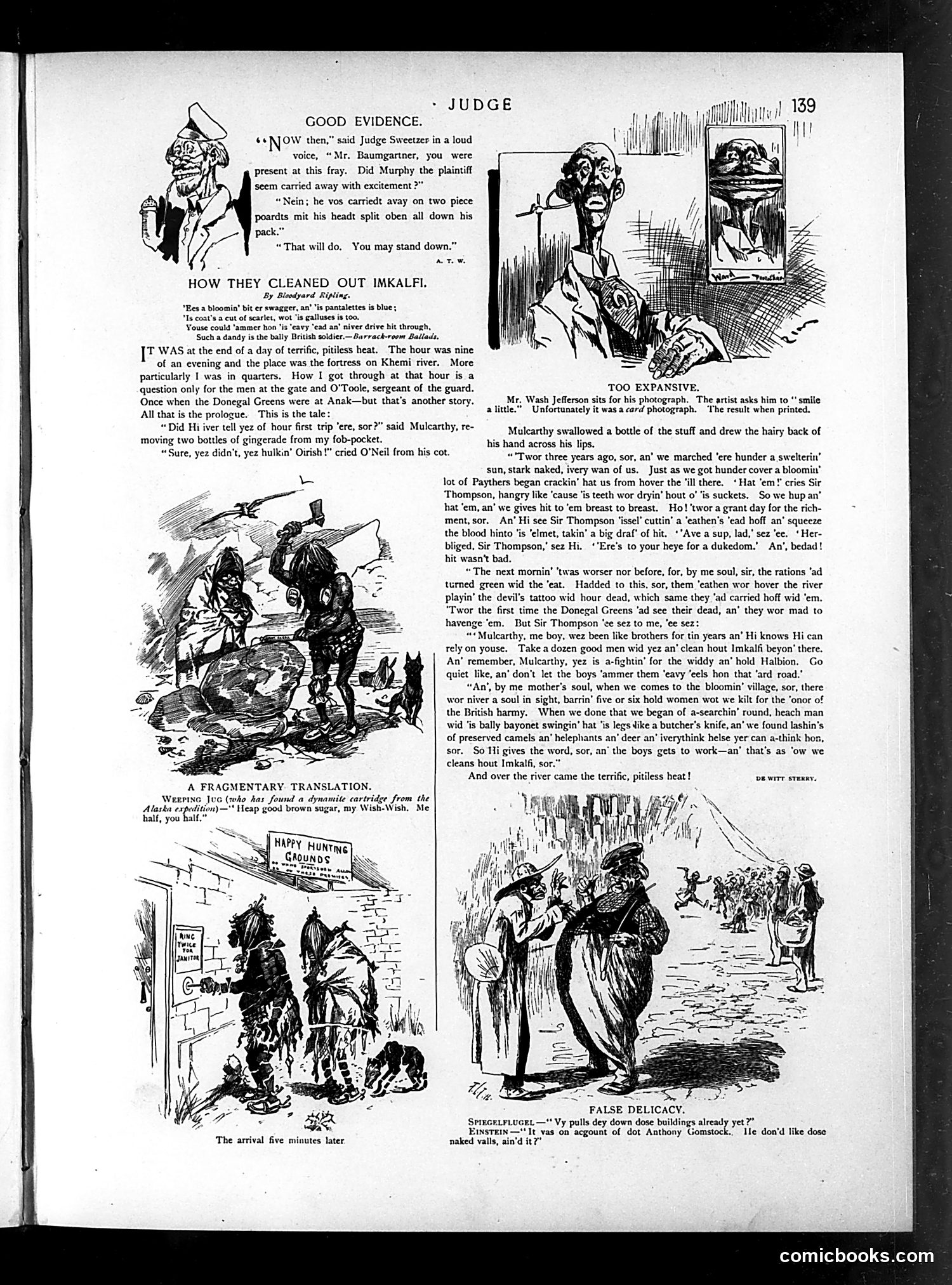
**"Good Evidence"** is a brief courtroom joke: A witness with a German accent testifies that the plaintiff wasn't "carried away with excitement" but rather was literally carried away on two wooden boards with his head split open. The judge accepts this as sufficient evidence and dismisses him—humor derived from the witness's literalism and the absurd violence. **"How They Cleaned Out Imkalfi"** parodies Rudyard Kipling's imperial adventure stories and soldier dialect. Told by Irish soldier Mulcarty, it describes a brutal colonial military campaign in India (Imkalfi appears to be a fictional location). The satire mocks Kipling's romanticization of empire: the narrative casually describes atrocities—killing innocent women—while maintaining a folksy, adventure-story tone. It satirizes both British imperialism and Kipling's glorification of soldier violence through exaggerated Irish vernacular. **"Too Expansive"** is a visual joke: a photographer asks subject Wash Jefferson to smile for a portrait, but the result shows him grinning grotesquely—the photograph captures too much of his smile, making it grotesque.
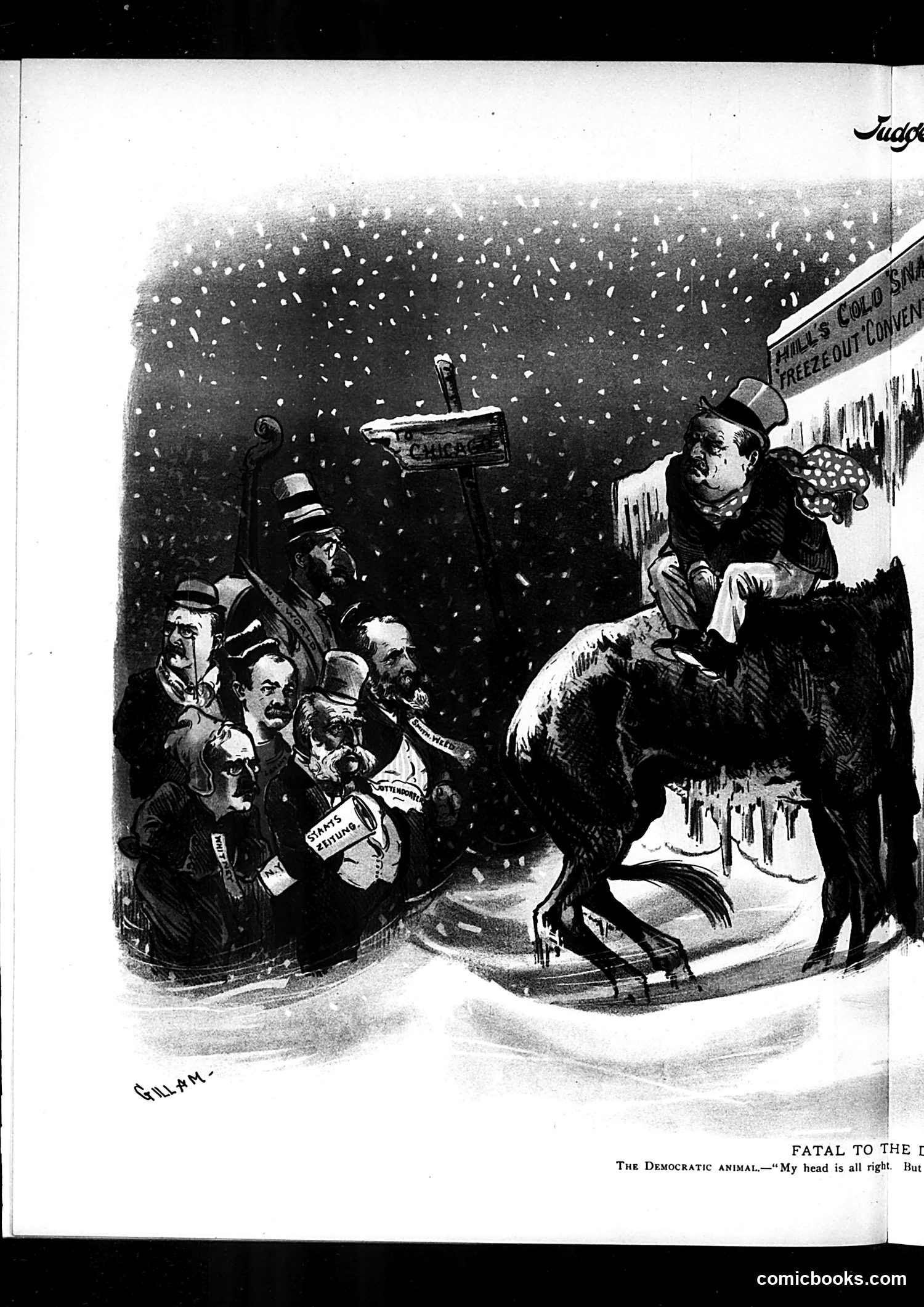
This political cartoon depicts a donkey (the traditional Democratic Party symbol) in distress during winter weather, with its head struck or injured. A group of men in period clothing and hats gather nearby, apparently witnessing the incident. The caption reads: "My head is all right. But—" suggesting the donkey has suffered damage beyond just a head injury, likely referencing internal problems or loss of leadership within the Democratic Party. The cartoon appears to satirize Democratic Party troubles or instability, possibly following a political defeat or leadership crisis. The winter setting and icicles emphasize harsh conditions. Without the full caption or specific date, the exact historical event being lampooned remains unclear, though the imagery suggests early-to-mid 20th century American politics.
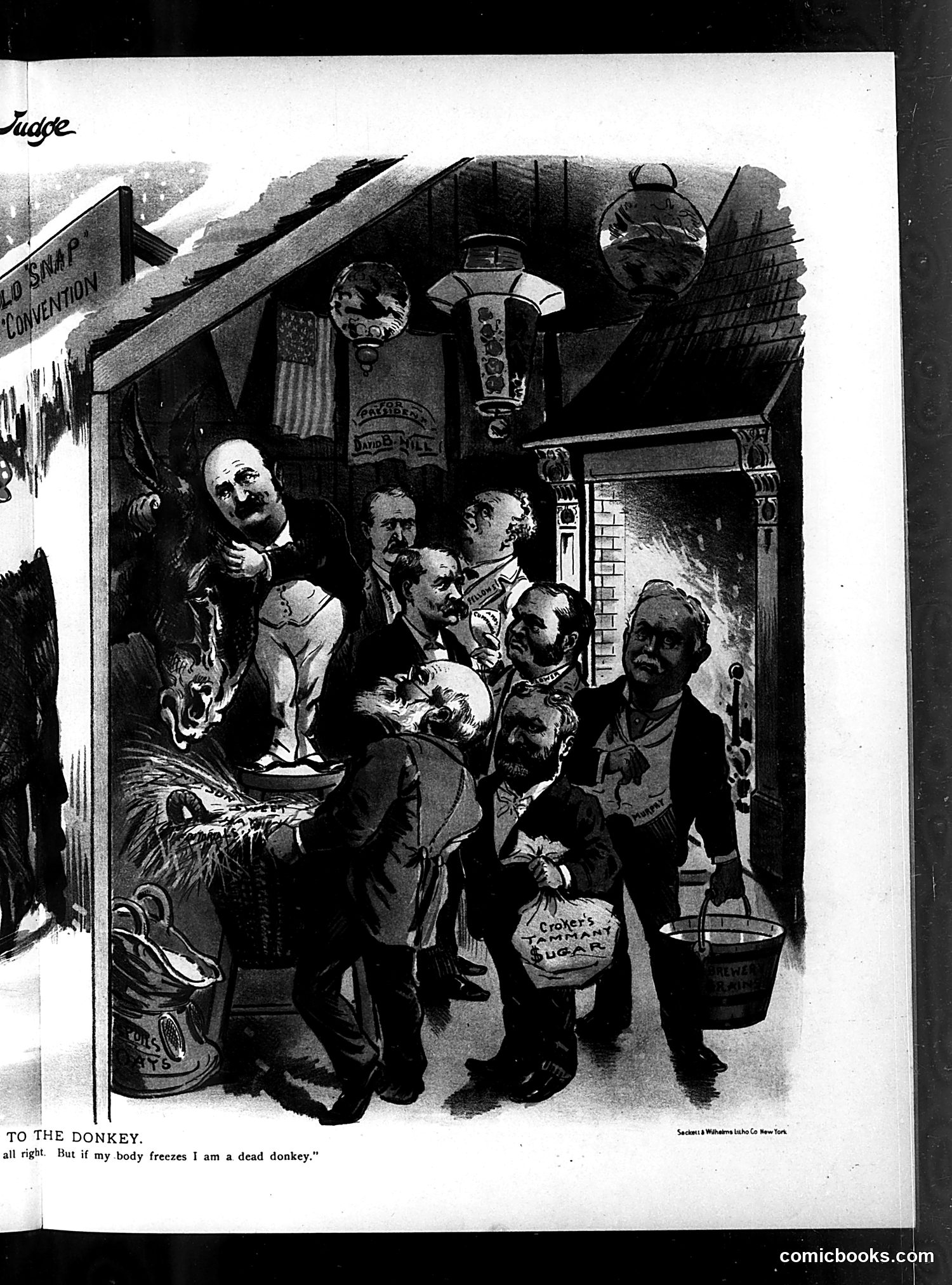
This Judge magazine cartoon satirizes corrupt political machine operators ("**TO THE DONKEY**"). The scene depicts a crowded, cramped interior where multiple men in suits appear to be stuffing a donkey—a traditional symbol of the Democratic Party—with various items and documents, likely representing bribes, patronage jobs, or political favors. The caption reads: "all right. But if my body freezes I am a dead donkey," suggesting the donkey-politician cannot survive the weight of corruption being forced upon it, or will collapse under the burden of dirty dealings. The cartoon mocks how party bosses exploit the party apparatus for personal gain. The literal overcrowding and stuffing imagery emphasizes how such corruption makes the institution itself dysfunctional and unsustainable. This reflects late 19th/early 20th-century American concerns about urban political corruption.
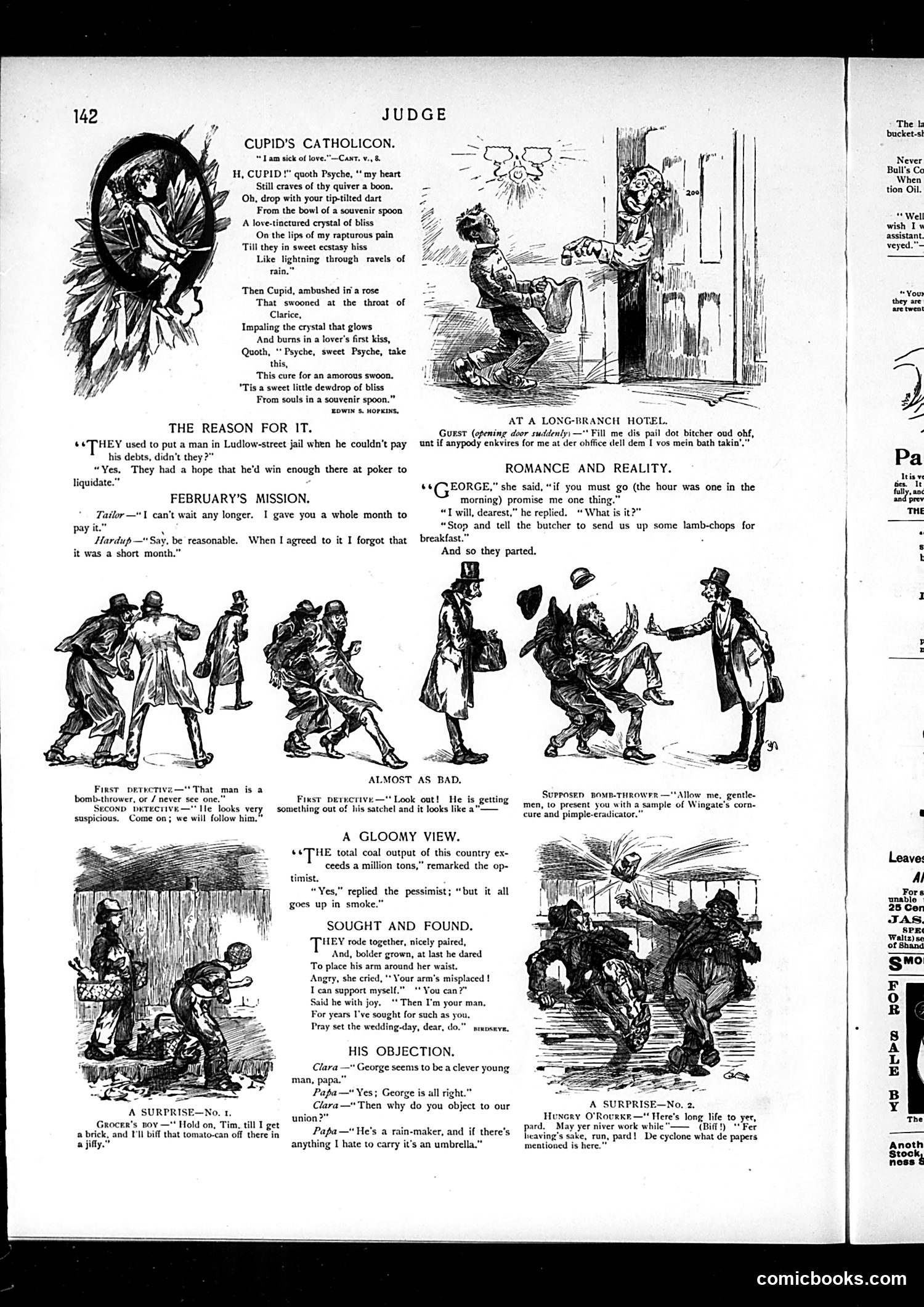
This page from *Judge* contains multiple short humorous pieces typical of late 19th-century American satirical magazines: **"Cupid's Catholicon"** is a romantic poem with accompanying illustration, playing on the Victorian literary convention of lovesick verse. **"The Reason for It"** jokes about Ludlow Street Jail (a New York debtors' prison), suggesting imprisoned debtors might gamble their way to paying debts—dark humor about poverty and incarceration. **"February's Mission"** depicts a tailor dunning a customer ("Hardup") for payment, with wordplay on the calendar (February being the shortest month). **Multiple detective cartoons** feature two policemen discussing suspicious characters—apparently bomb-throwers or criminals—reflecting contemporary anxieties about anarchist violence and urban crime. **"Romance and Reality"** contrasts romantic promises with mundane domestic reality (lamb chops for breakfast). The remaining sketches involve small domestic and commercial comedies: coal pessimism, a young couple courting, and parental objections to suitors. The overall tone reflects turn-of-the-century urban American humor: cynical about debt, class relations, and crime while sentimentalizing romance.
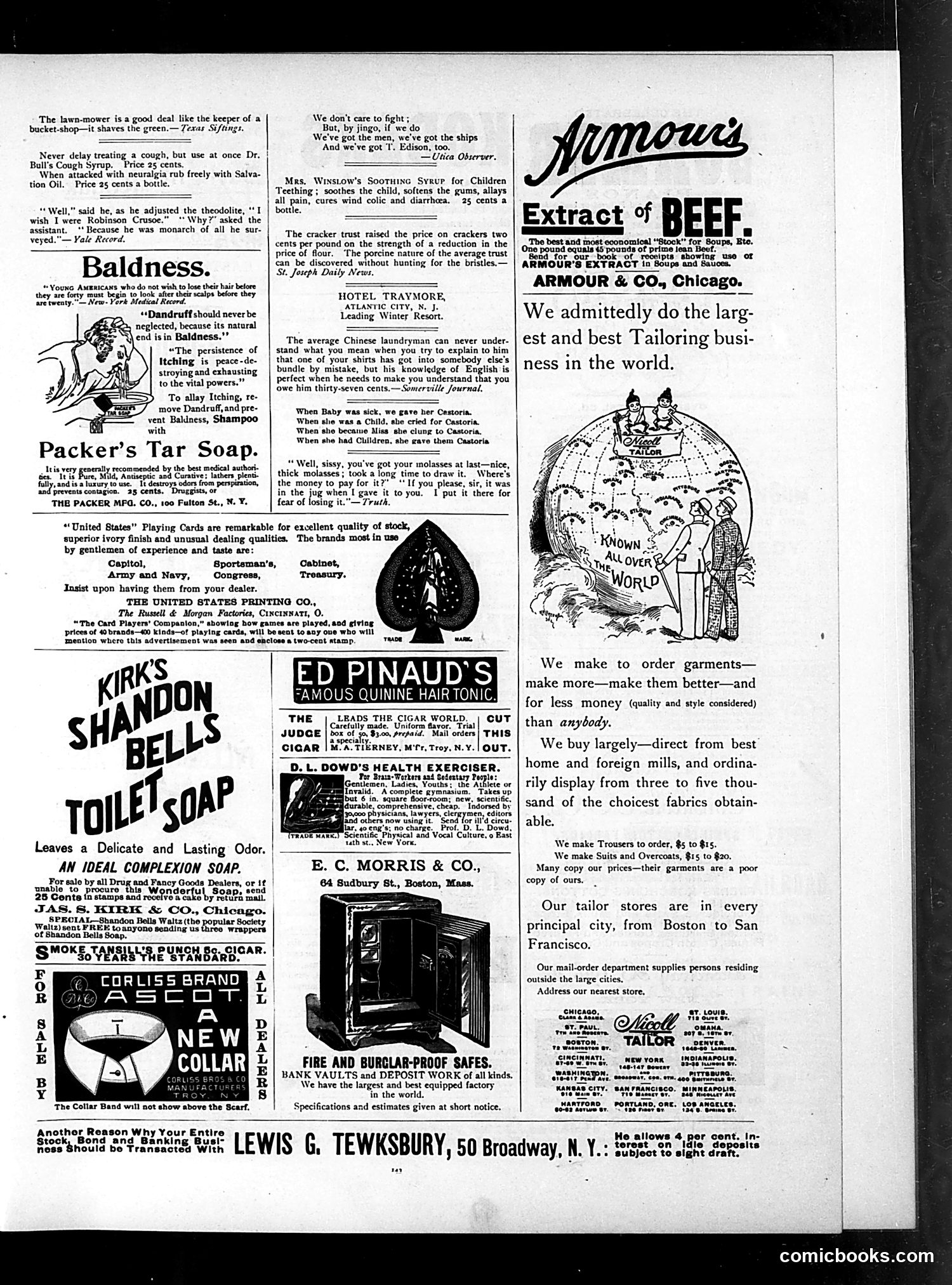
This page is primarily **advertising**, with brief satirical text snippets interspersed—typical of Judge's format. Key content: **Satirical Jokes:** - A lawn-mower joke comparing grass-cutting to stock manipulation ("shaving the green") - A quip about Chinese laundrymen understanding English only when demanding payment - A cracker trust joke mocking corporate price-fixing despite falling ingredient costs **The Notable Poem** (top right): "We don't care to fight; But, by jingo, if we do / We've got the men, we've got the ships / And we've got 'T'. Edison, too." This references American nationalist rhetoric (possibly 1890s-era), invoking Thomas Edison alongside military capability—satirizing American technological boasting and saber-rattling. **Ads** cover patent medicines (typical for the era), playing cards, soap, hair tonic, and tailoring services. The overall tone reflects *Judge* as a middle-class publication mixing gentle satire with commercial interests.
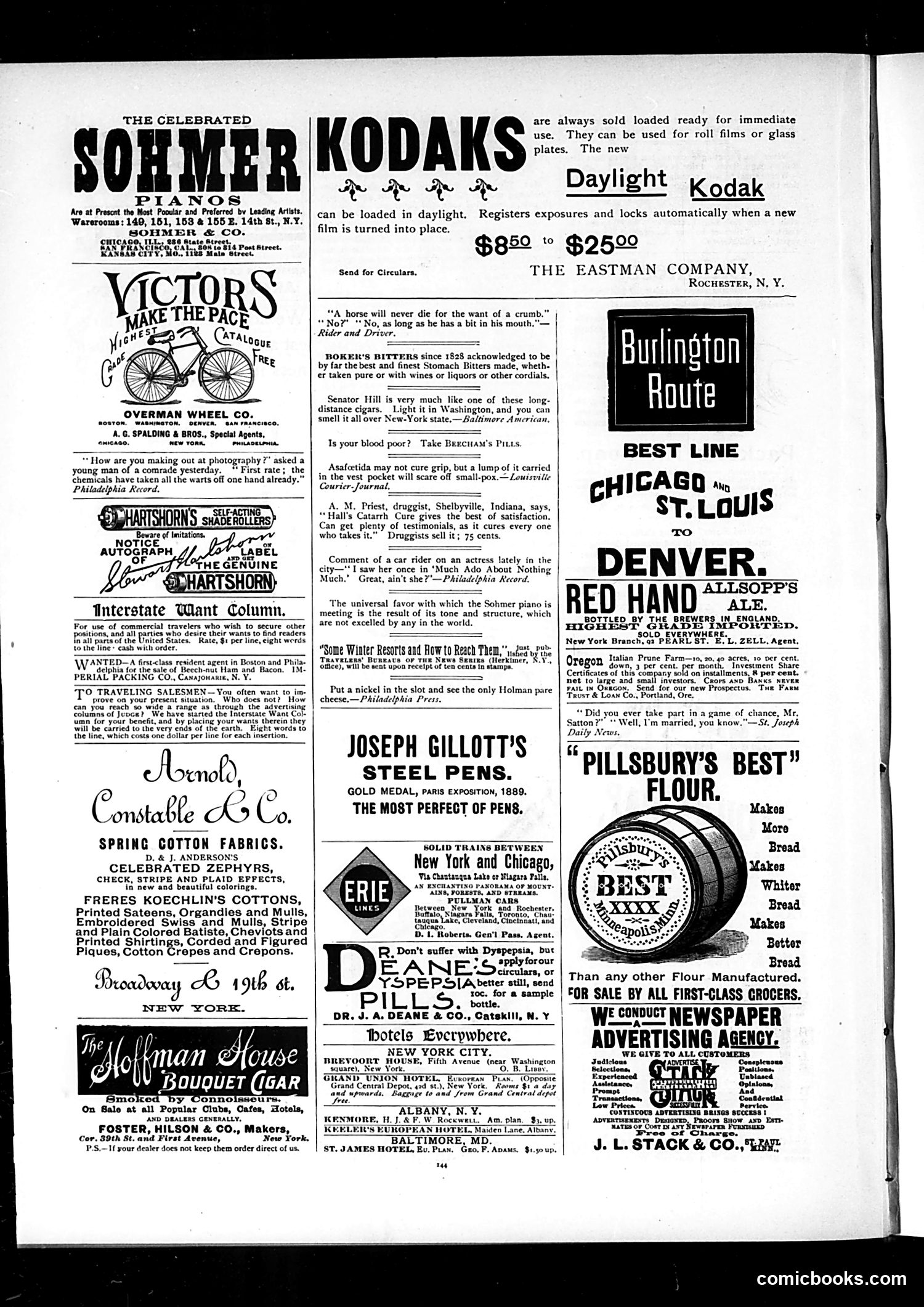
This page is predominantly **advertising**, not political satire or editorial cartooning. It contains numerous commercial advertisements for period products including Sohmer pianos, Kodak cameras, bicycles, cigars, flour, patent medicines (Bercham's Pills, Hall's Catarrh Cure, Boken's Bitters), and various other goods typical of late 19th-century publications. There are several brief **humorous filler items** scattered throughout—short jokes or quips rather than satirical cartoons—such as a photography chemistry joke and a comment comparing Senator Hill to a long-distance cigar that can be "smelled...all over New-York state." The page lacks substantive political commentary or recognizable caricatures of public figures. Its primary function appears commercial, serving Judge magazine's advertising base while filling space with light humor. Without additional context indicating the publication date, specific historical significance cannot be reliably determined.
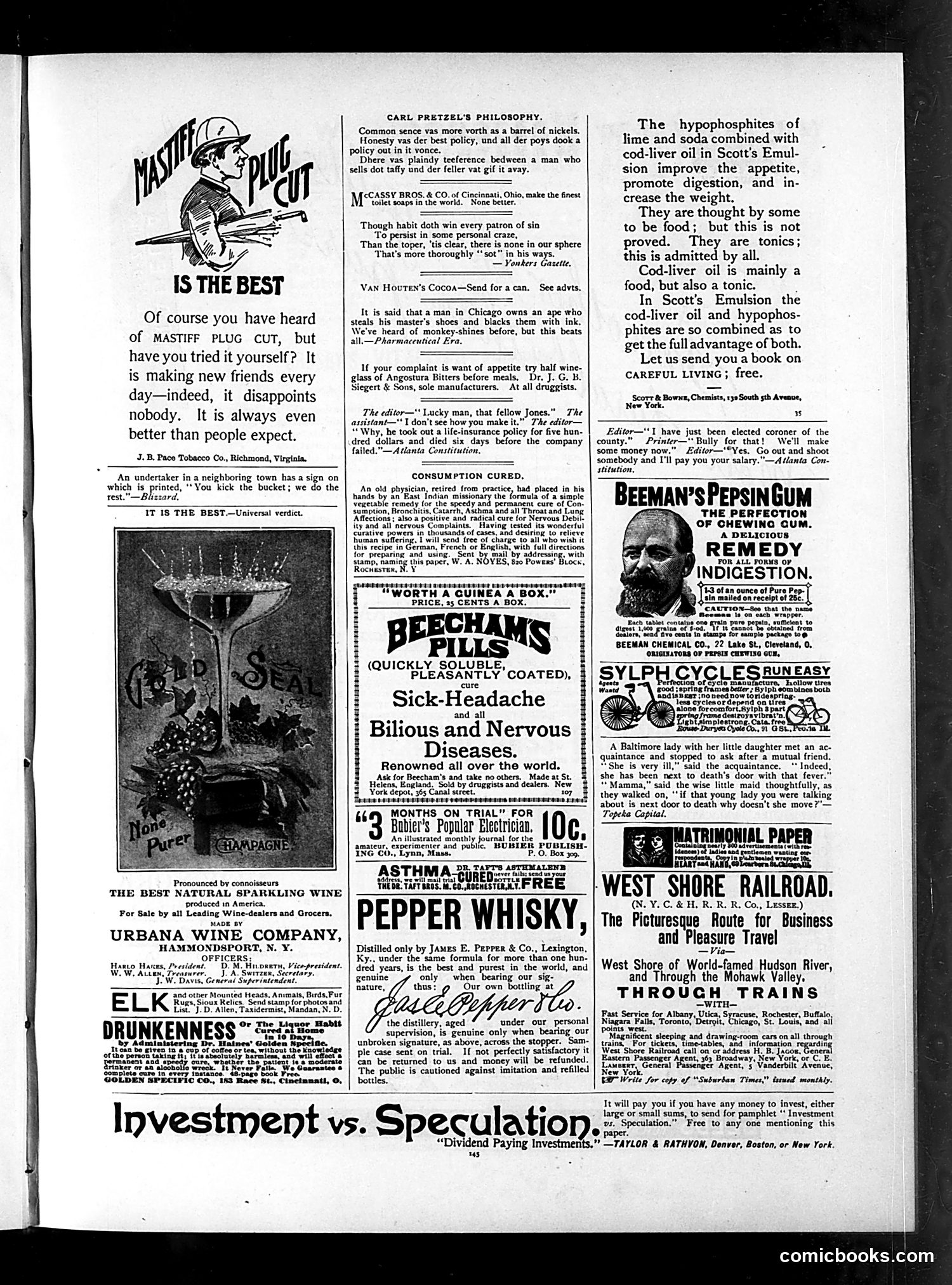
This is primarily an **advertising page** from *Judge* magazine, not a political cartoon page. The bulk of the content consists of period product advertisements (tobacco, wine, patent medicines, whiskey, bicycles, etc.). The only clearly identifiable satirical content is **"Carl Pretzel's Philosophy"** — a recurring humor column featuring a character speaking in exaggerated German-immigrant dialect ("vorth," "dere," "dook"). The jokes themselves are generic wordplay and observations (comparing common sense to a barrel of nickels; referencing "taffy" sellers). There's also a brief joke about a Chicago man whose ape steals and blacks his shoes, framed as absurdist humor. The page reflects typical 1890s-era *Judge* content: mixed satirical commentary with extensive patent-medicine advertisements—many of which made dubious or false health claims (consumption cures, appetite boosters, alcoholic "tonics"), reflecting an era before strict advertising regulation.
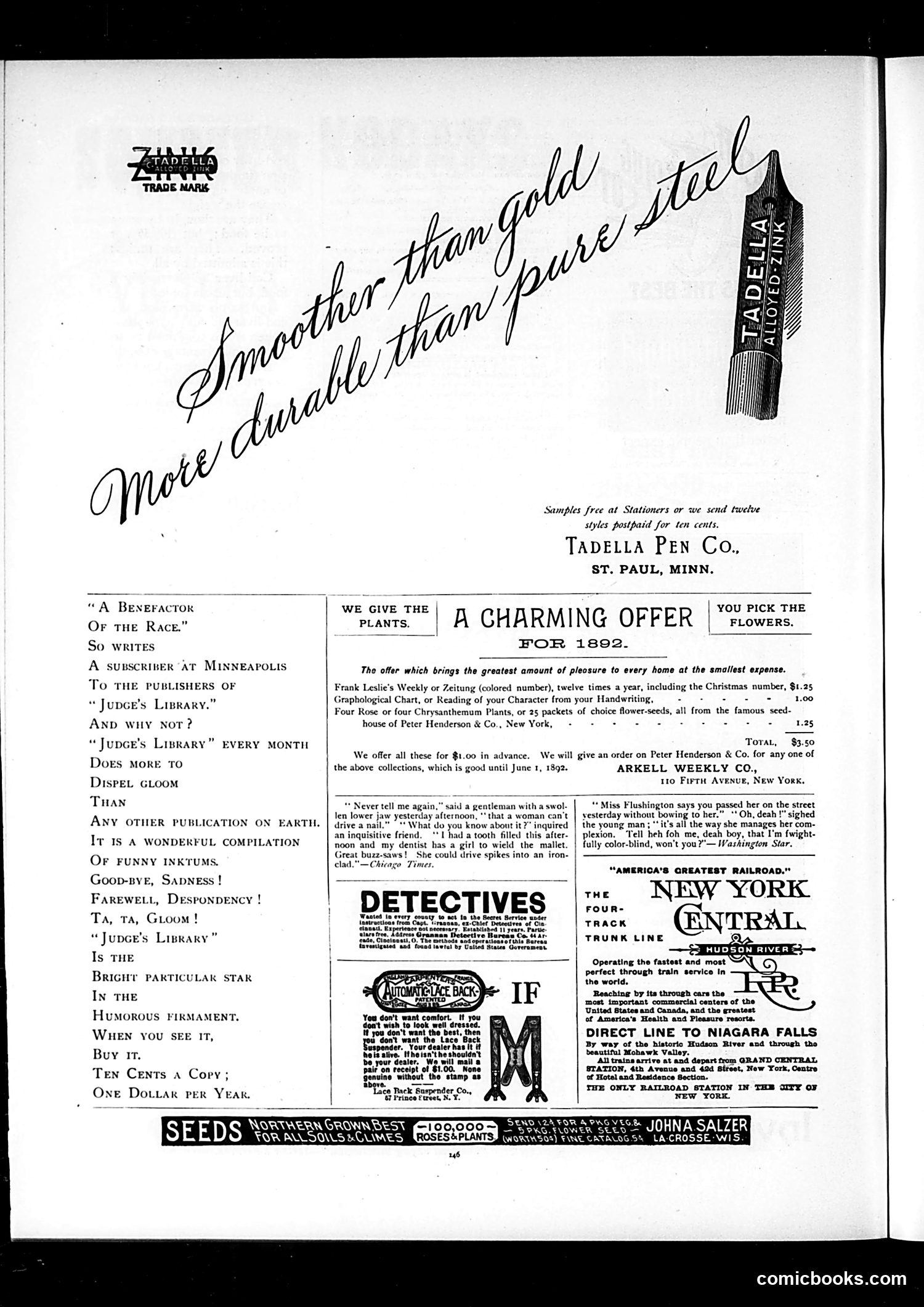
This page is primarily **advertising and promotional content** rather than political satire. It includes: **Main elements:** - A Tadella Pen Co. advertisement (top right) emphasizing durability - Promotional material for Judge's Library magazine subscription, pitched as uplifting reading that combats depression and gloom - A "charming offer" for 1892 combining Frank Leslie's Weekly, handwriting analysis, and seeds/plants for $1.00 - Two brief humorous anecdotes about a man with a toothache and color-blindness—mild social humor typical of the era - Standard advertisements for the New York Central Railroad, detectives, suspenders, and seeds **Notable context:** The subscription pitch explicitly markets Judge's Library as a remedy for sadness and despair, reflecting 19th-century attitudes toward humor as therapeutic. The offer bundles periodicals with horticultural products, typical of Victorian consumer culture. **No identifiable political figures or satirical targets** appear on this page—it's primarily commercial content with light domestic humor.
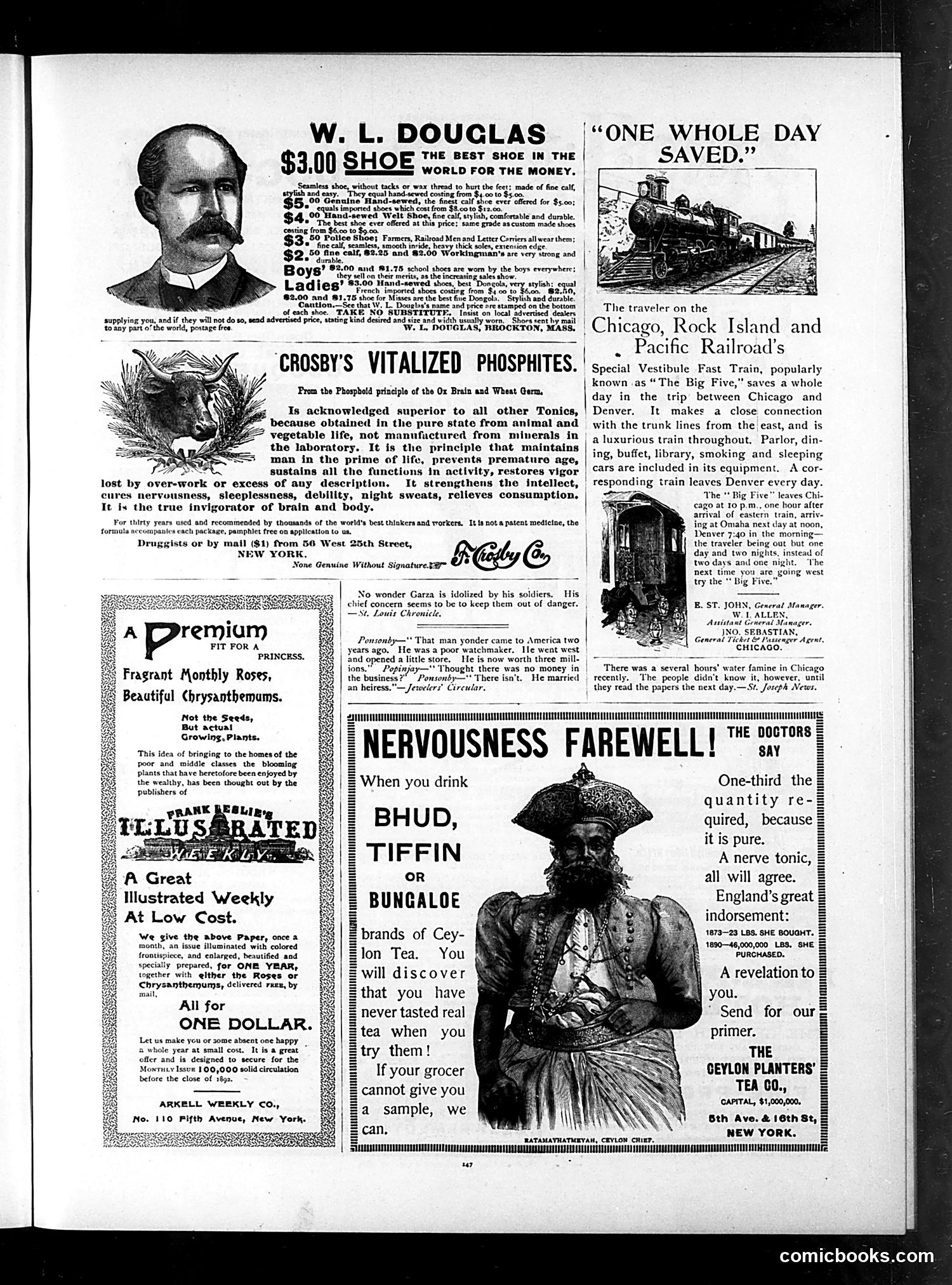
This page is primarily an advertising compilation typical of Judge magazine, not a political cartoon. It features: **Main advertisements:** - W.L. Douglas shoes ($3 product promoted for quality/value) - Crosby's Vitalized Phosphites (a medicinal tonic claiming to treat nervousness, exhaustion, and consumption) - The "Big Five" train service between Chicago and Denver, emphasizing speed and luxury - Ceylon Planter's Tea (marketed as a nerve tonic) - Arkell Weekly illustrated publication **Two brief satirical items:** 1. A joke about General Garza (likely Mexican military figure) keeping soldiers "out of danger" 2. A social commentary about a watchmaker who became wealthy by marrying an heiress—satirizing that success comes through marriage rather than business acumen The page reflects late 19th/early 20th-century advertising practices: patent medicines claiming miraculous cures, conspicuous consumption appeals (luxury trains), and brief humor targeting class mobility and military leadership.
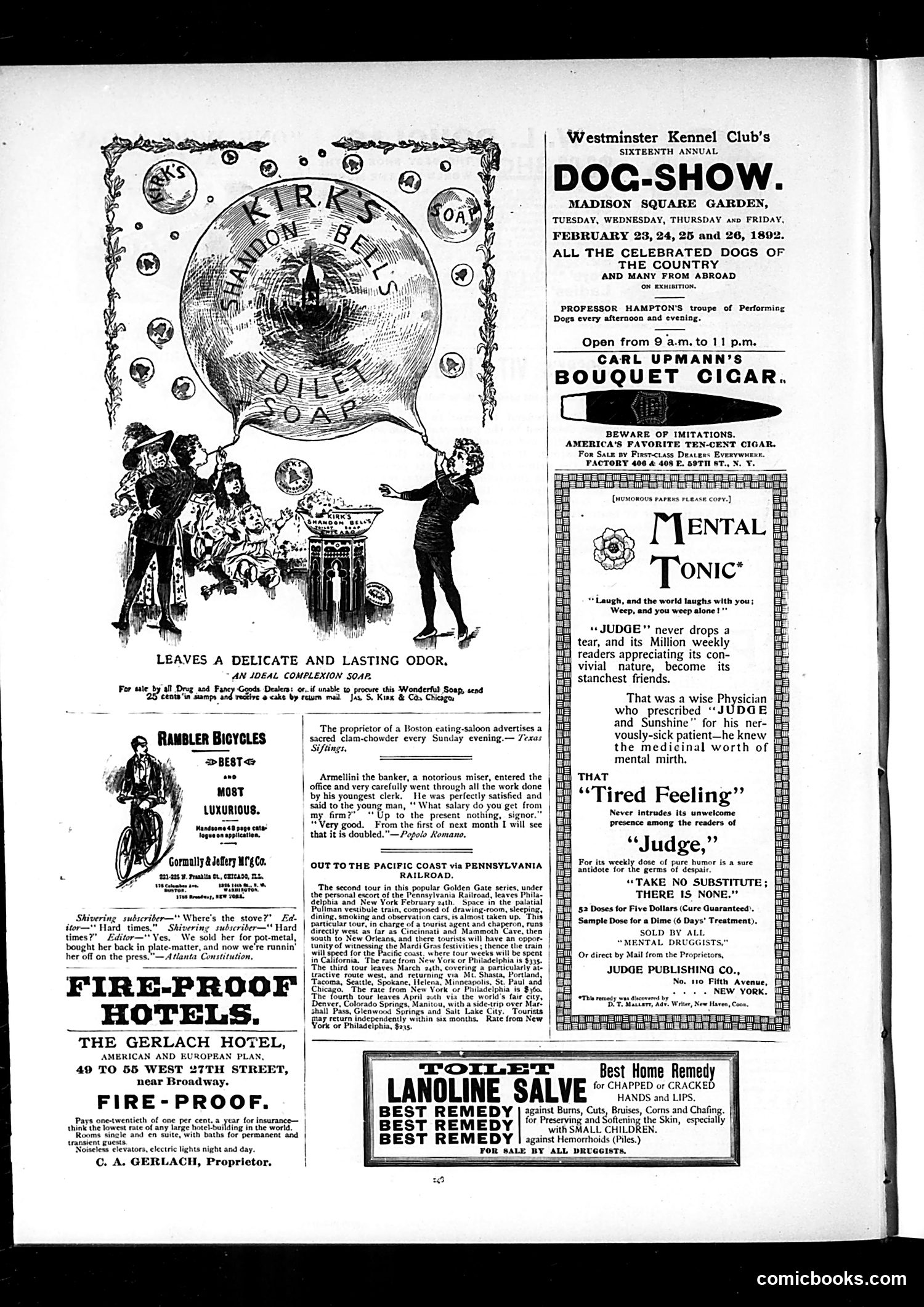
This page is primarily **advertising and announcements**, not political satire. Key content includes: **Main Advertisement**: The Kirk's soap ad features a large clock with decorative border and figures, promoting soap that "leaves a delicate and lasting odor." **Dog Show Announcement**: Westminster Kennel Club's sixteenth annual exhibition at Madison Square Garden (Feb 23-26, 1892), advertising it as featuring "all the celebrated dogs of the country." **Notable Ads**: - Rambler bicycles ("best and most luxurious") - Upmann's Bouquet cigars - Mental Tonic (a patent medicine marketed as mental health remedy) - Lanoline Salve and fire-proof hotels **Brief Humor Items**: Short jokes about bankers, newspaper editors, and restaurant proprietors—typical mild satirical fare without identifiable political figures. **No Political Satire**: Unlike typical Judge content, this page contains no recognizable caricatures of political figures or sharp social commentary—it's primarily a commercial page typical of 1890s magazines mixing ads with light humor.
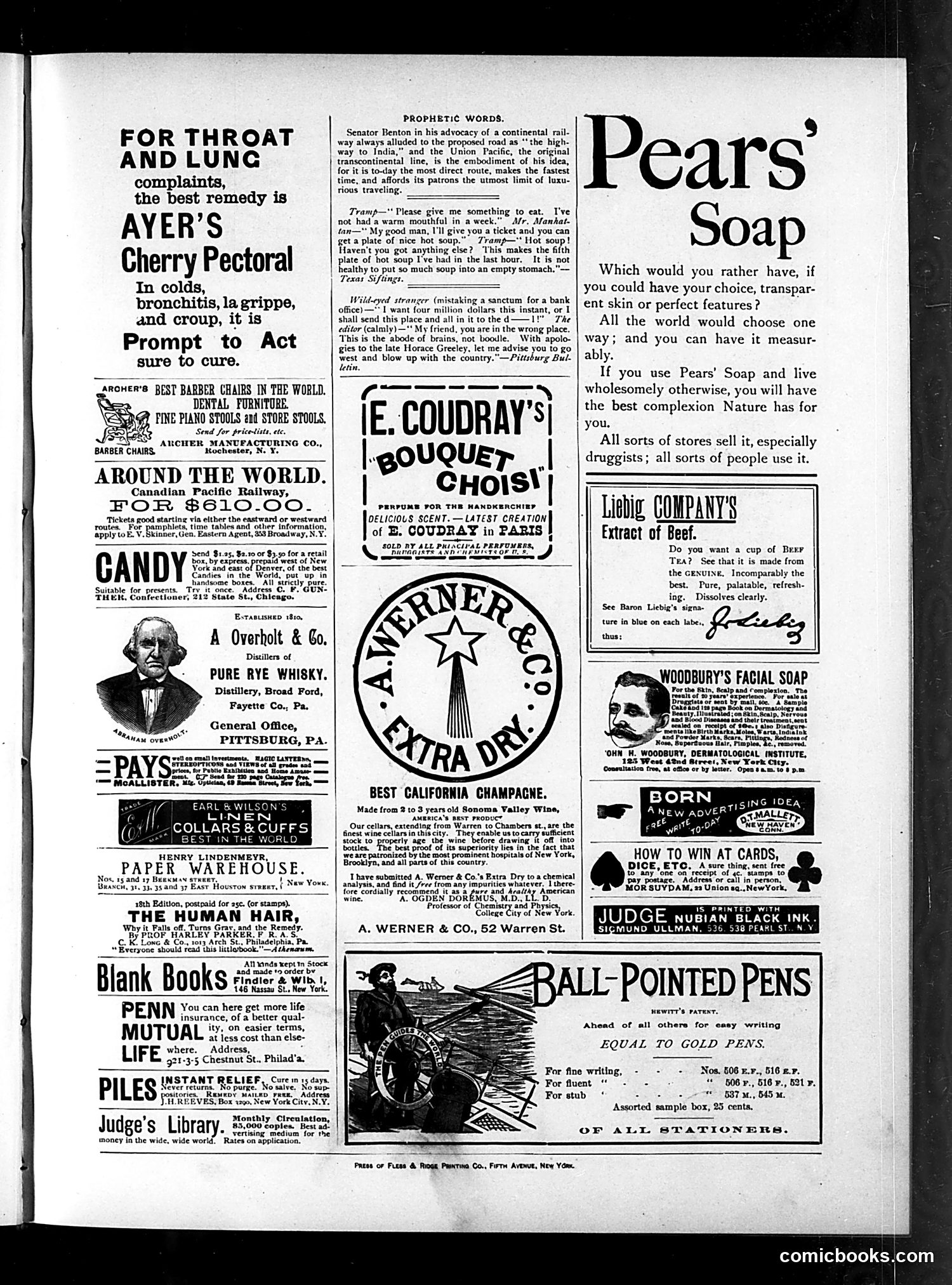
This page is primarily **advertising**, with minimal editorial content. The advertisements are typical of a late 19th-century American magazine, promoting patent medicines (Ayer's Cherry Pectoral for coughs), whiskey, champagne, soap, and stationery. The small satirical items embedded among ads include: 1. **"Prophetic Words"** section featuring two brief jokes: one about Senator Benton's vision of a transcontinental railroad (now realized), and anecdotes about a tramp receiving unwanted soup and a stranger confusing a newspaper office with a bank. 2. **Pears' Soap advertisement** — a major product placement claiming the soap produces perfect complexion. The page reflects Judge's business model: mixing humor and social commentary with lucrative advertising. The "jokes" are mild observations rather than sharp political satire. No specific political figures or major events are targeted—the humor is generic and inoffensive, designed not to alienate advertisers or readers.
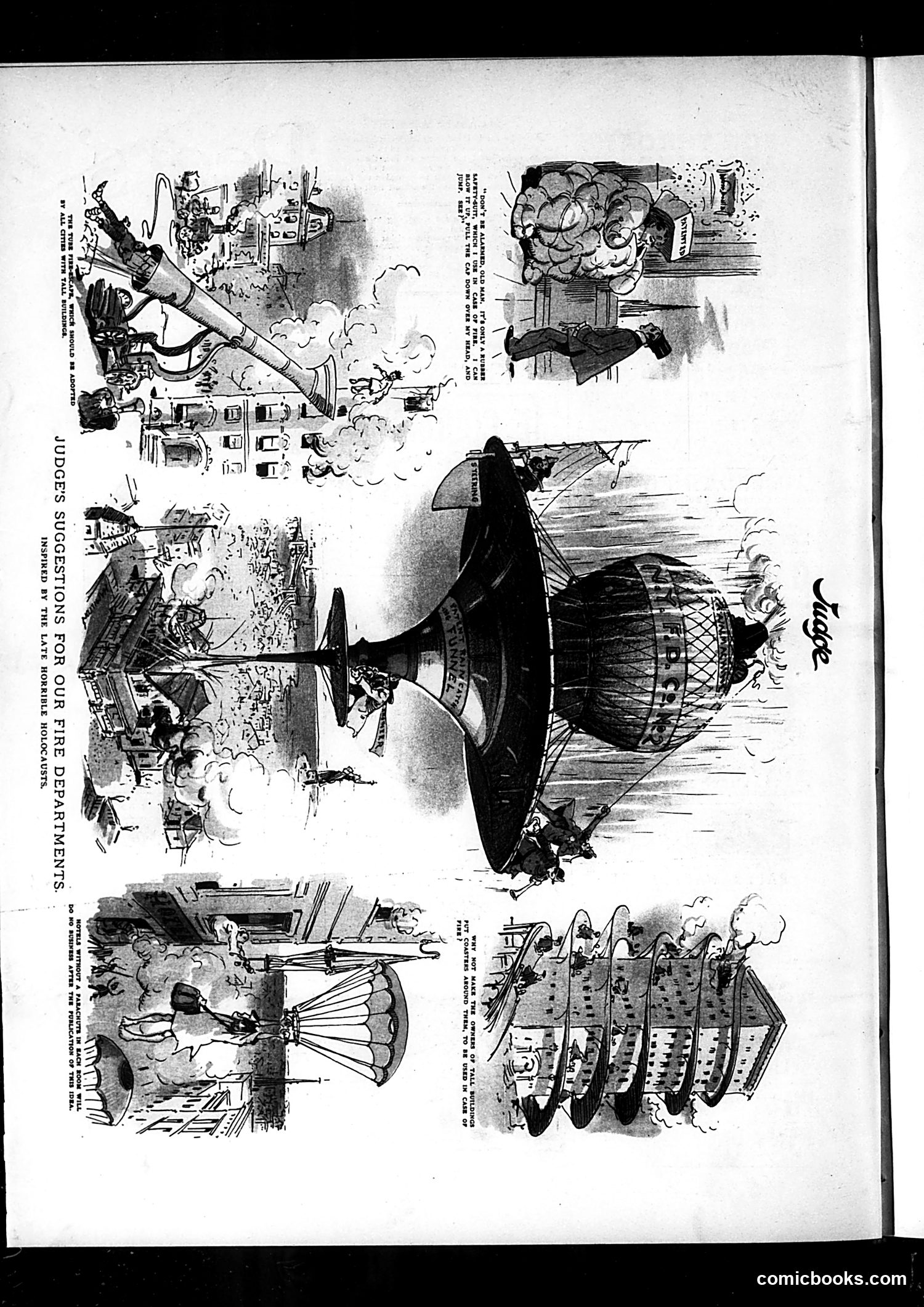
This page presents **satirical "solutions" to urban fire hazards**, inspired by recent catastrophic building fires (the "horrible holocausts" referenced). The cartoons mock inadequate fire safety regulations by proposing absurdly impractical remedies. **Key elements:** - **Tall building owners** are caricatured as negligent, prompting sarcastic suggestions like "blow it up" and installing massive parachutes or water-catching devices on roofs - The central image shows an enormous umbrella-like contraption, literally treating a skyscraper fire as if you could shade it away - Other panels depict equally ridiculous apparatus: giant funnels, elaborate pulley systems, and bucket arrangements **The satire's point:** Rather than blame dangerous building construction or insufficient firefighting equipment, Judge ridicules how authorities might respond—with theater rather than genuine reform. The phrase "do no business after publication of this idea" sarcastically suggests these "solutions" are so impractical they'll actually prevent nothing. This critiques indifference to real fire safety hazards in early 20th-century American cities.