
A complete issue · 16 pages · 1892
Judge — February 20, 1892
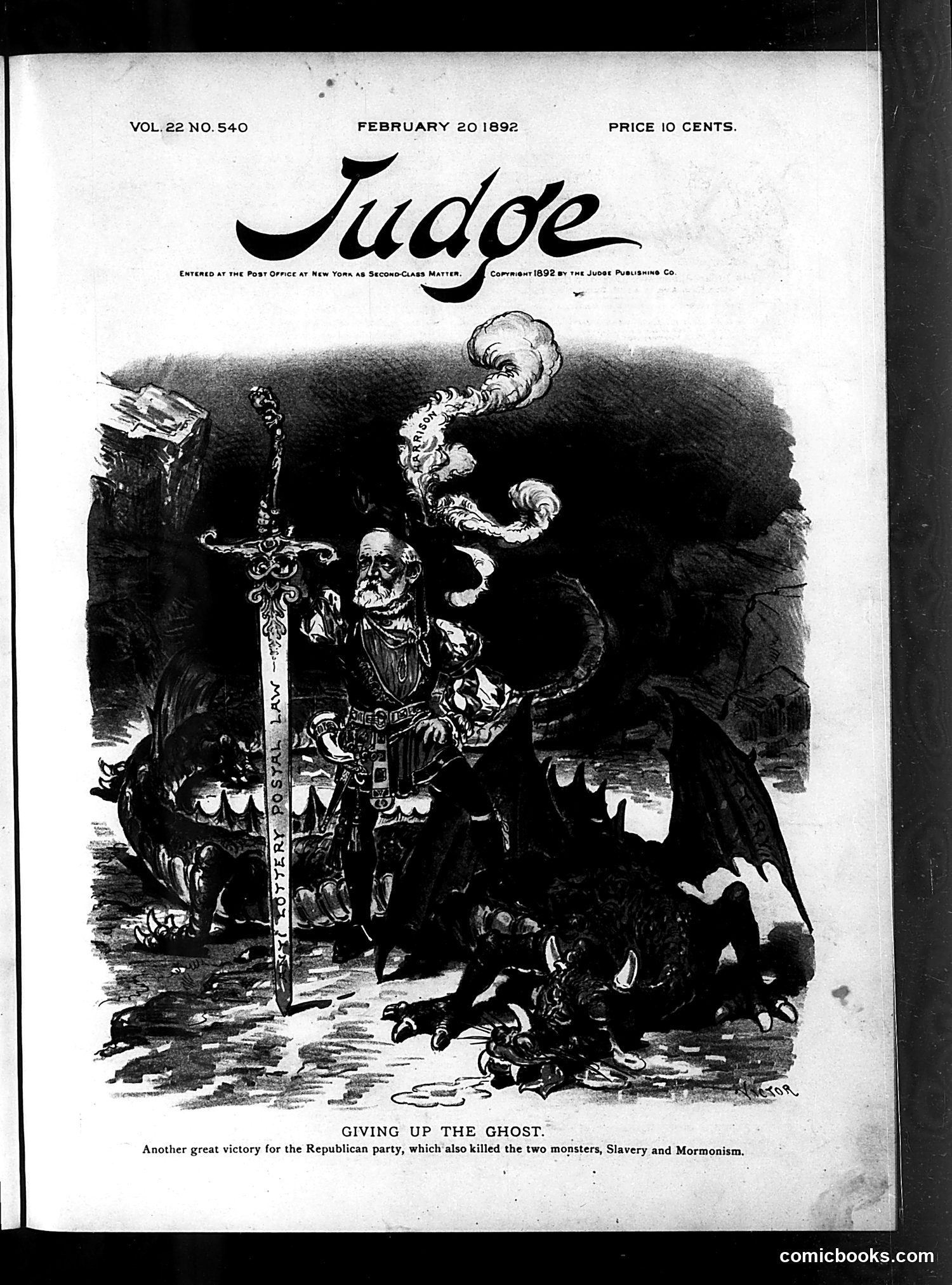
This is a political cartoon from February 20, 1892, celebrating a Republican party victory. The caption states it "killed the two monsters, Slavery and Mormonism." The central figure appears to be a Republican politician or personification of the party, confronting supernatural creatures—likely representing Slavery and Mormonism as demonic forces. The imagery uses gothic, ghostly symbolism to depict these as evil entities being defeated. The cartoon reflects late 19th-century Republican ideology that positioned the party as the moral force that ended slavery (via the Civil War and Reconstruction) and opposed Mormon polygamy, which was a major political issue through the 1890s. The style is typical of Judge's satirical approach: combining political messaging with dramatic, allegorical imagery to make partisan points visually compelling.
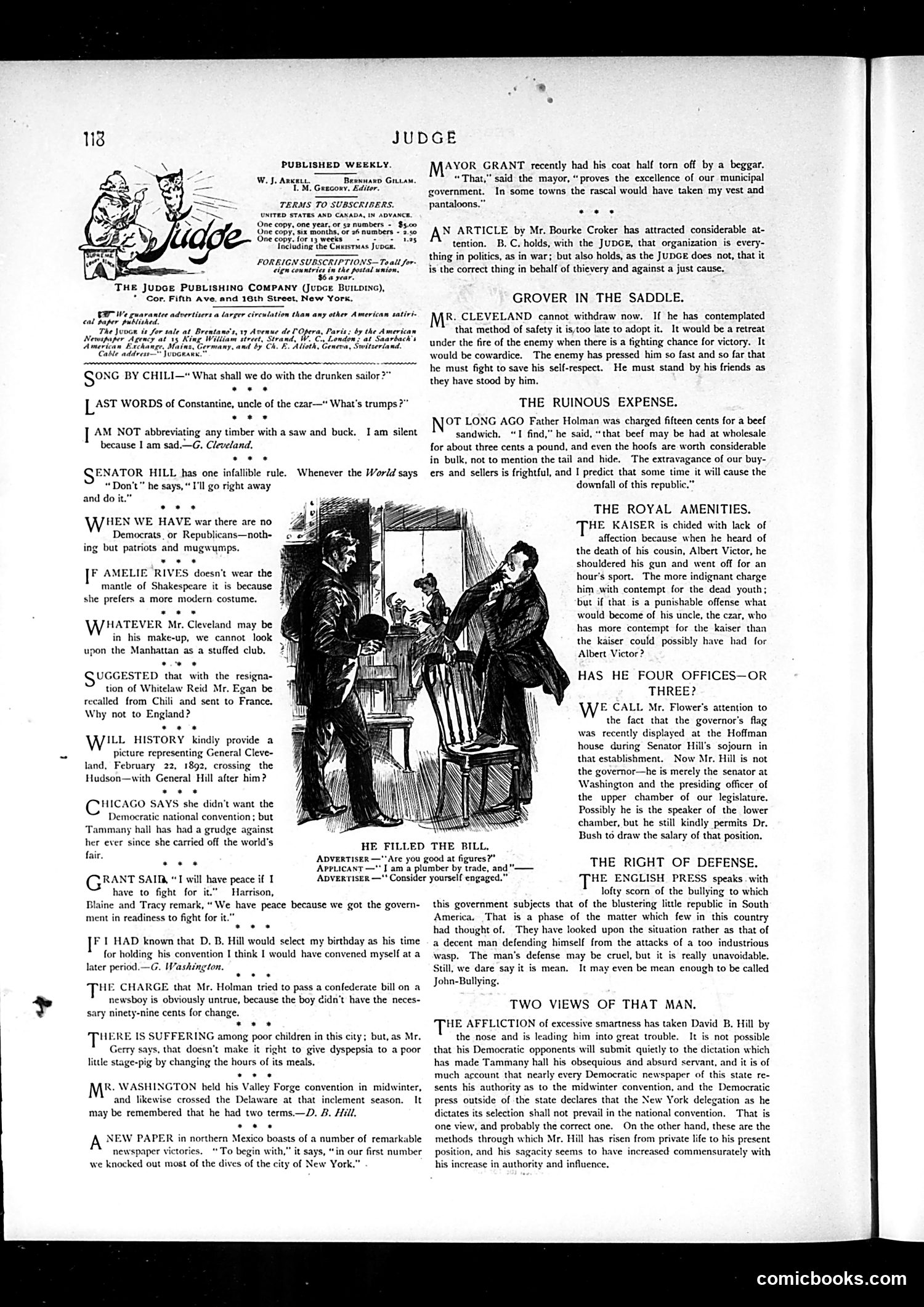
The central cartoon depicts what appears to be a commercial transaction, with one figure saying "Are you good at figures?" and another responding "I am a plumber by trade, and—" with a third interjecting "Consider yourself engaged." The caption reads "HE FILLED THE BILL." The satire appears to mock inefficiency in government hiring or contracting—suggesting that someone completely unqualified (a plumber) is being hired for an administrative position simply because he "fits the bill" (meets some minimal criterion). This reflects progressive-era critiques of patronage and incompetent political appointees. The surrounding text discusses various political matters including Cleveland, Senator Hill, and Democratic Party politics, suggesting this reflects 1890s-era American political scandals and complaints about government incompetence.
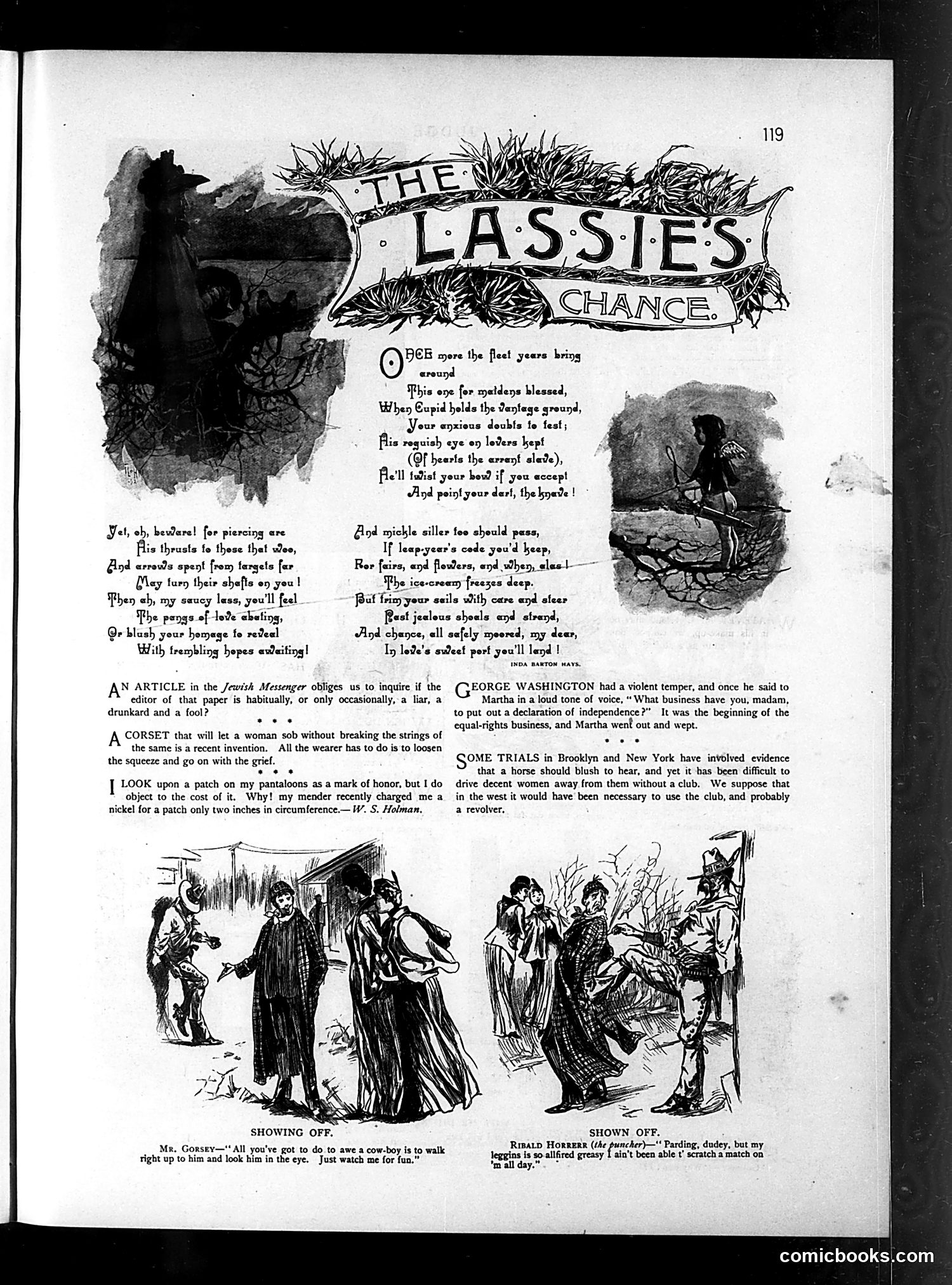
This Judge magazine page presents satirical commentary on gender and social behavior circa early 1900s. The title poem "The Lasses' Chance" appears to mock romantic courtship conventions, with illustrated vignettes showing women pursuing or manipulating men—inverting traditional gender roles for comedic effect. The lower cartoons labeled "Showing Off" depict social interactions where characters demonstrate vanity or pretense. One caption references a woman instructing a man to "ape a cow-boy" for entertainment. The scattered prose snippets discuss contemporary social issues: women's conduct, marriage prospects, and gender relations. References to "patches," "women sad without breaking strings," and debates about female behavior suggest anxieties about changing women's roles in turn-of-the-century America. The overall tone satirizes both masculine pretension and female agency, reflecting period attitudes toward evolving gender dynamics.
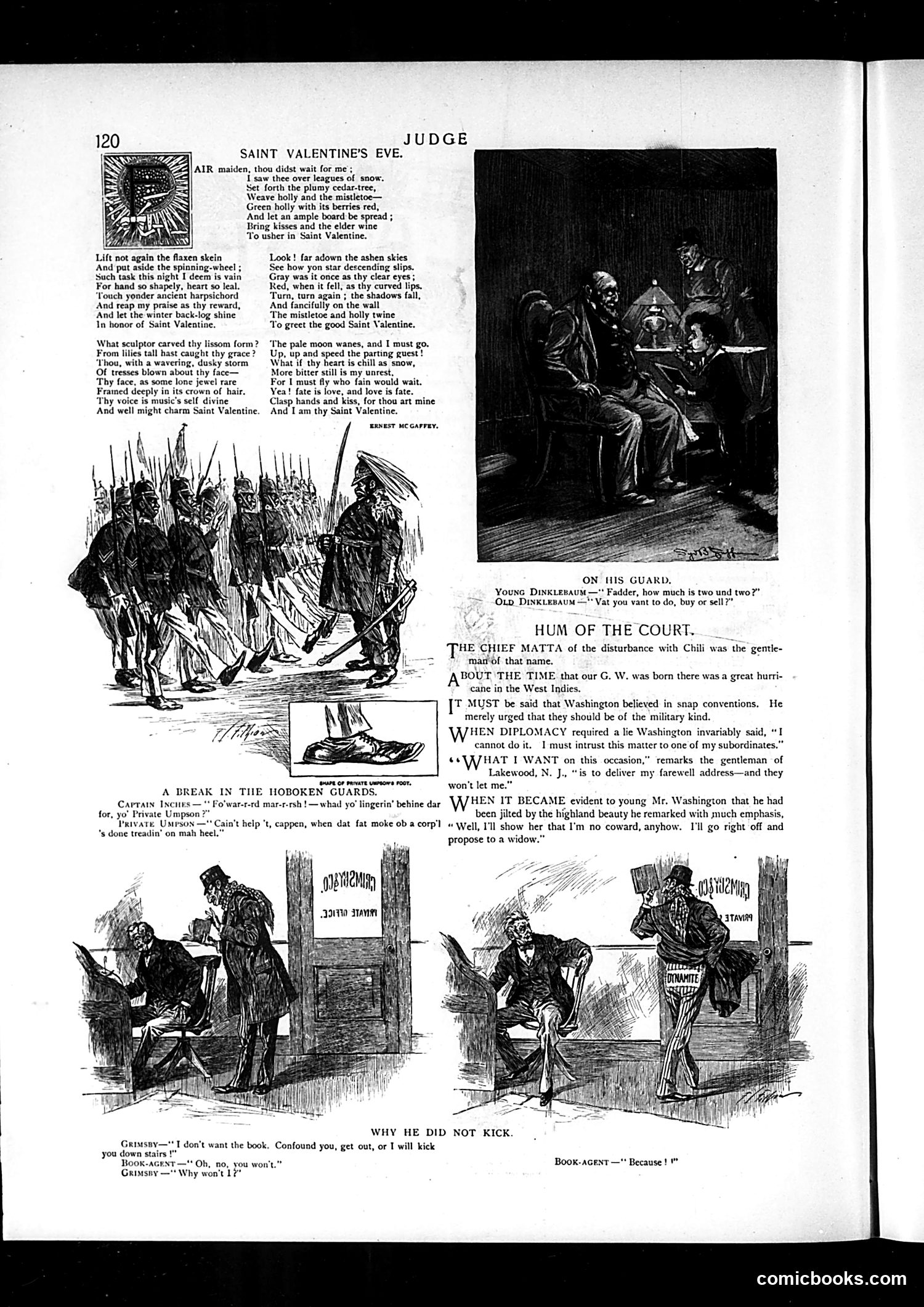
This page from *Judge* contains multiple satirical items targeting late 19th-century American politics and society: **"Saint Valentine's Eve"** is a romantic poem by Ernest McCaffey, accompanied by period illustrations. It's sentimental rather than satirical. **"Hum of the Court"** contains brief political jabs: mocking President Washington's belief in "snap conventions" (military discipline), his tendency to delegate lies to subordinates rather than tell them himself, and his romantic misadventures—suggesting he proposed to a widow after being rejected by a "highland beauty." **The cartoon vignettes** include ethnic humor typical of the era: caricatured Irish and German immigrants ("Captain Ixcites" and soldiers; "Young Dinklebaum" and his father), trading on stereotypes about dialect and behavior. **"Why He Did Not Kick"** shows a gentleman unable to kick a book agent—the punchline being social cowardice masked by excuses. The page reflects *Judge's* characteristic blend of romantic verse, political mockery of leadership, and period ethnic stereotyping.
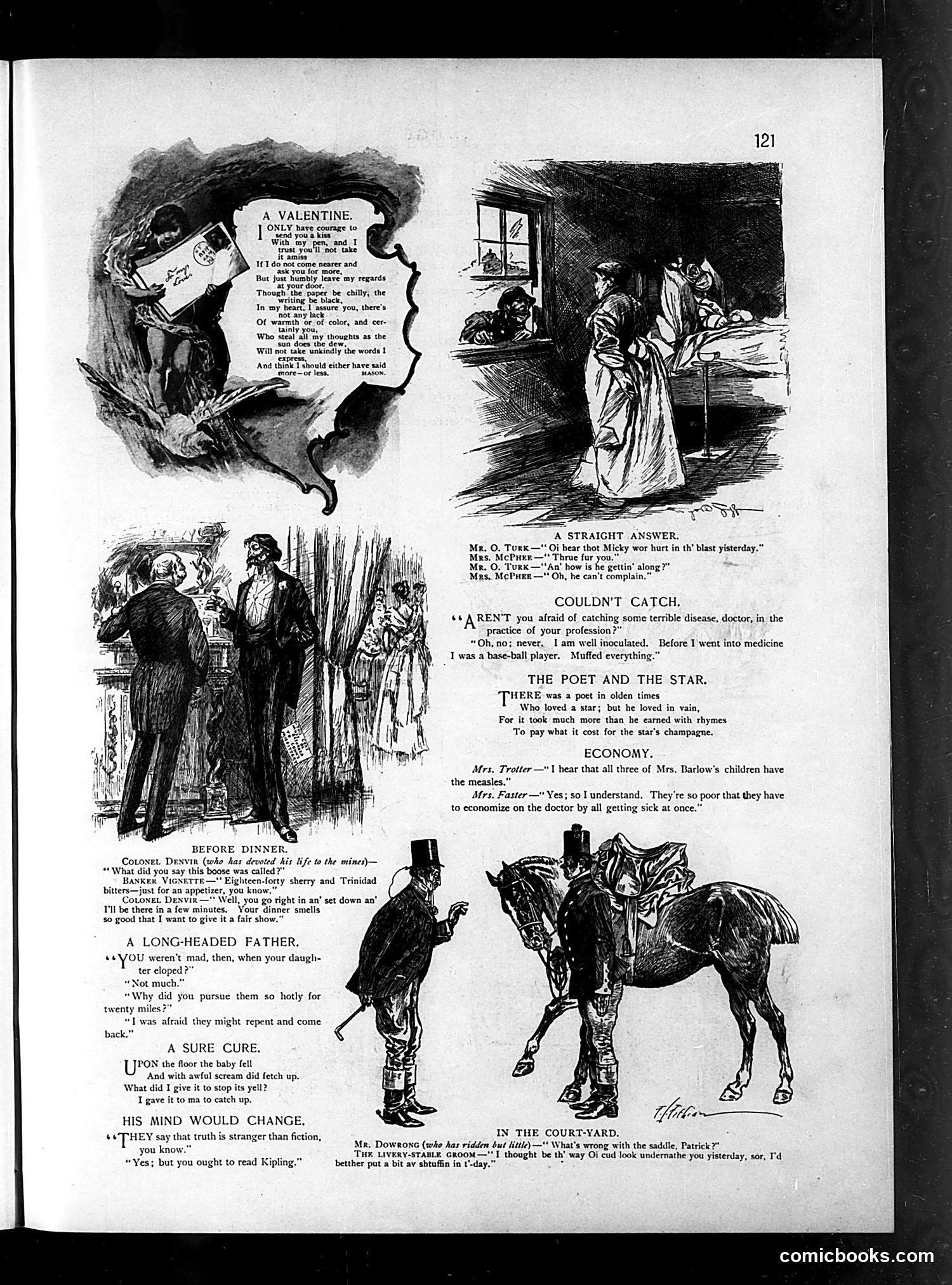
This page collects brief humorous sketches typical of Judge's satirical format: **"A Valentine"** (top left): A sentimental poem accompanying a cupid illustration—straightforward romantic humor rather than satire. **"A Straight Answer"** and other Irish dialect jokes: These feature working-class Irish characters (indicated by phonetic dialect: "thot," "yisterd'y"), reflecting Judge's era when Irish immigrants were common subjects of American humor, often portrayed as rough laborers in mines or stables. **"The Poet and the Star"**: Satirizes the high cost of maintaining a mistress ("the star")—suggesting a wealthy patron's expensive affair. **"Economy"**: Dark humor about poverty—poor families economize by having all children sicken simultaneously to avoid multiple doctor visits. **"Before Dinner"** and **"In the Court-Yard"**: Working-class scenes (miners, stable hands) depicting comic misunderstandings through dialect. The page exemplifies Judge's mix of gentle domestic humor and class-based satire, with Irish characters often portrayed as comic figures.
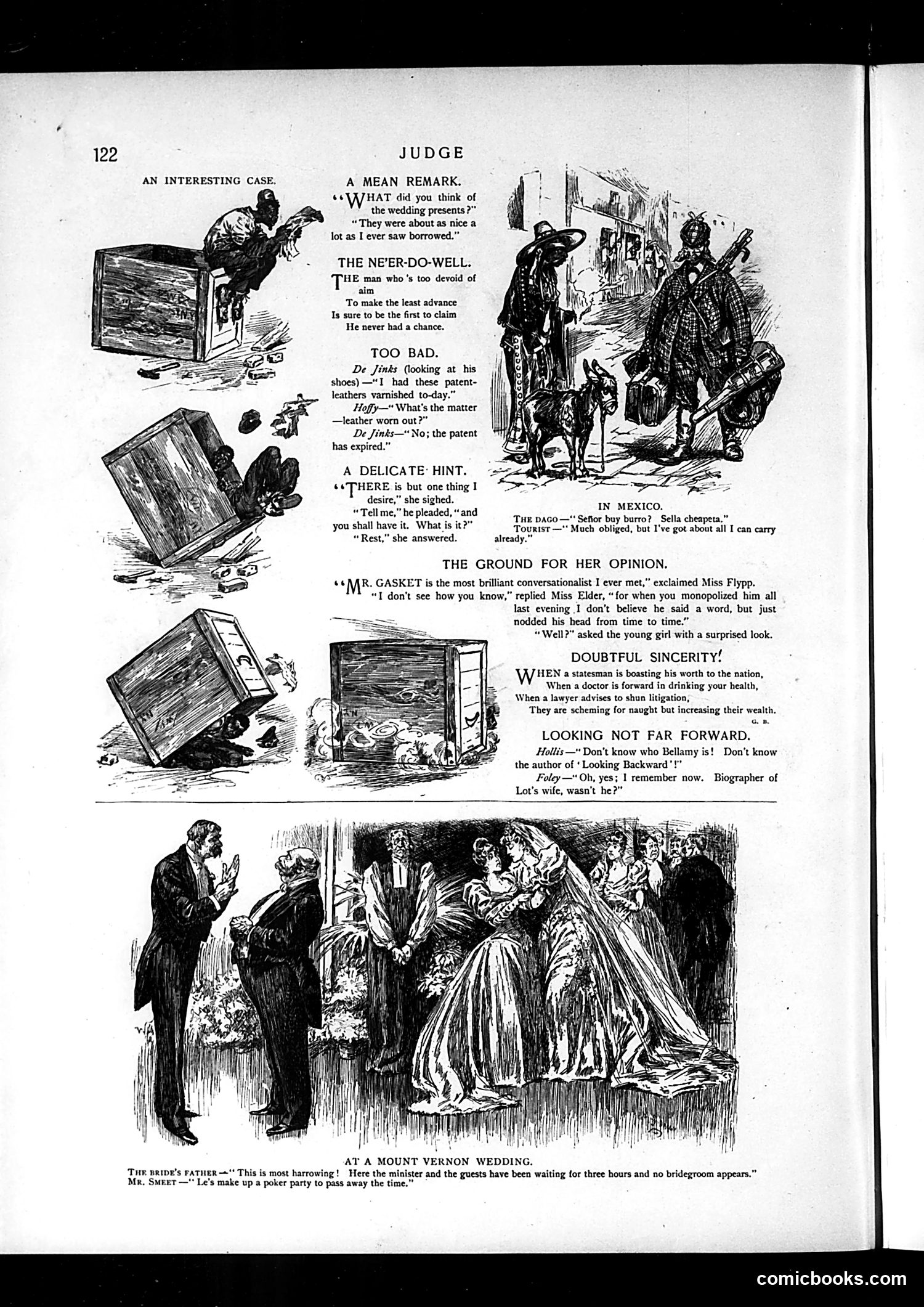
This page contains multiple brief satirical commentaries on Victorian social life, typical of Judge magazine's format: **"An Interesting Case"** mocks wedding gift etiquette—the joke being guests gave borrowed items as presents, suggesting stinginess among the social set. **"The Ne'er-Do-Well"** criticizes people who blame circumstances rather than taking responsibility for their failures. **"Too Bad"** is a pun: Dr. Jinks had his patent-leather shoes varnished, but the patent (legal protection) expired, so the finish wore away. **"A Delicate Hint"** plays on miscommunication—Miss Flypp praises Mr. Gasket's conversation skills despite him barely speaking; her companion ironically points out silence isn't conversation. **"In Mexico"** presents a stereotypical exchange with a Mexican vendor using exaggerated dialect ("cheapeta"), reflecting period attitudes toward Mexicans. **"Doubtful Sincerity"** cynically suggests politicians, doctors, and lawyers always pursue self-interest regardless of their public statements. **"At a Mount Vernon Wedding"** depicts impatience: after hours waiting for a tardy bridegroom, guests abandon decorum for poker.
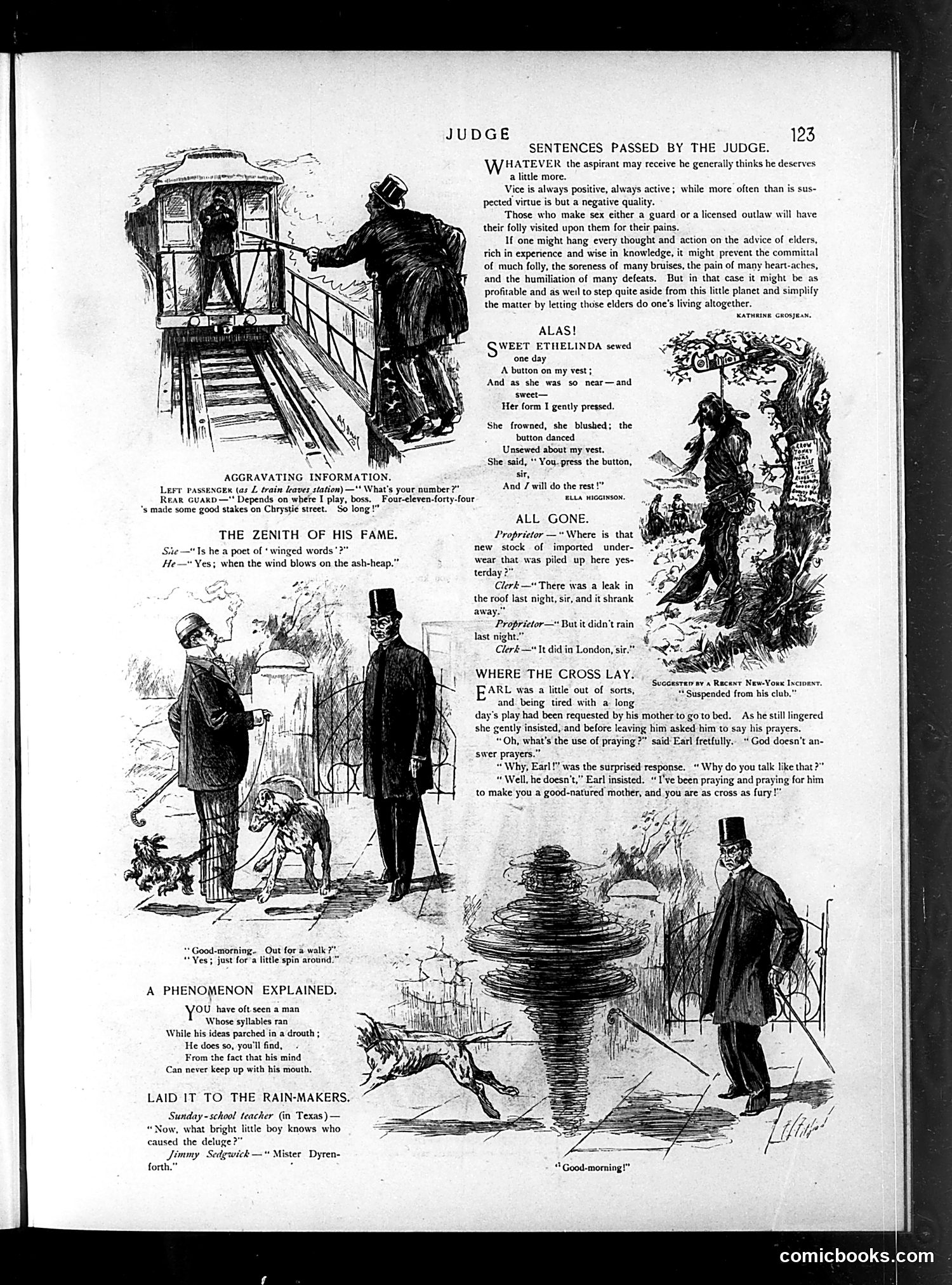
This page collects humorous sketches and satirical observations typical of Judge's satirical style. **Key pieces:** - **"Aggravating Information"**: A tram conductor boasts about gambling winnings, satirizing working-class men's obsession with betting. - **"The Zenith of His Fame"**: Mocks a poet whose reputation collapses—his "winged words" are merely trash blown by wind, ridiculing pretentious literary figures. - **"A Phenomenon Explained"**: Observes that verbose talkers often lack substantive ideas—their mouths outpace their brains. - **"Laid It to the Rain-Makers"**: A Sunday school teacher in Texas references the biblical deluge; a boy blames "Mister Dyrenforth" (likely a reference to unclear contemporary figure or event). - **"Alas!" and other sketches**: Domestic humor about a woman refusing romantic advances, complaints about shrinking imported goods, and a child's frustration with unanswered prayers. The "Sentences Passed by the Judge" provides philosophical observations on human nature—vice versus virtue, generational advice, and pride.
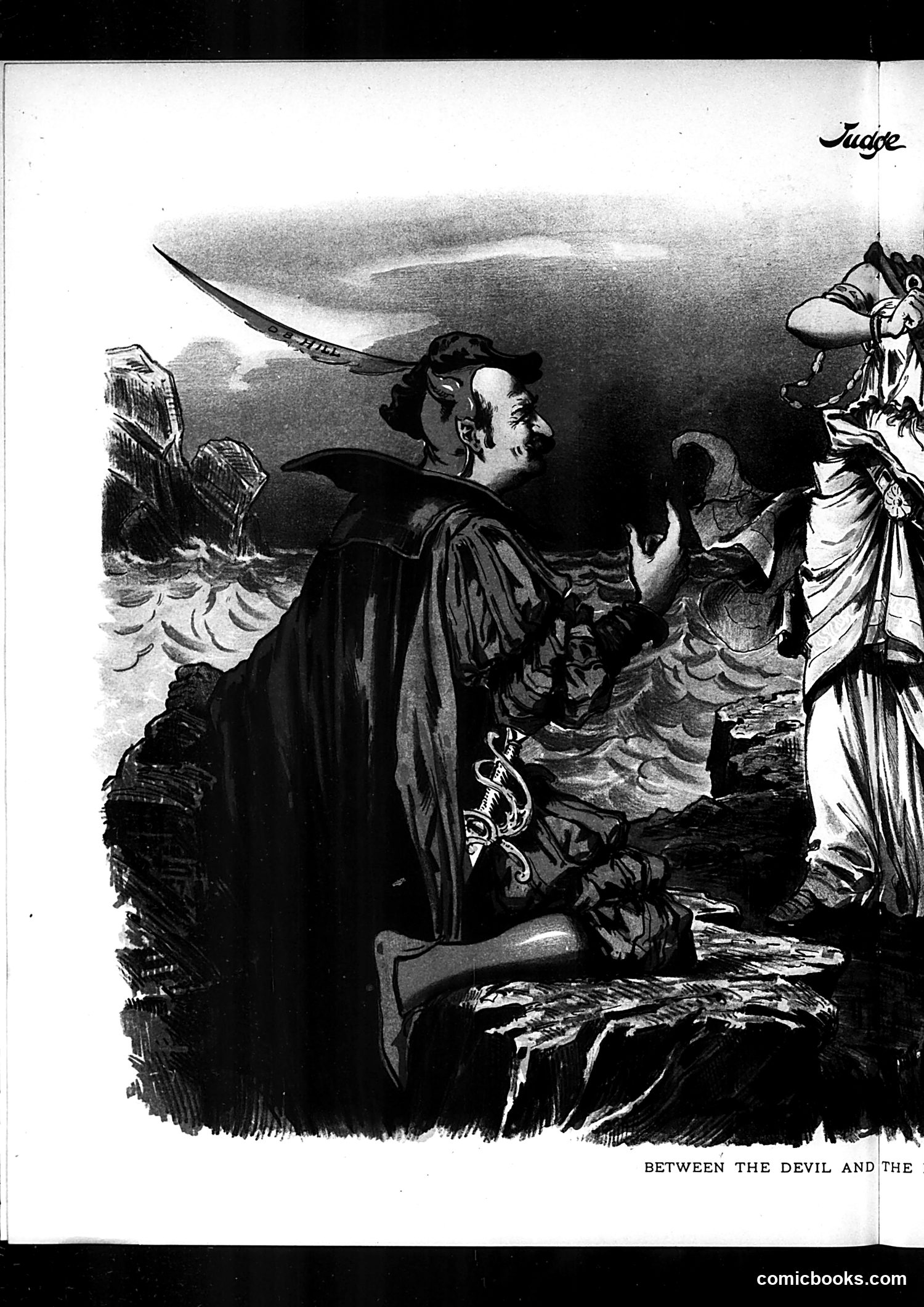
This appears to be a single satirical illustration from *Judge* magazine titled "Between the Devil and the [Deep Blue Sea]" (the caption is cut off). The image depicts a man in period costume (possibly 17th-18th century, given the hat and cloak) in what seems a dramatic maritime or supernatural scene. He's positioned between two figures: on the left appears to be a devil or demonic figure, and on the right a classical female figure (possibly Lady Justice or Liberty, given the draping). The composition suggests a moral dilemma or difficult choice—the phrase "between the devil and the deep blue sea" means caught in an impossible situation with only bad options. Without the complete title or additional context, the specific political or social reference remains unclear, though the theatrical staging suggests commentary on a contemporary political predicament.
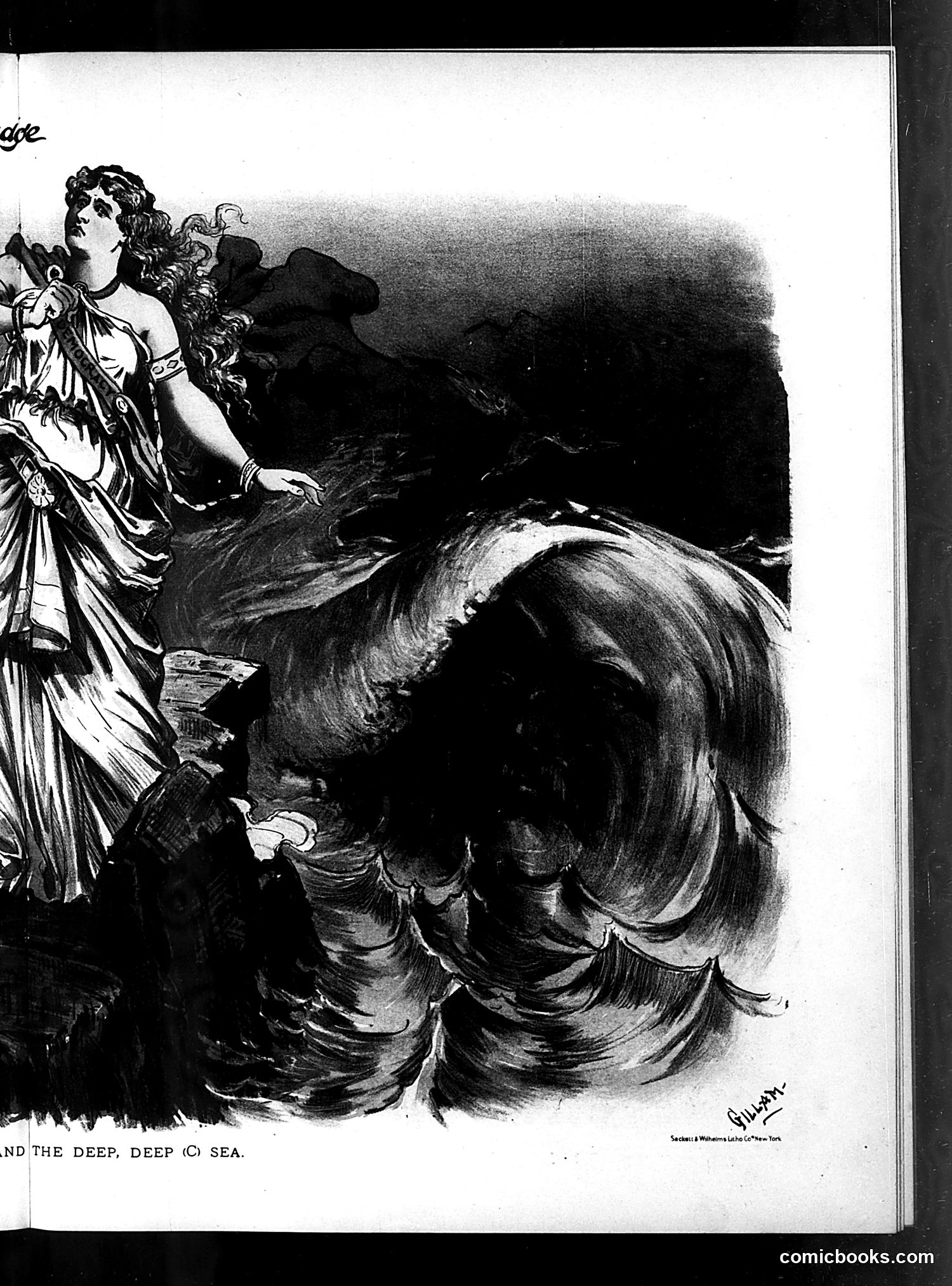
This appears to be a single satirical illustration from *Judge* magazine. The visible text reads "AND THE DEEP, DEEP (C) SEA," suggesting this is part of a larger titled work (the beginning is cut off). The image shows a classical female allegorical figure (possibly representing America, Liberty, or a similar concept) gesturing toward dark, turbulent waves. The style and subject matter suggest commentary on maritime affairs, naval policy, or oceanic matters—likely referencing a specific contemporary political or economic issue involving American interests at sea. Without the full title and complete caption, the specific satirical target remains unclear, though the ominous waves and the figure's concerned gesture suggest warning or disapproval of some sea-related policy or event.
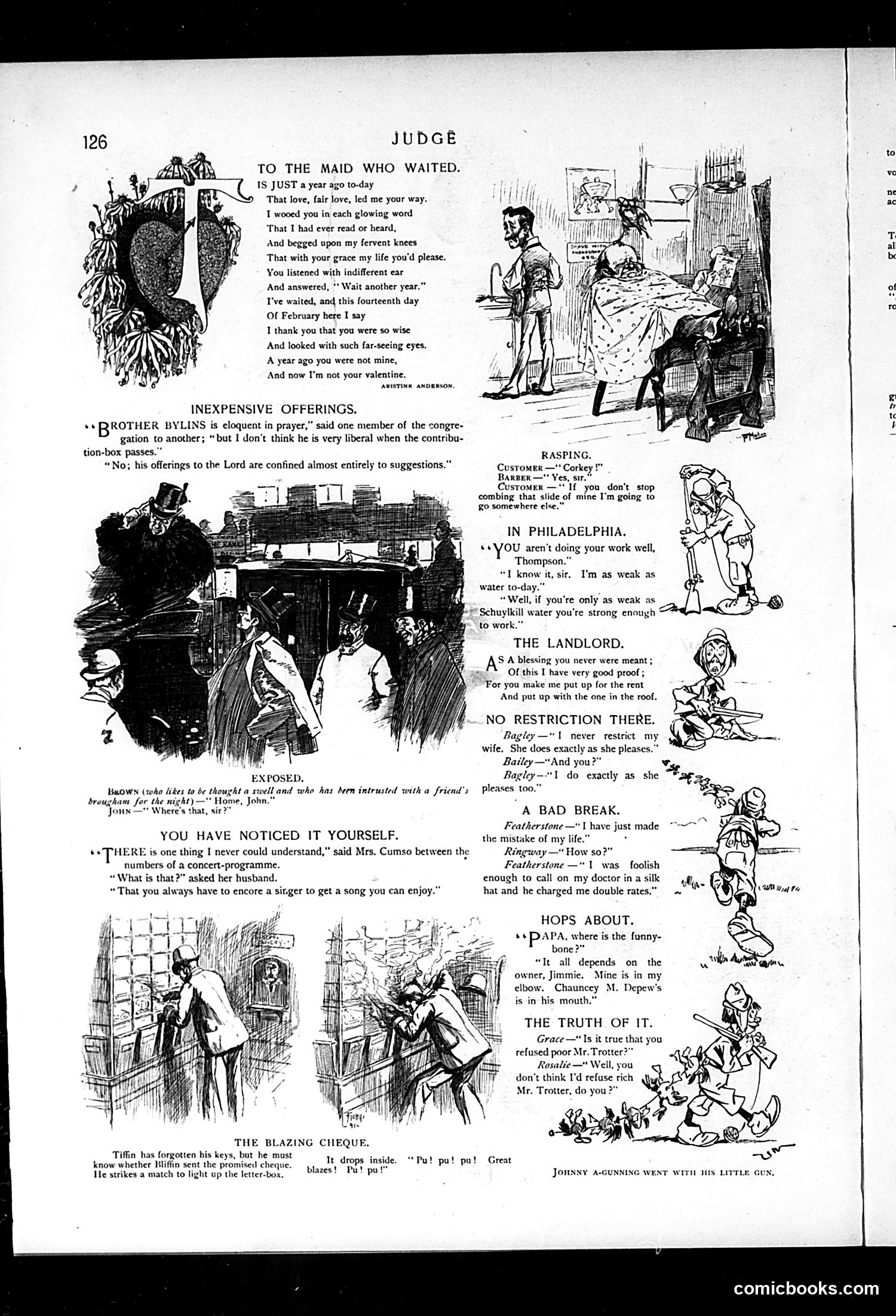
This page from *Judge* magazine contains several brief satirical sketches typical of the publication's humor: **"To the Maid Who Waited"** mocks romantic persistence—a suitor has waited a year after being told to "wait another year," only to realize his devotion was foolish, as he's now explicitly not her valentine. **"Inexpensive Offerings"** satirizes religious hypocrisy: a congregant praised for eloquent prayer actually gives only "suggestions" rather than money to the church. **Other sketches** lampoon everyday social absurdities: weak workers comparing themselves to Philadelphia's polluted Schuylkill River, a landlord's bitter resentment of tenants, marital dynamics where husbands claim wives do as they please (while doing likewise themselves), and a doctor overcharging a patient for wearing formal attire. The humor relies on wordplay, ironic reversals, and cynical observations about human nature—characteristic of *Judge's* satirical approach. The accompanying pen-and-ink illustrations enhance the comedic effect through exaggerated character expressions and domestic or urban scenes.
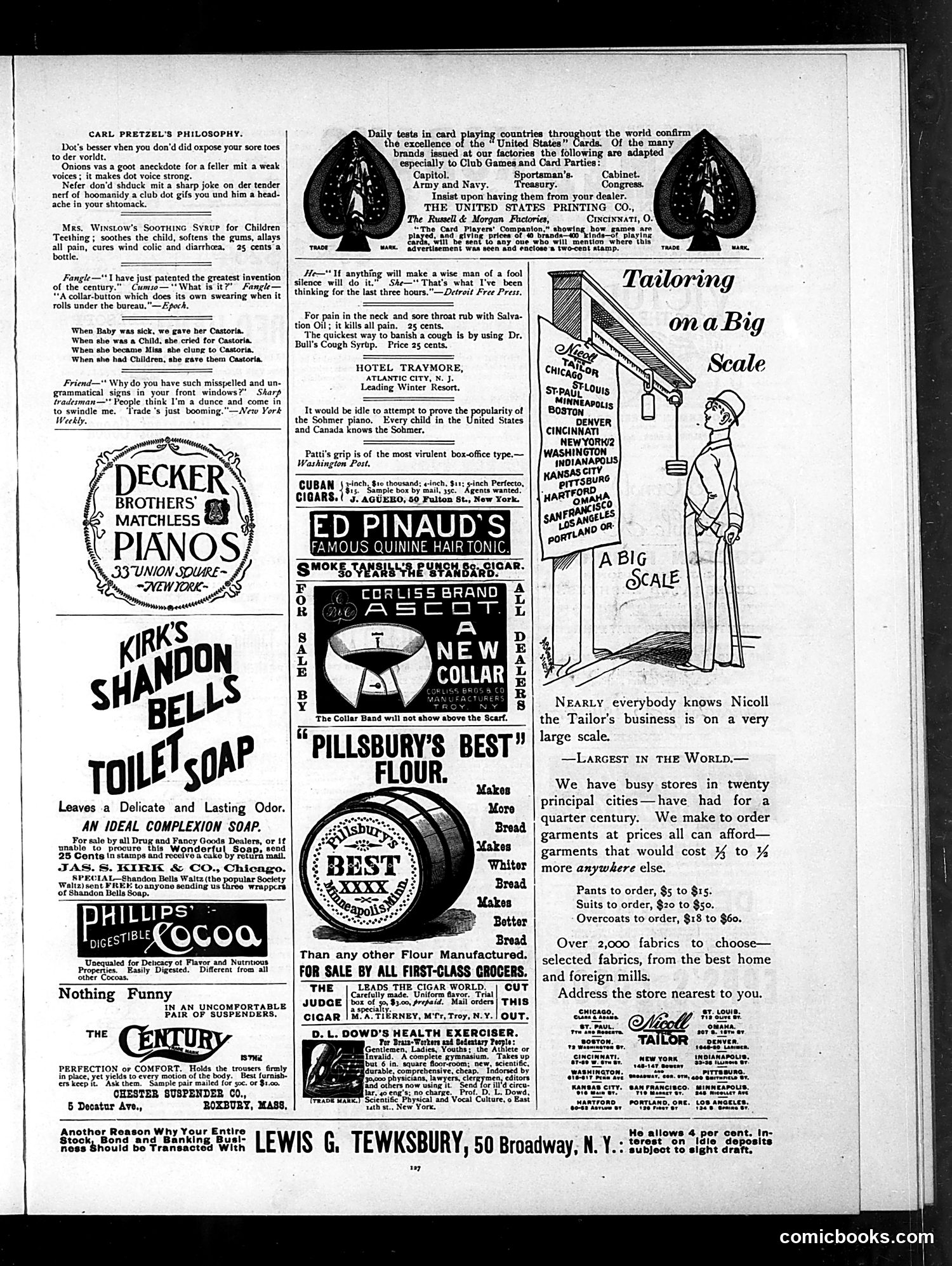
This is primarily an **advertising page** from Judge magazine, with minimal satirical content. The main editorial material is "Carl Pretzel's Philosophy"—a recurring humor column featuring a German-accented character offering folksy wisdom ("It's better when you don't expose your sore toes to the world"). The page is dominated by period product advertisements (Pillsbury flour, hair tonic, cocoa, soap, suspenders) typical of late 19th-century magazines. One small joke appears: a man deliberately misspells his storefront signs so people think he's a fool and come to swindle him—but he profits because they're "just booming." The "Tailoring on a Big Scale" illustration shows a giant tailor looming over a tiny client, humorously exaggerating Nicoll's tailoring business's scale and success. There is **no significant political satire** on this page. It reflects Judge's general editorial mix: light humor, social commentary through character voices like Pretzel, and substantial revenue from national advertisers.
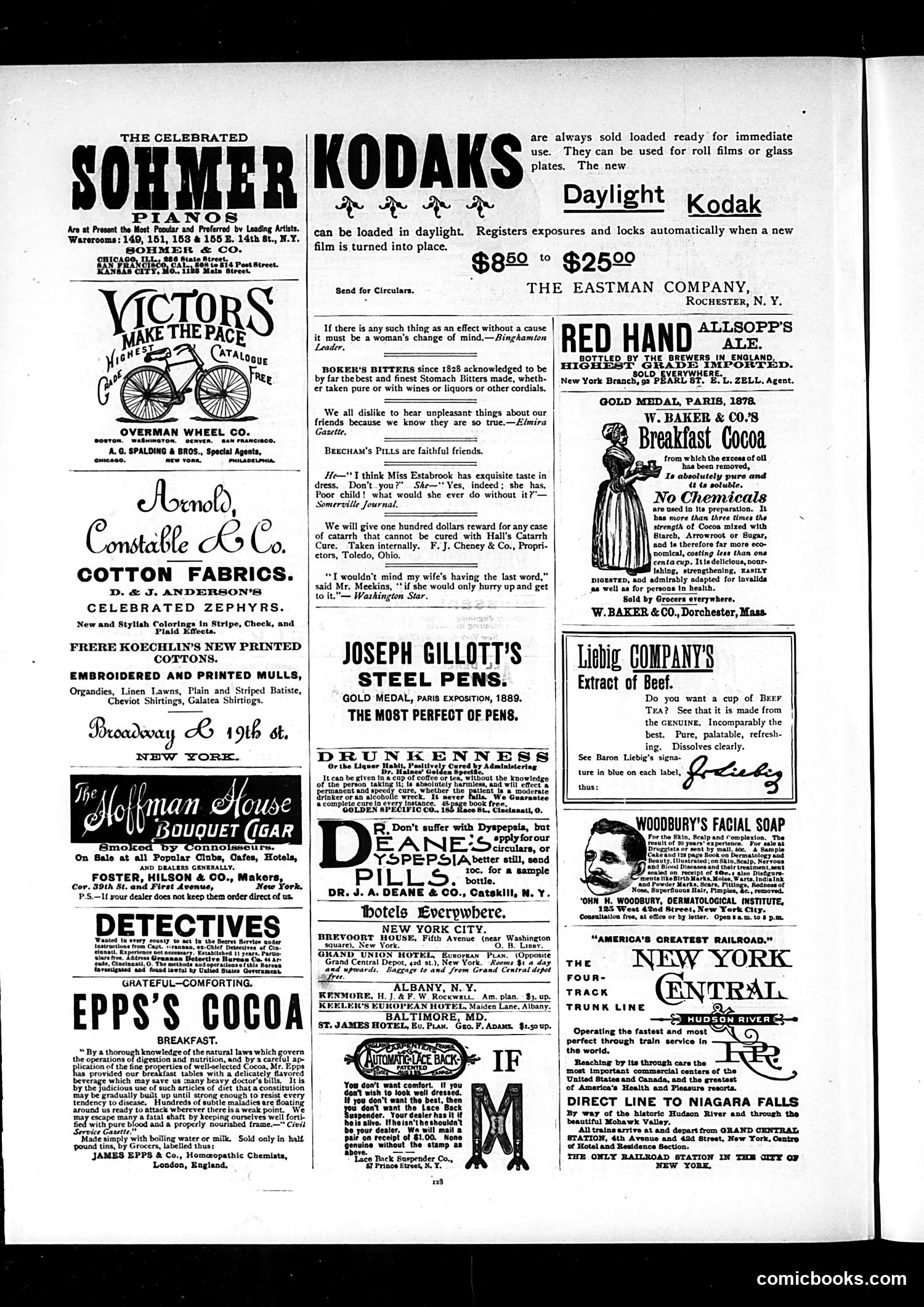
This page is **primarily advertising**, typical of 19th-century magazines. It contains no discernible political cartoon or satirical commentary. Instead, it features roughly 20 product advertisements—bicycles, fabrics, cocoa, pens, hotels, patent medicines, cigars, and early cameras. The only content approaching satire are brief **humorous one-liners** interspersed between ads: - A joke about women changing their minds (attributed to Binghamton Leader) - Wordplay about a woman's expensive taste in dress (Somerville Journal) - A husband's joke about his wife getting "the last word" (Washington Star) These are generic, domestic humor snippets—popular in period magazines—with no specific political targets. They reflect common era attitudes about women and marriage but constitute light social observation rather than pointed satire. **Conclusion**: This is a standard advertising page with filler humor, not a page of satirical content for historical analysis.
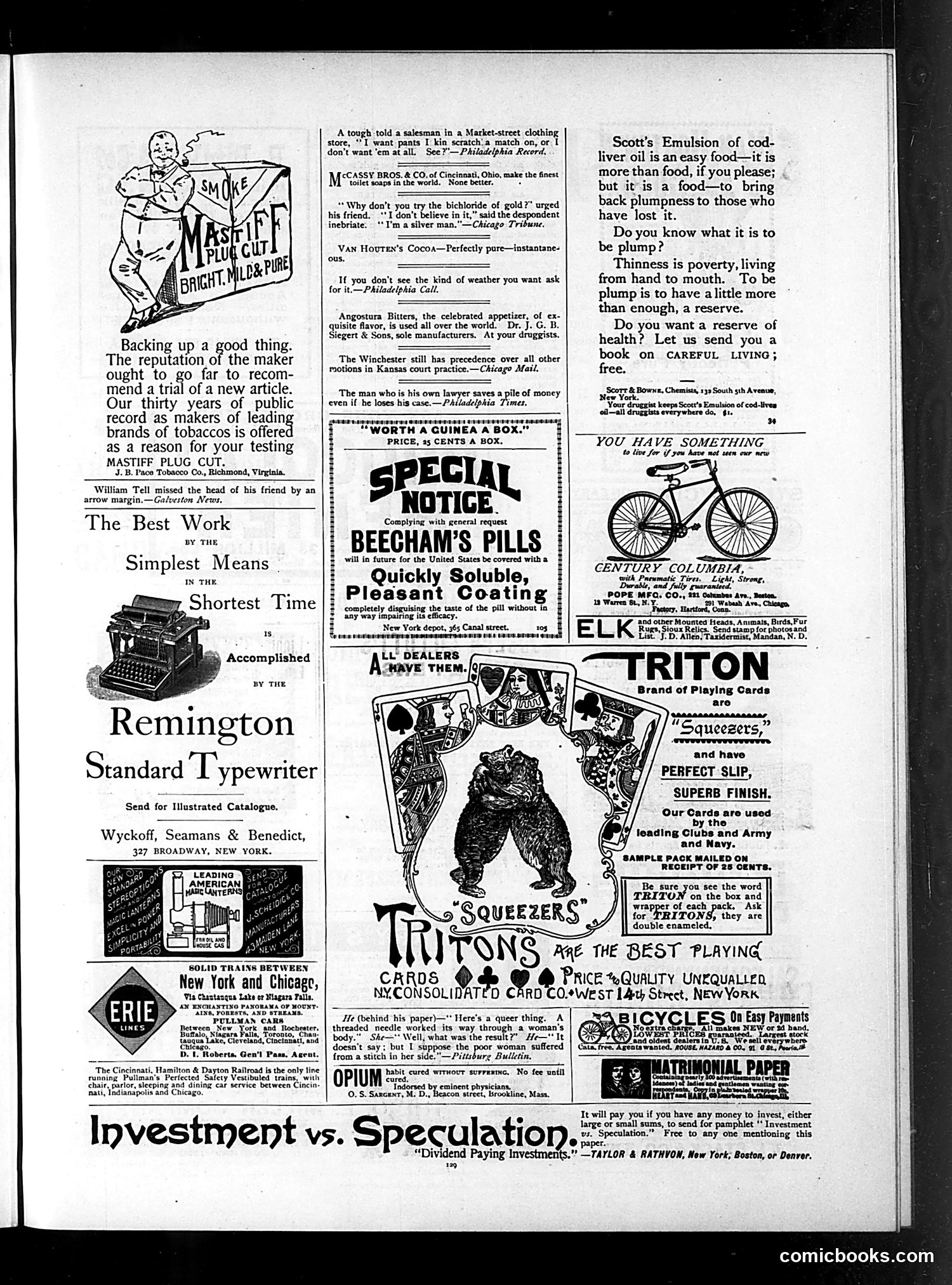
This page is primarily **advertising** with minimal editorial cartoon content. The notable satirical element is a small comic dialogue at the bottom: A man reading a newspaper tells his wife about a strange news story: a needle threaded itself through a woman's body. When she asks the outcome, he responds that the article doesn't say—but he supposes "she suffered." The humor relies on the crude assumption that any woman would obviously suffer from such an incident, playing on period stereotypes about female delicacy or hypochondria. The rest of the page consists of product advertisements typical of the era (1890s-1900s): tobacco, typewriters, patent medicines (Beecham's Pills, Scott's Emulsion), bicycles, and playing cards. These ads reflect consumer goods and health products marketed during the Gilded Age, with some including period-specific claims about efficacy that would be considered fraudulent today.
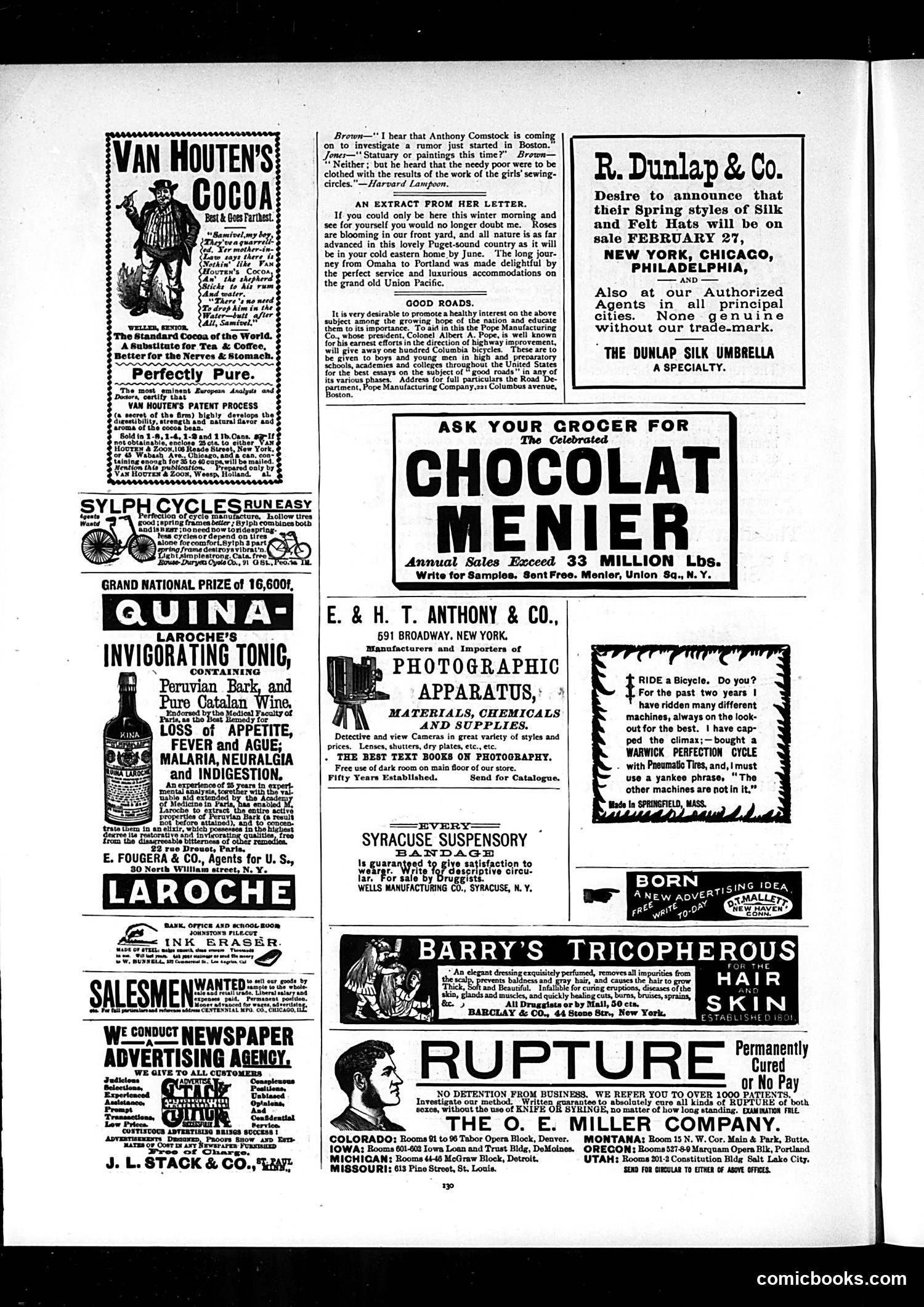
This page is primarily **advertising**, typical of late 19th-century magazines. The notable satirical content is a brief joke at the top: **The "Anthony Comstock" Cartoon/Joke:** The text references Anthony Comstock, the famous (or infamous) anti-vice crusader who led the New York Society for the Suppression of Vice. The joke imagines him investigating a rumor in Boston that poor people are receiving clothing made by girls' sewing circles. The satire mocks Comstock's notorious zeal for moral policing: he's portrayed as so obsessed with censorship that even *charitable work* seems suspicious to him. The joke plays on his real campaigns against "obscene" art and literature—suggesting he'd find impropriety even in innocent charity. **Context for modern readers:** Comstock was notorious for aggressive censorship and moral vigilantism. This joke ridicules how broadly he applied his self-appointed guardianship over public morality. The remainder of the page consists entirely of period advertisements for cocoa, bicycles, tonics, photographic equipment, and other goods—typical commercial content filling magazine space.
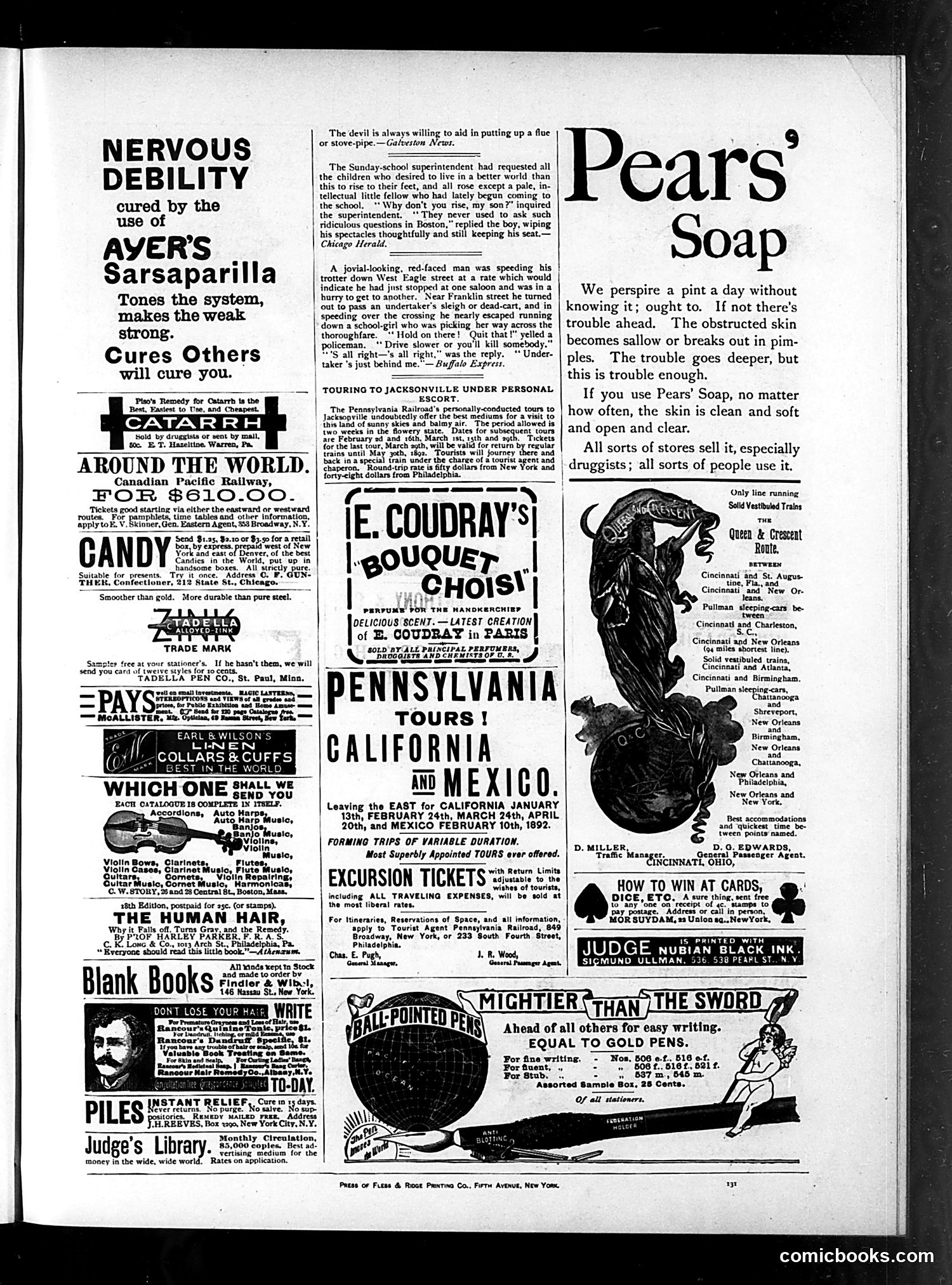
This page is primarily a **collection of advertisements** rather than satirical political cartoons. It appears to be from a 19th-century Judge magazine filled with period ads for patent medicines (Ayer's Sarsaparilla, Piso's Remedy for Catarrh), travel (Canadian Pacific Railway tours to California and Mexico), and merchandise (pens, collars, blank books, hair remedies). The only editorial content includes **brief satirical anecdotes** about human nature: a story about a Boston schoolboy's skeptical attitude toward Sunday school morality, another about a reckless driver speeding past a funeral hearse. These are light social humor mocking vanity and recklessness, not political commentary. The page's dominant purpose is **commercial advertising**, reflecting how satirical magazines of this era supported themselves through ads while providing entertainment—a business model quite different from modern journalism.
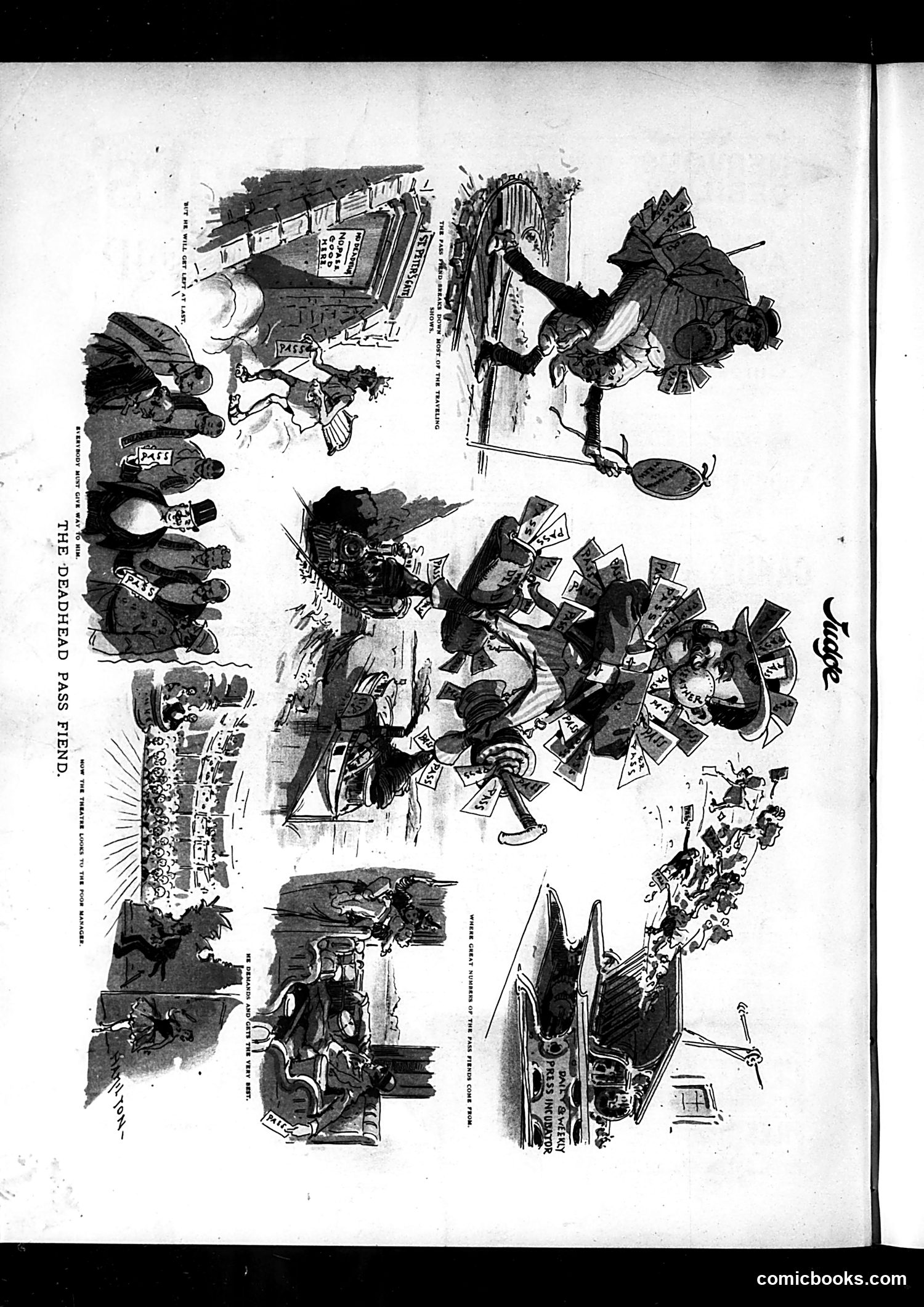
This satirical cartoon depicts someone obsessed with obtaining free admission passes to entertainment venues. The central figure appears to be a scheming individual surrounded by various theatrical and entertainment establishments—likely theaters, concert halls, or similar venues visible in the illustrations. The satire targets the social practice of using connections or manipulation to gain complimentary access ("deadhead passes") rather than paying admission. The cartoon portrays this behavior as compulsive and ridiculous, with the figure eagerly pursuing free entry across multiple venues. This reflects late 19th/early 20th-century social criticism about parasitic behavior among people seeking unearned privileges through networking or deception—a form of freeloading considered both amusing and contemptible by *Judge* magazine's readership.