
A complete issue · 16 pages · 1892
Judge — February 6, 1892
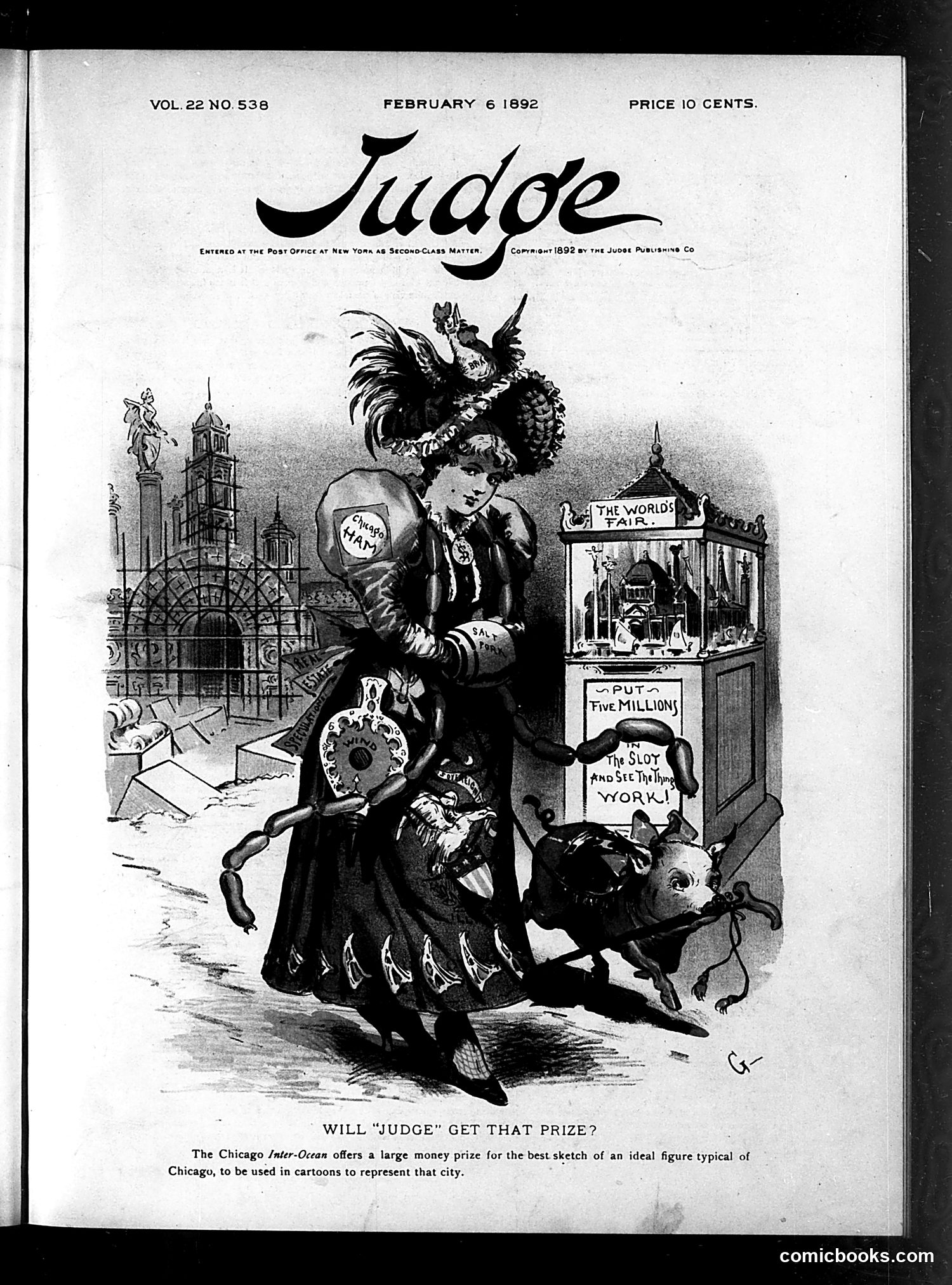
This February 1892 *Judge* cartoon satirizes the Chicago *Inter-Ocean* newspaper's contest offering prize money for the best sketch of an "ideal figure typical of Chicago." The central figure is a fashionably dressed woman weighted down with symbols of Chicago's commercial excess: a globe labeled "CHICAGO MAMS" (likely mocking wealthy Chicago matrons), boxed goods marked "SALT," and a miniature of the World's Fair (Chicago hosted the 1893 Columbian Exposition). A small dog pulls at her skirts. The caption asks "WILL 'JUDGE' GET THAT PRIZE?" — the magazine claiming that THIS exaggerated caricature better represents Chicago's true character than any serious submission the *Inter-Ocean* might receive. It's satirizing both the contest premise and Chicago's materialistic reputation.
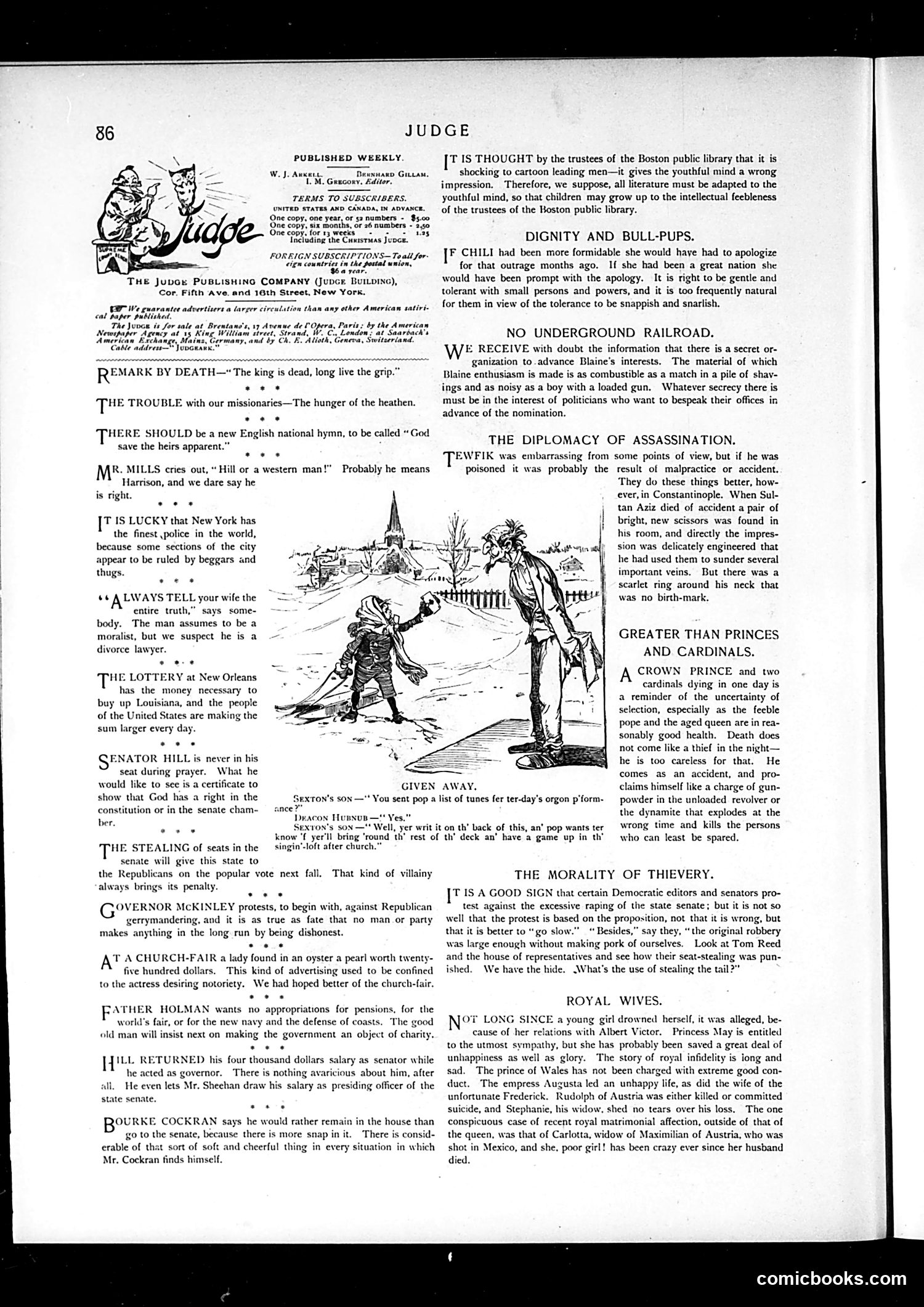
The central cartoon illustrates "The Diplomacy of Assassination," depicting what appears to be a confrontation between two figures near a Middle Eastern or Mediterranean setting (indicated by the minaret and palm tree). The text references Sultan Ariz's death by accident, during which scissors were found in his room—"directly the impression was deliberately engineered that he had used them to sunder several important veins." The satire targets diplomatic hypocrisy: rather than acknowledge suspicious circumstances around a ruler's death, officials construct elaborate false narratives to preserve appearances. The cartoon mocks how political powers manipulate truth to avoid scandal, suggesting that convenient "accidents" serve powerful interests better than honest investigation—a critique of corrupt diplomatic practices and the suppression of inconvenient facts.
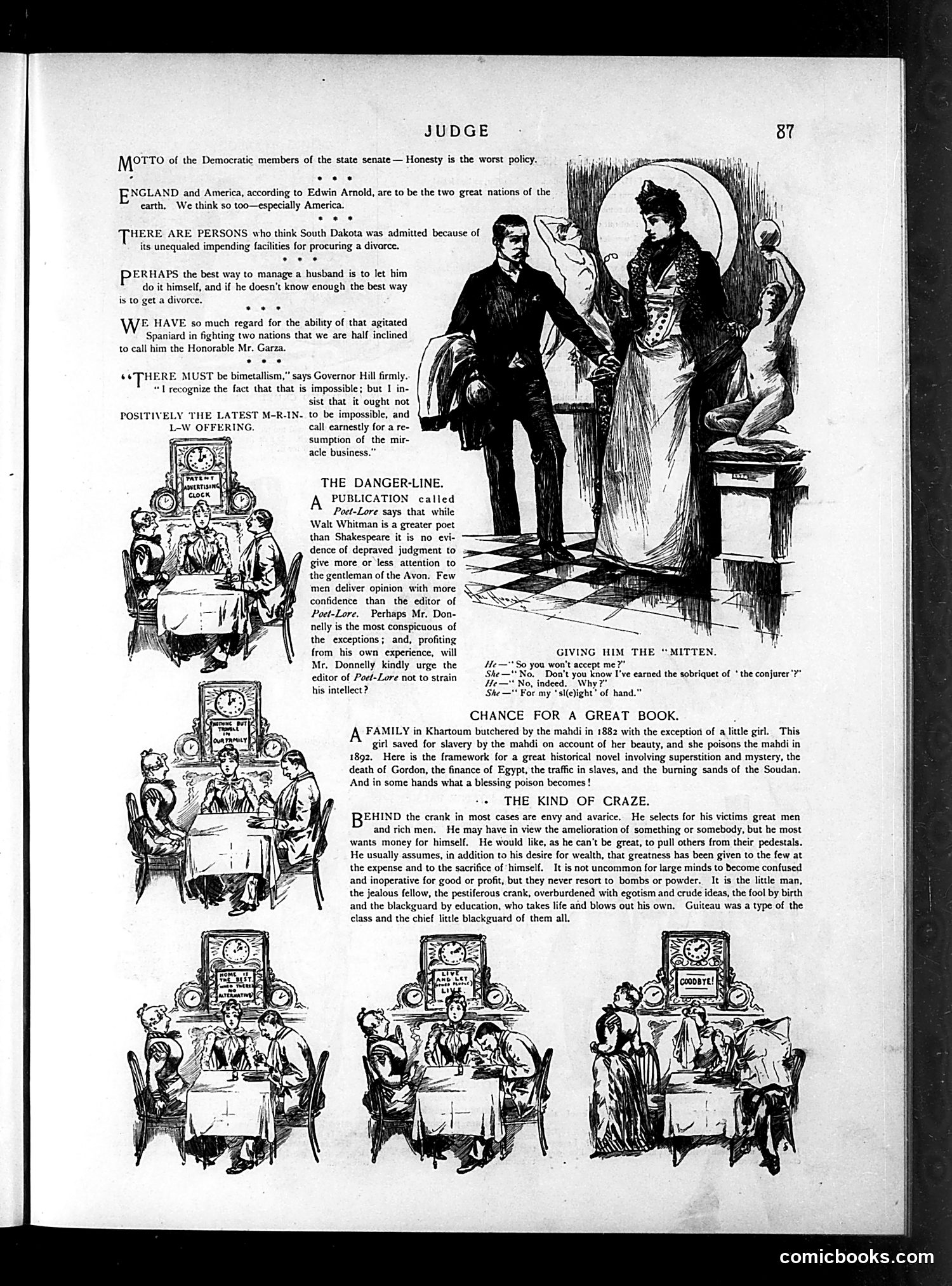
The main cartoon "Giving Him the Mitten" depicts a man being rejected by a woman—"the mitten" was period slang for dismissal or rejection. The dialogue references a "conjurer" and "sleight of hand," suggesting the man performed deception or tricks to win her affection, which she has now discovered. The page's political commentary mocks Democratic senators' dishonesty (opening motto) and references South Dakota's admission to the Union and divorce law debates. The three small dinner-table vignettes at bottom appear to be separate satirical sketches about social situations, though their specific targets are unclear from the visible text. The overall theme concerns deception in politics and relationships—exposing false promises and "sleight of hand" tactics used to manipulate the public and romantic interests.
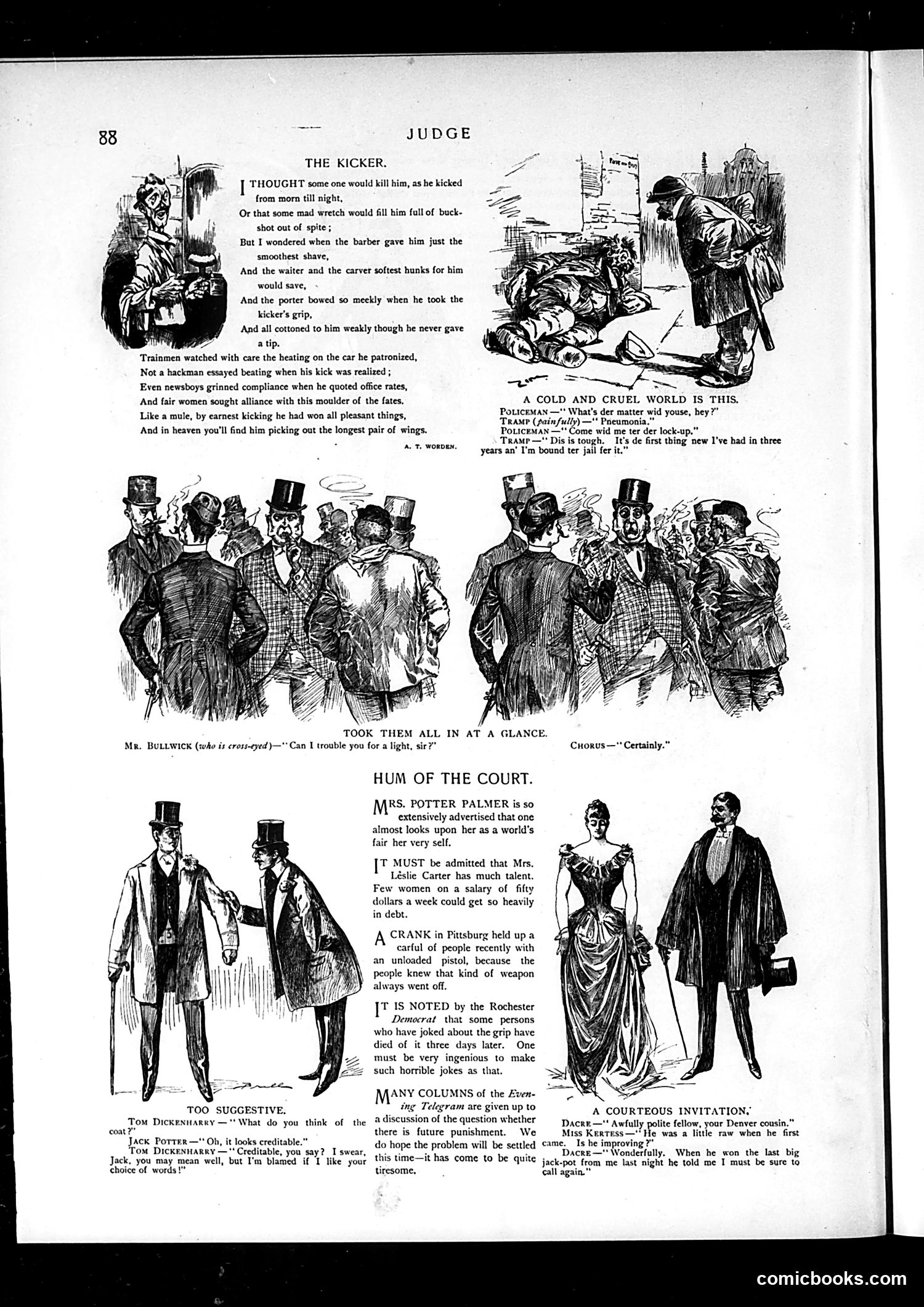
This page contains several satirical items typical of late 19th-century American humor: **"The Kicker"** (main poem with illustration): A commentary on how people treat chronic complainers with undeserved deference. The "kicker" who perpetually complains receives excellent service—smooth shaves, good food, careful treatment—despite never tipping. The satire mocks both the complainer's entitlement and society's inexplicable coddling of difficult people. **"A Cold and Cruel World is This"**: A brief joke about a tramp arrested for theft, lamenting that jail is ironically the first good thing he's received in three years. **"Hum of the Court"**: Gossip items about Mrs. Potter Palmer (a wealthy Gilded Age socialite), actress Léa Leslie Carter (known for debt), and commentary on an unloaded pistol robbery and jokes about influenza deaths. **"Too Suggestive"** and **"A Courteous Invitation"**: Minor jokes about word choice and social behavior. The page primarily satirizes American social pretense, celebrity culture, and human nature rather than addressing specific political events.
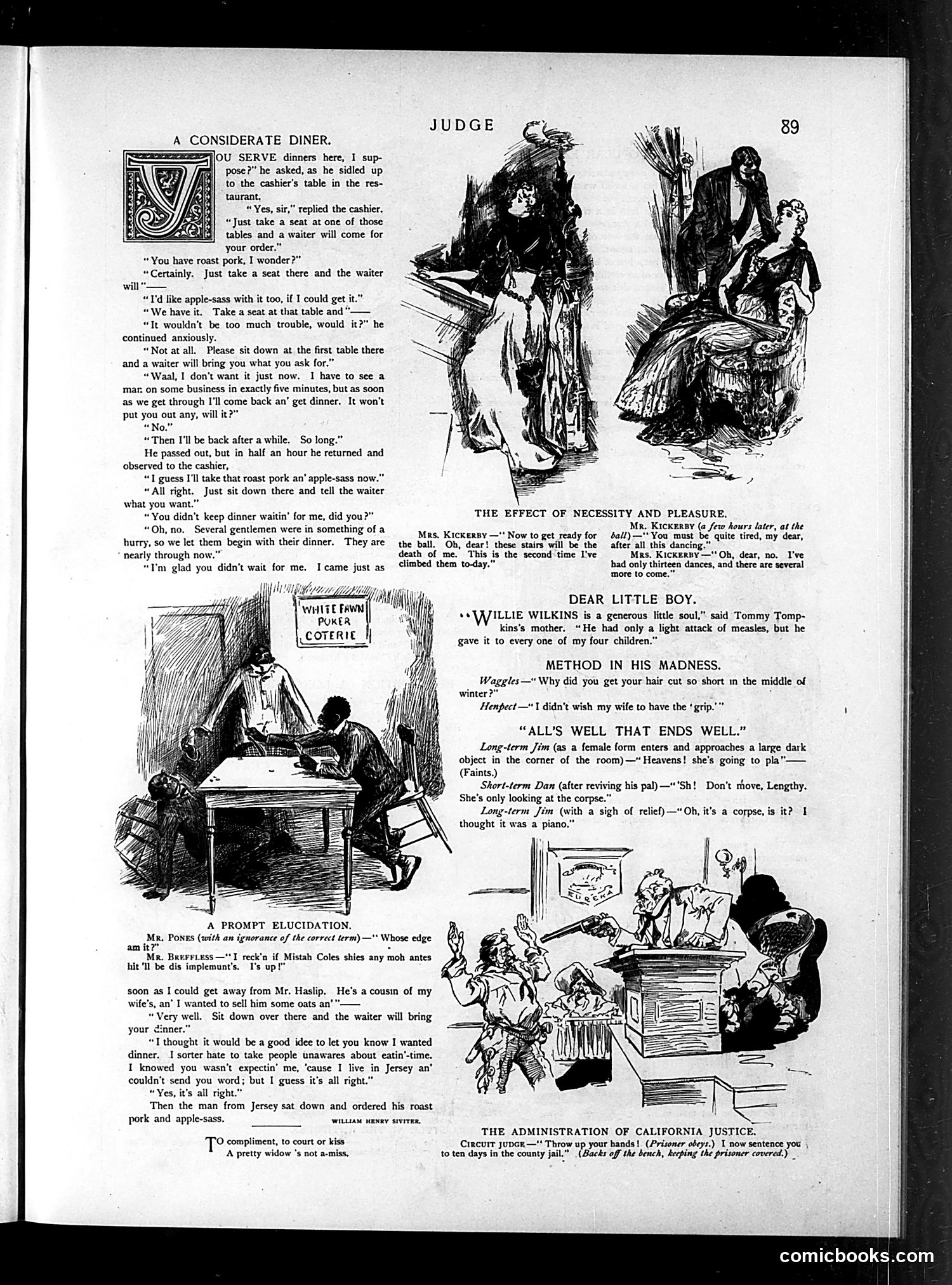
This page contains multiple satirical vignettes typical of late 19th-century Judge humor: **"A Considerate Diner"**: Mocks a rural visitor from Jersey who repeatedly interrupts restaurant service with apologies and explanations. The joke targets working-class anxiety about proper etiquette—his excessive politeness and self-consciousness reveal social insecurity. **"A Prompt Elucidation"**: Features two men (one appears to use dialect suggesting African American characters) discussing farm equipment in unclear language. The humor relies on linguistic confusion and rural incompetence. **"Dear Little Boy"**: Satirizes naive generosity—a child with measles deliberately infects others, which the mother praises as "generous." **"Method in His Madness"**: A husband cuts his hair short to prevent his wife catching the flu (grip), showing humorous domestic strategy. **"All's Well That Ends Well"**: Prison humor where an inmate mistakes a corpse for a piano, relieved it's not the latter. **"Administration of California Justice"**: Depicts a judge sentencing a prisoner while holding him at gunpoint—satirizing rough frontier justice as chaotic and violent. The page reflects Gilded Age class attitudes and regional stereotypes common to the era's popular humor.
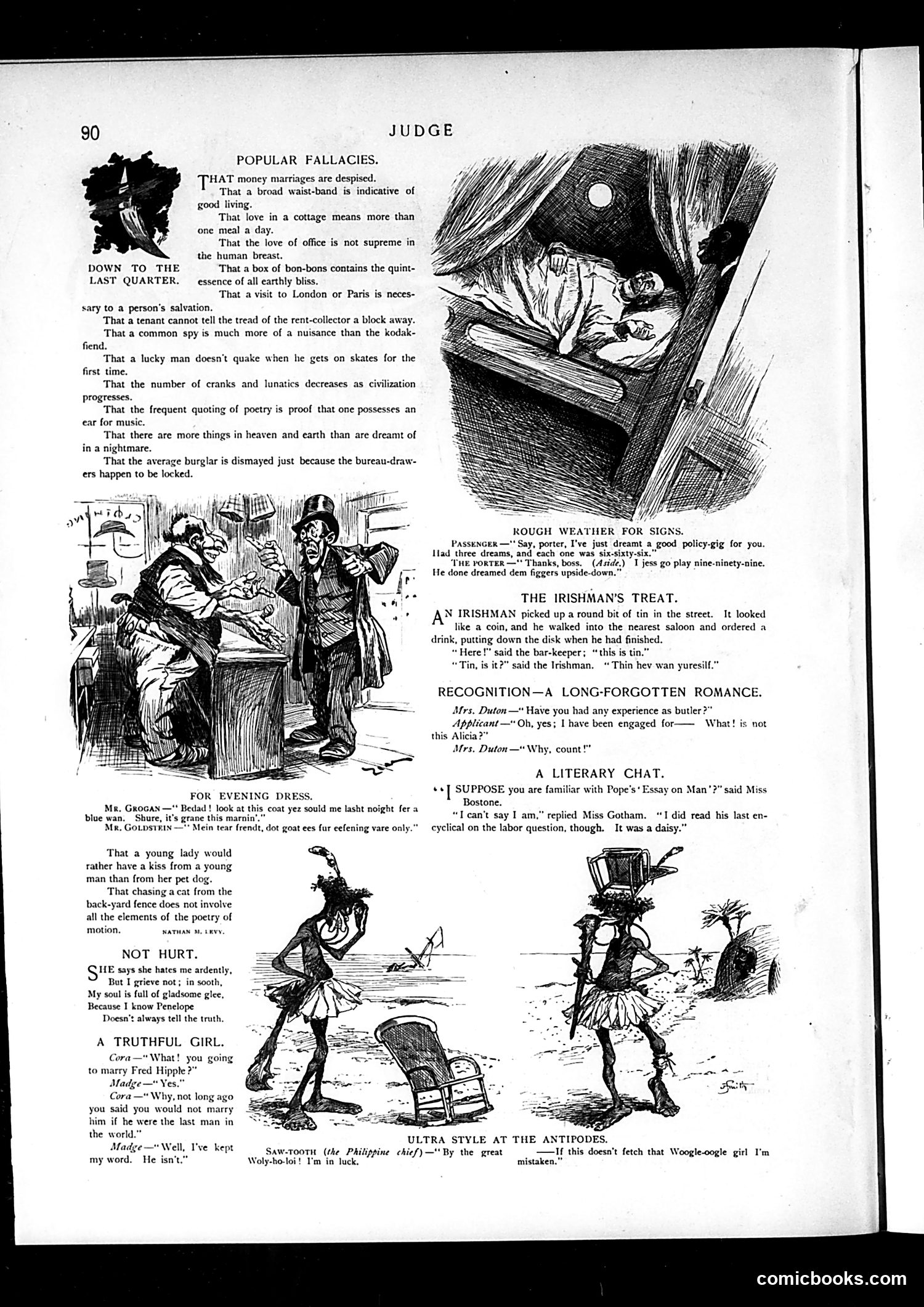
This page from *Judge* contains multiple brief satirical pieces mocking social conventions and human nature: **"Popular Fallacies"** lists common misconceptions about money, love, and society—the humor derives from the *actual* truth being the opposite of each claim. For instance, money marriages *are* despised (contradicting the opening), and people *do* fear rent collectors. **"The Irishman's Treat"** is an ethnic stereotype joke: an Irishman mistakes a tin disk for a coin, orders a drink, then insists the bartender keep the "payment"—the humor relies on a caricatured Irish accent and implied stupidity. **Other vignettes** include a porter interpreting lottery numbers from dreams, a job applicant's unexpected reunion, and a woman's insincere romantic declarations. The final "Antipodes" cartoon appears to reference colonial encounters. These pieces reflect late-19th/early-20th-century *Judge* humor: wordplay, ethnic stereotyping, and mocking social pretension. The crude woodcut illustrations and dense text layout were typical of the era's satirical magazines.
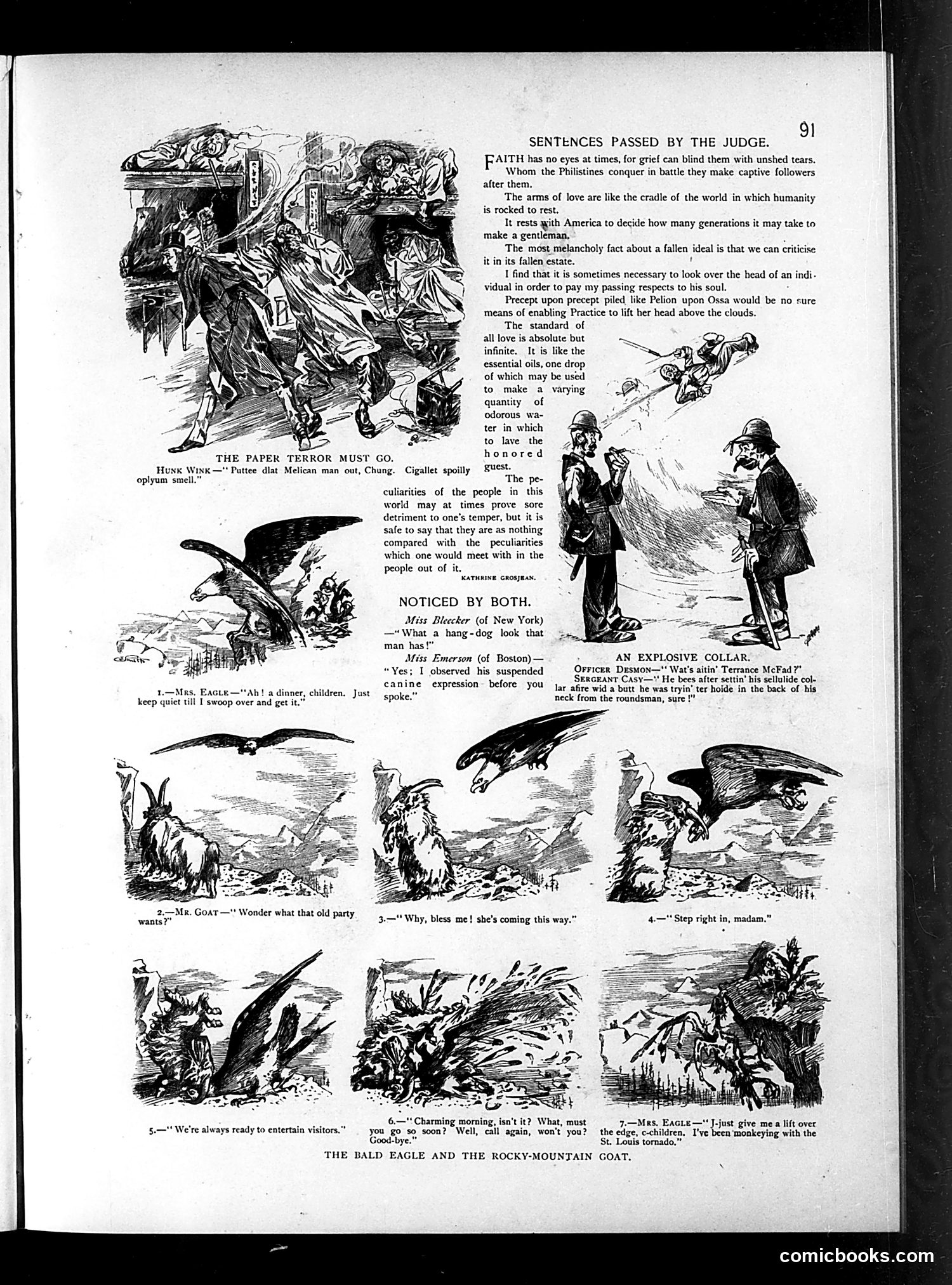
This page from Judge magazine contains editorial philosophy ("Sentences Passed by the Judge") — philosophical observations about faith, love, and American character — alongside several standalone comic panels. The main satirical pieces appear to be: 1. **"The Paper Terror Must Go"** — A caricatured exchange between characters with exaggerated accents, likely mocking immigrant speech patterns and opium use (a period concern). 2. **"Noticed by Both"** — Two society women from different cities observing a shabby man, satirizing regional social observation or gossip. 3. **"An Explosive Collar"** — A joke about an Irish policeman ("Sergeant Casy") hiding a bullet in his collar from a superior officer. 4. **"The Bald Eagle and the Rocky-Mountain Goat"** — Animal dialogues (a traditional Judge format) where creatures exchange witty remarks, appearing to comment on American character or social situations. The page uses ethnic stereotypes common to 1880s-90s satire and relies on visual gags and wordplay. Without specific historical context, the exact political targets remain unclear.
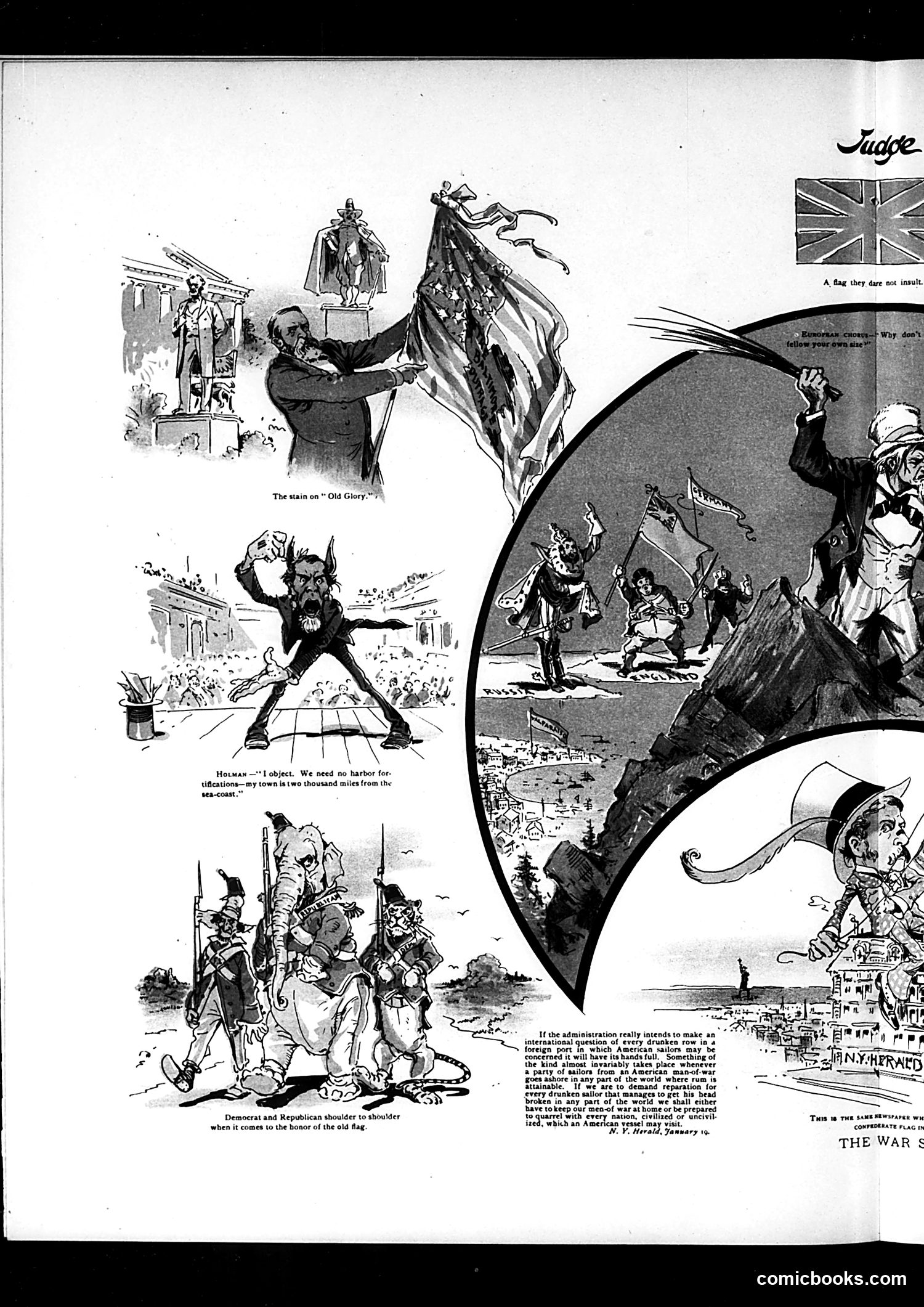
This page satirizes American preparedness debates, likely from the Spanish-American War era (the OCR mentions "January 19," suggesting early 1898). The top cartoon shows a figure defending the British flag ("Old Glory"), suggesting British imperial influence over American policy. The middle cartoon depicts "Hotwan" (possibly a caricature representing isolationist sentiment) objecting to harbor fortifications, arguing his town is distant from threats—satirizing those opposing military spending. The bottom cartoon shows "Democrat and Republican shoulder to shoulder" regarding "the honor of the old flag," suggesting both political parties unite on defense/patriotic issues despite other disagreements. The right-side illustration depicts military preparation and coastal defense, reinforcing the preparedness theme. Overall, Judge advocates for unified American military readiness, mocking isolationist objections and suggesting partisan cooperation on national defense is patriotic duty.
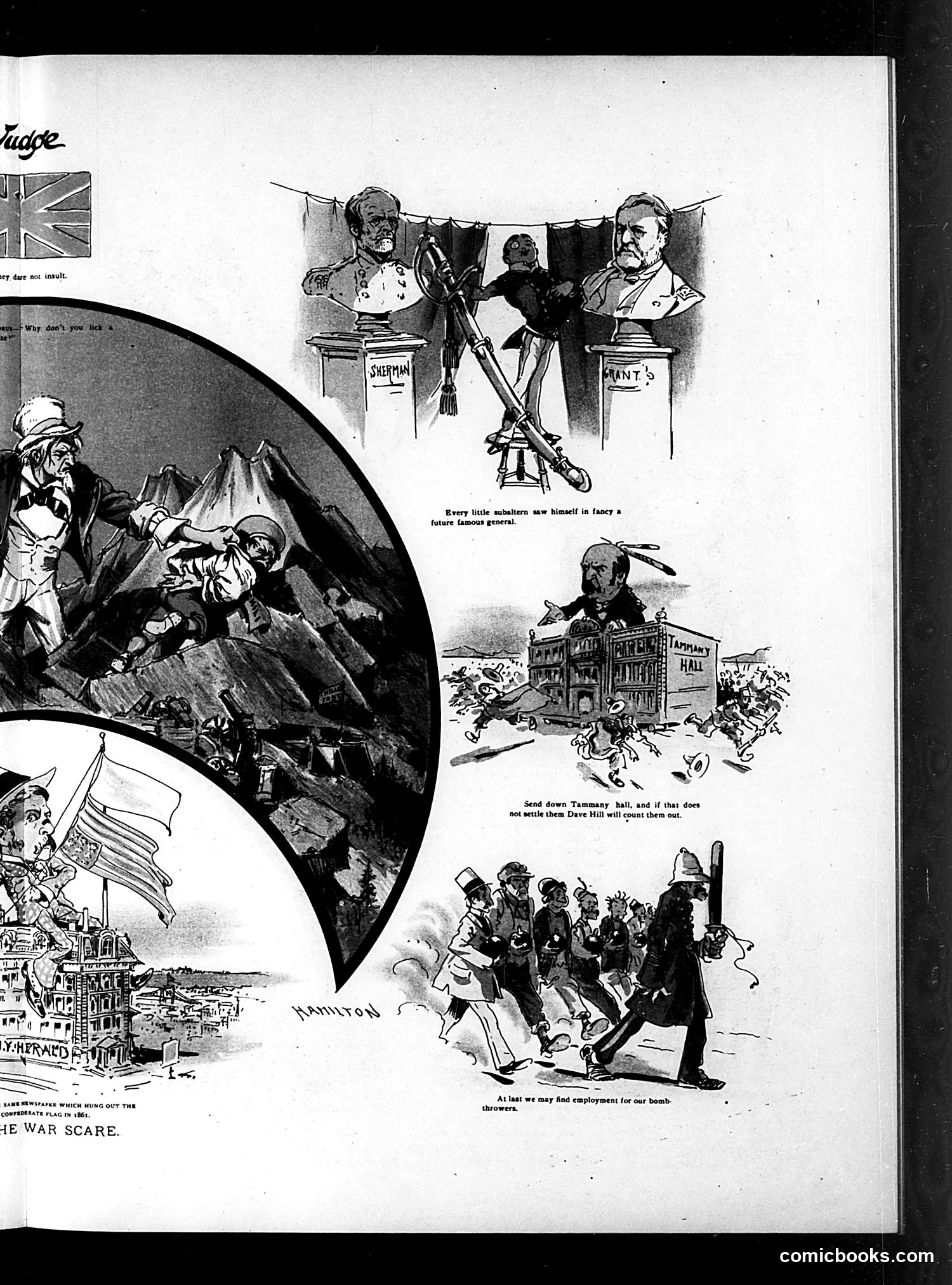
This political cartoon satirizes American anxieties about potential war, likely from the 1890s. The page mocks several targets: **Top section**: Military officers (Sherman and Grant busts) fantasize about future glory, while young soldiers imagine themselves as famous generals. **Middle**: References "Tammany Hall" (NYC's corrupt Democratic political machine) and "Dave Hill," suggesting that sending soldiers could solve domestic political problems. **Bottom**: Depicts unemployed "bomb-throwers"—likely anarchists or radical agitators—finding military service as employment, sarcastically suggesting war could solve social unrest. **Left panel**: "The War Scare" shows fearful civilians, implying public anxiety about conflict is being manufactured or exploited. The cartoon critiques how war rhetoric distracts from or seemingly "solves" domestic problems—corruption, unemployment, radical discontent—rather than addressing them directly.
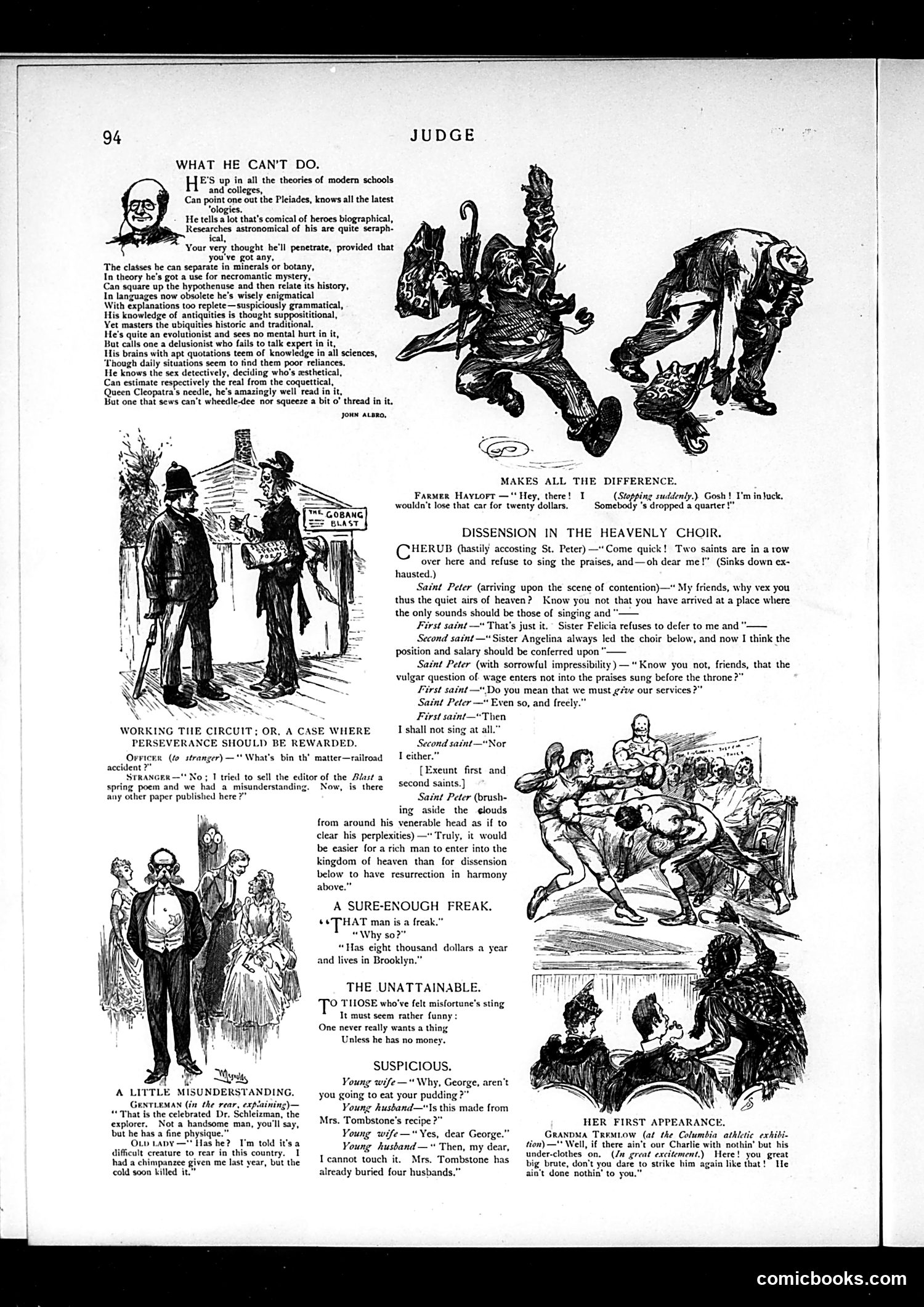
This page from Judge magazine contains several distinct satirical pieces mocking various social types and situations: **"What He Can't Do"** targets the overeducated intellectual who masters abstract knowledge (astronomy, languages, antiquities) but proves helpless at practical tasks—notably he can't thread a needle. The satire attacks pedantry and the gap between theoretical learning and real-world competence. **"Dissension in the Heavenly Choir"** mocks workplace disputes over status and salary by placing them absurdly in heaven itself. Two saints refuse to sing until given proper positions and pay, revealing how petty human vanities persist even among the blessed. Saint Peter's exasperation shows the humor. **"Makes All the Difference"** is a brief joke: a farmer loses a car worth twenty dollars but celebrates finding a dropped quarter—demonstrating economic desperation or misplaced priorities. Other sketches satirize human nature: the Brooklyn rich man as "freak," romantic suspicion, and the paradox that we only want what we cannot have. The cartoons use class and religious settings for social critique typical of Judge's satirical purpose.
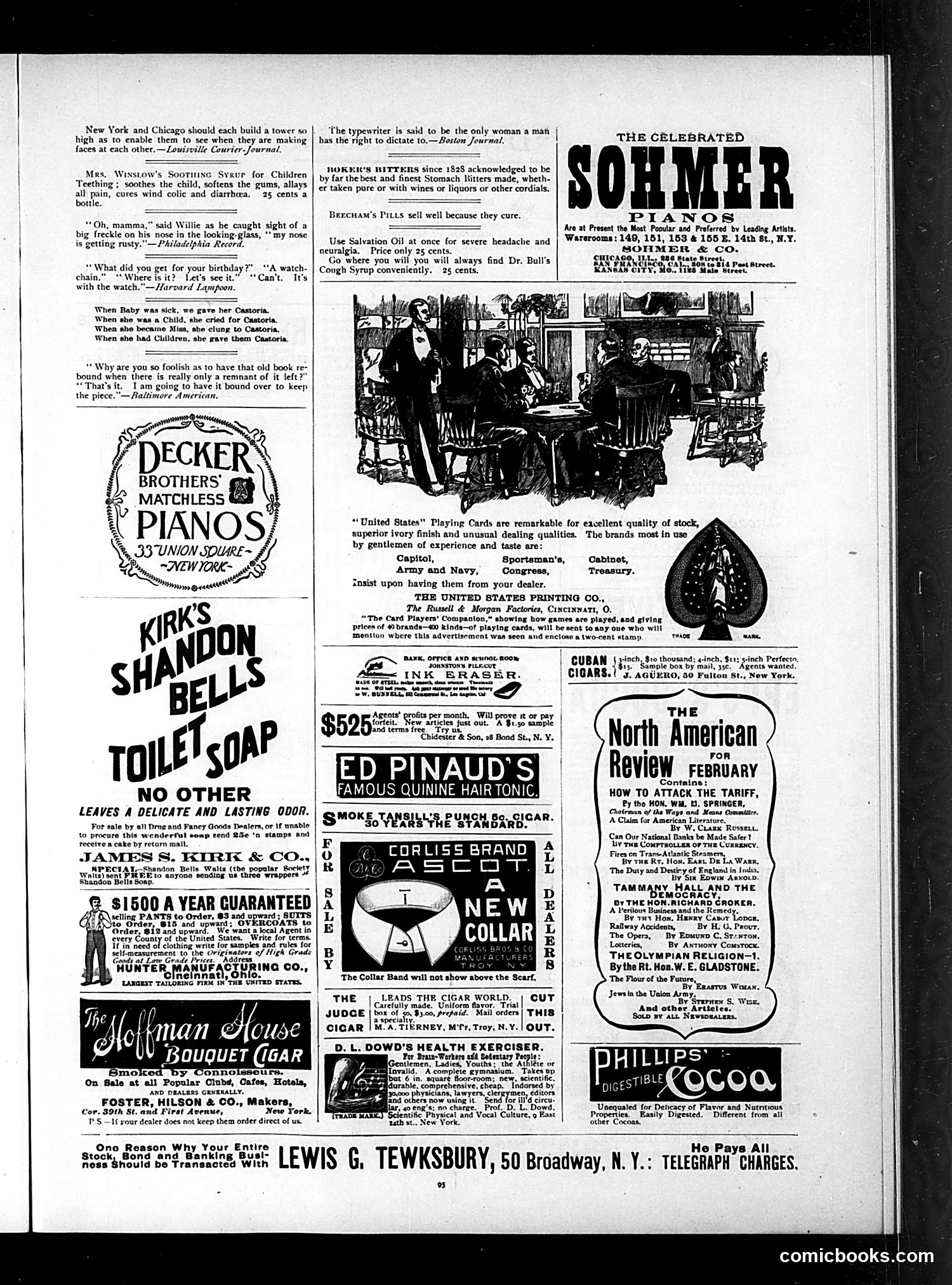
This page is primarily **advertisements and humorous filler content** rather than political satire. The layout includes various product ads (pianos, playing cards, toiletries, patent medicines) surrounding short jokes and quips clipped from other newspapers. The few visible jokes are generic humor typical of the era: wordplay about typewriters and women's subservience, a child's birthday gift joke, and observations about book binding and nostalgia. These are lighthearted rather than political. The dominant content reflects **early 1900s consumer culture**—promoting Sohmer pianos, Kirk's toilet soap, nostrum medicines (Castoria, Salvation Oil), and quack remedies (Beecham's Pills). The "$1500 a Year Guaranteed" tailoring scheme exemplifies aggressive sales tactics of the period. No clear political figures or satire are identifiable on this page. It represents Judge's business model: mixing modest editorial humor with paid advertisements.
This page is primarily **advertising**, not political satire. It contains no political cartoons or caricatures requiring historical context. The ads showcase late-19th-century consumer products: suspenders, fabric, cocoa, flour, steel pens, pianos, and cameras. One notable item is the "Daylight" Kodak advertisement, promoting a new camera innovation allowing film loading in daylight rather than darkrooms—a significant technological advance for amateur photography. The single non-advertising element is a small caption attributing a joke ("The best thing out—A conflagration") to *Drake's Magazine*, suggesting humorous commentary on industrial accidents or destruction. The page reflects the advertising-heavy nature of *Judge* magazine, mixing consumer goods with occasional witticisms. No political figures, events, or satire are discernible here—it's a straightforward commercial publication page from the 1880s-1890s era.
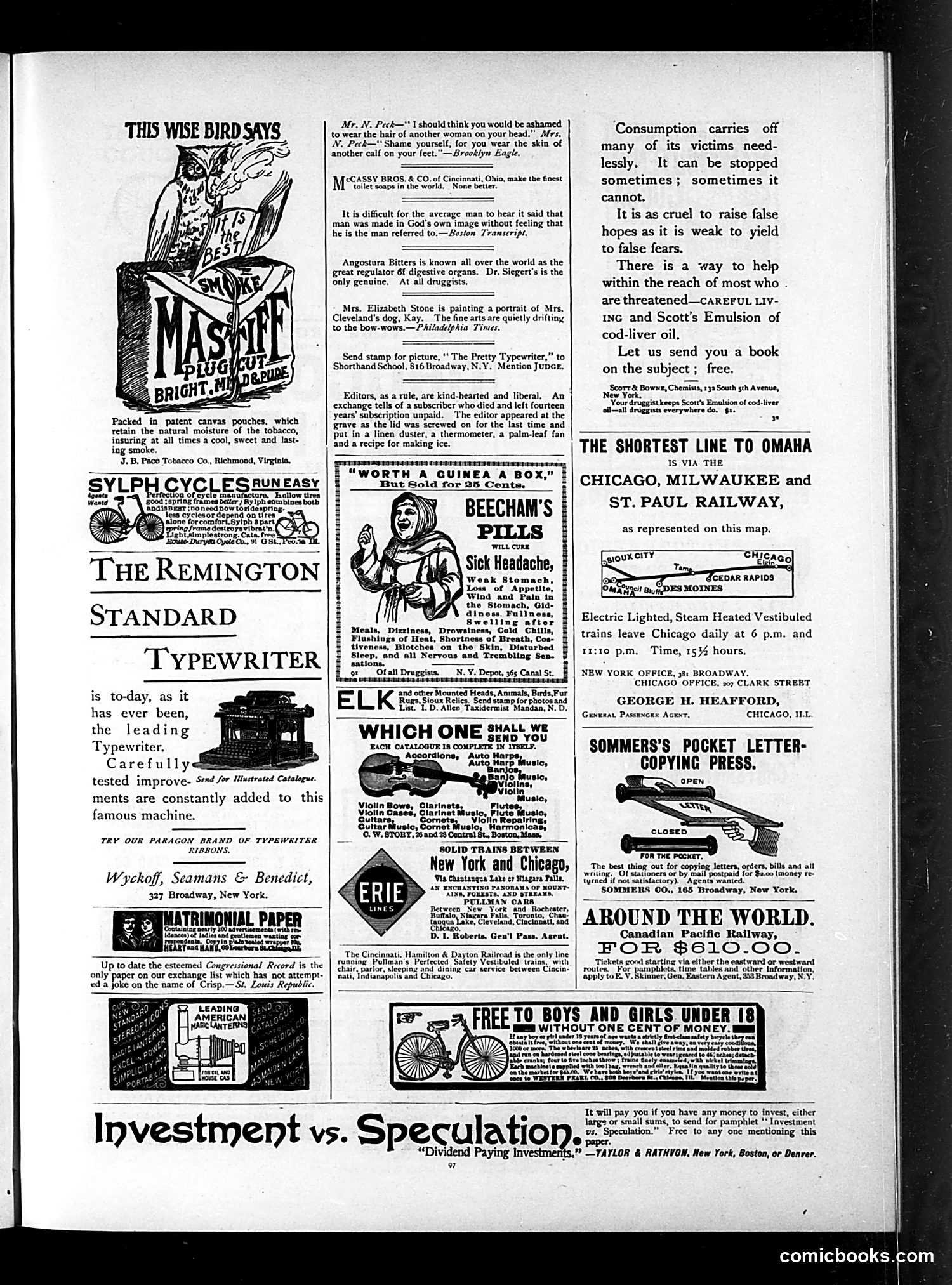
This is primarily an **advertising page** from an American satirical magazine, with several brief humorous items interspersed. The main **cartoons/humor** include: 1. **"This Wise Bird"** (top left): An owl mascot for J.B. Pace tobacco, offering smoking advice. The "wise bird" conceit is straightforward product branding rather than satire. 2. **Mr. and Mrs. N. Peck exchange** (top center): A marital joke about wearing another woman's hair (a hairpiece/switch) versus wearing calf skin (shoes). The humor derives from mock outrage and hypocrisy—each accuses the other of wearing animal products while doing the same themselves. 3. **Editor anecdote** (center): A satirical jab at newspaper editors' stinginess, describing one attending a subscriber's funeral and leaving items (duster, thermometer, fan, ice recipe) as if the dead man were still in debt. The remainder consists of **period advertisements** for typewriters, bicycles, pharmaceuticals, and railroad services—typical of late 19th-century American publications.
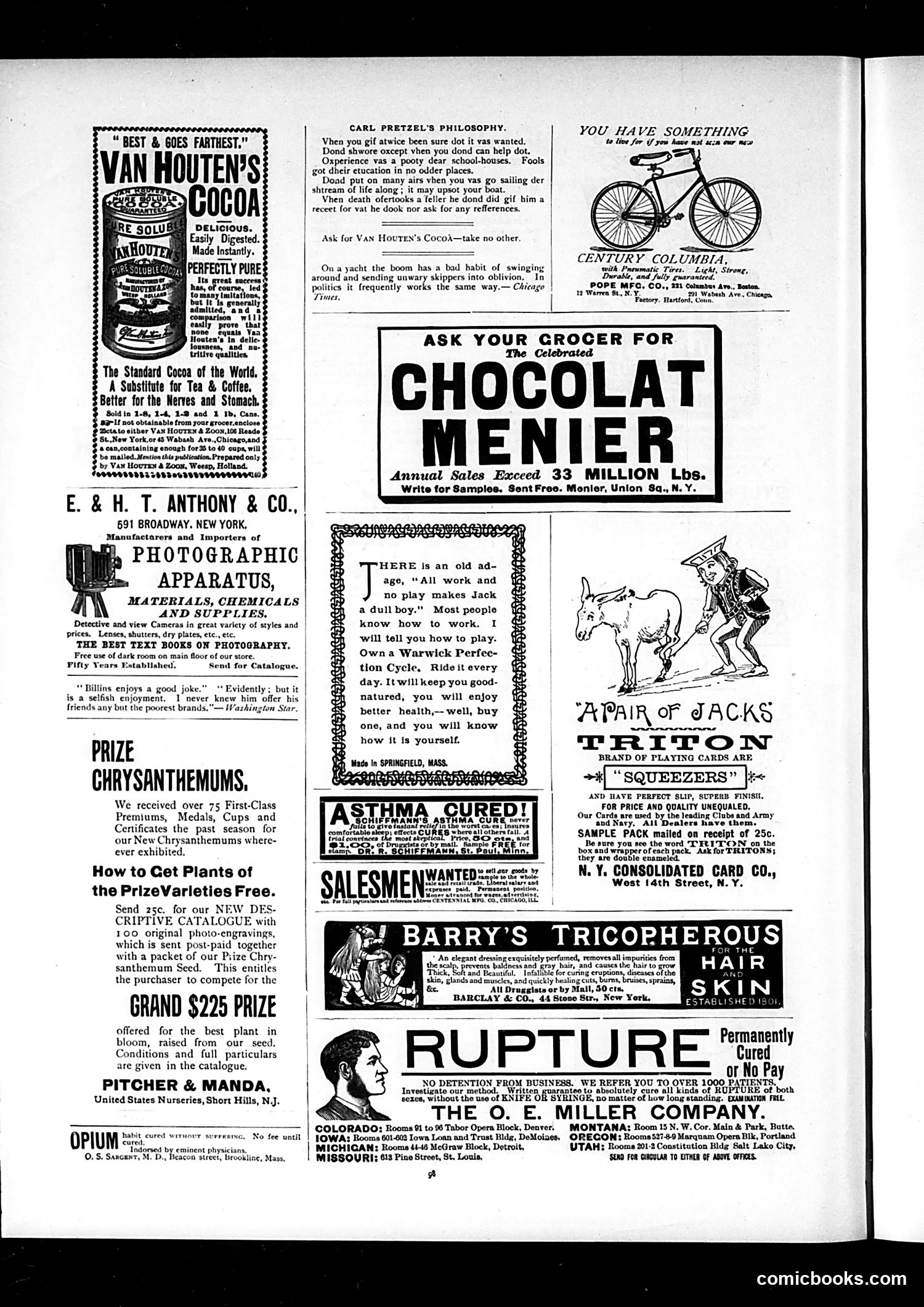
This page is primarily **advertising**, typical of Judge's revenue model. However, it includes one notable satirical element: **"Carl Pretzel's Philosophy"** presents a German-accented character dispensing folk wisdom in broken English—a common Judge format mocking immigrant speech patterns. The humor relies on ethnic caricature, with phrases like "dond shwore" and "pooty dear school-houses" rendering German-influenced English. The philosophical observations (about advice, experience, death, and yacht etiquette) are generic aphorisms, the satire being gentle rather than pointed. The remaining content consists of period product advertisements: cocoa, photographic equipment, bicycles, playing cards, patent medicines, and rupture cures—many making dubious health claims typical of early-1900s marketing. **For modern readers:** This reflects both Judge's satirical tradition and its dependence on ethnic humor and unregulated medical advertising now considered offensive and fraudulent respectively.
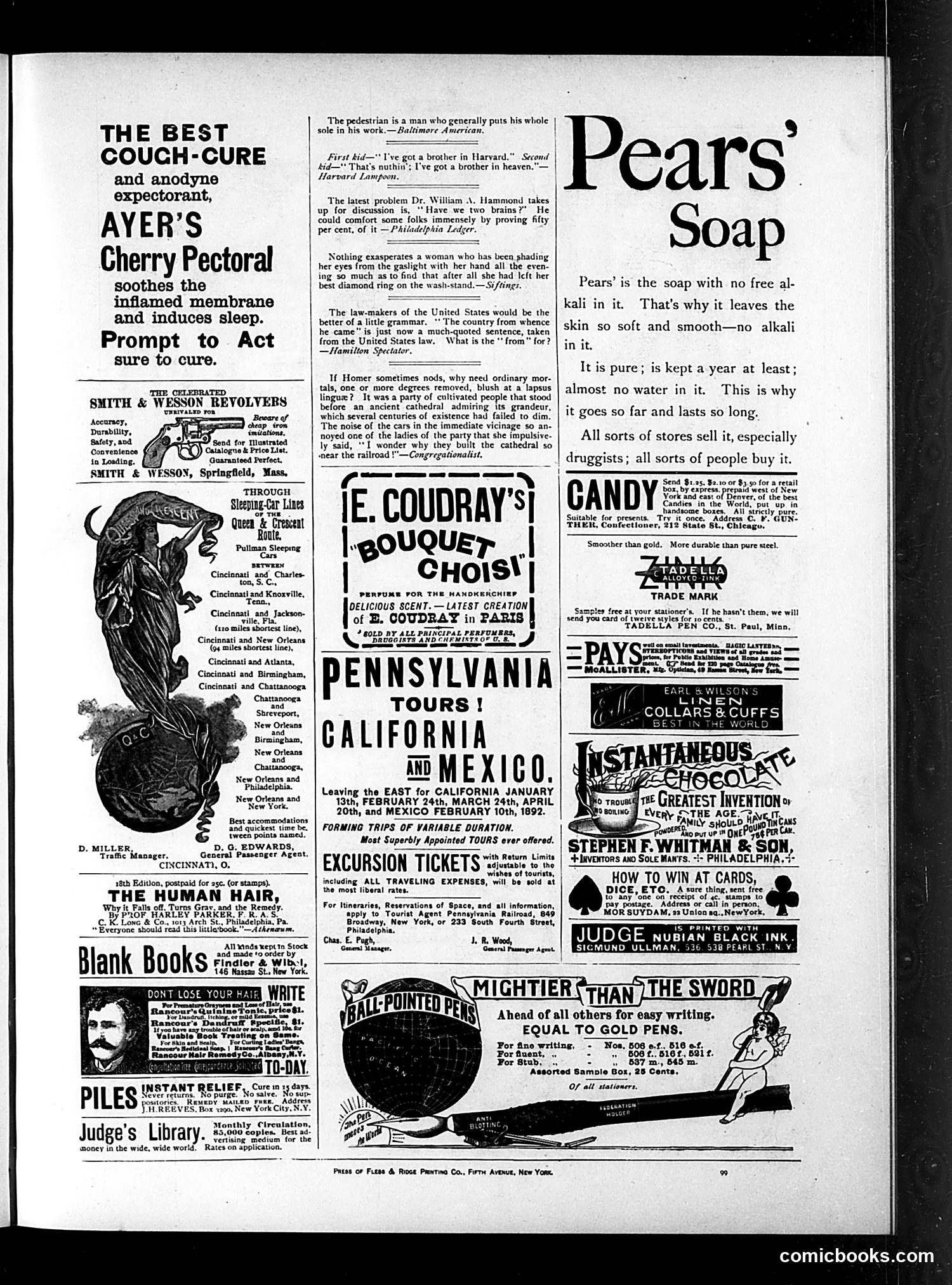
This is primarily an **advertising page** from Judge magazine (late 19th century, likely 1892 based on visible dates). The few editorial items are brief satirical quips about contemporary life: - A pun on "pedestrians" putting their "sole" into work - Jokes about Harvard snobbery, Dr. Hammond's theories on brain capacity, women's frustration with lost jewelry, and grammar in law-making - A humorous anecdote: cultured people admiring an ancient cathedral are so annoyed by nearby railroad noise that one woman wishes the cathedral had been built away from the railroad—missing the obvious historical point that trains didn't exist when cathedrals were constructed The page is otherwise dominated by **advertisements** for patent medicines (Ayer's Cherry Pectoral), firearms (Smith & Wesson), transportation services, toiletries, and travel tours. This reflects Judge's business model: satirical content subsidized by commercial advertising aimed at middle- and upper-class readers. The satire is mild, domestic, and class-conscious—typical of Gilded Age American humor.
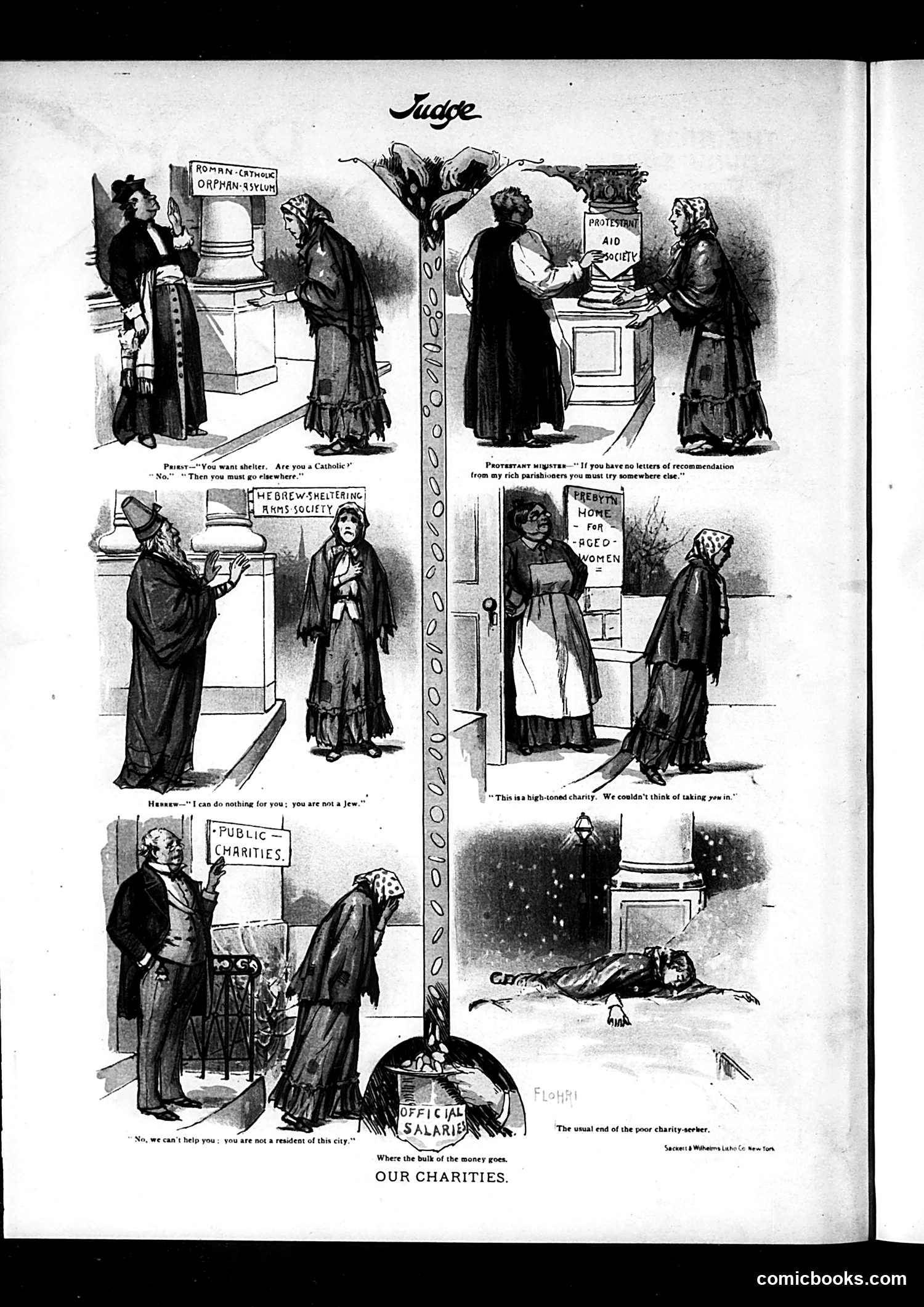
This multi-panel cartoon satirizes how established charitable institutions fail poor people through bureaucratic gatekeeping and prejudice. Each panel shows a desperate person seeking aid being rejected: - A **Catholic priest** turns away someone for lacking wealthy parishioner recommendations - A **Protestant minister** demands proof of residency - A **shelter operator** asks if the applicant is Catholic (implying sectarian discrimination) - A **"homes for aged women"** refuses admission based on unstated criteria - An **official charity administrator** denies help because the person isn't a city resident The final panel depicts a poor person dead in the street—"the usual end of the poor charity-seeker"—with the caption "Where the bulk of the money goes" pointing to the official's salary. The cartoon's message: charitable institutions prioritize rules, religious affiliation, and administrator salaries over actually helping the poor. The satire exposes how organized charity becomes self-serving rather than humanitarian.