
A complete issue · 16 pages · 1891
Judge — October 24, 1891
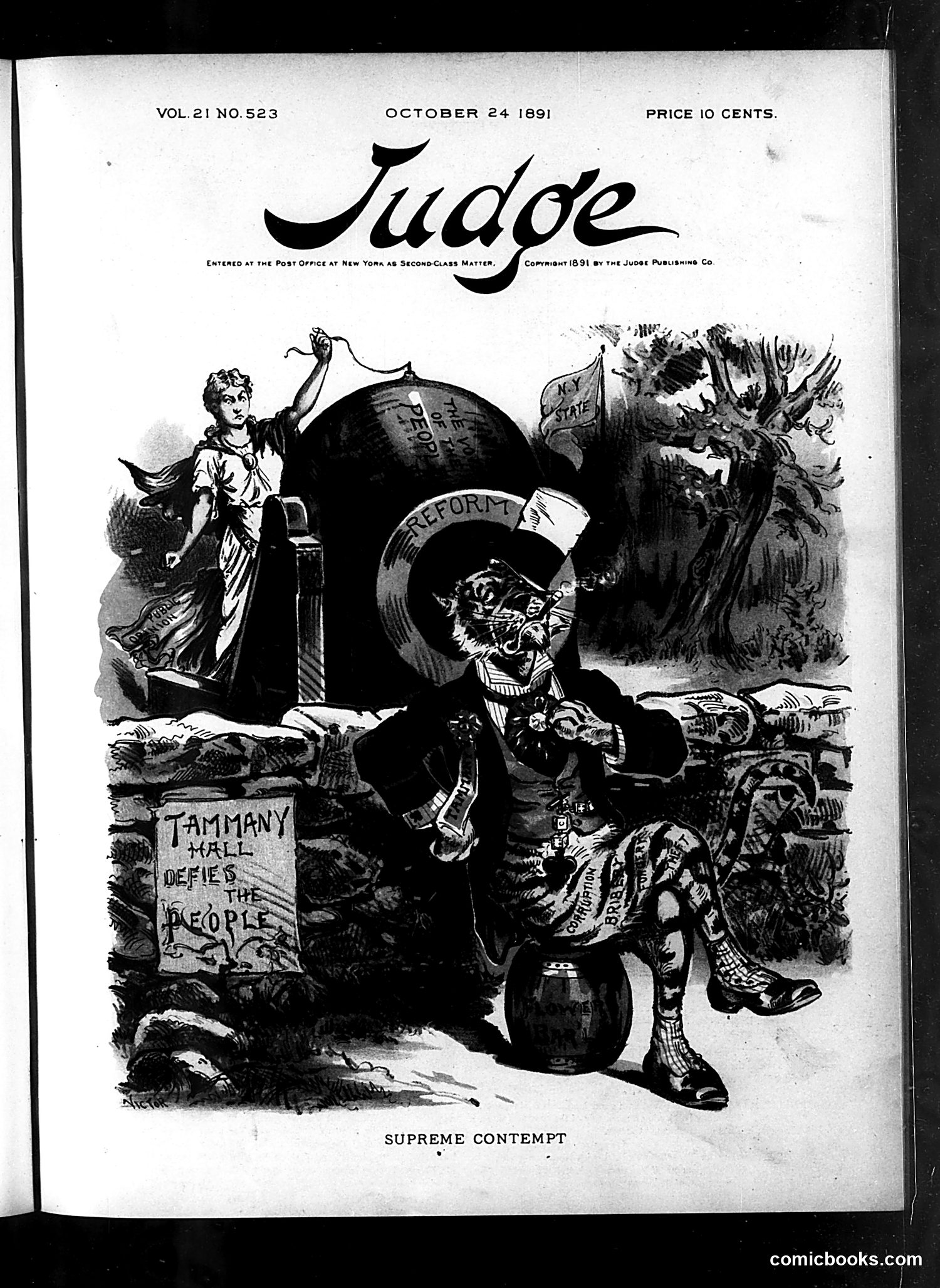
This political cartoon satirizes Irish nationalist leader **Charles Stewart Parnell** (the skeletal figure wearing a "Reform" hat) and the **Tammany Hall** political machine. The skeleton figure appears to represent the decay or death of reform efforts, while Lady Justice holds scales above, suggesting judicial judgment. The sign reading "Tammany Hall Defies the People" indicates criticism of New York's corrupt Democratic organization. The cartoon likely references Parnell's fall from power in 1891 following personal scandal, and connects this to broader American political corruption. The imagery suggests that both figures—the discredited Irish politician and the corrupt American political machine—merit public contempt for defying democratic principles.
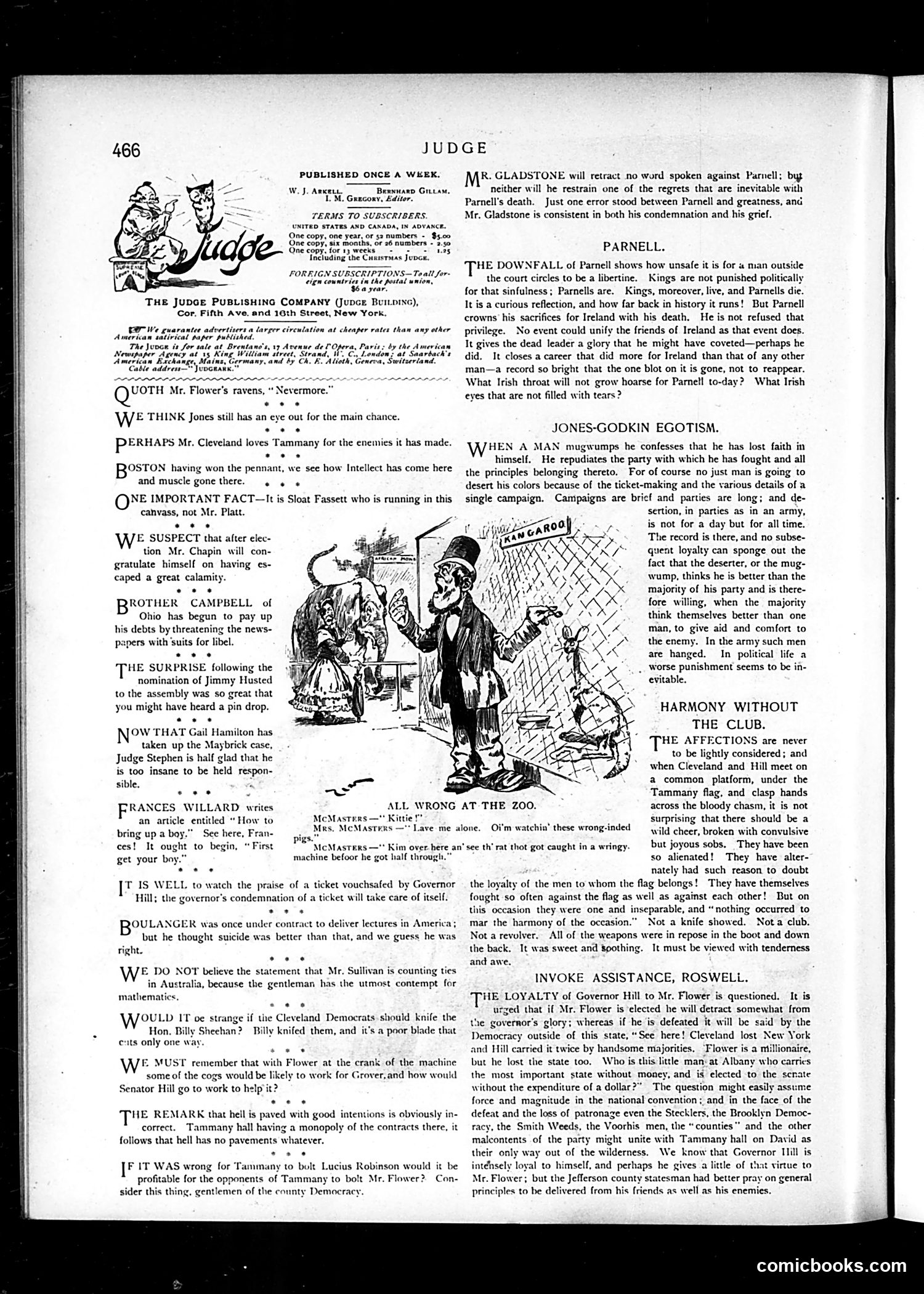
This cartoon satirizes **Mayor Gould** (labeled "McMasters") and an unnamed official at a zoo. The joke appears to involve a **lion escaping or misbehaving**, with one figure saying the lion "got caught in a wringer" while another insists he's "seen th'rat shot got caught in a wringer machine before." The satire seems to mock **incompetent municipal management**—specifically, the officials' inability to properly handle or explain the situation. The "zoo" setting may represent New York City politics itself, with various problematic "creatures" (political figures) requiring management. The accompanying text discusses **political loyalty, party machines, and Democratic infighting**, suggesting this addresses larger questions of patronage and political alignment during what appears to be an early 1900s election period.
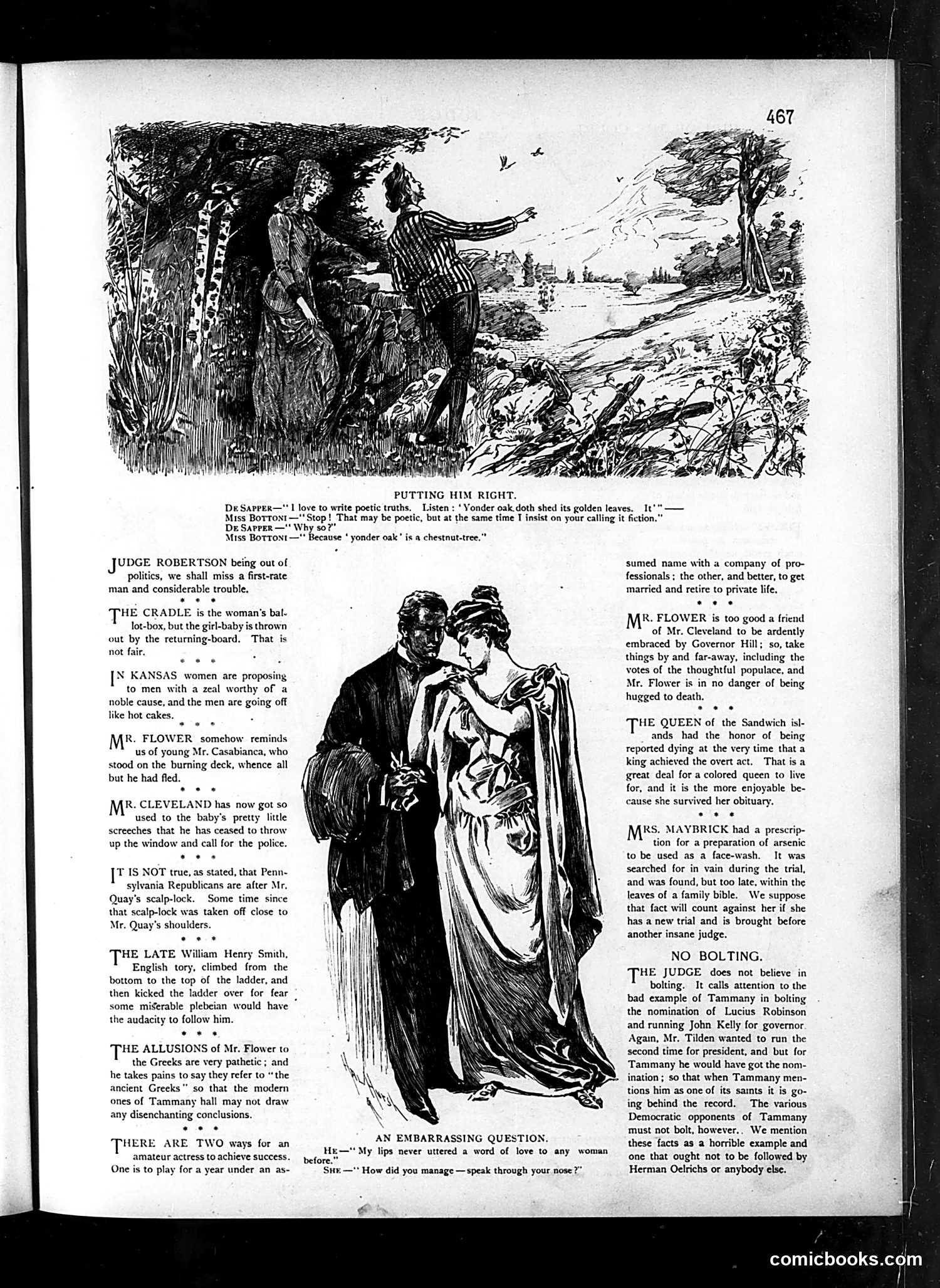
**Top Cartoon ("Putting Him Right"):** A satirical exchange about poetry and trees. Dr. Sapper claims "yonder oak doth shed its golden leaves," but Miss Bonton corrects him—it's a chestnut tree, not an oak. The joke mocks pretentious attempts at poetic language undermined by basic factual errors. It's social satire about affected speech among the educated classes. **Text Content:** The page contains brief political commentary critiquing Judge Robertson's absence from politics, gossip about Kansas women and courtship, and discussion of various society figures (Flower, Cleveland, Maybrick). The final item, "No Bolting," addresses political party loyalty—specifically referencing past candidates Tammany Hall opposed. The content reflects Gilded Age American political and social preoccupations.
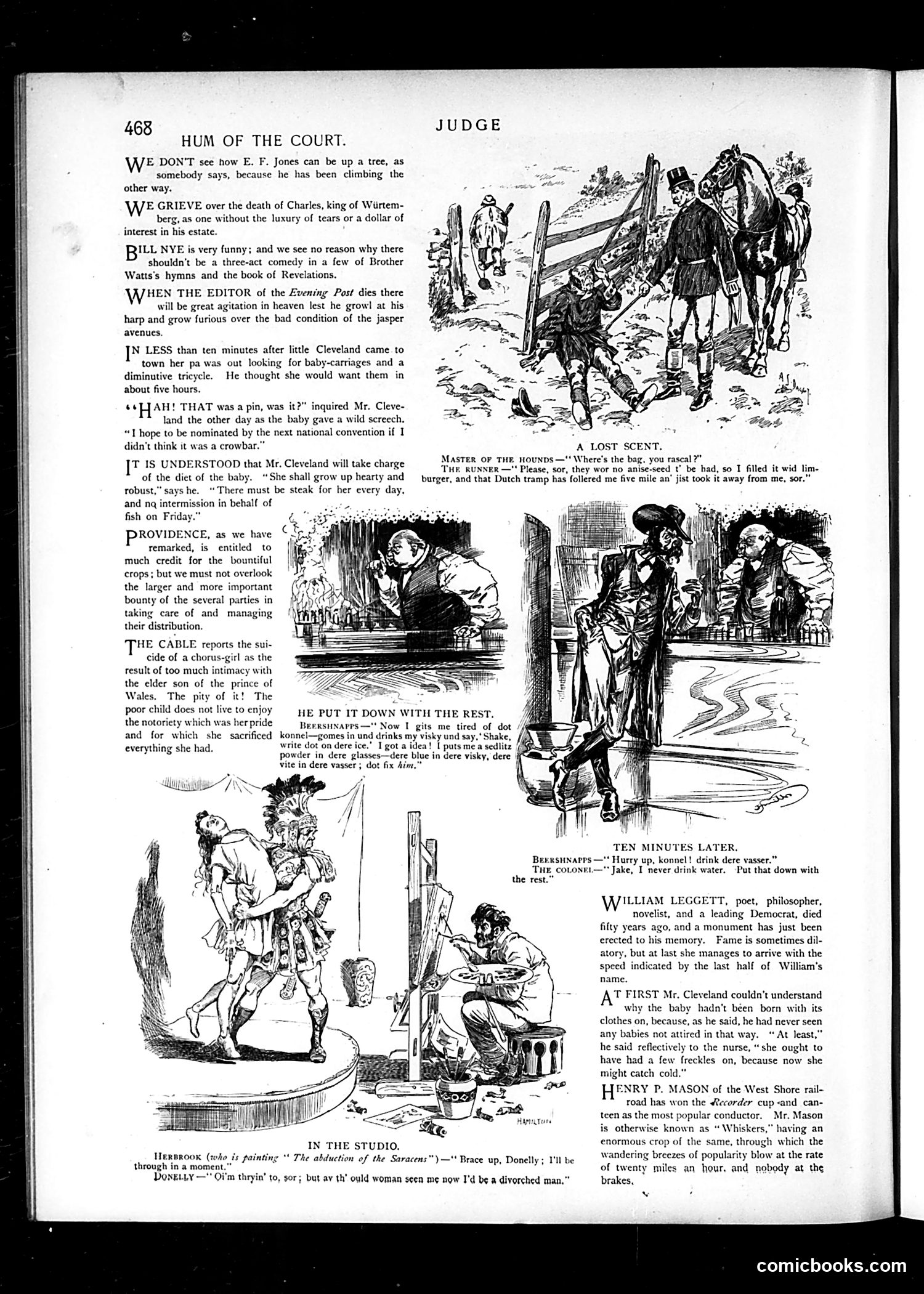
This page contains brief satirical "humor" items typical of Judge magazine's "Hum of the Court" column, mixing political jabs with general comedy. **Key references:** - **E.F. Jones** and **Cleveland**: Likely Grover Cleveland, referencing political climbing/reversals - **Charles, King of Württemberg**: Contemporary European news; the satire mocks indifference to royalty deaths among non-wealthy readers - **Evening Post editor**: Personal jab at a specific rival publication's editor - **Cleveland's baby**: Satirizes Cleveland as an obsessive new father, including jokes about his dietary micromanagement **The cartoons** depict working-class characters—Irish servants, old women—in domestic situations. The "Lost Scent" cartoon appears to mock both Irish servants and aristocratic pursuits (fox hunting); another shows a German servant ("Beersnapps") pranking his colonel with seltzer powder. **The satire's tone**: Punchy, mean-spirited, relying on ethnic stereotypes (Irish, German dialect humor), class mockery, and personal attacks on public figures. Typical of 1880s-90s American humor magazines that punched at both the powerful and working classes alike.
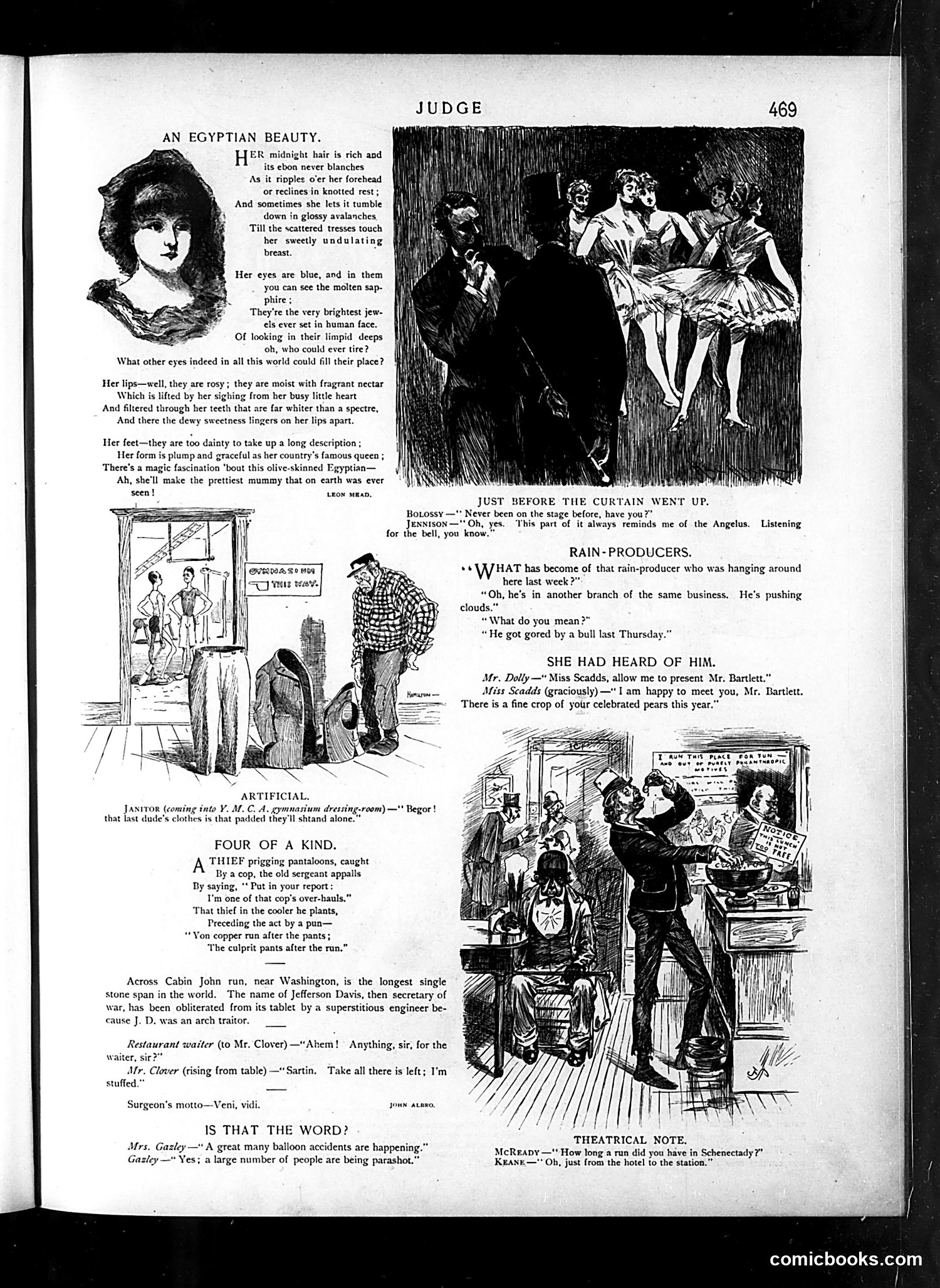
This page from Judge contains multiple brief humorous sketches typical of early 20th-century American satire: **"An Egyptian Beauty"** is a flowery poem mocking romantic literary clichés, paired with an illustration suggesting theatrical melodrama. **"Just Before the Curtain Went Up"** jokes about stage nervousness, with an actor comparing waiting in the wings to listening for a church bell—a reference to Millet's famous painting "The Angelus." **"Rain-Producers"** satirizes a con artist whose scheme has failed (gored by a bull), now relegated to selling "clouds"—likely mocking both weather-manipulation charlatans and failed businessmen. **"She Had Heard of Him"** plays on mistaken identity—Miss Scadds confuses Mr. Bartlett with someone else known for pears. **"Four of a Kind"** contains puns about theft and clothing ("pants" as trousers and the verb form). Minor items include observations about a Jefferson Davis monument and jokes about balloons and theatrical touring. The overall tone is light, pun-heavy vaudeville humor with no serious political commentary visible.
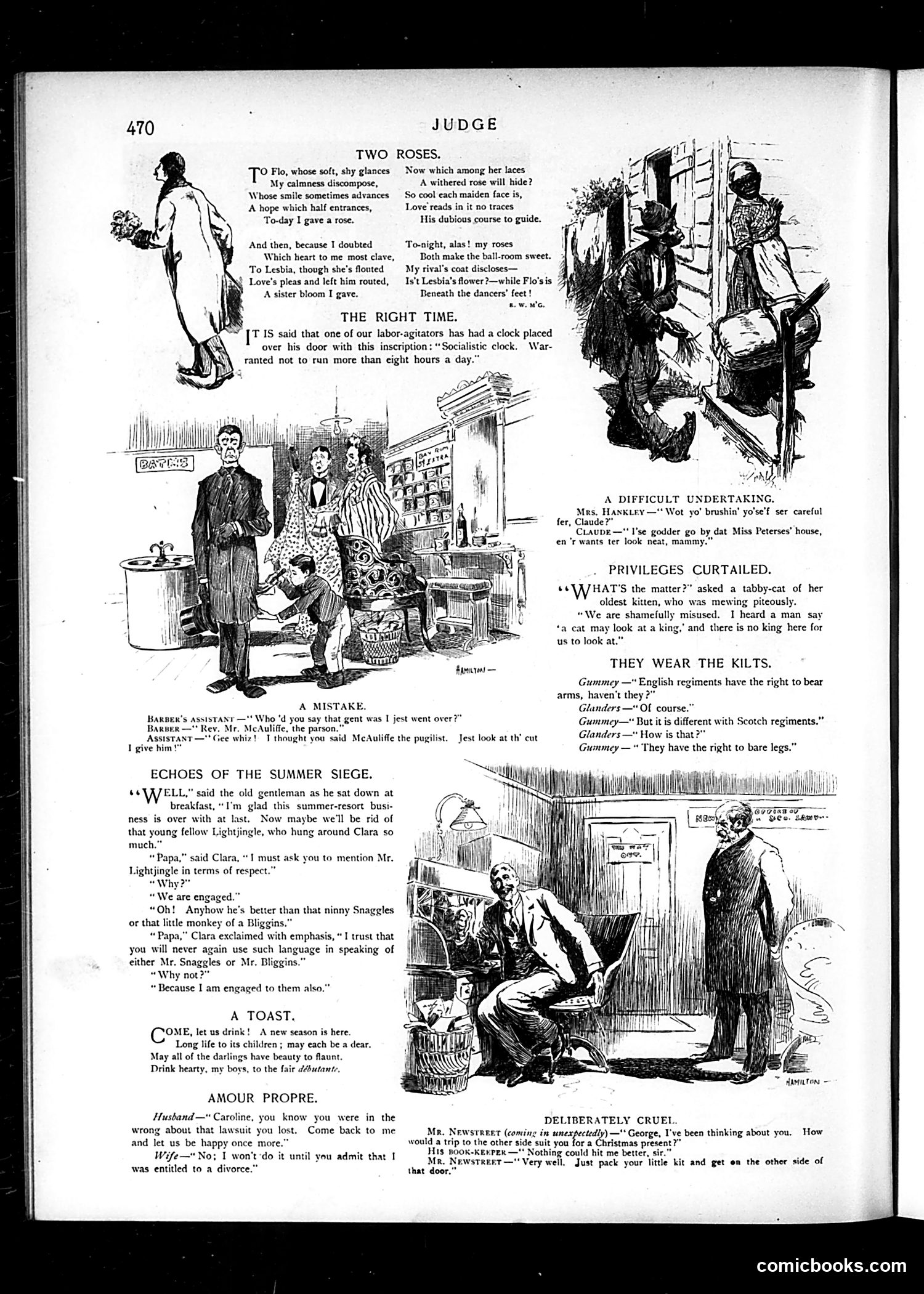
This page contains several satirical short pieces typical of Judge magazine's humor: **"The Right Time"** mocks labor activists with a joke about a "Socialistic clock" limited to eight-hour operation—commentary on labor movements' demands for shorter workdays. **"They Wear the Kilts"** plays on Scottish military regiments wearing kilts, with a pun: English regiments have "the right to bear arms" while Scottish ones have "the right to bare legs." **"Echoes of the Summer Siege"** satirizes a young woman (Clara) who becomes engaged to three different men during a summer resort season, poking fun at courtship customs and female agency. **"A Difficult Undertaking"** uses dialect humor (African American vernacular) for a joke about a servant visiting a white neighbor's house. **"Privileges Curtailed"** presents a kitten's complaint that without a king present, cats can't fulfill the saying "a cat may look at a king"—wordplay rather than political satire. The page reflects early-20th-century American humor conventions: social climbing anxieties, class distinctions, ethnic dialect comedy, and courtship mockery.
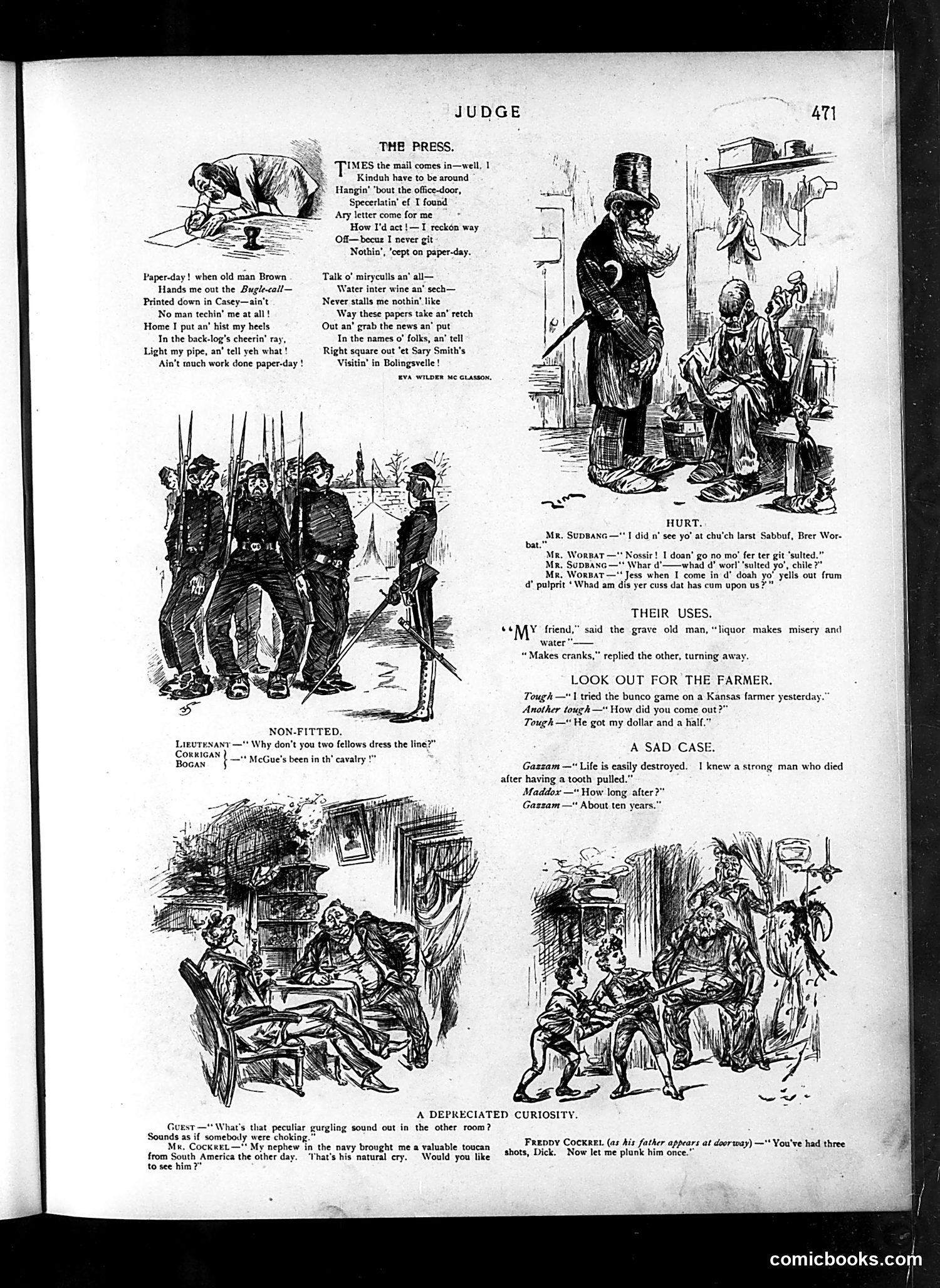
This page contains multiple satirical sketches typical of Judge's humor. "The Press" mocks rural readers' excitement about local newspapers—specifically how small-town papers publish trivial gossip (like "Sary Smith's Visitin' in Bolingsville"), treating mundane local news as miraculous. The rural dialect emphasizes the unsophisticated audience. Other sketches employ period humor: "Non-Fitted" jokes about military discipline; "Hurt" uses African American dialect for church humor; "Their Uses" contrasts liquor and water's effects; "Look Out for the Farmer" depicts a con man outsmarted by a farmer; "A Sad Case" presents dark humor about tooth extraction causing death; and "A Depreciated Curiosity" shows a man repeatedly shooting his nephew's imported toucan because of its natural cry. The cartoons reflect late 19th/early 20th-century Judge sensibilities: stereotyped dialects, slapstick violence played for laughs, and casual cruelty presented as wit.
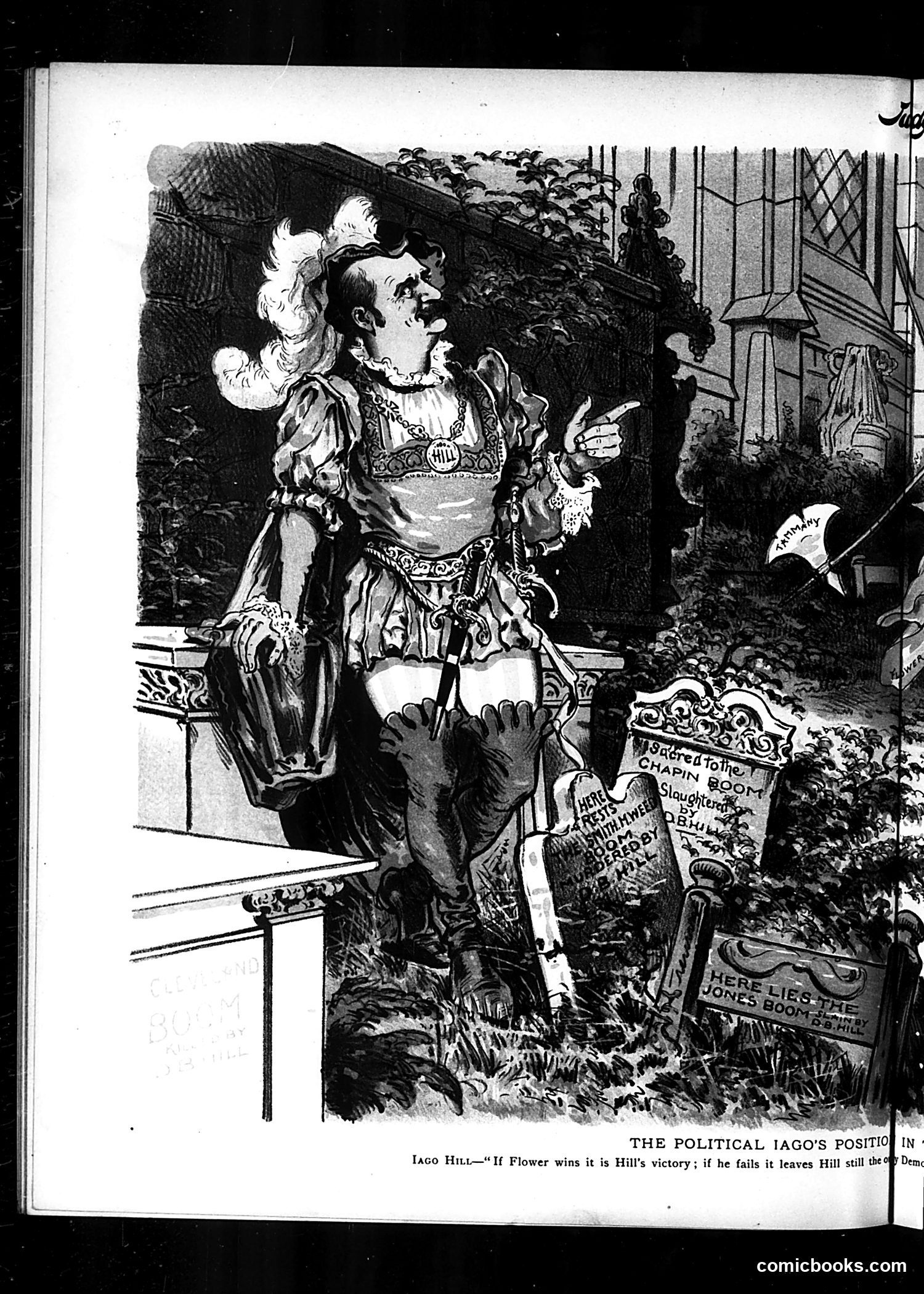
This political cartoon depicts a figure identified as "Iago Hill" in an ornate, theatrical costume, standing amid gravestones in what appears to be a cemetery. The reference to Shakespeare's *Othello* villain suggests this is satirizing someone manipulating events from behind the scenes. The caption indicates Hill is in a win-win position: if "Flower" wins, it benefits Hill; if Flower fails, Hill remains advantaged. This appears to reference late 19th-century American politics, likely involving David B. Hill and either Joseph H. Choate or another political rival nicknamed "Flower." The satire suggests Hill is orchestrating outcomes regardless of the election's result—a Machiavellian operator controlling the political landscape. The cemetery setting emphasizes the supposedly fatal consequences of his manipulation for his opponents.
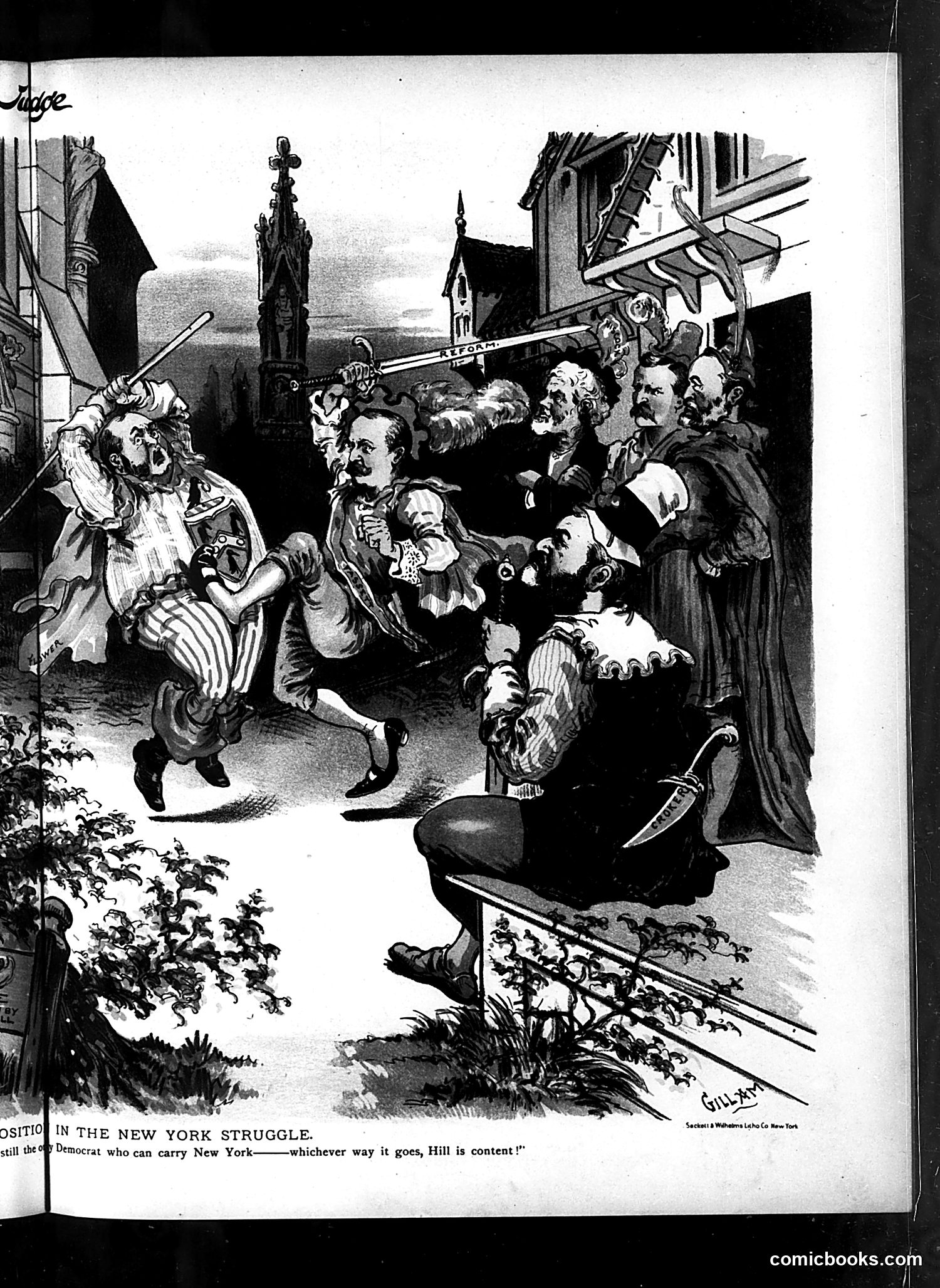
This political cartoon satirizes Democratic Party infighting over New York's electoral support. The text references "Hill" (likely David B. Hill, a prominent New York Democrat of the 1880s-90s), suggesting he's indifferent to which Democratic faction wins as long as he maintains power. The crowded scene shows multiple men in period dress appearing to negotiate or argue—representing competing Democratic factions fighting for control of New York's crucial electoral votes. The caricatured figures and their animated gestures convey the chaos and self-interested maneuvering within the party. The satire mocks Democratic disunity and suggests Hill's cynical pragmatism: he'll support whichever faction emerges victorious, caring only about his own position rather than party principle or broader politics.
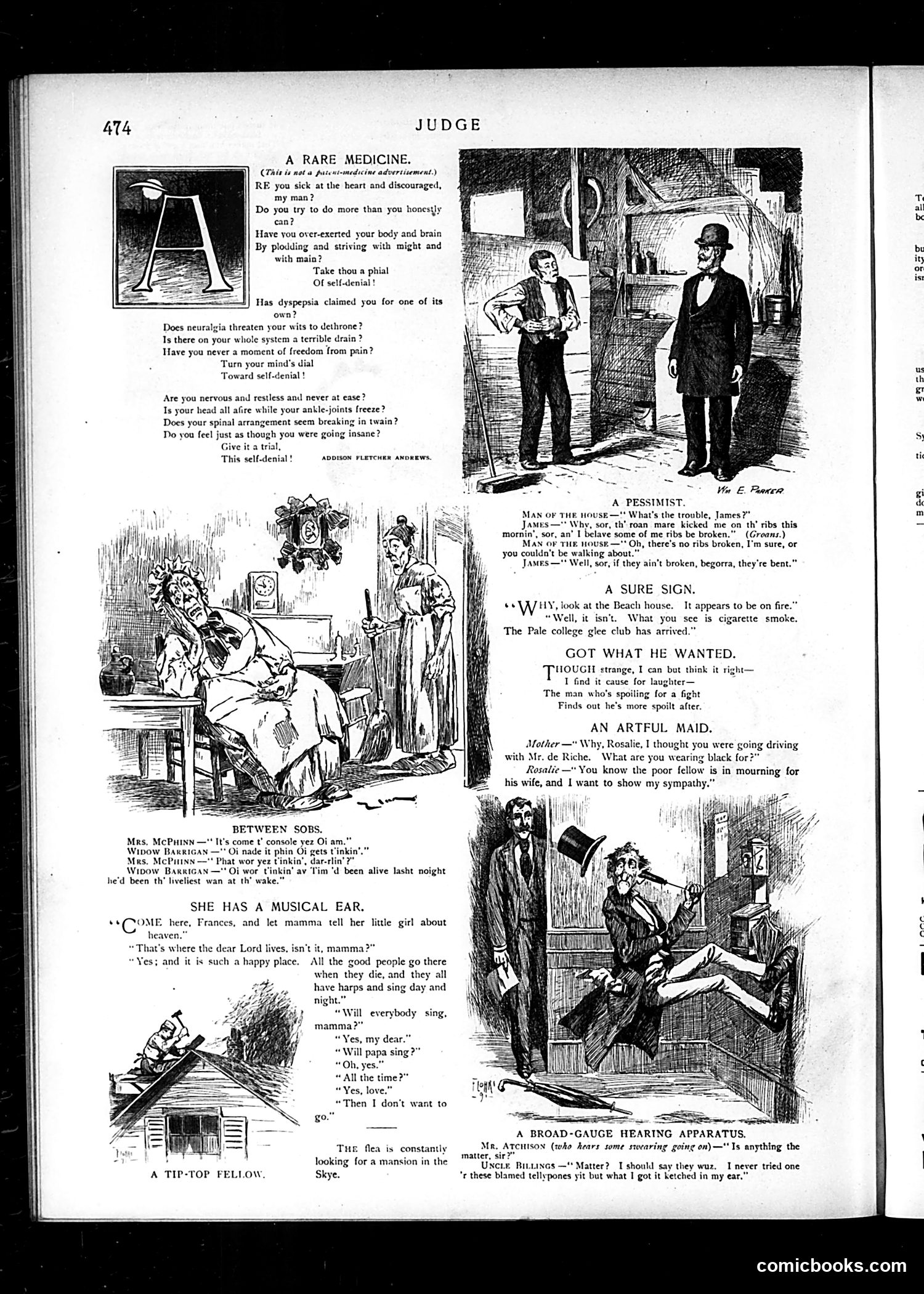
This page contains several unrelated satirical pieces typical of late 19th/early 20th-century humor journalism: **"A Rare Medicine"** mocks the era's tendency to prescribe "self-denial" as a cure-all for modern ailments—overwork, neuralgia, nervousness. The satire suggests Victorian society blamed personal weakness rather than systemic problems for health issues. **"She Has a Musical Ear"** jokes about a child's innocent logic: learning heaven means eternal singing, she refuses to go if her father will be there singing constantly—implying marital discord. **"A Sure Sign"** quips that the college glee club's arrival looks like fire (their singing is bad). **"A Broad-Gauge Hearing Apparatus"** depicts an older man struggling with a telephone—satirizing new technology's complexity for the elderly. "Broad-gauge" likely references railroad terminology, extending the mechanical metaphor. The remaining pieces are brief one-liners about Irish servants, flirtation, and fighting—typical period humor. The page reflects Judge's formula of mixed social satire and light comedic vignettes.
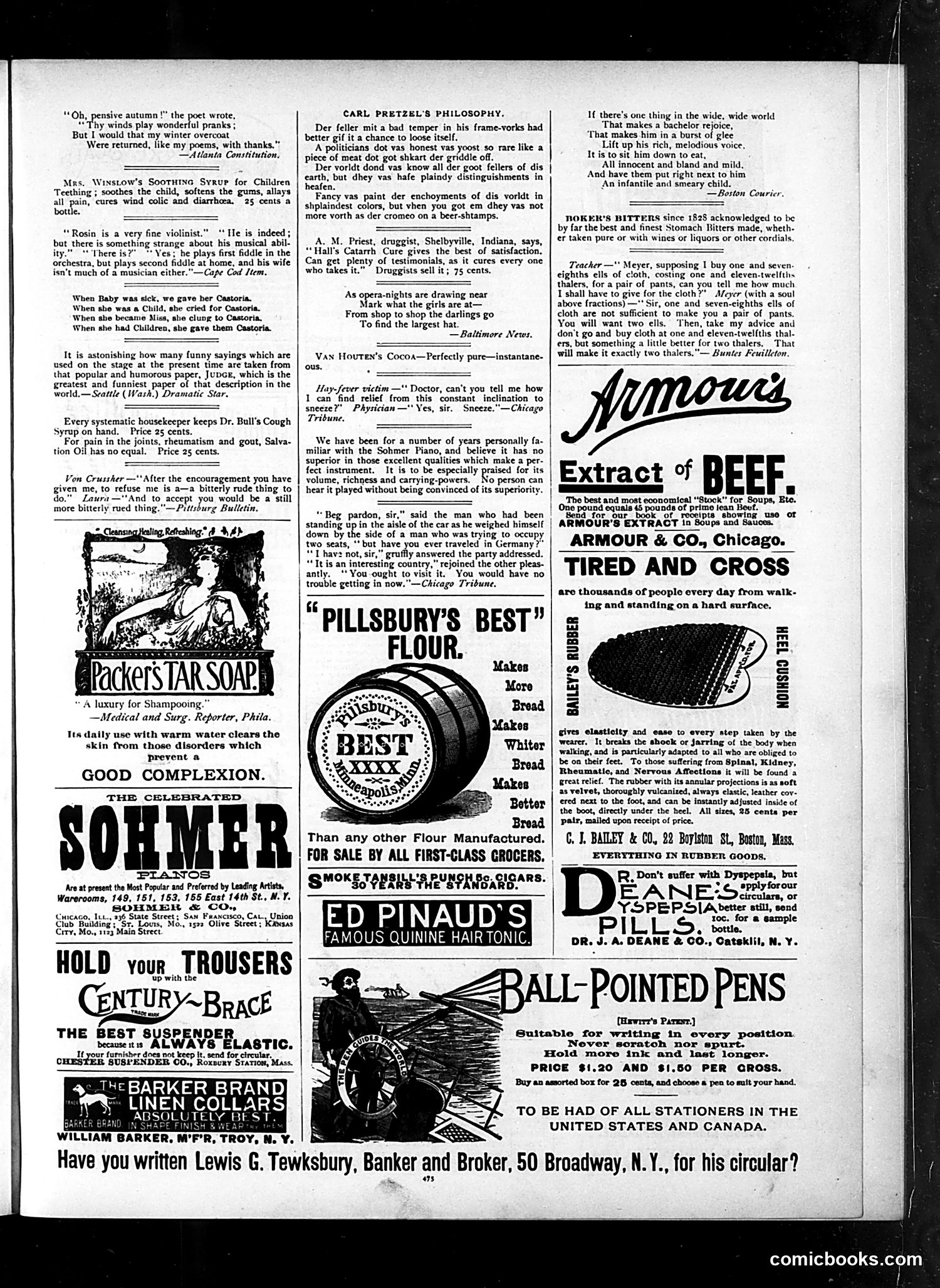
This page is primarily **advertising with satirical humor snippets**—typical of Judge magazine's format. The main satirical content includes: **"Carl Pretzel's Philosophy"** — ethnic humor featuring a German-accented character (identifiable by dialect spelling: "feller," "dot vas," "shkart") offering observations on temper, politicians' honesty, and life. This reflects late-19th/early-20th-century American magazines' reliance on ethnic caricature for humor. **Various short jokes** satirizing: - Rejected suitors and courtship ("Von Crusher") - Marital dynamics (musicians playing "second fiddle at home") - Contemporary social pretension (opera-goers buying oversized hats) **The advertising** promotes period products: pianos, flour, soap, suspenders, hair tonic, and patent medicines—reflecting the era's medical quackery and commercial culture. The page lacks prominent political cartooning; instead it showcases Judge's signature blend of **domestic comedy, ethnic stereotyping, and commercial messaging**—content designed for middle-class readers seeking genteel humor and product endorsements.
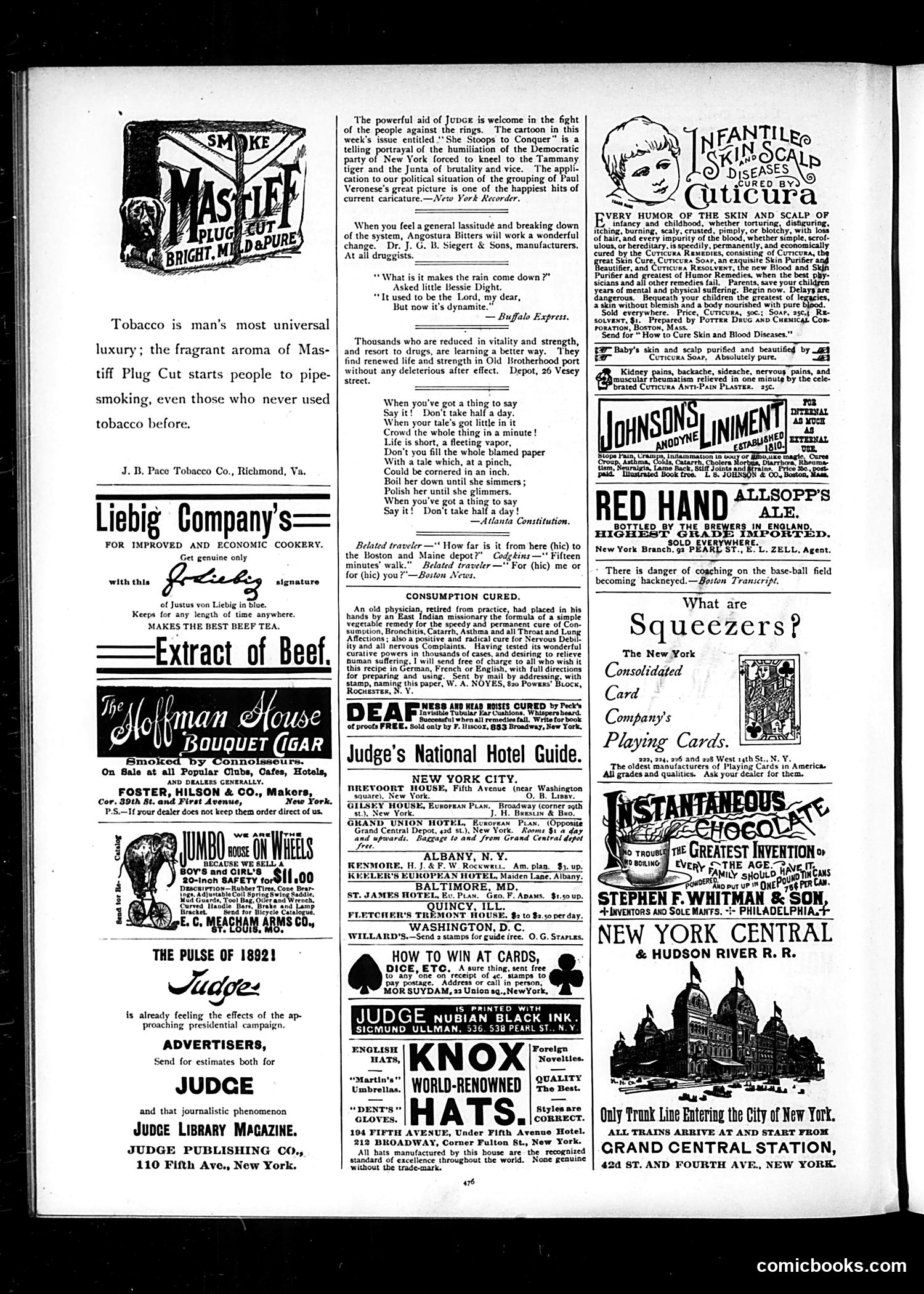
This page is primarily **advertising**, not political satire or editorial content. The references to Judge magazine appear only in house ads and publisher notes. The one substantive political reference is a quoted review praising Judge's cartoon "She Stoops to Conquer," which allegedly depicts the Democratic Party of New York "forced to kneel to the Tammany tiger"—meaning the Tammany Hall political machine. This suggests the magazine had published anti-Tammany satire, but that cartoon is not visible on this page. The bulk of the page consists of period advertisements for tobacco, beef extract, cigars, ink, playing cards, chocolate, hats, hotels, and medical remedies (many dubious by modern standards—consumption cures, "nervous debility" treatments). These ads are representative of late 19th-century advertising culture. The small poems and jokes scattered throughout are generic humor, not political commentary.
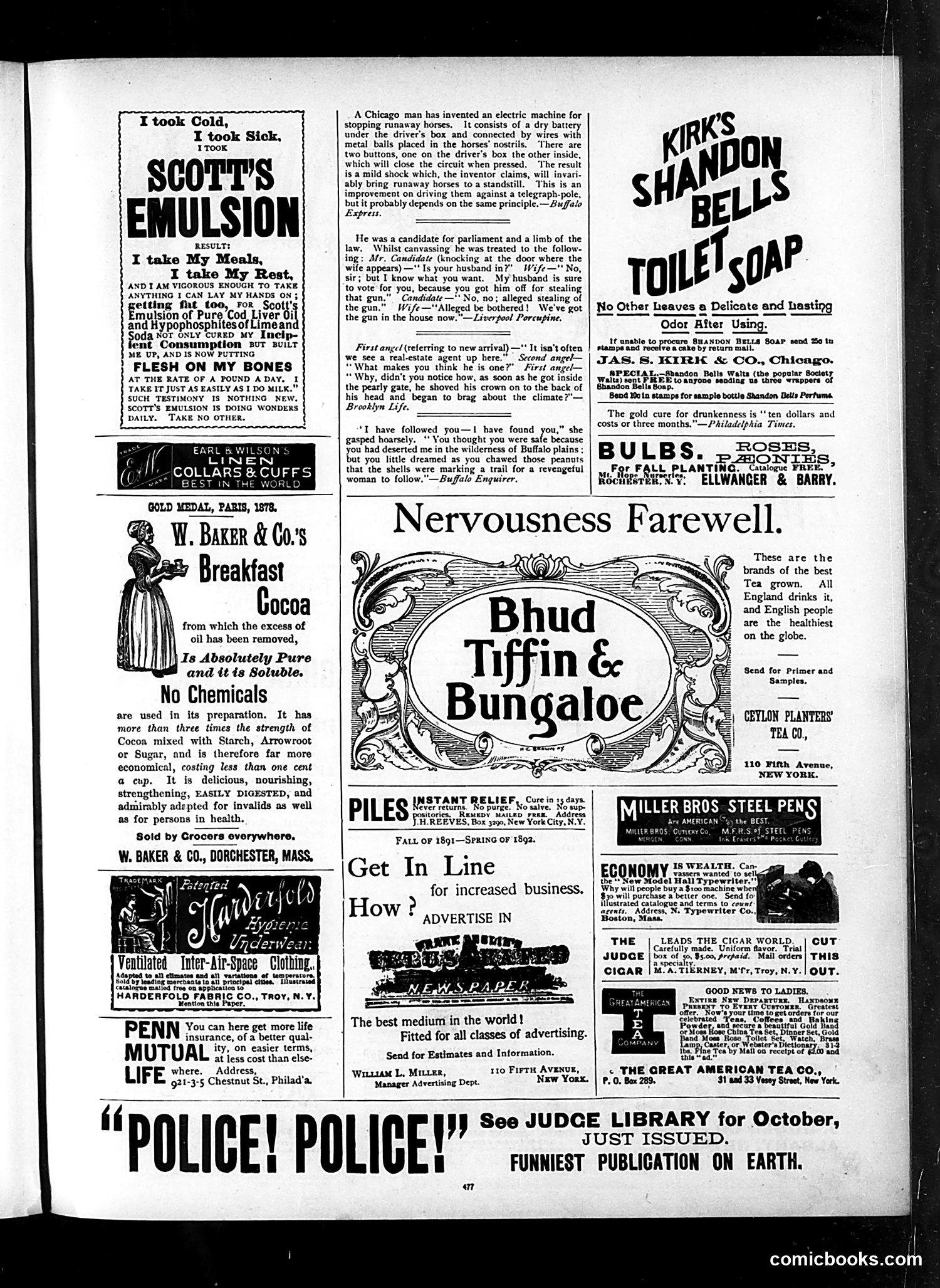
This is primarily an **advertising page** from Judge magazine, with minimal editorial content. The few short satirical pieces are: 1. **Anecdote about a parliamentary candidate**: A politician canvassing for votes encounters a woman whose husband he defended in a gun-theft case. She's grateful, but her language—saying "we've got the gun in the house now"—embarrasses the candidate by suggesting the alleged theft was real. The satire mocks both corrupt politicians and their constituents' crude honesty. 2. **Real estate agent joke**: A newly arrived real estate agent in heaven immediately begins boasting about the climate and pushing his crown aside—satirizing real estate salesmen's aggressive, relentless marketing tactics as almost demonic. 3. **A runaway horse invention**: Satirizes a Chicago inventor's electric nose-shocking device as needlessly complex compared to simply driving horses against telegraph poles. The page is otherwise dominated by period advertisements for Scott's Emulsion (cod liver oil), breakfast cocoa, soap, and other consumer goods typical of late-19th-century American magazines.
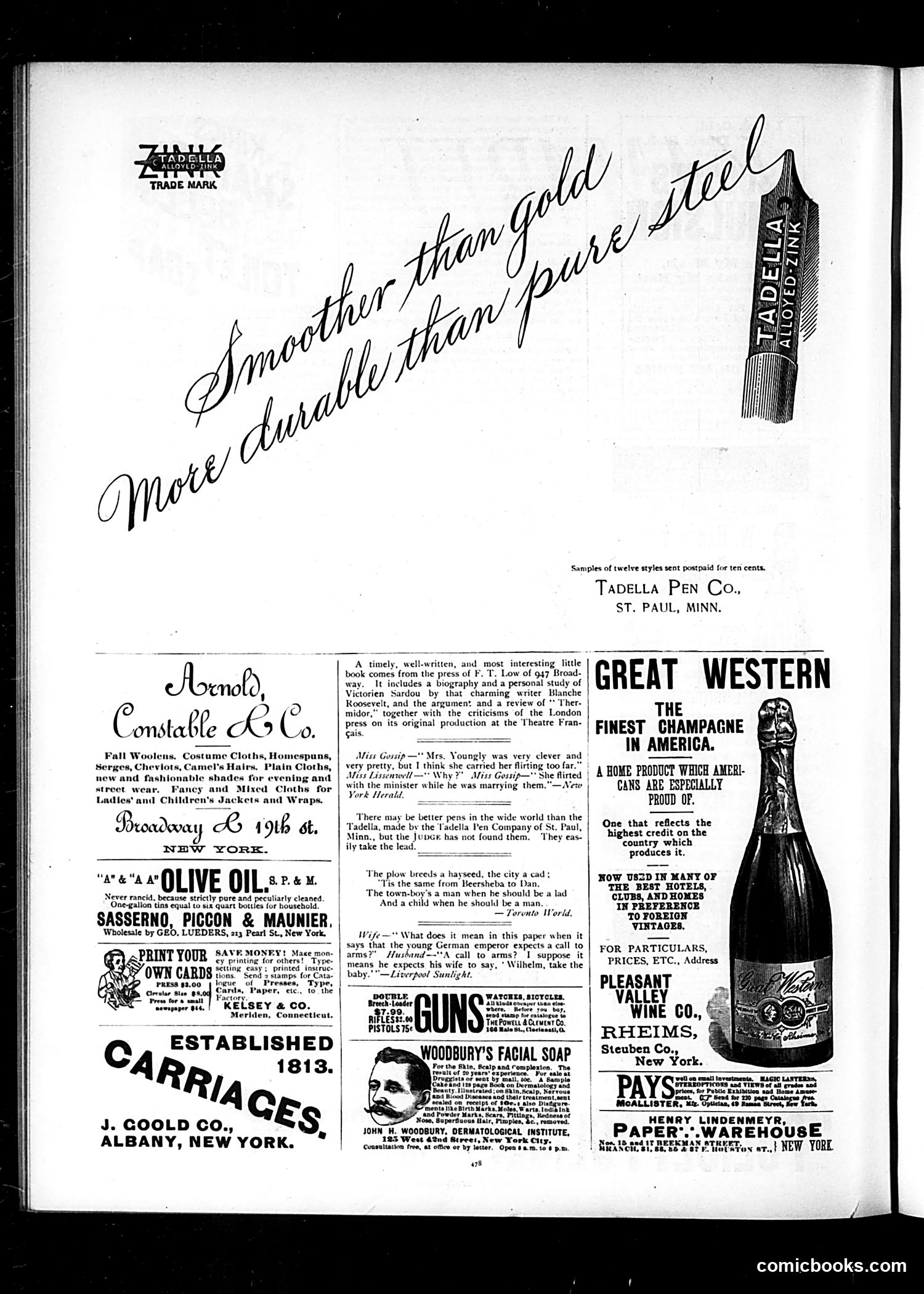
This is primarily an **advertising page** from Judge magazine, not a political cartoon page. It contains various product advertisements from the late 19th or early 20th century, including pens, clothing, olive oil, carriages, soap, and champagne. The few editorial snippets interspersed among ads are light humor rather than satire: - A joke about a woman flirting with a minister during her own wedding - A quip contrasting rural "hayseeds" and urban "cads" - Marital humor about a German emperor's "call to arms" (wife calling him to babysit) These are mild, domestic jokes typical of Judge's lighter content—social observation rather than political commentary. The page's main purpose is **revenue generation through advertising**, which was standard for 19th-century magazines. The ads target middle and upper-class readers with imported goods, fine clothing, and luxury champagne—reflecting Judge's affluent audience.
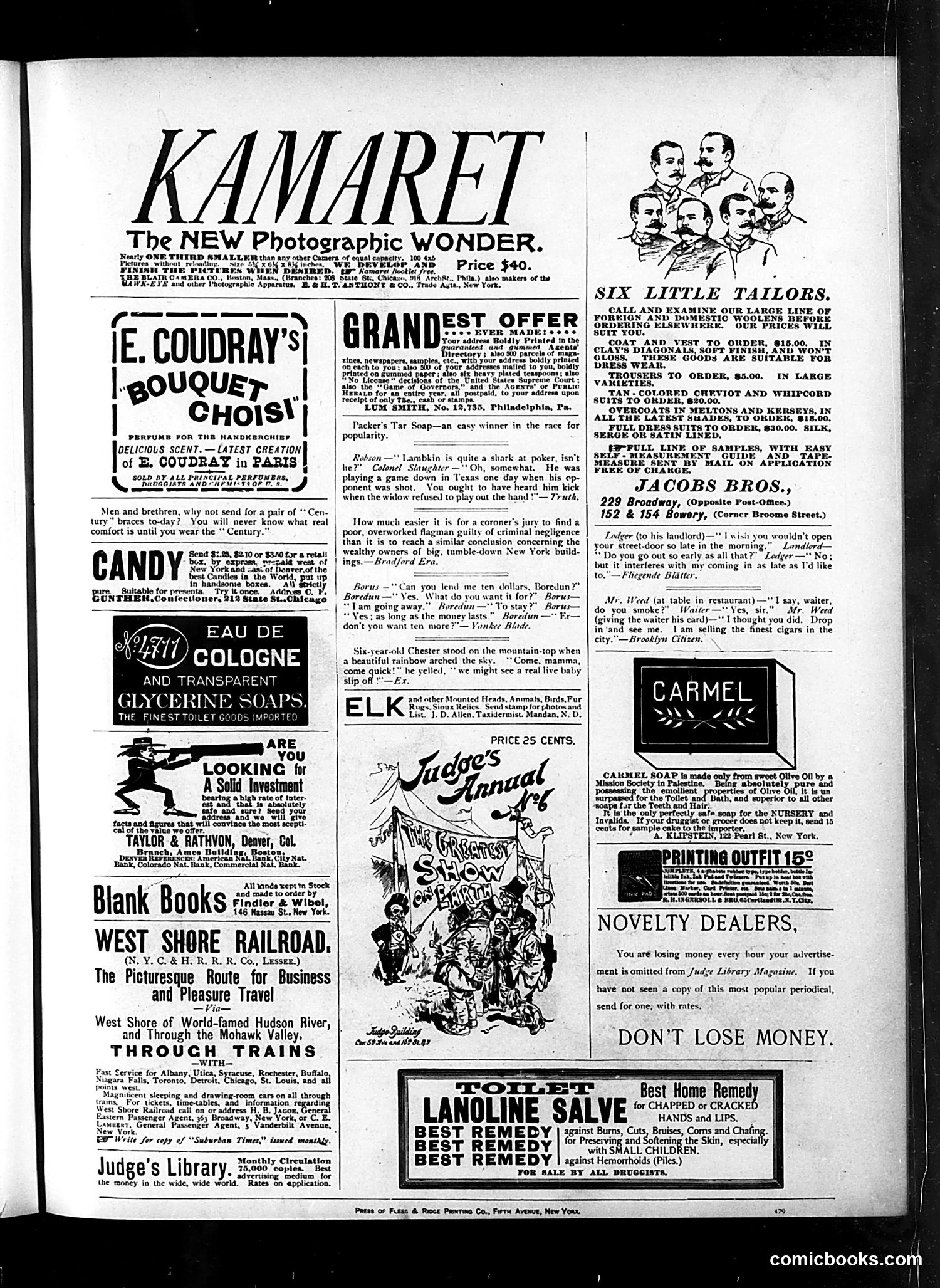
This is primarily an **advertising page** from Judge magazine with minimal editorial cartoon content. The page features various commercial advertisements for products ranging from cameras and perfume to railroad services and patent medicines—typical for late 19th-century magazines. The small editorial content consists of brief humorous anecdotes rather than political satire: - **"Robson" and "Colonel Slaughter"** dialogue: A joke about a poker game in Texas where someone is shot, mocking the casual violence of the frontier while playing on the absurdity of complaining about rules over a death. - **"Boredun" and "Borus"** exchange: A pun about borrowing money with the expectation of never repaying it—social commentary on deadbeats. - **Coroner's jury observation**: Satirizes class justice, suggesting juries readily convict poor railroad workers for negligence but hesitate to blame wealthy building owners for unsafe conditions. The page's primary purpose is **revenue generation through advertising** rather than political commentary.
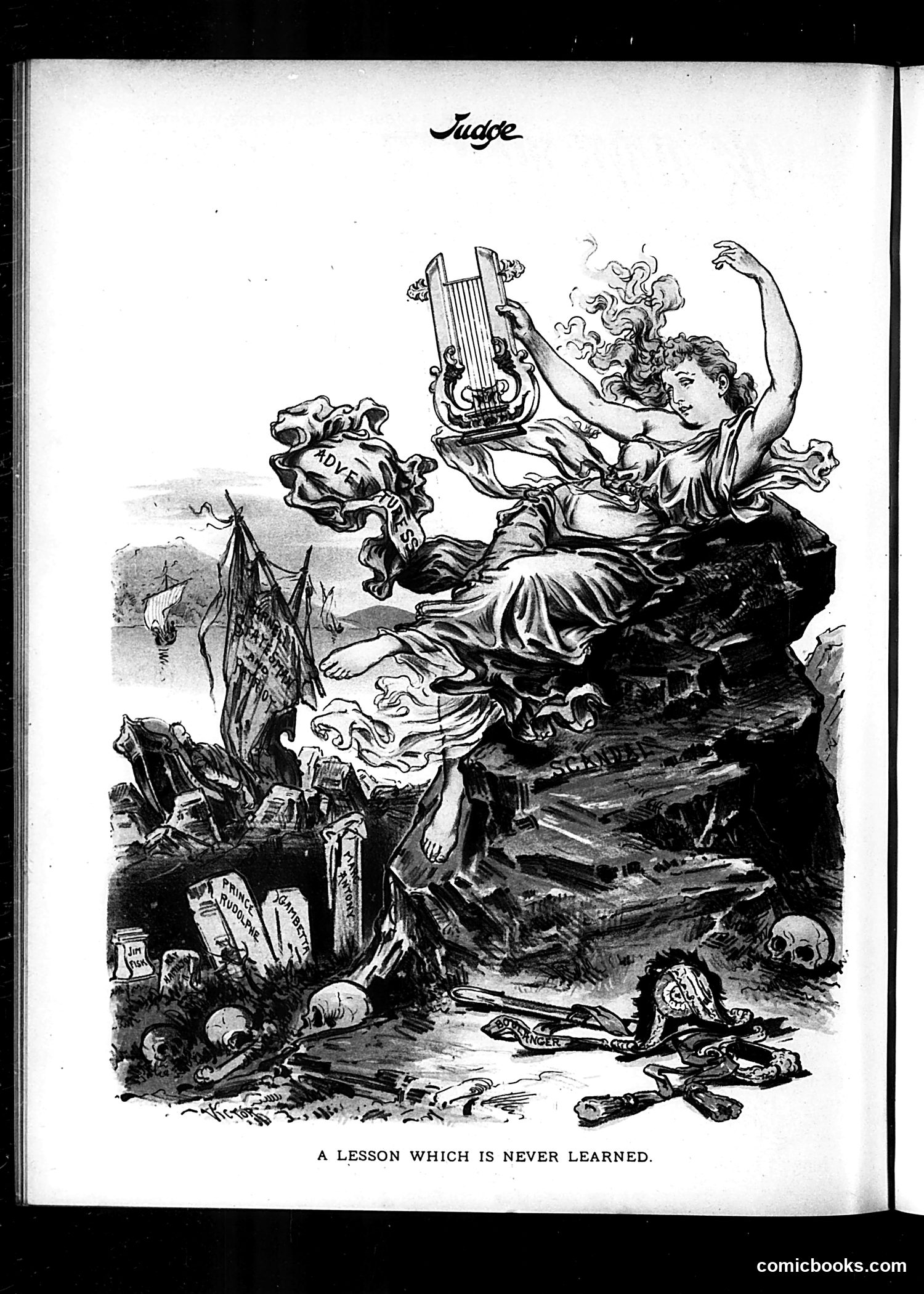
This Judge magazine illustration depicts a classical female allegorical figure (likely representing Justice or Wisdom) seated amid ruins and wreckage, holding a lyre and gesturing dramatically. The scene includes scattered debris, skulls, broken weapons, and what appears to be a shipwreck in the background—symbols of war, death, and destruction. The caption "A Lesson Which Is Never Learned" suggests bitter commentary on humanity's repeated failure to avoid warfare despite its devastating consequences. The classical artistic style—juxtaposing an elegant muse figure against scenes of carnage—creates ironic contrast, emphasizing the disconnect between idealized notions of civilization and the reality of recurring violence. The specific historical context remains unclear without dating information, though the imagery suggests commentary on 19th-century military conflicts.