
A complete issue · 16 pages · 1891
Judge — October 17, 1891
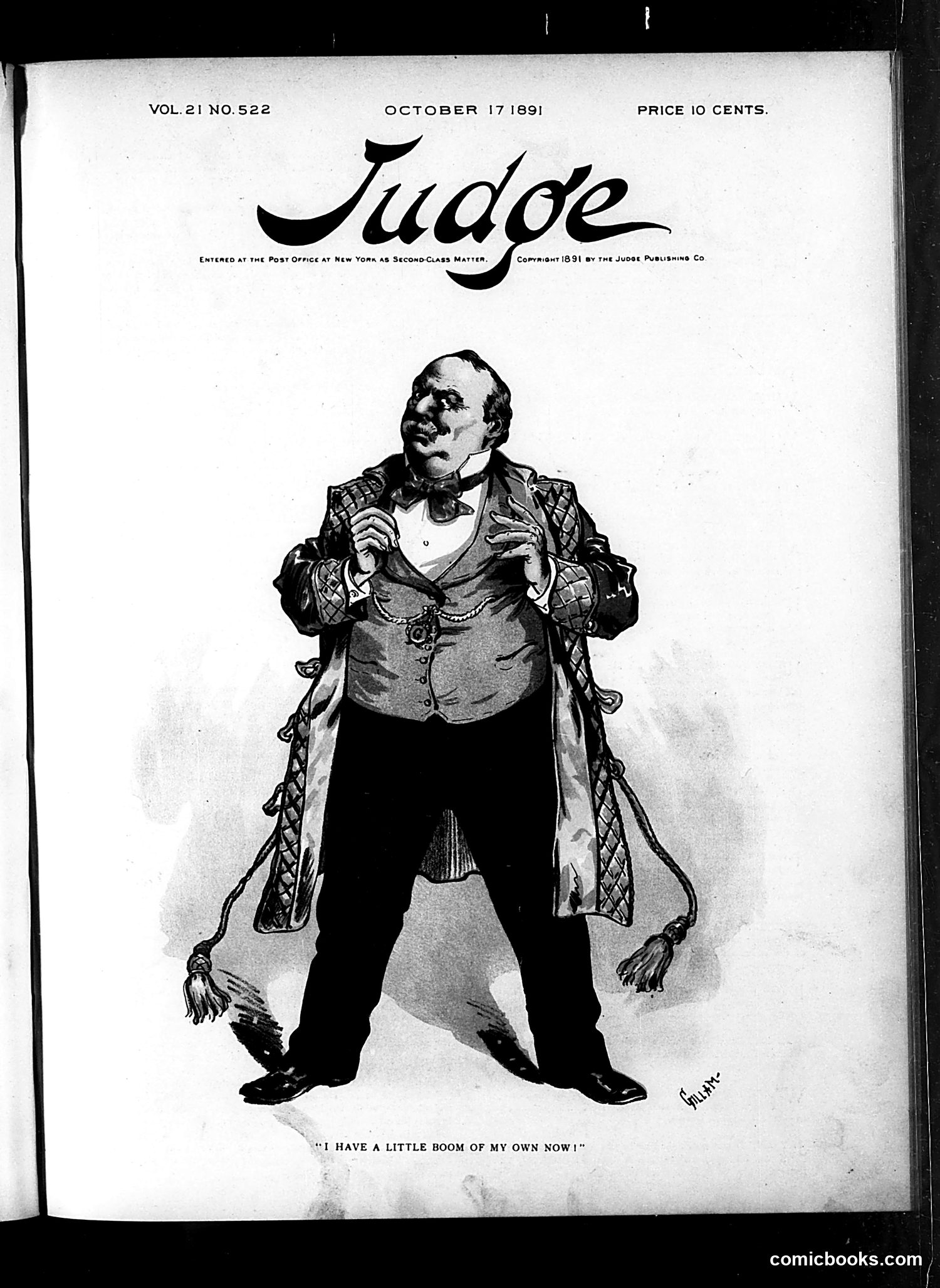
This satirical cartoon depicts a rotund, well-dressed man in an ornate coat with decorative tassels, striking a boastful pose. The caption reads "I HAVE A LITTLE BOOM OF MY OWN NOW!" The figure appears to be a political or business leader claiming independent success or influence. The exaggerated physique and pompous clothing suggest satire of self-importance or pretension. The "boom" likely references either economic prosperity or political momentum the subject claims to possess. Without additional context about 1891 current events, the specific identity remains unclear, though the style indicates this mocks someone recently elevated in status who's now bragging about their newfound power or wealth. The artistic rendering emphasizes vanity and overconfidence.
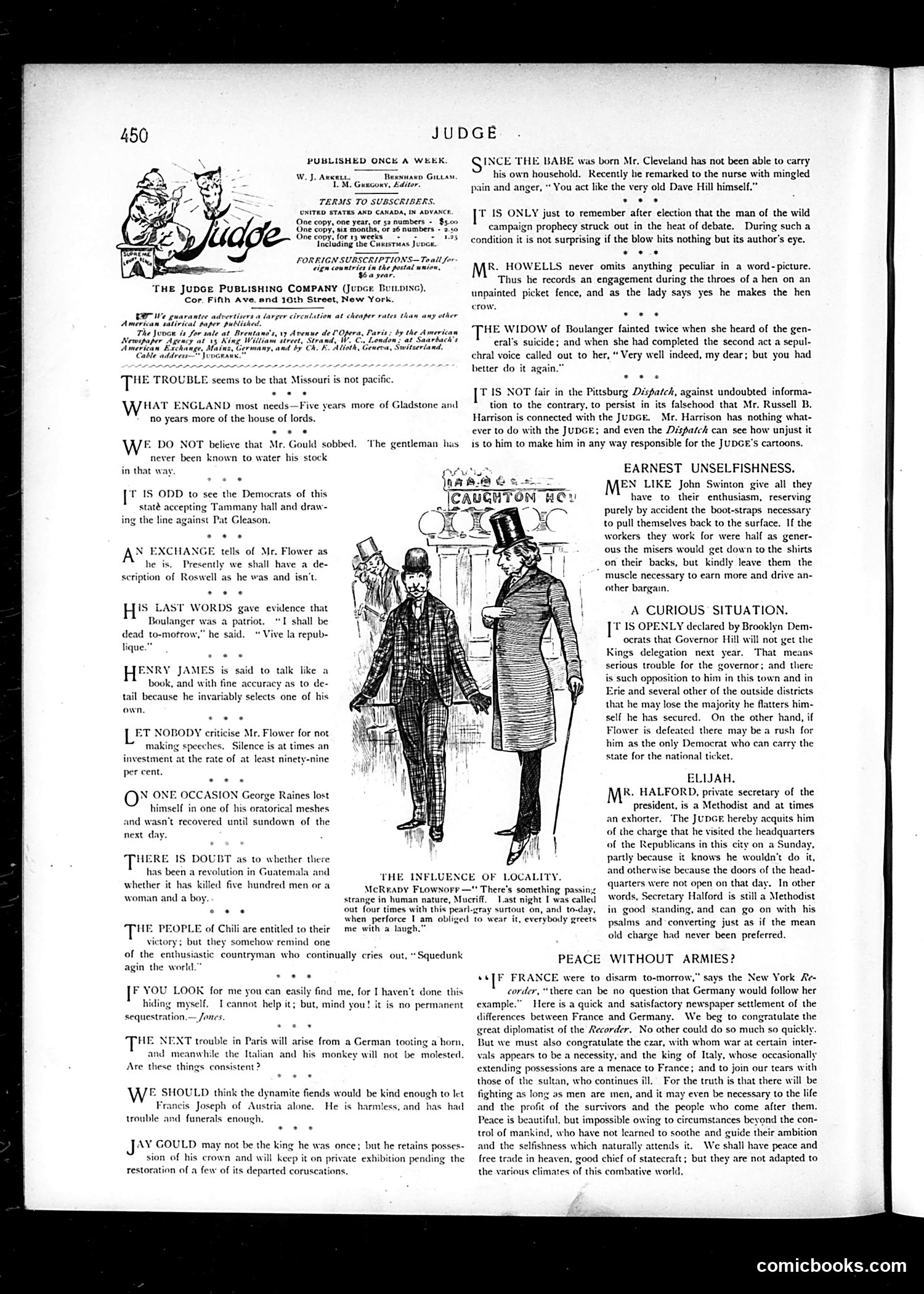
The cartoon depicts two men in Victorian dress examining a pig labeled "CAUGHTON HOG." Based on the surrounding editorial content criticizing the "Dispatch" newspaper and references to factual disputes, this appears to be political satire about unreliable journalism or fabricated stories. The text mentions the *Dispatch* persisting with false claims despite correction, suggesting the "hog" symbolizes a false or exaggerated news story that publications keep pushing. The well-dressed figures likely represent editors or journalists, treating misinformation as a commodity. The exact political figures or specific incident referenced remain unclear without additional context, but this clearly satirizes yellow journalism practices of the period—the publication and repetition of unverified or false claims for sensationalism.
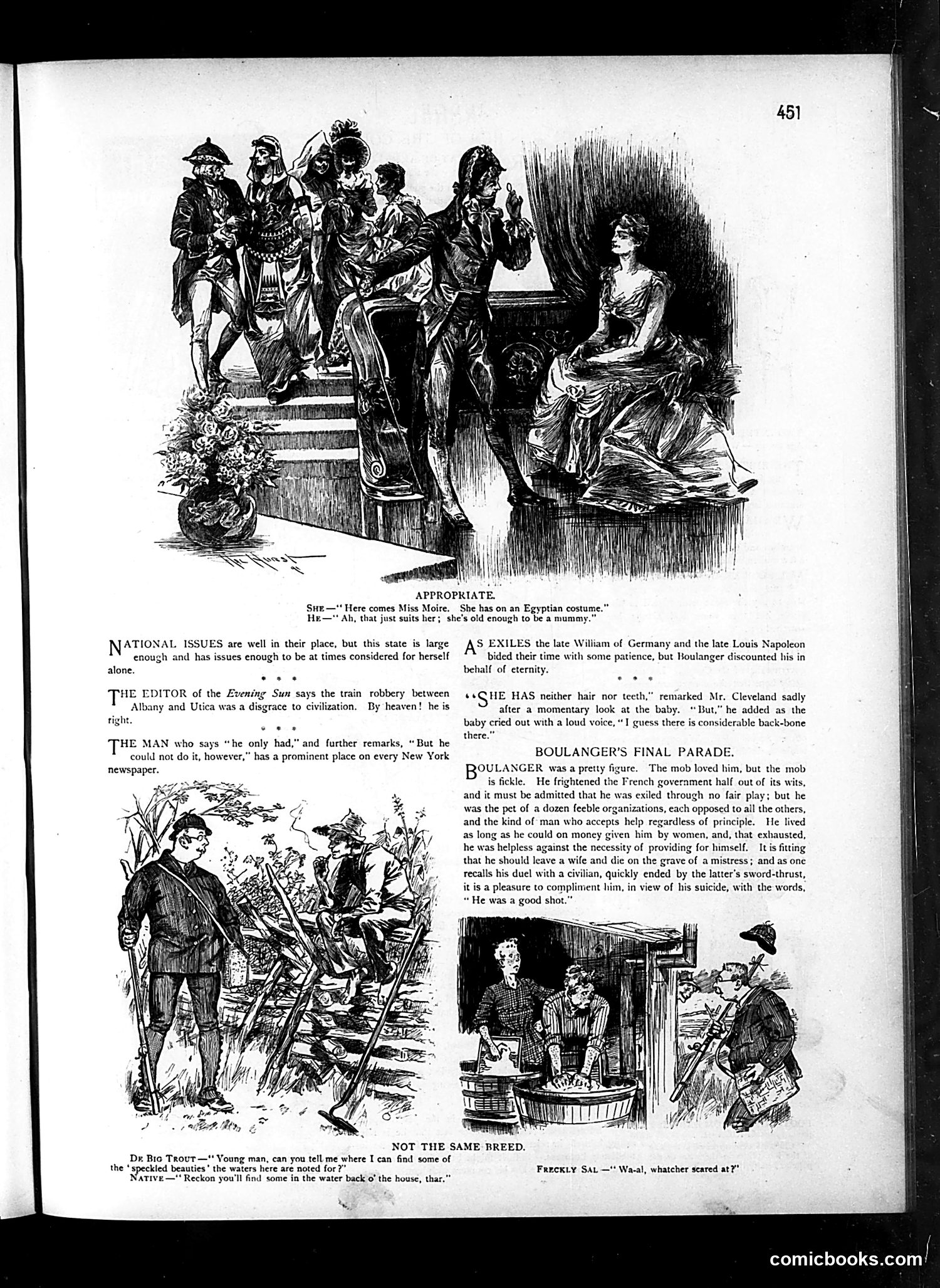
This page contains four separate satirical items: **"APPROPRIATE"** (top): A woman in Egyptian costume is presented to society. The joke plays on the double meaning of "mummy"—she's dressed as an Egyptian but is so old/lifeless she resembles an actual mummy. **"BOULANGER'S FINAL PARADE"** (right): References General Boulanger, a late 19th-century French military figure. The text criticizes him as a "pretty figure" manipulated by political factions, ultimately ending his life through suicide. It's a retrospective moral assessment of a failed demagogue. **Lower cartoons**: "Not the Same Breed" features a dialogue about finding water sources, while "Freckly Sal" depicts an interaction about being startled—both appear to be unrelated humor sketches typical of Judge's miscellaneous content pages. The page mixes social commentary with lighter comic vignettes.
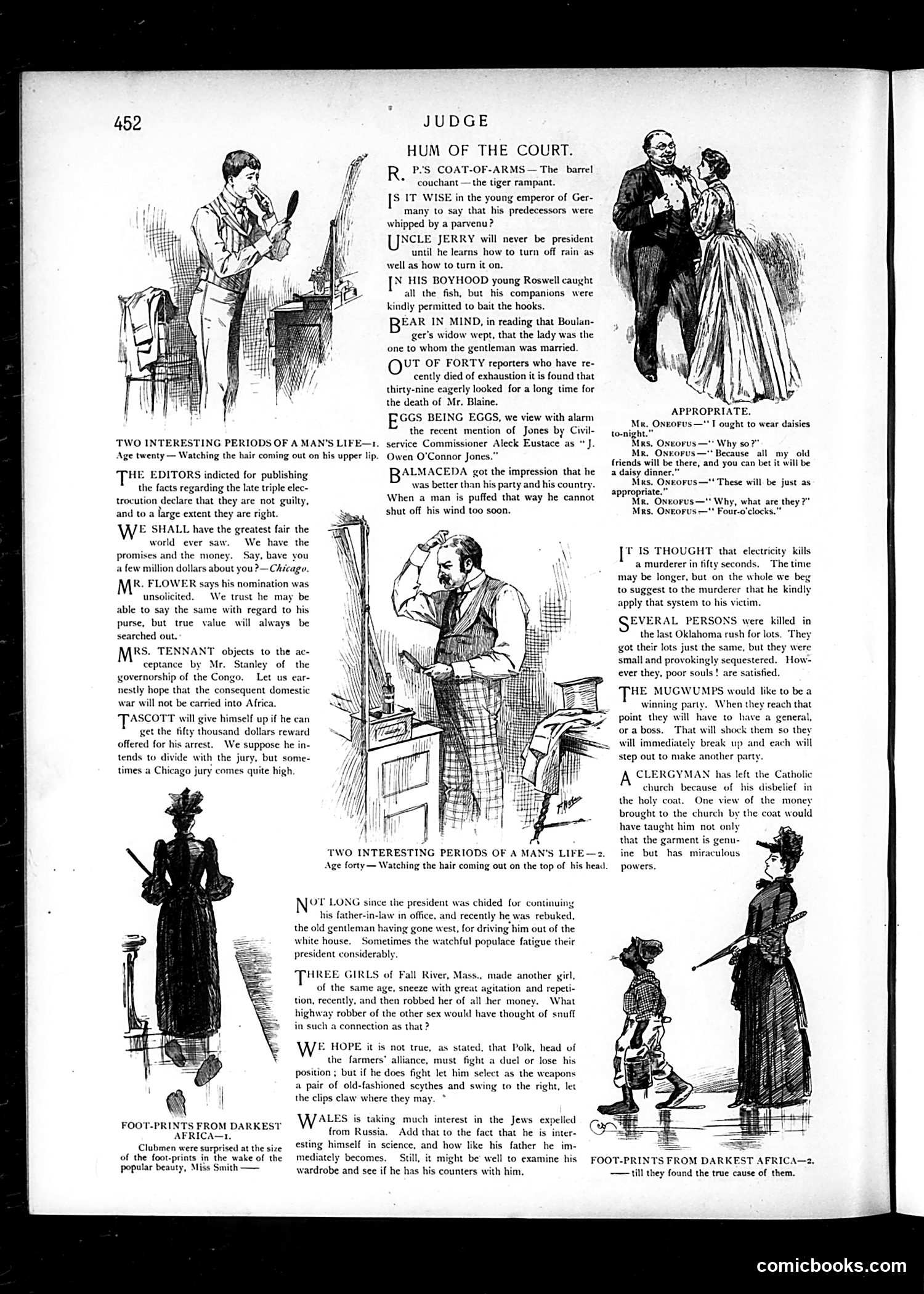
This page collects brief satirical commentary ("Hum of the Court") on contemporary 1880s-90s political and social figures: **Identifiable references:** - "Young emperor of Germany" = likely Kaiser Wilhelm II - "Uncle Jerry" = unclear which political figure - "Boulanger's widow" = references French General Boulanger - "Mr. Blaine" = James G. Blaine, prominent politician - "Balmaceda" = likely José Manuel Balmaceda, Chilean president - "Oklahoma rush for lots" = land rush speculation - "Mugwumps" = independent Republicans critical of party politics - "Fall River, Mass." girls = likely references the 1892 Lizzie Borden case **The satire targets:** political ambition, journalistic sensationalism, civil service reform debates, and social hypocrisy. The two illustrated panels on "Two Interesting Periods of a Man's Life" joke about aging (hair loss at 20 vs. 40). The page combines political commentary with light social humor typical of Judge's format—brief jabs at public figures and contemporary absurdities.
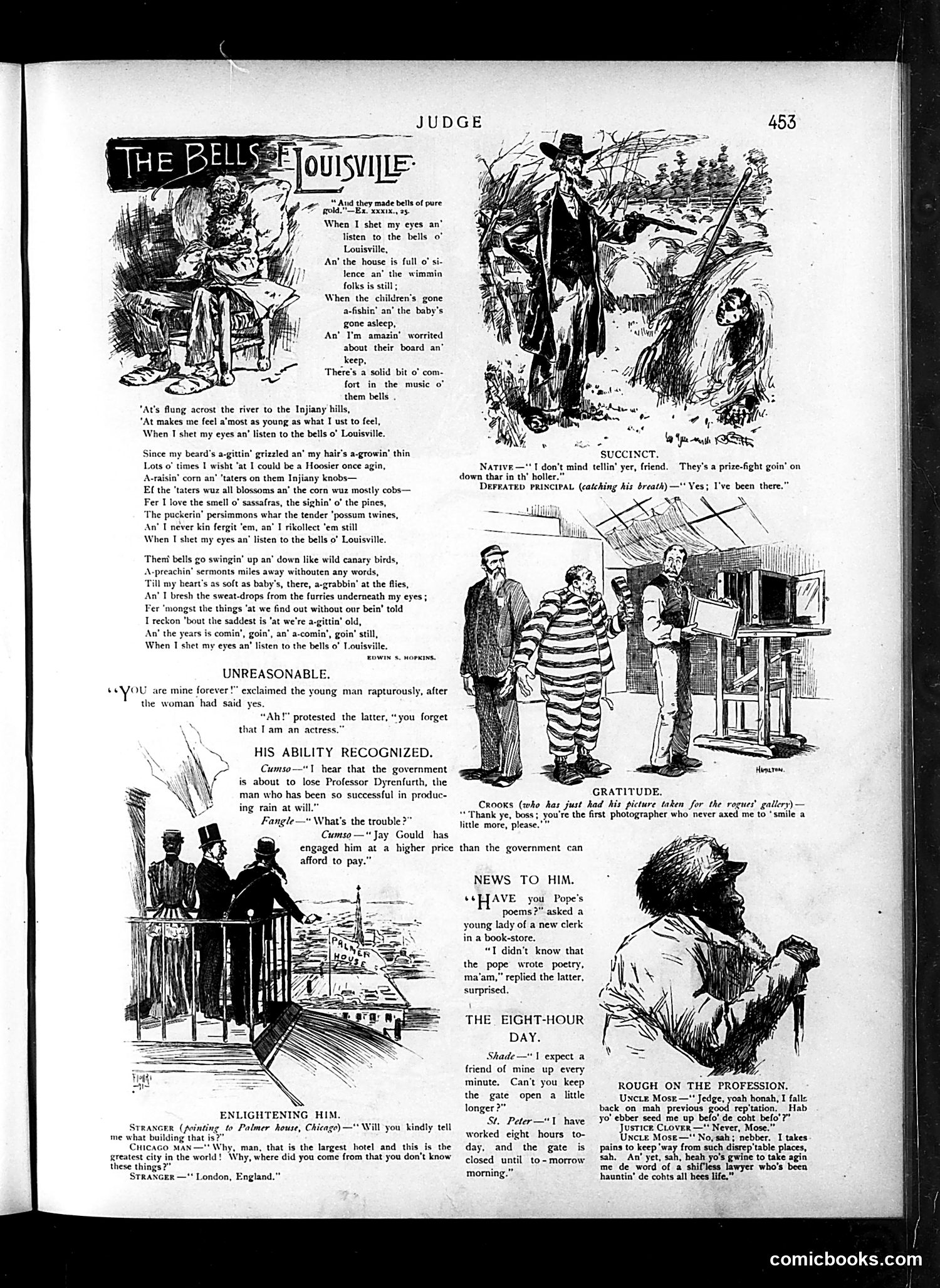
This page from *Judge* contains multiple satirical sketches reflecting late 19th/early 20th-century American social commentary: **"The Bells of Louisville"** is a sentimental poem with nostalgic illustrations, using bell imagery as emotional metaphor—likely a gentle satire of maudlin Americana poetry. **"Unreasonable"** jokes that an actress cannot truly commit to marriage, playing on period stereotypes about theatrical women's reliability. **"His Ability Recognized"** satirizes Professor Dyrenfurth, a real figure known for rainmaking experiments. The joke: Jay Gould hired him away from government work at higher pay—mocking both Gould's wealth and pseudo-scientific claims. **"Eight-Hour Day"** references labor movement demands for 8-hour workdays; the joke involves gate-keeping logistics. **"Rough on the Profession"** features "Uncle Mose," a racist caricature of a Black defendant claiming he avoids court, yet faces testimony from a disreputable lawyer—perpetuating harmful stereotypes. The page reflects *Judge*'s mix of social observation, class humor, and deeply offensive racial caricature typical of the era.
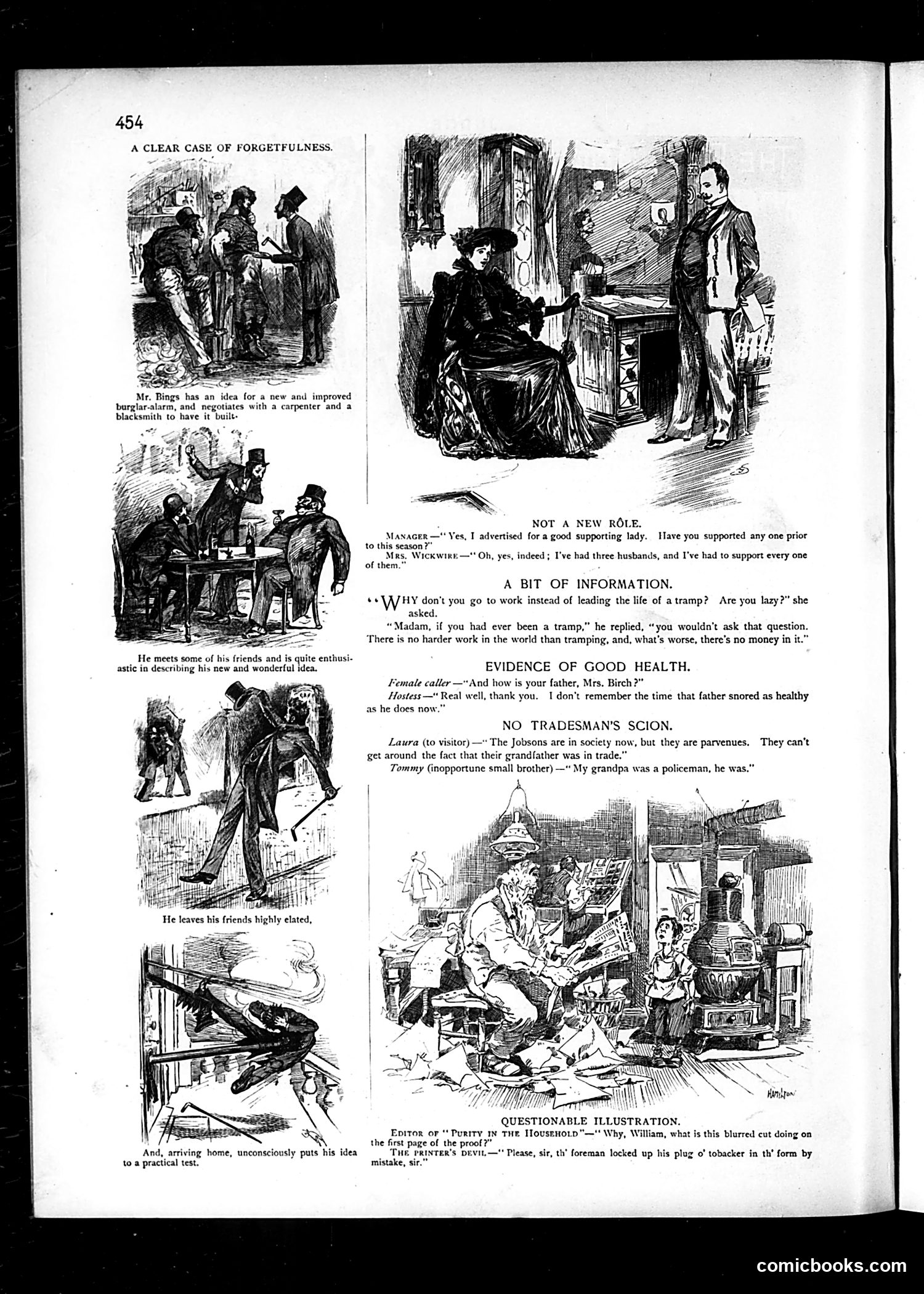
This page collects six brief comedic sketches mocking middle-class pretensions and social absurdities: **"A Clear Case of Forgetfulness"**: Mr. Bings designs an anti-burglar alarm but absent-mindedly tests it on his own home, demonstrating absent-minded obliviousness. **"Not a New Role"**: A theatrical manager interviews an actress who boasts of "supporting" three husbands financially—a reversal of expected gender roles, satirizing women forced into breadwinner positions. **"A Bit of Information"**: A tramp defends his lifestyle, claiming tramping is harder work than regular employment, yet pays nothing—mocking both vagrants' rationalizations and society's dismissal of poverty's difficulties. **"Evidence of Good Health"**: A woman celebrates her father's loud snoring as health indicator—absurd logic treating an annoying symptom as wellness. **"No Tradesman's Scion"**: A snobby woman disparages the newly-wealthy Jobsons for having a grandfather "in trade," while her brother naively reveals *his* grandfather was merely a policeman—undermining her class pretensions. **"Questionable Illustration"**: A printer's devil accidentally locked tobacco in printing type, causing a blur on the page—a workplace mishap.
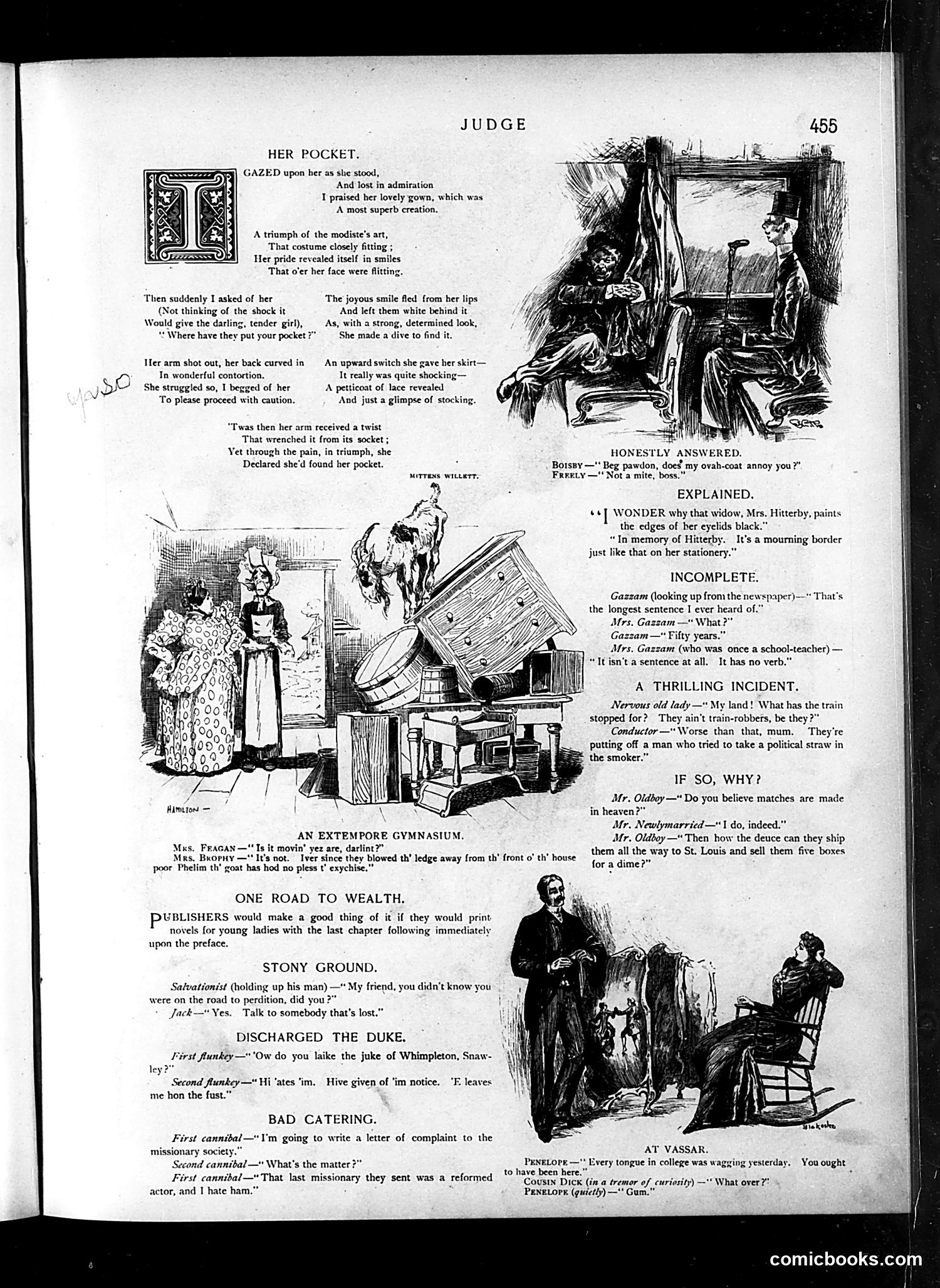
This page from the satirical magazine *Judge* contains multiple brief humor pieces typical of the era. **"Her Pocket"** (main poem with illustration): Satirizes women's fashion by depicting a woman's frantic search for pockets in her elaborate gown. The humor relies on the contemporary complaint that fashionable women's clothing lacked functional pockets—a genuine grievance. The exaggerated contortions and physical comedy emphasize the absurdity of impractical dress design. **Other sketches** include wordplay and social observations: a widow painting her eyelids black "in mourning," commentary on sentence structure, a conductor preventing political discussion on trains, and cannibals complaining about "reformed actor" missionaries being tough/hammy (a pun). The overall tone reflects *Judge's* satirical approach to fashion, gender roles, and social conventions of the period. These are light, domestic humor pieces rather than hard political satire—typical of the magazine's mixed content format.
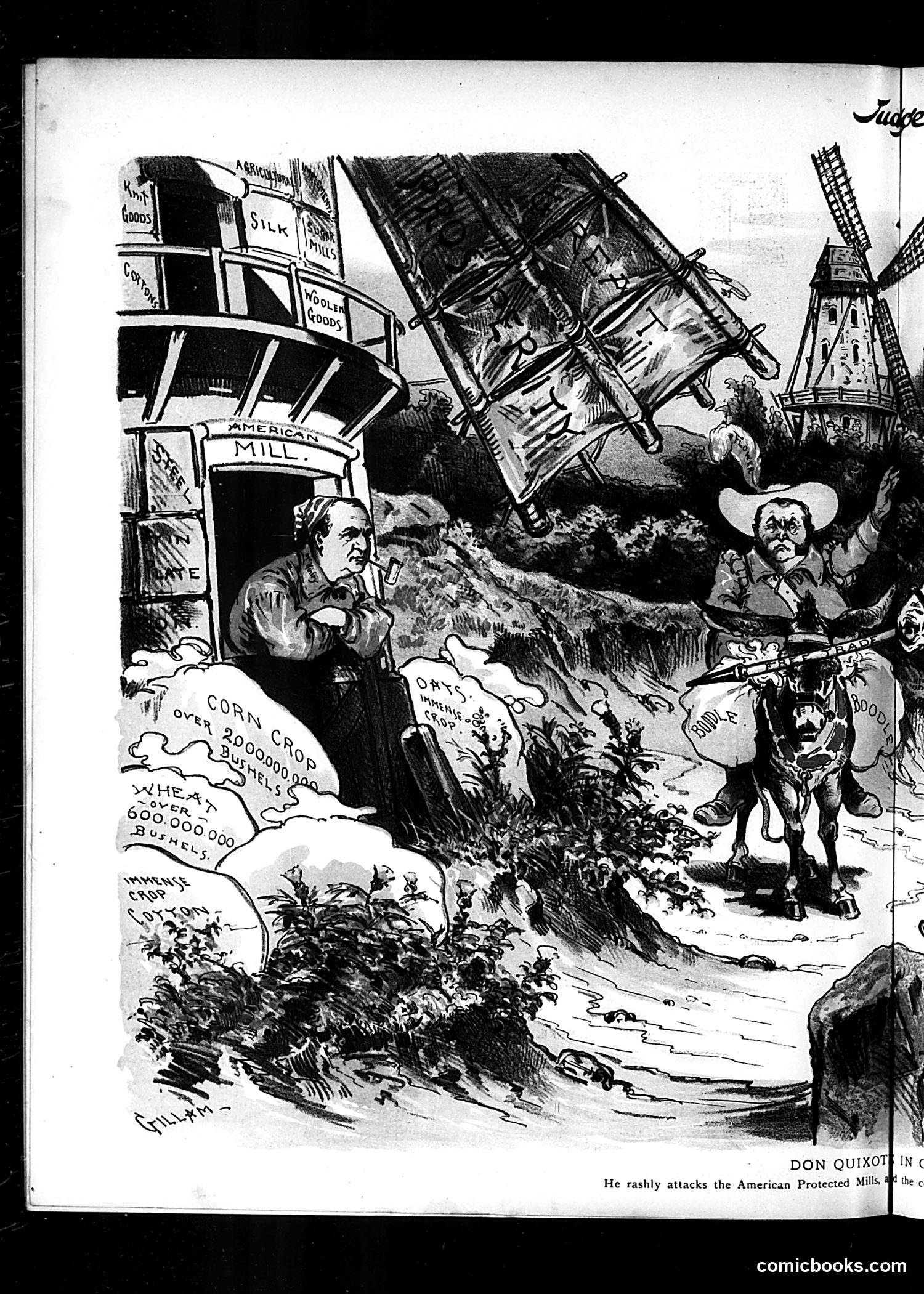
This **Judge** magazine cartoon depicts "Don Quixote" attacking the "American Protected Mills"—a reference to U.S. tariff protection for domestic mills (grain milling industry). The cartoon uses the famous literary character Don Quixote, known for tilting at windmills in delusional quests, as a metaphor for someone foolishly attacking American trade protections. The windmill visible in the background reinforces this literary allusion. The labeled crop quantities (corn, wheat, etc.) indicate this satirizes criticism of agricultural tariffs. The cartoonist suggests that attacking American mill protections is as futile and misguided as Quixote's fictional quest. This likely critiques opponents of U.S. protectionist trade policies during the Gilded Age, when tariffs were politically contentious.
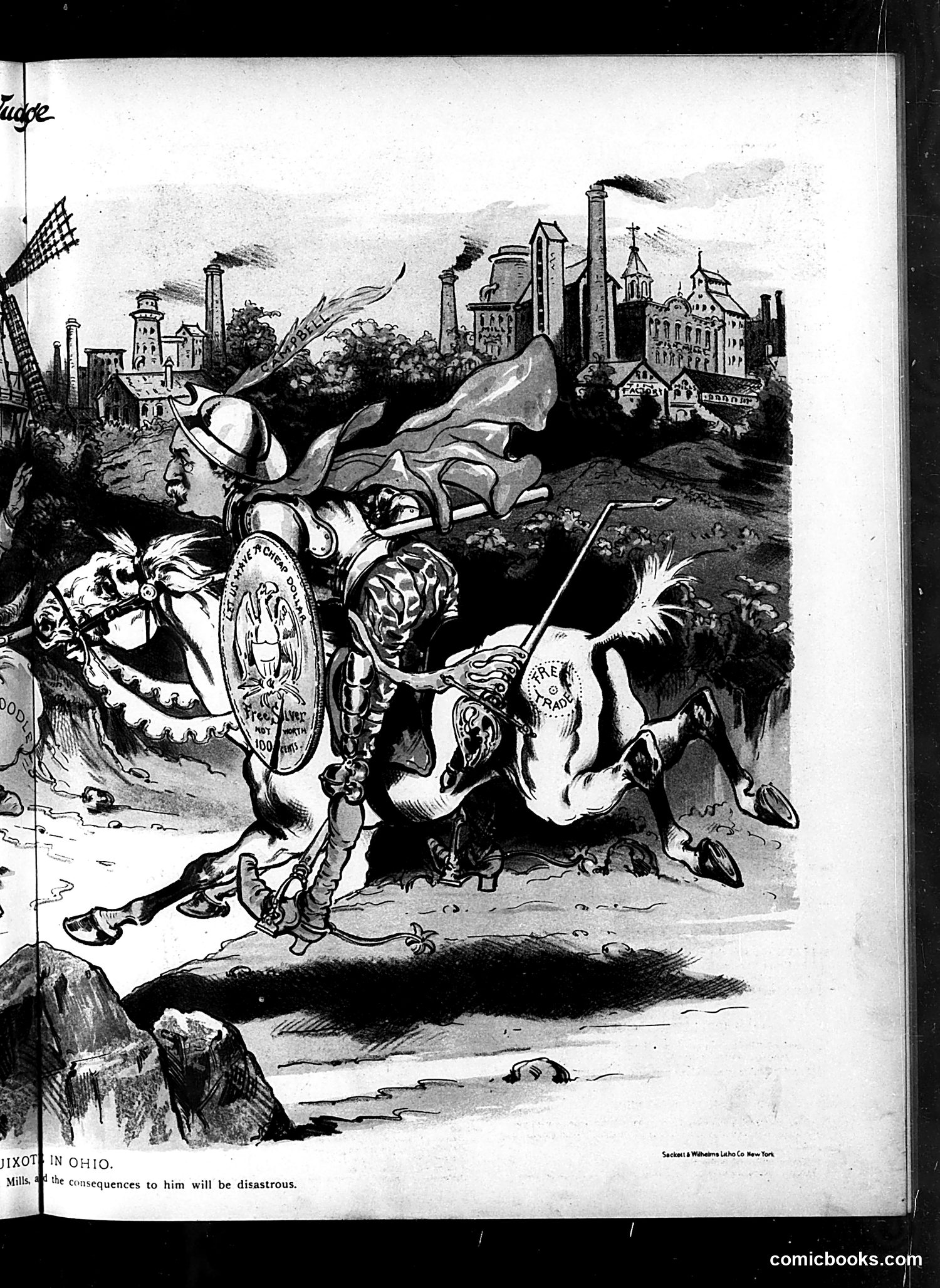
This appears to be a satirical cartoon playing on the famous literary figure Don Quixote. A figure in armor rides a donkey toward an industrial cityscape, suggesting someone pursuing an idealistic or misguided quest in modern Ohio. The partial text mentioning "Mills" and "consequences...disastrous" suggests criticism of someone's political or business actions. The industrial city backdrop—with smokestacks and factories—emphasizes the modern, industrial context contrasting with the archaic armor and quixotic imagery. Without the complete caption and date, the specific political target remains unclear, but the cartoon likely mocks an individual (possibly a politician or businessman) for pursuing doomed or foolish objectives amid Ohio's industrial reality. The Quixote reference implies tilting at windmills—futile idealism in a practical world.
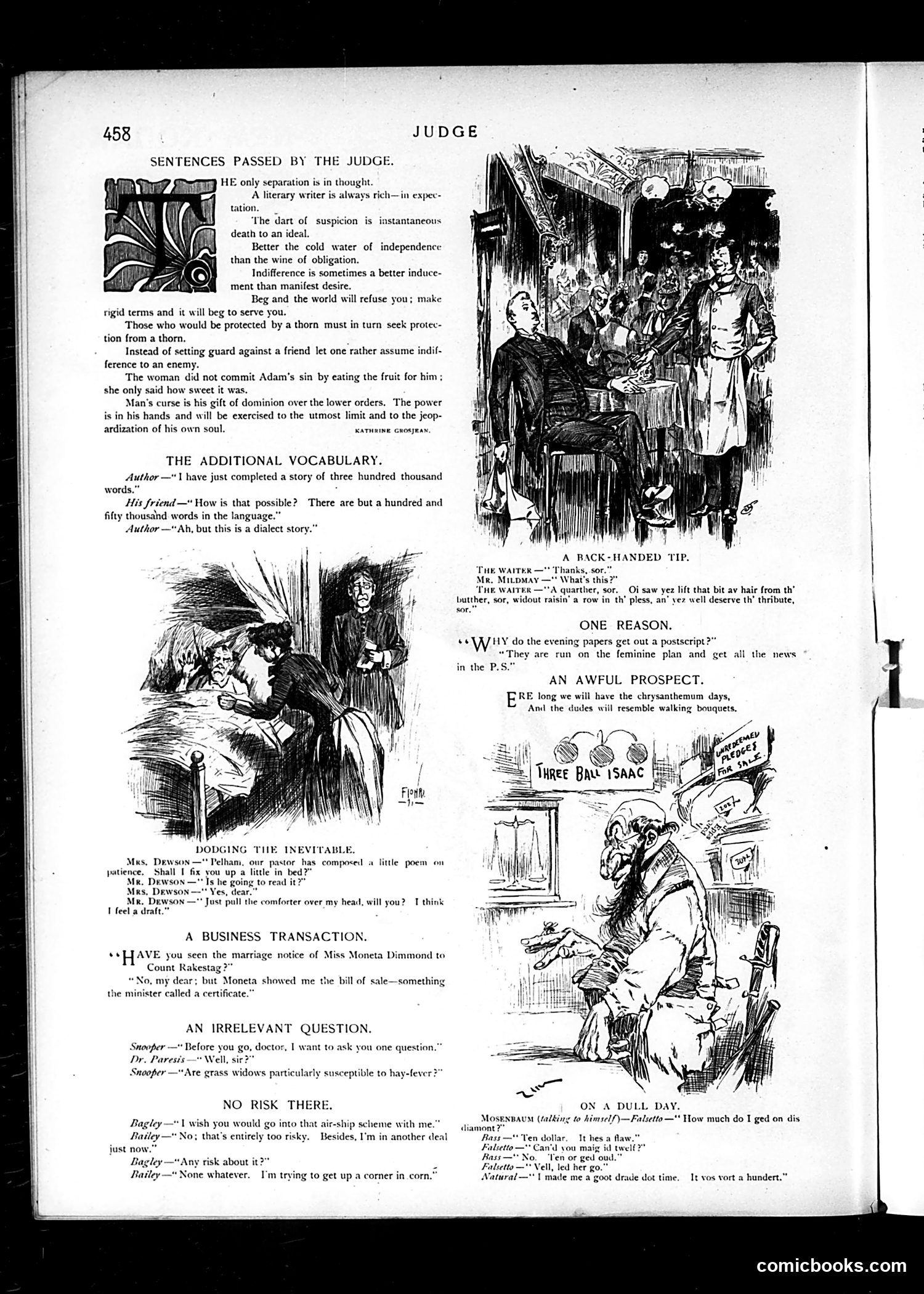
This page from *Judge* magazine contains miscellaneous satirical content rather than a unified cartoon: **"Sentences Passed by the Judge"** presents aphoristic observations about human nature and society—likely meant as witty commentary rather than political satire. One notable entry criticizes "Man's curse is his gift of dominion over the lower orders," suggesting social critique about power dynamics. **"The Additional Vocabulary"** jokes about dialect writing and Irish-accented service workers—reflecting period stereotypes about immigrant labor. **"One Reason"** mocks women's intelligence, suggesting evening newspapers' postscripts exist because women "get all the news in the P.S." **Other brief sketches** include a poem about fashionable "dudes" resembling "walking bouquets," humor about reluctant sermon-listeners, and financial schemes involving cornering the corn market and airship investments. The page demonstrates *Judge*'s typical approach: class-based humor, ethnic stereotyping, and social observations aimed at elite readers, with little explicit political content visible here.
This page is primarily an **advertisement compilation**, typical of Judge magazine's revenue model. It contains minimal political or satirical content. The main notable element is **"Carl Pretzel's Philosophy,"** featuring a character with a Germanic accent (indicated by dialect spelling: "hafe," "shteal," "gelt"). Pretzel offers cynical observations about wealth and morality—that the rich give money to charity while the poor give sympathy, and that money-seeking drives worldly troubles. This reflects common **turn-of-the-century social commentary** on class inequality and materialism, expressed through a stereotypical German immigrant character, a common trope in American humor of this era. The remainder is product advertising: pianos, hair tonic, flour, shaving soap, Kodak cameras, and patent medicines (throat bandages, cough syrup, etc.). The ads are representative of late 19th/early 20th-century marketing, including unsupported medical claims typical of the pre-FDA regulation era. No specific political figures or events are referenced on this page.
This page is primarily **advertising** rather than editorial cartoon content. It's a typical Judge magazine page mixing commercial advertisements with small comedic anecdotes and hotel listings. The humor snippets are light social observations: a wealthy man collecting violins he cannot play (mocking dilettante collectors), a joke about hypersensitivity to food via dreams, and a countryman's innocent misinterpretation of theatrical acting as drunkenness. The ads promote products typical of the era—tobacco, extract of beef, piano manufacturers, cocoa, bicycles, and medicinal pills—reflecting late 19th-century consumer culture and the common medical marketing of patent medicines. The **hotel guide** section lists establishments in major American cities, indicating Judge's audience was affluent travelers and urban professionals. Overall, this represents Judge's business model: pairing satirical content with lucrative advertising revenue.
This page is primarily **advertisements** rather than editorial cartoons or satire. However, it opens with three **humorous verses** that reflect period social commentary: 1. **"Three Fishers"** (Baltimore American): Satirizes dishonest husbands who deceive wives by buying market fish and claiming they caught them, while market-boys laugh at the deception. It's social satire about marital dishonesty and gullibility. 2. **"Borus & Naggus" exchange** (Chicago Tribune): Mocks a bad novelist whose editor admits falling asleep mid-manuscript, implying the work is tedious and forgettable—a literary joke. 3. **The explorer anecdote**: Ironic commentary on a man who traveled Africa, hunted big game, and gained fame—yet cannot find his own collars at home. It satirizes masculine pretension while suggesting domestic incompetence. The remainder is standard Victorian-era advertising: patent medicines (cod liver oil), bicycles, whiskey, walking boots, tea, playing cards, and dubious medical devices (suspensory bandage). These ads reflect period consumer culture.
This page is primarily **advertising**, with minimal editorial content. Key elements: **The Main Cartoon/Joke:** The only significant satirical piece is a brief anecdote mocking Rev. Simpersermun. When he begins pontificating to young ladies that sermons are underappreciated, a "saucy minx" retorts that his sermons actually *do* him injustice—implying they're worse than he thinks. It's gentle mockery of self-important clergy. **Advertisements:** The page is dominated by period product ads: the "Daylight" lamp, silk fabrics, hair-loss treatments, opium addiction cures, corsets, elastic trusses, hair removal products (Hyodene), cocoa, cigars, and various medical remedies. These reveal late-19th-century consumer anxieties and dubious medical claims. **Cultural Context:** The ads reflect 1892 concerns: hair loss, addiction treatment, women's fashion, and aggressive marketing of patent medicines with unproven efficacy. No identifiable political figures or events appear on this page.
This page is primarily **advertising**, not satirical content. It showcases various consumer products from the late 19th/early 20th century, including typewriters, bicycles, soaps, candies, and fountain pens. The small jokes interspersed are typical period humor: one mocks a writer who hasn't sold his story yet; another jokes about newlyweds choosing "family circle" seating at a theater rather than more intimate orchestra seating. The Franco-American Food Company advertisement emphasizes the "cleanliness" of their canned soups—a selling point reflecting contemporary concerns about food safety and industrial food production. Products like Woodbury's Facial Soap and E. Coudray's perfume represent aspirational consumer goods aimed at middle-class readers. This reflects Judge's dual nature: a satirical magazine that relied heavily on advertising revenue from manufacturers seeking upscale audiences.
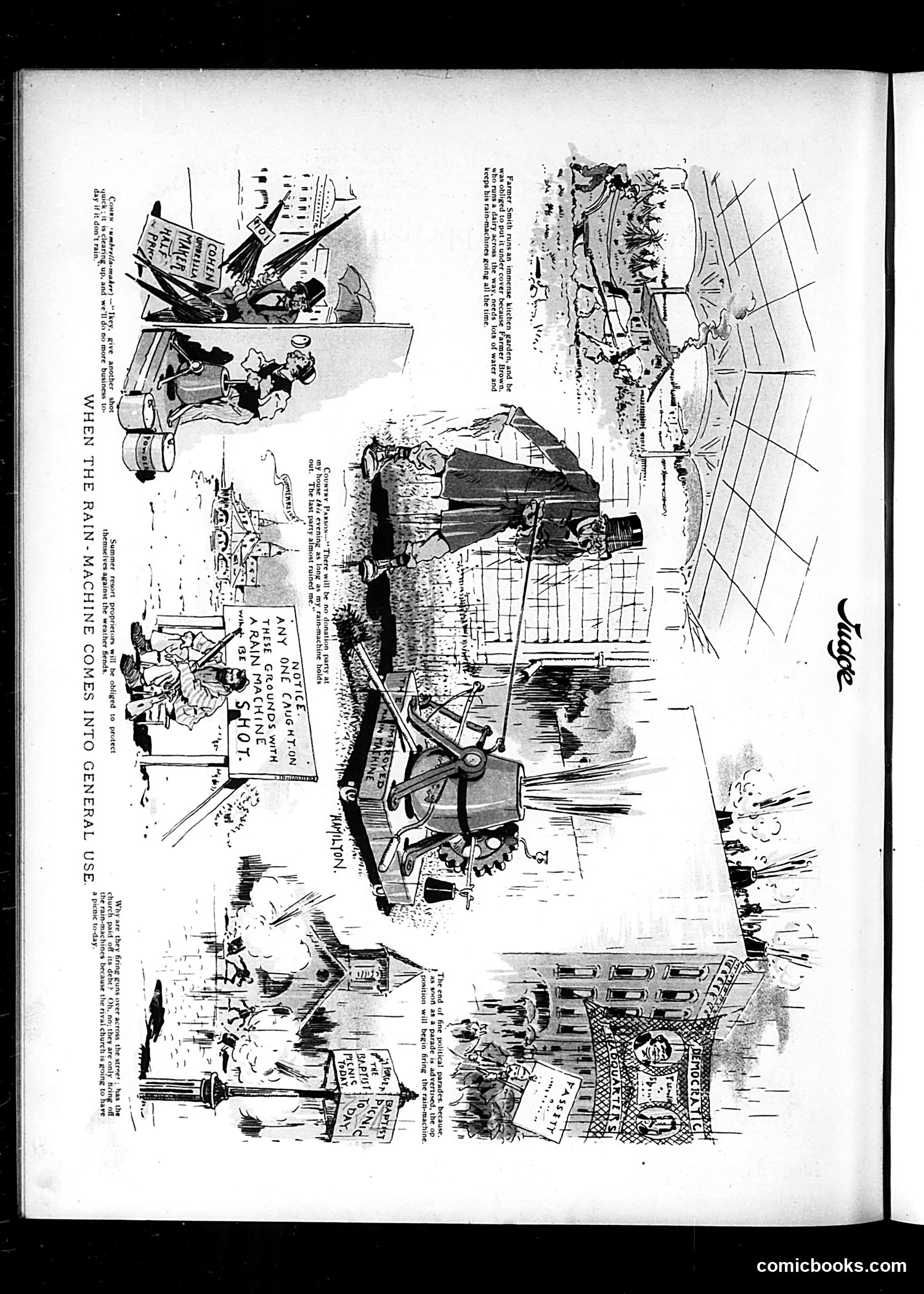
This page contains a satirical cartoon titled "When the Rain Machine Comes Into General Use," depicting a notice warning against rain machines on the grounds. The cartoon appears to be social satire about weather manipulation technology—a fantastical concept for the era. The central image shows a figure operating what looks like an early mechanical device, with surrounding vignettes illustrating chaotic consequences: flooding, disrupted activities, and general disorder from uncontrolled artificial rainfall. The satire targets both technological utopianism and concerns about unintended consequences. By presenting a "rain machine" that causes disaster rather than benefit, the cartoonist mocks contemporary optimism about industrial innovation solving human problems. The warning notice format suggests authorities struggling to control dangerous technology. Without a visible date, the precise historical context remains unclear, though this reflects late-19th or early-20th-century anxieties about scientific progress.