
A complete issue · 16 pages · 1891
Judge — May 30, 1891
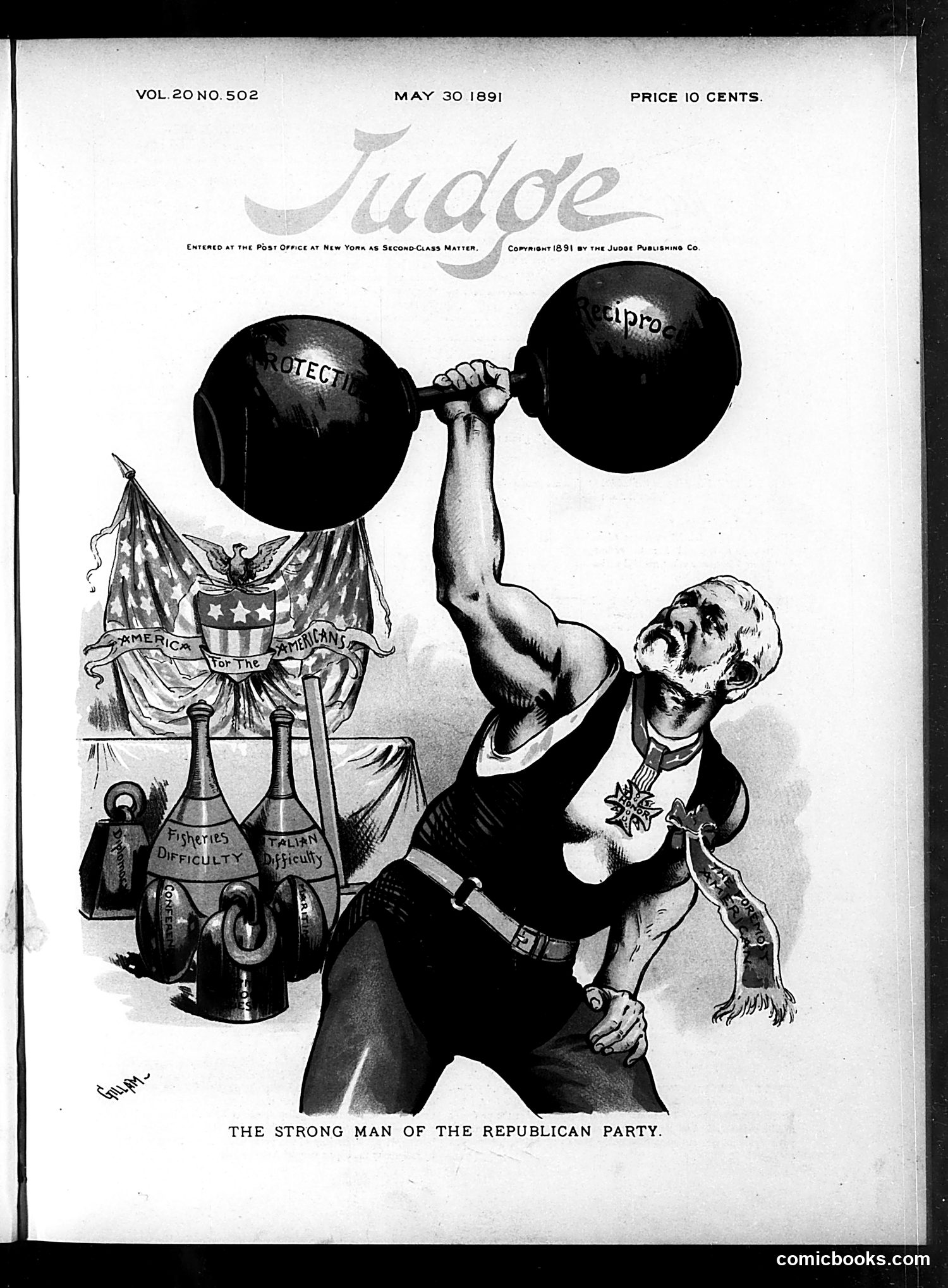
This political cartoon satirizes Republican Party leadership during the early 1890s. A muscular strongman lifts two heavy spheres labeled "PROTECT" and "HELP[?]," likely referencing protectionist tariff policies and economic assistance—key Republican platform issues. Behind him sits an American eagle standard with flags, suggesting patriotic rhetoric. At the base are weights labeled "FISHERIES DIFFICULTY" and "ITALIAN DIFFICULTY," referring to specific diplomatic crises troubling the GOP. A caricatured figure on the right (possibly representing a rival party leader) watches mockingly, suggesting the cartoonist questions whether the Republican Party can actually manage these substantial political and economic challenges despite its self-styled strength.
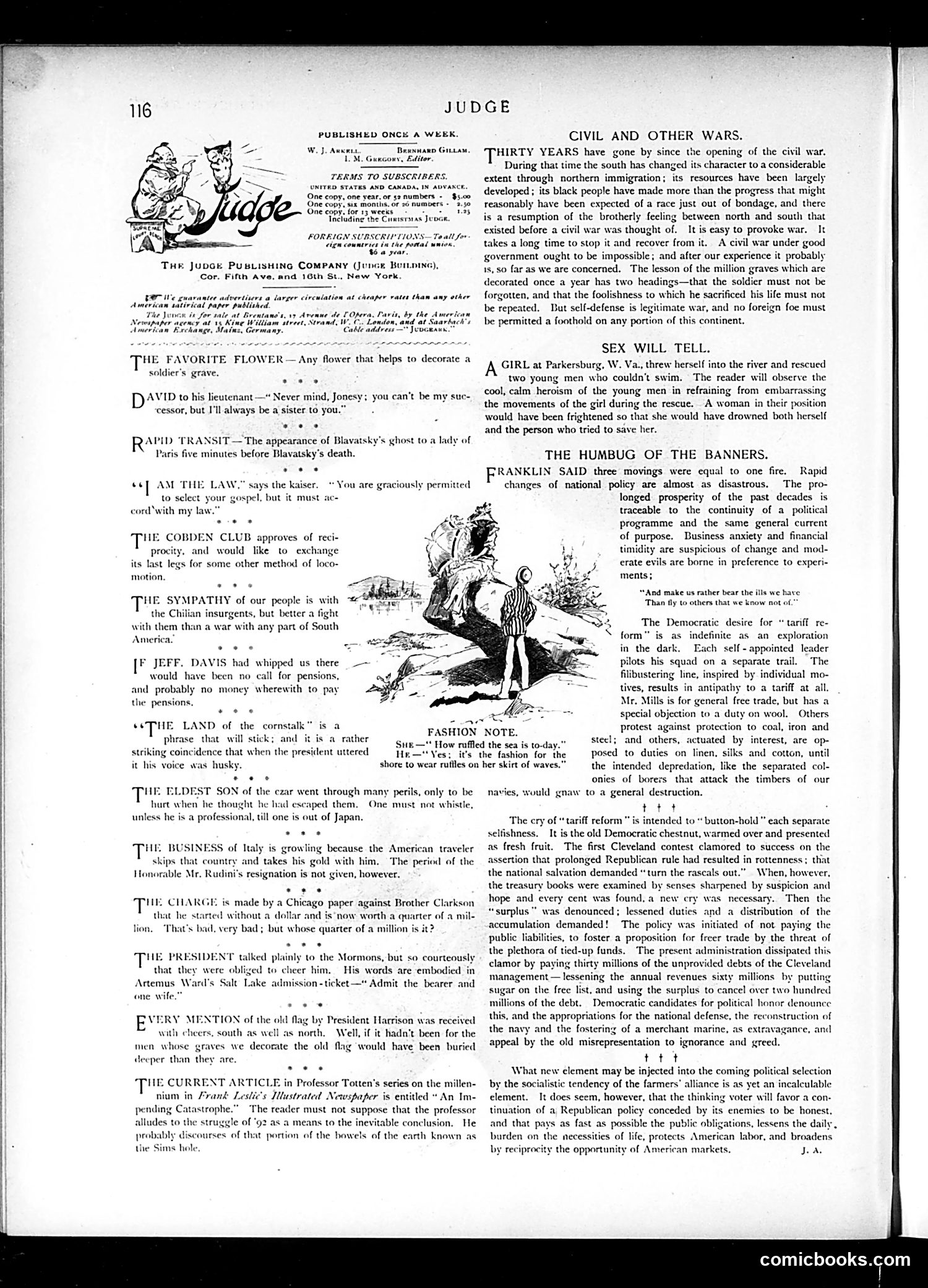
This page contains political commentary on post-Civil War reconstruction and contemporary issues (circa 1890s, given references to "thirty years" since the war's end). The main cartoon titled "The Humbug of the Banners" depicts a figure (likely representing political leadership) wrapped in banners, appearing disheveled or compromised. The satire criticizes inconsistent national policy—specifically rapid shifts in political direction that the cartoonist sees as driven by business interests rather than principle. The accompanying text attacks Democratic "tariff reform" as hollow posturing, arguing each faction pursues separate agendas. The author suggests both parties exploit public sentiment while serving special interests (steel, coal, iron industries). The page also contains brief political humor items mocking various public figures' statements and actions, typical of Judge's satirical format.
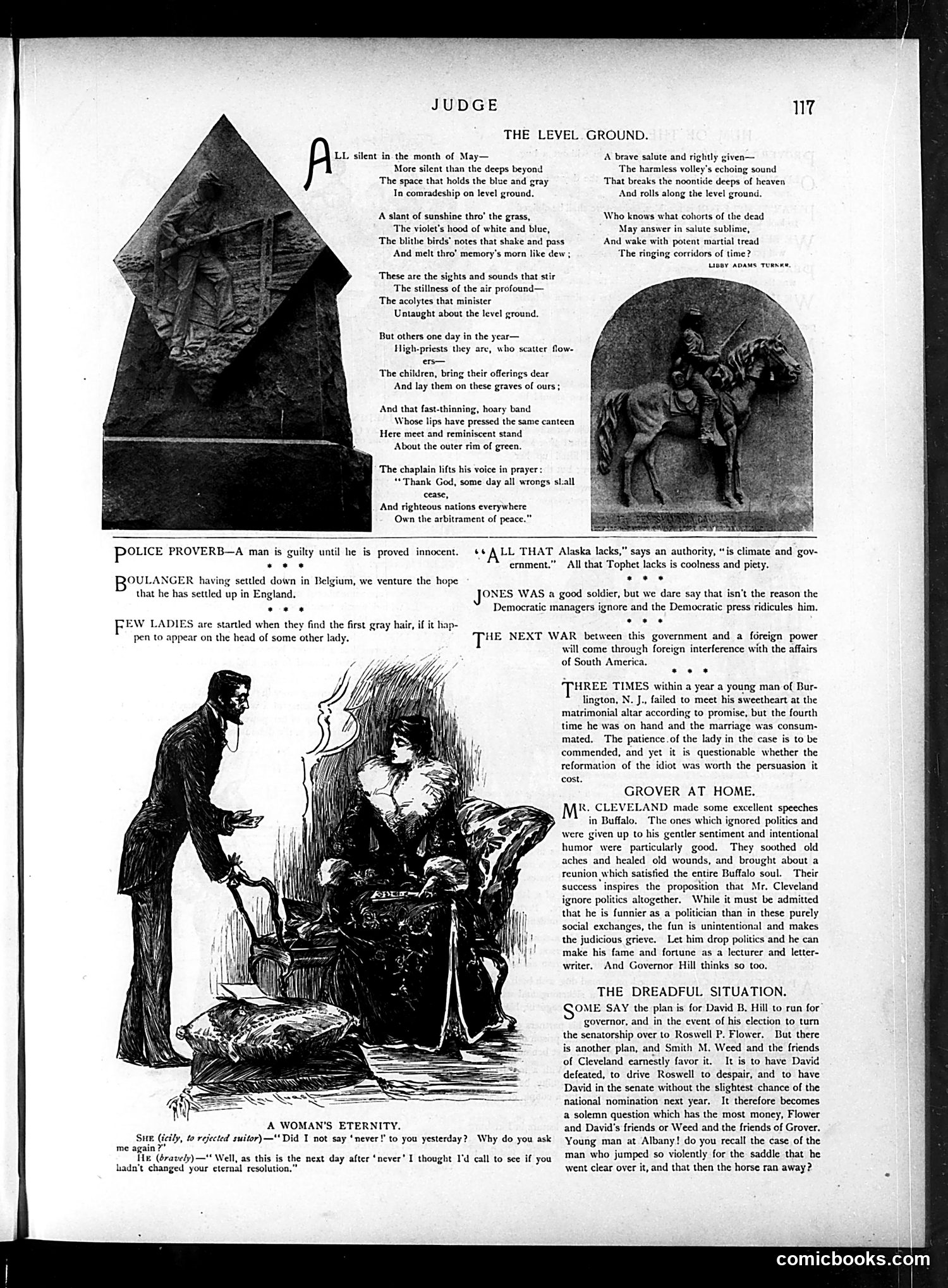
This page contains several unrelated satirical items rather than a unified cartoon. "The Level Ground" is a poem about a cemetery, accompanied by atmospheric illustrations. Below are brief satirical quips: one about a man settling in Belgium (likely referencing emigration), one about women noticing gray hair, and one titled "A Woman's Eternity" depicting a domestic scene where a woman rejects her husband's suggestion of spiritual renewal, implying marital discord. "Grover at Home" praises Cleveland's speeches for avoiding politics and focusing on sentiment, suggesting the public appreciated his rhetorical style over substance. "The Dreadful Situation" discusses potential political maneuvering around David B. Hill's governorship and successor negotiations, referencing Albany politics of the era. The page reflects late 19th-century American domestic and political satire.
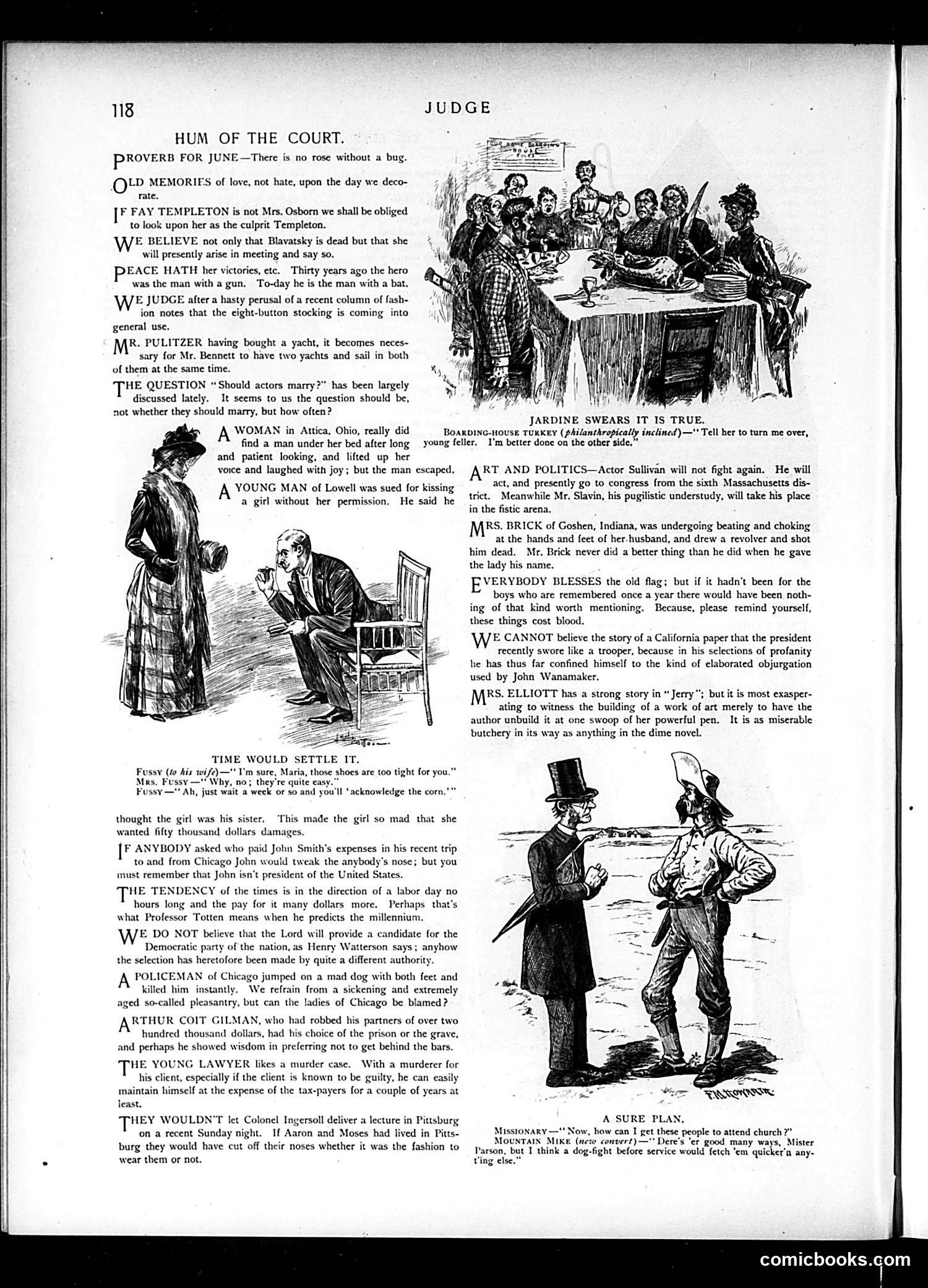
This page from Judge presents satirical commentary on contemporary American society through brief quips and illustrations. **Main Topics:** The text mocks various figures and trends: actress Fay Templeton's marital status, the spiritualist Madame Blavatsky, and a shift in American heroism from gunfighters to baseball players. It satirizes newspaper magnate Pulitzer's yacht acquisition, requiring rival Bennett to buy two yachts. An anecdote ridicules an Ohio woman who calmly discovered an intruder under her bed, while another celebrates an Indiana woman shooting her abusive husband. **Political References:** Actor John L. Sullivan is mocked for abandoning prizefighting to run for Congress, suggesting he'll become a lesser-known politician. The text also critiques President Cleveland's alleged profanity, comparing it unfavorably to department store magnate John Wanamaker's language. **Cartoons:** Two simple pen sketches illustrate domestic comedy scenes, typical of Judge's humorous social observation. The page exemplifies how Gilded Age satirical magazines combined gossip, political jabs, and social commentary.
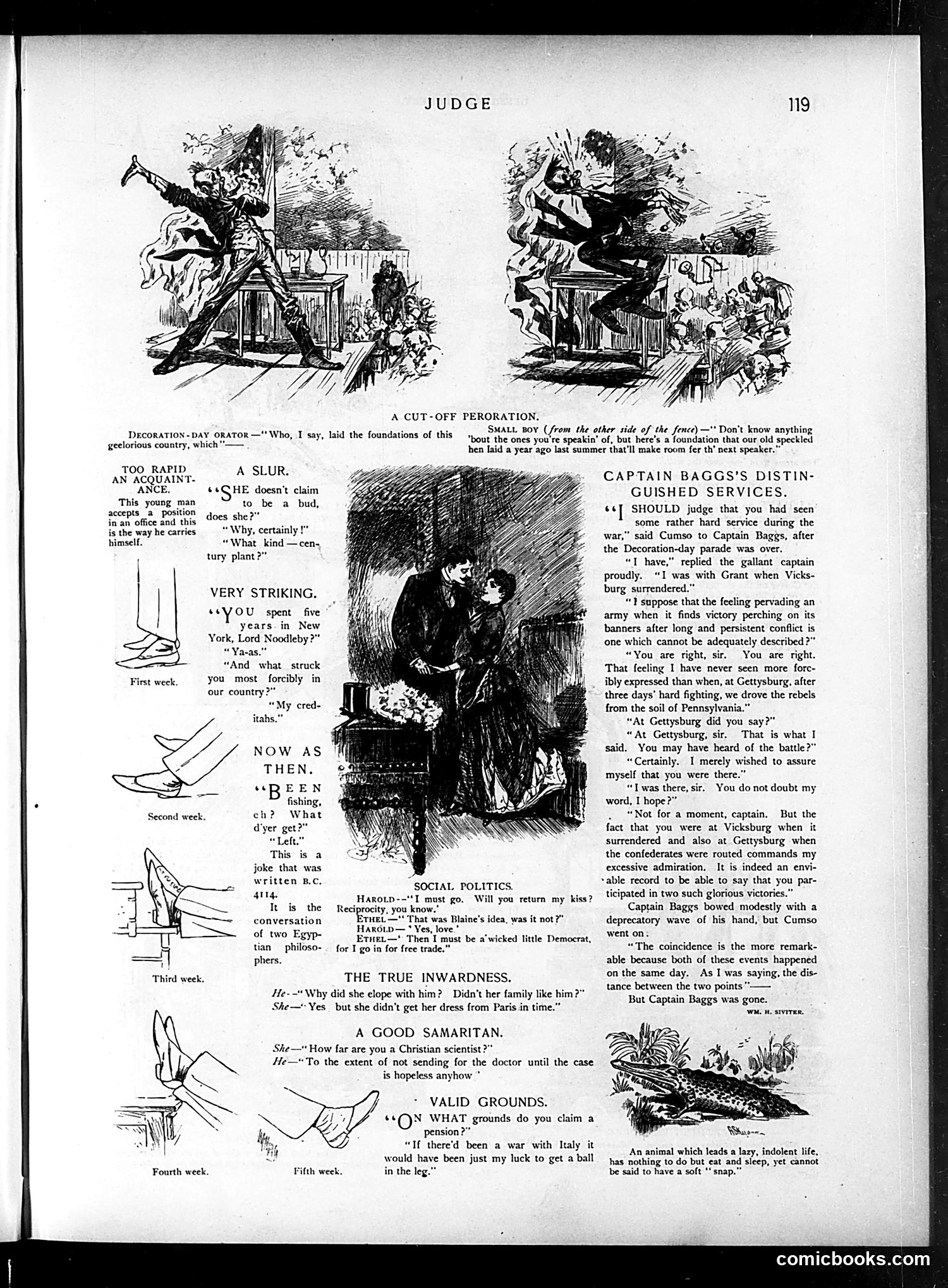
This page contains multiple satirical sketches typical of late 19th-century American humor: **Top cartoons**: "A Cut-Off Peroration" mocks long-winded public speeches, showing a boy interrupting a verbose orator by announcing he'll lay a foundation that makes room for the next speaker—satirizing tedious civic rhetoric. **"Captain Baggs's Distinguished Services"**: This dialogue exposes a braggart's logical inconsistency. Captain Baggs claims credit for both the Vicksburg *surrender* and the Gettysburg *victory*—mutually exclusive events during the Civil War. The questioner (Cumso) catches this impossible timeline, mocking veterans who inflate their war records. **Smaller jokes** ("Too Rapid an Acquaintance," "Very Striking," "Social Politics," etc.): Quick one-liners about courtship, class pretension, and political hypocrisy—standard Judge fare. **The foot diagrams**: "First through Fifth week" appear to illustrate progressive foot problems, likely commentary on fashionable but painful footwear. The satire targets pomposity, false heroism, and social pretension—core Judge themes attacking American vanity and dishonesty.
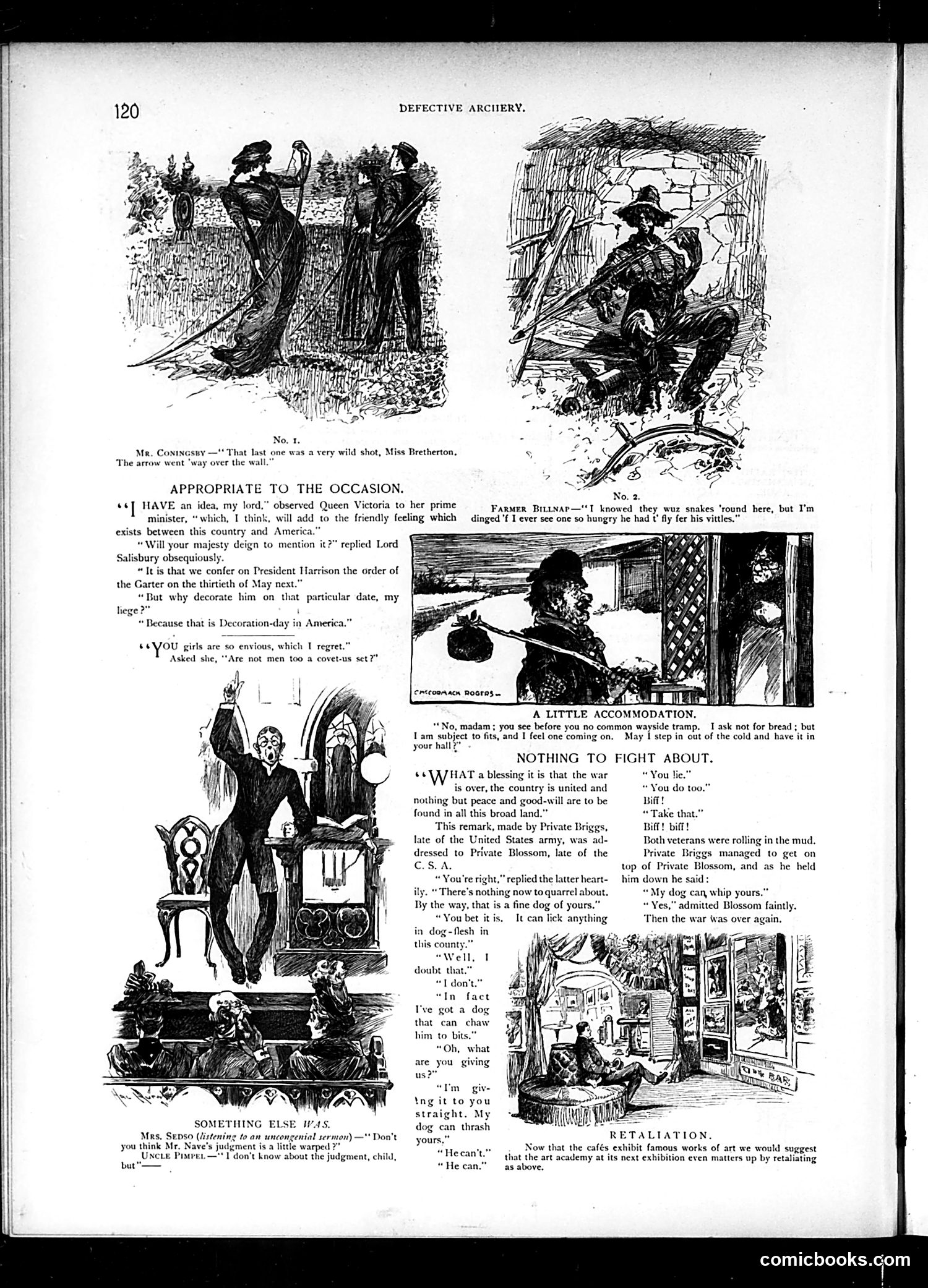
This page from *Judge* contains several unrelated satirical sketches typical of late 19th-century American humor: **Top section**: "Appropriate to the Occasion" mocks Queen Victoria's hypothetical idea to honor President Harrison with the Order of the Garter on Decoration Day (May 30th)—conflating a British honor with an American military memorial, satirizing transatlantic diplomacy as absurdly timing-obsessed. **Middle sketches**: Comic vignettes depicting everyday absurdities—a vagrant requesting shelter during a "fit," and two Civil War veterans (Union and Confederate soldiers, indicated by "U.S." and "C.S.A.") who claim peace has ended conflict, then immediately brawl over whose dog is tougher. The satire suggests post-war sectional animosity persists despite official reconciliation. **Bottom**: A joke about sermon-giving and artistic standards, plus "Retaliation"—suggesting cafés displaying fine art should allow the art academy to hang restaurant menus as retaliation. The humor relies on irony, wordplay, and observational comedy rather than political messaging.
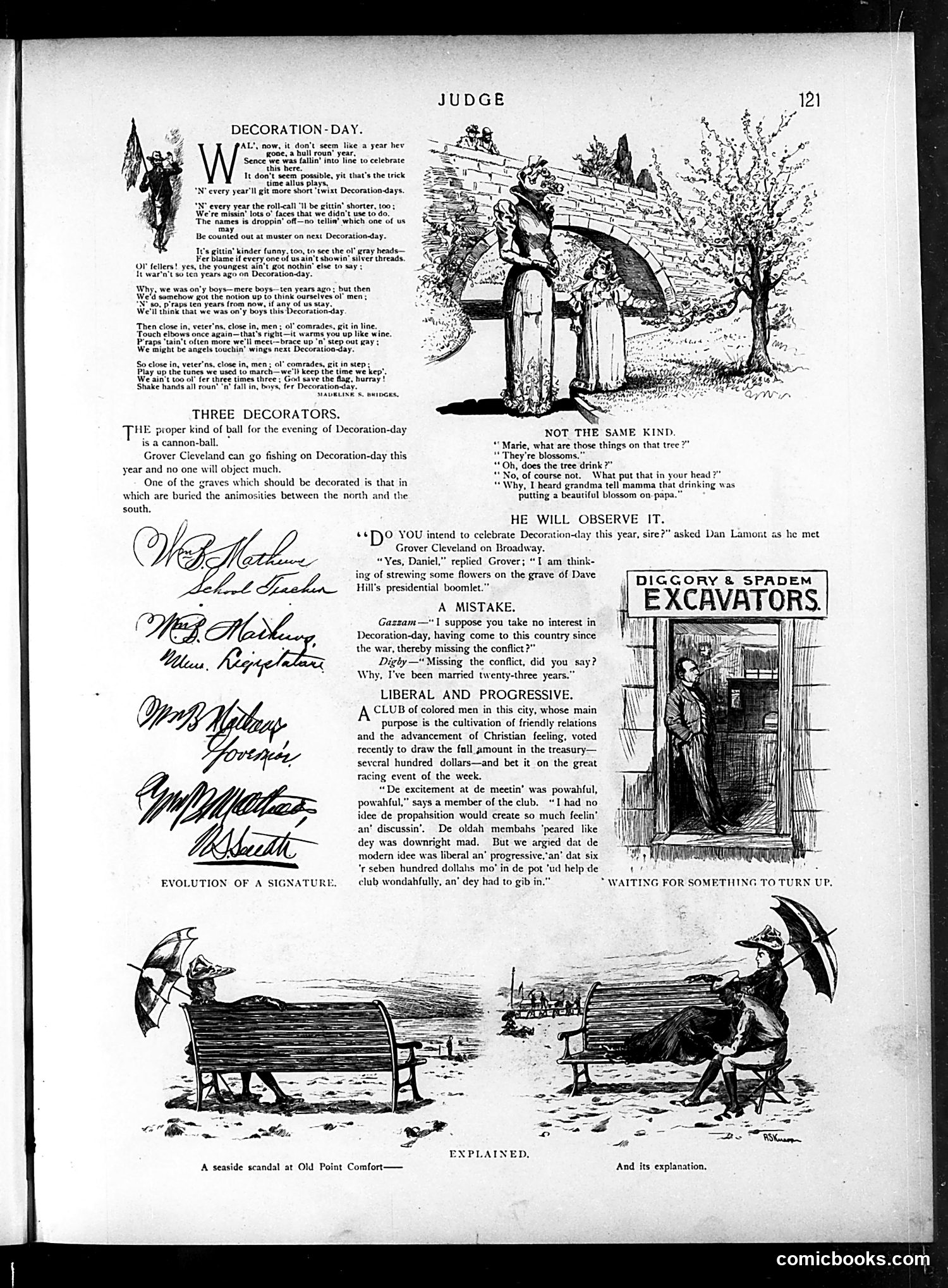
This page from Judge satirizes American attitudes toward Decoration Day (now Memorial Day) and contemporary politics. **Main Cartoons:** The "Decoration-Day" poem uses a Civil War veteran's voice to poignantly note how the annual observance grows shorter—fewer comrades attend each year as veterans age and die. It's sentimental Americana, not satire. **Political Jabs:** - **"Three Decorators"** mocks President Grover Cleveland for fishing rather than solemnly observing Decoration Day, while criticizing him for dismissing Dave Hill's presidential campaign as merely a "boomlet" (failed attempt). - **"Liberal and Progressive"** satirizes a Black men's club that votes to gamble their treasury on horse racing, ironically calling this "modern" and "progressive." The dialect humor reflects period racism. - **"A Mistake"** jokes that marriage is as much a "conflict" as the Civil War. The page mixes patriotic nostalgia with partisan mockery of Cleveland and social commentary (however crude by modern standards) on claims of progressive values contradicted by reckless behavior.
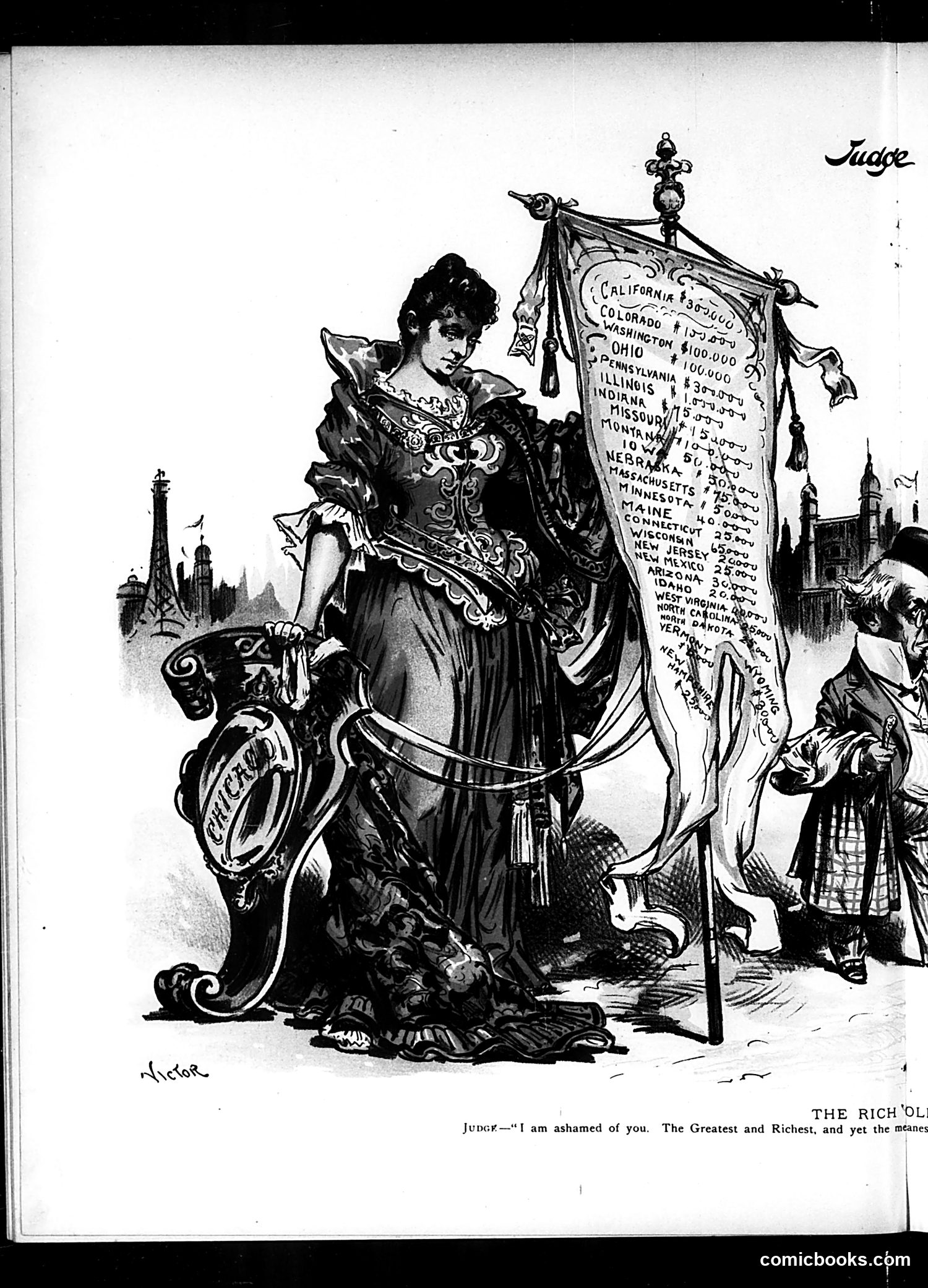
This Judge magazine cartoon depicts Lady Justice (or Columbia, representing America) in ornate robes, holding a banner listing U.S. states with their assessed wealth values. She confronts a figure labeled "The Rich 'Ol'" (text is cut off, likely "Old Lady" or similar). The Judge character reproaches this wealthy personification, stating: "I am ashamed of you. The Greatest and Richest, and yet the meanest" (text incomplete). The satire critiques American wealth inequality—specifically, that despite the nation's vast riches (evidenced by the state valuations), the wealthy are morally "mean" or stingy. This likely addresses Gilded Age concerns about wealthy industrialists' insufficient philanthropy or social responsibility, a common Progressive-era critique. The cartoon's point: prosperity without generosity or conscience is shameful.
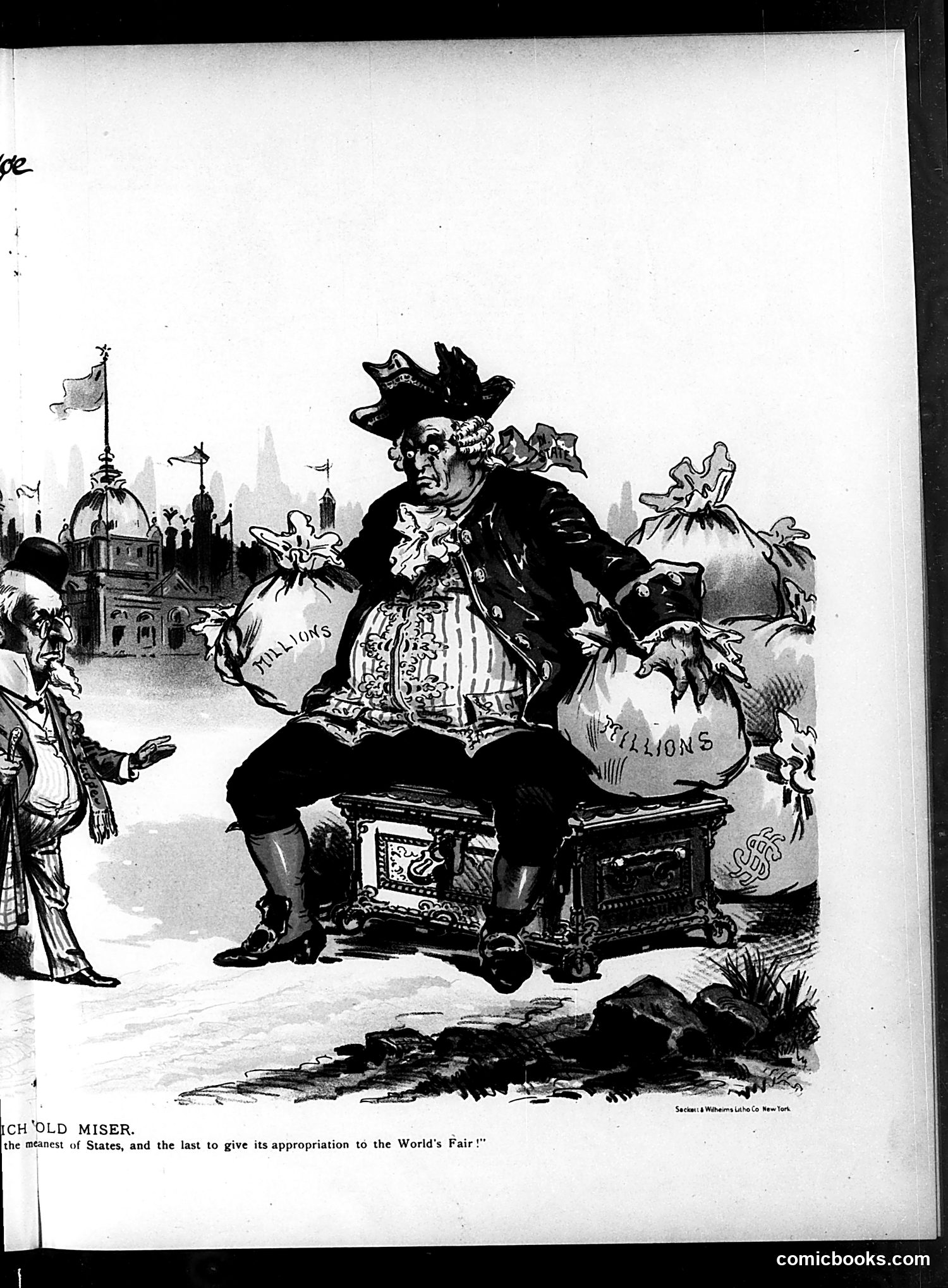
This is a satirical cartoon depicting a miserly state official (caricatured with exaggerated features) sitting on treasure chests labeled "MILLIONS." The figure is being criticized for stinginess regarding funding for "the World's Fair" — likely the 1893 World's Columbian Exposition in Chicago, a major national event requiring state contributions. The cartoon's caption calls the state "the meanest" and "the last to give its appropriation," suggesting a particular state was reluctant or slow in providing financial support compared to others. The formal architectural backdrop and other figures in period dress indicate this is political commentary on state-level reluctance to fund a prestigious national event. The satire mocks both the official's greed and the state's parsimony when broader civic pride or national prestige was at stake.
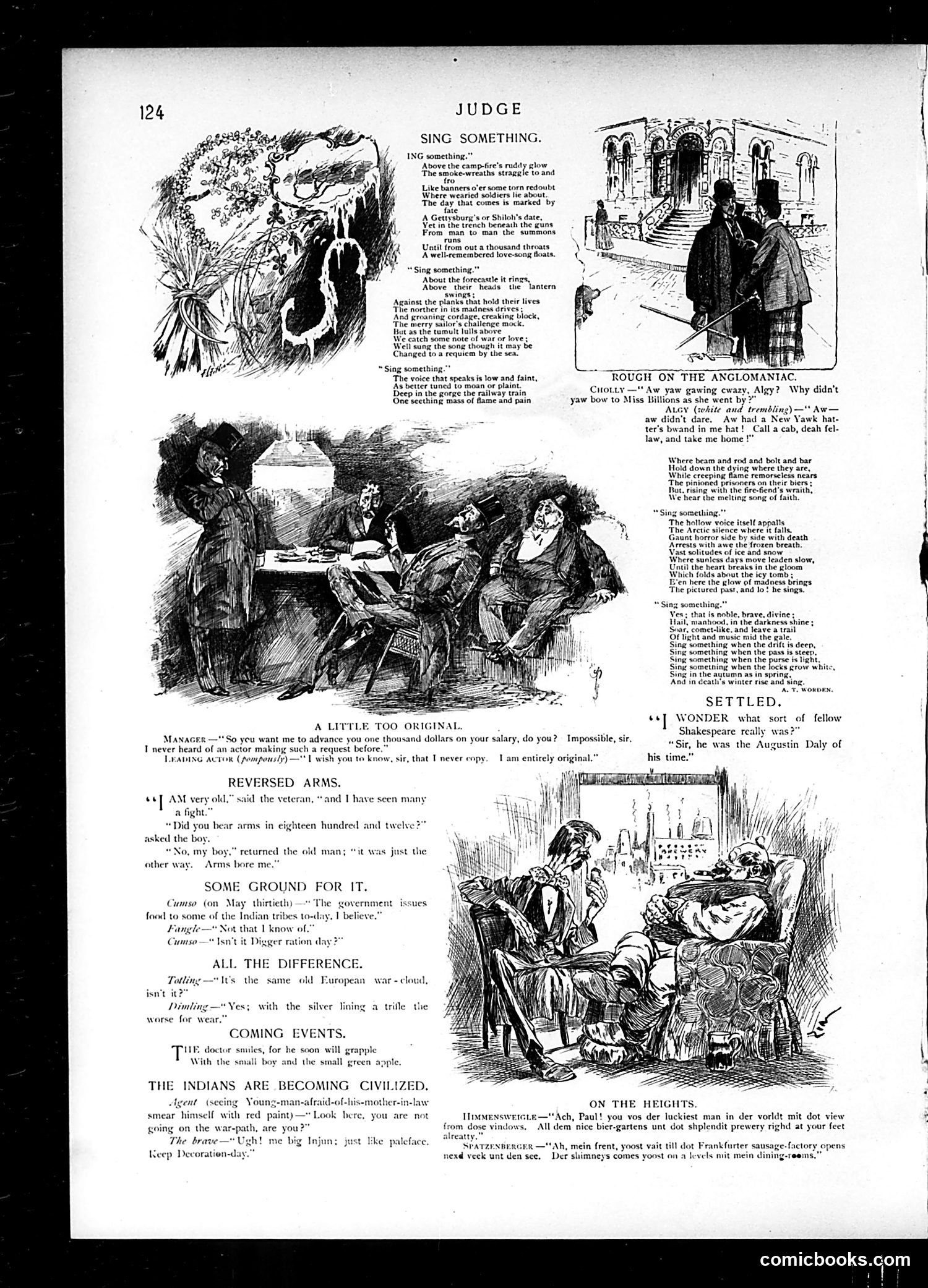
This cartoon satirizes a snobbish American Anglophile named Algy who adopts affected British mannerisms. When confronted by a socially superior wealthy American woman ("Miss Billions"), Algy becomes so nervous about his fashionable New York hat—a symbol of his pretension—that he can't manage a proper bow. He then pathetically requests a cab to flee home, reduced to calling the driver "deah fellow" in his affected accent. The satire targets Americans who mimicked British affectations and social anxiety around wealth. The humor lies in Algy's transparent insecurity: his imported British persona collapses instantly when faced with actual American money and status. "Anglomaniac" refers to the obsessive admiration of British culture popular among certain American social climbers in the late 19th/early 20th century.
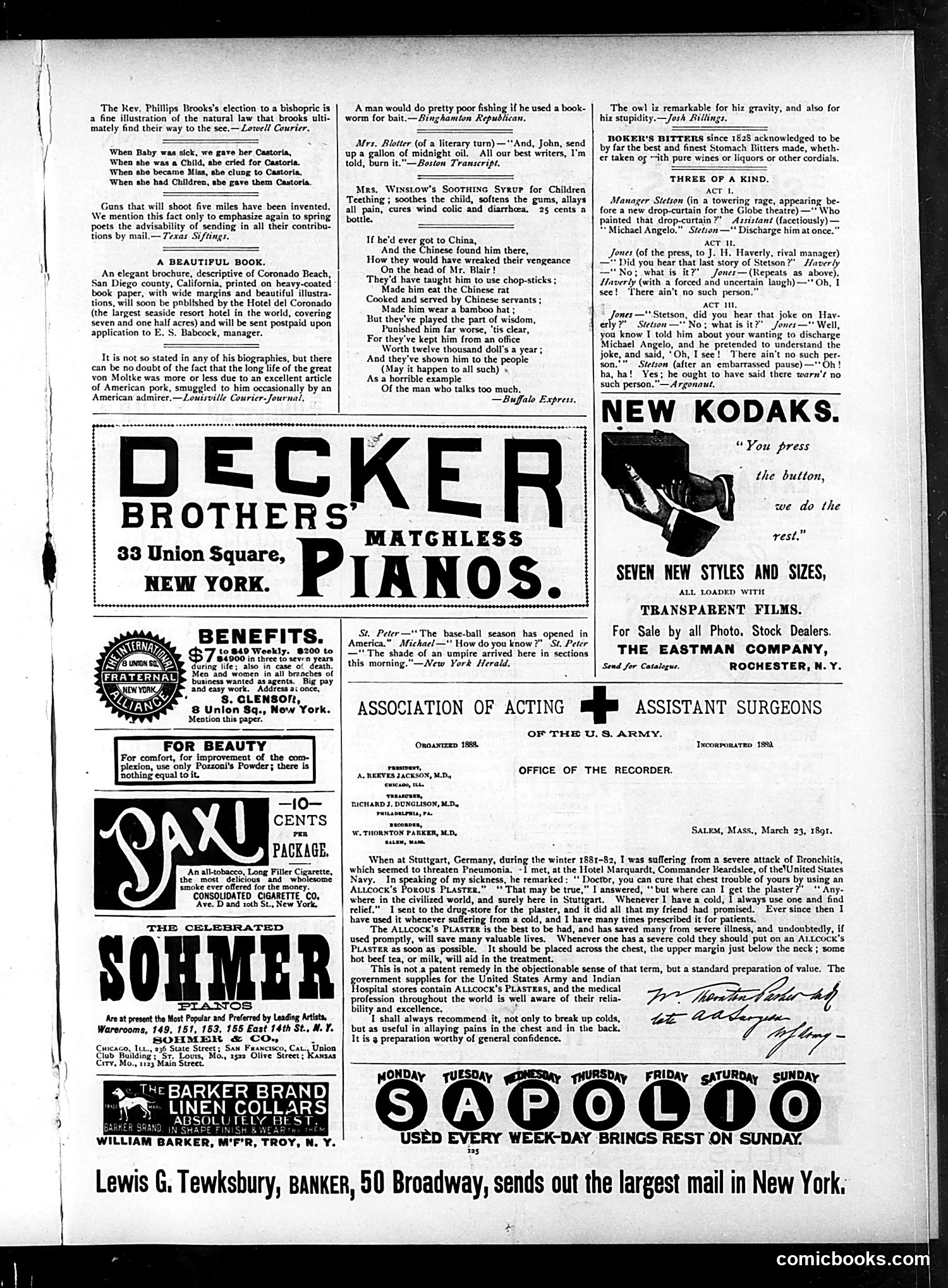
This page from Judge magazine is primarily advertising with some satirical content. The main cartoons are three short vignettes labeled "Three of a Kind," mocking theatrical rivalry between competing managers—one involves the fake artist "Michael Angelo" used as an insult, suggesting the manager is so ignorant he doesn't recognize the Renaissance master's name. The jokes highlight absurd theater gossip and wounded pride. The text also includes typical Judge-style one-liners: a pun on Reverend Phillips Brooks becoming a bishop (wordplay on "brooks" and "see"—the bishop's seat); a warning to poets to mail contributions rather than risk being shot; and jokes about products like Castoria and Boker's Bitters. The page is dominated by period advertisements for pianos, cameras (Kodak), cigars, and patent medicines—reflecting late-19th-century consumer culture. The content assumes readers familiar with New York theater personalities and appreciate light satire of contemporary urban life.
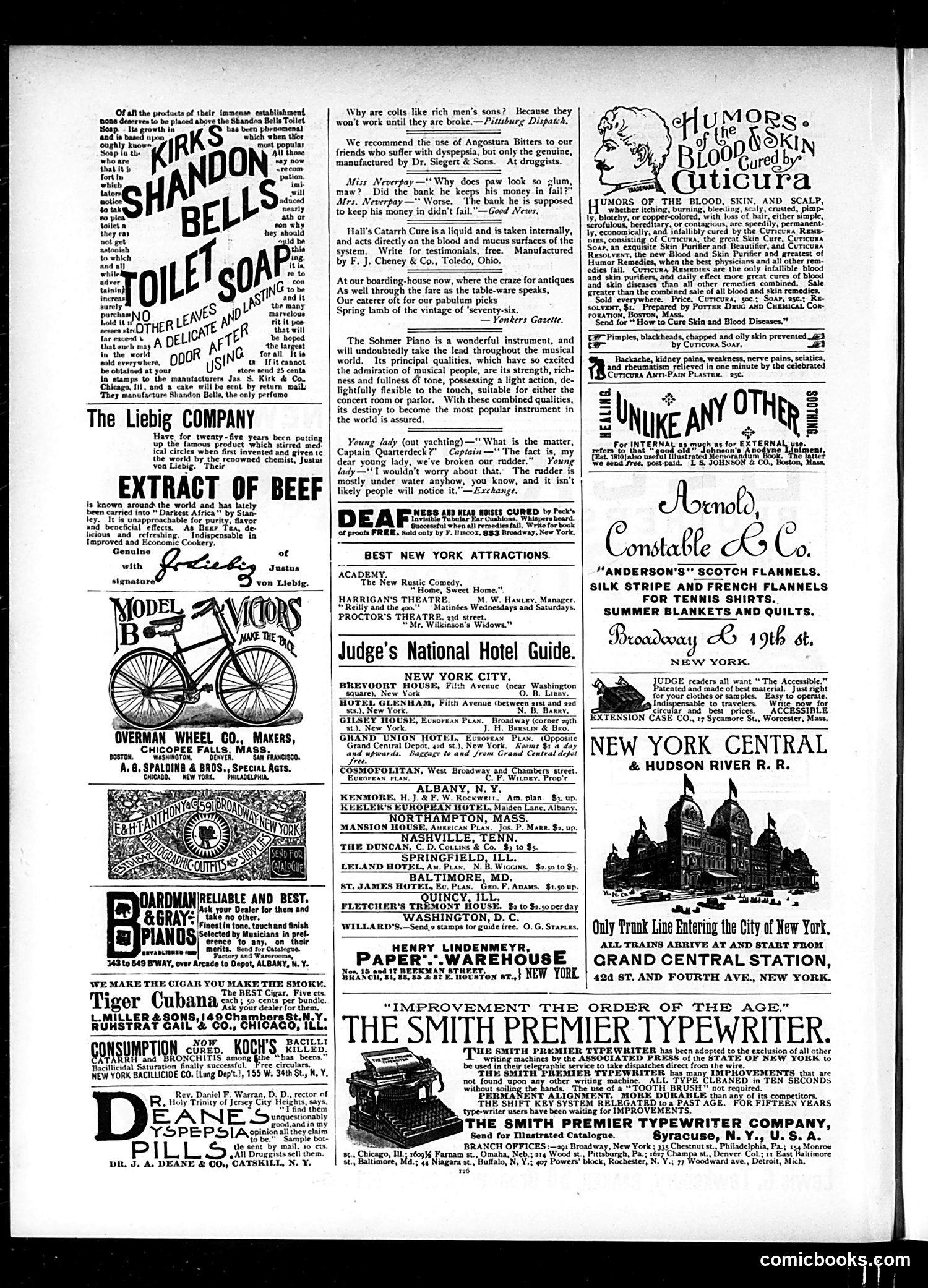
This is primarily an **advertising page** with scattered humorous filler content typical of Judge magazine's format. The few jokes present are mild social commentary: one quip mocks the wealthy ("colts like rich men's sons"), another jokes about banking failures (likely referencing late-19th-century financial instability), and a boarding-house joke satirizes the fashionable craze for serving "antique" food. The dominant content consists of **product advertisements**—Kirk's Shandon Bells soap, Liebig's Extract of Beef, bicycles, pianos, and hotels. These reflect period consumer culture and marketing conventions. There are **no political cartoons** on this page. The "cartoons" are actually product illustrations (bicycles, typewriter). The page functions as a commercial vehicle disguised as editorial content, which was standard Judge practice—blending entertainment, humor, and advertising to reach affluent readers.
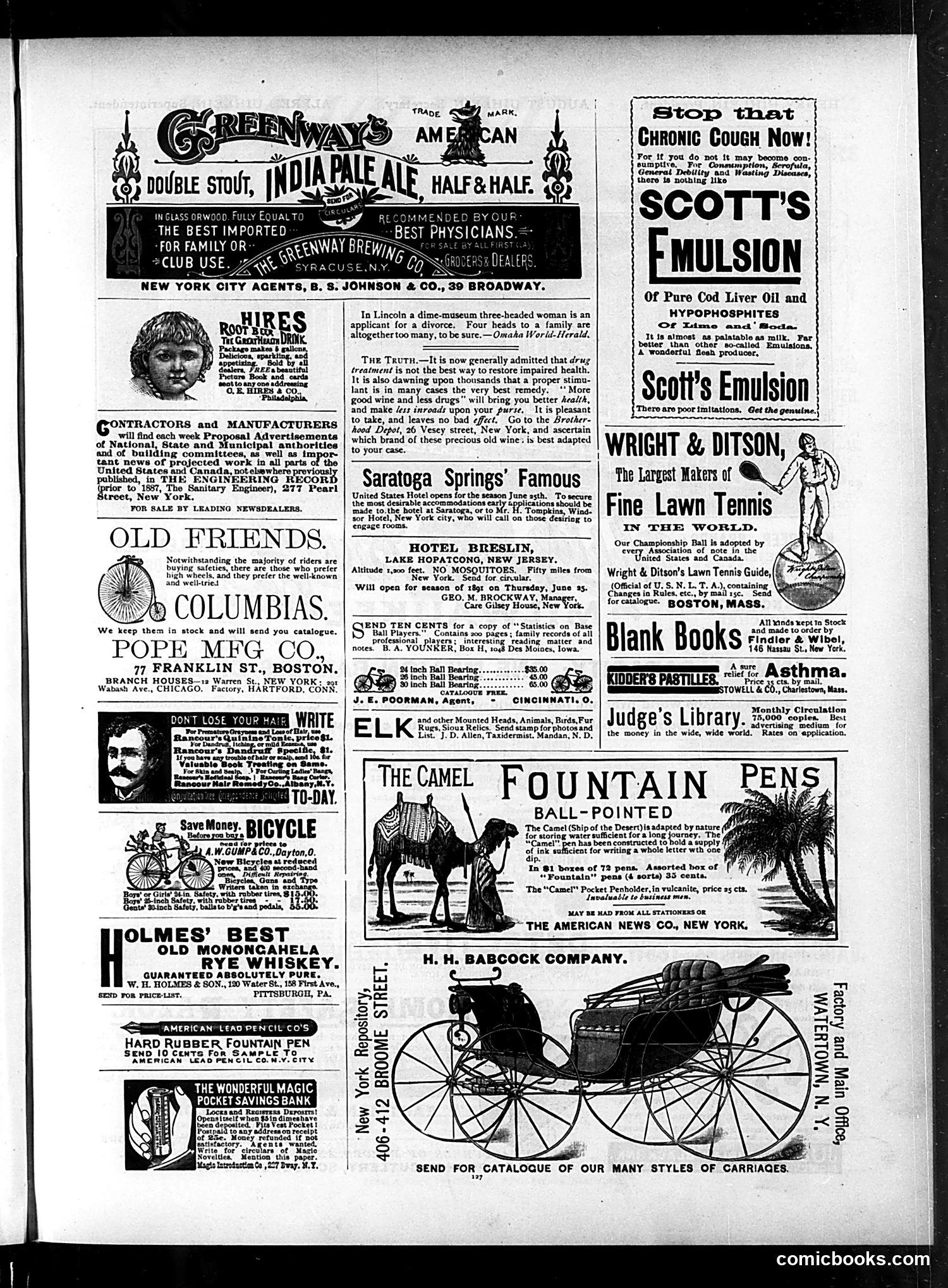
This page from Judge is **primarily composed of advertisements**—typical of late 19th-century publications. Rather than political cartoons, it contains commercial pitches interspersed with brief, era-appropriate humor items. Notable content includes: **The brief "joke"** about a Lincoln dime-museum "three-headed woman" seeking divorce, sardonically suggesting "four heads to a family are altogether too many." This is light topical humor, not meaningful satire. **Advertisements reveal period concerns**: patent medicines (Scott's Emulsion for coughs, Kidder's Pastilles for asthma), hair restoration products, carriages, bicycles, whiskey, and fountain pens—products marketed to Judge's middle and upper-class readership. **A recurring theme**: medicines and tonics claiming to restore health, reflecting Victorian-era medical skepticism and the prevalence of patent medicine marketing in American publications. The page lacks identifiable political figures or substantive satire—it's a straightforward commercial product showcasing the monetization model of late-19th-century magazines rather than editorial commentary.
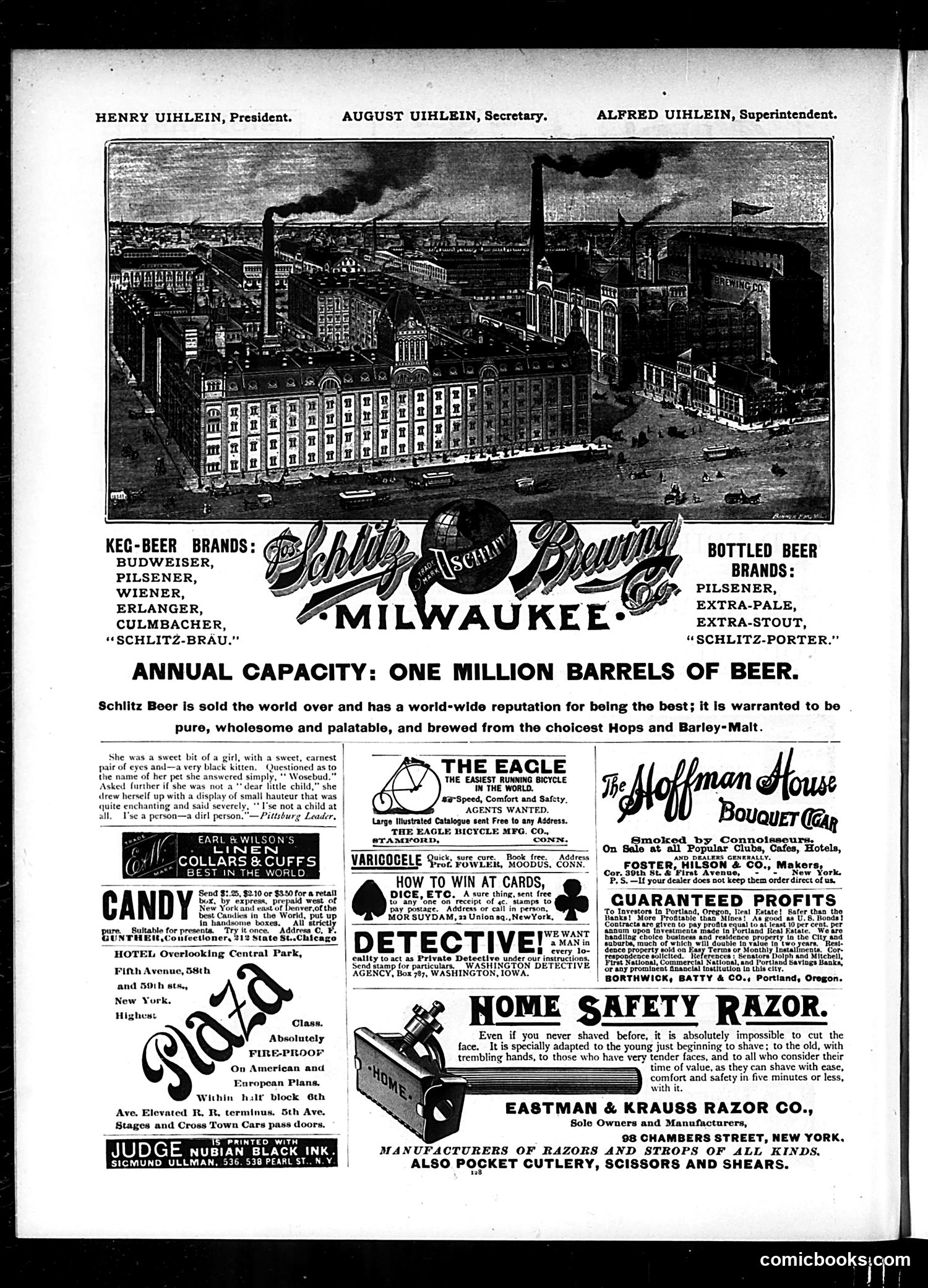
This is primarily a **business advertisement page**, not a political cartoon. The dominant feature is a detailed engraving of the Schlitz brewery facility in Milwaukee, promoting the company's massive production capacity of one million barrels annually. The page lists company leadership (Henry, August, and Alfred Uihlein) and advertises Schlitz's various beer brands—both kegged (Budweiser, Pilsener, Wiener) and bottled varieties (Extra-Pale, Extra-Stout). The remainder consists of typical period advertisements: collars and cuffs, hotel accommodations, bicycles, candy, razors, cigars, and various dubious products ("How to Win at Cards," ricocele cures, detective services, and "Guaranteed Profits" schemes). **There is no significant satirical or political content**—this appears to be a standard advertising page from *Judge* magazine, showcasing both legitimate and questionable commercial enterprises of the era. The brewery advertisement dominates; the surrounding ads are incidental filler.
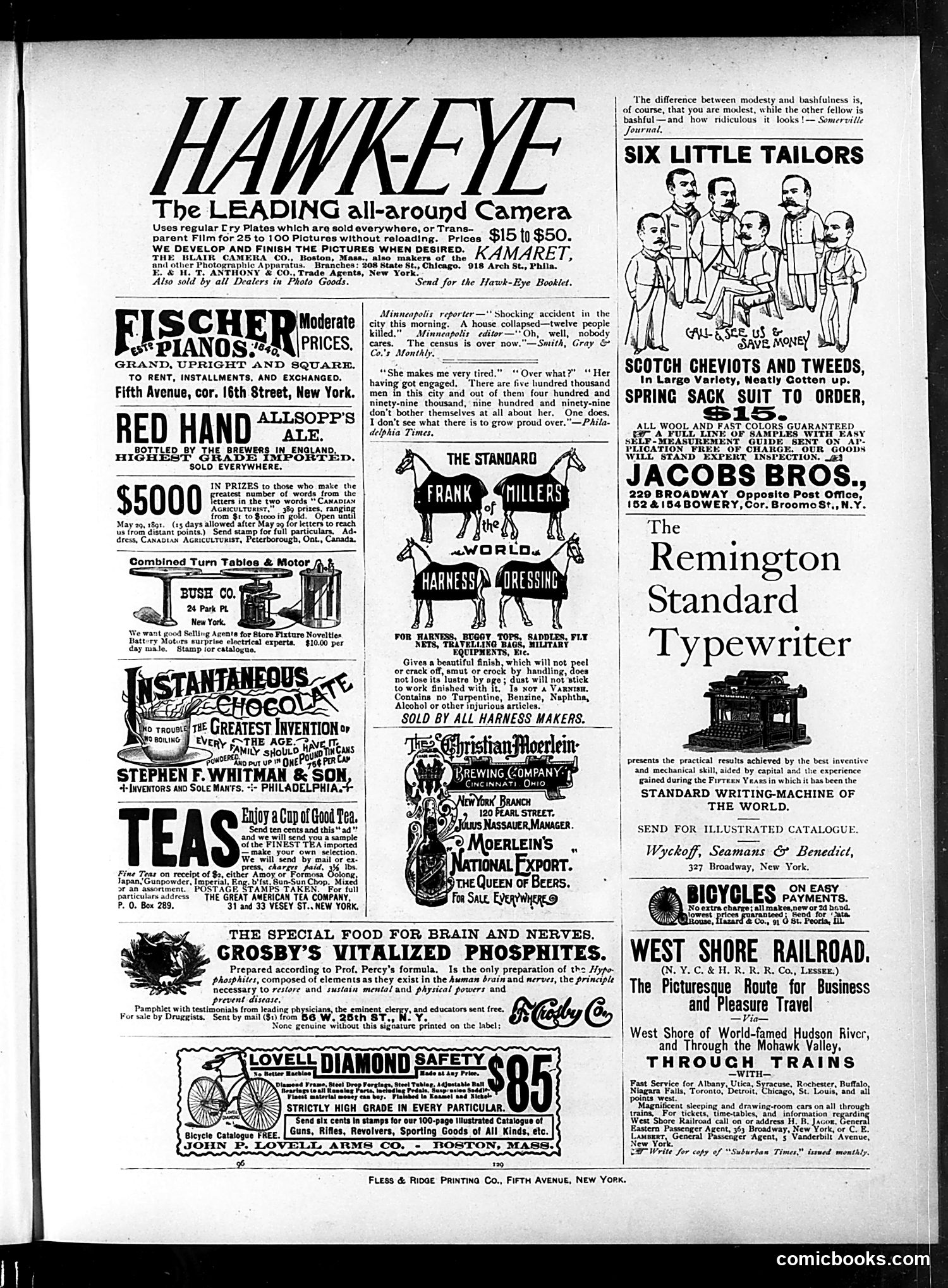
This is primarily an **advertising page** rather than editorial content or political cartoons. The page contains numerous product advertisements typical of late 19th-century American magazines, including cameras (Hawk-Eye), pianos (Fischer), tea, bicycles, and typewriters. The only satirical content appears to be two brief **humorous anecdotes** embedded among ads: 1. A Minneapolis reporter/editor exchange mocking journalistic indifference—after a building collapse kills twelve people, the editor dismisses it because "the census is over now" (suggesting census periods generate competitive news coverage). 2. A joke about a woman being "very tired" because her fiancé is proud of their engagement, when statistically only one man in 500,000 in the city cares about her. These are light social humor rather than political satire. The page itself demonstrates Judge's business model: mixing advertising revenue with brief comedic content to fill space.
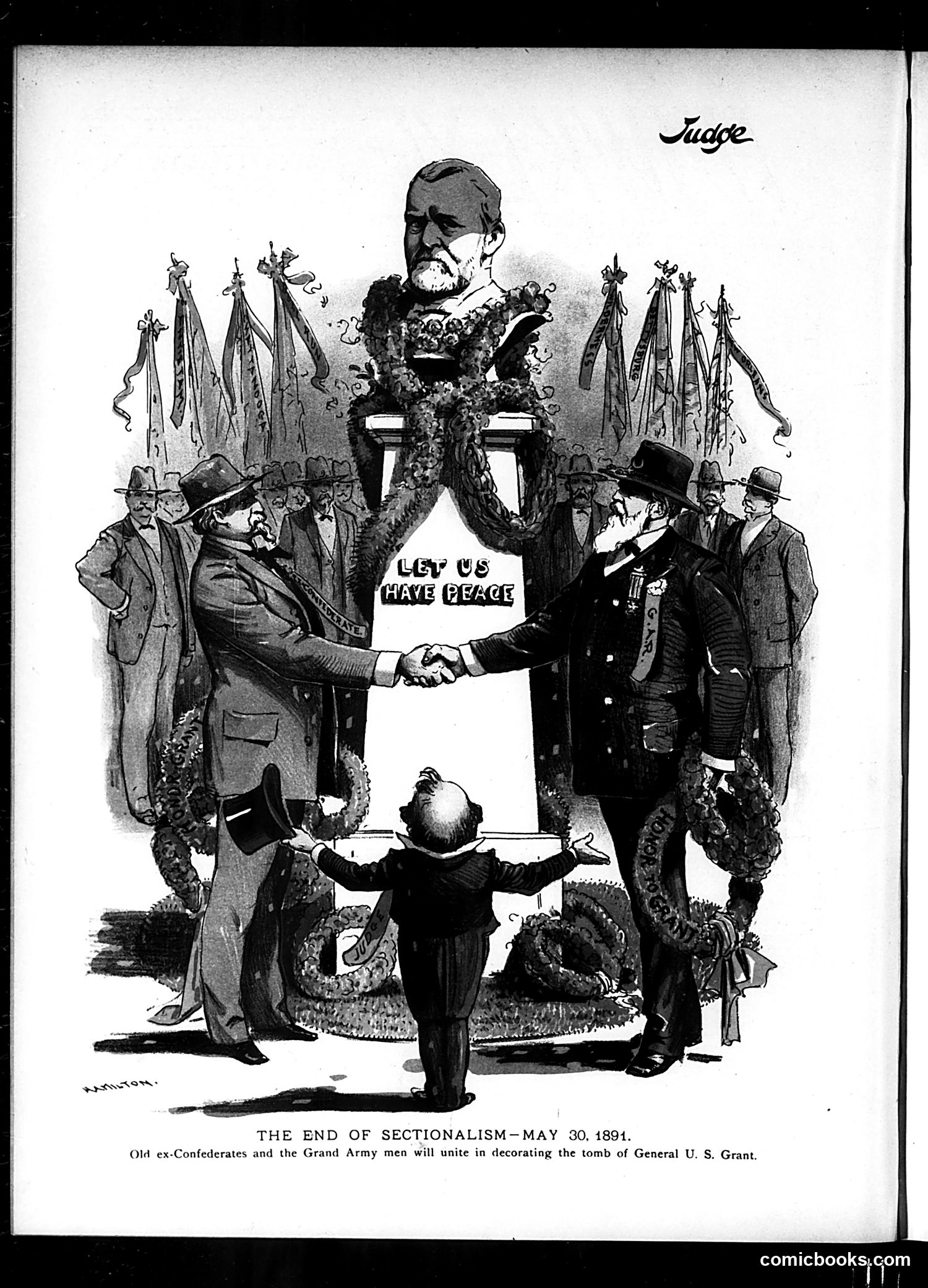
This cartoon celebrates the reconciliation between North and South following the Civil War. Two military figures—likely representing a Union officer (Grand Army of the Republic) and a Confederate veteran—shake hands beneath a massive, menacing octopus labeled "War," while soldiers with flags stand behind them. A small child figure watches from below. The satire's point: the "octopus of war" that divided the nation is being conquered through unity. The May 30 date references Decoration Day (now Memorial Day), when Americans honored war dead. The cartoon commemorates an actual 1891 event where ex-Confederates and Union veterans jointly decorated General U.S. Grant's tomb, symbolizing sectional healing over 25 years after the war's end.