
Judge, 1891-05-30 · page 2 of 16
Judge — May 30, 1891 — page 2: what you’re looking at
What you’re looking at
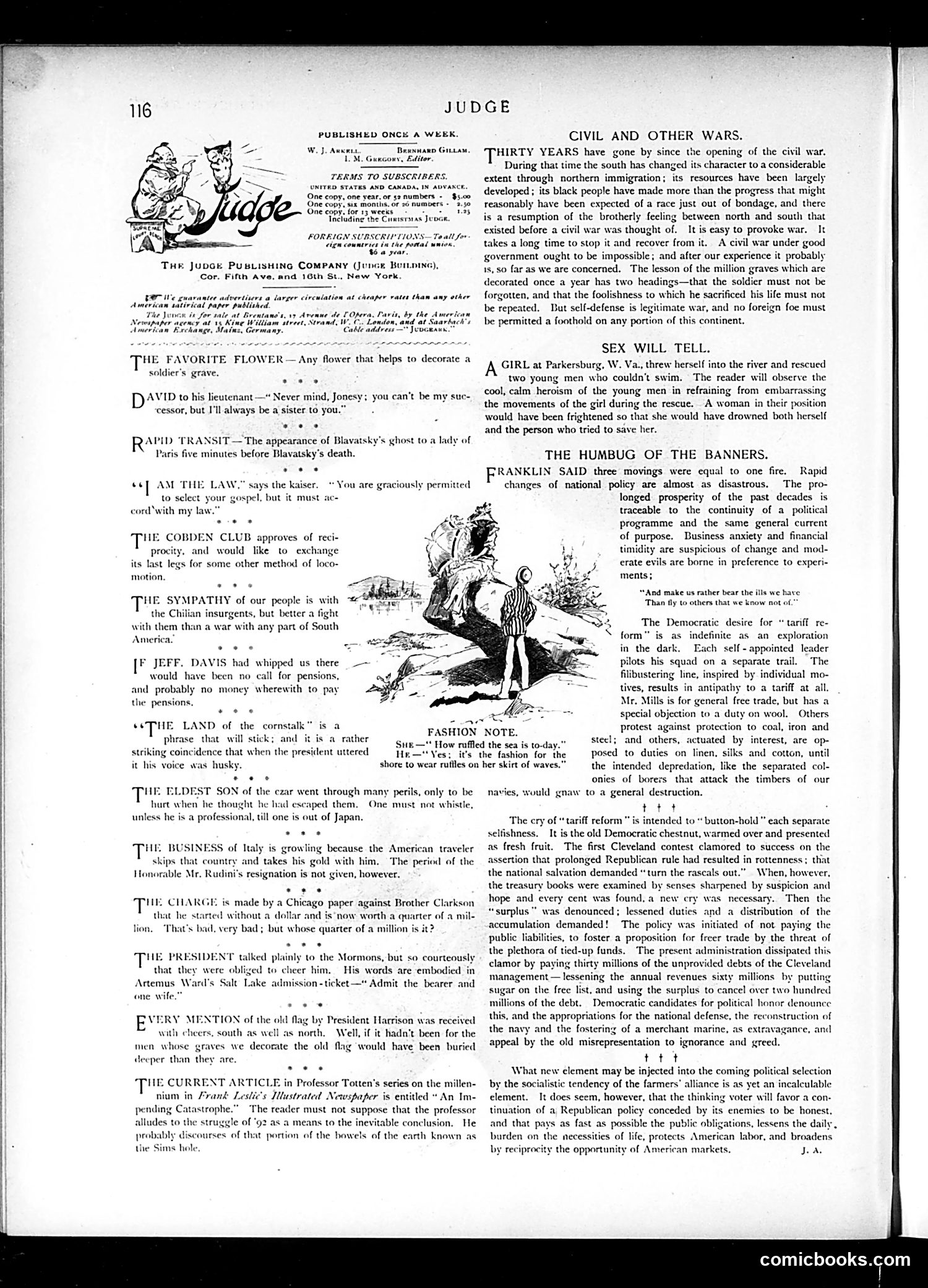
This page contains political commentary on post-Civil War reconstruction and contemporary issues (circa 1890s, given references to "thirty years" since the war's end). The main cartoon titled "The Humbug of the Banners" depicts a figure (likely representing political leadership) wrapped in banners, appearing disheveled or compromised. The satire criticizes inconsistent national policy—specifically rapid shifts in political direction that the cartoonist sees as driven by business interests rather than principle. The accompanying text attacks Democratic "tariff reform" as hollow posturing, arguing each faction pursues separate agendas. The author suggests both parties exploit public sentiment while serving special interests (steel, coal, iron industries). The page also contains brief political humor items mocking various public figures' statements and actions, typical of Judge's satirical format.
📄 Transcribed text from this page (OCR, searchable)
Machine-transcribed from the original scan — historical spelling and the odd misread are preserved.
PUBLISHED ONCE A WEEK. W. J. Ament. Braxnarp Gittas. 1. M. Guncony, Etitor TERMS TO SUBSCRIBERS. ONITRO STATIS AND CAKADA, IN ADVANCE One copy, one year. or s2 numbers » $3.00 Oe Sony. Se montis ors numoers «2 ne copy. for 1) weeks es Tncludine the Cumisratas JeDGR FOREIGN SUBSCRIPTIONS: eign countries fn the portal w $6 a year THE JUDGE PUBLISHING COMPANY (Junce Burninc), Cor. Fifth Ave, and 16th St., New York. all for ice advertisers a larger circulation at cheaper rates tham any other faper published. i for sale at Brentano's, 17 A HE FAVORI soldier's grave. AVID to his lieutenant —“ Never mind, Jonesy; you can't be my suc- cessor, but I'll always be a sister to you.” RAPID TRANSIT —The appearance of Blavatsky's ghost to a lady of ris five minutes before Blavatsky's death. 66] AM THE LAW,” says the kaiser. * You are graciously permitted to select your gospel, but it must a cord with my law.” HE COBDEN CLUB approves of reci- procity, and would like to. exchang its last legs for some other method of loco- motion. THE SYMPATHY of our people is with the Chilian insurgents, but better a fight with them than a war with any part of South America. F JEFF, DAVIS had whipped us there would have been no call for pensions, and probably no money wherewith to pay the pensions. s6THE LAND of the corn: is a JUDGE CIVIL AND OTHER WARS. HIRTY YEARS have gone by since the opening of the civil war. During that time the south has changed its character to a considerable extent through northern immigration; its resources have been largely developed ; its black people have made more than the progress that might reasonably have been expected of a race just out of bondage, and there s a resumption of the brotherly feeling between north and south that existed before a civil war was thought of. It is easy to provoke war. It takes a long time to stop it and recover from it. A civil war under good government ought to be impossible; and after our experience it probably 18, so far as we are concerned. The lesson of the million graves which are decorated once a year has two headings—that the soldier must not be forgotten, and that the foolishness to which he sacrificed his life must not be repeated. But self-defense is legitimate war, and no foreign foe must be permitted a foothold on any portion of this continent. SEX WILL TELL. A GIRL at Parkersburg, W. Va., threw herself into the river and rescued two young men who couldn't swim. The reader will observe the cool, calm heroism of the young men in refraining from embarrassi the movements of the girl during the rescue. A woman in their position would have been frightened so that she would have drowned both herself and the person who tried to save her. THE HUMBUG OF THE BANNERS. RANKLIN SAID three movings were equal to one fire. Rapid changes of national policy are almost as disastrous. The pro- longed prosperity of the past decades traceable to the continuity of a_ political programme and the same general current of purpose. Business anxiety and financial timidity are suspicious of change and mod- erate evils are borne in preference to experi- ments; “And make us rather bear the ills we have Than fly to others that we know not of.” The Democratic desire for tariff re- form” is as indefinite as an_ exploratios in the dark, Each self-appointed leader pilots his squad on a separate trail. ‘The filibustering line, inspired by individual mo- tives, results in antipathy to a tariff at all. Mr. Mills is for general free trade, but has a special objection to a duty on wool. Others the eu vision Nore. protest against protection to coal, iron and phrase that will stick; and it is a rather . : steel; and others, actuated by interest, are op- . : —"' How ruffled the sea is to-day : ‘ Z striking coincidence that when the president uttered TIp_—""Ves: it's ‘the fachion for the posed to duties on linen, silks and cotton, until it his voice was husky. shore to wear ruilles on her skirt of waves.” the intended depredation, like the separated col- eee onies of borers that attack the timbers of our HE ELDEST SON of the czar went through many perils, only to be hurt when he thought he had escaped them. One must not whistle, unless he is a professional, till one is out of Japan. THIE_ BUSINESS of Italy is growling because the American traveler kips that country and takes his gold with him, ‘The period of the Honorable Mr. Rudini’s resignation is not given, however. THE CHARGE is made by a Chicago paper against Brother Clarkson that he started without a dollar and is‘now worth a quarter of a mil- lion, That's bad, very bad; but whose quarter of a million is it? HIE PRESIDENT talked plainly to the Mormons, but so courteously that they were obliged to cheer him. His words are embodied in Artemus Ward's Salt Lake admission -ticket—" Admit the bearer and wile.” one Every MENTION of the old flag by President Harrison was received with cheers, south as well as north. Well, if it hadn't been for the men whose graves we decorate the old flag would have been buried deeper than they are. HE CURRENT ARTICLE in Professor Totten’s series on the millen- nium in Frank Leslie's Mlustrated Newspaper is emitled “An Im- pending Catastrophe.” ‘The reader must not suppose that the professor ludes to the struggle of ‘92 as a means to the inevitable conclusion. He pr sof the earth known the Sims hole, pably discourses of that portion of the bows navies, would gnaw to a general destruction. ttt The cry of “ tariff reform” is intended to “button-hold ” each separate selfishness. It is the old Democratic chestnut, warmed over and presented as fresh fruit. The first Cleveland contest clamored to success on the assertion that prolonged Republican rule had resulted in rottenness ; that the national salvation demanded “turn the rascals out.” When, however, the treasury books were examined by senses sharpened by suspicion and hope and every cent was found, a new ery was necessary. Then the “surplus” was denounced ; lessened duties and a distribution of the accumulation demanded! The policy was initiated of not paying the public liabilities, to foster a proposition for frcer trade by the threat of the plethora of tied-up funds. The present administration dissipated this clamor by paying thirty millions of the unprovided debts of the Cleveland management — lessening the annual revenues sixty millions by putting sugar on the free list, and using the surplus to cancel over two hundred millions of the debt. Democratic candidates for political honor denounce this, and the appropriations for the national defense, the reconstruction of the navy and the fostering of a merchant marine, as extravagance, and appeal by the old misrepresentation to ignorance and greed. Prt What new element may be injected into the coming political selection by the socialistic tendency of the farmers’ alliance is as yet an incalculable clement. It does seem, however, that the thinking voter will favor a con- tinuation of a Republican policy conceded by its enemies to be honest. and that pays as fast as possible the pub ations, lessens the dail burden on the necessities of life, protects American labor, and broadens by reciprocity the opportunity of American markets. Joa: comicbooks.com