
A complete issue · 16 pages · 1888
Judge — September 29, 1888
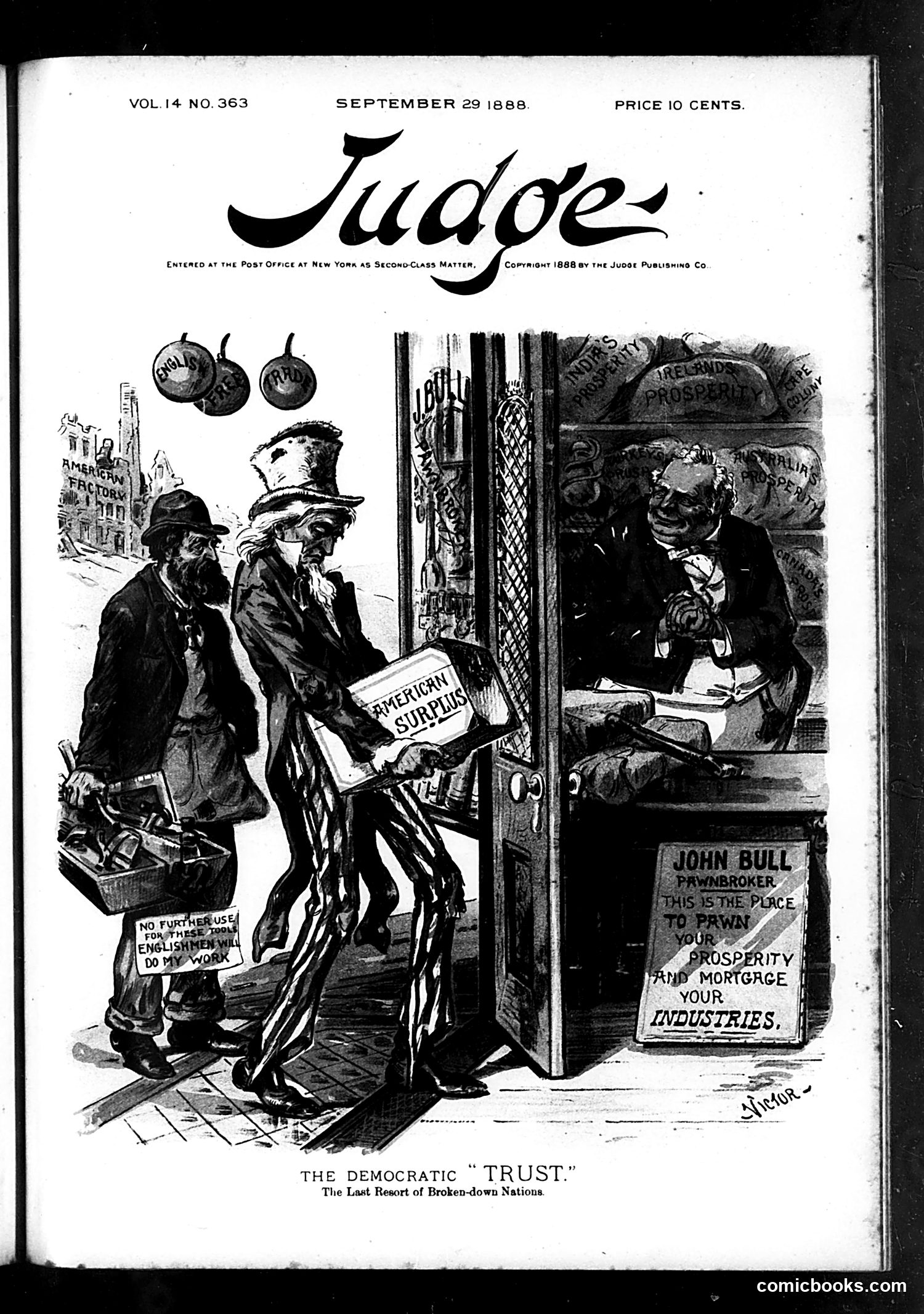
This political cartoon satirizes the Democratic Party as a pawnbroker's last resort for struggling nations. Two shabby, impoverished figures labeled "American Surplus" approach a pawn shop run by "John Bull" (Britain), representing the Democratic Party's economic policies as a financial disaster. The men carry signs reading "No Use...I can't...do my work," suggesting economic hardship under Democratic governance. The shop window displays items labeled with various nations' names and "Prosperity," implying that the Democratic approach has bankrupted other countries. The subtitle, "The Last Resort of Broken-down Nations," frames Democratic economic policy as a failed, desperate measure. The cartoon appears to be 1888 campaign rhetoric attacking Democratic economic management before the presidential election.
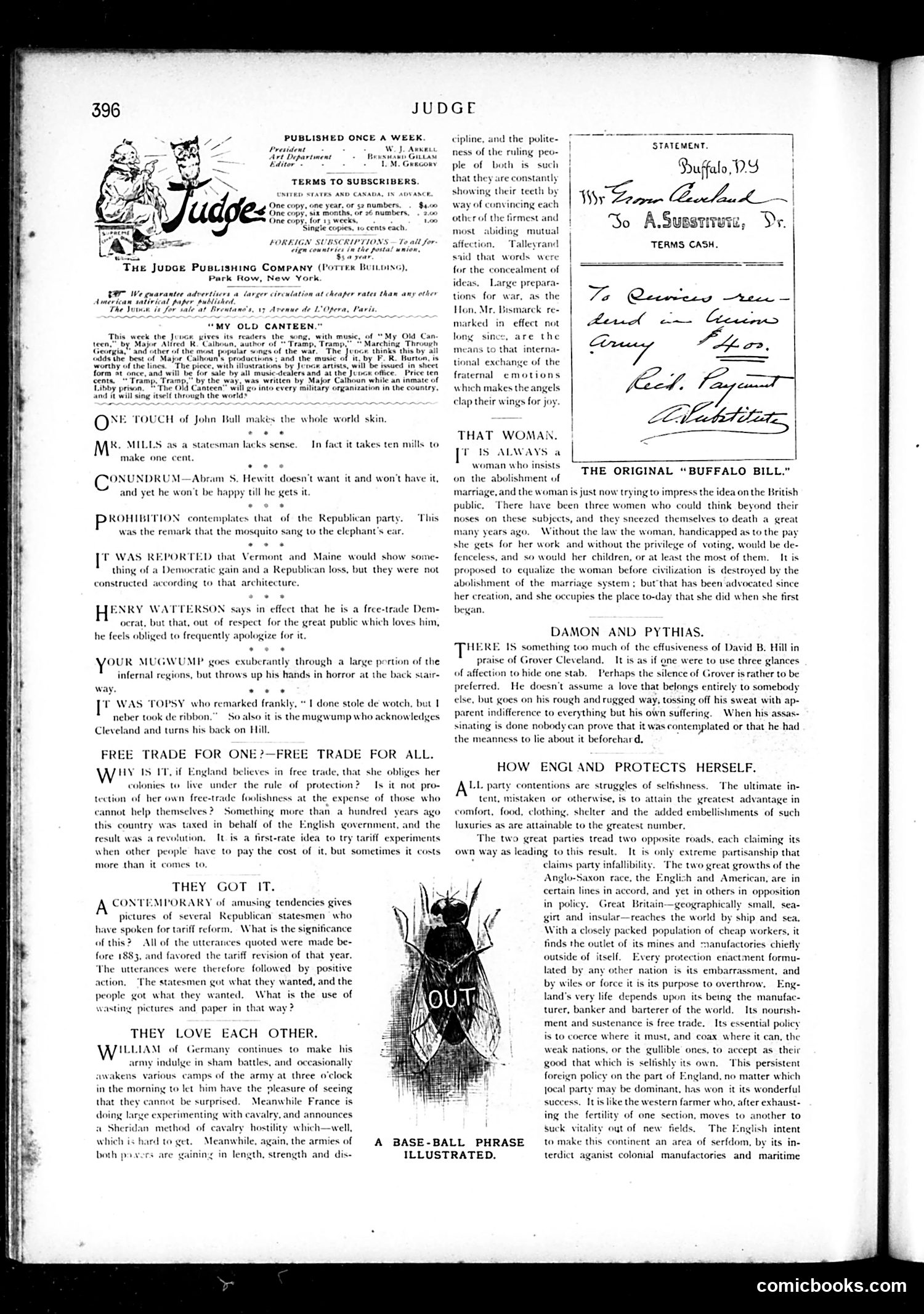
This page contains political commentary and satirical articles rather than illustrated cartoons. The main pieces critique: **"That Woman"** - A commentary on women's rights activism, specifically opposing marriage abolition. The author dismisses feminists as impractical idealists. **"Damon and Pythias"** - Appears to criticize David B. Hill (likely the New York politician) for his silence regarding Grover Cleveland's actions, suggesting Hill's loyalty is questionable. **"How Engl and Protects Herself"** - A protectionist trade argument defending England's colonial and trade policies, contrasting British and American economic approaches. The small illustration shows an insect, possibly referencing trade barriers metaphorically. The page reflects late 19th-century debates over tariffs, women's suffrage, and political loyalties typical of Judge's satirical focus.
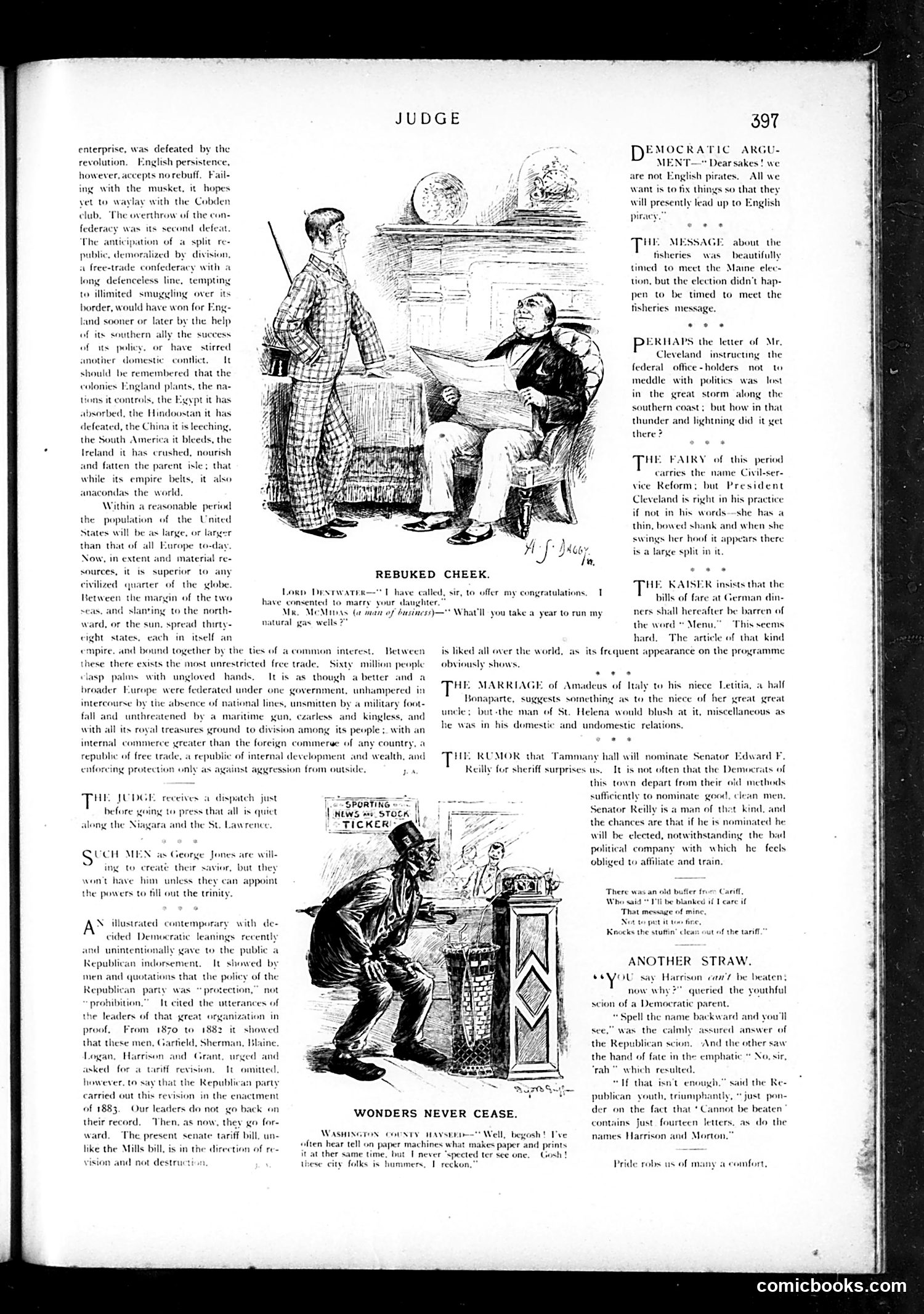
This page contains several brief satirical commentaries on 1880s American politics and international relations: **"Rebuked Cheek"** (top cartoon): Lord Denvwater congratulates someone on "natural gas wells," sarcastically referencing British imperial economic interests disguised as congratulations. **"Wonders Never Cease"** (bottom): A Washington County resident expresses surprise at a paper machine working, a commentary on local industrial development. **Text commentary** criticizes British imperial strategy—specifically the attempt to destabilize the post-Civil War United States through trade policy ("Cobden club") rather than military force. It defends American industrial potential against British economic colonialism. Additional items mock **Cleveland's civil service reform** efforts as ineffectual, discuss **Italian royal marriage politics**, and comment on **Tammany Hall** (Democratic machine politics) nominating practices. The overall thrust attacks British imperialism and defends American economic independence and democratic institutions against foreign manipulation and domestic corruption.
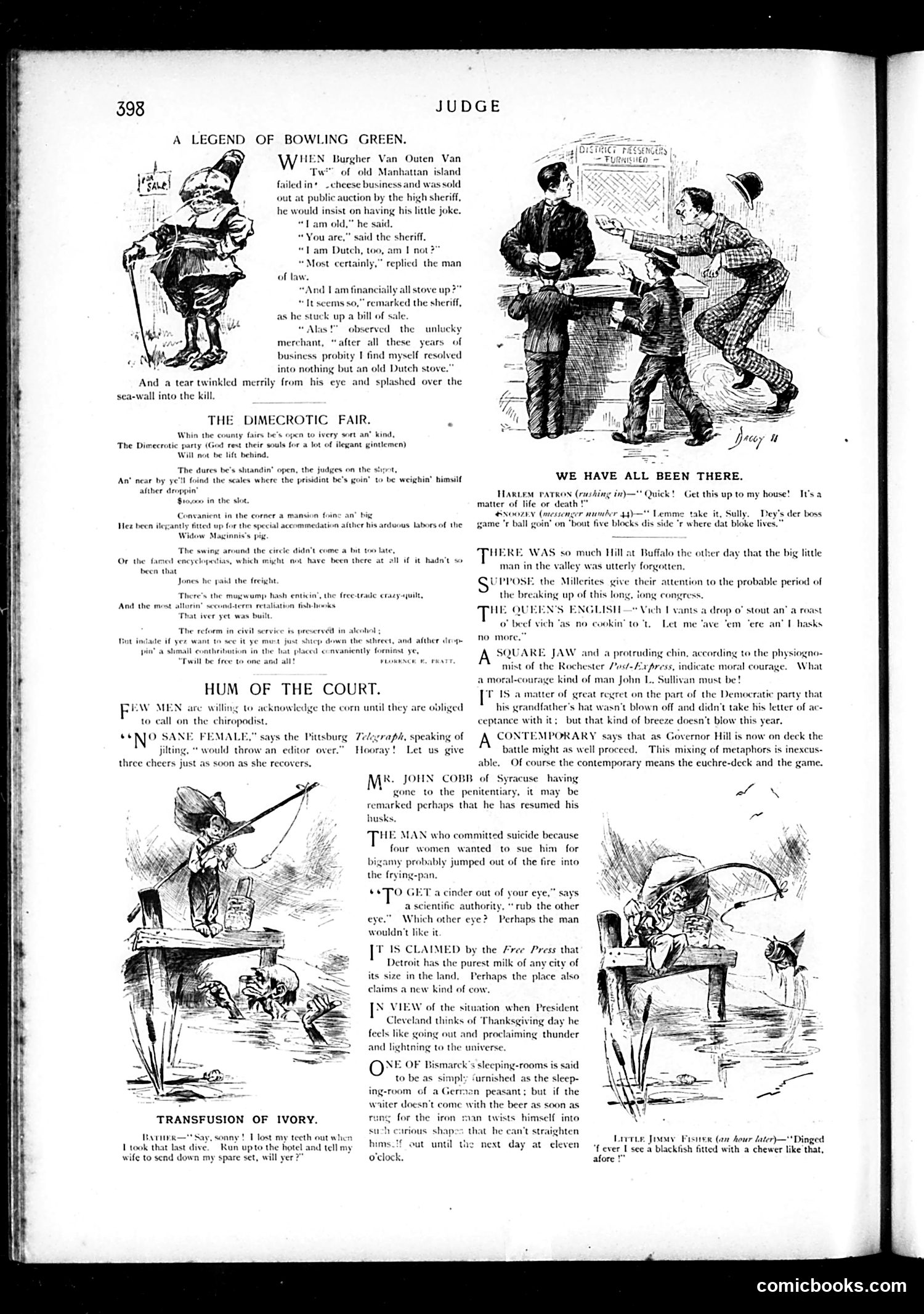
This page from Judge contains several satirical pieces mocking late 19th-century American politics and society. The main targets include: **"A Legend of Bowling Green"** mocks Dutch-American merchants and their supposed acceptance of financial ruin with ethnic humor. **"The Dimecratic Fair"** satirizes the Democratic Party (spelled phonetically with an Irish accent) as incompetent and self-interested, comparing them to county fair operators. **"We Have All Been There"** jokes about tenement life and working-class messengers in Harlem, playing on class stereotypes. **"Hum of the Court"** contains scattered political jabs: mockery of a Pittsburgh Telegraph editorial, commentary on John L. Sullivan (the boxer), criticism of Democratic Governor Hill, and references to Syracuse's John Cobb's imprisonment. The cartoons feature exaggerated immigrant dialects and working-class characters, typical of Judge's satirical approach targeting both political parties, ethnic groups, and social pretensions of the era. The overall tone reflects Gilded Age cynicism about politics and urban life.
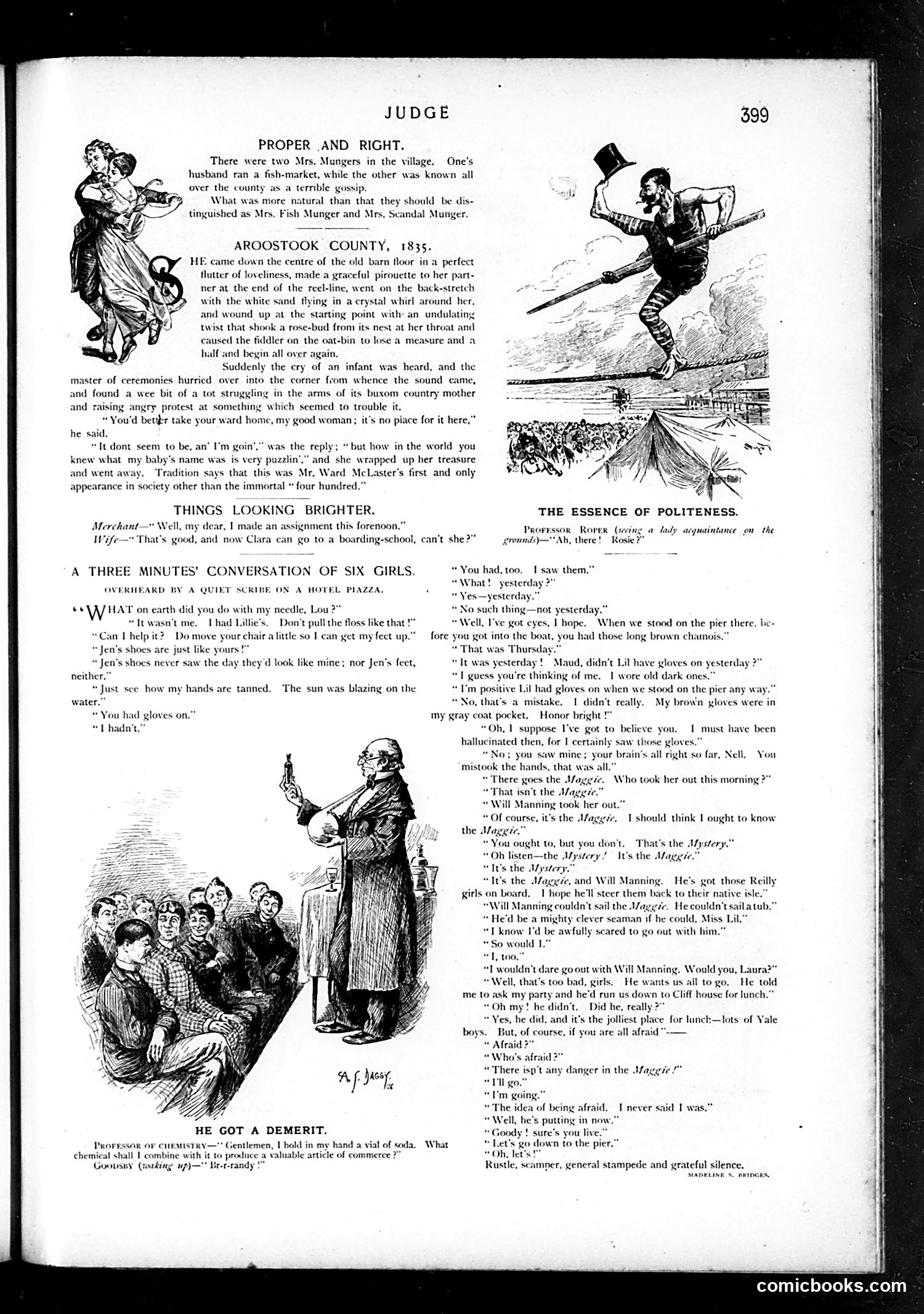
This page contains several satirical pieces typical of late 19th-century American humor: **"Proper and Right"** mocks small-town gossip by distinguishing between two Mrs. Mungers—one married to a fishmonger, the other a notorious gossip—showing how communities relied on descriptive titles to differentiate people. **"Aroostook County, 1835"** appears to be a humorous anecdote about a frontier dance where someone's baby cries, disrupting the event. The joke plays on misunderstanding: a man named "Ward McLaster" tells someone to take "their ward home," which the woman misinterprets as him knowing her baby's name. **"Things Looking Brighter"** contains a brief joke about financial hardship—a merchant announces bankruptcy to his wife, who sees the silver lining: now their daughter can attend boarding school. **"The Essence of Politeness"** depicts six girls bickering over whether someone wore gloves at a pier visit, escalating into absurd denials and accusations—satirizing how trivial disagreements among young women could become. The overall tone reflects period attitudes toward small-town life, gossip, and female social behavior.
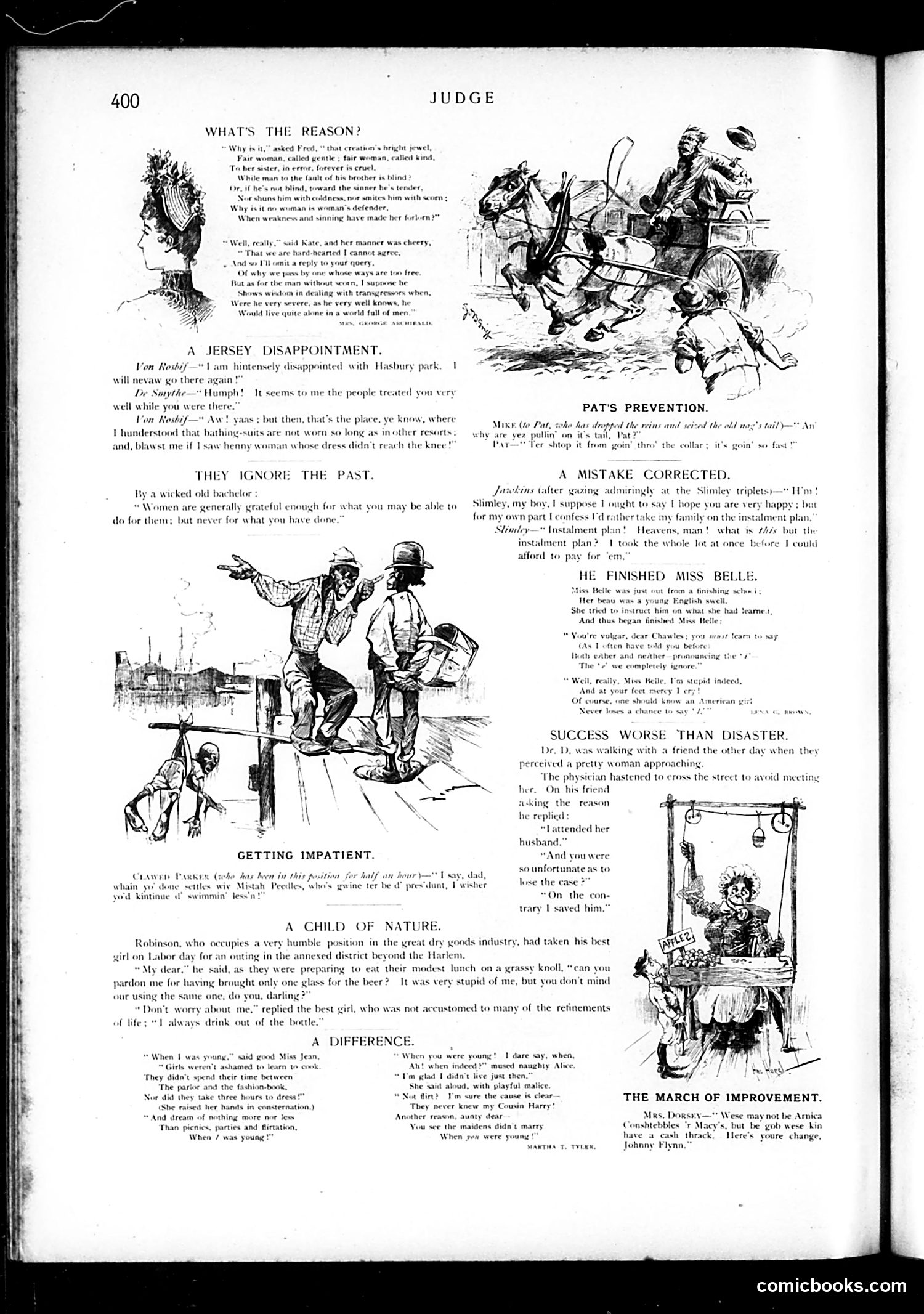
This page contains several brief satirical sketches typical of late 19th-century American humor magazines: **"What's the Reason?"** presents a philosophical debate about human nature and compassion, framed as dialogue between characters. **"A Jersey Disappointment"** mocks a snobbish tourist (Von Rosbif, a caricatured German or European) who complains that Asbury Park's female visitors wore overly modest bathing attire—he apparently preferred less coverage. The joke satirizes both prudish Victorian standards and foreigners' stereotypical obsession with seeing more flesh. **"They Ignore the Past"** offers cynical observations about gratitude between genders. **"Getting Impatient"** depicts working-class impatience (Chawen Parkes awaiting election results involving presidential candidate Peeilles). **"A Child of Nature"** jokes about class differences—a poor couple sharing one beer glass during an outing. **"A Difference"** contrasts old and new generations of women, with younger women less refined than their predecessors. The remaining sketches employ similar light domestic humor and social observation typical of Judge's editorial content.
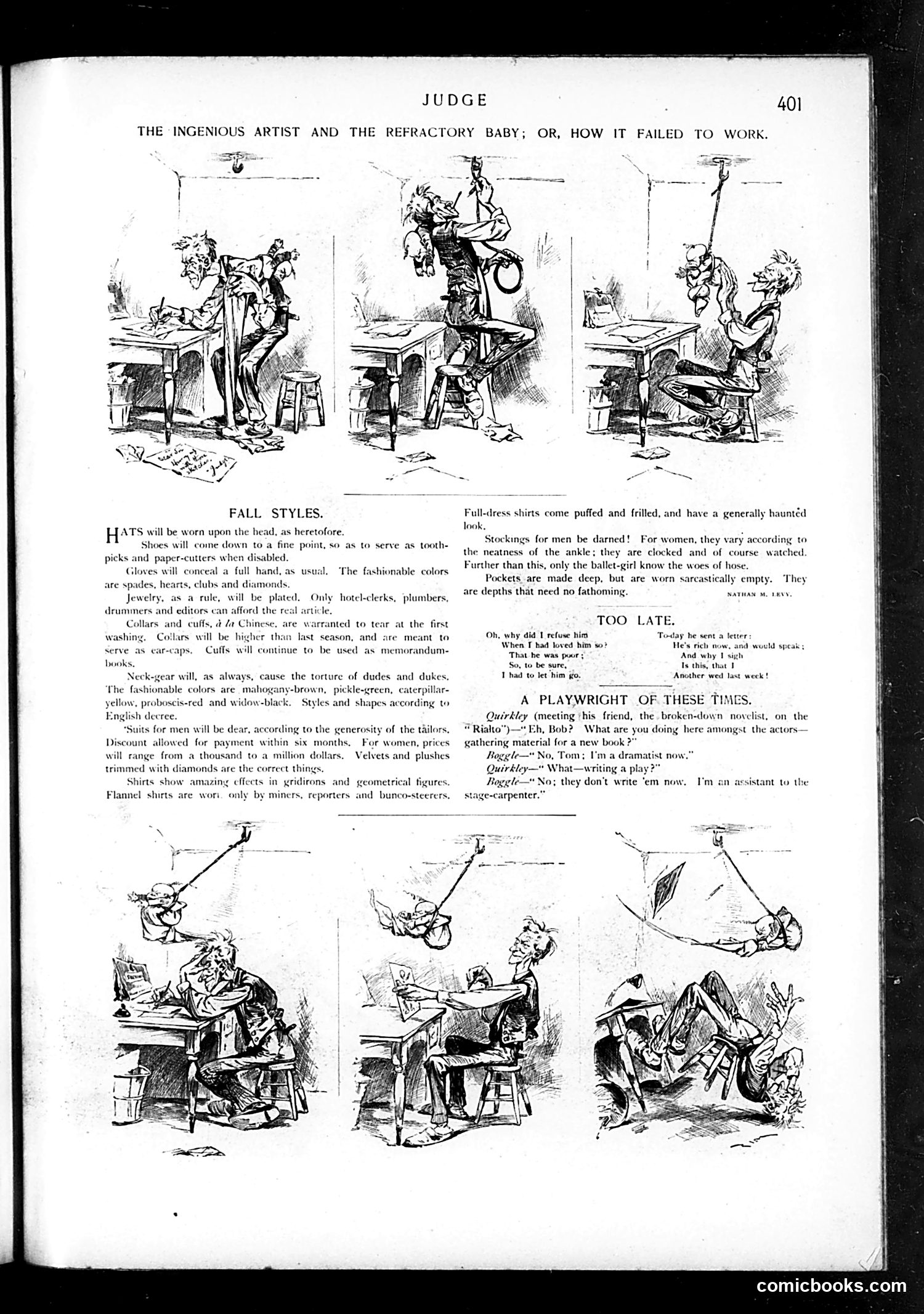
This page contains satirical commentary on **fall fashion trends** of the era and includes two separate humorous pieces. The top section mocks upcoming fashion styles with exaggerated descriptions: shoes pointed enough to serve as tools, collars so high they're impractical, expensive women's suits ranging "from a thousand to a million dollars," and deliberately empty pockets. The satire targets both the absurdity of fashion itself and class distinctions—only "hotel-clerks, plumbers, drummers and editors" wear plated jewelry rather than real gold. The illustrations above show an artist repeatedly failing to control or properly display a baby—suggesting the title's theme of incompetence. Below are two brief comedic sketches: "Too Late" depicts a woman regretting refusing a poor suitor who became wealthy, and "A Playwright of These Times" jokes that modern playwrights don't actually write plays anymore—they're merely "stage-carpenters," implying contemporary theater lacks literary substance. The overall tone is cynical social commentary typical of Judge's satirical approach.
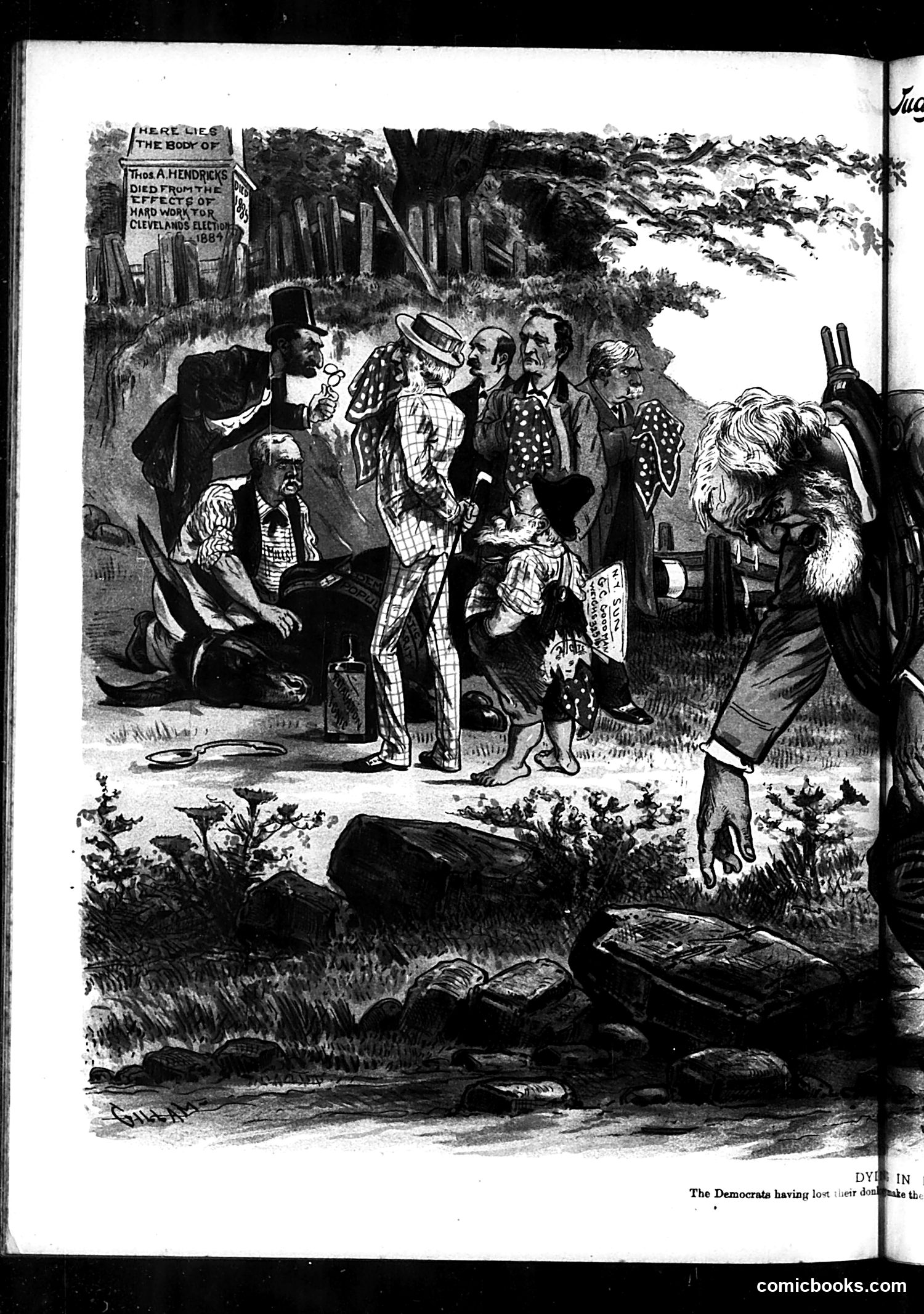
This appears to be a satirical cartoon from *Judge* magazine depicting a graveyard scene with a tombstone reading "HERE LIES THE BOOK OF THOSE A HENDRICKS DIED FROM THE EFFECTS OF HARD WORK FOR CLEVELAND'S ELECTION 1884." The cartoon ridicules Democrats, specifically referencing Thomas A. Hendricks (Grover Cleveland's 1884 running mate) and suggesting the Democratic Party "lost their don[something]" through exhausting campaign efforts. The graveyard setting, with well-dressed figures in top hats mourning around the grave, satirizes Democratic defeat or the supposed death of their campaign efforts. The incomplete OCR text prevents fuller interpretation, but the imagery clearly mocks Democratic Party struggles during Cleveland's election cycle.
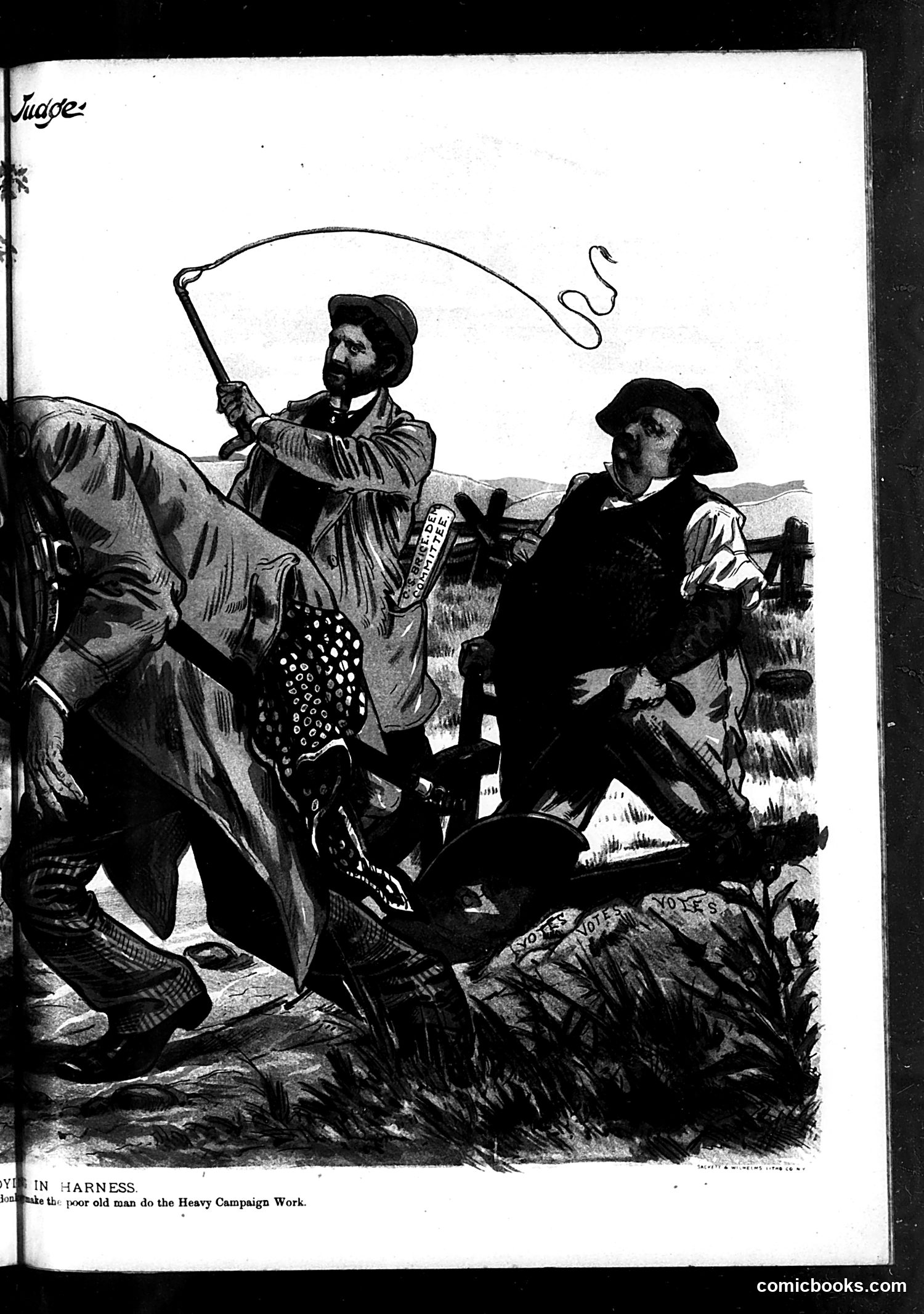
This political cartoon depicts an elderly man being harnessed like a beast of burden, pulling heavy campaign work. The figure on the left holds a whip and reins, controlling the old man who strains under the weight. A second figure observes on the right. The satire criticizes how political machines exploited elderly citizens or worn-out political figures for campaign labor. "In Harness" suggests the elderly were treated as draft animals rather than respected contributors—driven hard without consideration for their age or capacity. The exact political context (which campaign, which figure) is unclear from the visible text, but the cartoon's message about the exploitative nature of political campaigns and the disposability of older workers is unmistakable. This reflects Progressive Era concerns about labor practices and political corruption.
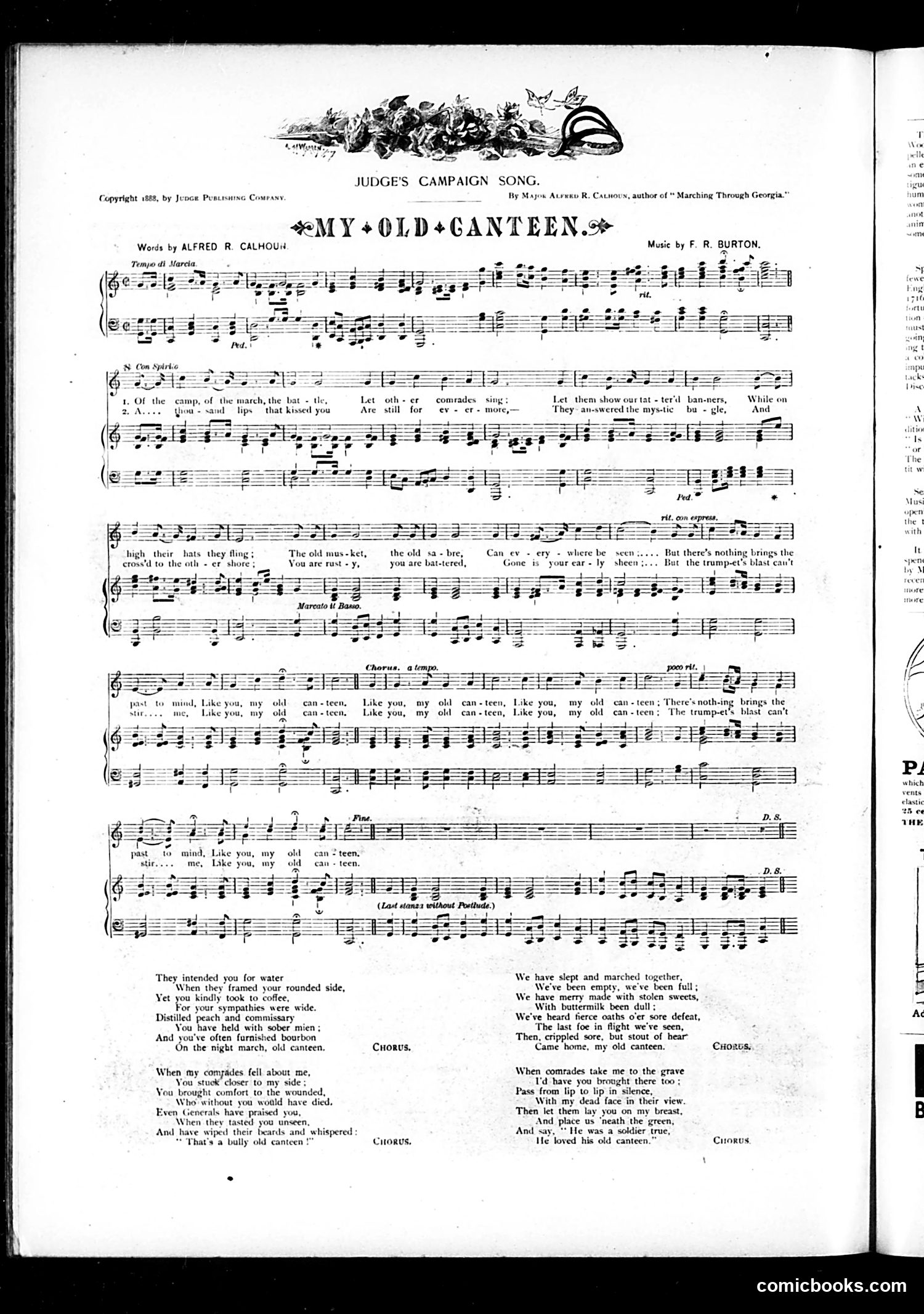
This is a sentimental Civil War veteran's song rather than a political cartoon. Published by Judge magazine during an 1888 election campaign, it's attributed to Major Alfred R. Calhoun (author of "Marching Through Georgia," a famous Union war song). The song romanticizes a soldier's canteen as a faithful companion through combat, depicting it as having provided water, coffee, and secretly-consumed liquor to officers and enlisted men alike. The lyrics create emotional nostalgia for shared wartime sacrifice—marching together, comforting the wounded, witnessing defeat and victory. The final verses request the canteen accompany the soldier to his grave, passed silently among comrades as a memorial to his service. This appears designed to appeal to Union veterans and their descendants as part of Judge's Republican campaign strategy, evoking Civil War patriotism and shared sacrifice to mobilize voters during the 1888 presidential election.
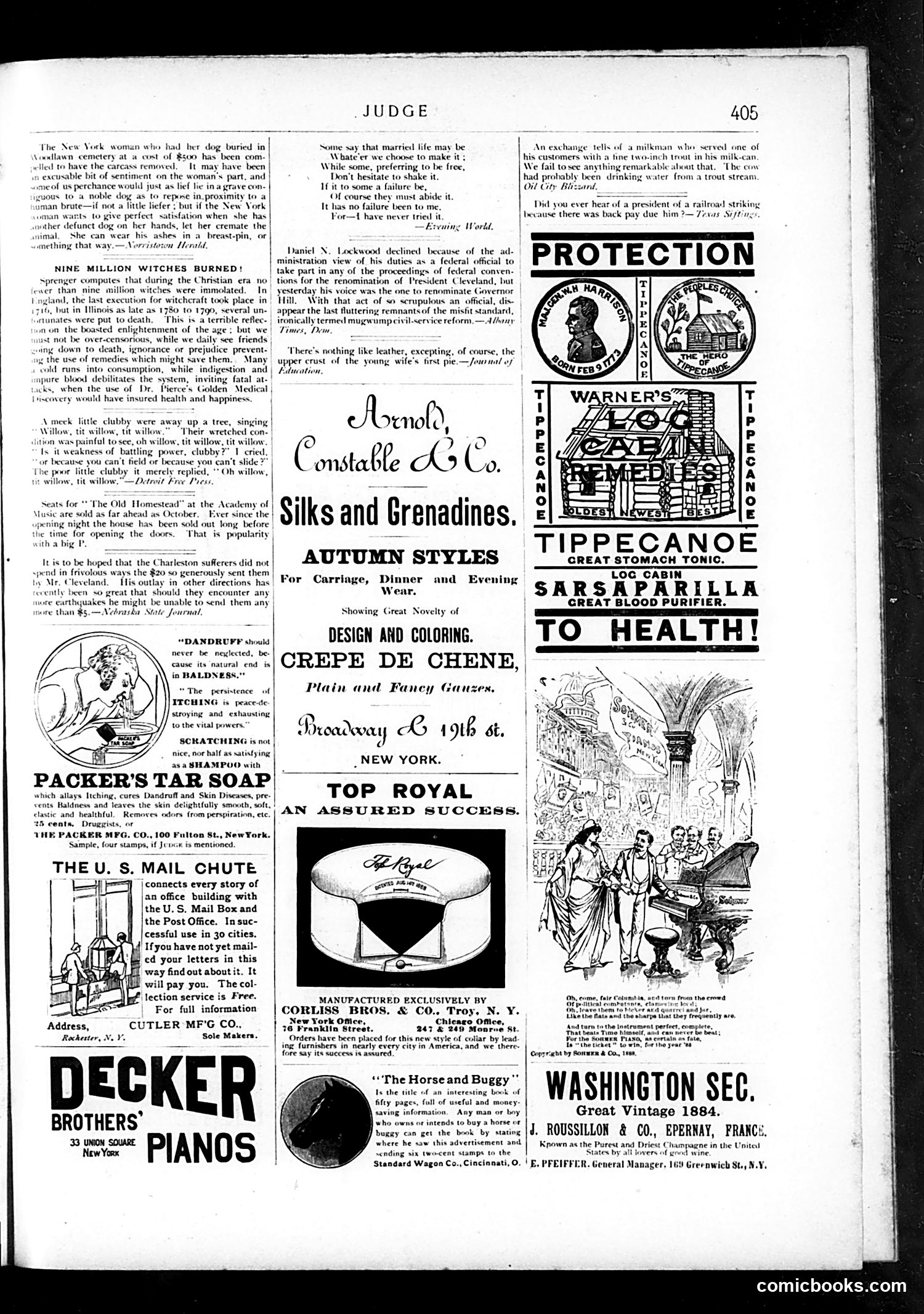
This page is primarily **advertisements and short satirical quips**, typical of Judge's format. Key content: **Political reference**: A brief note mentions Daniel N. Lockwood declining to participate in federal convention proceedings for President Cleveland's renomination due to his position as a federal official. The writer sarcastically calls this "scrupulous" behavior and suggests it marks the end of inconsistent "mugwump civil-service reform." **Social satire**: Multiple short jokes mock contemporary life—a wealthy New York woman spending $500 to bury her dog in a cemetery; references to nine million "witches" burned historically versus ongoing ignorance about modern medical remedies; commentary on Charleston earthquake relief funds allegedly misused. **Literary reference**: A quote mocking Gilbert & Sullivan's "Willow, tit willow" song. The page is otherwise dominated by period product advertisements (Packer's Tar Soap, Decker Brothers Pianos, Arnold Constable silks, etc.), reflecting Judge's revenue model. No major political cartoons appear—this is a typical back-page advertising section.
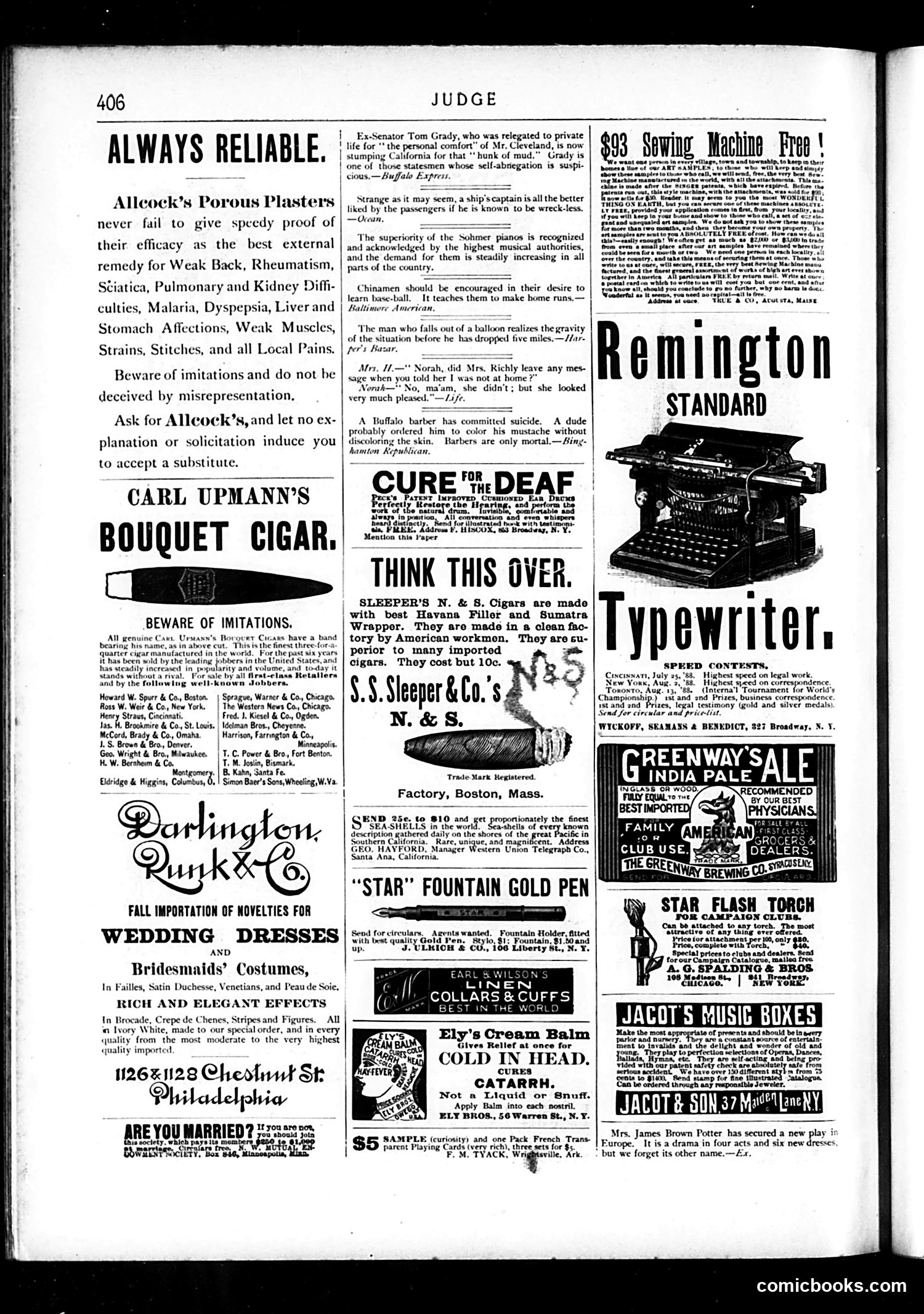
This page is primarily advertising, typical of Judge magazine's revenue model. Rather than political cartoons, it contains brief satirical snippets and extensive commercial advertisements. The satirical content includes short jokes: a commentary on ex-Senator Tom Grady's "self-abnegation" for Cleveland; wordplay about ship captains being "wreck-less"; and humor about Chinese immigrants and baseball. The brief pieces mock political figures (Grady), make puns, and offer social commentary in the style of 1890s American satirical magazines. The bulk of the page features period product advertisements: Allcock's porous plasters, Carl Upmann cigars, Remington typewriters, fountain pens, and music boxes. These ads typically warn "Beware of imitations," reflecting era-specific consumer concerns about counterfeit goods.
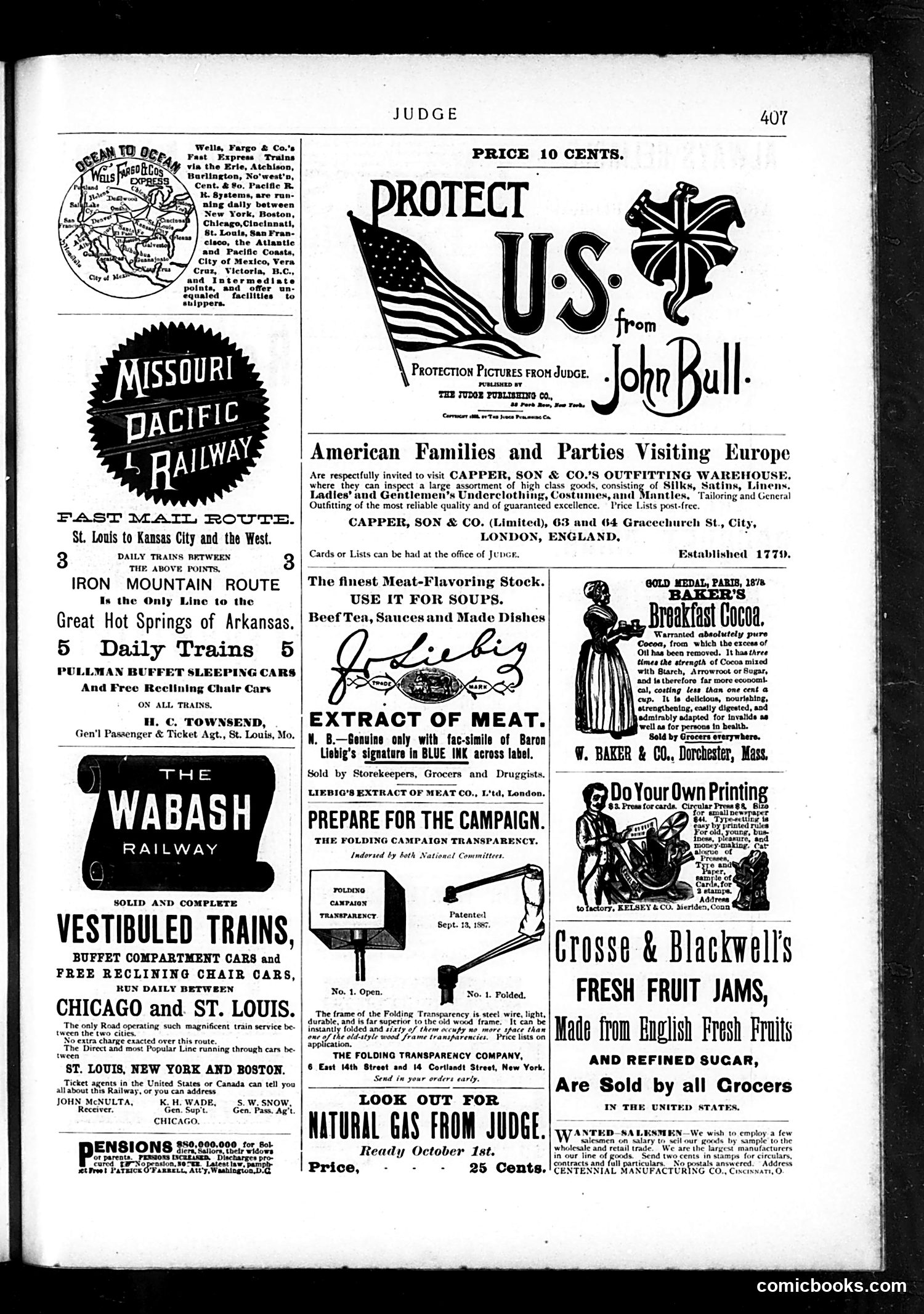
This page is primarily **advertising**, not political satire. The bulk consists of commercial notices for railways (Missouri Pacific, Wabash, Iron Mountain routes), food products (Baker's Cocoa, Liebig's Extract of Meat, Crosse & Blackwell jams), and services. The notable satirical element is the banner at top: **"Protect U.S. from John Bull"** — referring to Britain personified as "John Bull." This references protective tariffs, a major 19th-century American political debate. The image suggests advocacy for trade protectionism against British goods, a recurring theme in Judge's editorial stance. A small advertisement promotes **"Natural Gas from Judge"** (launching October 1st at 25 cents), which appears to be either a Judge publication or a cheeky self-promotional joke. The page otherwise reflects Judge's commercial function: a 10-cent satirical magazine supported by paid advertisements from American and British merchants and manufacturers.
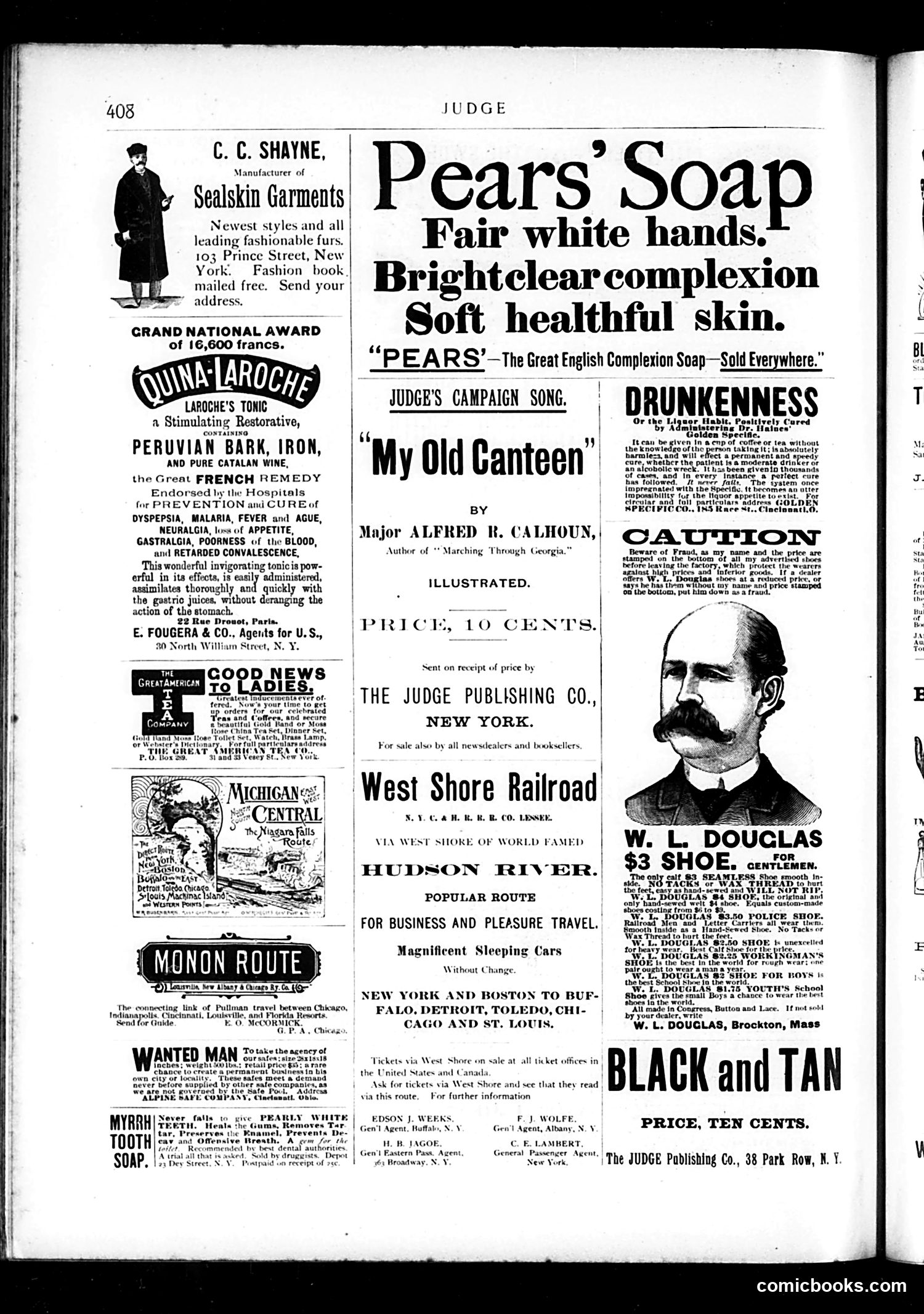
This page is primarily **advertising and promotional content** rather than political satire or editorial cartoons. The main elements include: - **Pears' Soap advertisement** (top center): A standard Victorian-era beauty product ad promising "fair white hands" and "bright clear complexion"—reflecting period beauty standards. - **"My Old Canteen"** (center): A campaign song by Major Alfred R. Calhoun, sold for 10 cents by Judge Publishing Company. The reference to "Marching Through Georgia" suggests Civil War–era military nostalgia. - **W.L. Douglas Shoe advertisement** (right): Features a man's portrait promoting "$3 Shoe" for gentlemen, emphasizing quality and warning against counterfeits. - **Transportation ads** (left/center): Michigan Central Railroad, West Shore Railroad, and Monon Route promoting travel routes. The page demonstrates Judge magazine's reliance on paid advertising revenue. No clear political cartoons or satirical commentary targeting specific figures or events are visible—this appears to be a typical late 19th-century magazine back page.
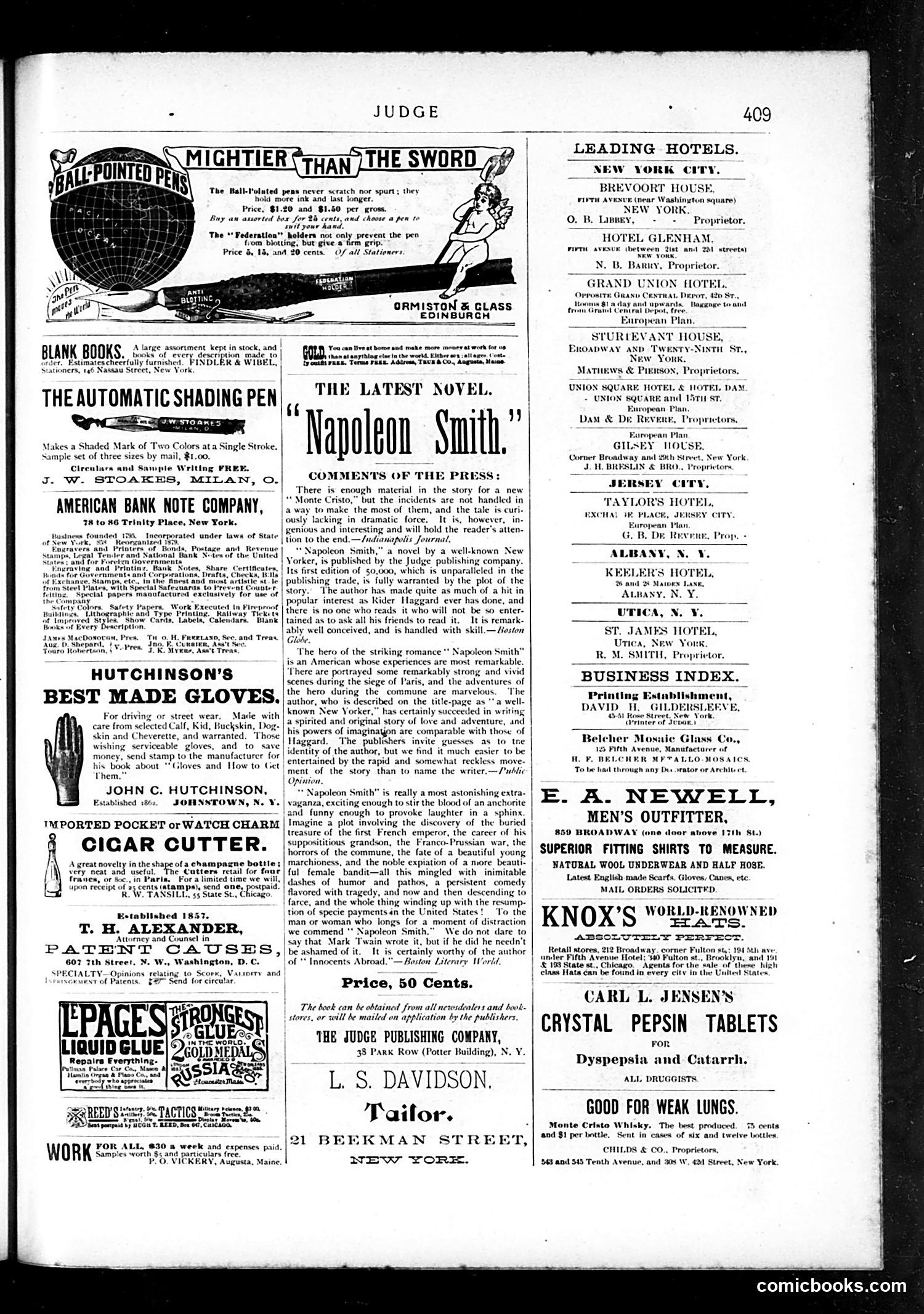
This page is primarily **advertising and business notices** for late 19th-century New York establishments and products. There is no significant political cartoon or satire to analyze. The visible content includes ads for: - Writing instruments (ball-pointed pens, automatic shading pens) - Hotels and lodging houses (Brevoort House, Hotel Glenham, Grand Union Hotel) - Financial/banking services (American Bank Note Company) - Gloves and accessories (Hutchinson's Gloves, imported cigar cutters) - Patent law services - Employment opportunities The only editorial content is a **book review** for "Napoleon Smith," a novel published by Judge Publishing Company. The review praises the work as exciting and popular, though notes it sometimes lacks dramatic force. The author's identity is kept anonymous—a marketing gimmick the publisher used. This appears to be a standard magazine back-matter page mixing commercial advertisements with minimal editorial content.
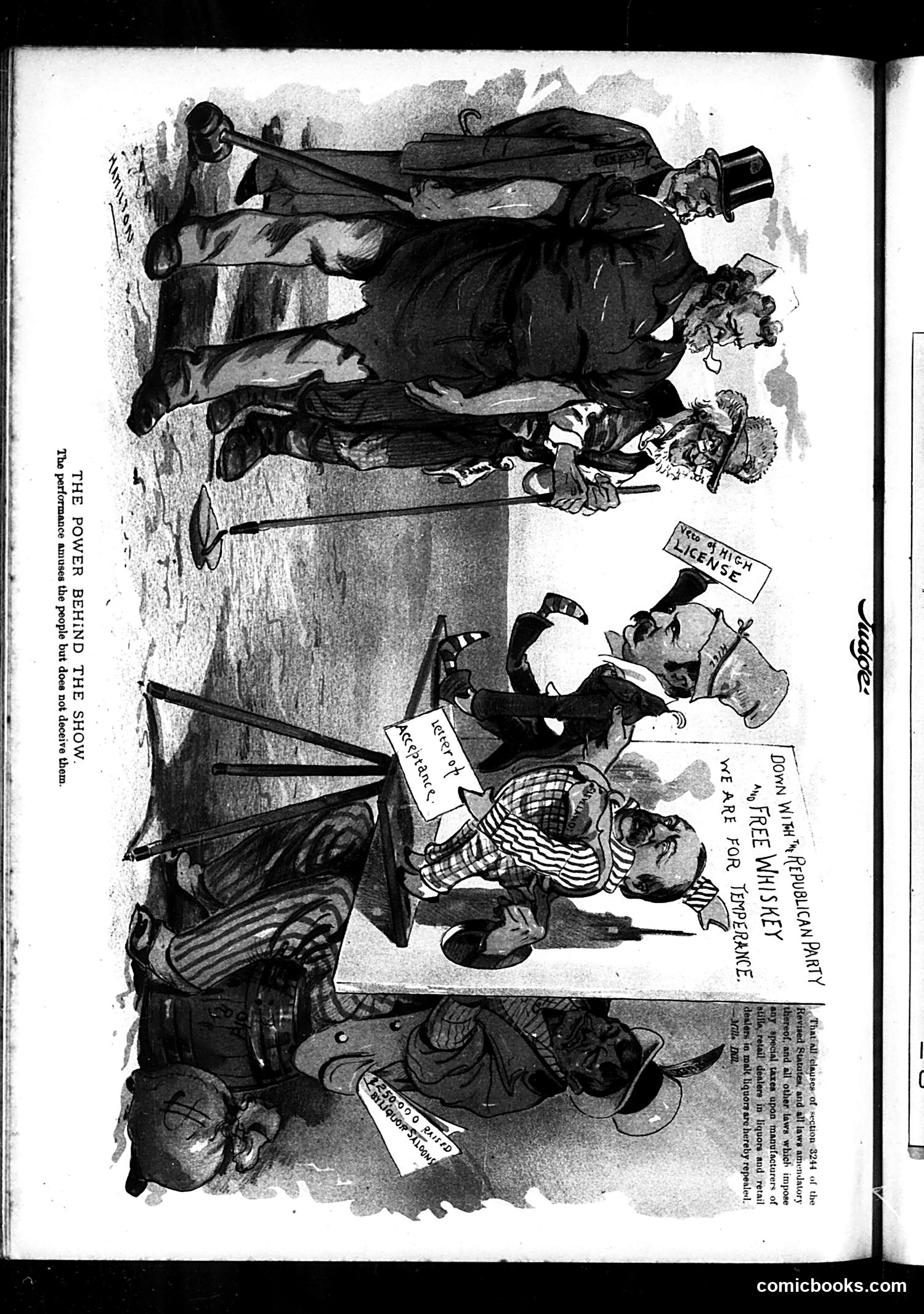
This cartoon satirizes political theater and hidden influence during Prohibition era politics. The image shows a puppet master (representing concealed power interests) manipulating visible political figures on stage—the "show" that "amuses the people but does not deceive them." The caption suggests citizens recognize the artificiality: they see the performance but understand real power operates behind the scenes. The liquor-related text references indicate this likely targets Prohibition politics and the interests actually controlling alcohol policy versus public-facing politicians. The cartoon's point: despite theatrical political displays, savvy voters understand who truly pulls the strings—whether wealthy business interests, party bosses, or other hidden powers—regarding major policies like alcohol regulation.