
A complete issue · 16 pages · 1888
Judge — March 3, 1888
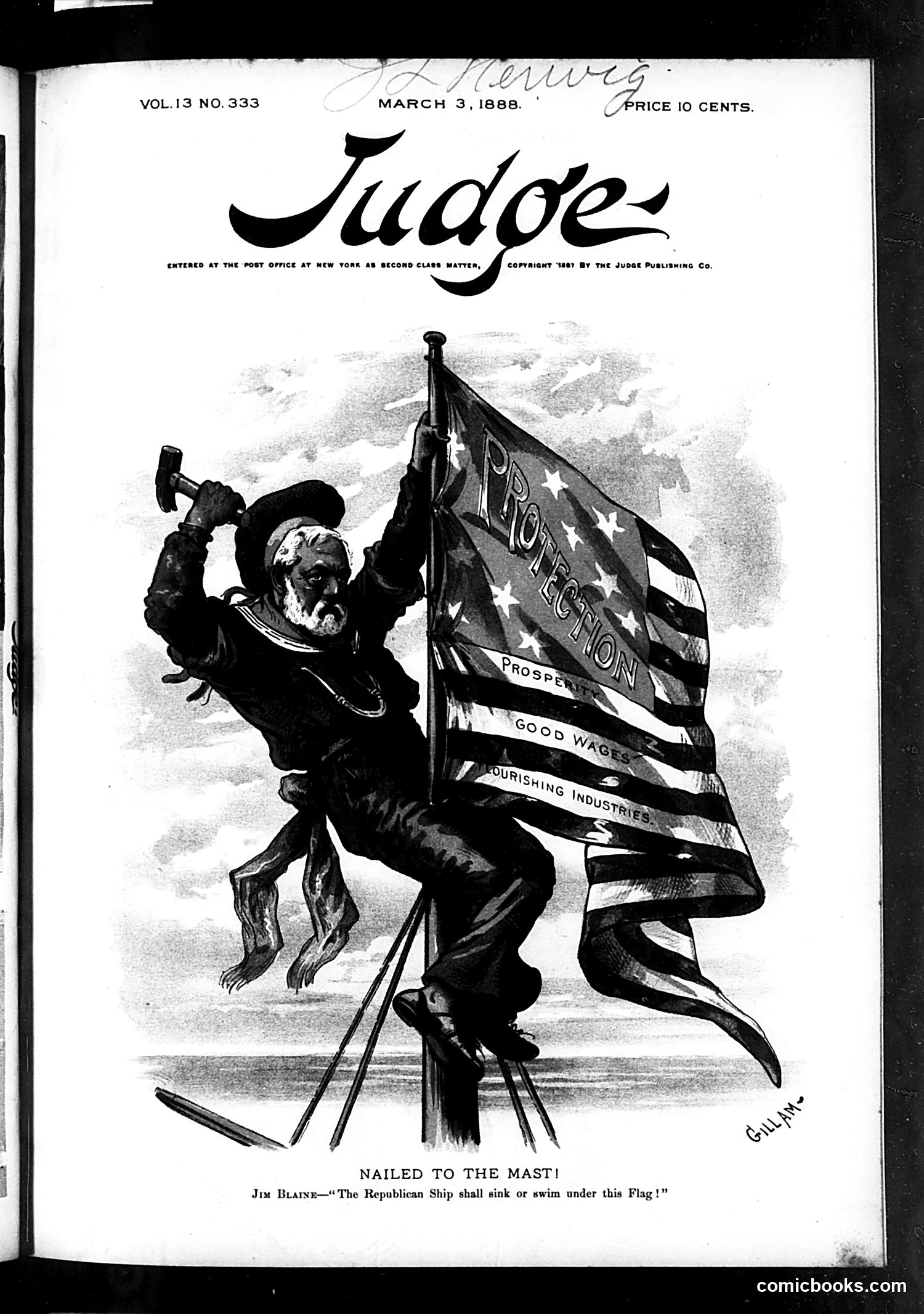
This March 3, 1888 *Judge* cartoon depicts a caricatured figure (identified as Jim Blaine in the caption) clinging to a flagpole bearing a Republican flag. The flag displays three key promises: "Protection," "Good Wages," and "Flourishing Industries." The caption quotes Blaine declaring "The Republican Ship shall sink or swim under this Flag!" This appears to reference James G. Blaine's 1888 presidential campaign, where he championed protectionist economic policies as central to Republican ideology. The sailor clinging desperately to the mast suggests the cartoon satirizes Blaine's rigid commitment to these policies—implying he's stubbornly committed to Republican principles regardless of practical consequences or electoral viability.
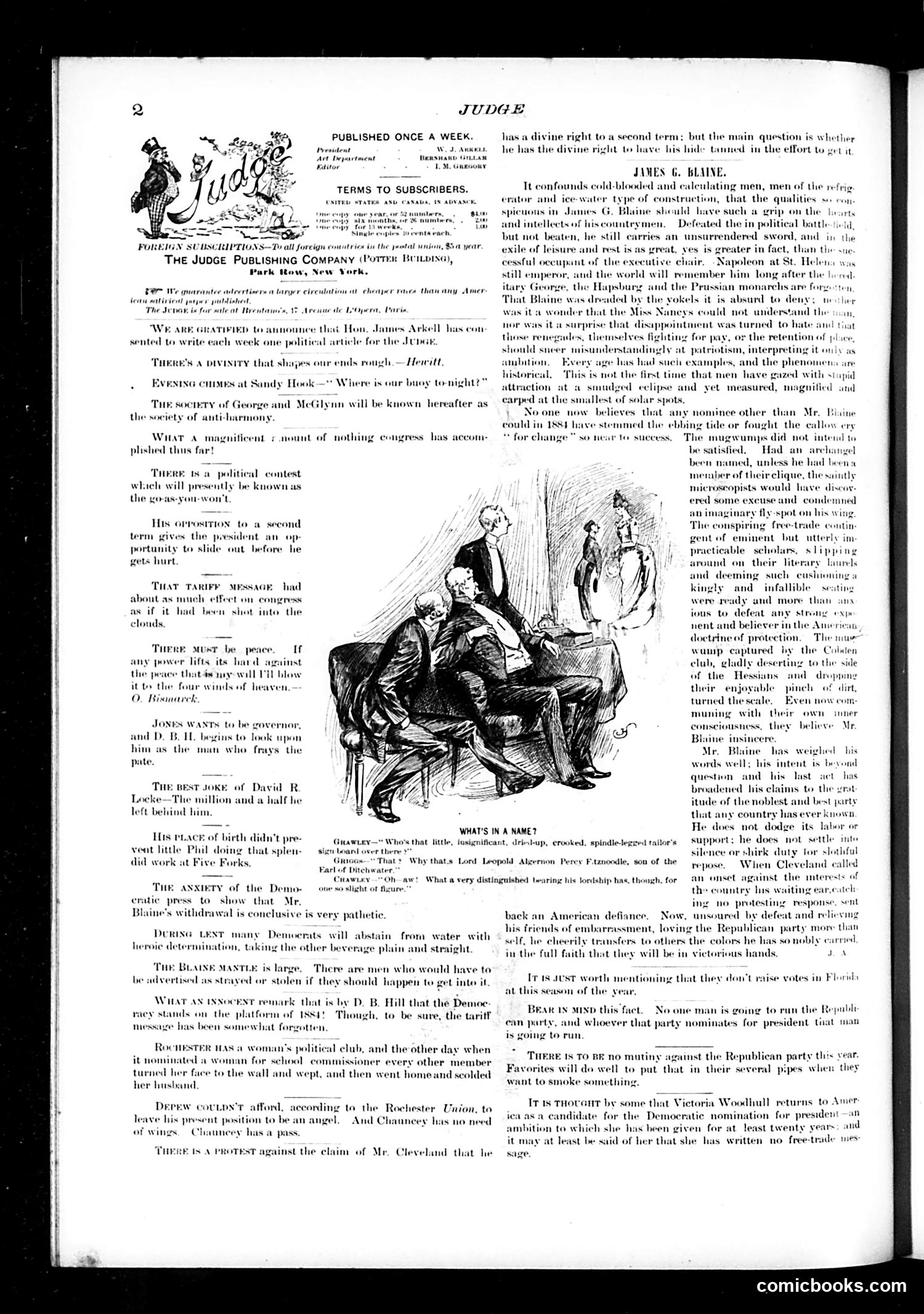
This page contains political commentary and a central cartoon titled "What's in a Name?" The cartoon depicts what appears to be political figures in a confrontational scene, likely satirizing a contemporary political dispute over naming or nomenclature. The editorial text references James G. Blaine (a prominent 19th-century politician), discussing his political position and legacy. Multiple short commentary pieces critique both Republican and Democratic parties, touching on issues of political integrity and party loyalty. The "What's in a Name?" cartoon seems to mock political posturing or hypocrisy—possibly regarding how politicians present themselves versus their actual positions. Without clearer identification of the specific figures and the exact historical moment, the precise satirical target remains unclear, though it definitely addresses late-19th-century American political maneuvering.
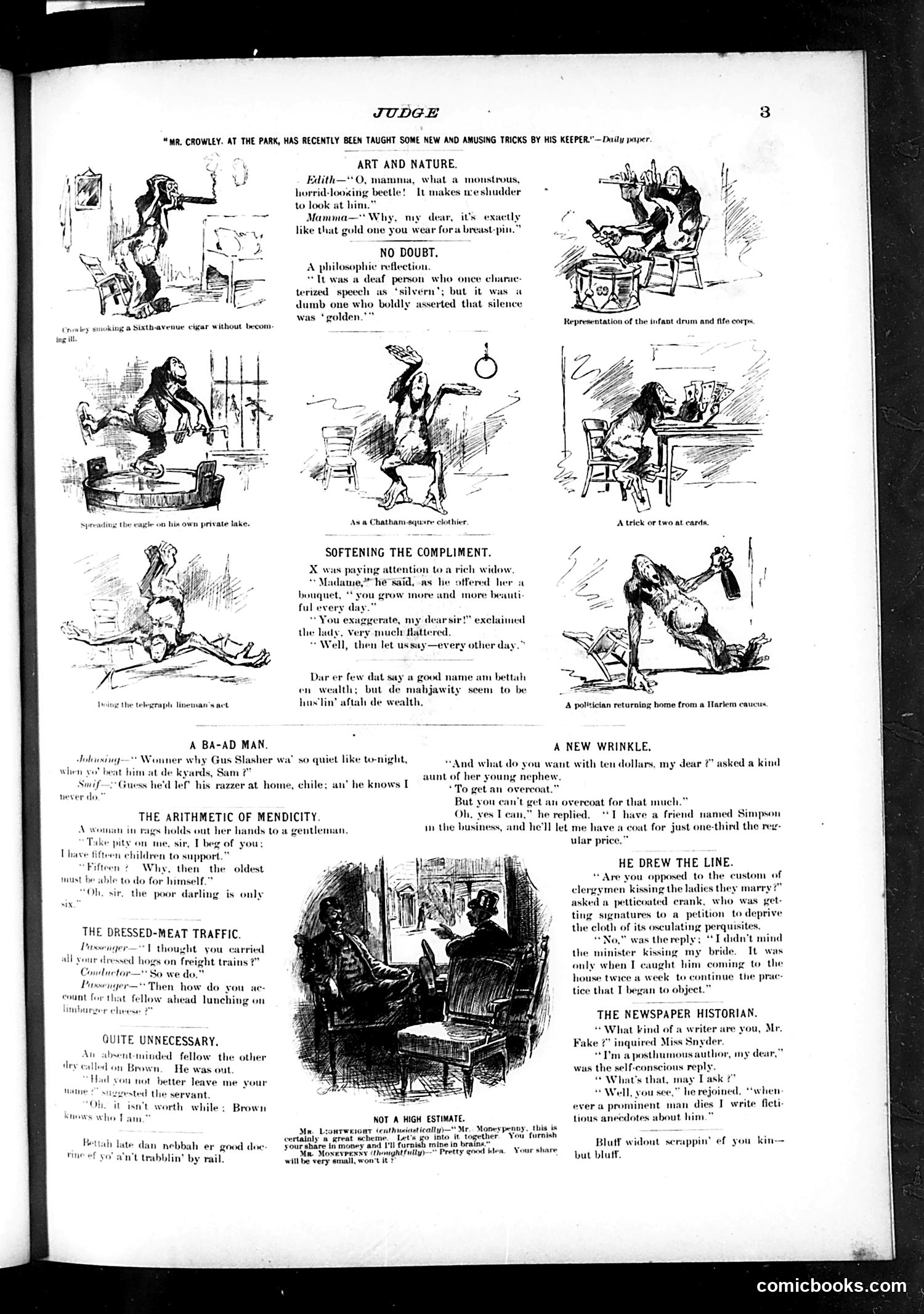
This page from *Judge* contains multiple short satirical pieces mocking contemporary social types and behaviors: **"Art and Nature"** jokes about a child comparing an ugly beetle to her mother's gold brooch—satirizing mothers' vanity. **"No Doubt"** reflects on silence being "golden" versus a "silvern" speech, likely referencing political oratory of the era. **"Softening the Compliment"** depicts a man flattering a wealthy widow, satirizing fortune-hunting and transparent social climbing. **"A Ba-ad Man"** uses dialect humor about a character ("Gus") losing at cards—typical of period racial caricature. **"The Dressed-Meat Traffic"** jokes about contradiction between carrying dead hogs on trains while passengers eat fresh meat. **"He Drew the Line"** mocks a woman petitioning against clergy kissing parishioners—satirizing both religious scandal and activist prudishness. **"The Newspaper Historian"** skewers hack journalists who fabricate anecdotes about deceased celebrities for profit. The humor relies on social hypocrisy, class commentary, and period prejudices now considered offensive.
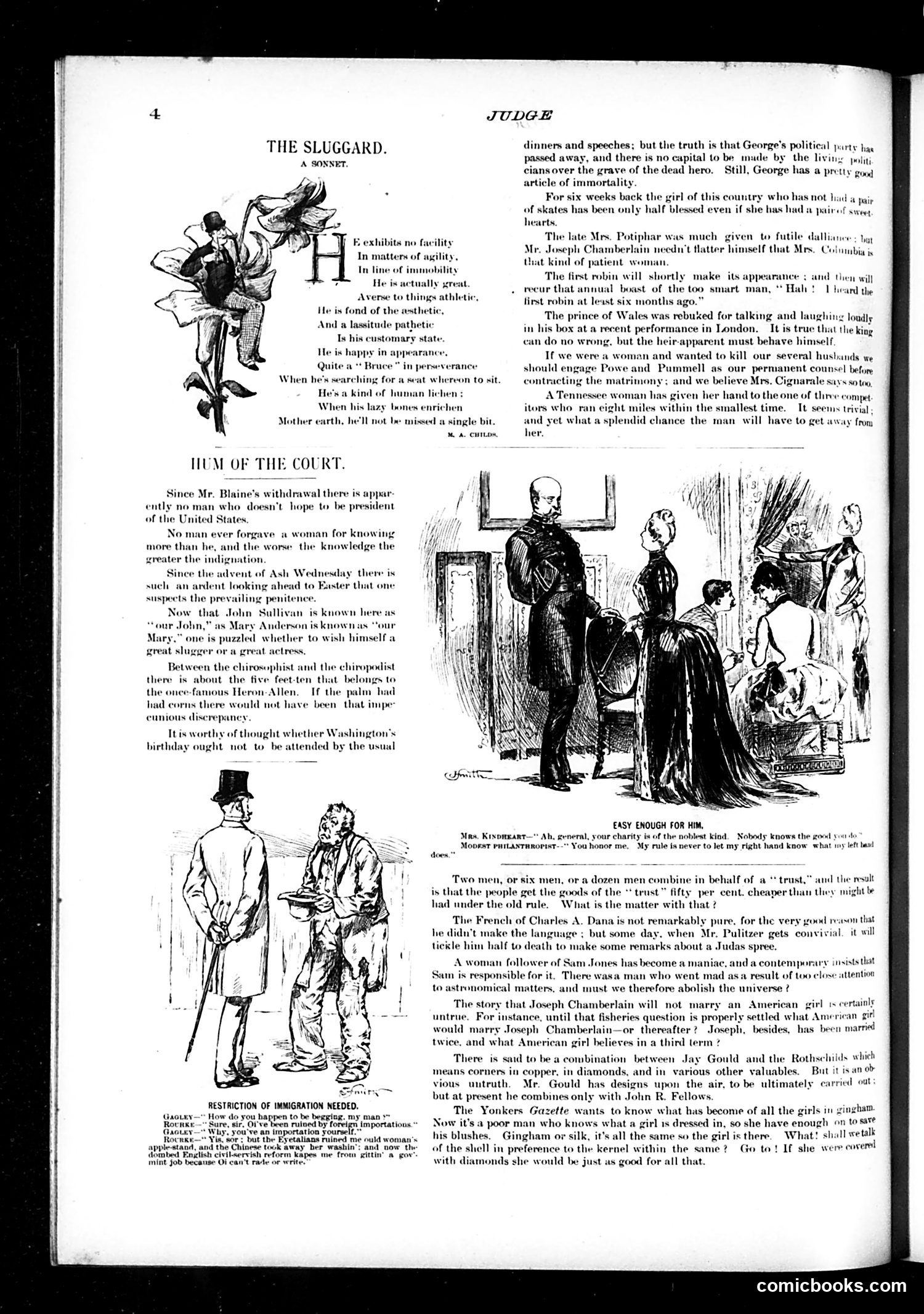
This page contains three distinct satirical pieces mocking prominent figures and social issues of the era: **"The Sluggard"** ridicules an unnamed lazy man (likely a political figure) through verse, depicting him as indolent and parasitic. **"Hum of the Court"** comments on James G. Blaine's withdrawal from presidential consideration, sarcastically noting that no man forgets "a woman for knowing more than he." It mocks Washington's Birthday celebrations and references John Sullivan (boxer) and Mary Anderson (actress) as celebrities. **"Easy Enough for Him"** and additional commentary satirize wealthy philanthropists and "trusts" (monopolistic business combinations), suggesting charitable giving is merely a cover for maintaining exploitative economic systems. The piece critiques Joseph Chamberlain, Charles Dana, and references Sam Jones (evangelist). The illustrations depict various social types and situations supporting these critiques. The overall thrust attacks political hypocrisy, business monopolies, and shallow charity among the wealthy and powerful.
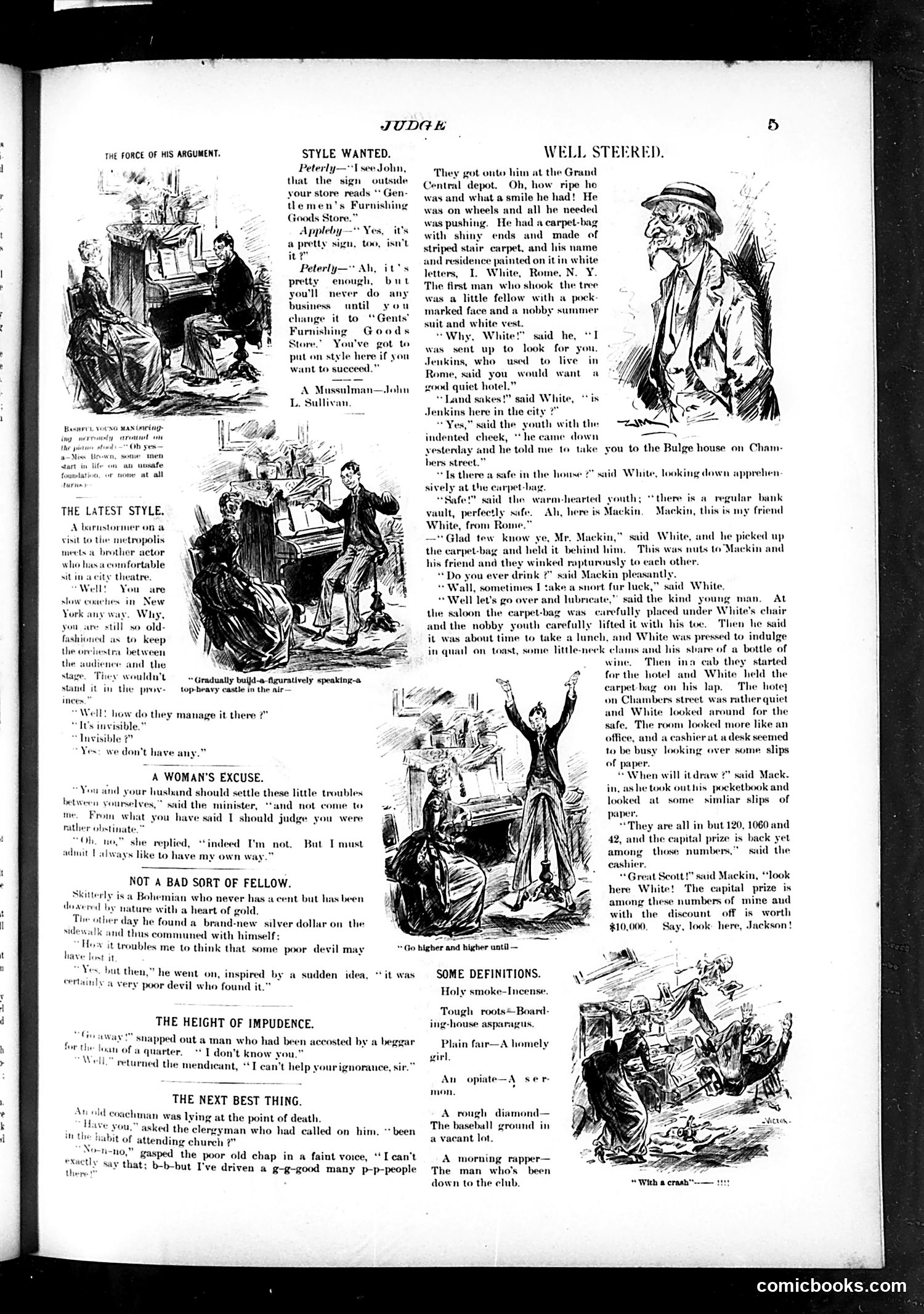
This satirical story depicts a classic 19th-century confidence game. An unsophisticated rube named "I. White" from Rome, New York arrives at Grand Central Station with a carpet bag—appearing gullible and wealthy. Two con men immediately befriend him, claiming connection to his acquaintance "Jenkins." They gain his trust through manufactured camaraderie, then systematically exploit him: taking him to a dubious hotel, plying him with expensive food and drink, and clearly planning to steal his carpet bag (likely containing money or valuables). The title "Well Steered" refers to how skillfully they're manipulating him toward their swindle. The accompanying anecdotes and jokes mock various types of foolishness—from poor business signage to marital disputes to religious hypocrisy—fitting Judge's satirical tone. This reflects contemporary anxieties about urban con artists preying on rural visitors unfamiliar with city sophistication.
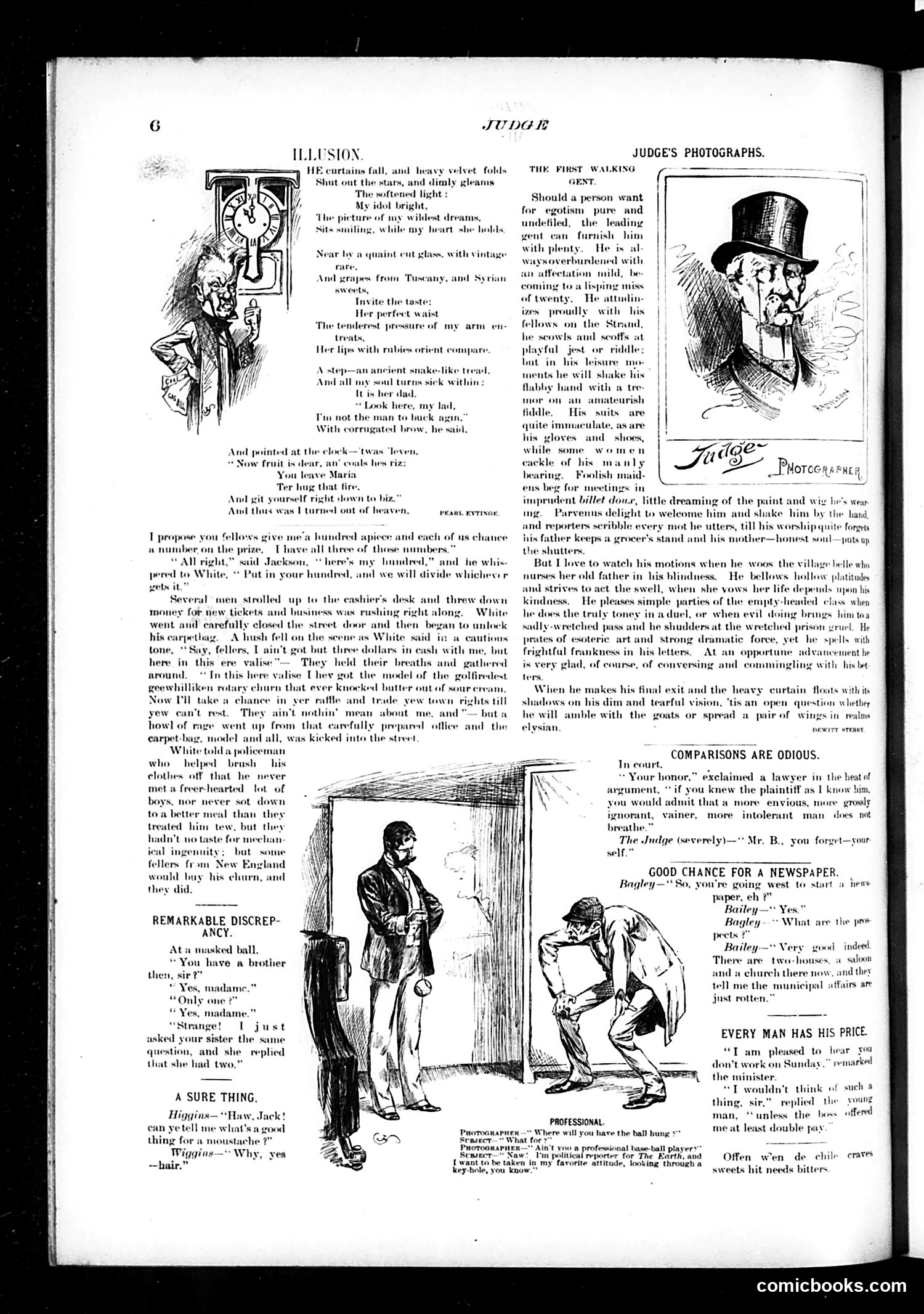
This page contains several satirical pieces typical of Judge magazine's humor: **"Illusion"** (left): A poem mocking romantic delusion—a man imagines seducing a woman in luxurious surroundings, only to be rudely ejected when she reveals her true nature (suggested by "ancient snake-like tread"). The satire targets male fantasies and self-deception. **"Remarkable Discrepancy"** (bottom left): A brief joke exposing a logical contradiction—a woman claims to have one brother, but her sister says she has two. The humor lies in the absurd inconsistency. **"A Sure Thing"** (bottom): A lengthy anecdote about con men selling a fake butter churn to gullible rural farmers. It satirizes both agricultural naiveté and urban trickery. **"Judge's Photographs"** (right): A satirical character sketch of an arrogant social climber—a man of humble origins (grocer's son) who now affects genteel pretensions, plays amateur violin, and courts wealthy patrons. The satire mocks nouveau riche pretension and social climbing. The remaining pieces are brief legal and social jokes about courtroom absurdities and newspaper ventures.
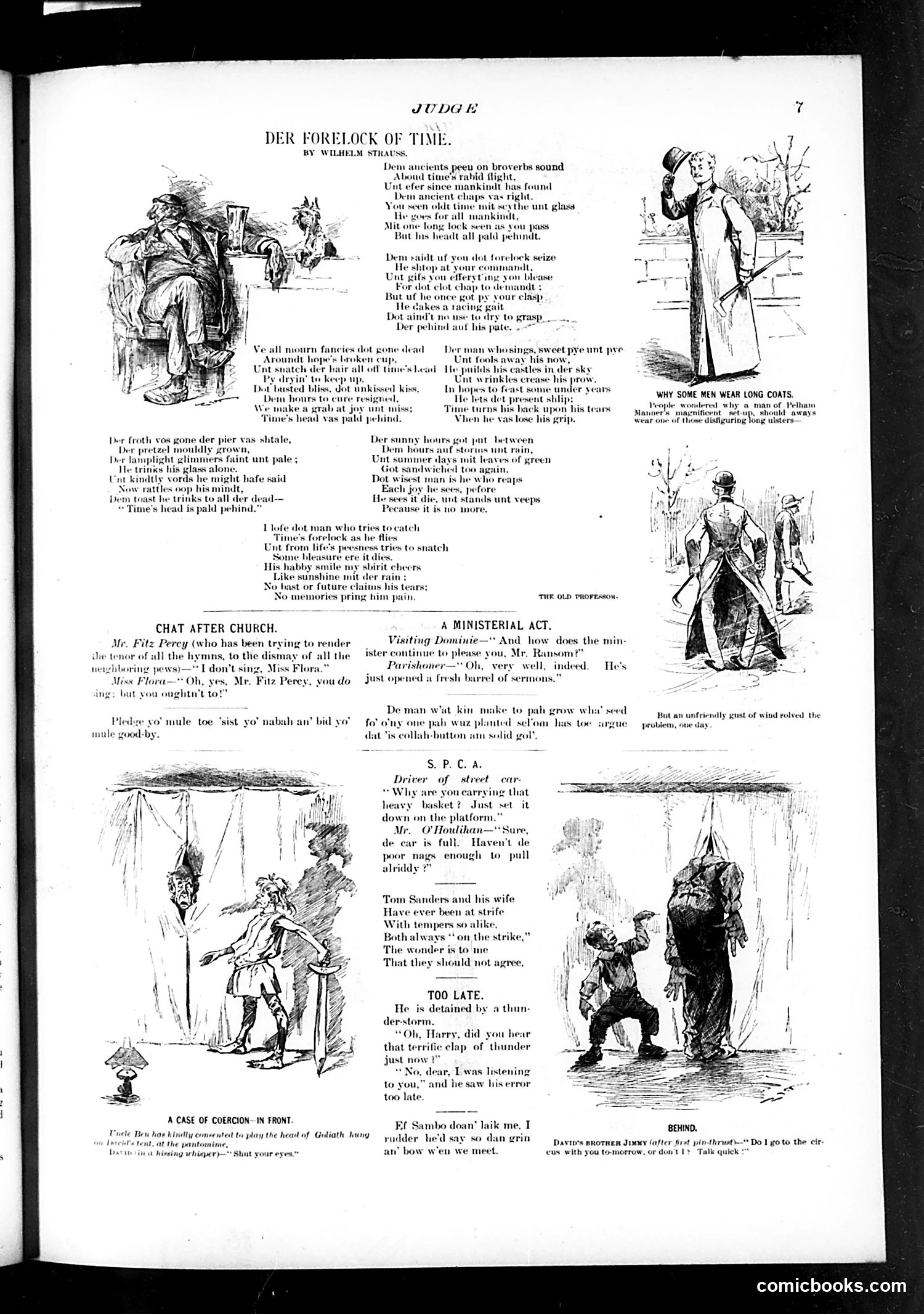
This page from *Judge* (likely early 1900s) contains multiple satirical pieces: **"Der Forelock of Time"** is a German-dialect poem lamenting lost opportunities and time's passage—a common *Judge* theme mocking sentimental nostalgia. **"Why Some Men Wear Long Coats"** appears to be a joke about concealment, likely referencing contemporary fashion or social embarrassment (text too fragmented to determine precisely). **"Chat After Church"** satirizes church singers, with "Miss Flora" claiming she doesn't sing well—a light domestic humor piece. **"A Ministerial Act"** jokes that a minister's solution to pleasing parishioners is simply producing more sermons—mocking clerical laziness or prolixity. **"S.P.C.A."** (Society for Prevention of Cruelty to Animals) depicts an animal-welfare activist criticizing a street-car driver for overloading a horse. **"Too Late"** and other fragments offer brief domestic gags. The German-dialect humor and mix of social commentary, puns, and domestic situations typify *Judge's* satirical approach to turn-of-the-century American life.
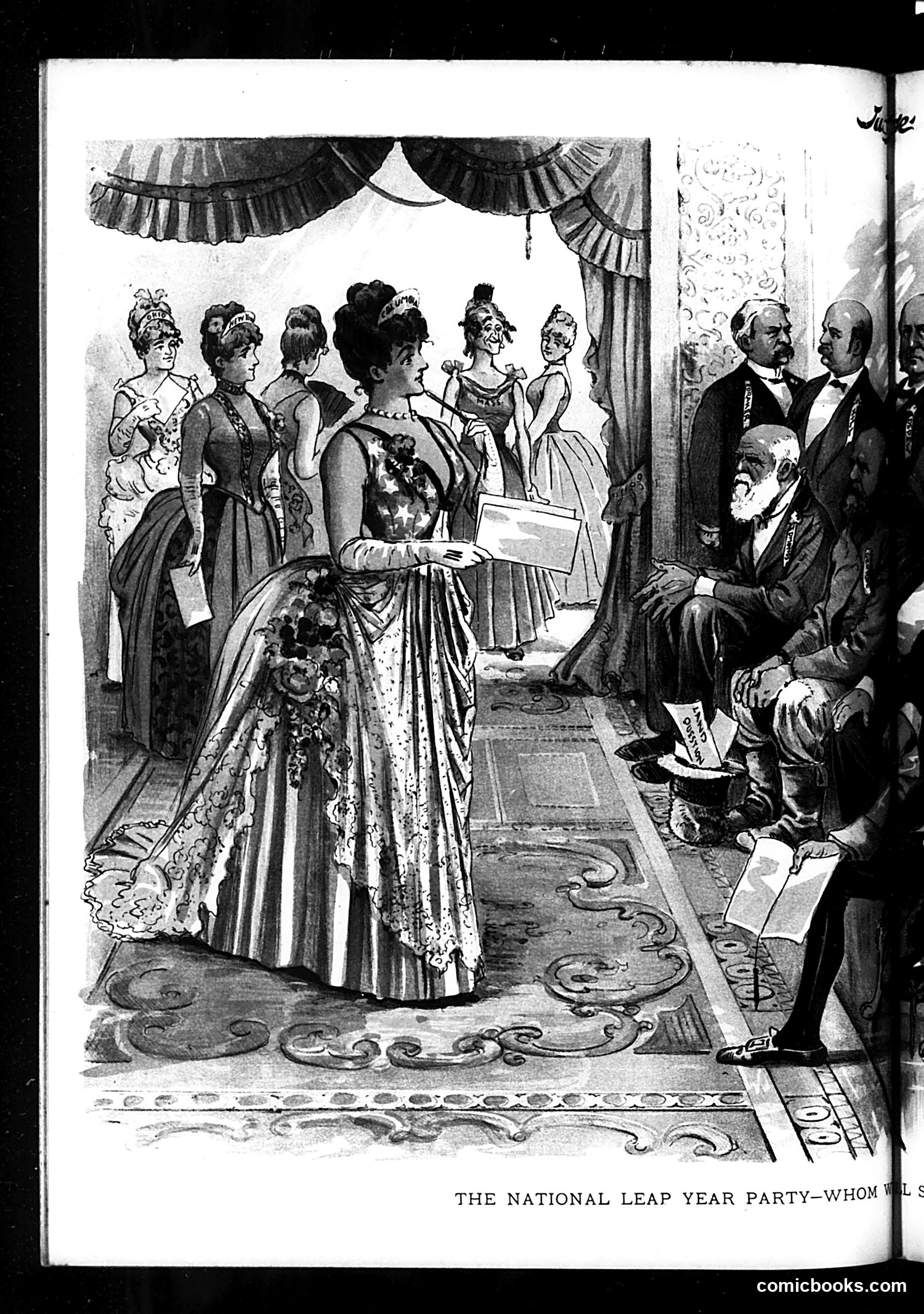
This satirical illustration depicts a formal social gathering centered on leap year tradition. The title references the custom allowing women to propose to men during leap years—a reversal of Victorian social norms. The cartoon shows an elegantly dressed woman in the center presenting a document (likely a marriage proposal) to seated gentlemen on the right, who appear uncomfortable or taken aback. Women in the background observe the scene. The satire mocks the disruption of traditional gender roles: the idea that women would actively pursue marriage rather than wait to be courted horrified Victorian sensibilities. The "National Leap Year Party" concept exaggerates this custom into an organized social event, treating women's temporary social agency as absurd and noteworthy. Judge magazine used this to lampoon both women's increasing assertiveness in the late 19th/early 20th century and the anxiety this provoked in conservative society.
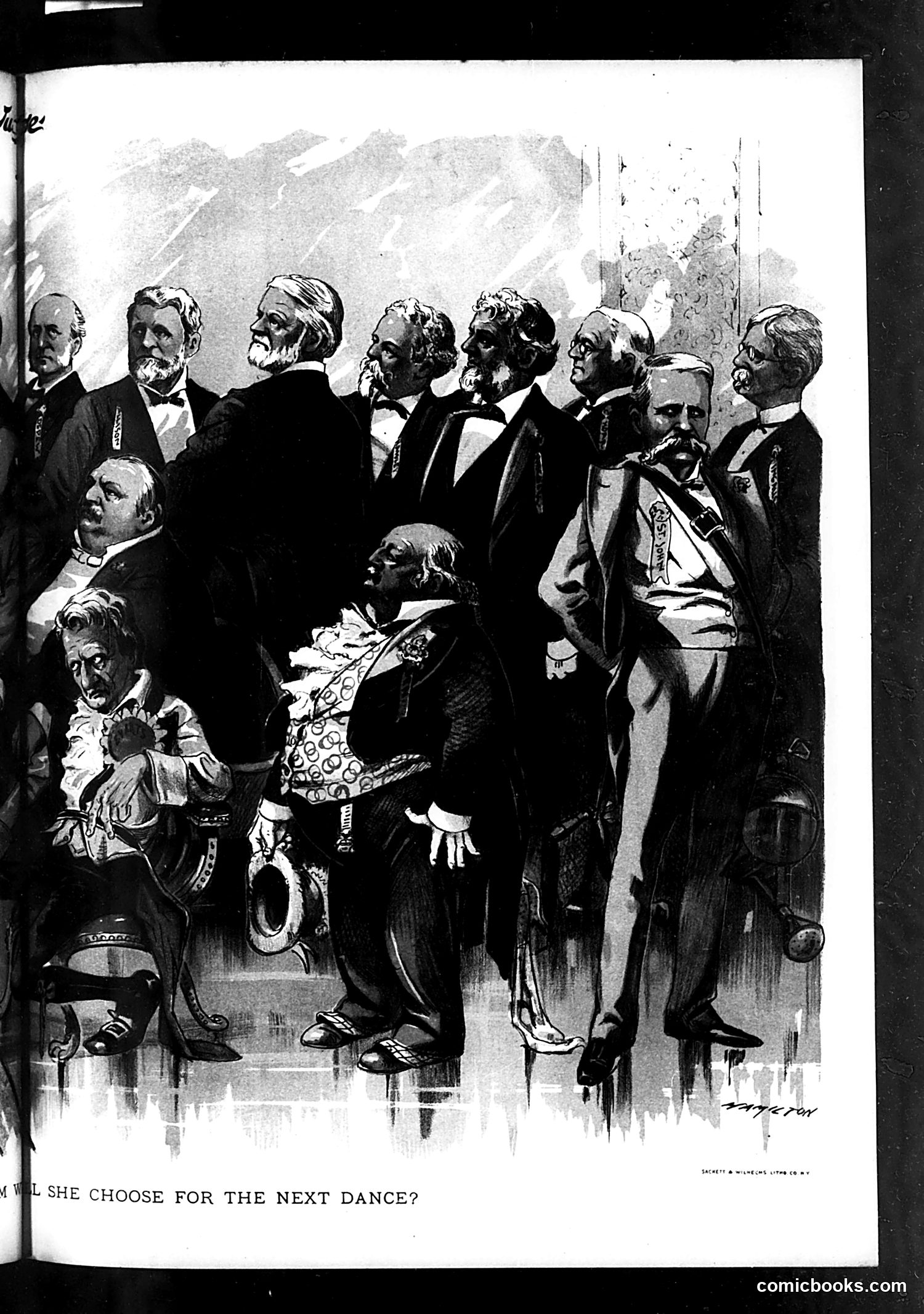
**Title:** "Whom Will She Choose for the Next Dance?" This cartoon satirizes European political alliances and matrimonial politics, likely from the late 19th century. A woman (representing a nation—possibly Belgium, the Netherlands, or another smaller European power) is surrounded by formally dressed male suitors representing major European powers. The central figure in elaborate military dress with decorations appears to be a prominent statesman or monarch. The satire mocks how smaller nations were courted and competed for by larger powers through diplomatic marriages and alliances. The "dance" metaphor suggests the shifting, strategic partnerships of European politics during a period of imperial competition and alliance-building. The OCR text is corrupted, making specific identification difficult, but the visual language clearly critiques the transactional nature of 19th-century international relations.
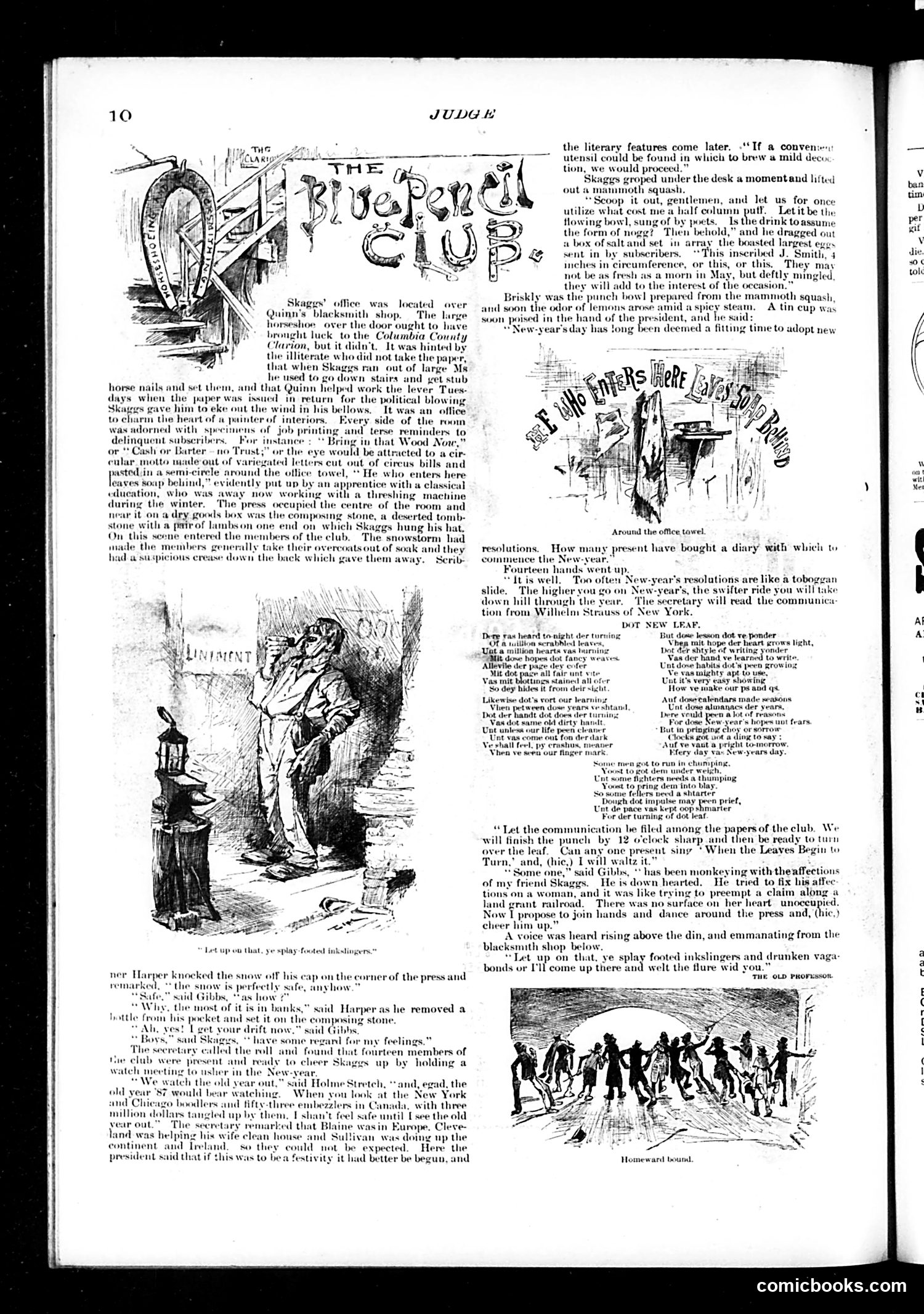
This page depicts a New Year's Eve gathering at a small-town newspaper office (the Columbia County *Clarion*), where the editor Skaggs and colleagues celebrate by concocting punch in a hollowed squash and making resolutions. The satire targets **newspaper culture and journalistic pretension**: the office is comically ramshackle (using tombstones as composing stones, horse nails for type), yet Skaggs and his staff affect literary grandeur, quoting poets about "flowing bowls" while actually just getting drunk. The German-dialect poem "Dot New Leaf" mocks **New Year's resolutions as empty gestures**—people promise reform annually but repeat the same mistakes ("every day vas New-years day"). The blacksmith's angry interruption from below adds physical comedy, contrasting working-class irritation with the pretentious newspaper men above. Overall, Judge ridicules both **small-town newspaper self-importance** and the **hollow ritual of New Year's vows**.
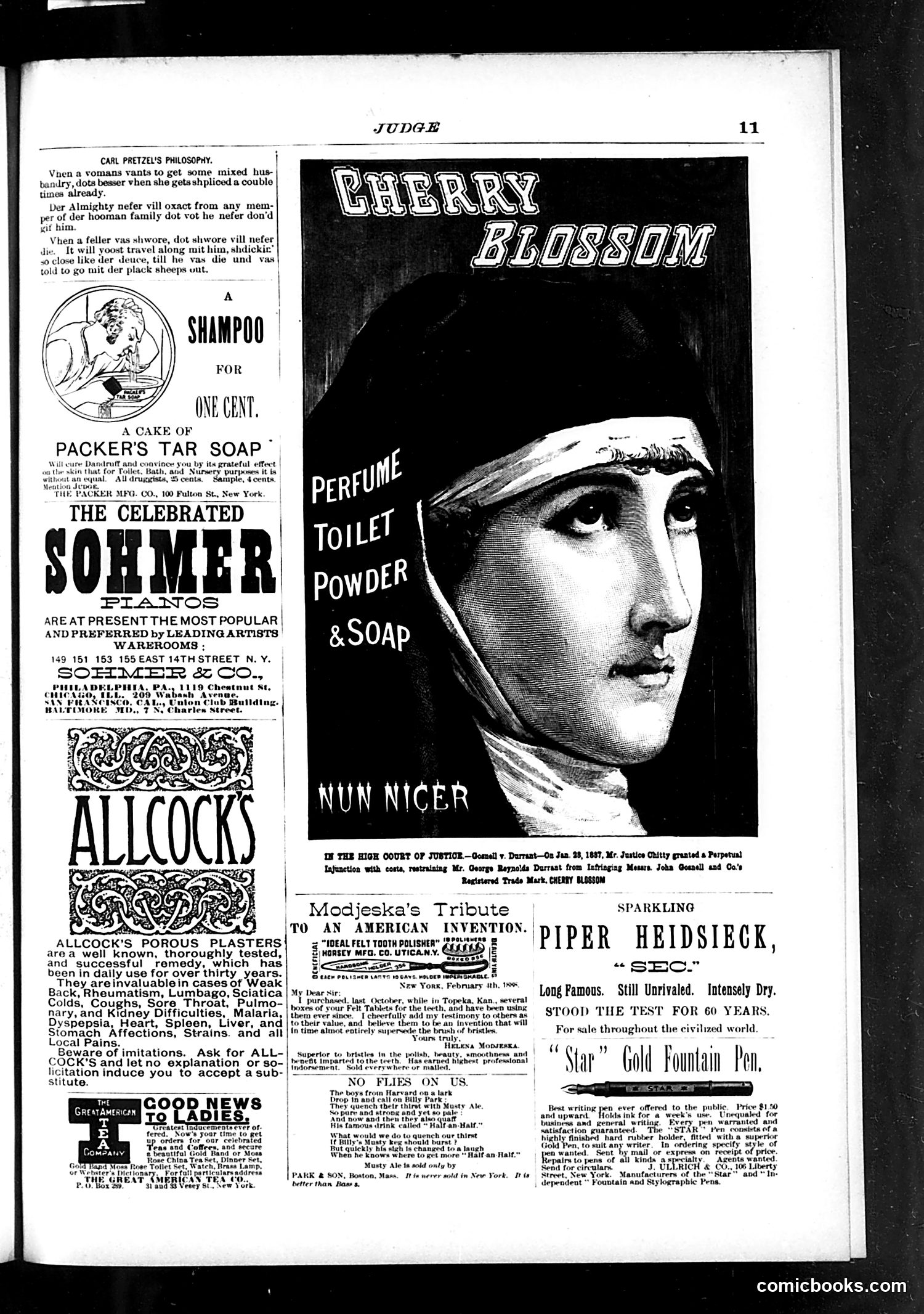
This page is primarily **advertisements**, not political satire. The main content includes product ads for pianos, soaps, plasters, fountain pens, and alcoholic beverages typical of late 19th-century magazines. The notable exception is a small section titled "Modjeska's Tribute to an American Invention," featuring actress **Helena Modjeska** endorsing an "Ideal Felt Tooth Polisher." This appears to be a celebrity testimonial—common advertising practice—rather than satire. At the top left, "Carl Pretzel's Philosophy" presents ethnic humor through a German-accented character offering folk wisdom about marriage and morality. This reflects period attitudes toward immigrant communities, using dialect comedy for entertainment. The page's "Cherry Blossom" movie advertisement and other content are straightforward commercial pitches. Without editorial cartoons or clear political commentary visible, this reads as a typical Judge revenue page mixing paid advertising with light ethnic humor.
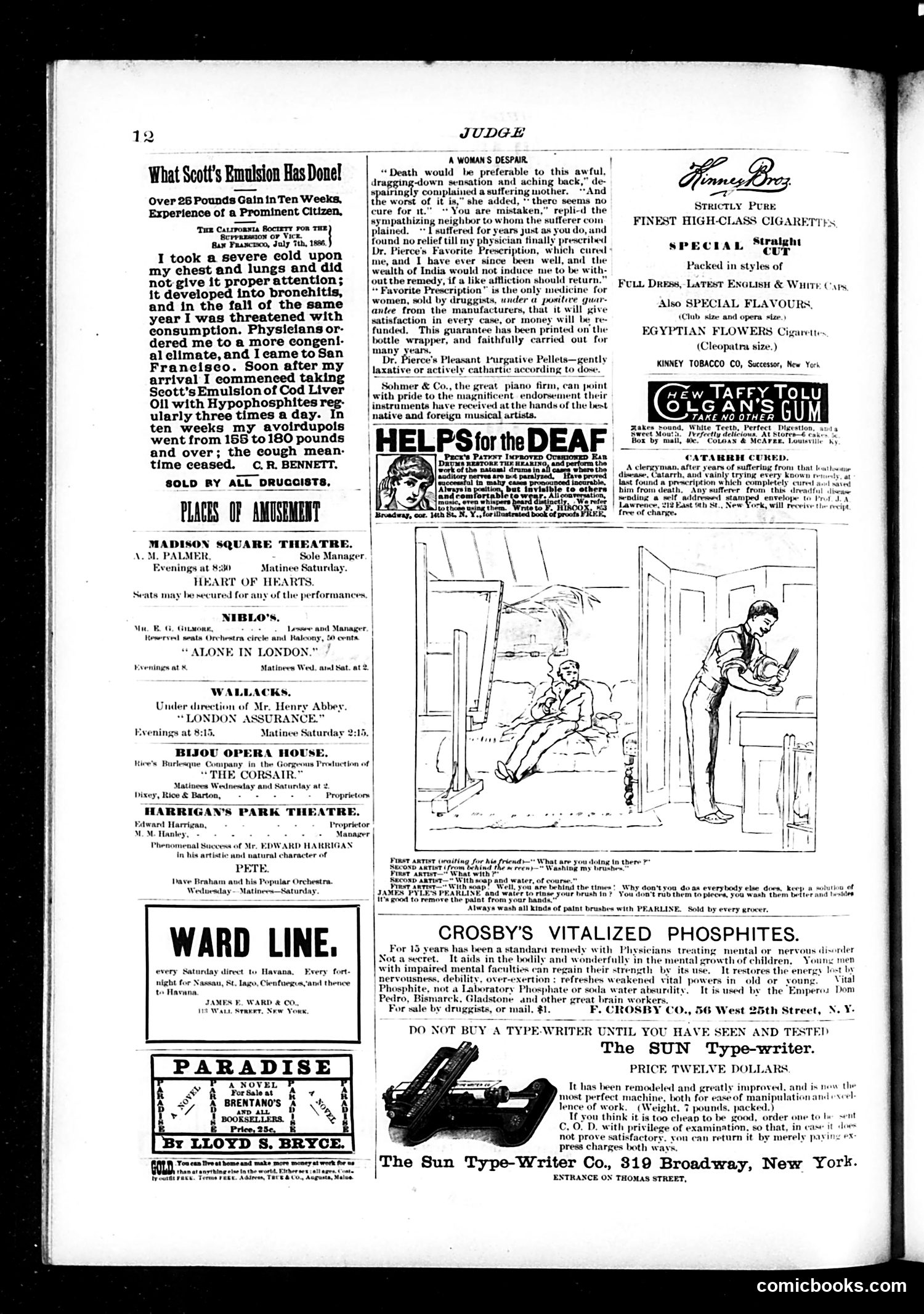
This page is primarily **advertising**, not political satire. The main illustrated content shows a domestic scene captioned "A Woman's Despair," depicting a woman complaining to a neighbor about physical ailment and exhaustion. The accompanying text is a patent medicine advertisement for Dr. Pierce's "Favorite Prescription," a widely-marketed remedy claiming to cure women's unspecified complaints (likely gynecological issues). The neighbor responds that the product cured her similar suffering. **Context for modern readers:** This reflects late-19th-century medical advertising that exploited women's health concerns with vague, unproven remedies. The ad uses a relatable domestic scene to build credibility. "Judge" magazine carried such advertisements alongside satirical content, normalizing these dubious medical claims through respectable publication placement. The cartoon itself contains **no political message**—it's purely commercial, targeting female readers' anxieties about health and vitality.
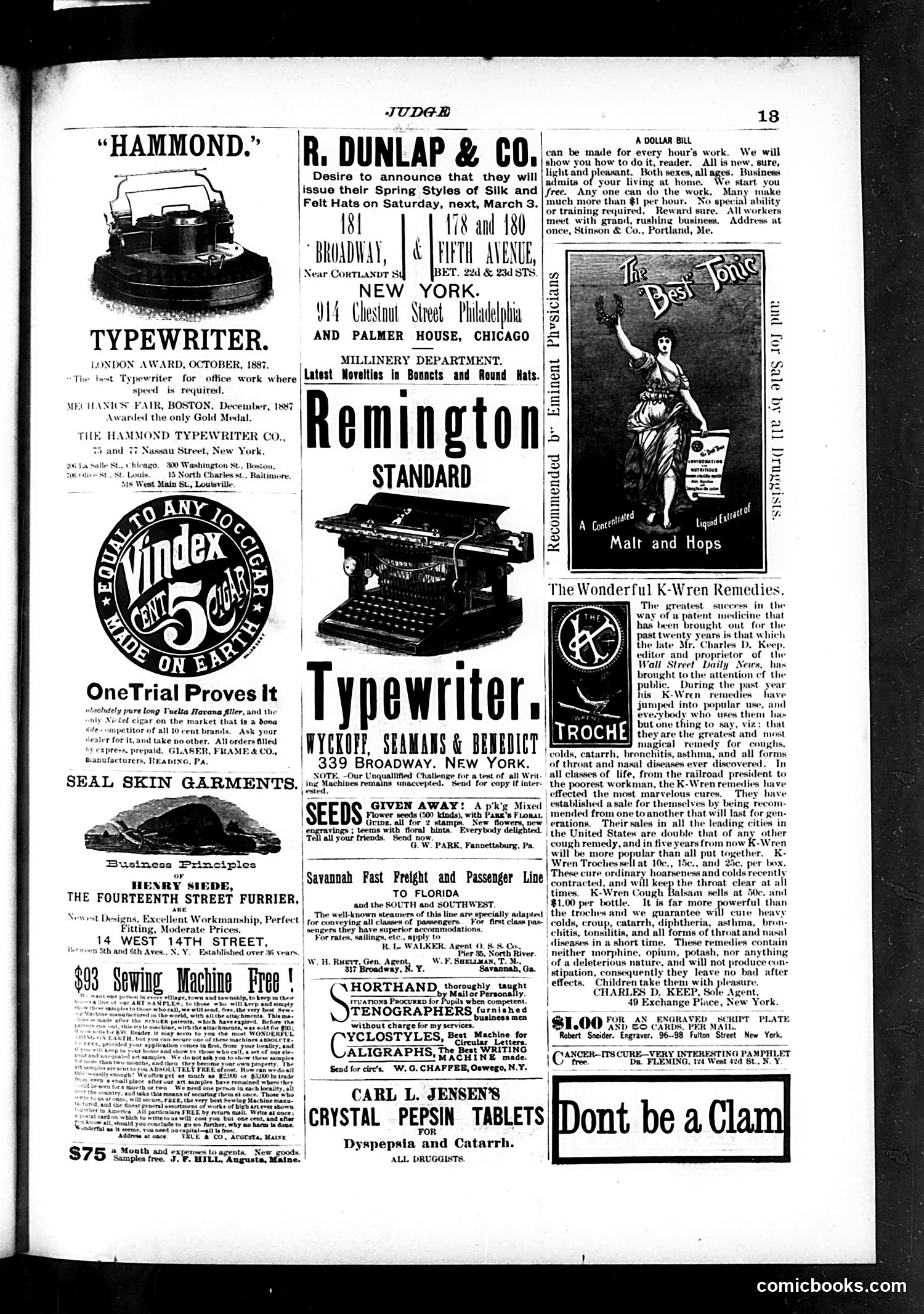
This is primarily an **advertising page** from Judge magazine (circa March 1887), with no political cartoons. The featured advertisements include: **Major Products Advertised:** - Hammond and Remington typewriters (competing office machines) - R. Dunlap & Co. hats and millinery - Seal skin garments and furs - "K-Wren Remedies" (patent medicine claiming to cure coughs, colds, asthma, throat/nasal diseases) - Sewing machines and stenography services **Notable to Modern Readers:** The page exemplifies late-19th-century commercial culture: typewriter technology was still novel and competitive; patent medicines made extravagant, unregulated health claims; and a prominent "work-from-home" scheme promised "$1 per hour" (substantial for 1887). The K-Wren advertisement's testimonial structure—citing a Wall Street editor's endorsement—represents the era's advertising techniques before FDA regulation or truth-in-advertising laws. No satirical content or cartoons appear on this page.
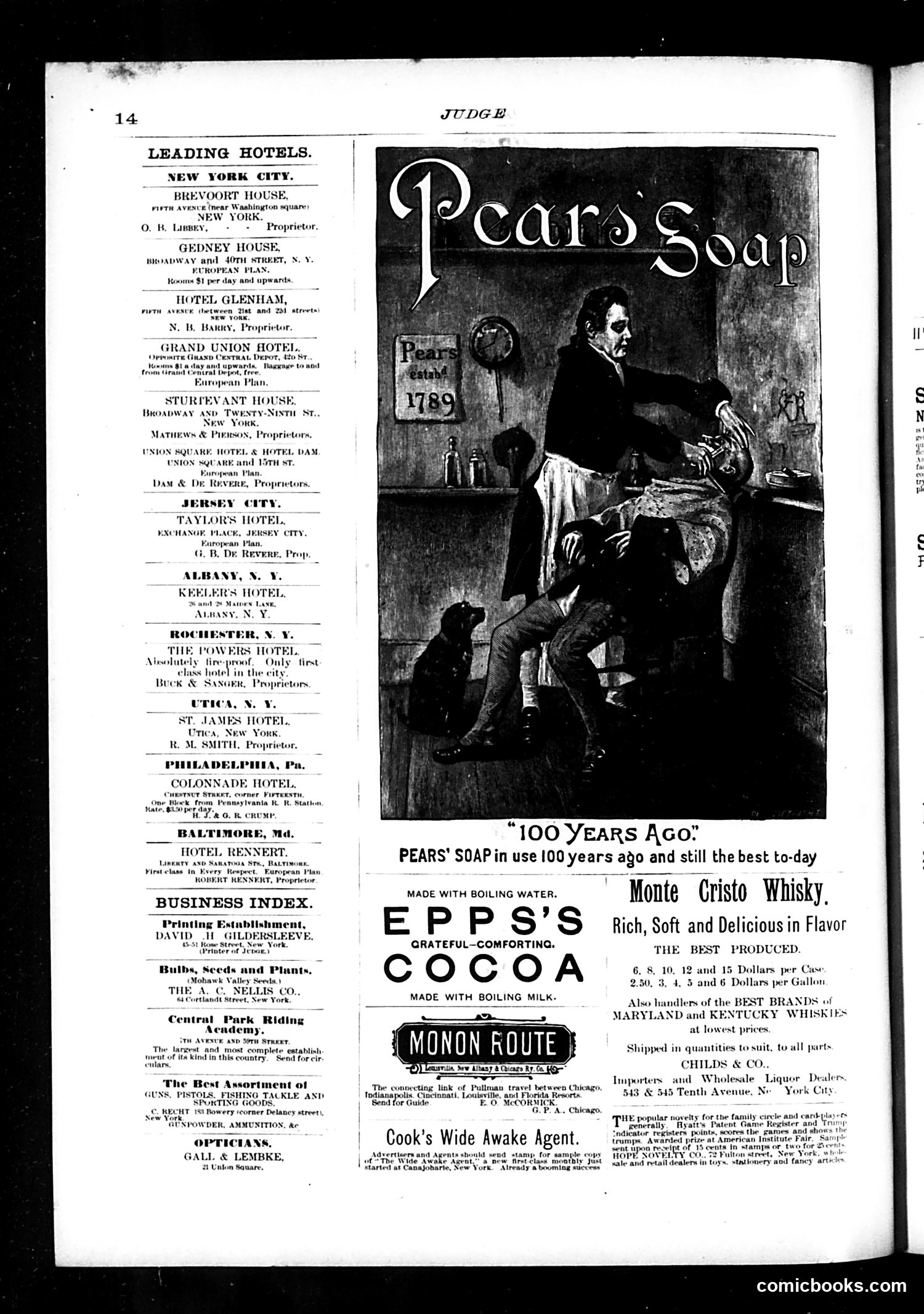
This page is primarily **advertising and business listings** for Judge magazine, not satirical content. The main visual element is a product advertisement for Pears' Soap featuring a historical scene titled "100 Years Ago." **The Pears' Soap Advertisement:** The image depicts a figure from approximately 1789 (the date visible on the soap) using Pears' Soap, with the advertising copy claiming the product "in use 100 years ago and still the best to-day." This is a nostalgia-based marketing pitch emphasizing product longevity and tradition—a common advertising strategy of the era. **The Surrounding Content:** The page lists prominent New York, New Jersey, Pennsylvania, and Maryland hotels, along with advertisements for whisky, cocoa, printing services, firearms, and optical goods. This represents typical late-19th-century classified advertising. **Historical Context:** There is no political satire visible here. This appears to be a standard advertising section of Judge magazine, reflecting consumer goods and services available to middle and upper-class readers of the period.
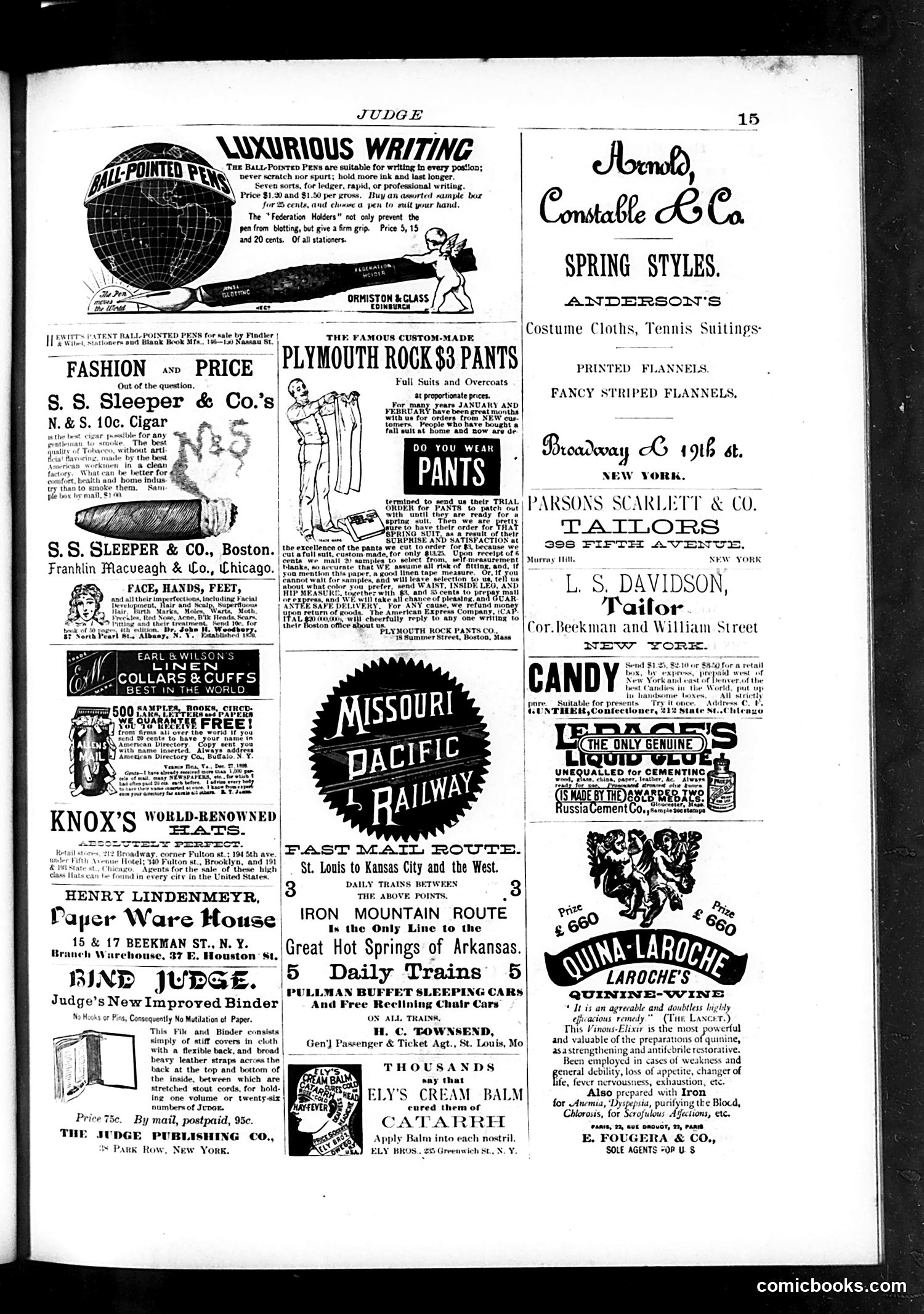
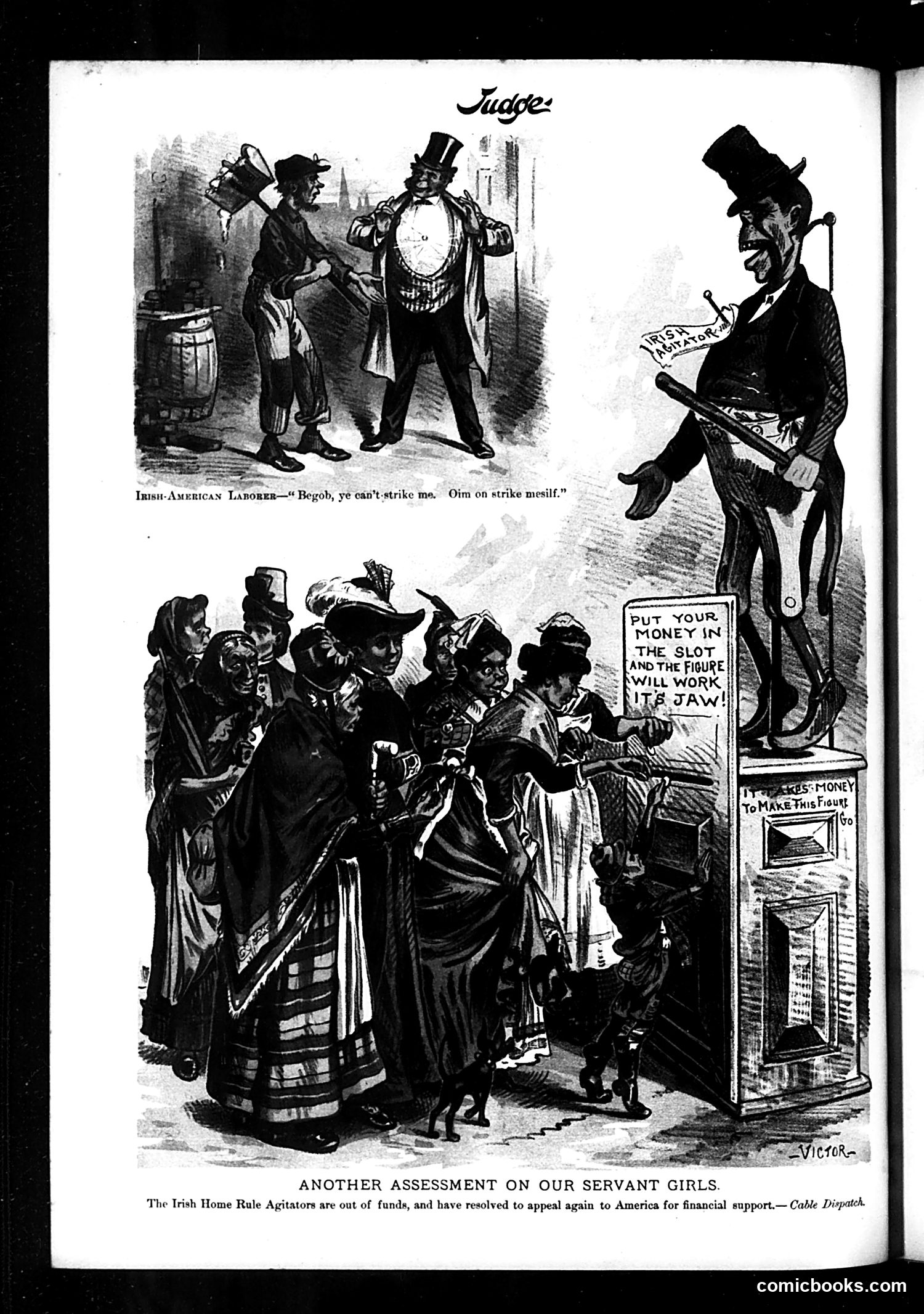
This Judge magazine cartoon satirizes Irish Home Rule activists fundraising in America. The top panel shows an Irish-American laborer resisting a well-dressed man's attempt to collect money, declaring "Begob, ye can't strike me. Oim on strike meself." The bottom panel depicts a money-collection machine operated by a caricatured figure (labeled as appealing to working-class immigrant women—"servant girls"). The sign reads: "Put your money in the slot and the figure will work it a jaw!" The satire mocks Irish Home Rule agitators as perpetual fundraisers who manipulate American Irish immigrants emotionally for financial support. The cartoon suggests their appeals are mechanical, repetitive ("work it a jaw" = talk), and exploitative—playing on ethnic and class sympathies while Irish-Americans themselves struggle financially.