
A complete issue · 16 pages · 1888
Judge — February 4, 1888
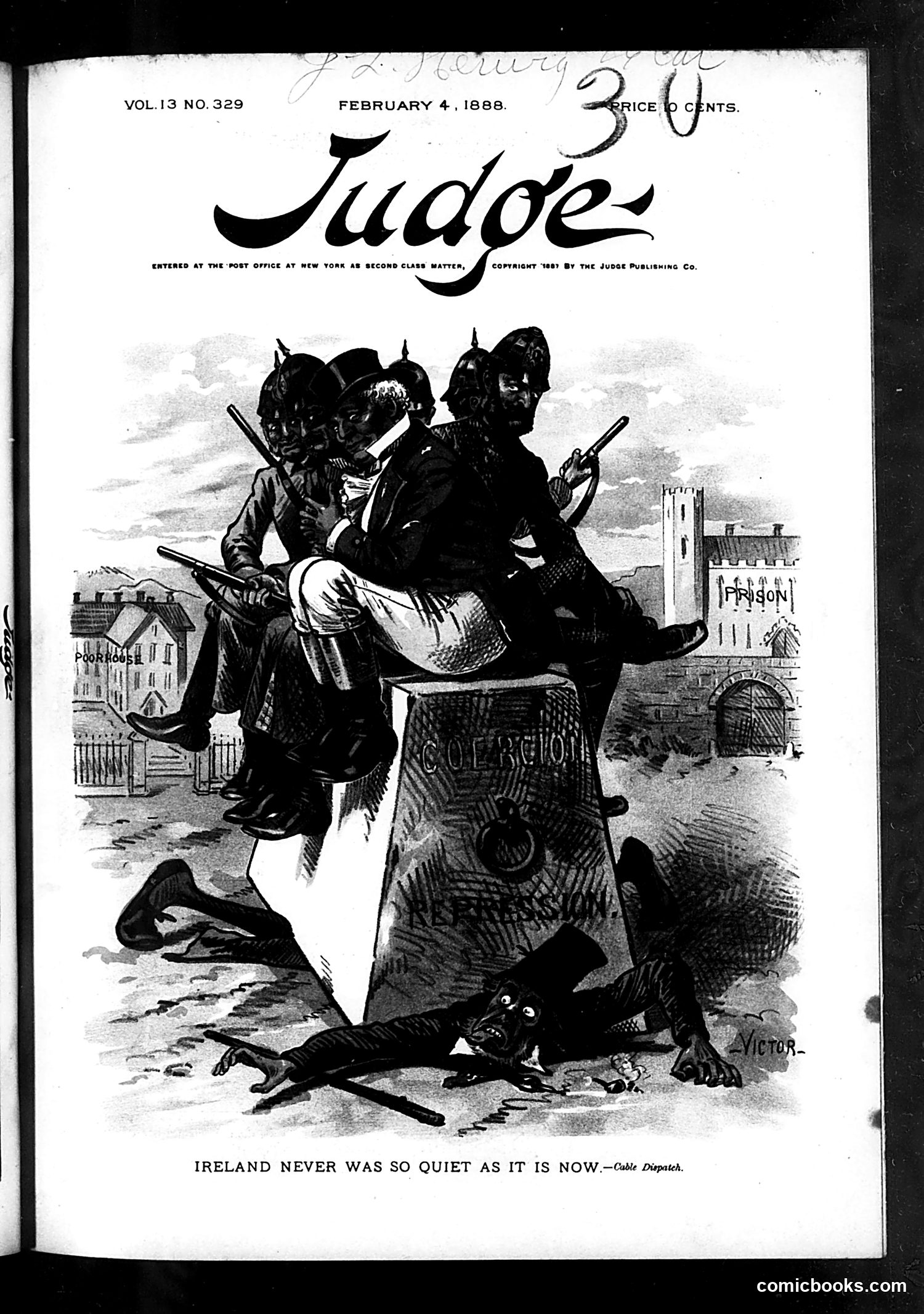
This 1888 Judge cartoon satirizes British coercion in Ireland. The image depicts three armed military/police figures brutally suppressing an Irish person (represented by the prone figure labeled "COERCION"). The caption attributes the "quiet" to the Cable Dispatch—likely referencing recent coercive legislation. The cartoon critiques British policy by showing that Ireland's apparent peacefulness results not from satisfied citizens but from violent military oppression. The prone figure and weapons suggest forced silence rather than genuine peace. This reflects 1880s Irish-British tensions, when the British government employed increasingly harsh measures against Irish nationalist movements and land reform agitation. The satire targets the hypocrisy of claiming successful governance through brutality.
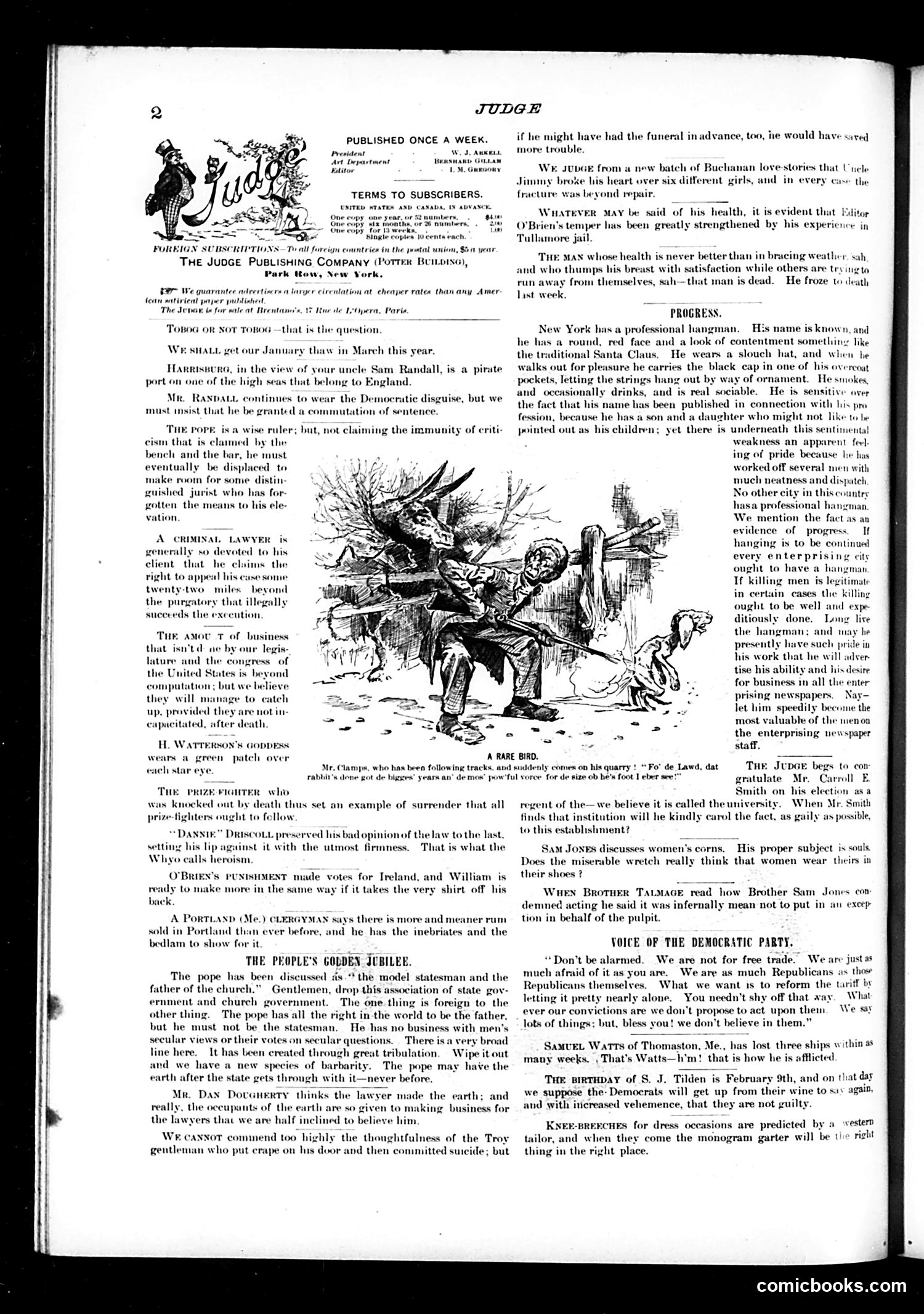
The central cartoon depicts a man labeled "Mr. Clamps" who has been following tracks and suddenly comes upon an old quarry, exclaiming "F'r de Lawd, dat makes me go de longest way to de mose pow'ful verse for de size ob his feet I eber see!" This appears to be a racist caricature using exaggerated dialect and physical features common to late 19th-century American satire. The figure's speech pattern and the quarry setting suggest a commentary on African American characters, though the specific political or social reference remains unclear from the text provided. The surrounding editorial content discusses judges, lawyers, and various political matters, but the cartoon's precise satirical point is difficult for modern readers to determine without additional historical context about the magazine's intended audience and editorial stance.
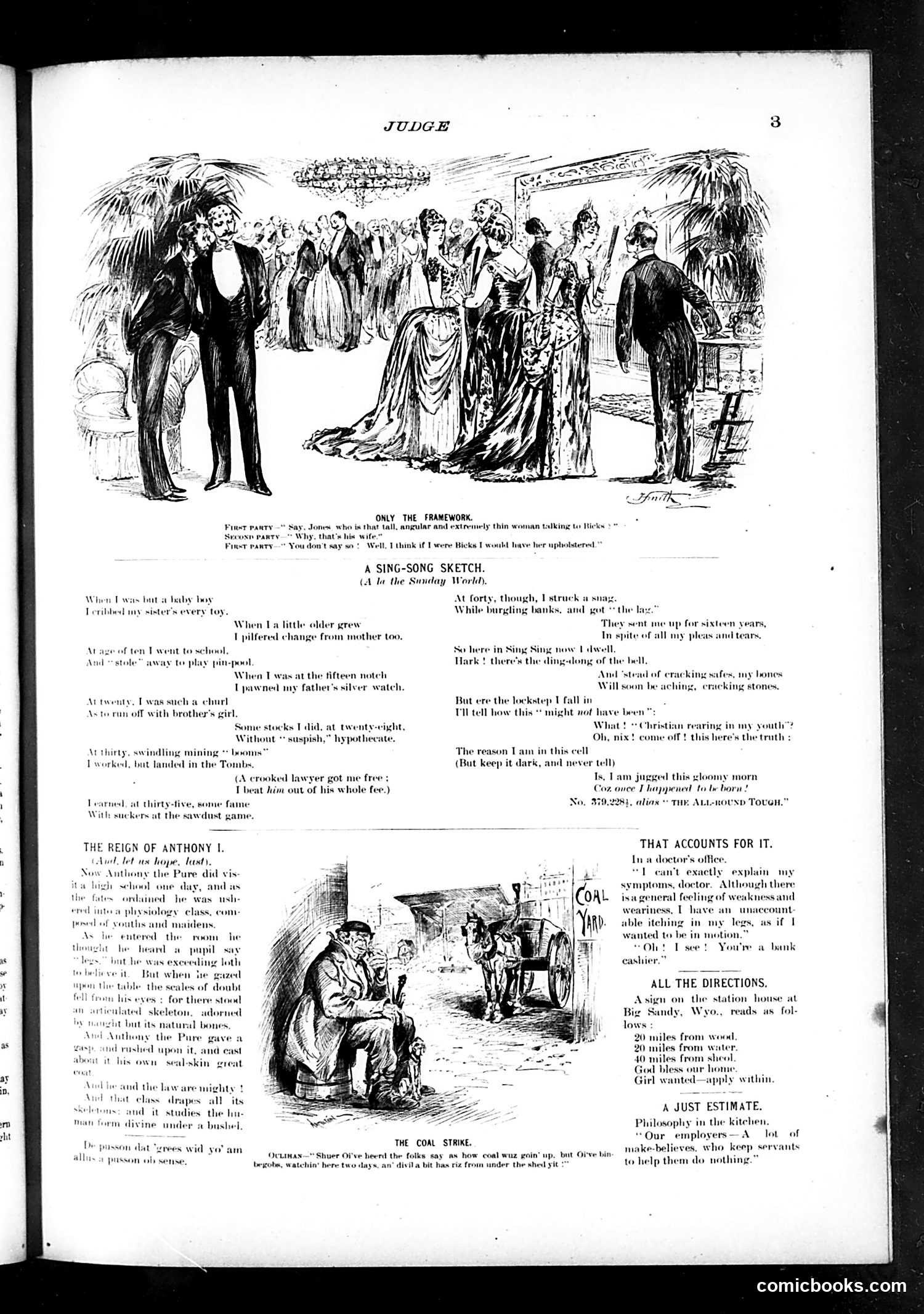
This page contains several satirical sketches from Judge magazine (date unclear from image). **"Only the Framework"** mocks a thin woman by suggesting she needs upholstering—a play on her skeletal appearance. **"A Sing-Song Sketch"** parodies the confessional narratives popular in Sunday newspapers. It's a cynical autobiography of a criminal whose entire life trajectory—from childhood theft through bank robbery to imprisonment at Sing Sing—is predetermined by poverty and circumstance. The closing line ("Coz once I happened to be born") sarcastically suggests social determinism: the speaker's crimes weren't choices but inevitable outcomes of his birth status. **"The Reign of Anthony I"** appears to reference Anthony Comstock, the famous anti-vice crusader, discovering an anatomical skeleton in a schoolroom and interpreting it as obscene—satirizing his prudish overreach. **"That Accounts for It"** humorously attributes a patient's weakness to his employer's exploitative nature. Remaining sketches are brief humor pieces about directions and labor issues (coal strike, servant relations).
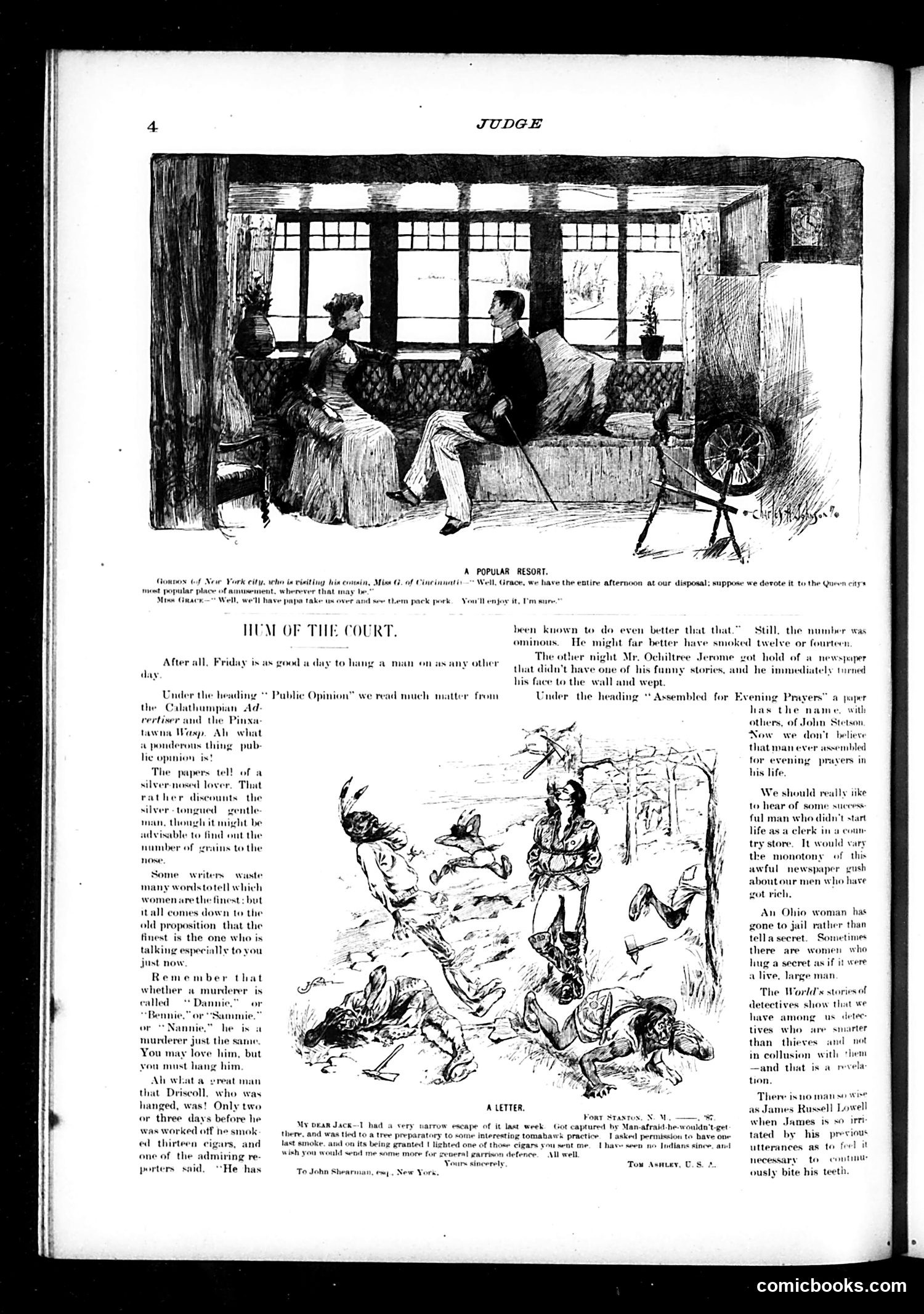
This page collects brief satirical observations on contemporary social absurdities. The top illustration shows a "Popular Resort"—likely a fashionable New York venue where idle wealthy people spend afternoons in leisure conversation. The "Hum of the Court" section uses biting wit to mock various targets: the pretentiousness of public opinion; the media's obsession with sensationalizing criminals (referencing someone named Driscoll who was hanged); a newspaper editor named Ochiltree Jerome whose stories are so consistently featured that his absence causes dismay; and the hypocrisy of self-made millionaires celebrated in the press. The illustrated letter about a narrow escape from Native Americans and the mention of smoking thirteen cigars before execution suggest dark humor about frontier violence and condemned prisoners' final moments. Overall, Judge satirizes American society's superficiality, media sensationalism, and the gap between public morality and actual behavior—typical targets for late-19th-century satirical journalism.
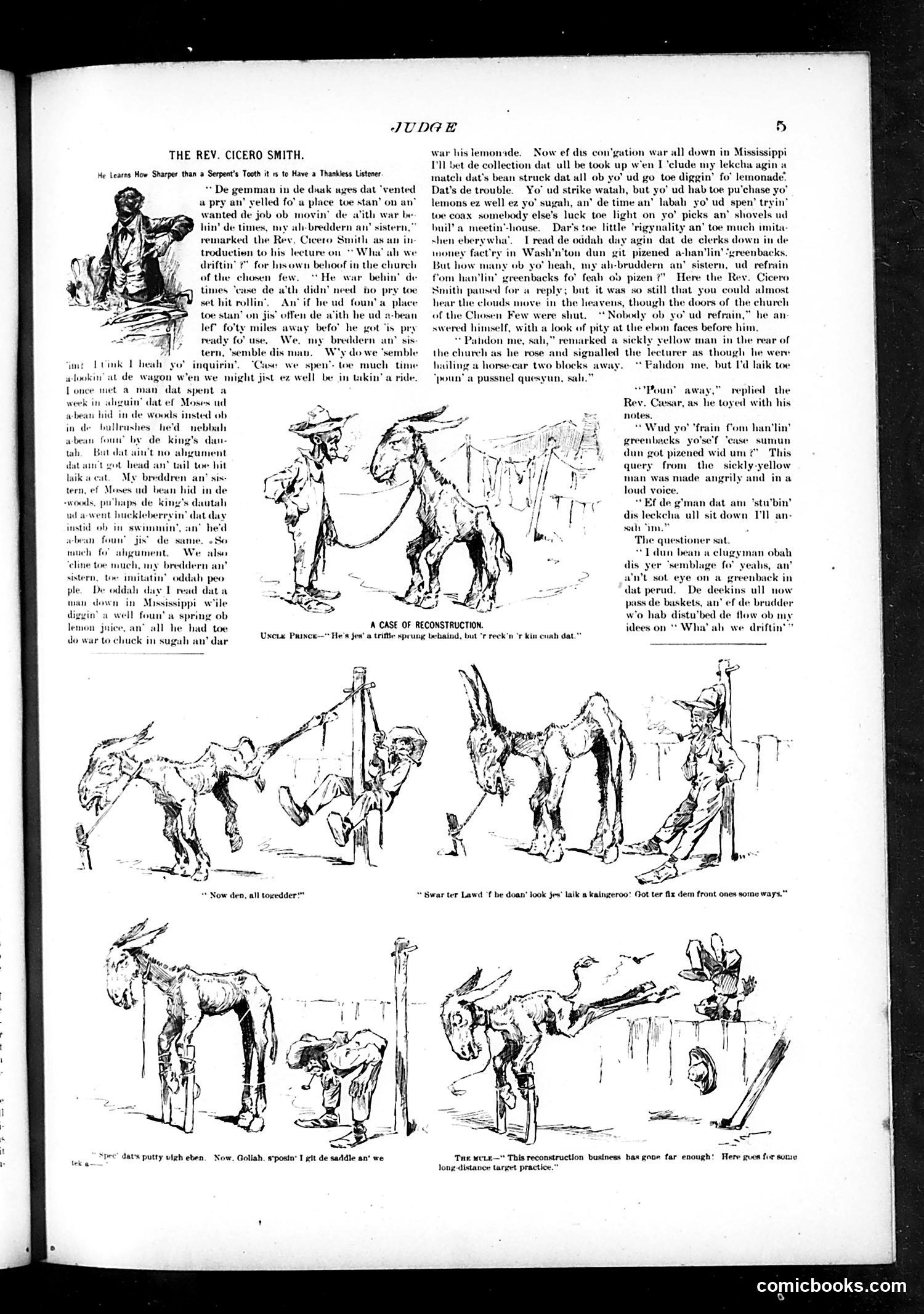
This page contains a satirical piece titled "The Rev. Cicero Smith," written in exaggerated African American dialect that was common in period humor. The reverend tells rambling parables to his congregation about avoiding temptation and greed—using examples like a man obsessing over Moses in the bulrushes or someone finding a lemonade spring in Mississippi. The humor relies on the reverend's tendency to digress endlessly. A sick parishioner interrupts, asking why the reverend won't handle church collection money himself if it's truly "poisoned" by government contact (likely referencing Reconstruction-era corruption). The reverend dodges the question, prompting the frustrated listener to leave. The cartoon illustrations labeled "A Case of Reconstruction" show mules being worked, apparently commenting satirically on post-Civil War labor practices. The satire targets both Black church culture (stereotypically) and Reconstruction-era financial/political corruption through the "poisoned money" metaphor—suggesting widespread distrust of government funds during this period.
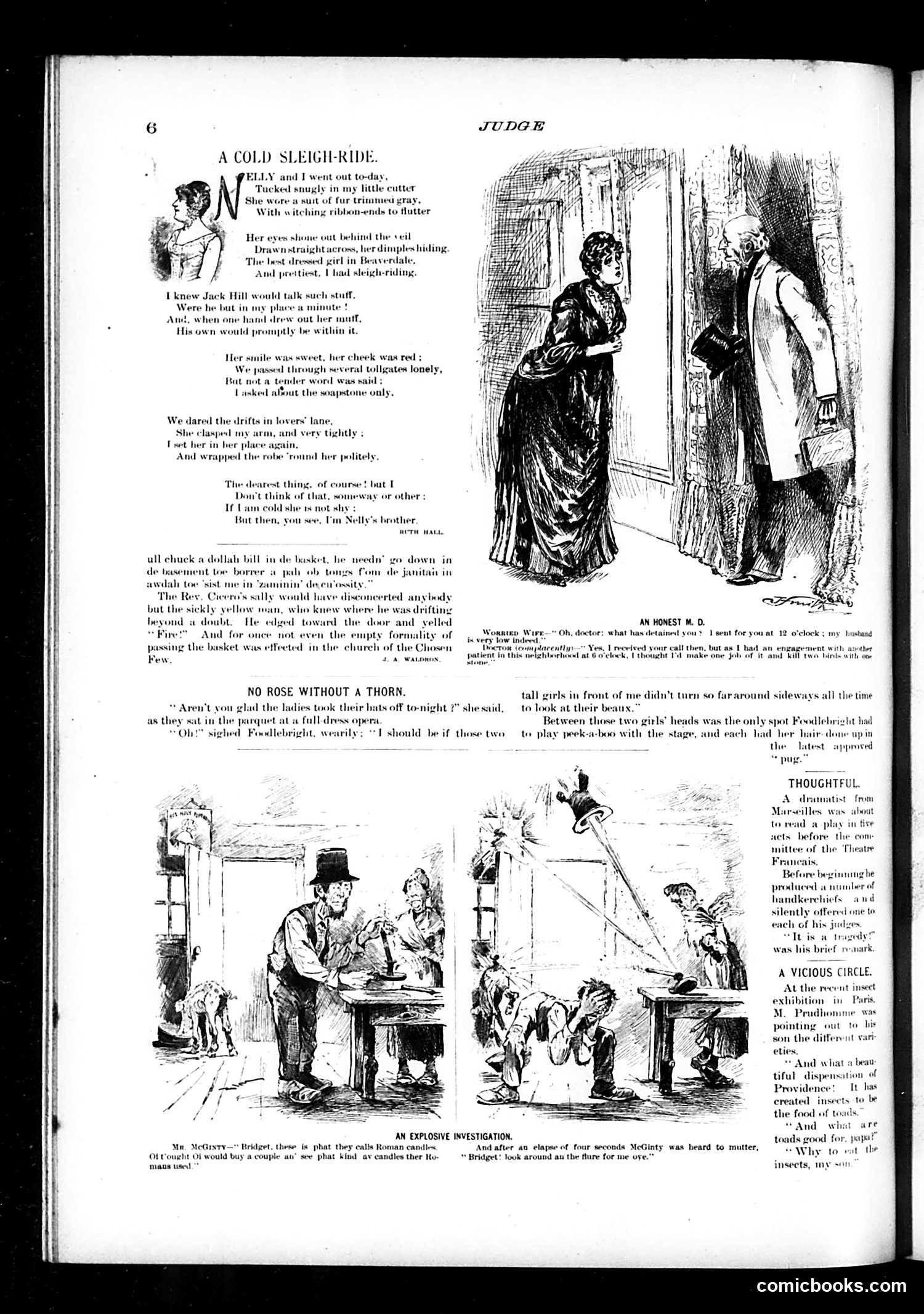
This page from *Judge* contains several short satirical pieces typical of late 19th-century American humor: **"A Cold Sleigh-Ride"** is a humorous poem about romantic tension during winter courtship—the narrator describes an attractive girl and implies a rival (Jack Hill) might steal her affection, ending with the twist that the narrator is her *brother*, making his protectiveness comedic rather than romantic. **"No Rose Without a Thorn"** jokes about social pretension at the opera, where women remove their hats (newly fashionable) but still manage to obstruct others' views. **"An Explosive Investigation"** depicts an Irish immigrant (McGinty) mishearing "Roman candles" (fireworks) and causing domestic chaos—ethnic humor common to the era. **"An Honest M.D."** satirizes a doctor's convenient excuse (prior engagement) when called for an emergency house visit. The remaining pieces offer light domestic and social satire typical of *Judge*'s content—no specific political figures are identifiable, and the humor relies on period-specific social conventions now largely obsolete.
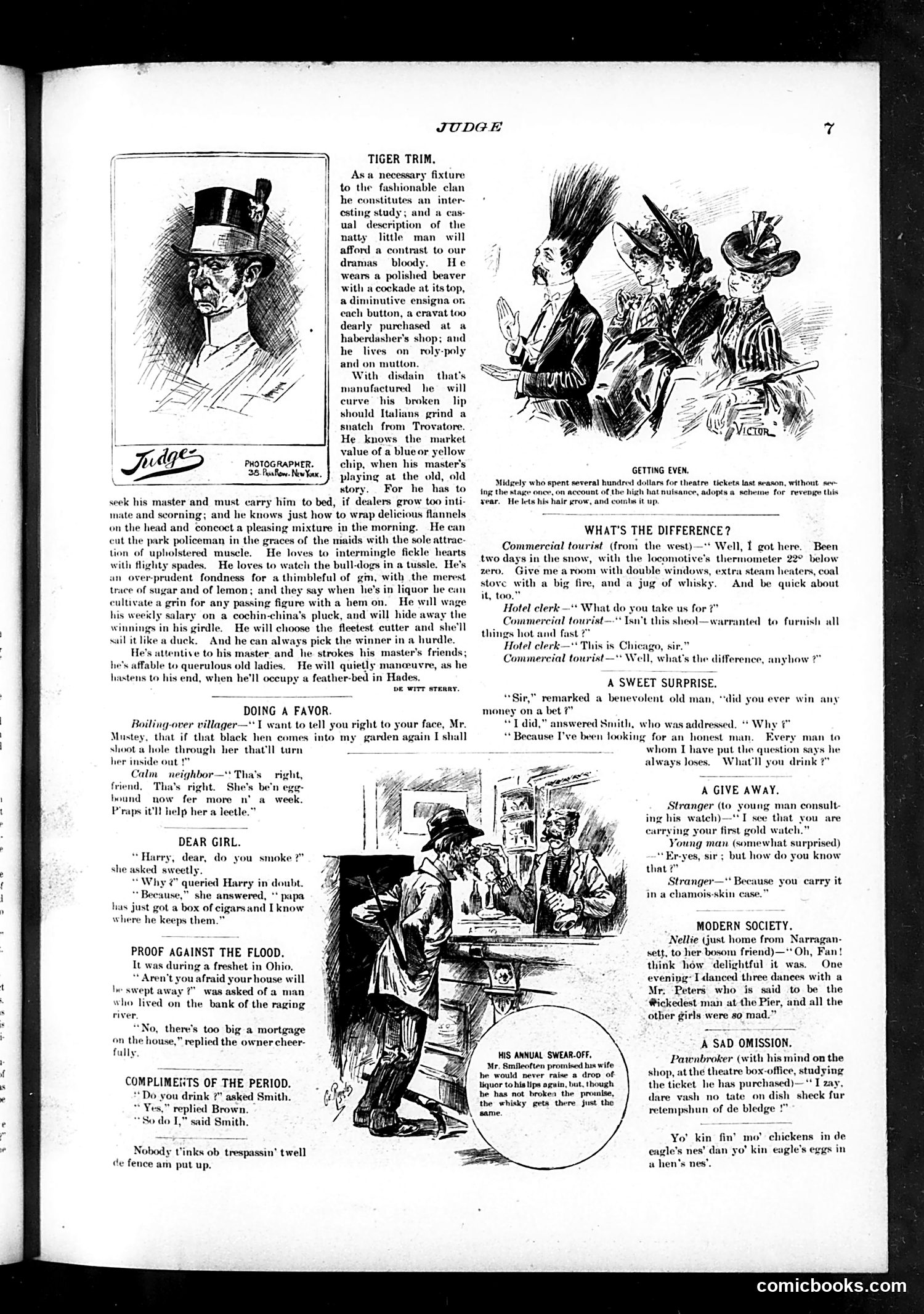
This page from *Judge* (an American satirical magazine) contains several short humorous pieces satirizing late 19th-century social types and behaviors: **"Tiger Trim"** mocks the fashionable young dandy—a vain, affected gentleman obsessed with appearance, gambling, and liquor, yet servile to his master. The detailed description parodies society columns' breathless treatment of such figures. **"Getting Even"** jokes about theater etiquette: a man who paid for expensive tickets but couldn't see the stage due to tall hats worn by others now deliberately grows his hair tall for revenge. **Other sketches** ridicule rural dialect speakers, opportunistic behavior (the woman after cigars), financial desperation (the mortgaged house), and regional stereotypes (comparing Chicago unfavorably to Hell). The overall tone mocks both upper-class affectation and working-class crudeness, typical of *Judge's* class-conscious humor targeting American pretension and social climbing during the Gilded Age.
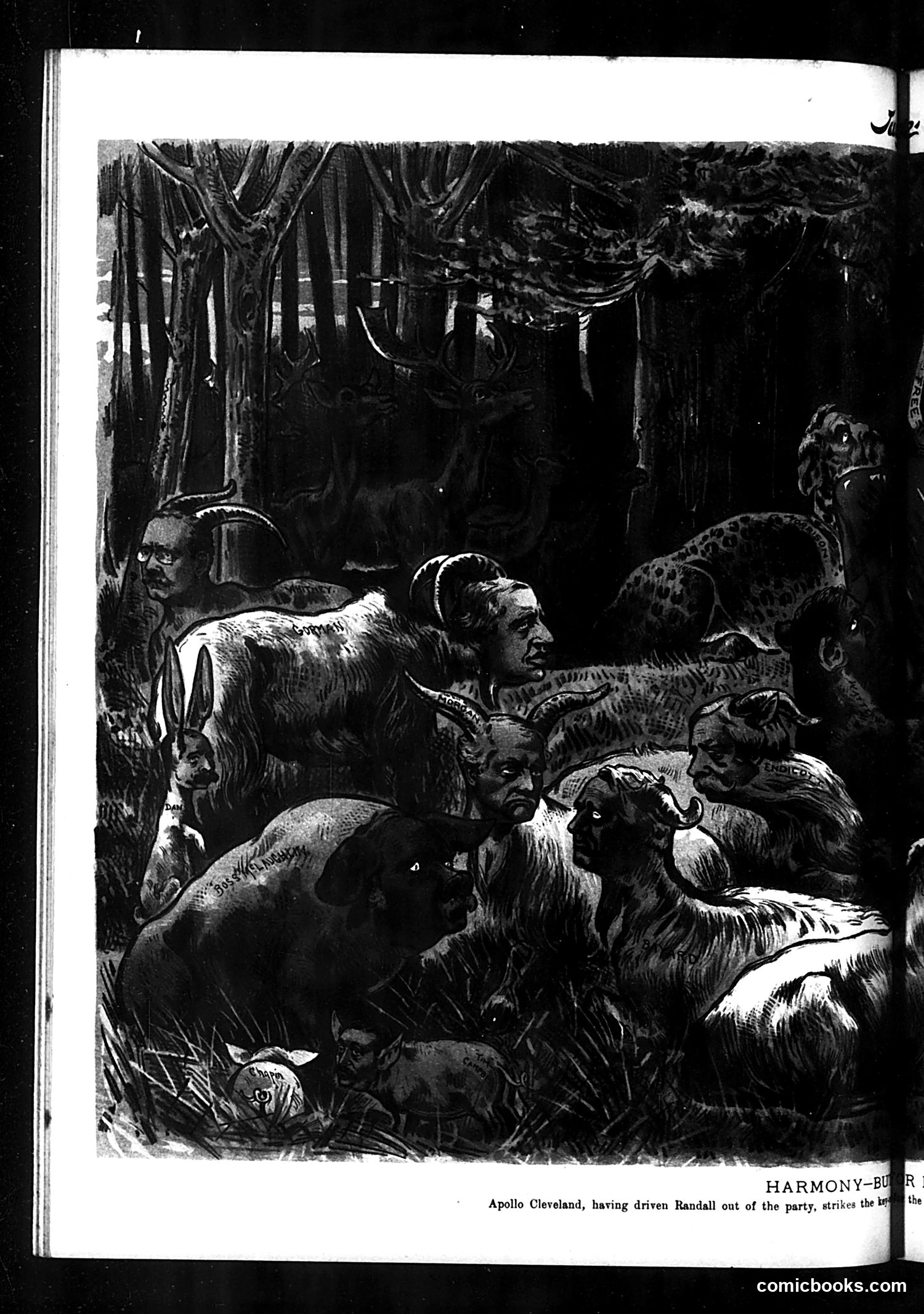
This appears to be a political cartoon from Judge magazine, though the OCR text is largely corrupted and unreadable. The visible caption mentions "Apollo Cleveland, having driven Randall out of the party, strikes the b[low]—" suggesting a reference to internal Democratic Party conflict, likely from the 1880s-1890s. The image depicts a dramatic scene with multiple human figures and goats inside what appears to be a tent. The goats likely represent stubborn or chaotic political behavior, while the figures represent political rivals—possibly Cleveland and Randall competing for party control. The satire suggests internal party dysfunction and struggle for dominance. Without clearer text or caption, precise identification of all figures remains uncertain.
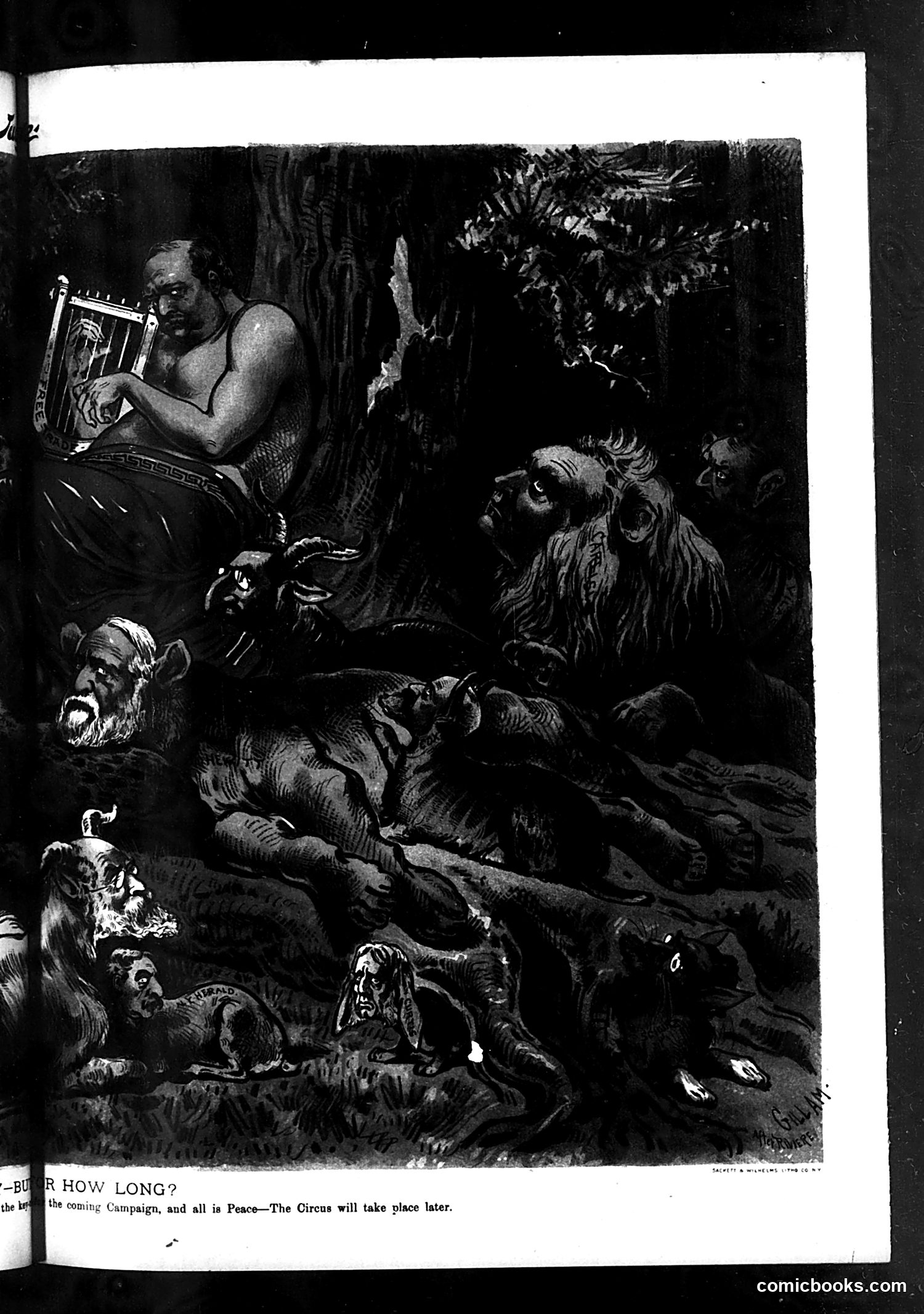
This Judge magazine cartoon satirizes American political discourse during an election campaign. The upper figure, appearing muscular and authoritative, displays what looks like campaign materials or political imagery to an audience of caricatured figures below—likely representing the voting public or political establishment. The caption's reference to "the coming Campaign" and "all is Peace" followed by "The Circus will take place later" suggests cynical commentary: the artist implies that despite current peaceful rhetoric, the actual campaign will devolve into chaotic spectacle (a "circus"). The degrading caricatures of the audience—rendered as animalistic or crude figures—reflect Judge magazine's often harsh satirical style toward various groups. Without clearer identifying marks or a visible date, the specific campaign referenced remains unclear, though this likely critiques 19th or early 20th-century American electoral politics.
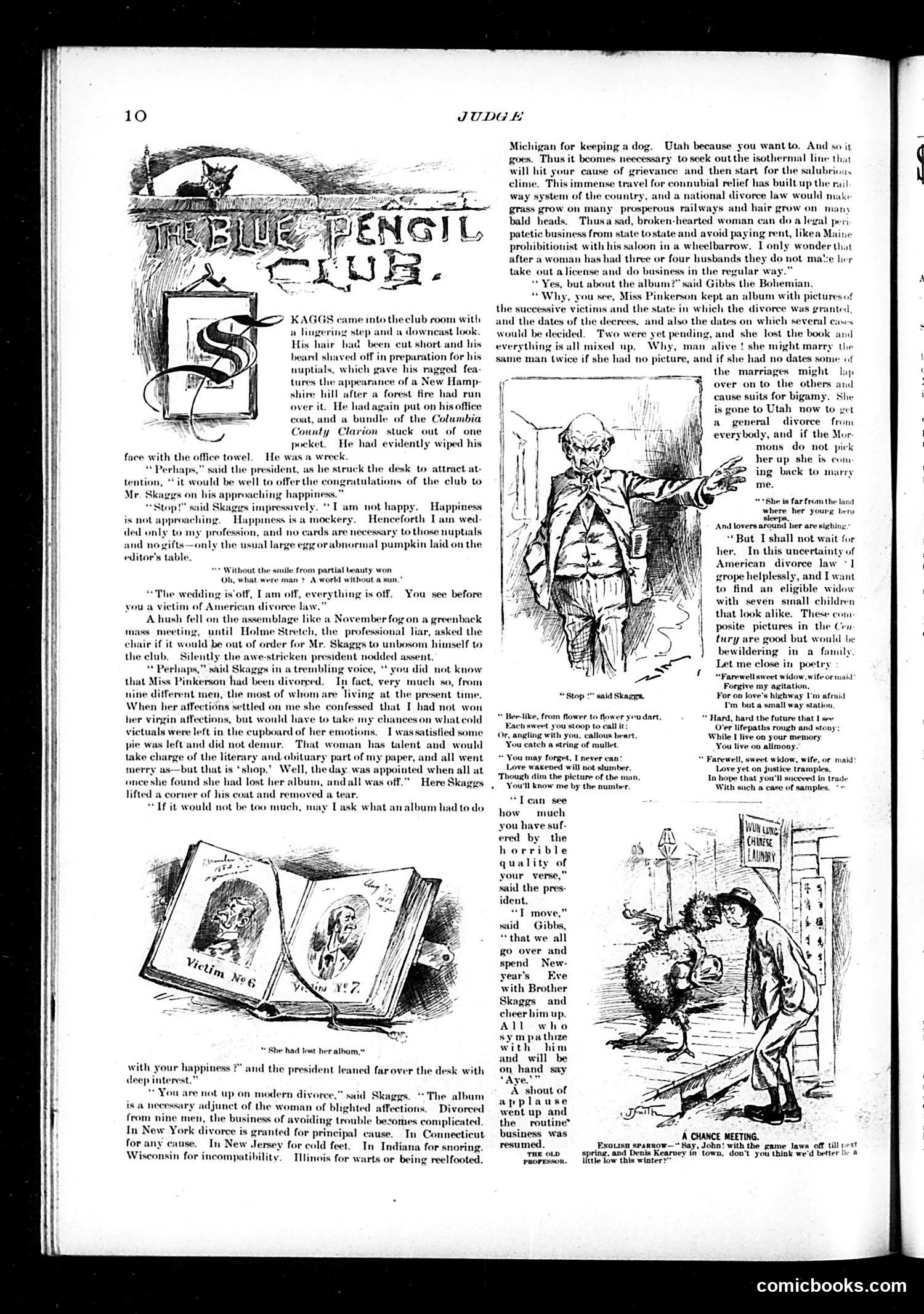
This page satirizes the phenomenon of **easy divorce laws** in early 20th-century America. The main article mocks how different states offered varying divorce grounds, encouraging people to "travel the isothermal line"—moving to permissive jurisdictions to obtain divorces. The central figure is **Mr. Skaggs**, a hapless man engaged to Miss Pinkerson, who maintains an album documenting her **multiple ex-husbands** (labeled "Victims") and the states granting divorces. The satire's target: a woman serial divorcée who exploited loose divorce laws across different states. The joke suggests Miss Pinkerson could marry men repeatedly without legal consequence due to conflicting state laws—a real legal loophole of the era. The accompanying sentimental verse mocking Skaggs's resignation adds comedic pathos. **Context**: This reflects genuine Progressive-era anxiety about "migratory divorce"—wealthy individuals (especially women) traveling to Nevada or other permissive states to escape restrictive marriage laws. The satire presents this as absurd and socially destabilizing, while also ridiculing both the exploitative nature of fragmented state laws and Skaggs's hapless victimhood.
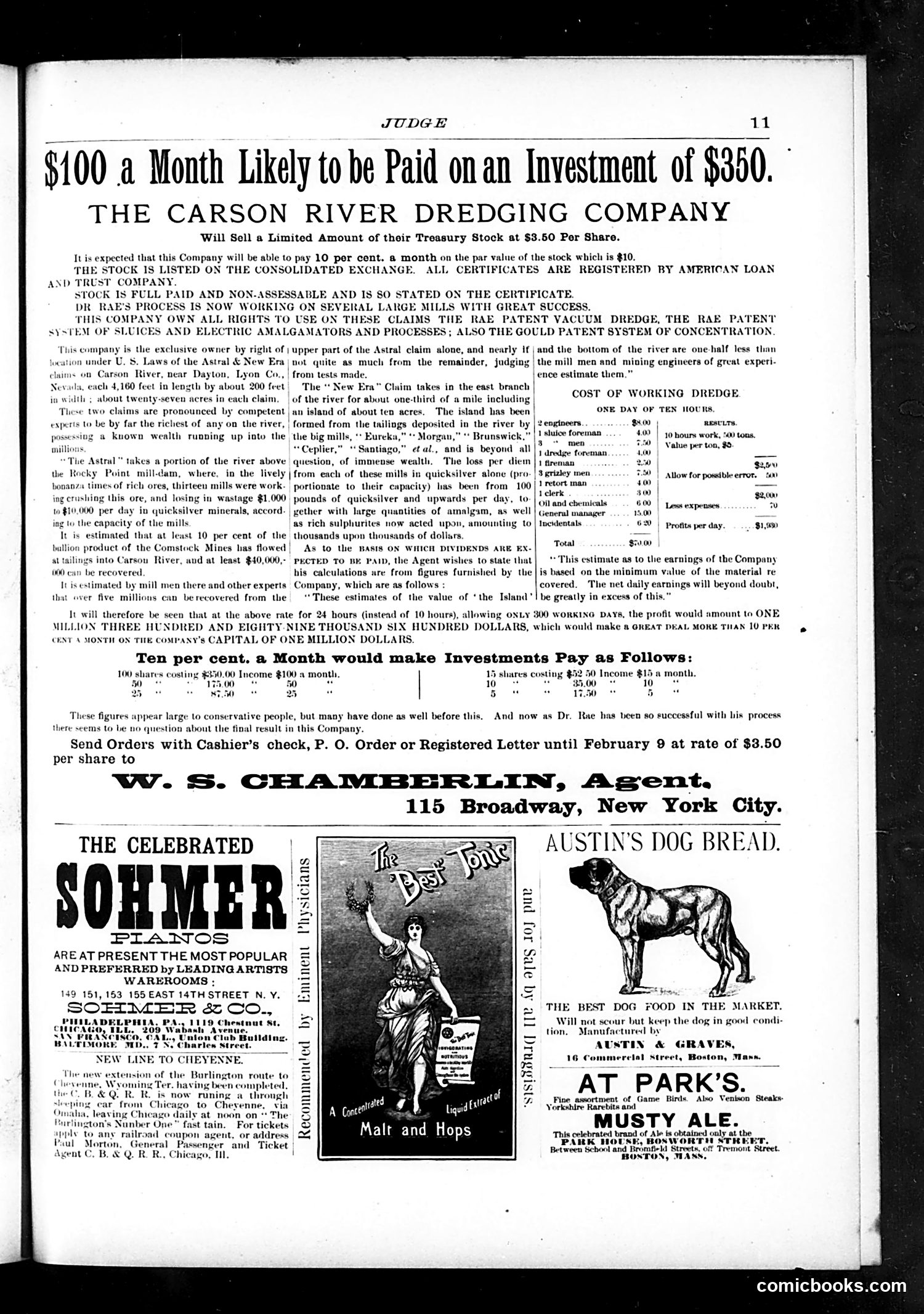
This page is primarily **financial advertising disguised as editorial content** — a common practice in 19th-century publications where paid promotions appeared alongside legitimate editorial matter. **The Main Pitch:** The Carson River Dredging Company is selling stock at $3.50 per share, promising 10% monthly returns ($100/month on a $350 investment). The elaborate text attempts to legitimize this claim by citing: - Exclusive mining claims near Dayton, Nevada - Historical gold/quicksilver recovery from previous mills - Detailed cost-benefit calculations showing $1,030 daily profits **The Satire/Red Flag:** Judge magazine's inclusion of this ad is itself the joke — the figures are transparently unrealistic. Claims of recovering millions from river tailings, paired with mathematical projections of "ONE MILLION THREE HUNDRED AND EIGHTY-NINE THOUSAND SIX HUNDRED DOLLARS" monthly profit, would have struck contemporary readers as obvious financial hucksterism. Judge was satirizing fraudulent investment schemes targeting gullible investors. **Historical Context:** This reflects the speculative mining booms and dubious stock schemes of the Gilded Age.
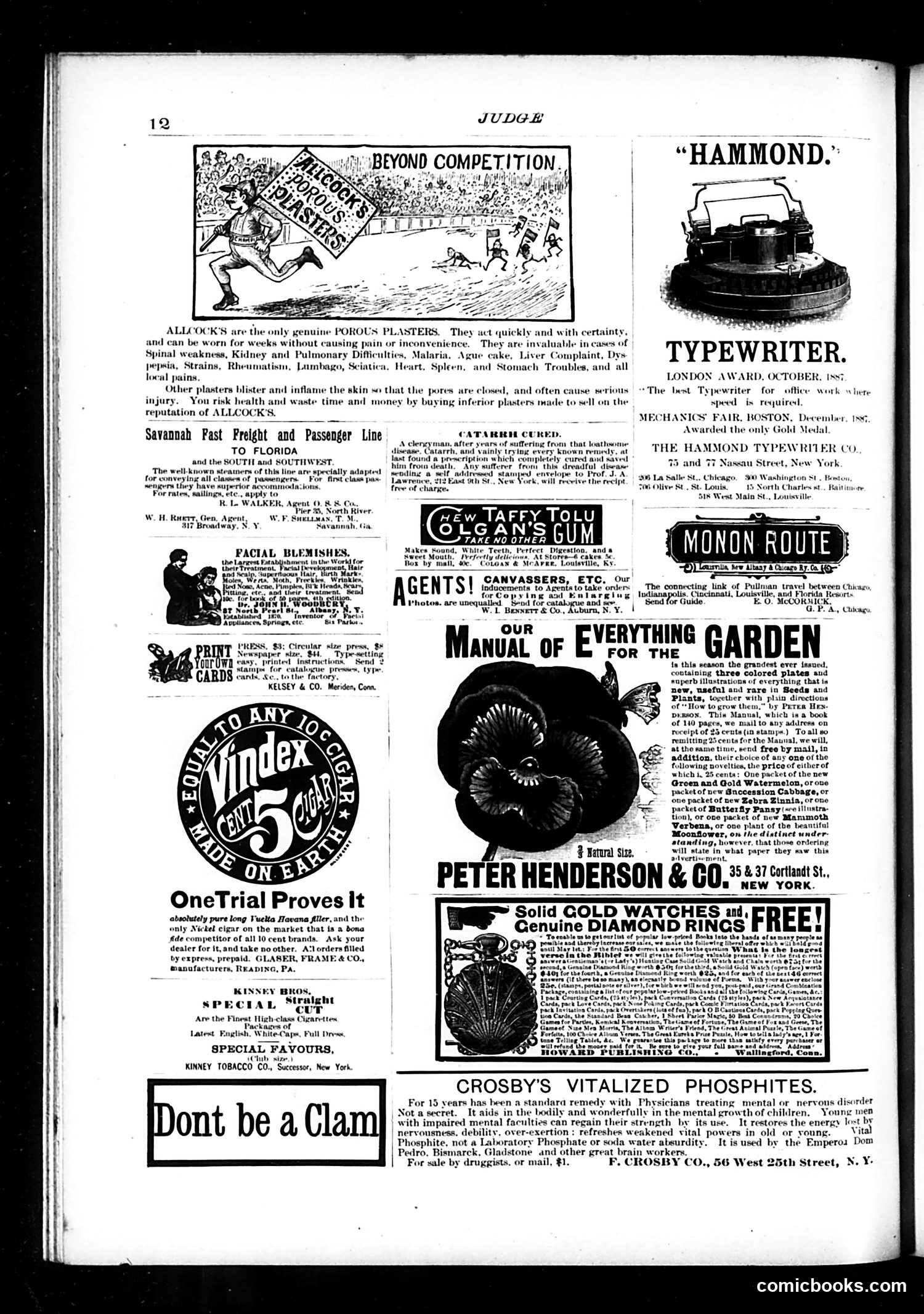
This page is predominantly **advertising** from a late 19th-century American satirical magazine. There is one small political cartoon at the top labeled "BEYOND COMPETITION," showing a figure running with a sign past competitors on a track—a metaphor for product superiority in the marketplace. The cartoon likely satirizes aggressive commercial competition and advertising claims, common concerns of the era. The bulk of the page features product advertisements typical of Judge's revenue model: patent medicines (Allcock's plasters for various ailments), typewriters, cigars, chewing gum, railroad lines, printing equipment, and garden seeds. One notable ad warns "Don't be a Clam"—likely encouraging readers not to be passive consumers. The ads reflect period medical quackery (catarrh cures, vitalized phosphites for mental disorders) alongside legitimate products. The page reflects Judge's dual nature: satirical commentary on American society alongside commercial exploitation of readers' anxieties about health and self-improvement.
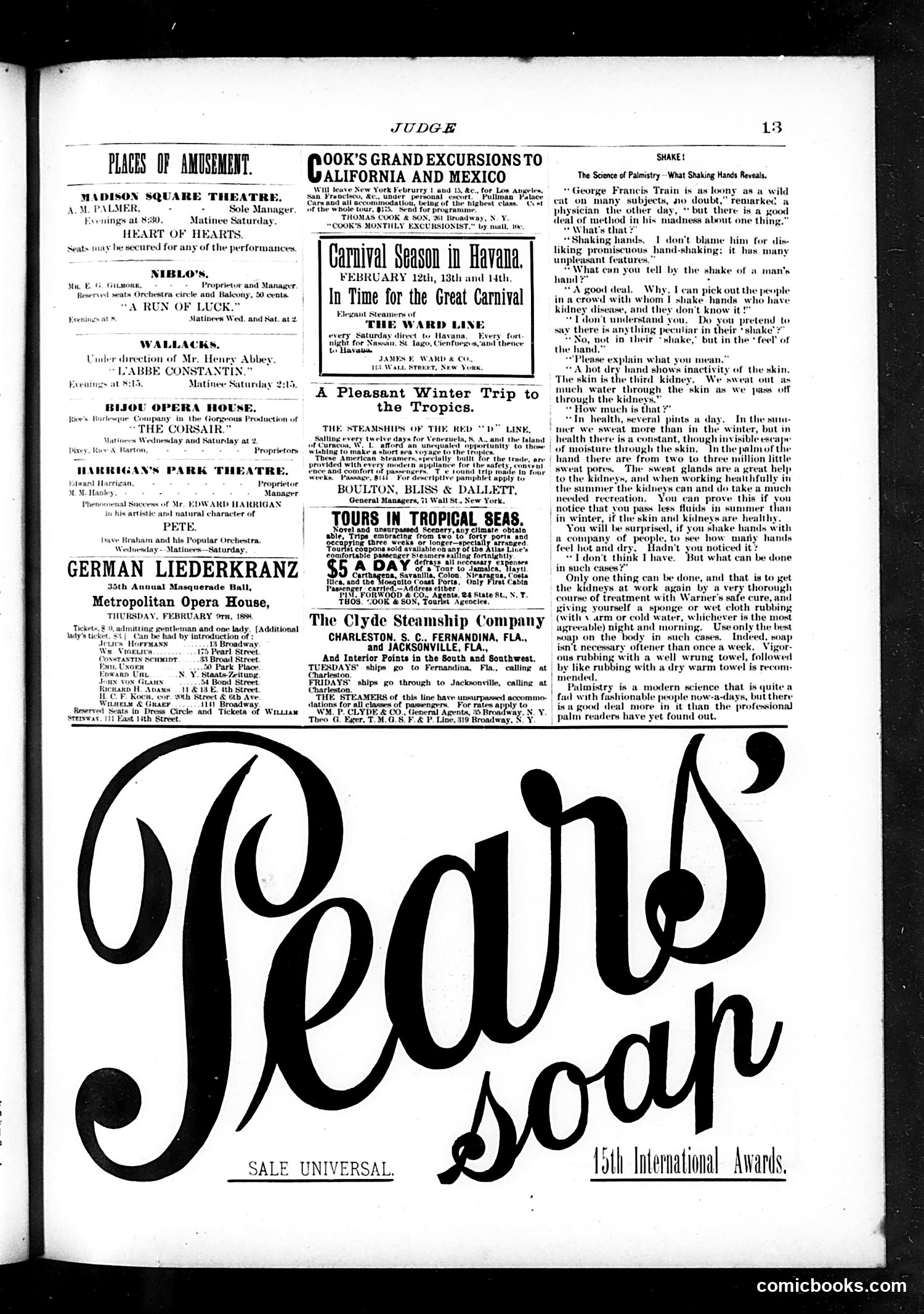
This page is primarily **advertising and entertainment listings** rather than satirical content. The dominant feature is a large decorative advertisement for "Pearls' Soap" (bottom half), promoting its "15th International Awards." The upper portion contains theater advertisements and travel promotions typical of Judge's era (circa 1890s), including: - New York theater productions (Madison Square Theatre, Wallack's) - Cook's Grand Excursions to California and Mexico - Steamship cruises to tropical locations and Havana The only substantive editorial content is a palmistry article titled "The Science of Palmistry—What Shaking Hands Reveals," which discusses health indicators through handshakes and skin moisture. This appears pseudo-scientific advice rather than satire. **No identifiable political cartoons or satirical commentary appears on this page.** It functions primarily as a commercial publication vehicle, which was standard for Judge magazine—advertising revenue funded the publication's satirical content published elsewhere.
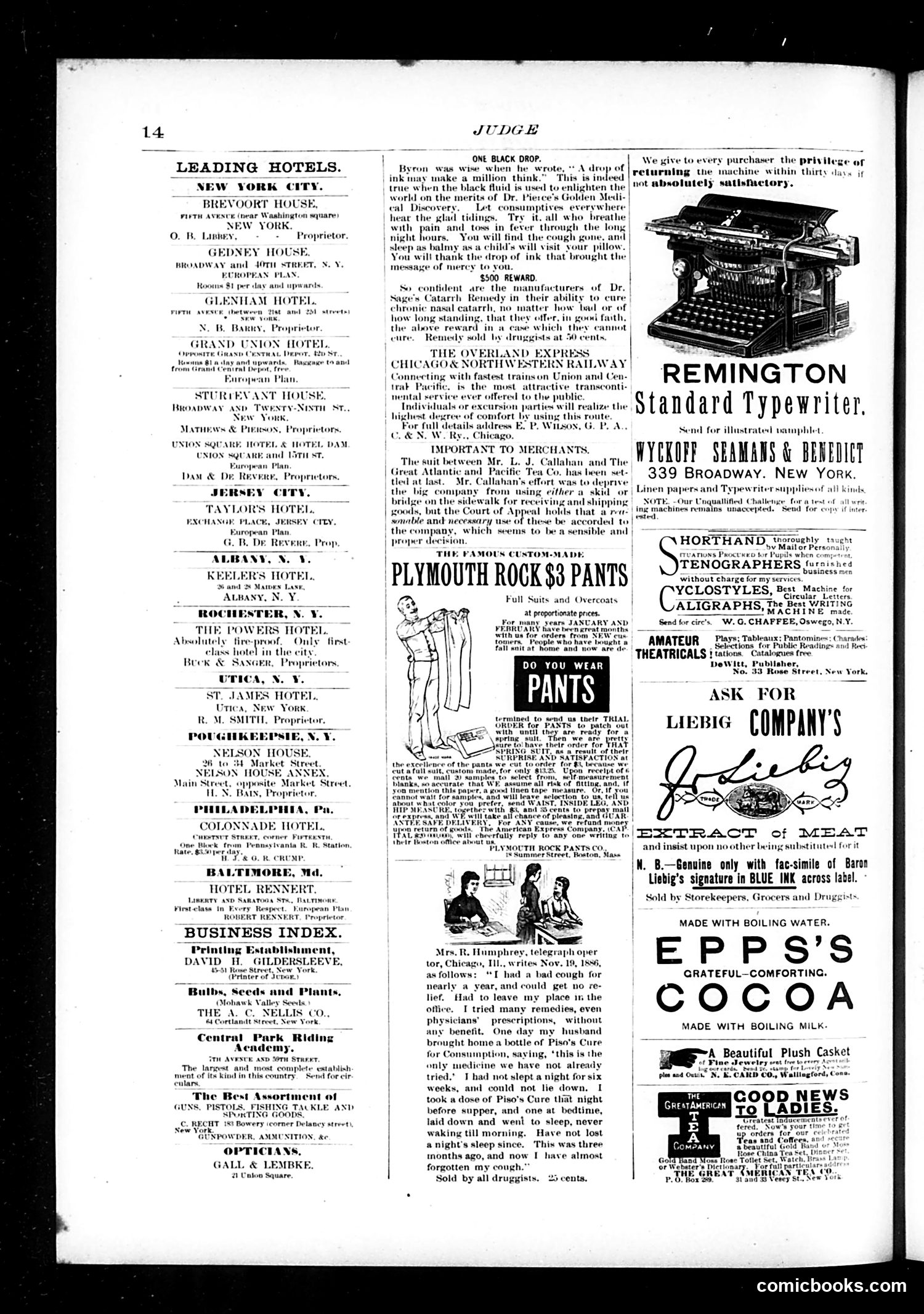
This page is primarily **advertising and business listings** with minimal editorial cartooning. The layout shows hotel directories for major cities, then shifts to product advertisements. The **advertisements** are period-typical pitches for: patent medicines (Piso's Cure for Consumption, One Black Drop cough remedy—both making miraculous health claims common in the 1880s-90s); Plymouth Rock custom-made $3 pants; the Remington Standard Typewriter; and Liebig's Extract of Meat (a concentrated beef product). There appear to be **small illustrations** accompanying ads—including figures modeling pants and what looks like domestic scenes—but these are product marketing rather than political satire. A small illustration shows people in an interior setting, likely accompanying the Piso's Cure testimonial. **No identifiable political cartoons or caricatures** are visible on this page. The "Judge" masthead and "One Black Drop" heading are present, but the page functions primarily as a **commercial advertisement section** rather than satirical editorial content.
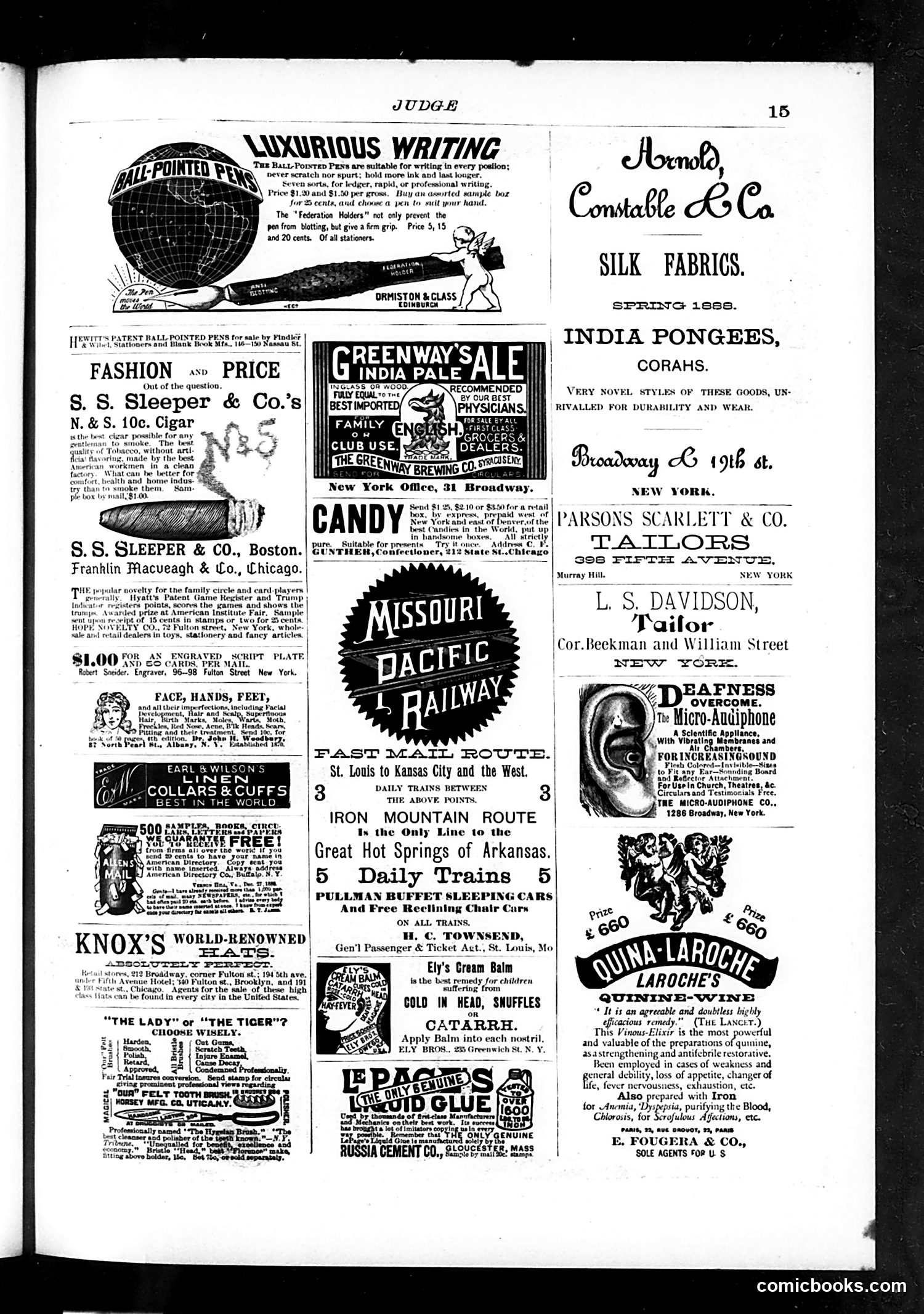
This page is **primarily advertising**, typical of late-19th-century magazines. The content includes product advertisements for writing instruments, cigars, railroads, collars, and patent medicines—with minimal satirical or political content. The most notable item is a reference to **"The Lady" or "The Tiger?"**—Frank Stockton's famous 1882 short story about choosing between two doors with unknown outcomes. This was a contemporary cultural sensation, and its appearance here shows how deeply it had penetrated American popular consciousness by 1886. The page reflects **Gilded Age consumer culture**: luxury goods (silk fabrics, tailored clothing), transportation (Missouri Pacific Railway), and especially **patent medicines** like Ely's Cream Balm and Quinine-Wine—products making dubious health claims that would later be regulated by the FDA. The advertisements target middle and upper-class readers with disposable income, which was Judge's typical audience.
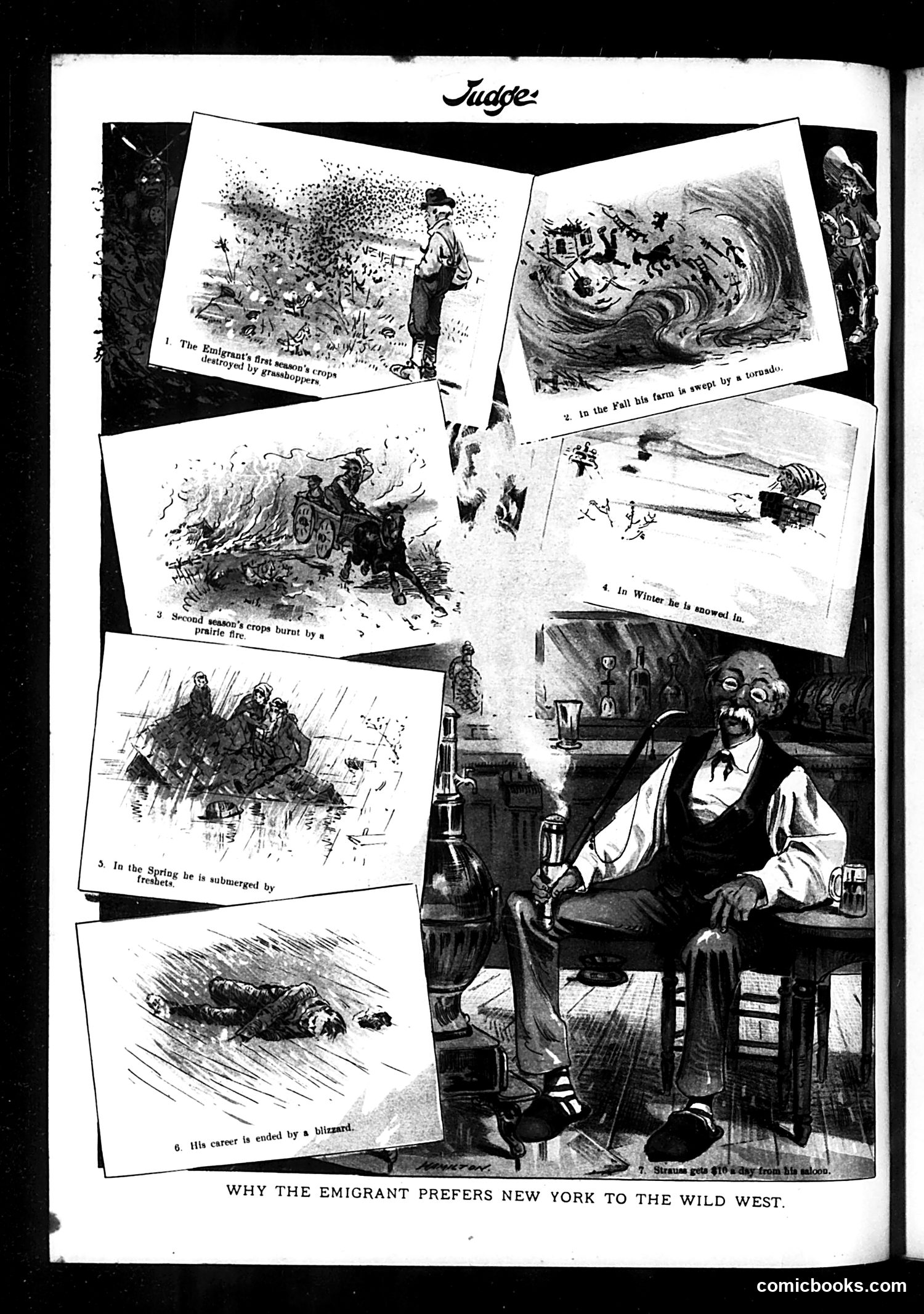
This Judge magazine page satirizes the "Wild West" as a destination for European emigrants, arguing they'd prefer New York instead. The comic presents six illustrated scenarios showing natural disasters befalling a frontier farmer: 1. Grasshoppers destroy crops 2. A tornado destroys his farm 3. Prairie fire burns his property 4. Winter brings severe snowstorms 5. Spring flooding submerges everything 6. A blizzard ends his career The final large panel shows a well-dressed man (the emigrant) safely indoors in an urban setting, appearing content and prosperous—implying civilization and comfort in New York contrast sharply with the relentless environmental catastrophes of frontier life. The satire mocks the romanticized notion of Western expansion while highlighting genuine agricultural hazards that made frontier farming precarious during this period.