
A complete issue · 19 pages · 1887
Judge — December 24, 1887
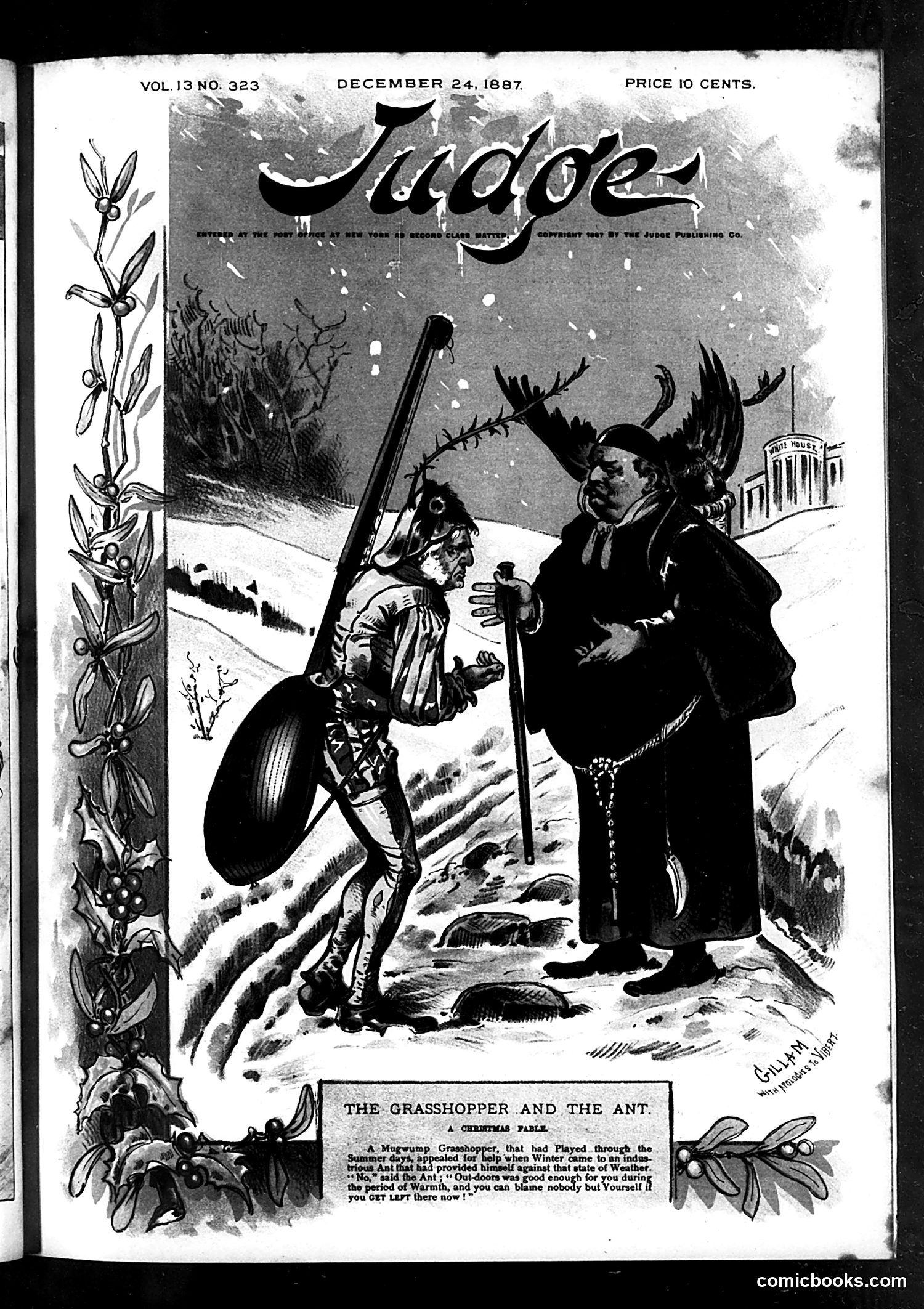
This is an illustrated adaptation of Aesop's classic fable, set in a winter landscape. The cartoon shows two anthropomorphic figures: a grasshopper (appearing as a soldier or vagrant in tattered clothing, carrying a rifle) and an ant (depicted as a wealthy, well-dressed gentleman with horns, suggesting devilish prosperity). The fable's moral—that the industrious ant prepared for winter while the grasshopper idled away summer—becomes a social commentary. The "horned" ant likely represents greed or capitalism rewarded, while the struggling grasshopper symbolizes the working poor or unemployed facing harsh conditions. This inverts traditional moral lessons, suggesting the satire critiques how the wealthy prosper while the destitute suffer, even during Christmas season.
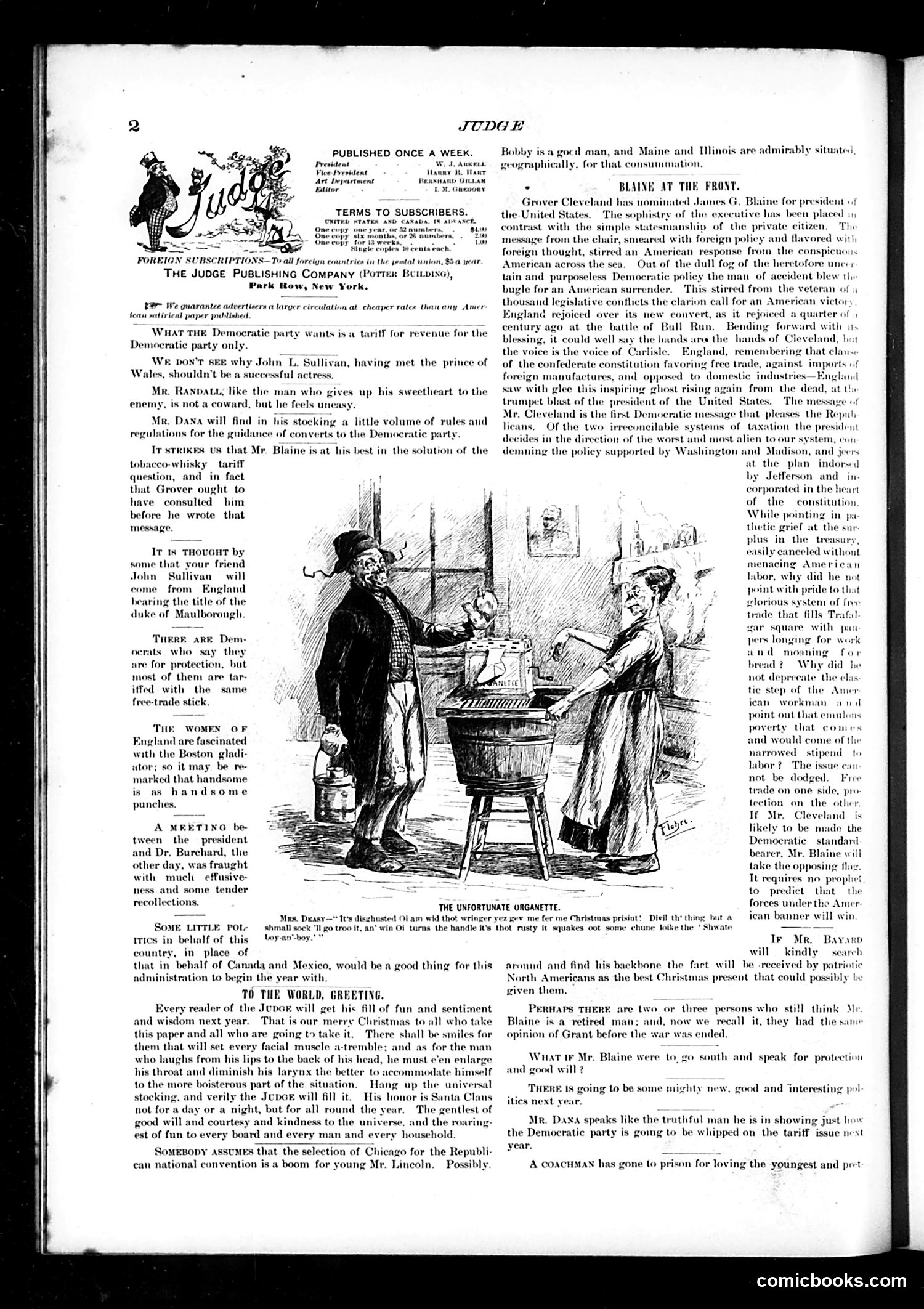
This cartoon satirizes Cleveland's tariff policy through domestic humor. The caption quotes "Miss Daisy" saying her Christmas present didn't turn out well—the handle's rusty and it squeaks, suggesting she should "Swear lay on." The visual pun compares making an omelette to Cleveland's economic policies: just as breaking eggs creates mess, his tariff decisions have messy consequences. The woman (likely representing "Miss Daisy" or the American public) and man appear to be Democratic supporters confronting the results of Cleveland's platform. The satire criticizes Democratic tariff policy as incompetent—promising protection for American workers but delivering poor results, much like a badly-made omelette. It's a common Victorian-era critique linking domestic mismanagement to political failure.
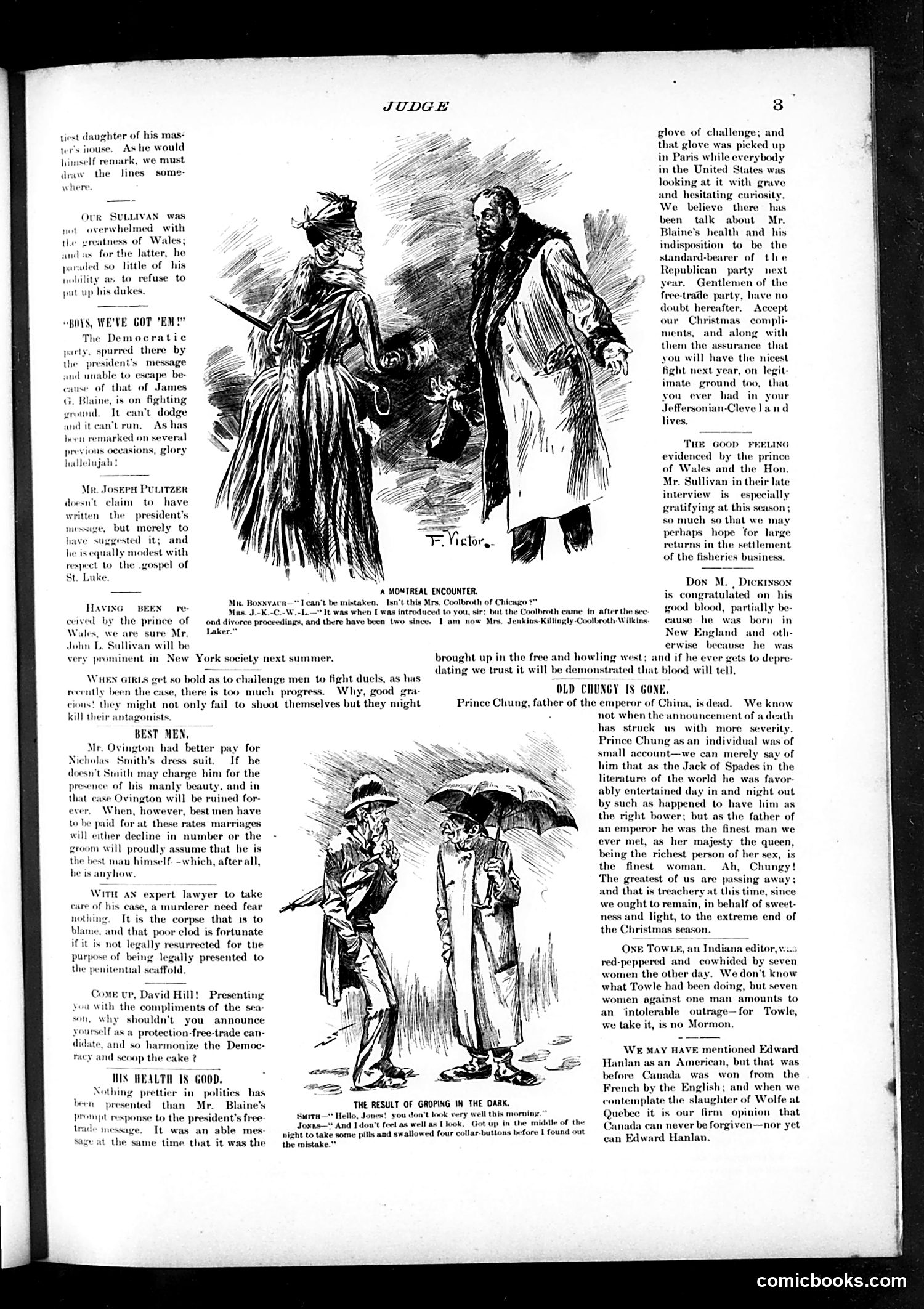
This page from the satirical magazine *Judge* contains multiple political commentaries, likely from the 1880s-90s era: **Main Cartoons:** The top illustration titled "A Montreal Encounter" depicts a social embarrassment involving Mrs. Coolbroth of Chicago and appears to reference an awkward meeting about a glove left in Paris—suggesting scandal or social impropriety among the elite. The lower cartoon, "The Result of Groping in the Dark," shows two figures in conversation, mocking someone's disheveled appearance despite claims of good health. **Political Content:** Articles reference James G. Blaine (likely a presidential candidate), Democratic party strategy, and the free-trade debate—indicating Republican/protectionist messaging. References to Sullivan suggest John L. Sullivan, the famous boxer, appearing in social commentary. **Tone:** The page combines gossip about high society scandals with partisan political jabs, using humor and caricature to mock political opponents and social pretenders. The content is typical of *Judge's* satirical approach to Gilded Age politics and society.
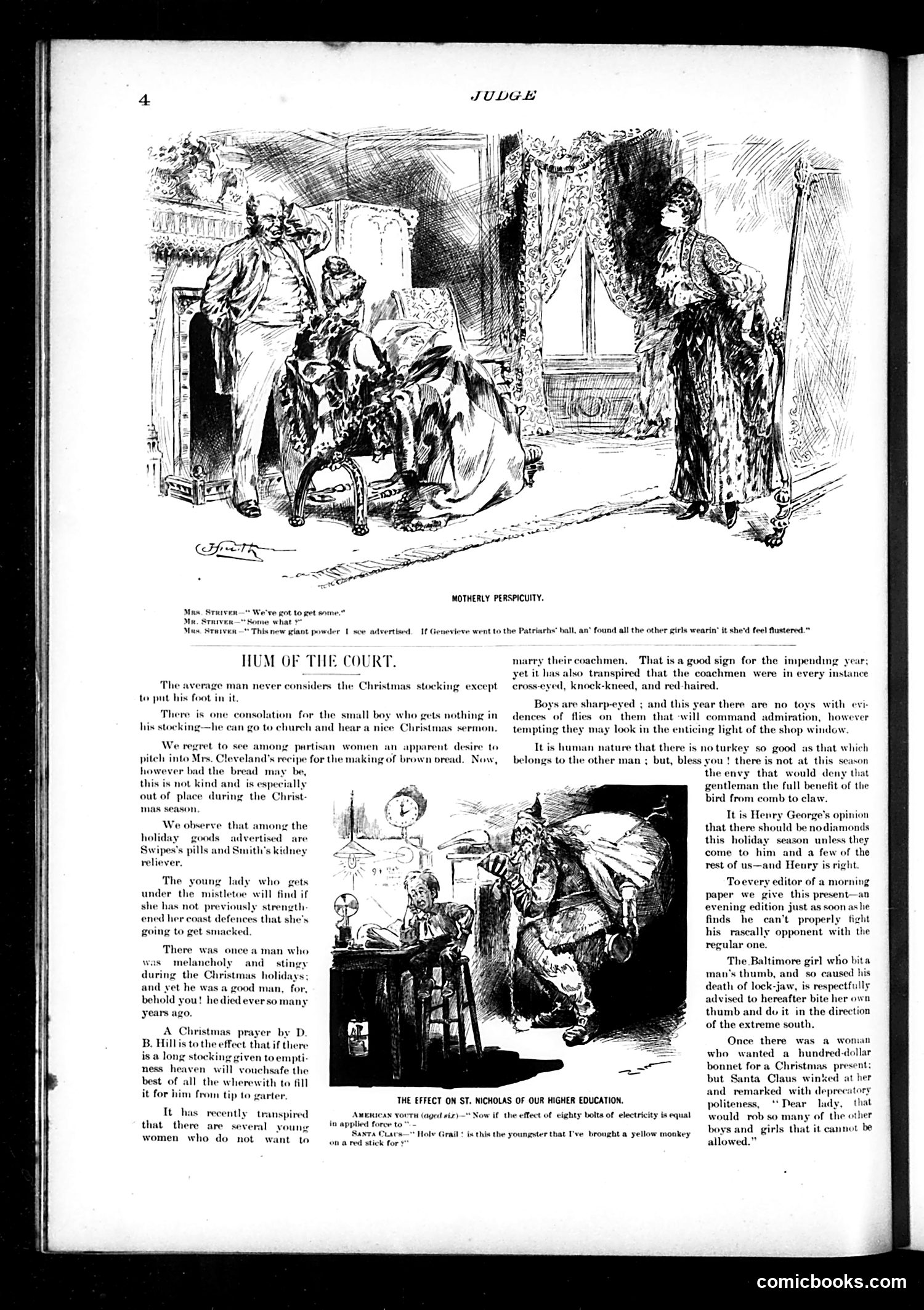
This page contains several short satirical pieces mocking American social customs and figures of the 1880s-90s era. **"Motherly Perspicuity"** (top cartoon) depicts a woman seeking "giant powder" (dynamite), likely referencing anarchist violence concerns of the period—the joke being mothers want explosives to manage Christmas preparations. **"Hum of the Court"** comprises multiple brief social observations: mocking partisan women attacking Mrs. Cleveland (wife of President Grover Cleveland), satirizing young women's dating strategies, criticizing stingy wealthy men, and joking about Christmas expectations. **"The Effect on St. Nicholas of Our Higher Education"** shows Santa confused by modern education, with a youth discussing electricity. The caption references a girl wanting expensive items (Patriarchs' ball dress), suggesting consumer culture and education were making youth materialistic. The pieces collectively mock: political partisanship, class pretension, consumer excess, and changing social values among the educated classes. The tone is cynical rather than deeply political.
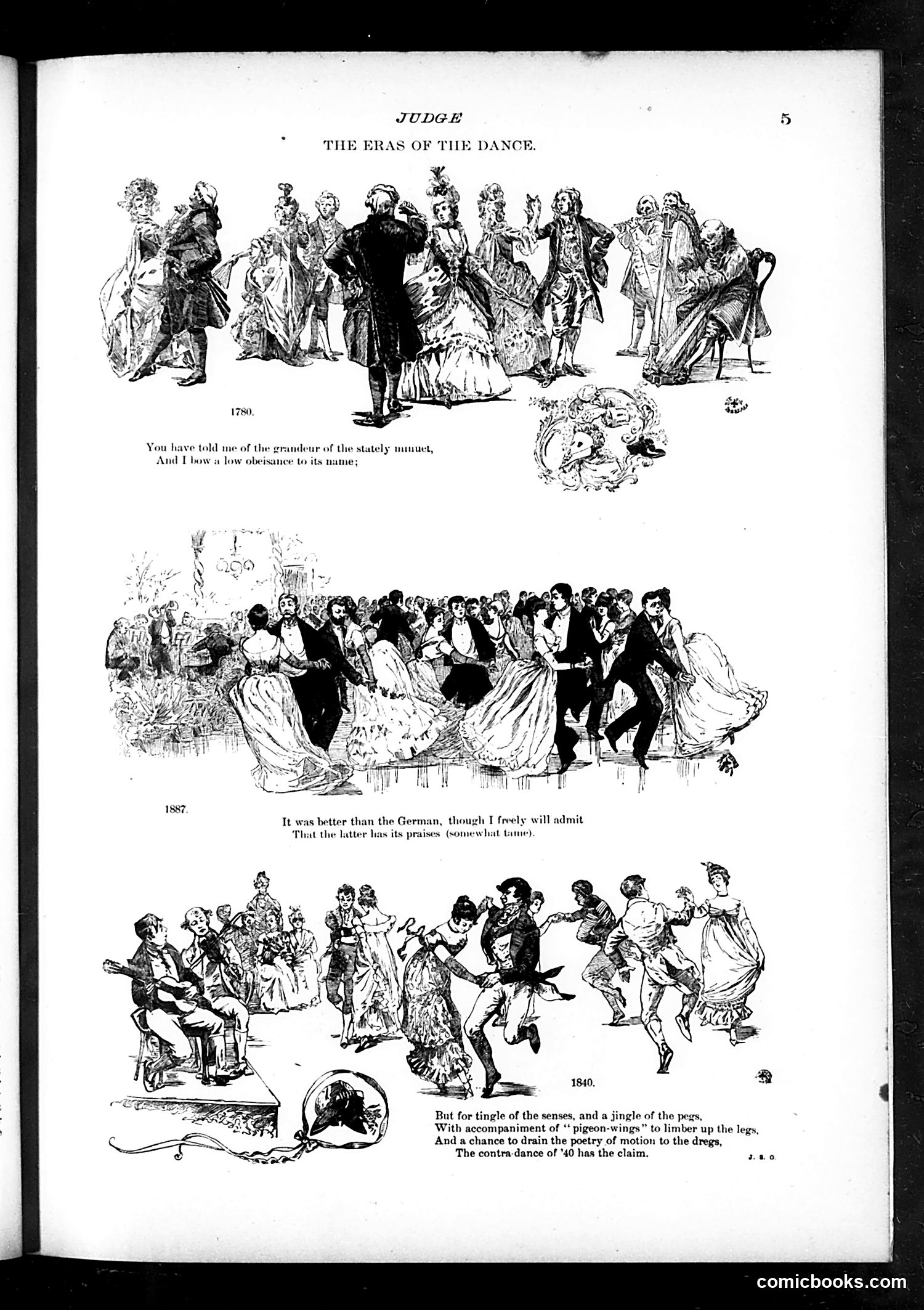
This satirical page from *Judge* contrasts dance styles across different historical periods. The three illustrations show: **1780** (top): Formal, restrained minuet with elegantly dressed nobility—representing aristocratic decorum. **1887** (middle): A crowded, energetic ballroom scene—contemporary to the magazine's publication, showing modern social dancing. **1840** (bottom): Lively contra-dancing with exuberant movements like "pigeon-wings." The accompanying verse humorously argues that while the minuet had grace and the German dance has merit, the 1840s contra-dance superior because it offers physical excitement and uninhibited "poetry of motion." The satire gently mocks Victorian sensibilities by suggesting that restraint and formality, though valued, pale compared to vigorous, unrefined enjoyment—a commentary on changing social attitudes toward physical expression and leisure.
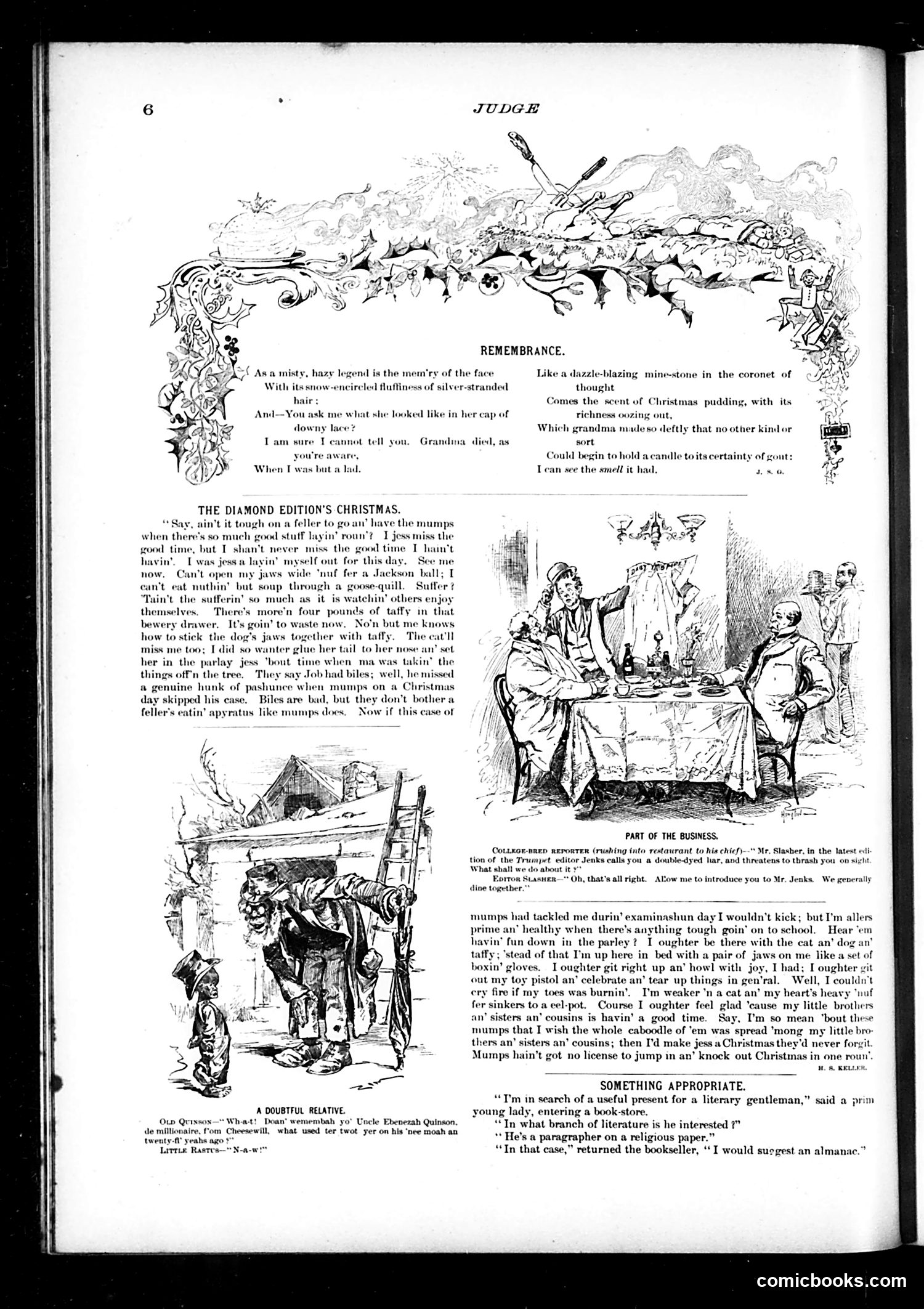
This page contains several humorous pieces typical of late-19th-century American satire: **"The Diamond Edition's Christmas"** depicts a boy with mumps bitterly complaining he's missing Christmas festivities—taffy, toys, and family fun—while bedridden. The satire mocks his self-pitying exaggeration about missed pleasures. **"Part of the Business"** shows a newspaper editor (likely representing *Judge's* satirical rival publications) unbothered by being publicly called a liar. His casual response—introducing the accuser to the critic for dinner—satirizes the rough-and-tumble, mutually antagonistic relationships between competing newspapers of the era, suggesting personal feuds were simply "business as usual." **"Something Appropriate"** is a brief joke: a bookstore clerk suggests an almanac as a gift for a religious newspaper writer, implying such writers lack creativity or originality—reducing them to mere fact-compilers rather than genuine authors. The decorative engravings and sentimental poem "Remembrance" provide period-typical filler.
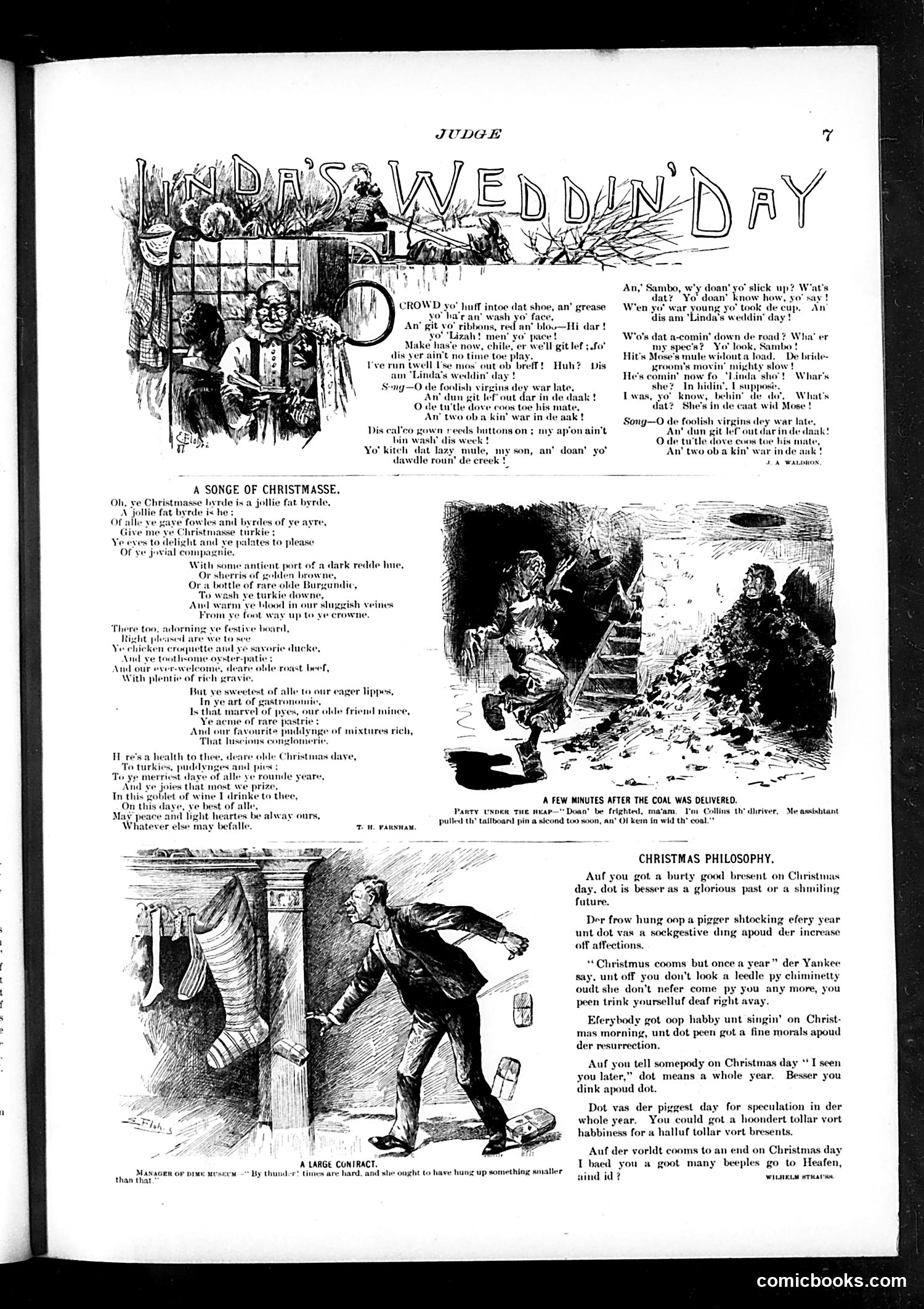
This page contains three distinct satirical pieces typical of 19th-century American humor: **"Lad's Wedding Day"** (top): A dialect comedy featuring African American characters discussing a wedding. The humor relies on exaggerated phonetic spelling and malapropisms—period conventions that reflect the racist stereotyping common to the era's "comic" representation of Black speech. **"A Song of Christmasse"** (left): A mock-archaic poem celebrating Christmas feasting with turkey, pudding, and wine. It's gentle satire mocking nostalgic idealization of "olde" traditions. **"Christmas Philosophy"** (right): Written in exaggerated German-accented English, this piece satirizes immigrant perspectives on American commercialism and materialism. The philosophy—that Christmas gifts matter more than sentimentality—critiques both consumerism and hypocritical piety. **"A Large Contract"** (bottom): A visual gag about a dime museum manager hiring a woman, presumably for a sideshow attraction. The page reflects *Judge*'s satirical targets: class pretension, immigrant "otherness," commercialism, and racial caricature—all standard for 1880s-90s American satire, though deeply offensive by modern standards.
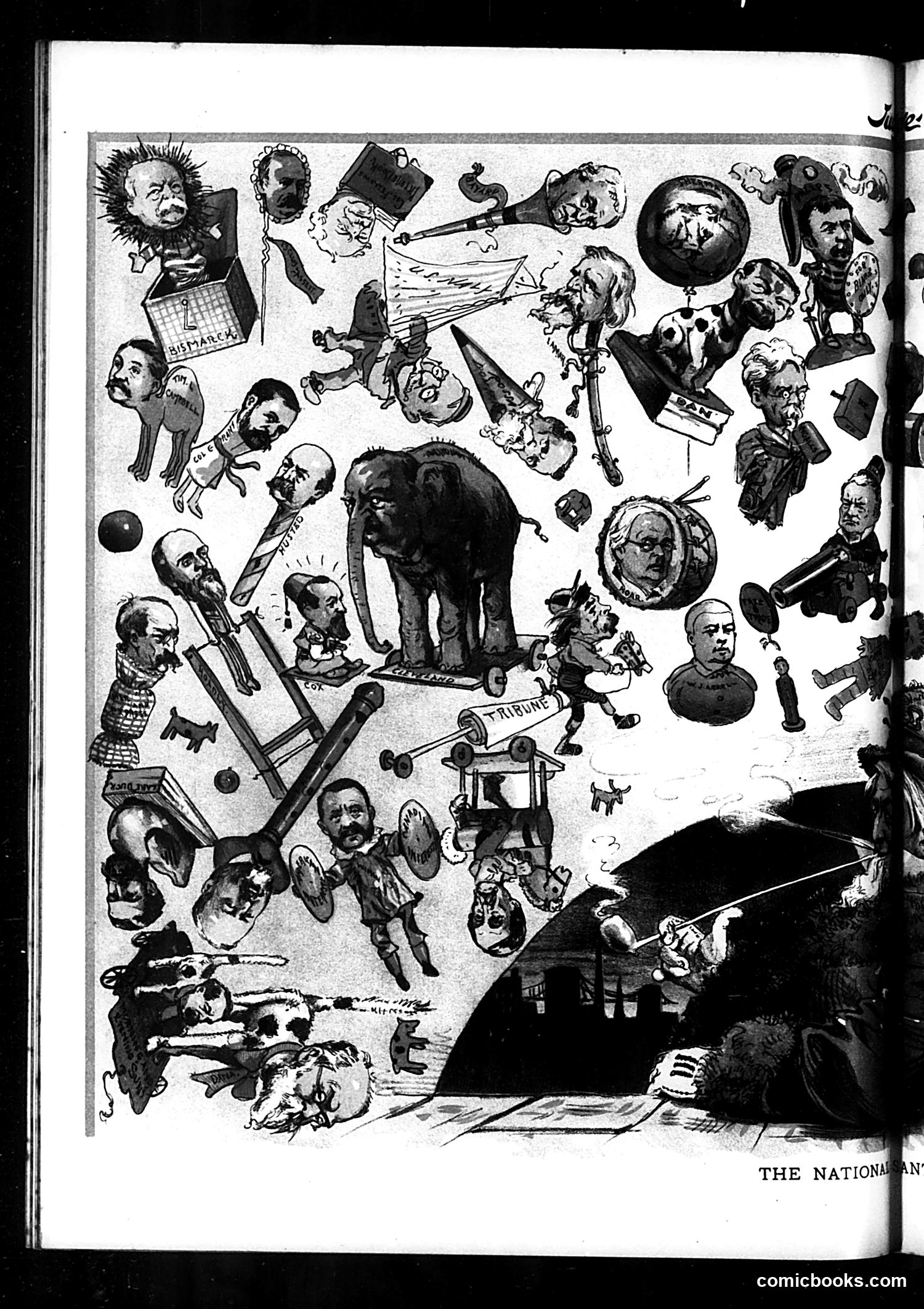
This appears to be a satirical illustration from *Judge* magazine depicting various political and public figures of its era in a chaotic, crowded composition. The central element is a large elephant (the Republican Party symbol), surrounded by numerous caricatured heads, bodies, and figures in various poses—some upside down, some in spheres, some holding objects or papers labeled "Tribune." The style suggests late 19th or early 20th-century American political satire, likely mocking Republican Party leadership, newspaper influence, or political corruption. The jumbled, surreal arrangement implies chaos, disorder, or absurdity within politics. However, without visible caption text or clearer identification of specific figures, I cannot definitively identify which particular politicians or events this targets or explain the exact satirical point intended.
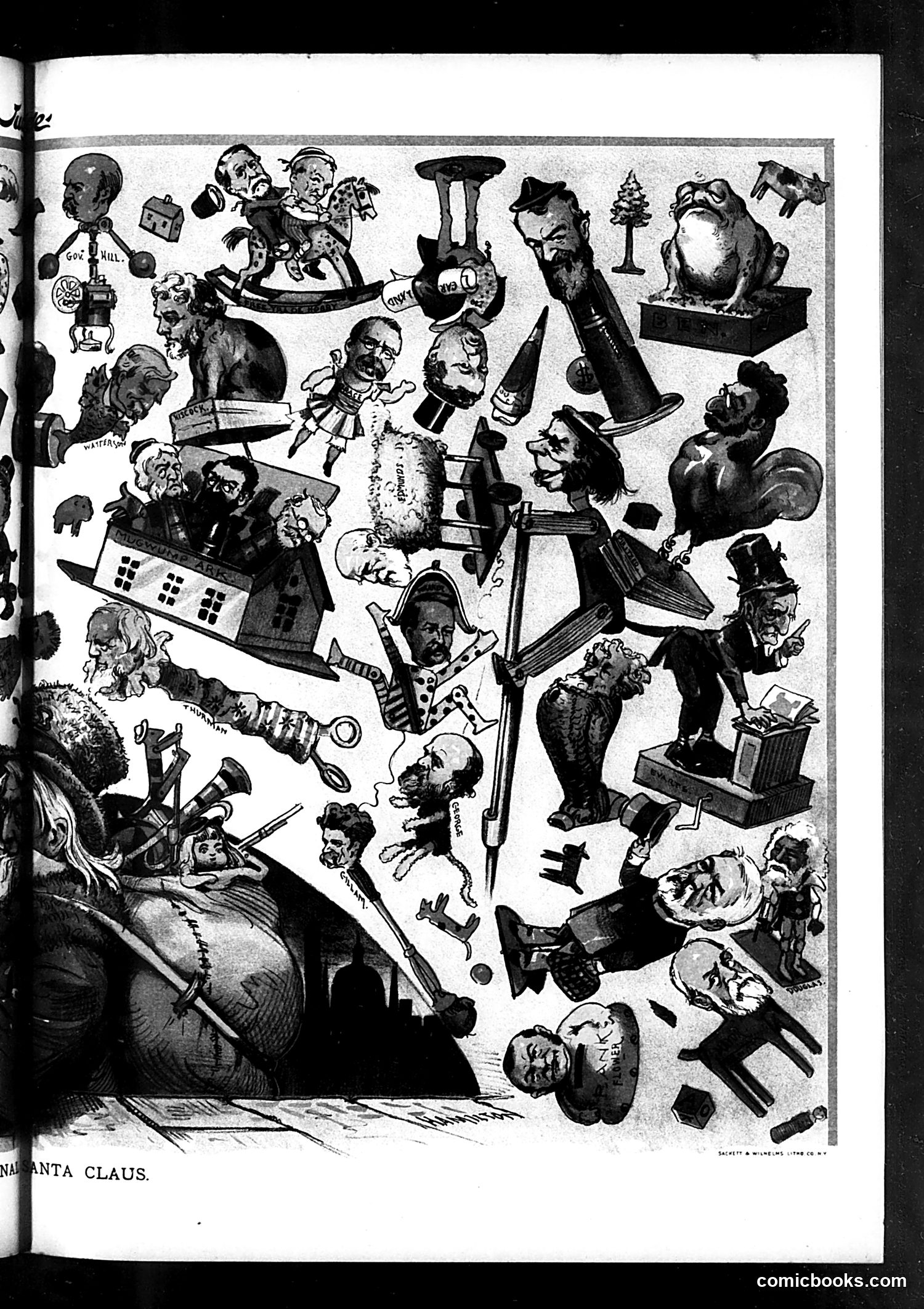
This is a satirical illustration depicting Santa Claus surrounded by various toys, dolls, mechanical devices, and caricatured figures. The cartoon appears to be political satire using Santa's workshop as a metaphor—the figures surrounding the central character seem to represent politicians or public figures of the era, rendered as grotesque caricatures and toys being "manufactured" or manipulated. The satire likely critiques how political figures are manufactured, controlled, or treated like puppets during a particular season or political moment. Santa's role as toy-maker serves as the vehicle for mocking the creation or manipulation of political personas. Without the specific date visible, the exact political context remains unclear, though the style suggests late 19th or early 20th century American politics.
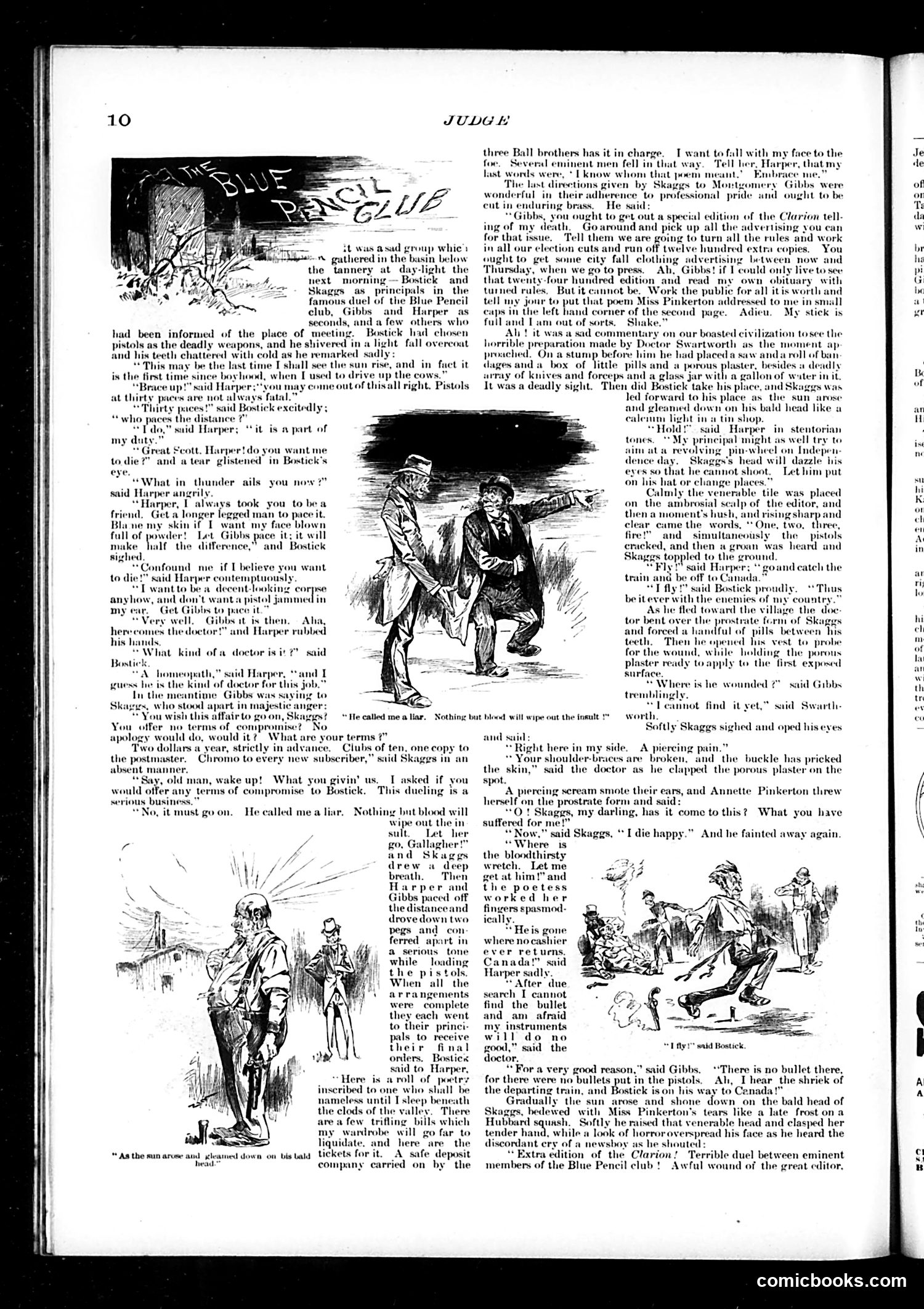
This is a satirical story about a ludicrous duel between members of the "Blue Pencil Club"—apparently a newspaper or publishing organization. The narrative mocks the pretensions of dueling culture by showing combatants obsessing over trivial concerns: one wants his corpse to look "decent," another insists the editor publish his obituary with specific formatting. The satire targets journalistic self-importance and the absurdity of honor-based violence. When shots are finally fired, the "wounded" Skaggs discovers his injury is merely a buckle scratch—anticlimactic and ridiculous. The illustrations show the formal duel preparations and aftermath. This lampoons both the dying tradition of dueling among "gentlemen" and the vanity of newspaper editors and writers who take themselves with excessive seriousness. The Blue Pencil (an editor's tool) becomes the weapon of choice for this pompous conflict.
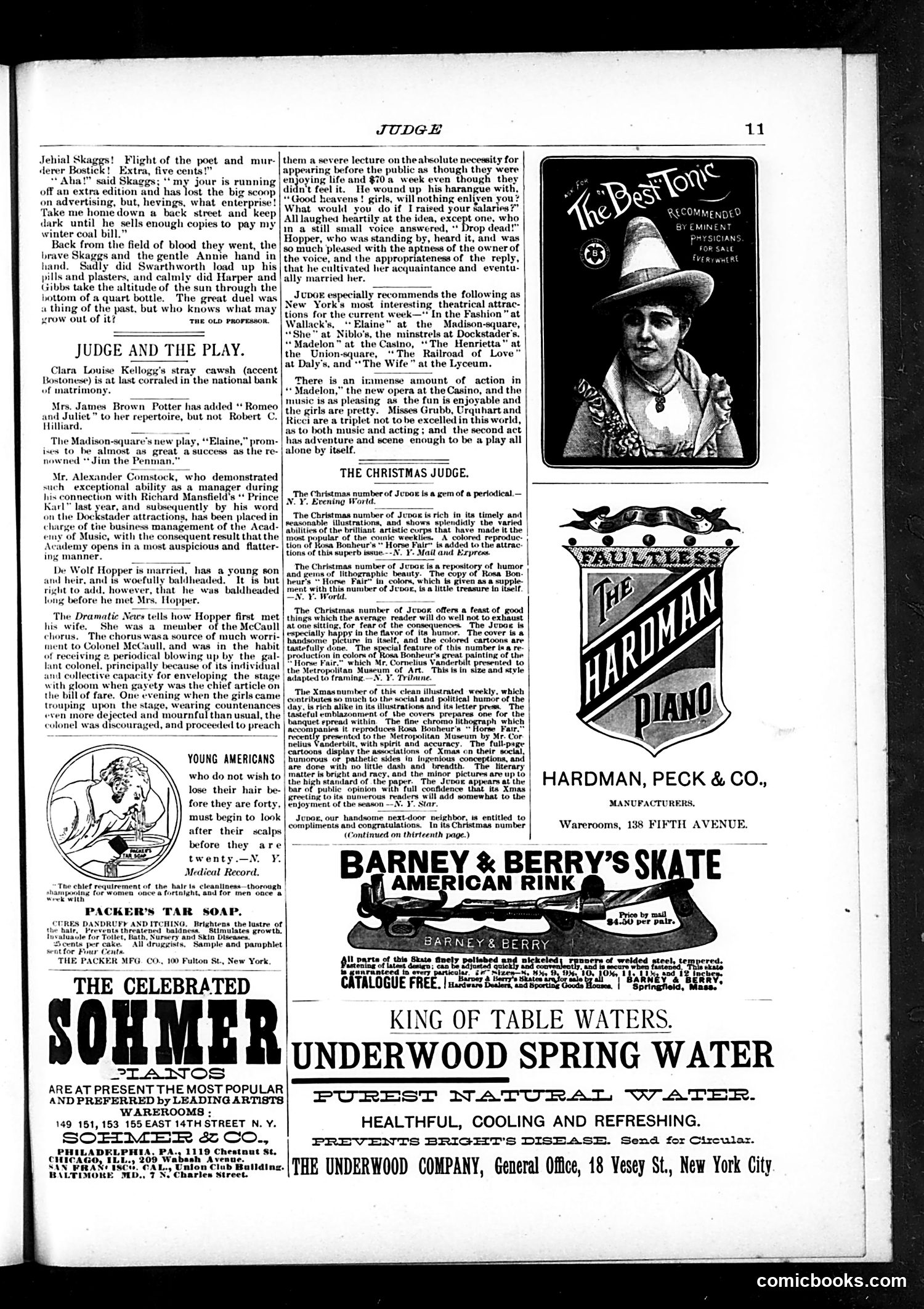
This page from *Judge* magazine consists primarily of **theater reviews and advertisements** rather than political cartoons. The main content discusses contemporary theatrical productions and performers. The "JUDGE AND THE PLAY" section reviews recent Broadway productions and gossip about actors like Clara Louise Kellogg, James Brown Potter, and DeWolf Hopper. One anecdote humorously recounts how Hopper met his wife—a chorus girl who responded to his lecture about maintaining cheerfulness with the quip "Drop dead!"—which so amused him that he married her. The top narrative excerpt appears to be a serialized story about characters named Skaggs and Bostick involving a duel. The remainder consists of **period advertisements** for pianos (Sohmer), soap, spring water, skates, and other consumer goods—typical of 19th-century magazine publishing. There is **no significant political satire** on this particular page.
This page is **primarily advertising** rather than editorial content or political cartoons. It contains various patent medicine and consumer product advertisements typical of late 19th-century American magazines. The ads reflect period attitudes about health and commerce: - **Brandreth's Pills** claims to cure multiple ailments by "purifying the blood"—typical snake-oil medicine marketing - **Pears' Soap** emphasizes racial beauty ideals ("fair white hands," "bright clear complexion")—reflecting era's troubling racial hierarchies - **Crosby's Vitalized Phosphites** promises mental/nervous disorder treatment with minimal evidence - Multiple fur and luxury goods ads target wealthy consumers The "Don't be a Clam" heading appears to be a slogan, though its specific context isn't clear from this excerpt. No political satire or recognizable caricatures are visible. This reflects *Judge's* dual function as satirical magazine and advertising vehicle—the ads helped fund editorial content.
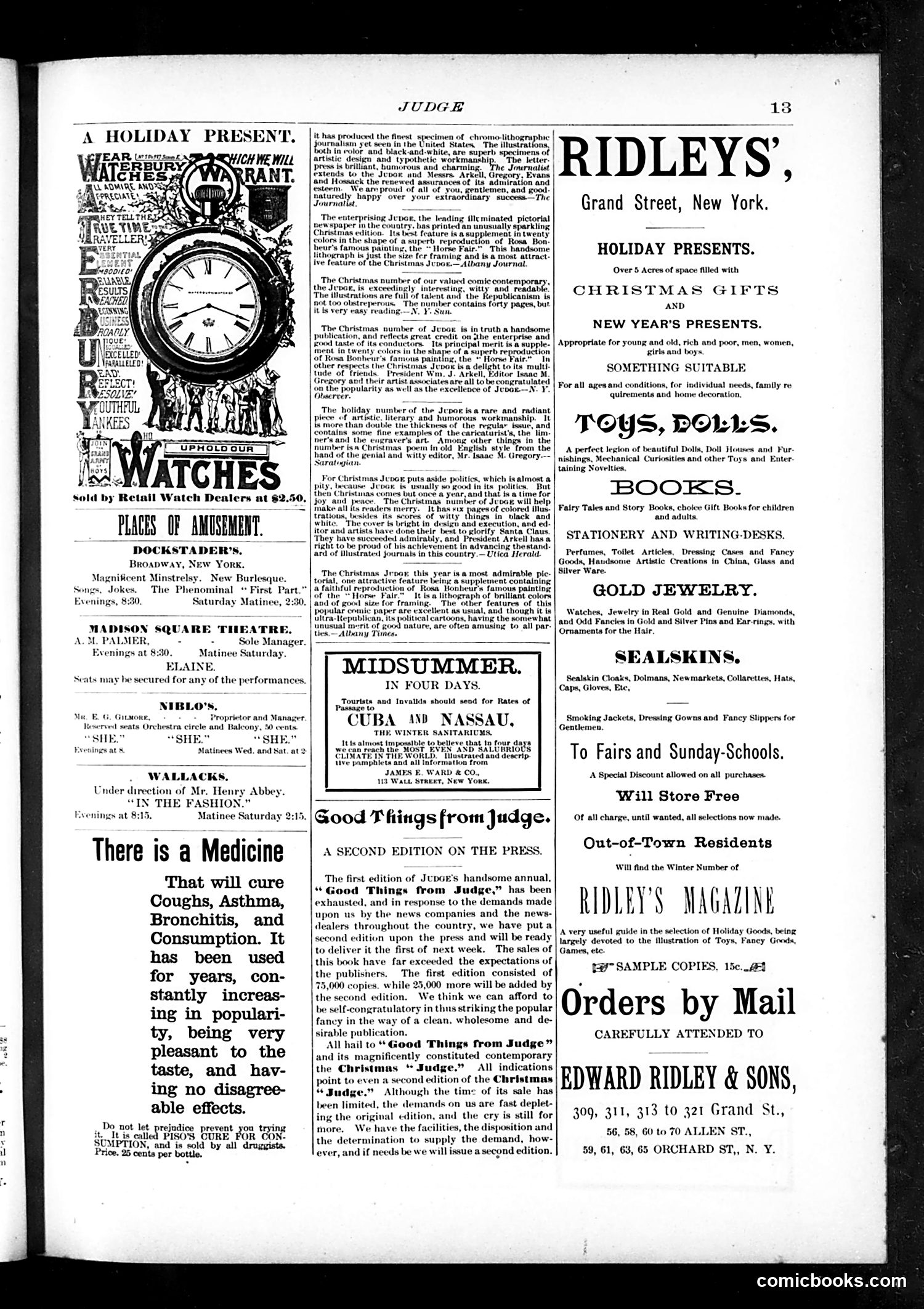
This is primarily an **advertising and announcements page** rather than a satirical cartoon page. The main content includes: **Left side:** An ornate clock advertisement for Ridley watches, framed by decorative text about timekeeping. **Center/Right:** Advertisements for theaters (Dockstader's minstrelsy, Niblo's, Wallack's), patent medicine for consumption, and cruise offerings to Cuba and Nassau. **Notable section:** The page reprints editorial praise for Judge's own Christmas annual, "Good Things from Judge." The text indicates the first edition (75,000 copies) sold out, necessitating a 25,000-copy second printing—celebrating the publication's commercial success. **Top right:** Ridley's department store advertisement listing holiday gift categories: toys, dolls, books, stationery, jewelry, and sealskins. The page reflects late 19th-century consumer culture and Judge's role as both satirical publication and commercial marketplace for advertisers seeking affluent readers.
This page is primarily **advertising and promotional content**, not political satire. It consists mainly of hotel listings and business advertisements from New York and other Eastern cities. The only substantial editorial content is a **poem titled "Reveille"** by Robert J. Burdette, depicting soldiers waking to a bugle call in military camp. The repetitive refrain "I can't get 'em up" humorously captures the difficulty of rousing sleepy soldiers at dawn—a universal military experience. The poem celebrates soldiers' eventual awakening and willingness to march into battle. Below the poem is a brief commentary mocking the cliché of embroidered slippers as Christmas gifts. The page concludes with promotional material for **"The Christmas Judge,"** a special 40-page holiday edition with colored cartoons and an oil-painted supplement, priced at 25 cents. There are no identifiable political figures or specific contemporary references requiring historical context.
This page is primarily **advertising**, not political satire. It's from Judge, a satirical magazine, but this particular page (page 15) consists almost entirely of commercial advertisements from the early 1900s. The advertisements include: - Writing instruments (Ball-Pointed Pens) - Railroad services (Missouri Pacific, Iron Mountain Route to Arkansas Hot Springs) - Shoes (W.L. Douglas $3 Shoe, Knox brand) - Patent medicines (Dr. Baird's Granules for catarrh, Ely's Cream Balm) - Luxury goods (handkerchiefs from Arnold Constable & Co.) - Fine dining/wine products (Quinine-Wine) - Dental products (Felt Tooth Brush) The only non-advertisement content is a brief humor piece titled "What Florida People Live On," which appears to be a joke about Florida residents' diets and remedies. This is a typical magazine layout of the era, where advertising revenue subsidized editorial content.
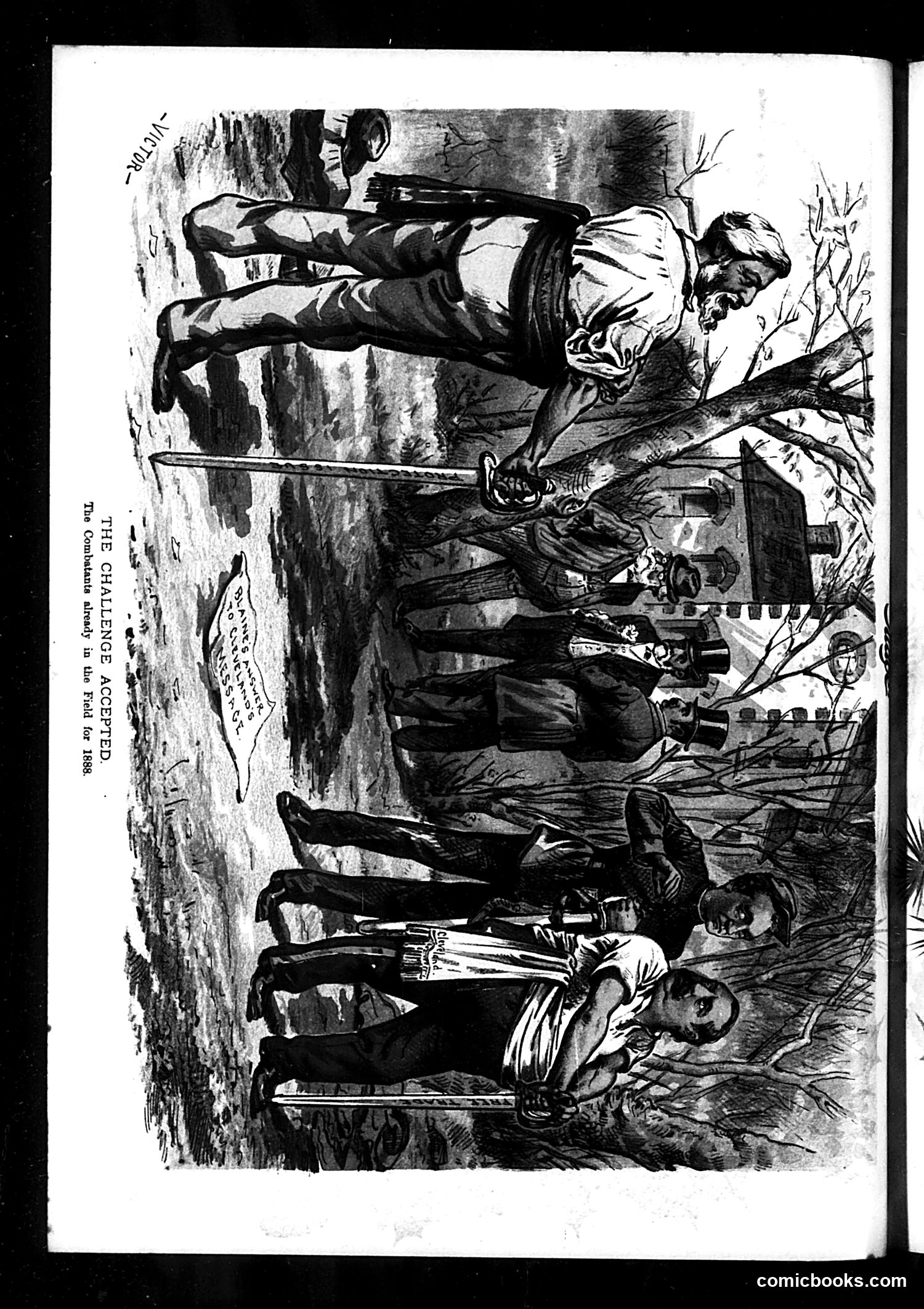
This editorial cartoon depicts the 1888 U.S. presidential race as a literal duel or combat. Multiple political figures are shown in fighting stances with weapons (swords/rifles), representing candidates and contenders "in the field" for the presidency that year. The satire compares electoral competition to violent combat—a common 19th-century metaphor. Without clearer facial details or labels identifying specific candidates, I cannot definitively name each figure. However, the cartoon's point is clear: it ridicules the aggressive, combative nature of presidential politics, suggesting candidates were literally at war with one another for the office. The dramatic, chaotic composition emphasizes the brutal intensity of campaign competition during this period.
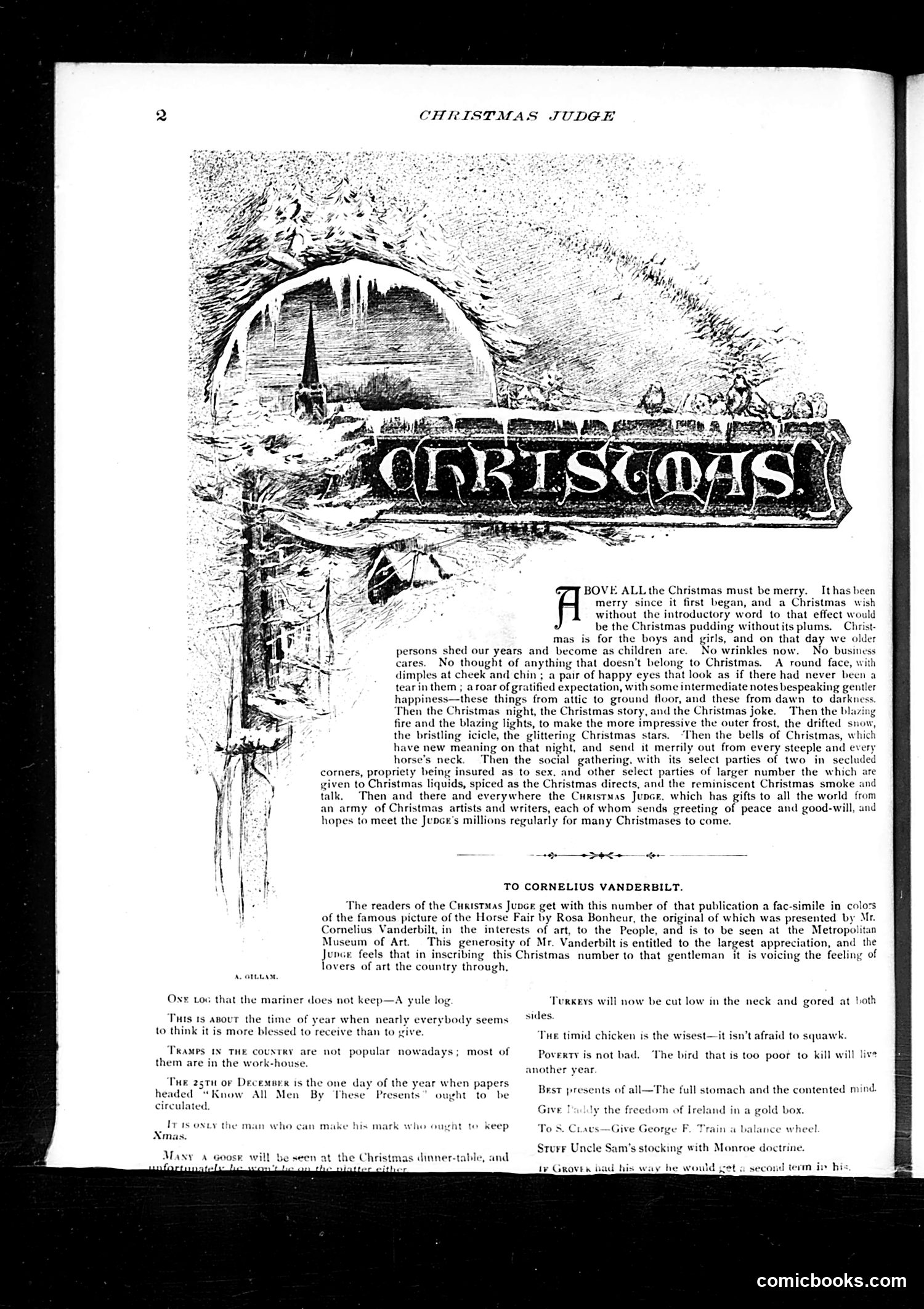
This is primarily a **Christmas editorial** rather than a political cartoon, celebrating the holiday's virtues and announcing a special gift to readers. **Main Content:** The opening essay romanticizes Christmas as a time when adults become childlike, free from business cares and wrinkles. It emphasizes family gatherings, "Christmas liquids" (alcohol), church bells, and social merriment. **Notable Elements:** - A dedication to **Cornelius Vanderbilt**, the wealthy industrialist, thanking him for donating a facsimile (in color) of Rosa Bonheur's famous painting "Horse Fair" to the Metropolitan Museum—framed as benefiting "the People" and art lovers nationally - Brief satirical quips at bottom mock tramping, legal documents, illiteracy, turkeys, and poverty - References to "George F. Train" (a eccentric 19th-century activist) and "Monroe Doctrine" suggest contemporary political jabs **The Satire:** The page celebrates Christmas sentimentality while the scattered jokes undercut it—poking fun at class divisions, charitable pretense, and political figures. The Vanderbilt tribute appears somewhat tongue-in-cheek given Judge's typical irreverence.
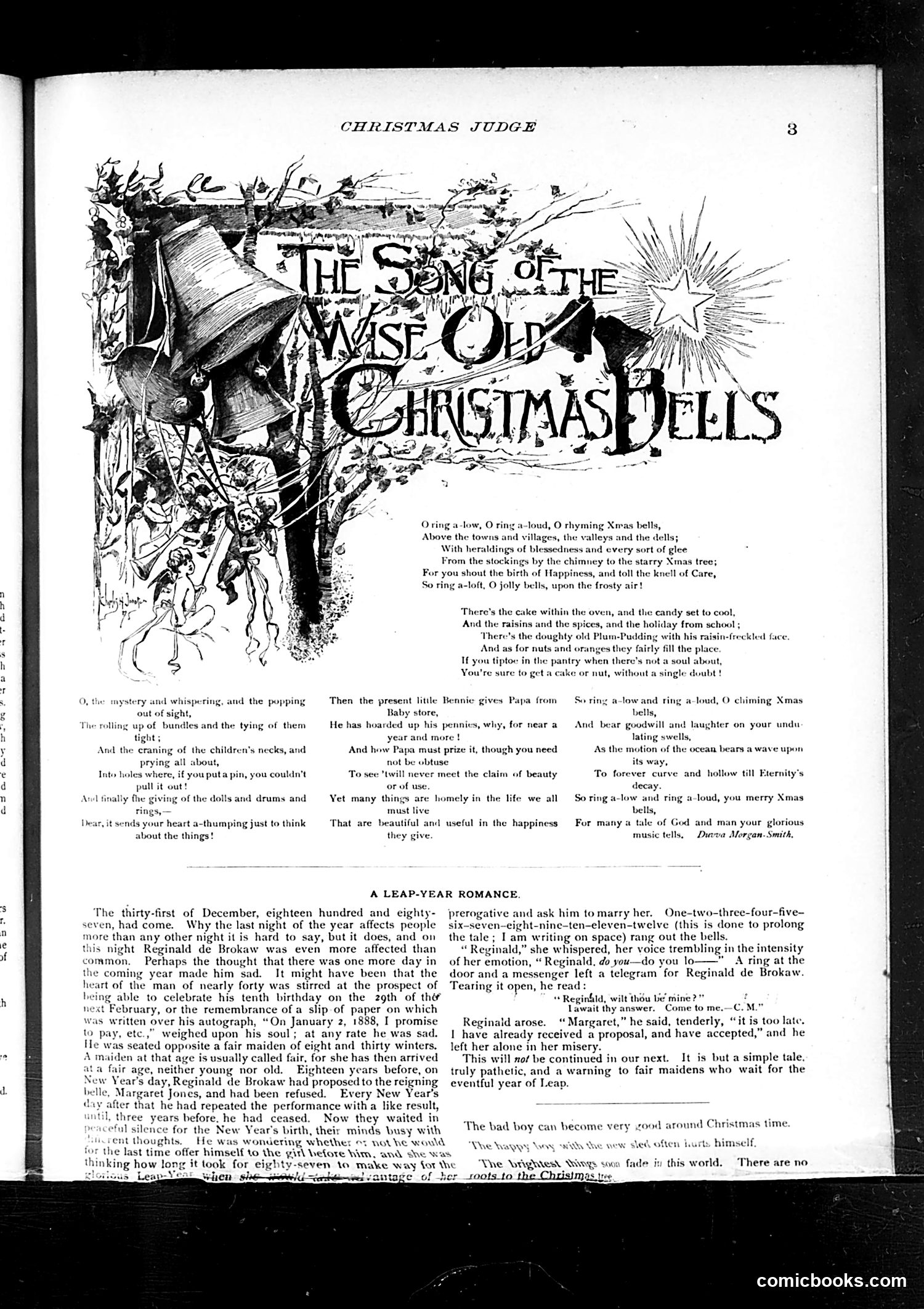
This page contains **two separate pieces** from Judge magazine: 1. **"The Song of the Wise Old Christmas Bells"** (top): A sentimental Christmas poem celebrating the holiday's joy—gift-giving, family gatherings, festive food—with illustrations of bells and holiday imagery. It's sincere holiday verse, not satirical. 2. **"A Leap-Year Romance"** (bottom): A brief comedic story mocking romantic conventions. A man named Reginald de Brokaw, nearly forty, has repeatedly proposed to women and been rejected. On New Year's Eve 1887, a woman finally proposes to *him* (using the leap-year tradition allowing women to propose), and he receives a telegram response. The humor lies in the reversal of gender roles and the absurdity of his persistent failures—the story ends with "This will *not* be continued," sarcastically promising no resolution, undercutting sentimental romance narratives popular in the era. The contrasting tones—earnest Christmas sentiment above, romantic satire below—were typical Judge magazine variety.