
A complete issue · 16 pages · 1887
Judge — December 10, 1887
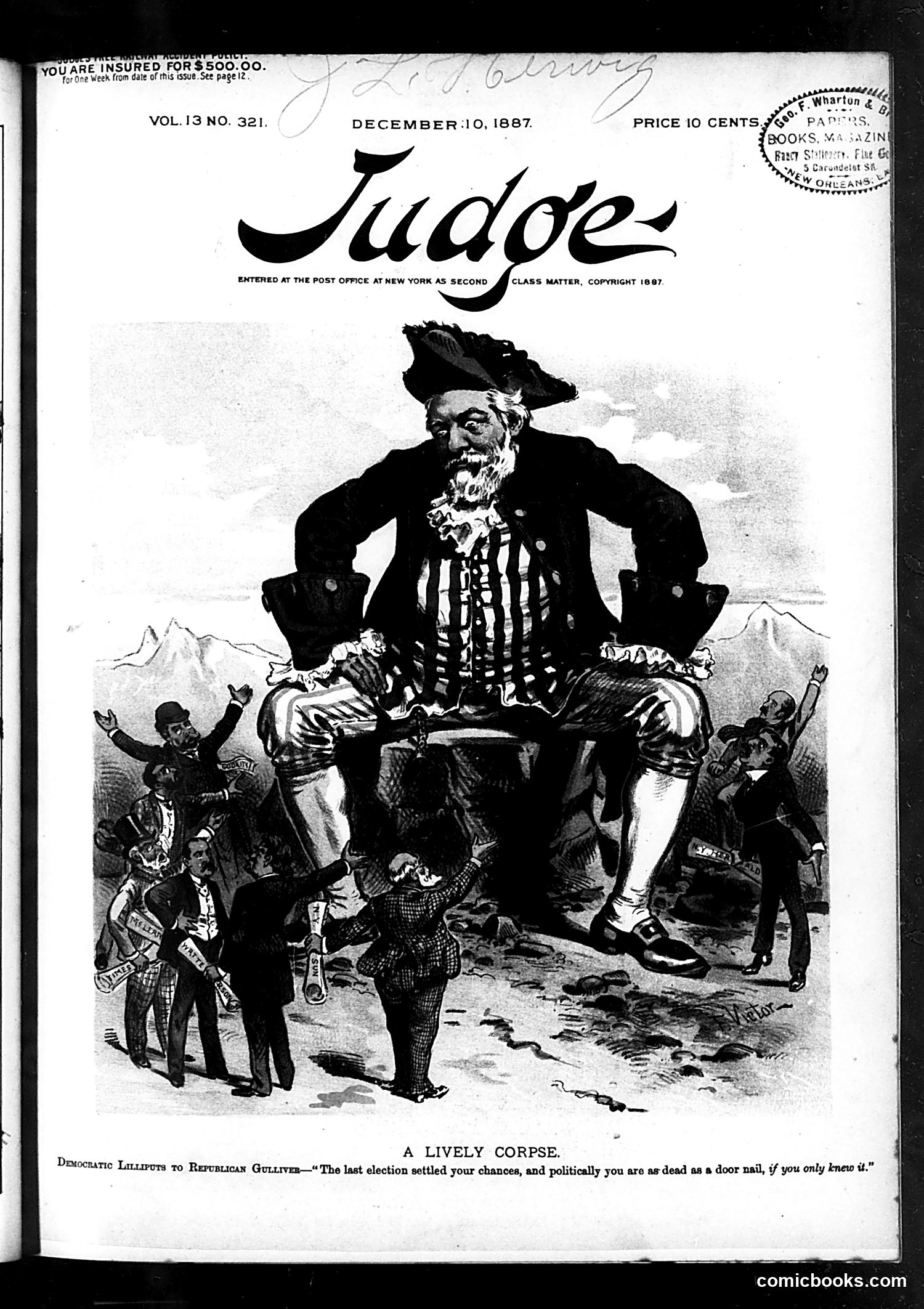
This political cartoon satirizes the Democratic Party following an election loss to Republicans. The caption subtitle reads: "The last election settled your chances, and politically you are as dead as a door nail, if you only knew it." The large central figure represents the Democratic Party depicted as a corpse or skeleton in 18th-century dress, surrounded by smaller Republican figures who appear gleeful or mocking. The imagery suggests Democrats are politically deceased yet refuse to acknowledge their demise. The cartoon reflects post-election Republican triumphalism and mocks Democratic denial about their electoral defeat. The "lively corpse" metaphor emphasizes the perceived contradiction between Democrats' actual political weakness and their continued activity and resistance.
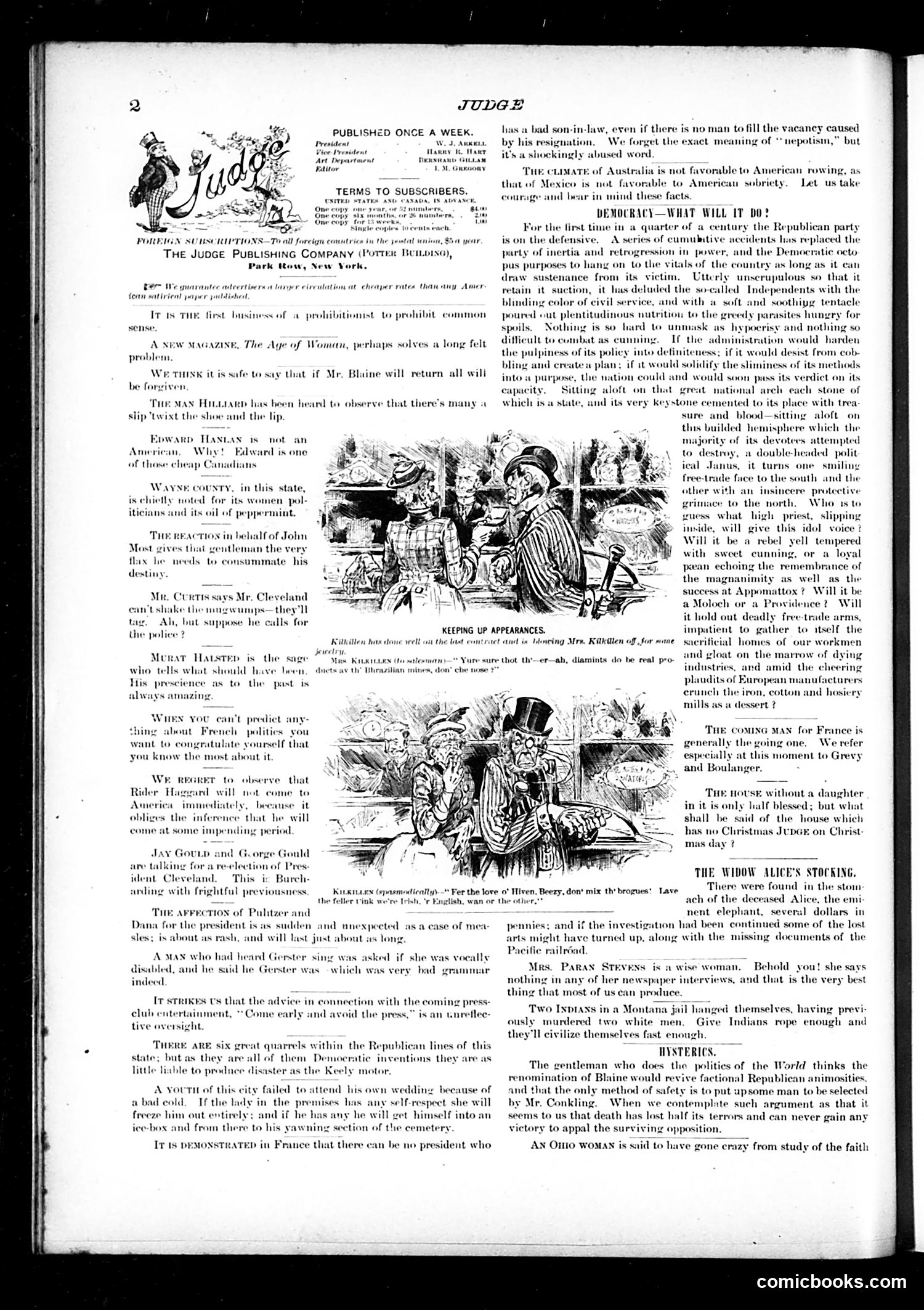
This page contains political commentary and satirical text rather than a prominent cartoon. The main illustrated section labeled "KEEPING UP APPEARANCES" shows a caricatured woman in Victorian dress, likely satirizing upper-class pretense or social climbing. The text discusses Republican Party defensive positions and internal struggles, mentioning the "scalded Independents" and comparing the party to a "double-headed political Janus." References to free-trade debates and manufacturing interests suggest this addresses late 19th-century political divisions over tariffs and economic policy. Additional commentary mocks French politics, criticizes a figure named Haggard, and discusses Cleveland's political situation, though the specific elections or events remain unclear without additional dating context. The overall tone ridicules hypocrisy among political and social elites.
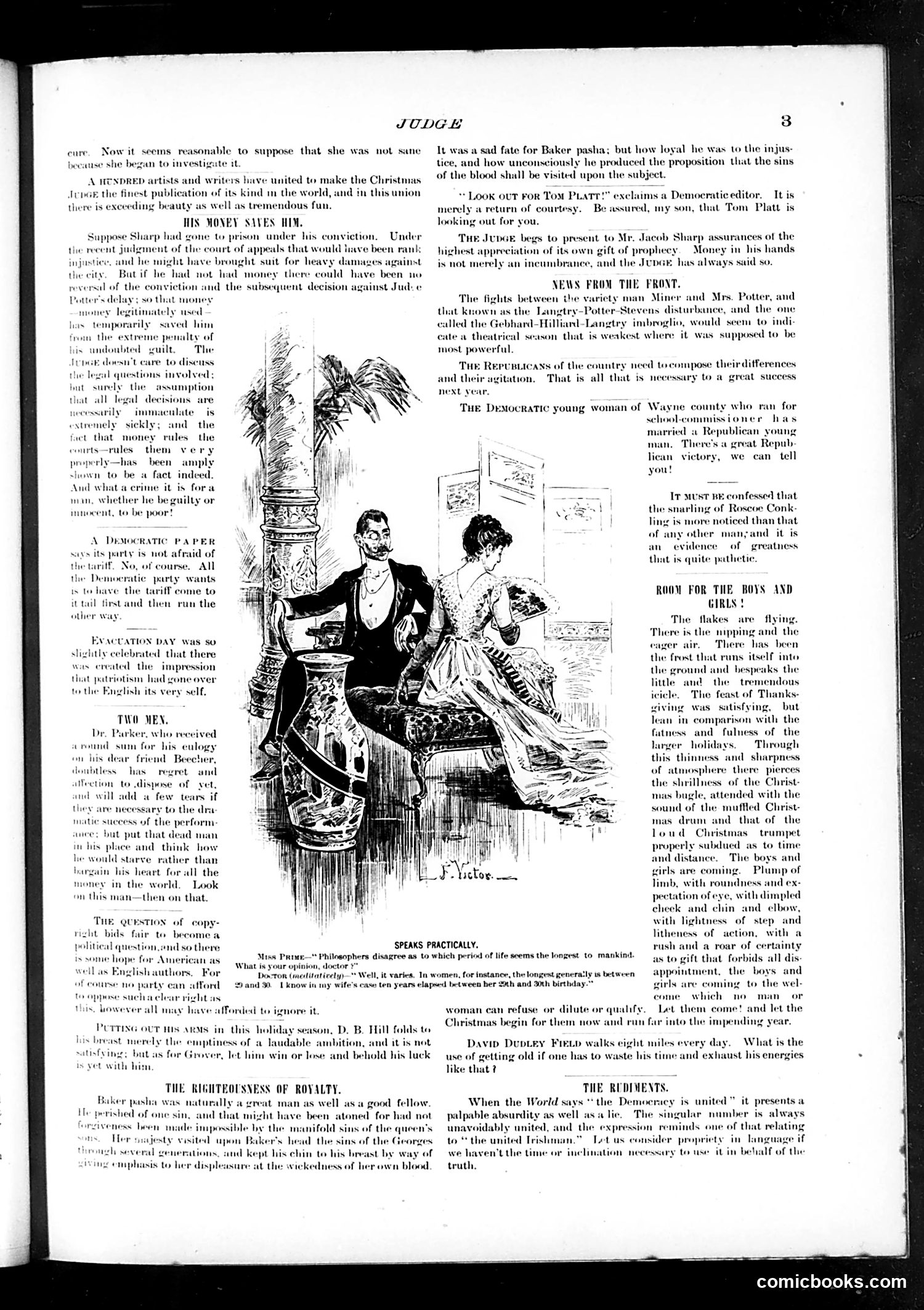
This page contains multiple satirical pieces typical of Judge's political humor circa the 1880s-90s. **"His Money Saves Him"** criticizes wealth's corrupting influence on justice, referencing a case where defendant Sharp escaped prison consequences through financial resources—mocking that "what a crime it is for a man, whether he be guilty or innocent, to be poor!" **"Two Men"** contrasts Dr. Parker (likely receiving money from friend Beecher) with a unnamed poor man, arguing the wealthy can buy their way through scandal while the poor starve. **"Speaks Practically"** shows Miss Prime and a young man discussing life's longest period, with the joke hinging on their ages and romantic calculations. The cartoon illustration depicts a well-dressed couple in an interior setting, likely illustrating one of these social commentary pieces about class disparities. Throughout, Judge employs its characteristic approach: mocking American political hypocrisy, inequality, and the undue influence of wealth on outcomes that should be equitable.
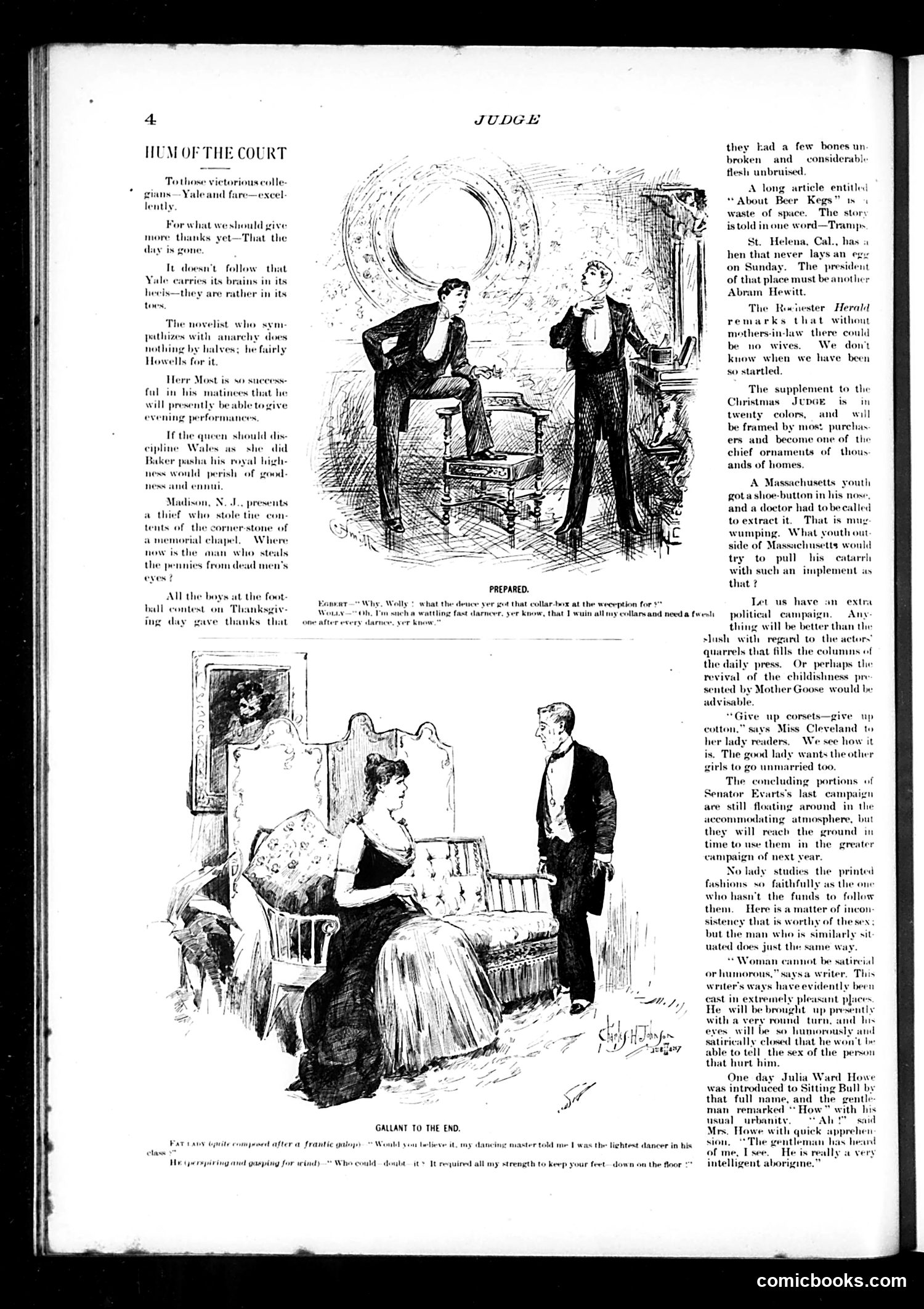
This page from *Judge* contains two distinct cartoons satirizing social etiquette and courtship customs of the Gilded Age. **Top cartoon ("Prepared"):** A gentleman explains he keeps a collar box at social events because his dancing partner—described as "the fastest dancer"—requires fresh collars after each dance. The joke mocks both the physical exhaustion of social dancing and the fastidiousness of the era's fashion-conscious elite. **Bottom cartoon ("Gallant to the End"):** A breathless dancing master, perspiring heavily, claims his student was "the lightest dancer" he's taught. The student sarcastically responds that maintaining her lightness required all his strength to keep her feet on the floor. This inverts the expected gallantry—rather than gracefully supporting a lady, he's struggling under her weight. Both cartoons ridicule Victorian courtship rituals and the performative politeness masking physical reality in high society.
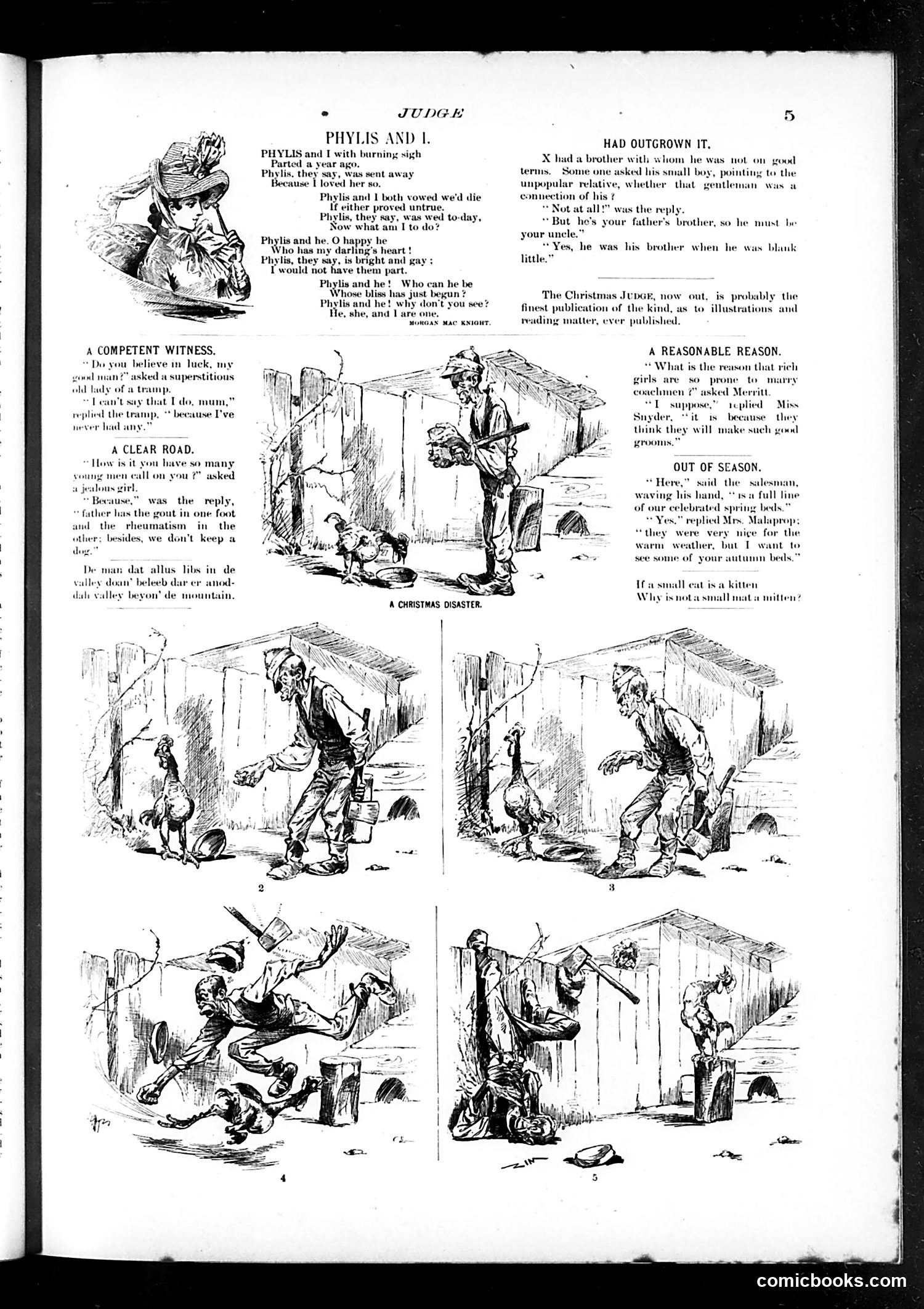
This page from *Judge* contains several brief humorous pieces typical of late 19th-century American satire: **"A Competent Witness"** and **"A Clear Road"** are working-class dialect jokes mocking a tramp's superstitious beliefs and physical ailments—common stereotypes in the era. **"Phylis and I"** is a sentimental poem parodying romantic melodrama, where a spurned lover discovers his beloved married someone else, then learns it's actually himself—a play on the phrase "He, she, and I are one" (marriage). **"Had Outgrown It"** jokes about a child's innocent logic regarding family relationships—the boy argues an unpopular uncle can't truly be family since he was only the father's brother "when he was blank little." **"A Christmas Disaster"** is a sequential comic strip (panels 2-5) depicting slapstick physical comedy—a man repeatedly falling while delivering holiday goods. **"A Reasonable Reason"** and **"Out of Season"** are brief puns: one about wealthy girls marrying for grooms, the other mocking a customer confusing "spring beds" with seasonal products. The page emphasizes wordplay, physical humor, and class-based stereotypes typical of period humor.
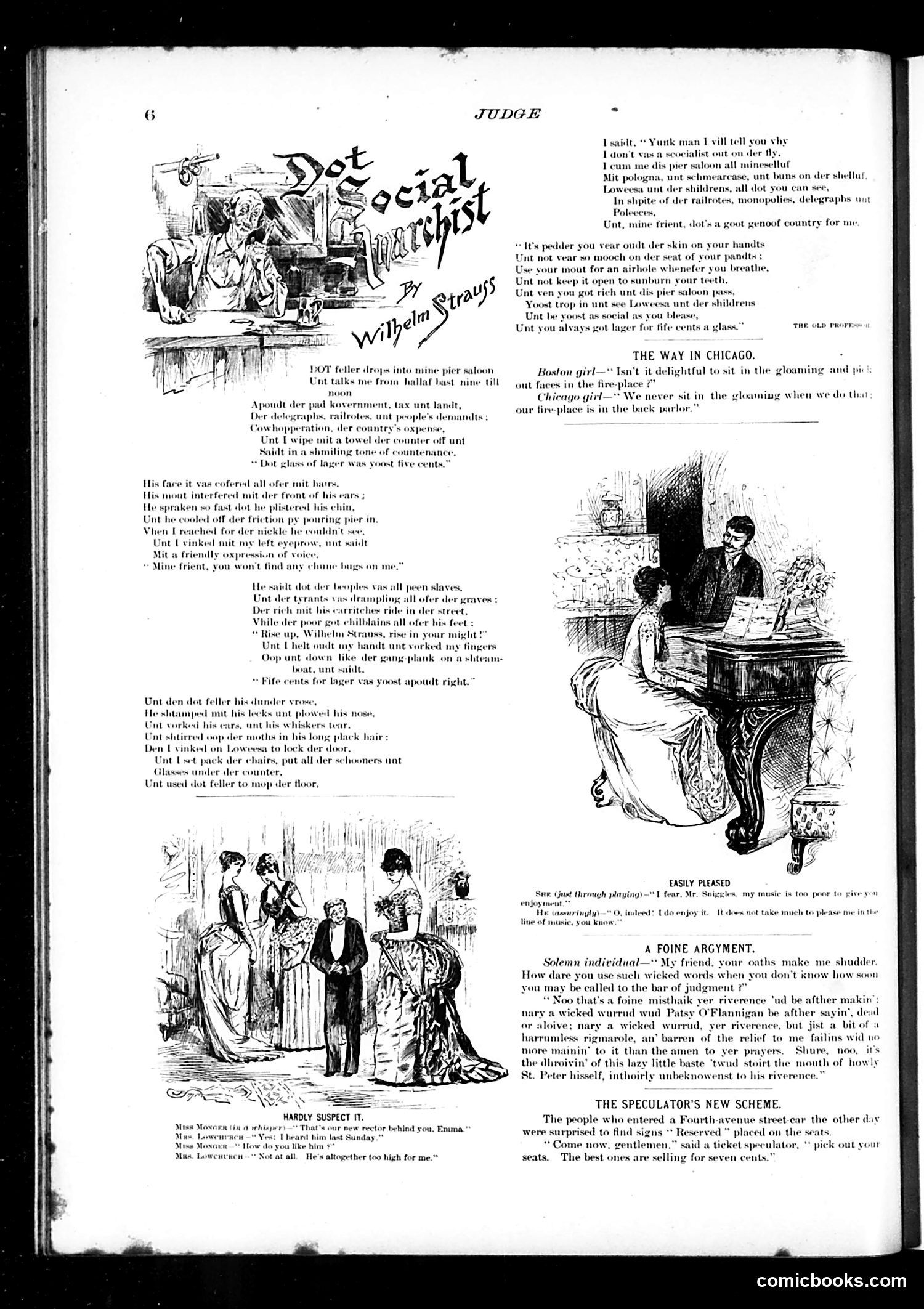
This page contains multiple satirical pieces typical of late 19th-century American humor: **"Dot Social Anarchist"** (top): A stereotypical German immigrant, rendered in thick dialect, ironically lectures about proper social conduct while describing anarchist violence—"Yunk man I vill tell you vy I shmashed out on der fly." The satire mocks both working-class immigrants and anarchist movements, conflating them. **"The Way in Chicago"** contrasts Boston and Chicago girls' domesticity preferences—light social satire. **"A Foine Argument"** presents an Irish Catholic character (Patsy O'Flannigan, dialect evident) defending swearing to a clergyman. The humor derives from ethnic Irish stereotyping and religious hypocrisy. **Minor pieces** include jokes about music quality, church attendance, and stock speculation schemes. The dominant satire targets immigrant groups—Germans and Irish—through heavy dialect caricature, a common Judge editorial approach reflecting contemporary nativist attitudes and class anxieties about working-class radicalism and "foreign" influence on American society.
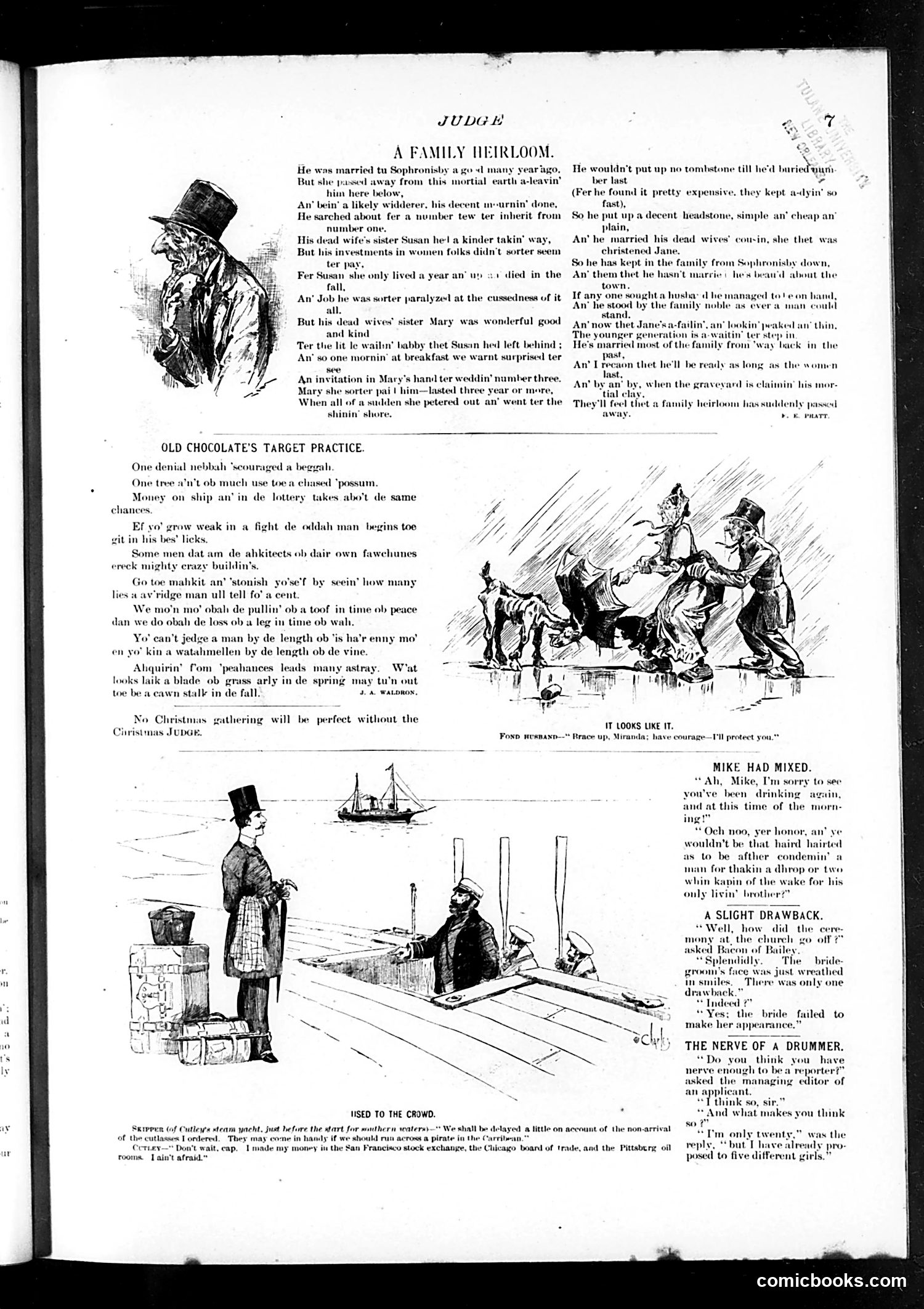
This page contains several satirical pieces typical of late 19th/early 20th-century American humor: **"A Family Heirloom"** (top): A narrative poem in dialect mocking a man named Job who serially marries and loses wives—apparently cycling through multiple spouses from the same family. The dark humor lies in treating wives as disposable while keeping their graves as a "family heirloom," suggesting both marital instability and callousness toward women's mortality. **"Old Chocolate's Target Practice"** (middle): Racist dialect humor presenting folksy aphorisms attributed to an African American character. This reflects the era's casual, dehumanizing stereotyping. **Smaller jokes** (bottom half): Brief vignettes including a ship captain unconcerned about pirates because he made money in rigged stock markets (suggesting financial fraud), a wedding where the groom smiles but bride fails to appear, and a salesman's bravado about proposing to five girls—all reflecting period attitudes toward commerce, romance, and gender. The page exemplifies Judge's combination of crude ethnic stereotyping and satire of American business/social practices.
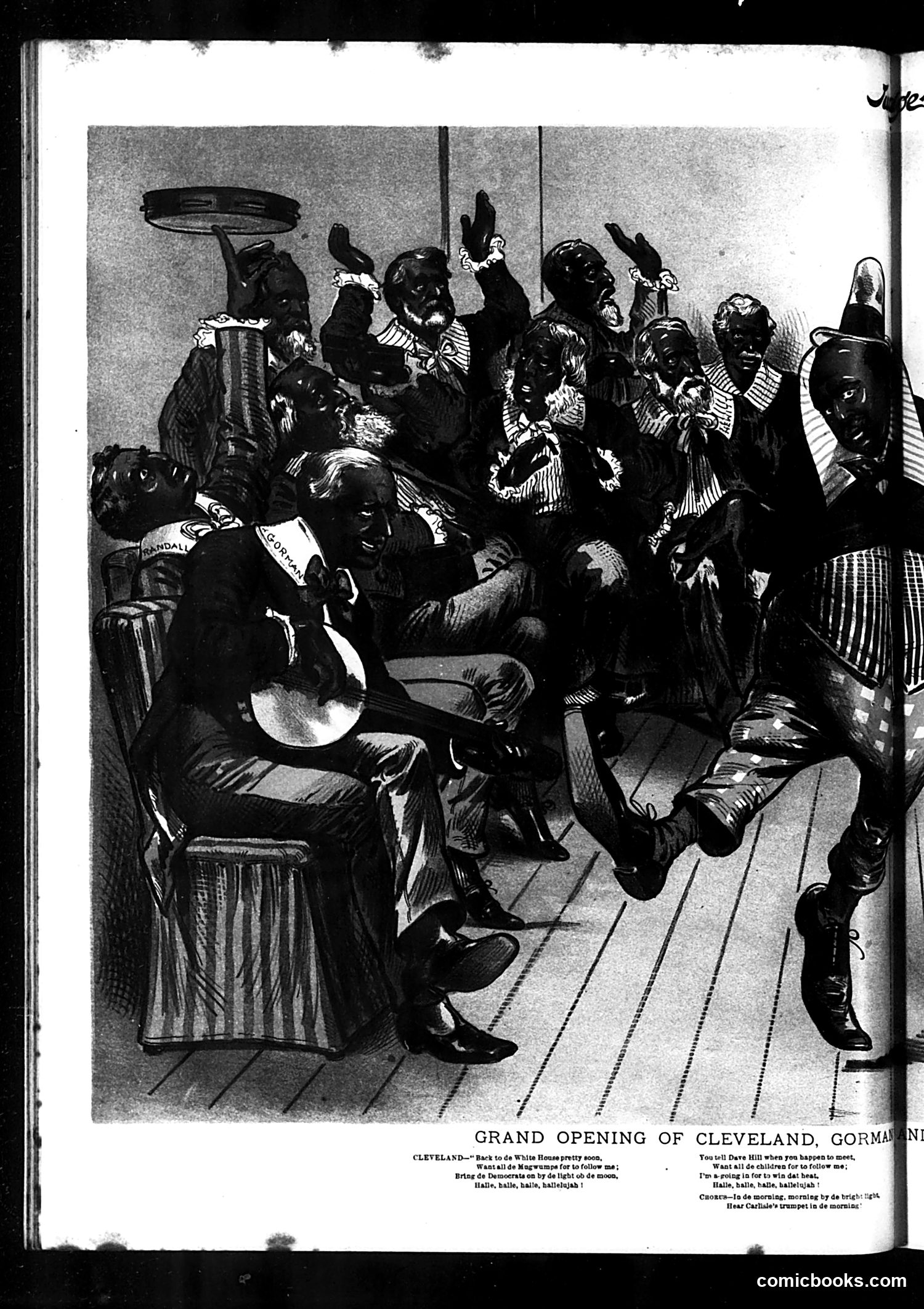
This **Judge** cartoon satirizes Democratic political ambitions following Grover Cleveland's presidency. The title references Cleveland's potential return to the White House ("Back to de White House pretty soon"), using minstrel-show dialect for comedic effect—a common Judge approach. The caricatured figures appear to represent Democratic Party figures celebrating Cleveland's possible comeback, with references to: - **"Magwumps"** (mugwumps—Republicans who defected to support Cleveland) - **"Carlisle"** (likely Treasury Secretary John G. Carlisle, visible in text as "Hear Carlisle's trumpet") The "Grand Opening" frames this as a theatrical spectacle of Democratic scheming. The exaggerated celebration and minstrel-style song parody the party's perceived desperation to regain power. The satire mocks both the Democrats' strategies and their theatrical political posturing, presenting their ambitions as a ridiculous carnival performance rather than serious governance.
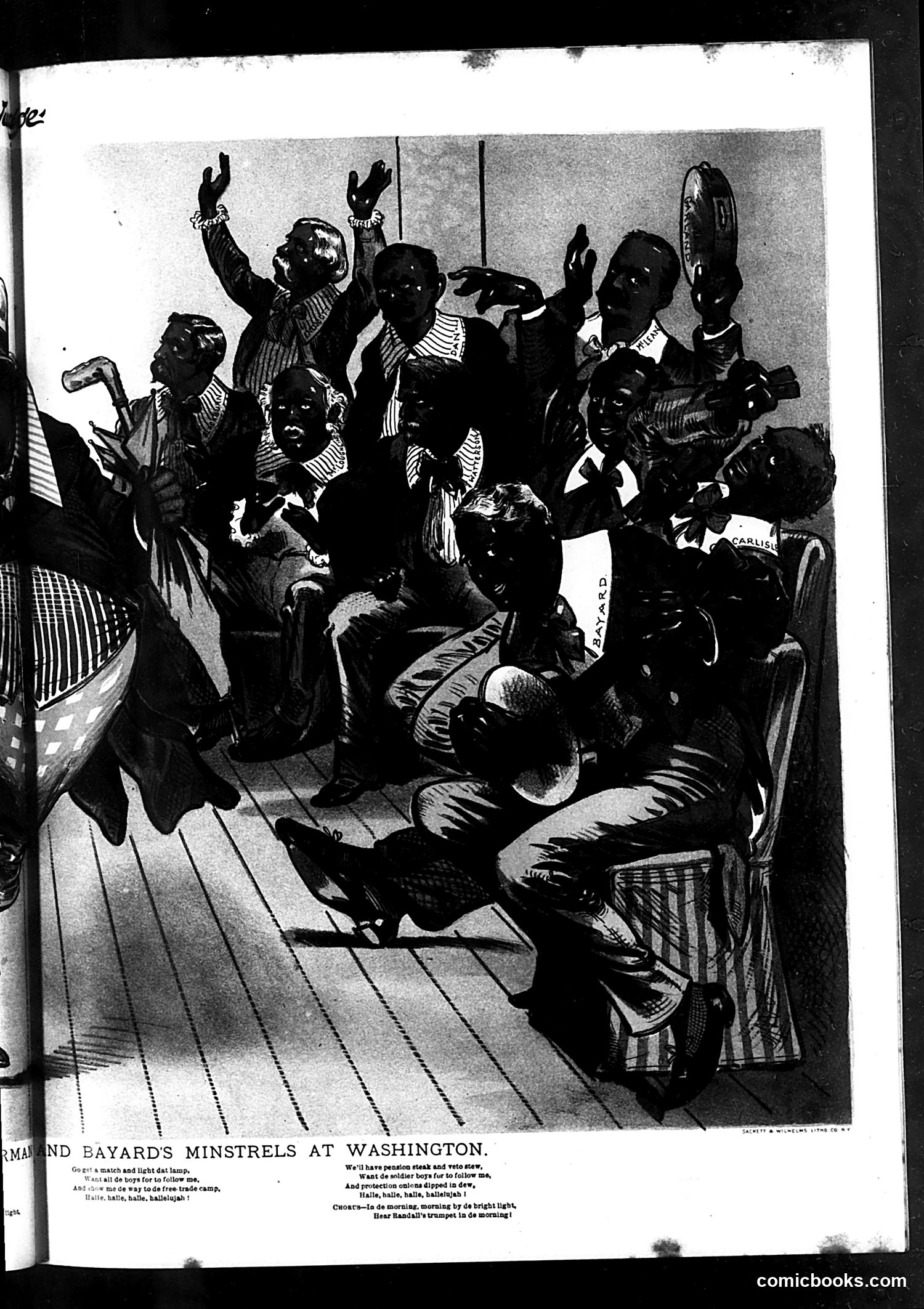
This satirical cartoon depicts a minstrel show performance, referencing the blackface entertainment tradition popular in 19th-century America. The title names "Grand Bayard's Minstrels," likely referring to a specific touring troupe. The image shows performers in exaggerated caricature engaging in entertainment, with audience members visible. The satirical point appears to mock either the minstrel performers themselves, Washington political figures attending such shows, or both—using the lowbrow entertainment as commentary on the capital's tastes or political culture. The OCR text is largely corrupted, making the specific lyrical or textual satire unclear, though references to "lamp," "free trade camp," and "morning" are partially legible. Without clearer text, the precise political target remains uncertain, though minstrel shows were often used in period satire to mock politicians and social pretensions.
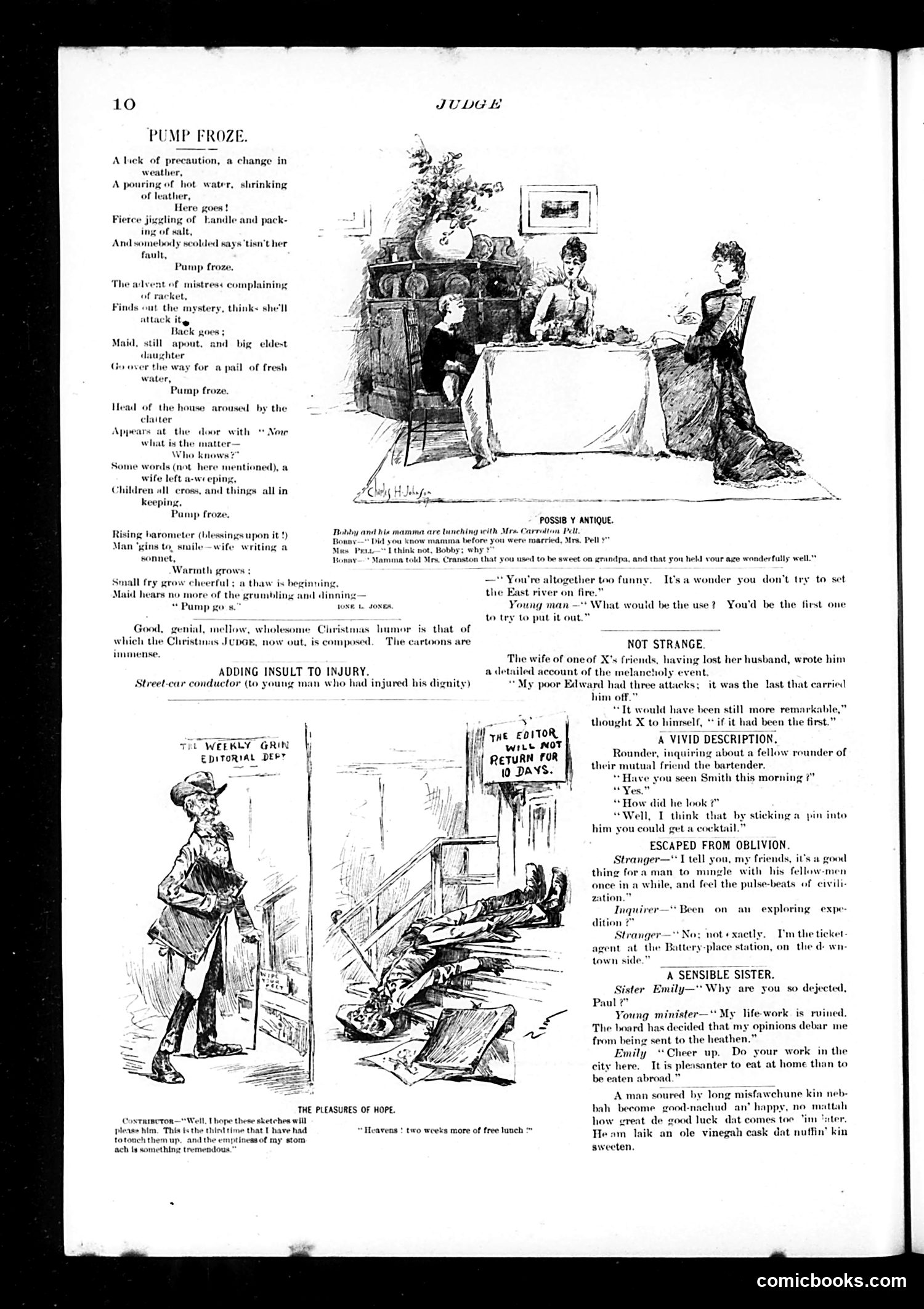
This page from *Judge* contains multiple brief humorous sketches typical of late 19th/early 20th-century American satirical magazines. **"Pump Froze"** depicts domestic chaos when a frozen water pump creates household pandemonium—the maid, children, and mistress all distressed, with the head of house arriving to investigate. The humor lies in this trivial mechanical failure causing disproportionate domestic hysteria. **Other sketches** include: - **"Possibly Antique"**: A woman flattering an elderly man about his youthful appearance - **"Not Strange"**: Wordplay about a widow describing her husband's final illness - **"Street-car Conductor"**: A working-class figure insulting an injured passenger - **"A Vivid Description"**: A drunk man described as so deteriorated that "sticking a pin into him" would produce a cocktail - **"A Sensible Sister"**: A minister's sister pragmatically suggests he do missionary work locally rather than abroad The humor is genteel, domestic, and class-conscious, reflecting period attitudes toward servants, illness, intoxication, and religious work. No specific political figures or events appear identifiable.
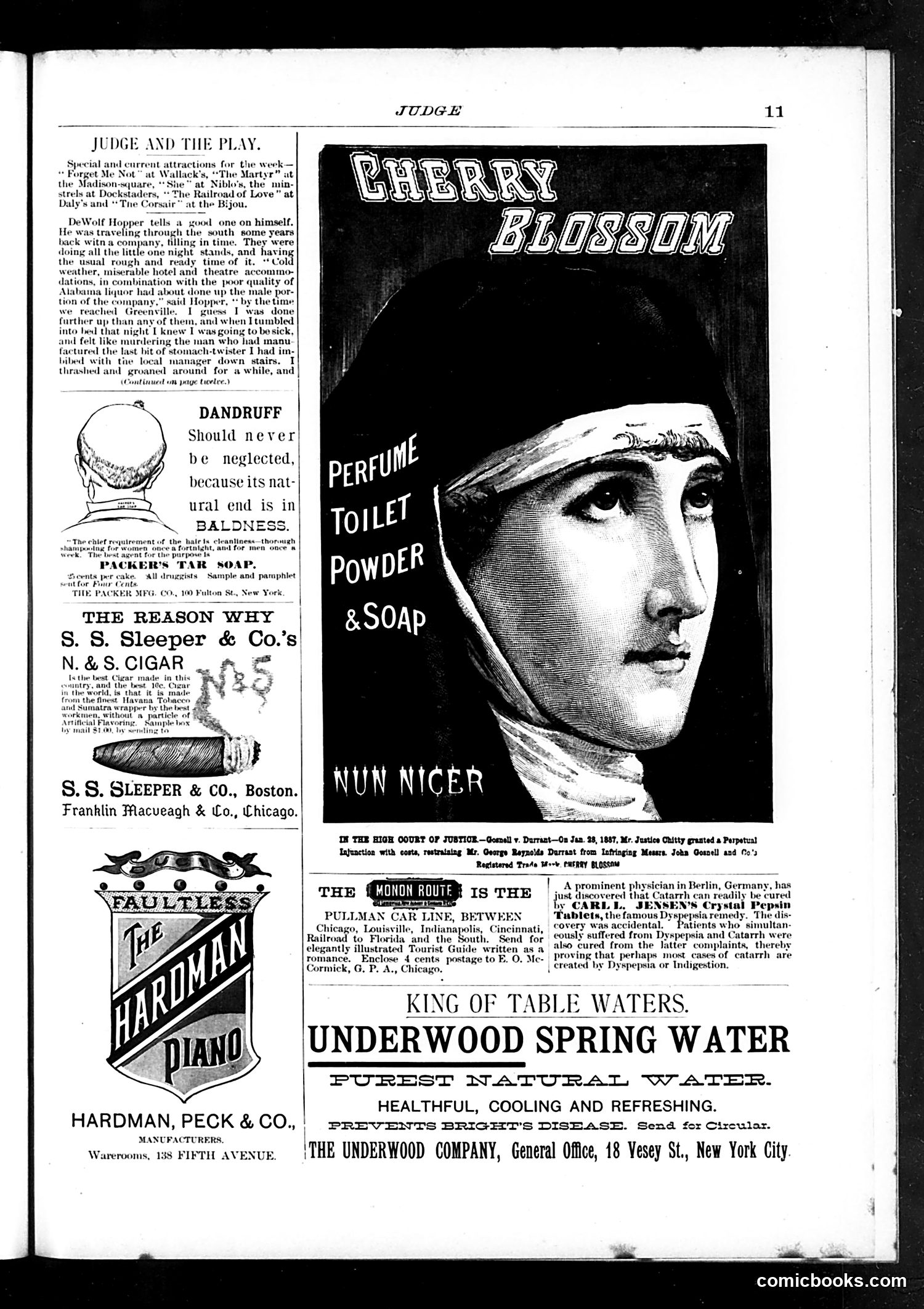
This page is primarily **advertising and legal notices** rather than satirical cartoon content. The main visual is a large advertisement for "Cherry Blossom" perfume, toilet powder, and soap, featuring a woman's face in profile wearing a nun's headdress. **Key elements:** - **Legal notice**: References a court injunction (Jan. 28, 1887) protecting "Cherry Blossom" as a registered trademark against infringement - **Product ads**: Multiple patent medicines and consumer goods typical of the 1880s-90s era—Packer's Tar Soap (for dandruff), S.S. Sleeper & Co. cigars, Hardman pianos, Underwood Spring Water, and Dr. Carl L. Jensen's Crystal Pepsin tablets - **Medical claims**: Ads promise treatments for dandruff, dyspepsia, cataracts, and Bright's disease—reflecting the era's dubious patent medicine marketing The page shows how Judge mixed satirical content with paid advertising, and reveals period attitudes toward unregulated health product claims.
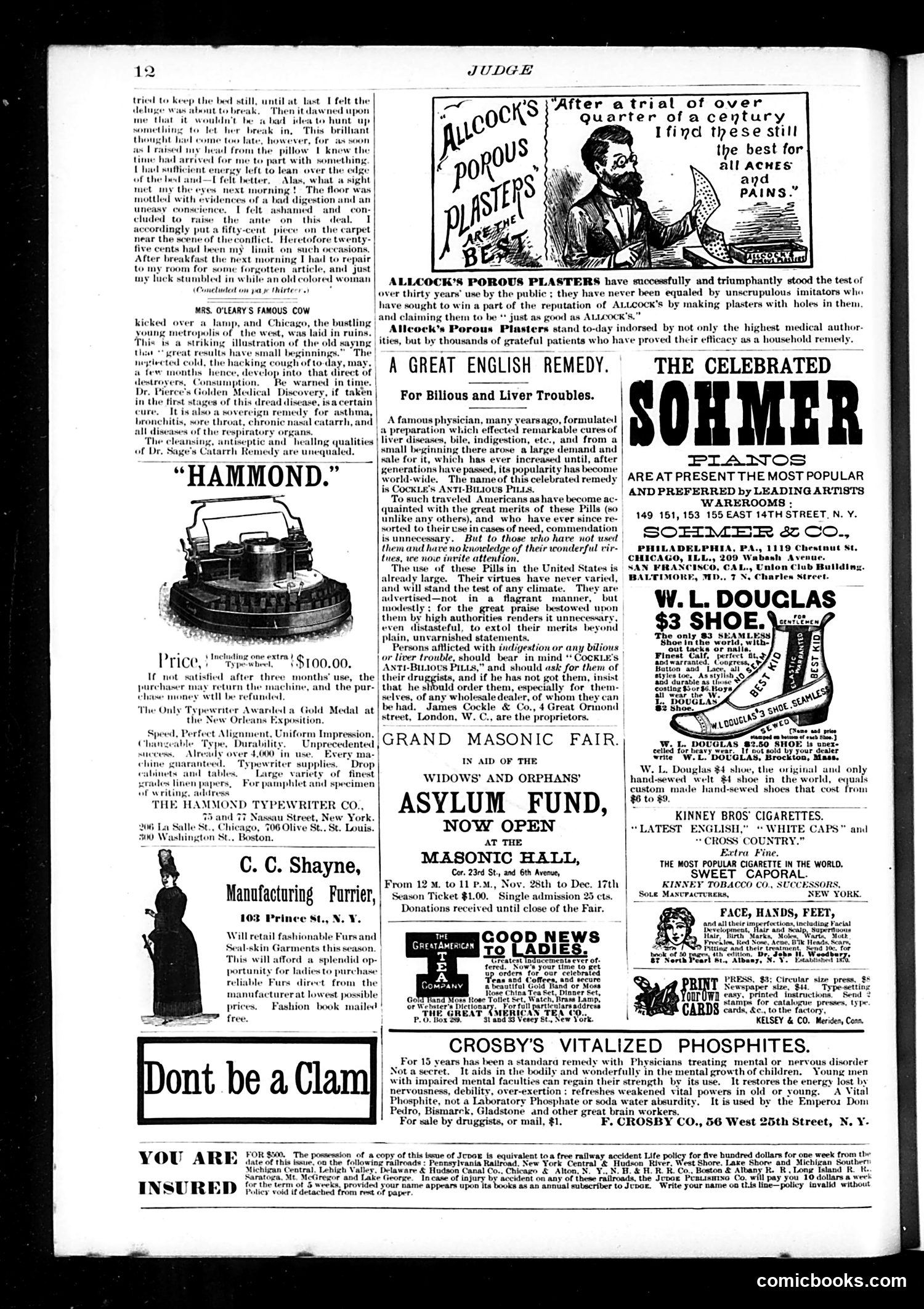
This page is primarily **advertising**, not political satire. The main content comprises product advertisements typical of a late 19th-century satirical magazine. The notable elements include: 1. **Allcock's Porous Plasters** - The central advertisement claims superiority over imitators, emphasizing thirty years of proven effectiveness for medical ailments. 2. **Cockle's Anti-Bilious Pills** - A prominent English remedy advertised as a famous cure for liver and digestive troubles, with detailed claims about medical endorsement. 3. **Sohmer Pianos** - Listed as "most popular and preferred by leading artists." 4. **W.L. Douglas Shoes** - Advertised as a "$3 shoe" with claims of quality construction. 5. The page also includes advertisements for typewriters, a Grand Masonic Fair fundraiser, and various other period products. The satirical content visible is minimal; this appears to be a standard advertising-heavy page from Judge magazine, mixing legitimate product promotion with editorial content. No clear political cartoon or social satire is evident on this particular page.
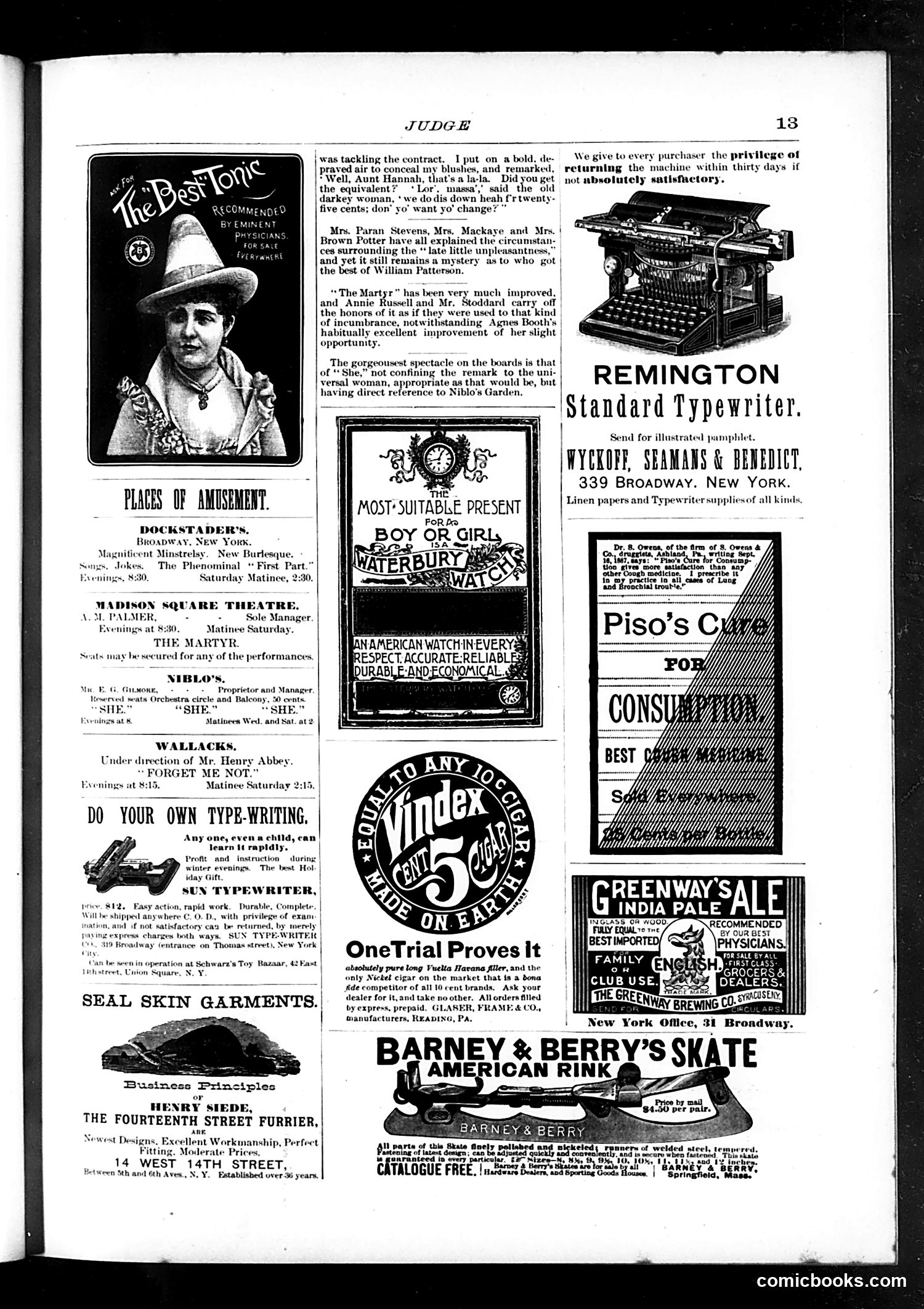
This page is primarily **advertisements and theater listings** with minimal satirical content. The visible cartoon elements are advertisements rather than editorial cartoons. **Content Overview:** The page features theater announcements for New York venues (Dockstader's, Niblo's, Wallacks) showing productions like "The Martyr" and "She." Brief theatrical reviews mention performers Annie Russell and Agnes Booth. **Notable Satire/Humor:** A small dialogue snippet references "Aunt Hannah" and a servant using dialect ("Lor', massa'"), employing period-typical stereotypical speech patterns for comic effect. This reflects late 19th-century entertainment conventions. **Primary Content:** The majority of the page comprises **commercial advertisements** for typewriters (Remington, Sun), cigars (Vuelta), skate manufacturers (Barney & Berry), fur services, and patent medicines. This reflects Judge's business model as a satirical magazine supported by advertising revenue. The page lacks substantive political or social satire—it's essentially a mixed editorial/advertising issue typical of the era.
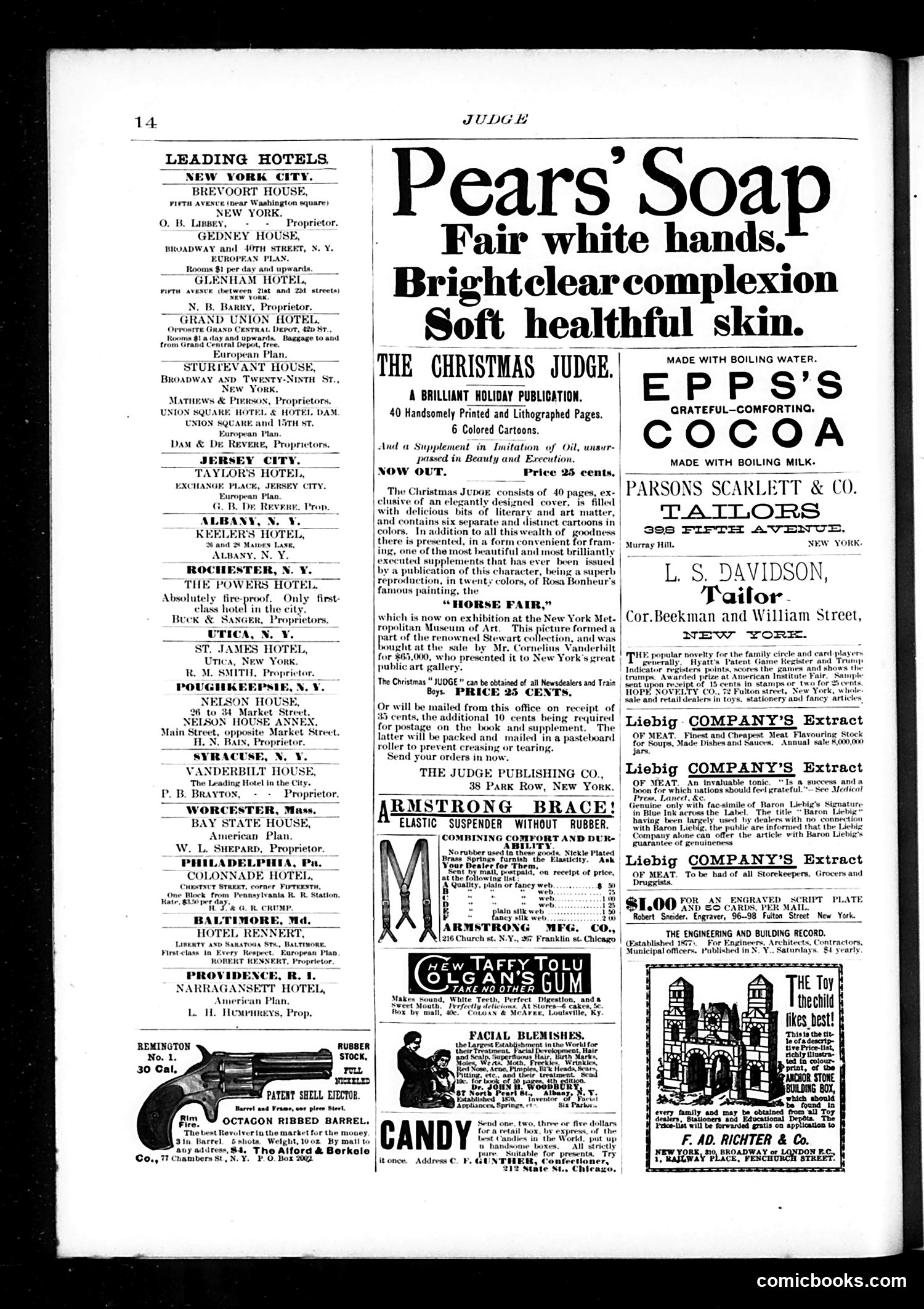
This page is primarily **advertising and announcements** rather than editorial cartoons. It contains: **Hotel Advertisements**: Multiple upscale New York City and regional hotels (Brevoort House, Glenham Hotel, Grand Union, etc.) promoting accommodations and European dining plans. **Main Editorial Content**: "The Christmas Judge" — a holiday publication announcement featuring 40 pages, 6 colored cartoons, and a supplement reproducing Rosa Bonheur's famous painting "Horse Fair." Priced at 25 cents. **Product Advertisements**: Period consumer goods including Pears' Soap (emphasizing "fair white hands" and "bright clear complexion"), Epps's Cocoa, tailoring services, Liebig's Meat Extract, Armstrong Braces, patent firearms, and dental products. **Context**: The advertisements reflect late 19th-century American consumer culture and social values. Notably, the soap ad's emphasis on "fair white hands" reflects period racial attitudes. This is a typical Judge page mixing editorial promotion with commercial advertising.
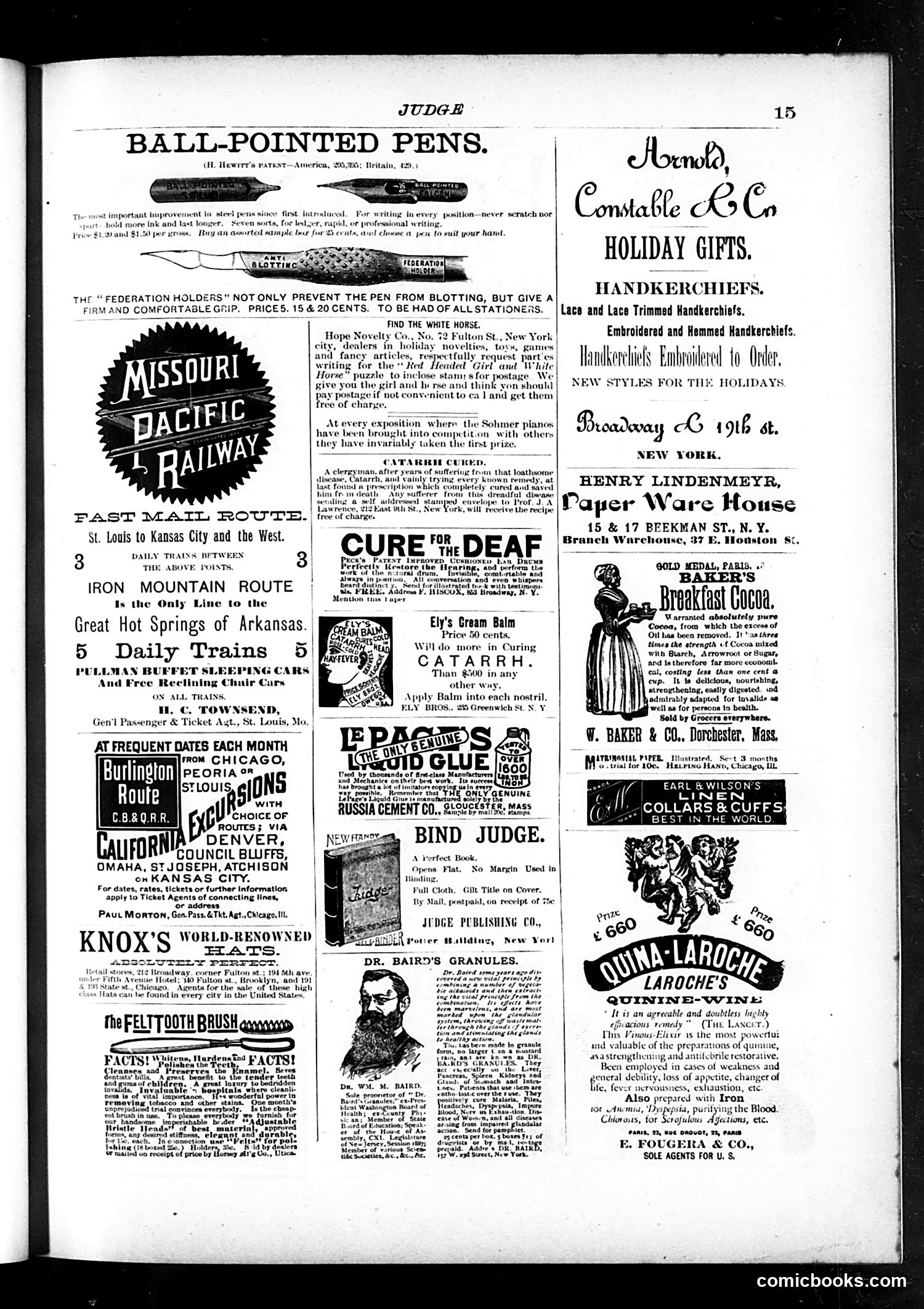
This is primarily an **advertising page** from Judge magazine, not a satirical cartoon. The page consists almost entirely of commercial advertisements for late 19th/early 20th-century products and services. **Notable ads include:** - Ball-pointed pens with "Federation Holders" to prevent blotting - Railroad routes (Missouri Pacific, Burlington Route) - Dr. Baird's Granules and Ely's Cream Balm (patent medicines) - Knox hats and felt toothbrushes - Breakfast Cocoa, Earl & Wilson collars - Quinine-Wine tonic - Holiday gift items (handkerchiefs, paper goods) **The only cartoon element** appears to be a small "Find the White Horse" puzzle advertisement from Hope Novelty Co. The page reflects period advertising conventions: medical cure-alls, patent medicines with vague health claims, and luxury goods marketed as holiday gifts. There is no discernible political or social satire on this particular page.
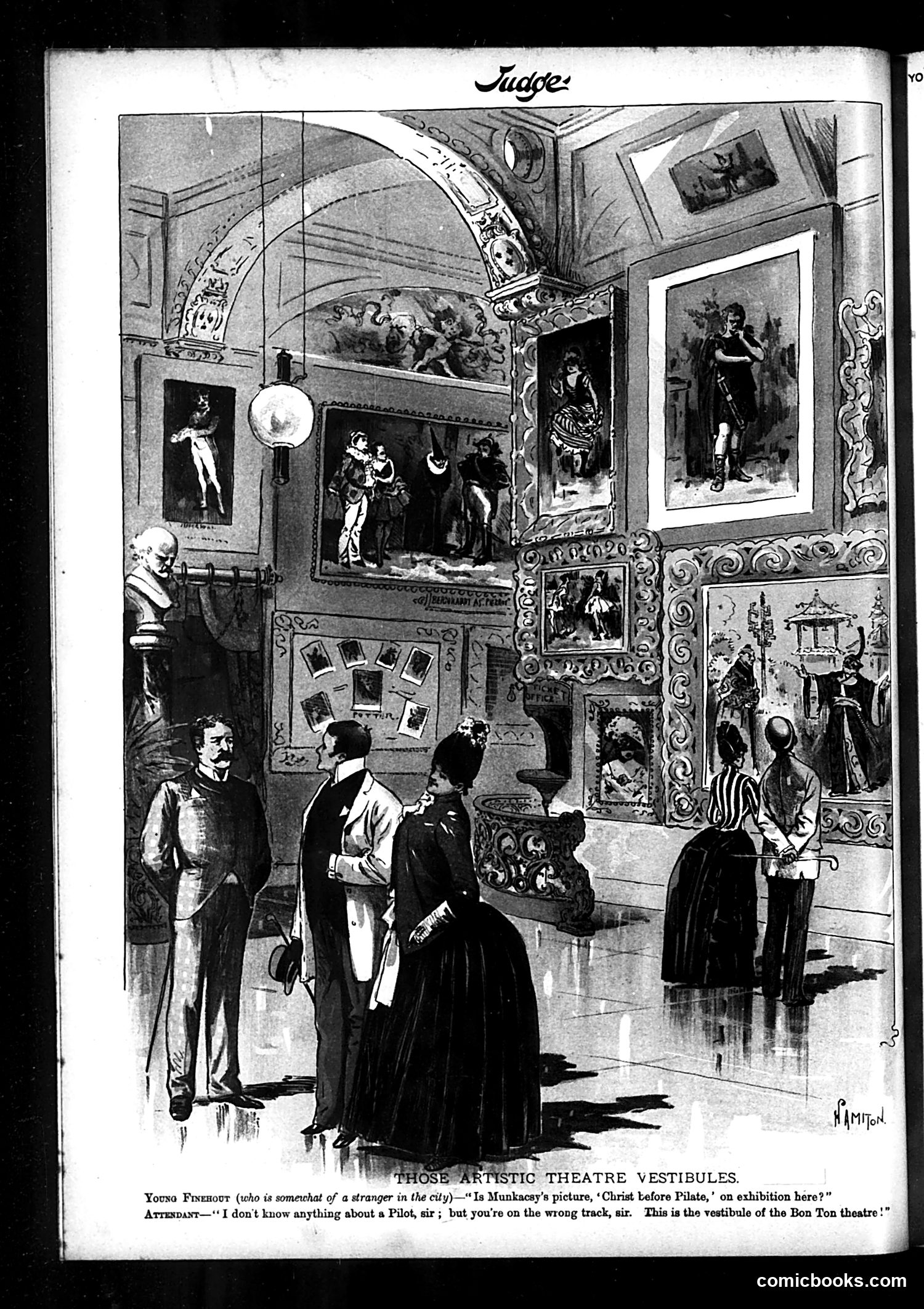
This Judge cartoon satirizes theatrical marketing practices of the era. A young visitor (labeled "Young Fireboot," suggesting he's unfamiliar with the city) mistakes the elaborate artwork decorating a theater vestibule for a genuine art gallery. He asks an attendant about Munkacsy's famous painting "Christ before Pilate," assuming he's in a museum. The attendant corrects him—he's at the Bon Ton theatre, not an art museum. The joke targets theaters that decorated their lobbies and entrances with ornate, respectable-looking artwork to appear cultured and upscale, when they were primarily commercial entertainment venues. The satire mocks both theaters' pretensions to artistic legitimacy and the confusion this affectation could create. The elaborate architectural details and framed paintings visible in the illustration reinforce this theme of theaters masquerading as refined artistic spaces.